Archives

Changing Visions

I’ve been moving in this direction for quite some time— really probably since my miscarriage-birth experience in late 2009—but I’ve decided that it is officially time for me to take a break from actively teaching birth classes. When I first started teaching in 2005, I envisioned having classes with 5-6 couples at a time. I quickly realized that the area didn’t really support that client volume–at least not with clients with similar due dates and similar interests in natural birth. I never intended to teach general/generic childbirth education, but focused on designing my classes for women planning for physiological, low-intervention (“natural” or unmedicated) births. I never apologized for that emphasis and my focus is what distinguished me from the locally available hospital-based classes that were free of charge. It became clear to me that my niche was in personalized, private, one-on-one birth education and I spent years delighting in the close relationships formed by working privately with couples rather than in a group. During these years I did teach some group classes as the opportunity and occasion arose and they were not as fulfilling or enriching for me as the one-on-one sessions. I think the pregnant women really benefit from the camaraderie of interacting with other pregnant women, but my relationship with the fathers-to-be and with the couple as a unit is nothing like it is when the couple is on their own with me.

Losing my spark

I also realized that I felt most satisfied and like I was making a genuine contribution/difference if I had clients during every month of the year. I set this intention for myself in 2007 and was able to meet my goal for the subsequent years. After I started teaching college classes, however, I found that I used up a lot of my teaching energy in the college classroom and that birth classes started to feel like more of a drain on my resources than a joy. I also realized that they were not very economically sensible and I became frustrated with having to pack up all my supplies and haul them to town with me each time I needed to teach. Having a new baby fanned the flames of my spirit for birth education again and I found that the spark that had been wavering since Noah died had re-ignited somewhat. However, the damage as it were, was done, in that teaching privately no longer made sense to me from a financial standpoint nor did it make sense from a maternal standpoint—I didn’t want to leave my baby behind to go teach class and I also found that in taking her with me, my attention was splintered and my clients didn’t necessarily get the best from me. Now that she is big enough to leave with my husband while I teach, I find myself “maxed out” with my college teaching schedule (which is only one night a week—who knows how I’d feel if it was more!) and other interests and the thought of trying to work in a series of private birth classes seems like a hurdle that I do not wish to struggle with. I coped for a while by trying to host the classes in my home (which is out-of-town), but that presents its own set of challenges. And, when I am home, I want to be home, not preparing birth class handouts or trying to shuffle the kids off to my parents’ house so that clients can come in for class. I love to be at home. I love where I live. As I wrote on Facebook recently, it is my soul place here.

Give points

As I am wont to do, I once again find myself looking around my life and schedule trying to find “give points” that allow me the life-work-passion-rest balance that best nourishes me, my family, my spirit, and my home life. This time, I find the give point is teaching face-to-face classes. It is hard to let go. I’ve worked on building this for years. I love the work. I have fear that what if someone else “takes over.” I have fear that I’ve “wasted” all of this training and effort. I have fear that I won’t be able to start again if I quit. However, as I’ve noted before, I’m very black-and-white when it comes to my responsibilities. I can either do something or STOP doing something. It doesn’t work for me to wait for things or “come back to it later” or “take a break for now.” I’m either doing it or I’m quitting. And, I always feel the need to “officially” decree this—I can’t just let things slide, or neglect them, I need to officially make the break or split from the task or responsibility. I have accepted that this is how I work and how I feel about tasks and while it is not true of everyone it IS true of me and I need to work with what I know of myself in this way. So, as of today, I am not planning to accept any new clients for the remainder of the year and I’m updating my business side of this site accordingly. I find it so interesting that the blog side of my site is where I have really developed a following and created relationships, and reach women’s lives around the world, even though I originally started it just to provide information for my few little clients here in rural Missouri. Birth writing is my other niche, the one that I feel like continuing to develop. As I’ve written before, I realized several years ago that writing this blog and my other articles is a legitimate form of “doing” childbirth education as well and perhaps actually has more impact than in-person classes (though, in-person classes are not replaceable in terms of the relational aspect).

New directions

Since 2009, I’ve also felt “called” to develop my other birth interests such as birth art facilitation, prenatal yoga, prenatal fitness, childbirth educator trainings, writing books, and pregnancy/birth retreats as well as my interest in women’s spirituality, women’s retreats, and women’s rituals in general. I feel like my interests in helping other women are deepening, maturing, and evolving from these roots in birth work. I think making this official break with my former means of birth education opens up the space in my life and my heart to develop those other areas of my interest and perhaps what I return to offer will be “bigger” and of more value to women and to my community.

When I applied to my doctoral program I had to write an extensive application letter responding to a variety of questions about my interest in the program. To me, applying to (and now participating in) this program represents an integration of something I feel with my mind, heart, and spirit. My whole being. As I wrote in my application, in women’s spirituality I glimpse the multifaceted totality of women’s lives and I long to reach out and serve the whole woman.I wish to extend my range of passion to include the full woman’s life cycle, rather than focus on the maternal aspect of the wheel of life as I have done for some time. I want to create rituals that nourish, to plan ceremonies that honor, to facilitate workshops that uncover, to write articles that inform, and to teach classes that inspire the women in my personal life, my community, and the world.

I also responded to this question:

Who/what inspires you?

I long to speak out the intense inspiration that comes to me from the lives of strong women.” –Ruth Benedict

I believe that these circles of women around us weave invisible nets of love that carry us when we’re weak and sing with us when we’re strong.” –SARK, Succulent Wild Woman

I am most inspired by the everyday women surrounding me in this world. Brave, strong, vibrant, wild, intelligent, complicated women. Women who are also sometimes frightened, depressed, discouraged, hurt, angry, petty, or jealous. Real, multifaceted, dynamic women. Women who keep putting one foot in the front of the other and continue picking themselves back up again when the need arises.

I am also inspired by women from the past who worked for social justice and women’s rights—women who lived consciously and deliberately and with devoted intention to making the world a better place. Jane Addams, Susan B. Anthony, Clara Barton. Women who have studied and written about feminist spirituality—such as Carol Christ, Hallie Ingleheart, Patricia Mongahan, and Barbara Ardinger–are also a source of inspiration. As a mother, I find additional inspiration in the self-care encouraging writings of Jennifer Louden and Renée Trudeau.

My children have provided a powerful source of inspiration and motivation. I wish to model for them a life lived as a complete, fully developed human being. After birthing three sons, I gave birth to a daughter in January, 2011. I always envisioned having daughters and felt well-prepared to raise a “kick-ass” girl. Having sons first presented me with a different type of inspiration (and, to me, a deeper challenge)—to raise healthy men. Men who treat women well and who are balanced, confident, loving, compassionate people. I came to think of myself as a mother of sons exclusively and was very surprised to actually have a girl as my last child. When I found out she was a girl, my sense of “like carries like/like creates like” was very potent and my current need to participate in the creation of a world in which she can bloom to her fullest is very strong.

My own inner fire inspires me—my drive to make a difference and to live well and wisely my one wild and precious life. Good conversations, time alone with my journal, time alone outdoors sitting on a big rock, and simple time in the shower provides additional fuel for this inner fire.

I have both a scholar’s heart and a heart for service. I wish to live so that my life becomes a living, embodied prayer for social change and to do work that is both spiritually based and woman affirming.

It is time for me to move forward with this expanded vision for what I’d like to offer to the world…
A Tale of Two Births

As Penny Simkin has frequently noted: “We can’t control labor, whether it’s hard; that’s a leap of faith. But we can always control how we care for [the mother]” [1]

In 2001 and in 2004, I attended the births of two of my dear friend’s children in the same hospital in a mid-sized Midwestern city.  I was not a childbirth educator or doula at this time, but was there in the capacity of friend and “witness.” Both births were intervention-heavy and not what I would call ideal, natural births; but the feelings were vastly different, which made all the difference.

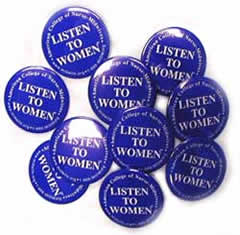
At the 2007 LLL International conference in Chicago, I picked up several of these great "Listen to Women" buttons from the ACNM booth in the exhibit area. I love them. Isn't this what it is all about? So simple and yet so profound. Imagine how the world would change if we just listened to women.

One had an atmosphere of respect, caring and trust; the other had a “climate of doubt” throughout. The difference was a certified nurse-midwife (CNM). My commitment to homebirth midwifery often leads me to forget what a profound and true difference a caring CNM can make in a hospital birth. All the other hospital procedures can be present, but the care factor a CNM provides can transform a woman’s experience from powerless to powerful. Sometimes I forget how CNMs are poised to bridge the gap between home and hospital effectively. The US needs lots of them (not as subordinate “junior obstetricians”—but as expert guardians of normal birth in a hospital setting).

The details were similar in each birth. The babies were both almost 9 lb; a doula was present (same doula in both births); and the mother labored with an IV, spent a large portion of the labor in bed and had internal fetal monitoring. In the first birth (with the CNM), the mother even had several hours of Pitocin augmentation; in the second, with the obstetrician, she had no Pitocin until third stage. With each birth, the mother also had an extensive tear and long repair (a third-degree with the CNM, a second-degree with the obstetrician).

However, some things were very different.

When the mother said, “Can I have a birth ball?” the CNM said, “Yes,” and the obstetrician said, “Not until the baby has been monitored.” And then, “The baby doesn’t like that; you need to get back into bed.”

When the mother’s confidence waned, the CNM said, “You can do it. You are.” The obstetrician said, “I don’t think this baby is moving down.

When the mother said, “This is taking such a long time,” the CNM said, “I know. It is taking for-freaking-ever!” and everyone laughed (including the laboring mother). The obstetrician said, “I think we should consider a c-section based on your history. The baby is not moving down.”

The CNM said, “You have such strong muscles in your legs and bottom, do you exercise a lot? I think because you are so strong, you’re holding a lot of tension here. Try to let it go.” The obstetrician ironed the perineum until the mother screamed with pain.

The CNM waited. The obstetrician did another internal check.

In both, a baby was eventually born (the first after four hours of pushing, the second after a little over an hour). A strong, healthy baby. Vaginally and without pain medications. After the first birth—though she would have done some things differently—my friend felt triumphant, empowered, powerful, strong, capable, happy and proud.

After the second birth she felt abused, disappointed, ashamed, guilty, angry, assaulted, diminished, wounded and scarred.

I believe the CNM’s personality, attitude and basic belief that vaginal birth would work was the critical difference between these two experiences. These births dramatically, viscerally illustrated for me that no matter what else is happening around the birthing woman, we can control how we care for her.

Endnote: My friend went on to have her third baby at home in 2008. She pushed this baby out in fifteen minutes, with no tear, and she shone with her power.

Molly Remer, MSW, ICCE, CCCE is a certified birth educator, writer, and activist who lives with her husband and children in central Missouri. She is the editor of the Friends of Missouri Midwives newsletter, a breastfeeding counselor, a professor of human services, and a doctoral student in women’s spirituality. She blogs about birth, motherhood, and women’s issues at https://talkbirth.me/posts.


[1] Looking to nature, doula Penny Simkin practices the art of delivery, in The Seattle Times, Pacific Northwest Cover Story. Originally published March 23, 2008. Accessed April 27, 2009. http://seattletimes.nwsource.com/html/pacificnw/2004299467_pacificpenny23.html.

This is a preprint of A Tale of Two Births, an article by Molly Remer, MSW, ICCE, published in Midwifery Today, Issue 91, Autumn 2009. Copyright © 2009 Midwifery Today. Midwifery Today’s website is located at: http://www.midwiferytoday.com/

Talk Less, Learn More: Evolving as an Educator

Since late 2006, I have written at the top of each of my teaching outlines: “Talk less, listen more.” This simple reminder has  fundamental importance and has completely revolutionized how I structure and guide my childbirth classes. During each series that I teach, I realize how listening to the women and giving them a space in which to share, is one of the most important things I can offer. Though I studied principles of adult learning and designing effective curricula during my certification program, I started out my childbirth education journey with a lecture and information-heavy approach I’ve since heard called, “opening their heads and dumping information in.” As I continue to teach, I’m continually discovering ways to talk less, but hopefully, impart more, creating a guiding philosophy of “talk less, [they] learn more” for myself as I plan and implement my classes.

Real birth preparation

After my first year of teaching, I realized that couples that sign up for my classes are not really looking for pregnancy and prenatal care information, but for real birth preparation. They are there because the women want to learn, “Can I do this?” and “How will I do this?” and the men are asking, “How I can help her do this?” It feels almost insulting to meet this quest for inner knowing with a discussion about the benefits of prenatal vitamins. I had to confront the fact that some of the things I was teaching seemed irrelevant, redundant, or obvious.

It became clear to me that I had to tackle the slightly embarrassing reality that I was following a model of prenatal education that was not in line with the true needs of the women in my community. I teach independent, natural childbirth classes privately in people’s homes. Maybe with a different population, my original approach would be more successful or I would take a different approach altogether. Also, just as students have different learning styles educators naturally have preferred methods. I have an information-heavy personal style that spilled into my teaching. I continue to wrestle with this tendency and struggle to rein in the information overload approach I gravitate towards.

Action!

As I made my discoveries, I began to drastically cut my talk time (lecture) and focus on action instead. Though it felt nearly sacrilegious to do so, I trimmed many things out of my outlines that were about nutrition, prenatal testing and so forth, because many of the women I work with have already read a great deal and don’t need to hear it again from me. I’ve come to see I really need to skip a great deal of the “book learning” and get them actually moving and practicing and using skills. Then, the “book learning” naturally arises during the course of the class, either via questions or via me needing to explain why something is useful or helpful during pregnancy or in labor.

I totally restructured and rearranged my class outlines to include a whole class about the mind-body connection and psychological preparation for birth. This class took the place of a previous class about birth planning. I was finding that many people already had a birth plan written and/or the birth plan information naturally comes up during the course of the six weeks without my needing to spend an excessive amount of lecture time on it. I tell them that I have the information, ask if you want it! I also dedicated a whole class to labor support with plenty of time to practice hands-on support techniques. In addition, I created a brand new class called “Active Birth” that involves lots of moving and positioning as well as many helpful ways to use a hospital bed without lying down. Informed consent, consumerism, and birth planning naturally arise as topics during this class, rather than being separately scheduled topics.

Information overload

Many pregnant women have information overload. They are faced with more information than they know what to do with. They are bombarded by it. What they really need is “knowing.” They need to know: “What skills do I possess or can learn that will help me greet my birth with anticipation and confidence? What are my tools? My resources? Can I just let it happen?” As an educator I ask myself, “What will help them feel confident? Feel ready? Trust their bodies and their capacities?”

I want people in my classes to learn material that is dynamic, active, exploratory, self-illuminating, supportive, positive, enriching, and affirming. I created a vision statement and asked myself where my classes stood in relationship to my vision. The answer was, “not as close as I want them to!” My vision statement for my classes is: to focus on celebration, exploration, motivation, education, inspiration, validation, initiation, and dedication.

I know I’m hitting the mark when couples comment, “Oh, this makes so much sense! I see how this works!” Or, “This was a really good illustration of what you were just talking about.” In this way, class participants readily reinforce (or modify) my own presentation style and I learn from series to series what to change, continue using, discard, or alter.

“Talk less…” teaching tips

I have many ideas of ways to “talk less” in birth classes, here are a few:

  • Media portrayals of birth—show two contrasting clips, such as a birth from a popular TV show (I often show Rachel’s birth from the show Friends) paired with an empowering birth from a film like Birth as We Know It and then have students discuss the two.
  • Use “The Ice Cube Minute” exercise from Family-Centered Education: The Process of Teaching Birth. In this exercise, couples hold an ice-cube in one hand for one minute and see what coping measures spontaneously arise for them. I do this exercise fairly early in my class series, before we’ve done a lot of formal talking about coping measures. It is very empowering for couples to discover what tools and resources come from within as they try the ice-cube minute.
  • To illustrate the potency of the mind-body contraction, practice two pretend contractions while holding ice. One contraction has an accompanying “stressful” paragraph read with it (“your body fills with tension…it hurts! Oh no!”) and the second contraction has a soothing paragraph read with it (“you greet the wave….it is YOUR power….”). This illustrates the fear-tension-pain cycle viscerally.
  • Use a five minutes series of birthing room yoga poses to begin the class—birth happens in our bodies, not our heads. Practicing the poses opens space to simultaneously discuss and practice: squatting, pelvic rocks, optimal fetal positioning ideas, healthy sitting, pelvic floor exercises, leg cramp prevention, back pain alleviation, and more.
  • Role playing cards—talk through various scenarios. I’ve found that couples are more receptive to talking through the cards than actually getting into a role and playing it through.
  • Values clarification exercise–participants cut out values from a list and arrange them in a grid to help them figure out if they are in alignment with each other and with their caregivers.
  • Leg stretch exercise to explore the use of vocalizations and other coping mechanisms during labor.
  • Ask plenty of open-ended questions that stimulate discussion and ideas, “what have you heard about XYZ?” or “what is your experience with…?”

Evolutionary spiral of a childbirth educator

After I had already done all of this self-inquiry and curriculum modification, I discovered Trish Booth’s concept of “The Evolutionary Spiral of a Childbirth Educator.” I quickly recognized myself and my experiences along the loops of the spiral. In the Early Stage of the spiral, educators are focused on “content and presenting the information.” This perfectly matches where I was when I started out with my “open heads and dump information in” approach. The Intermediate Stage is focused on the “group as a whole” and also “emphasizes learning rather than teaching.” Though I tend to teach one-to-one private classes and not groups, this seems to clearly be the stage I was in when I looked at my vision and realized that I needed to talk less so people would learn more. In the Advanced Stage, the educator “understands the meaning of the childbearing experience” and the focus is on the “individual learners.” This feels like the stage to which my teaching has spiraled. Further along the spiral is the Master Stage in which the educator “integrates the first three stages and moves gracefully between them” with a focus on “cognitive, emotional, and spiritual needs of the group as well as the individual learners” (Booth, 1995).

Perhaps my insights are old news to experienced educators, but they have made a profound difference in the quality of my classes. I’m sure as I continue to teach, I will continue to deepen and refine my approach and will continue to blossom as an effective educator.

Molly Remer, MSW, ICCE, CCCE is a certified birth educator, writer, and activist who lives with her husband and children in central Missouri. She is the editor of the Friends of Missouri Midwives newsletter, a breastfeeding counselor, a professor of human services, and doctoral student in women’s spirituality. She blogs about birth, motherhood, and women’s issues at https://talkbirth.me/posts.

Modified from an article originally published in the International Journal of Childbirth Education, December 2008.

References:

Booth, Trish. Family-Centered Education: The Process of Teaching Birth, ICEA, 1995.

Small Stone Birth Activism

As someone who feels deeply, passionately, and intensely about the need to transform the birth culture in the US, I have often experienced an immobilizing feeling of not doing enough. Of not helping enough. Of not being enough to affect the kind of social change I want to see happen in the world. As a mother of small children, I often feel limited with regard to the kind of large-scale changes I’d like to make in the birth world. I have been a childbirth educator since 2005 and I’m also trained as a birth doula, a postpartum doula, a prenatal fitness education, a prenatal yoga teacher, a birth art facilitator, and a breastfeeding educator. I’ve accepted that birth doula work doesn’t fit into my life right now (and even without young children, I do not know that I actually possess the strength to lend witness to the hospital birth machine). I’ve happily taught independent birth classes, usually privately in homes one-on-one, for quite a few years which feels like smaller scale change than I envision. It is also becoming less easy to integrate into the rest of my life’s responsibilities. Rather than relying only on teaching independent classes as my primary outlet for change, I enjoy discovering alternate ways of educating others about birth.

While reading the book The Mother Trip by Ariel Gore, I came across this quote from civil rights activist Alice Walker: “It has become a common feeling, I believe, as we have watched our heroes failing over the years, that our own small stone of activism, which might not seem to measure up to the rugged boulders of heroism we have so admired, is a paltry offering toward the building of an edifice of hope. Many who believe this choose to withhold their offerings out of shame. This is the tragedy of our world.” Ariel adds her own thoughts to this: “Remember: as women, as mothers, we cannot not work. Put aside your ideas that your work should be something different or grander than it is. In each area of your life—in work, art, child-rearing, gardening, friendships, politics, love, and spirituality—do what you can do. That’s enough. Your small stone is enough.”

These quotes caused me to reflect on the myriad methods of “small stone” birth activism that can be engaged in as a passionate birth activist mother embroiled in a season of her life in which the needs of her own young family take precedence over “changing the world.” We can offer the small stones of:

  • Speaking positively about normal, natural birth, to whomever we are speaking with whenever the topic arises.
  • Birth advocacy bumper stickers.
  • Sharing our birth stories.
  • Creating little informational cards (inspired by Carla Hartley’s Trust Birth Initiative cards) to seed around our communities in creative locations. I am fond of using Vistaprint and ordering their horizontal premium cards for just the cost of shipping.
  • Creating bookmarks with inspiring information about birth and giving them to pregnant women, handing them out at health fairs, etc.
  • Buying subscriptions to enlightening magazines for doctors’ offices.
  • Buying gift subscriptions to enlightening magazines for our public libraries.
  • Talking to pregnant women—my most recent approach is simply to say, “I wish you a wonderful birth!”
  • Responding to “action alerts” from the organizations in our states promoting healthy, normal birth and midwifery.
  • Supporting healthy birth related organizations with your membership. I am a member of 11 birth-related organizations. I also maintain subscriptions to a variety of magazines and journals.
  • Volunteering—either for advocacy organizations or directly with pregnant women.
  • Showing up at events, fundraisers, and rallies. Maybe we are not able to plan these events by ourselves at this point in our lives (or maybe we can!), but we can certainly show up and be counted!
  • Talking to non-pregnant women and girls about birth.
  • Giving empowering books to pregnant friends (or to not pregnant friends!).
  • Buying memberships to supportive organizations for friends and family members.
  • Give back issues of inspiring, positive magazines to people as part of your baby shower gifts.
  • Making donations as you are able to local chapters, statewide organizations, or national organizations promoting birth, breastfeeding, doulas, midwives, etc.
  • Making your birth stories available online.
  • Blogging about birth and about issues in the birth world (in addition to writing my Talk Birth blog since 2007, I’ve also blogged for ICEA and maintained the CfM blog).
  • Being an online childbirth educator—visit message boards (especially “mainstream” message boards) and give accurate, evidence based information. This has the potential to reach many people, but also can be very time-consuming (and addictive in a way) and can replace the face- to-face good you could do, so be careful with this one.
  • Participating in online research (such as the Birth Survey transparency in maternity care project).
  • Writing letters to the editor of your local newspaper educating the public about birth options and midwifery care.

Despite my persistent feelings of wishing to do more, when I examine each of my offerings, I begin to acknowledge that maybe my own small stones of effort are enough after all…

What stones do you add to the pile?

—-

Molly Remer, MSW, ICCE, CCCE is a certified birth educator, writer, and activist who lives with her husband and children in central Missouri. She is the editor of the Friends of Missouri Midwives newsletter, a breastfeeding counselor, a professor of human services, and doctoral student in women’s spirituality. She blogs about birth, motherhood, and women’s issues at http://talkbirth.me.posts.

The first version of this article was published in Citizens for Midwifery News, March 2008. Revised version published in the Fall 2009 edition of the International Journal of Childbirth Education (ICEA’s publication).

The Rest and Be Thankful Stage

During my first labor, I experienced what Sheila Kitzinger calls the “rest and be thankful stage” after reaching full dilation and before I pushed out my baby. The “rest and be thankful stage” is the lull in labor that some women experience after full dilation and before feeling the physiological urge to push. While commonly described in Kitzinger’s writings and in some other sources, mention of this stage is absent from many birth resources and many women have not heard of it. After writing recently about the spontaneous birth reflex, I received a comment stating the following: “I was particularly interested in the idea of resting after full dilation before pushing. This makes sense if you are only following your body’s urges to push, but never something I had seen (or remember seeing?) spelled out before.

I always make sure to tell my birth class clients about the possibility of experiencing a lull like this, because it is during this resting phase that labor is sometimes described as having “stalled” or as requiring Pitocin to “kick it off again” or as requiring directed or coached pushing. Also, think of the frequency of remarks from mothers such as, “I just never felt the urge to push.” When exploring further, it is often revealed that what the mother actually experienced was no immediate pushing urge instantly following assessment of full dilation. Depending on the baby’s position, this can be extremely normal. The way I explain it to my clients is that the lull represents the conclusion of the physiological shift happening in the uterus—the transition between contractions that open the cervix and the contractions that push the baby down and out.

As I wrote in a previous post from several years ago:

Your uterus is a powerful muscle and will actually push your baby out without conscious or forced effort from you–-at some point following complete dilation your body will begin involuntarily pushing the baby out. Many women experience the unmistakable urge to push as an “uncontrollable urge”–-but, in order to feel that uncontrollable urge, you often have to wait a little while! Though some care providers and nurses encourage you to begin pushing as soon as you are fully dilated there is often a natural lull in labor before your body’s own pushing urge begins. Some people refer to this lull as the “rest and be thankful” stage. It gives your body a chance to relax and prepare to do a different type of work (in labor the muscles of your uterus are working to draw your cervix up and open. During pushing, the muscles of your uterus change functions and begin to push down instead of pull up). If you wait to push until you really need to, you will often find that your pushing stage is shorter and progresses more smoothly that pushing before you feel the urge.

In the book, Our Bodies, Ourselves: Pregnancy and Birth they share the following important point:

“Research suggests that the length of time before the baby is born is the same if you allow one hour of ‘passive descent’ of the baby (when you relax and don’t consciously try to push) or you start pushing immediately after you are fully dilated.”

via Waiting before pushing… « Talk Birth.

That’s right, the length of time between full dilation and baby’s birth is the same, whether the mother waited one hour before pushing, or started pushing without the urge immediately following full dilation. I know which one sounds easier and more peaceful to me!

In my own experience with my first baby, I found that I felt like I should be pushing after full dilation and thus began to do so before feeling the full urge. I ended up pushing for about an hour and fifteen minutes. I suspect if I’d just continued hanging out for 45 minutes to an hour, he may have flown out in 15 minutes. Prior to pushing though, I did experience a rest and be thankful stage of about 30 minutes in which I sat in a rocking chair, joked about feeling “trippy,” and talked about being an A++ birthing woman. I describe it in my son’s birth story:

After finding out that I was fully dilated, I started to feel very odd and I really think I had to go through a sort of emotional/psychological transition to adjust myself to the fact that I had “missed” the physical transition point…I sat in the rocking chair for a while and kept saying things like, “am I dreaming? Is this real?” I also made a joke about feeling “trippy” like in Spiritual Midwifery. We also joked about what an A+ + + laboring woman I was (a family joke–I was a 4.0 student throughout college and grad school and so we always say that I like to get an A+ + + on everything I do). Those pressure feelings I had been having for a while, got a little more intense and I started pushing kind of experimentally. I was on my knees with my head on the bed on my pillow again and during one of the little pushes my water broke with a giant, startling POP and sprayed across the room including all over my friend. At this point, the midwife left saying, “I think I should call the doctor.” via My First Birth « Talk Birth.

The blog Birth and Baby Wise has some great thoughts to share on resting and being thankful (note the blog is from an educator in London, thus the use of the term Syntocinon, rather than the U.S. based brand Pitocin):

… it seems that there is little appreciation for this well documented pause amongst health professionals working in the consultant-led units of hospitals. Any stop in action once the magic ’10 cm dilatation’ is reached is met with almost instant medical intervention to get the contractions back up and running, ie a syntocinon drip. Women experiencing this are already on a consultant-led unit, where a higher level of medical intervention can be anticipated, but it is strange that there seems to be such a rush to use a syntocinon drip to get the contractions going again, providing mother and baby are both coping well.

One reason the contractions may ease temporarily is in order to allow the baby’s head to get into a better position. If this is the case, then artificially speeding contractions up is hardly likely to have the benefit of a faster birth for the woman – if anything, a slower and more complicated birth as she tries to push out a baby that is not quite in the right position. In addition, she has to cope with stronger contractions that she might find difficult to deal with, necessitating further medical help in the shape of an epidural – which in turn makes pushing the baby out even harder…

…At this stage, the woman and her partner are incredibly vulnerable to this well meant ‘help’ from midwives and obstetricians and are unlikely to question the requirement for additional medical help. It is also unlikely that the calm and relaxed environment so important for a peaceful birth can survive the worries of the health professionals, which will affect most women and their partners. via Rest and be thankful – or panic and have a drip shoved in? | Birth and Baby Wise.

I agree. In my own personal experience with my first birth, I was very vulnerable to just the perceived expectation of it being “time to push.” With later babies, it was intensely important to me that I have very few people present at the birth, knowing how sensitive I am to the expectations of those around me. It is truly only my husband and my mother than I trust to not disrupt my “birth brain” and the freedom of my birth space.

I’d love to hear more from readers about their experiences with the rest and be thankful stage.

Did you experience this lull between full dilation and pushing out your baby?

Was the lull recognized and respected by your birth attendants?

If you pushed without feeling the urge, was the pushing stage fairly long?

With subsequent babies, I had no internal checks during labor, so I never really knew if I experienced the rest and be thankful stage with them. I just pushed when my body started pushing—I have no idea how long after full dilation that was. So, I also am curious to know if women find they experience this stage with all babies, with only the first one, or with only some of their babies?

I suspect I did experience it with Alaina, because I remembering feeling concerned that contractions were suddenly “far apart.” I started talking more and analyzing myself and the labor and this was probably part of a lull in the intensity of the contraction action while my body prepared for a powerful spontaneous birth reflex.

Spontaneous Birth Reflex

Why do we, then, continue to treat women as if their emotions and comfort, and the postures they might want to assume while in labor, are against the rules?

– Ina May Gaskin (via Birth Smart)

I’ve  been intrigued for some time by Michel Odent’s description of what he calls the “fetal ejection reflex.” Personally, I would like to rename it the “spontaneous birth reflex.” Essentially, this reflex involves the spontaneous birth of the baby without coaching or conscious effort on the part of the mother. It is most likely to occur when the mother feels very safe and very private, which may be why we do not read descriptions of it occurring during many births. In an article about the fetal ejection reflex Odent writes: “During the powerful last contractions the mother-to-be seems to be suddenly full of energy, with the need to grasp something. The maternal body has a sudden tendency to be upright. For example, if the woman was previously on hands and knees, her chest tends to be vertical. Other women stand up to give birth, more often than not leaning on the edge of a piece of furniture. A fetus ejection reflex is usually associated with a bending forward posture.

Flicked forward hips?

In the book Optimal Birth: What, Why & How, which was heavily influenced by the work of Odent, the author frequently describes spontaneous birth reflex occurring with a swift “flicked forward” motion of the mother’s hips. I found the description curious at the time that I read the book, not really conceptualizing how one would flick one’s hips forward when pushing out a baby. However, following the birth of my daughter last year, I was completely amazed to hear my husband describe the pushing stage in these words, “…you were down on your hands and knees, but then you pushed up and moved your hips forward and suddenly you were holding her.” I would describe her birth as involving an authentic spontaneous birth reflex much like Odent and Sylvie Donna (the author of Optimal Birth) describe. This is what I wrote three days after her birth:

Shortly following a spontaneous birth reflex!

I was down on hands and knees and then moved partially up on one hand in order to put my other hand down to feel what was happening…her head pushed and pushed itself down as I continued to support myself with my hand and I moved up onto my knees, with them spread apart so I was almost sitting on my heels and her whole body and a whole bunch of fluid blooshed out into my hands… I didn’t realize until some moments later than both Mark and Mom missed the actual moment of her birth. Mark because he was coming around from behind me to the front of me when I moved up to kneeling…I had felt like the pushing went on for a “long” time, but Mark said that from hands and knees to kneeling with baby in my hands was about 12 seconds.

via Alaina’s Complete Birth Story « Talk Birth.

Birth without pushing?

I’ve been meaning to write about the experience for some time and then I received a comment on an older post I wrote titled Pushing the issue of pushing in labor… which addresses physiological pushing vs. coached/directed pushing. The mother wrote: “I would so love to give birth without pushing..I hope I can do this without pushing but is it really possible?? If it’s possible, why isn’t it practiced more widely?”

While I did not experience such a dramatic spontaneous birth reflex with any of my other births, Yes! It IS possible. There are a variety of reasons why it is not practiced more widely, two common ones being that many mothers do not give birth in the atmosphere of privacy that facilitates the reflex and secondly because many birth attendants ascribe to the notion that 10 centimeters of dilation = time to push, regardless of what mother’s body is telling her to do. With my own first baby, I was checked at 10 centimeters and told I could push whenever I felt the urge. While no one coached or directed me to begin pushing, I felt like I “should” be doing so and so start to experiment with actively pushing a little with contractions. It took a little over an hour before my son was finally born. I never felt an intense or irresistible or spontaneous urge to push. With my second baby, I felt literally driven to my knees by the force of the birthing energy. I did not consciously push him out, but it definitely took several pushes and maybe about 15 minutes to push him out. There was a process of pushing involved with his birth. With my daughter, as I describe above, it was like an irresistible force gripped my body and she just came flying out with no directed physical or mental involvement from me.

Trusting the urge

I shared the mother’s question with the CfM Facebook page in order to get some other perspectives on births with “no pushing.” I received several comments to share with the questioning mother-to-be. Most mothers referenced the idea of pushing when their bodies told them to. It is difficult to communicate this with someone who has not yet experienced it—how to recognize the “urge” and what it really means to “push when your body tells you to.” I also suspect it is frustrating for women who are honestly and courageously seeking “answers” in order to best prepare their bodies, minds, and hearts for birth, to receive responses like, “just trust your body,” which can feel trite or dismissive to the pregnant woman who hungers to know. However, then once on the other side of the birthing bridge, we discover there are really few better answers to give. I believe the capacity to trust that her body will communicate the unmistakable urge to push comes with an environment where the mother is treated with dignity and respect. She has her need for privacy honored and that she is mentally able to surrender to the birthing process and let her body take over—no attempting to wrestle with or control the birth, but to dig deep and then to let go.

Personal experiences in birthing without pushing:

ARA shared: “I will say that with my last birth I started out with having coached pushing. Then I felt my body take over. The nurse told me to stop pushing and I told her I can’t my body is doing it on it’s own. It was the most awesome feeling in the world.”

And AK shared: “I pushed when my body said to do so. It was relieving!! lol

EW wrote that she, “highly recommend physiological pushing over directed pushing. listen to your body. Consider hypnobirthing if you are wanting to birth without pushing, it encourages laboring down.

DF had this experience to share: “I don’t know if this is the same thing but with my first child, the nurse didn’t listen to me when I said I thought it was time and when my midwife came to check I was crowning, I had ‘labored down’ as she called it by my body doing the work. So I only actually pushed once on her cue and my baby was here. The second child the same happened automatically I wasn’t even aware it was happening…..maybe subconsciously?

NB shared that, “Because of my uterine prolapse issues, I do not push until the baby is essentially crowning on his own. I also don’t have anyone check to see how far dilated I am (since baby #1, that is) so when that burning feeling starts to get really strong I try a gentle little push to see what happens, and that usually initiates complete crowning… at which time, despite my best efforts, I CANNOT control the pushing urge any longer because I need to get that baby out!! 😉 I think it does make ‘transition’ longer in the sense that perhaps birth would have happened earlier if I’d begun pushing before the baby slid down that far on his/her own, but it makes the pushing stage much shorter and is certainly better for the baby – and me, too, since I’m not putting that strain on my uterine ligaments until the very last seconds.”

JD shared her different experiences: “With my first baby, I felt the need to push waaaay too early. (Baby turned posterior; I had back labor contractions less than a minute apart for several hours.) I spent over an hour pushing, but I can’t blame the wonderful midwives who attended my homebirth. They told me several times that it wasn’t time to push yet. But I was in so much pain, and had exhausted all my coping strategies, and just had to get that baby OUT! Then we had a dystocia, and everybody ended up yelling at me to push even though I wasn’t having a contraction, and my very calm, collected midwife sounded worried, so I pushed some more. Lots of pushing, lots of pain, lots of tearing. My second baby was smaller and lined herself up better. I didn’t push until the very end, and she came in a big hurry and surprised everybody. Nobody told me to push, and I barely needed to. So, yes, it can be done, but there are more factors at play than your doctor/midwife. I had two very different pushing experiences, both at home with the same midwife.

G wrote: “Unmedicated, midwife-assisted home birth, pushed for 3 hours, never really got the hang of it. Baby was not quite lined up right and was stuck, crowned, for an hour. I was exhausted and basically checked out. Eventually it was gravity that got him out – they hauled me upright and he basically fell out of me. I look back and wonder if maybe I should have taken more of a break after dilation – I FELT like I was ready to push, but who knows if I actually was. Maybe he would have labored down on his own if I’d just zonked out.

Why isn’t it encouraged?

I’ve already addressed several reasons why and then LDM shared these important points: “It’s not widely practiced because the obstetric timetable doesn’t allow for it. The physiological urge to push will be there, for some women sooner than others. Most care providers are taught to coach pushing (after all we all know women just can’t do the job they were designed to do) and to have that coached pushing happen under certain conditions (wait for the dr! Ok, doc is here!) Some women say they never felt any urge- they may have had normal physiological signals quelled from drugs or other common labor practices and/or they were not given time to rest and sleep after fully dilating. There is such urgency to force a baby out once she reaches 10, but if she is tired and cannot feel her body pushing, then mom probably needs a nap & maybe a snack. Letting a woman take that break is unheard of in hospitals.

And additionally, Mommy Baby Spot offered this tip: “Stay away from “helping” drugs so that your body knows what to do and learn different positions so that your body puts itself in the prime position to get the baby out with the minimum of hassle (which is different for everyone).

I thank the women who shared their experiences for their thoughts and I wish the mother who posed the question the very, very best with her upcoming birth. May you birth smoothly, peacefully, and spontaneously in harmony with your body’s wisdom, cues, and urging!

(Note: personal experiences are reprinted directly as shared on the CfM FB page, but have had some spelling corrected for readability.)

Sign up for my Brigid’s Grove Newsletter for resources, monthly freebies, and art announcements.

Some reminders for postpartum mamas & those who love them

Postpartum with Alaina, February 2011

I recently finished a series of classes with some truly beautiful, anticipatory, and excited pregnant women and their partners. I cover postpartum planning during the final class and I always feel a tension between accurately addressing the emotional upheavals of welcoming a baby into your life and marriage and “protecting,” in a sense, their innocent, hopeful, eager, and joyful awaiting of their newborns.

This time, I started with a new quote that I think is beautifully true as well as appropriately cautionary: “The first few months after a baby comes can be a lot like floating in a jar of honey—very sweet and golden, but very sticky too.” –American College of Nurse-Midwives

Matrescence

In Uganda there is a special word that means “mother of a newborn”–-nakawere. According to the book Mothering the New Mother, “this word and the special treatment that goes with it apply to a woman following every birth, not only the first one. The massages, the foods, the care, ‘they have to take care of you in a special way for about a month.'”

There is a special word in Korea as well. Referring to the “mother of a newborn child,” san mo describes “a woman every time she has had a baby. Extended family and neighbors who act as family care for older children and for the new mother. ‘This lasts about twenty-one days…they take special care of you.'”

These concepts—and the lack of a similar one in American culture—reminds me of a quote from Sheila Kitzinger that I use when talking about postpartum: “In any society, the way a woman gives birth and the kind of care given to her and the baby points as sharply as an arrowhead to the key values of the culture.” Another quote I use is an Asian proverb paraphrased in the book Fathers at Birth: “There is a proverbial saying in the East: The way a woman takes care of herself after a baby is born determines how long she will live.” While this quote usually gets some nervous laughter, I think it is impresses upon people how vital it is to plan for specific nurturing and care during this vulnerable time.

Dana Raphael, the author of Breastfeeding: The Tender Gift, who is best known for coining the word “doula” as it is presently used, also coined another valuable term: matrescense. “Nothing changes life as dramatically as having a child. And there was no word to describe that. So we invented the word—matrescence—becoming a mother.”

The postpartum law of threes

I also share the “law of threes” with my clients which I learned from an article titled “Baby Moon Bliss” by Beth Leianne Curtis in Natural Life, Fall 2008:

A helpful tool I share with students and clients of mine is what I describe as the ‘law of threes’ when beginning the postpartum period. The first three days after your baby is born, try to stay in bed or at least in your bedroom. Many other cultures worldwide have much longer ‘lying in’ periods for mother and baby. If you can give yourself the much-deserved rest of focusing on breastfeeding, sleeping, eating, and recovering from the work of labor, your body and your baby will thank you for it. While birth is a healthy, normal event, honor the recovery process that your hard working body needs and deserves. The less you physically do in the initial few days following childbirth, the better and stronger you will feel in the weeks ahead. …Next, prepare to have three weeks of meals readily available for breakfast, lunch, and dinner….” (don’t forget plenty of snacks at easy reach for breastfeeding!)

Finally, understand that those first three months after birth are truly a time to embrace the unexpected…for some mothers, after three months is when breastfeeding really begins to be fun and easy. Many parents find that at the end of this [fourth trimester] transitional time, baby has moved through any colicky phases and that suddenly baby looks and acts more like a ‘real person.’…Physically, this is when your body begins to return to its pre-pregnancy state.

When I present about this topic to groups, sometimes I hear the following types of remarks: “Getting back out made me feel better, I would be miserable lying around in bed all day”—at the time when my own first baby was born, I would have said this was true for me as well, but looking below the surface shows me something else. Someone who hadn’t planned for a nurturing, comforting, supportive postpartum cocoon and who hadn’t given herself permission to rest, relax, and restore. The same high-achieving style that served me well in the workplace did not nourish me physically or emotionally as a tender new mother. I firmly believe that a nurturing postpartum downtime lays foundation for continued “mother care” self-nurturing for the rest of your life.

Then, in my notebook, I found the following relevant quotes that I had saved from the book Natural Health After Birth by Aviva Jill Romm:

“Too often women develop the mindset that a good mother gives all and takes nothing for herself. Remember, this is a great cultural fallacy. A good mother gives of herself to her children, but she has to have a self to give. A good mother nurtures herself, develops her own interests, even if in small ways, and grows as a person along with her children. Children don’t need us to be martyrs; they need us to be their mothers. A self-actualized mother sets an example for her own daughters that becoming a mother expands identity, not limits it.”

–Aviva Jill Romm, Natural Heath After Birth

“To put a child on Earth, an immense amount of creative intelligence flowed from the Great Spirit, through nature itself into your body, heart, and mind–remaining now, as an integral part of your own spirit. This energy is yours forever. Like a pocket, deep and filled with magic seeds of creativity and healing, this is the source of unconditional loving from which every wise woman since the beginning of time has drawn her strength.”

–Robin Lim

“Motherhood is raw and pure. It is fierce and gentle. It is up and down. It is magic and madness. Single days last forever and years fly by…Be gentle with yourself as you travel, dear mother. Don’t miss the scenery. Don’t miss conversation with your traveling companions. Laugh at the bumps and say ‘ooh, aah!’ on the hairpin turns. Buckle your seat belt. You’re a mom!”

–Aviva Jill Romm

Helpful articles

Planning for Postpartum—this is one of my past articles that I remain proud of

How other cultures prevent PPD—helpful article by Kathleen Kendall–Tackett

DONA’s handout for making a postpartum plan—I think couples should spend at least as much time to developing a postpartum plan as they do to making their birth plans.

Support & Sanity Savers handout for class from Great Expectations—this is one of my very favorite postpartum handouts to use for birth classes, particularly the last page which is a “request for help after the baby is born” letter to prospective helpers that includes a “coupon” for people to fill out with what they’re willing to do for the new parents.

Time for a retreat!

It is only when we silence the blaring sounds of our daily existence that we can finally hear the whispers of the truth that life reveals to us, as it stands knocking on the doorsteps of our hearts.

~ K.T. Jong (via Kingfish Komment)

Some time around November each year for the last three years, I’ve had a feeling of being “sped up” in my life and a desperate craving of stillness and rest. I begin to feel like pulling inward, “calling my spirit back” and re-integrating fragmented parts. Aside from my family members, I stop feeling like being “of service” to others and their interruptions of my space or requests for my time or attention begin to feel like impositions. I begin to hear the distant call to “retreat.” I crave stillness, rest, and being alone. I fantasize about broad expanses of silent time in which to think and plan and ponder. It then takes me until February to actually act on this urge. So, as of today, I now begin my annual week of retreat. In the past, I’ve done a computer-off retreat. This year, it is a Facebook-off retreat. I keep returning to the persistent feeling of having my life/brain full of digital noise/clutter and envision taking a sabbatical from the constant, hyperactive flow. My good friend wrote a blog post about her decision to take a FB break and that was the last little nudge I needed to take a break myself. The night before reading her post, I’d gone to bed thinking, “any day in which I think, ‘I didn’t have time to XYZ,’ but I DID check FB, is a day that I lied to myself.” I have a somewhat conflictual relationship with Facebook—in most ways I love it and in some ways I feel like it fosters a false sense of connection with others. I do love that it helps me keep up with and maintain real connections with real friends and with long distance family. I also appreciate the way it “smallens” the gap between people and I appreciate the opportunities it offers me to network. And, I appreciate how I am able to use it to support, encourage, and connect with other women I may never meet—it broadens my reach and impact. Finally, I most definitely appreciate it when someone shares one of my blog posts via Facebook! A good deal of my site’s traffic over the last year has come from Facebook.

Digital noise

What I wish to disconnect from it is ALL the digital “noise” in general—FB, email, e-newsletters, free Kindle books, etc.—all the requests for my time and attention. A lot of it originates from Facebook. I’ve mentioned before how if I wasn’t there, I wouldn’t even know about all the stuff I wasn’t doing–instead, it contributes to this false sense of urgency and immediacy about staying “caught up” with everything and everyone.

I still have to teach and parent, so this isn’t a full retreat, but I am taking this FB break. Yesterday, I deleted my FB apps and prepared to take a rest to focus on CREATING rather than consuming. Upon reflection, I realized it sounds like I mean I want to create digital noise, which isn’t what I mean. Though, I do want to spend more time writing blog posts and articles, so I guess that is kind of ironic. Also, I recognize that it is kind of annoying when people make big announcements/declarations about how they are QUITTING FACEBOOK, but I still feel compelled to explain it… ;-D I didn’t delete my account, just the iPhone/iPad apps that make it so easy to check in often. I’ll reinstall them when I’ve had at least a week of mental space. I value the connections I have via FB and don’t want to lose that, but I need some time away to re-clarify my boundaries. I also need to go on a fan page deleting spree as I am a fan of more than 500 pages. ;-D I need QUIET! Space in my head to hear myself think.

Past retreats

On February 1, 2010, the first year I took a personal retreat (this one was a computer-off retreat), I also started to miscarry for the second time. In my journal, I wrote:

At 4:00 this morning, I began to bleed red. I had allowed myself to become hopeful yesterday since there was no spotting increase (until evening)…Today, I am certain that is not the case and I feel dissolved. I am disconnected from this experience and feel unreal and unmoored…I feel SO foolish–WHY did I think I could do this again? Why did I open myself up to this again so soon?

…I cannot believe Zander was the last–last to nurse, to sleep in our bed, to be carried in the Ergo, to watch crawl and learn to walk, to hold in scrunchy newborness. I’m NOT DONE YET. Or, am I?

…I just want to say two things again:

1. I do NOT want people to feel sorry for me again so soon.

2. I feel DUMB.

I do not feel like I am handling this well or with strength. I just feel numb and dumb and done and done for. I am bottoming out right now. Bottom. Pit. Despair.

20120201-141452.jpg

My nature-loving retreat buddy!

That retreat ended up being a meaningful and spiritually enriching time for me, but it was also full of a lot of darkness and tears.

On February 1, 2011, I had a 13 day old daughter and was enjoying my babymoon with a deeply thankful heart.

And, now on February 1, 2012, I have a robust one year old, whose boundless energy and drive also stimulate my interest in the stillness of retreat!

Why retreat?

Some time ago, I saved this list of why women need retreats (via Jennifer Louden):

I need retreats to remind me who I am.

I need retreats to come home to myself.

I need retreats to connect with the divine feminine.

I need retreats to renew myself.

I need retreats to connect with myself.

I need retreats to connect with others.

I need retreats to rest.

I need retreats to be alone.

I need retreats to find myself.

I need retreats to honor myself.

I need retreats to learn.

I need retreats to dance.

I need retreats to play.

I need retreats to sing.

I need retreats to laugh.

I need retreats to cry.

I need retreats to be myself.

I need retreats to Be.

Yeah. That pretty much sums it up! Though, actually, these are some of the things I wrote down when considering this year’s call to be on retreat:

  • Drum
  • Crochet Yoda for boys
  • Make craft projects with boys
  • Make doll for Alaina
  • Go outside
  • Snuggle!
  • Make more sculptures
  • Draw
  • Journal
  • Read
  • WRITE! Tons! Posts, articles, essays for classes.
  • Be still
  • Rest
  • Play!
  • Plan/brainstorm pregnancy retreats/birth art sessions/prenatal fitness classes—re-vision my plans for birth education
  • Clean out inbox
  • Clean up computer room and go through binders/filing cabinets/bookshelves
  • Declutter in general
  • Clean out closet and spare room
  • Review books (hmm. This is a “should do” rather than a want to. I’ve got about 6 that are staring at me and waiting their turn)

I’m no longer foolish enough to think that I’ll ever be able to get “everything done” (because I’m a fascinating, amazing person after all!), but I do feel confident that I can take some steps to gather the whole, improve my focus, and re-commit to my life’s priorities, as well as consider how to best prioritize my time and energy in order to fully “savor and serve” my family and the world.

20120201-141513.jpg

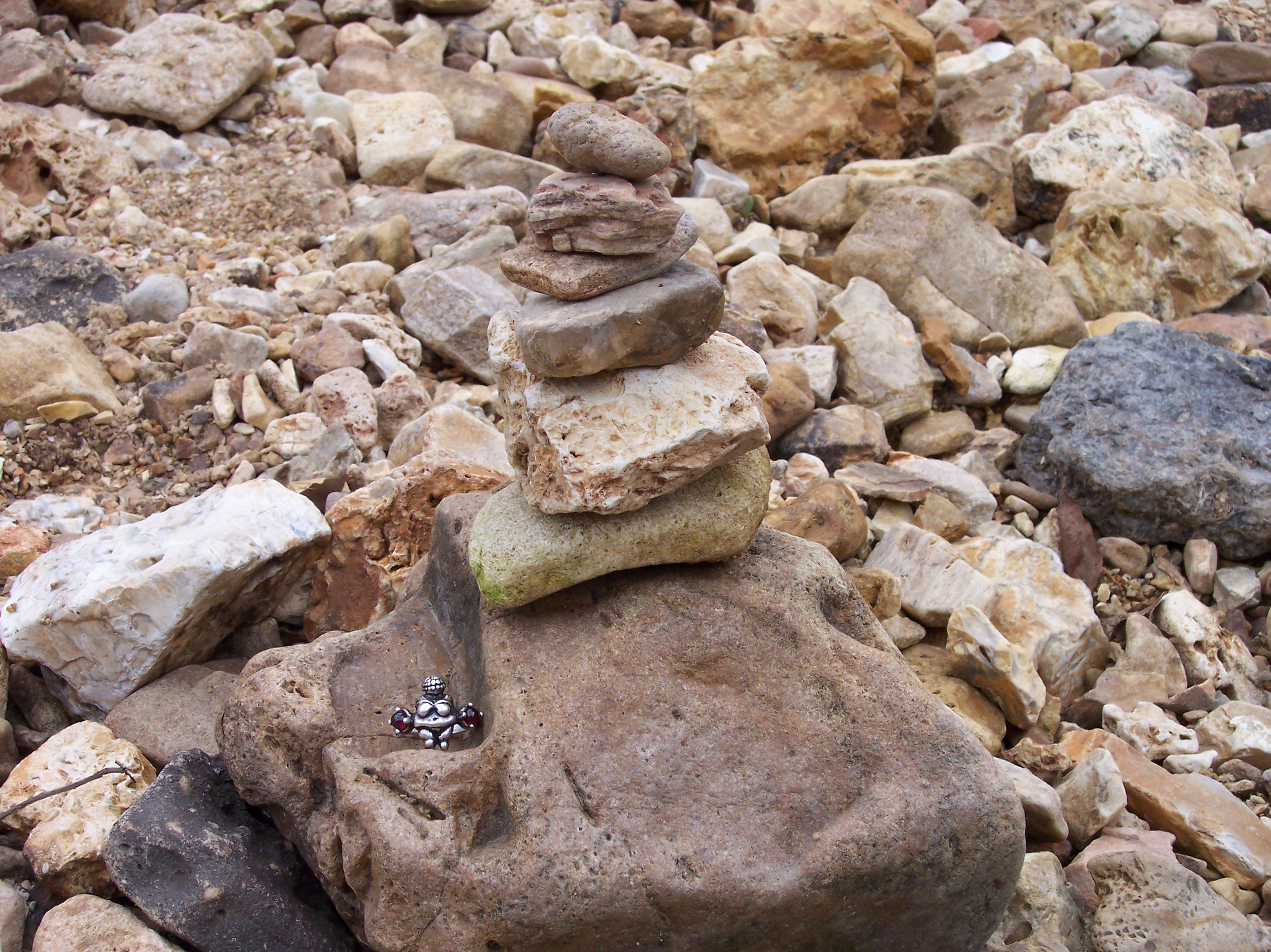
A nice place to retreat--priestess rocks in the woods behind my house.

20120201-141523.jpg

I love to sit in this stone "chair" to journal and think and feel. I sat here after my miscarriages. I sat here during my pregnancy. I took newborn Alaina here last February to "introduce" her to the earth. I bring the boys out here to play. I sat here today and thought about the ever-turning wheel of life.

20120201-141530.jpg

Footprints on My Heart: A Memoir of Miscarriage & Pregnancy After Loss

As of this week, my miscarriage memoir, Footprints on My Heart, has finally been published and is now available in eBook format via Kindle and Lulu, Inc. (epub format compatible with Nook and iBooks). There are a few formatting errors and some other general problems (like with the sample/preview–it is totally wonky–and with the lettering on the cover), but guess what, it is DONE, it available, and it is out there. I’m really, really excited about it and I feel this huge sense of relief. I still want to write my Empowered Miscarriage book someday, but for now, this memoir is what I had in me and it will have to do for the time being. I realized after Alaina was born and was, in a sense, the happy “ending” to my Noah story, that in writing my miscarriage blog I had actually ended up writing most of a book. So, the bulk of the book is drawn from my miscarriage blog and from this blog as well (for the pregnancy after loss content). I also included an appendix of resource information/additional thoughts that is fresh.

I’ve felt haunted by the desire to publish this for the entire last year. It took a surprising amount of work, as well as emotional energy, to prepare for publication, even though I actually did most of the actual writing via blog in 2010. Now that it is ready, I just feel lighter somehow and have this really potent sense of relief and ease, as if this was my final task. My final act of tribute. My remaining “to do” in the grief process.

If anyone really, really, really wants it and cannot afford the $3.99 for which I priced it, I do have it available as a pdf file, a mobi file, and an epub file and I will be happy to email it to you in one of those formats.

<deep breath> Aaaaaahhhhhh….

Thoughts on epidurals, risk, and decision making

In the Winter 2012 issue of The Journal of Perinatal Education I read several interesting tidbits related to women’s experiences of medication during labor, expectations for birth, and thoughts on risk and choice. In an article by Hidaka and Callister titled, “Giving Birth with Epidural Analgesia: The Experience of First-Time Mothers,” I was struck by one mother’s explanation of why she “chose” an epidural: “‘I was nervous about lying down and being confined to the bed again.'” As the researchers explain, “She wanted to stand or sit to cope with labor pain; however, many times she had to lie down for monitoring, and that position made her pain worse, so she was inclined to opt for an epidural” (p. 29).

Some questions immediately arise here. Did this mother actually want an epidural? Do women really need to lie down to be monitored? Was normal labor unbearable without medication? Did she make a free choice? The answer to all is, no. In this case and in so many others around the nation every day, the physiologically normal and fully appropriate need for freedom of movement during labor ran smack into the hospital’s expectation of stillness. And, medication was a consequence of that stillness, not an inability to cope with normal labor–it was an inability to cope with enforced passivity that was directly counter to the natural urges of her birthing body. Where is the “opting” here? When birthing women are literally backed into corners, no wonder epidural analgesia becomes the nationally popular “choice.”

Risk and birth

In another article titled “Risk, Safety, and Choice in Childbirth,” Judith Lothian explores our risk-driven obstetrical model, drawing on material from Raymond De Vries who, “describes that the common strategy of professional groups gaining control is to create risk or exaggerate risk. One ways groups gain power is by reducing risk and uncertainty. Where there is limited risk, it can be ‘created’ by redefining ordinary life events as risky and emphasizing whatever risk exists. The medical model encourages women to see birth as inherently risky for mother and baby…The obstetrician is then in the powerful position of reducing the risk and uncertainty. During pregnancy, women are advised and cautioned about every conceivable, however small, risk; but interestingly, when it comes time for the birth there is little, if any, discussion about the risks of routine interventions, such as continuous electronic fetal monitoring, elective induction, and epidurals…” (p. 45-46).

What are the implications for childbirth educators and doulas? We need to be cautious of perpetuating a medically oriented model that implies that women are responsible for minimizing all possible risks during pregnancy and yet then accepting a climate for giving birth that actually increases risks for both mother and baby. Lothian notes that educators must make it clear “that the current maternity care system increases risk and makes birth less safe for mothers and babies. Women need to know the care practices that make birth safer for mothers and babies and the practices that do not.” She goes on to address a key point, stating that “Childbirth educators need to take a strong stand in support of changing the system to increase safety for mothers and babies…safety is not about frantically trying to minimize small or exaggerated risks during pregnancy and then giving birth in hospitals that protect obstetricians’ interests while increasing risk for mothers and babies” (p. 47). [emphasis mine]

Storytelling and birth

In a later article by Barbara Hotelling about styles of teaching about medications in birthing classes, she references Lothian who suggests, “childbirth educators replace in-depth discussions of stages and phases of labor, medical interventions, hospital policies, and complications…’Let go of trying to fit everything in. Women don’t need to know everything about labor and birth.'” What to do instead? She suggests replacing traditional forms of education with storytelling and other strategies that recall how women through the ages have traditionally come to know and understand birth, stating that, “‘Storytelling is a powerful way to convey basic information about physiology, coping strategies, and confidence'” (p. 51). I’ve written before that what women need isn’t actually just more information and to get educated and these experienced educators agree, “Now there are many books, videos, YouTube videos, and magazines that give expectant parents the information. In their classes, childbirth educators can add storytelling from friends and family about their experiences with pain medication during labor and birth, allowing educators and their class participants to learn from the wise women who went before them” (p. 51).

I’ve long sought ways to help parents cultivate their inner knowing and body wisdom and to focus classes around the development and enhancement of personal resources, rather than on simple information sharing. I would like to re-vision my own approach to childbirth education into a cooperative, woman-to-woman, birth circle type of environment. Michel Odent describes this in his book Birth and Breastfeeding as “new style” childbirth education: “for the most part, these are mothers who have no special qualification but, having given birth to their own children, feel the need to help other women who could benefit from their personal experience. They organize meetings, often at their own homes. They do not usually encumber themselves with any particular theoretical basis for their teaching, but may find it useful to give this or that school of thought as a reference. Their aim could most accurately be described as being to provide information and education, rather than specific preparation.”

Addressing the subject of pain…

Returning to the first article quoted above, in their discussion, Hidaka and Callister state, “Our findings confirm those of a recent systematic review of women’s expectations and experience of pain relief in labor. Across studies, women underestimated the pain of childbirth, we’re not prepared for the intensity of the experience, and often had unrealistic expectations” (p. 29). I’d like to address the other points in a future post, because I think they are very significant, but for now they offer several good tips for childbirth educators to address the topic of labor pain during birth classes:

  • Teach that some pain/sensation has a purpose to alert the laboring woman to the need for movement, doing something different to encourage rotation and descent, or to push
  • Teach that the sense of empowerment for accomplished tasks and goals cannot be replaced only with pain relief
  • Teach that perception of pain is different for every woman
  • teach that every situation is unique so that no single pain management strategy works
  • Teach that the word labor means “hard work” and not “big pain”
  • teach that labor contractions intensify until about 5 cm, and that other sensations (e.g. “downward pressure”) may seem scary or painful
  • Teach that the sensations of labor are not all unique to labor (e.g. bad menstrual cramps, back pain, nausea, pressure)–they have lived through these experiences before

Related posts:

The Illusion of Choice

The Value of Sharing Story

Practical Ways to Enhance Knowledge for Birth

Information ≠ Knowledge

Women and Knowing

Asking the right questions…