Archives

Book Review: Survivor Moms


Book Review: Survivor Moms: Women’s Stories of Birthing, Mothering and Healing after Sexual Abuse

By Mickey Sperlich & Julia Seng
Motherbaby Press, 2008
ISBN 978-1-89-044641-3
245 pages, softcover
http://www.midwiferytoday.com

Reviewed by Molly Remer, MSW, CCCE

Past sexual abuse is an unfortunately common experience for women. Anyone who works with women of childbearing age should be mindful and informed of the effects of an abuse history on the woman’s experience of pregnancy, birthing, and mothering. Indeed, I consider this awareness to be a fundamental professional responsibility. Enter Survivor Moms, published by Motherbaby Press. This book is an incredibly in-depth look at the experiences and need of survivors of sexual abuse during the childbearing year.

One of the best and most unique features of the book is the “tab” format used for much of the clinical, research-based, or fact-based content in the book. Rather than lengthy chapters reviewing research and analyzing the phenomenon, textboxes containing quick facts and reference material are printed in the margins of many of the pages. The bulk of the narrative information in the main body of the text is then in the voices of mothers themselves, interspersed with commentary by the authors linking concepts, explaining ideas, and clarifying essentials. This is a powerful format that makes information readily and quickly available for reference as well as making the overall book very readable and approachable.

As someone with no personal abuse history who is currently pregnant, I did find the book to be a very emotionally difficult, intense, and almost overwhelming read at times. This is not a criticism in any way—sexual abuse is not a light or cheerful topic and it can be one that many people prefer to avoid. This is all the more reason for birth professionals to make a specific effort to be educated and informed.

Written both for mothers themselves and for the professionals who work with them, Survivor Moms is an essential part of any birth professional’s library. As noted in the book’s introduction, “We need to understand the impact of childhood abuse on birthing and mothering deeply, from hearing women’s stories. We also need to understand it broadly—from looking at the impact on samples and populations, on the body and on the culture.” Survivor Moms offers an accessible way of hearing those critically important stories and developing the necessary understanding to care compassionately for birthing women.


Disclosure: I received a complimentary copy of this book for review purposes.

And What’s This? More Birth Quotes!

I decided to split my most recent Facebook quote sharing into two posts, because it was becoming overwhelmingly long. These are the quotes I’ve shared on the Citizens for Midwifery Facebook page since April. While I realize that I don’t “own” these quotes—other people said them, not me!—I do have quite a bit of legwork invested in seeking and sharing these quotes (I mostly get them from my own reading) and if you re-post one or more of them on your own Facebook page, blog post, or book, I really appreciate acknowledgement and/or link back to this site or to my FB page, that this is where you originally got the quote!

‎”When a woman births without drugs…she learns that she is strong and powerful…She learns to trust herself, even in the face of powerful authority figures. Once she realizes her own strength and power, she will have a different attitude for the rest of her life, about pain, illness, disease, fatigue, and difficult situations.” –Polly Perez

“It is a curious commentary on our society that we tolerate all degrees of explicitness in our literature and mass media as regards sex and violence, but the normal act of breastfeeding is taboo.” – American Academy of Pediatrics (via Baby Bloom Doula Service)

“The way a society views a pregnant and birthing woman, reflects how that society views women as a whole. If women are considered weak in their most powerful moments, what does that mean?” –Marcie Macari

“Attempting to fulfill an idea of the ‘perfect’ mother can only prove soul-destroying, as no such person exists.” –Adela Stockton

“In the sheltered simplicity of the first days after a baby is born, one sees again the magical closed circle, the miraculous sense of two people existing only for each other.” –Anne Morrow Lindbergh

Giving birth is an experience carried not only into the first days of motherhood but also throughout life, having far-reaching effects on the mother’s self-esteem and confidence.” –Gayle Peterson

‎”I think one of the best things we could do would be to help women/parents/families discover their own birth power, from within themselves. And to let them know it’s always been there, they just needed to tap into it.” –John H. Kennell, MD

“As doulas, midwives, nurses, and doctors, it’s important to never underestimate how deeply entrusted we are with someone’s most vulnerable, raw, authentic self. We witness their heroic journeys, see them emerge with their babies, hearts wide open…” –Lesley Everest (MotherWit Doula)

“…advocates of home birth have never suggested that *all* women should give birth at home, only that it is a reasonable choice for some women. Given that rather modest claim, the force and vehemence with which home birth is opposed by ACOG seems out of all proportion.” –Elizabeth Armstrong (Princeton University)

“Few healthy, low-risk mothers require technology-intensive care…Yet…the typical childbirth experience has been transformed into a morass of wires, tubes, machines and medications that leave healthy women immobilized, vulnerable to high levels of surgery and burdened with physical and emotional health concerns…” –Maureen Corry (quoted in Lamaze International‘s journal)

“At a time when Mother Nature prescribes awe and ecstasy, we have injections, examinations, and [cord] clamping… Instead of body heat and skin to skin contact, we have separation…Where time should stand still for those eternal moments of first contact as mother and baby fall deeply in love, we have haste to deliver  the placenta and clean up for the next ‘case.'” –Sarah Buckley

“Who am I to be brilliant, gorgeous, talented, fabulous? Actually, who are you not to be?” – Marianne Williamson

“…celebrate ourselves for our courage to birth. The real question becomes not, ‘Have you done your breathing exercises?’ but rather, ‘Can you love yourself no matter how you birth, where you birth, or what the outcome?'” –Claudia Panuthos

“Whenever a woman has a problem, I believe that she herself can find the answer, provided she is given adequate information and support. I firmly believe in women’s strength and resourcefulness; I’ve witnessed these time and again. Women care about the continuation and continuity of life; they are intrigued by relationships, how things fit together.” –Elizabeth Davis

“Deep relaxation, surrender, letting go: when midwives are asked to disclose the secret of giving birth with relative ease, these are the words we choose. More than metaphors for coping, these responses are based on physiological imperatives…” –Elizabeth Davis

“The greatest joy is to become a mother; the second greatest is to be a midwife.” –Norwegian Proverb

‎”Brick walls eventually crumble precisely because people keep busting their heads against them.” –Barbara Wilson-Clay (IBCLC)

“Some midwives pull women up the hill and say I will get you through this. Other midwives walk behind quietly and gently say, ‘I believe in you.'” -Patricia M. Couch (via Wellpregnancy Childbirth Educator Trainings and Childbirth Classes)

‎”In our own world today, motherhood is rarely sufficiently honored. One day each year, there are brunches and corsages and little gifts of love. But the rest of the time? As a culture, we do not respect the great gift of mothering. Women’s work in raising the next generation is taken for granted. Yet it is a vital service to humanity, one that deserves to be acknowledged continually.” –Patricia Monaghan

‎”Becoming a mother does not need to rob you of your selfhood. Stay away from martyrdom. Martyrs never make good mothers; what is gained in giving is taken away in guilt.” –Gayle Peterson

“The midwife cannot be skilled without being caring. She cannot be truly caring without being skilled.” –Sheila Kitzinger

“The two most beautiful sights I have witnessed in my life are a full blown ship at sail and the round-bellied pregnant female.” –Benjamin Franklin

“When you have a baby, your own creative training begins. Because of your child, you are now finding new powers and performing amazing feats.” –Elaine Martin

“…in a time lacking in truth and uncertainty and filled with anguish and despair, no woman should be shamefaced in attempting to give back to the world, through her work, a portion of its lost heart.” –Louise Bogan

“If the baby’s body is a joy and a delight in the mother’s arms, that same body will become a joy and a delight to its owner later on.” –English & Pearson

“Even if I am simply one more woman laying one more brick in the foundation of a new and more humane world, it is enough to make me rise eagerly from my bed each morning and face the challenge of breaking the historic silence that has held women captive for so long.” –Judy Chicago

“Children are the power and the beauty of the future. Like tiny falcons we can release their hearts and minds, and send them soaring, gathering the air to their wings…” –Skip Berry

“Mama exhorted her children at every opportunity to ‘jump at de sun.’ We might  not land on the sun, but at least we would get off the ground.”- Zora  Neale Hurston (via Literary Mama)

“That they can strengthen through the empowerment of others is essential wisdom often gathered by women. “—Mary Field Belenky (via Applaud Women)

“Since beliefs affect physiologic functions, how women and men discuss the process of pregnancy and birth can have a negative or positive effect on the women that are involved in the discussion. Our words are powerful and either reinforce or undermine the power of women and their bodies.” –Debra Bingham (I was inspired to share this quote today by a conversation with Kerry Tuschhoff 🙂

“Learn to respect this sacred moment of birth, as fragile, as fleeting, as elusive as dawn.” ~ Frederick Leboyer (via From Womb to Cradle Doula Services)

‎”It takes force, mighty force, to restrain an instinctual animal in the moment of performing a bodily function, especially birth. Have we successfully used intellectual fear to overpower the instinctual fear of a birthing human, so she will now submit to actions that otherwise would make her bite and kick and run for the hills?” –Sister Morningstar (in Midwifery Today)

“Birth is women’s business; it is the business of our bodies. And our bodies are indeed wondrous, from our monthly cycles to the awesome power inherent in the act of giving birth.” –Sarah Buckley

“When a man is truly ‘present’ for the birth of his child and allows himself to be touched by the mystery unfolding before his eyes, he will have an unquestionable experience that can catapult him into the next phase of his development as a mature human being. His encounter with the power of birth…can connect him to his partner and his child in ways that sustain him for the rest of his life.” –John Franklin

“When he becomes a father, a man leaves behind his life as a single individual and expands into a more inclusive role. He becomes a link in an unbroken chain. And in doing so, he himself undergoes a birth process–the birth of himself as a father.” –John Franklin (FatherBirth)

‎”We are volcanoes. When we women offer our experience as our truth, all the maps change. There are new mountains. That’s what I want to hear–to hear you erupting. You Mount St. Helenses who don’t know the power in you–I want to hear you…If we don’t tell our truth, who will?” –Ursula K. Le Guin

“For most people, modern life meanders along a path of ups and downs, by and large devoid of high-voltage experiences that have the power to alter our lives in significant ways…The birth of a child is one of those significant experiences.” –John & Cher Franklin (FatherBirth)

“Pregnancy and labor are periods of vulnerability. This vulnerability is not weakness, but softness, which later contributes to adjustment to motherhood. Feeling dependent may open you to your need for help, and the ability to accept help from others can increase your strength and endurance for labor. Each of us must come to terms with our own feminine strength and our need for protection.” –Gayle Peterson (An Easier Childbirth)

“Labor is also teamwork. It is a mother and baby learning together how to push and how to be born, how to yield and separate from the union of pregnancy. You are not in control nor are you out of control during labor. The best way to approach labor is with an attitude of learning rather than controlling.” –Gayle Peterson (An Easier Childbirth)

“Midwifery calls upon you to be the best you can be: the best advocate, guide, healer, counselor, mother, comrade, and confidant of the women seeking your care.”— Anne Frye

“The birth of a baby is the birth of family. Myriad births take place at once: Women become mothers, husbands become fathers, daughters become sisters, and sons become brothers. One birth ripples through generations, creating subtle shifts and rearrangements in the family web.” –Gayle Peterson

“The family’s trust in the midwife and the midwife’s trust in the competence of the family members are the basis of caring that has the power of magic.” ~ Mary C. Howell (from Midwifery Today e-news)

“Birth is not a cerebral event; it is a visceral-holistic process which requires all of your self–body, heart, emotion, mind, spirit.” –Baraka Bethany Elihu (Birthing Ourselves into Being)

“Fear is completely intertwined with what we experience as labor pain…And it is the fear in our physicians and nurses as much as the fear within ourselves.” –Suzanne Arms (Immaculate Deception II)

“There is no place for ideology in birthing. Each birth has its own story and we must respond to what the baby tells us.” –Spinning Babies.com (via Kelly Caldwell)

I do think there is a place for ideologies/philosophies about birth and as guides for humane care/practice and as guides for making prenatal care and birth care decisions (before the birth), but in the actual moment, release of attachment is often necessary.

“To be pregnant is to be vitally alive, thoroughly woman, and undoubtedly inhabited.” ~Anne Buchanan (via CAPPA)

“Your doc/friend/mother-in-law may be saying, ‘Don’t be a hero, get the epidural!’ But this isn’t about heroics, this is about protecting your body…” –Jennifer Block (via @Spirited Doula Services)

“Giving birth in ecstasy: This is our birthright and our body’s intent. Mother Nature, in her wisdom, prescribes birthing hormones that take us outside (ec) our usual state (stasis), so that we can be transformed on every level as we enter motherhood.” –Sarah Buckley

“The mystery of life and birth is a profound invitation to be authentic as you trust and tremble your way through labor’s Gates of doubt and fear. It is possible that you will become more intuitive during labor than at any other time…Allow your body to guide you in your breathing, in your unique movement, in knowing …what to do…even when you don’t know what to do.” –Pam England (The Labyrinth of Birth)

“Every great dream begins with a dreamer. Always remember, you have within you the strength, the patience and the passion to reach for the stars to change the world.” ~ Harriet Tubman (via Midwifery Today e-news)

“Midwives can create a spirit of beauty at a birth or they can desecrate it. They can create a sacred space around a birthing woman that drives out fear & inspires the mother’s belief in herself, which ultimately determines the outcome of the birth. Midwives can be a channel of Grace in ways they never imagined & in doing so they create a spirit of reverence. Reverence in these days and times is not a common thing.” Caroline Wise, Birthing with Reverence (Midwifery Today)

Re: “advice” for someone who is pregnant: “…if you know that you are pregnant and if you know when you conceived your baby and you think that everything’s okay, doctors can probably do nothing for you. Women need to realize that the role of medicine in pregnancy is very limited…What’s important is for a mom-to-be to be happy, to eat well, to adapt her lifestyle to her pregnancy, to do whatever she likes to do…I think that’s what we have to explain to women. They have to realize that doctors have very limited power.” –Michel Odent (in Optimal Birth)

What To Do When Newly Pregnant and Wanting a Natural Birth…

Last month, a friend of my younger sister’s emailed to ask some questions about natural birth. She is newly pregnant and very interested in her birth choices (yay! How exciting!). I shared a couple of ideas with her and thought I would share them with my blog as well:

It can be hard to know where to start—there is SO much information out there. I would suggest getting a good, informative book—though I haven’t yet read it myself, Your Best Birth is a new book that is supposed to be good and very “balanced” at helping you make the choices that are right for you. I also have a suggested reading list here.  Mothering Magazine’s Having a Baby, Naturally is also quite good. Speaking of Mothering Magazine, their discussion boards are PACKED with good information and they all come from a natural/holistic perspective (a lot of other message boards have more of an “epidural soon!” culture). You can join a “due date club” there, etc. There is a whole forum just for birth stuff (and a subforum for homebirth), etc. Good resource, as is their entire website. Other good guides include Lamaze’s book Giving Birth with Confidence. One of my favorites as a really good “basic”/intro guide for pregnancy and birth is Pregnancy, Childbirth, and Newborn by Penny Simkin. A brand new edition is out, so think about checking it out!

Particularly if you plan to have your baby in a hospital, a doula would be a really good addition to your birth “team.” Doulas provide non-medical labor support and are there just to support YOU and what you want. It is really good to have continuous labor support. And, she does not replace your partner—he has his own “journey” to take into becoming a father and having a doula there frees him of a lot of the pressure of trying to be your “doula”—he can just be there with you, loving you, rather than trying to remember all kinds of stuff from books!

I would also suggest finding a good independent childbirth educator to take birth classes from when you get closer to your due date (one who doesn’t work in a hospital—it doesn’t matter if you plan to give birth in a hospital, an educator who works for herself instead of for somewhere else, is better able to give you complete information instead of just teaching about the “rules” of that particular location). Read more about “why independent classes” here.

Most of all, spend time celebrating your changing body and marveling at its inherent wisdom. Take time each day to “tune in,” draw inward and connect with your baby. Honor your natural rhythms—eating when you’re hungry, resting when you’re tired. Be gentle and loving with yourself. Know that you already have everything you need within you and strive to create a birth environment that encourages that inner wisdom to blossom and fully respects your right to freedom in birth.

Why Do I Care About Birth?

Some time ago I wrote a post on the Citizens for Midwifery blog about medical control as acceptable, in which I pondered the question of why do we care about birth, if many birthing women themselves don’t really seem to care? Why do we make it any of our business what other women choose to do with their births? And, is it any of our business anyway?

Well, I’ve been doing some thinking and I made and shared a list of why I care on the CfM blog. However, I wanted to go ahead and share my reasons on this blog as well. This is why I care about about other women’s births:

  • Because women are suffering (birth trauma is real–see organizations like Solace for Mothers–and postpartum mood disorders are very common).
  • Because babies are suffering–late pre-term births are increasingly common due to induction, many babies experience at least some post-birth separation from their mothers (which is not their biological expectation), and many babies spend time in the NICU. Infant mortality rates, especially for minority babies, are higher than in other industrialized countries.
  • Because breastfeeding is suffering and thus public health is suffering (see my previous article on the birth-breastfeeding continuum)
  • Because the physical costs of our current birth model are high (morality and morbidity rates are higher than necessary due to high volume of cesareans and many physicians and hospitals do not practice evidence-based care–continuing to deny laboring women food and drink and continuing to use Cytotec for inductions for example).
  • Because the financial costs of our current birth model to society are high–birth is a multi-billion dollar a year industry. Some facts from CfM:
    • Over four million births in the US each year (26.4 births per 1000 women aged 15-44 years in 2004).
    • Second most common reason for hospitalization of women.
    • Care for mothers and babies combined rank 4th for hospital expenses.
    • Hospital costs for deliveries mounted to more than $30 billion in 2004. More than 30% of births by cesarean section. ranking seventh highest total on the “national bill” for procedures (over $17 billion per year).
    • Of all births, 99% take place in hospitals, 90% are attended by obstetricians.
    • Over 6 million obstetric procedures are performed – the most common category of surgical procedures.

The percentage of births paid for by Medicaid varies from state to state but can be as high as 50% or more in some states. Coverage by all insurers (Federal government, Medicaid, private, HMOs, etc.) varies; many will not reimburse for OOH births, and when midwives are covered, the reimbursement rate is only a percentage of the rate for physicians. We all pay for births, including unnecessary interventions and preventable complications and injuries, through our taxes, health insurance withholding, and individual policies.

  • Because women’s birth memories last a lifetime (see Simkin, Not just another day in a woman’s life).
  • Because women deserve better.
  • Because I know in my heart that birth matters for women, for babies, for families, for culture, for society, and for the world.

Conference Blessings

This past week, I attended my first CAPPA conference (this one was in Charlotte, NC). I’ve been a member of CAPPA since 2004 and the thing that first attracted me to membership was the FREE annual conference. Now, six years later, I finally took advantage of going to one! I think it will be an annual tradition for our family 🙂 On the closing day of the conference, the MC asked us to consider how we had each been “blessed” at the conference this year and then to turn to the person next to us and share how we had been blessed. I thought of several things right away:

  • Meeting people face-to-face that I previously only had online contact with. There is no substitute for in person contact. It was great!
  • Attending Barbara Harper’s presentation on “Leave Well Enough Alone: Natural Third Stage.” It was VERY good. I also particularly enjoyed Andrea Sharpe’s presentation about empowering teen mothers and Barbara Hotelling’s “Your Body has the Power to Give Birth.”
  • Winning a birth bracelet from the Birth Behind Bars booth. They had an interesting project going on where you could submit a tip for the upcoming book 101 Ways to Support a Woman in Childbirth and have a chance to win a bracelet (as well as to get a nice purple “For the Love of Birth” lanyard for your name tag too). I love to win stuff and the bracelet is pretty 🙂
  • The between-session contacts and conversations. In addition to learning good information from the actual sessions, there is no substitute for the conversations that arise during breaks in the day—I met several really wonderful people just accidentally this way and I had some good, in-depth conversations about teaching methods and resources that would have been impossible to have if I’d only attended the sessions and then gone straight back to my room.
  • Being in an environment with 300 other women who also believe that birth matters.

With Barbara Harper

With Barbara Harper

DVD Review: Hab It: Pelvic Floor

DVD Review: Hab It: Pelvic Floor

PT Partners, 2008
DVD, 1 hour 42 minutes, $29.95

www.hab-it.com

Reviewed by Molly Remer, MSW, CCCE

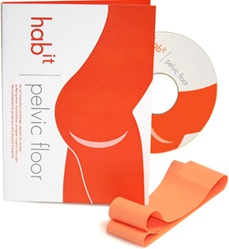
Most women, and certainly all birth professionals, are aware of the importance of the pelvic floor. Less well-known are methods and exercises beyond the basic “Kegel” to strengthen and rehabilitate weakened pelvic floor muscles. Hab It: Pelvic Floor is a physical therapy DVD specifically targeting the pelvic floor. It is designed for women who are experiencing incontinence, prolapse, or pelvic floor pain. It is also a preventative tool for women to avert the development of these distressing issues.

Hab It: Pelvic Floor begins with an anatomy overview and Kegel explanation/instruction and moves into correct postural positioning. The DVD contains four progressive workouts each more than 20 minutes long and also “time efficient” versions of each workout. Each workout is coached by physical therapist Tasha Mulligan while being demonstrated by another woman. All of the information is clearly presented and easy to follow and the instructor is pleasant and earnest. The DVD comes with an exercise band for use during some of the exercises and no other equipment or props are required.

A very thorough and complete resource for any woman of any age, Hab It: Pelvic Floor is a relevant, interesting, and worthwhile addition to the libraries of doulas, childbirth educators, and anyone who cares about women’s health.

Note: The DVD is not designed specifically for use by pregnant women and there are several exercises that are not compatible with pregnancy—it is ideal for pre or post-pregnancy however!

Disclosure: I received a complimentary copy of the DVD for review purposes.

Manual Clot Extraction Following Birth (Sequestered Clots)

There is a new blogger at Science and Sensibility—a science writer (and pediatrician) named Tricia who is going to be writing about patient safety and other interesting topics. She wrote an article for the online medical journal Pulse about her traumatic post-birth experience that involved (among other things) a large number of clots and a painful manual extraction.

What an intense story it was. I had a manual clot extraction following my first son’s birth and my uterus literally HURT while reading her story and remembering that experience. However, unlike Tricia, I was at a birth center and had a very gentle, caring doctor who was wincing as she did the extraction saying, “I’m sorry, I’m sorry. I know this is hurting you.” Even so, it was an excruciatingly painful experience—the most painful physical experience I’ve ever had. Uteruses are simply not MEANT to have hands in them. And, birth is about things coming out, not going in! I was left with lingering questions about why the doctor did a manual extraction instead of having me squat to see if the clots would come out on their own. Perhaps it was a more serious situation that I realized at the time and she was just playing it cool. I can find almost no information online about this type of an experience, just a small mention in one of my midwifery texts about “sequestered clots,” which is I guess what I experienced.

Reading about this other blogger’s experiences really brought back this painful experience for me. I have noticed a tendency amongst childbirth educators and doulas to sometimes only focus on the good and empowering parts of births and to overlook or not mention the “traumatic” parts. Personally, I felt so good OVERALL about my birth experiences, that it seemed like a “betrayal” of sorts to talk too much about the parts that were not as good. While I experience giving birth as the most powerful, transcendent, empowering, and just super awesome cool, experience of my life, when I take a couple of steps back into memory I also realize that each of my births involved a certain element that was significantly traumatic as well. With my first it was the manual extraction and then my postpartum recovery from what I feel like was a very mis-diagnosed/poorly treated labial tear. With my second, it was recovery from a very similar tear right next to the old one (but with the visually traumatic addition of bruises). I really felt like I had “failed” in some way to have not protected myself from tearing again in such an unusual and very awful way. Someday I would like to write a blog post or article about this—I find that labial/clitoral tears are a significantly overlooked subject in the birth and midwifery literature. Indeed, I hadn’t even it was possible to have a non-perineal tear. If they are mentioned, it is in some dismissive way about “skid marks” or “labial split” or “a little burning when you urinate,” not in terms of the fairly significant genital mutilation I experienced.

I also had an intense amount of clots following my third birth (second trimester miscarriage at home)–-“only” the size of grapefruits though, not “frying pans” as in Tricia’s story-–and when I finally went into the ER about it they acted like I was making a big deal out of nothing (“people have miscarriages all the time. They’re very common.”) They were not “sequestered” though, they were coming out (and coming out, and coming out). Despite these experiences, I was never classified as “hemorrhaging”—the ER doctor even said (with a shake of her head like I was an idiot), “you’re not hemorrhaging.” And, indeed, I did not have any postpartum symptoms of hemorrhage—no anemia or anything like that (though yes, loud heart-pounding-in-my-ears after this third birth). In addition to the more obvious trauma of having my baby die, the experience of very truly feeling close to death—of no longer being able to distinguish whether I was fainting or dying—is the thing I can barely talk about from this birth experience.

Baby In Utero Pendant

For quite some time, I’ve wanted a really cool silver “baby in the womb” pendant that is available online, but is out of my price range (I do have a smaller, less detailed version). Two years ago, I found a different version made by a company called Sacred Body Designs (they make various types of “anatomical jewelry” meant for healing purposes—so, a pendant of a heart for someone who has heart problems to wear). This one was a more affordable $30 (also sterling silver and with really great detail—LOVE the visible placenta and cord and the hair on baby’s head) and my husband got it for me for Christmas that year.

Now, two years later, I have been suddenly prompted to post about it, because it occurred to me that there may be other birthworkers like me out there who wish for the more expensive pendant and would delight to find a very cool alternative version that is less pricey! Of course, I can’t tell from looking at the website if they are still in business (looks like it hasn’t been updated for a long time), so I may just be teasing you—“look what I got! Don’t you wish you had one too?!” 😉

One Woman Awake

Several years ago,  I received a card from the National Association of Mothers’ Centers with the following poem printed on the front:

One Woman Awake
Awakens another,
The second awakens her next door neighbor.
And three awake can rouse the town,
And turn the whole place upside down.
And many awake
Can raise such a fuss
That it finally awakens the rest of us.
One woman up,
With dawn in her eyes,
Multiplies.

——

It has been hanging on the wall behind my computer since 2007 and it still gives me chills to read it. Of course, it can be applied to many elements of women’s lives, but I look at it through the lens of birth advocacy. I always say that what I want to do with my life is simply to transform the birth culture in the U.S. A lofty goal maybe, but if many awakened women raise enough of a fuss, it could happen!

WomanSpace

Yesterday, a friend/colleague and I toured a possible studio space to rent in Rolla. We do not have a particularly clear idea of what we’d like to do exactly, but we have both long felt the desire to create a “women’s resource center” as well as to have a dedicated “birth studio” for our birthwork (she is a doula and I’m a birth educator and soon to be prenatal yoga teacher). The space felt perfect and was in our exact price range. I left feeling tremendously excited and inspired about the possibilities. Later that evening, the doubts, realities, and fears started to crowd in—I do not want to live a fear-based life, but I also want to be “practical” (which can be a handicap as well as an asset). I have too much to do already, etc., etc. In February, after my miscarriages, I took a personal renewal retreat in which I kept my computer off for 5 days and spent the time nurturing myself and doing those many things I always say I “really want to do.” During that time, I spontaneously wrote a description in my notebook of the women’s center I envision. So, this morning I opened up my notebook and re-read my “vision” there. I want to share it now and continue to explore the possibilities angle of the studio opportunity, rather than get bogged down in fears and self-doubts:

I visualize a center. A place where women can come together to learn, to talk, to develop, to grow. A safe place. A nurturing place. A supportive place. Hostess to LLL meetings, book clubs, birth circle, birth info nights, prenatal yoga classes, birth classes, birth art workshops, pregnancy retreats, journaling workshops, craft classes, crafty mamas meetings, a miscarriage support group, postpartum mamas support group, birth counseling/consultation sessions, dancing for birth, prenatal bellydance, drop-in support chats, blessingways, red tent events, meet the doulas night, Mother’s Guide to Self-Renewal groups, women’s spirituality circles, playgroups, baby massage classes, baby/tot yoga, girls’ coming of age classes, an ICAN chapter, Friends of Missouri Midwives meetings. A gathering place. A woman’s place.

It will have a large, open meeting room, access to a bathroom and another, smaller room that could be an office, consult room, or playroom. We will have counter space to plug in some minimal cooking implements (like a microwave). There will be comfy couches, chairs, toys, a lending library of books and films as well as perhaps toys/games/puzzles. There will be big pillows on the floor and beautiful art all over the walls. Other women wishing to have groups/classes for women, could also use the space for their groups/events.

Think we can do it? (And, if so, what can I not do to make space in my life for it? 😉 )

In a way, my vision is that this will be that classic “room of one’s one” that every woman needs access to. WomanSpace.