Archives

Introversion

Ring the bells that still can ring

Forget your perfect offering

There is a crack in everything

That’s how the light gets in.

–Leonard Cohen, from “Anthem”

via A Meditation for the Weekend: How the Light Gets In – By Susan Cain.

Accidentally came across this quote via Facebook today and just loved it. It led me to the rest of Susan Cain’s website about introverts and her new book, Quiet.

During every session of my online class, I have my students take an online version of the classic Myers-Briggs personality inventory: Personality Type Explorer. Personally, I am an INFJ which is the result I also get when taking the paper version of the test as well as other online versions. So, it seems pretty consistent. I feel I am more accurately an “extroverted-introvert” (which isn’t a real category)—I really enjoy being around people and I’m friendly and social, but on the flip side I then feel very drained after people contact and need time alone to recharge. I find I am restored by being alone and drained by being with others (even though I like them!), hence my own self-labeling as “extroverted-introvert.” Though, of course, by definition it isn’t actually that extroverts “like people” and introverts don’t like people, it is a difference between whether they are fueled or drained by people contact. I’ve just observed that people seem to make an assumption that being introverted means someone is “shy” or “doesn’t like people,” so that’s why I choose extroverted-introvert for myself.

On the website above, I read Cain’s Manifesto, which contained these gems:

“1. There’s a word for ‘people who are in their heads too much’: thinkers.”

I have heard this phrase more times than I can count—“you think too much.” While often said with a teasing air, it is also tinged with a touch of shaming. Once, several years ago, I mentioned feeling “too busy” to an acquaintance. She responded with, “it is good to be busy, then you don’t have time to think.” I was stunned by the concept then and I remain stunned by it now—no time to think? What kind of life would that be?! Sounds hellish to me. When I begin feeling like I have no time to think or that I don’t have enough space in my own head, that is my personal cue that I need to make life changes. While I can “overthink” things or ruminate in pointless and self-berating ways, most of the time I really enjoy my own company. I like time to think and I love time spent in my own head. It is a pretty interesting and fun place to be. And, for me then, writing is thought made visible. (This brings me to Cain’s third point in her manifesto was: “3. Solitude is a catalyst for innovation.”)

And, finally, her fifth point appealed to the homeschooler in me:

“5. We teach kids in group classrooms not because this is the best way to learn but because it’s cost-efficient, and what else would we do with the children while all the grown-ups are at work? If your child prefers to work autonomously and socialize one-on-one, there’s nothing wrong with her; she just happens not to fit the model.”

(I love the casual acknowledgement that a primary purpose of government school is to provide publicly funded day care while parents are at work.)

My own kids love being home best of all (actually, they may love visiting my parents’ even better!). They always have each other for company though. I do not know if I’ve ever fully expressed how very much I love having this pair of boys. It is phenomenal. They pretty much play with each other from the time they wake up until the time they go to bed. Day in and day out each spends with his best buddy, his brother. Last weekend we had a family wide meltdown over something pretty silly, but the whole family ended up yelling about it and Lann ended up in his room for a while because the boys needed to be separated (besides being best buddies, they each have a “signature” behavior that leads to some challenges—L’s is to tease/taunt and then laugh in a horrible mocking way when Z gets upset, and Z’s is to throw massive “rage fits” that involve physical attacks). Z kept begging and begging for Lann to be able to come out of his room (L wanted to stay in because he was really upset and crying and mad) and then said to us, “you don’t understand, I HAVE to be with my BROTHER!” While it is an unfortunate example because of the family wide meltdown context, it was very telling about the depth and quality of their relationship and I just feel extraordinarily fortunate that they like each other so very much and are such an integrated and committed unit.

wearing their signature skeleton sweatshirts of awesomeness

This experience with a pair of brothers is one of the things that makes me want to have just one more baby—so A has a chance to have that intense sibling connection too. Of course, there are no guarantees that she would bond that well with a younger sibling—it could be a sibling rivalry torture fest that drives me screaming from my home with no scrap of time left to think. And, I know it is extremely ridiculous to plan to have kids to be friends for other kids (how would that hypothetical other baby feel to know that it was only born to be a buddy for someone else?!) And, of course, she has her two big brothers to be her friends. The boys are such a tight pair though and are enough older than she is that I don’t think she’ll ever be on the true friend level with either of them.

Okay, so I started on one topic and ended somewhere totally different. Ah, well.
Babies & Balance

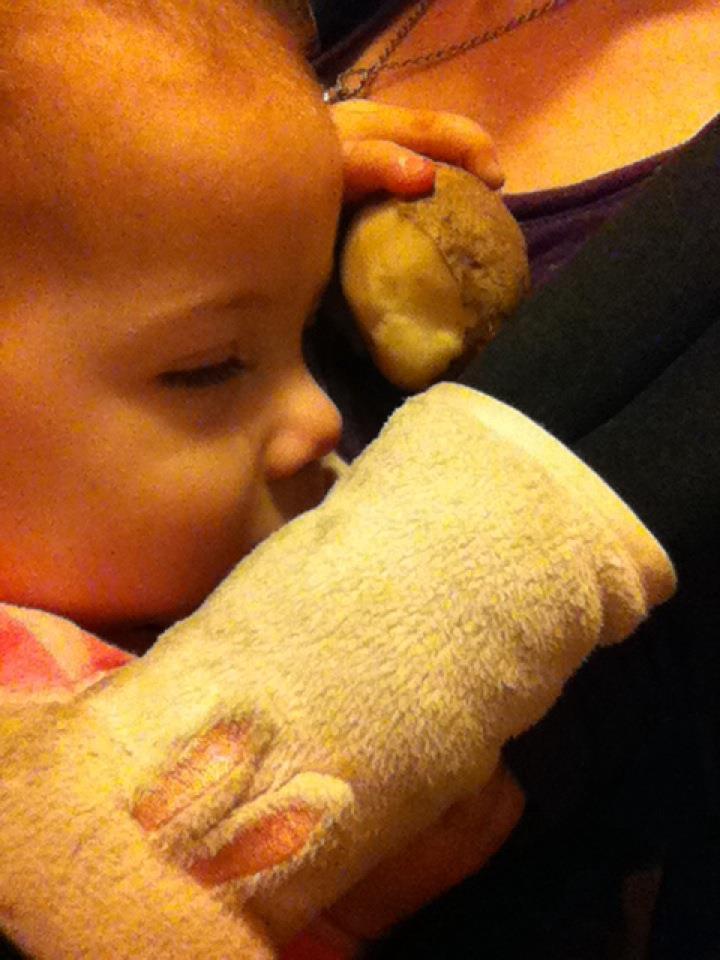
She is nursing here and holding a partially peeled potato. She likes to fall asleep holding something--and those somethings are often very random.

I’m just bursting with ideas for blog posts recently, but Alaina has other ideas for me namely with regard to her sleep “schedule.” She has had several days recently where she has only napped for 15 minutes. At night, she insists on sleeping with her head on my arm, which is really fine and pretty sweet, but since she goes to bed at about 8:30, I am then “trapped” there in the dark (light has to be off for her to go to sleep too) for hours and hours. (My iPad helps make this work.) With my boys, I could usually sneak away after they fell asleep. She, however, pops awake when I reclaim my arm. In the morning, I can’t get up before she does either, because she is still on my arm and pops awake when I try to sneakily wiggle away. I’ve surrendered to these things, knowing that they will pass soon and enjoying the fact that my baby has spent every night of her existence sleeping in my actual arms, but I have not surrendered to the notion that I’ll be able to put her down for a nap during the day! I nurse her to sleep for nap while walking her in the Ergo and then put her down on the bed. Today…popped up. This weekend…popped back up. Uh oh.

I have been “mining” my old blog for content that I want to move over here. In the same post in which I originally shared some quotes from the book The Mommy Wars, I found a quote that spoke to me again today as I try to figure out my “balance” with kids and teaching and writing and A’s popping up from nap ways. I thought I’d shared the quote here before, but I don’t see it now. So, here it is:

Let me save you some money: In a life with children, balance does not exist. Once you’re a parent, you can figure you’ll be out of whack for the rest of your life…Children are not born to provide balance. children are made to stir us up, to teach us how angry we can get, how scared we can be, how utterly happy, happier than we’d ever imagined was possible, how deeply we can love. Children turn us upside down and inside out; they send us to the depths and heights of ourselves; but they do not balance us. We can’t balance them either, and that’s a good thing, too. They’re finding out how to live in the world, and the most we can do is make them as safe as possible and have a good time with them.

I have struggled in the past when things like this happen thinking I need to give up my blog, but in the last year, I’ve accepted it is one of my favorite hobbies and should actually be the last thing to go. I’ve also come to the conclusion that it is a legitimate avenue for writing, providing me with countless seeds for later article and book projects, not to mention the personal posts serving as a “time capsule” or memory record for both me and my kids in the future.

Motherhood, Feminism, and More

When a woman tells the truth she is creating the possibility for more truth around her.

– Adrienne Rich (May 16, 1929 – March 27, 2012)

Some time ago Molly at First the Egg did a series of posts about the book Of Woman Born. This book is an excellent feminist classic that at the time during which I read it helped to clarify for me that it is the “institutional” elements of motherhood that I sometimes find so oppressive and binding—it isn’t the children themselves, in the climate of motherhood in which I find myself.

Several years ago I also read Fruitful, by Anne Roiphe. The subtitle is Living the Contradictions : A Memoir of Modern Motherhood. Like Of Woman Born, it was written before the more recent wave of “momoirs” (that is a kind of dismissive term, but it does help me classify the genre) and focuses heavily on feminism and its relationship to mothers/motherhood (so, different from momoirs in that the focus is less on personal experience of motherhood and more on motherhood and its social/cultural/political connections, I suppose). Fruitful is less “heavy” and depressing than Of Woman Born. The focus of the book is on the tension between feminism and motherhood (i.e. can you be a “good” feminist and also be a “good” mother) and she explores that issue throughout. Roiphe is a feminist and yet critiques some elements of the movement’s impact on mothers and motherhood. She is also very pro-father and I appreciated her exploration of men/fathers as people vs. “evil patriarchy—down with them!”

This is a quote about the crux of the mother/feminist issue: “Motherhood by definition requires tending of the other, a sacrifice of self-wishes for the needs of a helpless, hapless human being, and feminism by definition insists on attention being paid to the self. The basic contradiction is not simply the nasty work of a sexist society. It is the lay of the land, the mother of all paradoxes, the irony we cannot bend with mere wishing or might of will.

This reminds me of my journal entry from my early months as a new mother—“is it possible to balance motherhood with person-hood?” I’m still figuring it out! (some days it seems to work, some days it really doesn’t!)

During the time in which I read Fruitful, I also read The Mommy Wars. I almost didn’t read it because I was worried that it would be excessively harsh or inflammatory and I don’t need to bring things like that into my life. However, it seemed truly supportive of women/mothers. It was a collection of essays by various authors (alternating between those who have chosen to be mostly at home and those who have chosen to be mostly pursuing careers) and it quickly became clear that the most real “mommy war” that most of us experience is the one inside of our own heads. There seems to be no ideal/perfect solution. I also noticed that many of the women (including the editor of the collection) had cobbled together some sort of “balance” between working-outside-of-the-home and working inside it–there were lots of part-timers, lots of WAHMs, lots of writer-in-the-spare-minutes, etc. Since I’ve done the same, I particularly identified with those tales of struggle to discover the right balance for your family.

The first quote I wanted to share from this book is with regard to being asked “what do you do?” at a cocktail party: “I find it odd that I’d generate far more interest if I said I raised dogs or horse or chinchillas, but saying, in effect, ‘I raise human beings’ is a huge yawn...It might, in fact, be boring if child care were simply a series of pink-collar tasks–bathe, dress, feed, repeat. But observing and participating in a little Homo Sapien’s development is fascinating to me. Furthermore, being a mother isn’t just a ‘job’ any more than being a wife or a daughter; it’s a relationship.” [emphasis mine and in total agreement with this]

Then in another writer’s essay (the above was from one of the SAHM, the below is from one of the WOHM) came this interesting observation:

I remember reading once that all manner of selfishness is excused under the banner of focusing on one’s family, and it strikes me now as penetratingly true. How many of us don’t do for others because we’re supposedly saving it for our families? and how valuable is staying at home if you’re not teaching your children how much other people (and their feelings) matter?

In another book I have, The Paradox of Natural Mothering, she refers to the “family first” mentality as a type of narcissism and I do see the point.

I also wanted to share some quotes from an essay by a woman who does not yet have children, but is planning to, with regard to talking to mothers who shut down her opinions/thoughts with the, “what could you know? You don’t have children” brush-off. (Which, I personally, have definitely been guilty of thinking on more than one occasion! And, actually did so while reading this essay!):

I want to be able to say that all the judgment and aggression and competitiveness I witness among working and stay-at-home mothers surprises me and absolutely must change. But that wouldn’t be honest. I’ve been party to this one-upping and henpecking and know-it-all-ness my entire life. It’s as if becoming a mother puts us back into a sorority or junior high school, into some petri dish of experience where what other females think and say and feel and do counts more than anything.

The one thing my stay-at-home and working-mom friends share in the country of motherhood is a superiority gene, some may call it a gift of vision, that convinces them that women who don’t have children are, despite their educations and accomplishments, dumb as doorknobs. I’ve sat through many a heated conversation…during which I’ve been silly enough to offer an opinion only to be shut down more condescendingly and viciously by wise Goddess Mothers than I ever have been shut down by any man.

FWIW, I would not call this a “superiority gene” or “gift of vision,” but a “voice of experience”…I think most of us have been in the position of ourselves being the “just doesn’t get it” woman without kids! And, after you have kids of your own, you suddenly realize why “those mothers” were condescending to you.

On a somewhat related subject, I also enjoyed this post by Dreaming Aloud about the silencing of mama anger.

Memories of a One Month Old…

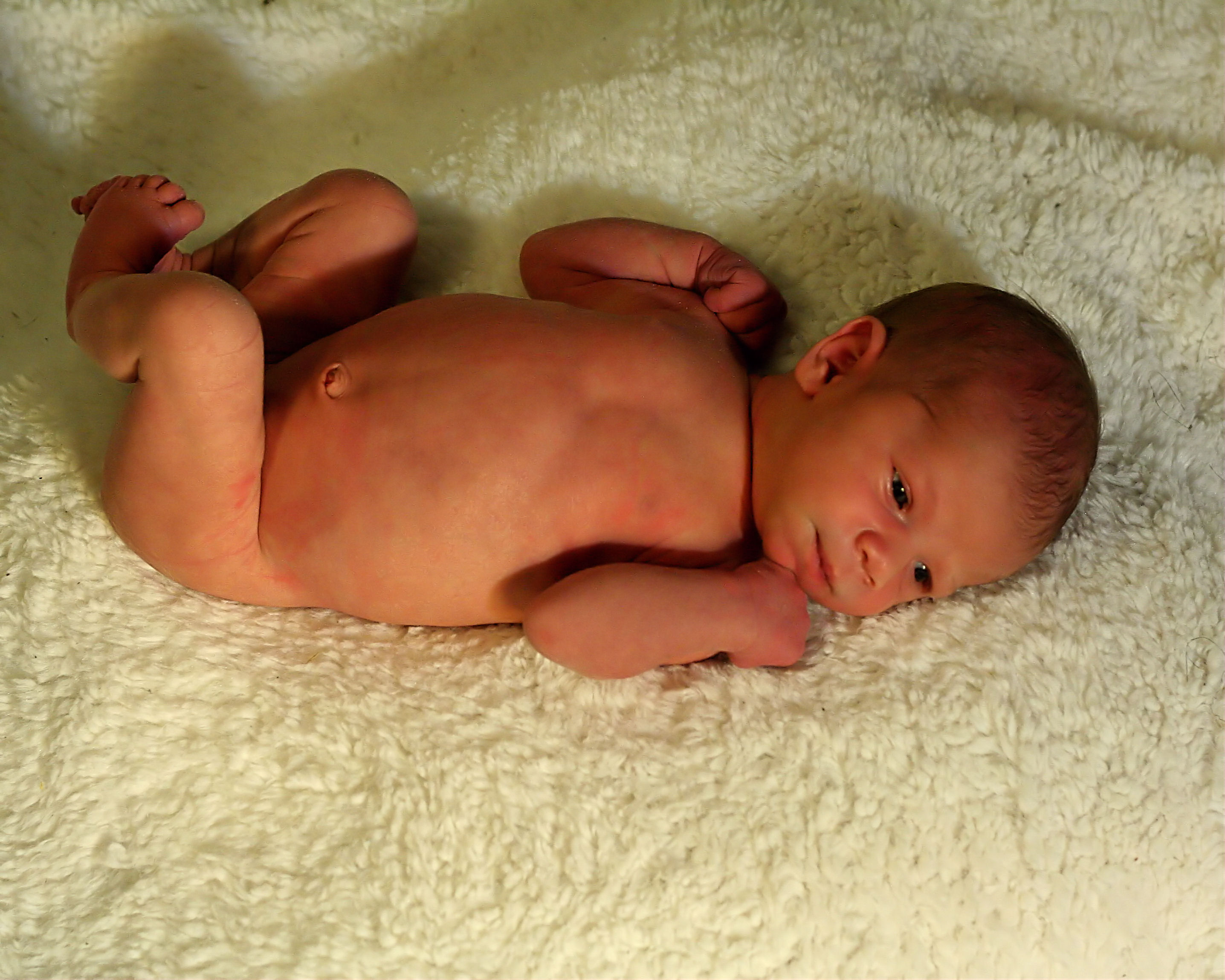
My newborn!

I didn’t make a “onemonthababy” post about Alaina and as I flipped back through my journal on her birthday this year, I found the entry I made on February 20—the day after her one month “birthday.” So, I feel like adding it now to join the other monthababy posts I made during her first year.

Alaina is one month old! Still a nice quiet, contented little soul with new smiling action, head-lifting action, and potty-peeing action. I love her SO incredibly much. I’m loving having a baby again. I do not find baby-parenting to be difficult, confusing, or frustrating. Pretty much non-stop marvelment. She feels so easy to take care of.

Alas, tis not true of my other kids lately who are exhausting, noisy, need-factories obsessed with butts and poop jokes.

Weather has been delightful lately and I walked with her down to the priestess rocks this afternoon feelings as if I was officially “presenting” her to the world/planet.

Earlier in the week, I took her outside to wait for [my friend’s] visit and I walked the labyrinth with her and also introduced her to Noah. I had profound sense of unity with her. Symbiosis. A feeling of being her whole world and she my whole world. World felt narrowed in on us and then also like I was part of some great, grand majesty. Her nestled against my chest, me protecting her and enfolding her. Nurturing her. Our twosome the whole world. “The sheltered simplicity of two people existing only for each other.” And, that is enough. All she wants is me and I can give that to her. 🙂

I also spotted this quote on a friend’s Facebook page recently and it spoke to my heart and feelings:

“A mother’s body remembers her babies–the folds of soft flesh, the softly furred scalp against her nose. Each child has its own entreaties to body and soul. It’s the last one, though, that overtakes you. I can’t dare say I loved the others less, but my first three were all babies at once, and motherhood dismayed me entirely. . . . That’s how it is with the firstborn, no matter what kind of mother you are–rich, poor, frazzled half to death or sweetly content. A first child is your own best foot forward, and how you do cheer those little feet as they strike out. You examine every turn of flesh for precocity, and crow it to the world.

But the last one: the baby who trails her scent like a flag of surrender through your life when there will be no more coming after–oh, that’s love by a different name. She is the babe you hold in your arms for an hour after she’s gone to sleep. If you put her down in the crib, she might wake up changed and fly away. So instead you rock by the window, drinking the light from her skin, breathing her exhaled dreams. Your heart bays to the double crescent moons of closed lashes on her cheeks. She’s the one you can’t put down.” ― Barbara Kingsolver, The Poisonwood Bible

Alaina is most likely my last baby. When we are alone together, I often spend time just staring at her. I want to memorize her. I stare at her eyelashes, her lips, her little nose, the curve of her cheek, her profile, her fuzzy hair, her little neck. I nuzzle her face with my nose and lips and sniff her all the time. Today, we went back down to the woods, and just sat there on the rocks together and I marveled at how fast time continues to pass and how she grows and grows and grows. It isn’t that I didn’t notice or appreciate or cherish my boys as babies, I did, and I have crystal clear memories of lying in bed nursing my first baby and cradling the back of his soft little head with my hand and crying as I laid there thinking about how he would be a teenager before I knew it. He isn’t gone now, of course, and he is still my “baby” forever and I cherish him today also, but that baby whose head I cradled and cried over in that moment is in fact gone and every day I feel conscious of the fact that another day of Alaina’s babyhood has passed. As I’ve noted before, there is just a sharp sweetness to this time with her that I did not experience before and I think it is the trailing flag of surrender, of a passing season, that Kingsolver references in the quote above.

20120217-170451.jpg

Getting soap

20120217-170552.jpg

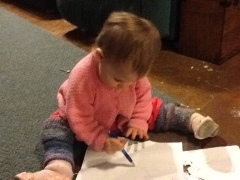
Drawing seriously

Book Review: The Complete Idiot’s Guide to Urban Homesteading & to Self-Sufficient Living

The Complete Idiot’s Guide to Urban Homesteading
Sundari Elizabeth Kraft
Paperback, 352 pages
Published by Penguin Group (USA)
ISBN: 9781615641048

And

The Complete Idiot’s Guide to Self-Sufficient Living
Jerome Belanger
Paperback, 400 pages
Published by Penguin Group (USA)
ISBN: 9781592579457

Reviewed by Molly Remer

Written in clear, straightforward language and covering an impressive array of topics, Urban Homesteading and Self-Sufficient Living, are excellent resources to those on a sustainable living path. At first I expected them to be “too basic,” but discovered useful information and resources applicable to people at various stages and experience levels. Because they are so comprehensive, the books both serve primarily as a broad overview of relevant topics, rather than as in-depth how-to guides. They serve to whet your appetite for further resources for a sustainable lifestyle.

I’m not a fan of the title Complete Idiot’s Guide in general, finding it unnecessarily insulting rather than amusing, but that is a minor drawback to these thorough, useful guides.

Of the two tomes, The Complete Idiot’s Guide to Urban Homesteading really shines. The focus is on micro-farming and self-sufficiency for the city dweller. It covers gardening (including options for those without yards), chickens and other small livestock, food preservation and preparation (including cheesemaking and various recipes for food prep), soapmaking, composting, foraging, and off-grid living. It also includes information about zoning laws and working with landlords. As someone who has homesteaded in a rural area for a number of years, I still found the Urban Homesteading book quite useful and informative.

The Complete Idiot’s Guide to Self-Sufficient Living focuses on living a self-reliant lifestyle and on sustainable living. It covers topics such as gardening, kitchen coordination, raising animals, and self-sufficient housing.

Disclosure: I received complimentary copies of these books for review purposes.

Toddler Birth Art

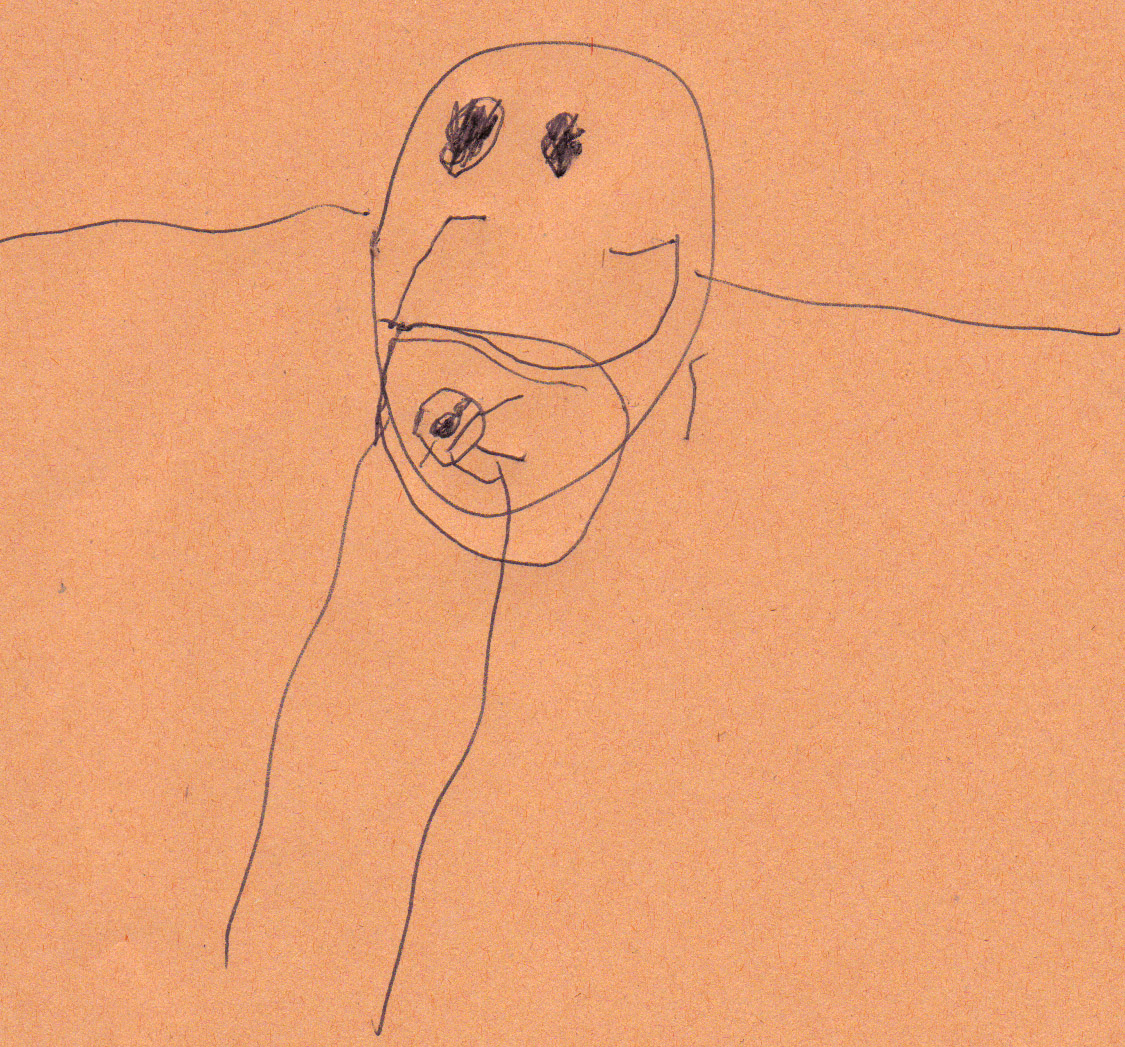
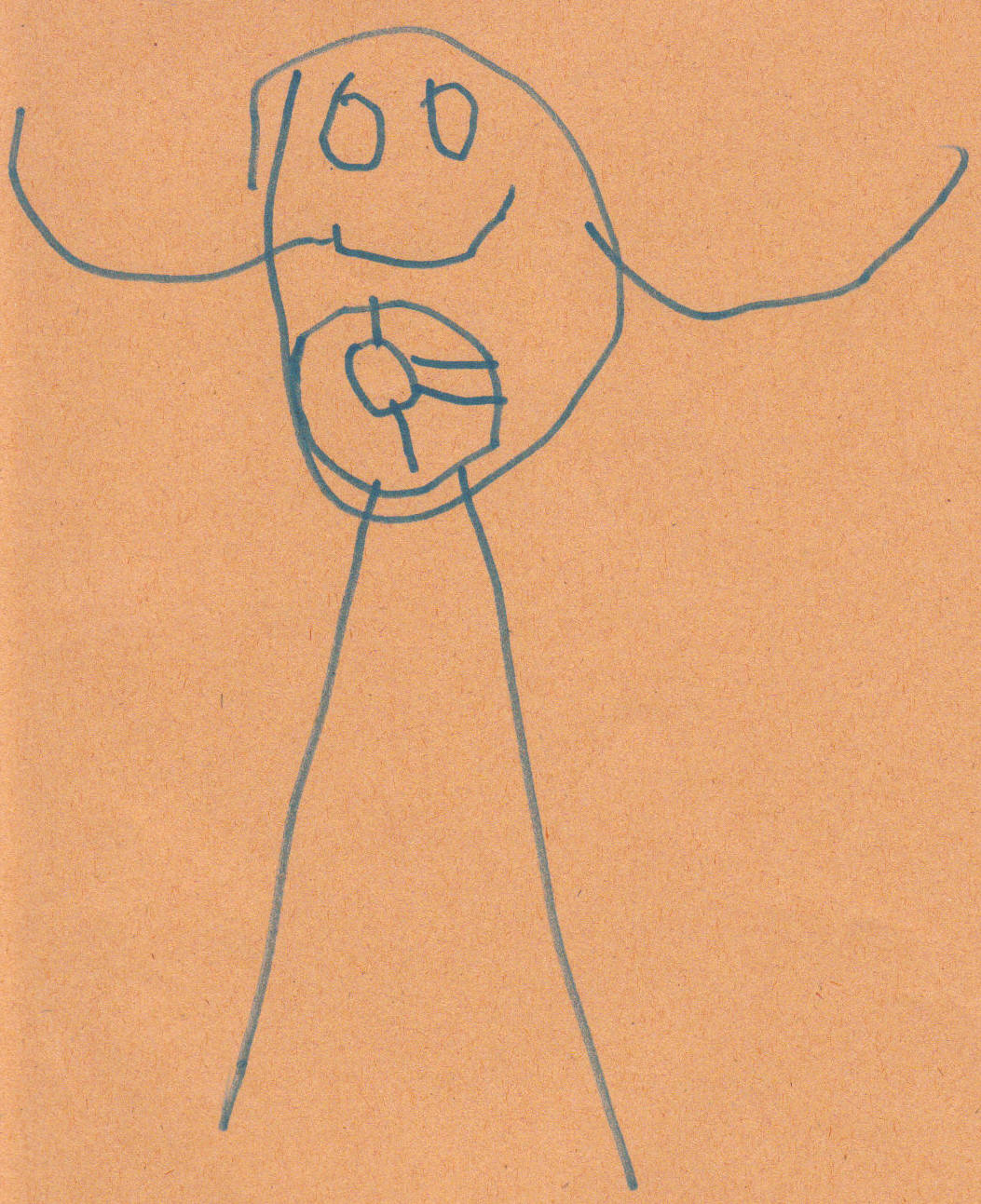
As I look at these drawings by my older son at ages 2.5 and 3.5, I feel quite a pang. This time has passed. He is eight now. He hasn’t drawn a picture like this in years. I didn’t fully realize at the time that he was drawing them that it was a one shot deal—looking at them gives me that familiar feeling of, but that was SO REAL. That was my life and my toddler and now our life landscape is a totally different one. Obviously, I guess I did have some recognition of the one shot nature, because I did save the drawings and have them to share this much later. In the first two pictures, which he drew before I gave birth to his brother, I love how the baby’s eyes match the mother’s.

I love how the baby looks like it is "floating" in this one.

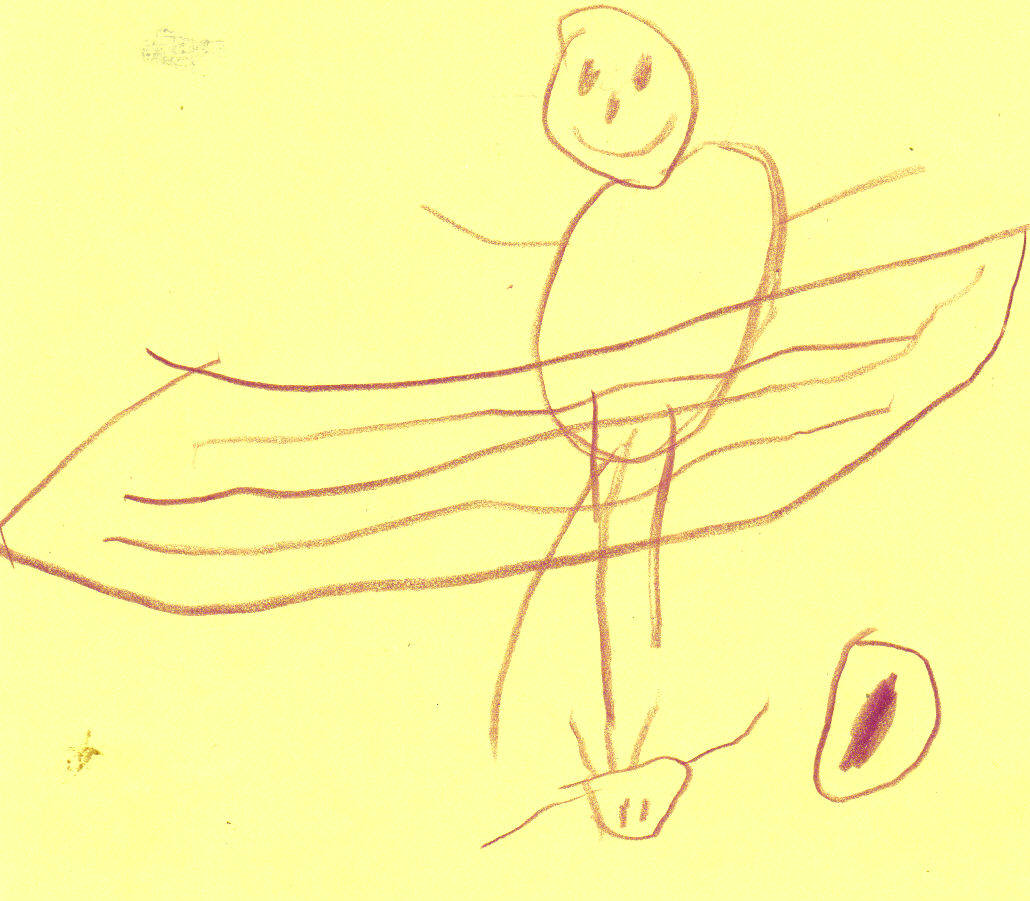
After Zander was born, Lann got a little older and a little more skillful at drawing. I forget exactly when he drew this one, it was sometime during Z’s first year I think, and is obviously based on Lann’s own observations of the birth, rather than just the idea of “mama’s got a baby in there.”

Love the placenta in a bowl and the baby attached to the mama with cord (yes, I know the two are mutually exclusive, but I love these details anyway!)

I forget if I’ve ever shared Lann’s version of his own birth story here. I asked him about it when he was about two (so, before he’d ever seen a birth). Do you remember being born? He immediately said yes and I asked him what it was like. He said:

Swimming.
Swimming down out of mama.
Crying.
Nursies.
Happy now!

This was a surprisingly accurate thumbnail snapshot of his birth. He cried when only his head was born. I brought him to my chest and said, totally instinctively with no pre-planning of the name, “do you want some nursies, baby?” and he immediately latched on and nursed. 🙂

These pictures and these thoughts are exactly why I write so much and why I have a semi-obsession with storing papers, drawings, writings, the printed word (I joke about being a personal archivist), it is because seeing them or reading what I’ve written later, brings that so real feeling back to me and that life that I lived, those babies that I raised, are vivid again, rather than faded, fuzzy, or forgotten.

Motherful

“…browsing through a dictionary one evening, I came across a medieval word that has fallen out of usage. It is ‘motherful.’ It would be good to have this word back. We could use it as we use ‘wonderful’ or ‘beautiful,’ to describe something that startles us with its wonder or beauty. A mother might look impressively efficient as she turns up for her work. But when she is together with her child again, we may marvel at the change in her as she relaxes into being motherful.

It may be a challenge to struggle through transitional discomforts as we ripen into mothers. But the better we can understand ourselves, the more we shall be able to support one another–in being motherful to our children.” –Naomi Stadlen (“Learning to be Motherful,” in New Beginnings magazine, issue 2, 2009)

Stadlen’s book, What Mothers Do, is one of my top recommendations for new mothers. One of my favorite things about it is how she explores how culturally we lack an appropriate vocabulary of motherhood and ascribe more value to the other tasks of “getting things done” while simultaneously taking care of children than the multitude of subtle behaviors and actions that make up the nearly invisible act of mothering. She uses an example of a mother trying to brush her teeth and being interrupted by the baby–we see the toothbrush left behind and think that the mother is getting “nothing done,” while in reality, she is mothering at that moment.

Look at that motherful sight! 🙂

I’ve found it helpful to re-read this book with each baby, because I am so likely to fall into the “getting nothing done” mental trap. Stadlen does an amazing job making the point that when we have to stop “getting things done” to look after our babies we ARE still doing something, we are MOTHERING and that truly still is getting “something done.” While I still thing things like that, the reframing really, really helped me. We do lack a vocabulary in our culture to describe what mothering is–we see someone shopping with two kids in the store and we only count the shopping as “getting something done,” the mothering acts the mother performs as she navigates the store while caring for her children are invisible (both to the observer and often to the mother herself).

The word motherful reminds me of Dr. Bradley’s great word, “motherlike”–as in, giving birth may not be ladylike, but it sure is motherlike. I’d like to see both words in common usage.

I think I’ve found my topic for my next LLL meeting!

Child’s birth art

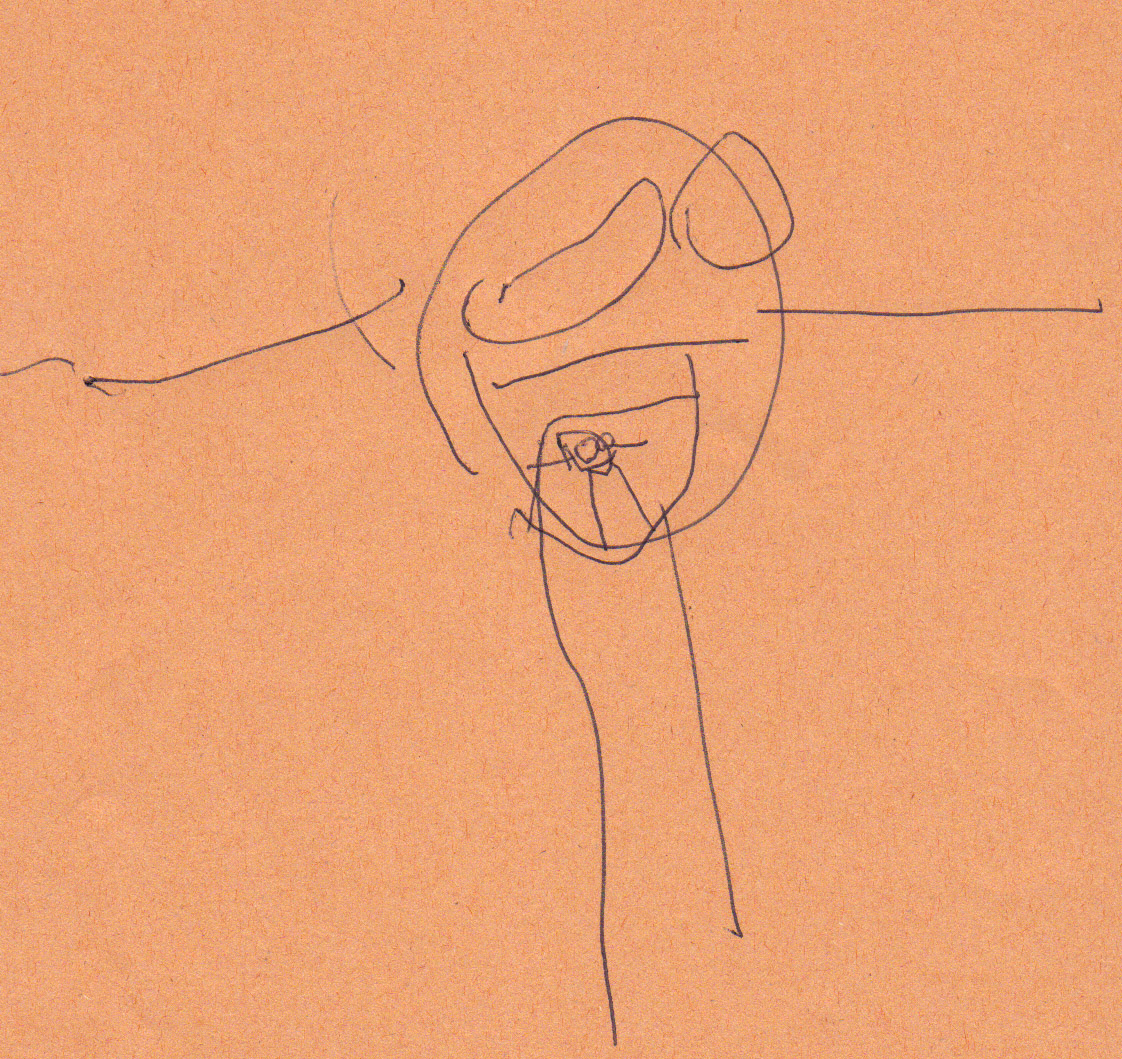
As I continue to embark on decluttering projects during my Facebook retreat, I found this awesome little drawing saved in one of my notebooks. I think it was drawn by my older son when he was about three:

20120204-214308.jpg
I love her smiling face and that birth was/is such a normal thing to him.

I have some others from this same time period that I should share soon too. One touch that I love in several is the placenta in a bowl next to mom 🙂

What a nice day!

Perhaps it is just a coincidence or simply due to the fact that Alaina took a lovely nap, but this no-Facebook retreat certainly seemed productive today! I decluttered/re-organized the hall closet, wrote two essays for one of my doctoral classes (the last two in this class as I already turned in my final paper earlier in the week), wrote a new blog post (and now this one), caught up on posts with my online classes, graded ALL my midterms (extra thanks to my parents for letting the kids visit for an extra 30 minutes so I could finish the last three), and made homemade spinach and mozzarella focaccia for dinner. Oh, and I did three loads of laundry too and made Nutella cocoa and later “Christmas crunch” candy. The boys worked on their movie, set up a Lord of the Rings scene with little toys, cleaned the living room, played with playdough, drew pictures, planned their party, and danced with Alaina while listening the radio. They also ate large quantities of mini pancakes. Alaina mashed playdough all over floor, human can-openered the lid off the vinegar, tried to get in the fridge, begged to go outside in the rain, gleefully watched small stray puppy eat some table scraps outside, tried to catch kitties, helped me poke the fire, nursed to sleep in Ergo, took nice nap, put playmobil into a houseplant, showed how big she was by picking up the footstool, sneaked into brothers’ room and collected small objects, had a bath, and whacked self in face with a toy horse making a bloody scratch/hole in eyebrow.

20120203-221512.jpg Showing eyebrow scratch.

20120203-221458.jpg

Taking a nursing break in the closet I was cleaning.

Still haven’t done any work on the crocheted Yodas…

Some reminders for postpartum mamas & those who love them

Postpartum with Alaina, February 2011

I recently finished a series of classes with some truly beautiful, anticipatory, and excited pregnant women and their partners. I cover postpartum planning during the final class and I always feel a tension between accurately addressing the emotional upheavals of welcoming a baby into your life and marriage and “protecting,” in a sense, their innocent, hopeful, eager, and joyful awaiting of their newborns.

This time, I started with a new quote that I think is beautifully true as well as appropriately cautionary: “The first few months after a baby comes can be a lot like floating in a jar of honey—very sweet and golden, but very sticky too.” –American College of Nurse-Midwives

Matrescence

In Uganda there is a special word that means “mother of a newborn”–-nakawere. According to the book Mothering the New Mother, “this word and the special treatment that goes with it apply to a woman following every birth, not only the first one. The massages, the foods, the care, ‘they have to take care of you in a special way for about a month.'”

There is a special word in Korea as well. Referring to the “mother of a newborn child,” san mo describes “a woman every time she has had a baby. Extended family and neighbors who act as family care for older children and for the new mother. ‘This lasts about twenty-one days…they take special care of you.'”

These concepts—and the lack of a similar one in American culture—reminds me of a quote from Sheila Kitzinger that I use when talking about postpartum: “In any society, the way a woman gives birth and the kind of care given to her and the baby points as sharply as an arrowhead to the key values of the culture.” Another quote I use is an Asian proverb paraphrased in the book Fathers at Birth: “There is a proverbial saying in the East: The way a woman takes care of herself after a baby is born determines how long she will live.” While this quote usually gets some nervous laughter, I think it is impresses upon people how vital it is to plan for specific nurturing and care during this vulnerable time.

Dana Raphael, the author of Breastfeeding: The Tender Gift, who is best known for coining the word “doula” as it is presently used, also coined another valuable term: matrescense. “Nothing changes life as dramatically as having a child. And there was no word to describe that. So we invented the word—matrescence—becoming a mother.”

The postpartum law of threes

I also share the “law of threes” with my clients which I learned from an article titled “Baby Moon Bliss” by Beth Leianne Curtis in Natural Life, Fall 2008:

A helpful tool I share with students and clients of mine is what I describe as the ‘law of threes’ when beginning the postpartum period. The first three days after your baby is born, try to stay in bed or at least in your bedroom. Many other cultures worldwide have much longer ‘lying in’ periods for mother and baby. If you can give yourself the much-deserved rest of focusing on breastfeeding, sleeping, eating, and recovering from the work of labor, your body and your baby will thank you for it. While birth is a healthy, normal event, honor the recovery process that your hard working body needs and deserves. The less you physically do in the initial few days following childbirth, the better and stronger you will feel in the weeks ahead. …Next, prepare to have three weeks of meals readily available for breakfast, lunch, and dinner….” (don’t forget plenty of snacks at easy reach for breastfeeding!)

Finally, understand that those first three months after birth are truly a time to embrace the unexpected…for some mothers, after three months is when breastfeeding really begins to be fun and easy. Many parents find that at the end of this [fourth trimester] transitional time, baby has moved through any colicky phases and that suddenly baby looks and acts more like a ‘real person.’…Physically, this is when your body begins to return to its pre-pregnancy state.

When I present about this topic to groups, sometimes I hear the following types of remarks: “Getting back out made me feel better, I would be miserable lying around in bed all day”—at the time when my own first baby was born, I would have said this was true for me as well, but looking below the surface shows me something else. Someone who hadn’t planned for a nurturing, comforting, supportive postpartum cocoon and who hadn’t given herself permission to rest, relax, and restore. The same high-achieving style that served me well in the workplace did not nourish me physically or emotionally as a tender new mother. I firmly believe that a nurturing postpartum downtime lays foundation for continued “mother care” self-nurturing for the rest of your life.

Then, in my notebook, I found the following relevant quotes that I had saved from the book Natural Health After Birth by Aviva Jill Romm:

“Too often women develop the mindset that a good mother gives all and takes nothing for herself. Remember, this is a great cultural fallacy. A good mother gives of herself to her children, but she has to have a self to give. A good mother nurtures herself, develops her own interests, even if in small ways, and grows as a person along with her children. Children don’t need us to be martyrs; they need us to be their mothers. A self-actualized mother sets an example for her own daughters that becoming a mother expands identity, not limits it.”

–Aviva Jill Romm, Natural Heath After Birth

“To put a child on Earth, an immense amount of creative intelligence flowed from the Great Spirit, through nature itself into your body, heart, and mind–remaining now, as an integral part of your own spirit. This energy is yours forever. Like a pocket, deep and filled with magic seeds of creativity and healing, this is the source of unconditional loving from which every wise woman since the beginning of time has drawn her strength.”

–Robin Lim

“Motherhood is raw and pure. It is fierce and gentle. It is up and down. It is magic and madness. Single days last forever and years fly by…Be gentle with yourself as you travel, dear mother. Don’t miss the scenery. Don’t miss conversation with your traveling companions. Laugh at the bumps and say ‘ooh, aah!’ on the hairpin turns. Buckle your seat belt. You’re a mom!”

–Aviva Jill Romm

Helpful articles

Planning for Postpartum—this is one of my past articles that I remain proud of

How other cultures prevent PPD—helpful article by Kathleen Kendall–Tackett

DONA’s handout for making a postpartum plan—I think couples should spend at least as much time to developing a postpartum plan as they do to making their birth plans.

Support & Sanity Savers handout for class from Great Expectations—this is one of my very favorite postpartum handouts to use for birth classes, particularly the last page which is a “request for help after the baby is born” letter to prospective helpers that includes a “coupon” for people to fill out with what they’re willing to do for the new parents.