Archives

The Great Birth (of the Universe)

I love it when someone writes with passion, heart, depth, and poetry about natural and scientific phenomena and as such greatly enjoyed an essay by Brian Swimme in the book Reweaving the World: The Emergence of Ecofeminist Philosophy. As an educator and a homeschooling mother (as well as a former homeschooler myself), I also appreciated his telling observation that (formal) education is a major cause of the “lobotomy” of which he writes: “…by the time they are done training us as leaders for our major institutions, we have only a sliver of our original minds still operative. What sliver is left? …the sliver chiseled to perfection for controlling, for distancing, for calculating, and for dominating. The rest has been sacrificed in the surgery of patriarchal initiation” (p. 16).

Since most children spend 12 years minimum steeped in this educational culture, is it any wonder that we find ourselves in our current social and political conditions? This surgery of which Swimme speaks leads to a mechanical conception of the operations, functioning, and majesty of the universe, meant to be analyzed rather than marveled over.

Rather than a Big Bang, the birth of the universe is much more aptly described in terms of a Big Birth: “Not bombs, not explosions, not abhorrence…a birthing moment, the Great Birth. To miss the reality of birth in these scientific facts is to miss everything. It is to sit at the heavily laden table and starve. For here is a great moment in human consciousness. Now for the first time in all of human history we have empirical and theoretical evidence of a reality that has been celebrated by primal people for millennia…the mathematics of this initial, singularity of space/time are not enough. We require song and festival and chanting and ritual and every manner of art so that we can establish an original and felt relationship with the universe…our universe is quite clearly a great swelling birthing event, but why was this hidden from the very discoverers of the primeval birth? The further truth of the universe was closed to them, because central regions of the mind were closed…I am sensitive to the charge that poetry [like this] is just an ‘addendum’–that what are real are the empirical facts, while the rest is commentary. On the contrary, what is true is that this universe is a stupendous birth process, an engendering reality…” (p. 19).

This is the kind of theapoetics that makes me swoon! What would our world, our culture, the way in which we give birth, and the way in which women are treated look like if we grew up with a Great Birth rather than a Big Bang?

Swimme continues: “From a single fireball the galaxies and stars were all woven. Out of a single molten planet the hummingbirds and pterodactyls and gray whales were all woven. What could be more obvious than this all-pervasive fact of cosmic and terrestrial weaving? Our of a single group of microorganisms, the Krebs cycle was woven, the convoluted human brain was woven, the Pali Canon was woven, all part of the radiant tapestry of being. Show us this weaving? Why, it is impossible to point to anything that does not show it, for this creative, interlacing energy envelops us entirely. Our lives in truth are nothing less than a further unfurling of this primordial ordering activity…Women are beings who know from the inside out what it is like to weave the Earth into a new human being” (p. 21, emphasis mine).

So, if the patriarchal initiation of modern education doesn’t do the job, what should we teach our children? “We will teach our children at a young age the central truth of everything: that this universe has been weaving itself into a world of beauty for 15 billion years, that everything has been waiting for their arrival, for they have a crucial if unknown role to play in this great epic of being. We will teach that their destinies and the destinies of the oak trees and all the peoples of Earth are wrapped together. That the same creativity suffusing the universe suffuses all of us, too, and that together we as a community of beings will fashion something as stupendous as the galaxies” (p. 22).

I believe this is ecofeminism in practice.

Breastfeeding as an Ecofeminist Issue

Breasts are a scandal because they shatter the border between motherhood and sexuality.

––Iris Marion Young

After Hurricane Katrina, I read a news story about a young mother whose newborn baby died of dehydration during the days in which she had been stranded without access to clean water. Upon admittance to the hospital, the mother was asked if she needed anything and she replied that her breasts were uncomfortable and could she have something to dry up the milk. This story brings tears to my eyes and chills to my body. What does this say about our culture that it is actually possible for mothers to be unaware that they carry the power to completely nourish their own babies with their own bodies? As mammals, all women have the potential to be lactating women until we choose not to be. The genius of formula marketing and advertising is to get women to withhold from their offspring that which they already have and to instead purchase a replacement product of questionable quality. To me this feels like being a given a “choice” between the blood already flowing through your veins and a replacement product that marginally resembles blood.

We are mammals because as a species we nurse our young. This is a fundamental tie between the women of our time and place and the women of all other times and places as well as between the female members of every mammal species that have ever lived. It is our root tie to the planet, to the cycles of life, and to mammal life on earth. It is precisely this connection to the physical, the earthy, the material, the mundane, the body, that breastfeeding challenges men, feminists, and society.

Breastfeeding is a feminist issue and a fundamental women’s issue. And, it is an issue deeply embedded in a sociocultural context. Attitudes towards breastfeeding are intimately entwined with attitudes toward women, women’s bodies, and who has “ownership” of them. Patriarchy chafes at a woman having the audacity to feed her child with her own body, under her own authority, and without the need for any other. Feminism sometimes chafes at the “control” over the woman’s body exerted by the breastfeeding infant.

Part of the root core of patriarchy is a rejection of the female and of women’s bodies as abnormal OR as enticing or sinful or messy, hormonal, complicated, confusing…. Authentic feminism need not be about denying biological differences between women and men, but instead about defining both as profoundly worthy and capable and of never denying an opportunity to anyone for a sex-based reason. Feminism can be about creating a culture that values what is female as well as what is male, not a culture that tries to erase or hide “messy” evidence of femaleness.

However, precisely because of the patriarchal association of the female with the earthy and the physical, feminists have perhaps wanted to distance themselves from breastfeeding. This intensely embodied biologically mandated physical experience so clearly represents a fundamental difference between men and women that it appears to bolster biological reductionism. Yet in so doing feminism then colludes with patriarchy and itself becomes a tool of the patriarchy in the repression and silencing of women and their leaky ever-changing, endlessly cycling bodies: these bodies that change blood into food and bleed without dying and provide safe passage for new souls upon the earth. Sometimes the issue of a woman’s right not to breastfeed is framed as a feminist “choice.” This is a myth, made in the context of a society that places little value on women, children, and caregiving. It is society that needs to change. Not women and not babies.

Systemic and Structural Context

In an essay for the Academy of Breastfeeding Medicine on “What does feminism have to do with breastfeeding?”, Maternal–fetal medicine specialist Dr. Alison Stuebe (2010) points out that for the most part feminist advocacy ignores breastfeeding and that most breastfeeding advocacy sidesteps the complicated contextual issues of women’s lives. Stuebe notes:

…the conventional wisdom is that breastfeeding is a maternal duty that forces women to eschew their career aspirations to fulfill some ideal of motherhood, while feminism is about liberating women from exactly those constraints. Case closed. Or is it?…The result is that women end up fighting among themselves about the choices our society forces us to make — motherhood or career? Breast or bottle? — instead of uniting to address the societal structures that prevent women from realizing their full potential.

Appropriately, Stuebe further notes that:

…breastfeeding is not a ‘choice.’  Breastfeeding is a reproductive right. This is a simple, but remarkably radical, concept. Here’s why: When we frame infant feeding as a choice made by an individual women, we place the entire responsibility for carrying out that choice on the individual woman…Indeed, the ultimate link between breastfeeding and feminism is that in a truly equitable society, women would have the capacity to fulfill to pursue both their productive and reproductive work without penalty.

And, in considering contextual and systemic issues that impact women every day, Stuebe points out that:

These issues transcend breastfeeding. Why, for example, do we pit “stay at home moms” against “working moms,” rather than demand  high-quality, affordable child care, flexible work, and paid maternity leave so that each woman can pursue both market work and caring work, in the proportion she finds most fulfilling? Why do we accept that, if a woman devotes all of her time to caring for her family, she does not earn any social security benefits, whereas if she gets a paying job and sends her children to day care, she and her day care provider earn credits toward financial security in old age? And why do we enact social policies that subsidize child care and require poor mothers to enter the paid work force, rather than support poor mothers to care for their own children?…

Naomi Wolf (2003) also addresses the myth of  “choice” regarding breastfeeding (specifically with regard to lack of support for breastfeeding while working outside the home) in her book Misconceptions: “…it was unconscionable for our culture to insist that women ‘choose’ to leave their suckling babies abruptly at home in order simply to be available for paid work.” (p. 270) Wolf also quotes Robbie Kahn who says, “the job market holds out an all-or-nothing prospect to new mothers: you can give your body and heart and lose much of your status, your money, your equality, and your income; or, you can keep your identity and your income—only if you abandon your baby all day long and try desperately to switch off the most powerful primal drive the human animal can feel.” And, then considering the argument that bottle feeding “liberates” women from the tyranny/restrictiveness of breastfeeding: “The liberation women need is to breastfeed free of social, medical, and employer constraints [emphasis mine]. Instead, they have been presented with the notion that liberation comes with being able to abandon breastfeeding without guilt. This ‘liberation,’ though, is an illusion representing a distorted view of what breastfeeding is, what breastfeeding does, and what both mothers and babies need after birth” (Michels, p. xxx). Often, not breastfeeding is a structural and systemic symptom of a patriarchal society that devalues women and caregiving work and views the masculine body as normative, not a personal choice!

I am a systems thinker and always hold in mind that breastfeeding, like all aspects of women’s lives, occurs in a context, a context that involves a variety of “circles of support” or lack thereof. Women don’t “fail” at breastfeeding because of personal flaws, society fails breastfeeding women and their babies every day through things like minimal maternity leave, no pumping rooms in workplaces, formula advertising and “gifts” in hospitals, formula company sponsorship of research and materials for doctors, the sexualization of breasts and objectification of women’s bodies, and so on and so forth. According to Milk, Money, and Madness (1995), “…infant formula sales comprise up to 50% of the total profits of Abbott Labs, an enormous pharmaceutical concern.” (p. 164) And the US government is the largest buyer of formula, paying for approximately 50% of all formula sold in the nation.

In a brilliant analysis of the politics of breastfeeding in the US, Milk, Money, and Madness (1995), by Dia Michels and Naomi Baumslag, the following salient points are made about why women in the US so often experience breastfeeding problems: “In western society, the baby gets attention while the mother is given lectures [emphasis mine]. Pregnancy is considered an illness; once the ‘illness’ is over, interest in her wanes. Mothers in ‘civilized’ countries often have no or very little help with a new baby. Women tend to be home alone to fend for themselves and the children. They are typically isolated socially and expected to complete their usual chores, including keeping the house clean and doing the cooking and shopping, while being the sole person to care for the infant…” (p. 17)

Michels and Baumslag go on to explain:

According to the US rules and regulations governing the federal worker, the pregnancy and postdelivery period is referred to as “the period of incapacitation.” This reflects the reality of a situation that should be called ‘the period of joy.’ Historically, mothering was a group process shared by the available adults. This provided not only needed relief but also readily available advice and experience. Of the “traditional” and “modern” child-rearing situations, it is the modern isolated western mom who is much more likely to find herself experiencing lactation failure [emphasis mine]. (p. 18)

There is a tendency for modern women to look inward and blame themselves for “failing” at breastfeeding. There is also an unfortunate tendency for other mothers to also blame the mother for “failing”—she was “too lazy” or “just made an excuse,” etc. We live in a bottle-feeding culture; the cards are stacked against breastfeeding from many angles–economically, socially, medically. When I hear women discussing why they couldn’t breastfeed, I don’t hear “excuses,” I hear “broken systems of support” (whether it be the epidural in the hospital that caused fluid retention and the accompanying flat nipples, the employer who won’t provide a pumping location, the husband who doesn’t want to share “his breasts”, or the mother-in-law who thinks breastfeeding is perverted). Of course, there can actually be true “excuses” and “bad reasons” and women theoretically always have the power to choose for themselves rather than be swayed by those around them, but there are a tremendous amount of variables that go into not breastfeeding, besides the quickest answer or what is initially apparent on the surface. As noted previously, breastfeeding occurs in a context and that context is often one that does not reinforce a breastfeeding relationship. In my seven years in breastfeeding support, with well over 800 helping contacts, I’ve more often thought it is a miracle that a mother manages to breastfeed, than I have wondered why she doesn’t.

The ecology of breastfeeding

A breastfeeding baby is the topmost point on the food chain (above other humans who consume other animals, because a breastfeeding baby is consuming a human product) and as such is deeply impacted by the body burden of chemicals stored by the mother. The book Having Faith: An Ecologist’s Journey to Motherhood (2003), Sandra Steingraber closely examines these factors in both an interesting and disturbing read. The body of the mother during pregnancy and breastfeeding is the natural “habitat” of the baby and our larger, very polluted environment has a profound impact on these habitats. Mothers have pesticide residues and dry cleaning chemicals, for example, in their breastmilk. The breastfeeding mother’s body is quite literally the maternal nest and a motherbaby is a single psychobiological organism. At an international breastfeeding conference in 2007, I was fortunate enough to hear Dr. Nils Bergman speak about skin-to-skin contact, breastfeeding, and perinatal neuroscience. The summary version of his findings are that babies need to be with their mothers following birth in order to develop proper neural connections and ensure healthy brain development and proper brain “organization”; mother’s chest is baby’s natural post-birth “habitat” and is of vital developmental and survival significance; and that breastfeeding = brain wiring.

A baby has no concept of the notion of independence. Even though we live in a culture that pushes for independence at young ages, all babies are born hard-wired for connection; for dependence. It is completely biologically appropriate and is the baby’s first and most potent instinct. Mother’s body is baby’s home—the maternal nest. If a baby cries when her mother puts her down, that means she has a smart baby, not a “dependent” or “manipulative” one.

What happens when society and culture pollute the maternal nest? Is that mother and baby’s problem or is it a political and cultural issue that should be of top priority? Unfortunately, many politicians continue to focus on reproductive control of women, rather than on human and planetary health.

Antonelli (1994) explores women’s reproductive rights in this passage in The Politics of Women’s Spirituality:

Human life is valuable and sacred when it is the freely given gift of the Mother—through the human mother. To bear new life is a grave responsibility, requiring a deep commitment—one which no one can force on another. To coerce a woman by force or fear or guilt or law or economic pressure to bear an unwanted child is the height of immorality. It denies her right to exercise her own sacred will and conscience, robs her of her humanity, and dishonors the Goddess manifest in her being. The concern of the anti-abortion forces is not truly with the preservation of life, it is with punishment for sexuality [and devaluation of the female]. If there were genuinely concerned with life, they would be protesting the spraying of our forests and fields with pesticides known to cause birth defects. They would be working to shut down nuclear power plants and dismantle nuclear weapons, to avert the threat of widespread genetic damage which may plague wanted children for generations to come… (p. 420).


If we valued breastfeeding as the birthright of each new member of our species, we would not continue inventing new breastmilk substitutes that encourage mothers to abandon breastfeeding. We would not continue to pollute the earth, water, and sky and in so doing increase the body burden of hazardous chemicals carried by mother and child. We would not treat as normative workplaces that expect and champion mother–baby separation after a few scant weeks of maternity leave. We would not accept broken circles of support as, “just the way things are.” And, we would not settle for a world that continues to sicken its entire population by devaluing, dishonoring, dismissing, and degrading our own biological connection to the natural world. As Charlene Spretnak states in The Womanspirit Sourcebook (1988):

In a broader sense the term patriarchal culture connotes not only injustice toward women but also the accompanying cultural traits: love of hierarchical structure and competition, love of dominance-or-submission modes of relating, alienation from Nature, suppression of empathy or other emotions, and haunting insecurity about all of those matters. The spiritually grounded transformative power of Earth-based wisdom and compassion is our best hope for creating a future worth living. Women have been associated with transformative power from the beginning: we can grow people out of our very flesh, take in food and transform it into milk for the young. Women’s transformative wisdom and energy are absolutely necessary in the contemporary struggle for ecological sanity, secure peace, and social justice. (p. 90)

As Glenys Livingstone stated: “It is not female biology that has betrayed the female…it is the stories and myths we have come to believe about ourselves [emphasis mine].” (p. 78) The stories we have come to believe are many and have complicated roots in both patriarchal social structures and in feminist philosophies that fail to recognize the potent and profound sociocultural legacy represented by the transformation of women’s blood to milk to life

Molly Remer, MSW, ICCE, CCCE is a certified birth educator, writer, and activist who lives with her husband and children in central Missouri. She is the editor of the Friends of Missouri Midwives newsletter, a breastfeeding counselor, a professor of human services, and a doctoral student in women’s spirituality at Ocean Seminary College. She blogs about birth, motherhood, and women’s issues at https://talkbirth.me/.

This is a preprint version of the following article: Remer, M. (2012). Breastfeeding as an ecofeminist issue. Restoration Earth: An Interdisciplinary Journal for the Study of Nature & Civilization, 1(2), 34–39. Copyright © The Authors. All rights
reserved. For reprint information contact: oceanseminary@ verizon.net.

Click here for a typeset pdf version of the original article.

Sign up for the Brigid’s Grove Newsletter for resources, monthly freebies, + art and workshop announcements.

References:

Antonelli, J. (1994). Feminist spirituality: The politics of the psyche. In C. Spretnak (Ed), The politics of women’s spirituality (p. 420) Garden City, NY: Anchor Books.

Baumslag, N., & Michels, D. (1995). Milk, money, and madness: The culture and politics of breastfeeding. Washington, DC, Bergin & Garvey Trade.

Spretnak, C. (1988). The womanspirit sourcebook. New York: Harpercollins.

Steingraber, S. (2003). Having faith: An ecologist’s journey to motherhood. Cambridge, MA: Perseus Books Group.

Stuebe, A. (2010). What does feminism have to do with breastfeeding. Breastfeeding Medicine, http://bfmed.wordpress.com/2010/06/12/what-does-feminism-have-to-do-with-breastfeeding/ Retrieved on March 1, 2012.

Wolf, N. (2003). Misconceptions: Truth, lies, and the unexpected on the journal to motherhood. New York: Anchor Books.

For some more information about breastfeeding as an ecological issue, see this article: Nursing the World Back to Health, http://www.llli.org/nb/nbmayjun95p68.html

Bits of the month

I’m trying something new—a weekly (or monthly) wrap-up sort of post where I share bits and pieces that don’t warrant full posts and that allow me to share personal type things about homeschooling and so forth as well as just random thoughts and ideas and material for my personal memory archives. I’m inspired to do this by Molly Westerman’s always interesting links for thoughts posts and by a blog I stumbled across recently called The Holistic Homeschooler(she does a weekly “homeschool mother’s journal” post).

So…here goes…

What I’ve been up to

Me = grading papers and final exams. The last day of the session is today

What boys have been up to

They both enjoy playing Minecraft to an almost obsessive degree. This week they’ve been working on plans for programming mods for the game and setting up sort of mock worlds with things they’d like their mods to have. Lann worked on a Batman themed mod and Zander’s is about “hunchback zombies” (many of whom are holding cakes).

New dog Dagger!

They’ve been making movies for the last several months in a very dedicated manner that I’ve really enjoyed observing. Over 300 video clips have been filmed since this new project began. And, then, this week, the perhaps inevitable happened—they dropped and broke my camera. It was around $300, but I quickly realized that I didn’t have any grounds to be mad at them (despite the fact that they’d been carefully instructed to always keep the strap around their wrist and to be careful). When you give 8 and 5 year old’s free reign with a camera, breakage is definitely a possible side effect. I also try very hard to remember the people before things mantra. So, now their extensively movie making projects are on hold until we figure out a replacement. I’m thinking a low cost kid-friendly, video-capable camera and an adult camera might be the most logical plan.

They buzz with ideas constantly. Lann’s big project idea this week was for a virtual reality helmet. Mark and I both struggle with the balance between expressing interest in his ideas and offering reality checks. It can be extraordinarily exhausting, truly. The other thing they came up with is a cartoon strip about “Poo Log Dog.” This is based on their intense dislike of our new little dog, Dagger, who showed up skinny and starving last month and is now part of the family. I like him, which is a real shocker, because dogs are not my favorite. The boys are less enraptured.

We’re back to our no artificial colors experiment which seems to have a drastic impact on Z’s rage fits, Lann’s teasing, and their cooperation with each other. We’ve had days and days of happy playing, bright energetic faces and ideas, and very little discord or meltdowns.

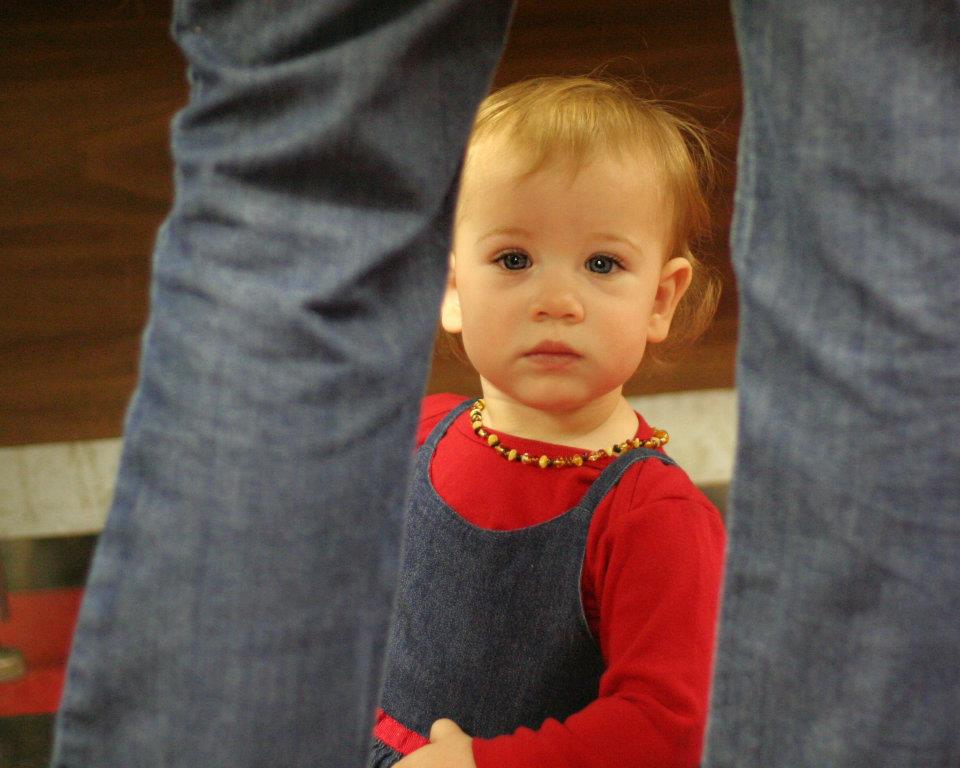
I love this baby's eye view picture taken by my friend at the playgroup Valentine party last month.

What baby has been up to

Walking more and more—I think we’ve almost seen the last of the crawling baby and the funny little one foot on ground, one leg down scoot-drag-crawl.

Climbs up on couch and onto stepstool in bathroom

Walks unsupported outside

Loves outside—loves so very much.

Likes to do mischievous stuff on purpose and stare at person til they notice and then squeal/yell while staring in their eyes.

Makes addle, addle, addle sound with tongue. Still uses adorable, “hmmm?” question-intonation sound to ask for or about things. Says Dagger, dog, Daddy, dragon, and quite a few other things. Refuses to perform any of them on command.

Loves to spin! In hammock swing outside, on Sit n Spin toy, dancing with brother. (A long time ago, pre-kids, I went to a workshop on play therapy. One of the speakers maintained that you should never bounce or rock or jiggle a baby, because it predisposes them to become addicts later in life—i.e. they start to like the feeling of having a “scrambled brain” and seek out that stimulation. It is amazing how certain, seemingly small experiences can leave a powerful legacy that cast a shadow on happy moments!)

What Mark has been up to

The man is quite focused on his plans for an aquaponics system. Is drawing plans for the greenhouse and figuring out supplies to buy. Planning to take a week off soon to focus on building it. We’ve also been doing our work party with a group of four friends. We take turns working on each other’s homesteads on alternate weekends. It has been a really good, community-building experience.

Homeschooling report

I finally did a Cartesian diver experiment (about buoyancy and air pressure) with the boys and it worked perfectly. While we did so, Alaina mashed her breakfast and a fruit leather into a cup of water.

I also signed them up for Studyladder. Jury is still out on whether this was a good plan. The graphics and style seem “primitive” in a way, like they were programmed in the late 90’s. However, I like it because they have math and science and counting in other languages, as well as reading. It seems much more comprehensive and full scale. Lann has also been wanting to work on his Click N Read Phonics lately and Zander has been doing Reading Eggs (still our favorite) and occasionally Starfall (we pay for the “more” version). Jumpstart we’ve let go, because even though it has really cool graphics and features, we can rarely get it to start up without crashing/freezing/or being generally frustrating.

I’ve been trying to find a good new book to read aloud to them. We keep reading the first chapter of various (free Kindle) books and then deciding we want something different.

This week (month) in blog news

I hit the 200,000 hit mark! That is pretty good for something that started out only intended for a local audience. I checked my annual stats too and noticed that in 2008 (my first full year of blogging), I had 8,000 hits during the entire year. Just this past week, my All that Matters is a Healthy Husband post had 8,000 hits by itself. ;-D Another new post that had a lot of shares and views was the Spontaneous Birth Reflex. I was happy to finally write it and also its related companion piece about the Rest and Be Thankful Stage of labor. My Honoring Miscarriage discussion and giveaway are still open too.

What’s on my mind

I am nearly speechless and also horrified about the current political obsession with contraception. This isn’t about birth control it is about woman control. I can’t stand it! And, I do not consider contraception to be a “women’s issue,” it is a human issue. Last time I checked, men participated in sex too. And, they too, desire a size of family that is compatible with their other needs (financial, personal, whatever). Likewise, many, many happily married, monogamous couples choose to use birth control and ; enjoy being able to have sex without procreating. It would be bizarre to characterize a man’s desire to be responsible for his own fertility as, “being paid to have sex all day.” It is equally bizarre to apply this claim to women.

In my work for my doctoral classes, I focus extensively on body politics, reproductive rights/politics, feminism, women’s rights, and personal autonomy as well as the historical and sociopolitical context of these issues. Since I live in a conservative area and have a “public” reputation to maintain, I shy away from addressing any of these subjects in depth here (I’m very googleable by students and prospective clients—heck, this blog was originally intended exclusively as a business tool for my local clients). However, in an ironic twist, that is exactly the kind of social control/inhibition/silencing/oppression of women that I am so passionate about addressing in my doctoral work. In fact, my dissertation is going to be about a thealogy of the body and how women’s bodies are the very terrain upon which patriarchal religious structures are built and maintained.

What I’m reading

I just finished reading The Hunger Games for book club—gobbled it up in a couple of hours—and I’m in the middle of the second one. I also finished reading Sisters Singing which is anthology of women’s prayers, blessings, songs, and readings. I read it over the course of several months in short segments during my daily meditation/altar time. I also finished reading Daughter of the Forest (also for book club) and Nobody Girl (don’t bother) and I am Woman by Rite: A Book of Women’s Rituals. I’m currently reading Peggy O’Mara’s Way Back Home collection of essays. The boys and I are listening to the sixth Harry Potter book on tape while in the car. I really love doing this! I less love realizing that by the time we finish we will have spent a minimum of 19 hours in the car. Whew. When I’m on my own I’m listening to Trickster’s Choice by Tamora Pierce, one of my favorite childhood authors who wrote The Song of the Lioness Quartet, which is where I got Alaina’s name (I guess when I was approximately 12). I recently finished re-listening to Two for the Dough and Three to Get Deadly by Janet Evanovich.

Articles I’ve enjoyed

Breastfeeding support: less is not more

What an awesome logo for the upcoming LLL of Illinois conference!

“I feel saddened by the alarming regularity at which women give up their desire to breastfeed because breastfeeding is not the ‘best’ way to feed babies. It’s the normal way. The idea that breastfeeding is somehow extraordinary persists because we live in a culture where very limited paternity leave is normal, where an expectation to continue cooking and cleaning and exercising and socialising in the post partum weeks and months is normal, and where a perception that unpaid work (especially if it is physical and monotonous) is pointless drudgery is normal.”

Breastfeeding – Does Science Mislead Parents & Professionals?

A clear majority of public opinion in the United States supports the view that ‘breastfeeding is healthier for babies’, yet substantially more than half of the surveyed population disagree that ‘feeding a baby formula instead of breastmilk increases the chances the baby will get sick’.

If exclusive breastfeeding was the norm against which other methods are measured, breastfeeding would not be ‘protective’ and breastfed infants would not enjoy ‘lower risks of ill health’; they would instead be referred to as ‘normal’, while formula fed infants are in fact ‘exposed’ to increased risk of poor health and development.

Also enjoyed this post from The Minimalists about turning off the internet at home. Since we live out of town and I work from home teaching online AND since it is super important to me to have a home based life, it wouldn’t make any sense for me to shut off the internet at home and drive into town to use it, but for a while after reading this article I fantasized about it.

And, this inspirational short post from Roots of She.

And, some pictures:

20120229-181538.jpg

This heart-meltingly adorable sight met my eyes as I sneaked away from Alaina's napping self this week.


20120229-181550.jpg

Tiny, independent nature girl!


20120229-181640.jpg

Sweet sibling moment even though I lose crunchy points because they're watching a movie (it is Kipper though)


20120229-181708.jpg

Yes, we have a michief-maker in the house!

I have about 14 others things I was going to include, but forgot about, such as the fact that we had our first local birth network meeting in February and I feel really good about it. But, now this post is terribly long and cumbersome anyway. I’m too wordy to do a bits and pieces type post, I guess! I thought it was going to be short and simple—instead it took several hours over the course of multiple days to get ready to post. Sheesh!

Motherhood, Feminism, and More

When a woman tells the truth she is creating the possibility for more truth around her.

– Adrienne Rich (May 16, 1929 – March 27, 2012)

Some time ago Molly at First the Egg did a series of posts about the book Of Woman Born. This book is an excellent feminist classic that at the time during which I read it helped to clarify for me that it is the “institutional” elements of motherhood that I sometimes find so oppressive and binding—it isn’t the children themselves, in the climate of motherhood in which I find myself.

Several years ago I also read Fruitful, by Anne Roiphe. The subtitle is Living the Contradictions : A Memoir of Modern Motherhood. Like Of Woman Born, it was written before the more recent wave of “momoirs” (that is a kind of dismissive term, but it does help me classify the genre) and focuses heavily on feminism and its relationship to mothers/motherhood (so, different from momoirs in that the focus is less on personal experience of motherhood and more on motherhood and its social/cultural/political connections, I suppose). Fruitful is less “heavy” and depressing than Of Woman Born. The focus of the book is on the tension between feminism and motherhood (i.e. can you be a “good” feminist and also be a “good” mother) and she explores that issue throughout. Roiphe is a feminist and yet critiques some elements of the movement’s impact on mothers and motherhood. She is also very pro-father and I appreciated her exploration of men/fathers as people vs. “evil patriarchy—down with them!”

This is a quote about the crux of the mother/feminist issue: “Motherhood by definition requires tending of the other, a sacrifice of self-wishes for the needs of a helpless, hapless human being, and feminism by definition insists on attention being paid to the self. The basic contradiction is not simply the nasty work of a sexist society. It is the lay of the land, the mother of all paradoxes, the irony we cannot bend with mere wishing or might of will.

This reminds me of my journal entry from my early months as a new mother—“is it possible to balance motherhood with person-hood?” I’m still figuring it out! (some days it seems to work, some days it really doesn’t!)

During the time in which I read Fruitful, I also read The Mommy Wars. I almost didn’t read it because I was worried that it would be excessively harsh or inflammatory and I don’t need to bring things like that into my life. However, it seemed truly supportive of women/mothers. It was a collection of essays by various authors (alternating between those who have chosen to be mostly at home and those who have chosen to be mostly pursuing careers) and it quickly became clear that the most real “mommy war” that most of us experience is the one inside of our own heads. There seems to be no ideal/perfect solution. I also noticed that many of the women (including the editor of the collection) had cobbled together some sort of “balance” between working-outside-of-the-home and working inside it–there were lots of part-timers, lots of WAHMs, lots of writer-in-the-spare-minutes, etc. Since I’ve done the same, I particularly identified with those tales of struggle to discover the right balance for your family.

The first quote I wanted to share from this book is with regard to being asked “what do you do?” at a cocktail party: “I find it odd that I’d generate far more interest if I said I raised dogs or horse or chinchillas, but saying, in effect, ‘I raise human beings’ is a huge yawn...It might, in fact, be boring if child care were simply a series of pink-collar tasks–bathe, dress, feed, repeat. But observing and participating in a little Homo Sapien’s development is fascinating to me. Furthermore, being a mother isn’t just a ‘job’ any more than being a wife or a daughter; it’s a relationship.” [emphasis mine and in total agreement with this]

Then in another writer’s essay (the above was from one of the SAHM, the below is from one of the WOHM) came this interesting observation:

I remember reading once that all manner of selfishness is excused under the banner of focusing on one’s family, and it strikes me now as penetratingly true. How many of us don’t do for others because we’re supposedly saving it for our families? and how valuable is staying at home if you’re not teaching your children how much other people (and their feelings) matter?

In another book I have, The Paradox of Natural Mothering, she refers to the “family first” mentality as a type of narcissism and I do see the point.

I also wanted to share some quotes from an essay by a woman who does not yet have children, but is planning to, with regard to talking to mothers who shut down her opinions/thoughts with the, “what could you know? You don’t have children” brush-off. (Which, I personally, have definitely been guilty of thinking on more than one occasion! And, actually did so while reading this essay!):

I want to be able to say that all the judgment and aggression and competitiveness I witness among working and stay-at-home mothers surprises me and absolutely must change. But that wouldn’t be honest. I’ve been party to this one-upping and henpecking and know-it-all-ness my entire life. It’s as if becoming a mother puts us back into a sorority or junior high school, into some petri dish of experience where what other females think and say and feel and do counts more than anything.

The one thing my stay-at-home and working-mom friends share in the country of motherhood is a superiority gene, some may call it a gift of vision, that convinces them that women who don’t have children are, despite their educations and accomplishments, dumb as doorknobs. I’ve sat through many a heated conversation…during which I’ve been silly enough to offer an opinion only to be shut down more condescendingly and viciously by wise Goddess Mothers than I ever have been shut down by any man.

FWIW, I would not call this a “superiority gene” or “gift of vision,” but a “voice of experience”…I think most of us have been in the position of ourselves being the “just doesn’t get it” woman without kids! And, after you have kids of your own, you suddenly realize why “those mothers” were condescending to you.

On a somewhat related subject, I also enjoyed this post by Dreaming Aloud about the silencing of mama anger.

Midwifery & Feminism

“Midwifery work is feminist work. That is to say, midwives recognize that women’s health care has been subordinated to men’s care by a historically male, physician-dominated medical industry. Midwifery values woman-centered care and puts mothers’ needs first. Though not all midwives embrace the word feminism (the term admittedly carries some baggage), I maintain that providing midwifery care is an expression of feminism’s core values (that women are people who have intrinsic rights).
–Jon Lasser, in Diversity & Social Justice in Maternity Care as an Ethical Concern, Midwifery Today, issue 100, Winter 2011/2012

I tend to define feminism as believing in the inherent worth and value of women and acting on that belief. I see birth care as a crucial, basic feminist issue and midwifery and most types of birth activism as feminist work. While, as Lasser notes above, not all midwives embrace the term, in my personal experience some of the most beautiful, loving words and actions about the value and worth of women are exhibited by midwives.

Magic of Mothering

Nursing baby A at two weeks old


(The first part of this post is an excerpt from an assignment in one of the classes I’m taking)

“Remember, when Keplet postulated that the moon effected the tides on earth, Galileo dismissed the hypothesis as ‘occult fancy.’ It involved action at a distance, and, therefore, violated the ‘solid laws of nature’ of that time. Now these laws of nature (as they were understood by classical physics only a century ago) have already been transcended; this progression should gently hint to us that many of the solid laws of our day are beliefs that obscure the otherwise obvious” (Passmore, 168).

I have long been wary of the phrase, “we used to think, but now we know…” usually stated with great conviction and little room for debate.

Body Wisdom

As Passmore goes on to note, “It is important to make a distinction between ‘progress in science’ and its explanatory power. This power for explanation depends upon the kind of question being asked. History shows that the questions change with changing beliefs/values in both time and space, periods and cultures.” It is exciting to me to consider how much we just don’t know and yet, the world keeps on spinning along, with or without our “knowing” all the facts. I think about this with regard to birth and breastfeeding. How many generations of women have pushed out their babies and fed them at the breast without knowing the exact mechanics of reproduction even, let alone milk production. There are all kinds of historical myths and “rules” about breastmilk and breastfeeding and even ten years ago we used to think the inner structure of the breast was completely different than what we think it is like now. Guess what? Our breasts still made milk and we still fed our babies, whether or not we knew exactly how the milk was being produced and delivered. Body knowledge, in this case, definitely still trumped scientific knowledge. I love that feeling when I snuggle down to nurse my own baby—my body is producing milk for her regardless of my conscious knowledge of the patterns or processes. And, guess what, humans cannot improve upon it. The body continues to do what the human mind and hand cannot replicate in a lab. And, has done so for millennia. I couldn’t make this milk myself using my brain and hands and yet day in and day out I do make it for her, using the literal blood and breath of my body, approximately 32 ounces of milk every single day for the last eleven months. That is beautiful.

The protective impact of a mama

And, on a somewhat related note, several years ago when I read Birth Book, I marked a section about “imprinting” in it (I think it has been fairly well established that there isn’t really human “imprinting” after birth, but when this book was written it was still one of the ideas). Anyway, there was a section about research done with baby goats done to look at the ability of a mother to protect her offspring from environmental stress. They separated twin goats and put some in rooms alone and the others in rooms with their mothers. The only difference in the room was the presence of the mother. An artificial stress environment was created involving turning off the lights every two minutes and shocking the baby goats on the legs. After the babies were conditioned like this, they were tested again two years later. This time all the babies (now adult goats) were in rooms alone and were again “treated” to the lights off and shock routine. The goats who had been with their mothers during the early experience showed no evidence of abnormal behavior in the stressful environment. The ones who had not been with their mothers did show “definite neurotic behavior.” Somehow, the presence of the mother alone served to protect the baby goats from the traumatic influences and keep them from being “psychologically” disturbed in adulthood.

Except for feeling sorry for the baby goats, I thought this information was SO COOL. How magic are mothers that just by being there we can help our babies–even if there is still something stressful going on, our simple presence helps our babies not be stressed by it and continue to feel safe. Magic!

Birth stress?

The goat research was included in the book because of the idea that birth may be a stressful environment for a baby and if the continuity of motherbaby is maintained after birth (immediate skin-to-skin contact and opportunity for breastfeeding), the baby does not become stressed or “neurotic.” But…if the continuity for mother and baby is broken by separation (baby whisked away for weighing or whatever), both mother and baby are stressed by this and it may have an impact on their future relationship and behavior. The book also talks about how the sound of the baby’s first cry has a sort of “imprinting” effect on the mother in that her uterus immediately begins to contract and involute after hearing her baby’s first cry, whereas mothers who are immediately separated from their babies and do not make contact with them have a higher likelihood of postpartum hemorrhage (I have no idea if this has been debunked or not since the book was written in 1972, but it was an interesting idea to read about).

Mothering is magic. Seriously.

Birth and the Women’s Health Agenda

Ready to be on the agenda, dangit!

In the Fall issue of The Journal of Perinatal Education (Lamaze), there was a guest editorial by perinatologist Michael Klein called “Many Women and Providers are Unprepared for an Evidence-Based Conversation About Birth.” In it he notes:

Childbirth is not on the women’s health agenda in most Western countries…It never has been. Osteoporosis is. Breast health is; violence against women is. Why not childbirth? Because women, understandably, do not want to be judged only by their reproductive capacities. Women are multipotential people. Among many potentialities, they can rise to the top of the academic and corporate world. Giving birth is just one of many things women can do. But now is the time to add childbirth to the women’s health agenda; it is because of the lack of informed decision making that birth should be added to that agenda, lack of information, misinformation, and even disinformation. The time is now.

…What really matters is attitudes and beliefs, which are much more difficult to change than putting away the scissors and hanging some plants. These are systemic issues. (emphasis mine) It is all about anxiety and fear. The doctors are afraid…The women are afraid…Society is afraid and averse to risk.

So how can you make a revolution when so few individuals are unhappy with current maternity care practices? The most unhappy and well-informed women select midwives, if available. The most fearful women select obstetricians. Providers are not going to initiate the revolution to make childbirth a normal rather than high-risk, industrialized activity…Women are going to have to take the lead…

The problem is not that obstetricians are surgeons. They are. The problem is that society has invested surgeons with control over normal childbirth.

I keep wanting to write an article called, “is evidence-based care enough?” because we see this phrase used so often in birth advocacy work. It is kind of the companion phrase to the, “women just need to educate themselves” line of thought, that, quite frankly, is also just not enough. And, I think the reason it isn’t enough—all of our education, all of our books, and all of our evidence—is because it isn’t information itself that really needs to change, it is women’s feelings and beliefs about birth (and the medical system’s feelings and beliefs about it too, in addition to their practices) and changing those sometimes feel like an insurmountable task. As I’ve written before, much of the time it isn’t that we actually want women to know more, we want them to act differently. And, a choice made in a context of fear is not an informed choice at all.

What Really Scares Me: Social Attitudes Towards Women

The following items all came across my desk (top) last week and it seemed fitting to put them into one post.

The first is with regard to the Boxing Federation wishing to make the female boxers box wearing skirts:

That’s right, skirts. The AIBA has introduced a trial alternate uniform, asking female boxers to wear skirts because it will make the women easier to distinguish from the men, as if the completely different bodies wasn’t enough. Poland adopted the uniform, calling the uniforms more “elegant” and “womanly.”

via Boxing federation wants female boxers to wear skirts – Fourth-Place Medal – Olympics Blog – Yahoo! Sports.

As you might imagine, the comments on this article with alternately hilarious and maddening (seriously, reading comments on a news article is the quickest way to both cause my blood to boil and to simultaneously despair at the future of humankind). I liked this one though:

“So I guess the AIBA thinks Americans are so stupid that when they see ‘Women’s boxing,’ sports bras, longer hair, and oh yeah, women, we can’t figure out what gender it is until we see skirts.

‘What sport is this?’ ‘Boxing…but those don’t look like men…what the hell are they?'”

But, why stop at skirts?! Why not lingerie! That’s what the Lingerie Football League is in favor of:

The LFL claims its emergence in 2009 “formally shattered … the ceiling on women playing tackle football.” Thankfully, the visionaries at the LFL have devised a way to offer such athletic empowerment to our younger generation with their decision to start a youth league:

“With the growing popularity around the LFL, younger and younger girls are starting to dream of playing LFL football,” its website reads. “In recent months and years, parents of young ladies routinely contact LFL league offices inquiring about everything ranging from what size football do you use to what form of training should I place my daughter into now to prepare her for LFL Football. [sic]”

…Look, I know we can’t shield our little girls with a protective glass box and expect them to never be exposed to the harsh reality that at some point in their lives, probably sooner rather than later, they will viewed as sexual objects. But do we need them to feel it before they know how to multiply double digits? I can appreciate that the LFL youth league will be fully clothed, but just the mere association with the word “lingerie” will instill in the girls that one day, if they want to play with the big boys, they’ll be forced to strip down to do so.

via Talking Smack — Are you ready for some T&A? – espnW.

What an excellent concluding point. This article reminded me of the sexyfication of Halloween costumes for girls in recent years. And, also of conversations recently amongst my friends about “appropriate dress” and how restricting girls’ clothing choices is damaging too, just like clothing that objectifies girls/women is damaging. We usually conclude that dressing in a way that makes YOU feel good is what matters (and being able to make your own choices about what that is). When think about things like the LFL though, I just wonder if it is even possible to tease it apart anymore—are girls learning that there is any other way to feel good about themselves other than how they look while playing football in a bra?! Likewise, we’ve also had conversations about how little girls are often complimented on their clothes and how “cute” and “pretty” they are and much less often about how brave and smart and strong they are. But, likewise, sometimes it is also nice to be told you look cute or pretty—when I feel cute or pretty it feels nice to have that acknowledged rather than to be ignored PCishly. I think it is hard to tell where it comes from.

So, this brings me to my third disturbing experience. I frequently receive press releases about a variety of products related to pregnancy, birth, parenting, and women’s health. Some of them I write about, some of them I don’t. I usually refrain from posting about the ones I find ridiculous or insulting, because I don’t want to have this be a place in which I mock things and I also don’t want to insult or point fingers at the press people who contact me with these “news” items. However, in the context of the above, I cannot help but mention that I received a release about a new procedure for those of us who are seeking, “completely new buttocks” with just two quick, nearly painless doctor’s visits! According to the release:

Dallas, Texas, October 28, 2011 – A stitch in time can re-align. At least, that’s the concept behind a new minimally-invasive cosmetic procedure to lift and shape the buttocks called the Brazilian Thread-Lift.

“I’ve never seen anything this quick and this dramatic,” says Dr. Bill Johnson at Innovations Medical in Dallas. “After two simple, 45-minute procedures using only local anesthetic, a patient can completely re-shape her backside.”

During the first visit, while under local anesthesia, the patient has several specifically-designed sutures or plastic threads strung under the skin and across each buttock. The entire procedure takes less than an hour. The threads have a series of thin knots covered by tiny cones which can be placed easily and with minimal discomfort. The cones create small fibrotic areas that function like little ligaments. After three months, the patient returns for an equally-brief follow-up visit, during which the physician gently tightens each thread, providing a smooth, even lift… (emphasis mine)

While they term it “small fibrotic areas,” I read purposeful internal scarring in the name of “beauty” or sexiness and I find it deeply disturbing. What does it say about our cultural attitudes towards women that anyone would desire OR promote purposely creating scar tissue in your butt so that you look more “youthful”? Because, after all, nothing says youthful and sexy like fibrotic areas that help pull your butt fat into place.

And, this reminded me that on a recent trip out of town we passed a “women’s health office” of an OBGYN. In largest print on the clinic’s sign was, “laser hair removal.” Ah, yes, because the most pressing mission of a women’s health surgeon should be to rid the world of excess body hair. That really inspires confidence. And, it also makes me wonder what is happening socioculturally, that anyone would consider it appropriate to see a physician for hair removal. How could we possibly be having a national health care crisis when such fabulous services are available on every street corner?! Considering that being pregnant and giving birth are medical conditions requiring “delivery” via the medical model of care, I guess it is not such a leap to think that those pesky stray hairs could also warrant medical attention. Perhaps we will reach a point in the future where anything having to do with women and their messy, excess hairy, birthy, butt fatty bodies will be dealt with by professionals. Wearing skirts.


Homeschooling & Feminism

Though I spent my entire childhood as a homeschooler and my own children are also homeschooled, I find I rarely have the urge to write about it. Homeschooling for my own children felt like a “given” to me—I didn’t feel like doing any reading or soul-searching about making the decision, as it had been made in my mind before ever even becoming pregnant with our first child. Indeed, the decision was made when I was a child myself. When I had been married for about two years, I remember telling a friend that maybe I wanted to wait a little longer than many people do to have children after getting married, because once I had them, I knew I was in it for the “long haul.” There was no, “well, after they’re five, then I’ll have six hours a day to myself.” I knew without a doubt that once I had kids it was going to be a 24/7, 365 gig. She said, “well, you don’t have to homeschool you know. You always have a choice.” I said, “you know. I really don’t have a choice.” And, while I do know that in truth one always has choices, homeschooling was a completely foregone conclusion for me. (Breastfeeding was the same way—I didn’t “choose” between feeding methods, I was born to be a breastfeeding mother. There wasn’t a choice about it for me in my mind—much like if someone had asked me whether I was going to go with “artificial blood” or regular blood in my own body! Hmm, thanks, I’ll take what my body makes of its own accord!) Another Molly at the blog first the egg asked a couple of weeks ago for input about homeschooling and feminism—i.e. where are the homeschooling feminist mothers. I raised my virtual hand, but said I don’t really write about it and she essentially said, “get started.” I’m surprised by how many good “nuggets” exist at my old blog, just languishing and waiting to be mined into new blog posts here and I discovered that I had, in fact, done a little writing about homeschooling there. So, with minor modification, here are some thoughts about homeschooling and feminism…as primarily separate topics though, not intertwined…

Natural Life magazine often has good articles about homeschooling. A couple of years ago, I enjoyed one called “Education is Not Something That’s Done to You” and it addresses the (false) assumption that learning “can and should be produced in people.” It addresses the assumption that children won’t learn on their own, but must be made to learn by being kept in confinement with others their own age day in and day out. She notes that even homeschoolers often fall into the trap of thinking education must be “done to” children. I marked the conclusion to share: “What we should not do is create new schools—be they charter schools, private schools, or home schools—which perpetuate old assumptions of how children learn or who controls children’s learning.” I have to remind myself of this sometimes—if I start to feel like my own children “should” be doing something specific, or think “most 5 year olds can XYZ…” or if someone asks my boys if they’re getting ready to go back to school or remarks on how “is your mommy or your daddy your teacher,” that I reject that system—why would I try to use its values to define our experiences?

The other article I enjoyed in the same issue is  The Hand that Rocks the Cradle Rocks the Boat: Life learning as the ultimate feminist act. In it, the author quotes social commentator Susan Maushart as asserting that “motherhood needs to be at the center of human society, from which all social and economic life should spin. Society needs to ‘acknowledge that bearing and raising children is not some pesky, peripheral activity we engage in, but the whole point,’…Warehousing kids in daycare or school so mothers can get on with what they see as their real lives is not part of that vision, but we need to find ways to ensure economic security for women of all classes, and extend the vision to include fathers as well.”

While thinking about feminism and homeschooling, I had an epiphany while facilitating a series of women’s spirituality classes. The theme of one week’s session was “womanpower.” A point was emphasized several times during this class that in feminism the view of power is different. A patriarchal view of power is that of “power over” or control over—you have power, someone else doesn’t. You can use your power to control others, or to take their power away, etc. A feminist view of power is of cooperation—“power with” as well as inner power. When you have inner power, you do not need power over someone else. A hierarchical version of power falls away and is unnecessary. I reflected on the times I have heard women say, “I’m not a feminist, but…” and how I’ve always *boggled* at that. How can you NOT be a feminist, I’d wonder. Now, I think it is because of a misinterpretation of values—an interpretation that views feminism as wanting to “take over” or to “dominate” men or to prove that “women are better than men.” This is flaw in understanding—using a worldview rooted in “power over” concepts, instead of a totally different worldview or a reinvention of how society operates/what it’s values are. My epiphany is that this is just like homeschooling—you can’t use the “lens” of public school to understand homeschooling and you can’t use the “lens” of patriarchy to understand feminism. These different lenses are why you feel like you are banging your head against something when you speak to someone who is coming from a fundamental misinterpretation of the values at work. Feminism and homeschooling both involve alternate value systems to that of mainstream society and a revisioning of social structures into new kinds of systems (healthier ones).

Another issue of Natural Life had an interesting article about free schools called U of Free. Some points I liked: “most come with the free school philosophy of solely pursuing an interest, rather than for a degree or other recognition of knowledge. They resist the consumer-driven mentality sweeping traditional schools, where students vie for exam hints and quick solutions to get to the next step, with their ultimate goal being an exit out – their graduation. At Anarchist U, the students are all about learning itself. Without the pressure of exams and marks, students can relax and savor their learning moments.”

And on the same topic: “In his classes at U of T, he encounters a chorus of students whose sing-song refrain ‘is this on the exam?’ puts his pedagogical ideals out of tune. The classroom conductor laments that these U of T students are looking for a quick study guide ‘because they need the credit from my class to get the piece of paper.’ Instead of enjoying the educational experience, his students are disengaged, shrewdly seeking the quickest route out of the system.”

I struggle to cope with this in teaching college classes—I want to work with people who are excited to learn, not people who are trying to just get the grade and get out. I see this as the whole point of homeschooling/unschooling—to create a way of life that involves learning for intrinsic reasons, not extrinsic ones. This was very much true for me as a homeschooler and I carried it over into college—I didn’t understand why people were there for other reasons than to learn. It didn’t make any sense to me to hear someone recommend a class because it was an “easy A” (but had a teacher who was so boring and so pointless as to make you wish to be unconscious under a rock rather than listen to him any longer). What is the point of an easy A?! Hello! It also didn’t make sense to me to have to take classes that I wasn’t interested in (and I did have to do this), but I made the best of them by studying the stuff and trying to get it/like it. Someone at our craft camp one year expressed surprise that I was “self-taught” at the classes I was teaching—“so, you just learned this by teaching yourself?” Yes, I did! Why? Because I like to learn stuff—no one has to make me do it or show me how! I study and learn things all of the time, because I like it. I’m a very self-motivated, self-disciplined, self-directed person and credit that to my homeschooled/unschooled background (thanks, Mom!). I long while ago a heard a friend say about herself that if, “no one is making me do it, I won’t do it/learn it.” I thought that was incredibly sad as well as incredibly telling about the drawbacks of our current social methods of education as something that is “done to” people, rather than a self-directed process.

Pulling my two seemingly disparate subjects back together, I return to Wendy Priesnitz’ article in which she says this: “In short, schools – and society in general – treat children the way women don’t want to be treated. They don’t trust children to control their own lives, to keep themselves safe, and to make their own decisions. In this way, feminism and life learning are one and the same because they trust people to take the paths that suit them best. ” (emphasis mine)

Isn’t that just delicious?

—-

Two pictures from our lives this morning:

Artists at work!

Pensively patting