Archives

Why Do I Care About Birth?

Some time ago I wrote a post on the Citizens for Midwifery blog about medical control as acceptable, in which I pondered the question of why do we care about birth, if many birthing women themselves don’t really seem to care? Why do we make it any of our business what other women choose to do with their births? And, is it any of our business anyway?

Well, I’ve been doing some thinking and I made and shared a list of why I care on the CfM blog. However, I wanted to go ahead and share my reasons on this blog as well. This is why I care about about other women’s births:

  • Because women are suffering (birth trauma is real–see organizations like Solace for Mothers–and postpartum mood disorders are very common).
  • Because babies are suffering–late pre-term births are increasingly common due to induction, many babies experience at least some post-birth separation from their mothers (which is not their biological expectation), and many babies spend time in the NICU. Infant mortality rates, especially for minority babies, are higher than in other industrialized countries.
  • Because breastfeeding is suffering and thus public health is suffering (see my previous article on the birth-breastfeeding continuum)
  • Because the physical costs of our current birth model are high (morality and morbidity rates are higher than necessary due to high volume of cesareans and many physicians and hospitals do not practice evidence-based care–continuing to deny laboring women food and drink and continuing to use Cytotec for inductions for example).
  • Because the financial costs of our current birth model to society are high–birth is a multi-billion dollar a year industry. Some facts from CfM:
    • Over four million births in the US each year (26.4 births per 1000 women aged 15-44 years in 2004).
    • Second most common reason for hospitalization of women.
    • Care for mothers and babies combined rank 4th for hospital expenses.
    • Hospital costs for deliveries mounted to more than $30 billion in 2004. More than 30% of births by cesarean section. ranking seventh highest total on the “national bill” for procedures (over $17 billion per year).
    • Of all births, 99% take place in hospitals, 90% are attended by obstetricians.
    • Over 6 million obstetric procedures are performed – the most common category of surgical procedures.

The percentage of births paid for by Medicaid varies from state to state but can be as high as 50% or more in some states. Coverage by all insurers (Federal government, Medicaid, private, HMOs, etc.) varies; many will not reimburse for OOH births, and when midwives are covered, the reimbursement rate is only a percentage of the rate for physicians. We all pay for births, including unnecessary interventions and preventable complications and injuries, through our taxes, health insurance withholding, and individual policies.

  • Because women’s birth memories last a lifetime (see Simkin, Not just another day in a woman’s life).
  • Because women deserve better.
  • Because I know in my heart that birth matters for women, for babies, for families, for culture, for society, and for the world.

Manual Clot Extraction Following Birth (Sequestered Clots)

There is a new blogger at Science and Sensibility—a science writer (and pediatrician) named Tricia who is going to be writing about patient safety and other interesting topics. She wrote an article for the online medical journal Pulse about her traumatic post-birth experience that involved (among other things) a large number of clots and a painful manual extraction.

What an intense story it was. I had a manual clot extraction following my first son’s birth and my uterus literally HURT while reading her story and remembering that experience. However, unlike Tricia, I was at a birth center and had a very gentle, caring doctor who was wincing as she did the extraction saying, “I’m sorry, I’m sorry. I know this is hurting you.” Even so, it was an excruciatingly painful experience—the most painful physical experience I’ve ever had. Uteruses are simply not MEANT to have hands in them. And, birth is about things coming out, not going in! I was left with lingering questions about why the doctor did a manual extraction instead of having me squat to see if the clots would come out on their own. Perhaps it was a more serious situation that I realized at the time and she was just playing it cool. I can find almost no information online about this type of an experience, just a small mention in one of my midwifery texts about “sequestered clots,” which is I guess what I experienced.

Reading about this other blogger’s experiences really brought back this painful experience for me. I have noticed a tendency amongst childbirth educators and doulas to sometimes only focus on the good and empowering parts of births and to overlook or not mention the “traumatic” parts. Personally, I felt so good OVERALL about my birth experiences, that it seemed like a “betrayal” of sorts to talk too much about the parts that were not as good. While I experience giving birth as the most powerful, transcendent, empowering, and just super awesome cool, experience of my life, when I take a couple of steps back into memory I also realize that each of my births involved a certain element that was significantly traumatic as well. With my first it was the manual extraction and then my postpartum recovery from what I feel like was a very mis-diagnosed/poorly treated labial tear. With my second, it was recovery from a very similar tear right next to the old one (but with the visually traumatic addition of bruises). I really felt like I had “failed” in some way to have not protected myself from tearing again in such an unusual and very awful way. Someday I would like to write a blog post or article about this—I find that labial/clitoral tears are a significantly overlooked subject in the birth and midwifery literature. Indeed, I hadn’t even it was possible to have a non-perineal tear. If they are mentioned, it is in some dismissive way about “skid marks” or “labial split” or “a little burning when you urinate,” not in terms of the fairly significant genital mutilation I experienced.

I also had an intense amount of clots following my third birth (second trimester miscarriage at home)–-“only” the size of grapefruits though, not “frying pans” as in Tricia’s story-–and when I finally went into the ER about it they acted like I was making a big deal out of nothing (“people have miscarriages all the time. They’re very common.”) They were not “sequestered” though, they were coming out (and coming out, and coming out). Despite these experiences, I was never classified as “hemorrhaging”—the ER doctor even said (with a shake of her head like I was an idiot), “you’re not hemorrhaging.” And, indeed, I did not have any postpartum symptoms of hemorrhage—no anemia or anything like that (though yes, loud heart-pounding-in-my-ears after this third birth). In addition to the more obvious trauma of having my baby die, the experience of very truly feeling close to death—of no longer being able to distinguish whether I was fainting or dying—is the thing I can barely talk about from this birth experience.

One Woman Awake

Several years ago,  I received a card from the National Association of Mothers’ Centers with the following poem printed on the front:

One Woman Awake
Awakens another,
The second awakens her next door neighbor.
And three awake can rouse the town,
And turn the whole place upside down.
And many awake
Can raise such a fuss
That it finally awakens the rest of us.
One woman up,
With dawn in her eyes,
Multiplies.

——

It has been hanging on the wall behind my computer since 2007 and it still gives me chills to read it. Of course, it can be applied to many elements of women’s lives, but I look at it through the lens of birth advocacy. I always say that what I want to do with my life is simply to transform the birth culture in the U.S. A lofty goal maybe, but if many awakened women raise enough of a fuss, it could happen!

Interview with Elizabeth Stein, CNM

Recently I had the opportunity to interview certified-nurse midwife, Elizabeth Stein, CNM, MSN, MPH. Elizabeth practices in New York and has experience with high-risk populations. Visit her at her website: Ask Your Midwife.

1. Please tell me a little bit about your services as a midwife:

My private practice provides obstetrical care, which includes prenatal care, labor and delivery, postpartum and breast feeding. After delivery, women are seen 6 weeks postpartum. Alternatively, women who had a cesarean delivery are seen for an incision site check at 10-14 days post partum and once again at 6 weeks.

GYN care includes an annual GYN exam, which includes a Pap smear, STD testing and treatment, breast exam, urine test and blood work. I also address common GYN complaints, such as family planning/birth control, basic infertility, and pre/ postmenopausal care. I provide primary care and stress the importance of being proactive.

2. How long have you practiced?

I have been a certified nurse midwife 25 years and have delivered more than 2600 babies.

3. What inspired you to become a CNM?

I was an EMT before I was a nurse. On one occasion, I was working in the emergency room when the director told me to go upstairs to L & D to learn how to do a delivery, since that would be helpful while working in the ER. The female doctor I worked with was so beautiful, calm and relaxed, yet very attentive. She calmly and gently delivered the baby. Instantly, I knew this was what I should be doing!

4. What are the top questions you are asked by expectant mothers?

Is my baby ok? Is it a girl or boy? Where will I deliver? When can I have a sonogram? When is my next appointment? How much weight should I gain? Do I have to take prenatal vitamins? How will I know if the water breaks? How will I know when labor starts?

5. What are your thoughts on current bioethical issues in maternity care? (particularly elective cesarean section)

  • Elective cesarean delivery (maternal request)
  • TOL/VBAC (trial of labor-vaginal birth after cesarean) versus repeat cesarean delivery
  • Home births
  • Circumcisions
  • Cord blood collection (fetal stem cells)
  • Chorionic villus sampling (CVS) and amniocentesis
  • Oocyte and embryo storage (prepregnancy)
  • 6. Any tips for women planning a natural hospital birth?

    The hardest yet most rewarding day of your life! Natural means vaginal versus abdominal (surgical).

  • Baby’s going to come, when the baby’s going to come (doesn’t read the sonogram report or prenatal chart). Baby is in charge.
  • Stay home as long as possible (exceptions: rupture of membranes, group b strep positive, vaginal bleeding, other medical or obstetrical reason to come right in)
  • Your birth plan is a wish list, not a guarantee!
  • Don’t start labor exhausted! Rest!
  • Eat and drink (you may vomit later)
  • Know who will deliver you
  • Know  when to go to labor and delivery
  • Beware of unrealistic expectations. Go with the flow of your body. Be flexible and open minded.
  • Know how you may labor…..in bed, on the ball, walking, on the fetal monitor, in the shower
  • You may have to bail out……and have a cesarean delivery….it’s not a failure, just another route of delivery
  • It’s your baby……everyone wants the baby in the first 5 minutes! Bonding is ongoing and forever
  • Breast feeding is not as easy as it sounds but everyone will help you
  • Nobody is judging you! Once you are a mom, you wear the badge MOM.
  • Whatever pregnancy and birth experiences it took to make you MOM should remain a memory and should not haunt you.

    Enjoy your baby!

    Thank you for sharing your expertise with my readers, Elizabeth!

    The Birth-Breastfeeding Continuum


    Birth professionals have long been aware that there is a connection between birth and breastfeeding, but in recent years experts are making this link more explicit and the inextricable nature of the two experiences is becoming clearer. Birth and breastfeeding exist on a continuum. They are not discreet events. As speaker and author Dia Michels says, “we need a new word—birthandbreastfeeding.” Human women are mammals and the same things that disrupt bonding and breastfeeding for other mammals also apply to women. Darkness, quiet, no disruptions/interruptions, safe, upright, mobile, easy access to food and drink as they choose….these things support healthy births for female mammals! In brief, a normal, healthy, undisturbed birth leads naturally into a normal, healthy, undisturbed breastfeeding relationship. Disturbed birth contributes to disrupted breastfeeding.

    New mothers, and those who help them, are often left wondering, “Where did breastfeeding go wrong?” All too often the answer is, “during labor and birth.” Interventions during the birthing process are an often overlooked answer to the mystery of how breastfeeding becomes derailed. An example is a mother who has an epidural, which leads to excess fluid retention in her breasts (a common side effect of the IV “bolus” of fluid administered in preparation for an epidural). After birth, the baby can’t latch well to the flattened nipple of the overfull breast, leading to frustration for both mother and baby. This frustration can quickly cascade into formula supplementation and before she knows it, the mother is left saying, “something was wrong with my nipples and the baby just couldn’t breastfeed. I tried really hard, but it just didn’t work out.” Nothing is truly wrong with her nipples or with her baby, breastfeeding got off track before her baby was even born!

    Problems with breastfeeding often start before baby is born. According to Linda Smith, BSN, FACCE, IBCLC, co-author of the book Impact of Birthing Experiences on Breastfeeding (2004), birth practices that impact breastfeeding include:

    • Mechanical forces of labor (positioning of baby, positioning of mother, etc.)
    • Chemicals (drugs) used in labor
    • Injuries to mother or baby
    • Treatment of mother during labor
    • Treatment of mother after birth
    • Separation from mother after birth
    • Procedures that alter behavior

    Linda Smith also notes that a mother’s confidence and trust in her body’s ability to give birth is related to her confidence in her body’s ability to breastfeeding. There are several birth related risk factors for breastfeeding problems (please note that not all babies with risk factors will actually have problems):

    • Induction of labor
    • Epidural and/or narcotic medications
    • Cesarean
    • Instrumental delivery (forceps or vacuum)
    • Post birth suctioning of baby’s airway

    Additional procedures that affect baby’s ability to breastfeed if they are done before baby’s first breastfeeding include:

    • Separation of mother and baby for any reason.
    • Weighing and measuring
    • Vitamin K injection
    • Metabolic tests
    • Circumcision
    • Infant hypothermia

    According to the Academy of Breastfeeding Medicine (www.bfmed.org), “unmedicated, spontaneous, vaginal birth with immediate skin-to-skin contact leads to the highest likelihood of baby-led breastfeeding initiation.” Immediate skin-to-skin contact restores the biologic continuum begun during conception.

    When I was in graduate school, one of my professors used the following analogy to make a point and I now use it with my own students:

    There is a river running through town. Daily, emergency workers are called upon to rescue people from the river who have fallen in and are floating downstream drowning. Day after day they pull the gasping people back to land until one of the workers suddenly realizes, “maybe we should go see what is happening upstream and try to stop these people from falling in to begin with?”

    My professor then encouraged us to always remember to go “upstream” when working in the helping professions rather than only addressing the immediately presenting problem. Childbirth professionals are in an “upstream” position when it comes to protecting the birth-breastfeeding continuum!

    —-

    For more about the value of keeping mothers and babies together following birth, check on Healthy Birth Practice Six: Keep Mother and Baby Together – It’s Best for Mother, Baby, and Breastfeeding from Lamaze.

    —-

    References:

    If my mom were a platypus: what we can learn by studying mammal lactation, presentation by Dia L. Michels, La Leche League of Missouri Conference, November 2007.

    Impact of Birthing Practices on Breastfeeding: Protecting the Mother and Baby Continuum. Mary Kroeger and Linda J. Smith, Jones and Bartlett Publishers, Inc.; 1 edition (February 2004). ISBN-13 978-0763724818.

    Mother-Baby Togetherness, presentation by Dr. Nils Bergman, La Leche League International Conference, July 2007.

    The Power of Touch, presentation by Diane Wiessinger, La Leche League of Missouri Conference, November 2007.

    Winning at Birth, presentation by Linda J. Smith, La Leche League International Conference, July 2007.

    ——

    This article is adapted from “Celebrating World Breastfeeding Week and the Birth-Breastfeeding Continuum” by Molly Remer, MSW, ICCE, published in the International Journal of Childbirth Education, June 2008.

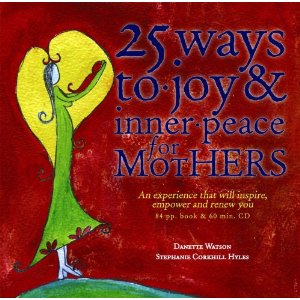
    Book Review: 25 Ways to Joy & Inner Peace for Mothers

    Book Review: 25 Ways to Joy & Inner Peace for Mothers

    By Danette Watson & Stephanie Corkhill Hyles
    Watson & Corkhill Hyles, 2006
    ISBN 0646-46588-0

    84 page hardcover book & 60 minute CD set, $24.95
    http://www.awakenyourbirthpower.com

    Reviewed by Molly Remer, MSW, ICCE

    Consisting of a book and CD, 25 Ways to Joy & Inner Peace for Mothers contains 25 short breathing meditations with accompanying whimsical, colorful drawings. The meditations are on topics such as “surround yourself with mother energy,” “embrace change,” “feel reverence,” and “trust the rhythm of your baby.”

    The final third of the book contains breathing tips, tips for using the meditations in life, and then “10 Healing Practices for Mothers” that are a very nice addition. This segment is followed by “Questions for Inner Exploration” that include journaling questions and prompts based on each of the meditations.

    It is not clear at first glance, but 25 Ways is designed for mothers of newborns and infants, not mothers of older children (though, of course, most of the meditations could be adapted to apply to older children). The addition of “new” to the title would have been a useful clarifier.

    Inspiring, empowering, and renewing, 25 Ways to Joy & Inner Peace for Mothers is a lovely and nurturing little manual that would make a nice blessingway gift for a pregnant or a congratulations gift for a special new mother.

    Disclosure: I received a complimentary copy of this book for review purposes.

    Review originally published in the CAPPA Quarterly, April 2010.

    Cesarean Awareness Month

    April is Cesarean Awareness Month! My favorite resources about cesareans are the International Cesarean Awareness Network (ICAN) and The Unnecesarean.

    In honor of the month (and in recognition that the national cesarean rate has risen again–to 32.3%), I went back through some of my posts and pulled out some of the things I’ve written about cesareans:

    One of my “pet” subjects centers around the question of, “why would someone be upset over a cesarean, at least she has a healthy baby?” and this post partially addresses that: Birth and Apples.

    I believe that a cesarean is often an act of personal courage and wrote about this here.

    I also wrote about the same in this post on when birth doesn’t go as planned.

    And, finally, here is a post I wrote about cesarean trivia.

    Consumer Blame

    Two things came to my attention today that made me think about how ironic it is that the medical system “lets” or doesn’t “let” women do so many things with regard to pregnancy and birth care and yet if something goes wrong, the locus of control shifts suddenly and it is now her fault for the situation. I see this often with things like “failure to progress”—“she’s just not dilating”—and even with fetal heart decelerations (“the baby just isn’t cooperating”). With induction—“her body just isn’t going to go into labor on its own”—and with pain relief—“she’s just not able to cope anymore” (yes, but is she also restrained on her back and denied food and drink?!). There are other ugly terms associated with women’s health that blame the “victim” as well such as “incompetent cervix” and “irritable uterus” and even “miscarriage” (and its even uglier associate, “spontaneous abortion.” And then for women with recurrent pregnancy losses we have the lovely, woman honoring term, “habitual aborter.” EXCUSE me?!). And then today, via The Unnecesarean, I read about a doctor inducing “labor” and then performing a cesarean on a non-pregnant woman.

    Okay wow. So much could be said about that, but the kicker for me is that the woman was blamed—“The bottom line is the woman convinced everybody she was pregnant.” Huh?! So random surgery is totally acceptable if the person is “convincing” enough? What happened to diagnosing something first? Or, for taking responsibility for an inaccurate diagnosis?

    The final thing that happened is that I got a completely unexpected refund check for over $400 today from my own local medical care system. While I’m not complaining about $400 that I thought I’d seen the last of, I had to shake my head in disbelief at the reason for the refund—“you overpaid”—excuse me, but I think the real reason is, “you overcharged me.” I checked back through my bills and I paid what I was billed (which, now that I think about, did seem like a heck of a lot for services NOT-rendered. If I had been in less of a state of grief and shock perhaps I would have questioned it more!), but now it has become “my fault” (in a sense) by switching the language to my overpaying vs. them overcharging.

    What interesting dynamics these are…

    Postpartum Reading List

    20130903-200533.jpgSuggested Reading—Postpartum

    After the Baby’s Birth, by Robin Lim. This book is very holistic in approach and is one of my very favorite postpartum reads. It offers such gems as, “you’re postpartum for the rest of your life” (which some people have said they feel like is depressing, but I find a tremendously empowering statement!) and “when the tears flow, so does the milk” (with regard to the third day postpartum). It does have a large section on Ayurvedic cooking, which, personally, I don’t connect with, so be aware that that section is in there and depending on your belief system, might make perfect sense to you, or might seem inapplicable like it feels to me.

    Mother Nurture: A Mother’s Guide to Health in Body, Mind, & Intimate Relationships, by Rick & Jan Hanson. This book is phenomenal. Very comprehensive. It addresses mothers of children from birth to age 5, so even if you are several years past the early postpartum weeks, this book has much to offer to you! One of the focus areas is on “Depleted Mother Syndrome” and addresses coping with it via all areas (body, mind, social/relational).

    The Womanly Art of Breastfeeding, by Diane Weissinger and Diana West for La Leche League International. This classic book from the original mother-to-mother support organization has been published for more than fifty years. This nurturing, conversational book will help you with all of your breastfeeding questions from birth and onward, whether your breastfeeding goal is three days, three weeks, three months, or three years. Reading this book is like having access to an experienced, friendly network of breastfeeding mothers who know all the practical, as well as emotional, ins and outs of mothering through breastfeeding. (And, to get this kind of support in person, check out an LLL group near you!)

    The Year After Childbirth, by Sheila Kitzinger. Another book covering the physical, social, and emotional changes after birth. This book is more “basic” and less in-depth than the two above.

    The Post-Pregnancy Handbook, by Sylvia Brown. This book is the most “mainstream” of my suggested titles.

    Mothering the New Mother, by Sally Placksin. This book is excellent for people supporting new mothers, as well as for mothers themselves. It is very validating and affirming of women’s feelings and needs after birth. This is the book in which I learned the term “matrescence”= becoming a mother.

    What Mothers Do: Especially When it Looks Like its Nothing, by Naomi Stadlen. I love this book! It takes a close look at how women mother and how skillfully they do so (so that on the outside it looks like they are doing “nothing”). This is not a “how to” book, but a book that tries to look below the surface and explore concepts that are very difficult to verbalize/articulate. She strives to put into words/give us language to describe what is it that mothers do all day–their often invisible contributions to life. Contributions that are often invisible even to ourselves. This is a very affirming and unique book.

    Postpartum Memoirs:

    Misconceptions: Truth, Lies, and the Unexpected on the Journey to Motherhood, by Naomi Wolf. This was the first book that I ever read about a woman’s postpartum experience. It was suggested to me by the doctor at the birth center when I expressed some teary frustrations about adjusting to my new life and wondering if I would ever get “back to normal.” This book is on the “angry” side–it is not a nurturing and tender read in the way my earlier suggestions are. I did not identify with the author’s birth experiences or feelings about birth (I felt tremendous during birth and powerful, empowered, triumphant, and confident), but her postpartum feelings closely match my own (weak, wounded, invisible, etc.)

    Operating Instructions, by Anne Lamott. This is a classic. A memoir of the author’s first year with her son. She is a single parent and so the book addresses some of the challenges involved with parenting solo. This book is incredibly funny at times.

    Let the Baby Drive: Navigating the Road of New Motherhood, by Lu Hanessian. Another wonderful read! I first read this when my own children were out of babyhood and still found it tremendously relevant and enjoyable.

    Callie’s Tally: An Accounting of Baby’s First Year, [or, What My Daughter Owes Me], by Betsy Howie. Very funny, though not particularly “AP” (so if you’re looking for that, read Let the Baby Drive instead). This book chronicles how much money the author has spent on her daughter during her first year of life.

    You might also like to check out my list of Non-Advice Books for Mothers | Talk Birth.