Archives

Practical Ways to Enhance Knowledge for Birth

Related to my previous posts about information vs. knowledge, I want to share a couple of ideas from an article I wrote some time ago for the International Journal of Childbirth Education. Obviously, I don’t have all the answers, but these are some of my ideas/tips about transferring information into knowledge that will be meaningful to parents when their birthing time comes:

  • Use “The Ice Cube Minute” exercise from Family-Centered Education: The Process of Teaching Birth. In this exercise, couples hold an ice cube in one hand for one minute and see what coping measures spontaneously arise for them. I do this exercise fairly early in my class series, before we’ve done a lot of formal talking about coping measures. It is very empowering for couples to discover what tools and resources come from within as they try the ice cube minute.
  • To illustrate the potency of the mind-body contraction, practice two pretend contractions while holding ice. One contraction has an accompanying “stressful” paragraph read with it (“your body fills with tension…it hurts! Oh no!”) and the second contraction has a soothing paragraph read with it (“you greet the wave….it is YOUR power….”). This illustrates the fear-tension-pain cycle viscerally.
  • Use a five minutes series of birthing room yoga poses to begin the class—birth happens in our bodies, not our heads. Practicing the poses opens space to simultaneously discuss and practice: squatting, pelvic rocks, optimal fetal positioning ideas, healthy sitting, pelvic floor exercises, leg cramp prevention, back pain alleviation, and more.
  • Role playing cards-—talk through various scenarios. I’ve found that couples are more receptive to talking through the cards than actually getting into a role and playing it through. The activity that seems to work best for actual role play is the labor simulation series available on the Transition to Parenthood site.
  • Values clarification exercise—participants cut out values from a list and arrange them in a grid to help them figure out if they are in alignment with each other and with their caregivers.
  • Leg stretch exercise to explore the use of vocalizations and other coping mechanisms during labor.
  • Ask plenty of open ended questions that stimulate discussion and ideas, “what have you heard about XYZ?” or “what is your experience with…?”
  • Use birth art processes to “switch” parents from linear, logical, left-brain thinking into the right-brain mode they will also enter in “laborland.”
  • Media portrayals of birth—show two contrasting clips, such as a birth from a popular TV show (I often show Rachel’s birth from the show Friends) paired with an empowering birth from a film like Birth as We Know It and then have students discuss the two. Sometimes this more clearly brings into focus the influence of our culture on birth practices than a simple discussion does. Since I originally wrote this, the film Laboring Under an Illusion was released which does exactly this—contrast media portrayals of birth with how birth can be. It is a great resource for birth classes.

In classes, I also incorporate the idea of mother-baby symbiosis through:

  • The use of affirmations—“my baby and my body work in harmony to make birthing easier.”
  • A discussion of cardinal movements with an emphasis on how the baby moves to help itself navigate the pelvis (thus, helping you have a smoother birth).
  • Visualization exercises that encourage “seeing” and connecting with the baby while in the womb.
  • Belly Mapping” to get a sense of the baby as a person positioned in the uterus. Talking about what baby is like in the womb—when does it kick more, when is it quiet, does it like music, poke you back with you touch it, etc.
  • Impressing upon participants that it is not selfish to want both a good birth and a healthy baby (I actively challenge statements about, “well, in the end, all that matters is that the baby is healthy”). Laboring women have a basic right to humane care, which supports both a happy, satisfied mother and a healthy baby. I use examples during class to show how these are intertwined—for example, a stressed, unhappy, unsupported, tense mother may have a baby with heart decels and accompanying distress.

I try to build a sense of confidence through:

  • Opening each class with a brief series of “birthing room yoga” poses to help couples become comfortable using their bodies and moving from “head space” into “body space.” Birth is a physical process and I am convinced that it is vital to include physical movement during every class to bring that message home. Additionally, the poses I teach can all be used while in labor (thus, building confidence in coping “tools” for labor).
  • Emphasizing active birth—freedom of movement through labor helps baby rotate and descend and helps mother feel more comfortable.
  • Encouraging active birth on all levels: First, the physical level–being active during the actual physical process of birth. Second, the mental level–mentally engaged with labor. Third, a cultural level—a perspective that sees women as active birthgivers, not victims of birth. Birth is something women do, as opposed to something that “gets” them.
  • Giving couples plenty of time for hands on practice of labor support and coping measures. I have a personal motto for classes of, “talk less, learn more.” Practicing support tools in class helps them develop a sense of confidence in having a well-stocked toolbox for labor, instead of being a victim of pain.
Recommendation: Luna Protein Bar

So, I’m a big one for recommending books, but not usually so big on recommending other products. I am also very careful about what samples/product information I give out during my classes. There are ethical issues with distributing just any old sample that someone sends you because you are a childbirth educator. However, I do have a snack recommendation for today! I regularly get samples of mini Luna bars to give away during my classes. I like putting them into my client packets—they make them look exciting and “goody”-ish :)—and, I also like putting a little pile of them on the table for people to snack on during class. (I also bring them to my various mother’s group meetings for the same purpose.) Some time ago, Luna Bar sent me a single full-size sample of their new Luna Protein bar. It was really quite good and since then I have bought them at the store when I’m grocery shopping and start casting my eye towards the candy bar aisle. The Luna Protein bar actually has a candy-bar-ish appeal (kind of “nougat” in the center and chocolate on the outside), but is made from mostly organic ingredients and things with actual nutritional value and is good for you as well as pretty tasty. So, I was VERY excited today to see UPS arrive with my regular shipment of mini Luna Bars AND, surprise!, a big box of full-size Luna Protein bars for my classes! They included three different varieties (cookie dough, chocolate peanut butter, and chocolate cherry). <happy dance> 🙂

Baby In Utero Pendant

For quite some time, I’ve wanted a really cool silver “baby in the womb” pendant that is available online, but is out of my price range (I do have a smaller, less detailed version). Two years ago, I found a different version made by a company called Sacred Body Designs (they make various types of “anatomical jewelry” meant for healing purposes—so, a pendant of a heart for someone who has heart problems to wear). This one was a more affordable $30 (also sterling silver and with really great detail—LOVE the visible placenta and cord and the hair on baby’s head) and my husband got it for me for Christmas that year.

Now, two years later, I have been suddenly prompted to post about it, because it occurred to me that there may be other birthworkers like me out there who wish for the more expensive pendant and would delight to find a very cool alternative version that is less pricey! Of course, I can’t tell from looking at the website if they are still in business (looks like it hasn’t been updated for a long time), so I may just be teasing you—“look what I got! Don’t you wish you had one too?!” 😉

How Do Women Really Learn About Birth?

April 2015 123“I usually claim that pregnant women should not read books about pregnancy and birth. Their time is too precious. They should, rather, watch the moon and sing to their baby in the womb.” –Michel Odent

Related to a previous post about the difference between information and knowledge, I have been pondering how women really learn about birth. Where does birth knowledge they can really use when they need it come from? Is it from birth classes, reading, or from other sources? Though I teach birth classes and believe that childbirth education has important value, I continue to return to thought that what women truly need to give birth does not come from (traditional) classes and it doesn’t come from books either.

Ever since I posted the above quote from Michel Odent on my Facebook page, I have been reflecting back to my pregnancy with my own first baby. Personally, I love books–-of all sorts-–and reading is the top way for me to learn about anything. I think some of the best preparation I did before having my first baby was to read and I always give a recommended reading list to my clients. And, while I “hear” the sentiment in the quote and honor it, my personal opinion is that in our current birth culture it is nearly impossible to go into birth just planning to “go with the flow” and let labor unfold without expectation (if you are birthing in the hospital that is—because the hospital is FULL of expectations and those will often run right over your flow).

When I was pregnant the first time and approaching my first birth, I was hungry for birth information and keenly felt the mystery and unknowableness of the challenge I was about to face. I described it as feeling like I was preparing for the biggest test of my life, but without knowing what the test was. So, how did I learn what I needed to know about giving birth? AND, perhaps most importantly, what had I learned before birth that actually spoke to me while in labor? What did I use and how did I learn about that? Obviously, women are different and have different learning styles and each birth is different, but reflecting on these questions, several things arise as most helpful for me in real preparation:

  • Other women’s experiences—these were frequently what floated through my head during labor and were what I drew on for information and guidance, not “technical” childbirth books, but the stories and opinions and reflections I had read in birth stories and from the participants of the newsgroup misc.kids.pregnancy.
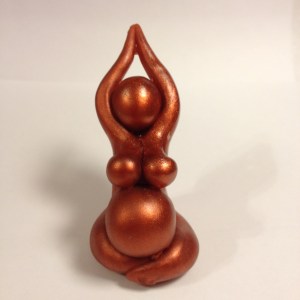
  • Birth art—I created a series of needle felted birth goddess sculptures during my pregnancy that had a “message” for me (that what I needed to give birth—that wild, intuitive knowledge—was already inside me).
  • And yes, reading (and to some extent, classes). I didn’t necessarily use or remember things that I’d read (other than other women’s “voices” through birth stories), but reading definitely helped me prepare—so, while I was not necessarily conscious of book or class-knowledge when I was actually in labor, I was informed by it, yes. During all my reading what I really wanted to to figure out and know was, how am I going to do this? This is the same question that most women who come to my classes have (and my answer is really, “you just will”). The books that were of most value to me were Birthing from Within and An Easier Childbirth. These were the books that had “right brain” lessons to share, even though it was the “left brain” books that I “studied” harder.
  • Yoga—I spontaneously adopted poses used in prenatal yoga during my first labor without even knowing it was “prenatal yoga.” It was an example of how the knowledge already existed inside my body and spontaneously arose when given the space to do so. I also used yoga poses during my other births—not consciously (“I think I’ll try child’s pose now”), but spontaneously and instinct-driven.
  • My blessingway experience/memories—particularly the chant Woman Am I, which I hummed over and over again during my first labor.
  • Voice—talking to myself (inside my head or our loud), verbally coaching myself.
  • My husband—his presence just there with me. I felt like we were one person. This isn’t something I feel like you can “train” for. It too was naturally arising and just pure.
  • Holding a fused glass touchstone and having my favorite pillow (in my third labor, it was holding my goddess of Willendorf pendant).

For me, it all came down to FREEDOM and space for me—I was not in an institutional setting, I was in my own “nest” and that was very key for letting my own body’s wisdom unfold and find expression.

——

A powerful pre-birth lesson in my body’s wisdom actually came from an assassin bug (of all things!). Assassin bugs have very potent, poisonous bites (and in some countries carry hideous diseases). During my first pregnancy I was bitten multiple times in the night by one of them. I had bites on my face (lip) as well as in a row on my arm. The bites caused swelling, ongoing stabbing pain, and joint aching (as well as intense palm-of-hand and sole-of-feet itching when they first occurred). I turned this into a practice experience for myself in coping with labor—figuring that, like labor, this was something uncomfortable and out of my control, but that would eventually pass and that my body would take care of without my needed to actively do anything about it. The stabbing pain was also intermittent (like a pulse), so I thought that was good practice too. I practicing “softening” around the sensations and “being” with the discomfort. I reminded myself that my body knew what to do and that it would heal itself. And, guess what? It did. Each day as the bites healed, I would marvel, “look how much my body knows! Look what it can do without me even knowing what or how it is doing.” Of course, it took several days of stabbing and aching pain for this process to occur, whereas my first labor involved only 5 hours of intense sensation as well as several preceding hours of totally manageable sensation and my subsequent labors only involved 2 hours each of fairly intense sensation. This experience in watching my body take care of itself using its own inherent wisdom was a potent (and unexpected) lesson for me in approaching my first birth.

My Message?

The Orgasmic Birth fan page on Facebook was having a giveaway and to enter the contest the following question was posed:

You are given the chance to speak to the world about childbirth. What is your message?

What a great question! This was my response (as I re-read it, I see I answered as if I was only speaking to one person and not the world. Darn it. I want to speak to the world!):

Birth can be a beautiful, powerful, joyful celebration and a transformative experience. Women’s bodies have a deep knowing of how to give birth and I encourage you to choose a birth setting the supports the unfolding of this knowledge. Women can safely and joyfully give birth in any setting, but freedom, privacy, individualized care, and respect make a HUGE amount of difference in how readily you will be able to have the birth you imagine–so, choose carefully. You do have options. This baby will only be born once, so don’t wait for “next time” to have the birth that you and your baby both deserve.

The needs of mothers and babies during birth are intimately entwined–what is good for mother is also good for babies. Do not ever be misled into thinking that you have to choose between a “good birth” or a “healthy baby”–good, satisfying births are exactly the kind that are most likely to produce that healthy baby!

A Weaning Ritual

The suggestion is often made to have a “weaning party” when a toddler is ready to be weaned. Recently I have been reading the book Seven Times the Sun and she mentions a lovely, simple  little weaning ritual that she did with one of her daughters (18 months). I wanted to share it, because I think a lot of people think about doing something to commemorate weaning, but that it can be hard to find ideas of what exactly to do. Both of my weaning experiences occurred during subsequent pregnancies and I was never quite sure when that “last nursing” would be. Both kids (during the different experiences—I never ended up tandem nursing) gradually cut down on their nursings per day until they were only nursing once a day. I was eager to leave this final nursing behind, because I am someone who finds nursing during pregnancy to be very unpleasant. However, I didn’t want to miss the “last time” and spent weeks remembering to cherish each nursing and fix its every detail in my mind so I would remember it if it turned out to truly be the last—I wanted the last to be emblazoned in my memory. I did successfully manage to note the last nursing for each of them in my journal (and fix some of the details in memory—though not as detailed as I had hoped, because there were so many potentially last nursings!), but we did not have any other sort of weaning party or commemoration.

Okay, on to the ritual idea:

The child is invited to nurse for the final time. Then, offer the child a small round object (like a pebble) and say, “From the time you were a tiny seed inside me, you were fed from my body.” Next, give the child a small baby doll or figure and say, “When you were born into this world as a baby, you were fed from my breasts.” And finally, give the child a silver cup (engraved with their name) and say, “Now I give you this cup, so you may feed yourself.” Then sing a song or blessing and close. The author of the book said their ritual took about 7 minutes, but was a profound memory for the family. I thought it was a delightful idea.

One Woman Awake

Several years ago,  I received a card from the National Association of Mothers’ Centers with the following poem printed on the front:

One Woman Awake
Awakens another,
The second awakens her next door neighbor.
And three awake can rouse the town,
And turn the whole place upside down.
And many awake
Can raise such a fuss
That it finally awakens the rest of us.
One woman up,
With dawn in her eyes,
Multiplies.

——

It has been hanging on the wall behind my computer since 2007 and it still gives me chills to read it. Of course, it can be applied to many elements of women’s lives, but I look at it through the lens of birth advocacy. I always say that what I want to do with my life is simply to transform the birth culture in the U.S. A lofty goal maybe, but if many awakened women raise enough of a fuss, it could happen!

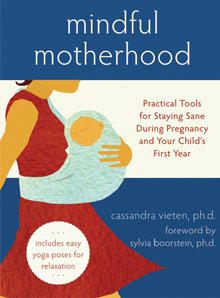
Book Review: Mindful Motherhood: Practical Tools for Staying Sane During Pregnancy and Your Child’s First Year

Book Review: Mindful Motherhood: Practical Tools for Staying Sane During Pregnancy and Your Child’s First Year
By Cassandra Vieten, Ph.D.
New Harbinger, 2009
ISBN 978-061531935-3
200 pages, softcover, $16.95
www.mindfulmotherhood.org

Reviewed by Molly Remer, MSW, CCCE

Written for pregnant women and for mothers embroiled in the intense rite of passage that is baby’s first year, Mindful Motherhood is a practical and simple guide to the practice of mindfulness during everyday life. “Mindfulness is moment-to-moment, nonjudgmental awareness of your present-moment experience…so that you can be connected to your baby even in times of distress, be less overwhelmed by distressing emotions and less caught up in negative thought patterns, and enjoy the simple pleasures that suffuse each day of being a mom.”

The book is composed of many small chapters each containing a 5-10 minute exercise readily incorporated into daily life with a baby. It also includes a line-drawing illustrated “mindful motherhood yoga series” of gentle, basic poses, which are an excellent prelude to meditation.

Mindful Motherhood is rooted in attentiveness to needs of the child, present moment awareness—whether comfortable or uncomfortable—and radical self-compassion. “Mindful motherhood, above all, is a way of approaching your experiences during pregnancy and early motherhood with gentleness and friendliness.” The author models this gentle and friendly approach throughout the accessible, supportive, and important guide. What a lovely gift for a woman approaching new motherhood, or for any mother seeking to explore present-moment awareness in everyday life!


Disclosure: I received a complimentary copy of this book for review purposes.

Interview with Elizabeth Stein, CNM

Recently I had the opportunity to interview certified-nurse midwife, Elizabeth Stein, CNM, MSN, MPH. Elizabeth practices in New York and has experience with high-risk populations. Visit her at her website: Ask Your Midwife.

1. Please tell me a little bit about your services as a midwife:

My private practice provides obstetrical care, which includes prenatal care, labor and delivery, postpartum and breast feeding. After delivery, women are seen 6 weeks postpartum. Alternatively, women who had a cesarean delivery are seen for an incision site check at 10-14 days post partum and once again at 6 weeks.

GYN care includes an annual GYN exam, which includes a Pap smear, STD testing and treatment, breast exam, urine test and blood work. I also address common GYN complaints, such as family planning/birth control, basic infertility, and pre/ postmenopausal care. I provide primary care and stress the importance of being proactive.

2. How long have you practiced?

I have been a certified nurse midwife 25 years and have delivered more than 2600 babies.

3. What inspired you to become a CNM?

I was an EMT before I was a nurse. On one occasion, I was working in the emergency room when the director told me to go upstairs to L & D to learn how to do a delivery, since that would be helpful while working in the ER. The female doctor I worked with was so beautiful, calm and relaxed, yet very attentive. She calmly and gently delivered the baby. Instantly, I knew this was what I should be doing!

4. What are the top questions you are asked by expectant mothers?

Is my baby ok? Is it a girl or boy? Where will I deliver? When can I have a sonogram? When is my next appointment? How much weight should I gain? Do I have to take prenatal vitamins? How will I know if the water breaks? How will I know when labor starts?

5. What are your thoughts on current bioethical issues in maternity care? (particularly elective cesarean section)

  • Elective cesarean delivery (maternal request)
  • TOL/VBAC (trial of labor-vaginal birth after cesarean) versus repeat cesarean delivery
  • Home births
  • Circumcisions
  • Cord blood collection (fetal stem cells)
  • Chorionic villus sampling (CVS) and amniocentesis
  • Oocyte and embryo storage (prepregnancy)
  • 6. Any tips for women planning a natural hospital birth?

    The hardest yet most rewarding day of your life! Natural means vaginal versus abdominal (surgical).

  • Baby’s going to come, when the baby’s going to come (doesn’t read the sonogram report or prenatal chart). Baby is in charge.
  • Stay home as long as possible (exceptions: rupture of membranes, group b strep positive, vaginal bleeding, other medical or obstetrical reason to come right in)
  • Your birth plan is a wish list, not a guarantee!
  • Don’t start labor exhausted! Rest!
  • Eat and drink (you may vomit later)
  • Know who will deliver you
  • Know  when to go to labor and delivery
  • Beware of unrealistic expectations. Go with the flow of your body. Be flexible and open minded.
  • Know how you may labor…..in bed, on the ball, walking, on the fetal monitor, in the shower
  • You may have to bail out……and have a cesarean delivery….it’s not a failure, just another route of delivery
  • It’s your baby……everyone wants the baby in the first 5 minutes! Bonding is ongoing and forever
  • Breast feeding is not as easy as it sounds but everyone will help you
  • Nobody is judging you! Once you are a mom, you wear the badge MOM.
  • Whatever pregnancy and birth experiences it took to make you MOM should remain a memory and should not haunt you.

    Enjoy your baby!

    Thank you for sharing your expertise with my readers, Elizabeth!