Archives

Becoming an Informed Birth Consumer

Though it may not often seem so, birth is a consumer issue. When speaking about their experiences with labor and birth, it is very common to hear women say, “they won’t let you do that here” (such as regarding active birth–moving during labor). They seem to have forgotten that they are customers receiving a service, hiring a service provider not a “boss.” If you went to a grocery store and were told at the entrance that you couldn’t bring your list in with you, that the expert shopping professional would choose your items for you, would you continue to shop in that store? No! If you hired a plumber to fix your toilet and he refused and said he was just going to work on your shower instead, would you pay him, or hire him to work for you again? No! In birth as in the rest of life, YOU are the expert on your own life. In this case, the expert on your body, your labor, your birth, and your baby. The rest are “paid consultants,” not experts whose opinions, ideas, and preferences override your own.

There are several helpful ways to become an informed birth consumer:

  • Read great books such as Henci Goer’s The Thinking Woman’s Guide to a Better Birth or Pushed by Jennifer Block.
  • Hire an Independent Childbirth Educator (someone who works independently and is hired by you, not by a hospital). Some organizations that certify childbirth educators are Childbirth and Postpartum Professionals Association (CAPPA), BirthWorks, Bradley, Birthing From Within, Lamaze, and Childbirth International. Regardless of the certifying organization, it is important to take classes from an independent educator who does not teach in a hospital. (I’m sure there are lots of great educators who work in hospitals, but in order to make sure you are not getting a “co-opted” class that is based on “hospital obedience training” rather than informed choice, an independent educator is a good bet.)
  • Consider hiring a doula—a doula is an experienced non-medical labor support provider who offers her continuous emotional and physical presence during your labor and birth. Organizations that train doulas include CAPPA, DONA, and Birth Arts.
  • Join birth organizations specifically for consumers such as Citizens for Midwifery or Birth Network National.
  • Talk to other women in your community. Ask them what they liked about their births and about their care providers. Ask them what they wish had been different.
  • Ask your provider questions. Ask lots of questions. Make sure your philosophies align. If it isn’t a match, switch care providers. This is not the time for misplaced loyalty. Your baby will only be born once, don’t dismiss concerns your may have over the care you receive or decide that you can make different choices “next time.”
  • Find a care provider that supports Lamaze’s Six Healthy Birth Practices and is willing to speak with you seriously about them:
  1. Let labor begin on its own
  2. Walk, move around and change positions throughout labor
  3. Bring a loved one, friend or doula for continuous support
  4. Avoid interventions that are not medically necessary
  5. Avoid giving birth on your back and follow your body’s urges to push
  6. Keep mother and baby together – It’s best for mother, baby and breastfeeding

Remember that birth is YOURS—it is not the exclusive territory of the doctor, the hospital, the nurse, the midwife, the doula, or the childbirth educator. These people are all paid consultants—hired by you to help you (and what helps you, helps your baby!).

Birthing Room Yoga Handout

In my classes, I teach a short little series of prenatal yoga poses called “Birthing Room Yoga.” I learned the series from the excellent video, Yoga for Your Pregnancy by Yoga Journal and Lamaze. My rationale for including the poses in all my classes is that while academic/intellectual information is useful (and is my personal learning style), birth happens in your body and not your head—-lots of us are uncomfortable with our bodies, so I try to get people to use their bodies a lot during classes. This helps women become comfortable with using their bodies, plus gets them out of their heads-space and into body-space, plus each exercise chosen has pregnancy or birth related benefits. Physical work is important for partners too—-birth is a physical event (both for the person helping and for the partner watching the pregnant woman work during labor).

I didn’t learn this series of poses until after my first two children were born. I was interested to see that I used all of the poses (or variations thereof—I also show a variety of variations during class) during my labor with my first son—even though I didn’t call it “yoga” or consciously “practice” during labor. I think that is a powerful reminder of the wisdom we carry in our bodies—as long as there is space and freedom in which to do so, this “birth yoga” arises spontaneously out of our own inherent wisdom, no training required!

Here is the Birthing Room Yoga handout I give with the pose reminders! The pelvic circles are particularly good and can be done seated on the edge of a hospital bed while having fetal monitoring.

Birth Quotes Update

More birth quotes collected for my Facebook pages. Maybe I need to start compiling a book!

“…natural birth is full of magnificent, life-changing wisdom.” –Christiane Northrup

“The major role that the body’s natural oxytocin plays in birth encourages the idea that birth is an experience of love…birth is a spiritual experience simply because it is largely an act of love on the part of the body physiology and the indwelling spirit.” –Cathy Daub

“It makes sense that we should help our bodies with the amazing work of giving birth, rather than make the process more difficult and complicated. However, along with all the life-saving benefits modern [L & D] units provide, many of today’s routine practices…and interventions can actually slow down labor, increase pain, cause unnecessary stress for baby, and make cesarean surgery more likely.” (Mother’s Advocate)

“…experiences have clearly shown that an approach which ‘de-medicalizes’ birth, restores dignity and humanity to the process of childbirth, and returns control to the mother is also the safest approach.” –Michel Odent, MD (via BirthWorks)

“A calm, watchful, loving presence protects the fragile harmony of birth; frantic coaching has *never* been part of nature’s plan.” –Pam England

“Yes, of course, some women have a choice about becoming pregnant, but whether a woman chooses to give birth or not, once she is in the throes of labor, her individuality counts for little; she becomes caught up in the universal act of ‘giving life.’ She can do this with control and passion or be totally unconscious and unable to participate–but once begun, the birth process is unstoppable.” –Judy Chicago

“A knowledgeable childbirth teacher can inform mothers *about* birth, physiology, hospital policies and technology. But that kind of information doesn’t touch what a mother actually experiences IN labor, or what she needs to know as a mother (not a patient) in this rite of passage.” –Pam England

“Women…are storytellers. They are nurturers…filled with creative forces when they are fertile, pregnant or birthing. Millions of years of biology are on their side to ‘bring forth.’ Nothing can stop the power behind that force, not even the woman herself…She is the living essence of the future. She is a holy woman and there is intelligence at work in her. It is sacred energy.” –Sister MorningStar

“When enough women realize that birth is a time of great opportunity to get in touch with their true power, and when they are willing to assume responsibility for this, we will reclaim the power of birth and help move technology where it belongs–in the service of birthing women, not their master.” –Christiane Northrup

“Before I had children I always wondered whether their births would be, for me, like the ultimate in gym class failures. And I discovered instead…that I’d finally found my sport.” –Joyce Maynard

“Our body-wisdom knows how to birth a baby. What is required of the woman who births naturally is for her to surrender to this body-wisdom. You can’t think your way through a birth, and you can’t fake it.” –Leslie McIntyre

“Birth is an opportunity to transcend. To rise above what we are accustomed to, reach deeper inside ourselves than we are familiar with, and to see not only what we are truly made of, but the strength we can access in and through Birth.” –Marcie Macari

“So the question remains. Is childbirth painful? Yes. It can be, along with a thousand amazing sensations for which we have yet to find adequate language. Every Birth is different, and every woman’s experience and telling of her story will be unique.” –Marcie Macari

“The natural process of birth sets the stage for parenting. Birth and parenting mirror each other. While it takes courage and strength to cope with labor and birth, it also takes courage and strength to parent a child.” –Marcy White

“The instant of birth is exquisite. Pain and joy are one at this moment. Ever after, the dim recollection is so sweet that we speak to our children with a gratitude they never understand.” ~ Madline Tiger

“…celebrate ourselves for our courage to birth. The real question becomes not, ‘Have you done your breathing exercises?’ but rather, ‘Can you love yourself no matter how you birth, where you birth, or what the outcome?'” –Claudia Panuthos

“Listening to your heart is not simple. Finding out who you are is not simple. It takes a lot of hard work and courage to get to know who you are and what you want.” –Sue Bender

“As women, we are inherently both power-filled and power-full. Each one of us knows on some level that we do have awesome strength at our core.” –from the book Mother Rising

“VITA MUTARI – the literal translation from Latin to English is ‘Life Transformation.’ That is the closest thing I could think of the feeling of labor/birth…what you are feeling isn’t pain, it’s life transformation. Is it dramatic? You bet! I think it should be!” –Stephanie Soderblom

“…Birth is a rite of passage of women. Their journey should be honored, their rights should be fiercely protected, and their stories should be shared.” –Marcie Macari

“How you view childbirth is a reflection of your philosophy of life…I feel…sad about…our culture where the message is that women can’t have a good childbirth experience without turning themselves over to the control and interventions of the medical community.” –Marcie K. Richardson (OB & instructor at Harvard Medical School!)

“Birth is a three legged stool, a healthy mom, a healthy baby and a healthy birth. Without ANY one leg, it is equally unstable!” –Sharon Muza

“While all of your (birth) planning may spin a cocoon of security, in actuality, the course of your labor is unknowable…your critical task is to prepare for a birth that has NO script.”–Pam England

“A woman in Birth is at once her most powerful, and most vulnerable. But any woman who has birthed unhindered understands that we are stronger than we know.” –Marcie Macari

“Breastfeeding… led me to self-discovery and to a greater appreciation of the full humanity of the babies who were entrusted to me. Each woman needs to trust her own instincts, her own feelings, and her own sense of what will work for her with each baby.” –Viola Lennon (1923-January 22, 2010, LLLI Founder and profound influence on the world)

“Whether a woman is making children or other works of the womb, the creative power of her uterus is amazing to behold. Some of a woman’s greatest transformations involve the changes in her womb: menarche, pregnancy, miscarriage, childbirth, and menopause.” –Tami Lynn Kent

“Life is full of beauty. Notice it. Notice the bumble bee, the small child, and the smiling faces. Smell the rain, and feel the wind. Live your life to the fullest potential, and fight for your dreams.”~ Ashley Smith

“I would say in obstetrics you are numbed by the technology. Your ability to understand the more sacred and spiritual aspects of birthing is extremely numbed.” –Dr. Eden Fromberg, OB/GYN (in The Business of Being Born)

“There is such a special sweetness in being able to participate in creation.” –Pamela Nadav

“Never underestimate the power of a woman AND never underestimate the power of YOU!!” –Nicole at Your Birth Right

“Although pregnancy and birth is a richly intuitive and instinctive process, a woman will prepare her ‘nest’ and birth according to the style of her culture, in the same way that a particular species of bird will build its nest with whatever is available.” –Pam England

“keeping active during labour and adopting natural, upright or crouching birth positions is the safest, most enjoyable, most economical and sensible way for the majority of women to give birth.” –Janet Balaskas

“Until women themselves value and honor mothering in all its forms, there is little chance that the cultural paradigms will change…Many women with children have come to respect the art of mothering, but still need to advocate for its value when faced with external expectations and pressures to feel professional success.”–Tami Lynn Kent

“…birth is the pinnacle where women discover the courage to become mothers…” –Anita Diamant

“We are made to do this work and it’s not easy…I would say that pain is part of the glory, or the tremendous mystery of life. And that if anything, it’s a kind of privilege to stand so close to such an incredible miracle.” –Simone in Klasson 2001

“A woman is the full circle. Within her is the power to create, nurture and transform.” –Diane Mariechild

“Women are AWESOME – We can do such out of control, yet in-control cool stuff with our bodies.” –Desirre Andrews

“There is power that comes to women when they give birth. They don’t ask for it, it simply invades them. Accumulates like clouds on the horizon and passes through, carrying the child with it.” – Sheryl Feldman

(I don’t think the power “invades” so much as it is already there, inherent, just not tapped into…)

“Mothering is a subtle art whose rhythms we collect as much from one another as from instinct.” –Louis Erdrich

“The woman about to become a mother, or with her newborn infant upon her bosom, should be the object of trembling care and sympathy wherever she bears her tender burden or stretches her aching limbs…. God forbid that any member of the profession to which she trusts her life, doubly precious at that eventful period, should hazard it negligently, unadvisedly or selfishly”. – Oliver Wendell Holmes

“The knowledge about how to give birth is born within every woman: women do not need to be taught how to give birth but rather to have more trust and faith in their own body knowledge.” –BirthWorks

“A new year is unfolding – like a blossom with petals curled tightly concealing the beauty within.” –Anonymous

“Birth is about radical, creative, life-affirming change. It is about adaptation on a nearly unbelievable scale.” –Mark Sloan, MD

“Understanding birth technology shouldn’t lull you into thinking you understand *birth*. The profound mystery and spirituality of birth can never be understood with the mind, they are known through the heart…” –Pam England

“Attempting to fulfill an idea of the ‘perfect’ mother can only prove soul-destroying, as no such person exists.” –Adela Stockton

“Pregnancy, birth and motherhood move us further along on life’s continuum. They challenge us to create a new nomality.” –Pat Thomas

(I feel like having children is an essential part of my “development” as a human being–without them, I’d be a less developed person…)

“Pregnancy and birth knit womankind together. Help weave a gorgeous thread to add to the fabric. Be supportive. Be kind. Be wise. Be open.” –Desirre Andrews

“Birth is a mystery. Words are not enough.” –Marie O’Connor

“Birth matters. It brings us into being, on many levels.” –Ananda Lowe

“Babies are bits of star-dust blown from the hand of God. Lucky the woman who knows the pangs of birth for she has held a star.” –Larry Barretto

“Midwifery calls upon you to be the best you can be: the best advocate, guide, healer, counselor, mother, comrade, and confidant of the women seeking your care.” — Anne Frye

“This is the day which honors the bond between sisters and the freedom of all women. There is no slavery today…Today all women are joined in the joys of motherhood: for we hold up, not our own, but our sister’s children to the sun.” –Ovid, Fasti (today, March 1, was known as “Matronalia” in ancient Rome, the great spring feast of motherhood.)

“I think of women’s kinships as pottery kilns, where two together shape the rough clay of emotion into humankind’s most valuable and prized vessels: human community.” –Pythia Peay

“Simply put, when there is no home birth in a society, or when home birth is driven completely underground, essential knowledge of women’s capacities in birth is lost to the people of that society—to professional caregivers, as well as to the women of childbearing age themselves.” –Ina May Gaskin

“…to give birth with power, without drugs, means having to go to the edge, and beyond…the hospital ‘battle field,’ in striving to be sterile and clean, inadvertently sends a confusing message to women giving birth. Birth-warriors don’t stay clean, made-up, and poised…” –Pam England

“Strange as it may appear…the results of trials and investigations show that fewer women die when treated in their own squalid ill-ventilated houses and nourished by the coarsest of food than when inmates of the best-equipped and best-managed lying-in hospital in the world.” –New York City newspaper ~1801 (I got this quote from the new book Get Me Out. Of course, I would prefer that women have access to non-squalid homes and non-coarse food, but I thought the sentiment was interesting–and relevant!)

“Sometimes the strength of motherhood is greater than natural laws.” –Barbara Kingsolver

“…fear has to be present in order for courage to exist. The English word ‘courage’ is derived from the French word for the heart, coeur. Finding the heart to continue doing the right thing in the face of great fear inspires others to become nobler human beings.” ~ Gloria Lemay

“When I stopped seeing my mother with the eyes of a child, I saw the woman who helped me give birth to myself.” — Nancy Friday

“Giving birth is not an isolated event in a person’s life. A woman births with both her mind and her body and participates in the attitudes toward childbearing of her culture and her family.” –Rahima Baldwin

“For each of us as women, there is a deep place within, where hidden and growing our true spirit rises…Within these deep places, each one holds an incredible reserve of creativity and power, of unexamined and unrecorded emotion and feeling. The woman’s place of power within each of us…it is dark, it is ancient, and it is deep.” –Audre Lorde

“The way we give birth is a story about our deepest desires and our fundamental concerns about life, death, and sex.” –Randi Epstien

“…what is normal today is not the same as what is healthy.” –Barbara Patterson & Pamela Bradley

“Our lives begin to end the day we become silent about things that matter.” –Martin Luther King Jr.

“Pregnancy and birth are the most crucial and powerful passages in a woman’s life. Most births around the world lead to some degree of preventable trauma for the mother and baby…preventable because much of it is iatrogenic, that is, caused by the doctor or midwife. In many cases, if the mother, baby and birthing …process had been treated with respect, the trauma would possibly have never taken place…Instead, the mother likely would have had the most miraculous experience of her life.” –Midwifery Today e-news

“Rigid plans work best if you’re building a skyscraper; with something as mysteriously human as giving birth, it’s best, both literally and figuratively, to keep your knees bent.” –Mark Sloan, MD

“It is not ‘ladylike’ to give birth. The strength and power of labor is not demure.” –An Easier Childbirth (quoting a midwife)

“Mothers need to know that their care and their choices won’t be compromised by birth politics.” – Jennifer Rosenberg

“To rediscover midwifery is the same as giving back childbirth to women. And imagine the future if surgical teams were at the service of the midwives and the women instead of controlling them.” -Michel Odent, MD

“…Childbirth in itself is a rite of passage. Being born is an initiation and giving birth is a transforming experience.” –Benig Mauger

“We must attempt to tell the whole truth about birth, the truth that includes the transformation, mastery, satisfaction, personal power and the difference between pain and suffering.” –Cheri van Hoover

“Giving birth is a transformation and it doesn’t matter whether you’ve had eight babies before. It’s still a transformation the next time you have another baby, because you are no longer the same woman you were before you had that baby.” –Penny Handford

“We need nothing less than a revolution in our attitudes towards conception, pregnancy, birth and parenting.” –Sophie Style

“When you destroy midwives, you also destroy a body of knowledge that is shared by women, that can’t be put together by a bunch of surgeons or a bunch of male obstetricians, because physiologically, birth doesn’t happen the same way around surgeons, medically trained doctors, as it does around sympathetic women.” –Ina May Gaskin

Birth Violence

“‘Old wives’ tales,’ says the Oxford dictionary, are ‘trivial stories, such as are told by garrulous old women.’ It is significant that no one ever talks about ‘old husbands’ tales’ or ‘old doctors’ tales.’ Women are blamed instead. It is implied that there is poison in their speech and that the only safe thing to do is remain silent. The experiences that women share with other women are thus rejected and trivialized…In reality, it is not other women who instill and fuel anxiety in most pregnant women, but the medical system itself.” This quote from the 1980’s book, Giving Birth, by Sheila Kitzinger, remains strikingly relevant today. When women in the United States today enter the hospital to give birth, many experience some form of institutional violence. They may not explicitly define it as violence, but listening to their stories provides a disheartening picture of maternity care today.

What kinds of violence occur in the birth place? Here are a few possible examples of “normative abuse” women may experience when giving birth in U.S. hospital setting

• Restriction of movement
• Restriction of nourishment
• Domination by those in positions of authority—must obey even when it is against her own best interests.
• Routine, forced interventions such as IVs
• Repeated, possibly painful, vaginal examinations by many different people
• Denial of option for VBAC (vaginal birth after cesarean)
• At the most extreme example of overriding patient rights, a forced cesarean section
• Vaginal cutting (episiotomy)
• Abusive language
• Separation from family/restriction of companionship
• Lack of respectful treatment
• Voice and wishes disregarded/unheard
• Emotional manipulation using baby as a “card” to force compliance (“you want a healthy baby don’t you?” No mother doesn’t. It is degrading and dehumanizing to suggest that she doesn’t.)
• Forced separation of mother and baby
• Administration of medications without consent
• Cord traction and interference with third stage (placenta) that may lead to hemorrhage.

The emotional treatment of women in labor is the most significant factor contributing to their satisfaction with their birth experiences (emotional factors of highest importance include having good support from caregivers and being treated with respect). According to Kitzinger, “We are only now discovering the long-term destructive effect on human beings and families of treating women as if they were merely containers, to be opened and relieved of their contents; and of concentrating attention on a bag of muscle and a birth canal, rather than relating to, and caring for, the person to whom they belong. The violence which is a common element in childbirth today leaves many women feeling that birth has been a kind of rape. This sort of experience is not easily forgotten. It can shatter a woman’s self-confidence, make her doubt her ability to mother her baby, destroy joy in the expression of her sexuality, and attack her very sense of self–the roots of her identity. It is psychologically mutilating.”

And, as Mary Rucklos Hampton says, “The effort to separate the physical experience of childbirth from the mental, emotional, and spiritual aspects of this event has served to disempower and violate women.”


Molly Remer, MSW, ICCE is a certified childbirth educator and activist who blogs about birth at https://talkbirth.wordpress.com and midwifery at http://cfmidwifery.blogspot.com.

Note: In 2009, I wrote an article about birth violence for International Women’s Day, but it appears to have never been published. So, I decided to post it here (and on the CFM blog in honor of this year’s International Women’s Day on March 8th). I also read two relevant articles recently: How childbirth caused my PTSD and Birth Trauma: An Introduction.

Rolla Area Doula Recommendation

Summer Eyberg has been a colleague and friend of mine for many years. Late last year, I was privileged to received Summer’s skills as a doula during my third pregnancy and also postpartum when that pregnancy ended unexpectedly during the fourth month. Summer has an amazing gift of presence—she is open and receptive and listens without judgment. She is also skilled at always returning decision-making power to the hands of the mother (where it belongs!). I have always been impressed with Summer’s ability to notice when something needs to be done and how she quickly and graciously moves to do it without fanfare. Summer is also friendly, passionate, and easy to trust and she has a natural gift in celebrating and honoring pregnant women.

Summer’s compassionate attention and sensitive listening have blessed me beyond measure and I am lucky to call her my doula and my friend!

Summer can be contacted via Peaceful Beginnings Doula Services or via Facebook

Conclusions About Listening

“What would happen if one woman told the truth about her life? The world would split open.” —Muriel Rukeyser

I continue to think about the ideas in the post I made a couple of days ago about birth choices and listening to women’s stories. Though my thoughts are by no means fully “concluded,” I wanted to add a postscript of sorts based on comments some people have left as well as to share some new apropos quotes that keep popping out at me from all kinds of places. I guess my basic conclusion is that as “birth advocates” we definitely should NOT stop sharing our stories–-perhaps what most needs to change is how we listen to stories—how they are received and accepted and heard, rather than analyzed or dissected. And, perhaps also our approach at story-telling itself needs to change-–to being about our experiences and not trying to “convert” anyone. Bottom line for me is that if I was forced to choose, I value WOMEN the most–-not birth or giving birth the “right way.”

I just finished reading a book called Soul Sisters and came across this quote: “I have learned that…in listening you become an opening for that other person.” Perhaps this is how changes are born. And later this treasure, “Indeed, nothing comes close to an evening spent spellbound by the stories of women’s inner lives.”

And, I think the KuKd author made a good point–-most women are “capable” of seeking out the information they wish, without having it handed to them (that supports the blog theory-–the value of sharing our stories via blogs and letting people find them as they wish!). Though, then my recent experience with my brother’s girlfriend shows me that maybe some people really don’t even know that they’d like to seek out the information and I’m back to the beginning again…

Another blogger commented that my post raised many conflicting feelings for her and expressed that she does not believe in a “live and let live approach,” that some choices in life truly are  “wrong.” I have many conflicting feelings about my post too…and I wrote it! However, the basic conclusion I reached with my wanderings was that I think we (okay, I) need to do some serious thinking about HOW it is (and WHY it is) that I share information about alternative choices or tell stories. Because, as the KuKd post I quoted shared, sharing in a specific type of “zealous” way, closes doors rather than opens eyes.

How to Meditate with a Baby…

How to meditate with a baby…

Lie down in a comfortable place.
Latch baby on.
Feel your bodies relax and become
Suffused with peace.
Rest your nose in his hair.
Inhale.

By Molly Remer
1/10/08

Previously published in New Beginnings and in Compleat Mother. I decided that I need to remember to post some of the things that I’ve written and had published various places. This poem popped into my head one afternoon when I was nursing Z to sleep during an illness—he’d been wanting to nurse A LOT and I had spent a lot of time doing so during a several day time period.

Racktrap Giveaway!

Giveaway closed! The  four winners for this giveaway were Rini, inoakpark, Summer, and Rixa!

Time for another giveaway! This is not really birth related, but it is breast-related and since breasts are part of being female and nurturing children, etc., etc. I decided it was related enough to go ahead and share here! The Racktrap is a little tiny purse/pouch that you tuck inside your bra (credit card, ID, cash, etc.) to leave yourself hands-free and unencumbered. I was amused the the first step in the instructions included is to, “Locate your breasts.” ;-D You can use the Racktrap while exercising OR while going out somewhere in a fancy dress! They have lots of different colors (though presumably no one will see it!). I wasn’t sure how it would work exactly because I wear simple “sleep bra” type bras that pull over my head like a sports bra, but I tried it and it works really well even in that kind of bra (don’t worry, I didn’t try the ones I’m giving away, I tried out the cute Valentine print one they sent and I’m keeping that one!)

Something that surprised me about it is that the open edge doesn’t have a closure, so I thought things might fall out of it, but once it is tucked away, nothing falls out (somehow in the context of talking about bras, this sounds like there are secret meanings here…). It is very trim and, I have to say, MUCH classier than just sticking money directly into your bra (which I’ve never done, but still, if that is something you do, perhaps you’d like to win one of these instead!).

Okay, so I have FOUR cute little Racktraps to give away. They came in a little pouch together, but I’m giving them away one at a time because that way more people get to win. I will close the giveaway this Friday. To enter, you can simply leave a comment here (make sure I can figure out your email address from your comment so I can get in touch with you if  you win). You can get additional contest entries by becoming a fan of the Racktrap on Facebook (first time fans only) and leave a comment here telling me you did so, and/or becoming a fan of Talk Birth on Facebook (first time fans only) and leaving a comment here telling me you did so. It is that simple 🙂

Disclosure: I was provided with complimentary samples of this product. I have no other financial or commercial relationship to the company.

Book Review: Dance of the Womb

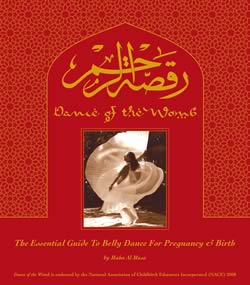
Dance of the Womb book cover

Book Review: Dance of the Womb: The Essential Guide to Belly Dance for Pregnancy and Birth
By Maha Al Musa, 2008
ISBN 978-0-646-48705-2
260 page hardcover book, $49.95 (AUS)
http://www.bellydanceforbirth.com

Reviewed by Molly Remer, MSW, ICCE

Some books simply feel good to hold in your hands. Dance of the Womb is one such book: it is beautiful, both in content and appearance. While priced a little higher than some birth books, I cannot emphasize enough what a high quality book it is—-it is not a traditional trade paperback, it is of textbook quality and size. Hardbound with a lovely cover and endpapers, Dance of the Womb is packed with full color, detailed, step-by-step instructional photographs leading the reader through a “belly dance for birth” journey.

Dance of the Womb is divided into several segments. The first section summarizes the benefits of belly dance and explores the physiology of birth. The next section walks the reader through a series of gentle warm-up exercises while the following sections progress through a variety of different specific belly dance movements. Nearing the conclusion of the text is a segment about labor movements with positions. Each section of the book is lavishly illustrated with very clear, easy to follow, step-by-step photographs.

The author’s own journey through pregnancy, birth, and mothering is skillfully interwoven throughout the text as well as her own feminine passage into understanding herself as a complete woman. Interspersed with the photographs and belly dance instructions, is the exploration of the author’s pregnancy and birth experiences, her relationship with her own mother and her parents’ culture. The book contains her personal birth stories as well as perspectives on belly dance for birth from three midwives.

The author, Maha Al Musa lives in Australia. Her interest in Middle Eastern Dance was sparked by her Palestinian/Lebanese roots and birthplace as well as her pilgrimage to explore her heritage and reconnect with her long-separated mother. Maha has also developed a Dance of the Womb step-by-step instructional belly dancing DVD (sold separately, review to follow) that includes a video of her own homebirth journey with her third child. She is also developing a one day foundation course in “bellydancebirth” for birth professionals with a plan to go international in 2011.

Dance of the Womb is a great introduction to not just the basic physical elements of prenatal belly dance, but also to the spiritual aspects of giving birth and life as a woman. It is written with an intimate tone that makes the reader feel as if the author has reached out across the miles to form a direct, personal connection. This book feels like a rich treasure to hold and is a gentle, nurturing, encouraging, and enriching voyage for pregnant women or the people who serve them.

—-

Disclosure: I received a complimentary copy of this book for review purposes.

Tips for Emotional Well-Being During Pregnancy

I got a lot of wonderful responses to my question about emotional well-being during pregnancy (associated with my giveaway of the book Birth Space, Safe Place). So, courtesy of a lot of wise women, here are some top tips for supporting your emotional well-being during pregnancy and birth:

  • Peaceful Beginnings doula services shared “I think my best tip for emotional well-being during pregnancy (and life in general) is to let go of guilt. We can only do the best we can with the information we have at the time, no more, no less.”
  • Yasmel shared that her most helpful tip, “would be to find whatever gives you positive thoughts and use it, a lot. I loved the book Ina May’s Guide to Childbirth and whenever I started second guessing my homebirth decision, I would open it up and just read the birth stories in it.”
  • Heather appreciated a helpful tip from her sister: “I was having alot of people question my birthing choices and telling me that my baby and I were going to die. None of which happened. She told me that ‘you can’t expect people to agree with your choices or behave respectfully about them. All you can do is know that you are doing what’s right for you and your child and that is all the matters. Don’t let them change your mind with fear. It has no place in childbirth.’”
  • And I especially enjoyed Ahmie’s advice: “remember that cats purr while giving birth. Figure out what makes you ‘purr’ while you’re pregnant and find ways to do more of that as well as to bring those tools to the birth-space with you.”
  • One of the most simple and yet important tips was shared by bubbledumpster, “Trust yourself,” and echoed in several other comments, such as earthmothergypsy who said, “I think one of the best helps emotionally is to encourage mamas to trust in themselves, their bodies and their babies. By giving them support in a way that they don’t feel undermined they can build the above trust in themselves.” And inoakpark who said, ” learning to trust your body (and trusting the people who will be with you at your birth to hold that space), is vital for an emotionally secure pregnancy and birth.”
  • bee in the balm offered another elegantly simple tip “to breathe, just take the time to come back to center and be and breathe.”
  • Nicole d shared that her best tip is “meditation on good/safe birth… the normalcy and miraculous nature of it. So much of pregnancy stress is uncertainty and fear of the birth process. The more you can trust in the process of pregnancy and birth, the more joyful and peaceful pregnancy can be.”
  • For Lee-Ann, “emotional wellbeing came with knowledge, the more I read and the more I normalized the birth process in my mind, the more research I did, the more confident and at peace I became.”
  • Rebekah made an excellent point about honest during pregnancy: “I think being open and honest with yourself and talking to your baby openly helps. It benefits no one to ‘pretend’ like everything is perfect and is okay to have trials, doubts, and fears.”
  • Jessica benefited from midwifery care: “One of the things that helped me a lot was having a midwife that I knew and trusted implicitly. I knew that my body and my baby would know what to do, and that I had a wonderful woman who would let it all unfold!”
  • And whoz_your_doula pointed out the benefit of taking time for yourself: “For me that took the form of meditation and prayer. The early morning is my time for deep reflection before the house begins to stir.”
  • A similar tip was shared by Gentle Beginnings: “I feel it is very important for a woman’s emotional well being to take a few minutes each day to spend time alone. To sit quietly and think about the precious child growing inside them, to disconnect from the world, to envision how peaceful they want their birth to be, to take a stroll in nature and to connect with their inner self. I think we can all benefit from these simple suggestions, but feel it is especially important during pregnancy and childbirth.”
  • Helpful for birth educators as well as couples, Janet shared that her favorite tip is “teaching the mom and her partner to work together towards open and honest communication before hand. I find a lot of the mothers I teach think, ‘Oh, well we talked about it once and I think we are on the same page,’ only to be completely blind-sided afterwards. Keeping these lines of communication open before, during and after pregnancy makes for a much better emotional state for all.”
  • Jamie moved us back to the trust theme: “Trust yourself. Trust that your body knows how to be pregnant and how to give birth. Be positive in the changes your body is going through and how you are being prepared for motherhood in all facets of your being. Know that you can do this—you are doing it!”
  • And another excellent and simple tip was shared by Heather Richins: “My tip is to make sure you stay well fed and hydrated. It is hard to feel good emotionally if you don’t feel good physically.”
  • Deborah had more than one to share: “1) Eat well: increase protein and raw fruits & veggies, and drink lots of water. Decrease refined foods, white flour products and sugars. 2) Exercise: walk, swim, yoga, etc. 3) Talk: find someone you trust and be honest about how you are feeling.”
  • And finally, Kathy offered a comprehensive collection of tips: “to be conscious of their needs each day. This includes physical,emotional, and spiritual. For the physical; Eat well. Whole foods, including whole grains, fruits, vegetables. Protein intakes needs to be adequate for a pregnant woman on a daily basis. Eating often to keep your blood sugars level is especially important for warding off mood swings. For the emotional; Trust yourself and others who care about you. Surround yourself with positive people who support you in what your doing. Communicate your needs and wants. Be willing to be honest and vulnerable. Pregnancy can often ‘stir the pot.’ Being willing to work out your feeling and talk to someone you trust and bring about personal growth and sometimes, bring about healing the past. For the spiritual; It is just as important for the spirit to be fed, as it for the body. Fellowshipping with others of the same faith is uplifting to the spirit. Take time for reflections and meditations each day. Keep a journal.”

I appreciated all the responses and think that emotional well-being is such an important subject. I feel like, especially with a first baby, it is an often overlooked element of birth preparation—a lot of time and energy is spent on the physical health of the pregnant woman, but the emotions are assumed to kind of take care of themselves, to perhaps be no one’s business, or to be dismissed summarily as “crazy pregnancy hormones” and “mood swings of pregnancy!”