Archives

Birth Space, Safe Place Book Giveaway!

This giveaway is now closed! The winner was drawn and was Jessica (of Jess Loves Being a Mommy)—please email me with your mailing address! 🙂

I am fortunate to have an extra copy of the new book Birth Space, Safe Place: Emotional Well-Being through Pregnancy and Birth. to give away to one lucky reader! 🙂 You can read my review of the book in the post below. There are three ways to enter to win the book and you will receive an entry for each method you employ (please make a separate comment for each of your entries):

1. Leave a comment on this post sharing your most helpful tip for emotional well-being during pregnancy and birth. I would like to compile these tips into a new blog post in the future (so if you don’t want me to include yours in that, please let me know!)

2. Become a fan of Talk Birth on Facebook (and post a comment here letting me know you are a fan).

3. Post about the giveaway on your blog and post a link back to it as well as a comment letting me know you did so.

Have fun! This is an interesting and useful little book and I know many people would enjoy having a copy. I will draw for the winner on Friday, January 22 at noon, so make sure to enter before that date!
Book Review: Birth Space, Safe Place

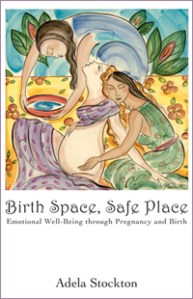
Birth Space, Safe Place: Emotional Well-Being through Pregnancy & Birth
By Adela Stockton
Findhorn Press, 2009
ISBN 978-1-84409-165-2

102 pages, paperback, $14.95
http://www.findhornpress.com

Reviewed by Molly Remer, MSW, ICCE

Appropriate for first time mothers as well as women having subsequent children, Birth Space, Safe Place is a slim and succinct little volume with a sole center: emotional well-being throughout pregnancy and birth. This very specific purpose is what makes the book special. It focuses on creating the emotional space for a gentle birth as well as a physical environment conducive to gentle, physiological birth. However, there is a broad range of topics covered within this specific focus including pain, fear, support, the “cocktail” of labor hormones, avoiding physiological disturbances of the birth process, optimal fetal positioning, and blessingways.

The chronology of the book flows from “conscious conception” through making decisions about birth location, preparing for labor, support during birth, “the spirit of birth,” and “early parenting joys and griefs” which addresses birth processing and postpartum recovery. The chapter on “cleansing the past” briefly addresses prior loss and bereavement, difficult previous birth experiences, and issues of abuse. Each section contains brief personal anecdotes, some from the author and some from mothers she has worked with. The exploration of each topic is brief, but is an adequate overview.

The author is a “childbirth homeopath” and so there are several sections about homeopathic remedies for specific symptoms or concerns. Aside from the homeopathic content, I did not feel as if I learned anything particularly new from the book, however it was very nice to have information about a specific element of pregnancy and birth preparation all pulled together into one nurturing place.

Birth Space, Safe Place is very supportive of doulas—for both labor and postpartum—and also of midwifery care and homebirth.

The book contains three appendices, endnotes, references, a glossary, and resource listing. The book is written in the UK (author is in Scotland), so National Health Service care is assumed and that system of maternity care, midwifery, and homebirth. The first appendix briefly addresses differences in US and Australian midwives compared to the UK.

And, make sure to check out my giveaway of Birth Space, Safe Place here!

Disclosure: I received a copy of this book for review purposes.

Birth Symbol

At the very end of August, I went to see Birth, the play in St. Louis. I was about 5 weeks pregnant at the time. Following the play and “talkback” event, there was a BOLD Red Tent (birth stories sharing circle). Right before the birth stories portion of the Red Tent, we did a birth art project. The Birthing from Within Mentor who was facilitating the Red Tent asked each of us to draw a symbol on a card that communicated what we would want to share with other women about birth—not in words, but a visual representation of the message we’d like to share. We then painted our symbols onto prayer flags to be strung together as a whole “language of birth” in symbols. We left the flags with her to be taken to births to share the symbols with other birthing mamas. I drew a spiral and explained that the message I was sharing was, “You can do it. You’re okay. Let it happen.” I also added a little birth goddess with wild hair that to me represents the intuitive birth wisdom women carry with them (when I was pregnant with my first baby I was worried about being too “in my head” to give birth powerfully–I created a series of needled felted sculptures of birth goddesses with wild hair and worried that the hair showed that I was too in my head. After he was born, I realized that my sculptures were telling me about the wild, natural, birth wisdom I had in my head, not the “book learning” that was also there and was what I had worried about interfering with the flow of birth).

A few days following my miscarriage in November, I received a Facebook message from the BfW mentor (and friend) who had facilitated the Red Tent session. She attached a photo of the flag I had painted during the Birth Art session and asked me to “allow the gift to come and sit with you” (as well as gifting me with “no response necessary”).

It was amazing to have my own birth symbol come back to “speak” to me in this way during such a painful (and also transformative) time.

“You can do it. You’re okay. Let it happen.”

Tummy Tub Mini-Review

When my two children were babies, I struggled through many a bath with them in a shallow little white plastic baby tub. It was hard to keep the baby warm in the water and it was also hard on my back to lean over the big bathtub to bathe them. We actually preferred sink baths (which are quite messy). Bathing together in a big tub was not an option because we didn’t have one available.

So, I was delighted to recently discover a new type of tub for infants and to receive one for review purposes—The Tummy Tub has an appearance similar to large bucket with a flared out top. It can hold a nice level of water to keep the baby comfortable, but still safe. The idea is that it duplicates some of the elements of being in the womb for babies, thus making the bathing experience more pleasant for everyone. You can also purchase a separate little stool/stand for the Tummy Tub so that you can sit comfortably with it instead of leaning over and straining your back.

I’m pleased to have this new resource available to show to my clients. During our last week of classes when we cover postpartum, newborn care, and breastfeeding, I bring along a variety of products to demonstrate and let parents see and touch and experiment with hands-on. I bring a variety of baby carriers, plenty of cloth diapers, and now a Tummy Tub as well.

Simply Give Birth: A Mini-Review

Only about a week following my miscarriage, I received a review copy of a new book by Heather Cushman-Dowdee (also known as Hathor the Cowgoddess). I have a pile of birth-related books waiting for me to review. However, I found that this soon post-miscarriage when I go to read them, my heart just isn’t in it, and I set them down again. However, Heather’s book was a different experience. Titled Simply Give Birth, the book is a beautiful collection of powerful birth stories (mostly unassisted births). When I got the book, I thought, “well, I’ll just flip through this a bit, even though my heart isn’t in it.” Well, I was instantly entranced in spite of myself. I didn’t finish reading it that week, but I picked it back up the following week and read it all the way through. What a treasure. It was very, very good and I really recommend it.

As I have briefly referenced here, I was struck by how the experience of “unassisted natural home miscarriage” parallels that of unassisted birth. Immediately after my body released my little baby, I felt strong and brave and powerful and like, “wow! I did it!” even though the outcome was not what I ever planned for or wanted. I rarely see feelings like that expressed in the many hospital/D & C miscarriage stories I’ve been reading lately and I feel happy that I was able to give myself and my baby the gift of “letting go” in our own dear home.

Reading Heather’s introduction about telling a new story about birth made me think there are new stories to be told about miscarriage as well. She says about the stories she selected for her book: “…all birth stories…prove what can be done. We can birth our babies and relish it too. We’re not stoic or fanatical, we’re mothers doing what mothers have always done, giving birth; with grace and spirit, and chutzpah, and moxie…they shared their grief, their passions, their exhaultation, and their fears. It takes massive courage to write about this most personal of moments with such candor and intensity and then be willing to share…”

Simply Give Birth is simply amazing. If hope you are lucky and find it in your Christmas stocking this year. If you don’t, or if you just can’t wait to read it, pop on over to the website and buy it ASAP!

Beautiful Homebirth Slideshow

Today I was sent a link to a lovely homebirth slideshow (scroll down through the photos and story to get to the slideshow link—-the story is worth reading too. It has some good observations about why birth matters: “If you have scene the movie The Business of Being Born there is a seen where one of the OBs being interviewed states in so many words that the process of birth is unimportant that it’s the outcome that is important – a healthy baby and a healthy mom. And while he is correct that a healthy baby and a healthy mom are always the most important end result he is dead wrong about the process. The process matters – -immensely. Physically the birth process is extremely important for the long term health of the mother and the baby, emotionally and psychologically the birth process will affect a woman for the rest of her life.” Can I just say, Amen!)

I absolutely love the joyful expressions on the mother’s face immediately after birth. So beautiful! Plus, it brings that feeling from my own births back to me. On Labor Day, CAPPA posed the question:


“Happy ‘LABOR’ day from CAPPA. What I loved about labor was________________!”

My response was: The feeling of personal power at the end—the “I climbed my mountain,” I DID IT feeling. And that moment of ecstasy of holding my new baby and saying, “my baby, my baby, oh my baby” over and over 🙂 Brings tears to my eyes thinking about it!

Watching the slideshow above, also brought the memory of that same “my baby, my baby” rapture back to me.

New Edition of The Guide to a Healthy Birth!

One of my favorite resources to hand out in birth classes and to give to pregnant friends is Choices in Childbirth‘s booklet “The Guide to a Healthy Birth.” I’m so excited to learn that the second edition of the booklet is now available! (Thanks to Teri at Passion for Birth for the tipoff!) You can download the pdf version directly here. Or, for very minimal shipping, you can order print versions here.

I just ordered 50 copies, so if you’re a real life friend of mine or are taking a class from me, I’d be delighted to give you one of these phenomenal booklets!

Birthing Poem

the woman speaks of birthing
After Langston Hughes’s The Negro Speaks of Rivers

I’ve known birthing
Before creation
And older than the labor of mankind
My womb is the mother of life
I carried Adam when seeds
In the garden were gestating
I pushed the head of Cronos from
Between my legs and swaddled
Him in the sands of time
I was midwife to the moon and
Made her crib in my lodge
I wailed with Demeter’s chorus
When armies stole children
Killed the land
And I’ve seen her barren lap
Turn poppy red with birth
In the spring
I’ve known birthing
Before god became a man

by Margaret Arabella Kenney

From Mothering Magazine (pg. 58, Sept-Oct 2008). I love to read this poem aloud at Blessingways. I thnk it is very powerful.

Timing Poem

I recently finished reading Teaching Natural Birth. In it, the author shares a poem called Timing, by Anne Clark. I haven’t read it anywhere else and a google search didn’t turn it up, so I wanted to share it here. I especially liked the closing paragraph.

Timing

by Anne Clark

Some people live life at fast and furious rates.

It’s the fast-food burger, the instant photo, the 12-hour birth.

Some thoughts that life, children and birth cannot be hurried:

A baby’s needs and wants are the same.

Meet the cries for dependence in a toddler, and a year later you’ll rarely have him on your lap.

Push him from your breast, out of your bed before he’s ready, and as an adult he’ll be on your lap, or worse, lost.

Some thoughts when my first couple asked me to provide labor support:

I should have paid them for the experience.

Hours of labor; a tender soul slow to yield to the pressure of insistence; a novice support person petrified by the intensity of it all; a center in myself created for the needs of this mother and father and baby.

To the mother, gently suggested, no rush, you’re fine, feel your baby, he’s strong. Let him come.

Mothers deliver their own babies.

My waiting hands caught him, a living, flowing, glistening sunbeam.

Forever hooked on Birth.

And from that day determined to give up anything instant (the hamburgers were agony.)

Delivery is drugged, controlled, guilt producing, hurried.

Birth is natural, forgiving, unhurried.

As a teacher of natural childbirth I try to teach the difference between Birth and delivery. Any woman can be delivered of her baby. It is up to us, the natural childbirth educators, to elicit the deep-down birthing knowledge that every woman possesses and to enourage patience in a natural process that, like life and children, cannot be hurried.

————