Archives

Birth Quotes Update

“Letting a woman discover her own power is a delicate art…You’ve helped her go to a place where she feels safe…and she will grow there when she is ready. We cannot take away her strength by controlling. We need to shelter and encourage her strength.” –Midwife Carol Gautschi on First Stage (in Midwifery Today interview by Kelly Moyer)

(I have a pet peeve about any use of the word “let” in relationship to birthing women, but I still like the ideas in this quote.)

“When you change the way you view birth, the way you birth will change.” ~Marie Mongan, Hypnobirthing (via Birth Without Fear)

“Every single human being was drummed into this world by a woman, having listened to the heart rhythms of their mother.” -Connie Sauer

“We must not, in trying to think about how we can make a big difference, ignore the small daily differences we can make which, over time, add up to big differences that we often cannot foresee.” –Marian Wright Edelman

‎”I believe the act of giving birth to be the single most miraculous thing a human being can do and it is surely the moment when a lot of women finally understand the depth of their power. You think it can’t possibly be done, you think you can’t possibly take the pain, and then you do —and afterward you look at yourself… in a whole new way. If you can do that, you can do anything.” – Ani DiFranco (via Spirited Doula Services)

“I see the beautiful curve of a pregnant belly shaped by the soul within.” –Hafiz (quoted in The Art of Pregnancy)

“In acknowledging woman-to-woman help it is important to recognize that power, within the family and elsewhere, can be used vindictively, and that it is not only powerful men who abuse women; women with power may also abuse other women.” –Sheila Kitzinger

‎”Anyone who has felt the pain of bearing a child, or pushed past physical limits in some athletic event, or struggled to learn difficult but powerful truths understands that suffering can be an integral part of the most profound joy. In fact, once suffering has ended, having experienced it seems to magnify the capacity… to feel pleasure and delight.” –Martha Beck

My note: As I’ve noted several times previously, I always emphasize in my own birth classes that pain does not equal suffering–there is a profound difference between pain and suffering (and much suffering that women experience in birth is NOT actually physical) and that no one wants birthing women to *suffer* (i.e. “natural birth advocates think women should just suffer” is not true!). However, I still liked the essence of this quote, which did not come from a book that has anything to do with birth, but from Beck’s book Finding Your Own North Star.

“Of course, if 40% of women need oxytocin to progress normally, then something is wrong with the definition of normal.” ~ Henci Goer (via An Everyday Miracle)

(“Synthetic oxytocin” would be better in the quote, because all women DO need oxytocin to progress, but what they need is their OWN oxytocin, not Pitocin, which is what the quote above is actually referring to.)

“When we talk about changing birth in our culture, everybody’s small & grand efforts matter. Birth touches everybody. So everybody must speak up: mothers, fathers, grandmothers, doctors, midwives, doulas, nurses, writers, & artists. We cannot wait for the powers that be to change birth for us. When millions of us change our attitude & expectations, & we speak up, we become the change we are waiting for.” -Pam England

from this blog post: http://birthpeeps.blogspot.com/2010/09/4-change-birth-change-cesarean-customs.html

This quote makes me think of my own “small stone” birth activism article: Small Stone Birth Activism « Talk Birth

“Woman-to-woman help through the rites of passage that are important in every birth has significance not only for the individuals directly involved, but for the whole community. The task in which the women are engaged is *political*. It forms the warp and weft of society.” –Sheila Kitzinger (Rediscovering Birth)

“Women die in childbirth as a result of systemic failures including: barriers to accessing care, inadequate, neglectful or discriminatory care, and overuse of risky interventions like inducing labor and delivering via cesarean section.” — Amnesty International (via Huffington Post article)

Obstetric Violence = “[T]he appropriation of the body & reproductive processes of women by health personnel, which is expressed as dehumanized treatment, an abuse of medication, & to convert the natural processes into pathological ones, bringing with it loss of autonomy & the ability to decide freely about their bodies & sexuality, negatively impacting the quality of life of women.” –International Journal of Gynecology & Obstetrics

This quote is re: the term as used in Venezuela, which carries a fine for violation.

“The protocols in the world of animal husbandry to protect an offspring at the time of birth—no strangers, dimmed lights, freedom of movement, familiar environment, unlimited nourishment, respectful quiet, no disruptions—are done without hesitation because to do otherwise invites ‘unexplained distress’ or sudden demise of the offspring.” ~ Beth Barbeau (via Midwifery Today, from article “Safer Birth in a Barn?”)

“In most societies birth has been an experience in which…women draw together to help each other and reinforce bonds in the community. Now that eradication of pain with effective anesthesia is often the only issue in any discussion of birth…the sacramental and social elements which used to be central to women’s experience of birth…seem, for an increasing proportion of women, to be completely irrelevant.” –Sheila Kitzinger

“Having a good birth is great. It helps you feel empowered. It’s the most powerful time in your life; it’s creation…But the self-empowerment that comes with knowledge and being able to make choices that are good for you, and good for your baby, and good for your family, helps put women on that path of being able to use that for the rest of their lives…” –Jennifer Welch (Turtle Women’s Project Founder)

“When I dare to be powerful–to use my strength in the service of my vision–then it becomes less and less important whether I am afraid.” –Audre Lorde

‎”No one can sufficiently capture in words the euphoria, the gratitude, and the total delight which can follow a natural birth. The high of these moments is spiritual to the utmost, while remaining utterly physical.” -Qahira Qalbi

“If mothers experience birth as a spiritual event that brings them closer to their communities instead of as a violent incident that takes place among strangers, then they can pass that attitude along to their children.” –Elizabeth O’Sullivan (in “The Turtle Women,” Mothering Magazine, 2004)

‎”But, to me, the battle will not be won until midwives can be positioned not as some new fringe ‘hippie-mother’ movement but as a longstanding and natural part of the human experience, as part of rather than threat to the modern health care industry.” –Sam Ford (in article about the Midwife “Brand”)

“A baby, a baby, she will come to remind us of the sweetness in this world, what ripe, fragile, sturdy beauty exists when you allow yourself the air, the sunshine, the reverence for what nature provides, even its uncertainty and sadness.” – Sarah Werthan Buttenwieser (Literary Mama)

“Fear is completely intertwined with what we experience as labor pain…And it is the fear in our physicians and nurses as much as the fear within ourselves.” –Suzanne Arms (Immaculate Deception II)

My note:

I think sometimes women underestimate the power the attitudes of other people in the birthplace hold over outcome (the nocebo effect, possibly)–while being prepared, confident, fearless, etc. a birthing woman is excellent and she *can* som…etimes manage to triumph over the fear of the others around her, I more often see the fear of others overriding the preparation and confidence a mother has tried to develop in herself 😦

“We have disrespected the motherbaby bond and their birthrights so badly that we have changed the course of history. It is time to take birth back. It belongs to motherbaby (with dad and midwife there to love, support and protect the motherbaby). This does not mean any particular birth will always go easy and you must have skill, knowledge, techniques and intuition with a lot of love.” –Jan Tritten (Midwifery Today)

‎”When intervening becomes routine, meaning there is no reason for it, only risks remain.” ~Henci Goer (via Fans of birth activist Henci Goer)

‎”…we can’t define our birth story ahead of time. We can’t go into it assuming it will be healing or empowering or a message or a political statement. When we do that, we risk that we will not see our birth for what it is – a beautiful, amazing process that helps define us as women and mothers in ways we may not expect. It may not be pretty. It may not live up to our standards of perfection. Sometimes birth just…is.” –Angela Quinn in the article Baggage Check via The Unnecesarean: http://www.theunnecesarean.com/blog/2010/10/20/baggage-check.html

My note:

Each of my births has had a “down side” or something that was “bad” about it (“bad” in that it didn’t in some way meet my expectations, OR, it threw me a curve ball). Interestingly, it is those difficult patches that were the most growth/strength producing. I also perceive (perhaps imaginary) pressure from the homebirth/natural birth community to not share or to gloss over the parts of our stories that are not beautiful, wonderful, perfect–the parts that may have been scary, bad, or disappointing. This lack of sharing of the bad parts also comes from within (for me), in order not to “scare” other pregnant women. (Here is a blog post I wrote about the “negative” elements of my births: https://talkbirth.wordpress.com/2010/06/29/manual-clot-extraction-following-birth-sequestered-clots/)

‎”The desire to help is so great, even from well-meaning, beautiful midwives, that they use intervention. We want to help. But what’s missing in our culture is that there is pain with a purpose, and that helping is sometimes interfering.” –Augustine Colebrook, CPM (quoted in “Do-it-Yourself Birth” article in Mothering mag)

I’ve written a lot about birth having inherent value in its own right. Process AND “product” (i.e. healthy mom, healthy baby) are both important. An de-emphasis on the process only serves to disempower, silence, invalidate, and violate women.

That said, I do also value the work of organizations like Hypnobabies that questions the very notion of pain as being an inherent part of birth.

I always explain to my students that the sensations of labor are more similar to the exertion of intense physical work/effort more than the pain associated with accident, illness, or injury. We need a bigger and broader vocabulary for completely describing the breadth, range, intensity, and beauty of birth experiences!

“Today, shake things up. Look at everything differently: Love a tantrum. Don’t dry tears. Embrace your flaws. Trash your guilt. Get stronger at the broken places. Parent where you are. Forget the crystal ball. Trust the process. Develop an insatiable curiosity. Tell another parent they rock. Give your child the benefit of *no* doubt. Go!” —Parent2ParentU

‎”How is one woman to claim her own experience of an ‘easy’ birth when she knows other women labor for days in pain… Or if you had a ‘bad’ experience giving birth, how are you to name that when women around you are happily anticipating a successful culmination to their [birth] classes? Women’s naming of much in their own birthing experiences is silenced by their sensitivity to other women’s feelings.” –Elizabeth Dodson Gray

My note: I think sometimes those of us who do have it “easier,” forget that even sometimes when someone has done all the “right” things, birth is ultimately an unpredictable and surprising journey with its own power, path, and purpose. My third son died unexpectedly early in my second trimester and that labor and birth had a huge impact on me–though not in the “joyful,” share-with-the-world way that I previously associated with homebirth.

“Childbirth can be changed, one woman at a time. Each woman can share with another what she has learned, and as women stand up to their providers with information and intelligence, I believe we will gradually see a desperately needed change in the state of modern obstetric care in America.” ~The Midwife Next Door (via Delightful Pregnancy & Birth)

“Nothing in medical literature today communicates the idea that women’s bodies are well-designed for birth. Ignorance of the capacities of women’s bodies can flourish and quickly spread into the popular culture when the medical profession is unable to distinguish between ancient wisdom and superstitious belief.” –Ina May Gaskin (in an article in Pathways to Family Wellness Magazine)

“The knowledge of how to give birth without outside interventions lies deep within each woman. Successful childbirth depends on the acceptance of the process.” – Suzanne Arms

(I would add, “and birthing in an environment that shares that acceptance…”)

“When there is no home birth in a society, or when home birth is driven completely underground, essential knowledge of women’s capacities in birth is lost to the people of that society–to professional caregivers, as well as to women of childbearing age themselves.” –Ina May Gaskin (in an article in Pathways to Family Wellness Magazine)

“Woman is as common as a loaf of bread, and like a loaf of bread, will rise.” –Judy Grahn

(After my third birth (at 14w5d), I wrote a list of “things I learned from miscarriage” in my journal and one of the final ones was, “when tested, I rise.”)

“…Like other involuntary processes, we cannot consciously control pregnancy and birth unless we physically intervene. Did you need to learn how to make your heart beat? How to breathe? How to digest your food? How to produce hormones?…You don’t have to do anything to make these processes work. You can support them, or you can intervene, but they will happen all on their own. You can trust them.” –Lamaze International

‎”Worry gives a small thing a big shadow.” – Old Swedish proverb (via Lamaze e-news)

“Who invented First Stage? Did it come about when we started putting our hands inside women? This act…killed many women because doctors were doing it before they learned to wash their hands…mother-leading is best. We are in partnership with women, but she is going by her thoughts, knowledge and culture. You have time to change and educate during the prenatal period, but at birth follow her lead!” –Jan Tritten

“Labor is for bringing the baby down and out. If we are going in and up, we are reversing the natural order. Let us try to find the most optimal ways of working with the natural process of birth. It cannot be improved upon in 90–95% of cases. Discerning the 5–10% is the hard part. With good prenatal care and careful attention to our reactions, we can probably come close.” –Jan Tritten (Midwifery Today e-news. Continued from above)

“Pregnant and birthing mothers are elemental forces, in the same sense that gravity, thunderstorms, earthquakes, and hurricanes are elemental forces. In order to understand the laws of their energy flow, you have to love and respect them for their magnificence at the same time that you study them with the accuracy of a true scientist.” – Ina May Gaskin (via Birth True Childbirth Education)

“Don’t forget to bring your sense of humor to your labor.” ~ Ina May Gaskin (via Midwifery Today e-news)

“When you have a baby, your own creative training begins. Because of your child, you are now finding new powers and performing amazing feats.” –Elaine Martin

“Uterine contractions are felt by many women to sweep towards them, rise in crescendo and then fade away like waves of the sea, so that wave imagery is very useful when describing the sensations they produce. This wave imagery is closely associated with the idea of rhythm, which is all important in harmonious psychosomatic adapation to labor.” –Sheila Kitzinger (Education and Counseling for Childbirth)

I’ve noted before that even though I’m not much of a “water” person, wave/water imagery and analogies always strike me as very right/true for my own birth experiences.

“The childbearing year–the time of pregnancy and early parenting–is the temporal and physical passage from being one woman to being a motherbaby dyad. The symbiotic relationship the two share during this time is critical to the long-term wellness of both.” –Julia Seng (intro to Survivor Moms)

‎”Nature in all her wisdom has designed the experience of birth so that it teaches a woman about her inner resources and how to access them.” ~ Christiane Northrup, MD (via An Everyday Miracle)

“The contemporary woman is the victim of her culture. It has beautifully conditioned her to a view of childbirth that cannot serve her well when she enters labor. Western culture generally, and American culture specifically, considers childbirth synonymous with suffering.” –Dr. Irwin Chabon (Awake and Aware, 1969. Quoted in Lamaze International‘s Summer 2010 journal)

I always talk in my classes about the difference between pain and suffering and often see a “lightbulb” go on…

‎”Through the act of controlling birth, we disassociate ourselves with its raw power. Disassociation makes it easier to identify with our ‘civilized’ nature, deny our ‘savage’ roots and connection with indigenous cultures. Birth simultaneously encompasses the three events that civilized societies fear–birth, death, and sexuality.” –Holly Richards  (In Cultural Messages of Childbirth: The Perpetration of Fear,” ICEA Journal, 1993. Via this blog: http://humanizebirth.blogspot.com/)

“Childbirth education has changed because what we know about birth has changed…Childbirth education must evolve from the technological curriculum to a physiologic study of how well women’s bodies are created, not for being delivered, but for giving birth.” –Barbara Hotelling (in Lamaze International’s Journal of Perinatal Education, Fall 2009)

“Mothers who have fears also hand down fearful attitudes about birth to daughters–and to every other woman who will listen. But each woman who gains the confidence to birth as unhindered or freely as her biological circumstances will allow–she will go on to encourage her sisters and daughters with birth words and images which resound with all the potential strength and beauty of birth.” –Jan Tritten

‎”Choices–no matter how *educated* or *informed* the consent–are not real choices when they are made within the context of fear…” –Jan Tritten (in Life of a Midwife)

I get frustrated with comments about how women need to “be educated” or “as long as they make an informed decision…” It is a LOT more complicated and “bigger” than that. I heard a presentation where informed consent was referred to as “the ritual of informed consent.” (i.e. not informed at all!)  Informed refusal is the logical companion of informed consent and yet it is almost never a real “choice” at all–so, how “informed” can the decision be? ARGH! This is so frustrating for me! (and it is frustrating because I hear doulas and childbirth educators say these kinds of things–but,  if the only choice that is allowed is to say “yes” then the whole thing is a sham!) Having no options to choose differently makes a choice not represent a real choice, regardless. Personally, I do not have the energy to fight my way through labor. I also know that even with all my information and resources, I don’t have the strength to overpower the hospital “birth machine” while also birthing a baby!

‎”Remember this, for it is as true and true gets: Your body is not a lemon. You are not a machine. The Creator is not a careless mechanic. Human female bodies have the same potential to give birth well as aardvarks, lions, rhinoceri, elephants, moose, and water buffalo. Even if it has not been your habit throughout your life so far, I recommend that you learn to think positively about your body.” ~ Ina May Gaskin

“One of the central spiritual lessons of birth is accepting that life is unpredicatable and we are not in control. Another is it cannot be done perfectly. Accepting that can be a deeply enriching act of self-love.” –Jennifer Louden (The Pregnant Woman’s Comfort Book)

“You can’t mass produce good birth experiences. Midwifery is a place where you can use all the love you have.” –Jan Tritten (founder of Midwifery Today in their book Life of a Midwife)

“Giving birth naturally is not just a nice option or the opportunity to have a transforming experience; giving birth naturally is the safest way to give birth for mothers and babies.” –Judith Lothian (in an article in Lamaze International‘s Journal of Perinatal Education, Fall 2009)

“…drugging or cutting a pregnant woman with no medical indication is an act of violence, even when performed by a medical professional in a hospital…In what other area of life in the United States is it apparently acceptable or legal for a professional to perform major abdominal surgery to reduce vulnerability to a lawsuit? Is this not even more violent than a black eye? And more insidious?” –Susan Hodges ‎(CfM’s founder, in an article in Lamaze International’s Journal of Perinatal Education)

‎”Truth has a power all its own. Truth is stronger than lies. We need to tell the truth about birth. Trust will follow.” – Carla Hartley (via Lamaze International pregnancy e-newsletter)

“A mother is a school. Empower her and you empower a great nation.” – Hafez Ibrahim (Egyptian poet 1872-1932, via Literary Mama)

“The gift of creating new life needs to be, once again, welcomed and honored as one of the most mysterious of human powers. And women need to be confirmed in their decisions to use this power however and whenever they see fit.” –Patricia Monaghan

“Birth has not only reached the absurdity of having to be relearned, it also has the absurdity of becoming a criminal offense if we are to go ahead with our ideals & do things the way we desire…midwifery as practiced in [Birth Book] is against the law. It has become political. We didn’t make it that way. For us it is… a beautiful, personal, spiritual, sexual experience…for us to have that, we become criminals.” –Raven Lang, Birth Book, 1972

“Be sure to share your story. There is no shortage of fear-mongering and simply unhelpful advice when it comes to birth. As fathers, we need to make birth a part of the masculine dialogue.” –A father quoted in The Father’s Home Birth Handbook by Leah Hazard

“Pregnancy offers us the excuse to be gentle with ourselves. That excuse can become a habit. That habit can slowly become a lovingly held belief: ‘I AM worthy of self-care, not just when I am carrying a child but every day.'” –Jennifer Louden (Pregnant Woman’s Comfort Book)

“Pregnancy can make you fat, or it can allow you to appreciate the wonder of your body. Pregnancy can make you a raving lunatic, or it can give you clues from your raw emotions where you need to ‘cut to the chase’…Pregnancy can make you extraordinarily exhausted, or it can give you clues to slow down and listen to your body, feed it what the baby and you need to thrive…” –Jennifer Louden

“Birth goes best if it is not intruded upon by strange people and strange events. It goes best when a woman feels safe enough and free enough to abandon herself to the process.” –Penny Armstrong & Sheryl Feldman (A Midwife’s Story, quoted in Having a Baby, Naturally)

[re: “surrender” during labor] “…She may refer to this as the feeling of surrender; but this kind of surrender is a gift, not something she herself did with her mind. At this point the body truly takes over and the thinking mind recedes into the background. This may be how women historically and presently, are able to labor without mental suffering and without pain medication.” –Pam England (Labyrinth of Birth)

“…in not disturbing the laboring woman you’re not handing over all control to her…it’s not a question of handing control to the laboring woman, it’s a question of *not controlling* her…while she’s in labor and giving birth physiologically, she’s going to seem well and truly out of control–totally wild!–so the issue of control seems a pretty irrelevant one really.” –Sylvie Donna (Optimal Birth)

“…if you know that you are pregnant and if you know when you conceived your baby and you think that everything’s okay, doctors can probably do nothing for you. Women need to realize that the role of medicine in pregnancy is very limited… –Michel Odent (in Optimal Birth)

Re: “advice” for somone who is pregnant. Quote continues with: “What’s important is for a mom-to-be to be happy, to eat well, to adapt her lifestyle to her pregnancy, to do whatever she likes to do…I think that’s what we have to explain t…o women. They have to realize that doctors have very limited power.”
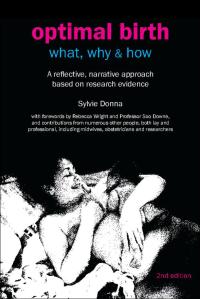
 

Book Review: Optimal Birth: What, Why & How

Book Review: Optimal Birth: What, Why & How
By Sylvie Donna
Fresh Heart, 2010
ISBN 9781906619138
670 pages, paperback, £24.99
http://www.freshheartpublishing.com

Reviewed by Molly Remer, MSW, ICCE, CCCE
https://talkbirth.wordpress.com

Written in an energetic and confident tone, Optimal Birth is written for midwives and other birth care providers and emphasizes undisturbed, natural birth. Throughout the text, a unique “birthframe” format is used to share birth wisdom in women’s own words. Donna is heavily influenced by the work of Michel Odent (he attended several of her births) and references him frequently. The author writes in a very straightforward manner and has extremely strong opinions as to what constitutes “undisturbed birth,” but these opinions are backed up with ample evidence-based information. The exquisite sensitivity of a birthing woman to her environment is of primary importance in the book and caregivers are strongly urged to take an extremely hands-off approach to care.

A lengthy volume, Optimal Birth is difficult to describe adequately in summary form—it contains extensive sections about physiological birth, birth interventions, the emotional impact of women’s experiences, prenatal care, and postpartum care. It also includes a week-by-week guide to pregnancy. There are a large number of black and white pictures and each section of the book contains a series of insightful questions designed to provoke self-discovery about physiological birth and the appropriate care of birthing women.

Readers unaccustomed to the midwives model of care or to the principles of undisturbed, physiological birth may find the book’s emphasis on non-intervention heavy-handed or one-sided. Considering that many manuals for care providers focus extensively on labor and birth “management,” personally I find the non-disturbance approach advised by Optimal Birth to be inspirational and encouraging as well as appropriate. As the author notes, “the processes of birth are so delicate that many things can disturb a laboring woman and consequently make her labor slower and more dangerous.”

An encouraging and informative companion book containing much of the same information but from a consumer perspective titled Preparing for a Healthy Birth is also available.

Disclosure: I received a complimentary copy of this book for review purposes.

Pain with a Purpose?

“The desire to help is so great, even from well-meaning, beautiful midwives, that they use intervention. We want to help. But what’s missing in our culture is that there is pain with a purpose, and that helping is sometimes interfering.” –Augustine Colebrook, CPM (quoted in “Do-it-Yourself Birth” article in Mothering mag)

When I shared this quote on the CfM Facebook page, a reader added: “Dr. Bradley wrote about ‘pain with a purpose’…Problem is, in our society, we don’t value the process of childbirth. Therefore, whatever it is you have to do to get thru it… Hence epidurals & nubain, and on and on. Please know I’m not dismissing your experiences if you went that route. But that phrase alone resonated with me when I was giving birth and helped me. I wish it would do so with more women.”

I’ve written a lot about birth having inherent value in its own right. Process AND “product” (i.e. healthy mom, healthy baby) are both important. A de-emphasis on the birth process and its significance in a woman’s life only serves to disempower, silence, invalidate, and violate women.

That said, I do also value the work of organizations like Hypnobabies that questions the very notion of pain as being an inherent part of birth.

So, what about pain?

I find that couples who come to my classes often have pain and managing pain (or witnessing pain) as their top issue of concern. For this reason, I spend time addressing the subject straight out and yes, I have been known to use the dreaded “pain with a purpose” phrase. Some would say that the word “pain” has no place in birth classes—that it sets women up for just that experience—however, as I noted, my clients come with “pain” on their minds and I find I need to use the p-word and sort of clear the air/get past that hurdle, before we do the rest of our work together. Also, as one of my clients once noted, “it wasn’t you who planted that seed [of pain being possible]. It was planted deeply a long time ago!”

And, what would be the purpose of pain in labor?

It is actually part of a beautiful hormonal symphony of labor—the sensations of labor signal our brains to release more endorphins, more endorphins leads to more oxytocin, and more oxytocin leads to increased intensity, which leads to more endorphins, etc., etc. When the pain to brain feedback loop is interrupted with medications, so too, are the oxytocin and endorphin messages that we need to get our babies born—and more interventions to “augment” labor are then likely to follow. As Preparing For Birth notes: “It is true that naturally occurring labor can feel larger and greater than the woman birthing. This is not so as she creates from within the very hormones that increase the strength, power, and frequency of her work of labor. That is the good news, it is from her, for her, by her.”

But, all these things said, I simply think the word “pain” is woefully inadequate to describe the feelings of labor. I like this description from Stephanie Soderblom better:

“VITA MUTARI – the literal translation from Latin to English is ‘Life Transformation.’ That is the closest thing I could think of the feeling of labor/birth…what you are feeling isn’t pain, it’s life transformation. Is it dramatic? You bet! I think it should be!”

I also love the description from Painless Childbirth:

“When I say painless, please understand, I don’t mean you will not feel anything. What you will feel is a lot of pressure; you will feel the might of creation move through you. Pain, however, is associated with something gone wrong. Childbirth is a lot of hard work, and the sensations that accompany it are very strong, but there is nothing wrong with labor.”

Now that’s what I’m talking about, might of creation moving through you. The word “pain” is way too puny to hold that!

I always explain to my clients that the sensations of labor are more similar to the exertion of intense physical effort more than the pain associated with accident, illness, or injury—both the effort AND the exhilaration are similar to doing good, hard, challenging, limit-testing, but doable work (though even bigger and more important). We need a bigger and broader vocabulary for completely describing the breadth, range, intensity, and beauty of birth experiences! What if we had more choices other than “painful” and “painless” to describe the experiences of birthing our babies? Though I wouldn’t say my births were “painless,” when I describe my own birth experiences, “pain” is simply not the word that rises to the top as the most appropriate descriptor.

“So the question remains. Is childbirth painful? Yes. It can be, along with a thousand amazing sensations for which we have yet to find adequate language. Every Birth is different, and every woman’s experience and telling of her story will be unique.” –Marcie Macari

We end up limited when we use only “pain” based language that fails to embrace the broadness and complexity and enormity of the experience.

Newborn Alaina, January 2011

Call for contributions: personal birth stories for new booklet on birthing positions

I received an email this weekend from a woman who is writing a booklet about birthing positions (non-profit and free for distributing when finished!). She is seeking contributions of birth stories to use in the book. Below is her message:

———————-

My name is Megan Layton. I have a strong interest in Women’s Health, current issues in obstetrics, as well as the cultural perceptions towards childbirth in general.

As well as being a Missouri native, a supporter of midwives and a woman’s right to an active role in childbirth, I am also a graduate student at the School of the Art Institute of Chicago. Currently I am working on a small, illustrated publication that focuses on birthing positions. The small book will be informative, fun, attractive, and free for distribution and copying. It is my intent to emphasize a woman’s choice during labor and childbirth, and not advocate for any particular position, provider, or setting, but merely convey the options available as well as the potential for birth to be a profound, empowering experience.

Part of the booklet will be first hand accounts of birth—oral histories from women who have had many different birthing experiences.

This is the reason I write to you: to ask that you share this with women who would be willing to share their personal stories, as well as any advice they could give to a woman who is about to experience childbirth for the first time.

Long or short, joyous or rational, funny or sad–any and all stories are welcome, and will be greatly appreciated. At the end of reviewing the narratives, I will ask those women whose stories best suit the publication for permission to use them. As well, I will send copies to all those who graciously allow me to reproduce their words.

All stories, narratives, and questions can be emailed via this link.

—————————

It sounds like a wonderful project to me!

It also reminded me of my previous postings about how to use a hospital bed without lying down. I tell all my clients if they remember only ONE thing from my classes, it is see the hospital bed as a “platform” and a tool in their toolbox—NOT as a place to lie down!

And, here are links to my own birth stories (each which involved freedom of movement during labor as an integral piece!)

First son’s birth (at freestanding birth center): https://talkbirth.wordpress.com/2009/02/25/my-first-birth/

Second son’s birth (at home): https://talkbirth.wordpress.com/2009/02/25/my-second-birth/

Third son’s birth (miscarriage at home at 15 weeks): https://talkbirth.wordpress.com/2010/05/03/noahs-birth-story-warning-miscarriagebaby-loss/


Effectiveness of Childbirth Education?

Some time ago a study was picked up by the media as proving that childbirth education “doesn’t work”. This BJOG study compared two groups of women—one group had 8 hours of childbirth classes that also included information about natural childbirth. The other group had classes that did not include natural childbirth information. The epidural rates for the two groups were the same and the couples’ satisfaction levels with their births was also the same. After this media attention, several birth bloggers addressed the study in-depth. The Science and Sensibility blog in a post titled Do Breathing Exercises Work? and The Family Way Publications in Natural Childbirth Class Not Useful?

What stood out to me in the article was the emphasis on breathing techniques. There is a lot more to childbirth education than “the breathing” and if that is all the “natural birth” classes had to offer, no wonder the results were what they were! As was noted in one of the blogs cited above, it is also significant that the women were randomly assigned to either group, indicating that they did not have a strong interest in natural birth (if they did, why risk being assigned to the non-natural birth classes!), so that perhaps the personal investment element was missing. A woman has to want to experience natural childbirth in order to do so!

Another birth educator commenting on The Family Way’s blog post, made an excellent observation that I think really got to the true heart of the issue. She said, ” Until childbirth educators emphasize this key component of CONGRUENCY in their classes women will continue to seek ‘care’ from professionals and institutions incompatible with their professed desire for natural birth. (emphasis mine) All this study proved to my mind it that both types of classes offered were ineffectual in promoting the with-women model of care in labor and birth… Both types of classes failed to address the real crux of the matter…are you receiving care from a provider/institution compatible with the kind of birth you want?” I explain to people in my classes that in the hospital women’s coping mechanisms are often stripped away from them-–sometimes by force, sometimes by misinformation, sometimes by excuses. I tell them over and over again to “ask questions before their chile is roasted” (Pam England). People tell me they can fight for what they want or that their husbands are good at “standing up for me” and I remind them that birth is not a time in a woman’s life when she should have to fight for anything! The time to get good care is NOW, not while “fighting” during labor and not during the “next birth” either (see more thoughts about “the next birth” here).

So, does childbirth education matter or not? Is the birthing woman’s environment of greater influence? I don’t think we have a full answer to this question. I do feel in my heart that childbirth education has important things to offer (otherwise, I wouldn’t be in the field!), but I also know in my heart that an unsupportive birth environment can steamroller right over most of the benefits. Birth is a lived experience and as such is greatly impacted by going on in the “here and now,” rather than past learning or ideas. Recently, I shared this quote from Suzanne Arms on my Talk Birth Facebook page:

“The knowledge of how to give birth without outside interventions lies deep within each woman. Successful childbirth depends on the acceptance of the process.”

In the comments, I noted: also helpful is to birth in an environment that shares that acceptance!

In July, I attended the annual CAPPA conference and enjoyed hearing Polly Perez speak about the benefits of childbirth education. She shared the following evidence-based benefits:

  • Knowledge
  • Less fear
  • Student more able to take responsibility for their own health care
  • Less need for medications/anesthesia
  • More satisfaction with birth experience
  • Life skills!

I definitely have been witness to the reduced fear as well as to the development of life skills that will continue to serve parents on the parenting journey. My own personal observations of additional benefits would be:

  • Increased confidence in their bodies, the birth process, and their own capacities
  • Enhanced father participation
  • Increased prenatal bonding/connection with baby and positive feelings towards baby
  • Reframing of birth from something to fear/greet with anxiety to something to embrace and greet with anticipation and enthusiasm.

It is hard for me to identify if these benefits carry over from my actual classes into the birth room, however, and this is an issue and question that I continue to ponder.

On a related note, here is a handout from Mother’s Advocate on choosing a childbirth class.

Birth Waves

‎”Uterine contractions are felt by many women to sweep towards them, rise in crescendo and then fade away like waves of the sea, so that wave imagery is very useful when describing the sensations they produce. This wave imagery is closely associated with the idea of rhythm, which is all important in harmonious psychosomatic adaptation to labor.”

–Sheila Kitzinger (Education and Counseling for Childbirth)

Sheila Kitzinger is one of my all-time favorite birth writers and I quote her frequently. She has such a beautifully lyrical writing style.

I’ve noted before that even though I’m not much of a “water” person, wave/water imagery and analogies always strike me as very right/true for my own birth experiences. I shared the quote above on the CfM Facebook page and one person made a comment that quotes like the one above “hide” the truth about how birth is painful and that perhaps we should stop talking in flowery images and instead address how it really is. What was interesting to me is that I do not associate “wave” images with lack of pain or lack of intense sensation. Indeed, somewhat of the opposite! This is one of my personal experiences that leads me to identify with quotes about waves, water, and birth:

With my second baby, I described the contractions as having a “sharp edge” to them. My mental imagery of water and birth was not so much of peaceful, lapping waves, but of intense waves CRASHING into/around a rock. They would then part and flow around the rock (i.e. me), so it wouldn’t get knocked down by them but would be there waiting for the next wave to crash into it…I actually have this same image come to mind during the tough moments of parenting young children!

Additionally, the way contractions build to a peak of intensity much the way waves crest and break, as well as the unstoppable rhythm and flow of them also held power and relevance for me. The ocean is BIG and waves are powerful and so is birth!

Honesty in Birth Preparation

Some time ago I came to the disheartening conclusion that what many independent birth educators like myself teach women in birth classes isn’t actually what they can expect, it is what they deserve. And, in our birth culture there can be a dramatic difference between the two. I then wrote an article exploring what many women can expect from a traditional hospital-based “natural” birth—it was published in Pathways magazine and has also made the rounds multiple times as a blog post. So, what then do women deserve? In my mind, they deserve: humane care; respectful, individualized treatment; freedom of movement and choice in a woman-honoring environment; informed consent; the Six Healthy Birth Practices; and the recognition that birth is a significant rite of passage and transformative life event. With this conviction, I therefore refuse to start teaching only what can be expected, because women deserve so very much more than that—but, how to professionally handle the dichotomy in class?

Published in the 80’s, the book Childbirth with Insight by Elizabeth Noble has some thoughts on the subject offer the birth educators of today. In the section addressing the issue of being honest with childbirth education clients about common obstetric practices, she says:

“…instructors in the community cannot afford to discuss obstetric practices in ways that will aggravate local hospitals and obstetricians if they wish to fill their classes. One childbirth educator comments, ‘Imagine if we told couples how it really was…perhaps we’d lose fewer teachers from our group.’ No wonder many of these dedicated and enthusiastic teachers suffer ‘childbirth preparation burnout.’ They are caught in a triple bind. If they describe accurately how birth is managed in some hospitals, couples would become very fearful. If expectant parents anticipate a warm and flexible birth environment and find that such is not the case in the hospital they use, their disappointment is inevitable and bitter. If the instructors advocate childbirth without drugs or anesthesia and these are needed, parents may harbor feelings of guilt and failure.”

The author concludes this segment of the discussion with a very potent and powerful message to birth educators:

“Each instructor must teach what she knows in her bones to be true. A dynamic teacher is constantly changing, becoming more self-aware. At the same time, couples must be warned that almost all hospitals and doctors have expectations based on the mechanical model of birth.” [emphasis mine]

This is such a difficult line to walk—to encourage confidence, trust, and joy in childbearing, while being straightforward about the challenges couples may face when seeking a natural birth experience in a hospital. I always encourage couples to “assume good intent” from hospital staff—they offer medication because they feel like they are helping and also simply because it is the primary “tool” in their medical-model oriented helping toolbox. I also remind them that routines are powerful and if the majority of births occurring at a specific hospital are induced, medicated, heavily intervened with, etc. it can be difficult to buck the trend. Again, not out of some sketchy motive from hospital staff, but simply because of routine or “this is what we always do” or “this is what mothers want from us.”

The very firey, bold, honest, and passionate 1990’s manifesto on VBAC, Open Season even more bluntly addresses the issue of transparency in maternity care and also the effectiveness of childbirth education in this quote:

“If childbirth classes really ‘worked,’ more women would be having babies without interference. More women would be recognizing the complete naturalness of birth and would remain at home, delivering their infants with feelings of confidence and trust. More and more, midwives would be demanded. The names of those hospitals and doctors who treated women and babies with anything less than absolute respect would be public knowledge, and childbirth classes would be the first place these names would be discussed. ‘You’re seeing What’s-His-Face? He’s a pig! In my opinion, of course,’ I tell people who come to my classes. I then proceed to give them the names of people who have used Pig-face. They can always ask Dr. P. for the names of people who have used him and been satisfied with their births, for balance.”

While I’m not personally to the point of taking the “Dr. Pig-face” approach from Open Season, I’ve decided that honesty is the best policy and I’ve started to be very upfront about my challenge with the couples in my classes. Lately, I say, “here’s where I’m wrestling with something. I’m teaching you what you deserve, but it isn’t necessarily what you can expect…” and we proceed to explore choices, talk about communication skills, talk about evidence-based care, making sure the care provider’s words and actions thus far are matching, etc. However, my basic dilemma remains—I am not changing a broken system by teaching individual couples how to navigate it more satisfactorily, I’m actually supporting the broken system (right?!). While one-on-one change efforts have value and are personally rewarding, what I know in my bones to be true is that what we actually need is widespread maternity care reform and systemic change on a global level…

(I originally posted some content from this post on the ICEA blog.)

Ecstatic Birth

The beautifully organized hormonal symphony of labor was mentioned by several speakers at the CAPPA conference in North Carolina.

Here are two lovely quotes from Sarah Buckley about ecstatic birth and the role of birthing hormones:

“Giving birth in ecstasy: This is our birthright and our body’s intent. Mother Nature, in her wisdom, prescribes birthing hormones that take us outside (ec) our usual state (stasis), so that we can be transformed on every level as we enter motherhood.” –Sarah Buckley

“This exquisite hormonal orchestration unfolds optimally when birth is undisturbed, enhancing safety for both mother and baby. Science is also increasingly discovering what we realise as mothers – that our way of birth affects us life-long, both mother and baby, and that an ecstatic birth —
a birth that takes us beyond our self — is the gift of a life-time.” –Sarah Buckle

While I definitely do not feel like “orgasmic” is an accurate descriptor of my own birth experiences, I really like the term “ecstatic birth.” According to Sarah’s descriptions/definitions of ecstatic birth, I feel like I’ve had three ecstatic births (including a second-tri miscarriage-birth—the hormonal “symphony” was the same as with full-term labor and my sense of exhilaration and accomplishment and almost “pride” was the same as with my other babies, except then I also had the accompanying overwhelming grief at not having a living baby to exalt over).

When I think about the term “ecstatic birth” and recall my own feelings and experiences, I think I’m thinking of the immediate post-birth ecstasy/euphoria I experienced and still remember so profoundly. The I DID IT moments. And too, the other-plane-of-existence feelings/consciousness of being in labor and working in harmony with my body. The Laborland stuff—which is that indescribable, surrendered, sort of “hypnotized” state of truly embodied experience.

And What’s This? More Birth Quotes!

I decided to split my most recent Facebook quote sharing into two posts, because it was becoming overwhelmingly long. These are the quotes I’ve shared on the Citizens for Midwifery Facebook page since April. While I realize that I don’t “own” these quotes—other people said them, not me!—I do have quite a bit of legwork invested in seeking and sharing these quotes (I mostly get them from my own reading) and if you re-post one or more of them on your own Facebook page, blog post, or book, I really appreciate acknowledgement and/or link back to this site or to my FB page, that this is where you originally got the quote!

‎”When a woman births without drugs…she learns that she is strong and powerful…She learns to trust herself, even in the face of powerful authority figures. Once she realizes her own strength and power, she will have a different attitude for the rest of her life, about pain, illness, disease, fatigue, and difficult situations.” –Polly Perez

“It is a curious commentary on our society that we tolerate all degrees of explicitness in our literature and mass media as regards sex and violence, but the normal act of breastfeeding is taboo.” – American Academy of Pediatrics (via Baby Bloom Doula Service)

“The way a society views a pregnant and birthing woman, reflects how that society views women as a whole. If women are considered weak in their most powerful moments, what does that mean?” –Marcie Macari

“Attempting to fulfill an idea of the ‘perfect’ mother can only prove soul-destroying, as no such person exists.” –Adela Stockton

“In the sheltered simplicity of the first days after a baby is born, one sees again the magical closed circle, the miraculous sense of two people existing only for each other.” –Anne Morrow Lindbergh

Giving birth is an experience carried not only into the first days of motherhood but also throughout life, having far-reaching effects on the mother’s self-esteem and confidence.” –Gayle Peterson

‎”I think one of the best things we could do would be to help women/parents/families discover their own birth power, from within themselves. And to let them know it’s always been there, they just needed to tap into it.” –John H. Kennell, MD

“As doulas, midwives, nurses, and doctors, it’s important to never underestimate how deeply entrusted we are with someone’s most vulnerable, raw, authentic self. We witness their heroic journeys, see them emerge with their babies, hearts wide open…” –Lesley Everest (MotherWit Doula)

“…advocates of home birth have never suggested that *all* women should give birth at home, only that it is a reasonable choice for some women. Given that rather modest claim, the force and vehemence with which home birth is opposed by ACOG seems out of all proportion.” –Elizabeth Armstrong (Princeton University)

“Few healthy, low-risk mothers require technology-intensive care…Yet…the typical childbirth experience has been transformed into a morass of wires, tubes, machines and medications that leave healthy women immobilized, vulnerable to high levels of surgery and burdened with physical and emotional health concerns…” –Maureen Corry (quoted in Lamaze International‘s journal)

“At a time when Mother Nature prescribes awe and ecstasy, we have injections, examinations, and [cord] clamping… Instead of body heat and skin to skin contact, we have separation…Where time should stand still for those eternal moments of first contact as mother and baby fall deeply in love, we have haste to deliver  the placenta and clean up for the next ‘case.'” –Sarah Buckley

“Who am I to be brilliant, gorgeous, talented, fabulous? Actually, who are you not to be?” – Marianne Williamson

“…celebrate ourselves for our courage to birth. The real question becomes not, ‘Have you done your breathing exercises?’ but rather, ‘Can you love yourself no matter how you birth, where you birth, or what the outcome?'” –Claudia Panuthos

“Whenever a woman has a problem, I believe that she herself can find the answer, provided she is given adequate information and support. I firmly believe in women’s strength and resourcefulness; I’ve witnessed these time and again. Women care about the continuation and continuity of life; they are intrigued by relationships, how things fit together.” –Elizabeth Davis

“Deep relaxation, surrender, letting go: when midwives are asked to disclose the secret of giving birth with relative ease, these are the words we choose. More than metaphors for coping, these responses are based on physiological imperatives…” –Elizabeth Davis

“The greatest joy is to become a mother; the second greatest is to be a midwife.” –Norwegian Proverb

‎”Brick walls eventually crumble precisely because people keep busting their heads against them.” –Barbara Wilson-Clay (IBCLC)

“Some midwives pull women up the hill and say I will get you through this. Other midwives walk behind quietly and gently say, ‘I believe in you.'” -Patricia M. Couch (via Wellpregnancy Childbirth Educator Trainings and Childbirth Classes)

‎”In our own world today, motherhood is rarely sufficiently honored. One day each year, there are brunches and corsages and little gifts of love. But the rest of the time? As a culture, we do not respect the great gift of mothering. Women’s work in raising the next generation is taken for granted. Yet it is a vital service to humanity, one that deserves to be acknowledged continually.” –Patricia Monaghan

‎”Becoming a mother does not need to rob you of your selfhood. Stay away from martyrdom. Martyrs never make good mothers; what is gained in giving is taken away in guilt.” –Gayle Peterson

“The midwife cannot be skilled without being caring. She cannot be truly caring without being skilled.” –Sheila Kitzinger

“The two most beautiful sights I have witnessed in my life are a full blown ship at sail and the round-bellied pregnant female.” –Benjamin Franklin

“When you have a baby, your own creative training begins. Because of your child, you are now finding new powers and performing amazing feats.” –Elaine Martin

“…in a time lacking in truth and uncertainty and filled with anguish and despair, no woman should be shamefaced in attempting to give back to the world, through her work, a portion of its lost heart.” –Louise Bogan

“If the baby’s body is a joy and a delight in the mother’s arms, that same body will become a joy and a delight to its owner later on.” –English & Pearson

“Even if I am simply one more woman laying one more brick in the foundation of a new and more humane world, it is enough to make me rise eagerly from my bed each morning and face the challenge of breaking the historic silence that has held women captive for so long.” –Judy Chicago

“Children are the power and the beauty of the future. Like tiny falcons we can release their hearts and minds, and send them soaring, gathering the air to their wings…” –Skip Berry

“Mama exhorted her children at every opportunity to ‘jump at de sun.’ We might  not land on the sun, but at least we would get off the ground.”- Zora  Neale Hurston (via Literary Mama)

“That they can strengthen through the empowerment of others is essential wisdom often gathered by women. “—Mary Field Belenky (via Applaud Women)

“Since beliefs affect physiologic functions, how women and men discuss the process of pregnancy and birth can have a negative or positive effect on the women that are involved in the discussion. Our words are powerful and either reinforce or undermine the power of women and their bodies.” –Debra Bingham (I was inspired to share this quote today by a conversation with Kerry Tuschhoff 🙂

“Learn to respect this sacred moment of birth, as fragile, as fleeting, as elusive as dawn.” ~ Frederick Leboyer (via From Womb to Cradle Doula Services)

‎”It takes force, mighty force, to restrain an instinctual animal in the moment of performing a bodily function, especially birth. Have we successfully used intellectual fear to overpower the instinctual fear of a birthing human, so she will now submit to actions that otherwise would make her bite and kick and run for the hills?” –Sister Morningstar (in Midwifery Today)

“Birth is women’s business; it is the business of our bodies. And our bodies are indeed wondrous, from our monthly cycles to the awesome power inherent in the act of giving birth.” –Sarah Buckley

“When a man is truly ‘present’ for the birth of his child and allows himself to be touched by the mystery unfolding before his eyes, he will have an unquestionable experience that can catapult him into the next phase of his development as a mature human being. His encounter with the power of birth…can connect him to his partner and his child in ways that sustain him for the rest of his life.” –John Franklin

“When he becomes a father, a man leaves behind his life as a single individual and expands into a more inclusive role. He becomes a link in an unbroken chain. And in doing so, he himself undergoes a birth process–the birth of himself as a father.” –John Franklin (FatherBirth)

‎”We are volcanoes. When we women offer our experience as our truth, all the maps change. There are new mountains. That’s what I want to hear–to hear you erupting. You Mount St. Helenses who don’t know the power in you–I want to hear you…If we don’t tell our truth, who will?” –Ursula K. Le Guin

“For most people, modern life meanders along a path of ups and downs, by and large devoid of high-voltage experiences that have the power to alter our lives in significant ways…The birth of a child is one of those significant experiences.” –John & Cher Franklin (FatherBirth)

“Pregnancy and labor are periods of vulnerability. This vulnerability is not weakness, but softness, which later contributes to adjustment to motherhood. Feeling dependent may open you to your need for help, and the ability to accept help from others can increase your strength and endurance for labor. Each of us must come to terms with our own feminine strength and our need for protection.” –Gayle Peterson (An Easier Childbirth)

“Labor is also teamwork. It is a mother and baby learning together how to push and how to be born, how to yield and separate from the union of pregnancy. You are not in control nor are you out of control during labor. The best way to approach labor is with an attitude of learning rather than controlling.” –Gayle Peterson (An Easier Childbirth)

“Midwifery calls upon you to be the best you can be: the best advocate, guide, healer, counselor, mother, comrade, and confidant of the women seeking your care.”— Anne Frye

“The birth of a baby is the birth of family. Myriad births take place at once: Women become mothers, husbands become fathers, daughters become sisters, and sons become brothers. One birth ripples through generations, creating subtle shifts and rearrangements in the family web.” –Gayle Peterson

“The family’s trust in the midwife and the midwife’s trust in the competence of the family members are the basis of caring that has the power of magic.” ~ Mary C. Howell (from Midwifery Today e-news)

“Birth is not a cerebral event; it is a visceral-holistic process which requires all of your self–body, heart, emotion, mind, spirit.” –Baraka Bethany Elihu (Birthing Ourselves into Being)

“Fear is completely intertwined with what we experience as labor pain…And it is the fear in our physicians and nurses as much as the fear within ourselves.” –Suzanne Arms (Immaculate Deception II)

“There is no place for ideology in birthing. Each birth has its own story and we must respond to what the baby tells us.” –Spinning Babies.com (via Kelly Caldwell)

I do think there is a place for ideologies/philosophies about birth and as guides for humane care/practice and as guides for making prenatal care and birth care decisions (before the birth), but in the actual moment, release of attachment is often necessary.

“To be pregnant is to be vitally alive, thoroughly woman, and undoubtedly inhabited.” ~Anne Buchanan (via CAPPA)

“Your doc/friend/mother-in-law may be saying, ‘Don’t be a hero, get the epidural!’ But this isn’t about heroics, this is about protecting your body…” –Jennifer Block (via @Spirited Doula Services)

“Giving birth in ecstasy: This is our birthright and our body’s intent. Mother Nature, in her wisdom, prescribes birthing hormones that take us outside (ec) our usual state (stasis), so that we can be transformed on every level as we enter motherhood.” –Sarah Buckley

“The mystery of life and birth is a profound invitation to be authentic as you trust and tremble your way through labor’s Gates of doubt and fear. It is possible that you will become more intuitive during labor than at any other time…Allow your body to guide you in your breathing, in your unique movement, in knowing …what to do…even when you don’t know what to do.” –Pam England (The Labyrinth of Birth)

“Every great dream begins with a dreamer. Always remember, you have within you the strength, the patience and the passion to reach for the stars to change the world.” ~ Harriet Tubman (via Midwifery Today e-news)

“Midwives can create a spirit of beauty at a birth or they can desecrate it. They can create a sacred space around a birthing woman that drives out fear & inspires the mother’s belief in herself, which ultimately determines the outcome of the birth. Midwives can be a channel of Grace in ways they never imagined & in doing so they create a spirit of reverence. Reverence in these days and times is not a common thing.” Caroline Wise, Birthing with Reverence (Midwifery Today)

Re: “advice” for someone who is pregnant: “…if you know that you are pregnant and if you know when you conceived your baby and you think that everything’s okay, doctors can probably do nothing for you. Women need to realize that the role of medicine in pregnancy is very limited…What’s important is for a mom-to-be to be happy, to eat well, to adapt her lifestyle to her pregnancy, to do whatever she likes to do…I think that’s what we have to explain to women. They have to realize that doctors have very limited power.” –Michel Odent (in Optimal Birth)

Birth Quotes Update

Time for my semi-regular re-sharing of birth quotes I’ve shared on my Talk Birth Facebook page in the last several months (there are also a few grief/miscarriage quotes mixed in as well as some activism quotes too). While I realize that I don’t “own” these quotes—other people said them, not me!—I do have quite a bit of legwork invested in seeking and sharing these quotes (I mostly get them from my own reading) and if you re-post one or more of them on your own Facebook page, blog post, or book, I really appreciate acknowledgement and/or link back to this site or to my FB page, that this is where you originally got the quote!

“…in not disturbing the laboring woman you’re not handing over all control to her…it’s not a question of handing control to the laboring woman, it’s a question of *not controlling* her…while she’s in labor and giving birth physiologically, she’s going to seem well and truly out of control–totally wild!–so the issue of control seems a pretty irrelevant one really.” –Sylvie Donna (Optimal Birth)

“I see my body as an instrument, rather than an ornament.” ~Alanis Morissette, quoted in Reader’s Digest, March 2000 via Denver Doula

‎”Expectant mothers need to be mothered; their hearts need to be infused with love, confidence, and determination. I now see myself as ‘midwife’ to the gestation and birth of women as mothers.” –Pam England (Birthing from Within)

‎[re: “surrender” during labor] “…She may refer to this as the feeling of surrender; but this kind of surrender is a gift, not something she herself did with her mind. At this point the body truly takes over and the thinking mind recedes into the background. This may be how women historically and presently, are able to labor without mental suffering and without pain medication.” –Pam England (Labyrinth of Birth)

This feels true from my personal experiences–I feel like the most important thing anyone can know about birth is to welcome that surrender (to let go of control) and also about the value of *freedom* in enabling the surrender to happen (freedom in the physical space–i.e. no one “letting” you drink or not drink or labor in bed or out of bed).

“[re: ecstatic birth] This exquisite hormonal orchestration unfolds optimally when birth is undisturbed, enhancing safety for both mother and baby. Science is also increasingly discovering what we realise as mothers – that our way of birth affects us life-long, both mother and baby, and that an ecstatic birth —
a birth that takes us beyond our self — is the gift of a life-time.” –Sarah Buckley

“When you don’t follow your nature there is a hole in the universe where you were supposed to be.” –Dane Rudhyar (via Marian Thompson, LLL Founder)

‎”Birth is what women do. Women are privileged to stand in such power! Birth stretches a woman’s limits in every sense. To allow such stretching of one’s limits is the challenge of pregnancy, birth, and parenting. The challenge is to be fully present and to allow the process because of inner trust. How can women find their power, claim it, and stand firm in it throughout?” –Elizabeth Noble

(Her answer: “vertical birth”–thus, to quite literally STAND in one’s birth power!)

‎”…it is not easy for women to lay claim to our life-giving power. How are we to reclaim that which has been declared fearful, polluting and yet unimportant? How are women to name as sacred the actual physical birth, which comes with no sacred ritual…?” –Elizabeth Dodson Gray

‎”A woman’s path to power is more like engaging life’s energies in a swirling movement filling us up, out, into wholeness.” –Lois Stovall

“The body has its own way of knowing, a knowing that has little to do with logic, and much to do with truth, little to do with control, and much to do with acceptance…” –Marilyn Sewell (via Mothering Magazine‘s pregnancy e-newsletters)

“…much of what passes for childbirth education and preparation today actually increases women’s fears by giving them too much concrete information to hang their anxiety on, and too many names for all the bad things they already fear will happen. In the course of trying to calm the higher brain by giving it lots of data, we can end up defeating our purpose by feeding our fears.” –Suzanne Arms (Immaculate Deception II)

“We take for granted in the United States that childbirth is a multi-million dollar industry. It’s as simple as that–women’s bodies and the act of creation are intertwined with the economy. What if our relationship with body and womb and birth was in every sense of the word FREE? What if we didn’t need managed care? Literally or figuratively?” –Baraka Bethany Elihu (Birthing Ourselves into Being)

Reader responded with a question about, “how do we teach our children about birth?” and this was my short answer:

I think by talking about is as something that is a “normal” as can be–i.e. not scary and dangerous–and by not “hiding” birth from them like it is a secret. My kids have seen all kinds of natural birth videos, pictures in books, etc. When …my older son was only 3 1/2 he drew me a picture with the baby attached to the mom with an umbilical cord (both with big smiles on their faces) and the placenta in bowl next to them (which of course couldn’t actually be there unless the baby was not still attached to the mom with the cord). 🙂

“I am starting to see that a woman’s strength in birth is also in the letting go and allowing herself to tumble fearlessly with the current, never losing sight of the belief that, when the energy of the tide is through, she will find herself upright again on the shore.” –Maria (at the blog A Mom is Born)

“Because parents are transients in the maternity care system, there is little cumulative birth experience over successive generations of mothers. Women giving birth don’t make the same mistakes as their mothers or grandmothers–they make new ones.” –Elizabeth Noble (Childbirth with Insight)

‎”Those who push themselves to climb the last hill, cross the finish line, or conquer a challenging dance routine often report feelings of euphoria and increased self-esteem…women who experience natural birth often describe similar feelings of exaltation and increased self-esteem. These feelings of accomplishment, confidence, and strength have the potential to transform women’s lives…In many cultures, the runner who completes the long race is admired, but it is not acknowledged that the laboring woman may experience the same life-altering feelings…” -Giving Birth with Confidence (Lamaze International)

“Fathers’ sharing in the birth experience can be a stimulus for men’s freedom to nurture, and a sign of changing relationships between men and women. In the same way, women’s freedom to give birth at home is a political decision, an assertion of determination to reclaim the experience of birth. Birth at home is about changing society.” –Sheila Kitzinger

(Emphasis mine.) Posted in honor of Independence Day!

I’ve noted that many women (including myself) cite “freedom” as one of the main reasons they choose out-of-hospital birth…

‎”Labor is not a time to judge ourselves but a period for reflecting on our movement through life at a given moment. It is not possible to control labor, it is only possible to follow the process and to meet whatever it may offer.” –Gayle Peterson (An Easier Childbirth)

“There is an urgent need for childbirth education for doctors and nurses so that, instead of superimposing a medical perception of birth, professional helpers listen to, learn from, and respect women’s experiences. Only in this way shall we be able to humanize the culture of birth.” –Sheila Kitzinger (forward in An …Easier Childbirth by Gayle Peterson)

The book was written in 1993 and I think we still haven’t figured that out yet…:(

‎”The absolute miracle of a birth and the emergence of a new human being into the world catapults both mother and father into the realm of awe and wonder. They are flooded with non-ordinary feelings and energies that support a deep connection not only with the newborn and each other, but also with the mystery and power of life itself.” –John & Cher Franklin

‎”A strong woman knows she has strength enough for the journey, but a woman of strength knows it is in the journey where she will become strong.”

“A strong woman isn’t afraid of anything, but a woman of strength shows courage in the midst of her fear.” (from the same “Woman of Strength” poem as above quote, author unknown, many internet versions floating around)

“When I dare to be powerful–to use my strength in the service of my vision–then it becomes less and less important whether I am afraid.” –Audre Lorde

“Despite hundreds of years of negative programming, labor and birth can be a soul-stirring experience!” —Christiane Northrup, MD

“The labor and birth experience itself is a microcosmic slice of what fathering asks of a man.” –John Franklin (FatherBirth)

‎”…an experience of the phenomenal capacity of our birthing body can give us an enduring sense of our own power as women. Birth is the beginning of life; the beginning of mothering, and of fathering. We all deserve a good beginning.” –Sarah J. Buckley

“Birth privacy is important because it fosters FREEDOM and that sense of freedom is fundamental to birthing unhindered and with joy.” –Molly Remer (my contribution to the book/DVD giveaway on Orgasmic Birth: The Best Kept Secret (fan page))

“Cautious, careful people, always casting about to preserve their reputation and social standing, never can bring about a reform.” Susan B. Anthony

“When I say painless, please understand, I don’t mean you will not feel anything. What you will feel is a lot of pressure; you will feel the might of creation move through you. Pain, however, is associated with something gone wrong. Childbirth is a lot of hard work, and the sensations that accompany it are very strong, but there is nothing wrong with labor.” –Giuditta Tornetta

Love this –the “might of creation.” How true!

“Day by day, month by month, year by year we are confronted with all that we do not know, that we do not understand, that we do not grasp. Sometimes we are humbled by this knowledge and say: God, it is too wonderful for me to comprehend but I know this universe is more grand and more beautiful than I ever could have imagined and I give thanks for the blessing of being here and seeing, hearing, experiencing, and sensing all that is so wonderful around and in me…” –Susan L. Suchocki

“Life is full and overflowing with the new. But it is necessary to empty out the old to make room for the new to enter.” —Eileen Caddy

“Once the baby is born, your life will change forever. It will change in so many ways, and until you get there you simply can’t be told. The joys, the sorrows, the excitement, the fear, the frustrations–in fact, I think all the adjectives in the world couldn’t describe what is in store for you.” –Giuditta Tornetta

‎”I love to think that the day you’re born, you’re given to the world as a birthday present.” –Leo Buscaglia (shared on my second son’s fourth birthday)

“Wherever women gather together failure is impossible.” –Susan B. Anthony

“I believe with all my heart that women’s birth noises are often the seat of their power. It’s like a primal birth song, meeting the pain with sound, singing their babies forth. I’ve had my eardrums roared out on
occasions, but I love it. Every time. Never let anyone tell you not to make noise in labor. Roar your babies out, Mamas. Roar.” –Louisa Wales

“…The motherhood mosaic has pieces that are dark and dull, but it’s a work that shines.” –Carol Weston

“Women’s bodies have near-perfect knowledge of childbirth; it’s when their brains get involved that things can go wrong.” –Peggy Vincent (via Sweet Miracles

“A child strips away our illusions that we are perfect, that we have it all figured out, that we are all grown up. In fact, we grow up with our children if we are willing to remain open to their innate goodness as well as our own.” –Peggy O’Mara

“The suckling relationship is one of the sources of real sweetness that we have in human existence…The suckling baby can teach adults about the expression of sweet love and gratitude in a way no words can.”
–Ina May Gaskin

“Unfortunately, birthing woman has not only lost touch with her body and with her ancient female lineage. She has also lost her voice to speak up, to question intervention, to ask for support, to demand respect for the work of giving birth and caring for her infant. When she finds that voice, she will regain a vital part of her creativity and power as a woman.” –Suzanne Arms (Immaculate Deception II)

“Pregnancy is a time of being in touch with the power of creation itself.” –Rahima Baldwin & Terra Richardson

“We ourselves feel that what we are doing is just a drop in the ocean. But the ocean would be less because of that missing drop.” –Mother Teresa

‎”Childbirth calls into question our very existence, requiring an expectant couple to confront not only new life but death, pain, fear, and, most of all, change.” –Elizabeth Noble (quoting a new mother)

“Hope is the thing with feathers, That perches in the soul, And sings the tune without the words, And never stops at all…” –Emily Dickinson

‎”We may tell ourselves that birth is a natural and safe process and recall our childbirth teacher’s emphasis that a woman’s body is designed for giving birth, but our own bodies may hold a different truth. It is essential to honor body memory, as it wields far more influence than the intellect during labor.” –Gayle Peterson (in An Easier Childbirth re: working through birth memories in preparation for future births)

“If a community values its children, it must cherish its mothers.” -John Bowlby

“Just as a tree grows best when anchored firmly in the earth, so can a pregnant mother feel strong and capable when supported by a sisterhood of nurturing friends.” -April Lussier

“Planning for birth is like getting ready for an athletic event…You can’t predict exactly what is going to happen; the events of the game will unfold according to their own particular logic, and not necessarily
according to your plan.” –Adrienne Lieberman

“If we don’t take care of mothers, they can’t take care of their babies.” –Jeanne Driscoll

“And I also know how important it is in life not necessarily to be strong but to feel strong, to measure yourself at least once, to find yourself at least once in the most ancient of human conditions, facing blind, deaf stone alone, with nothing to help you but your own hands and your own head…” –Christopher McCandless

‎”When you are drawing up your list of life’s miracles, you might place near the top the first moment your baby smiles at you.” –Bob Greene

I have crystal clear memories of my second baby’s first smile (the day of birth–looking into my eyes) and of my first baby’s first laugh. Less clear memories of the FIRST smile for my firstborn and first laugh for my second. I guess it is good that they each get one of the special, miracle moments!

“Midwives do NOT empower women. Only women can empower themselves. If you’ve been empowered through birth, thank your midwife for holding the space – but know that it was surely YOU that created and walked the journey” -Pamela Hines (via Barbara Herrera)

“Though we have lost a petal, we are still flowers, lush and full together in a garden of hope.” -Angie M. Yingst

‎”Once her endorphins have kicked in, a woman may actually enjoy labor or may even find it an ecstatic experience. I have many times told the story of one of my clients who was crying and desperate in early labor, only to be smiling and dancing around the room at nine centimeters’ dilation.”–Elizabeth Davis

“Life shrinks or expands in proportion to one’s courage.” –Anais Nin

“Giving birth requires an honest surrendering of your body and soul. You need to be in a relaxed state of love. Love has a way of overpowering fear. The more energy-draining feelings you can unload, the more room you will have for bliss and simplicity. Birth can be an unfolding and emergence like something you’ve never experienced before.” –Lynn Griesemer

“Labor is like mothering: you prepare and do the best you can, but finally, most of it is out of your hands. Birth is a great mystery. Yet we live in a rational, scientific world that doesn’t allow for mystery…” –Jennifer Louden

‎”Although the popularly desired outcome is ‘Healthy mother, healthy baby,’ I think there is room in that equation for ‘Happy, non-traumatized, empowered and elated mother and baby.’” –Ashley Booth Youn

[in reference to before she had her baby] “…I thought the only thing that was important…was to have a healthy baby. Now I recognize that while this is the primary goal, it is not the only goal. Birth is such an emotional experience; it can give or take away so much more than I ever realized…it will change you in such a wonderful and powerful way. It gave me more strength than I ever imagined. Since then, whenever I become overwhelmed, all I have do to is say, ‘I had a baby in my home!’ I am instantly empowered.”–Jody Niekamp (in Journey into Motherhood)

‎”10% of births needfully culminate in intervention. Self-esteem depends on salvaging the most important truth from your experience: Birth cannot be controlled. It is a mystery.” –Karen Fisk

“As doulas, midwives, nurses, and doctors, it’s important to never underestimate how deeply entrusted we are with someone’s most vulnerable, raw, authentic self. We witness their heroic journeys, see them emerge with their babies, hearts wide open…” –Lesley Everest (MotherWit Doula)

“Not every woman experiences unaided, natural childbirth, yet many women hope for it. To strive for birth as a peak experience—to withstand this ‘trial by fire’–a woman must learn what labor pain is and be prepared to accept and work with it. And she must also prepare for the unexpected.” –Karen Fisk

‎”It is so easy to close down to risk, to protect ourselves against change and growth. But no baby bird emerges without first destroying the perfect egg sheltering it. We must risk being raw and fresh and awkward. For without such openness, life will not penetrate us anew. Unless we are open, we will not be filled.” –Patricia Monaghan

“A Life may last for just a moment…. but a memory can make that moment last forever…” (Unknown)

“Birth is an experience that demonstrates that life is not merely function and utility, but form and beauty.” –Christopher Largen

“Birth matters. It brings us into being, on many levels.” –Ananda Lowe

‎”The way a society views a pregnant and birthing woman, reflects how that society views women as a whole. If women are considered weak in their most powerful moments, what does that mean?” –Marcie Macari

“Shrouding information about birth in silence hides the fact that labor and birthing pain is a positive key to transformation. Preparation for and expectation of that pain leads to self-awareness. Thus, birth becomes not only a passage for your child, but a passage for you into instinctual and effective parenting.” –Karen Fisk