Archives

Thesis Tidbits: Birth as an Initiation

“We owe it both to our children and to the world, to conceive, birth and welcome our children with as much love and prayerfulness as possible.” –Jackie Singer (Birthrites)

“Childbirth is a rite of passage so intense physically, psychologically, emotionally, spiritually, that most other events in a woman’s life pale next to it. In our modern lives, there are few remaining rituals of initiation, few events that challenge a person’s mettle down to the very core. Childbirth remains a primary initiatory rite for a woman.” –from the book MotherMysteries

via Thesis Tidbits: Birth as a Shamanic Experience | Talk Birth.

I recently finished reading a short book called Return to the Great Mother, which is very specifically focused on giving birth as an initiatory event. It includes a variety of birthing women’s voices and experiences with accessing the energy and wisdom of the “great mother,” be it archetype, an inner resource, or one face of the Sacred. The author, Isa Gucciardi, writes:

Giving birth is one of a series of important initiations a woman may experience in her lifetime. Initiations are intimately tied https://www.sacredstream.org/components/com_virtuemart/shop_image/product/b0e92ae33095ca07867acb0a841a9f05.jpgwith change. They bring the initiate from one state of being into a new state of being. Initiations accomplish this task by putting the initiate through a series of experiences that challenge them in a particular way and bring them into new ways of being and of understanding. The initiate must meet these challenges and overcome any obstacles in order for the initiation to succeed in bringing about these changes.

Today, many people going through initiations and many people managing initiations do not have a clear understanding of the nature of the power and vulnerability that is at the heart of initiation. Initiates must render themselves vulnerable to initiatory processes in order for initiations to become complete, and the power in that vulnerability must be managed carefully and thoughtfully. Most importantly, for an initiation to be successful, that power and vulnerability must be safeguarded and dedicated to the initiate.

The process of meeting an obstacle and overcoming it in order to ultimately gain greater insight and power is described by Joseph Campbell as the “hero’s journey.” The “hero’s journey” is an initiatory experience. Every woman takes this journey when she gives birth and it can be the primary initiation a woman undergoes in the course of her life.

Often a woman encounters herself in an entirely new way during the process of giving birth. She may encounter the effect of traumas long buried, or she may encounter fear long denied. She may also discover power deep within herself that she had never imagined.

When the processes of birth are allowed to take their course, a woman with the proper care has the opportunity to come to terms with whatever may arise. In doing so, she may experience a shift into a new way of being or understanding. Yet, when the birth process is interrupted, or not properly held, the power of the initiation is often lost or distorted… (p. 10)

We know that women do not always have full and free choice when it comes to decisions about their birthing bodies and childbearing years…so, how does this impact the initiatory process? Isa writes:

In modern births, the power of the initiation of birth is often co-opted by doctors, pharmaceutical companies, insurance companies, and hospitals. It is also co-opted by the fear of pain and the influence of friends and family. It is difficult for women to hold onto the power of the initiation of birth under these circumstances. The unfortunate implication here is that the subsequent initiations of women interrupted in this way will be affected by their inability to hold onto the power of their birthing process.

Based on the level of interruption of the birth initiation caused by unnecessary interventions in the birthing process today, it seems reasonable to suggest that many women experience incomplete initiations when giving birth…

(Personally, I would clarify that it is not that women are unable to hold onto the power of the birthing process, but rather that it is often systematically stripped from them.)

Each of my children’s birth experience was an initiatory event for me, but in varying ways. With my first, it was the initiation to motherhood, the mystery and anticipation of giving birth. The crucible moment for me with him was actually my journey through the harrowing landscape of postpartum. With my second son, giving birth rapidly and with great intensity and power, the initiation felt like it was in letting go and hanging on for the ride—letting my mind stop and my body go. With my third birth, which was my first miscarriage, the initiation was in the physically grueling and bloody aftermath of his birth and then the broad, deep, unknown, transformative path of grief and change. I still feel as if this was one of the most powerfully initiatory experiences of my life. (And, I did have an encounter with one face of the great mother.) After Alaina’s birthday this week, I was talking to my husband about my memories of this last birth and telling him that I do not review the details of her birth with the same sense of power or initiation as the births of my other children. It doesn’t hold that same “touchstone” energy for me as the births of my boys—experiences that I continued to draw strength from as I went on into other events in my life. I don’t return to her birth for strength or courage the way I remember returning to the births of each of my sons. And, then I said it was because with her, the pregnancy was the initiation. The long, long, path of pregnancy after loss and all the fear and all the hope and all the strain of feeling the feelings and doing it anyway. Her birth itself was the moment of relief. The end of a trial, rather than the triumph or peak experience of the births of my first two babies. So, while of course I still carry powerful and potent memories of her birth as well, it was the journey of pregnancy that holds the talismans of initiation for me.

In her classic book Shakti Woman, Vicki Noble describes giving birth as a central shamanic experience and perhaps the root of all shamanism:

“I believe I underwent an initiation of the most ancient variety, birth as a shamanic experience, the central act of female shamanism—the quintessential act that offers a woman a completed experience of facing and moving through her fears to the other side. It isn’t that birth is the only way for a woman to experience this initiation—many women climb mountains or face other kinds of physical endurance tests and also come through it reborn into their power. But biologically birth is a doorway, a given for most women on the planet. It is fundamental opportunity to become empowered. Most of us giving birth today do not have the full experience, which is co-opted and distorted beyond recognition, changed from an active process into something that is done to us, as if we don’t know how to do it ourselves. Reclaiming the right to birth in our own instinctual way is a shamanic act of courage that has unfortunately become as remote to us as our ability to fly through the night in the form of an owl or heal the sick with the power of the drum. It wouldn’t hurt if we began to think of our birthing and child rearing as central parts of our shamanic work…” (p. 223).

via Thesis Tidbits: Birth as a Shamanic Experience | Talk Birth.

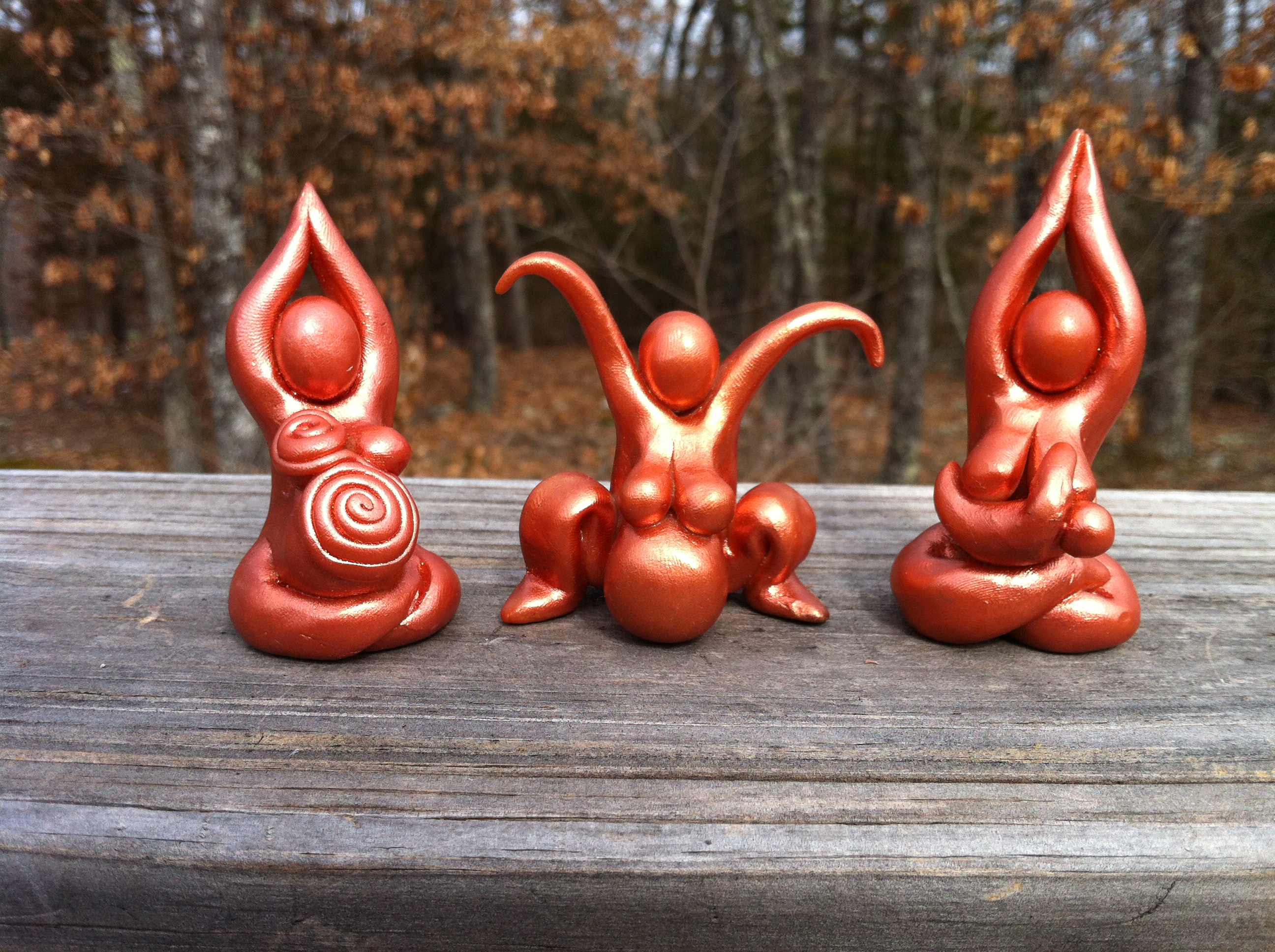
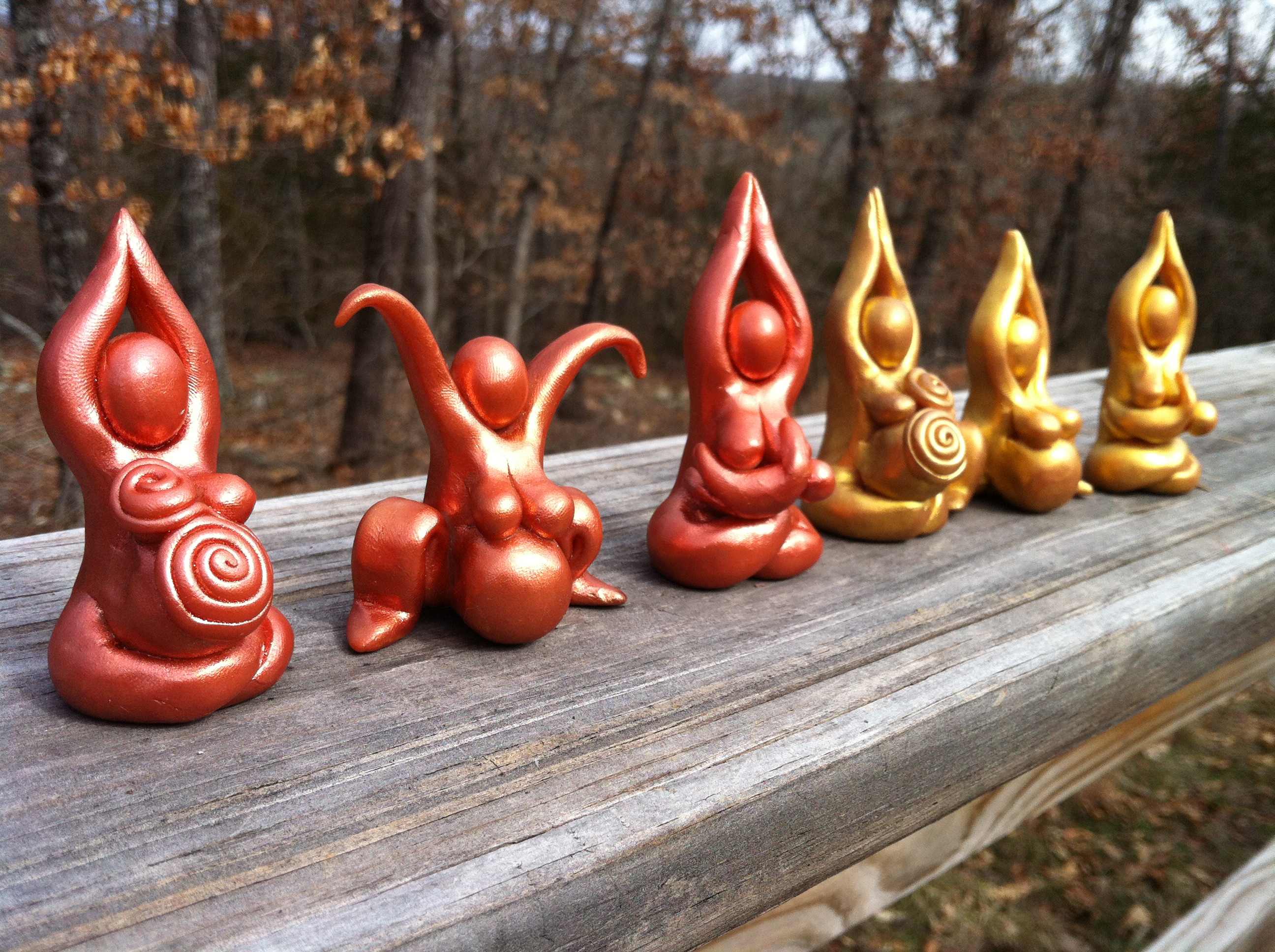
I just finished a new sculpt for a medium sized version of our classic birth goddess pendant and Mark cast and finished some of them last night. I woke up this morning with a phrase from a past piece of poetry floating through my mind over and over:

Soft belly January 2014 088
no longer bearing children
I am pregnant with myself
ripe with potential,
possibility, power
I incubate my dreams
and give birth to my vision…

I also thought about what I hope to communicate to others through my sculptures and when I took the new pendant down to the woods with me, a little song emerged to go with her:

Birth mama
birth goddess

reaching out
to join the circle of mothers

feeling her way
finding her place
in the web of women

Birth mama January 2014 050
birth goddess

hold strong
hold steady

make way for baby
make way for baby

Body opens
heart opens
hands open to receive

Birth mama
birth goddess

she’s finding her way
she’s finding her way…

Disclosure: I received a complimentary digital copy of the book for review purposes.

Talk Books: Laughter & Tears: The Emotional Life of New Mothers

Laughter and Tears: The Emotional Life of New MothersBecause books are my first and longest-lasting love, I began my blogging career with a book blog. I eventually gave it up when I felt I no longer had time for it and turned my attention of other blog work. However, I occasionally mine the old blog for content here and I’ve realized that rather than doing traditional reviews, I really, really like doing my somewhat-new “talk books” posts on this blog. I’ve mentioned before that one of my reasons for blogging is simply to store information in one place that I want to remember or come back to later. If I’ve typed up everything I like from a book, I don’t really need to hang onto the book and the “essence” of many books (or at least what I got from them) is all compiled in one place. So, what follows is one of those mined posts (though at the end, I got caught up in the topic and went off into some related thoughts).
Laughter and Tears: The Emotional Life of New Mothers was written in 1997 by Lamaze co-founder Elisabeth Bing. I found myself with a dearth of postpartum resource books after giving birth to my first child and desperately hungered for them. I went on a dogged mission to locate them, finding them somewhat difficult to unearth, and eventually I think I read basically every book ever written on the postpartum period.  I started out enjoying Laughter and Tears, but found it less and less engaging as it went on. I think there is such a great need for books about postpartum out there—ideally, for women to read before their babies are born. I wish I would have had one already on my shelf when my first baby was born, instead of having to discover the niche later. However, part of why the book was not engaging by the time I actually read it was simply because it is geared toward women in the immediate postpartum (and also first time mothers primarily)—when I read it, I was no longer there and so my interest in the book waned fairly quickly. I also found a the heavy emphasis on “reclaiming your body” off-putting—there was even a comment like, “now that your baby is a robust two month old, you can begin to reclaim your body by reducing or eliminating feedings at night.” Excuse me? “Robust” TWO MONTH OLD? That is practically still a fetus as far as I’m concerned!

Several quotes I marked to share:

“Our society is profoundly ambivalent about children. On one hand, we praise family values, but on the other, we emphasize individual liberty and the rights of women to have as many freedoms as men. We encourage mothers to desire to have it all, but do not guarantee maternity leave, health insurance, or day care. We use babies to sell products, from laundry detergent to automobile tires, but we don’t want a mother with a toddler in the seat next to us on an airplane. We question the legality of abortion but threaten to withdraw welfare benefits from disadvantaged children. We celebrate children and praise parents for having them, but we do not provide structures or systems to help nurture them.”

And, one I still find extremely relevant:

“The degree of pleasure you take in your mothering is not the same thing as loving the baby or being an effective parent. Keep in mind there is a distinction between mother love and maternal satisfaction. You may love your baby very much but be dissatisfied with your life circumstances.”

There was also a quote that I find a new relevance in today now that our household structure has changed to both parents being home nearly full-time. I’ve been confronted over and over again in the last several months with how many “keys” to the household and family life that I’ve held over my ten years as the primary parent in the home and that, at some level, there is a power in being the one who knows (even if it just where the mustard is, for example) and that switching over to sharing those household details doesn’t actually come easily for either parent, no matter how we’ve said we wish to share them. I’m also noticing how very, very many details of the somewhat invisible work of parenting are still very much my responsibility—such as planning birthday parties or taking kids to playgroup or making dentist appointments or making sure Christmas presents are purchased and equal—and apparently, I do not know how to let those go or start transferring some of the responsibility without feeling put-upon, annoyed, demanding or like, I’ll just do it myself, since I’m the expert anyway. And, as this quote below references, I also have enjoyed being the primary emotional parent as well and still hold on to that terrain—essentially, what I want to share is the cooking and towel-folding responsibilities, while still getting to be the one run to for security and snuggles.

“Men are challenged by their attempts to be more involved and more nuturant than the ‘traditional’ father. Women are challenged not only by developing an identity in the world outside the home, but also by opening up and truly incorporating men into the intimate life of the family. You may have a concept of what a more involved father should be like, but if you are honest with yourself, is your image truly about sharing the love and nurturance? Or is it actually about wanting your partner to help with domestic chores? Are you really imagining a co-parent, or are you thinking of something more like a regular baby-sitter and handyman?”

Whatever it’s shortcomings, this book again reminded me of how vital postpartum support is for families in our society and reminded me of why I originally wanted to be a postpartum doula and how called I felt to that work. In 2004, I trained with DONA as a postpartum doula and felt 100% certain that I had found where I belonged (indeed, I still get Christmas cards and updates from one of my first postpartum doula clients—I was good at the work and they liked me a lot!). I stopped working as a postpartum doula in 2006 though. My biggest reason for discontinuing postpartum work was because at this point in my life I couldn’t reconcile taking care of someone else’s family while my own needed me so much. There I would be washing my client’s dishes and thinking that I have a huge pile unwashed at my own house (that my husband then did at night when he got home) and/or folding their laundry and thinking of the two full baskets at my own house in my own living room as yet not put away. Also, I recognized that I felt more comfortable with and am temperamentally more suited for educational/”academic” types of support  rather than the “intimate” hands-on support that postpartum or labor support requires. For a time after quitting, I really felt embarrassed about it because I was SO sure it was my “calling” and because I spent so much money on training, books, supplies, certification packet, etc. (Luckily, I totaled it up when I was preparing to quit and I made enough money from my clients to at least more than pay myself back for the training!)

I feel fervently that women/families need postpartum doula support (sometimes desperately) and I felt depressed to realize that I wasn’t the person for the role after all. I didn’t understand at the time, but I quickly figured out why the majority of the women in the postpartum doula training with me were middle-aged. They had the energy to “mother-the-mother” and “nurture the family” at that season in their lives, whereas I am still in a season in which I need to nurture my own family before I have the energy to spare to nurture someone else’s. There were also a handful of women in the training, like me, who had very young children. There were no in-betweeners, like where I am right now. I’ve begun to notice this in birth activism work (and to a lesser, but still noticeable extent, in breastfeeding support work) as well—passionate mothers-of-infants or toddlers and gray-haired sage-women are the ones who come together for the bulk of the birth activist workload in various organizations.

I’m also reminded again, however, of why breastfeeding support holds such a lasting pull for me and that is because postpartum is where it is at, that is where we are so very, very deeply needed as support people. Birth is amazing and exhilarating and women most definitely need us there too, but in the nitty-gritty, day-to-day, unglamorous, nipples and breast infections, teething, crying, dirty-haired, exhausted, wrung-out maternal web of daily being is a very tender and delicate beauty that becomes visible only when we’re willing to spend months and months, or even years, serving as a listening ear, a medication lookup, and someone to trust with both her laughter and her tears.

December 2013 018Additional resource: Non-Advice Books for Mothers

Tuesday Tidbits: Postpartum Mamas

As Americans, we are under the impression that new moms are ‘Superwomen’ & can return to life as it was before baby. We must remember to celebrate this new mother and emulate the other cultures that honor new mothers by caring for them, supporting them, & placing value on the magnificent transformation she is going through. This is the greatest gift we can give to new mothers & newborns…–Darla Burns (via Tuesday Tidbits: Postpartum Mothering)

“The first few months after a baby comes can be a lot like floating in a jar of honey—very sweet and golden, but very sticky too.” –American College of Nurse-Midwives

The United States are not known for their postpartum care practices. Many women are left caught completely off guard by the postpartum recovery experience and dogged by the nagging self-expectation to do and be it all and that to be a “good mother” means bouncing back, not needing help, and loving every minute of it.

This country is one of the only utterly lacking in a culture of postpartum care. Some version of the lie-in is still prevalent all over Asia, Africa, the Middle East, and particular parts of Europe; in these places, where women have found the postpartum regimens of their own mothers and grandmothers slightly outdated, they’ve revised them. The U.S. seems only to understand pregnancy as a distinct and fragile state. For the expectant, we issue reams of proscriptions—more than can reasonably be followed. We tell them what to eat and what not to eat. We ask that they visit the doctor regularly and that they not do any strenuous activity. We give them our seats on the bus. Finally, once they’ve actually undergone the physical trauma of it, their bodies thoroughly depleted, we beckon them most immediately to rejoin the rest of us. One New York mother summed up her recent postpartum experience this way: “You’re not hemorrhaging? OK, peace, see you later…”

…“A culturally accepted postpartum period sends a powerful message that’s not being sent in this country,” said Dr. Margaret Howard, the director of the Day Hospital for Postpartum Depression in Providence, Rhode Island. “American mothers internalize the prevailing attitude—‘I should be able to handle this myself; women have babies every day’—and if they’re not up and functioning, they feel like there’s something wrong with them.”

via Why Are America’s Postpartum Practices So Rough On New Mothers? – The Daily Beast.

Via First the Egg, I then read this powerful reflection prompted by the article above:

In the piece, one woman mentions that women are literally still bleeding, long after they’re expected to “bounce back” and reclaim their old lives and be totally self-sufficient. Our bodies haven’t finished healing, and we’re supposed to look and act as though nothing even happened here, it’s all good. It’s all just the same as it was.

Secretly, I’ve been the slightest bit ashamed of all the help I’ve needed.

via Eat the Damn Cake » bleeding time.

I also read this raw, honest, and touching look at the “betrayal” experienced by women who enter into the mystery of birth expecting a blissed out, earth mother, orgasmic birth experience:

…But inside my head, I could not believe what was happening. How painful it was. How terrifying. I felt helpless. And degraded and humiliated by there being witnesses. And at the same time, I felt so, so alone. I remember at one point saying, completely out of my mind, “I don’t understand why no one is doing anything to help me! Please help me!” Della reminded me that what I was feeling was the baby coming. That I was doing just what I was supposed to, having the baby, right then….

via Mutha Magazine » S. LYNN ALDERMAN’S Ugliest, Beautiful Moment (Or, Fuck Ina May).

And, that made me think of my own thoughts about birth regret and how we may hide it from the pregnant woman we perceive as vulnerable in her beautiful, fleeting state as Pregnant Woman:

I’ve come to realize that just as each woman has moments of triumph in birth, almost every woman, even those with the most blissful birth stories to share, have birth regrets of some kind of another. And, we may often look at subsequent births as an opportunity to “fix” whatever it was that went “wrong” with the birth that came before it. While it may seem to some that most mother swap “horror stories” more often than tales of exhilaration, I’ve noticed that those who are particularly passionate about birth, may withhold or hurry past their own birth regret moments, perhaps out of a desire not to tarnish the blissful birth image, a desire not to lose crunchy points, or a desire not to contribute to the climate of doubt already potently swirling around pregnant women…

via Birth Regrets? | Talk Birth.

Which then made me think about the women who know...

Where are the witches, midwives

and friends

August 2013 011

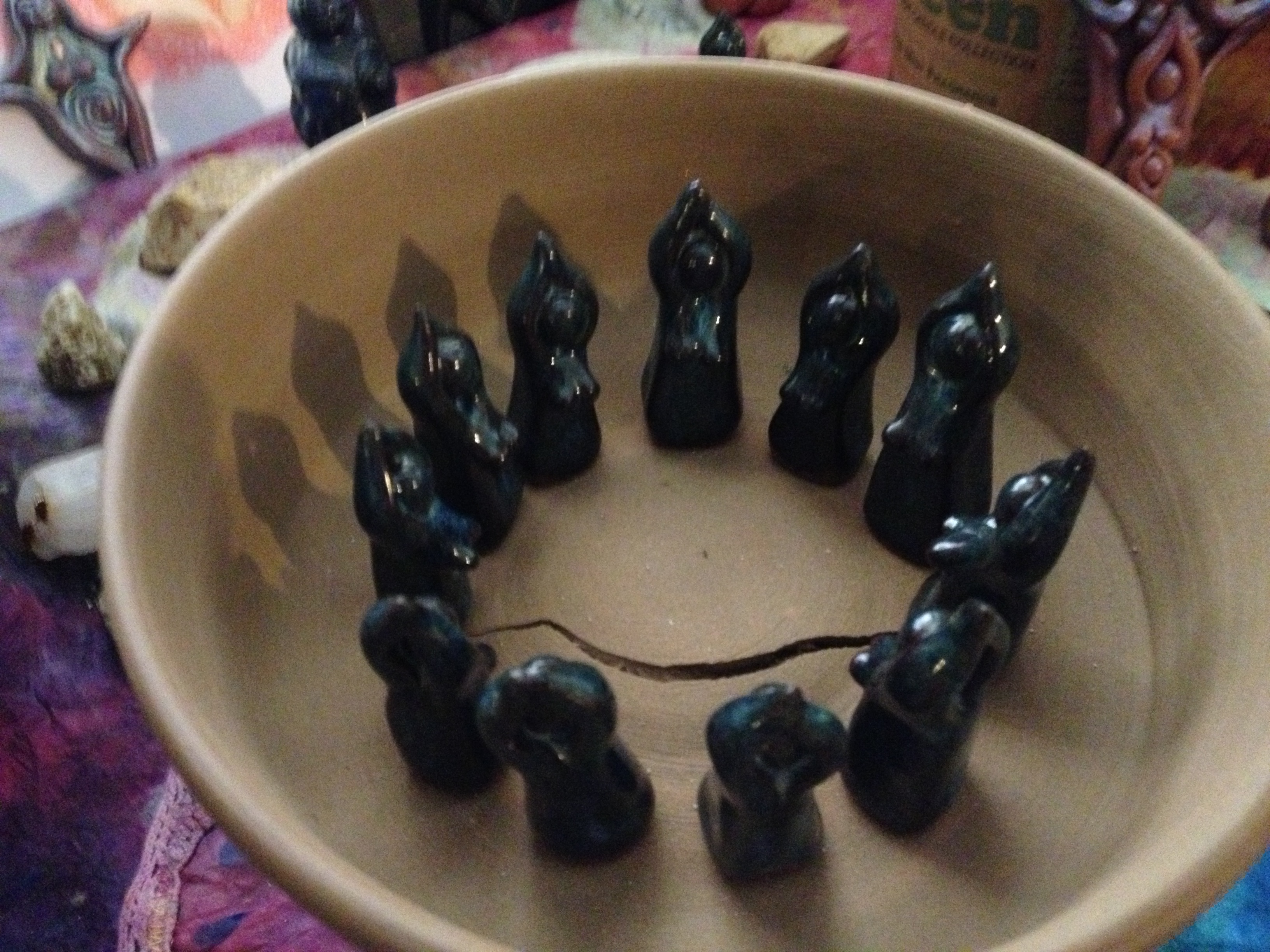
Circle of women sculptures as gifts for my women’s group. Yes, there’s a crack—“the world cracks everyone”—but that is how the light gets in…

to belly dance and chant

while I deliver

to hold me and breathe with me

as I push

to touch me and comfort me

as I cry?

Where are the womyn who know

what it’s like

to give birth?

via Where are the women who know? | Talk Birth.

Thinking about that reminded me of the chant we sang around the fire at the festival I just returned from on Sunday night:

Dance in a circle of women,

Make a web of my life,

Hold me as I spiral and spin,

Make a web of my life…

via Goddess Chants – Dance in a Circle of Women by Marie Summerwood.

May all pregnant women and tender postpartum mamas dance in a circle of women!

I’d hoped to have time to post a festival recap and some lessons learned, but other responsibilities take precedence at least for today, so I’ll leave you with one of the pictures my sister-in-law took on a misty morning, sunrise stroll around the lake and another that I took in the Temple at the festival:

Sept 2013 090

Sept 2013 036

See also:

Postpartum Survival Tips

Timeless Days: More Postpartum Planning

Mothers Matter–Creating a Postpartum Plan

Planning for Postpartum

Some reminders for postpartum mamas & those who love them

Birthing the Mother-Writer (or: Playing My Music, or: Postpartum Feelings, Part 1)

Postpartum Thoughts/Feelings, Part 2

Postpartum Feelings, Part 3

What to tell a mother-to-be about the realities of mothering…

Everything Banana Bread Recipe

3/4 c. sugar May 2013 001
1 1/2 c. mashed banana (or combination of banana and applesauce, or even just applesauce!)
3/4 c. melted coconut oil (or vegetable oil)
2 eggs
2 c. flour (I use one cup wheat, one 1/2 cup white, and one 1/2 c. a mix of oats, bran, wheat germ, flax seeds, chia seeds, or whatever other good things I’d like to put in to make this a truly “everything” bread)
2 ts vanilla (I use the homemade extract I made last year!)
1 ts baking soda
1/2 ts salt

Optional, but highly recommended: pecans/walnuts and chocolate chips!

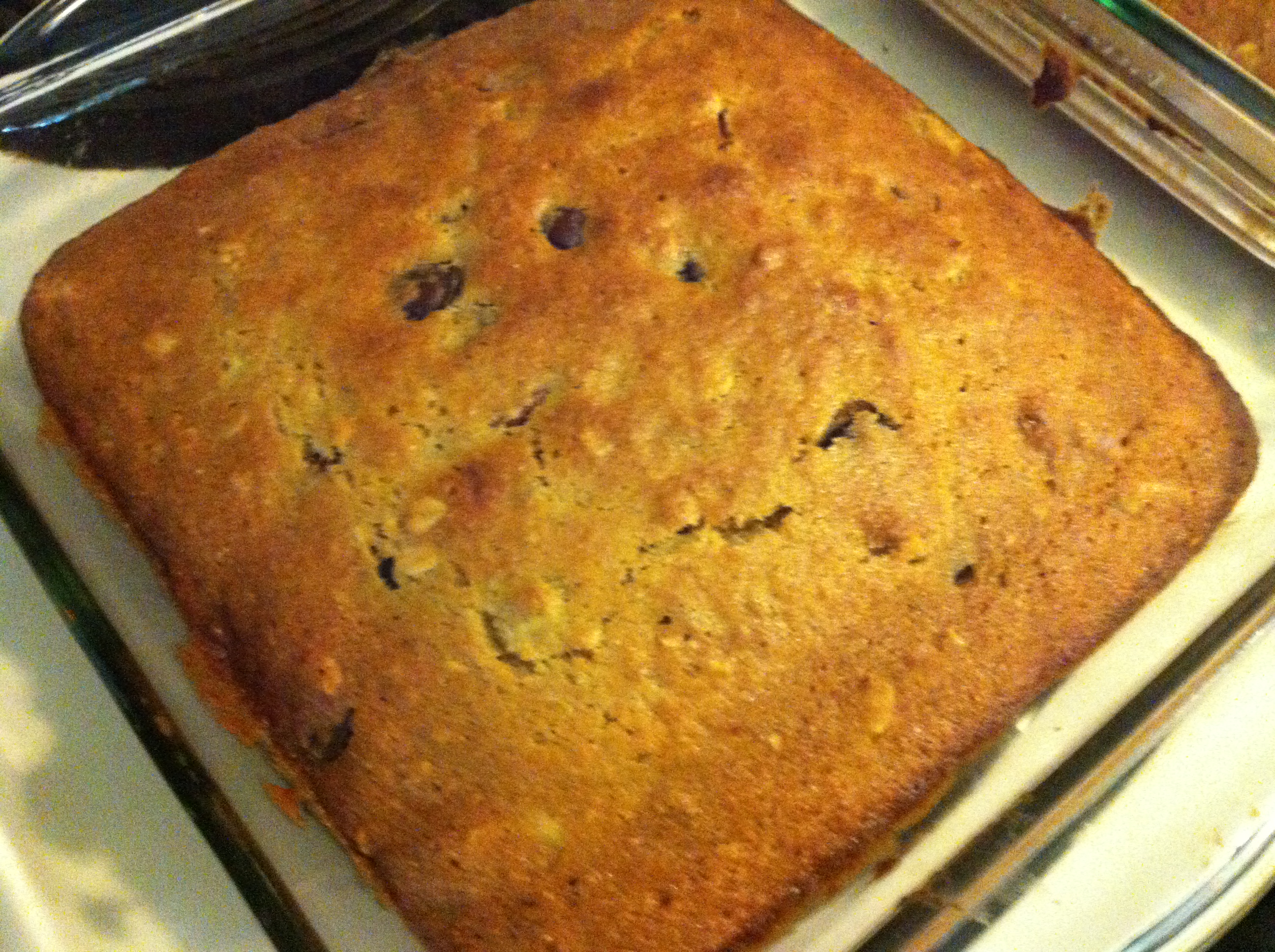
Mash bananas and mix in all ingredients except nuts and chocolate chips. Stir in chocolate chips and nuts. Bake in a greased cake May 2013 002pan, two loaf pans, or muffin cups at 350 for approximately 30 minutes (less for muffins, more for loaf pans).

I strongly recommend this recipe for postpartum mamas! Either make and freeze in advance yourself, OR make a batch and bring it to a postpartum mama to have on hand for a nutrient dense, tasty, pick me up, any time during the day. When I was postpartum, I loved having things on hand to eat for snacks, rather than only specific meals. Getting enough to eat postpartum is a perpetual issue for me and this “everything” bread solves the issue nicely 🙂 It took me an excessively long time to realize that you can make any quick bread recipe in a cake pan rather than loaf pans—it bakes more quickly and it cuts up into nice little squares for potlucks or for postpartum snacking, rather than trying to dig something out of a loaf pan and hack it into slices (for a potluck, this tip makes the bread go literally twice as far!).

Here are lots more Postpartum Survival Tips!

May 2013 003May 2013 005

Tuesday Tidbits: Postpartum Mothering

Some honest, nitty-gritty, lovely, and poignant looks at motherhood today…

Beautiful print of a babyloss mandala by Amy Swagman. My mom surprised me with this for my birthday after thoughtfully contributing to our Amethyst Network fundraiser and receiving the print as a premium.

Beautiful print of a babyloss mandala by Amy Swagman. My mom surprised me with this for my birthday after thoughtfully contributing to our Amethyst Network fundraiser and receiving the print as a premium.

First, I very much enjoyed this article about the painfulness many women experience as they transition into motherhood. This may be re-experienced/re-visited with each baby, or perhaps the initial challenge fades into the background of memory, unless you actively acted to preserve it.

…For me, and for many other women, being a new mother is hard. It can be hard in a million different ways: painful physical recovery from a difficult birth, breast-feeding problems, colic, tensions with your partner, sleep problems. It’s also just hard on its own, on top of and in between all these other challenges. As a friend of mine said, “I knew it would be hard, but I didn’t know what ‘hard’ would feel like.” We thought it would be sitcom-style hard—not necessarily with a feel-good resolution at the end of every episode, but at least punctuated by those frequent moments of uplift indicating that, in spite of everything, life really is beautiful, isn’t it? I’m pretty sure it’s like that for some people, but for many of us, it’s not. For many of us, it’s not good hard, as in a “good hard workout”; it’s bad hard, as in, it sometimes feels like something bad is happening to you…

Before I Forget: What Nobody Remembers About New Motherhood – Jody Peltason – The Atlantic.

I recognize that many mothers do not have difficult transitions in postpartum, but I certainly did, and the period of time following the birth of my first baby remains fixed in my own memory one of the most pivotal, painful, challenging, and transformative times of my life as a woman. Perhaps it is more fixed, because I did write about it and the rawness and the struggle is preserved in those words from the past. This article reminds me of my own past thoughts:

When I had my first baby, I would see women who were pregnant and feel almost a sense of grief for them—like, just wait, you have NO idea what is coming. I also told my husband more than once: “this is both more wonderful and more HORRIBLE than I ever could have imagined.” The fear of being thought a “bad mom” is SO powerful that it keeps us quiet about many things. I’ve felt more than once that my kids were “torturing” or me or literally trying to crush my spirit/soul. It sounds horrible to type it out, but that is how I feel sometimes! I’ve also written about how it interesting to feel both captivated AND captive. Bonded and also bound. I discovered that there was a whole new section of women’s rights I hadn’t even been aware of prekids–mother’s rights. I do think many, many women have written about this, but when you start out you feel like you’re the only one whose “daring” to mention the ugly side [she’d also mentioned, “why doesn’t anyone write about this?” Um, they totally do. A lot]. Start reading “momoirs”—they’re a lifeline! So many good ones out there. I have a big collection of them. Oh, and start reading Brain, Child magazine. The best look at real mothering I’ve ever know.

via What to tell a mother-to-be about the realities of mothering…

See also:

Postpartum Survival Tips

Birthing the Mother-Writer (or: Playing My Music, or: Postpartum Feelings, Part 1)

Postpartum Thoughts/Feelings, Part 2

Postpartum Feelings, Part 3

The time of danger, what needs to be survived, comes at different times for mothers. For me, it came early — during my [child]‘s infancy.” ––From Sleeping Beauty & The Fairy Prince: A Modern Retelling By Cassie Premo Steele

Ever since my first child was born over nine years ago, I’ve been talking about writing an article about the tension between choices and that whatever it is you’re doing, you can be blamed for the outcome later—i.e. “you let me co-sleep, and now I have lifelong sleep problem” OR, “you didn’t co-sleep and now I have lifelong abandonment issues!”

So, I appreciated this humorous look at how you’re doing everything wrong:

Everybody’s always trying to figure out how to do it right.

What’s “best” for my children? What can I do to raise the healthiest, most well-adjusted kids possible?

How can I do it “right?”

Well I think we should reframe this whole discussion into a simple recognition that we’re doing it all wrong.

Everything we do, it’s wrong.

Every decision is the wrong decision. And I have proof. Check this out.

via So basically, you’re doing everything wrong always – renegade mothering.

In a happier tone, I very much enjoyed this sweet post about the end of the breastfeeding relationship:

I’m hoping that buried in the corners of my children’s minds, along with all the other lovely things, there are some memories of breastfeeding that will be there all their lives. As for me, it’s not so much a corner of my mind as an overflowing treasure chest.

via Lonely Scribe: Of milk and memories: how my breastfeeding story ends.

I was very grateful for my own breastfeeding relationship last week when we took Alaina in for her dental work under general anesthesia at an outpatient surgery clinic. After it was over, we nursed and nursed and nursed. It was healing and renewing for us both and it meant I didn’t have to worry about her getting enough to eat or drink after being groggy and having a sore mouth. Interestingly, while she was under, we went ahead and had her upper frenulum clipped (I’ve thought for a long time that she had a upper-lip tie) and it has made such a surprising difference in how comfortable it feels to nurse her. I think I had adapted to a low-level of irritation and discomfort throughout the entire two years that I’ve nursed her.

The day after surgery: showing off new teeth (the previously poorly repaired ones WERE able to be saved!) as well as a new baby chick!

The day after surgery: showing off new teeth (the previously poorly repaired ones WERE able to be repaired and saved! I went in thinking we’d be coming home with a [more] toothless girl) as well as a new baby chick!

Tuesday Tidbits: Parenting, Help, and Early Motherhood

From The Doula Guide to Pregnancy and Birth’s website (book previously reviewed here), I learned about an upcoming free childbirth and parenting virtual conference. I keep signing up for things like this and not really “finding time” to actually participate in them, but this one looks like it has a pretty amazing line up! Making time to READ something is almost always possible for me (though I have a backlog there too), but making time to listen to or watch something just never seems to actually happen. I wonder if I’ll ever stop signing up for them though–so alluring, so intriguing, so free…and yet, then I get daily emails about the call/talk for that day and feel a nagging sense of “guilt” (or something) for not participating and also like I’m “missing out.” An exception is the Life Balance calls Renée Trudeau used to do from her book The Mother’s Guide to Self-Renewal. I did make time for those and never regretted it! 🙂 (I should get that book back out again.)

Thinking about parenting and self-care and help brings me to several other posts that I’ve enjoyed recently:

To parents of small children: Let me be the one who says it out loud

There are people who say this to me:

“You should enjoy every moment now! They grow up so fast!”

I usually smile and give some sort of guffaw, but inside, I secretly want to hold them under water. Just for a minute or so. Just until they panic a little.

If you have friends with small children — especially if your children are now teenagers or if they’re grown – please vow to me right now that you will never say this to them. Not because it’s not true, but because it really, really doesn’t help.

The reason I liked this acknowledgement is because it is so true that they grow up so fast. It hurts my heart how fast. However, in the moments in which people choose to make this comment or when it is used against yourself or against others as a way of shaming or guilt tripping, it really, really doesn’t help. One comment on this post says, “I hear the first 40 years of parenting are the hardest.” 😉

And, speaking of things that DO help, actual help from actual people helps quite a lot. As a work-at-home mother that blogs, I particularly enjoyed this post from Girl’s Gone Child:

Girl’s Gone Child: Help is (not) a Four-Letter Word

So what’s this big secret we’re trying to keep and who do we think we’re fooling?

And what is it doing to people who read our blogs and books and pin our how-tos and think that all of these projects are being finished while children sit quietly on the sidelines with their hands in their laps.

What is it doing to you?

We write disclosure copy on posts that are sponsored, giveaways that are donated. We are contractually obligated to label and link but where is the disclosure copy stating how we work from home with small children?…

We have help, that’s how!

My help is naptime (quickly fading!), Minecraft, and grandparental cherishment (one mile away, two hours a day = good for kids, I hope good for grandparents, and great for mom!)

And, speaking of blogging, last week Talk Birth hit 400,000 hits. I celebrated by posting this on Facebook:

“Women around the world and throughout time have known how to take care of each other in birth. They’ve shown each other the best positions for comfort in labor, they’ve used nurturing touch and repeated soothing words, and they’ve literally held each other up when it’s needed the most…” –The Doula Guide to Birth

And…they’ve gone looking for support and information on the internet too. Talk Birth hit 400,000 hits today! Woohoo! Thanks, everyone 🙂

I very much enjoyed this quote that I saw on Facebook this morning:

561196_522097027840366_343300980_n

I just finished reading the book The Art of Family and she addresses this tender transition in a way that also felt familiar to me from my own experiences:

What new parents lack most is perspective. They have no idea how fast they are to be catapulted through these early stages. How can they have a perspective of speediness when the nights are endless? It seems apparent to everyone as soon as the baby arrives that this is it—right now is what parenting looks like, and it looks pretty bad. It is a terribly tender, fragile time, akin to sex for the first time. Your first experience at parenting will haunt you in the same way.(emphasis mine)

Yes! I’ve written a lot about my postpartum experiences and I do feel “haunted” in some ways by my introduction to the parenting journey and the process of being forged into a mother. The author goes on to muse that perhaps it is more difficult to parent a boy first (as I did)…

But I had a philosophical breakthrough. Luckily I had a girl first, otherwise it might have taken me a few more years to work through to it. Forgive the tangent, but I have often wondered about the differing routes into parenthood, either having a girl first or having first a boy. Random accounts I have collected tend to confirm the easier route for moms is having a girl first. In part, I wonder if this reflects, as one mother stated, “With a girl I felt immediately in the driver’s seat. I knew all about being a girl.’’ Having a boy first, moms tend to talk about the strangeness of having a truly “other’’ little creature in their care and especially the fear of unintentionally emasculating a son.

And, she takes a look at something that, while not uplifting, was something that I also experienced very clearly in my first months of mothering…

These are, of course, just more thoughts to muse over in the rocking chair. Rocking, rocking, I kept thinking, “But if I am investing my total self in her so that she can take off and fly and reach her full potential, what happens when she becomes a mom, cut down in midflight, so to speak? It can’t be that I am pouring myself into her so that she can turn around and sacrifice herself to her children. Hey, what about my mom—what does she want for me? Was she secretly raising me just to reproduce? Is there life for me past parenting? It has to be that I’m worth more than the second I give birth and the rest of the time I’m downsized to slave.’’ Oh, yes, parenting is slave labor, but only for the opening act, and it’s a long, long play. Once I got a hold of the possibility that being a mom meant staying personally alive through all this, I got some relief from the voice, “It’s Over. My life is Over,’’ whimpering in my head…

–Gina Bria (2011-11-28). The Art of Family : Rituals, Imagination, and Everyday Spirituality (p. 159). iUniverse. Kindle Edition.

I really felt “deconstructed” by early motherhood and often found myself thinking thoughts of this type. I also used to pace around the house with my cranky son in a sling crying and singing, “who am I, I’m Lannbaby’s mama, who am I, I’m Lannbaby’s mama,” over and over again.

The “agony and the ecstasy” of parenting begins with birth. If you’re in the mood for a powerful birth story, here is a triumphant one that I enjoyed reading just tonight:

The Agony and the Ecstasy : The Birth of Santina Maria

 “The natural process of birth sets the stage for parenting. Birth and parenting mirror each other. While it takes courage and strength to cope with labor and birth, it also takes courage and strength to parent a child.” –Marcy White

Tuesday Tidbits: Hemorrhage & Postpartum Care

March 2013 068“A bright red ribbon of blood weaves women together. We are blood sisters. We bleed and bleed, and we do not die. Usually.” –Susun Weed

These Tuesday Tidbits all come from the current issue of Midwifery Today. It is an excellent issue with tons of great information. As I referenced before, however, it is literally making my uterus ache and contract to read it since the theme is Hemorrhage. I’ve had to read it in small doses—5-10 pages at a time—and then come back to it later because the contractions/crampiness in my uterus and lower back get too intense for me to continue. I’ve always known that I have an intense response to blood, but this is the first time that I’ve really tuned in to the body memory my pelvic bowl still holds with regard to excessive postpartum blood loss. That blood loss is one of the things I don’t blog about, but today I’m writing about hemorrhage anyway (even though my back/uterus is starting up again as I type this). I guess you could call it “psychosomatic,” but I call it uterine memory.

Robin Lim’s article about postpartum hemorrhage in Bali includes a nice list of preventing and managing hemorrhage, one of the most significant being to minimize prenatal “scare” as much as possible. She writes about good prenatal nutrition and nurturing prenatal care and she also recommends this essential:

Build layers of support and trust for the mother in pregnancy and labor to help her cope with any social, psychological or spiritual challenges that she might be carrying…

Lim also says that laboring women use “qi” while laboring and birthing, which is our life force, our energy. She says that if women run out of “qi,” they have to dip into their “jin,” which is, “one’s God-given lifespan”:

“If a mother uses all of her qi to bring her baby out, then she has none left to bring her baby out and to close her uterus properly…As birth-keepers it is our job to maintain the qi of pregnant, laboring, birthing and breastfeeding mothers. The mother who maintains her qi and does not use up her jin can still be glowing and full of energy after having five children…the mother who has dipped too deeply into her jin, due to having depleted her qi, can be dangerously run down after having just one baby…”

While one might interpret this as being a little too esoteric for the practical mind and perhaps a tad too close to the victim-blaming “you create your own reality” thought processes that grate on my nerves, I really appreciated the idea of the responsibility of birth-keepers to guard mothers’ life-force energy and to act to preserve mother’s natural resources and reserves of strength.

On a midwifery education note, I love the writing of Sister MorningStar and I loved reading her thoughts on midwifery education, especially her observation that

…I’m dreaming of a way and time when women are as healthy as deer and mothers birth in the night before professionals arrive. Don’t misunderstand, I want and am willing to talk at any roundtable about midwifery education. We need everyone who cares about birth at such a table, including mothers. We need a global table with a global voice, passion and wisdom. I am not saying that birth and midwives are not made better with midwifery education, but I am saying that I have many questions about modern midwifery education and its effect on the experience of birth.

And, moving on to postpartum care, loved this quote from Darla Burns in an article by Allie Chee:

As Americans, we are under the impression that new moms are ‘Superwomen’ & can return to life as it was before baby. We must remember to celebrate this new mother and emulate the other cultures that honor new mothers by caring for them, supporting them, & placing value on the magnificent transformation she is going through. This is the greatest gift we can give to new mothers & newborns…

I appreciated that Chee included information about postpartum recovery from miscarriage and stillbirth as well, rather than assuming that postpartum care is a need only following a live birth. Consistent with my own experiences and observations she notes that, “in the case of miscarriage and stillbirth, a woman is usually sent home with no postpartum care instructions other than perhaps a list of negative signs to watch for that may indicate further complications with her health. In these instances, many friends and family members, often not knowing how to respond, leave the mother to grieve alone and to recover physically by herself.” Other interesting notes with regard to postpartum recovery after miscarriage or stillbirth include these two:

  • The depression and anxiety experienced by many women after a miscarriage can continue for years, even after the birth of a healthy child….
  • [with regard to postpartum recovery/”lying in” time in other cultures]…Amy Wong, an internationally acclaimed author and expert on postpartum writes, “Natural delivery requires at least 30 days of rest, while cesarean delivery, miscarriage and abortion require at least 40 days…”

Of course, this made me reflect on my own experiences. I feel fortunate that I was cared for with a lot of love and tenderness in my own miscarriage postpartum, with my mom bringing us food and providing child care and support, and my doula organizing and delivering meals from friends as well as offering a loving and supportive listening ear. That said, I was back in front of the classroom two weeks postpartum and felt like perhaps I was taking “too long” to get back to “normal.”

Definitely make sure to check out the complete issue! Midwifery Today is my favorite birth publication and is a treasure trove of information as well as personal experiences and reflection.

March 2013 040

Birth Regrets?

March 2013 034I usually talk in my classes about how ‘this’ is the only chance you’re going to get to birth this baby. Sure you may go on to have other babies, but you only get *THIS* chance to birth *THIS* baby. I also share with moms that because of this fact, the significance of this birth is infinitely greater than the significance of this birth is to your nurse, OB, midwife, etc.” – Louise Delaney

As I was writing my post last week about “bragging rights” in birth, I was also considering the role of birth regret. I’ve come to realize that just as each woman has moments of triumph in birth, almost every woman, even those with the most blissful birth stories to share, have birth regrets of some kind of another. And, we may often look at subsequent births as an opportunity to “fix” whatever it was that went “wrong” with the birth that came before it. While it may seem to some that most mother swap “horror stories” more often than tales of exhilaration, I’ve noticed that those who are particularly passionate about birth, may withhold or hurry past their own birth regret moments, perhaps out of a desire not to tarnish the blissful birth image, a desire not to lose crunchy points, or a desire not to contribute to the climate of doubt already potently swirling around pregnant women. I’ve already acknowledged all of my own moments of birth regret, but never all in the same post…so, here they are…

First birth: This birth was great and very empowering, but I also learned a lot of things I’d like to do differently the next time. Maybe “regret” is too strong a word, but there were things I definitely knew I wanted to change for next time. I regretted feeling pushed into several things I wouldn’t have chosen on my own, such as giving birth in a semi-sitting position rather than on hands and knees. I wished I hadn’t had quite so many people around me at the birth and I wished I would have just stayed home, rather than driving to a birth center. I regretting not asking to squat after the placenta to help the “sequestered clots” come out and possibly avoid the manual extraction I experienced which was pretty awful (I swear my uterus actually twinges when writing/thinking about it). I regretted having a pitocin shot after the birth, because I still don’t think I actually needed it and it bothered me for a long time that I couldn’t figure out whether or not I’d really needed it. I was also pretty physically and emotionally traumatized by the labial/clitoral tearing I experienced and desperately wanted to fix that next time! Interestingly, most of these regrets were clearly connected to other people and to events in the immediate postpartum period, rather than anything to do with the labor or birth process itself.

Second birth: With this birth, I see very clearly how I deliberately made choices to “fix” the things that nagged at me from my first birth. I gave birth at home, I had very few people present, I gave birth on hands and knees. I was extremely distraught to tear again in the same unfortunate and traumatic way. I’d been totally convinced before the birth that it was all related to positioning and I could fix it, next time. I regretted getting up and showering, etc. so soon after the birth and I wished for more postpartum care (noticing a theme here…). I wished I hadn’t almost fainted several times and still recall the feeling of my head snapping back as I almost went under. That said, I felt the proudest and most exhilarated after this birth.

Third birth: Aside from the obvious of wishing my baby had been born alive, I “fixed” some things from prior births in that I stayed down after the birth to keep myself from fainting. I regretted drinking Emergen-C after the birth. I regretted not being better informed about coping physically with a miscarriage. And, I wished I’d been better able to assess blood loss. I also wished I’d had an attendant of some kind, particularly for immediate postpartum care. I still feel traumatized from the memory of what felt like extreme blood loss during this birth. This was the most physically demanding experience of my life. Not just my birth life, my whole life.

Fourth birth: My biggest regret from this birth was having tried to use a hypnosis for birth program while in labor. I feel as if there were some pre-birth benefits from using the program, but it was not a match for the way I labor and birth and I actually feel as if using it had a negative impact both on my ability to clearly remember and to focus my energy. I did still tear in the same place and in what seems like some new ways as well. I never want to tear like that again. I hate it. I’ve reached my physical and emotional limit with experiencing that type of tearing and I feel like I still have some negative lasting effects. I also think I had some nerve damage that continued until about six months ago. What I “fixed” this time was having a living baby and rediscovering that I could in fact do this and there was nothing wrong with me. I loved that I caught my own baby. (Best. Moment. Ever.) I also had the immediate postpartum care I’ve finally learned I really, really need. I consumed a small piece of placenta postpartum, I drank chlorophyll (and not vitamin C), when I went to the bathroom and did not look down, so I didn’t get all fainty and woozy from seeing the blood, and my doula encapsulated the placenta and I loved it.

It is interesting to me to look at these feelings and situations in the same place. With my last birth, I finally “fixed” the postpartum and blood loss issues that haunted me, but I created new things to fix by experimenting with hypnosis rather than the active birth, birth warrior, Birthing from Within type of experience that truly suits me. I guess I will never fix the tearing situation (I still want to write about that someday!). I also notice how impacted I was and still am by the two births that involved major blood loss. This came up for me very viscerally in reading the current Midwifery Today issue about hemorrhage. While the topic is important and the issue is really informative and useful, I actually had to put it down by page nine because my uterus was hurting/twinging so much (low back too). I really don’t think it was only my imagination either. (This is one reason my work with birth is never going to actually include becoming a midwife!)

I’m curious to know…do you have birth regrets? Or, things that you used subsequent births to fix, overcome, or cope with? Do you see any patterns to your birth experiences like I see in mine?

The other thing this exercise brought up for me is the important of preparing for the birth you want during this birth. This baby is only born once. This birth only happens once. I have clients tell me sometimes while still pregnant with their first baby, “well, next time, I’ll try XYZ…” Don’t wait for next time, do it this time!

The first birth is the pivotal birth. Every birth experience that follows builds on that one. Our choices now are choices for the NEXT birth. The first birth doesn’t have to be either perfect or awful and earth shattering to make us think. We don’t have to choose differently than the first birth; but it’s the first one that gives us a place to begin experiencing not just birth but ourselves as mothers, women, people. We may not all have ground shaking, earth thundering thoughts but we have them. The experience belongs to us. We choose what to do with it. Choosing to do nothing different is still an influenced choice ~ made on that experience…

…What will YOU do to have a first birth that leaves you with few regrets or changes for your NEXT birth? Why not have the birth of your choosing, rooted in truth and your ability to know yourself and your baby now?…

via The Home Birth Experience: The First Birth is HERstory | Real women. Real options. Real birth..

These types of triumphs and regrets produce both birth professionals dedicated to helping others and also mothers who become so hurt and disillusioned with birth that they may actively reject the “natural birth” movement.

March 2013 049

Introverted Mama

This post is excerpted from one written in response to the current Patheos Book Club exploration of the book Quiet: The Power of Introverts in a World That Can’t Stop Talking. I previously wrote a post for my blog about Quiet and then built on that post for my book club post. The previous post is here and my new additions are below…

I really enjoy being around people and I’m friendly and social, but on the flip side I feel very drained after people contact and need time alone to recharge. I find I am restored by being alone and drained by being with others (even though I like them!), hence I would self-label as an “extroverted-introvert,” “ambivert,” or social introvert. By definition it isn’t that extroverts “like people” and introverts don’t like people, it is a difference between whether they are fueled or drained by people contact. However, I’ve observed that people seem to make an assumption that being introverted means someone is “shy” or “doesn’t like people,” so that’s why I would choose extroverted-introvert for myself. I recently took a week-long retreat from Facebook, email, social media, and reading articles online. I did this primarily to silence the digital noise in my life (see some good explorations of why you, too, may be an introvert in this article: “Noise” Got You Down? Maybe You’re an Introvert).

Once I starting thinking about this book, Quiet, I was amazed at the connections I uncovered with how my introverted personality is expressed during pregnancy, labor, and birth. This was actually the very first time I’ve made the connection between my own birthing preferences and my introvert nature, that finds such renewal in solitude and craves silence.

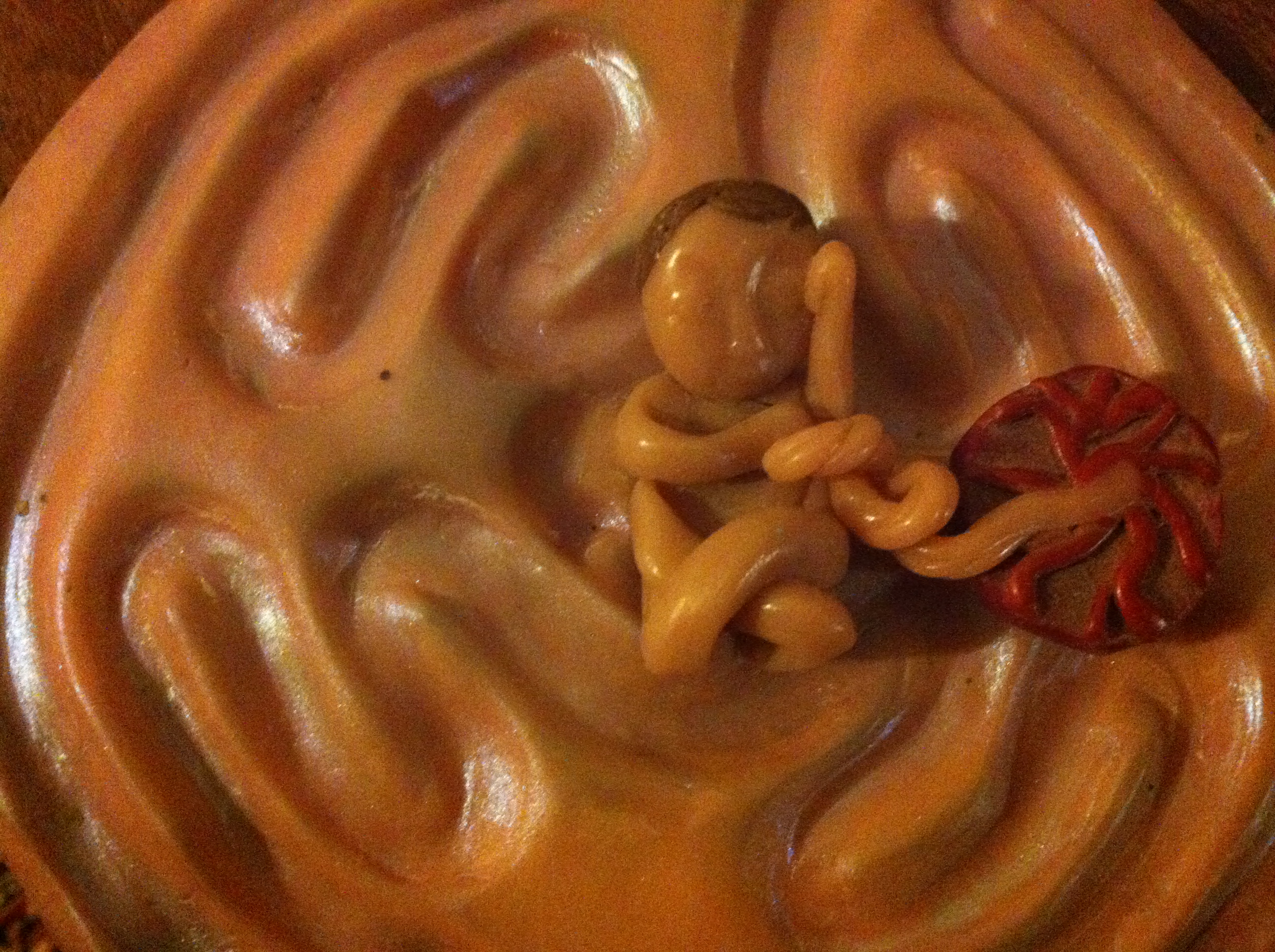
Labyrinth of pregnancy pre-birth sculpture.

Pregnancy—towards the end of pregnancy I feel an inward call. I start wanting to quit things, to be alone, to “nest,” to create art, to journal, and to sink into myself. Nothing sounds better to me in late pregnancy than sitting in the sunlight with my hands on my belly, breathing, and being alone with my baby and my thoughts.

Labor—during my first pregnancy, the very first thing on my birth plan was “no extraneous noise.” It was really essential to me to labor without beeping, chattering, or questions. This birth room silence, in fact, was SO essential that it was one of my only requests for my second labor—no unnecessary talking. I can talk during labor, I talk a lot in fact, but I don’t want people around me talking. I want silence. My epiphany as I thought about the Quiet book was that this is why. I’m an Introverted Mama. I know many women are very nourished by the presence of supportive and loving family members and friends during their labors. They express wanting to be encircled by support and companionship. For me, I like to cut my birth attendants down to only the very most essential companions (and they’d better be quiet!). And, this leads me to…

Birth—after my first birth, in which I’d had the loving and supportive accompaniment of my husband, my mother, my best friend, my doula, a midwife, and a doctor, one of my most potent longings for my second birth was as few people present as possible. And, indeed, for this second labor I had my husband alone present for the first hour of a train ride of a two-hour labor, my mother and toddler son present for about 30 minutes and my midwife who walked in as my son’s head was crowning. For my last birth, I wanted even fewer companions, spending the bulk of the labor alone with my husband and later calling in my mother. When my daughter was actually born, I was the sole witness to her emergence as she slid forth into my grateful hands in one swift spontaneous birth reflex just as my mother stepped into another room and my husband was moving from behind me around to the front of my body. Shortly after her birth, my doula arrived to provide amazing postpartum care and my midwife came shortly after that to assess blood loss and to help with the placenta. This was the perfect companionship arrangement for an Introverted Mama. My older children were pretty disappointed not to be present, but I need solitude in birth and I heeded that call.

324

Postpartum—I am firmly convinced of the critical importance of planning for a postpartum “nesting” time or babymoon, in which parents can cocoon privately with their new baby in the solitude of their own home. I only now came to realize that perhaps this is Introverted Mama talking! I’ve spoken to other women who say that getting out and seeing people was really important during their own postpartum time. I’ve maintained for ages that this is probably culture talking (“get back to ‘normal,’ prove how capable of a mother you are,” etc.), and not what the tender new motherbaby most needs, but perhaps my preference is largely a function of personality. There is nothing better for me than spending at least four weeks nested at home with my new baby and my immediate family, no long-time visitors, no phone calls, little email, and no travel, visiting, or responsibilities. Ahhhh….babymoon bliss.

Breastfeeding—in the early days, weeks, and months of breastfeeding the symbiosis of the nursing relationship is so complete that the baby becomes a part of me. A newborn does not “disturb my peace” the way toddlers are wont to do. I especially feel this interdependent connection during nighttime nursings, in which the harmony with the baby feels complete and total and a peace like little else.

Toddlerhood and Beyond—Oh dear, now is when “no time to think” starts to wear on Introverted Mama’s nerves and stamina. I’ve met some awesome mothers of large families who comment on how they, “love the chaos” of home with lots of children. “Our house is wild and crazy and full of noise and I love it,” they may be known to say. Thinking of how desperately I crave silence and solitude, sometimes with an almost physical pain and longing, I feel inadequate in comparison to these declarations. Is this too simply a function of personality? Can these chaos-thriving mamas be extroverts who gain energy from interaction with others? I find that my own dear children, my own flesh and blood and bone and sweat and tears, still feel very much like “company” in terms of the drain on my energy that I experience. Whether it is socializing with a group or friends or spending the day with my energetic, loveable, highly talkative children, I crave time alone to recollect myself and to become whole once more. I once commented to my husband that I feel most like a “real person” when I’m alone. That means that the intensiveness and unyielding commitment of parenting can be really, really hard on me emotionally. Maybe it is okay to “own” that need for quiet, even as a mother, rather than to consider it some type of failure or an indication of not being truly cut out for this motherhood gig. (See more in a past, lengthy, navel-gazing post on why I need my “two hours”.)

How do you experience (and honor) introversion in your life as a parent? Sometimes I feel like being an introvert and being a mother are not very compatible, but as I learn to respect my own needs, to speak up for myself, and to heed that call for silence and solitude, I realize it is compatible after all. My children have two introverted parents and will hopefully grow up feeling confident in the knowing that there is profound power in being quiet, in taking time to think deeply, and to respond to the call of solitude if it comes knocking at the door of their hearts.

It is only when we silence the blaring sounds of our daily existence that we can finally hear the whispers of the truth that life reveals to us, as it stands knocking on the doorsteps of our hearts.

~ K.T. Jong (via Kingfish Komment)

Timeless Days: More Postpartum Planning

“Understand that the tremendous energy going through you during birth is the same sort of power as the force of ocean waves moving towards shore. Know that just as a bird knows how to build its nest, and when to lay its eggs, you too will build your birthing nest…” –Janice Marsh-Prelesnik (The Roots of Natural Mothering)

So, after writing about postpartum survival tips and about what to share with mothers-to-be about the realities of motherhood, I found some more postpartum notes saved in my always overflowing drafts folder from the sidebar to Time in a Bottle by Beth Bailey Barbeau in Spring 2011 issue of Midwifery Today (p. 44).

  • Encourage realistic contact between mothers-to-be and new mothers to help them shape more realistic expectations of postpartum life.” Yes! This is why I strongly encourage mothers to come to LLL meetings before they have their babies.
  • “Use language that shares your expectations and gives parents a vocabulary to articulate the demanding needs of their new infant.” Like Barbeau, I find it helpful to bring in the concept of the fourth trimester. The first three months are the “fourth trimester” during which baby pretty much wants to live on mom’s chest and replicate the womb (i.e. almost constant feeding–like the umbilical cord–constant holding and lots of motion, like being in the uterus, as well as being able to hear your heartbeat). After the fourth trimester passes, babies “wake up” even more and start really interacting with the world. I explain in a light-hearted way that even if you hold your baby for 12 solid hours a day following birth, that is a 50% reduction in what she is used to. And, I let them know that while the adult’s brain thinks, “how can this baby be hungry, I just fed him 30 minutes ago?!” The baby’s brain thinks, “it is has been 30 minutes since I’ve EATEN ANYTHING!!!!!” I also reinforce the idea that a baby that wants to be held and snuggled and nursed is a smart baby, not a manipulative one. And, of course, I also describe mother’s body as baby’s natural habitat after birth.
My husband and first baby during the first tender postpartum days.

My husband and first baby during the first tender postpartum days.

  • Remind new parents that most cultures around the world have some sort of ‘lying in’ period, typically lasting 30-60 days or more.” Truly the things that support both a healthy birth and healthy postpartum are contrary to the expectations and habits of mainstream society. See Kathleen Kendall-Tackett’s handout on how other cultures prevent postpartum depression.
  • “Matter-of-factly inform the family, especially the extended family (if you have your client’s permission), that mama is going to be encouraged to stay in bed for a while after the birth and that she’s not ‘being lazy.'” Mothers can have a lot of difficulty giving themselves this permission and it can help to have the acknowledgement and encouragement to family members coming from an outside source.
  • “Remind them that a true six-week postpartum window allows for the placenta site to fully heal and supports minimized bleeding and stronger recovery.” An excellent tip for educators and doulas from Barbeau is to illustrate size of placental site healing area with hands like small dinner plate—if this was outside the body, how would you care for yourself
  • “Encourage preparation for postpartum success!” I write about the idea of postpartum expression instead of postpartum depression. See ample past articles about postpartum planning and a nice specific story about creating a nest here.

“Although pregnancy and birth is a richly intuitive and instinctive process, a woman will prepare her ‘nest’ and birth according to the style of her culture, in the same way that a particular species of bird will build its nest with whatever is available.”

–Pam England

Let’s help make sure her nest is rich, resourceful, blessed, and beautiful!