Archives

Birth Dreams

I’ve always been interested in the birth dreams that women have. During my first pregnancy, I only had a couple of birth/baby dreams and they were very odd/unrealistic (because I didn’t know physically what giving birth was actually like). I did have one very vivid and scary miscarriage dream. Between that birth and my pregnancy with my second son, I had TONS of birth dreams. A common theme was that I gave birth to a baby boy and would say to my husband “now we have three sons!” (even though we only had one son at the time and I wasn’t even pregnant). I also dreamed I had twins, dreamed I had a very premature baby at about 20 weeks who then died, and several others. These dreams were very vivid and real-seeming and have stuck with me as meaningful for a long time.

Then, during my second pregnancy, I had seven dreams in which I gave birth to a boy and thus I was convinced I was having a boy (I did). Some of these dreams were exceedingly realistic, down to length of labor and time of birth. Seven of them revealed/confirmed that he was a boy (in the only girl dream I had during that pregnancy, my husband was the one giving birth to the baby, so both genders were “switched”). One of them was extremely vivid and was that he was born on a specific date and time. I was in the living room on my hands and knees. The birth took four hours and when he was born I said, “I KNEW he was a boy, I KNEW it would be a fast labor, and I KNEW he would be born on a weekend.” As it was, he was not born on that day (two weeks later) and he was born at a different time (within a few hours of the dream time). He was a boy and it was a fast labor (two hours, not four). He was born at 2:45 a.m. on Memorial Day morning, so it was actually a Monday, but it WAS a holiday weekend. He was born in the living room by the green chair on my hands and knees, just like in the dream.

During my third pregnancy, I didn’t really have any birth dreams, and then had one vivid miscarriage dream the night we found out the baby had died. I did have one ultrasound dream in which he was a girl (he wasn’t). After he was born, I had a vivid placenta dream and then I only have had one other dream about him since he was born—I halfway expected to have several birth dreams or “still pregnant” dreams as a way to kind of “psychically” close out his pregnancy, but I didn’t (which in a way was comforting—like my subconscious has “processed” the loss completely). That single dream I did have post-loss was kind of a miscarriage re-do dream in which the birth proceeded exactly as it really had, but instead of all the blood following the baby, I was able to spend a LONG time looking at him and making hand and footprints.

As I mentioned, one of my vivid birth dreams after my first pregnancy, but before any others, was about giving birth to a premature baby (one of the aforementioned “third sons”) and trying to nurse him at least once before he died as well as remembering to smell his head so I would never forget his own unique baby smell. In that dream, I named the baby Noah, which is what in fact we did name our third son when he died early in my second trimester.

After my second baby was born, but before I was pregnant with my third, I had many, many vivid birth dreams about a specific birth position to give birth (half kneel/half squat) in to avoid tearing as well as the idea of making a “birth nest” for myself to have the baby in, rather than having it in the living room and then having to get up to go lie down somewhere else. I feel like the position dream is a strong message from my subconscious about how I should plan to give birth—something I’ve been working over in my unconscious or something and I’m giving myself a “tip.” As it turned out, that baby was born much earlier than expected and I ended up giving birth standing. I did, in fact, make myself a “birth nest” as my dreams had suggested and would do the same again.

During my fourth pregnancy I had two brief miscarriage dreams and since the pregnancy ended quickly, there was no time really to have any other dreams. However, the whole reason I knew I was pregnant in the first place was because I dreamed that I took a pregnancy test and it was positive. When I woke up from that dream, I took one and it was positive. During my fifth pregnancy (so far), I’ve had quite a few “bleeding” dreams and one miscarriage dream.

Then, this week, I had the first birth dream that I’ve had in AGES!

I was in a birth pool in our the living room and the baby was born in the water. The focus of the dream was on the placenta really, not the baby—though I think it was a boy. Placenta was perfectly heart shaped (and small) and had strange “bands” of tissue on it, which I decided meant it was a “circumvallate placenta” (a term I had just heard referenced for the first time the day before in a blog post). The experience of pushing the placenta out was VIVID. It is weird how the body remembers the feeling so clearly and can reproduce it in a dream, when my brain cannot conjure up a daytime memory of how exactly it feels to have the placenta bloop out—and then there was quite a bit of blood with the placenta that diffused/clouded through the water, just like it really would. It was very clear.

So, do birth dreams predict anything? Basically, I feel like my dreams, while not exactly “predictive,” do have some signs/intuitive information within them. I also think dreams often have symbolic (rather than literal) meaning. And, obviously some dreams are simply related to day-to-day happenings (or fears, like with the bleeding dreams) and do not have “deep” meaning at all. With that second baby, I really felt strongly that he was “telling” me he was a boy. My first child was a boy and I felt like the second baby wanted me to never even entertain the notion of “wanting a girl.” I knew I was having a boy and so THAT was the baby I wanted 🙂

When I say vivid, I mean really vivid—the feeling of pushing the baby out is JUST what it really feels like, the sensation of holding the new, slippery baby, etc. I think it is a “body memory” thing and the whole feeling of giving birth comes back vividly during dreams in a way that it doesn’t in just plain memory. While, the memories of my actual sons’ births ARE extremely vivid and I DO feel like I remember what it feels like to birth (I know some people say “you forget how it feels, that is why you can do it again,” but I do not feel like that is true for me), that visceral body-feeling isn’t really there in memory (for me), the way it is in dreams.

Another logical reason for all my birth dreams is that I’m a childbirth educator and writer and read/write about birth constantly. Makes sense that that is what I dream about! 😉
Book Review: Mindful Motherhood: Practical Tools for Staying Sane During Pregnancy and Your Child’s First Year

Book Review: Mindful Motherhood: Practical Tools for Staying Sane During Pregnancy and Your Child’s First Year
By Cassandra Vieten, Ph.D.
New Harbinger, 2009
ISBN 978-061531935-3
200 pages, softcover, $16.95
www.mindfulmotherhood.org

Reviewed by Molly Remer, MSW, CCCE

Written for pregnant women and for mothers embroiled in the intense rite of passage that is baby’s first year, Mindful Motherhood is a practical and simple guide to the practice of mindfulness during everyday life. “Mindfulness is moment-to-moment, nonjudgmental awareness of your present-moment experience…so that you can be connected to your baby even in times of distress, be less overwhelmed by distressing emotions and less caught up in negative thought patterns, and enjoy the simple pleasures that suffuse each day of being a mom.”

The book is composed of many small chapters each containing a 5-10 minute exercise readily incorporated into daily life with a baby. It also includes a line-drawing illustrated “mindful motherhood yoga series” of gentle, basic poses, which are an excellent prelude to meditation.

Mindful Motherhood is rooted in attentiveness to needs of the child, present moment awareness—whether comfortable or uncomfortable—and radical self-compassion. “Mindful motherhood, above all, is a way of approaching your experiences during pregnancy and early motherhood with gentleness and friendliness.” The author models this gentle and friendly approach throughout the accessible, supportive, and important guide. What a lovely gift for a woman approaching new motherhood, or for any mother seeking to explore present-moment awareness in everyday life!


Disclosure: I received a complimentary copy of this book for review purposes.

Courage Reading for Mother Blessing

I have already shared a fear release for birth exercise here. I also want to share a “courage” reading that could be used for mother blessings:

Courage Ritual:

(write down fears and burn or bury them them)

Friends gather in circle holding hands surrounding the mother and say:

We accept that you have fears

You are not your fears

You are now cleansed and renewed

Go forward with courage at your side.

——–

Simple, but meaningful!

Book Review: Brought to Earth by Birth

Book Review: Brought to Earth by Birth

By Harriette Hartigan
Motherbaby Press, 2008
ISBN 978-1-890-44642-0
93 pages, softcover, $25.95

www.motherbabypress.com

Reviewed by Molly Remer, MSW, CCCE

Written by well-known birth photographer Harriette Hartigan, Brought to Earth by Birth is a lyrical ode to the power of birth and babies. The book feels like an extended “poem” expressed in both word and image. The emphasis of the book is the black and white photos of pregnant women, families, and newborns that grace the pages. There are several photos of women in labor and a couple of breastfeeding images. Surrounding the photos are carefully chosen quotes and gentle words.

Brought to Earth by Birth is separated into six “chapters” and contains several birth photos, but no crowning photos or any other photos that some may consider “graphic.” The book is short—under 100 pages—and some photos were familiar to me (cover images in birth publications). The concluding emphasis is on the newborn, the one who is, after all, “brought to earth by birth.”

The book would make a nice gift for a midwife, doula, or childbirth educator and is a nice “waiting room” book to browse through. It would also make an inspirational mother blessing gift. As the author states, “The experience of birth is vast. It is a diverse tapestry woven by cultural customs, shaped in personal choices, affected by biological factors, marked by political circumstances. Yet the nature of birth itself prevails in elegant design of simple complexity.” Brought to Earth by Birth is a lovely glimpse of some strands of that elegant tapestry.

Disclosure: I received a complimentary copy of this book for review purposes.

In-Utero Practice Breathing

During my pregnancy with my first baby I had a somewhat unique experience in that I was able to feel him practice breathing in the womb.  Babies practice breathing movements with increasing frequency towards the end of pregnancy, but usually this is only seen via ultrasound and the mother can’t feel OR see it happening.

A mysterious sensation

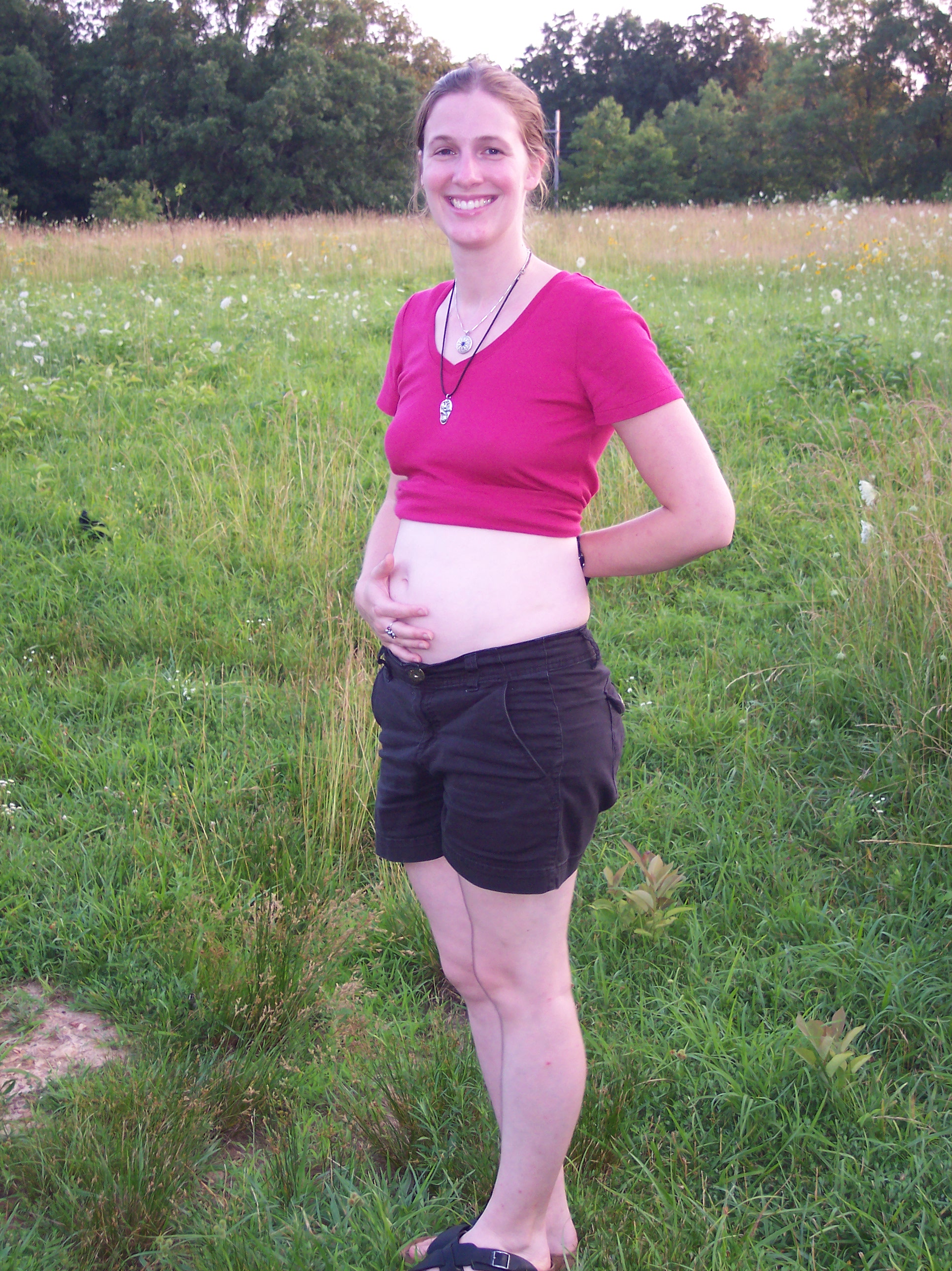
38 weeks pregnant with baby #1

I was about 32 weeks pregnant when we had a prenatal visit (and I was up to a whopping 140 pounds—looking back, that seems very thin, but at the time I felt like I had gained  a lot of weight!) . Since 30 weeks I’d been feeling what I thought was the baby practicing breathing. My husband was able to feel it too, as well as occasionally physically see it—a rhythmic sort of pulsing sensation located where the baby’s back was and feeling like a rising/falling breath type sensation (like a cat under a blanket). I noticed it once or twice daily. Very different than the hiccups, which I also felt often. I wanted to mention it to the doctor to see if that was really what I was feeling, because lots of books and things say you won’t be able to feel those movements, but I didn’t want to be wrong and be embarrassed for having a kooky idea about feeling him breathe. (When we mentioned the feeling to my mom, she looked at us like we were quite nutty to think we could feel it!)

A prenatal appointment and a doctor’s surprise

At the prenatal appointment, I laid down to have my fundal height measured (32) and the baby’s heartbeat checked and he was conveniently doing the breathing thing at that exact moment! My husband asked the doctor about it and told her we thought it was breathing. She quickly disregarded the breathing hypothesis, saying it was unlikely we’d be able to feel that, but she was fascinated by the movements and listened with the Doppler trying to figure it out etc. She thought for a minute that it had something to do with my pulse and checked that, but it didn’t match, plus was just on one side of my belly where his back is. She also felt with her hands, etc. It was particularly strong that day—usually I felt a sort of pulsing and could also feel it with my hand. On this occasion, it was like the left side of my belly was rising and falling rhythmically in a very noticeable way. She said she’d never felt or seen anything like it before.

Then (this was the weird part), she said that maybe I should have an ultrasound to see what the baby was doing in there. This doctor was a crunchy-mild-mannered-has-you-call-her-by-her-first-name-homebirth-attending -birth-center-low-intervention-doesn’t-break-your-water-unless-the-baby-is-born-in-the-sac sort of doctor, so I was really shocked by that. I said I really didn’t think that was necessary, because I wasn’t worried about it we just thought it was breathing (again, we get a look that vaguely implies that we are nutty). She kept saying she’d never seen it before and said she was going to call one of her consulting doctor friends, “just because I’m curious,” to see what he thought about maybe needing an ultrasound.

After she left to call him, I started to feel nervous that something might actually be wrong. I knew how this doctor was and she did not seem like the type at all who would be calling other doctors unless she was a little worried about something. My husband kept saying that, “no, she is just curious about what it is,” but the “curious” wording felt to me like a don’t-want-alarm-the-mother-but-I-think-something-is-up type of doctor speak. Also, I knew her well enough to know that running off to call other people in the middle of an appointment wasn’t in character for her, especially since the mom (me) was saying it didn’t seem necessary. So, I briefly became petrified that the baby was having seizures or something.

Trust the mother!

She came back in a bit and had consulted with her ultrasound doctor friend who had said, “let me guess. This mom is thin and very healthy” and then confirmed that it was just the baby’s breathing movements we were seeing. He told her that you usually don’t see them on the outside, just via ultrasound, but it is still normal and just means that the baby is healthy and he is getting good practice. When she came back, the doctor also brought the practice’s midwife in to see, since the midwife had never seen anything like it either, but it had mostly stopped by then. This doctor has been in practice since 1992 and has had four kids of her own and the midwife has six kids and a 20-year practice. The doctor explained that she’d seen the breathing movements on ultrasound before, but they were always more like occasional gasp-type things, not steady and pulsing like that and not visible externally. She thanked me for teaching her something new 🙂

I liked being right about what was going on (trust the mother! She usually knows what’s up!) and I liked that my pregnancy had something “new” or special to it to show to someone for whom pregnancy is quite routine. Being able to feel my baby breathe in the womb was one of the special things about this first pregnancy.

(Side note: the doctor then said, “I’ll bet he comes out screaming” and as a matter of fact this baby did begin to cry when only his head was sticking out of my body!)

Note (added 3/2/2013):

A lot of mothers come to this post because of concerns similar to my own…what if my baby is having seizures in the uterus? Of course I am not able to tell you with 100% certainty that your baby is not having seizures, but here are two things to pay attention to that may set your mind at ease and allow you to enjoy this special connection with your baby:

  • One way to help you feel confident that it is practice breathing is to pay attention to whether it happens at the same time(s) each day. There’s usually a pattern to it.
  • Another way to tell with almost total accuracy is to notice if the baby gets hiccups shortly after and “episode.” A lot of babies will practice breathe and then get hiccups from their practice.

This post is modified from a message board posting that I made shortly after the events described above.

Sign up for my Brigid’s Grove Newsletter for resources, monthly freebies, and art announcements.

Film Review: Sunshine

Film Review: Sunshine

By Karen Skloss
PBS, Independent Lens, 2010
60 minutes

www.pbs.org/independentlens/sunshine

Reviewed by Molly Remer, MSW, CCCE

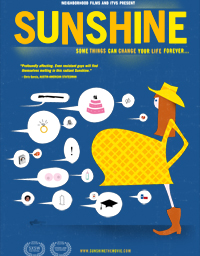
I was very excited to receive a review copy of the independent film, Sunshine, airing on the PBS series Independent Lens on Tuesday, May 4. Through personal narrative, Sunshine chronicles the changing social definition of family and cultural attitudes towards “unwed mothers” and “single moms.” Filmmaker Karen Skloss explores her answer to her question, “does history repeat itself?” as she considers her own history as a baby given up for adoption in 1975 by her nineteen year old “unwed” biological mother (Mary) and her personal experiences of giving birth to her daughter Jasmine as a “single mother” in 1999. Since I teach Human Services classes at the college level as well as teaching private childbirth education classes, I was intrigued in the film’s subject from both perspectives—that of someone in the field of social work at the academic level and that of someone deeply invested in work with pregnant women and new mothers.

The images chosen for the film are pieced together from home movies, family snapshots, interviews, and current footage of Karen and her family—both biological and adoptive. Karen and her biomom also make a pilgrimage of sorts to visit the Texas home for unwed mothers in which Mary lived before she gave birth. Karen co-parents her daughter with Jasmine’s father in a fairly unusual arrangement in that they share care 50-50—Jasmine lives with her father half-time and with Karen half-time. Jeremy, the father, also receives some screen time in the film and has some interesting comments to make about how he is perceived as a single father and how that compares to perceptions of single mothers (i.e. as a single father he is viewed as “hero” and not as someone who is just doing what anyone should do). The footage is mostly of the mundane—everyday life: bike riding, walking, people at kitchen tables—and the content is mild. No biting commentary or sweeping sociological conclusions. The story is an engaging one and an emotional connection is quickly formed. Though the content is nondramatic on the surface, the narrative is a multilayered representation of the complexity of the everyday lives of “normal” people and I was moved to tears on at least three occasions.

My medium is the written word—I read and write prolifically—so Sunshine was a change of pace for me. And yet, it unfolded like a personal essay “written” in visual form. I was fascinated in a way I have not been before by the use of film to tell a personal, human-sized story.

The Human Services professor in me would have liked to see a little more sociopolitical commentary—the viewer is left to draw their own conclusions about larger social issues that could give context to the personal story. The childbirth educator in me was delighted to see some footage of what appeared be a gentle, positive homebirth with Karen laboring in a birth pool and then giving birth in a supported squat on the floor. This footage is without commentary, but appears to be a midwife-attended homebirth with both Karen’s biomom and adoptive mother present as well as the father of her child.

As the film concludes, Karen states that, “it is hard to understand the times you’re living in, because you’re living in them.” Sunshine is a compelling portrait of one woman’s efforts to explore those times.

Disclosure: I received a complimentary copy of this film for review purposes.

Book Review: Pregnant on Prozac

Book Review: Pregnant on Prozac: The Essential Guide to Making the Best Decision for You & Your Baby

By Shoshanna Bennett, Ph.D.
GPP Life, 2009
ISBN 978-0-7627-4940-9

248 pages, softcover, $16.95
http://www.clearsky-inc.com

Reviewed by Molly Remer, MSW, CCCE

Written by a clinical psychologist and mother of two, Pregnant on Prozac is a comprehensive look at the benefits and risks of antidepressant use during pregnancy or postpartum. The focus on depression during pregnancy is what makes this book stand out—this is a subject that has received very little attention and it is important for doula and childbirth educators to learn more about the issues involved.

The book includes sections on “natural and emerging treatments” including homeopathy and acupuncture as well as a section on nutrition, though the overall emphasis is on pharmacological treatment methods.

The information presented is very comprehensive, though I was disturbed by the suggestion not to read the package inserts coming with medications, but to trust your doctor to know “what is safest for you and your baby.” This is not the type of informed decision-making I promote in my work with pregnant and new mothers!

Pregnant on Prozac briefly addresses midwives and doulas in a section about “helping professionals who may be of use to you.”

I have three significant critiques of the book. During one section the author waxes eloquent about the non-specific benefits of an unnamed “exercise system” and then later an unnamed “nutritional system.” She glowingly recommends these unidentified systems and refers readers to her website for more information about the nutritional system and to another website for the exercise system. I suddenly felt like I was reading a commercial and the tone called into question for me the validity and reliability of the entire rest of the book.

My third critique is that the segment addressing medication use while breastfeeding is woefully incomplete, falling back on the trite platitude “a calm, happy mother is more important to a child’s healthy development than breast milk.” Though I do not quibble with the truth of this statement in an “ultimate” sense, my concern is that it summarily dismisses the fact that many women can take medication AND breastfeed—it is not an either or situation! The very brief section on breastfeeding also included the questionable and disappointing statement, “you can even get better eye contact with your baby with a bottle in its mouth instead of being squished face-first into your breast.”

Each of these sections is small, but my concerns about them are large. Despite these critiques however, I would still recommend Pregnant on Prozac to birth professionals and parents seeking information about treatment options for depression during pregnancy with the caution not to rely on it as your only resource and certainly not to count on it for advice on exercise, nutrition, or breastfeeding.

Disclosure: I received a complimentary copy of this book for review purposes.

Book Review: She Births

Book Review: She Births: A Modern Woman’s Guidebook for an Ancient Rite of Passage By Marcie Macari
Infinity Publishing, 2006
ISBN 0-7414-3390-7
255 pages, softcover, $23.95
http://www.shebirths.com

Reviewed by Molly Remer, MSW, ICCE

She Births is a book that “goes beyond” the average birth book. It is a particularly good read for mothers having subsequent children—perhaps for a woman who is well read in the physiology and stages of labor and who wants to dig deeper into the emotional and spiritual meaning of giving birth. It is also helpful for first-time mothers, though I felt that there was a lot of content that seemed to assume the reader had already given birth (and was perhaps reading this book to reflect, process, and prepare for future births).

The emphasis of She Births is on childbirth as a rite of passage and as an opportunity for spiritual growth and personal transformation. There is a lot of content that has a very “New Age” flavor. While I personally do not mind—and actually enjoy—this framework, other readers may consider some of the sections to be offputting.

Each chapter ends with a short chapter-topic meditation and several pages of related journaling exercises.

The book contains a higher than average number of minor typographical errors, as well as odd mid-sentence capitalizations, and too-short dashes between ideas. Persistent capitalization of words such as Birth and Spirit were a bit distracting. The book contains a variety of empowering birth stories, but none of them have attribution, making it difficult to identify who was giving birth. (The author? The woman in the previous story?) It was hard to grasp who was the “I” reflecting and sharing in each story.

She Births has several particularly wonderful passages that are well worth quoting and it also has a lovely cover. It is a passionately written book that is very dynamic and “alive” to read. The book is strongly written—the author does not mince words nor attempt to “balance” her perspective and this can be a refreshing approach. She Births also raises thought-provoking questions such as, “The way a society views a pregnant and birthing woman, reflects how that society views women as a whole. If women are considered weak in their most powerful moments, what does that mean?”

Disclosure: I received a complimentary copy of this book for review purposes.

Birth Quotes and More Birth Quotes

Time for my semi-regular birth quotes update post!

“Birth is the doorway for integration of body and mind.” –Gayle Peterson

“Good timber does not grow with ease; the stronger the wind, the stronger the trees.” – J. Willard Marriott

“Most mothers are instinctive philosophers.” – Harriet Beecher Stowe

“Sometime in your life you will go on a journey. It will be the longest journey you have ever taken. It is the journey to find yourself.” – Katherine Sharp

“Sometimes when you think you are done, it is just the edge of beginning. Probably that’s why we decide we’re done. It’s getting too scary. We are touching down onto something real. It is beyond the point when you think you are done that often something strong comes out.” ~ Natalie Goldberg

(This is something I try to convey in my birth classes–that when it seems “too much” and you manage to “dig deeper,” you find so much strength that you didn’t know you had and that knowledge of strength can continue to inform the rest of your LIFE!)

“When a woman has a child, it is equivalent to taking life vows.” –Stephanie Demetrakopoulos

“You do not know how a pregnant woman comes to have a body and living spirit in her womb.” –Ecclesiastes 11:5

(I guess tecnnically we “know,” but I think this is talking about the mystery of how we get from no where to now here…)

“Childbirth is a rite of passage so intense physically, psychologically, emotionally, spiritually, that most other events in a woman’s life pale next to it. In our modern lives, there are few remaining rituals of initiation, few events that challenge a person’s mettle down to the very core. Childbirth remains a primary… initiatory event for a woman.” –Maren Hansen

“Birth is an active, completely engaging process and requires that a woman be actively engaged, not only physically and emotionally but also in the decision-making process (before and during the birth).” –Awaken Your Birth Power e-newsletter

“Although women have been giving birth since time began, the lack of cumulative female knowledge and sharing in our society has led us to seek information about birth in books and classes rather than from the native wisdom of community experience.” –Elizabeth Noble

“…many women see the experience of birth as mystical, something they turn over and refocus on all their lives.” –Stephanie Demetrakopoulos

“Confront the dark parts of yourself, and work to banish them with illumination and forgiveness. Your willingness to wrestle with your demons will cause your angels to sing. Use the pain as fuel, as a reminder of your strength.” ~August Wilson

“You know being born is important to you. You know nothing else was ever so important to you.” –Carl Sandburg

“Spring has returned. The earth like a child that knows poems.” –Rainer Maria Rilke

“Hope is like a bird that senses the dawn and carefully starts to sing while it is still dark.” ~Anonymous

“Giving birth and being born brings us into the essence of creation, where the human spirit is courageous and bold and the body, a miracle of wisdom.” –Harriette Hartigan

“Giving birth is a transformation and it doesn’t matter whether you’ve had eight babies before. It’s still a transformation the next time you have another baby, because you are no longer the same woman you were before you had that baby.” –Penny Handford

“When a woman births without drugs…she learns that she is strong and powerful…She learns to trust herself, even in the face of powerful authority figures. Once she realizes her own strength and power, she will have a different attitude for the rest of her life, about pain, illness, disease, fatigue, and difficult situations.” –Polly Perez

“It is certainly true that for an increasing number of women, the birth experience is ecstatic. But it’s very important to keep in mind that, from a global perspective, the birth experience is still not a positive one for millions of women.” –Judy Chicago

“Woman is the first environment. In pregnancy our bodies sustain life. At the breast of women, the generations are nourished. From the bodies of women flows the relationsiop of those generations both to society and the natural world. In this way the earth is our mother, the old people said in this way we as women are earth.” –Katsi Cook Mohawk midwife

“When we let our light shine, we unconsciously give others permission to do the same.” –Marianne Williamson

“Awe enables us to perceive in the world intimations of the divine, to sense in small things the beginning of infinite significance, to sense the ultimate in the common and the simple; to feel in the rush of passing the stillness of the eternal.” –Abraham Joshua Heschel

“Loss makes artists of us all as we weave new patterns in the fabric of our lives.” –Greta W. Crosby

“Pregnant woman, at once universal and individual, lives the compelling force of creation within her whole being.” –Harriette Hartigan

“Childbirth is a rite of passage so intense physically, psychologically, emotionally, spiritually, that most other events in a woman’s life pale next to it. In our modern lives, there are few remaining rituals of initiation, few events that challenge a person’s mettle down to the very core. Childbirth remains a primary initiatory event for a woman.” –Maren Hansen

“Male science disregards female experiences because it can never share them.” –Grantly Dick-Read

“I usually claim that pregnant women should not read books about pregnancy and birth. Their time is too precious. They should, rather, watch the moon and sing to their baby in the womb.” –Michel Odent

(Personally, I LOVE books–of all sorts–and reading is THE top way for me to learn about anything. I think the best prep I did before having my first baby was to read and I always give a recommended reading list to my clients. However, I also “hear” what he is saying here and wanted to share the quote. My personal opinion is that in our current birth culture it is nearly impossible to go into birth just planning to “go with the flow” and let labor unfold without expectation [if you are birthing in the hospital that is—because the hospital is FULL of expectations and those will often run right over your flow]).

“No matter what your size, shape, percentage of body fat, or BMI, you and I…can start right this minute to express gratitude to our bodies for being home to our souls and allowing us to express our uniqueness on the earth at this time.” – Dr. Christiane Northrup, The Wisdom of Menopause

“In pregnancy’s sculptured beauty, one body grows within another. Energy becomes human in the alchemy of the womb.” –Harriette Hartigan

“The experience of birth is vast. It is a diverse tapestry woven by cultural customs, shaped in personal choices, affected by biological factors, marked by political circumstances. Yet the nature of birth itself prevails in elegant design of simple complexity.” –Harriette Hartigan

“Stress hormones are contagious–if someone in your birthing space is stressed, you will feel it and become stressed.” (Awaken Your Birth Power)