Archives

Interview with Elizabeth Stein, CNM

Recently I had the opportunity to interview certified-nurse midwife, Elizabeth Stein, CNM, MSN, MPH. Elizabeth practices in New York and has experience with high-risk populations. Visit her at her website: Ask Your Midwife.

1. Please tell me a little bit about your services as a midwife:

My private practice provides obstetrical care, which includes prenatal care, labor and delivery, postpartum and breast feeding. After delivery, women are seen 6 weeks postpartum. Alternatively, women who had a cesarean delivery are seen for an incision site check at 10-14 days post partum and once again at 6 weeks.

GYN care includes an annual GYN exam, which includes a Pap smear, STD testing and treatment, breast exam, urine test and blood work. I also address common GYN complaints, such as family planning/birth control, basic infertility, and pre/ postmenopausal care. I provide primary care and stress the importance of being proactive.

2. How long have you practiced?

I have been a certified nurse midwife 25 years and have delivered more than 2600 babies.

3. What inspired you to become a CNM?

I was an EMT before I was a nurse. On one occasion, I was working in the emergency room when the director told me to go upstairs to L & D to learn how to do a delivery, since that would be helpful while working in the ER. The female doctor I worked with was so beautiful, calm and relaxed, yet very attentive. She calmly and gently delivered the baby. Instantly, I knew this was what I should be doing!

4. What are the top questions you are asked by expectant mothers?

Is my baby ok? Is it a girl or boy? Where will I deliver? When can I have a sonogram? When is my next appointment? How much weight should I gain? Do I have to take prenatal vitamins? How will I know if the water breaks? How will I know when labor starts?

5. What are your thoughts on current bioethical issues in maternity care? (particularly elective cesarean section)

  • Elective cesarean delivery (maternal request)
  • TOL/VBAC (trial of labor-vaginal birth after cesarean) versus repeat cesarean delivery
  • Home births
  • Circumcisions
  • Cord blood collection (fetal stem cells)
  • Chorionic villus sampling (CVS) and amniocentesis
  • Oocyte and embryo storage (prepregnancy)
  • 6. Any tips for women planning a natural hospital birth?

    The hardest yet most rewarding day of your life! Natural means vaginal versus abdominal (surgical).

  • Baby’s going to come, when the baby’s going to come (doesn’t read the sonogram report or prenatal chart). Baby is in charge.
  • Stay home as long as possible (exceptions: rupture of membranes, group b strep positive, vaginal bleeding, other medical or obstetrical reason to come right in)
  • Your birth plan is a wish list, not a guarantee!
  • Don’t start labor exhausted! Rest!
  • Eat and drink (you may vomit later)
  • Know who will deliver you
  • Know  when to go to labor and delivery
  • Beware of unrealistic expectations. Go with the flow of your body. Be flexible and open minded.
  • Know how you may labor…..in bed, on the ball, walking, on the fetal monitor, in the shower
  • You may have to bail out……and have a cesarean delivery….it’s not a failure, just another route of delivery
  • It’s your baby……everyone wants the baby in the first 5 minutes! Bonding is ongoing and forever
  • Breast feeding is not as easy as it sounds but everyone will help you
  • Nobody is judging you! Once you are a mom, you wear the badge MOM.
  • Whatever pregnancy and birth experiences it took to make you MOM should remain a memory and should not haunt you.

    Enjoy your baby!

    Thank you for sharing your expertise with my readers, Elizabeth!

    Book Review: Painless Childbirth: An Empowering Journey Through Pregnancy and Birth

    Book Review: Painless Childbirth: An Empowering Journey Through Pregnancy and Birth

    By Giuditta Tornetta
    Cumberland House, 2008
    ISBN 978-1-58182-640-1
    320 pages, softcover, $16.95

    http://joyinbirthing.com/

    Reviewed by Molly Remer, MSW, CCCE

    Written by a mother of two who is also a doula, childbirth educator, hypnotherapist, Painless Childbirth takes the pregnant mother on a physical, mental, and spiritual journey from conception through postpartum. The text is interspersed with personal stories from the author’s own pregnancies and births as well as those of her doula clients.

    A lot of people are initially skeptical of the phrase “painless childbirth” and I really loved the author’s description of what painless childbirth means: “When I say painless, please understand, I don’t mean you will not feel anything. What you will feel is a lot of pressure; you will feel the might of creation move through you. Pain, however, is associated with something gone wrong. Childbirth is a lot of hard work, and the sensations that accompany it are very strong, but there is nothing wrong with labor.” The book has no rigid concept of what “painless” means and no suggestion that mothers who do not experience birth as painless have “failed.” Painless Childbirth is written in a gently nurturing tone throughout (you can “hear” the author’s doula skills coming through), but is also very assertive that painless childbirth is very reasonable, doable, and is, indeed, the birthing mother’s right.

    The book contains a lot of ideas and concepts that are of use to doulas and childbirth educators. I particularly liked Tornetta’s characterization of the three phases of first stage labor according to the primary means of coping with each phase—distraction, concentration, and surrender.

    After my own experiences with pregnancy loss, I have become more aware of the treatment of the subject in birth books. Painless Childbirth directly addresses childbearing losses in a short, but compassionately written segment about healing past grief. The book also has content about exploring and overcoming fears.

    The book is holistic in its approach, addressing body, mind, and spirit. It contains a lot of spiritual content of a “new age” flavor (for example, lots of references to the law of attraction and the book is organized by month according to fetal development as well as associated body chakra). While I definitely agree that birth is a spiritual event, my practical, down-to-earth side stumbled a bit over some of the concepts and phrasing, and the esoteric content may not appeal to all audiences. That said, Painless Childbirth presents a positive, loving, welcoming approach to giving birth that is both refreshing and interesting.

    Disclosure: I received a complimentary copy of this book for review purposes.

    WomanSpace

    Yesterday, a friend/colleague and I toured a possible studio space to rent in Rolla. We do not have a particularly clear idea of what we’d like to do exactly, but we have both long felt the desire to create a “women’s resource center” as well as to have a dedicated “birth studio” for our birthwork (she is a doula and I’m a birth educator and soon to be prenatal yoga teacher). The space felt perfect and was in our exact price range. I left feeling tremendously excited and inspired about the possibilities. Later that evening, the doubts, realities, and fears started to crowd in—I do not want to live a fear-based life, but I also want to be “practical” (which can be a handicap as well as an asset). I have too much to do already, etc., etc. In February, after my miscarriages, I took a personal renewal retreat in which I kept my computer off for 5 days and spent the time nurturing myself and doing those many things I always say I “really want to do.” During that time, I spontaneously wrote a description in my notebook of the women’s center I envision. So, this morning I opened up my notebook and re-read my “vision” there. I want to share it now and continue to explore the possibilities angle of the studio opportunity, rather than get bogged down in fears and self-doubts:

    I visualize a center. A place where women can come together to learn, to talk, to develop, to grow. A safe place. A nurturing place. A supportive place. Hostess to LLL meetings, book clubs, birth circle, birth info nights, prenatal yoga classes, birth classes, birth art workshops, pregnancy retreats, journaling workshops, craft classes, crafty mamas meetings, a miscarriage support group, postpartum mamas support group, birth counseling/consultation sessions, dancing for birth, prenatal bellydance, drop-in support chats, blessingways, red tent events, meet the doulas night, Mother’s Guide to Self-Renewal groups, women’s spirituality circles, playgroups, baby massage classes, baby/tot yoga, girls’ coming of age classes, an ICAN chapter, Friends of Missouri Midwives meetings. A gathering place. A woman’s place.

    It will have a large, open meeting room, access to a bathroom and another, smaller room that could be an office, consult room, or playroom. We will have counter space to plug in some minimal cooking implements (like a microwave). There will be comfy couches, chairs, toys, a lending library of books and films as well as perhaps toys/games/puzzles. There will be big pillows on the floor and beautiful art all over the walls. Other women wishing to have groups/classes for women, could also use the space for their groups/events.

    Think we can do it? (And, if so, what can I not do to make space in my life for it? 😉 )

    In a way, my vision is that this will be that classic “room of one’s one” that every woman needs access to. WomanSpace.

    Book Review: The Littlest Sister

    Book Review: The Littlest Sister
    By Leigh Schilling Edwards
    Strategic Book Publishing, 2008
    ISBN 978-1-60693-041-0
    14 pages, softcover, $12.00
    http://www.facebook.com/pages/The-Littlest-Sister/317995643791

    Reviewed by Molly Remer, MSW, CCCE

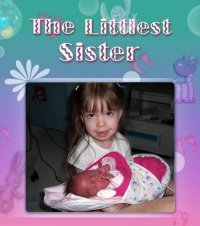
    Written from the perspective of a family’s middle child—the big sister of a hospitalized baby—The Littlest Sister is designed for siblings of a baby in the Neonatal Intensive Care Unit (NICU). It would also be a good book for a child who was formerly a preemie themselves. There is an older brother in the story as well, which enables readers of either gender can easily identify with the children.

    Color snapshots of a real family grace each page and make the book very genuine and true-to-life. The baby in the book was born at 30 weeks and has Down Syndrome and a mild heart defect. The pictures and text contain a lot of details children will identify with—there is a picture of the big brother touching the baby in her isolette, pictures of the baby sister with a tube in her nose and monitors attached, and so forth. Bottle feeding is mentioned briefly and I wish breastfeeding had been mentioned as well

    I have a special interest in the subject area because I worked for the Ronald McDonald House for four years. Written in a warm, personal tone, using easy to understand language and simple descriptions, The Littlest Sister would be a great addition to the lending library resources of Ronald McDonald Houses or NICU facilities.


    Disclosure: I received a complimentary copy of this book for review purposes.

    Film Review: Natural Born Babies

    Film Review: Natural Born Babies

    South Coast Midwifery, 2009
    DVD, 24 minutes, $24.95

    www.naturalbornbabies.com

    Reviewed by Molly Remer, MSW, CCCE

    This lovely short film produced by a midwifery service in California, is a great “ad” for the benefits of homebirth and of midwifery care. Natural Born Babies has a very clean, fresh, and contemporary feel and features a multicultural collection of homebirth families talking about their experiences in front of a white screen. Something that is particularly striking is that some of the people speaking with love and enthusiasm about their midwives and their birth experiences include a cardiologist, an anesthesiologist, and an ER physician!

    The first part of the film is titled Interventions and features both men and women speaking about birth, referencing how pregnancy and birth are treated like medical conditions and including a lot of discussion about the prevalence of cesareans. The point is made that, “no epidural can replace human touch.” The second part is titled The Birth Specialists and points out that OB/GYNS are pathology specialists, whereas midwives are trained in normalcy—“we take low-risk women, and keep them low-risk.” Midwives are specialists in normal pregnancy and birth. Because of the film’s emphasis is wholly on out-of-hospital birth and hospitals are critiqued very soundly, hospital-bound couples viewing the film may find that it causes their defenses to rise.

    Several of the parents are holding their babies as they speak and a CNM speaks briefly as well (citing both ACNM and MANA). The CNM manages Orange County’s only accredited birth center. I enjoyed the presence of a bio-physicist dad originally from Holland saying, “everyone I know was born at home” and noting that “you give birth the same way you live.” Several of the couples speaking do refer to the father as “delivering” the baby, which is a long-term pet peeve of mine.

    Special features include a 10 minute version of the film, an outtakes section, and a look inside the South Coast Birth Center. At the end of the film we see that one of the couples is the director/producer of the film.

    Natural Born Babies is a fast-paced film and though it is filmed in a “talking heads” format, it cuts quickly from person to person, thus keeping the viewer engaged. If you are looking for an informative video that is homebirth and midwifery friendly, but that does not include any birth footage, this would be a good addition to your library.

    Disclosure: I received a complimentary copy of the film for review purposes.

    Empowerment Recipe for Moms

    Happy Mother’s Day!

    I wanted to share this “empowerment recipe for moms” that I got from the book Celebrating Motherhood by Andrea Gosline and
    Lisa Bossi. I thought it was a fitting recipe for Mother’s Day as well as for general happiness as a mother 🙂

    Empowerment Recipe for Moms

    In a long day, mix:

    • A walk in the park
    • Ten minutes reading a positive book
    • Uplifting and relaxing music
    • Some time spent on a hobby or personal project
    • A cup of tea in the afternoon
    • A little quiet time alone
    • A twenty-minute nap
    • An adult conversation with your spouse
    • Lots of hugs and kisses.
    • –Cindy Angell Keeling

    It has taken me a while to find my rhythm and it is easier now that the children are older, but I do actually manage to include most of these recipe elements into my daily life. I drink my cup of tea in the morning (my husband fixes it and leaves it for me, so when I get up it is ready to drink) before my daily yoga practice. I don’t get to nap anymore, but when I had a napping child, I used to always get a fifteen minute nap in every day and it was a good thing. My husband and I walk together in the evenings for about 30 minutes a day and that allows us time for adult conversation (though sometimes people are riding bikes around our feet at the same time!). I read every night while lying down with the kids to put them to sleep. I don’t have time each day for ALL of my personal projects, but I usually have time for at least one of them. I journal every morning, practice yoga every morning, and usually get some writing time in at least once a week (hopefully more frequently!)…

    Book Review: 25 Ways to Joy & Inner Peace for Mothers

    Book Review: 25 Ways to Joy & Inner Peace for Mothers

    By Danette Watson & Stephanie Corkhill Hyles
    Watson & Corkhill Hyles, 2006
    ISBN 0646-46588-0

    84 page hardcover book & 60 minute CD set, $24.95
    http://www.awakenyourbirthpower.com

    Reviewed by Molly Remer, MSW, ICCE

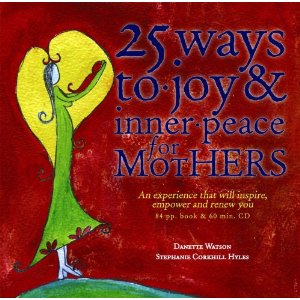
    Consisting of a book and CD, 25 Ways to Joy & Inner Peace for Mothers contains 25 short breathing meditations with accompanying whimsical, colorful drawings. The meditations are on topics such as “surround yourself with mother energy,” “embrace change,” “feel reverence,” and “trust the rhythm of your baby.”

    The final third of the book contains breathing tips, tips for using the meditations in life, and then “10 Healing Practices for Mothers” that are a very nice addition. This segment is followed by “Questions for Inner Exploration” that include journaling questions and prompts based on each of the meditations.

    It is not clear at first glance, but 25 Ways is designed for mothers of newborns and infants, not mothers of older children (though, of course, most of the meditations could be adapted to apply to older children). The addition of “new” to the title would have been a useful clarifier.

    Inspiring, empowering, and renewing, 25 Ways to Joy & Inner Peace for Mothers is a lovely and nurturing little manual that would make a nice blessingway gift for a pregnant or a congratulations gift for a special new mother.

    Disclosure: I received a complimentary copy of this book for review purposes.

    Review originally published in the CAPPA Quarterly, April 2010.

    Distraction, Concentration, Surrender

    In my childbirth classes when I cover “labor and birth 101,” I talk about the traditional stages of labor—early labor, active labor, transition, pushing, and third stage (placenta). I also talk about the “emotional signposts” of labor—excitement, seriousness, and self-doubt, as well as about the fear-tension-pain cycle and the excitement-power-progress cycle. Recently, I finished reading the book Painless Childbirth by Giuditta Tornetta and she elegantly described the three phases of first-stage labor in a three-word format that I found extremely accurate and helpful, as well as fresh and interesting. The first phase is distraction—during early labor, it is most helpful to continue to go about your normal life as if nothing is happening. Do not give your contractions any attention until they strongly request your attention! I tell my clients to just do what they would normally be doing—-if they would be sleeping, sleep. If they would be walking the dog, walk the dog. Watering the plants, eating dinner, etc., etc. Just keep up the normal routine until you need to give the birthing energy more attention. Without distraction as a tool, labor can become very long and exhausting—if you think of yourself as in labor from the second you feel anything, you are much more likely to experience a 24 hour labor than if you do not think of yourself as in labor until you are completely absorbed by its sensations.

    The second phase is concentration—contactions have now become what Ina May Gaskin would term “an interesting sensation requiring my complete attention.” This phase corresponds to the Bradley Method’s emotional signpost of “seriousness.” I tell my clients that this is when she stops laughing at your jokes and stops even seeming aware that you’re talking. (She IS still aware however, and we will address this in a later post about undisturbed birth, prompted by another new book I am reading called Optimal Birth.)

    The third phase is surrender and this corresponds with the transition portion of active labor and the “self-doubt” signpost. I think the concept of surrender during labor is one of the most profound and transformative elements of giving birth. If you can embrace the notion of “surrendering” to birth rather than staying in “control” of it, I think this can revolutionize your perception of what is happening in your body and your life. While hard to express in words, the experience of surrendering to my own body’s power was a transformative experience in my life (particularly since I am a “controlling” sort of person in “real life”—maybe this is why this term and experience holds such meaning to me). With surrender comes “flow”—there is such value and beauty and strength to be found in letting go and just letting it happen; letting “the might of creation come through you.” This was the most profound truth I discovered in each of my birth experiences.

    Book Review: Pregnant on Prozac

    Book Review: Pregnant on Prozac: The Essential Guide to Making the Best Decision for You & Your Baby

    By Shoshanna Bennett, Ph.D.
    GPP Life, 2009
    ISBN 978-0-7627-4940-9

    248 pages, softcover, $16.95
    http://www.clearsky-inc.com

    Reviewed by Molly Remer, MSW, CCCE

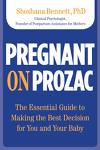
    Written by a clinical psychologist and mother of two, Pregnant on Prozac is a comprehensive look at the benefits and risks of antidepressant use during pregnancy or postpartum. The focus on depression during pregnancy is what makes this book stand out—this is a subject that has received very little attention and it is important for doula and childbirth educators to learn more about the issues involved.

    The book includes sections on “natural and emerging treatments” including homeopathy and acupuncture as well as a section on nutrition, though the overall emphasis is on pharmacological treatment methods.

    The information presented is very comprehensive, though I was disturbed by the suggestion not to read the package inserts coming with medications, but to trust your doctor to know “what is safest for you and your baby.” This is not the type of informed decision-making I promote in my work with pregnant and new mothers!

    Pregnant on Prozac briefly addresses midwives and doulas in a section about “helping professionals who may be of use to you.”

    I have three significant critiques of the book. During one section the author waxes eloquent about the non-specific benefits of an unnamed “exercise system” and then later an unnamed “nutritional system.” She glowingly recommends these unidentified systems and refers readers to her website for more information about the nutritional system and to another website for the exercise system. I suddenly felt like I was reading a commercial and the tone called into question for me the validity and reliability of the entire rest of the book.

    My third critique is that the segment addressing medication use while breastfeeding is woefully incomplete, falling back on the trite platitude “a calm, happy mother is more important to a child’s healthy development than breast milk.” Though I do not quibble with the truth of this statement in an “ultimate” sense, my concern is that it summarily dismisses the fact that many women can take medication AND breastfeed—it is not an either or situation! The very brief section on breastfeeding also included the questionable and disappointing statement, “you can even get better eye contact with your baby with a bottle in its mouth instead of being squished face-first into your breast.”

    Each of these sections is small, but my concerns about them are large. Despite these critiques however, I would still recommend Pregnant on Prozac to birth professionals and parents seeking information about treatment options for depression during pregnancy with the caution not to rely on it as your only resource and certainly not to count on it for advice on exercise, nutrition, or breastfeeding.

    Disclosure: I received a complimentary copy of this book for review purposes.

    New Training!

    This year, I completed several new trainings that I am very excited about.

    Prenatal Yoga Training

    This weekend I fulfilled a 7 year old dream and attended a prenatal yoga teacher training in St. Louis. I have wanted to teach prenatal yoga since I was pregnant with my first baby, but a training opportunity just never opened up for me until now. I felt like this was perfect timing. The training was through YogaFit and was pretty basic, but it was just what I needed to feel like I can move forward with this dream. YogaFit is a very “fitness” oriented type of program vs. any kind of holistic-mind/body connection stuff, but I can add those elements in myself. I think I will be able to offer something fairly unique—not just yoga and not just childbirth education but yoga-childbirth-education. There are several other programs like that, of course, but none in the local area! At the training, I also learned some really cool partner yoga stuff that I didn’t know how to do before.

    Birth Art Training

    In February, I completed something else that I’ve been dreaming about for some time—I took Birthing from Within‘s online course, “How to Lead the Birth Art Process.” Aside from a few minor complaints about the sometimes-frustrating “Zen” underlay and occasional contradictions within the course, I really LOVED this class. I found the online course format to be an ideal format for me—real-person interaction through message board, chat, phone call, and email; written information; writing journals/essay responses; hands-on personal practice with the assignments; and real-life application with other people/clients in birth art sessions. I felt like I got more out of actual use out of this workshop than most of the other classes and workshops I’ve attended—I think this was because the course was spread out over 5 weeks, not just a weekend, which allowed plenty of time to really assimilate and USE the information. It was very affordable too and I was able to attend right from the comfort of my own chair! The class is marketed as suitable for beginners, but personally I found my past background in childbirth education to be very important and I cannot imagine having taken the class with no prior birth class teaching experience—I think the people who had little experience were kind of disadvantaged in this course. Birthing from Within is my all-time favorite birth preparation book/resource and it was so exciting for me to have a little taste of direct training with them. Hopefully at some point in the not-too-distant future, I will take further training with BfW.

    Childbirth Educator Certification

    In March of this year, I was pleased to earn my childbirth educator certification with CAPPA. Since I am already certified with other organizations, I enrolled in the dual certification program option. I am very excited to be “throwing my hat in” with CAPPA. The organization is very friendly and stable and I really connect with the CAPPA Vision. The program information itself was pretty basic and I didn’t really learn anything new from it, but that makes sense because it isn’t specifically designed for people who already have CBE teaching experience—I think it is a great program for someone starting out in this field.

    Comparing CBE Programs:

    I get a lot of inquiries from people seeking information about different childbirth education programs and thought I would provide a super-quick mention of the things I enjoyed most about each of my certification programs/organizations. Keep in mind that I certified with ALACE first, hence, I had the most direct experience with their full training program, vs. the other organization’s “accelerated” options (which I SO deeply value and I am SO grateful that ICEA and CAPPA make that option available to people—I’m very, very grateful!). In sequential order:

    ALACE (now IBWP)—phenomenally in-depth training program with a wonderful woman-oriented, holistic, midwifery-model. Very homebirth friendly. When I finished this program, I felt like I’d earned another master’s degree—this time in birth. At the present time, however, I do not get a “stable” or professional feeling from the organization and that is very disappointing 😦

    ICEA—very professional. Lots of really good information on how to teach and on the principles of adult education in general. I learned the most about the “how” from ICEA (and the “how” is very, very important). They also have several great teaching manuals that are super-affordable. I enjoy the International Journal of Childbirth Education as well. Very professional. The training information assumes educators will be teaching a “mainstream” population, probably in a hospital, but their position papers are very sound and I can really get behind their mission as well. Their certification exam was the most difficult of the three programs and I feel like I really earned my certificate!

    CAPPA—I am really pleased with my association with CAPPA. As I noted, they are very friendly and I feel like they will be around for a long time to come. I just get a lovely, warm feeling of “sisterhood” from CAPPA and that is very important to me. I feel connected to the organization and the people and it is a very supportive atmosphere. I recommend them for training, especially for people who are just starting out. I’m excited about the free conferences CAPPA offers as well and I’m going to my first one this July! I also enjoy the CAPPA Quarterly and and I am proud to write the book/film reviews column.