Archives

Book Review: Homebirth in the Hospital

Homebirth in the Hospital
by Stacey Marie Kerr, MD
Sentient Publications, 2008
Softcover, 212 pages
ISBN: 978-1-59181-077-3
www.homebirthinthehospital.com

Reviewed by Molly Remer, MSW, ICCE, https://talkbirth.wordpress.com

I would venture to say that most midwifery activists and birth professionals have said at some point, “what she wants is a homebirth in the hospital…” This comment is accompanied with a knowing look, a bit of head shaking, and an unspoken continuation of the thought, “…and we all know that’s not going to happen.”

Well, what if it is possible? A new book by Dr. Stacey Kerr, Homebirth in the Hospital, asserts that it is. She was originally trained at The Farm in TN (home of legendary midwife Ina May Gaskin) and after going to medical school realized that she, “…needed to balance my new knowledge with my old priorities. I missed the feeling of normal birth, the trust that the birthing process would occur without technology, and the time-tested techniques that help women birth naturally. And so it was that I went back to midwives to find the balance.”
If you are a dedicated homebirth advocate, I recommend reading Homebirth in the Hospital with an open mind—clear out any cobwebs and assumptions about doctors, hospitals, and birth and read the book for what it is: an attempt to create a new model of hospital birth. What Dr. Kerr proposes in her book is a model of “integrative childbirth”—the emotional care and support of home, while nestled into the technology of a hospital.

The opening chapter explores the concept of integrative childbirth and “the 5 C’s” of a successful integrative birth: choices, communication, continuity of care, confidence, and control of protocols (“protocols are the most disempowering aspect of modern maternity care…”).

This section is followed by fifteen different birth stories, beginning with the author’s own (at a Missouri birthing center—my own first baby was born in a birth center in Missouri, so I felt a kinship there).

The births are not all happy and “perfect,” not all intervention-free, and most are quite a bit more “managed” and interfered with than a lot of homebirthers prefer (one is a cesarean, several involve epidurals or medications). I, personally, would never freely choose a “homebirth in a hospital” (I also confess to retaining a deep-seated opinion that this phrase is an oxymoron!). However, that is not the point. Over 90% of women do give birth in a hospital attended by a physician and I appreciate the exploration of a new model within the constraints and philosophy of the hospital.

The book closes with a chapter called “how to be an integrative childbirth provider.” The book has no resources section and no index.

I certainly hope that doctors read this book. I am also glad it is available for women who feel like homebirth is not an option or not available and would like to explore an integrative approach. Even though my opinion is that none of the births are really “homebirths in the hospital” as most bear little resemblance to the homebirths I know and love, unlike the content of the standard hospital birth story, they are deeply respectful births in the hospital and that’s the issue truly at the heart of this book.

—-

Disclosure: I received a complimentary copy of this book for review purposes.
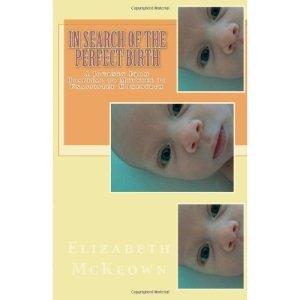
Book Review: In Search of the Perfect Birth

Book Review: In Search of the Perfect Birth
By Elizabeth McKeown, 2011
186 pages,  paperback.
ISBN-13: 978-0615481708
http://www.theperfectbirth.com/

Reviewed by Molly Remer

Written by a mother of three, In Search of the Perfect Birth is an unassisted childbirth manifesto. It chronicles the author’s journey through the births of her children—the first born in the hospital, the second a planned homebirth ending in hospital transport, and the third an unassisted birth. Elizabeth is strongly convicted that unassisted birth is the right choice for most women, though I feel she is also fairly respectful that other women’s experiences may or may not lead them to the same conclusion. This book is not a do-it-yourself guide to UC, but is an exploration of one woman’s experiences in healing from birth trauma and taking full responsibility for the birth of her next child. I was fascinated by her conclusions that her own birth trauma wasn’t healed through unassisted birth itself, but through the decision to take charge of her own birth care.

The book is pretty rough around the edges and could use some more editing and polishing. There is a stream-of-consciousness feel to the writing style that can be a little confusing and disjointed.

The author makes some excellent points with regard to the restrictions that can be placed on women’s birth freedoms by midwives also, noting wryly that if you choose the “middle ground” you may well end up with all the downsides of being told what to do with your own body, but “without the opiates that make it bearable!” Elizabeth’s homebirth turned hospital transport experience was pretty horrific and it was difficult to read about. She also writes with candor about the degree and intensity of pain she experienced during all of her births (including the UC).

In Search of the Perfect Birth will be of particular interest to women who already support unassisted birth and to women who have experienced birth trauma and are seeking resolution in future natural childbirths. It is an honest and heartfelt story.

Disclosure: I received a complimentary copy of this book for review purposes.

Book Review: Doulas’ Guide to Birthing Your Way

Book Review: Doulas’ Guide to Birthing Your Way
Authors: Jan Mallak & Teresa Bailey, 2010.
ISBN: 978-0-9823379-7-4
$15.37 – $21.95, 188 pages, softcover
Hale Publishing: http://www.ibreastfeeding.com/

Reviewed by Molly Remer

Geared towards pregnant women, Doulas’ Guide to Birthing Your Way is written in a simplistic manner using short, direct sentences. While in some ways this approach makes the information readily accessible, it can also feel unsophisticated in places. However, while the writing style is basic, the content is not. The Doulas’ Guide is a book that really “goes beyond” the information traditionally offered in birth preparation books, covering topics many parents typically may not have considered prenatally such as natural birth vs. birthing naturally, physical comfort preference styles, visualization, being a savvy consumer, blessingways, and taking pictures of the placenta. The information is refreshingly practical and hands-on. Chapters cover the critical importance of the human environment, “five arms of doula support,” birth preparation, one chapter for each stage of labor including separate chapter for immediate postpartum, a section about cesarean birth and VBAC, and a breastfeeding chapter.  There is an excellent section on postpartum care including a PPD symptoms chart. I was a little taken aback by a blithe comment, “Just think of it as an alternate birth route!” regarding cesareans.

Doulas’ Guide contains good, helpful snapshots throughout the text. Dads will like the plethora of labor support skills and ideas and the accompanying photographs. The book advocates preparation of a “birth vision” and includes examples at the end of the book (including cesarean birth options).

The variety of checklists, key questions, tables with reference information, bullet points, and pictures keep the pace of Doulas’ Guide to Birthing Your Way snappy and digestible. This book covers lots of ground and packs a lot of information into under 200 pages!

—–

Disclosure: I received a complimentary copy of this book for review purposes.
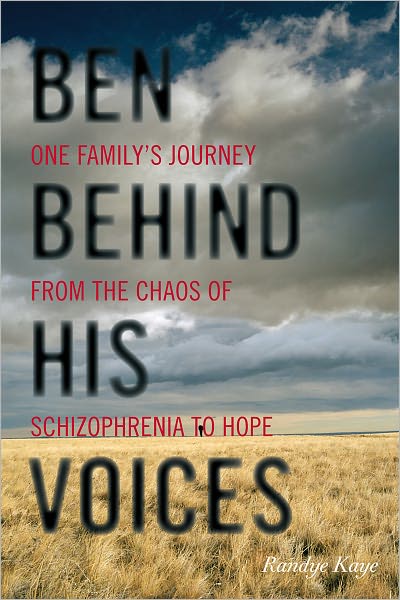
Book Review: Ben Behind His Voices

Review: Ben Behind His Voices: One Family’s Journey From the Chaos of Schizophrenia to Hope
By Randye Kaye
ISBN: 978-1442210899

Rowman and Littlefield Publishers

Hardcover, 320 pages, $26.95; Kindle, $9.99
http://benbehindhisvoices.com/

Reviewed by Molly Remer

Ben Behind His Voices is a mother’s poignant memoir of her young adult son’s struggle with paranoid schizophrenia. It was instantly engaging and kept my attention throughout. The author, Randye Kaye, is a radio personality and voice actress and the mother of two children. When her oldest child, Ben, is 17 he begins exhibiting increasingly strange, confusing, and disturbing symptoms. After being shuttled through a variety of diagnoses and treatment providers while steadily becoming worse, he is diagnosed at age 21 with schizophrenia. Randye is obviously a devoted parent to Ben and a committed advocate for her son and the book chronicles a roller coaster of experiences with psychiatric hospitalizations, medication challenges, bright spots of hope, relapses, group home placements, and readjustments of expectations. Perhaps most touching are her struggles to accept the “new normal” of her family’s life and to let go of her old expectations and hopes for her son, while still celebrating the caring and worthwhile person he is, albeit one who is coping with a formidable disability.

A particularly nice feature of this book are the textboxes inset throughout containing facts and information for family members of those with mental illnesses. Much of this information is based on Family-to-Family peer support materials from the National Alliance on Mental Illness (Randye becomes a trainer for this program).

Though written about very emotional events, there is a dispassionate quality to the writing that kept me from feeling fully connected to the narrator.

A fascinating character study as well as an exploration of family adaptation and coping skills, Ben Behind His Voices would be a particularly interesting read for students in psychology, social work, or human services as well as anyone who has a family member with a mental illness. As a mother of young sons, Ben Behind His Voices was a difficult book to read—Randye’s thoughts and reflections about her own son as a young boy, made me look at my own little guys with a pang of “what if.”

——-

Disclosure: I received a complimentary copy of this book for review purposes.

Book Review: Healthy Eating During Pregnancy


Review: Healthy Eating During Pregnancy
By Erika Lenkert with Brooke Alpert
ISBN: 978-1-906868-41-3
Softcover, 144 pages, $16.95
http://www.healthywomen.org

Reviewed by Molly Remer

Co-written by a cookbook author/food writer and a nutritionist (both of whom are mothers), Healthy Eating During Pregnancy offers 100 recipes with the nutritional needs of pregnant women in mind. The first part of the book contains specific nutrition information for pregnant women, including a short section on coping with morning sickness, as well as good information about the micronutrients and macronutrients that are essential for growing a healthy baby. The remaining two thirds of the book is a collection of tasty recipes, organized into categories beginning with breakfast and concluding with desserts. The book is very colorful and contains many appetizing photos.

Though marketed specifically for pregnant women, the recipes have appeal to anyone. My family enjoyed the zucchini and parmesan frittata and the “totally tasty breakfast muffins” and we look forward to trying more of the recipes in the future.

This book would be well-placed in the lending libraries of midwives, doulas, or childbirth educators. Anyone in need of healthy recipe ideas during pregnancy will enjoy exploring the new book Healthy Eating During Pregnancy!

——-

Disclosure: I received a complimentary copy of this book for review purposes.
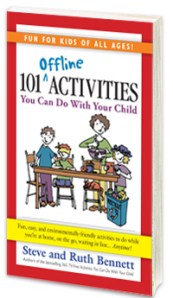
Book Review: 101 Offline Activities You Can Do With Your Child

101 Offline Activities You Can Do With Your Child
Steve Bennett,  Ruth Bennett
Paperback: 134 pages
Publisher: BPT Press (June 14, 2011)
ISBN-13: 978-0984228522

Reviewed by Molly Remer

Just in time for summer amusement comes the new book 101 Offline Activities You Can Do With Your Child. Written by the authors of the classic 365 TV-Free Activities You Can Do With Your Child (a book I’ve used a resource for about 6 years), this concise little book offers a wide variety of fun activities. Coded at the bottom of the page with a sketch, the activities are either designed to be used at home, on the road, in the kitchen, or anytime, anyplace. A nice feature is the picture index for kids who are not yet reading to choose their own activities.

Single page explanations/descriptions mean all of the activities are fairly simple to implement and enjoy—offering a brief time-out for anytime fun. Many of the craft ideas seem most appropriate for children under age 10 and plenty of the other games and other activities are enjoyable for any age group.

My kids have come up with quite a few of the suggested ideas using their own imaginations and some of the ideas are classic car games (or variations thereof), but there is enough fresh, unique content to make this book a worthwhile resource for our family.

Disclosure: I received a complimentary copy of this book for review purposes.

Book Review: Arms Wide Open: A Midwife’s Journey

Book Review: Arms Wide Open: A Midwife’s Journey
By Patricia Harman
Beacon Press, 2011
ISBN: 978-0807001387
324 pages, paperback, $16.47 (Amazon)
http://www.beacon.org

Reviewed by Molly Remer, MSW, ICCE, CCCE
https://talkbirth.wordpress.com

I very much enjoyed Patricia Harman’s first book, The Blue Cotton Gown, and was delighted to learn about her new memoir, Arms Wide Open which is, in a sense, both a prequel and sequel to her first memoir.  The first half of Arms Wide Open chronicles Patsy’s experiences with homesteading and communal living as a young hippie mother in the 1970’s. It also explores her thoughts and experiences with peace activism and her passion for an eco-friendly life. During this time, she attends her first birth and dives into her midwifery journey and eventually becomes a CNM practicing with her hippie-farmer-turned-OB/GYN husband in West Virginia. Her experiences with their years in a joint women’s health practice are described in The Blue Cotton Gown. Readers who, like me, wondered what happened where The Blue Cotton Gown left off, can find out in the second half of Arms Wide Open, which is a narrative of Patsy’s ongoing work with women through 2009 and includes her emotional painful moments in her marriage, as her husband struggles with fears of another lawsuit as well as with chronic pelvic pain patients who abuse his trust (chronic pelvic pain is a specialty of their practice).

I did feel as if there was a large chunk of story missing as the book somewhat abruptly skips from 1978 to 2008. We miss learning about any of Patsy’s experiences in nurse-midwifery school, nor do we learn much about her practice when she was a CNM attending births. The book transitions from her years as a self-taught midwife considering going to school to become a CNM, straight to her present-day years as a CNM in a private women’s health practice.

Harman’s writing style is lyrical and engaging as well as candid. The book is based on personal journals and reading it feels like eavesdropping on someone’s very private thoughts and feelings. The book is much more of a look at a woman’s feelings about her life, than it is a “manifesto” about birth or about the practice of midwifery. In this manner, I feel like you receive a much more complete picture of a midwife’s life and journey, rather than reading a sequence of birth stories. Patsy has a lot of life in addition to birth. While definitely not a “feel good” book, Arms Wide Open is a deeply touching and very honest exploration of one woman’s personal journey in life, love, motherhood, and midwifery.

Disclosure: I received a complimentary copy of this book for review purposes.

Review: A Book for Midwives

Review: A Book for Midwives
Hesperian Foundation
CD-Rom, 2011
544 page pdf book in English and Spanish
by Susan Klein, Suellen Miller, and Fiona Thomson
ISBN13: 978-0942364-24-8, $16.00
www.hesperian.org

Reviewed by Molly Remer, MSW, ICCE
https://talkbirth.wordpress.com

As a child, I was fascinated by my father’s copy of the book, Where There is No Doctor. Fast forward twenty or so years and imagine my glee when as a birth activist adult, I then discovered A Book for Midwives, also published by the Hesperian Foundation. Hesperian’s goal “is to promote health and self-determination in poor communities throughout the world by making health information accessible. [They] work toward that goal by producing books and other educational resources for community-based health.” In keeping with this goal, A Book for Midwives is available for FREE download on the Hesperian site. (Personally, I appreciate the professionally printed version of the book I purchased, because I think it would cost more same in ink to print it myself, but without the nice cover!).

A Book for Midwives is excellent; a true community resource. It is also a very sobering look at the reality of women’s health and health care in other countries. It contains reminders such as “do not hit or slap a woman in labor,” and other things that can make you cringe. A Book for Midwives is basically a textbook for midwives, health care workers, or educators working in developing countries and/or with very limited resources. I appreciate how it makes information available that is sometimes “hidden” in other books–i.e. explicitly technical content and “how to’s” that are normally reserved only for “professional” people. It is simply written and extremely blunt. There is no fluff and nothing romanticized about pregnancy, labor, and birth. In a way, it was hard to read a book that makes it so very clear how very, very difficult things are for midwives and women in impoverished areas (living in the US, I am used to the “normal, healthy pregnant women” approach to midwifery care). The book covers a wide range of information from preventing infection, treating obstetrical emergencies, doing pelvic exams, and breastfeeding to HIV/AIDS, testing for STDs and cervical cancer, and IUD insertion. There is also a section in the back of the book about medications, medication administration, giving injections, and other topics. It is an extremely comprehensive resource. (Just a side note, in the section on contraceptives, the book is heavily in favor of hormonal methods such as pills as well as very positive about IUDs and sterilization.)

Recently, Hesperian made A Book for Midwives available for purchase on CD. The CD includes the 544 page book as a pdf file in both English and Spanish. Both high resolution and low resolution versions of the book (in both languages) are included on the disk. This format makes it easy for the book to travel with you via laptop for trainings or presentations. I was particularly excited to convert it for my Kindle, making it readily available for travel and reference.


Disclosure: I received a complimentary copy of the CD for review purposes.

The Five Ways We Grieve

“…most people are unaware that our losses affect us forever, since they cause us to see the world and ourselves differently. The task of discovering ‘Who am I now?’ and finding our own path to healing represents one of the greatest challenges of the grieving process.” –Susan Berger

I recently received a request to review a new book, The Five Ways we Grieve, by Susan Berger. I was instantly intrigued by the book and felt like while it is not specifically about pregnancy loss, it might still have helpful information to contribute to mothers who are coping with pregnancy loss. And, it does not disappoint! The book describes the five “identities” survivors of loss assume and the ways in which these identities transform or paralyze. While the experience of pregnancy loss is often minimized or marginalized culturally as less significant than other types of loss, the reality is that many women experience profound and genuine grief that is just as “real” as any other sort of grief and loss. When I found out that my tiny son had died after 14 weeks of pregnancy, I experienced a depth of sadness never before experienced in my life. I felt a sorrow so profound and full of anguish that I feel certain it was the same type of grief I would experience at the death of any of my dearly loved children. While some might find this surprising (or even impossible), because the baby wasn’t born yet, I believe that the pit of despair one enters after losing a child is the same regardless of the age of the child and whether born or not—perhaps the duration of grief might be shorter for some, but the initial shock, impact, and sense of intense loss and sadness is the same. And, while my own first loss may be defined by some as, “just a miscarriage,” the reality is that I gave birth to a third tiny son in the privacy of my own home—a real, little baby with fingers and toes and whose little fluttery kicks I had just been beginning to feel.

So, regardless of the size of person who died, I very readily recognized myself in the descriptions of the five identities explored in The Five Ways We Grieve.  Most people are familiar with the classic “5 Stages of Grief” model developed by Elisabeth Kubler-Ross (Denial, Anger, Bargaining, Depression, Acceptance), however, these stages most readily apply to people who are dying, not to the survivors. While survivors still speak of moving through these stages, they are not really adequate to describe the experience of grieving a loved one. The five identities explored in Susan Berger’s book are:

  • Nomads:  Those who have not yet resolved their grief in a way that allows them to move on with their life and form a satisfying new identity.
  • Memorialists:  Their main goal is to honor their loved one by creating physical objects or rituals that honor the deceased.
  • Normalizers:  They work to recreate the kind of life they lost or wished they’d had.
  • Activists:  They focus on helping other people who are dealing with the same disease or issues that caused their loved one’s death.
  • Seekers:  They experience loss as a catalyst for philosophical exploration into the meaning of life.

In my own experience, I believe the Activist and Memorialist roles are intimately intwined—nearly immediately post-loss, I wanted to reach out to others and to try to help them as they experienced their own loss journeys. Creating my website/blog/journal, Footprints on My Heart, was a means of helping myself through exploration of my feelings and thoughts, but also a means of helping others. And, it is also a means of being a memorialist. I wanted to assure that Noah’s brief life would be remembered and would have value. On significant dates, I felt/feel an urge to acknowledge the date with some type of memorialization. In keeping with this, I’m posting this on his due date (which is also my birthday). Earlier in the year, following the birth of my sweet new baby girl, I felt like perhaps these date milestones would have lost their significance. In March, I considered that I had hardly given my former due date any thought at all and was really only thinking of it as my birthday and not really as anything else. However, as we got closer, old feelings were stirred and I remember how very painful this time of year was to me last year. And, no matter how distant the lived experience becomes, my birthday will actually never be the same, because I will never forget. And, I don’t want to. His death/birth and my experiences with those things are part of me in a permanent way. However, the experiences now come through the lens of memory and commemoration/memorialization, rather than as a “fresh” or current, in-process experience. I write about it to ensure that he is not forgotten, nor is what he meant to me. And, I am presently in the process of turning my Footprints blog into a book, again with a dual intention of activism and memorialization.

Finally, I also see myself in the Seeker role. While I have spent a lot of years already exploring the meaning and purpose of life, giving birth to Noah was a catalyst for spiritual exploration for me. His birth prompted me to take a deep and long-lasting inner journey and to much more fully explore and elaborate on my spiritual perspective and my experiences with the Sacred Feminine, rather than to just continue to “dabble” with various ideas.

—-

The Five Ways We Grieve: Finding Your Personal Path to Healing After the Loss of a Loved One
By Susan A. Berger, LICSW, EdD
Psychology/Grief | US $17.95 CAN $20.50 | Paperback | ISBN: 978-1-59030-899-8 | Trumpeter, an imprint of Shambhala Publications, Inc.
http://www.amazon.com/Five-Ways-We-Grieve-Personal/dp/159030697X
http://www.shambhala.com/html/catalog/items/isbn/978-1-59030-697-0.cfm

Book Review: Home/Birth: a poemic

Book Review: Home/Birth: a poemic
By Arielle Greenberg and Rachel Zucker
1913 Press, 2011
ISBN 978-0-9779351-7-8
208 pages, softcover, $11

http://www.1913press.org

http://www.facebook.com/pages/HomeBirth-A-Poemic/

Reviewed by Molly Remer, MSW, ICCE, CCCE
https://talkbirth.wordpress.com

Co-authored by a pair of long-time friends, the “poemic” book Home/Birth reads as if you are eavesdropping on a lengthy, juicy, engaging, thought-provoking conversation about homebirth, birth in America, maternity care, and feminism. The book has a lyric, narrative, stream of consciousness format linked together with segments of poetry.

The text does not differentiate between the two speakers/writers, though through the “call and response,” back-and-forth exchange between the two authors, you quickly begin to recognize two distinct voices (as well as other fragments from birth books, bumper stickers, midwives, etc.).

The book was written during Arielle’s second pregnancy, which ends in the stillbirth of her baby boy. Arielle had one prior homebirth and one subsequent homebirth. Rachel had two hospital births and a homebirth prior to the writing of the book.

While the style in which it is written takes some time to get used to, once you tune in to its rhythm, Home/Birth is a unique and fascinating journey. Because it is so distinctive, I find it difficult to describe in writing—you need to make sure to read it for yourself!

Disclosure: I received a complimentary copy of this book for review purposes.