Archives

Guest Post: Paid Menstrual Leave?

Paid Menstrual Leave – it’s time!  

by DeAnna L’am. Reprinted with permission.

A Russian lawmaker has asked parliament to give women two days paid leave a month when they menstruate… Mikhail Degtyaryov, a member of the nationalist LDPR party, wrote on his website “During that period (of menstruation), most women experience psychological and physiological discomfort. The pain for the fair sex is often so intense that it is necessary to call an ambulance”… Scientists and gynecologists look on difficult menstruation not only as a medical, but also a social problem…” ~ Standard Digital, August 2013

Fascinating! Lets look at how good things are turned on their heads, yet again, to result (unsurprisingly) in women’s dis-empowerment.

Indeed, a paid monthly Menstrual Leave would be an honoring, empowering option for women worldwide. Yet proposing it for all the wrong reasons diminishes us, and our cyclicity, to “a social problem.”

Campaigns have been initiated over the years under the guise of empowering women, which ended up diminishing, dis-empowering, and ultimately killing us! Marketing guru Edward Bernays was hired in 1928 by an American Tobacco Company president to increase sales of Lucky Strike cigarettes. Sigmond Freud’s work was utilized to expand understanding of ‘What Women Want’ and capitalize on it for marketing purposes.

Realizing that women were motivated and empowered by the suffrage movement, Bernays manipulated a real need – into a persuasive sales tactic. He hired women to march in the Easted Sunday parade smoking what he cleverly named their “Torches of Freedom.” Bernays succeeded overnight: he persuaded women to pick up an unhealthy habit, and commit to spending their hard earned money for years, by equating cigarettes with personal freedom and equality to men. Smoking among women exploded into unparalleled heights. Their personal freedom and equality to men continued to suffer…

Similarly, women were encouraged by manipulative campaigns to start giving birth in hospitals after countless generations of home births. Many new hospitals were built as a result of Second World War, to accommodate the staggering number of injured soldiers returning from battle. It took a few years for most hospitals to empty, as wounded soldiers either recovered or died. Faced with many large vacant hospital buildings and idle staff, administrators procured and released ad campaigns, which sinisterly manipulated women to believe that giving birth at home was ‘primitive’ and unsafe, while birthing at the hospital was promoted as safer, ‘modern’, and a highly intelligent choice.

Women bought into these campaigns, and many others like them, all over the world. They started smoking and felt ‘glamorous’. They started giving birth in hospitals and felt ‘modern’. They started using disposable menstrual products and felt ‘progressive’ and ‘in control.’ All along they have also been developing an array of respiratory diseases and dying of lung cancer; They have been cut open in cesarean sections (1 in 4, to accommodate doctor’s convenience); They have reached an all-time-high maternal and infant mortality rates following hospital birth; And they have been contributing to our planetary ecological crisis by damping 12 billion “feminine hygiene” products into landfills every year, in the U.S.A. Alone!

And here we are: In the midst of a pioneering worldwide movement of women reclaiming menstruation as the heightened state of awareness for which it was recognized in all indigenous cultures; In the process of inspiring women to honor their menstrual blood and their body’s needs, by taking time off to rest and renew themselves on the first day of their period — we are faced with a legal initiative which is both revolutionary and reactionary at the same time!

Wouldn’t it be revolutionary for the workplace to grant Paid Menstrual Leave to women? Wouldn’t we feel validated in our need for rejuvenation, honored for our body’s monthly regeneration, and empowered by the cultural acknowledgment of our rhythm?

We certainly would, if it weren’t billed as a response to “a social problem” of the “fair sex” who suffers “psychological and physiological discomfort.” Our menstrual cycle is neither a social problem nor a mere discomfort. Our menstrual flow is profound and life affirming work performed monthly by our bodies. We need to rest and renew in response to it, or we develop symptoms labled “psychological and physiological discomfort” by our culture (and frequently by us, too…)

Cigarettes, hospital births, and disposable menstrual products were sold to us through clever manipulative tactics, yet we never needed them… We DO NEED Paid Menstrual Leave!

We have stopped smoking in drovers. We have been reclaiming home births, and have started using sustainable menstrual products (such as cloth pads, sea sponges, and menstrual cups). It is time to claim for ourselves, and demand from our culture, a monthly PML to replace PMS!

PML (Paid Menstrual Leave) is the deeply deserved rest our body, mind, and spirit need monthly. In its absence, our body screams in PMS pain, and will continue to do so until we listen to its needs and honor them.

This is a call for action! Lets unite in demanding legaly-bound Paid Menstrual Leave — not as a patronizing gesture designed to send us home for being a “social problem.” But rather as the honoring of a deep need, which springs from our depth, to renew our body, our emotions, and our spirit – monthly – while preparing for another cycle in the ever turning wheel of our lives.  


© 2013, DeAnna L’am, Red Moon – Cycles of Women’s Wisdom™

DeAnna L’am, (B.A.) speaker, coach, and trainer, is author of ‘Becoming Peers – Mentoring Girls Into Womanhood’ and ‘A Diva’s guide to Getting Your Period’. She is founder of Red Moon School of Empowerment for Women & Girls™ and of Red Tents In Every Neighborhood – Global Network. Her pioneering work has been transforming women’s & girls’ lives around the world, for over 20 years.

DeAnna helps women & girls love themselves unconditionally! She specializes in helping women make peace with their cycle; Instructs Moms in the art of welcoming girls to empowered womanhood, and trains women to hold RED TENTS in their communities. Visit her at: www.deannalam.com

Disclaimer: I am a Red Moon program affiliate. However, the only affiliate link in this post is the one included here!

Tuesday Tidbits: Moontime Mojo

“I am obsessed with becoming a woman comfortable in her skin.”
— Sandra Cisneros

I know I’ve been focusing on the subject of healthy menstruation a lot lately, but it is has been a persistent interest since my period came back after my last baby. At that time, since we are not planning to have any more children, I realized that I was going to have to redefine my relationship with my cycling body, no longer in the context of planning the next pregnancy. I also had the epiphany of sorts that in not acknowledging or fully experiencing the role of menstruation in my own life as a woman, I have been missing out on an opportunity to connect on a regular basis with one of the core “blood mysteries” of being female—I’ve spent a lot of time on birth and breastfeeding in my life, but my period? Oh, that old thing! I maintain that our attitudes towards our monthly bleeding are reflected in our culture’s attitudes towards birth and breastfeeding—ook! Bloody! Messy! Leaky! Stuff comes out of you! Hide it away! Don’t let anyone see! I shared some of these emerging 2013-06-22 08.59.09discoveries and thoughts during my Moontime session at the La Leche League of Missouri conference this month and many women attending expressed similar feelings—that they’d never actually connected the menstrual cycle fully with their experiences of pregnancy, childbirth, and lactation. As I explained to them, as women involved with LLL or birth advocacy we may be well-versed in listening and responding to our bodies when it comes to childbirth and breastfeeding, but many women overlook or minimize the influence menstruation has on their lives. We easily forget that menstruation also provides us with a regular reminder to listen to our bodies, follow their cues, and honor our own wisdom. I’m still working on it in my own life, but I really believe that women benefit from recognizing moontime as a time for rest, retreat, and renewal—a time to re-gather our scattered energy and resources and to emerge with strength and powerful medicine.

A friend came to me recently to ask for resources for her pre-menstrual daughter and said that she wanted something practical to tell her, not just to go sit in a tent, because that sounds nice, but it isn’t realistic in the modern age. And, I thought, but what if it WAS realistic and practical?! I would go so far as to say that perhaps we wouldn’t have such challenges with birth and breastfeeding in our culture if girls were taught that it was normal to need to rest and listen to their bodies once a month rather than to push forward like they’re exactly the same every single day. If this is how we grew up, wouldn’t it then be easier to accept the swell and flow of the energy of birth, to respect the need for rest and renewal during postpartum, and to listen to our bodies’ messages as we learn to breastfeed our babies and fall into sync with the timelessness of life with a newborn and beyond?

(Side note: when I originally chose the quote to open this post, I totally mis-read it and thought it said, “I am obsessed with women becoming comfortable in her own skin” and that is how I feel, but I guess I’m obsessed with it for myself too?)

I just finished reading the book Honoring Menstruation by Lara Own and it was really good. She says:

Our initiation of girls is superficial…how to put on makeup, buying your first bra, using a tampon for the first time. Many women get married and get pregnant without having any sense of their own capacity for endurance, physically or psychologically. Small wonder then than so many girl-women elect to give birth with the aid of painkillers and a technology that robs them of the experience of their own strength…

And she makes a point that I shared during my conference presentation:

As a culture we value stoicism and the overriding of the body. We have schedules, appointments, and timetables which are based on industrial efficiency rather than the moment-to-moment needs of the body. We wait until the end of the meeting to empty our bladders, until the end of the day to eat our main meal. We go to work when we have colds, when we have menstrual cramps, when we have a headache. ‘Not feeling like it’ is seen as a pretty lame excuse.

This is very useful training for all sorts of situations, but not for everything. And there are certain aspects of being female in which stoicism is exactly the opposite of what is required for successful survival. One of the skills of being a woman lies in being very aware of moment-to-moment bodily needs. Being deeply in touch with her body enables a woman to be able to know, and to say, ‘I need this type of food Now,’ ‘I need to rest Now,’ ‘I need to drink Now…’

I’ve previously used the example of listening to the urge to use the bathroom as a core issue in respecting our bodies and preparing for birth. Very, very few people actually go to the bathroom when they first feel the urge, waiting sometimes hours before finally making the time to run to the restroom. If we cannot listen to this simple, basic request from our bodies on a regular basis, can we honestly expect women to magically know how to “listen to their bodies” and give birth to their babies, particularly when we put them in birthing environments that are in many ways designed around overriding bodily requests? (Eating during labor? Sorry, you can just have ice chips. Moving around. Sorry, we can’t monitor the baby well enough like that.) We’ve been trained for years not to listen.

It is easy in today’s world to forget that our menstrual cycle is all about reproduction. Mostly – young women are given information about cleaning up their cycles from tampons to deodorants. Many are given birth control pills which in some cases stops their monthly bleeding all together. There are not many mothers who teach their daughters about the Rhythms of their Cycles – and instill a sense of true self-care and honoring as opposed to a fear of pregnancy, inconvenience and cleaning up. It is important for us to reconsider our relationship with our cycles – and take the time to not only understand our bodies – but connect with our inner compass.

A woman’s monthly cycle has an emotional and sexual landscape whether we are trying to conceive in that month or not. Instead of walking over these natural patterns – let’s try to understand them.

via Listening to our Menstrual Cycle ~ Wild Women Sisterhood.

I also enjoyed this article about Fertility Awareness, which is intimately tied (obviously) to an understanding of menstruation and body rhythms:

…throughout a natural menstrual cycle, hormonal fluctuation can alter a woman’s facial appearance, body odor, waist-to-hip ratio, vocal pitch, mood, habits of dress, and even language. When ovulating, these changes make women more attractive to men because they indicate fertility; in fact, one scientific study I read about later found that strippers have their peak earnings on the days when they are ovulating. These cycles also affect what type of men a woman finds attractive (women tend to be attracted to high testosterone macho types while ovulating and more nurturing men during the rest of the cycle). In short, a woman’s cycles affect how she thinks, how she feels, and how she behaves. Bly explained that our natural cycles are the full expression of ourselves. When a woman takes a birth control pill, which tricks the body into thinking its already pregnant, she is making a bigger change than she may imagine. Beyond obvious side effects like headaches, irritability, and bloating, Bly says, “The birth control pill emotionally flatlines a woman in a way that supports her ability to participate in the workforce, but does not support the ecstatic or transcendent qualities of masculine and feminine union.”

via The Hidden Wisdom of Fertility Awareness | Spirituality & Health Magazine.

And, I downloaded a free ebook about Rediscovering Your Menstrual Mojo from  Jo Macdonald. She specifically has resources for mothers and daughters. Check her out!

“Menstruation is an initiatory moment. Women can potentially open to a highly charged altered state, giving them access to a singular kind of power – the power of self-awareness, deep feeling, knowingness, intuition. A power that matures over time with each cycle.”

— Alexandra Pope

Finally, on Facebook recently, I saw this handy reminder card:

999013_189701581193314_1476244365_n

Tuesday Tidbits: Wild Woman

Women are the most beautiful embodiment of empowered awakening. We breathe life into the world with the heave of our body, sing the sacred into song with our soul, and heal the deepest of wounds with our boundless heart. Our time has come. Love is calling us all to remember the eternal ecstasy of Being. Now is the time. Now is the place. Love is here pressing itself into the moment. Love calls us to remember the universal creative pulse. Love calls all of humanity to its embrace. Love calls for women to claim their deepest truth, to create their greatest gift, and to rise from the ashes of a yesterday gone, to rise to fulfill authentic self. We women are awakening. We women are empowering. We women are rising. I am a woman rising.

~ Ani Kaspar

wildwoman

via Wild Woman Sisterhood on Facebook

This past weekend was the La Leche League of Missouri conference. I absolutely love these conferences and always learn so much, usually things I can use instantly. At this conference, I gave two presentations. The first was about miscarriage and grief and was sparsely attended, but pretty powerful. The second was about Moontime and it was really crowded! The participants were a diverse crowd and I felt a little unsure of my ability to connect with all of them without being excessively “woo woo.” Though, I expressed that concern in a comment on another woman’s blog post and I got this wonderful remark in return: I was just listening to an online interview with Sonia Choquette where she said that “woo woo” should be “where it’s at,” meaning that when we’re “woo woo,” we’re actually connecting to our authentic self, being in touch with our intuition, etc.

I’m going to remember this in the future—woo woo is where it’s at! 😉

Anyway, one of the things I shared during my talk is that mothers of small children are more likely to have PMS than anyone else—it is partly because our bodies call out to us to rest and be alone and we often can’t be when we have little babies that need us. It really, really does help with all pre-menstrual symptoms to be able to take some time to yourself to rest and rejuvenate rather than staying “on” all the time. Several women emailed me with follow-up questions and so here are the links and resources that I suggested for them:

Check out Miranda Gray’s website, particularly her free handouts. Deanna L’am is another favorite resource and she has resources for pre-moontime daughters as well.  Oh, and Tisha Lin’s Pleasurable Periods is another good resource as well as The Happy Womb from Lucy Pearce which has a free ebook about having a happy, healthy menstrual cycle. I’ve been digging into this subject a lot over the past year—any posts I’ve written are here. I’m also really liking the book I recently got called Honoring Menstruation by Lara Owen.

Bringing it back to the Wild Woman, I also shared a quote previously shared here:

“…Could it be that women who get wild with rage do so because they are deeply deprived of quiet and alone time, in which to recharge and renew themselves?

Isn’t PMS a wise mechanism designed to remind us of the deep need to withdraw from everyday demands to the serenity of our inner wilderness? Wouldn’t it follow, then, that in the absence of quiet, sacred spaces to withdraw to while we bleed — women express their deprivation with wild or raging behaviors?…” –DeAnna L’am via Occupy Menstruation

And, this book project recently caught my eye: Blood Sister, Moon Mama: a Celebration of Womanly Ways – submissions for a new book

Less related, but cool, I also just downloaded The Creative Joy Workbook (free!) from the incomparable Jennifer Louden.

For me, honoring moontime in my own life is very much about taking it to the body and listening to myself in the way in which I learned to do during pregnancy, birth, postpartum, and lactation. So, I loved this quote I spied on Facebook late last night:

Your body is your own.
This may seem obvious.
But to inhabit your physical self fully,
with no apology, is a true act of power.
This sovereignty over your body may need to be cultivated.
Most of us have been colonized; other people’s ideas, desires,
and expectations have taken hold in our flesh. It takes some time
and effort to reclaim our own terrain.

Own yourself. Say no when you need to.
Only then can you say yes…

– Camille Maurine, Meditation Secrets for Women (via TheGypsyPriestess)

I have read this book and actually have used part of the quote on my own before, but it spoke to me again in this different medium last night.

I’ve also written about the thoroughly embodied act of motherhood and likewise enjoyed this snippet via Facebook as well:

Nitty Gritty Motherhood | Theresa Martin

Motherhood came as quite a shock to me. It was just so… physical. It was often messy and gritty. Without motherhood, I probably could have lived my whole life without being truly present for any of it.

But as I reflect, it seems so much of a female’s life is just so physical.

Take menstruation for example, that first initiation into womanhood. It’s holy and sacred, a reorienting of our bodies from girlhood to womanhood, a constant preparation for the possibility of nourishing new life within us.

Menstruation is that time when we are called to change our focus from “doing” and “completing” to just being and reflecting. We are called to rest and to reevaluate our priorities and to ponder how our lives are going. So while this time is special and sacred, the shocking physical reality remains. I think my girlhood reaction to first learning about menstruation sums it up well: “We bleed?! From THERE!!??”

All of motherhood is no different. There’s that act that causes motherhood in the first place. It’s carnal and messy. Then there’s pregnancy. Like menstruation and sex, it occurs inside my body. I have the experience of housing, protecting, and growing my children until they can breathe for themselves. After that comes labor and birth. Once again, messy, gritty, carnal reality.

~ Theresa Martin, excerpt from “Nitty Gritty Motherhood”

Read more! http://www.newfeminismrising.com/2012/07/nitty-gritty-motherhood.html

Katharine Krueger ~ Journey Of Young Women, Consultant and guide, Girls’ Empowerment and Coming of Age http://JoYW.org/

And, yesterday, I went on my own wild woman adventure picking wild raspberries with my kids. I wrote about it on Pagan Families and included a bonus recipe for wild raspberry sorbet:

…may I be reminded June 2013 024
of the courage and love
shown in small, wild adventures.

Wild black raspberries are ripe at my Missouri homestead and this morning I went on an expedition with my three children to gather what we could. As I returned, red-faced, sweating, and after having yelled much more than I should and having said several things I instantly regretted, I was reminded of something that I manage to forget every year: one definition of insanity is picking wild berries with a toddler. In fact, the closest I ever came to spanking one of my kids was during one of these idyllic romps through the brambles when my second son was three. While still involving some suffering, today’s ramble was easier since I have a nine and a half year old now as well as the toddler. This time, my oldest son took my toddler daughter back inside and gave her a bath and put her in new clothes while I was still outside crawling under the deck in an effort to retrieve the shoes and the tiny ceramic bluebird I’ve had since I was ten that my girl tossed over the railing and into the thorns “for mama.”

While under the deck, I successfully fished out the shoes (could not find the tiny bird) and I found one more small handful of June 2013 038raspberries. Since the kids were all safely indoors, I took my sweaty and scratched up and irritable self and ran down to my small, sacred space in the woods. I was thinking about how I was hot, tired, sweaty, sore, scratched, bloody, worn, and stained from what “should” have been a simple, fun little outing with my children and the above prayer came to my lips. I felt inspired by the idea that parenting involves uncountable numbers of small, wild adventures. I was no longer “just” a mom trying to find raspberries with her kids, I was a raspberry warrior. I braved brambles, swallowed irritations, battled bugs, sweated, swore, argued, struggled, crawled into scary spaces and over rough terrain, lost possessions and let go of the need to find them, and served as a rescuer of others. I gave my blood and body over to the task.

When I returned and showered, my oldest begged for me to make homemade raspberry sorbet with our findings. I’ve never made June 2013 063sorbet before and wasn’t sure I should dare try, but then I gathered my resources and said yes to yet another small adventure…

via Small Adventures (sorbet recipe included there!)

I’ve also been enjoying the wild, riotous blooms of summer:

June 2013 041June 2013 049 June 2013 037

Motherhood and Embodiment

“Loving, knowing, and respecting our bodies is a powerful and invincible act of rebellion in this society.” –Inga Muscio

As I’ve written before, pregnancy, birth, and breastfeeding are incredibly embodied experiences—motherhood in general feels very much a molly37weeks 016physical commitment. Our relationship with our children begins in the body, it is through the maternal body that a baby learns to interpret and engage with the world, and to the maternal body a breastfeeding toddler returns for connection, sustenance, and renewal.

Why might birth be considered an ecofeminist issue though? Because mother’s body is our first habitat. We all entered the world through the body of a woman and that initial habitat has profound and long-lasting effects on us, whether we recognize them or not. Midwife Arisika Razak explains, “the maternal womb is their first environment. The cultural paradigm of birthing is the first institution that receives our children…Each of these elements—womb, birth culture, and family—has a profound effect upon the new human bring. Each deserves our best thinking and analysis. What would it be like if we envisioned a society in which positive, lifelong nurturing support—from old to young, and young to old—were the dominant theme of human interaction?” (p. 167).

What would it be like if we treated birthing women and their babies like they mattered?

Our first and deepest impulse is connection. Before Descartes could articulate his thoughts on philosophy, he reached out his hand for his mother. I have learned a lot about the fundamental truth of relatedness through my own experiences as a mother. Relationship is our first and deepest urge and is vital to survival. The infant’s first instinct is to connect with others. Before an infant can verbalize or mobilize, she reaches out to her mother. Mothering is a profoundly physical experience. The mother’s body is the baby’s “habitat” in pregnancy and for many months following birth. Through the mother’s body, the baby learns to interpret and to relate to the rest of the world and it is to the mother’s body that she returns for safety, nurturance, and peace. Birth and breastfeeding exist on a continuum, with mother’s chest becoming baby’s new “home” after having lived in her body for nine months. These thoroughly embodied experiences of the act of giving life and in creating someone else’s life and relationship to the world are profoundly meaningful experiences and the transition from internal connection to external connection, must be vigorously protected and deeply respected.

via Talk to Your Baby | Talk Birth and Breastfeeding as a Spiritual Practice

I have a particular interest in embodiment and my dissertation topic is related to a thealogy of embodiment (basically the Goddess and the body) and so my attention was caught by some great sections about birth, bodies, and family in the book The Art of Family:

AS WE MOVE THROUGH BODILY stages together, there are some special stages that are worth thinking of in advance. Pregnancy is one, of course, and babies. Nothing is more inescapably BODY than birth. For the mother, both through her pregnancy and the labor and delivery of the baby. In birth, the body gets to drive the soul for a change and one’s soul is on for the wild ride, whatever happens. What does she deliver, after all, but a body, this little lamblike creature packaged in a now wholly-other body? What does she deliver but a body—and what do she and Daddy count but a body’s toes, a body’s fingers? In these small ways we acknowledge our wholeness, our physical sacredness.

Gina Bria (2011-11-28). The Art of Family : Rituals, Imagination, and Everyday Spirituality (Kindle Locations 1693-1700). iUniverse. Kindle Edition.

(Amazon affiliate link included)

And, I appreciate that Bria then moves into a consideration of how men experience pregnancy and birth…

YES, BIRTH IS THE BODY, and for women it is manifestly given. But one should note that the world over, there is a complementary effort by men to try to counterbalance the impressive power of women who have even the potential of birth, whether it is actualized or not. Men, too, have moments of making special use of their bodies. Men make quests, and perform feats of extraordinary effort, to put their bodies on the line in some attempt to match birth.

…For modern men, pregnancy means two things, not one integral, unfolding experience, as for women. First, they must cope with a partner undergoing tremendous physical change. In essence, they are no longer dealing with the same body. It’s a stressful experience, and many men fear they will never see their old partner again, quite literally. They listen to their wives agonize about weight gain and swollen ankles, and secretly grieve the loss, all the while maintaining a show of faith, for their wives, for themselves, that it will come to a happy ending. And on top of that, they must then forge a new relationship with the party responsible for this, someone they can neither see, nor touch, indeed, can hardly believe exists! Women at least get touched by their in-utero babies, even if it’s a swift kick from the inside. “Hey, it’s Daddy,’’ my husband said rather sheepishly into my belly one night. This seemed to me quite amusing, as if the baby needed an introduction to one half of his own genetic material. Then suddenly it struck me that I had never considered introducing myself to the baby, announcer like over an intercom—“This is your mother speaking’’—because I felt the bodily connection so inexorably. I knew I was well known to the baby, but my husband had no such advantage. He had to make connections in other physical ways, in this case using his voice. Making a family where men touch, speak, and care for children is a vital way to connect them to their own progeny; one way that many cultures, including our own, can often deny men. Perhaps you have been stopped in your tracks, as I have, over the recent spate of advertisements of bare-chested men holding tiny babies. Do advertisers, more than Freud, know what women want? Yes! We want to see our handsome men holding babies, snoozing with them, schmoozing with them in chest-to-chest communion. As Jane Austen asks, “What attaches us to life?’’ Anyone who lays on hands gets attached to life.

These thoughts really struck me in a profound way. During each of my own pregnancies, I remember marveling and feeling impressed, as well as a little sad, that my husband had to somehow forge this bond with a newcomer without the same benefit of the embodied, constant experience of pregnancy—pregnancy from the inside is different than pregnancy from the outside. I shared the author’s amusement in picturing how it would have been to “announce” my own presence to my babies. I’ve tried, but cannot fully imagine the process and psychological task involved with the paternal experience, of in a sense, “suddenly” having a baby to hold and care for and “instantly” love, though I’m sure I have the capacity within me somewhere (and, yes, I know that not all mothers feel an instant love either and may have the same sense of suddenness in their own lives—it was certainly true for me that the inner experience of a womb-dwelling baby was pretty different from the external experience of having a physically visible baby to tote around). As a pregnant woman though, the baby is basically inescapably present and part of me in an interconnected, interwoven, symbiosis of being. There is the transition at birth to an “outer” relationship, but that intense embodied interconnection continues immediately with the breastfeeding relationship. It is somewhat impressive or staggering to me almost, that men have to form their own connection born out of different “stuff” that the biology of gestation and lactation that weaves the motherbaby together.

Bria also addresses the loving of a baby’s body that isn’t going to survive:

WE ARE NEVER MORE CRUSHED than when there is trouble at birth. No sadness holds for us the power of an incomplete body, a broken body. We grieve and turn heart stricken at this time like no other. In moments like these we can only comfort ourselves, with love, that love would allow us to care for this child when many would not be able to do so. We hope to find ourselves the kind of people who could, in such circumstances, make a life for a whole person, with an incomplete body. When our son was born with a leaking heart, an old-fashioned “blue baby,’’ and destined to die without surgical repair, we learned quickly that all we could give him, all he could receive as a newborn, was the small, inconsequential daily care of the body, gentle changing, warm nursings, our breath upon his face. Perhaps, we thought, it would be all he would ever get. In that season of attention, we really learned the significance of loving a body. A body, however small, records every trace of touch; it is never unconscious; unlike the mind, a body is never without sensing, even in sleep. A body will always remember.

I liked the description of a body always remembering. We do carry deep, physical memories of our pregnancies, births, and babies. I find the physicality actually comes back most clearly in dreams for me, when I can again feel with a sharp potency the sensation of a baby’s body slipping swiftly from my own body. I also like reading research that indicates that mother’s body carries fetal cells within her forever. I like thinking that physical evidence of the embodied, relational experience of pregnancy remains written into my very cellular structure (well, and on my bones and skin too, I suppose!). I found this a comfort after my little Noah’s birth, thinking that in a very real way, I would truly always remain a “little bit pregnant” with him and that perhaps some of his unique genetic material lives on in my body.

After birth, we continue to relate to our babies on a very physical, body-oriented level. There is nothing like a baby to bring things back to the body, to use your body and their own in a complete, intensive, totalness.

BABIES’ BODIES AND CHILDREN’S BODIES   LIKE PLAY, LOOKING AT THE body of an infant returns us to childhood. Babies’ bodies are a special form of being human, and they elicit in us essential, elemental emotions. They infect us with longing for the integration, the wholeness, they have. As new parents, we experience again all the helpless and exuberant feelings of children, the unfeigned marveling over everything manifested by a baby, a physical miracle. We cannot contain our awe, expressing it to everyone within earshot. New parents on the street can always be identified by their aura of vulnerability; they’ve shed the social cloth that keeps us all appropriately attired to go about our work. Instead, just like the baby, they are naked to everything good. They blink and look around, bemused, tired, and delighted. You will notice they always smile at you at the crosswalk—it is a secret, initiated smile. They assume you either know what they are smiling about or wish that you did. What is it they know? Their babies made them once again aware of the pleasures of physical delight. To care for an infant is a test of our humanness, a trial by fire and love.

What is good about caring for infants is that they never let us forget how essential the body is. They snuffle, bawl, and demand attendance. “Feed me, change me, hold me,’’ for an eternity of right-nows. And when they sleep, it’s as if they have cast themselves on a thin but safe shelf of floating wholeness, complete integration. They show us what we once were, without guile, delightedly in love with our own body. When infants turn into toddlers, the body is still in front, still demanding, but in a bigger world. Now protection from bodily harm becomes a concern of everyday physical life together. We aren’t as impressed by the bodily transmogrification that takes place in front of us, because we’ve learned to live with it happening every day, day to day. It’s impossible for the same miracle to impress us the same way over and over again. Thus begins the very fading away of the lesson we most need from our children—that there is intense pleasure in the active human body. Right under our noses they play. They play and play and we watch and nod as if this itself isn’t a further miracle. What do infants do when they get control of themselves, but move, explore, experience exhilarated delight in their bodies and what they can do. Their essence is to enjoy themselves as bodies, all over…Through physical life with our children, through care of them and play with them, the hands-on of it, we again acquire our innocent selves, a delight in each other and the world around us. We discover all over the potentialities of the senses. This is the heart of being with young children.

Gina Bria (2011-11-28). The Art of Family : Rituals, Imagination, and Everyday Spirituality (Kindle Locations 1729-1760). iUniverse. Kindle Edition.

As they age, this physical, body-based relationality and experiences may wane, and yet still holds important value:

As our children age we must struggle to keep this alive for ourselves, for them, in one form or another, as the world begins its intrusion into our family lives. This may be as simple as pointing out that a flower is beautiful, that rain smells divine, that a hand held feels warm and comfortingly sweet, that nothing satisfies like cool water. Once children hit the walking stage and beyond, we spend more time explaining compared with the time we spent holding. Yet there are still many miniature ways of communicating with one’s body. Its active use—a nod, a wink, a hug—are all fleeting acts of committing one’s body, however momentarily, to another. Looks, touches, squeezes, physical smiles, a physical vocabulary—aren’t they what children long for? Indeed, isn’t that exactly what we thrill to in a romance—those little signals that you belong to each other—and isn’t that what we end up complaining of missing when our marriages seem stale? It isn’t just for romance that these things work, though it is there that we most seem to notice them. All of family life can capitalize on a richer life with each other’s bodies.

And, bringing it back to birth and the care of birthing bodies, I really liked this image via Facebook:

treatment

Tuesday Tidbits: Red Tent

April 2013 019

Dogwoods are blooming here.

“..by honouring the demands of our bleeding, our blood gives us something in return. The crazed bitch from irritation hell recedes. In her place arises a side of ourselves with whom we may not-at first- be comfortable. She is a vulnerable, highly perceptive genius who can ponder a given issue and take her world by storm. When we’re quiet and bleeding, we stumble upon solutions to dilemmas that’ve been bugging us all month. Inspiration hits and moments of epiphany rumba ‘cross de tundra of our senses…”
Inga Muscio

“The great mother whom we call Innana gave a gift to woman that is not known among men, and this is the secret of blood. The flow at the dark of the moon, the healing blood of the moon’s birth – to men, this is flux and distemper, bother and pain. They imagine we suffer and consider themselves lucky…In the red tent, the truth is known. In the red tent, where days pass like a gentle stream, as the gift of Innana courses through us, cleansing the body of last month’s death, preparing the body to receive the new month’s life, women give thanks — for repose and restoration, for the knowledge that life comes from between our legs, and that life costs blood.
Anita Diamant

I have to be quick today—lots going on. I don’t know if anyone else is enjoying my little Tuesday Tidbits post series particularly, but I really love doing it, because it gives me an automatic structure for a post, a sense of focus rather than an open book of endless possibility, and also the ability to put something up quickly even admidst life swirls. And, I find it funny how things collect around a theme without me consciously trying to do so. What collected around me during the past week was Red Tent Resources again…

First, a short video about starting a Red Tent:

Then, this cool Lunation website where you can subscribe to a newsletter and receive a free guided meditation called Connect to the Red Threads.

And, I enjoyed an article called Menstrually Yours – Women Can Map Periods as a Path to Self-Awareness.

This article uses the same “seasons” metaphor for understanding the energy of your cycle that a lot of menstrual empowerment activists are using. This seasons idea has helped me find an enhanced place of understanding about my own ebb and flow of energy, enthusiasm, and creativity.

Winter is the first stage, when we bleed. Characteristically it’s the time of wanting to hibernate (or just hide under a duvet and eat chocolate). We are withdrawn and inward and it’s tough to focus and find a lot of energy, contrary to the images forced on us by the Bodyform adverts.

Spring is the week after when the bleeding has stopped and we suddenly feel more energised and sociable. We want to get on and often we get stuff done quickly and with grace and ease.

Summer is characterised by our really coming into fullness, it’s when we are ovulating and energetically we are fully blooming and really advancing.

Autumn is when we start the decline back into ourselves. Typically now we may experience some PMT, being a bit snappy or less tolerant than we were in spring and summer.

via Claire Snowdon-Darling: Menstrually Yours – Women Can Map Periods as a Path to Self-Awareness.

What I find transformative about this understanding is the acceptance that comes from realizing what season I’m in and knowing that a new season is coming. Rather than get frustrated with myself during “autumn” or winter, thinking it means a permanent state of being, I say, “ah ha! This sense of needing to pull in and retreat. I know this. Time to break out some of those saved guided meditations, say no to things I can say no to, and sit down with a book and some tea.” Just a few months ago, I would have taken this impulse as a sign that my life is too crowded and I MUST. QUIT. SOMETHING. NOW. THINGS. MUST CHANGE. ARGHHHH. NO MORE! Now, I see that it is just a call for right now, for this little season, not a permanent change, just an honoring of body rhythms. Interestingly, I’m actually in the summer stage of my own cycle right now, which is the time I usually wait for and get a bunch of “stuff done” and scheduled to post so that when I feel withdrawn again, my blog can go on on its own. However, with my grandma’s dying process and my mom’s absence while she cares for my grandma in California, I actually feel extremely “autumn” right now and would like nothing better than to just lie down with a book and STOP. My kids and my students all need attention though.

And, I enjoyed this cool website too:

Birthing Art Birthing Heart is a website

that promotes, facilitates and offers examples of art made by woman.

Birthing Art Birthing Heart offers new ways for woman to explore what they are ‘birthing’ at any given moment.

via Birthing Art – Birthing Heart – Home.

Bringing it into the Red Tent theme, they have a current project called Bleeding Art, Bleeding Heart too.

Speaking of art, though it isn’t finished yet, I made a couple of new pieces about my grandma. This is the first one:

April 2013 038

The shells were supposed to be a spiral, not a “6,” but on such a small surface, I couldn’t spiral them any better.

Related past posts:

Red Tent Resources

Book Review: Moon Time

Moontime’s Return…

Red Tent Resources

“Blood Mysteries recall the immense power of the bleeding woman. Power enough to share in great nourishing give-aways. Give-away from woman womb to earth womb, give-away from mother to matrix, give-away of nourisher to nourisher…bleeding freely, we know ourselves as women, as nourishers of life…” –Susan Weed

International Women’s Day is coming up on March 8th and I signed up for a cool sounding free online class about working with your moon cycle. I’m loving the focus and I hope to learn some useful things:

What you do on the first day of your cycle radically affects your health and happiness for the next 30 (or so) days. It impacts your relationships, creativity, energy, spiritual connectedness, and self-confidence, just to name a few things…”

This class is part of a free online 28 day event about honoring our moon cycles that is already in progress—I wish I would have learned about it a little earlier!

Also, on International Women’s Day is a Red Tent Activation offering from Deanna L’am:

We’ve Birthed The world We Want To Live In…

Lets Re-Member, Re-Activate & Re-claim
Our cellular memories of The Red Tent!

I do a lot of work with women already. I have provided breastfeeding support and counseling for eight years now. I’ve been teaching and writing about birth and doing birth activism for just about as long. I help plan blessingway/rite of passage ceremonies and facilitate workshops and lead rituals (and occasionally, I do weddings). I hold quarterly women’s retreats and this year I’m doing a year-long monthly women’s spirituality class. But, I still want to do more! I envision having a fabulous red yurt out in the field that would always be available to any woman who wanted to come to it. I envision a “Women’s Temple” and nurturing, enriching, replenishing WomanSpace. I envision monthly full moon circles and seasonal ceremonies and plenty of time for celebration of Women’s Mysteries…

I also really, really want to host a screening of the Red Tent Movie (this is totally within my capacity for this year at least!)

While I also have a whole collection of favorite women’s temple/women’s mysteries resources, some of my favorite Red Tent specific resources on Facebook are:

Your period is a vehicle for greater compassion in the world at large.

Your period is a universal language.

Yet, it’s one of the least understood by women today.

It’s one of the topics that is least talked about in our modern culture…

Pleasurable Periods

20130303-100804.jpg

Tuesday Tidbits: Blood Wisdom

“Nothing will change as long as women say nothing.” ~ Cynthia Blynn

We are the torchbearers of truth, the tellers of tales of beautiful birth, the weavers of courageous empowering visions to set before the women and families we serve. Our stories must be told often, until they become more compelling and convincing than the horrible […] myths people hear all around them.” ~ Judy Edmunds

I loved these two quotes from the most recent Midwifery Today e-news. And, some quotes via Pagan Families showed up at just the right time, as I had already saved several other menstruation-related quotes to share.

“Honouring our menstrual cycle reminds us how sacred we are.” -Jane Hardwicke Collings in Becoming A Woman

“Childbearing is a form of power, one of the greatest powers in the world, and menstruation is a sign of that power.” –Valerie Tarico

“We are born into blood and with blood.” -Chandra Alexandre, at The Conference on Earth-Based Spiritualities & Gender

via Pagan Families

February 2013 012

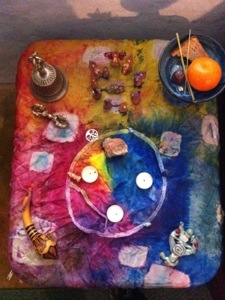
Creativity altar during recent retreat time.

Something that has been coming into clearer focus for me lately is the emotional and creative cycle of the menstrual cycle—there is a natural outward directed phase of the cycle and there in an inward directed phase. I’m trying to be more mindful of scheduling my commitments and my expectations for myself to coincide with the rhythms of my body. As I wrote in response to the quotes above, I’m only recently making the connection between birthing body wisdom and menstrual cycle wisdom….how do we honor this naturally “shamanic” time and inward connection in the midst of the swirl of daily life. What I’m finally figuring out is that there is a cycle of energy that goes with our moontime cycles and that life “flows” much more easily when I plan around those natural cycles of energy. For example, during ovulation I feel energetic, outward directed, focused, and creative. During this time, I compose new blog posts, work on articles, and do, do, do–and, finally, I’m realizing that I can do stuff during this time in advance preparation of the reduced energy and inward focus I feel during bleeding. I can take care of my future self, by focusing energy in powerful ways when I have it and then gathering in and being still when THAT is what I need instead. This is a new understanding for me, one that is still developing…

In the Moods of Motherhood, Lucy Pearce discusses this ebb and flow of energy as well, first with respect to children:

This is a little discussed subject. I remember reading in The Wise Wound the fact that there was no research anywhere on the impact of women’s cycles and PMS on children… and yet an effect there must be! We joke about women on the rag. Those around us suffer too, but we do not discuss it, or re-think family life at these times. They also see and feel the effects of our enhanced creativity, libido and need to retreat within. The whole family sails the seas of a mother’s cycles…

I am recognising in myself, my husband, and my kids the pressure valve, the thermostat which rises to boiling point, the markers that say: Please stop the overwhelm I CAN’T COPE. I am recognising that this is essential for our happy, healthy family co-existence. It is not a sign of weakness or manipulation. It is very real: it is how we function and who we are. Pretending it is not the case, getting angry that it is, blaming others for our feelings or trying to ignore it does not work. It is at the point of overwhelm our instincts emerge, the reptilian brain literally takes over the show – we lash out, scream, yell… now is not the time for moralising, for punishments, for anger… now is the time for de-compression…

And then:

I think the most important thing any person can do is to know themselves and try to find balance amongst the various strands of themselves. And for a woman to know her cycles and her energy levels and work to these rather than against herself. This is absolutely what I try to do. But most often I fail on the balance front – I do too much and then burn out. In our culture this is seen as a good thing… but really it’s a form of ego driven insanity.

Via Journey Of Young Women this quote also caught my eye:

Women’s mysteries, the blood mysteries of the body, are not the same as the physical realities of menstruation, lactation, pregnancy, and menopause; for physiology to become mystery, a mystical affiliation must be made between a woman and the archetypal feminine…

Under patriarchy, this connection has been suppressed; there are no words or rituals that celebrate the connection between a woman’s physiological initiations and spiritual meaning.

~ Jean Shinoda Bolen, “Crossing to Avalon”

On Valentine’s Day last week, I helped host a One Billion Rising event in my town. Even though we didn’t have much time to prepare, we danced anyway. When I got home, I saw this quote on Facebook and thought it connected nicely with my Tuesday Tidbits theme this week:
vday

Tuesday Tidbits: Birthing Bodies

These Tuesday Tidbits all come from the Fall 2012 Pathways magazine. Pathways is a fabulous publication and the best replacement for Mothering magazine that I’ve found!
BirthontheLabyrinthPath_300x250-ad_2

…I get that some women want a particular experience of birth—I mean, I really get it now that I have had a birth that left me feeling more powerful, more humble, more focused, and more devoted to my lover than I ever thought I could feel.

But I wish American women were told the truth about birth—the truth about their bodies, their abilities, and the dangers of technology. Mostly I wish all pregnant women could hear what Libby Bogdan-Lovis, my doula, told me: ‘Birthing a baby requires the same relinquishing of control as does sex–abandoning oneself to the overwhelming sensation and doing so in a protective and supportive environment’…

–Alice Dreger in The Hard Science Supporting Low-Tech Birth

Next, in connection to my own series of posts on taking it to the body, I enjoyed Karen Brody’s article, My Body Rocks, in which she describes her experiences in a yoga nidra class, noting that when asked in class to let her intention come from her body, her reaction was:

My body? I was ashamed to admit that, after two powerful homebirth experiences, I no longer felt intimately connected to my body. Pregnancy and giving birth were all about every little feeling in my body; mothering felt like a marathon of meeting everyone else’s needs and rarely my own…Most days, the question I asked was, ‘How are their bodies?’ My body was in the back seat, unattended, without a seatbelt.”

With regard to my own body, I’m re-introducing my daily yoga practice, maintained since 2001 even through the births of my other two children and playing a significant role in my birth experiences, and yet released with reluctance during Alaina’s infancy. It is time to bring it back! On a related note, I have a neat prenatal yoga book/DVD to review and I watched it this week with Alaina practicing with me—when it instructed you to, “put your hands on your baby,” I put my hands on her! 😉

Speaking of toddlers, I’m wearing a little thin with toddler breastfeeding. I’ve commented to friends that some of the issues and annoyances and difficulties that I’ve previously associated with nursing during pregnancy are actually simply issues of nursing two-year-olds. She is rough, wild, pinchy, scratchy, and practically abusive. She’s nursing way too much at night and I’m tired! In the Pathways article A Natural Age of Weaning by Katherine Dettwyler (who rocks), she makes a point that I’ve always felt intuitively and yet haven’t really articulated in writing:
398124_10152413274040442_130771351_n

Another important consideration for the older child is that they are able to maintain their emotional attachment to a person, rather than being forced to switch to an inanimate object, such as a teddy bear or blanket. I think this sets the stage for a life of people-orientation, rather than materialism, and I think that is a good thing.

As I’ve said before, pregnancy, birth, and breastfeeding are all such embodied experiences—motherhood in general feels very much a physical commitment. Our relationship with our children begins in the body, it is through the maternal body that a baby learns to interpret and engage with the world, and to the maternal body a breastfeeding toddler returns for connection, sustenance, and renewal.

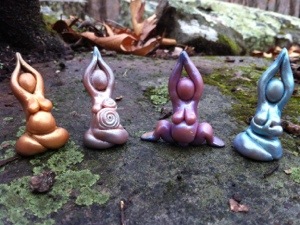
It is this embodied spirit of creation and connection I feel I draw upon and represent when I create my little birth art figures, a spirit that caught the attention of many on Facebook this week when I shared a photo of a series of four figures that I’d made as a custom order:

20130210-155705.jpg

I will write more about these in an upcoming post and I am now accepting custom requests, though there is already a waiting list! I did update my Shop page briefly with some already made figures that I have available though.

Honoring Moontime

“The revolution must have dancing; women know this. The music will light our hearts with fire,
The stories will bathe our dreams in honey and fill our bellies with stars…”

–Nina Simons in We’Moon 2012

“A woman’s best medicine is quite simply herself, the powerful resources of her own deep consciousness, giving her deep awareness of her own physiology as it changes from day to day.”

–Veronica Butler and Melanie Brown

While lots of TV ads would have you assume that it is physical symptoms that “interfere” with a woman’s life during menstruation (i.e. cramps, bloating, whatever), I find it is the reverse—that normal life interferes with my body’s call. As I’ve tuned in more fully to my body’s moontime rhythms this year, I’ve realized that aside from the killer headache that heralds moontime’s approach about two days prior, I don’t really feel bad, sick, or particularly uck, during menstruation. It isn’t at all that I don’t feel well, it is that I feel like being alone, turning inward and away, withdrawing, and being creative. I feel like cocooning and feel easily disturbed/disrupted from that needed cocoon. It reminds me of postpartum and I’ve tried to explain to my husband that taking some time off from my regular roles to rest and be during moontime, truly makes as much sense as doing so during postpartum. I’ve also noticed emotional vulnerability to any criticism, increased irritability and impatience, and usually a monthly “breakdown” of some kind in which I generally decree that something MUST change ™, usually precipitating big life-revisions plans (maybe including charts/diagrams), long discussions, flawed self-analysis, harsh assessments, and endless ruminating along with self-recrimination. This is usually followed with an invigorating surge of energy, enthusiasm, and creativity on the actual first day of bleeding.

“When a woman begins her monthly bleeding, she has a very special vibration. The blood flow is cleansing as the old uterine lining is sloughed off, one monthly reproductive cycle ended. At menstruation, women have the chance to rid themselves of all old thoughts, habits, and desires, and be receptive to new visions and inspirations for the next cycle…

If a woman continues her normal routine at menstruation, then she loses a uniquely female opportunity for introspection. She also finds she gets more tired, irritable, and upset because her physical rhythm has slowed down. She needs rest, more time for meditation, and less time doing housework, cooking, working in the outside world, and taking care of children.” –Marcia Starck, Women’s Medicine Ways

After thinking these thoughts and reading the above paragraph, my attention was caught by all this totally relevant and interesting stuff on Facebook:

“…Could it be that women who get wild with rage do so because they are deeply deprived of quiet and alone time, in which to recharge and renew themselves?

Isn’t PMS a wise mechanism designed to remind us of the deep need to withdraw from everyday demands to the serenity of our inner wilderness? Wouldn’t it follow, then, that in the absence of quiet, sacred spaces to withdraw to while we bleed — women express their deprivation with wild or raging behaviors?…” —DeAnna L’am via Occupy Menstruation

And:

There is magic inherent in the menstrual cycle. Each cycle provides a woman with the opportunity to understand and read the messages her body gives her for any specific healing she needs. Each cycle creates the opportunity for as much spiritual growth and personal development that she could want. All a woman has to do to connect with that potential is simply to be with what is, her cycle, happening over and over.

~ Jane Hardwicke Collings, “The Spiritual Practice of Menstruation” Check out her fabulous work at MoonSong and at htttp://www.moonsong.com.au

via Occupy Menstruation

And, then this great idea. I’m working on this one! I really think for me it is also actually in the two days prior to bleeding that I really need to most withdraw and be alone…

HONORING OUR MOONTIME WITH EASE

You have to remove yourselves from duties! In our modern age, much of the honor for the female and her cycles has been lost… and it won’t be retrieved by members of the opposite sex!

We cannot rely on others to begin respecting us and our cycles, we must learn to respect ourselves enough to set our boundaries and realize our limitations AND our power!

DON’T work when you’re on your menses! Even if you still go to work, treat yourself with the care of one carrying a child. YOU are carrying yourself during this time!

Be your own mother and know when enough is enough.

CREATE your PERFECT existence.

~ Renæ Sunspirit, commenting on an earlier Moon Lodge post via Occupy Menstruation

More about solitude:

“The psyches and souls of women have their own cycles and seasons of doing and solitude, running and staying, being involved and being removed, questing and resting, creating and incubating, being of the world and returning to the soul-place…”

“In order to converse with the wild feminine, a woman must temporarily leave the world and inhabit a state of aloneness in the oldest sense of the word. Long ago the word alone was treated as two words, all one. To be all one, meant to be wholly one, to be in oneness, either essentially or temporarily. That is precisely the goal of solitude, to be all one. It is the cure for the frazzled state so common to modern women…”

Clarissa Pinkola Estés via TheGypsyPriestess

Via Wild Free Beautiful You

Via Wild Free Beautiful You

Wild Free Beautiful You

More about Moon Lodges:

The Moon Lodge is the place of women, where women gather during their menstrual time to be at-one with each other and the changes occurring in their bodies. Long ago, during this special time of moon cycles, women were removed from duties of family and allowed to retreat to the Moon Lodge to enjoy the company of their Sisters.

Traditionally, the Moontime is the sacred time of woman when she is honored as a Mother of the Creative Force. During this time she is allowed to release the old energy her body has carried and prepare for reconnection to the Earth Mother’s fertility that she will carry in the next Moon or month. Our Ancestors understood the importance of allowing each woman to have her Sacred Space during this time of reconnection, because women were the carriers of abundance and fertility.

As Grandmother Moon is the weaver of tides (the water or blood of our Earth Mother) so a woman’s cycles follow the rhythm of that weaving. When women live together in a common space, their bodies begin to regulate their menses and all will eventually have their Moontime concurrently. This natural rhythm is one of the bonds of Sisterhood.

Women honor their sacred path when they acknowledge the intuitive knowing inherent in their receptive nature. In trusting the cycles of their bodies and allowing the feelings to emerge within them, women have been Seers and Oracles for their tribes for centuries.

via moonsurfing.com via Occupy Menstruation

Why pay attention to this stuff anyway? Because of this…

“A woman who becomes aware of her cycle and inherent connection to the whole, also learns to perceive a level of life that goes beyond the visible; she maintains an intuitive link with the energies of life, birth and death, and feels the divinity within the Earth and herself. From this recognition woman deals not only with the visible and the earthly but with the invisible and spiritual aspects of her existence. It was through this altered state of consciousness that was taking place every month than the shamans/healers and priestesses, contributed to the world and to their own community its power, clarity and connection with the divine.”

Miranda Gray via Mujer Arbol

20121230-220625.jpg

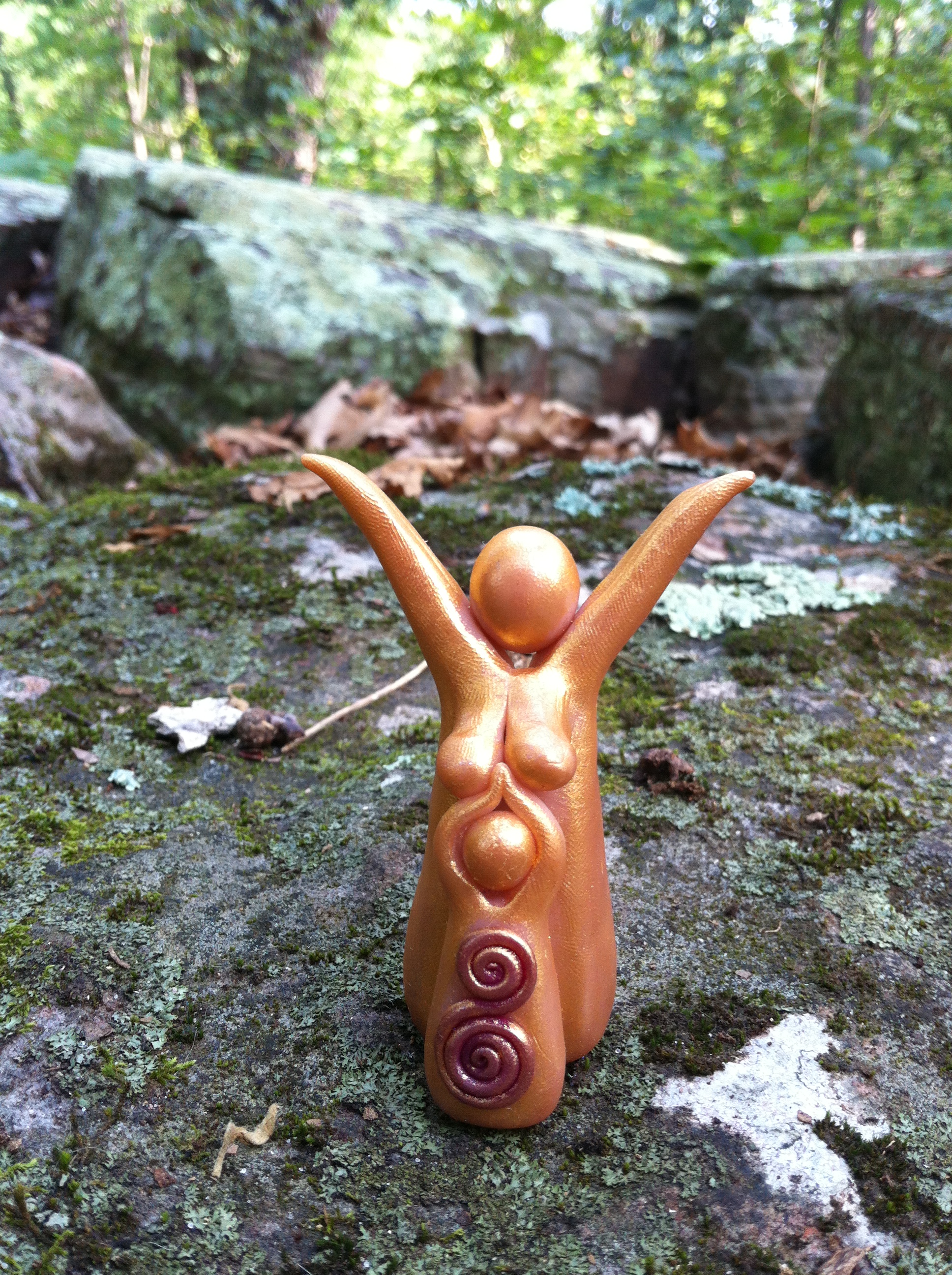
New moontime goddess sculpture hanging out with “moontime’s return” sculpture from earlier this year.

Taking it to the Body, Part 4: Women’s Bodies and Self-Authority

This is a somewhat shortened version of a prior post. I revised it to be a part of my taking it to the bodyDecember 2012 001 series.

I believe a potent source of female power lies in the female body and that body wisdom has been suppressed and denied over the course of many years as a means of oppression and control. One of the root issues of patriarchy is who “owns” women’s bodies—is it men, is it the government, is the medical system, or is it the woman herself? (you know my pick!).

Body wisdom and sources of power

Considering power, sources of power, and body wisdom, I appreciated reading Barbara Starrett’s essay The Metaphors of Power in the book The Politics of Women’s Spirituality. While she uses a different example, I have modified and paraphrased her thoughts to make the idea about birth. Starrett originally states, “We can create power centers both within and outside ourselves…Power is where power is perceived. Power resides in the mind. We can give or withhold power through our beliefs, our felt thoughts.” Medical professionals can make decisions about a woman’s body and birth choices effectively only as long as women believe that the professionals have the right to do this. When women reclaim the power to decide for themselves about birth, the doctors proclaim in a vacuum. Their power depends on the transference of our power, through our belief that this is right…Power is where power is perceived. This also means that in any given in-the-world situation, we can intentionally set up our own power centers. If we believe that power resides in those centers, it will. We will act successfully on this belief. Women’s organizations, unions, birth coalitions, etc., will never work unless we regard them, “as the legitimate centers of power…We must grant our own power to ourselves” (p. 191).

While this comes a little too close for comfort to me with the idea that “we create our own reality” (which I cannot fully embrace due to the logical extension into blaming the victim that it creates), I connect deeply with the idea that we must treat women’s organizations and work as legitimate power sources. I think of books/movements like Our Bodies, Ourselves, for example. To me, this is a definitive women’s health resource—by women, for women and separated from the medical establishment that often dehumanizes women. If we continue to believe our “alternative” structures are just that, “alternative,” then the dominant model is still the norm and still accepted, even by us, as “normal.”

Starrett continues her essay by sharing that “It is necessary for some women to risk total reclamation, to risk the direct and intentional use of power, in bold, even outrageous ways. It takes only a minority of women to alter present reality, to create new reality, because our efforts are more completely focused, more total.” (p. 193) This is the risk that the creators of Our Bodies, Ourselves took. It is the risk birth activists and women’s health activists continue to take.

Consult your health care provider?

In my own life, I am frustrated by the ubiquitous phrase, “Consult your health care provider.” No, thanks. I prefer consulting myself, my books, google, my own research, and my friends. Last time I checked, my doctor did not own my body nor did she have divine revelation as to what I need in my life. I am a breastfeeding counselor providing phone and email support to women who have breastfeeding questions. Women frequently receive very poor breastfeeding “advice” from their doctors—to the extent that I honestly think they’d receive better information by polling random strangers at Wal-Mart with their questions (and, yes, I will actually tell women this). One caller once used the phrase, “but, I don’t want to disobey my doctor” and I found this extraordinarily telling as well as depressing. I recognize that doctors have special training and can be life-saving, however, what does that say about mothering in our culture that a woman would not act on behalf of her own baby and herself because of fear of being disobedient to a professional that she has hired? She is a consumer of a service, not the subject of a ruler!

This brings me to a thought by Dr. Michelle Harrison, author of the book A Woman in Residence:

I used to have fantasies…about women in a state of revolution. I saw them getting up out of their beds and refusing the knife, refusing to be tied down, refusing to submit…Women’s health care will not improve until women reject the present system and begin instead to develop less destructive means of creating and maintaining a state of wellness.”

Indeed! And, in an essay by Sally Gearhart’s about womanpower, she notes: “…there’s no forcing any other woman into a full trot or a gallop; she will move at her own pace, but at her own pace we can be sure she will move. At this point I always remind myself that the patriarchal use of crash programs is antithetical to organic movement; in a crash program the theory goes that if you can get nine women pregnant you can have a baby in one month; it takes women, I suppose, to understand that it doesn’t work that way.” (p. 202-203)

Reclaiming power

So, how do women reclaim power? I think story holds a key to power reclamation in this context. As I’ve referenced before, Carol Christ describes it thusly, “When one woman puts her experiences into words, another woman who has kept silent, afraid of what others will think, can find validation. And when the second woman says aloud, ‘yes, that was my experience too,’ the first woman loses some of her fear.” As I touch on above, for me it is to see myself and my body as a source of wisdom and to refuse to participate in structures that do not honor my power and personal agency. It involves more often turning to my peers, to other women, for advice and comfort and support, rather than to experts.

I’ve written many times before that I am a systems thinker. Women’s choices about their bodies and about birth are not made in personal isolation, but in a complexly interwoven network of social, political, medical, religious, and cultural systems. As Gearhart notes, “There may be no ‘enemy’ except a system. How do we deal with ‘the enemy’? As seldom as possible but when necessary by opening the way for [their] transformation into not-the-enemy. What weapons do we use? Our healing, our self-protection, our health, our fantasies, our collective care…” (p. 203).

20121218-134856.jpg