Archives

The Impact of Birth on Breastfeeding

Just in time for the start of World Breastfeeding Week, here is part 3 of my CAPPA re-cap series!

…they want you to believe it’s their power, not yours…They stick needles into you so you won’t hear anything, you might as well be a dead pig, your legs are up in metal frames, they bend over you, technicians, mechanics, butchers, students, clumsy or sniggering, practicing on your body, they take your baby out with a fork like a pickle out of a jar.

–Margaret Atwood in her novel Surfacing (opening quote of Dr. Jack’s presentation at the 2012 CAPPA conference)

As I mentioned, my favorite part of the CAPPA conference was hearing Dr. Jack Newman speak about controversies in breastfeeding (see next post) and then about the impact of birth on breastfeeding (breakout session). He was an amazing speaker. Very straightforward and almost blunt as well as funny and fast-paced. I really feel glad to have had the chance to see him in person after years of being familiar with his materials.

The notion of the birth-breastfeeding continuum isn’t new to me, having actually published articles about it previously, however Dr. Newman’s phrasing, descriptions, and reminders was just so perfect that it left me feeling even more enthused about the inextricable link between birth and breastfeeding. It is a biologic continuum that nature does not see distinct events—baby is born and goes to breast, it is part of the same event. Drawing on Diane Wiessinger’s work, Dr. Newman explained

With animal births: following a normal birth, infant feeding just…happens. Following an interventionist birth, the mother rejects the baby and there is no nursing at all.

In some hospitals, separation of mother and baby is routine as a way to “prevent” postpartum mood disorders. Dr. Jack’s own theory was that perhaps human mothers turn this “rejection” against themselves and it shows up as a postpartum mood disorder.

Babies NEED and expect to be with their mothers after birth. It is of critical importance. As I shared via Facebook, Dr. Jack explained this:

Know how much an incubator costs now? $50,000. Why don’t we just give half of that money to the mother and put the baby skin to skin on mother’s chest?

And, this gem:

Our hospital births break every rule in the mammalian list of mother-baby necessities.” –Dr. Newman

He also noted that if baby is put skin-to-skin on mother immediately after birth regardless of original intention, the pair will breastfeed. It is biologically programmed.

Why do hospital births break the rules?

Because, as Dr. Newman explained we have a big, big problem in that HCPs do not recognize the critical importance of breastfeeding. He also repeatedly emphasized (in a very funny way) that there are many people who don’t know squat about breastfeeding and breastmilk and don’t feel like they need to learn anything before they start doing studies and writing papers about it.

Dr. Newman also emphasized the important point that the burden of proof rests upon those who promote an intervention! He was speaking with regard to recommending formula supplementation, but I strongly believe it applies to any birth practice. So simple and yet so profound. One example that he shared that is familiar to birth advocates is that lying down for electronic fetal monitoring is a position of comfort for the care provider, NOT for the mother.

And, he made this excellent point: “All medical interventions, even when necessary, decrease the mother’s sense of control, and increase her sense of her ‘body not being up to the task.” Again, the burden of proof rests on those who promote the intervention, not vice versa.

As I’ve touched on several times before, IV fluids that are commonly administered during labor may increase the baby’s birth weight, leading the baby to be more likely to experience the dreaded 10% weight loss (“totally bogus, by the way”). Also as I’ve noted before, IV fluids lead to significant maternal fluid retention which contributes to edema in the nipples and areolas and then…the dreaded “flat nipples.” The more fluid a mother gets in labor, the more a baby “loses” after birth!

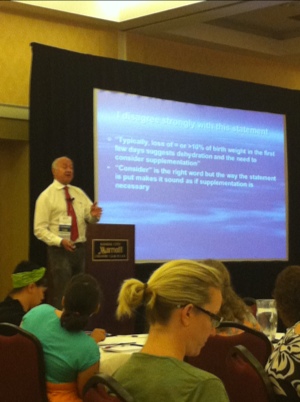
Including the same picture as in my other post, because it is in this picture that Dr. Jack is specifically talking about his next point:

I disagree strongly with this statement:

‘Typically, loss of = or >10% of birth weight in the first few days suggests dehydration and the need to consider supplementation.’

He goes on to note that what is necessary is NOT supplementation but to help the mother and baby breastfeed well. The real question when it comes to newborn weight loss is, “is the mother-baby breastfeeding well?”

Newman also addressed something birth advocates are familiar with, the fact that epidural anesthesia can cause maternal fever. This leads to an infant sepsis workup and antibiotics and usually means separation of mother and baby. Here we again experience the failure of many medical care providers to recognize the importance of breastfeeding as beyond just a feeding method. Breastfeeding protects the baby–this is what most hospitals do not understand.

Of interventions that undermine breastfeeding, Dr. Jack pointed to Demerol (meperidine) as the “worst of the lot,” with newborns experiencing sedation and many of them not sucking at all. He also pointed out that all interventions increase the risk of cesarean section, which leads to increased discomfort for mothers and less willingness to breastfeed and increased likelihood of mother-baby separation.

The importance of skin-to-skin contact

Babies easily find their way to the unwashed nipple. And, given baby’s inborn feeding behaviors and instincts, it seems clear that, “if the baby expresses his or her choice, the baby would choose the breast.” (with regard to breastfeeding as maternal “choice”)

Not putting baby skin to skin with the mother, “increases the risk of hypoglycaemia significantly…Isn’t skin to skin contact a less invasive preventative measure than giving formula?” Newman then points out that most often we see “skin to blankets” which keeps baby from showing they’re ready to feed, doesn’t stimulate milk supply, and leads to engorgement which is not normal.

And, at the end he emphasized that when it comes to birth and breastfeeding, all too often WE MESS IT UP by meddling with the biological processes and rhythms of the mother-baby relationship.

For more about controversies in breastfeeding, check out my next post.

Handouts from Dr. Newman are available here. One I’ve used recently is How to Know a Health Professional is not Supportive of Breastfeeding.

I’ve written about the birth-breastfeeding continuum and about some other systemic influences on breastfeeding in breastfeeding as an ecofeminist issue.

Book Review: The Blue Cotton Gown


Book Review: The Blue Cotton Gown: A Midwife’s Memoir
By Patricia Harman
Beacon Press, 2008
Hardcover, 290 pages
ISBN: 978-0807072899

Reviewed by Molly Remer, Talk Birth

Patsy Harman is a CNM in West Virginia. She runs a busy women’s health practice with her husband Tom, an OB-GYN. Though obstetrics was once a rewarding part of their practice, they’ve stopped attending births due to unaffordable malpractice insurance rates. In addition to tales from the office, this compelling narrative follows Patsy through struggles with the IRS, fears over potential lawsuits, family complications, and uterine cancer. Since I usually come from a consumer advocate’s perspective, it was very interesting to have this intensely personal look at the other side of the coin—the deep fear obstetric professionals have of lawsuit.

The author told me in advance that this is not a book of birth stories, “it is about women giving birth to themselves.” This is true—there are almost no birth stories in the book (and in one of the few there is, I was surprised to read that the mother was induced with misoprostol!). However, this is actually what gives the book its absorbing edge. In it, you get to see another side of midwifery—the “with woman” side that extends before and after pregnancy and childbirth. This is a side of midwifery that I haven’t yet seen explored in memoir format and it was incredibly engaging. Patsy’s clientele are women who have STDs or yeast infections, who need pap smears or well-woman exams, or who need a pregnancy diagnosed, but her care for them goes beyond the physical. The women’s lives are complicated, as is her own. Some of the stories are very sad and others are uplifting. If you are looking for birth stories, look elsewhere, if you are looking for a skillfully written and emotional look at the practice of nurse-midwifery and its dominating role in a woman’s multifaceted life, you will find a treasure in The Blue Cotton Gown. As it came to an end, I found myself wishing for Part Two.

Read my review of Patsy’s other memoir here:

Book Review: Arms Wide Open: A Midwife’s Journey

Disclosures:

I received a complimentary copy of this book for review purposes.

Amazon affiliate link included above (in title and image)

This review was previously published at Citizens for Midwifery.

Epigentics, Breastfeeding + Diet, and Prenatal Stress

This post is part one of my CAPPA Re-Cap series.

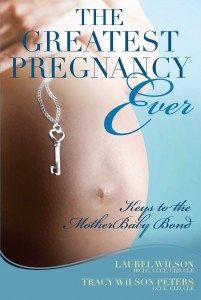
CAPPA linchpins Laurel Wilson and Tracy Wilson Peters are co-authors of a new book, The Greatest Pregnancy Ever, that focuses on the depth, intensity, and value of the MotherBaby bond. As I noted, I listened to Laurel talk about Bridging the Nutrition Gap and to Tracy speak about the “accidental parent.” In both, they addressed the biological wisdom that mothers possess and of the deeply interconnected nature of the maternal relationship.

Laurel reminded us that there is a brain in our gut, essentially. This brain literally tells us how we should be feeling our emotions, based on the nutrition that we’re putting into our bodies. She discussed epigenetics–a term meaning literally “above the gene”—explaining that this is the “translator that ‘reads’ the book of instructions from our genome.” The translator tells the body to turn on or off the genes we’ve inherited from our parents. Epigenetics is essentially the environment–those things in our environment that influence our biology. Laurel pointed out enthusiastically that we want to create an excellent “translator” for our children. She also emphasized repeatedly that one important job of the placenta is to “train” the baby for the environment it will be experiencing. This is why prenatal diet matters, it is helping to prepare the baby to thrive in the environment into which it will be born. So, chronic stress leads to a stressful womb environment, which leads to a baby that is biologically primed to be born into a stressful postnatal environment. Mother’s body primes baby’s body for success in that environment. As I listened to her speak and discuss the things we’ve learned from science about genetics and how our bodies function, I kept thinking: science can do a lot, it can do wonderful things. Mother’s body can do even moreAnd, isn’t that just cool?!

So, what’s going on in the maternal habitat?

One important point Laurel made about prenatal diets was that prenatal diets high in hydrogenated oils predispose mamas to postpartum moods disorders. She said this is because hydrogenated oils essentially “leach” EFA’s out of the mother’s system.

She also noted that mice up to three generations are affected with PCOS by BPA and phthalates (in food packaging. Our food is literally making us sick). These influence change the endocrine system and are connected with reduced sociality and community engagement.

Laurel explained too that no artificial sweeteners are considered safe for pregnant women and that stevia too is linked to epigentic damage. She suggested using honey and molasses as sweeteners if needed.

One tip that I found funny, basic, but so true with regard to choosing healthy foods is to make sure to choose to eat foods that will rot!

In Tracy’s talk she passionately affirmed that we have to eliminate chronic stress from pregnant women’s lives because she is laying an emotional and physical foundation for another person’s life. This matters! Babies are feeling before they are thinking and we are designed to live in the environment we are being born into.

Also remember, babies don’t need to be in nurseries–they need to be with their mothers. This MATTERS!

Women’s Retreat Recipe

Quarterly, I get together with some of my friends and we have a women’s retreat. We had our summer retreat this past Sunday and I thought I’d share the outline and our activities as a “retreat recipe” that others may use if they wish to do so. Since my friends do not necessarily share specific religious beliefs, the retreats are spiritual in a somewhat generic “womanspirit” sort of way and you can obviously customize your own retreat to best suit the spiritual beliefs/backgrounds of your own friendship group.

Circle up—we stand in a circle, place our hands on eachother’s backs and hum together three times to raise the energy of the circle.

Invocation to directions. This time we used an invocation by Judith Laura:

We honor the East
Home of air
March wind
Morning’s song
Eagle’s flight
Aurora’s breath
Welcome East

We honor the South
Home of fire
Noon sun
Flame of change
Heat of passion
Pele’s power
Welcome South

We honor the West
Home of water
River’s flow
Font of feelings
World’s womb
Kwan Yin’s love
Welcome West

We honor the North
Home of Earth
Root of life
Shaded mystery
Ground of being
Gaia’s growth
Welcome North.

Light candle/opening quote

“I see the wise woman. And she sees me. She smiles

from shrines in thousands of places. She is buried

in the ground of every country. She flows in every

river and pulses in the oceans. The wise woman’s

robe flows down your back, centering you in the

ever-changing, ever-spiraling mystery.

Everywhere I look, the wise woman looks back.

And she smiles.”

–Susun Weed quoted in Birthing Ourselves Into Being

Check-in–we take turns “passing the rattle” and each woman has about two minutes to share what’s been on her mind.

Since we are close to summer solstice, I then chose to do this solstice prayer of healing from the United Nations as a responsive reading as a group:

A Prayer of Healing
From the United Nations Environmental Sabbath

We join with the earth and with each other.
To celebrate the seas.
To rejoice the sunlight.
To sing the song of the stars.

We join with the earth and with each other.
To recall our destiny.
To renew our spirits.
To reinvigorate our bodies.

We join with the earth and with each other.
To create the human community.
To promote justice and peace.
To remember our children.

We join together as many and diverse expressions of one loving mystery: for the healing of the earth and the renewal of all life. We join with the earth and with each other.
To bring new life to the land.
To restore the waters.
To refresh the air.

We join with the earth and with each other.
To renew the forests.
To care for the plants.
To protect the creatures.

Guided visualization/meditation/relaxation (for this particular retreat, I used a nice full body relaxation from the book Birthing Ourselves into Being. This one isn’t available online that I can find, but you can find others online, like this one for example.)

We followed the relaxation with a muse questions and journaling using one of the questions from Shiloh Sophia’s Museletter:

Your Muse would like to show you something you haven’t been able to see.

She wants to invite you to have a thought you haven’t had yet…isn’t that an enticing thought in and of itself?

A thought that has lingered on the edge of your consciousness for maybe even a few years, or months….tell her…

I want to know what it is I am not seeing.

Then automatic write whatever comes up until you have to put the pen down.

Immediately following this question, it began to rain. Blissful, blessed, healing, glorious rain for which we were in so much need.

Discuss responses/experiences to relaxation/journaling.

Listen to songs/perhaps drum (this time, went outside together and stood in the rain)

Closing circle: Sing Woman Am I (recording of my friends singing it together is here).

Closing quote and extinguish candle

“A circle! No sharp edges, no hierarchy, just a circle of women…We are mothers. We are the portals. The next generation comes through our bodies.” –Annie Lennox

and one of my all-time favorites:

“I believe that these circles of women around us weave invisible nets of love that carry us when we’re weak and sing with us when we’re strong.” –SARK, Succulent Wild Woman

When reading a 1988 back issue of SageWoman magazine, I fell in love with Womanrunes by Shekhinah Mountainwater (originally in her book Ariadne’s Thread, which I then purchased) and so I made copies of the images to share with my friends. We are going to make some sets of runes at our next retreat. (And, after much scouring of the interwebz, I found a pronunciation guide for the runes here).

I also made a handout packet for them of various moon wheels/circular calendars for tracking your cycles, or simply for planning and thinking in circles rather than in lines. In the packets were:

And, then it was time for a craft, so as we snacked and chatted, I showed everyone how to make a small, hardbound pocket journal. You can find instructions for a simple book here, or, to make it even more simple, use this kit from Blick Art Supplies.

It was a delightful afternoon of connection and celebration—my original vision for holding these retreats was to bring some blessingway spirit into our regular lives, rather than only centered on being pregnant and I think that purpose was achieved.

This post is crossposted at Woodspriestess.

I See You: talking to mothers about their breastfeeding concerns…

I’m helping to train two women right now to become breastfeeding counselors. As well as discussing how to help other women with the numerous issues that may be a part of the normal course of breastfeeding, we talk a lot about listening skills. As I’ve been working with them, I found a reminder list that I made 7 years ago when I took on this role myself. The list simply consists of ideas for how to talk to mothers about their breastfeeding questions in a way that promotes continued dialogue, demonstrates respect, and employs good active listening.

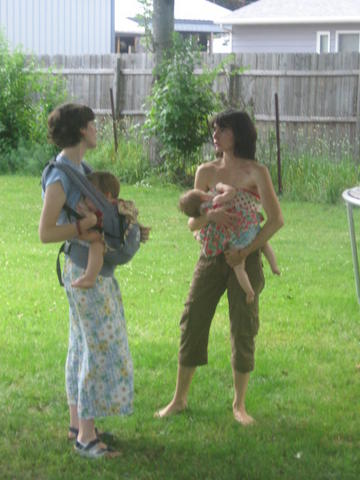
Photo from several years ago of a good friend and I nursing our babies while “seeing” each other.

Talking to mothers about their breastfeeding concerns…

“I hear you saying that….”

“You seem to be telling me that….”

“You seem to be feeling….”

“You sound…”

“How do you…”

“What are you observing that makes you think…”

“Tell me more about…”

“How would you like to see this resolved…”

“Many mothers have found…” **This is my all-time favorite and hands-down most useful. I use it all the time. It is so handy.**

“How would you feel about…”

“For some families it works well to…”

“There are some suggestions I can give you for… that have been helpful for other mothers…”

“It depends….”

“It sounds to me like you are doing a wonderful job as a mother”

“It sounds to me like your baby really responds to you”

“Your baby is so lucky that you want to/did give him the benefit of your milk”

With doctors/others’ opinions:

“How do you feel about those suggestions?”

Some doctors take that approach, but research has shown….” (or, “we’ve noticed…” or, “reliable references indicate…” May also follow-up with, “Would you like me to send you a reference?”). **This is another one of my favorites, it doesn’t smack down the doctor and yet it gently and firmly provides you with a means of sharing alternate—correct—information.

Other good things to remember when listening to mothers:

Breastfeeding is not a by the book procedure—it is an intimate relationship with different dynamics from one nursing couple to the next. Individual mothers and babies respond differently to the same things. There are no hard and fast rules.

Our main message to each mother is how important she is to her baby and how breastfeeding can be a wonderful part of this. We want to help mothers feel good about being a mother, about meeting their babies’ needs in the way that feels best for them, and to trust their own instincts. We wish to leave mothers with a feeling of self-confidence and acceptance.

I See You

I often remind students in my human services classes that all people have a basic need to be both seen and heard. This doesn’t mean agreeing with everything someone else says and does, it means being present and witnessing them as they follow their own paths.

In a newsletter recently, I read an article called “I See You” by Sue Scott, a communication skills instructor. She explains that in South Africa, native peoples greet each other with an expression that literally means, “I see you.” The response is then, “I am here.” She observes, “what a powerful and beautiful gift it is to recognize another individuals in this way: ‘I see you.’ Acknowledgement, recognition, and respect all require focus on the other person…the word respect comes from the Latin word ‘respecere’ meaning ‘to look at again and again…’I see you’…seems to me to be the ultimate in respect.” Sue goes on to explain that when we truly SEE another mother—“when we truly hear her concerns—then we affirm her ability to mother her baby in her own best way.”

A little more than two years ago, I received the precious gift of being seen when a mother that I had previously helped with many breastfeeding questions called to ask me another question. We had become friends over the course of time since she’d had her first baby and I was in the process of my second miscarriage when she called with a question about her own pregnancy. I told her about the miscarriage, but said I felt like I could still talk with her about her question. We ended up then talking for a time about miscarriage and about cesarean birth, because we discover numerous surprising connections between the feelings and experiences of an unexpected outcome to our dreams for our pregnancies. She then said, “You know in that movie Avatar how they say, ‘I see you’?” I said yes, and she said, “I just wanted to let you know that I see you, Molly.” These words were such a gift to me. It was beautiful to hear them and I cried. I felt so seen. It was just what I needed and I hadn’t even known it. I will never forget that simple and yet extremely potent gift of acknowledgement from another woman.

A previous post about Listening Well Enough.

Women’s Power & Self-Authority

“I know myself linked by chains of fires,
to every woman who has kept a hearth.
In the resinous smoke
I smell hut, castle, cave,
mansion and hovel,
See in the shifting flame
my mother and grandmothers
out over the world.”
–Elsa Gidlo

I used the quote above as my winter solstice Facebook posting last year. It reminds me of a quote from Margaret Atwood used in the book Sacred Circles, “Sons branch out, but one woman leads to another.” One of the powerful gifts of feminist spirituality is the sense of intergenerational connectedness to all women of all time. We begin to sense the buried matrilineal links across time and culture. Links that have often been culturally, socially, and religiously broken on purpose as a way to separate and disempower women and to bury women’s wisdom. I believe a potent source of female power lies in the female body and that body wisdom has been suppressed and denied over the course of many years as a means of oppression and control. One of the root issues of patriarchy is who “owns” women’s bodies—is it men, is it the government, is the medical system, or is it the woman herself? (you know my pick).

Body wisdom and sources of power

Considering power, sources of power, and body wisdom, I appreciated reading Barbara Starrett’s essay The Metaphors of Power in the book The Politics of Women’s Spirituality. While she used abortion as her example, I have modified and paraphrased her thoughts to make the idea about birth instead. Starrett originally states, “We can create power centers both within and outside ourselves…Power is where power is perceived. Power resides in the mind. We can give or withhold power through our beliefs, our felt thoughts.” Medical professionals can make decisions about a woman’s body and birth choices effectively only as long as women believe that the professionals have the right to do this. When women reclaim the power to decide for themselves about birth, the doctors proclaim in a vacuum. Their power depends on the transference of our power, through our belief that this is right…Power is where power is perceived. This also means that in any given in-the-world situation, we can intentionally set up our own power centers. If we believe that power resides in those centers, it will. We will act successfully on this belief. Women’s organizations, unions, birth coalitions, etc., will never work unless we regard them, “as the legitimate centers of power…We must grant our own power to ourselves” (p. 191).

Lucky to have such a great group of friends to gather in the park to take part in the Our Bodies, Our Votes campaign.

While this comes a little too close for comfort to me with the idea that “we create our own reality” (which I cannot fully embrace due to the logical extension into blaming the victim that it creates), I connect deeply with the idea that we must treat women’s organizations and work as legitimate power sources. I think of books/movements like Our Bodies, Ourselves, for example. To me, this is a definitive women’s health resource—by women, for women and separated from the medical establishment that often dehumanizes women. If we continue to believe our “alternative” structures are just that, “alternative,” then the dominant model is still the norm and still accepted, even by us, as “normal.”

Starrett continues her essay by sharing that “It is necessary for some women to risk total reclamation, to risk the direct and intentional use of power, in bold, even outrageous ways. It takes only a minority of women to alter present reality, to create new reality, because our efforts are more completely focused, more total.” (p. 193) This is the risk that the creators of Our Bodies, Ourselves took. It is the risk birth activists and women’s health activists continue to take.

Peggy O’Mara tackles a similar topic in her essay, “Holy Mother,” in her collection of essays The Way Back Home, observing:

We live in a society…that romanticizes and trivializes the feminine…we live in an economy that regards women as cheap labor. In the marketplace, women work for less than men. At home, we do the large majority of the work. I believe that we enslave ourselves.

Is it any wonder, then, that we have not successfully resolved the childcare debate? Child care and national family policy are process issues, and thus sexist issues. Women themselves engage in sexism when they debate the either/or dichotomy of work or home. Too often, we do not realize the devaluation involved in playing by the crumbling rules of a male-dominated society rather than making up our own. The matriarchal process-based model comes from a religious belief system in which the Divine is immanent, within life, within us, ascribing sacredness to the ordinary processes of daily life. Rather than choosing between opposites, let us evolve a culture that values both the product and the process, a culture that synthesizes both the patriarchy and the matriarchy.

…we must put all of our loves–work and family, mothering and career, self and others—on the bargaining table at once, and not assume that because we are women, we must acquiesce to the cultural ideal. To run our personal lives in enslavement to an economic reality that does not serve our needs makes society crazy.

In a brief except from author Libba Bray, she states that for years she “…heard feminist Gloria Steinem described as ‘shrill’ and ‘hostile’ and many other dismissive, denigrating terms. But after reading about her struggles as a human being and as a leader of feminism’s second wave…I got a truer picture…I learned that it’s far too easy for women to be shamed into staying quiet about their lives–their dreams, needs, desires, anger, aspirations—and that the old adage, ‘Well-behaved women seldom make history’ is all too true.”

Consult your health care provider?

In my own life, I am frustrated by the ubiquitous phrase, “Consult your health care provider.” No thanks. I prefer consulting myself, my books, google, my own research, and my friends. Last time I checked, my doctor did not own my body nor did she have divine revelation as to what I need in my life. I am a breastfeeding counselor providing phone and email support to women who have breastfeeding questions. Women frequently receive very poor breastfeeding “advice” from their doctors—to the extent that I honestly think they’d receive better information by polling random strangers at Wal-Mart with their questions (and, yes, I will actually tell women this). One caller once used the phrase, “but, I don’t want to disobey my doctor” and I found this extraordinarily telling as well as depressing. I recognize that doctors have special training and can be life-saving, however, what does that say about mothering in our culture that a woman would not act on behalf of her own baby and herself because of fear of being disobedient to a professional that she has hired? She is a consumer of a service, not the subject of a ruler!

This brings me to a thought by Dr. Michelle Harrison, author of the book A Woman in Residence: “I used to have fantasies…about women in a state of revolution. I saw them getting up out of their beds and refusing the knife, refusing to be tied down, refusing to submit…Women’s health care will not improve until women reject the present system and begin instead to develop less destructive means of creating and maintaining a state of wellness.” Indeed! And, in an essay by Sally Gearhart’s about womanpower, she notes: “…there’s no forcing any other woman into a full trot or a gallop; she will move at her own pace, but at her own pace we can be sure she will move. At this point I always remind myself that the patriarchal use of crash programs is antithetical to organic movement; in a crash program the theory goes that if you can get nine women pregnant you can have a baby in one month; it takes women, I suppose, to understand that it doesn’t work that way.” (p. 202-203)

Reclaiming power

So, how do women reclaim power? I think story holds a key to power reclamation in this context. As I’ve referenced before, Carol Christ describes it thusly, “When one woman puts her experiences into words, another woman who has kept silent, afraid of what others will think, can find validation. And when the second woman says aloud, ‘yes, that was my experience too,’ the first woman loses some of her fear.” As I touch on above, for me it is to see myself and my body as a source of wisdom and to refuse to participate in structures that do not honor my power and personal agency. It involves more often turning to my peers, to other women, for advice and comfort and support, rather than to experts.

Returning to Gearhart, she states: “If I can move out of the patriarchy for my re-sourcement, then I do indeed march to a different drummer; but I have to march with the consciousness in my very bones of the cost in blood and pain and death that is somewhere being paid for my personal growth.” (p. 203)

I’ve written before that I am a systems thinker. Women’s choices about their bodies and about birth are not made in personal isolation, but in a complexly interwoven network of social, political, medical, religious, and cultural systems. As Gearhart notes, “There may be no ‘enemy’ except a system. How do we deal with ‘the enemy’? As seldom as possible but when necessary by opening the way for [their] transformation into not-the-enemy. What weapons do we use? Our healing, our self-protection, our health, our fantasies, our collective care…” (p. 203).

And, in closing I like this reminder:

“Study after study has taught us that there is no tool for development more effective than the empowerment of women. No other policy is as likely to raise economic productivity, or to reduce infant and maternal mortality. No other policy is as sure to improve nutrition and promote health—including the prevention of HIV/AIDS. No other policy is as powerful in increasing the chances of education for the next generation. But whatever the very real benefits of investing in women, the most important fact remains: Women themselves have the right to live in dignity, in freedom from want and from fear.” —Former UN Secretary-General Kofi Annan

This is the whole point—women’s rights aren’t about “taking” rights from anyone else OR about demanding “special treatment,” they are important for a HUMANE WORLD for all people. I think it is hilariously awful that “women’s rights” are considered a political issue and that there is a section about “women’s rights” in the “opposing viewpoints” database for my social policy class. As long as women’s rights are considered a political issue or as something about which an opposing viewpoint can be held, rather than as self-evident, we are in continued, desperate need of revolution.

—-

(note: portions of this post are excerpted from one of my essays for a class I took about Goddess Traditions)

Breastfeeding as an Ecofeminist Issue

Breasts are a scandal because they shatter the border between motherhood and sexuality.

––Iris Marion Young

After Hurricane Katrina, I read a news story about a young mother whose newborn baby died of dehydration during the days in which she had been stranded without access to clean water. Upon admittance to the hospital, the mother was asked if she needed anything and she replied that her breasts were uncomfortable and could she have something to dry up the milk. This story brings tears to my eyes and chills to my body. What does this say about our culture that it is actually possible for mothers to be unaware that they carry the power to completely nourish their own babies with their own bodies? As mammals, all women have the potential to be lactating women until we choose not to be. The genius of formula marketing and advertising is to get women to withhold from their offspring that which they already have and to instead purchase a replacement product of questionable quality. To me this feels like being a given a “choice” between the blood already flowing through your veins and a replacement product that marginally resembles blood.

We are mammals because as a species we nurse our young. This is a fundamental tie between the women of our time and place and the women of all other times and places as well as between the female members of every mammal species that have ever lived. It is our root tie to the planet, to the cycles of life, and to mammal life on earth. It is precisely this connection to the physical, the earthy, the material, the mundane, the body, that breastfeeding challenges men, feminists, and society.

Breastfeeding is a feminist issue and a fundamental women’s issue. And, it is an issue deeply embedded in a sociocultural context. Attitudes towards breastfeeding are intimately entwined with attitudes toward women, women’s bodies, and who has “ownership” of them. Patriarchy chafes at a woman having the audacity to feed her child with her own body, under her own authority, and without the need for any other. Feminism sometimes chafes at the “control” over the woman’s body exerted by the breastfeeding infant.

Part of the root core of patriarchy is a rejection of the female and of women’s bodies as abnormal OR as enticing or sinful or messy, hormonal, complicated, confusing…. Authentic feminism need not be about denying biological differences between women and men, but instead about defining both as profoundly worthy and capable and of never denying an opportunity to anyone for a sex-based reason. Feminism can be about creating a culture that values what is female as well as what is male, not a culture that tries to erase or hide “messy” evidence of femaleness.

However, precisely because of the patriarchal association of the female with the earthy and the physical, feminists have perhaps wanted to distance themselves from breastfeeding. This intensely embodied biologically mandated physical experience so clearly represents a fundamental difference between men and women that it appears to bolster biological reductionism. Yet in so doing feminism then colludes with patriarchy and itself becomes a tool of the patriarchy in the repression and silencing of women and their leaky ever-changing, endlessly cycling bodies: these bodies that change blood into food and bleed without dying and provide safe passage for new souls upon the earth. Sometimes the issue of a woman’s right not to breastfeed is framed as a feminist “choice.” This is a myth, made in the context of a society that places little value on women, children, and caregiving. It is society that needs to change. Not women and not babies.

Systemic and Structural Context

In an essay for the Academy of Breastfeeding Medicine on “What does feminism have to do with breastfeeding?”, Maternal–fetal medicine specialist Dr. Alison Stuebe (2010) points out that for the most part feminist advocacy ignores breastfeeding and that most breastfeeding advocacy sidesteps the complicated contextual issues of women’s lives. Stuebe notes:

…the conventional wisdom is that breastfeeding is a maternal duty that forces women to eschew their career aspirations to fulfill some ideal of motherhood, while feminism is about liberating women from exactly those constraints. Case closed. Or is it?…The result is that women end up fighting among themselves about the choices our society forces us to make — motherhood or career? Breast or bottle? — instead of uniting to address the societal structures that prevent women from realizing their full potential.

Appropriately, Stuebe further notes that:

…breastfeeding is not a ‘choice.’  Breastfeeding is a reproductive right. This is a simple, but remarkably radical, concept. Here’s why: When we frame infant feeding as a choice made by an individual women, we place the entire responsibility for carrying out that choice on the individual woman…Indeed, the ultimate link between breastfeeding and feminism is that in a truly equitable society, women would have the capacity to fulfill to pursue both their productive and reproductive work without penalty.

And, in considering contextual and systemic issues that impact women every day, Stuebe points out that:

These issues transcend breastfeeding. Why, for example, do we pit “stay at home moms” against “working moms,” rather than demand  high-quality, affordable child care, flexible work, and paid maternity leave so that each woman can pursue both market work and caring work, in the proportion she finds most fulfilling? Why do we accept that, if a woman devotes all of her time to caring for her family, she does not earn any social security benefits, whereas if she gets a paying job and sends her children to day care, she and her day care provider earn credits toward financial security in old age? And why do we enact social policies that subsidize child care and require poor mothers to enter the paid work force, rather than support poor mothers to care for their own children?…

Naomi Wolf (2003) also addresses the myth of  “choice” regarding breastfeeding (specifically with regard to lack of support for breastfeeding while working outside the home) in her book Misconceptions: “…it was unconscionable for our culture to insist that women ‘choose’ to leave their suckling babies abruptly at home in order simply to be available for paid work.” (p. 270) Wolf also quotes Robbie Kahn who says, “the job market holds out an all-or-nothing prospect to new mothers: you can give your body and heart and lose much of your status, your money, your equality, and your income; or, you can keep your identity and your income—only if you abandon your baby all day long and try desperately to switch off the most powerful primal drive the human animal can feel.” And, then considering the argument that bottle feeding “liberates” women from the tyranny/restrictiveness of breastfeeding: “The liberation women need is to breastfeed free of social, medical, and employer constraints [emphasis mine]. Instead, they have been presented with the notion that liberation comes with being able to abandon breastfeeding without guilt. This ‘liberation,’ though, is an illusion representing a distorted view of what breastfeeding is, what breastfeeding does, and what both mothers and babies need after birth” (Michels, p. xxx). Often, not breastfeeding is a structural and systemic symptom of a patriarchal society that devalues women and caregiving work and views the masculine body as normative, not a personal choice!

I am a systems thinker and always hold in mind that breastfeeding, like all aspects of women’s lives, occurs in a context, a context that involves a variety of “circles of support” or lack thereof. Women don’t “fail” at breastfeeding because of personal flaws, society fails breastfeeding women and their babies every day through things like minimal maternity leave, no pumping rooms in workplaces, formula advertising and “gifts” in hospitals, formula company sponsorship of research and materials for doctors, the sexualization of breasts and objectification of women’s bodies, and so on and so forth. According to Milk, Money, and Madness (1995), “…infant formula sales comprise up to 50% of the total profits of Abbott Labs, an enormous pharmaceutical concern.” (p. 164) And the US government is the largest buyer of formula, paying for approximately 50% of all formula sold in the nation.

In a brilliant analysis of the politics of breastfeeding in the US, Milk, Money, and Madness (1995), by Dia Michels and Naomi Baumslag, the following salient points are made about why women in the US so often experience breastfeeding problems: “In western society, the baby gets attention while the mother is given lectures [emphasis mine]. Pregnancy is considered an illness; once the ‘illness’ is over, interest in her wanes. Mothers in ‘civilized’ countries often have no or very little help with a new baby. Women tend to be home alone to fend for themselves and the children. They are typically isolated socially and expected to complete their usual chores, including keeping the house clean and doing the cooking and shopping, while being the sole person to care for the infant…” (p. 17)

Michels and Baumslag go on to explain:

According to the US rules and regulations governing the federal worker, the pregnancy and postdelivery period is referred to as “the period of incapacitation.” This reflects the reality of a situation that should be called ‘the period of joy.’ Historically, mothering was a group process shared by the available adults. This provided not only needed relief but also readily available advice and experience. Of the “traditional” and “modern” child-rearing situations, it is the modern isolated western mom who is much more likely to find herself experiencing lactation failure [emphasis mine]. (p. 18)

There is a tendency for modern women to look inward and blame themselves for “failing” at breastfeeding. There is also an unfortunate tendency for other mothers to also blame the mother for “failing”—she was “too lazy” or “just made an excuse,” etc. We live in a bottle-feeding culture; the cards are stacked against breastfeeding from many angles–economically, socially, medically. When I hear women discussing why they couldn’t breastfeed, I don’t hear “excuses,” I hear “broken systems of support” (whether it be the epidural in the hospital that caused fluid retention and the accompanying flat nipples, the employer who won’t provide a pumping location, the husband who doesn’t want to share “his breasts”, or the mother-in-law who thinks breastfeeding is perverted). Of course, there can actually be true “excuses” and “bad reasons” and women theoretically always have the power to choose for themselves rather than be swayed by those around them, but there are a tremendous amount of variables that go into not breastfeeding, besides the quickest answer or what is initially apparent on the surface. As noted previously, breastfeeding occurs in a context and that context is often one that does not reinforce a breastfeeding relationship. In my seven years in breastfeeding support, with well over 800 helping contacts, I’ve more often thought it is a miracle that a mother manages to breastfeed, than I have wondered why she doesn’t.

The ecology of breastfeeding

A breastfeeding baby is the topmost point on the food chain (above other humans who consume other animals, because a breastfeeding baby is consuming a human product) and as such is deeply impacted by the body burden of chemicals stored by the mother. The book Having Faith: An Ecologist’s Journey to Motherhood (2003), Sandra Steingraber closely examines these factors in both an interesting and disturbing read. The body of the mother during pregnancy and breastfeeding is the natural “habitat” of the baby and our larger, very polluted environment has a profound impact on these habitats. Mothers have pesticide residues and dry cleaning chemicals, for example, in their breastmilk. The breastfeeding mother’s body is quite literally the maternal nest and a motherbaby is a single psychobiological organism. At an international breastfeeding conference in 2007, I was fortunate enough to hear Dr. Nils Bergman speak about skin-to-skin contact, breastfeeding, and perinatal neuroscience. The summary version of his findings are that babies need to be with their mothers following birth in order to develop proper neural connections and ensure healthy brain development and proper brain “organization”; mother’s chest is baby’s natural post-birth “habitat” and is of vital developmental and survival significance; and that breastfeeding = brain wiring.

A baby has no concept of the notion of independence. Even though we live in a culture that pushes for independence at young ages, all babies are born hard-wired for connection; for dependence. It is completely biologically appropriate and is the baby’s first and most potent instinct. Mother’s body is baby’s home—the maternal nest. If a baby cries when her mother puts her down, that means she has a smart baby, not a “dependent” or “manipulative” one.

What happens when society and culture pollute the maternal nest? Is that mother and baby’s problem or is it a political and cultural issue that should be of top priority? Unfortunately, many politicians continue to focus on reproductive control of women, rather than on human and planetary health.

Antonelli (1994) explores women’s reproductive rights in this passage in The Politics of Women’s Spirituality:

Human life is valuable and sacred when it is the freely given gift of the Mother—through the human mother. To bear new life is a grave responsibility, requiring a deep commitment—one which no one can force on another. To coerce a woman by force or fear or guilt or law or economic pressure to bear an unwanted child is the height of immorality. It denies her right to exercise her own sacred will and conscience, robs her of her humanity, and dishonors the Goddess manifest in her being. The concern of the anti-abortion forces is not truly with the preservation of life, it is with punishment for sexuality [and devaluation of the female]. If there were genuinely concerned with life, they would be protesting the spraying of our forests and fields with pesticides known to cause birth defects. They would be working to shut down nuclear power plants and dismantle nuclear weapons, to avert the threat of widespread genetic damage which may plague wanted children for generations to come… (p. 420).


If we valued breastfeeding as the birthright of each new member of our species, we would not continue inventing new breastmilk substitutes that encourage mothers to abandon breastfeeding. We would not continue to pollute the earth, water, and sky and in so doing increase the body burden of hazardous chemicals carried by mother and child. We would not treat as normative workplaces that expect and champion mother–baby separation after a few scant weeks of maternity leave. We would not accept broken circles of support as, “just the way things are.” And, we would not settle for a world that continues to sicken its entire population by devaluing, dishonoring, dismissing, and degrading our own biological connection to the natural world. As Charlene Spretnak states in The Womanspirit Sourcebook (1988):

In a broader sense the term patriarchal culture connotes not only injustice toward women but also the accompanying cultural traits: love of hierarchical structure and competition, love of dominance-or-submission modes of relating, alienation from Nature, suppression of empathy or other emotions, and haunting insecurity about all of those matters. The spiritually grounded transformative power of Earth-based wisdom and compassion is our best hope for creating a future worth living. Women have been associated with transformative power from the beginning: we can grow people out of our very flesh, take in food and transform it into milk for the young. Women’s transformative wisdom and energy are absolutely necessary in the contemporary struggle for ecological sanity, secure peace, and social justice. (p. 90)

As Glenys Livingstone stated: “It is not female biology that has betrayed the female…it is the stories and myths we have come to believe about ourselves [emphasis mine].” (p. 78) The stories we have come to believe are many and have complicated roots in both patriarchal social structures and in feminist philosophies that fail to recognize the potent and profound sociocultural legacy represented by the transformation of women’s blood to milk to life

Molly Remer, MSW, ICCE, CCCE is a certified birth educator, writer, and activist who lives with her husband and children in central Missouri. She is the editor of the Friends of Missouri Midwives newsletter, a breastfeeding counselor, a professor of human services, and a doctoral student in women’s spirituality at Ocean Seminary College. She blogs about birth, motherhood, and women’s issues at https://talkbirth.me/.

This is a preprint version of the following article: Remer, M. (2012). Breastfeeding as an ecofeminist issue. Restoration Earth: An Interdisciplinary Journal for the Study of Nature & Civilization, 1(2), 34–39. Copyright © The Authors. All rights
reserved. For reprint information contact: oceanseminary@ verizon.net.

Click here for a typeset pdf version of the original article.

Sign up for the Brigid’s Grove Newsletter for resources, monthly freebies, + art and workshop announcements.

References:

Antonelli, J. (1994). Feminist spirituality: The politics of the psyche. In C. Spretnak (Ed), The politics of women’s spirituality (p. 420) Garden City, NY: Anchor Books.

Baumslag, N., & Michels, D. (1995). Milk, money, and madness: The culture and politics of breastfeeding. Washington, DC, Bergin & Garvey Trade.

Spretnak, C. (1988). The womanspirit sourcebook. New York: Harpercollins.

Steingraber, S. (2003). Having faith: An ecologist’s journey to motherhood. Cambridge, MA: Perseus Books Group.

Stuebe, A. (2010). What does feminism have to do with breastfeeding. Breastfeeding Medicine, http://bfmed.wordpress.com/2010/06/12/what-does-feminism-have-to-do-with-breastfeeding/ Retrieved on March 1, 2012.

Wolf, N. (2003). Misconceptions: Truth, lies, and the unexpected on the journal to motherhood. New York: Anchor Books.

For some more information about breastfeeding as an ecological issue, see this article: Nursing the World Back to Health, http://www.llli.org/nb/nbmayjun95p68.html
Birth Culture

Birth is cultural, the way eating is cultural. We don’t just eat what our bodies need to sustain us. If we only did that, there would be no reason for birthday cake. Birthday cake is part of our food culture. The place you are giving birth in has a local culture as well. It also partakes of our national birth culture. Not everything doctors do regarding birth makes the birth faster or physically easier for you or the baby. Some things are just cultural. For example, most hospitals do not offer enemas to birthing women anymore, yet a few years ago, most women who labored in hospitals were required to have an enema whether they wanted one or not. Enemas are sometimes helpful at birth, but not always…But they used to be part of the birthing culture… –Jan Mallack & Teresa Bailey in (p. 32)

I don’t feel like I have time to construct a big blog post about this subject, but I’ve been having big thoughts lately about birth culture and also how we think about and treat women’s bodies in pregnancy, labor, birth, and postpartum. So, this collection of quotes will have to do for now!

In the short book Birth on the Labyrinth Path by Sarah Whedon, I also marked this passage to share: “In the context of modern medicine, the childbearing year is often treated as a healthcare problem and we are alienated from the natural and holy processes of our reproductive bodies. Let us seek more and more ways to reframe pregnancy as a natural part of the human experience and to honor the holiness of this work that brings a pure and tiny spark of the divine into the messy, beautiful drama of life on Earth. Let us guard mothers, fathers, and babies as they grow families. Let us celebrate our sexy, dangerous, bloody, beautiful ability as people to make and love more people…” (emphasis mine)

Later on, Whedon makes these lovely observations about postpartum bodies:

A body that is curvier than it was before, maybe bearing stretch marks or scars from surgical procedures or tearing, maybe producing milk, is a body that bears the signs of delivering a human being into this world. We may mourn our smooth, skinny, unmarked maiden bodies, but at the same time we can celebrate the beauty of our storied, productive, and strong mama bodies….
—-
You may have seen images of new mothers as mama goddesses, resplendent in their fertility, effortlessly suckling a new babe while woodland creatures graze nearby. This is a lovely scene to aspire to, but my personal experience is that new mama goddesses are more likely to be found pinned to a couch by a ravenous infant, wearing pajamas and a messy ponytail, and surrounded by the remains of hastily grabbed snacks and partially read motherhood memoirs. Those mamas are no less goddesses. In fact, a careful Pagan theology of embodiment will recognize that the true mama goddess must include the range of experience of new motherhood, with all the sleepless nights, messy lochia, and milky-sweet sleeping babes.”

I also came across this quote from Sister MorningStar in the Spring 2011 issue of Midwifery Today: “Every mother has a culture. Every mother is a culture. She is born into an ocean of language, traditions and rituals around how she eats, sleeps, poops, makes love or births a baby.”

And, then from Ani DiFranco’s great introduction to Birth Matters: How What We Don’t Know About Nature, Bodies, and Surgery Can Hurt Us by Ina May Gaskin:
“The pains associated with menstruation and childbirth (even the emotional pain) are the price of having agency with the bloody, pulsing, volcanic divinity of creation, and they lie at the core of feminine wisdom. The literal experience of my body is your body your blood is my blood holds great insight into the way of things. A self-possessed woman in childbirth can be a powerful teacher for all (including herself) on the temporality, humility, and connectedness of life.”
I honestly believe that if modern birth culture rested in perspectives like this, our whole world would change!

The Gift of Giving Life: Interview with Sheridan Ripley

This interview with Sheridan Ripley is a stop on the Virtual Book Tour for The Gift of Giving Life.

Q1: Many people liken the writing of a book to giving birth to a baby? Did you find this an apt analogy?

YES! We (the co-authors) brought this up a lot. It was like we were gestating together and ideas were growing and growing. The first trimester I actually felt like I missed as I joined the group at the beginning of the 2nd year. It was a 3 year process so the trimester analogy works well.

The 2nd trimester we had plenty of energy and got a lot done and things moved forward quickly. We had that happy, easy 2nd trimester.

That 3rd trimester felt SO SLOW!!! It was the editing, book layout, more editing. Details and more details and felt so long. I know I felt so heavy and weighed down by the process. Luckily we had each other for support and we made a great team.

Finally we were pushing the baby out and while there were little hold ups along the way, it was so exciting. The triumph we felt as we finally held our book in our hands was pretty amazing!

Q2: I’m fascinated by the concept of Heavenly Mother and really enjoyed the sections of The Gift of Giving Life that touched on the relationship with Her. Can you explore more about how LDS women might find strength and connection in this image of the Feminine Divine and how she might aid in giving life?

I believe I am a literal child of a Heavenly Father and knowing that he is a partner with a Heavenly Mother and together they are able to love billions of children, helps me to have faith in my ability to love and raise my boys.

Knowing that our bodies are patterned after their bodies also gives me faith that my body can grow and birth babies! We are mortal and there are instances when medical intervention is needed, but the majority of the time birth is safe. Our bodies are created to create!

As we connect with other women in a supportive loving way we can feel connected to Her because we are each created in Her image. Maybe that is why when women gather around women in childbirth we feel so uplifted, powerful and humbled at the same time.

Some women really feel a need for a connection of a mother figure, especially while pregnant. I have an earthly mom who I am very connected to and she was very helpful during my pregnancy, so I didn’t personally have a desire for a connection with a Feminine Divine at that point.

However there are women who may be missing that mother figure in their life and we all have a deep desire for such a connection. Knowing that there is a Heavenly Mother who stands beside Heavenly Father to help guide us and protect us especially during this time of pregnancy and birth is powerful.

Meditating and pondering on the idea of a Heavenly Mother and how that can help us as we give the gift of life and then raise our children is the best way for me to connect to her. I actually just took time to do this as I hadn’t really thought of this question until you asked it.

That is the great thing about our book and having so many contributors is it will speak to different women, because so many view points are included.

Q3: Do you have any specific tips for women wishing to incorporate more spiritual practices into their pregnancies?

We actually have a newsletter that moms can sign up for where they get a free 20 minute meditation MP3 as well as 5 tips to have a more spiritual pregnancy/birth. I think for each mom it may look different. Prayer and meditation are great places to start, as you will often get inspiration on where to go from there. I also love Mother’s Blessings as a way to have the strength of other women buoy up the pregnant mom. She can benefit from feeling their love and spiritual support

Q4: When women in the birth stories say they asked their husband for a blessing or that their husband gave them a blessing, what does that mean?

A blessing is similar to a prayer. All male members of the Church who are prepared receive the priesthood, which is the authority to act in God’s name. One of the ways they can serve others with the priesthood is by giving blessings by the laying on of hands. They can give blessings of healing or for comfort and guidance. In some cases a wife might ask her husband (or other priesthood holder) for a blessing before or during birth.

I know for me in my first birth, it was so comforting because with my first birth my husband gave me a blessing when I was concerned about the Thing 1’s lack of movement. In the blessing he said he would be born when he was ready. When we discovered that he needed to be born by emergency cesarean immediately even though I was only 34 weeks, I had peace knowing that my husband had just blessed me that “he would be born when he was ready.” I knew everything would be OK.

—-

Thanks for the interesting interview and the review copy of The Gift of Giving Life, Sheridan!

Visit The Gift of Giving Life site to sign up for their newsletter and to receive a free Meditation MP3 as well as tips to help increase spirituality in your pregnancy and birth.

For my readers I have a coupon code for 10% off a copy of The Gift of Giving Life. Click here and after you add the book to your cart use this coupon code. GWFWXR3F This code is good until Father’s Day 2012.

A Jagged Peace

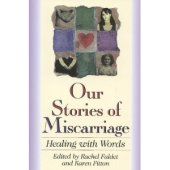
The legacy of miscarriage is profound. Recently, for some reason I felt drawn to read a book that I bought when I was pregnant with Alaina, but didn’t want to read while pregnant. Our Stories of Miscarriage was a very good book and I wish I had read it when my miscarriages were in process rather than now, in retrospect. The book is a collection of personal stories, essays, poems, and reflections about miscarriage and stillbirth (mostly miscarriage). Most of the stories are written by women and there are a handful written by fathers. I marked these things that I found meaningful…

I no longer underestimate the bond between a mother and her baby, no matter how tiny, in her womb (p. 19)

While I know this is not everyone’s experience and that people who are pro-choice often balk at this kind of language, this is true of my own experience. (For the record, I consider myself pro-woman and for me that does mean supporting the full spectrum of reproductive rights, but I have always felt a very uncomfortable and almost impossible to reconcile tension between my own, innate sense that a “fetus” IS a real and valuable baby and my own commitment to upholding the rights of each woman to make the best decisions for her own body).

I also appreciated this quote from a woman writing about talking to a friend who also had a miscarriage (and whether it is okay to talk about your own experiences/share your own story):

I can’t really say I know how you feel. I only know how I felt…

I think this is really nice choice of wording to empathize and share, without dominating another woman’s experience with your own narrative or feelings.

In another story, a mother says:

Now I know what it is like to lose a baby, so when I get pregnant again, I don’t need to know the gender, to have a trauma-free birth, to get the exact birthday, or to worry about making sure I’m relaxed. I just want a baby (p. 113).

I identified with this also, having written repeatedly during my pregnancy with Alaina that my main goal was live baby. While I still think it is perfectly reasonable and indeed should be a given that you have the right to BOTH have a “trauma-free birth” AND a baby (which, I did in fact have), my focus during my post-loss pregnancy experience was more definitely on having that living baby. I have written several times about how miscarriage allowed me to be much more able to understand the women who say, “all that matters is a healthy baby” or, “it doesn’t matter how your baby gets here, what matters is that she gets here.” While I will always maintain that both matter, my empathy for those statements did increase.

Yesterday, a friend of mine who had borrowed my doppler returned it to me. Looking at that box I remembered how often I’d used it during my pregnancy for the “life status update” of the day. I had a lot of cognitive dissonance about excessive ultrasound exposure and yet I was compelled to know if she was still alive. Looking at the box, it all seemed so far away. That fear. That uncertainty. That inner struggle. One of the reasons I published my own miscarriage memoir is because I wanted to be able to share how it all felt right then. That rawness of emotion and spirit, not the experience as filtered through time and new babies and healing of heartache.

The stories of other women reaching out across the page and across the years is a beautiful gift to all the women to follow who find themselves joining the same, unwanted “club” of babyloss mamas. I identified with the closing journal entry of Our Stories of Miscarriage reflecting on, “all the women who comforted me with stories…a sorority of sorrow, these women, and now myself among them, moving past the pain to find a jagged peace in comforting another suffering sister.” (Edgren, p. 184, emphasis mine)

My labyrinth of pregnancy drawing–see if you can find the doppler…