Archives

Motherhood, Feminism, and More

When a woman tells the truth she is creating the possibility for more truth around her.

– Adrienne Rich (May 16, 1929 – March 27, 2012)

Some time ago Molly at First the Egg did a series of posts about the book Of Woman Born. This book is an excellent feminist classic that at the time during which I read it helped to clarify for me that it is the “institutional” elements of motherhood that I sometimes find so oppressive and binding—it isn’t the children themselves, in the climate of motherhood in which I find myself.

Several years ago I also read Fruitful, by Anne Roiphe. The subtitle is Living the Contradictions : A Memoir of Modern Motherhood. Like Of Woman Born, it was written before the more recent wave of “momoirs” (that is a kind of dismissive term, but it does help me classify the genre) and focuses heavily on feminism and its relationship to mothers/motherhood (so, different from momoirs in that the focus is less on personal experience of motherhood and more on motherhood and its social/cultural/political connections, I suppose). Fruitful is less “heavy” and depressing than Of Woman Born. The focus of the book is on the tension between feminism and motherhood (i.e. can you be a “good” feminist and also be a “good” mother) and she explores that issue throughout. Roiphe is a feminist and yet critiques some elements of the movement’s impact on mothers and motherhood. She is also very pro-father and I appreciated her exploration of men/fathers as people vs. “evil patriarchy—down with them!”

This is a quote about the crux of the mother/feminist issue: “Motherhood by definition requires tending of the other, a sacrifice of self-wishes for the needs of a helpless, hapless human being, and feminism by definition insists on attention being paid to the self. The basic contradiction is not simply the nasty work of a sexist society. It is the lay of the land, the mother of all paradoxes, the irony we cannot bend with mere wishing or might of will.

This reminds me of my journal entry from my early months as a new mother—“is it possible to balance motherhood with person-hood?” I’m still figuring it out! (some days it seems to work, some days it really doesn’t!)

During the time in which I read Fruitful, I also read The Mommy Wars. I almost didn’t read it because I was worried that it would be excessively harsh or inflammatory and I don’t need to bring things like that into my life. However, it seemed truly supportive of women/mothers. It was a collection of essays by various authors (alternating between those who have chosen to be mostly at home and those who have chosen to be mostly pursuing careers) and it quickly became clear that the most real “mommy war” that most of us experience is the one inside of our own heads. There seems to be no ideal/perfect solution. I also noticed that many of the women (including the editor of the collection) had cobbled together some sort of “balance” between working-outside-of-the-home and working inside it–there were lots of part-timers, lots of WAHMs, lots of writer-in-the-spare-minutes, etc. Since I’ve done the same, I particularly identified with those tales of struggle to discover the right balance for your family.

The first quote I wanted to share from this book is with regard to being asked “what do you do?” at a cocktail party: “I find it odd that I’d generate far more interest if I said I raised dogs or horse or chinchillas, but saying, in effect, ‘I raise human beings’ is a huge yawn...It might, in fact, be boring if child care were simply a series of pink-collar tasks–bathe, dress, feed, repeat. But observing and participating in a little Homo Sapien’s development is fascinating to me. Furthermore, being a mother isn’t just a ‘job’ any more than being a wife or a daughter; it’s a relationship.” [emphasis mine and in total agreement with this]

Then in another writer’s essay (the above was from one of the SAHM, the below is from one of the WOHM) came this interesting observation:

I remember reading once that all manner of selfishness is excused under the banner of focusing on one’s family, and it strikes me now as penetratingly true. How many of us don’t do for others because we’re supposedly saving it for our families? and how valuable is staying at home if you’re not teaching your children how much other people (and their feelings) matter?

In another book I have, The Paradox of Natural Mothering, she refers to the “family first” mentality as a type of narcissism and I do see the point.

I also wanted to share some quotes from an essay by a woman who does not yet have children, but is planning to, with regard to talking to mothers who shut down her opinions/thoughts with the, “what could you know? You don’t have children” brush-off. (Which, I personally, have definitely been guilty of thinking on more than one occasion! And, actually did so while reading this essay!):

I want to be able to say that all the judgment and aggression and competitiveness I witness among working and stay-at-home mothers surprises me and absolutely must change. But that wouldn’t be honest. I’ve been party to this one-upping and henpecking and know-it-all-ness my entire life. It’s as if becoming a mother puts us back into a sorority or junior high school, into some petri dish of experience where what other females think and say and feel and do counts more than anything.

The one thing my stay-at-home and working-mom friends share in the country of motherhood is a superiority gene, some may call it a gift of vision, that convinces them that women who don’t have children are, despite their educations and accomplishments, dumb as doorknobs. I’ve sat through many a heated conversation…during which I’ve been silly enough to offer an opinion only to be shut down more condescendingly and viciously by wise Goddess Mothers than I ever have been shut down by any man.

FWIW, I would not call this a “superiority gene” or “gift of vision,” but a “voice of experience”…I think most of us have been in the position of ourselves being the “just doesn’t get it” woman without kids! And, after you have kids of your own, you suddenly realize why “those mothers” were condescending to you.

On a somewhat related subject, I also enjoyed this post by Dreaming Aloud about the silencing of mama anger.
Postpartum Thoughts/Feelings, Part 2

The time of danger, what needs to be survived, comes at different times for mothers. For me, it came early — during my [child]’s infancy.

From Sleeping Beauty & The Fairy Prince: A Modern Retelling By Cassie Premo Steele

After posting my “playing my music” essay containing an exploration of my postpartum feelings after the birth of my first son, I went back and forth about continuing to explore the subject. I’ve written about it a lot, but the feelings are scattered throughout a variety of locations—including partially written articles and also blog posts from my first, no-longer-updated blog. I actually wrote this post last year, immediately after my part 1 post, and then ended up not sharing it, but moving straight on to Postpartum Feelings, Part 3 instead.

Weird thoughts

Anyway, I wanted to briefly address the weird/intrusive thoughts that I experienced postpartum with both of my boys. I think one of the reasons I have trouble broaching this topic on this blog is that to look back at my thoughts and feelings is to begin to acknowledge to myself that I very likely experienced a postpartum mood disorder, even though I—perhaps purposefully—did not identify it as such at the time. With my first, I had a recurrent image of the bookshelf in my computer room at the time falling over and squashing me. I also had the sense that the baby was trying to “squash” me—as in stamp out my life spark (actually, who am I kidding, life with kids still makes me feel like this is their goal sometimes! ;-D) and the best way I could come up with to describe my feelings at the end of a long day was that I had been chewed up and had my bones spit out. This is a pretty intense description that some people might feel is ridiculous or over-the-top, but is the way I would have described it.

When my second son was a baby, I planned much better for postpartum and experienced a fairly pleasant babymoon at home with him. I felt like in general, mothering him was easier than mothering my first and as he grew, I frequently would say (and feel) that having a second child was the best thing I’d ever done. Despite those feelings, I had a recurrent image that would pop into my mind unbidden of falling backwards through a grate, my body dissolving into water as I fell and dripping through the grate and the skin of my face remaining a “mask” on the grate, eventually also dissolving/dripping through. I also had a weird, recurrent sensation that my shin bones were fragile somehow and I would imagine them snapping.

So, after typing this out I officially felt mentally ill, and that is why it hasn’t been posted until now.

The current

With my second son, I described my mood to my husband in this way: There is a current that underlies all of my emotions. I feel like I can “dip” into this current and test out how it feels, beneath the mood that I present outwardly or how I feel on the surface. My current lately is always sad—even when I am happy and feeling/acting happy, if I take the time to “dip” beneath, what I feel is sad. I used to actually chart the feelings on my calendar, with a little notation for the surface feeling and a different notation for the current. I tried to explain to him that I did not feel like I had a neutral point and that I would like to feel “even.” However, I also acknowledged that if to feel “even” or neutral as my “current” would mean trading in all peaks of emotion, rather exuberant or despondent, I’d rather have the ups and downs. During this time I looked up various mood disorders, thinking that I might possible qualify as having cyclothymia.

Wal-Mart “angel”

Then, one day, when my second son was perhaps a year or so old, I had an interesting experience at Wal-Mart with a very friendly and cheerful checker. She chatted along with us and was just very nice and pleasant to be around. That night I had a vivid dream that this checker was actually an angel and that she had come to “heal” my feelings. When I woke up that morning, I had very dramatic sensation and announcement of sorts in my head, “you are not depressed anymore” and indeed, when I dipped into the current it had become a wellspring of joy, rather than sadness. Since this time, my “current” has never again shifted back to sad. While I definitely have sad or “down” moods or get distressed about things, I now feel like it is only that surface emotion that is being buffeted, but that what waits underneath is always doing all right. Perhaps you have to know me in real life to understand how strange of an experience this is for me to describe. I have never had another “angel” experience and do not connect with angel imagery. The word “angel” is not one that I use to describe anything, really, and I feel extraordinarily skeptical and uncomfortable when other people say things about having guardian angels. I suppose if I did have PPD, it could be looked upon as a “hallucination” almost. However, I do not have a way to describe what happened to me without using the word. Indeed, I feel so oddly about it, that I have never actually told anyone else about this—I told my husband about the current shifting, but left out the “Wal-Mart angel” piece of the story.

Why tell it now?

As I noted, I’ve been waffling about posting this. It is close on the heels of another post that may seem woo-tastic. It makes me feel vulnerable and embarrassed. Why? Why bother sharing things that bring up these sorts of feelings? My answer was almost, just don’t, and then I read a fabulously amusing essay in the winter issue of Brain, Child magazine about a woman’s experience teaching “sexuality and the new mother” workshops at Babeland in New York City. In her postscript closing the essay, Meredith Fein Lichtenberg writes the following:

“…writing this now, years after it happened, I still felt that sharing something personal cast stark light on the Inner Vat of Chaotic Shit I Haven’t Figured Out Yet. The desire to hide that is amazingly strong; I see it in my students, and I see it in myself. But I also see that when we bend our lives’ stories into words to be shared, everything changes. Sharing stories reminds us we’re not alone with our icky mess of doubts and questions. In the light of day, frightening concerns and general weirdness become more understandable, forgivable, human.”

Reading this, I knew I wanted to share after all. And, it reminded me of another quote, this one by Carol Christ, a thealogy scholar that I love:

“When one woman puts her experiences into words, another woman who has kept silent, afraid of what others will think, can find validation. And when the second woman says aloud, ‘yes, that was my experience too,’ the first woman loses some of her fear.” –Carol Christ

Postpartum Feelings, Part 1

Postpartum Feelings, Part 3

Birth Plan Item #1: Leave My Cervix Inside My Body!

Some time ago I read several articles in Midwifery Today about birth in the Ukraine. Apparently, it is a routine practice immediately postpartum to use two “shoe horn” shaped devices to pull the cervix out of the woman’s body to examine. Yes, I think that warrants repeating–manually pulling out the cervix to look at! (no pain medications). This is so patently horrible and unnecessary that I had a visceral response to reading about it–my uterus hurt.

U.S. maternity care routines

However, as I reflected on my reaction, I began to wonder if the practice is any more strange or disturbing that some U.S. maternity care routines? I still feel like cervix-pulling-out ranks pretty high on the horrible factor, but I also recognize that it is filtered through my cultural lens of what I’m used to—“normal” (i.e. culturally acceptable) birth practices in the U.S. (such as Pitocin injection immediately following most normal births regardless of indication and so on and so forth). We have any number of questionable medical care practices in this country too, but because I’m used to them they register as “normal.” Of course, this doesn’t mean I approve of them or fail to notice that they are not evidence-based, but I accept them as possible occurrences and I’m certainly not surprised to read about them over and over again, or shocked when my clients experience them during their births.

One of the articles was about birth in a Ukrainian “birth house” and the other was a composite of observations about birth in the Ukraine in general. Sometimes there is a tendency amongst midwifery supporters to romanticize birth and midwifery care in other countries and to vilify the U.S.—if you are a Ukrainian woman, this is clearly misplaced!

My first thought when reading the essays was, “Wow! The U.S. system isn’t so terrible after all!” But then, I tried to imagine the U.S. birth culture seen through completely fresh eyes, as I had just viewed the cervix-pulling technique. How would facets of hospital birth care in the U.S. appear to me if I was just hearing about them for the first time? As gross human rights violations?

Though I cannot make it have the same raw emotional and physical shock to me as cervix-pulling-out, I can only imagine how an episiotomy might sound to my imaginary fresh eyes: “then the doctor took some scissors and cut through the skin and muscles at the base of the woman’s vagina.” Or, the same with the not uncommon addition of, “as she begged ‘please don’t cut me! No!'”

I also read with sadness and dismay about the emotional maltreatment of Ukrainian women in labor and how (in hospitals) they are frequently denied the companionship of their husbands. Is this really more awful than women being coerced into unnecessary cesareans or even more basic, being denied food and drink throughout their labors? No, not really, just less familiar.

What do all women deserve?

While it is nice to recognize that there are things that women birthing in U.S. hospitals can be very grateful for, there is not an official continuum or hierarchy of “better” bad things to happen to birthing women regardless of country of residence. Humanized care is humanized care. Women worldwide deserve a safe environment, a respectful caregiver, continuous emotional support, physically responsive care, evidence-based medicine, and to have their cervixes and uteruses left inside their bodies.

(P.S. In case anyone is interested, “cervices” or “cervixes” and “uteri” or “uteruses” are both acceptable plurals)

Some reminders for postpartum mamas & those who love them

Postpartum with Alaina, February 2011

I recently finished a series of classes with some truly beautiful, anticipatory, and excited pregnant women and their partners. I cover postpartum planning during the final class and I always feel a tension between accurately addressing the emotional upheavals of welcoming a baby into your life and marriage and “protecting,” in a sense, their innocent, hopeful, eager, and joyful awaiting of their newborns.

This time, I started with a new quote that I think is beautifully true as well as appropriately cautionary: “The first few months after a baby comes can be a lot like floating in a jar of honey—very sweet and golden, but very sticky too.” –American College of Nurse-Midwives

Matrescence

In Uganda there is a special word that means “mother of a newborn”–-nakawere. According to the book Mothering the New Mother, “this word and the special treatment that goes with it apply to a woman following every birth, not only the first one. The massages, the foods, the care, ‘they have to take care of you in a special way for about a month.'”

There is a special word in Korea as well. Referring to the “mother of a newborn child,” san mo describes “a woman every time she has had a baby. Extended family and neighbors who act as family care for older children and for the new mother. ‘This lasts about twenty-one days…they take special care of you.'”

These concepts—and the lack of a similar one in American culture—reminds me of a quote from Sheila Kitzinger that I use when talking about postpartum: “In any society, the way a woman gives birth and the kind of care given to her and the baby points as sharply as an arrowhead to the key values of the culture.” Another quote I use is an Asian proverb paraphrased in the book Fathers at Birth: “There is a proverbial saying in the East: The way a woman takes care of herself after a baby is born determines how long she will live.” While this quote usually gets some nervous laughter, I think it is impresses upon people how vital it is to plan for specific nurturing and care during this vulnerable time.

Dana Raphael, the author of Breastfeeding: The Tender Gift, who is best known for coining the word “doula” as it is presently used, also coined another valuable term: matrescense. “Nothing changes life as dramatically as having a child. And there was no word to describe that. So we invented the word—matrescence—becoming a mother.”

The postpartum law of threes

I also share the “law of threes” with my clients which I learned from an article titled “Baby Moon Bliss” by Beth Leianne Curtis in Natural Life, Fall 2008:

A helpful tool I share with students and clients of mine is what I describe as the ‘law of threes’ when beginning the postpartum period. The first three days after your baby is born, try to stay in bed or at least in your bedroom. Many other cultures worldwide have much longer ‘lying in’ periods for mother and baby. If you can give yourself the much-deserved rest of focusing on breastfeeding, sleeping, eating, and recovering from the work of labor, your body and your baby will thank you for it. While birth is a healthy, normal event, honor the recovery process that your hard working body needs and deserves. The less you physically do in the initial few days following childbirth, the better and stronger you will feel in the weeks ahead. …Next, prepare to have three weeks of meals readily available for breakfast, lunch, and dinner….” (don’t forget plenty of snacks at easy reach for breastfeeding!)

Finally, understand that those first three months after birth are truly a time to embrace the unexpected…for some mothers, after three months is when breastfeeding really begins to be fun and easy. Many parents find that at the end of this [fourth trimester] transitional time, baby has moved through any colicky phases and that suddenly baby looks and acts more like a ‘real person.’…Physically, this is when your body begins to return to its pre-pregnancy state.

When I present about this topic to groups, sometimes I hear the following types of remarks: “Getting back out made me feel better, I would be miserable lying around in bed all day”—at the time when my own first baby was born, I would have said this was true for me as well, but looking below the surface shows me something else. Someone who hadn’t planned for a nurturing, comforting, supportive postpartum cocoon and who hadn’t given herself permission to rest, relax, and restore. The same high-achieving style that served me well in the workplace did not nourish me physically or emotionally as a tender new mother. I firmly believe that a nurturing postpartum downtime lays foundation for continued “mother care” self-nurturing for the rest of your life.

Then, in my notebook, I found the following relevant quotes that I had saved from the book Natural Health After Birth by Aviva Jill Romm:

“Too often women develop the mindset that a good mother gives all and takes nothing for herself. Remember, this is a great cultural fallacy. A good mother gives of herself to her children, but she has to have a self to give. A good mother nurtures herself, develops her own interests, even if in small ways, and grows as a person along with her children. Children don’t need us to be martyrs; they need us to be their mothers. A self-actualized mother sets an example for her own daughters that becoming a mother expands identity, not limits it.”

–Aviva Jill Romm, Natural Heath After Birth

“To put a child on Earth, an immense amount of creative intelligence flowed from the Great Spirit, through nature itself into your body, heart, and mind–remaining now, as an integral part of your own spirit. This energy is yours forever. Like a pocket, deep and filled with magic seeds of creativity and healing, this is the source of unconditional loving from which every wise woman since the beginning of time has drawn her strength.”

–Robin Lim

“Motherhood is raw and pure. It is fierce and gentle. It is up and down. It is magic and madness. Single days last forever and years fly by…Be gentle with yourself as you travel, dear mother. Don’t miss the scenery. Don’t miss conversation with your traveling companions. Laugh at the bumps and say ‘ooh, aah!’ on the hairpin turns. Buckle your seat belt. You’re a mom!”

–Aviva Jill Romm

Helpful articles

Planning for Postpartum—this is one of my past articles that I remain proud of

How other cultures prevent PPD—helpful article by Kathleen Kendall–Tackett

DONA’s handout for making a postpartum plan—I think couples should spend at least as much time to developing a postpartum plan as they do to making their birth plans.

Support & Sanity Savers handout for class from Great Expectations—this is one of my very favorite postpartum handouts to use for birth classes, particularly the last page which is a “request for help after the baby is born” letter to prospective helpers that includes a “coupon” for people to fill out with what they’re willing to do for the new parents.

Time for a retreat!

It is only when we silence the blaring sounds of our daily existence that we can finally hear the whispers of the truth that life reveals to us, as it stands knocking on the doorsteps of our hearts.

~ K.T. Jong (via Kingfish Komment)

Some time around November each year for the last three years, I’ve had a feeling of being “sped up” in my life and a desperate craving of stillness and rest. I begin to feel like pulling inward, “calling my spirit back” and re-integrating fragmented parts. Aside from my family members, I stop feeling like being “of service” to others and their interruptions of my space or requests for my time or attention begin to feel like impositions. I begin to hear the distant call to “retreat.” I crave stillness, rest, and being alone. I fantasize about broad expanses of silent time in which to think and plan and ponder. It then takes me until February to actually act on this urge. So, as of today, I now begin my annual week of retreat. In the past, I’ve done a computer-off retreat. This year, it is a Facebook-off retreat. I keep returning to the persistent feeling of having my life/brain full of digital noise/clutter and envision taking a sabbatical from the constant, hyperactive flow. My good friend wrote a blog post about her decision to take a FB break and that was the last little nudge I needed to take a break myself. The night before reading her post, I’d gone to bed thinking, “any day in which I think, ‘I didn’t have time to XYZ,’ but I DID check FB, is a day that I lied to myself.” I have a somewhat conflictual relationship with Facebook—in most ways I love it and in some ways I feel like it fosters a false sense of connection with others. I do love that it helps me keep up with and maintain real connections with real friends and with long distance family. I also appreciate the way it “smallens” the gap between people and I appreciate the opportunities it offers me to network. And, I appreciate how I am able to use it to support, encourage, and connect with other women I may never meet—it broadens my reach and impact. Finally, I most definitely appreciate it when someone shares one of my blog posts via Facebook! A good deal of my site’s traffic over the last year has come from Facebook.

Digital noise

What I wish to disconnect from it is ALL the digital “noise” in general—FB, email, e-newsletters, free Kindle books, etc.—all the requests for my time and attention. A lot of it originates from Facebook. I’ve mentioned before how if I wasn’t there, I wouldn’t even know about all the stuff I wasn’t doing–instead, it contributes to this false sense of urgency and immediacy about staying “caught up” with everything and everyone.

I still have to teach and parent, so this isn’t a full retreat, but I am taking this FB break. Yesterday, I deleted my FB apps and prepared to take a rest to focus on CREATING rather than consuming. Upon reflection, I realized it sounds like I mean I want to create digital noise, which isn’t what I mean. Though, I do want to spend more time writing blog posts and articles, so I guess that is kind of ironic. Also, I recognize that it is kind of annoying when people make big announcements/declarations about how they are QUITTING FACEBOOK, but I still feel compelled to explain it… ;-D I didn’t delete my account, just the iPhone/iPad apps that make it so easy to check in often. I’ll reinstall them when I’ve had at least a week of mental space. I value the connections I have via FB and don’t want to lose that, but I need some time away to re-clarify my boundaries. I also need to go on a fan page deleting spree as I am a fan of more than 500 pages. ;-D I need QUIET! Space in my head to hear myself think.

Past retreats

On February 1, 2010, the first year I took a personal retreat (this one was a computer-off retreat), I also started to miscarry for the second time. In my journal, I wrote:

At 4:00 this morning, I began to bleed red. I had allowed myself to become hopeful yesterday since there was no spotting increase (until evening)…Today, I am certain that is not the case and I feel dissolved. I am disconnected from this experience and feel unreal and unmoored…I feel SO foolish–WHY did I think I could do this again? Why did I open myself up to this again so soon?

…I cannot believe Zander was the last–last to nurse, to sleep in our bed, to be carried in the Ergo, to watch crawl and learn to walk, to hold in scrunchy newborness. I’m NOT DONE YET. Or, am I?

…I just want to say two things again:

1. I do NOT want people to feel sorry for me again so soon.

2. I feel DUMB.

I do not feel like I am handling this well or with strength. I just feel numb and dumb and done and done for. I am bottoming out right now. Bottom. Pit. Despair.

20120201-141452.jpg

My nature-loving retreat buddy!

That retreat ended up being a meaningful and spiritually enriching time for me, but it was also full of a lot of darkness and tears.

On February 1, 2011, I had a 13 day old daughter and was enjoying my babymoon with a deeply thankful heart.

And, now on February 1, 2012, I have a robust one year old, whose boundless energy and drive also stimulate my interest in the stillness of retreat!

Why retreat?

Some time ago, I saved this list of why women need retreats (via Jennifer Louden):

I need retreats to remind me who I am.

I need retreats to come home to myself.

I need retreats to connect with the divine feminine.

I need retreats to renew myself.

I need retreats to connect with myself.

I need retreats to connect with others.

I need retreats to rest.

I need retreats to be alone.

I need retreats to find myself.

I need retreats to honor myself.

I need retreats to learn.

I need retreats to dance.

I need retreats to play.

I need retreats to sing.

I need retreats to laugh.

I need retreats to cry.

I need retreats to be myself.

I need retreats to Be.

Yeah. That pretty much sums it up! Though, actually, these are some of the things I wrote down when considering this year’s call to be on retreat:

  • Drum
  • Crochet Yoda for boys
  • Make craft projects with boys
  • Make doll for Alaina
  • Go outside
  • Snuggle!
  • Make more sculptures
  • Draw
  • Journal
  • Read
  • WRITE! Tons! Posts, articles, essays for classes.
  • Be still
  • Rest
  • Play!
  • Plan/brainstorm pregnancy retreats/birth art sessions/prenatal fitness classes—re-vision my plans for birth education
  • Clean out inbox
  • Clean up computer room and go through binders/filing cabinets/bookshelves
  • Declutter in general
  • Clean out closet and spare room
  • Review books (hmm. This is a “should do” rather than a want to. I’ve got about 6 that are staring at me and waiting their turn)

I’m no longer foolish enough to think that I’ll ever be able to get “everything done” (because I’m a fascinating, amazing person after all!), but I do feel confident that I can take some steps to gather the whole, improve my focus, and re-commit to my life’s priorities, as well as consider how to best prioritize my time and energy in order to fully “savor and serve” my family and the world.

20120201-141513.jpg

A nice place to retreat--priestess rocks in the woods behind my house.

20120201-141523.jpg

I love to sit in this stone "chair" to journal and think and feel. I sat here after my miscarriages. I sat here during my pregnancy. I took newborn Alaina here last February to "introduce" her to the earth. I bring the boys out here to play. I sat here today and thought about the ever-turning wheel of life.

20120201-141530.jpg

Midwifery & Feminism

“Midwifery work is feminist work. That is to say, midwives recognize that women’s health care has been subordinated to men’s care by a historically male, physician-dominated medical industry. Midwifery values woman-centered care and puts mothers’ needs first. Though not all midwives embrace the word feminism (the term admittedly carries some baggage), I maintain that providing midwifery care is an expression of feminism’s core values (that women are people who have intrinsic rights).
–Jon Lasser, in Diversity & Social Justice in Maternity Care as an Ethical Concern, Midwifery Today, issue 100, Winter 2011/2012

I tend to define feminism as believing in the inherent worth and value of women and acting on that belief. I see birth care as a crucial, basic feminist issue and midwifery and most types of birth activism as feminist work. While, as Lasser notes above, not all midwives embrace the term, in my personal experience some of the most beautiful, loving words and actions about the value and worth of women are exhibited by midwives.

Footprints on My Heart: A Memoir of Miscarriage & Pregnancy After Loss

As of this week, my miscarriage memoir, Footprints on My Heart, has finally been published and is now available in eBook format via Kindle and Lulu, Inc. (epub format compatible with Nook and iBooks). There are a few formatting errors and some other general problems (like with the sample/preview–it is totally wonky–and with the lettering on the cover), but guess what, it is DONE, it available, and it is out there. I’m really, really excited about it and I feel this huge sense of relief. I still want to write my Empowered Miscarriage book someday, but for now, this memoir is what I had in me and it will have to do for the time being. I realized after Alaina was born and was, in a sense, the happy “ending” to my Noah story, that in writing my miscarriage blog I had actually ended up writing most of a book. So, the bulk of the book is drawn from my miscarriage blog and from this blog as well (for the pregnancy after loss content). I also included an appendix of resource information/additional thoughts that is fresh.

I’ve felt haunted by the desire to publish this for the entire last year. It took a surprising amount of work, as well as emotional energy, to prepare for publication, even though I actually did most of the actual writing via blog in 2010. Now that it is ready, I just feel lighter somehow and have this really potent sense of relief and ease, as if this was my final task. My final act of tribute. My remaining “to do” in the grief process.

If anyone really, really, really wants it and cannot afford the $3.99 for which I priced it, I do have it available as a pdf file, a mobi file, and an epub file and I will be happy to email it to you in one of those formats.

<deep breath> Aaaaaahhhhhh….

Thoughts on epidurals, risk, and decision making

In the Winter 2012 issue of The Journal of Perinatal Education I read several interesting tidbits related to women’s experiences of medication during labor, expectations for birth, and thoughts on risk and choice. In an article by Hidaka and Callister titled, “Giving Birth with Epidural Analgesia: The Experience of First-Time Mothers,” I was struck by one mother’s explanation of why she “chose” an epidural: “‘I was nervous about lying down and being confined to the bed again.'” As the researchers explain, “She wanted to stand or sit to cope with labor pain; however, many times she had to lie down for monitoring, and that position made her pain worse, so she was inclined to opt for an epidural” (p. 29).

Some questions immediately arise here. Did this mother actually want an epidural? Do women really need to lie down to be monitored? Was normal labor unbearable without medication? Did she make a free choice? The answer to all is, no. In this case and in so many others around the nation every day, the physiologically normal and fully appropriate need for freedom of movement during labor ran smack into the hospital’s expectation of stillness. And, medication was a consequence of that stillness, not an inability to cope with normal labor–it was an inability to cope with enforced passivity that was directly counter to the natural urges of her birthing body. Where is the “opting” here? When birthing women are literally backed into corners, no wonder epidural analgesia becomes the nationally popular “choice.”

Risk and birth

In another article titled “Risk, Safety, and Choice in Childbirth,” Judith Lothian explores our risk-driven obstetrical model, drawing on material from Raymond De Vries who, “describes that the common strategy of professional groups gaining control is to create risk or exaggerate risk. One ways groups gain power is by reducing risk and uncertainty. Where there is limited risk, it can be ‘created’ by redefining ordinary life events as risky and emphasizing whatever risk exists. The medical model encourages women to see birth as inherently risky for mother and baby…The obstetrician is then in the powerful position of reducing the risk and uncertainty. During pregnancy, women are advised and cautioned about every conceivable, however small, risk; but interestingly, when it comes time for the birth there is little, if any, discussion about the risks of routine interventions, such as continuous electronic fetal monitoring, elective induction, and epidurals…” (p. 45-46).

What are the implications for childbirth educators and doulas? We need to be cautious of perpetuating a medically oriented model that implies that women are responsible for minimizing all possible risks during pregnancy and yet then accepting a climate for giving birth that actually increases risks for both mother and baby. Lothian notes that educators must make it clear “that the current maternity care system increases risk and makes birth less safe for mothers and babies. Women need to know the care practices that make birth safer for mothers and babies and the practices that do not.” She goes on to address a key point, stating that “Childbirth educators need to take a strong stand in support of changing the system to increase safety for mothers and babies…safety is not about frantically trying to minimize small or exaggerated risks during pregnancy and then giving birth in hospitals that protect obstetricians’ interests while increasing risk for mothers and babies” (p. 47). [emphasis mine]

Storytelling and birth

In a later article by Barbara Hotelling about styles of teaching about medications in birthing classes, she references Lothian who suggests, “childbirth educators replace in-depth discussions of stages and phases of labor, medical interventions, hospital policies, and complications…’Let go of trying to fit everything in. Women don’t need to know everything about labor and birth.'” What to do instead? She suggests replacing traditional forms of education with storytelling and other strategies that recall how women through the ages have traditionally come to know and understand birth, stating that, “‘Storytelling is a powerful way to convey basic information about physiology, coping strategies, and confidence'” (p. 51). I’ve written before that what women need isn’t actually just more information and to get educated and these experienced educators agree, “Now there are many books, videos, YouTube videos, and magazines that give expectant parents the information. In their classes, childbirth educators can add storytelling from friends and family about their experiences with pain medication during labor and birth, allowing educators and their class participants to learn from the wise women who went before them” (p. 51).

I’ve long sought ways to help parents cultivate their inner knowing and body wisdom and to focus classes around the development and enhancement of personal resources, rather than on simple information sharing. I would like to re-vision my own approach to childbirth education into a cooperative, woman-to-woman, birth circle type of environment. Michel Odent describes this in his book Birth and Breastfeeding as “new style” childbirth education: “for the most part, these are mothers who have no special qualification but, having given birth to their own children, feel the need to help other women who could benefit from their personal experience. They organize meetings, often at their own homes. They do not usually encumber themselves with any particular theoretical basis for their teaching, but may find it useful to give this or that school of thought as a reference. Their aim could most accurately be described as being to provide information and education, rather than specific preparation.”

Addressing the subject of pain…

Returning to the first article quoted above, in their discussion, Hidaka and Callister state, “Our findings confirm those of a recent systematic review of women’s expectations and experience of pain relief in labor. Across studies, women underestimated the pain of childbirth, we’re not prepared for the intensity of the experience, and often had unrealistic expectations” (p. 29). I’d like to address the other points in a future post, because I think they are very significant, but for now they offer several good tips for childbirth educators to address the topic of labor pain during birth classes:

  • Teach that some pain/sensation has a purpose to alert the laboring woman to the need for movement, doing something different to encourage rotation and descent, or to push
  • Teach that the sense of empowerment for accomplished tasks and goals cannot be replaced only with pain relief
  • Teach that perception of pain is different for every woman
  • teach that every situation is unique so that no single pain management strategy works
  • Teach that the word labor means “hard work” and not “big pain”
  • teach that labor contractions intensify until about 5 cm, and that other sensations (e.g. “downward pressure”) may seem scary or painful
  • Teach that the sensations of labor are not all unique to labor (e.g. bad menstrual cramps, back pain, nausea, pressure)–they have lived through these experiences before

Related posts:

The Illusion of Choice

The Value of Sharing Story

Practical Ways to Enhance Knowledge for Birth

Information ≠ Knowledge

Women and Knowing

Asking the right questions…

The Grassroots of Safer Birth: Get Karen There

Midwives speak the same lan­guage, regardless of politics: women come first.

–Palestinian Midwife (quoted by COHI)

I have found that it is easy to get so caught up in local or national birth activism that I forget to even consider the birth climate and concerns of other regions of the planet.

Why should we care?

Most simply, because lack of access to good maternity care is a huge issue around the world, with a profound impact on women, mothers, babies, families, and communities. Some selected facts (via COHI):

  • Nearly 400,000 women will die each year from pregnancy-related causes and 99% of these deaths will occur in de­veloping countries, according to the World Health Organization (WHO).
  • For each woman who dies, 20 others will suffer from serious complications.
  • The five leading causes of pregnancy-related deaths are bleeding, infec­tion, high blood pressure, prolonged labor and abortion complications. In poor countries, a mother’s death leaves her new­born at risk of dying as well.
  • The majority of pregnant women die because of the three major delays that have been identified as:
  1. Delay in the woman, her family or community members’ recognition of a life-threatening problem and the decision to seek care.
  2. Delay in a woman’s access to trans­portation to a health facility, espe­cially at night.
  3. Delay in the woman’s access to quali­fied health workers with access to es­sential equipment and supplies.
  • Women and children constitute as 80% of the world’s refugees and displaced people.
  • In areas where conflict and turmoil is rampant, nurses and midwives are the primary reproductive health care providers. They provide up to 80% of direct patient care around the world every day.

Recently, I was asked to participate in a fundraising effort to get midwife Karen Feltham to Haiti. Spearheaded by BirthSwell in connection with the amazing organization Circle of Health International, the fundraiser already reached its goal before my post was scheduled to run! That’s what I call some effective grassroots organizing! The fundraiser is still open for contributions however, and now any additional funds raised will be used to sponsor other midwifery volunteers to disaster areas in need of support. COHI knows that the majority of pregnant and birthing women worldwide are cared for and by midwives and believes that, “midwives should be involved in the effort to foster change by bringing about increased access to services, support and care for women everywhere.”

What can you do?

  • Make a contribution!
  • Get connected! Visit the fundraiser’s indiegogo site and be sure to share it on Twitter, Facebook, and your listserves.  (The indiegogo site has great tools and widgets for sharing – try them out!)
  • Tweet about the fundraiser using hashtag #getkarenthere
  • Make sure to follow COHI on Facebook!

I have a personal tradition of getting a new We’Moon datebook every year and I was pleased to notice that part of the proceeds from the 2012 edition goes to support Circle of Health International also. COHI focuses on: “Working with women and their communities in times of crisis and disaster to ensure access to quality reproductive, maternal, and newborn care.”
COHI lists the following as their core values:

  • Grassroots social change by creating local, community driven collaborations in order to foster social change from the top down, as well as from the bottom up.
  • Nonviolence in terms of active resistance requiring one to act when faced with injustice. Leadership at COHI is supporting women to lead, to be forces for change in communities healing from conflict and disaster, and in organizational movements to support women in leadership roles.
  • Volunteerism through the giving of time, money, knowledge, and general support with the goal of easing the suffering of others.
  • Activism in individual responses to inequity and injustice.
  • Supporting women and their families in their right to make their own decisions in all aspects of birth spacing and family size, while protecting access to the resources required to honor their choices.

I value all of the above as well, which is why I’m pleased to be involved with the effort to Get Karen There!

http://www.indiegogo.com/project/badge/45681?a=

Happy Birthday, Baby Girl!

“Our lives can sometimes feel like passages through harsh landscapes that shake us to our core. Yet these difficult passages bring us to our most profound transformations. In the midst of heartache and greatest need, we find that grace descends. And at the end of it all, we often discover that we have become someone new, stronger and more alive…the tender moments of heartache, illness and inner strangeness that we all experience at times. They illuminate the path of healing–when awe, self-love and grace touch our very being, leave us breathless, make us whole.” –Carolyn Brigit Flynn (Sisters Singing)

I have hands big enough to save the world, and small enough to rock a child to sleep.” –Zelda Brown

(I wrote this second quote on the first page of the baby record journal I kept of her first year)

I’ve spent multiple days trying to gather some minutes together to work on a happy birthday reflective post. While sometimes I hesitate to write posts that are “too personal”— thinking things like “who really cares anyway?” and “why do I feel so compelled to share my life online?”—I’m so glad I’ve written regular updates about this first year of life with my baby girl. Even if no one else does really care to read about it–I care and I’m glad to have a “permanent record” of her infancy in this manner. The main thought that comes to mind when I reflect on her first year of life is, but it has all been SO REAL. I’ve expressed that same sentiment previously and maybe it doesn’t make sense to anyone else, but that it is the feeling I return to. This life, this past year has just been so real. By that I mean so vivid, so present, so conscious, so physical, so embodied, so here and now, that I can hardly believe it has now passed. I am likely to never have another crawling, drooly, grabbing, fuzzy headed baby of my own in my house again–and, even if I do. It won’t be this baby. This little walking, minimally talking, amazed, and amazing, energetic and enthusiastic, baby girl. I paid attention, I told about it, I remembered to look, listen, feel, and to embed precious moments and memories as deeply into my soul as I possibly could. I’ve struggled with life balance, come in and out of various states of equilibrium/disequilibrium. I’ve laughed, I’ve cried, I’ve marveled, and I’ve been ragged. And, we’re here. We did it. We’ve taken our first trip around the sun together. After having walked the labyrinth of pregnancy after loss in 2010, in January of 2011 I greeted the labyrinth of birth with wild joy and sweet relief, and now we’ve been on our “return” journey–step by step and in my arms, Alaina and I have now completed our postpartum return labyrinth together (though, I think it might actually last three years…).

Just this time last year I was wondering aloud if the full moon would bring me my baby and sure enough, my labor began that night and she was born at 11:15 a.m. on January 19 (full birth story in case anyone missed it). For me, the first birthday is really as much about memories for the mom as it is about the baby! Some favorite early pictures:

Moments after birth. I tried editing the contrast to make the picture actually visible for this post. I'd just caught her myself. The tenderness and majesty of this moment makes me cry!

On my due date demonstrating how she could still fit!

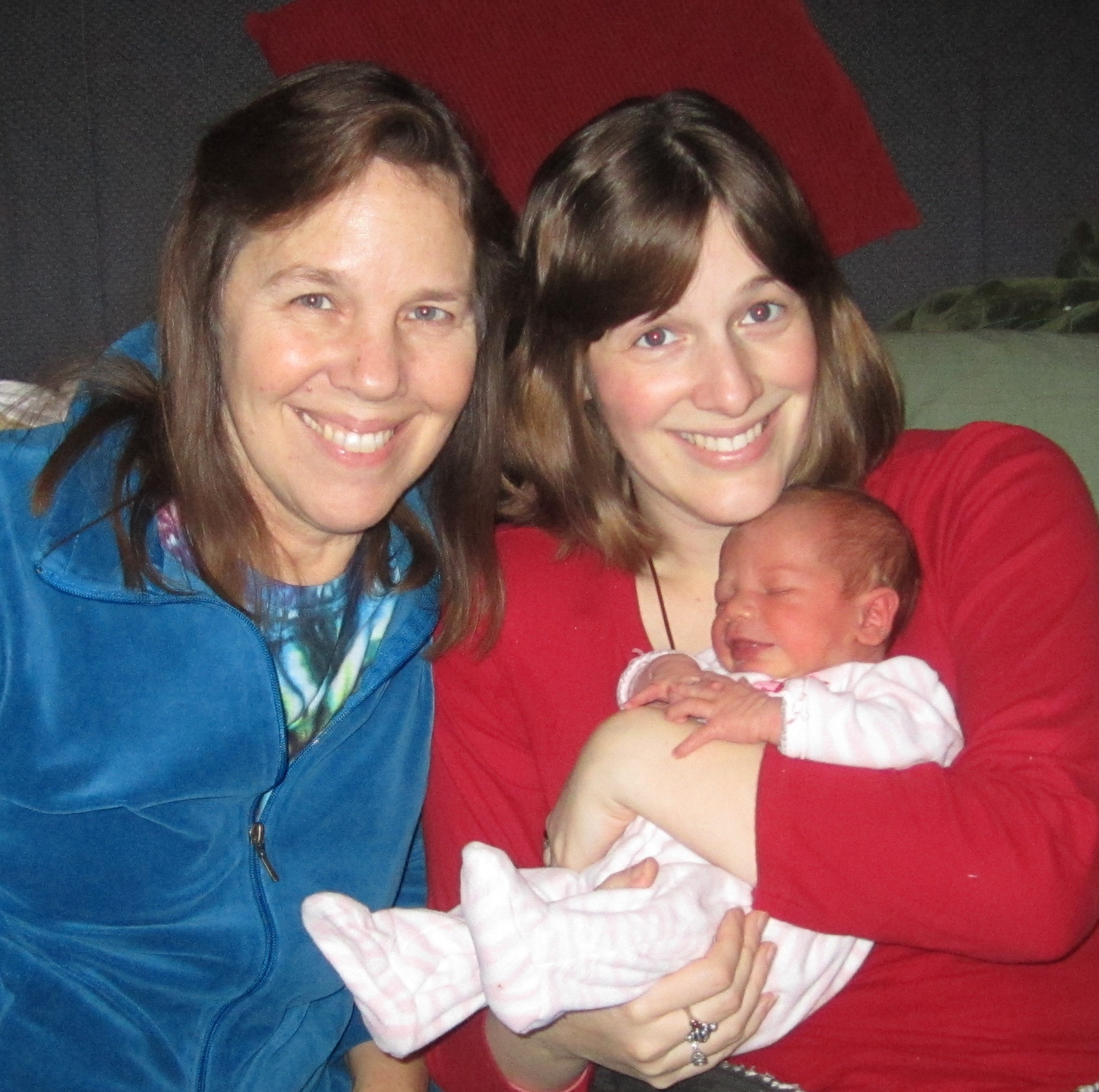
First three generations picture. Look how excited I am!

Here is a video we took for family when she was a couple of days old. I love my voice in this video—in you can hear how marvelous I think she is—and how my fingers tenderly touch and explore her as I talk.

And now, fast forward a year and we’ve got some early steps:

And, then more real walking at Baba’s house:

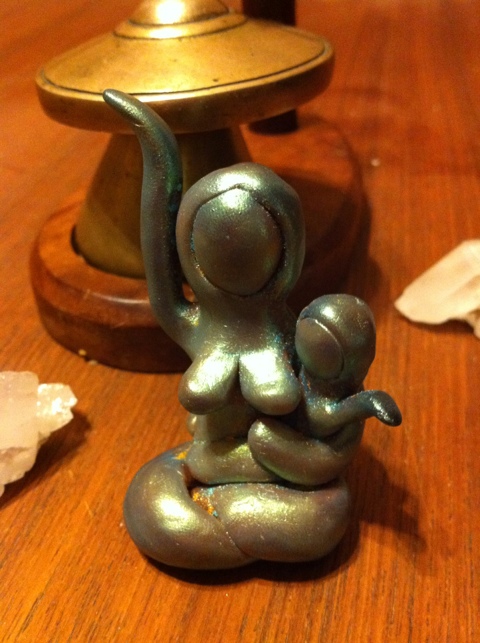
And, of course I had to make some more polymer clay birth art goddesses to commemorate the big birthday! This mama has her baby on her hip, which is still Alaina’s most preferred mode of transport:

20120118-085130.jpg

This baby is stepping out a little, but still intimately connected with mama. Double spiral symbolizes our interlocking labyrinth path, forever joined, but now able to separate too:

20120118-085149.jpg

The whole birth art series!

20120118-085216.jpg!

It is a total coincidence that I ended up making 12 figures--I didn't plan it that way and I didn't make one during every month or anything (though, that would have been cool. I wish I'd done that!)

Okay, time for  twelve month update too! After many months of posting about the best baby ever, I am here to report that Miss A has taken a turn for the wild. If anyone has been secretly annoyed by my “perfect baby” and wishing to crow with delight, now is your chance! Oh my goodness. I don’t even know where to start. How about with this picture?!

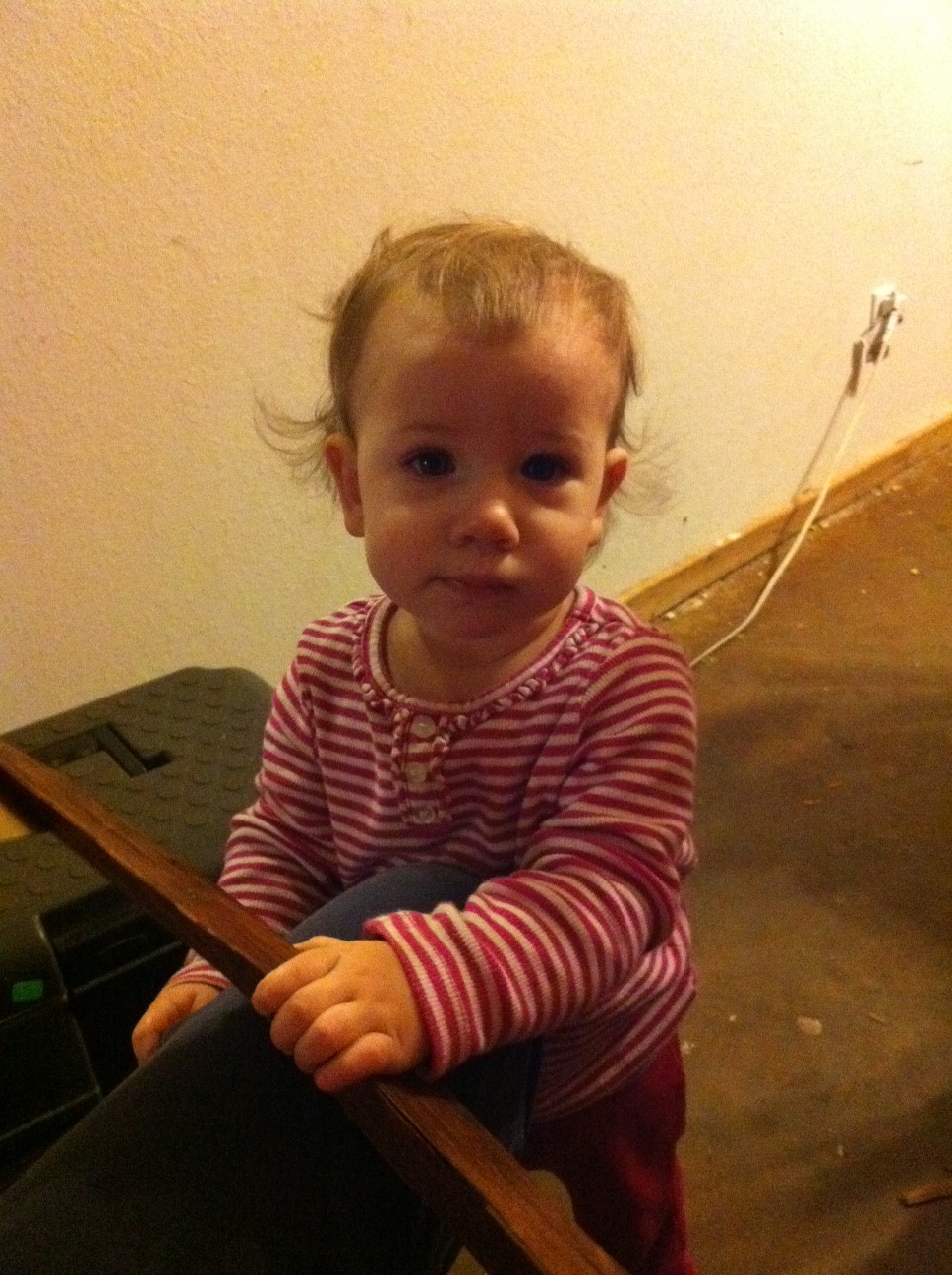
Yes. That would be some of the wood from the back of the kitchen chair. Peeled off by a baby. And, the set of her mouth is because she’s also eating it. The slightly wild, manic-clown-type hair also sums it up. This girl is on the move. She’s into everything. Wants it all. Is constantly making one of two sounds to indicate her many wants–a cute little question-intonation “huh?” sound, or a grating,  “aaaaaaaah!” sound that makes you want to yell, JUST STOP. She is incredibly grabby and shockingly destructive. Nurses very roughly (this isn’t new) and uses my skin as a handhold or toehold often enough that my upper arms are covered with little fingertip sized bruises. My thighs near my knees are also covered with small toe-sized bruises from being kick-walked on during lying down nursing. BUT, lying down nursing is pretty rare, since she pretty much will only nurse while standing up in the Ergo. And, that is how she goes down for nap every day (down to only one nap per day now). Nurses lying down during night. Potty strike is finally pretty over, but sitting down to pee just takes too much time. I still mean to write an EC post, a common refrain in which will be, and then I got peed on.

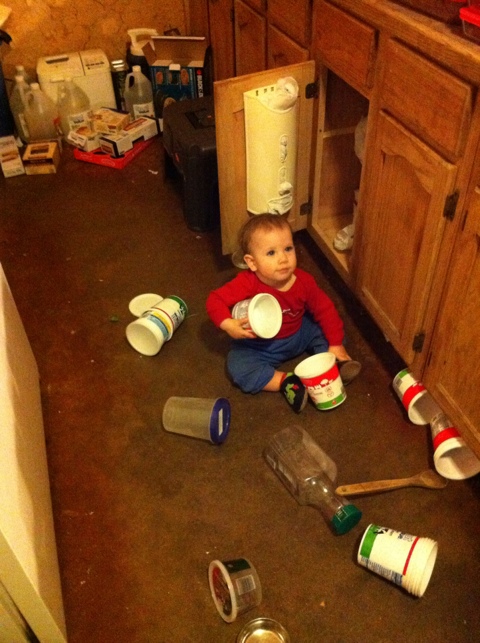
She loves to get into cabinets and also to take lids off of stuff.

20120118-085403.jpg

Again with that hair and face of mischief-making!

20120118-085235.jpg

What a sweet face too!

She weighs about 24 pounds and I need to measure her height. Has 8 teeth. Thought recent personality shift might have to do with more teeth or the developmental milestone of walking or the fact that she had a yucky cold, but it seems to be her new way of being. Markedly less verbal than she was last month—I know that is supposed to be a worrisome sign, but I think in this case it is related to the brain being able to concentrate on one significant developmental leap at a time. Right now, walking is primary and language has taken a backseat. I remember the boys doing this too. She often seems disgruntled lately–like whatever we are doing, she wants something different. Wants to get on top of table, counters, and stove. LOVES to be outside and asks all day long to go out (even when it is 10 degrees–then she complains and wants us to make it magically warmer). Has thrown several fits about this (and other things too). Is constantly aggravating the boys by getting into their games and wrecking their stuff.

She is very tough and brave and surprises me still with her unflappability in the face of change or drama. A couple of days ago I accidentally scraped her face with a tree branch when going out to open the chickens and didn’t notice what had happened. She made a small sound and had a turned down lip and I said, “oh, what’s wrong?” Upon getting inside I then noticed the two inch long bloody scratch down the side of her head and face!

Spends a lot of time in-arms still. Really enjoys mama and wishes to be mainly with me, though she does like visiting my parents and playing with daddy too. So far she still prefers to crawl to get things, but on two occasions this week, she has chosen to walk toward something rather than crawling. Crawling will soon be history! I swear, sometimes it feels like my heart is breaking when I think about the little baby of one year ago and how she is growing so fast, but at the same time of course I’m just so happy to see her developing and changing and being amazing. It has been a beautiful year.

Happy Birth Day to both of us!