Archives

Tuesday Tidbits: Human Rights and Birth

“It takes force, mighty force, to restrain an instinctual animal in the moment of performing a bodily function, especially birth. Have we successfully used intellectual fear to overpower the instinctual fear of a birthing human, so she will now submit to actions that otherwise would make her bite and kick and run for the hills?”

–Sister Morningstar (in Midwifery Today)
486253_470181139659475_1370955888_nWhen I end my introduction to human services class and then again when I begin my social policy class, I ask my students to consider the above: What would happen if everyone cared? What would happen if our first reaction was compassion? What would happen if we focused on what matters? What would happen if we assumed everyone had inherent worth and value and deserves humane care and compassion?

I have said for a long time that women’s rights in birth represent a human rights issue, so I was very interested to receive word of a Human 10360685_10152979214427627_4161278366266845515_nRights in Childbirth campaign:

Women do not lose their basic human rights once they become pregnant. And yet, across the globe, women’s human rights are compromised and violated around childbirth. Examinations, interventions and procedures that pose risks to both mothers and their babies are routinely performed without informed consent, or through coerced compliance via threats or fear. When women come out of childbirth with post-partum PTSD from disrespect, abuse, or obstetric violence, the goal of a “healthy mother and healthy baby” has not been met.

via Home | Human Rights in Childbirth.

Childbirth IS a women’s rights issue and a reproductive issue:

Childbirth is a women’s rights issue and a reproductive justice issue. The United States maternity system is one of the costliest in the developed world, yet our birth outcomes compare poorly to those of other industrialized nations. Among industrialized countries, we consistently rank last or second to last in perinatal and maternal mortality rates. Moreover, birth is depicted in mainstream media with fear, medical intervention, and crisis…

via Business of Being Born: Classroom Edition | Talk Birth.

But, childbirth is also, quite simply, a human issue:

This is the whole point—women’s rights aren’t about “taking” rights from anyone else OR about demanding “special treatment,” they are important for a HUMANE WORLD for all people. I think it is hilariously awful that “women’s rights” are considered a political issue and that there is a section about “women’s rights” in the “opposing viewpoints” database for my social policy class. As long as women’s rights are considered a political issue or as something about which an opposing viewpoint can be held, rather than as self-evident, we are in continued, desperate need of revolution.

via Women’s Power & Self-Authority | Talk Birth.

Human rights in childbirth include access to the provider of one’s own free choice, so on a related note check out this set of consumer-oriented materials about the midwives model of care offered by collaborative effort of several midwifery organizations and endorsed by several others:

“Normal Healthy Childbirth for Women & Families: What You Need to Know” clearly explains and advocates the benefits of normal, physiologic birth for the average health care consumer. This helpful tool was created from a 2012 consensus statement developed by ACNM, the Midwives Alliance of North America, and the National Association of Certified Professional Midwives.

via OMOT Normal Birth Document Feature Page.

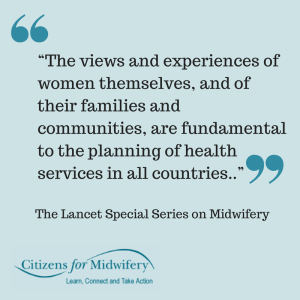
The below quote may seem obvious to birth advocates, but it is revolutionary in terms of health care. When Citizens for Midwifery shared this quote, they noted that, “One the KEY findings of the Lancet Special Series on Midwifery affirms the importance of women and their families participating in planning of health care.” For more from this special series on midwifery, go here: TheLancet.com.
10455322_10152508291549483_5155910343021300458_n(1)

And, in case we get so caught up in theorizing about appropriate care that we forget the lived experiences of the women who need it, read this tough, sobering article about why “going in pushing” does not a VBAC birth plan make:

Karen’s story is not uncommon and nor is the advice she was given about “going in pushing” but when we tell women they can not be cut unless they consent are we telling the truth? Whilst it’s true that legally the hospital can not physically force you into an operating theatre without your consent, they are not afraid to gain consent using underhand methods…

via Go In Pushing – It’s not a VBAC Birth Plan – Whole Woman.

And, of course, some relevant quotes to remember:

“If women lose the right to say where and how they birth their children, then they will have lost something that is as dear to life as breathing.” –Ami McKay

“Mothers need to know that their care and their choices won’t be compromised by birth politics.” – Jennifer Rosenberg

via As dear as breathing… | Talk Birth.

Is there anything that can be done, or are we facing an insurmountable struggle? I think we can remember that our “small stone” birth activism does matter:

While reading the book The Mother Trip by Ariel Gore, I came across this quote from civil rights activist Alice Walker: “It has become a common feeling, I believe, as we have watched our heroes failing over the years, that our own small stone of activism, which might not seem to measure up to the rugged boulders of heroism we have so admired, is a paltry offering toward the building of an edifice of hope. Many who believe this choose to withhold their offerings out of shame. This is the tragedy of our world.” Ariel adds her own thoughts to this: “Remember: as women, as mothers, we cannot not work. Put aside your ideas that your work should be something different or grander than it is. In each area of your life—in work, art, child-rearing, gardening, friendships, politics, love, and spirituality—do what you can do. That’s enough. Your small stone is enough.”

These quotes caused me to reflect on the myriad methods of “small stone” birth activism that can be engaged in as a passionate birth activist mother embroiled in a season of her life in which the needs of her own young family take precedence over “changing the world”…

via Small Stone Birth Activism | Talk Birth.

And, on a fun note, you might enjoy this lovely homebirth treasury on etsy: Home Birth by Kayleigh on Etsy. 🙂

“Thousands of women today have had their babies born under modern humanitarian conditions–they are the first to disclaim any knowledge of the beauties of childbirth…” –Grantly Dick Read, Childbirth without Fear

“I am not free while any woman is unfree, even when her shackles are very different from my own.” –Audre Lorde

“Humanizing birth means understanding that the woman giving birth is a human being, not a machine and not just a container for making babies. Showing women—half of all people—that they are inferior and inadequate by taking away their power to give birth is a tragedy for all society.” –Marsden Wagner
IMG_6046

Guest Post: Pelvic Exams Need Rethinking

June 2014 045I almost never reprint any of the random articles, press releases, and news tidbits that find their way to my email address. However, this one was too interested to skim past. Conclusion: The pelvic exam has been a standard part of a woman’s annual checkup for decades — yet it serves no clear purpose and may do more harm than good.

Considering that I’ve written about Pelvic Exams I Have Known (watch for my eventual stand-up routine, 😉 ), I found this very interesting…

UC SAN FRANCISCO
Jennifer O’Brien, Assistant Vice Chancellor/Public Affairs
Source: Elizabeth Fernandez (415) 502-6397 (NEWS)
Web: www.ucsf.edu
Twitter: @EFernandezUCSF

TO COINCIDE WITH PUBLICATION IN ANNALS OF INTERNAL MEDICINE

UCSF Commentary: Pelvic Exams Need Rethinking

The pelvic exam has been a standard part of a woman’s annual checkup for decades — yet it serves no clear purpose and may do more harm than good.

That’s the conclusion of a new guideline by the American College of Physicians (ACP) based on a review of scientific literature spanning more than 60 years. In an article to be published July 1, 2014 in the ACP’s flagship journal, Annals of Internal Medicine, the national organization of internists strongly recommends against pelvic examinations for adult women who are not pregnant and show no signs of disease.

In issuing the new guideline, the nation’s largest medical-specialty organization contends that pelvic exams rarely detect “important disease” or reduce mortality. Under the new guideline, the ACP advises that pelvic exams are appropriate for women with symptoms such as vaginal discharge, abnormal bleeding, pain, urinary problems, or sexual dysfunction.

The recommendation is expected to be controversial, according to an accompanying editorial by George F. Sawaya, MD, a UC San Francisco professor of obstetrics, gynecology and reproductive sciences, and epidemiology and biostatistics; and Vanessa Jacoby, MD, a UCSF assistant professor of obstetrics, gynecology and reproductive sciences.

“The recommendation is based on a systematic review that found no data in support of the examination but did find evidence of harms ranging from distress to unnecessary surgery,” they wrote in the commentary.

Sawaya and Jacoby point out that tens of millions of pelvic exams are performed annually at well-woman checkups in the United States but whether the exams actually benefit asymptomatic women has largely been unstudied. To help fill the void, surveys recently have sought to establish the goal of clinicians in performing the exams: some physicians contend the exams help detect benign uterine and ovarian lesions while others mistakenly say they effectively screen for ovarian cancer, noted Sawaya and Jacoby.

The editorial called into question the nature of the medical literature review by the ACP because some of the research analyzed focused on older women and failed to evaluate “the most important goal of the pelvic examination cited by obstetrician-gynecologists – detecting noncancerous masses.”

“Thus, it is reasonable to disagree with using these findings to recommend a major change in clinical practice for women of all ages attending well-woman visits,” Sawaya and Jacoby wrote in their editorial. “Many will ask ‘Have all of the pertinent clinical questions been addressed?’”

“Deciding when evidence is sufficient to conclude that an intervention should be promoted, discontinued, or submitted to further study is challenging,” they continued. “The determination relies largely on judgment about evidence quality and the likelihood that more evidence will tip the balance in making either a favorable or an unfavorable recommendation.”

Numerous routine screenings, including mammograms and prostate tests, are being reevaluated for their medical and financial value.

In their commentary, the UCSF authors stress that whether or not the new guideline actually changes current practice, it could lead to a better evaluation of the benefits and harms of pelvic exams.

“The pelvic examination has held a prominent place in women’s health for many decades and has become more of a ritual than an evidence-based practice,” said the authors.  “With the current state of evidence, clinicians who continue to offer the examination should at least be cognizant of the uncertainty of benefit and the potential to cause harm through a positive test result and the cascade of events that follow.”

UCSF is the nation’s leading university exclusively focused on health. Now celebrating the 150th anniversary of its founding as a medical college, UCSF is dedicated to transforming health worldwide through advanced biomedical research, graduate-level education in the life sciences and health professions, and excellence in patient care. It includes top-ranked graduate schools of dentistry, medicine, nursing and pharmacy; a graduate division with world-renowned programs in the biological sciences, a preeminent biomedical research enterprise and two top-tier hospitals, UCSF Medical Center and UCSF Benioff Children’s Hospital San Francisco. Please visit www.ucsf.edu.

###

Follow UCSF

ucsf.edu | Facebook.com/ucsf | Twitter.com/ucsf | YouTube.com/ucsf

Rolla Red Tent Event!

poster

On August 2, 2014 in conjunction with Rolla Birth Network’s annual MamaFest event, we will be hosting the Missouri Premiere of Things We Don’t Talk About: Women’s Voices from the Red TentI am thrilled to bring this film to Missouri and I hope many, many woman come to enjoy the Red Tent atmosphere during MamaFest. We aren’t just showing the film, we’re also having a real Red Tent event with free activities available from 4-8:00 (film itself from 6-8:00). If the event goes well, I’d love to continue hosting Red Tent events at other points during the year (perhaps quarterly). I already priestess a small monthly women’s circle and have done so for several years, but a Red Tent event would be broader in scope and open to many women of all kinds of belief systems and backgrounds.

Red Tents are safe spaces for all women that transcend religious/cultural/political barriers and just be about coming together in sacred space as women. While I personally have a Goddess-oriented perspective, Red Tents honor the “womanspirit” present within all of us. Within the safety and sacredness of the Red Tent, women’s experiences across the reproductive spectrum are “held” and acknowledged, whatever those experiences might be. (As well as menopause, menstruation, assault, grief, loss, etc.—it definitely isn’t just pregnancy related!)

In our Red Tent at MamaFest, we will have jewelry making, henna tattoos, tea, and bindis. I have a mini ceremony/ritual to do before the film starts, the film screening itself, and then a scarf dance and song to close it out. This is meant to be an inclusive setting/experience for women of many backgrounds and beliefs!

I’m still collecting red fabric and decor for our Tent and it is really exciting to me to finally be doing this, since I’ve imagined doing it for a long time! (Goodwill last week was a jackpot of red curtains!)

You can learn more about the film and about Red Tents in general by checking out filmmaker Dr. Isadora Leidenfrost’s YouTube channel.

I’ve also written some Red Tent themed posts in the past:

Tuesday Tidbits: Red Tent

Red Tent Resources

Tuesday Tidbits: Pregnant Woman

100 Things List!

mamafest 2014 flyer


Tuesday Tidbits: Pregnant Woman

May 2014 056I’ve got a whole collection of thoughts rolling around and wanting to be shared! Tonight is my teaching night, however, so I have to boil it down.

First of all, I’m 20 weeks pregnant already! I can hardly believe it, though I also feel as if I’ve been pregnant for a “long time” too. I remain in a state of being both constantly aware of being pregnant and constantly in something like disbelief or “denial.” I feel surprised when I see myself in the mirror and in my head I still feel distanced from the idea of being pregnant and the identity of Pregnant Woman. It still feels somehow “far away,” like that chapter of my life is still closed for me mentally.

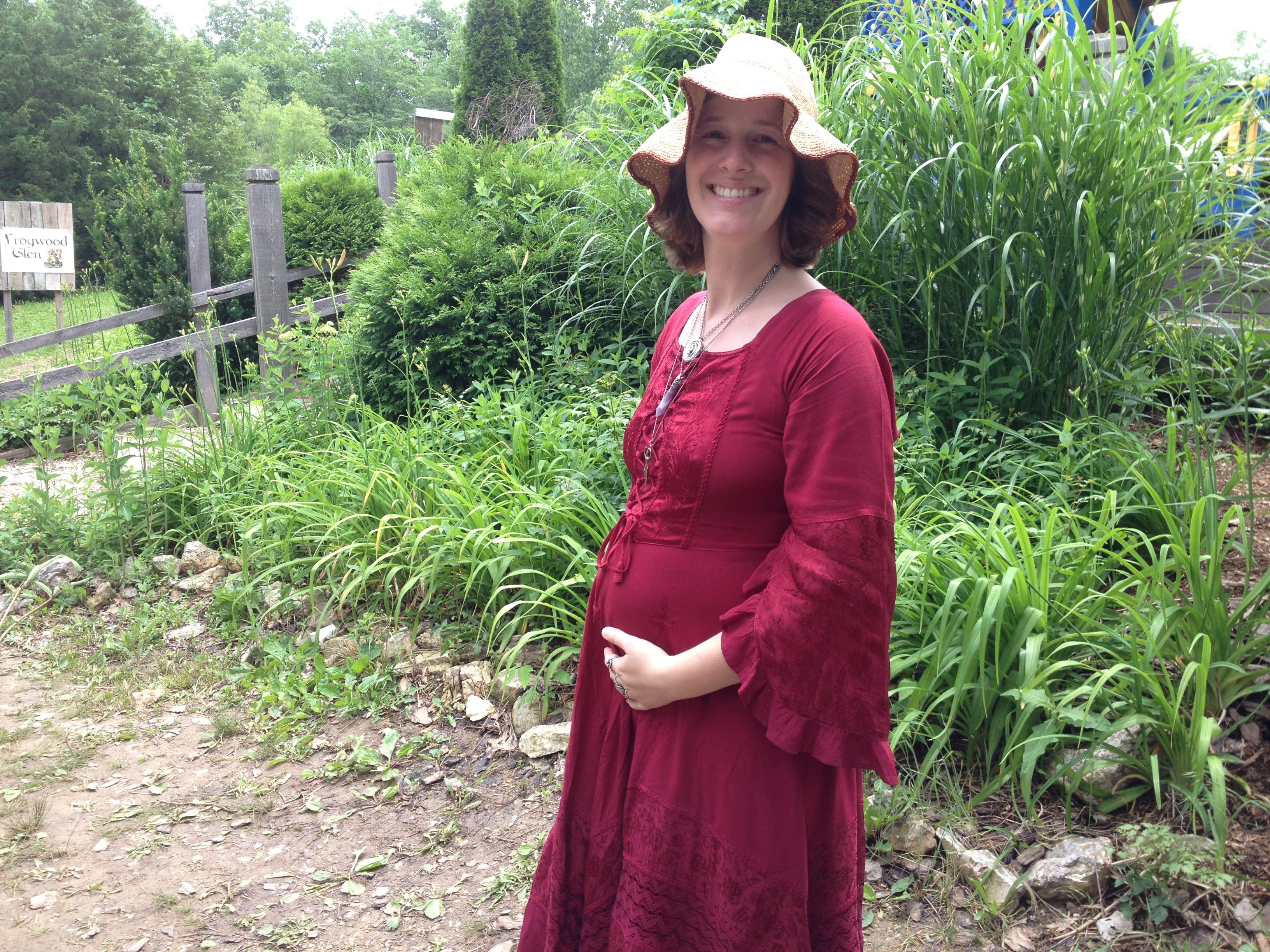
June 2014 033This picture was taken at the St. Louis Renaissance Festival on Sunday, one day before 20 weeks. I wasn’t sure my pretty Holy Clothing dress would actually still fit, but it did!

One of the reasons I decided to hire a midwife for this pregnancy was because I feel like I need to bring it back into the front of my mind and to give time and attention to this experience. I need some time to focus on being pregnant and on my new baby and have interaction with someone who cares about exactly that. I need someone to pay attention to me as Pregnant Woman and to care about me in that way that midwives do so well.

I finally added a couple of items to my Amazon wish list for new baby boy as well. I’m intrigued by this Nesting Days carrier and also by the new Ergobaby Four Position 360 Baby Carrier.

(Yes, I do still have Alaina’s Ergo, but apparently I think maybe each baby needs its own new baby carrier!)

With regard to Pregnant Woman, I took the leap and signed up for the online Sacred Pregnancy retreat training in August. I’ve thought about it several times and now feels like the right time for me—I hope to benefit from it both personally and professionally.

Signing up for this training represents another moment of Leonie Dawson‘s #AmazingYear workbook 100 Things list, ftw. I had it on my list as a tentative, but it has now become a reality.

Speaking of the Amazing Year workbook, I’m gearing up to give two presentations at the La Leche League of Missouri Conference coming up this week. I’m doing a session on the amazing year and my first continuing education eligible session on active birth/pelvic mobility. I’ve been working hard on preparing for both sessions as well as getting all of our booth stuff ready, since we’ll be having a Brigid’s Grove booth at the conference too. (Mark will be working at it while I attend sessions.) My LLL Group also has a sales table in the boutique for which I am providing most of the items and we also got silent auction donations ready over the weekend.

Back to the Renaissance Festival where some dear friends were working as pirates, I received this lovely surprise birthday gift.

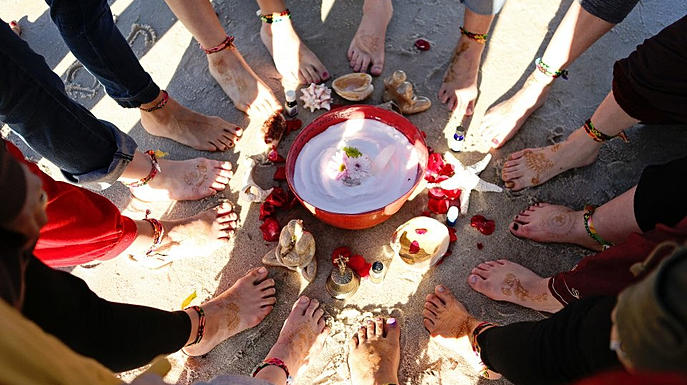
June 2014 001It is perfect for my Red Tent plans for August!

Speaking of the Red Tent, I enjoyed watching this video again today and thinking about my plans and wishes for this event:

And, surfacing from celebration and shifting to the pain women experience as part of the childbearing year, I appreciated two powerful articles this morning. The first was about a backlash to the backlash with regard to traumatic birth:

If we want to reduce the prevalence of traumatic birth experiences, we’re going to have to confront some common expectations, narratives, and perceptions around childbirth to help shape women’s beliefs and emotionally prepare them for the realities of childbirth. Childbirth is often glamorized as a spiritual journey, but physically, it is called labor for a reason. Sure, it can be a transcendent experience for many women, but it can also be a challenging ordeal involving blood, sweat, and tears, among other bodily fluids. Without adding any other stressful or complicating circumstances, childbirth already has all the necessary ingredients to be bewildering, frightening, and emotionally exhausting. And yet, because of the subjective nature of experience, two mothers can have the same events happen during birth, and one can emerge merely rattled while the other emerges with PTSD.

A good place to start with recalibrating beliefs and expectations of childbirth is with the image of an ideal birth with little pain, no complications or medical interventions, dim lights, and soft music. It’s a lovely and inspiring conception of birth, but we should also acknowledge that absolute perfection is rarely a reality. Most births don’t have complications but some do, and it is unfortunate when women feel they or their births are failures for failing to meet their preconceived notions of success. Women should strive for a birth that is manageable and meaningful, but without a sense of entitlement that it must be fast, painless, and stoic. Holding unrealistic expectations of childbirth can set women up for disappointment…

via Recalibrating Our Expectations of Childbirth | Cara Paiuk.

(Just a note that the conclusion of this otherwise powerful piece felt a little forced and a little too close to “at least you have a healthy baby” for my taste.)

And, then there was this essay about a cesarean picture on Facebook that was reported as “violent”:

This is motherhood. Raw and uncut. Refuse to be silent, show up and stand out, rip off the covers and be seen. This is the May 2014 011motherhood behind closed doors. This is the warriors path and these women are foot soldiers on the battlefield to make miracles and bring fragile lives onto this Earthen soil. Don’t let anyone tell you your birth wasn’t beautiful, that that your moment of utter transcendence wasn’t real. Never believe for a moment that you, too, did not emerge a butterfly…

via A Slightly Twisted Fairy Tale » The warrior with a scar.

The cesarean post reminded me of some of my own previous posts about Cesarean Courage. And, the piece about recalibrating childbirth reminded me of these two articles, the first about the strength found in our most shadowy “what’s ifs” and darkest places:

I’ve also come to realize that despite the many amazing and wonderful, profound and magical things about birth, the experience of giving birth is very likely to take some kind of toll on a woman—whether her body, mind, or emotions. There is usually some type of “price” to be paid for each and every birth and sometimes the price is very high. This is, I guess, what qualifies, birth as such an intense, initiatory rite for women. It is most definitely a transformative event and transformation does not usually come without some degree of challenge. Something to be triumphed over or overcome, but something that also leaves permanent marks. Sometimes those marks are literal and sometimes they are emotional and sometimes they are truly beautiful, but we all earn some of them, somewhere along the line. And, I also think that by glossing over the marks, the figurative or literal scars birth can leave on us, and talking about only the positive side we can deny or hide the full impact of our journeys. What if it was okay to share our scars with each other? Not in a fear-mongering or “horror story” manner, but in honesty, depth, and truth—what if we let other women see the full range of our courage?

via What If…She’s Stronger than She Knows… | Talk Birth.

And, the second about the many possibilities for birth regret:

I’ve come to realize that just as each woman has moments of triumph in birth, almost every woman, even those with the most blissful birth stories to share, have birth regrets of some kind of another. And, we may often look at subsequent births as an opportunity to “fix” whatever it was that went “wrong” with the birth that came before it. While it may seem to some that most mother swap “horror stories” more often than tales of exhilaration, I’ve noticed that those who are particularly passionate about birth, may withhold or hurry past their own birth regret moments, perhaps out of a desire not to tarnish the blissful birth image, a desire not to lose crunchy points, or a desire not to contribute to the climate of doubt already potently swirling around pregnant women…

via Birth Regrets? | Talk Birth.

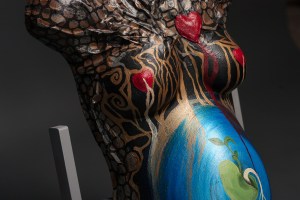
Last night, I enjoyed looking at photos from a very interesting art exhibit called Mama that explores birth as a creative process…

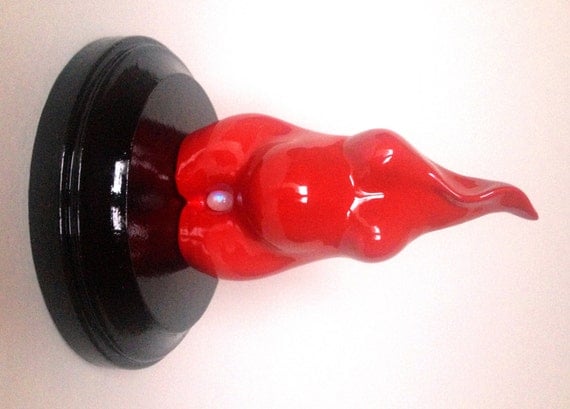
img_3628The artist has a beautiful etsy shop as well in which she sells her “mamamore” sculptures:

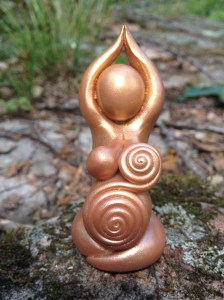
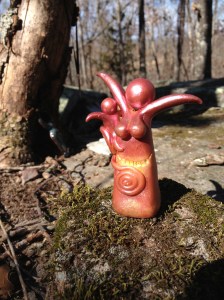
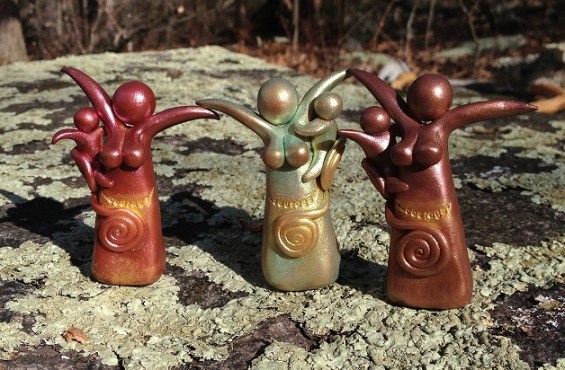
The Mamadonna in Blaze Red, on Black Lacquered Wood Plaque; Goddess Sculpture, Divine Feminine, Healing ObjectI’m currently looking into ways to reproduce some of my own sculptures, so that I can make them more readily available to women without burning myself out in the process. Here is a photo of a recent batch that mostly headed to Canada for a shop there, with a few extras that went on etsy (and a few are prototypes for possible casting in resin).

May 2014 085

May we celebrate pregnancy, birth, and motherhood in all of its unfolding mystery—both the power and the pain.

Breastfeeding as an Ecofeminist Issue: Collage Project

Processed with Moldiv

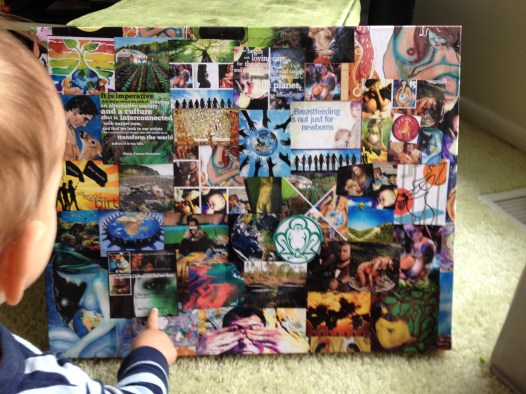
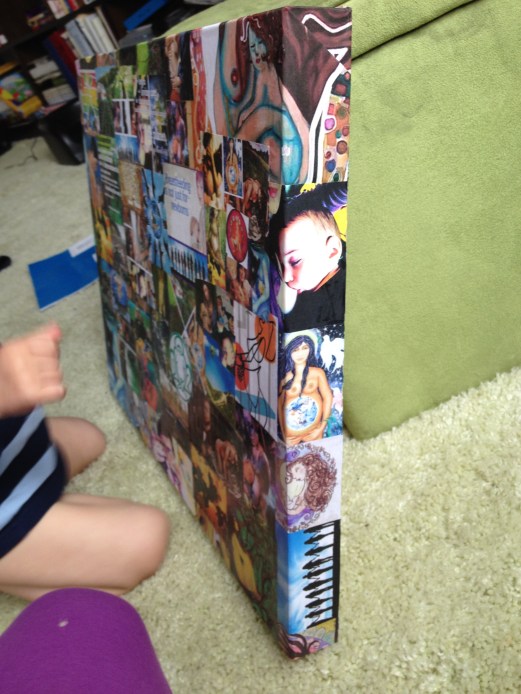
Since January I’ve been working with an independent study student from Prescott College on a self-designed course called Breastfeeding and Ecofeminism. Her class ended this month and her final project was a collage making the connection between the world body and the female body and reflecting the idea that how we treat women and their bodies as a culture is mirrored by our global treatment of the planet (and, conversely, if we change how women’s bodies our treated, our treatment of the planet will also change). As she worked on her collage, she also made a series of digital collage images for use on social media (see above), using quotes from her reading for the course.

“Governments and commercial companies will ‘invest’ billions in expensive new technology: roads, bridges, airports, dams or power generation plants, ‘for the good of society’. They may even ‘invest’ in schools and hospitals, but the crucial primary investment in the emotional, physical and mental health of all humans, which breastfeeding and mothering provide, is invisible.”

Gabrielle Palmer (The Politics of Breastfeeding, p. 333)

As my student remarked, this is an atrocity. AND, it is one that is largely “invisible” to the average person.

I also find this quote relevant from The Politics of Women’s Spirituality:

“Human life is valuable and sacred when it is the freely given gift of the Mother—through the human mother. To bear new life is a grave responsibility, requiring a deep commitment—one which no one can force on another. To coerce a woman by force or fear or guilt or law or economic pressure to bear an unwanted child is the height of immorality…If they were genuinely concerned with life, they would be protesting the spraying of our forests and fields with pesticides known to cause birth defects. They would be working to shut down nuclear power plants and dismantle nuclear weapons, to avert the threat of widespread genetic damage which may plague wanted children for generations to come…” (p. 420).

For one of her digital images, she chose one of my favorite quotes from Reweaving the World in an article that touches on birth as an ecofeminist issue:

Here are some photos of her final collage project:

photo 1 photo 5 photo 3

“Knowledge serves no purpose if it is not spread around. As the poor get poorer and the rich get richer, an entrenched ignorance is kept in place through a culture created and maintained by commercial interests.” – Gabrielle Palmer, The Politics of Breastfeeding

Thesis Tidbits: Feminism, Midwifery, and Motherhood

“Feminism catches fire when it draws upon its inherent spirituality. When it does not, it is just one more form of politics, and politics never fed our deepest hungers.” –Carol Lee Flinders (in The Millionth Circle)

Yesterday, I spent several hours finishing a blog post for Feminism and Religion regarding empowered self-care (it won’t run until next  week). It is a primarily a personal narrative, rather than a political commentary, but as I was writing it, I learned about new legislation introduced in Missouri in an effort to effectively destroy the practice of independent midwifery here. I also have a friend whose family March 2014 082 member just experienced terribly abusive treatment during the immediate postpartum period. I typed feverishly away with an absolutely excruciating headache and a million things on my mind, primarily the very many injustices experienced by women during the childbearing year. I was also left wondering HOW we can truly take care of ourselves when legislators and health care workers actively take dramatic and even cruel steps to prevent us from doing so?

Another friend wrote a comprehensive blog post about this malpractice insurance legislation and the issues involved with it. Midwifery advocacy organizations have already introduced a perfectly appropriate piece of legislation this session and do not need the proposed bogus piece of legislation that offers nothing in the way of protection for Missouri midwifery consumers and instead simply serves to drive midwives out of practice:

…Fortunately, midwives in Missouri do offer a grievance process and adhere to the practice standards set by the certifying agency NARM (North American Registry of Midwives). While there is already a high degree of professional accountability practiced in Missouri, this is because the state professional organization (Missouri Midwives Association) believes it is important and necessary for the professional practice of midwifery and not because the state has directed midwives to do so.

The state of Missouri has continued to be uninterested in working with midwives and home birth families to improve and safeguard the practice of midwifery.

Is there a better option? YES! HB 1363

Instead of HB 2189, we would like to suggest directing legislators to support HB 1363. This is a comprehensive midwifery licensing bill which does provide a mechanism for oversight and responsible, regulated practice. It also addresses the issue of malpractice insurance by requiring midwives to have coverage under the same conditions as physicians. It would also require Medicaid reimbursement for families desiring the care of Certified Professional Midwives and home birth.

via Missouri Legislature Works Against Women, Families and Midwives….AGAIN. | Midwives, Doulas, Home Birth, OH MY!.

I also recently finished a class on ritual theory for my doctoral degree program. The text for the class was To Make and Make Again: Feminist Ritual Thealogy by Charlotte Caron. In it, I was repeatedly reminded that gathering with other women in a circle for ritual and ceremony is deeply important even though it might just look like people having fun or even being frivolous, it is actually a microcosm of the macrocosm—a miniature version of the world we’d like to see and that we want to make possible. Returning to Caron, she explains something similar: “Ritual change is symbolic change, but it can lead to direct action or to ideological change, so it can be an important element in strategizing for change. One way of causing change is to re-form or alter the system. This involves recognizing that we are part of the system and that the system is dependent on feedback from its parts to keep it in balance, which means that we have the capacity to change” (p. 209).

Ritual experience can lead to practical action: spiritual praxis. But, this action does not need to look the same for all women, nor does it always have to involve large structures of society or even sweeping societal change.

“It is important to recognize that not all women will choose to act in the large structures of society. While it is hoped that all women will act toward justice, still electoral politics, lobbying, and revising the economic system may not be the spheres in which some women exert their energy. Ritual actions, raising children to be just and caring people, living in just ways in intimate and community relationships, and modeling different patterns and values are political actions to change patriarchal ideology. The choices of what spheres to devote energy to are important to honor. The constraints of women’s lives—when they are disabled, when they are dealing with past traumas, when they are raising young children, and when they are doing the many other things expected of women in our society—mean that women need to make choices that will allow them to live with integrity and well-being.” (p. 211)

A number of options of action are possible. “What is important are women’s choices to act in concrete ways in every circumstance, to know our neighbors, to raise children to be caring people, to live as if justice exists, to be just in personal relationships, and to live in the community in ways that model the values of justice and well-being for women and all of creation.” (p. 211)

As a mother who works extensively with other mothers, I appreciated Caron’s acknowledgement that raising children is a feminist act with potential to create change as well. “Another strategy for change is through raising children to be just and caring people. A media image portrays feminists as being against motherhood—but in fact, feminists make the best mothers. They raise children aware of themselves and the world, of options and values, of what justice means and how to work toward it, and how to be self-critical and self-respecting” (p. 203-204). Caron also explains that “in a just society, women would be free to make whatever decisions they needed to, for however long they needed to, in relation to political action in the public and the private sphere. All people would participate in the decision-making, and women would be supported in their decisions rather than, as sometimes happens, made to feel guilty for not doing enough or not valued for what they do.”

In connection with women being valued for what they actually do, Caron makes an interesting note about the visions women in her research hold for the future, for the possible:

“Interestingly, none of the visions described by women was based in self-fulfillment, in gaining personal power, or in one’s group having power and the expense of others. Instead, the interviewees talked about the elimination of social, economic, military, and other patriarchal problems, and about living in a world of valued individuals, healthy and diverse relationships, economic and environmental sustainability, equality for all, and shared decision-making and power” (p. 220).

Connected to these themes, one of my classic favorite quotes about women’s spirituality groups is this one:

“…Women’s spirituality groups can become birth centers for social change”

–Anne Rush in The Politics of Women’s Spirituality (p. 384)

March 2014 127

Tuesday Tidbits: Cesarean Courage

“Her courage is written on her body.” –Molly (Talk Birth)

March 2014 009Last year I made several cesarean birth art sculptures by request. It felt like a “risk” of sorts to make them, like I was trying to interpret another woman’s experience artistically, but I did it and they were well-received. I chose to imprint words in the figure’s cesarean scar because I kept thinking about how that mother’s love and hope and courage are all permanently written on her body. Recently, I had a request to make another and so I re-visited my Cesarean Courage idea and made some new figures. She is wearing her baby and her scar with pride and strength. These sculptures are not supposed to send an “at least you have a healthy baby” message, they are communicating that her birth journey with her baby is seen and acknowledged and validated.

“I became a mama goddess, too. I became a wonder of fertility, of softness, of late nights and warm beds; a body capable of unimaginable things. I labored and tore open, too.”

–Amanda King (in Being a C-Section Mama In the Birth Goddess Club)

When I shared the cesarean courage mama picture on Facebook, someone responded: Usually I look at the scar as a forever reminder of my failure. The idea my courage and love is forever written on my body in the marks of a surgeon’s knife is so transforming. I am humbled and amazed and inspired and encouraged by the ways in which birth art “speaks” to other women. It is a powerful experience and I feel so honored to communicate and share in this way. When I stopped teaching birth classes, I worried about no longer being “of service” to birthing women, but through my sculptures, jewelry, and writing, I still am doing this work and I am grateful.

Thinking about it reminded me of this wonderfully powerful photo of a mother-assisted cesarean birth in which the mother (a midwife, IIRC) caught her own baby…

You can read more in the accompanying article.

WHEN a baby is born by caesarean, the hands that lift it from the womb to the world usually belong to an obstetrician. But now, there’s someone else who can help deliver the baby: the mother.

via Delivered safely by caesarean with his mother’s hands – National – theage.com.au.

This picture and article were published several years ago and also covered in a Radical Doula post.

There are lovely photos from an online doula friend at Plenitud of a family-centered cesarean birth as well. And, two more recent posts with family-centered cesarean births here and here.

This week I was also touched to read a mother’s story of homebirth plans turned hospital birth plans turned cesarean birth after the baby developed an atrial flutter and was risked out of homebirth:

This has been a big week, with deep shifts that I’m sure will keep happening as we go through the coming days. March 2014 036Sometime in the next three weeks, I will subdivide into two women — one a mother, and one a fresh newborn infant, each with our own developing story and life path. I will find that I care more deeply about some things than I ever thought possible, and other things that were important markers of my life and identity are no longer significant. I’ll celebrate and I’ll mourn…

via Pregnancy Not-So-Blahs: My Story of Fetal Atrial Flutter | Amanda Aguilar Shank.

I knew I was going to be a mother very soon. I focused on not freaking out, and on enjoying my last moments of being so intertwined with my baby. I sent her telepathic messages of love and reassurance. I knew I wouldn’t be seeing her right after the surgery and that likely she would have to go through some trials before I could be with her again.

The operation itself was not as bad as I expected. One critical piece of my experience was having the accompaniment of a labor and delivery nurse friend, who served as a kind of impromptu doula, helping me to hold my ground when treatments being offered were inappropriate or unnecessary, and to fully embrace with less fear and more trust the life-saving help that hospital staff had to offer…

via From Home Birth to Hospital: My Story of Fetal Atrial Flutter | Amanda Aguilar Shank.

smallMarch 2014 059These mamas have taken powerful birth journeys. They have laid down their bodies for their babies. They hold their experiences, they wear them, their courage, love, and hope, upon their skin. The birth experience is there, loud and clear, and yet new experiences and joys are too. She is whole.


The Goddess of Willendorf & Does My Uterus Make Me Look Fat?

“Loving, knowing, and respecting our bodies is a powerful and invincible act of rebellion in this society.”
~ Inga Muscio

IMG_0222

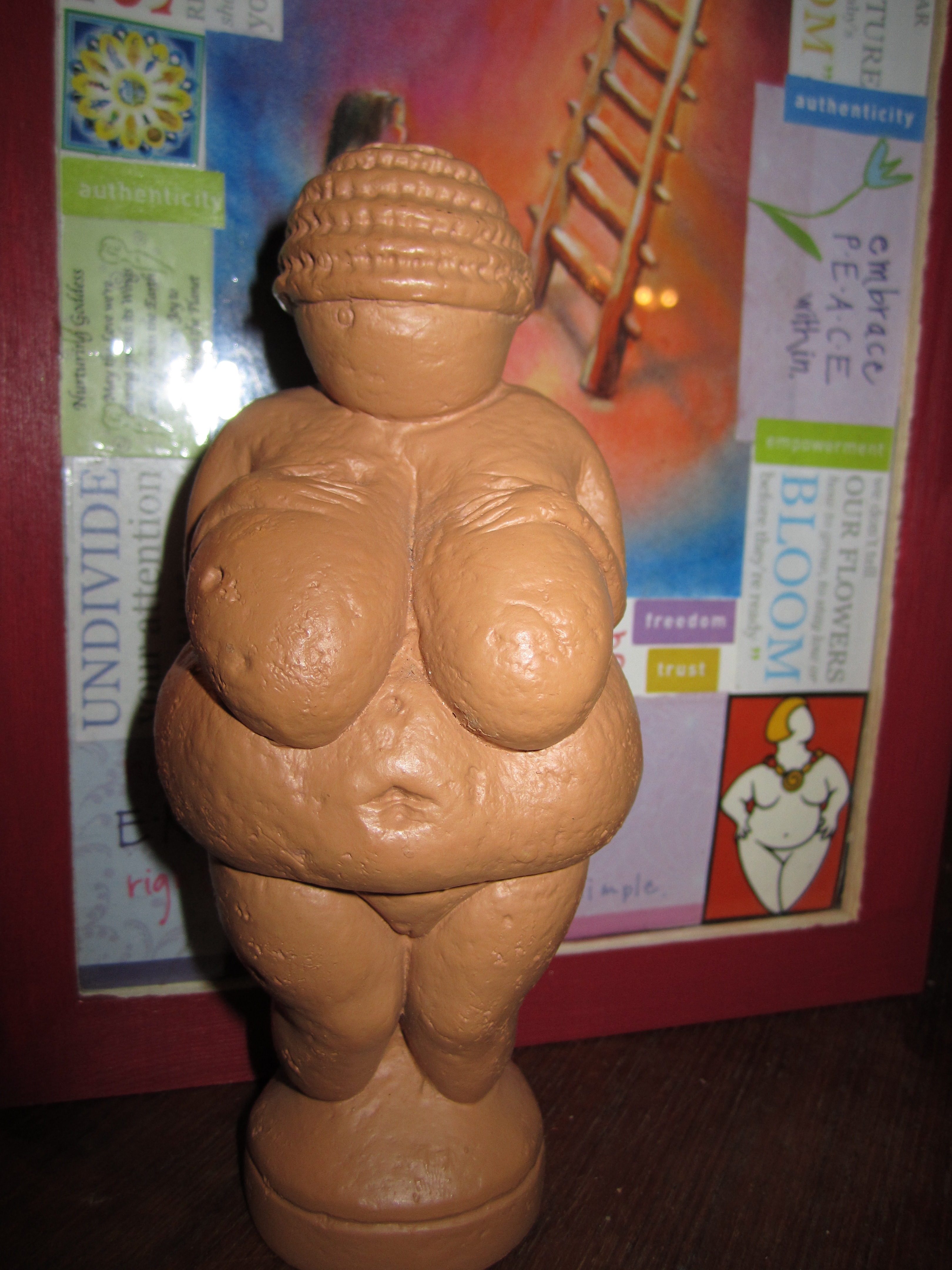
Replica on my birth altar.

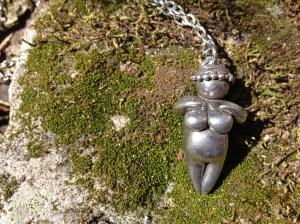
I do not remember the first time I ever saw her, but I do know that I have loved the Goddess (Venus) of Willendorf sculpture for many, many years now. I consider her almost a personal “totem.” I do not see her as a literal representation of a particular deity (though when someone uses the phrase, “Great Goddess” or “Great Mother,” she’s the figure I see!), I see her more as honoring the female form. I love that she is so full-figured and not “perfect” or beautiful. I like that she is not pregnant (there is some disagreement about this and many people do describe her as pregnant) and what I like best is that she is complete unto herself. She is a complete form–not just a headless pregnant belly–I just LOVE her. She represents this deep, ancient power to me.

In a past assignment for one of D.Min classes, I wrote:

I have a strong emotional connection to the Paleolithic and Neolithic figures. I do not find that I feel as personally connected to Egyptian and Greek and Roman Goddess imagery, but the ancient figures really speak to something powerful within me. I have a sculpture of the Goddess of Willendorf at a central point on my altar. Sometimes I hold her and wonder and muse about who carved the original. I almost feel a thread that reaches out and continues to connect us to that nearly lost past—all the culture and society and how very much we don’t know about early human history. There is such a solid power to these early figures and to me they speak of the numinous, non-personified, Great Goddess.

I know ancient goddess figures are commonly described as “fertility figures” or as pregnant, but most of the early sculptures do not actually appear pregnant to me, they appear simply full-figured. One of the things I love about the Willendorf Goddess is her air of self-possession. She is complete unto herself. She may be a fertile figure, but she is not clearly pregnant and she does not have a baby in her arms, which indicates that her value was not exclusively in the maternal role. Early goddess figurines are usually portrayed alone, it is only later that we see the addition of the son/baby figure at the mother’s breast or in arms. The earliest figures seem independent of specifically maternal imagery, it is later that we begin to see Goddess defined in relationship to children or as exclusively maternal. I think this reflects a shift that women continue to struggle with today (in Goddess religion as well as personal life) with the mother role see as exhaustive or exclusive. In contemporary society, the only mainstream representation of the Goddess that manages to survive under public recognition is the Madonna and Child and here, not only has Goddess been completely subsumed by her offspring, but she is no longer even recognized as truly divine.

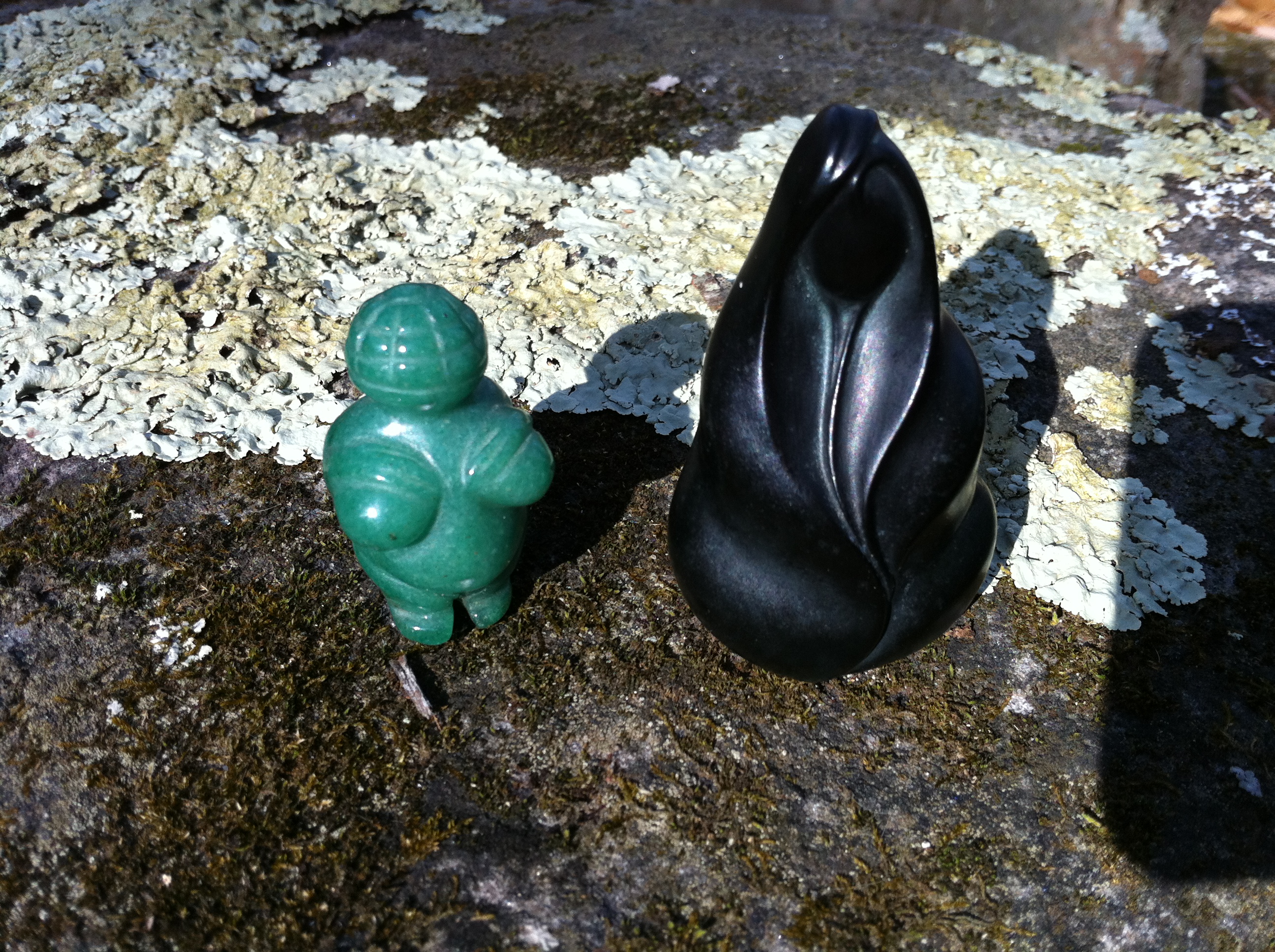
This image has been a potent affirmation for me many times in my life. One Mother’s Day, my then four-year-old son Lann found a IMG_0636little green aventurine Goddess of Willendorf at a local rock shop: “We have GOT to get this for Mom!” he told my husband and they surprised me with it that afternoon. It still makes me get a little teary to look at it, because it was such a beautiful moment of feeling seen by my little child.  When I found out I was pregnant for the third time, my husband surprised me with a beautiful, large Goddess of Willendorf pendant. I was holding onto that pendant during the ultrasound that told us that our third son no longer had a heartbeat and during my labor with my little non-living baby, I wore and held onto the pendant. It went with me to the emergency room and I could feel its solid, reassuring weight against my chest when dressed in just a hospital gown and receiving IV fluids as blood continued to come from me as my body said goodbye to my baby. I buried a goddess of willendorf bead with my baby’s body and put a matching one on his memorial necklace.

100_2269

Bead ready to go in with my baby.

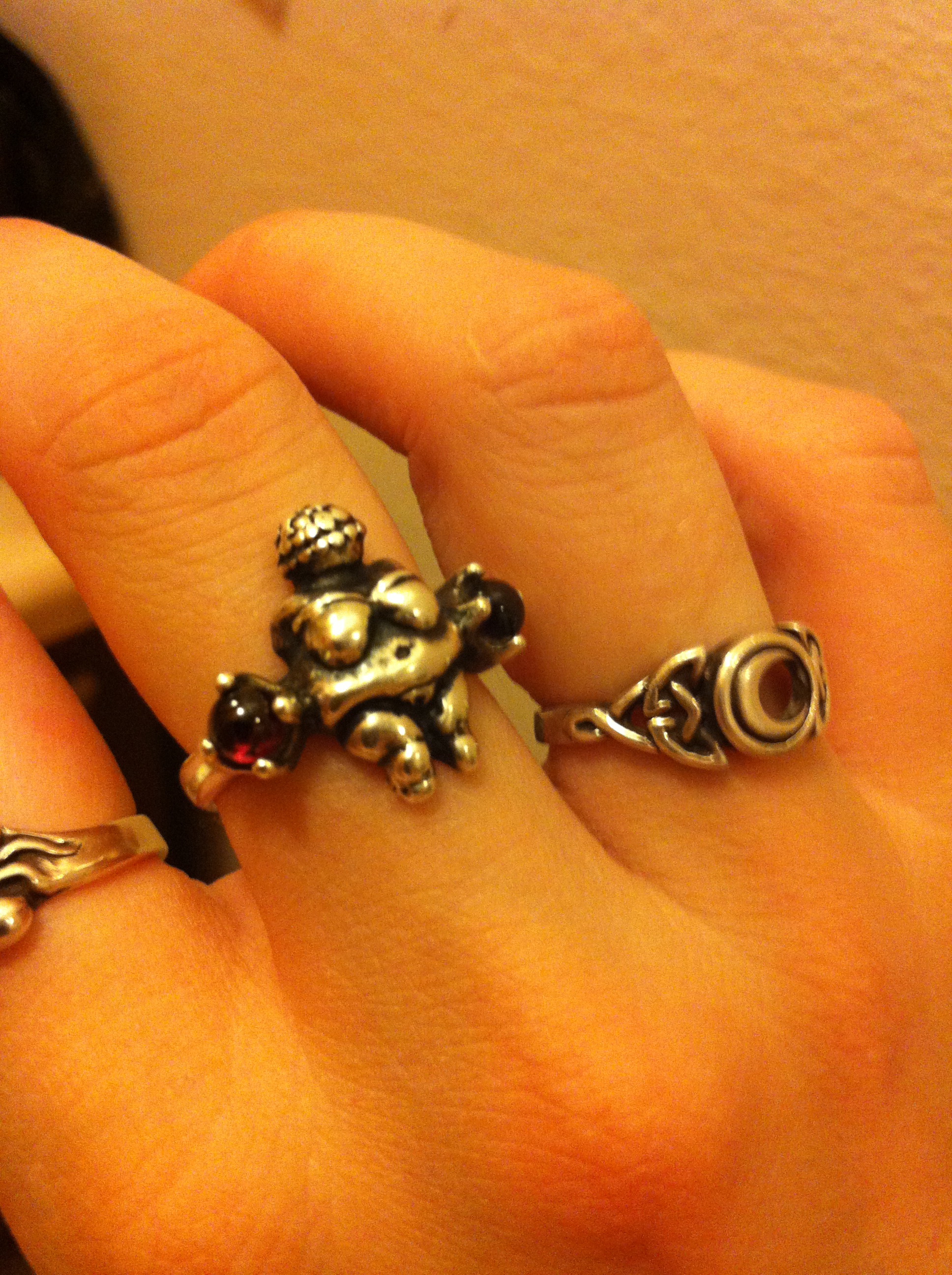
On Mother’s Day the following year, right after finding out I was pregnant with my rainbow baby girl, my husband gave me a beautiful new Goddess of Willendorf ring. I was little scared to wear it, because what if she too, became a sad reminder of a pregnancy lost (I have only worn the pendant again a tiny handful of times since the miscarriage-birth experience, even though I took a lot of comfort in it during that time), but wear it I did up to and through the moment when I caught my sweet little living girl in my own grateful, be-ringed hands.

The website that he bought the ring from went down shortly after and I’d not ever seen another ring like it for sale. However, I signed up to become a retailer for Wellstone Jewelry in 2011. While on the phone making an order, I requested one of their Venus of Lespugue pendants. The woman on the phone told me, “we don’t sell very many of those. She seems to make people uncomfortable. In fact, we used to make a ring too. A venus of willendorf ring, but no one ever wanted her. I think because 1057she is ‘too fat’ and she makes people feel weird.” Oh my goodness, I replied, I think I have one of your rings! I emailed her a picture of my hand and sure enough, though discontinued now, I’d coincidentally gotten one of the last ones ever made. She said they could get the mold out of storage and make some more custom rings just for me. Since I’m a business genius (what? You said they never sold? Sign me up for a dozen!), I immediately said yes and she shipped me several beautiful Goddess of Willendorf rings, which I then sold to several friends. (I still have two left if anyone wants to buy one! I would wear them all if I had enough fingers. My favorite ring ever!)

What does this have to do with my uterus making me look fat? Well, I’ve had the experience of wearing this ring and having another woman, a wonderful, peaceful, healer of a woman, laugh at it, like it was a joke ring. My mom sold a pottery sculpture version of the Willendorf to a man at our craft workshop and he laughed at her too saying, “this is hilarious.” Hilarious? Because she is fat, I guess? Several years ago, I read a post online titled Does My Uterus Make Me Look Fat? and I thought of my beloved Goddess of Willendorf, She of the Ample Uterus. While I can no longer locate the article itself and the post I had linked to in my drafts folder takes me to a re-direct site, I remember the article talking about how even pre-teen girls have a slight swell to their bellies. The author of the post was like, “duh, a flat belly IS NEVER POSSIBLE. THERE IS A UTERUS IN THERE.” When I read it, I thought about the jewelry woman’s comments about women not liking the goddess of willendorf ring because she is too fat. And, I saved a couple of quotes, the first two from the Our Bodies edition of Sage Woman magazine (Spring, 1996):

IMG_0243

Batik Goddess of Willendorf from a friend at my blessingway.

“…so it has been: women’s power has declined as woman’s belly has been violated and shamed…5,000 years of patriarchal culture has degraded belly, body, woman, the sacred feminine, the soul, the feminine sensibility in both women and men, native peoples, and nature–all in a single process of devaluation. Because our belly is the bodily site of feminine sensibility, our patriarchal culture marks the belly as a target of assault, through rape, unnecessary hysterectomies and Cesarians [sic], reproductive technology, legal restrictions on women’s authority in pregnancy and childbirth, and belly-belittling fashions, exercise regimens, and diet schemes…a culture that literally hates women’s guts…” –Lisa Sarasohn, The Goddess Ungirdled

“Our bodies are vessels of the sacred, not the homes of sinful urges. Our bodies create and sustain the sacred. And that sacredness does not equate with any artificial notion of bodily perfection. All of us are fit habitations for the divine, no matter what the diet doctors, fitness gurus, health good fanatics, New Age healers, and the fashion police try to force on us. If we don’t take our bodies into account in our expression of [our religion], then it becomes a mere shadow of itself. When we are fully present in our bodies [women’s religion] becomes a three-dimensional, vibrant, fully fleshed-out expression of the divine…” –DeAnna Alba in How to Flesh Our Your Magick

And, perhaps from the original Does My Uterus Make Me Look Fat article, I had this quote saved as well that addresses the “love your body,” rhetoric so often expressed, including, I suppose, in even the quote I chose to open this post:

“the fact that “love your body” rhetoric shifts the responsibility for body acceptance over to the individual, and away from communities, institutions, and power, is also problematic. individuals who do not love their bodies, who find their bodies difficult to love, are seen as being part of the problem. the underlying assumption is that if we all loved our bodies just as they are, our fat-shaming, beauty-policing culture would be different. if we don’t love our bodies, we are, in effect, perpetuating normative (read: impossible) beauty standards. if we don’t love our individual bodies, we are at fault for collectively continuing the oppressive and misogynistic culture. if you don’t love your body, you’re not trying hard enough to love it. in this framework, your body is still the paramount focus, and one way or another, you’re failing. it’s too close to the usual body-shaming, self-policing crap, albeit with a few quasi-feminist twists, for comfort.”

–saved from this post

March 2014 023
Even though I am a goddess sculptor myself, I have never been able to make my own version of the Goddess of Willendorf that satisfied me. I tried polymer clay, I tried pottery clay, I tried making my husband make one for me. None of them were right. Finally, just this month, my husband said, why don’t you make one, but using your own style? This was an ah ha moment for me and guess what, it worked! I successfully used the same technique and structure I use for all of my sculptures, but with a Willendorf-style-twist and I finally made my own sculpture that I’m really proud of. My husband made a mold and cast her in pewter and I’m wearing her right now. Her uterus might make her look fat, but to me, she is one of the most powerfully affirming images of womanhood I have ever encountered and there is nothing funny about her.

        “Your body is your own. This may seem obvious. But to inhabit your physical self fully, with no apology, is a true act of power.”

–Camille Maurine (Meditation Secrets for Women)

March 2014 022  March 2014 038

International Women’s Day: Body Prayer

I roam
sacred ground
my body is my altar
my temple.

I cast a circle
with my breath
I touch the earth
with my fingers
I answer
to the fire of my spirit.

My blood
pulses in time
with larger rhythms February 2014 040
past, present, future
connected
rooted
breathing.

The reach of my fingers
my ritual
the song of my blood
my blessing
my electric mind
my offering.

Breathing deep
stretching out
opening wide.

My body is my altar
my body is my temple
my living presence on this earth
my prayer.

Thank you.

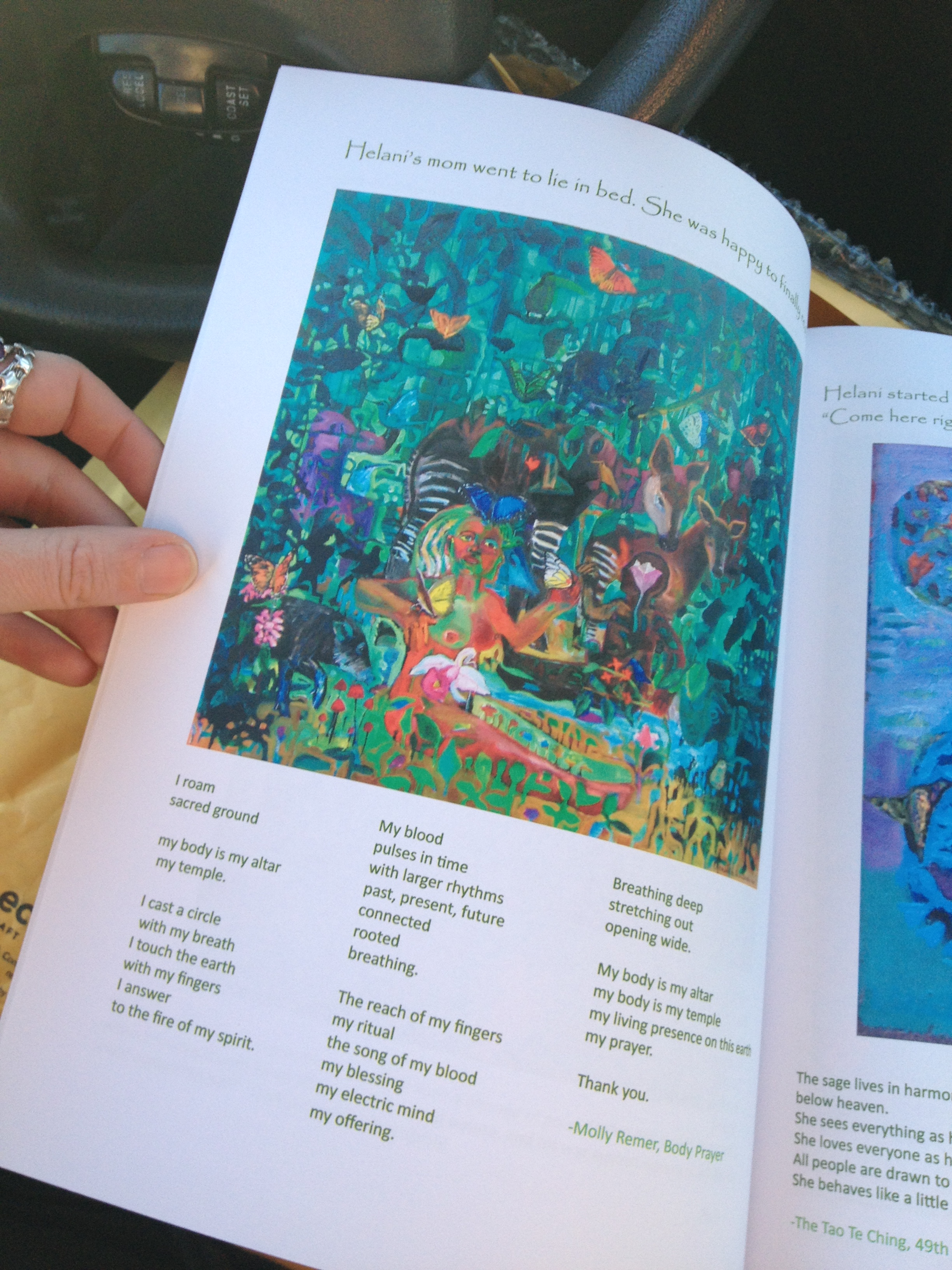
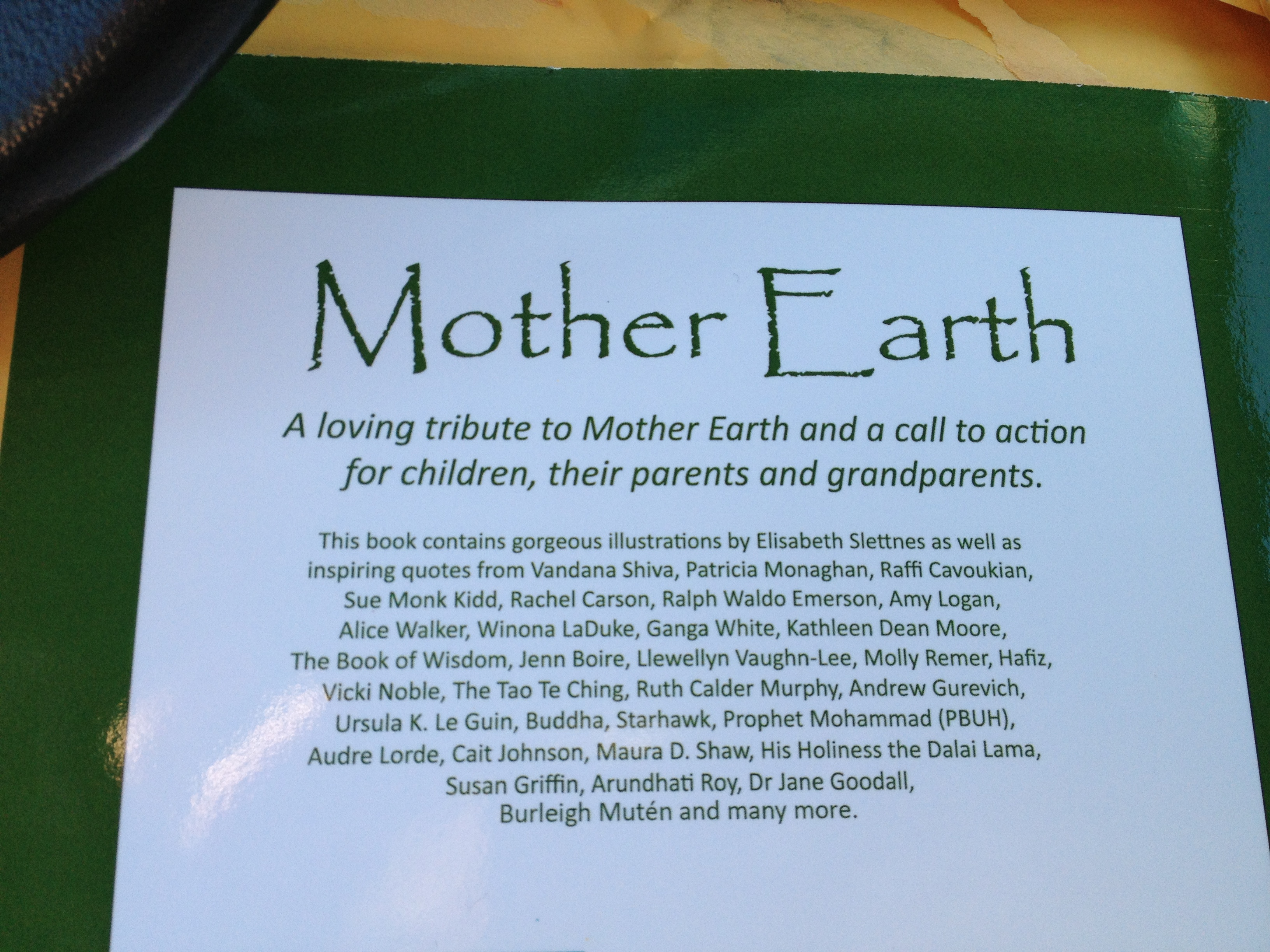
I wrote this poem in the spring of last year and was very pleased when Trista Hendren, author of the children’s book The Girl God, wrote to ask permission to reprint it in her new book: Mother Earth. I received my copy of the book last month and wanted to offer a mini-review of it today, International Women’s Day, because as Trista says, it is “a beautiful tribute to the world’s first ‘woman.’” Mother Earth is theoretically a children’s book, but it offers an important message and call to action to all world citizens. Along the top of the pages is a story, written as a narrative experience between Trista and her daughter Helani, about the (human) mother’s need to rest. The story evolves into a message about the Earth and the care and rest she is crying out for. Each page features a large illustration and below the illustration is a relevant spiritual quote, poem, prayer, or message.

February 2014 038(I got a big kick out of seeing the company I keep on the back cover…Buddha, Hafiz, the Dalai Lama, Starhawk…Molly Remer?!)


I’m still wrapping up the school session as well as preparing for a big event next weekend. I feel taut, overcommitted, crabby, snappy, distracted, and out of time for writing even though I have a pile of ideas for things to write about (always!). Trying to remember that this is normal for me during the week of final paper grading and final exam giving and does not indicate a permanent state of imbalance requiring mass quitting of everything, but that is still how it feels in my (tired) body. It was nice to revisit this poem and take some quiet time to read the whole book.

I wrote a prayer for mothers last year on International Women’s Day:

See your worthIMG_8522
hear your value
sing your body’s power
and potency
dance your dreams
recognize within yourself
that which you do so well
so invisibly
and with such love.

Fill your body with this breath
expand your heart with this message
you are such a good mother.

via International Women’s Day: Prayer for Mothers | Talk Birth.

It is also important to remember the sociopolitical purpose of this day:

International Women’s Day is not about Hallmark. It’s not about chocolate. (Thought I know many women who won’t turn those down.) It’s about politics, institutions, economics, racism….

As is the case with Mother’s Day and many other holidays, today we are presented with a sanitized, deodorized, nationalized, commoditized version of what were initially radical holidays to emphasize social justice.

Initially, International Women’s Day was called International Working Women’s Day. Yes, every woman is a working woman. Yes, there is no task harder perhaps than raising a child, for a father and a mother. But let us remember that the initial impetus of this International Working Women’s Day was to address the institutional, systematic, political, and economic obstacles that women faced in society.

via How we miss the point of International Women’s Day–and how to get it right. | What Would Muhammad Do?.

In years past, I also wrote about the connection to birth as a feminist issue:

“The minute my child was born, I was reborn as a feminist. It’s so incredible what women can do…Birthing naturally, as most women do around the globe, is a superhuman act. You leave behind the comforts of being human and plunge back into being an animal. My friend’s partner said, ‘Birth is like going for a swim in the ocean. Will there be a riptide? A big storm? Or will it just be a beautiful, sunny little dip?’ Its indeterminate length, the mystery of its process, is so much a part of the nature of birth. The regimentation of a hospital birth that wants to make it happen and use their gizmos to maximum effect is counter to birth in general.” –Ani DiFranco interviewed in Mothering magazine, May/June 2008
via International Women’s Day, Birth Activism, and Feminism | Talk Birth.

Happy International Women’s Day! May we all find the space in our day to take a deep breath and honor our bodies, our families, and women around the world who are working, working, working every day to make the world a gentler place to live. (Even if we sometimes get snappy while doing it…)

November 2013 061

Rise for Justice

1497514_10153552346400442_1148387720_nOkay, so I knew I would enjoy The Vagina Monologues. How could I not, right?! Well, I did not expect to be SO blown away by the power, presence, and passion of my magnificent friends. They were incredible. Seriously incredible. It was an amazing show!  There were many powerful moments–some very funny, some sad, some horrifying. My friend, doula, and colleague did the piece on birth at the end and brought me to tears with her vibrance and passion. There was a moment in the middle where the teenage girl member of the cast read out some statistics on the One Billion women who are raped, abused, or assaulted. Each member of the cast began to rise in turn and as they did, their friends in the audience rose with them, until the whole theater was standing. We rose for justice.

I’ve mentioned several times that I came to birth work with a core foundation in feminism and social justice work, primarily in domestic violence. I remain firmly convinced that the way we treat women in the birthplace reflects an overall cultural attitude towards women in general. I believe that peace on earth begins with birth. I believe that we can change the world with the way we greet new babies and celebrate new mothers and see the deep, never-ending work of parenting our children. I believe in rising for justice and I keep vigil in my heart every day for women around the world.

In a stroke of coincidence that gave me chills, my independent study student who is working on a Breastfeeding and Ecofeminism course submitted her weekly reflections and in it she mentioned Eve Ensler, The Vagina Monologues, and One Billion Rising with no idea that I was going to the show this week. As I read her reflections, the connection between the personal and political was so tangible that I asked her if I could use her assignment as a guest post for my blog. Part of the reason I assigned the book Reweaving the World for this course was because of how it contextualizes the issues facing women so broadly and makes this undeniable connection between exploitation of the planet and exploitation of women’s bodies. While it might sometimes trigger a sense of hopelessness and distress, I think ultimately, the contextualization is empowering. The Vagina Monologues are based on the courage of women telling their stories and sharing their truths. Likewise, I appreciate Alea’s generosity and courage in sharing her reflections with my readers…

November 2013 061

Dancing for Change: A look inside a personal exploration of ecofeminism, sexuality, and social justice.

Guest post by Alea Scarff

I began reading The Politics of Breastfeeding which sparked a series of “hell, yes’s!” It also left me feeling inspired, excited and validated that I’m not the only one with these feelings and notions about women, breastfeeding, and the injustice I witness within this issue. Her kick-ass presentation of the truth among this profound cultural issue left me enlivened and ready for action sentence after sentence.

Then I read several pages of Reweaving the World: The Emergence of Ecofeminism. Yikes. This was heavy. I suddenly found myself caught between two worlds of inherent optimism excited for positive social change, and the deep dark issues of ecology and the longstanding reality of suffering and inequality of women on this planet. I felt my body overcome with anger. A feeling of helplessness ensued. I felt those women in third world countries starving and overheated, overworked and just trying to sustain the lives of their children on top of enduring mental, emotional, physical, and sexual abuse. I felt all the children who suffer because of this. I felt all of the gender imposing rules children in the western world are conditioned by, thus tainting our hearts and souls with limitation and sharp edges surrounding who we are allowed to be in this society. All of the emotionally repressed men; all of the objectified, degraded women who have never known what it feels like to feel good in their bodies.

I began to feel my grandmother’s oppression she suffered from my grandfather in the 60s. The abandonment, the sexual abuse, the use and re-use of her as a resource and service for himself. I felt my mother’s experience of an emotionally abusive relationship, and finally my experience of sexual molestation as a child. Where was all of this coming from? A deep sadness came over me as I desperately tried to figure out my own issues with sexuality and my relationship to the world as I sat amongst strangers in this warm coffee shop. Was I angry about what happened to me? Was I angry at my partner? Past partners? Was I angry at the world? I really couldn’t identify where the anger came from, or where it was directed. I had to stop, refresh, and start over. Maybe this shit is too intense for me. Maybe I need to change my course of study.

No, no. You can’t run away. I realized I had been running from this issue my whole life and it’s finally time to recognize it. I stopped, took some deep breaths, did some yoga asanas to release the sticky tensions of injustice lurking in my joints throughout my body. Ok. Begin again.

So I went back to my childhood, with my deepest memories of the frequent encounters of gender inequality. My mother, to this day, credits me for bringing to light her own femininity and capturing her attention to the inequalities of men and women. Something that went unnoticed until I came along, however she still was not interested in changing the ways of the world to the extent I was. She had her own social change she was working on. It was entrenched in art and consciousness. Luckily, I picked up on this, and found my own desire for changing the world through consciousness. Consciousness through equality for women. How could anyone else NOT be outraged by the fact that 8 out of 10 songs on the radio were sung by men? As a twelve year old, I began writing letters to radio stations. I couldn’t understand how no one seemed to care about this absurd injustice constantly happening on the radio. Something so simple yet so powerful as radio permeated our culture – and no one seemed to notice. There were a plethora of female musicians that I favored at this age. How could I not hear them on the radio? On top of an array of social issues such as this, I always HATED those older men who would make random, confusing, degrading comments to me for others’ and their own amusement. What the hell was up with that?

I began reading an interview with Eve Ensler, the creator of The Vagina Monologues and the global women’s campaign, One Billion Rising. The figures quoted from the UN in this interview left me in a deeper outrage. One billion women on the planet today are beaten or sexually assaulted. I reflected on an article I had read earlier that week, as well about how to talk with your children about their private parts and to help prevent them from being sexually abused. The article stated that one in five girls are sexually molested and one in six boys are. I never identified with the label “sexually molested” nor did I want to admit I was affected by this, but just in the last few years when I looked at the definition, I realized, even my few small inappropriate experiences are considered just that, and they have, in fact, affected me.

I had to take a few days off. This all needed to settle inside and I had to figure out what to do with it. I spent days pondering, how do I continue to explore this crucial subject and maintain a positive outlook? How do I channel this anger into solutions for helping others? How can I continue researching and hold my strength and goddess energy as a female role model, an inspiration for my two little boys, my partner, men and women, and the planet?

This is a tall aspiration I set for myself, I realize. I suppose this is simply what I aspire to be.

I began speaking with my mother about my sexuality from a young age and my exploration of it now. It was both comforting and disheartening to discover my mother had similar inappropriate sexual experiences as a child that I endured, as well as finding she’s still on her journey of understanding this taboo topic herself, female sexuality. Perhaps a running thread in my family of women? Or is this prevalent everywhere? Why is no one talking about it? Even after being so close with my mother, and being able to talk about anything for as long as I can remember, it took some courage to bring up this subject with her. Regardless, I am so glad I did.

I began to read again. I decided I had to begin with an open heart and mind, as I swim right through the obstacles of understanding the depths and spaces of the world of women and the planet. There is a lot to be grateful for, and a lot that needs changing. Positive reflection throughout this journey can only bring more light. Letting go and forgiving my past experiences, and the oppression the women I know and love have endured, I take a step into a new beginning. I can move forward continuing to understand my path of my sexuality growing up, and what this means for me now. I feel I’ve got a long way to go, and I can sense a gap of mystery and unknown feelings sitting somewhere inside. But I’m ready to embrace and heal whatever decides to reveal itself.

I am now in the process of releasing fear and letting go. Letting go of being afraid to speak up and stand up for what’s right; of being viewed as a bitch, uptight, or simply being exposed. We as women need to start somewhere within this realm in order to ignite change. Rather than accepting these old cultural paradigms and letting them continue to thrive within this patriarchal society, it’s time to change this tired, destructive trend. As Ensler quotes in a recent interview with Deccan Aitkenhead for The Guardian, “We have one in three women on the planet being raped or beaten…We’ve all learned to be so well behaved and polite. We should be hysterical.”

Ensler launched One Billion Rising which, on Valentine’s Day in 2013 brought close to one billion women out on the streets to protest against violence towards women. Ensler’s goal is to have one billion gather on February 14th outside buildings that represent justice – police stations, courthouses, and government offices – and dance. That’s it. Where and how they dance is up to them; each is organized at a local level. In this, I found tremendous uplifting relief.

Through this personal revelation, I’ve decided to remain free – and not restrained by anger or resentment of injustice. I simply cannot move forward or flourish from that space. We must find liberation through the endurance, triumph and the celebration of womanhood. Simply. This is the only way to encourage and create change. I must release the tensions that like to creep up and burrow inside my joints and muscles. I no longer will walk around carrying this stuff – I’d rather be dancing than dwelling. This is the only way I will find my way to living up to my goddess vibration of inspiration for social change for my two little boys, my partner, women and men, and the planet collectively.

Next year on Valentine’s Day, I think I will be dancing.

“But when you suddenly understand that violence against women is the methodology that sustains patriarchy, then you suddenly get that we’re in this together. Women across the world are in this together.” –Eve Ensler