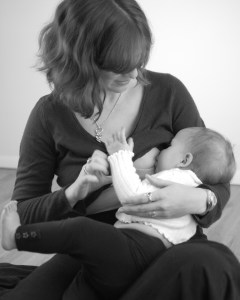
The Beauty of a Nursing Mother

“The beauty of a nursing mother can never be explained by a little oxytocin around the milk glands.” 

The Wisdom of the Body

(in a section discussing the biology and physiology of milk production and delivery)

I’ve mentioned before how very much I enjoy the Diane Wiessinger’s conference presentations. In 2007, I attended her amazing session called “Watch Your Language” that was about how we talk about breastfeeding. An example of a problem word when it comes to breastfeeding–using the word “special” to describe breastfeeding: a “special bond” a “special nursing corner” etc. and also using the word “perfect” (which communicates something that isn’t reasonable or that “real” people can’t do or live up to). She encouraged us not to “glorify breastfeeding” like this. Breastfeeding ISN’T special, it is NORMAL. A breastfed baby has a “normal bond” with its mother! Human milk isn’t the perfect food for babies, it is the NORMAL food for babies.

A long time ago I also marked the following quote to share from K.C. Compton in an article in Utne about baby boomers:

We discovered firsthand the radical nature of simple acts: Sit in the front of the bus, ask that your husband be present during his son’s birth, decide to feed your infant with your own breasts, refuse the nuclear power plant being built just up the road. We also learned how much more effective those acts can be when compounded by the hundreds and thousands, their feet on the street…

And, then this reminds me of a powerful editorial by Peggy O’Mara, urging women to see their mothering as a political act:

See your mothering as a political act. The way you talk to your child becomes his or her inner voice. The way you model acceptance of your own body becomes the way your daughter learns to accept hers. The way you model the distribution of chores in the household provides a blueprint for your children’s marriages. Bringing consciousness and awareness to the small acts of your life with your family can change the world. Your mothering is enough.

…As mothers, we think that our concerns are the concerns of the many. We have to make sure that they are. As mothers, we hope that our children are protected by society. We have to act when they are not. As mothers, we have authoritative knowledge about our own experience, an experience we have in common with millions of women. We can build a more just society on the ground of this common experience.


New Pictures!

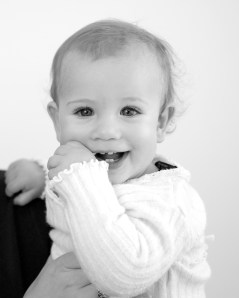
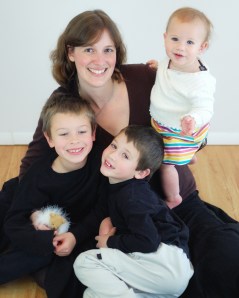
I took Alaina for a 9 month photo shoot with my friend Karen (of Portraits and Paws Photography) who also took my pregnancy photos. I really have fun getting high quality pictures that capture what our lives are like. She is able to catch expression, details, and feeling in a way that I can’t usually do with snapshots. So, even though we were thoroughly exhausted from having just returned from my sister-in-law’s wedding near Chicago), I’m really glad we did another photo shoot!

Here are a couple of my favorites from the day, including one of each of my boys (lest you think I only get pictures taken of the baby!):

(c) Karen Orozco

This one might be my favorite--I see this little face all the time, but have never really preserved it in a picture (she always looks away, it is blurry, whatever).

(c) Karen Orozco

Became very obsessed with this candy cane

What a cutie! (note, still has some candy cane)

My biggest boy!

My little Z! (He's got some pretty amazing eyelashes/eyes too!)

We're going to try to get some better family shots another day. This was at the end of the shoot and all were tired. I like it anyway though. I also think it somehow looks like a lot of kids and only one mom!

I thought this one was a cute one of me--A looks done with pictures though (and, still has some candy cane)

Guest Post: More Business of Being Born Mini-Review

In conjunction with the More Business of Being Born giveaway I’m currently hosting, I’m also pleased to share this mini-review of the first installment (Down on the Farm) guest posted by my friend and colleague, doula Summer:

More Business of Being Born

Down on the Farm: Conversations with Legendary Midwife Ina May

Reviewed by Summer Thorp-Lancaster

http://peacefulbeginnings.wordpress.com
http://summerdoula.wordpress.com

The first installation of More Business of Being Born, Down on the Farm: Conversations with Legendary Midwife Ina May, is infused with loving scenes of midwifery care, loads of vital information and even a few jokes (such as a gift referencing Ina May’s infamous “sphincter law”).  We are given an up close view of the well-known Farm in Tennessee, whose Midwives boast an exemplary track record of Midwife attended, out-of-hospital births. This record includes a less than 2% cesarean section rate in over 2500 births. Throughout the interviews, Ina May’s (and the other Midwives featured) reverence and respect for the Midwifery Model of Care is ever-present. Her passion for the safety and overall well-being of the motherbaby is palpable and stirring.

It would be impossible to cover the many aspects of birth, or even just Midwife attended out-of-hospital birth, in a full length film, let alone an episode, but this piece successfully touches on many topics and will (hopefully) lead to further discussion amongst viewers. As an activist, I found myself left with a renewed sense of action or purpose, a desire to do more and help more so that all mamas and babies have the opportunity to experience birth as the positive, loving and intimate experience it was meant to be as well as a deeper understanding of the crisis surrounding our medical model of birth. I would recommend this film to everyone, as the state of maternity care affects us all.

Giveaway! More Business of Being Born!

This giveaway is now closed: Kelli, Stephanie Lee, Luta, and Jessica (jessiegirl) were the four winners!

Today the long-awaited sequel to the Business of Being Born is released! I should have a review of the film to share with you soon and I’m so excited about this film. But, even better than a review, I am hosting a giveaway in honor of the film’s release today! More Business of Being Born consists of four approximately one hour films centering on different themes (see summaries below). We will have four lucky winners of this giveaway—one per film. Each winner will receive a code to watch one of the films for free. To enter, simply leave a comment below letting me know which of the four you’d most like to see! I will draw the winners via random.org next Monday.

Here is a little bit more about More Business of Being Born:

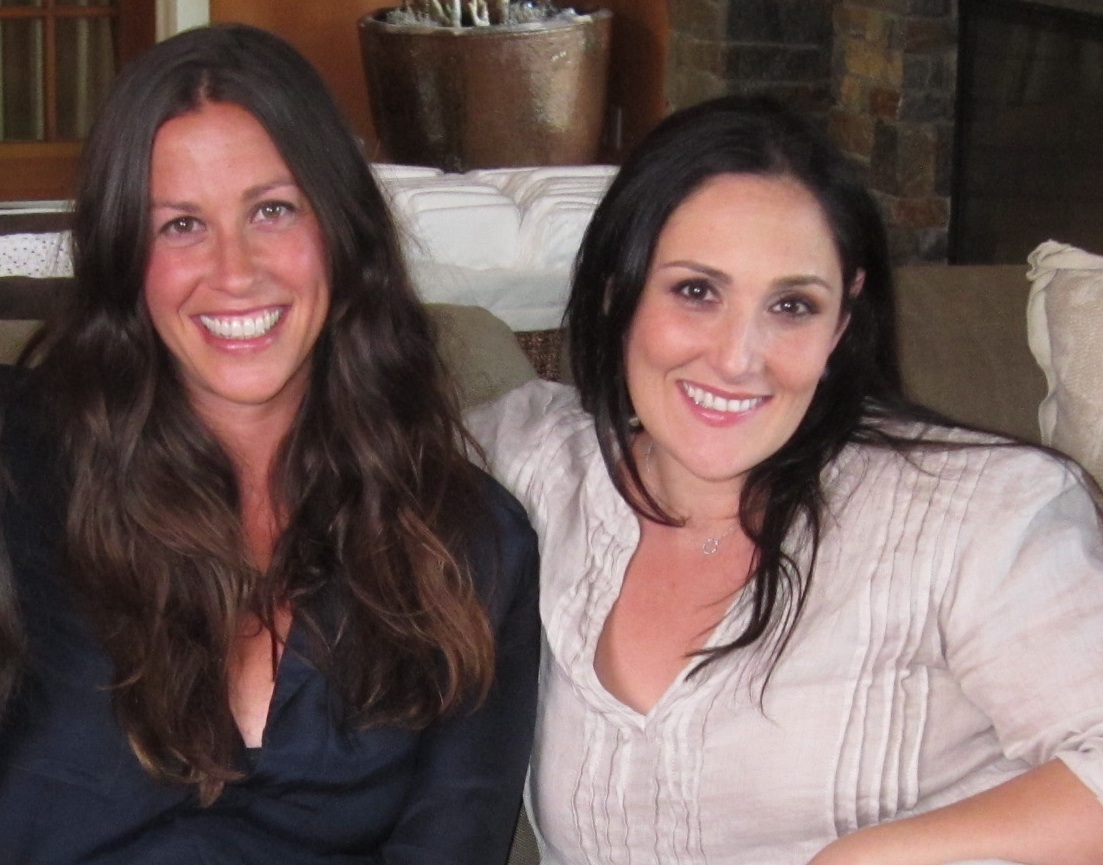
Ricki & Alanis

This release follows their landmark documentary, The Business of Being Born, with a four part DVD series that continues their provocative and entertaining exploration of the modern maternity care system. More Business of Being Born, available November 8th, offers a practical look at birthing options as well as poignant celebrity birth stories from stars including Alanis Morissette, Gisele Bundchen, Christy Turlington-Burns, Cindy Crawford, Molly Ringwald, Laila Ali, Kimberly Williams-Paisley and Melissa Joan Hart.

And, you can check out the trailer here too:

Film summaries:

DVD #1

Down on The Farm: Conversations with Legendary Midwife Ina May Gaskin

Follow Executive Producer Ricki Lake and Director Abby Epstein to The Farm Community in Summertown, Tennessee, where pioneer midwife Ina May Gaskin talks candidly about the latest birth trends and the art of midwifery. Gaskin, who was featured in the original The Business of Being Born, sparked Lake’s initial interest in natural birth and has continued to inspire the filmmaking duo’s advocacy efforts. Also on the journey is pregnant actress Kimberly Williams-Paisley, who has enlisted a midwife to attend the birth of her second child and joins the filmmakers in meeting The Farm’s famous midwives and touring the picturesque birth cabins in the woods. In the poignant final sequence, Gaskin exhibits her Safe Motherhood Quilt and calls for a deeper examination into the rising maternal mortality rate in the US. (Running Time: 55 min)

DVD #2

Special Deliveries: Celebrity Mothers Talk Straight on Birth

Featuring celebrity moms Laila Ali, Gisele Bundchen, Cindy Crawford, Alyson Hannigan, Melissa Joan Hart, Kellie Martin, Alanis Morissette, Christy Turlington-Burns and Kimberly Williams-Paisley, Special Deliveries is a collection of intimate birth stories from a diverse group of mothers. Whether they chose to deliver at a hospital, home or birthing center, these heartfelt and humorous testimonies speak to the lasting power of the birth experience. True inspiration for any mother-to-be, this group of women trusted their bodies and intuitions, taking responsibility for their birth decisions even when things didn’t go according to plan. None of these courageous women has ever spoken on the record in such compelling detail, and, on this DVD, the filmmakers weave together their passionate narratives as a celebration of the journey to motherhood that will leave viewers with a renewed sense of amazement about the power of women.
(Running Time: 74 min)

DVD # 3

Explore Your Options: Doulas, Birth Centers & C-Sections

The most comprehensive and educational DVD in the series, Explore Your Options offers birth-planning guidance around key topics such as the role of doulas (labor support specialists,) the advantages of birth centers and the alarming escalation of cesarean sections in the United States and Brazil. Epstein and Lake talk to doulas about why their profession is currently booming and uncover why having a good doula can make-or-break the entire birth experience. They look at the ever-growing rates of inductions and c-sections, which have reached 50% in many US hospitals and more than 99% in some private hospitals in Brazil. How “safe” are these cesarean surgeries, and what are the health implications for the mothers and babies? Explore Your Options examines the pros and cons of birth centers, described as a perfect middle ground between home and hospital. Special features include Alanis Morissette and Alyson Hannigan on the advantages of doulas, Christy Turlington Burns on her unexpected complications at a birth center, Molly Ringwald on how she avoided a cesarean birth with her twins and Gisele Bundchen and Michelle Alves on the cesarean epidemic in their native Brazil. (Running Time: 102 min)

DVD #4

The VBAC Dilemma: What Your Options Really Are

The VBAC (Vaginal Birth After Cesarean) has become a hot-button issue in the modern maternity care system, as one in three new mothers will give birth via cesarean section. Are all of these mothers then forced to undergo a repeat cesarean the next time around? Epstein and Lake posed that question to dozens of experts, determining the surprising truth about VBACs. They also follow several women’s stories – both those who succeed and fail at attempting a VBAC – including that of filmmaker Abby Epstein, whose first c-section delivery was depicted in the dramatic, final moments of The Business of Being Born.
(Running Time: 51 min)

Sand Tray Therapy

I hoped to finish Noah’s book before his birthday today, but I didn’t quite make it. I’m still editing the last half, adding resources to the appendix, and waiting for my husband to design the cover for me. Hopefully I will publish it by the end of the year! Instead, I wanted to share some pictures and thoughts from a sand tray therapy exercise that I did during a session at the ICAN conference in St. Louis in April. I’ve been meaning to post about it since then and haven’t found the opportunity, so in honor of his birthday seems very fitting and appropriate. The session was intentionally kept small for personal sharing and when we walked in the therapist, Maria Carella, asked if we were there to celebrate a birth or to grieve one. I said I was there for both (I had Alaina with me and she slept in the Ergo during the session). Each of us had a tray of sand and there were long tables at the front of the room full of objects and materials (like shells, feathers, and so forth). We were paired up and after arranging our items on our sand, we were asked to share our tray with the person next to us as well as the message, lesson, reflection, or insight we received from the process of making the tray. While some people used the sand in various creative ways—mounding it up, etc.—I just smoothed mine out and put stuff on top of it. The experience of sharing with my tablemate was very moving and profound. We had a lot of surprising similarities in our feelings about our births, though our stories were very different. And, our closing thoughts or insights about our trays were almost identical.

While it might be hard to see everything, I chose the bridge to symbolize my feeling of having crossed the bridge to the “other side”—meaning first the fact that after Noah and my second miscarriage, I felt separated from women who had not experienced loss by a bridge and as if I’d crossed over into new territory and left my old, happy, naive pregnant self behind (along with the other non-loss mamas. A little more about this bridge here). AND, that I also felt like with Alaina’s birth that I crossed a bridge into the  unknown and to the end of the pregnancy-after-loss journey. Her birth represented the “other side” of PAL. So, at the end of the bridge I drew a question mark in the sand, representing all the questions I had to get past and over in order to get to my new baby. The little baby on the side of the bridge represents how I still had Noah with me. He didn’t get “left behind” on the other side of the bridge, but was next to me on my journey. The spiral on the other side represents the continuous, unfolding spiral of life. Sitting by the question mark is a sort of Kachina-type figure holding many babies. To me she represents all of the babyloss mamas and also reminds me of the jizos who protect lost babies. There is also a coffin on the other side of the question mark, summing up how the fear of the death was everpresent for me and I had to pass over that fear as well to get to my new baby—my light, the candle on the other side of death. The little sparkling gems also represent my joy at her birth and what a treasure she is to me. The bone on the side of the candle represents the places where the “meat was chewed off my bones” by all my births, including Noah’s (I had just attended Pam England’s birth story sharing session prior to this sand tray session). I placed the Goddess of Willendorf figure, that I had immediately snatched off the table as soon as I spotted her, at the top to represent how my sense of spirituality had surrounded and enfolded both my experiences—She is “holding” it all. And, I explained to my tablemate how the roundness of the tray to me also represented the full circle—how Alaina’s story and Noah’s are entwined and how her birth was the “end” (of sorts) of his story, but that they are part of one whole.

View from the top

Happy birthday, tiny third son. We remember you. Thank you for opening my heart and my life for your sister to enter.

What Really Scares Me: Social Attitudes Towards Women

The following items all came across my desk (top) last week and it seemed fitting to put them into one post.

The first is with regard to the Boxing Federation wishing to make the female boxers box wearing skirts:

That’s right, skirts. The AIBA has introduced a trial alternate uniform, asking female boxers to wear skirts because it will make the women easier to distinguish from the men, as if the completely different bodies wasn’t enough. Poland adopted the uniform, calling the uniforms more “elegant” and “womanly.”

via Boxing federation wants female boxers to wear skirts – Fourth-Place Medal – Olympics Blog – Yahoo! Sports.

As you might imagine, the comments on this article with alternately hilarious and maddening (seriously, reading comments on a news article is the quickest way to both cause my blood to boil and to simultaneously despair at the future of humankind). I liked this one though:

“So I guess the AIBA thinks Americans are so stupid that when they see ‘Women’s boxing,’ sports bras, longer hair, and oh yeah, women, we can’t figure out what gender it is until we see skirts.

‘What sport is this?’ ‘Boxing…but those don’t look like men…what the hell are they?'”

But, why stop at skirts?! Why not lingerie! That’s what the Lingerie Football League is in favor of:

The LFL claims its emergence in 2009 “formally shattered … the ceiling on women playing tackle football.” Thankfully, the visionaries at the LFL have devised a way to offer such athletic empowerment to our younger generation with their decision to start a youth league:

“With the growing popularity around the LFL, younger and younger girls are starting to dream of playing LFL football,” its website reads. “In recent months and years, parents of young ladies routinely contact LFL league offices inquiring about everything ranging from what size football do you use to what form of training should I place my daughter into now to prepare her for LFL Football. [sic]”

…Look, I know we can’t shield our little girls with a protective glass box and expect them to never be exposed to the harsh reality that at some point in their lives, probably sooner rather than later, they will viewed as sexual objects. But do we need them to feel it before they know how to multiply double digits? I can appreciate that the LFL youth league will be fully clothed, but just the mere association with the word “lingerie” will instill in the girls that one day, if they want to play with the big boys, they’ll be forced to strip down to do so.

via Talking Smack — Are you ready for some T&A? – espnW.

What an excellent concluding point. This article reminded me of the sexyfication of Halloween costumes for girls in recent years. And, also of conversations recently amongst my friends about “appropriate dress” and how restricting girls’ clothing choices is damaging too, just like clothing that objectifies girls/women is damaging. We usually conclude that dressing in a way that makes YOU feel good is what matters (and being able to make your own choices about what that is). When think about things like the LFL though, I just wonder if it is even possible to tease it apart anymore—are girls learning that there is any other way to feel good about themselves other than how they look while playing football in a bra?! Likewise, we’ve also had conversations about how little girls are often complimented on their clothes and how “cute” and “pretty” they are and much less often about how brave and smart and strong they are. But, likewise, sometimes it is also nice to be told you look cute or pretty—when I feel cute or pretty it feels nice to have that acknowledged rather than to be ignored PCishly. I think it is hard to tell where it comes from.

So, this brings me to my third disturbing experience. I frequently receive press releases about a variety of products related to pregnancy, birth, parenting, and women’s health. Some of them I write about, some of them I don’t. I usually refrain from posting about the ones I find ridiculous or insulting, because I don’t want to have this be a place in which I mock things and I also don’t want to insult or point fingers at the press people who contact me with these “news” items. However, in the context of the above, I cannot help but mention that I received a release about a new procedure for those of us who are seeking, “completely new buttocks” with just two quick, nearly painless doctor’s visits! According to the release:

Dallas, Texas, October 28, 2011 – A stitch in time can re-align. At least, that’s the concept behind a new minimally-invasive cosmetic procedure to lift and shape the buttocks called the Brazilian Thread-Lift.

“I’ve never seen anything this quick and this dramatic,” says Dr. Bill Johnson at Innovations Medical in Dallas. “After two simple, 45-minute procedures using only local anesthetic, a patient can completely re-shape her backside.”

During the first visit, while under local anesthesia, the patient has several specifically-designed sutures or plastic threads strung under the skin and across each buttock. The entire procedure takes less than an hour. The threads have a series of thin knots covered by tiny cones which can be placed easily and with minimal discomfort. The cones create small fibrotic areas that function like little ligaments. After three months, the patient returns for an equally-brief follow-up visit, during which the physician gently tightens each thread, providing a smooth, even lift… (emphasis mine)

While they term it “small fibrotic areas,” I read purposeful internal scarring in the name of “beauty” or sexiness and I find it deeply disturbing. What does it say about our cultural attitudes towards women that anyone would desire OR promote purposely creating scar tissue in your butt so that you look more “youthful”? Because, after all, nothing says youthful and sexy like fibrotic areas that help pull your butt fat into place.

And, this reminded me that on a recent trip out of town we passed a “women’s health office” of an OBGYN. In largest print on the clinic’s sign was, “laser hair removal.” Ah, yes, because the most pressing mission of a women’s health surgeon should be to rid the world of excess body hair. That really inspires confidence. And, it also makes me wonder what is happening socioculturally, that anyone would consider it appropriate to see a physician for hair removal. How could we possibly be having a national health care crisis when such fabulous services are available on every street corner?! Considering that being pregnant and giving birth are medical conditions requiring “delivery” via the medical model of care, I guess it is not such a leap to think that those pesky stray hairs could also warrant medical attention. Perhaps we will reach a point in the future where anything having to do with women and their messy, excess hairy, birthy, butt fatty bodies will be dealt with by professionals. Wearing skirts.

Birth Fear

“…if you want to know where a woman’s true power lies, look to those primal experiences we’ve been taught to fear…the very same experiences the culture has taught us to distance ourselves from as much as possible, often by medicalizing them so that we are barely conscious of them anymore. Labor and birth rank right up there as experiences that put women in touch with their feminine power…” -Christiane Northrup

Since it was just Halloween, I wanted to re-post some things about fear and birth that I shared on another blog a couple of years ago. I encounter a lot of women who are very scared of birth, particularly of the pain of birth. Grantly Dick-Read’s Fear-Tension-Pain cycle has influenced the teachings of most natural birth educators and most people readily connect to the idea that fear leads to elevated tension in body which leads to increased pain (more about fear-tension-pain in a linked post below).

One of my favorite birth books, Birthing from Within, has several sections about coping with fear. The author’s idea is that by naming fears and looking them in the eye rather than denying they exist, you shift your thinking from frozen, fear-based, thoughts to more fluid, adaptable coping-mechanisms. There is a useful handout based on her ideas available at the Transition to Parenthood site.

I also think of this quote from Jennifer Block:

Why is it that the very things that cause birth related morbidity rates to rise are seen as the ‘safe’ way to go? Why aren’t women and their doctors terrified of the chemicals that are dripped into their spines and veins—the same substances that have been shown to lead to more c-sections? Why aren’t they worried about the harm these drugs might be doing to the future health of their children, as some studies are indicating might be the case? Why aren’t they afraid of picking up drug-resistant staphylococcus infections in the hospital? And why, of all things, aren’t women terrified of being cut open?

I actually was afraid of these things, which is part of why I didn’t go to a hospital to have my babies!

I hope some day all women will be able to greet birth with confidence and joy, instead of fear and anxiety. This does NOT mean denying the possibility of interventions or that cesareans can save lives. And, it also doesn’t mean just encouraging women to “trust birth.” Indeed, I  read a relevant quote in the textbook Childbirth Education: Research, Practice, & Theory: “…if women trust their ability to give birth, cesarean birth is not viewed as a failure but as a sophisticated intervention in response to their bodies’ protection of the baby.”

Here are some more good quotes from Childbirth without Fear:

A well–prepared woman, not ignorant of the processes of birth, is still subject to all the common interventions of the hospital environment, much of which places her under unnecessary stress and disrupts the neuromuscular harmony of her labor.

It is for this reason that thousands of women across the country are staying home to give birth…Women are choosing midwives as attendants, and choosing birth centers and birthing rooms, in order to regain the peaceful freedom to ‘flow with’ their own labors without the stress of disruption and intervention. Pictures on the wall and drapes on the window do not mask the fact that a woman is less free to be completely herself in the hospital environment, even in a birthing room. The possibility of her being disturbed is still there.

The women in labor must have NO STRESS placed upon her. She must be free to move about, walk, rock, go to the bathroom by herself, lie on her side or back, squat or kneel, or anything she finds comfortable, without fear of being scolded or embarrassed. Nor is there any need for her to be either ‘quiet’ or ‘good.’ What is a ‘good’ patient? One who does whatever she is told—who masks all the stresses she is feeling? Why can she not cry, or laugh, or complain?

When a woman in labor knows that she will not be disturbed, that her questions will be answered honestly and every consideration given her, then she will be better able to relax and give birth with her body’s neuromuscular perfection intact. The presence of her loving husband and/or a supportive attendant will add to her feelings of security and peace, so she can center upon the task at hand.

Childbirth without Fear was originally written in the 1940′s. The quotes above are just as relevant and true today.

Related posts:
Fear & Birth
Fears about birth and losing control

Fathers, Fear, and Birth
Fear-Tension-Pain or Excitement-Power-Progress?
Cesarean Birth in a Culture of Fear Handout
Worry is the Work of Pregnancy

Motherhood as Meditation

I sometimes use my blog as a way to “store” things that I’ve read and want to remember later–or, come back to and re-discover later. I’m slowly making my way through a book called Meditation Secrets for Women and this morning I read the following:

…a mother is naturally drawn into simplicity meditations when she has small children. A hundred times a day you are forced to surrender, to slow down and pay attention…A mother must continually let go, not only of rigid scheduling but in the deepest movement of her heart. The maternal bond is a powerful primordial instinct…Each day is a little death and a challenge to live in trust. When a mother learns to accept this process and allows herself to be changed by it, her heart is softened and stretched. This demonstrates again how women’s awareness of the preciousness of life leads us into a natural spirituality that does not have to be manufactured or enforced.

I was just thinking on Friday about just how many things I let go of every day. It is still painful to do–I’m not softened and stretched enough yet, I guess–but I also feel impressed with my own ability to accommodate and enfold. Knowing how many letting gos are required daily also doesn’t stop me from starting out the next day with just as many plans as the day before though.

I’m experimenting with making this post using my phone…did it work?!

Related posts:
Surrender?
Book Review: Mindful Motherhood
Book Review: 10 Steps to Joy and Inner Peace for Mothers
Breastfeeding Toward Enlightenment
How to meditate with a baby

20111030-124905.jpg
My baby zen master 🙂

Spirit Doll

Traditional Akuaba figures

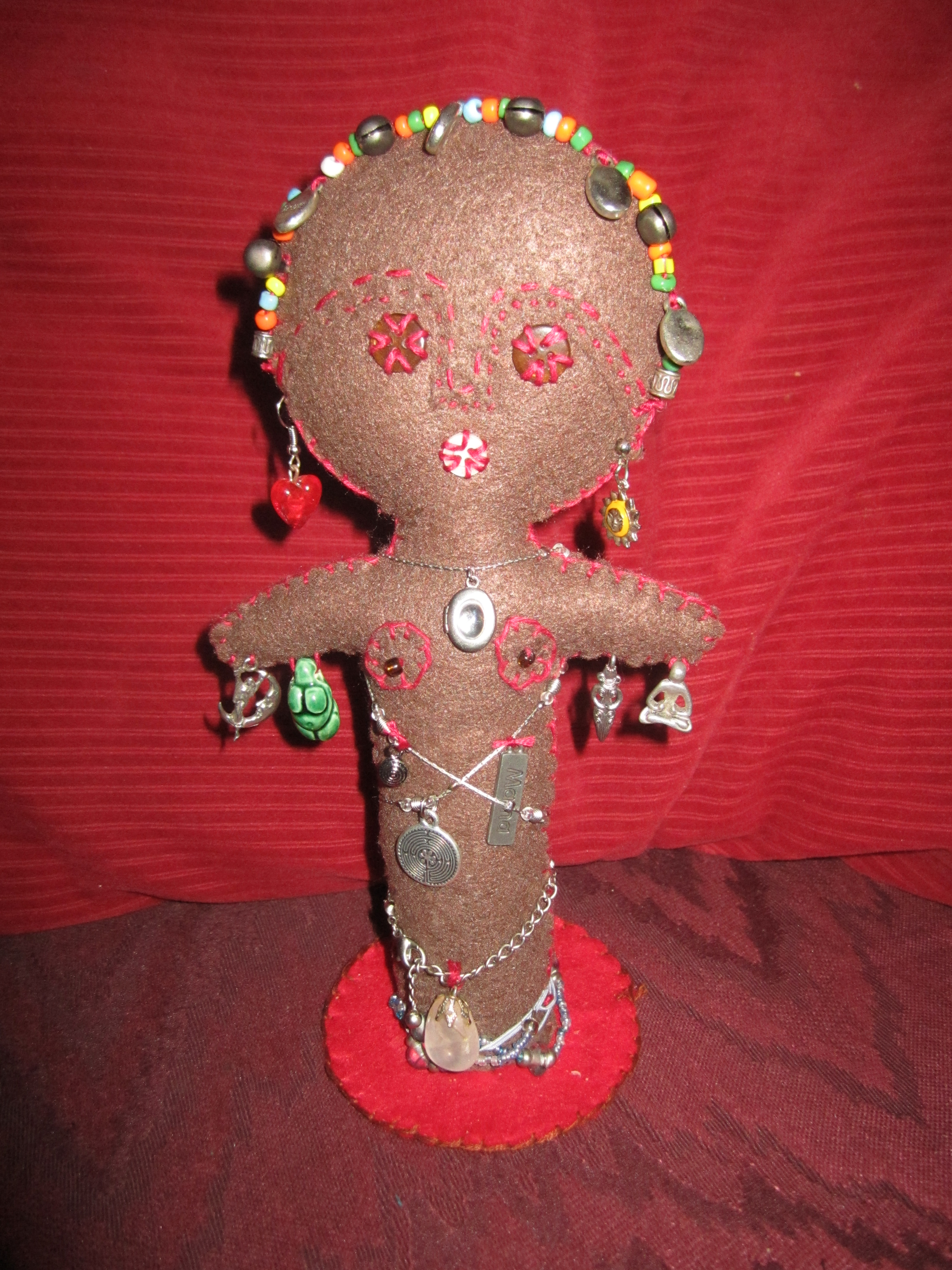
In the summer we started working on spirit dolls at our women’s retreat. I have always wanted to make one in the style of an Akuaba—an African fertility goddess-type figure—however, I felt like it would be quicker to make a different style and so that was the one I began working on in the summer. After letting her languish for months without finishing her, I realized after our fall retreat that I really wanted to make one according to my original vision. So, in two days, I worked feverishly and made this little beauty:

I love her! She’s just what I wanted to make. My boys say she looks like a gingerbread voodoo doll and she kind of does. That’s okay. I know what she really is!

Happy Halloween!

This time last year I was entering the third trimester of my pregnancy. It feels almost surprising to me to look back at my pictures and posts from that time. I love having it be my past experience now—it feels great. And, in some ways it seems so far away that it is hard to believe that it was just last year. I’ve reposted several links from old posts to my Talk Birth Facebook page recently because of that feelings—I’m like, remember just LAST YEAR you were PREGNANT??!!

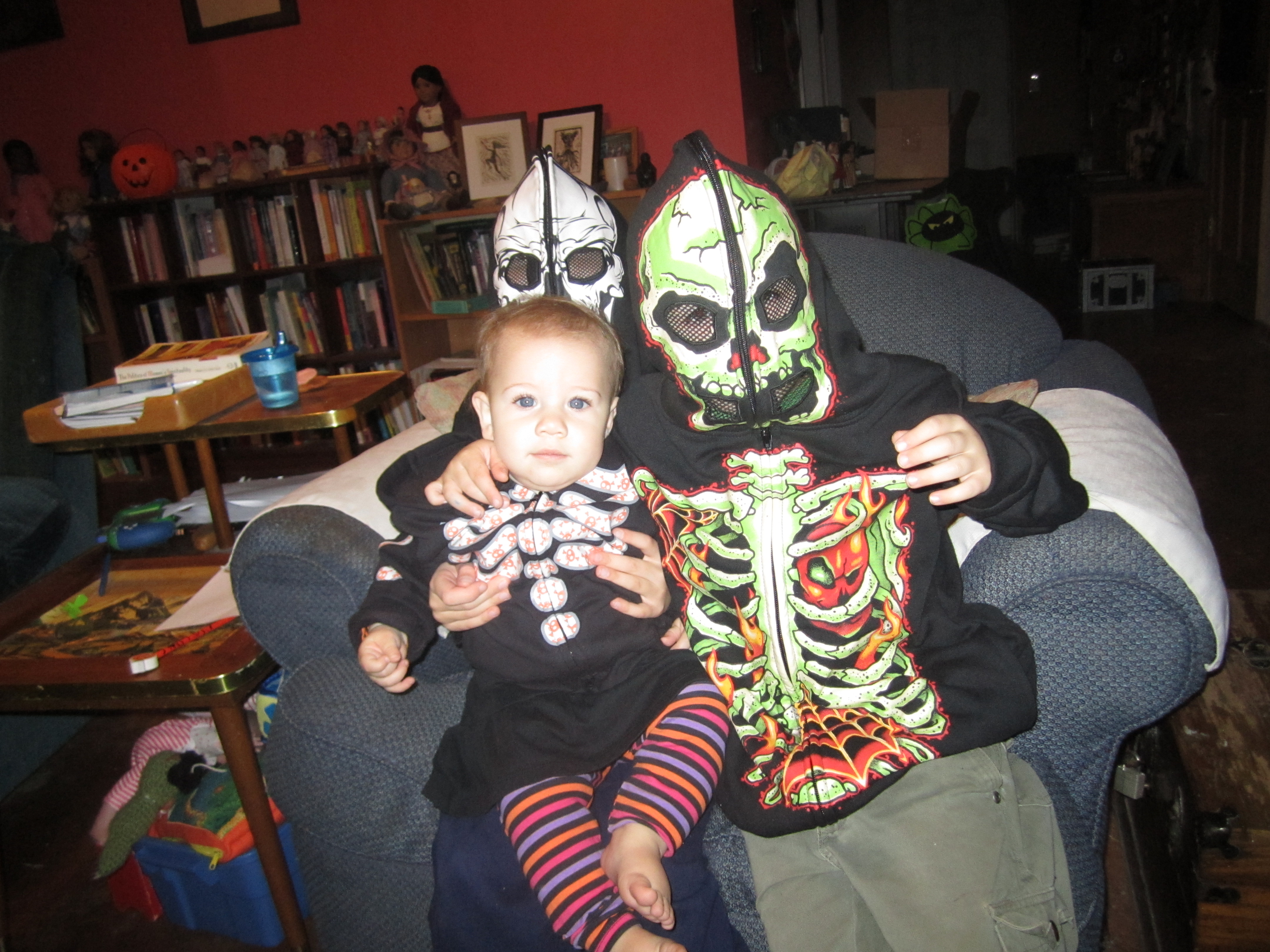
Today was our playgroup Halloween party again and here we are (Lann took the picture so isn’t in this one):

Yes, I have three troll pins on 🙂

When my first son was three, my friend sent him a skeleton sweatshirt that glows in the dark. He wore it for about three years! Now, it has passed on to my younger son and he has been wearing it for a year. So, imagine the delight when we found these cool sweatshirts at KMart this week. I got one for each of them (these glow in the dark too) and I couldn’t resist getting a smaller skeleton sweatshirt for Alaina as well. (Hers doesn’t have the cool hood-mask though.)

Three little skeletons!