Product Review: PumpEase Hands Free Pumping Bra

This review was written for Talk Birth by Amanda Prim of the blog Raising a Green Bean in a Material World.
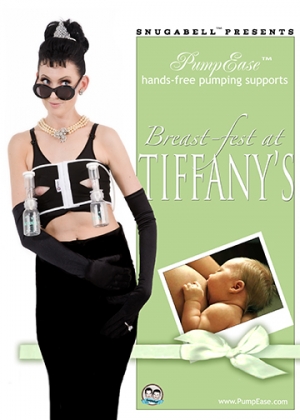
They say necessity is the mother of invention and I believe that may be true.  At least it was for me when I had to pump breast milk to feed my son every two hours ‘round the clock.  For 15 minutes every two hours I was tied to the kitchen table pumping.  I couldn’t see the TV, I couldn’t have a snack, I couldn’t read, all I could seem to do was sit there holding these plastic horns to my breast.   After a few days of that I just couldn’t take anymore so I decided there had to be a better way.  I whipped out an old sports bra, cut an “X” over where my nipples where and presto! a hands free pumping bra.  I was pretty proud of my ingenious plan, until my husband came in the kitchen, took one look at me and started laughing so hard he had to sit down.  Then I just felt stupid!  I loved that I could have a snack or read a book while I pumped while wearing it, but I HATED that I had to get completely undressed from the waist up to put it on and use it. I also HATED that when I wore it I looked like Madonna in a bad 80’s music video.

I was offered the chance to review a PumpEase Hands Free pumping support.   As a full time college student I have to do a lot of pumping when school is in session so I jumped at the chance to do the review.  I was very happy to see that PumpEase accommodates moms with breast sizes from 32AA to 48H.  That was great news for me because it seems like you can seldom find nursing bra’s for anything bigger than a D cup. I wear a 42 E bra and I ordered a size large in the PumpEase.  It is loose enough to be comfortable but tight enough to hold the “horns” of the pump in place.

I ordered mine in the “Snowy Leopard” print.  When it came in I fell in love with the print and the feel of the bra.  The material is soft and almost silky feeling and has some stretch to it.  I had expected it to fit like a traditional bra with openings at the nipple for the pump.  It turned out to fit more like a tube top than a bra.  It latches in the front between the breasts and is just one piece of material.  My favorite part of the design? You can wear it OVER your regular nursing bra, so there is no need to undress from the waist up to pump!!! When my husband saw me pumping in this bra he didn’t burst into laughter.  He raised one eyebrow (his attempt at being seductive) and growled then said he sure liked that pattern.

Overall I love this bra!  I think the color/design selection is fabulous and I love that I can still feel pretty while pumping (a hard combo if you asking me!).  It is easy on and easy off so pumping is a breeze.  The sizing is wonderful because it easily accommodates us bigger girls.  I would suggest that if you are on the borderline of sizes (say between a medium and a large) that you choose the smaller size.  The bit of stretch in the material will allow it to fit snugly and you won’t have to worry about it being too loose.

Amanda Prim

http://avinsmomma.blogspot.com/

What To Do When Newly Pregnant and Wanting a Natural Birth…

Last month, a friend of my younger sister’s emailed to ask some questions about natural birth. She is newly pregnant and very interested in her birth choices (yay! How exciting!). I shared a couple of ideas with her and thought I would share them with my blog as well:

It can be hard to know where to start—there is SO much information out there. I would suggest getting a good, informative book—though I haven’t yet read it myself, Your Best Birth is a new book that is supposed to be good and very “balanced” at helping you make the choices that are right for you. I also have a suggested reading list here.  Mothering Magazine’s Having a Baby, Naturally is also quite good. Speaking of Mothering Magazine, their discussion boards are PACKED with good information and they all come from a natural/holistic perspective (a lot of other message boards have more of an “epidural soon!” culture). You can join a “due date club” there, etc. There is a whole forum just for birth stuff (and a subforum for homebirth), etc. Good resource, as is their entire website. Other good guides include Lamaze’s book Giving Birth with Confidence. One of my favorites as a really good “basic”/intro guide for pregnancy and birth is Pregnancy, Childbirth, and Newborn by Penny Simkin. A brand new edition is out, so think about checking it out!

Particularly if you plan to have your baby in a hospital, a doula would be a really good addition to your birth “team.” Doulas provide non-medical labor support and are there just to support YOU and what you want. It is really good to have continuous labor support. And, she does not replace your partner—he has his own “journey” to take into becoming a father and having a doula there frees him of a lot of the pressure of trying to be your “doula”—he can just be there with you, loving you, rather than trying to remember all kinds of stuff from books!

I would also suggest finding a good independent childbirth educator to take birth classes from when you get closer to your due date (one who doesn’t work in a hospital—it doesn’t matter if you plan to give birth in a hospital, an educator who works for herself instead of for somewhere else, is better able to give you complete information instead of just teaching about the “rules” of that particular location). Read more about “why independent classes” here.

Most of all, spend time celebrating your changing body and marveling at its inherent wisdom. Take time each day to “tune in,” draw inward and connect with your baby. Honor your natural rhythms—eating when you’re hungry, resting when you’re tired. Be gentle and loving with yourself. Know that you already have everything you need within you and strive to create a birth environment that encourages that inner wisdom to blossom and fully respects your right to freedom in birth.

Of Birth & Bugs

I included this story as part of a previous post about how women learn about birth, but I wanted to share it as a separate post because it gets lost as side note in the other post:

Doula in Disguise?!

A powerful pre-birth lesson in my body’s wisdom actually came from an assassin bug (of all things!). Assasin bugs have very potent, posionous bites (and in some countries carry hideous diseases). During my first pregnancy, I was bitten multiple times as I slept by one of them. I had bites on my face (lip) as well as in a row on my arm. The bites caused swelling, ongoing stabbing pain, and joint aching (as well as intense palm-of-hand and sole-of-feet itching when they first occurred).

I turned this into a practice experience for myself in coping with labor—figuring that, like labor, this was something uncomfortable and out of my control, but that would eventually pass and that my body would take care of without my needed to actively do anything about it. The stabbing pain was also intermittent (like a pulse), so I thought that was good practice too. I practicing “softening” around the sensations and “being” with the discomfort. I reminded myself that my body knew what to do and that it would heal itself. And, guess what? It did. Each day as the bites healed, I would marvel, “look how much my body knows! Look what it can do without me even knowing what or how it is doing.” Of course, it took several days of stabbing and aching pain for this process to occur, whereas my first labor involved only 5 hours of intense sensation as well as several preceding hours of totally manageable sensation and my subsequent labors only involved 2 hours each of fairly intense sensation.

This experience in watching my body take care of itself using its own inherent wisdom was a potent (and unexpected) lesson for me in approaching my first birth. I learned almost as much from it as I did from the books I read and the classes I took!

Why Do I Care About Birth?

Some time ago I wrote a post on the Citizens for Midwifery blog about medical control as acceptable, in which I pondered the question of why do we care about birth, if many birthing women themselves don’t really seem to care? Why do we make it any of our business what other women choose to do with their births? And, is it any of our business anyway?

Well, I’ve been doing some thinking and I made and shared a list of why I care on the CfM blog. However, I wanted to go ahead and share my reasons on this blog as well. This is why I care about about other women’s births:

  • Because women are suffering (birth trauma is real–see organizations like Solace for Mothers–and postpartum mood disorders are very common).
  • Because babies are suffering–late pre-term births are increasingly common due to induction, many babies experience at least some post-birth separation from their mothers (which is not their biological expectation), and many babies spend time in the NICU. Infant mortality rates, especially for minority babies, are higher than in other industrialized countries.
  • Because breastfeeding is suffering and thus public health is suffering (see my previous article on the birth-breastfeeding continuum)
  • Because the physical costs of our current birth model are high (morality and morbidity rates are higher than necessary due to high volume of cesareans and many physicians and hospitals do not practice evidence-based care–continuing to deny laboring women food and drink and continuing to use Cytotec for inductions for example).
  • Because the financial costs of our current birth model to society are high–birth is a multi-billion dollar a year industry. Some facts from CfM:
    • Over four million births in the US each year (26.4 births per 1000 women aged 15-44 years in 2004).
    • Second most common reason for hospitalization of women.
    • Care for mothers and babies combined rank 4th for hospital expenses.
    • Hospital costs for deliveries mounted to more than $30 billion in 2004. More than 30% of births by cesarean section. ranking seventh highest total on the “national bill” for procedures (over $17 billion per year).
    • Of all births, 99% take place in hospitals, 90% are attended by obstetricians.
    • Over 6 million obstetric procedures are performed – the most common category of surgical procedures.

The percentage of births paid for by Medicaid varies from state to state but can be as high as 50% or more in some states. Coverage by all insurers (Federal government, Medicaid, private, HMOs, etc.) varies; many will not reimburse for OOH births, and when midwives are covered, the reimbursement rate is only a percentage of the rate for physicians. We all pay for births, including unnecessary interventions and preventable complications and injuries, through our taxes, health insurance withholding, and individual policies.

  • Because women’s birth memories last a lifetime (see Simkin, Not just another day in a woman’s life).
  • Because women deserve better.
  • Because I know in my heart that birth matters for women, for babies, for families, for culture, for society, and for the world.

Conference Blessings

This past week, I attended my first CAPPA conference (this one was in Charlotte, NC). I’ve been a member of CAPPA since 2004 and the thing that first attracted me to membership was the FREE annual conference. Now, six years later, I finally took advantage of going to one! I think it will be an annual tradition for our family 🙂 On the closing day of the conference, the MC asked us to consider how we had each been “blessed” at the conference this year and then to turn to the person next to us and share how we had been blessed. I thought of several things right away:

  • Meeting people face-to-face that I previously only had online contact with. There is no substitute for in person contact. It was great!
  • Attending Barbara Harper’s presentation on “Leave Well Enough Alone: Natural Third Stage.” It was VERY good. I also particularly enjoyed Andrea Sharpe’s presentation about empowering teen mothers and Barbara Hotelling’s “Your Body has the Power to Give Birth.”
  • Winning a birth bracelet from the Birth Behind Bars booth. They had an interesting project going on where you could submit a tip for the upcoming book 101 Ways to Support a Woman in Childbirth and have a chance to win a bracelet (as well as to get a nice purple “For the Love of Birth” lanyard for your name tag too). I love to win stuff and the bracelet is pretty 🙂
  • The between-session contacts and conversations. In addition to learning good information from the actual sessions, there is no substitute for the conversations that arise during breaks in the day—I met several really wonderful people just accidentally this way and I had some good, in-depth conversations about teaching methods and resources that would have been impossible to have if I’d only attended the sessions and then gone straight back to my room.
  • Being in an environment with 300 other women who also believe that birth matters.

With Barbara Harper

With Barbara Harper

The Future

I enjoyed reading an article called “The Future of Midwifery” by Judith Rooks and Kitty Ernst in the December 1999 edition of the IJCE (another find from the previously referenced big binder of back issues). The conclusion of the article was as follows:

It is said that the best way to predict the future is to create it. Creative forces come from our souls, our beliefs, our values, our moral and spiritual strength, and from the scientific evidence available to us at any given time. If we are to meet the challenges ahead, each of us must weigh authoritative pronouncements and popular opinions against the available scientific evidence, temper it with our own beliefs and values, and chart a course drawing on our collective moral and spiritual strengths. Change is often shaped not only by what we do but by what we do not do. The future of midwifery and our children’s care in childbirth is in our hands today. To be silent is to speak. To do nothing is to take action. (emphasis mine)

Sometimes it seems as if I am saying the same things over and over and trying to reach people who may or may not want to be reached. I found the above quote a good reminder that continuing to pursue change in birth practices is a worthwhile endeavor.

Opening for Birth

Some time ago, I bought several large binders of back issues of The International Journal of Childbirth Education (ICEA‘s publication). The December 2001 edition of the IJCE contains an article titled “The Pelvis Revisited” by Elizabeth Noble. An interesting article overall, I particularly enjoyed the language of the section titled Opening for Birth:

“Birth is what women do. Women are privileged to stand in such power! Birth stretches a woman’s limits in every sense. To allow such stretching of one’s limits is the challenge of pregnancy, birth, and parenting. The challenge is to be fully present and to allow the process because of inner trust. How can women find their power, claim it, and stand firm in it throughout? The vertical position comes again into prominence. Women must ‘stand up’ for what they want and ‘on their own two feet’ by refusing to take their birth ‘lying down’! Being upright is essential for pelvic power–psychological strength, pelvic mobility, gravity’s assistance, pelvic pump efficiency, and the hygienic downflow of bodily fluids.”

In the September 1999 issue, the article “Belly-Dancing Through Pregnancy: A Way to Give Birth and Not Be Delivered” by Gaby Mardshana Oeftering caught my eye. In it, she also addresses the needs to build inner trust and to open to birth through physical movement and an active approach to birthing:

“Women expecting their second or third child don’t necessarily need this [traditional prenatal classes]. They are looking for a way to relax, find their inner selves, and get better acquainted with their bodies, their babies, and the process of birthing. When allowed to move during childbirth, many women instinctively start moving their pelvis in hip circles which are typical of belly-dance…All soft and gentle belly-dance movements are beneficial to pregnant women; for example, hip circles, the various hip-eights, and hip rocking. The rule is: all horizontal movements relax the uterus; vertical movements excite it. Physically speaking, all these movements strengthen and mobilize the pelvis and the legs and train the pelvic floor. They also activate deep abdominal breathing…the hip movements demand a lot of attentiveness and body awareness. On a mental level, this leads to better consciousness of tension and relaxation—a body feeling that is needed during birthing.”

Recently, I feel myself intrigued by the possibilities of working with these women—those who are on their second or third pregnancies and who are seeking to “go beyond” traditional birth class information (that often assumes first baby status). I know that I, personally, have wanted new, fresh, inspirational birth information during each of my pregnancies—labor and birth 101, stages of fetal development, or even labor support and comfort measures isn’t “enough” for me anymore (and wasn’t after my first baby). The desire to honor the pregnancy experience, prepare for the birth experience, and to work with psychological and emotional elements of childbearing are still very much present though! I envision doing a series of “pregnancy retreat” type of things or other types of workshops that “go beyond” and help second, third, or fourth time mothers to spend some dedicated,special attention to each pregnancy and birth experience in a personally enriching and rewarding way 🙂

An Encouraging Thought…

Some time ago I read the book Teaching Natural Birth. In it, the author shares this thought about the importance of teaching families about birth:

“We are not ‘hobbying’ or ‘playing house.’ We do this not because we like people or like babies, but because there are earthshaking issues involved in the way our culture is giving birth and raising its children…We are playing for keeps and the stakes are high. We are professionals. We matter. Always and indescribably.”

I do not view my birthwork as a “hobby.” I view it as my career/profession. I have noticed a tendency of people outside the “birth world” to look upon it as a hobby however. Reading this quote was a nice reminder that this work is important!

The Womanly Art of Breastfeeding & Nursing Johnny Depp

I’ve already shared this all over Facebook, but wanted to mention it here too because I’m that excited 🙂 Quite some time ago the authors of the newest edition of the LLL classic, The Womanly Art of Breastfeeding, contacted me to see if they might include a partial version of my essay “Nursing Johnny Depp” (previously published in Literary Mama) in the book. Of course I said YES! The Womanly Art has been published since 1958 (that is more than 50 years) and it thrilled my little heart to be a tiny, tiny piece of that world-changing history. I have six copies of the WAB (different editions—including two of the old blue-covered editions) and so what a bonus to have another copy, but this time with my own voice within it. The book was released on July 13 and my copies have arrived in the mail. The excerpt of my essay was actually used as the introduction to the “Nursing Toddlers” chapter of the book and I feel proud to be part of it. (I was also humbled to see my name in the acknowledgments section, since, seriously, I really did hardly anything.)

I first read the WAB when I was pregnant with my first baby in 2003. This newest edition is updated with a very contemporary feel and an engaging style. One of the things I like about it is that it is so practical and a lot of the suggestions are very simple (yet, not necessarily obvious). It is written in the mother-to-mother support format that is the hallmark of LLL and the very core of the organization. I like that the book includes personal experiences from a variety of mothers as well as all kinds of suggestions based on what, “some mothers have found.” Those are the kind of suggestions a new breastfeeding mother needs—not advice or directions or orders or “prescriptions,” but information about what other mothers have found helpful—she can then take what works for her and her baby and leave the rest. Love it!