Tag Archive | birth

Tips for Emotional Well-Being During Pregnancy

I got a lot of wonderful responses to my question about emotional well-being during pregnancy (associated with my giveaway of the book Birth Space, Safe Place). So, courtesy of a lot of wise women, here are some top tips for supporting your emotional well-being during pregnancy and birth:

  • Peaceful Beginnings doula services shared “I think my best tip for emotional well-being during pregnancy (and life in general) is to let go of guilt. We can only do the best we can with the information we have at the time, no more, no less.”
  • Yasmel shared that her most helpful tip, “would be to find whatever gives you positive thoughts and use it, a lot. I loved the book Ina May’s Guide to Childbirth and whenever I started second guessing my homebirth decision, I would open it up and just read the birth stories in it.”
  • Heather appreciated a helpful tip from her sister: “I was having alot of people question my birthing choices and telling me that my baby and I were going to die. None of which happened. She told me that ‘you can’t expect people to agree with your choices or behave respectfully about them. All you can do is know that you are doing what’s right for you and your child and that is all the matters. Don’t let them change your mind with fear. It has no place in childbirth.’”
  • And I especially enjoyed Ahmie’s advice: “remember that cats purr while giving birth. Figure out what makes you ‘purr’ while you’re pregnant and find ways to do more of that as well as to bring those tools to the birth-space with you.”
  • One of the most simple and yet important tips was shared by bubbledumpster, “Trust yourself,” and echoed in several other comments, such as earthmothergypsy who said, “I think one of the best helps emotionally is to encourage mamas to trust in themselves, their bodies and their babies. By giving them support in a way that they don’t feel undermined they can build the above trust in themselves.” And inoakpark who said, ” learning to trust your body (and trusting the people who will be with you at your birth to hold that space), is vital for an emotionally secure pregnancy and birth.”
  • bee in the balm offered another elegantly simple tip “to breathe, just take the time to come back to center and be and breathe.”
  • Nicole d shared that her best tip is “meditation on good/safe birth… the normalcy and miraculous nature of it. So much of pregnancy stress is uncertainty and fear of the birth process. The more you can trust in the process of pregnancy and birth, the more joyful and peaceful pregnancy can be.”
  • For Lee-Ann, “emotional wellbeing came with knowledge, the more I read and the more I normalized the birth process in my mind, the more research I did, the more confident and at peace I became.”
  • Rebekah made an excellent point about honest during pregnancy: “I think being open and honest with yourself and talking to your baby openly helps. It benefits no one to ‘pretend’ like everything is perfect and is okay to have trials, doubts, and fears.”
  • Jessica benefited from midwifery care: “One of the things that helped me a lot was having a midwife that I knew and trusted implicitly. I knew that my body and my baby would know what to do, and that I had a wonderful woman who would let it all unfold!”
  • And whoz_your_doula pointed out the benefit of taking time for yourself: “For me that took the form of meditation and prayer. The early morning is my time for deep reflection before the house begins to stir.”
  • A similar tip was shared by Gentle Beginnings: “I feel it is very important for a woman’s emotional well being to take a few minutes each day to spend time alone. To sit quietly and think about the precious child growing inside them, to disconnect from the world, to envision how peaceful they want their birth to be, to take a stroll in nature and to connect with their inner self. I think we can all benefit from these simple suggestions, but feel it is especially important during pregnancy and childbirth.”
  • Helpful for birth educators as well as couples, Janet shared that her favorite tip is “teaching the mom and her partner to work together towards open and honest communication before hand. I find a lot of the mothers I teach think, ‘Oh, well we talked about it once and I think we are on the same page,’ only to be completely blind-sided afterwards. Keeping these lines of communication open before, during and after pregnancy makes for a much better emotional state for all.”
  • Jamie moved us back to the trust theme: “Trust yourself. Trust that your body knows how to be pregnant and how to give birth. Be positive in the changes your body is going through and how you are being prepared for motherhood in all facets of your being. Know that you can do this—you are doing it!”
  • And another excellent and simple tip was shared by Heather Richins: “My tip is to make sure you stay well fed and hydrated. It is hard to feel good emotionally if you don’t feel good physically.”
  • Deborah had more than one to share: “1) Eat well: increase protein and raw fruits & veggies, and drink lots of water. Decrease refined foods, white flour products and sugars. 2) Exercise: walk, swim, yoga, etc. 3) Talk: find someone you trust and be honest about how you are feeling.”
  • And finally, Kathy offered a comprehensive collection of tips: “to be conscious of their needs each day. This includes physical,emotional, and spiritual. For the physical; Eat well. Whole foods, including whole grains, fruits, vegetables. Protein intakes needs to be adequate for a pregnant woman on a daily basis. Eating often to keep your blood sugars level is especially important for warding off mood swings. For the emotional; Trust yourself and others who care about you. Surround yourself with positive people who support you in what your doing. Communicate your needs and wants. Be willing to be honest and vulnerable. Pregnancy can often ‘stir the pot.’ Being willing to work out your feeling and talk to someone you trust and bring about personal growth and sometimes, bring about healing the past. For the spiritual; It is just as important for the spirit to be fed, as it for the body. Fellowshipping with others of the same faith is uplifting to the spirit. Take time for reflections and meditations each day. Keep a journal.”

I appreciated all the responses and think that emotional well-being is such an important subject. I feel like, especially with a first baby, it is an often overlooked element of birth preparation—a lot of time and energy is spent on the physical health of the pregnant woman, but the emotions are assumed to kind of take care of themselves, to perhaps be no one’s business, or to be dismissed summarily as “crazy pregnancy hormones” and “mood swings of pregnancy!”
Cesarean Trivia

Anyone who is even slightly familiar with the history of childbirth in the modern world has probably heard the legendary story of the pig-gelder Jacob Nufer and the first successful cesarean section (performed on his wife in 1500). Successful because both mother and child lived, which had never before been documented to happen with a cesarean—and took quite some time to happen again. For example, there was a 100% mortality rate for cesareans performed in Paris for 89 YEARS (1787–1876). I’ve read several excellent books about the history of birth and feel fairly well-versed in the associated facts. However, this month I finished reading a new book by pediatrician Mark Sloan and was surprised to learn something completely new about the history of the cesarean section. This was that, the well-known legacy of Jacob Nufer notwithstanding, the first well-documented successful cesarean section performed in the English-speaking world was performed by Dr. James Barry in Cape Town South Africa in 1826. James Barry was quite the character, small of stature and very big of opinion and personality. He was a British Army officer who clashed frequently with everyone over everything (including even fighting duels!). He even had public arguments with none other than Florence Nightingale! And…then…the conclusion to this already interesting tale is that after Dr. James Barry died—after his forty year medical and military career—it was discovered that he was actually a woman!

I found this extremely fascinating. (I also imagined Jill at Unnecesarean using her Photoshop talents to make some kind of image about this…) So, despite the dominance of males in the medical profession, the first successful cesarean in the English-speaking world was actually performed by a woman! A point the author brings out in this discussion is that, “Here in the early years of the twenty-first century we have reached a point of high medical irony that would not be lost on James Barry: it now can take more courage—or foolhardiness—not to do a cesarean than it takes to do one.” How true.

Some other non-related quotes from Birth Day that I shared via the CfM Facebook page are as follows:

“Birth is about radical, creative, life-affirming change. It is about adaptation on a nearly unbelievable scale.” –Mark Sloan, MD

The quote above is in regard to the physical adaptations required by the baby immediately after birth—I see it as about both mother and baby though and I enjoy that it comes from a man and a doctor no less!

“Rigid plans work best if you’re building a skyscraper; with something as mysteriously human as giving birth, it’s best, both literally and figuratively, to keep your knees bent.” –Mark Sloan, MD

The above quote is from the segment about what he would want to tell his daughter about giving birth. Though the book wasn’t as “alternative” as many of the birth books I enjoy, I found Birth Day to be a very engaging and entertaining read!

Birth Space, Safe Place Book Giveaway!

This giveaway is now closed! The winner was drawn and was Jessica (of Jess Loves Being a Mommy)—please email me with your mailing address! 🙂

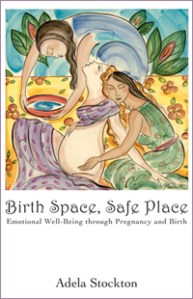
I am fortunate to have an extra copy of the new book Birth Space, Safe Place: Emotional Well-Being through Pregnancy and Birth. to give away to one lucky reader! 🙂 You can read my review of the book in the post below. There are three ways to enter to win the book and you will receive an entry for each method you employ (please make a separate comment for each of your entries):

1. Leave a comment on this post sharing your most helpful tip for emotional well-being during pregnancy and birth. I would like to compile these tips into a new blog post in the future (so if you don’t want me to include yours in that, please let me know!)

2. Become a fan of Talk Birth on Facebook (and post a comment here letting me know you are a fan).

3. Post about the giveaway on your blog and post a link back to it as well as a comment letting me know you did so.

Have fun! This is an interesting and useful little book and I know many people would enjoy having a copy. I will draw for the winner on Friday, January 22 at noon, so make sure to enter before that date!

Book Review: Birth Space, Safe Place

Birth Space, Safe Place: Emotional Well-Being through Pregnancy & Birth
By Adela Stockton
Findhorn Press, 2009
ISBN 978-1-84409-165-2

102 pages, paperback, $14.95
http://www.findhornpress.com

Reviewed by Molly Remer, MSW, ICCE

Appropriate for first time mothers as well as women having subsequent children, Birth Space, Safe Place is a slim and succinct little volume with a sole center: emotional well-being throughout pregnancy and birth. This very specific purpose is what makes the book special. It focuses on creating the emotional space for a gentle birth as well as a physical environment conducive to gentle, physiological birth. However, there is a broad range of topics covered within this specific focus including pain, fear, support, the “cocktail” of labor hormones, avoiding physiological disturbances of the birth process, optimal fetal positioning, and blessingways.

The chronology of the book flows from “conscious conception” through making decisions about birth location, preparing for labor, support during birth, “the spirit of birth,” and “early parenting joys and griefs” which addresses birth processing and postpartum recovery. The chapter on “cleansing the past” briefly addresses prior loss and bereavement, difficult previous birth experiences, and issues of abuse. Each section contains brief personal anecdotes, some from the author and some from mothers she has worked with. The exploration of each topic is brief, but is an adequate overview.

The author is a “childbirth homeopath” and so there are several sections about homeopathic remedies for specific symptoms or concerns. Aside from the homeopathic content, I did not feel as if I learned anything particularly new from the book, however it was very nice to have information about a specific element of pregnancy and birth preparation all pulled together into one nurturing place.

Birth Space, Safe Place is very supportive of doulas—for both labor and postpartum—and also of midwifery care and homebirth.

The book contains three appendices, endnotes, references, a glossary, and resource listing. The book is written in the UK (author is in Scotland), so National Health Service care is assumed and that system of maternity care, midwifery, and homebirth. The first appendix briefly addresses differences in US and Australian midwives compared to the UK.

And, make sure to check out my giveaway of Birth Space, Safe Place here!

Disclosure: I received a copy of this book for review purposes.

Does Water Slow Down Labor?

il_570xN.684257213_8rjiA concern commonly expressed about using water during labor is that immersion in a tub of warm, soothing water has the potential to slow down or even stop labor, particularly in the early stage. For many women, this is not a desirable effect!

The Waterbirth International website (www.waterbirth.org) shares this information about choosing when to get into the water:

A woman should be encouraged to use the labor pool whenever she wants. However, if a mother chooses to get into the water in early labor, before her contractions are strong and close together, the water may relax her enough to slow or stop labor altogether.  That is why some practitioners limit the use of the pool until labor patterns are established and the cervix is dilated to at least 5 centimeters.

There is some physiological data that supports this rule, but each and every situation must be evaluated on its own.

Some mothers find a bath in early labor useful for its calming effect and to determine if labor has actually started. If contractions are strong and regular, no matter how dilated the cervix is, a bath might be in order to help the mother to relax enough to facilitate dilation.

Therefore, it has been suggested that the bath be used in a ‘trial of water’ for at least one hour and allow the mother to judge its effectiveness. Midwives report that some women can go from 1 cm to complete dilation within the first hour or two of immersion.  The first hour of relaxation in the pool is usually the best and can often help a woman achieve complete dilation quickly.

In the book, Birth Day: A Pediatrician Explores the Science, Mystery, and Wonder of Childbirth, Dr. Mark Sloan explores the biochemical reason why water immersion can slow down labor. I found the explanation interesting as well as logical:

When a laboring woman climbs into a bath, the refreshing buoyancy she feels sets off a chain of physical and hormonal events. As her muscles relax, her catecholamine levels—the ‘fight or flight’ hormones that rise in labor—decrease. This can actually help her labor progress, as excessive levels of catecholamines are known to slow down uterine contractions.

But countering that lowered-catecholamine labor boost is the effect that water pressure has on other maternal hormones. When a mother sinks deep into a tub, the weight of the water on her body forces fluid contained in her tissues into her bloodstream, thus increasing her blood volume. Sounds like a good idea—increased blood volume means increased cardiac output and oxygen-carrying capacity, and oxygen is a good thing to have coursing through your arteries when you’re trying to have a baby.

But the weight of the water on a woman’s body also causes a ‘pooling’ effect in the blood vessels inside her chest, because the rib cage protects the lungs from the water-pressure squeeze exerted on the softer tissues of the limbs and abdomen. Over time this leads to a complicated hormonal chain reaction that results in decreased secretion of oxytocin, the uterine-contraction hormone, from the pituitary gland within the brain. With less oxytocin circulating than before she climbed in the tub, a woman’s labor can slow down significantly.

The labor-slowing effect of taking a bath seems to be a problem only if the bath is taken early in labor, though. Once a woman is in active labor, the oxytocin surges are strong enough that no bath in the world can derail them.

The author goes on to explain that current research isn’t clear on when exactly oxytocin levels are high enough to prevent labor from slowing down, but suggests that it is “prudent to hold off on baths until the cervix has dilated to about five centimeters.” He also notes that water immersion during labor does not increase the infection risk for either mother or baby, and that as long as water is kept at body temperature, there is no risk to either of overheating.

I also decided to ask the real experts—birthing women—what their experiences were with water in labor. I posted the question to my Facebook Talk Birth “fan” page and received a few responses:

“I feel like it definitely helped me. I couldn’t find a comfortable position, but when I got out of the water it was definitely worse. It didn’t seem to slow anything down; C was born a few hours after I got in. I plan to blow the ol’ gal up again for the next baby.”–SE

“I have such fast, easy labor that I only get in the water for transition and delivery. I will not do it any other way and kick myself for not doing it with all my births!!! It definitely takes the edge off for me (and no ring of fire either). I think it actually does slow me down a bit, but my births are crazy fast, so that is a good thing.”–NA

“I feel like for first time moms it’s hard to know how to push when you don’t have all of the pressure. I labored in the water with Ashton but delivered him out of the water when things just weren’t finishing. With Brice I knew what I was doing so had no problems pushing Brice out in the water. I really liked the water but haven’t labored without it for transition. My [midwife] also has found that first time moms many times need to get out of the water to deliver and that it can slow down labor.”–RK

“I had a waterbirth with my 2nd, and due to her malpositioning it was by far my most painful birth. Most people say the water really relaxes them and eases pain, but that was not the case with me. Also, one thing I did not realize about water birth babies is that often they are not full of color when they are born. Some people say this is because they have an easier transition into the air. I’m not sure of the reason, but this was very startling for my husband. I just talked to her and rubbed her vigorously, and she pinked up soon after.”–GC

Personally, think the laboring woman should be the guide. If she feels like getting into the water, then it seems like the right time to me! With my second baby, I had a birth pool on hand thinking I may like to try it, but my labor progressed so rapidly that there was no time to blow up the pool, let alone fill it up or deliberate about when to get into it. As midwife Judy Edmunds says, “Waterbirth is one of many lovely ways to enter the world.”

Originally written for the FoMM newsletter.

Sign up for my Brigid’s Grove Newsletter for resources, monthly freebies, and art announcements.

Simply Give Birth: A Mini-Review

Only about a week following my miscarriage, I received a review copy of a new book by Heather Cushman-Dowdee (also known as Hathor the Cowgoddess). I have a pile of birth-related books waiting for me to review. However, I found that this soon post-miscarriage when I go to read them, my heart just isn’t in it, and I set them down again. However, Heather’s book was a different experience. Titled Simply Give Birth, the book is a beautiful collection of powerful birth stories (mostly unassisted births). When I got the book, I thought, “well, I’ll just flip through this a bit, even though my heart isn’t in it.” Well, I was instantly entranced in spite of myself. I didn’t finish reading it that week, but I picked it back up the following week and read it all the way through. What a treasure. It was very, very good and I really recommend it.

As I have briefly referenced here, I was struck by how the experience of “unassisted natural home miscarriage” parallels that of unassisted birth. Immediately after my body released my little baby, I felt strong and brave and powerful and like, “wow! I did it!” even though the outcome was not what I ever planned for or wanted. I rarely see feelings like that expressed in the many hospital/D & C miscarriage stories I’ve been reading lately and I feel happy that I was able to give myself and my baby the gift of “letting go” in our own dear home.

Reading Heather’s introduction about telling a new story about birth made me think there are new stories to be told about miscarriage as well. She says about the stories she selected for her book: “…all birth stories…prove what can be done. We can birth our babies and relish it too. We’re not stoic or fanatical, we’re mothers doing what mothers have always done, giving birth; with grace and spirit, and chutzpah, and moxie…they shared their grief, their passions, their exhaultation, and their fears. It takes massive courage to write about this most personal of moments with such candor and intensity and then be willing to share…”

Simply Give Birth is simply amazing. If hope you are lucky and find it in your Christmas stocking this year. If you don’t, or if you just can’t wait to read it, pop on over to the website and buy it ASAP!

Lavender & Letting Go (Warning: Miscarriage/Baby Loss)

My life has taken a sad and unexpected turn. I was 14 weeks and 4 days pregnant with my third baby and we found out on Friday afternoon that the baby had died. Very early Saturday morning, he was born at home. Though it was different in some ways than a full-term birth, my experience of miscarriage was very much a birth–my water broke, I had normal contractions for about two hours, the baby was born (about 4 inches, well formed with eyelids, fingers, toes, mouth that opened, etc.), we saw the tiny umbilical cord, and so forth. I was surprised to discover that some of the same feelings of empowerment were also present after a “natural home miscarriage” as with a natural home birth–I felt strong and brave and like “I did it myself!” as well as amazed at how well my body worked and knew what to do. We learned the baby was our third boy and named him Noah.

I have a number of feelings and observations that I would like to share about this birth experience, but I’m not sure if this blog is the “appropriate” place to do so, because this is also my business website and I don’t want to “scare” any prospective clients away by being sad. There are a lot of losses that accompany the loss of a baby and one of the ones that is hard for me is that my life is devoted to helping women give birth with confidence, strength, and joy and to embrace pregnancy and birth as wonderful events. It is sad to me to now be a source of fear/elevated perception of risk—“if it could happen to her, it could happen to me!” Kind of like I’ve become a “bad omen” instead of a source of encouragement. 😦

One thing I do want to share about the birth of my third baby is that earlier that afternoon I’d received a package from Taylor’s Scarlet Thread. I had ordered a bonnet and apron from them for a Kirsten costume (Kirsten is an American Girl doll) for myself. They sent along a little lavender sachet as a free gift with my order. When my labor began, for some reason I wanted the sachet and held and smelled it throughout my labor. I also used it to kind of revive myself when I felt like I was fainting several times afterwards. I talked to the baby and to myself before I started having regular contractions telling myself and the baby that we need to “let go” of each other and that it was time to let go. During the labor, I chanted to myself, “let go, let go, let go” and smelled my sachet.  Several days later, I was reading a book about miscarriage and it had some aromatherapy suggestions in it. It listed lavender for “letting go”…

And Even More Birth Quotes

Continuing my semi-regular addition of birth quotes I’ve used on the Talk Birth Facebook page recently.

“When women understand what’s available to us at birth, then we won’t ever give that over to an ‘expert’ the birth power, the orgasmic power that’s in our bodies” –Christiane Northrup

“Women have the inner power and the inner knowledge of giving birth. There is a parallel of sexuality and giving birth. Women who are giving birth, trust yourselves. Trust your inner power. Trust your ability to give life. This is something absolutely sacred that is inside all women in the world.” –Ricardo Jones, MD

“If women experienced the ecstasy of birth, they would have the high that would get them through the hormonal changes of the next week. Your body and your inner wisdom give you that high.” –-Christiane Northrup

“While many of us believe that encouraging a laboring woman to move when and how she wants to is healthier and safer than making her stay in bed, waiting for evidence that it produces better health outcomes is putting a burden of proof on normal birth that has never been applied to routine intervention.–Amy Romano

“Pay attention to the pregnant woman! There is no one as important as she!” –Chagga saying, Uganda

“A pregnant woman is like a beautiful flowering tree, but take care when it comes time for the harvest that you do not shake or bruise the tree, for in doing so, you may harm both the tree and its fruit.” –Peter Jackson

“Can we create a world where all needs are met with dignity and individual culture is retained; where a baby anywhere in the world is born nonviolently and according to the instincts of its mother; where people progress in directions of full potential and spirit is not sacrificed; where women no longer obey, submit and apologize for who they are?” –Sister MorningStar

“If birth were a medical disaster in waiting, routine medical intervention would not disrupt the process. It does. If technology were integral to the process of birth, routine technology would improve outcomes. It hasn’t. If birth were inherently painful, all women would suffer without medicine. They don’t. The initial assumption[s] are proven faulty.” –Kim Wildner

“Having a baby [is] an opportunity to transform a life, because in the moments of labor and birth all the forces of the universe are flowing through a woman’s body…’If you have 12 babies you only get 12 of those opportunities. This is big fun.'” –Sister MorningStar

“I think that women can be just completely surprised by the change in them from giving birth—you have something powerful in you—that fierce thing comes up—and I think babies need moms to have that fierceness—you feel like you can do anything and that’s the feeling we want moms to have.” –Ina May Gaskin

“Birth has been broken. The spirit of women with respect to their innate birthing power has been broken. We can do nothing about the millions of broken births that have already taken place, but by seriously looking at the effect of fear–the powerful emotion that clouds our thinking and causes the birthing body to break down–perhaps we can keep the finely tuned, precision bodies of women whole for future generations…” –Marie Mongan

“When you destroy midwives, you also destroy a body of knowledge that is shared by women, that can’t be put together by a bunch of surgeons or a bunch of male obstetricians, because physiologically, birth doesn’t happen the same way around surgeons, medically trained doctors, as it does around sympathetic women.” –Ina May Gaskin

“In a modern world, ‘getting through’ labour without numbing or dumbing the process can be a very powerful experience for a woman, and very challenging.” –The Pink Kit

“When it comes to pregnancy and birth, we as a culture and as individuals need to wake up and claim our right to literally birth right!” –-Christiane Northrup

“Birth may bring you face-to-face with your insecurities, doubts, inadequacies and fears, as well as your joy, determination, willingness and courage.” –The Pink Kit

“$13 to $20 billion a year could be saved in health care costs by demedicalizing childbirth, developing midwifery, and encouraging breastfeeding.” –Frank Oski, MD

“Let us initiate our daughters into the beauty and mystery of being strong and confident women who claim their right to give birth and raise their children with dignity, power, love, and joy.” –Barbara Harper

When it comes to birth classes, “restricting yourself to what ‘everyone else does’ will only get you what everyone else got. The numbers say this is a very sad limitation to place on yourself.” –-Kim Wildner

“In the absence of the medical indication for which they were developed, birth interventions are at best worthless, at worst, harmful.” –Kim Wildner

“Let parents know that they don’t need special techniques and gadgets to give birth safely and happily. Make sure to communicate to every mother you help, that she has all the essential ingredients for a safe, healthy birth within herself. A womb, a baby, a vagina, and a few warm pieces of fabric make an excellent, complete birth kit.” –Laura Morgan

“Women’s bodies have their own wisdom, and a system of birth refined over 100,000 generations is not so easily overpowered.” –Sarah Buckley


Moving During Labor

The second Healthy Birth Blog carnival is up on Lamaze’s Science & Sensibility blog. It is a great collection of links to posts about the importance of Healthy Birth Practice #2: Walk, Move Around, and Change Positions During Labor. For the blog carnival I contributed a post/handout I made last year called How to Use a Hospital Bed Without Lying Down. We spend quite some time on the subject in my classes and I encourage my clients to treat the bed like a “tool,” rather than a place to lie down. I also encourage strategizing about ways to both meet the needs of the hospital staff for “confinement” as well as the needs of the birthing woman for mobility (so, sitting on birth ball right NEXT to the bed and monitor, instead of lying back in the bed—both sets of needs can be met this way).

When reading through some of the other links in the blog carnival, I particularly enjoyed the one at The Unnecesarean about Women Describe Walking, Moving and Changing Positions in Labor. In the post, Jill points out “For first time mothers who have had no exposure to a birth, the time between, ‘I felt a contraction!’ and ‘I have to push!’ is often a total mystery.” How true is this! How many birth documentaries and shows (even very good ones), essentially only show a few minutes in early labor and then the baby being pushed out? What happened during the other 12 hours?? Obviously, we can have an episode or documentary that lasts 12 hours and shows every single detail, but I do think this gap means it is hard for first time mothers to really get a “vision” of what labor and birth is really like—the “long haul” picture.

Of course, that post made me think about my own births and how movement played an important role in both of them. I think it was equally significant/important for both, but since I was in labor longer with my first baby I used movement much more. In early labor, I sat on the floor cross legged with my back straight (working to keep the baby in “optimal” fetal alignment :), while I ate dinner and watched a movie. Then, I walked in the hallway to see if walking would stimulate any increased contractions. I also sat on the birth ball. As labor moved on, I ONCE tried lying down on my side in bed to “go to sleep” (at the suggestion of my doctor and doula) and that was IT. I had one contraction lying down and it was the worst contraction I’ve ever experienced (both babies). I never laid down again during either birthing! No possible way! When I got tired, I did kneel on the bed with a pile of pillows in front of me and rested my head/arms on the pillows. I also spent a lot of time kneeling by the side of the bed with my head resting on my arms on it. (This was my own bed at home.) I sat and rocked in the rocking chair with my eyes closed. I sat on the floor (briefly) with the rice sock under my belly and husband sitting behind me.When I went to the birth center, I sat in the rocking chair (oh wait, I did lie down one more time, for my sole cervical check of either pregnancy/birth). I also went back to kneeling on the floor with my head on the bed. Then I gave birth to my first son in a semi-sitting position on the birth center bed with my husband behind me/to the side. (Not the position I would have instinctively chosen, I think I would have actually birthed him kneeling by the side of the bed, but I was encouraged to get up into the bed. See his birth story.)

With my second baby, I walked around (again, “testing” out whether labor was “real” and going to intensify) in our kitchen. I squatted down several times (again, “testing” and trying to “make it bigger“). Then, I sat on my birth ball in the living room. I only stayed there for a few contractions and then stood up and wanted something to lean on—I leaned on the back of the (too rocky) recliner. Then, I ended up kind of hanging on my husband for a while—my arms around his neck and my legs dropping kind of outward. I then felt “driven to my knees” and got on my hands and knees on the floor with my arms and head on my birth ball. I quickly decided I didn’t want the ball and got just on my hands and knees with my husband in front of me with his arms around me. My son was born while I was on my hands and knees in this way.

I think when women think about “active birth” or “freedom of movement throughout labor,” sometimes they think this means walking the whole time or squatting up and down and up and down, or literally being *standing up* and moving around “aggressively” throughout labor. My own experiences were “active birth,” but the freedom of movement includes being able to sit in a rocking chair and “meditate” through contractions, or resting on your knees with your head on the bed. The “activity” we’re really talking about is really not lying down-–having the body upright/torso above the pelvis.

The most important event shaping my life as a mother?

Recently, this quote from a Midwifery Today blog post came to my attention: “your birth is the most important event in shaping your life as a mother.” It has generated some pretty heated discussion and negative feelings amongst some writers in the blogosphere. Despite my intense commitment to birthwork, I stumble over the quote a bit as well. I would venture to guess that if phrased in less black-and-white terms, it would not have caused such an angry reaction in some women. Perhaps, “your [child’s] birth is a very important event…” or “…is ONE of the most important events…” would have been better received, while communicating a similar idea. While I understand the sentiment and deeply agree that birth matters,  the sweeping assertion of the phrase “the most” doesn’t leave a lot of of room for personal experiences and individual variation!

I found the quote first referenced here with an insightful “rebuttal” of sorts. There is also a very detailed critique here.

I have a lot of my own thoughts based on both the original quote/blog post and on the responses from other bloggers.

It is well documented that birth is NOT “just another day in a woman’s life” and that giving birth does have lasting impact on women’s memories and quality of life. Those day-to-day moments with your children that several bloggers mentioned as more appropriate representations of “most important event shaping my life as a mother” are certainly important too and are the makings of a “real life,” but they don’t necessarily stand out in the memory as transformative events. Kind of like your wedding day stands out as very significant—it matters and is important and is not “just another day”—while simultaneously it is clear that the day-to-day life and love with your husband is actually more important than the wedding day.  So, while I would agree that “ultimately” speaking, your marriage is definitely more important than your wedding, I would also put forth that you are much more like to remember your wedding specifically and clearly and with specific emotion than you are to remember what you ate for breakfast with your honey-pie last weekend and that is one of the reasons why the wedding matters. Perhaps it is an issue of the mudane vs. the miraculous…

I believe you can hold the two experiences simultaneously—you can enjoy the wedding memory, while cherishing your regular old daily husband AND you can enjoy (or suffer from) the birth memory while also cherishing the daily life with the little ones. One doesn’t have to trump the other or to be “what really matters.” There’s room for lots of mattering in an every day life 🙂

I think another key is that birth is (or can be) a “peak experience” for women (and families). I want all women to have a chance to experience that. I certainly do not want her to feel diminished, unworthy, inferior or lacking if birth is not a peak experience in her life, but I also want all women to certainly be given a reasonable opportunity to let birth unfold in all its power and be treated respectfully and humanely by those around her—regardless of what is going on or the eventual outcome.

I love birth and cherish my memories of my sons’ births and consider them to be some of the most transformative, empowering, and significant single days in my life—peak experiences, powerful memories—and I also feel that birth matters as a distinct (and relatively rare) occurrence in a woman life. I believe birth has inherent value and worth on its own terms. I also believe that your feelings about the birth and the baby can most definitely be separated—you can feel pleased as punch with your delightful, precious baby and also be disappointed (or super thrilled with) your birthing. One does not take from the other—you can hold the reality of both and a breadth of feelings about them. And additionally, it is not wrong to want both things—a “good birth” and a “healthy baby.” The two go hand in hand and are not mutually exclusive concepts at all (see links to previous posts below).

All that said, however, I also do not feel that my children’s births were the most important events shaping my life as a mother. They were important, yes, but I think stating with finality that the event that shapes us is definitely X—or putting a finger on THE most important event is NOT something that can be pinned down by any one person or imposed from someone on the outside of yourself. I think it varies by woman and mother and there is room for many things to be true and valuable and okay. So, perhaps your important life shaper is seeing your children decorate the Christmas tree (though I still submit that “peak experiences” carry more emotional and psychological weight that everyday occurrences). For another mother, it could be the day she gave birth to her child. Those are both okay! One woman’s feelings and reality do not invalidate or dismiss another’s.

For me, the profound shaping event was the experience postpartum with my first baby. I have never had an experience that shaped me and impacted me and SHOOK me more profoundly than adjusting to life with my newborn son. That was my journey. That was my struggle. That was my challenge. That is what dissolved me and burned me into ashes and let me rise again as someone the same but also brand new—a mother. I was not “born” when my son was born, I was forged. Made, in the intense weeks that followed his birth.

If another mother states that her postpartum was full of “babymoon bliss,” do I need to dismiss her as deluded, lying, and or possibly perpetuating a myth? No! I can hold both in my awareness—my postpartum experience was my most significant life challenge. Hers was not. Both truths are FINE! Likewise, if I decide share that my sex life post-kids is better than ever before, is that dismissed as “couldn’t possible be true? MY sex life was ruined by kids!” or that I’m somehow lying or misrepresenting the truth? No, both can be true, because we are all different women with different lives and experiences and “realities.” So, if a woman feels like her birth experiences were the most important events shaping her life as a mother, that is totally okay—and, it can be true, without making a woman with the opposite experience diminished or “less than.” Of course, the logical extension of this train of thought, is whether I (and other birth activists) can hold our birth matters truth alongside the realization or acceptance that for some women birth IS “just one day” or that it is not an important event in their lives?

I also think we can draw on powerful memories for present strength—I remember my “birth warrior” feelings and it helps me with other tasks or with day to day life. I remember the laughing, crying, “my baby, MY BABY!” moments of triumph and bliss and ecstasy immediately postpartum and it buoys me with a fresh charge of  love for the little ruffians leaping off the couch in front of me or throwing crackers all over the house.

——–

Since the “birth experience vs. healthy baby” argument is of special interest to me, I’ve addressed it several other times on this blog:

Birth and Apples

Personal Mastery & Birth

Birth Experience or Healthy Baby?

Evidence Based Care

Another Healthy Mother/Healthy Baby Quote