Archive | August 2012

Book Giveaway! The Midwife of Hope River

**This giveaway is now closed. Heather K was the winner!**

In conjunction with the virtual book tour for Patrician Harman’s new book The Midwife of Hope River, I’m very pleased to offer a giveaway of a paperback copy of this wonderful piece of historical fiction.

To enter to win, simply leave a comment on this post!

For additional entries, do any or all of the following:

Read my reviews of Patsy’s two memoirs here:
Book Review: Arms Wide Open: A Midwife’s Journey
Book Review: The Blue Cotton Gown

Patricia Harman is also on a physical tour for her book (schedule here) and you can also check our her website, Facebook page, and Twitter account.

Giveaway closes at 11:00 a.m. on Thursday, Sept. 6.

Disclosure: Amazon affiliate link included in cover image.

Patricia Harman.jpg 

Book Review: The Midwife of Hope River

Book Review: The Midwife of Hope River: A Novel of an American Midwife
By Patricia Harman
Paperback: 400 pages
Publisher: William Morrow Paperbacks; Original edition (August 28, 2012)
ISBN-13:978-0062198891

Reviewed by Molly Remer, Talk Birth

Already a fan of CNM Patsy Harman’s lyrical writing style and understated prose, I was eager to read her first foray into historical fiction. The Midwife of Hope River: A Novel of an American Midwife did not disappoint. This novel contains a little bit of everything: some mystery, some romance, some intrigue, some drama, some sociopolitical commentary and ecological activism, and also, birth. Lots of birth–some animal births and many human births. Some of the births are powerful, some are scary, some are sad, and all are realistic and touching.

The Midwife of Hope River is set in a small mining town in West Virginia during the Great Depression and follows the story of Patience Murphy, a midwife with some secrets, as she attends births in desperately poverty-stricken conditions. The story also explores the race relations of the time, with Patience developing a close and mutually supportive relationship with a young black woman who becomes her apprentice—a friendship that raises the hackles of the emerging KKK members in the region.

Harman’s writing reminds me of that of Catherine Cookson or Anne Tyler in the simple elegance with which she writes about normal people experiencing normal lives. Low key and plainspoken without unnecessary drama or angst, the result is a realistic story that speaks to the heart and to the common human experience.

I kept expecting something bad to happen in this book, and while there were definitely some bad events in the story, there was a wonderfully empowering scene towards the end, rather than the victimization or attack I was fearing. I simply can’t think of any type of historical fiction that could be better than a novel about a midwife! Patricia Harman.jpg

Read my reviews of Patsy’s two memoirs here:
Book Review: Arms Wide Open: A Midwife’s Journey
Book Review: The Blue Cotton Gown

Disclosures:

I received a complimentary copy of this book for review purposes.

Amazon affiliate link included above (in title)

tlc tour host.png

**Also, make sure to check out the companion book giveaway as part of the virtual book tour of Harman’s novel.**

Patricia Harman is also on a physical tour for her book (schedule here) and you can also check our her website, Facebook page, and Twitter account.

Book Review: Pushing for Midwives


Book Review: Pushing for Midwives: Homebirth Mothers and the Reproductive Rights Movement
by Christa Craven
Paperback: 232 pages
Publisher: Temple University Press; 1 edition (October 28, 2010)
ISBN-13: 978-1439902202

Reviewed by Molly Remer, Talk Birth

Mainstream feminist groups have been slow to recognize the right to reproduce along with the right to be free from reproducing. A focus of the second-wave women’s movement was shaking off motherhood as what solely defined womanhood. So perhaps there has been a reluctance to watch over the process that makes women mothers. –Jennifer Block quoted in Pushing for Midwives

Framed as a health policy concern, Pushing for Midwives assesses the homebirth movement and midwifery activism in the context of the reproductive rights movement. The focus of the book is on legislation in Virginia, but is still of relevance and interest to activists from other states. Craven also tackles complicated topics that are often ignored in homebirth and midwifery texts, addressing issues of race, privilege, and socioeconomic status and the impact on access to care. She also takes a solid look at issues of political and religious diversity within the homebirth activist community.

Written in a densely academic style evocative of a dissertation, Pushing for Midwives, became tedious and dry in places and took a long time to finish reading. The very narrow focus on Virginia, while still applicable to other states, became tiresome by the final chapters.

I particularly enjoyed Craven’s exploration of the history of consumer activism in midwifery as well as the consideration of homebirth in the larger context of women’s health activism. I appreciated her exploration of the feminist movement and how it has historically neglected issues of birth advocacy and reform, while also looking the current relationship between feminism and midwifery activism, particularly how birth advocates choose to self-identify. Women’s health activists and midwifery advocates will likely find a lot of food for thought in the pages of Pushing for Midwives.

Disclosures: I received a complimentary copy of this book for review purposes.

Amazon affiliate links included in book title and image.

Blessingways and the role of ritual

In this circle No Fear
In this circle Deep Peace
In this circle Great Happiness
In this circle Rich Connection

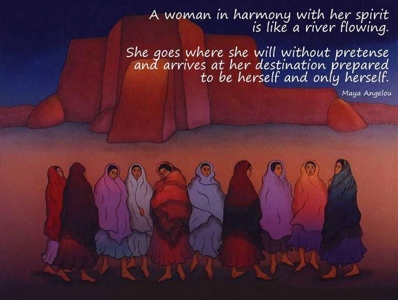
I saw this gorgeous blessingway image pinned on Pinterest a while ago. Love it!

I’ve recently been on a reading streak with books on ritual. I’ve always been interested in ritual, especially women’s rituals, and I’ve planned and facilitated a lot of different rituals. I also have a huge variety of books that include information on planning rituals, women’s spirituality books, books about blessingways, and more. I’m branching out even more with my recent kick though, starting with buying books on officiating/planning wedding ceremonies (I have two weddings coming up in October). Then, I was talking to some mothers of newly teenage boys about planning some kind of coming of age rite/ritual for them and  bought some more books on creating sacred ceremonies for teenagers. (I’m good with books for women/girls, but sadly lacking in resources for ceremonies and celebrations for boys/men.) One of the books I purchased was Rituals for Our Times, a book about “celebrating, healing, and changing our lives and relationships.” I left a mini-review on goodreads already:

There were some good things about this book about the meaning, value, purpose, and role of ritual in family life. I lost interest about halfway through and ended up skimming the second half. While it does contain some planning lists/worksheets for considering your own family rituals, the overall emphasis is on short vignettes of how other families have coped with challenges or occasions in their own lives. Also, the focus is on very conventional, mainstream “ritual” occasions–birthdays, anniversaries, holidays–rather than on life cycle rites of passage and other more spiritual transitions in one’s life.

However, one section I marked was about the elements that make ritual work for us and I thought about blessingways and how they neatly fulfill all of the necessary ritual elements (which I would note are not about symbols, actions, and physical objects, but are instead about the emotional elements of connection, affection, and relationship):

Relating–“the shaping, expressing, and maintaining of important relationships…established relationships were reaffirmed and new relationship possibilities opened.” Many women choose to invite those from their inner circle to their blessingways. This means of deeply engaging with and connecting with those closest to you, reaffirms and strengthens important relationships. In my own life, I’ve always chosen to invite more women than just those in my “inner circle” (thinking of it as the next circle out from inner circle) and in so doing have found that it is true that new relationship possibilities emerge from the reaching out and inclusion of those who were originally less close, but who after the connection of shared ritual, then became closer friends.

Changing–“the making and marking of transitions for self and others.” Birth and the entry into motherhood—an intense and permanent life change–is one of life’s most significant transitions. A blessingway marks the significance of this huge change.

Healing–“recovery from loss,” special tributes, recovering from fears or scars from previous births or cultural socialization about birth. My mom and some close friends had a meaningful ceremony for me following the miscarriage-birth of my third baby. I’ve also planned several blessingways in which releasing fears was a potent element of the ritual.

Believing–“the voicing of beliefs and the making of meaning.” By honoring a pregnant woman through ceremony, we are affirming that pregnancy, birth, and motherhood are valuable and meaningful rites of passage deserving of celebration and acknowledgement.

Celebrating–“the expressing of deep joy and the honoring of life with festivity.” Celebrating accomplishments of…one’s very being.

Notice that what is NOT included is any mention of a specific religion, deity, or “should do” list of what color of candle to include! I’ve observed that many people are starved for ritual, but they may so too be deeply scarred from rituals of their pasts. I come from a family history of “non-religious” people and I feel like I seem to have less baggage about ritual and ceremony than other people do. An example from the recent planning for a mother blessing ceremony: we were talking about one of the blessingway songs that we customarily sing–Call Down Blessing–we weren’t sure if we should include it for fear that it would seem too “spiritual” or metaphysical for the honoree (i.e. blessings from where?!) and I remembered another friend asking during a body blessing ritual we did at a women’s retreat, “but WHO’s doing the blessing?” As someone who does not come a religious framework in which blessings are traditionally bestowed from outside sources–i.e. a priest/priestess or an Abrahamic God–the answer felt simple, well, WE are. We’re blessing each other. When we “call down a blessing” we’re invoking the connection of the women around us, the women of all past times and places, and of the beautiful world that surrounds us. We might each personally add something more to that calling down, but at the root, to me, it is an affirmation of connection to the rhythms and cycles of relationship, time, and place. Blessings come from within and around us all the time, there’s nothing supernatural about it.

I also think, though I could be wrong, that it is possible to plan and facilitate women’s rituals that speak to the “womanspirit” in all of us and do not require a specifically shared spiritual framework or belief system in order to gain something special from the connection with other women.

In another book I finished recently, The Power of Ritual, the author explains:

“Ritual opens a doorway in the invisible wall that seems to separate the spiritual and the physical. The formal quality of ritual allows us to move into the space between the worlds, experience what we need, and then step back and once more close the doorway so we can return to our lives enriched.”

She goes on to say:

You do not actually have to accept the ideas of any single tradition, or even believe in divine forces at all, to take part in ritual. Ritual is a direct experience, not a doctrine. Though it will certainly help to suspend your disbelief for the time of the ritual, you could attend a group ritual, take part in the chanting and drumming, and find yourself transported to a sense of wonder at the simple beauty of it all without ever actually believing in any of the claims made or the Spirits invoked. You can also adapt rituals to your own beliefs. If evolution means more to you than a Creator, you could see ritual as a way to connect yourself to the life force…

As I continued to think about these ideas, I finished reading another book on ritual called The Goddess Celebrates. An anthology of women’s rituals, this book included two essays by wisewoman birthkeeper, Jeannine Pavarti Baker. She says:

The entire Blessingway Ceremony is a template for childbirth. The beginning rituals are like nesting and early labor. The grooming and washing like active labor. The gift giving like giving birth and the closing songs/prayers, delivery of the placenta and postpartum. A shamanic midwife learns how to read a Blessingway diagnostically and mythically, sharing what she saw with the pregnant woman in order to clear the road better for birth.

[emphasis mine, because isn’t that just a cool idea?! I feel another blog post coming on in which I “read” my own blessingway experiences and how they cleared the way for my births]

Baker goes on to describe the potent meaning of birth and its affirmation through and by ritual acknowledgement:

Birth is a woman’s spiritual vision quest. When this idea is ritualized beforehand, the deeper meanings of childbirth can more readily be accessed. Birth is also beyond any one woman’s personal desires and will, binding her in the community of all women. Like the birthing beads, her experiences is one more bead on a very long strand connecting all mothers. Rituals for birth hone these birthing beads, bringing to light each facet of the journey of birth…
20120818-120826.jpg

I wish for you a life full of ritual and community.” —Flaming Rainbow Woman, Spiritual Warrior 

(in The Thundering Years: Rituals and Sacred Wisdom for Teens)

Genuine, heartfelt ritual helps us reconnect with power and vision as well as with the sadness and pain of the human condition. When the power and vision come together, there’s some sense of doing things properly for their own sake.” —Pema Chodron

(in The Thundering Years: Rituals and Sacred Wisdom for Teens)

Other posts about mother blessings can be found here.


Amazon affiliate links included in book titles.

Can I really expect to have a great birth? (updated edition)

Given my limited situation, can I really expect to have a great birth today?” For the woman who asked me this question a homebirth, a birth center, a midwife, and a doula were all not remotely feasible options. My answer to her question is a qualified “yes!” and it really got me thinking about ways to help yourself have a great birth when your overall choices are limited. In fact, there is a long list of ideas of things that may help contribute to a great birth!

  • Choose your doctor carefully—don’t wait for “the next birth” to find a compatible caregiver. Don’t dismiss uneasiness with your present care provider. As Pam England says, “ask questions before your chile is roasted.” A key point is to pick a provider whose words and actions match (i.e. You ask, “how often do you do episiotomies?” The response, “only when necessary”—if “necessary” actually means 90% of the time, it is time to find a different doctor!). Also, if you don’t want surgery, don’t go to a surgeon (that perhaps means finding a family physician who attends births, rather than an OB, or, an OB with a low cesarean rate).
  • If there are multiple hospitals in your area, choose the one with the lowest cesarean rate (not the one with the nicest wallpaper or nicest postpartum meal). Hospitals—even those in the same town—vary widely on their policies and the things they “allow” (i.e. amount of separation of mother and baby following birth, guidelines on eating during labor, etc.) Try checking with Cesareanrates.com for local information!
  • When you get the hospital, ask to have a nurse who likes natural birth couples. My experience is that there are some nurses like this in every hospital—she’ll want you for a patient and you’ll want her, ask who she is! If possible, ask your doctor, hospital staff, or office staff who the nurses are who like natural birth—then you’ll have names to ask for in advance.
  • Put a sign at eye level on the outside of your door that reads, “I would like a natural birth. Please do not offer pain medications.” (It is much easier to get on with your birth if you don’t have someone popping in to ask when you’re “ready for your epidural!” every 20 minutes.)
  • You might want to check out either or both of these two books: Homebirth in the Hospital and/or Natural Hospital Birth
  • Work on clear and assertive communication with your doctor and reinforce your preferences often—don’t just mention something once and assume s/he will remember. If you create a birth plan, have the doctor sign it and put it in your chart (then it is more like “doctor’s orders” than “wishes”). Do be aware that needing to do this indicates a certain lack of trust that may mean you are birthing in the wrong setting for you! Birth is not a time in a woman’s life when she should have to fight for anything! You deserve quality care that is based on your unique needs, your unique birthing, and your unique baby! Do not let a birth plan be a substitute for good communication.
  • Two resources I particularly enjoy that shake up the notion of a birth plan are, 1. the birth as a labyrinth metaphor from Birthing from Within and 2. this article about how does one really PLAN for birth.
  • When making a birth plan, use the Six Healthy Birth Practices as a good, solid foundation.
  • Cultivate a climate of confidence in your life.
  • Once in labor, stay home for a long time. Do not go to the hospital too early—the more labor you work through at home, the less interference you are likely to run into. When I say “a long time,” I mean that you’ve been having contractions for several hours, that they require your full attention, that you are no longer talking and laughing in between them, that you are using “coping measures” to work with them (like rocking, or swaying, or moaning, or humming), and that you feel like “it’s time” to go in. If you’re worried about knowing when you’re really in labor, check out this post: how do I know if I’m really in labor?
  • Ask for the blanket consent forms in advance and modify/initial them as needed—this way you are truly giving “informed consent,” not hurriedly signing anything and everything that is put in front of you because you are focused on birthing instead of signing.
  • Have your partner read a book like The Birth Partner, or Fathers at Birth, and practice the things in the book together. I frequently remind couples in my classes that “coping skills work best when they are integrated into your daily lives, not ‘dusted off’ for use during labor.”
  • Practice prenatal yoga—I love the Lamaze “Yoga for Your Pregnancy” DVD—specifically the short, 5-minute, “Birthing Room Yoga” segment. I teach it to all of my birth class participants.
  • Use the hospital bed as a tool, not as a place to lie down (see my How to Use a Hospital Bed without Lying Down handout)
  • If you feel like you “need a break” in the hospital, retreat to the bathroom. People tend to leave us alone in the bathroom and if you feel like you need some time to focus and regroup, you may find it there. Also, we know how to relax our muscles when sitting on the toilet, so spending some time there can actually help baby descend.
  • Use the “broken record” technique—if asked to lie down for monitoring, say “I prefer to remain sitting” and continue to reinforce that preference without elaborating or “arguing.”
  • During monitoring DO NOT lie down! Sit on the edge of the bed, sit on a birth ball near the bed, sit in a rocking chair or regular chair near the bed, kneel on the bed and rotate your hip during the monitoring—you can still be monitored while in an upright position (as long as you are located very close to the bed). Check out the post Active Birth in the Hospital for some additional ideas.
  • Bring a birth ball with you and use it—sit near the bed if you need to (can have an IV, be monitored, etc. while still sitting upright on the ball). Birth balls have many great uses for an active, comfortable birth!
  • Learn relaxation techniques that you can use no matter what. I have a preference for active birth and movement based coping strategies, but relaxation and breath-based strategies cannot be taken away from you no matters what happens. The book Birthing from Within has lots of great breath-awareness strategies. I also have several good relaxation handouts and practice exercises that I am happy to email to people who would like them. One of my favorites is: Centering for Birth.
  • Use affirmations to help cultivate a positive, joyful, welcoming attitude.
  • Read good books and cultivate confidence and trust in your body, your baby, your inherent birth wisdom.
  • Take a good independent birth class (not a hospital based class).
  • Before birth, research and ask questions when things are suggested to you (an example, having an NST [non-stress test] or gestational diabetes testing). A good place to review the evidence behind common forms of care during pregnancy, labor, and birth is at Childbirth Connection, where they have the full text of the book A Guide to Effective Care in Pregnancy and Childbirth available for free download (this contains a summary of all the research behind common forms of care during pregnancy, labor, and birth and whether the evidence supports or does not support those forms of care).
  • When any type of routine intervention is suggested (or assumed) during pregnancy or labor, remember to use your “BRAIN”—ask about the Benefits, the Risks, the Alternatives, check in with your Intuition, what would happen if you did Nothing/or Now Decide.
  • Along those same lines, if an intervention is aggressively promoted while in the birth room, but it is not an emergency (let’s say a “long labor” and augmentation with Pitocin is suggested, you and baby are fine and you feel okay with labor proceeding as it is, knowing that use of Pitocin raises your chances of having further interventions, more painful contractions, or a cesarean), you can ask “Can you guarantee that this will not harm my baby? Can I have in writing that this intervention will not hurt my baby? Please show me the evidence behind this recommendation.
  • If all your friends have to share is horror stories about how terrible birth was, don’t do what they did.
  • Look at ways in which you might be sabotaging yourself—ask yourself hard and honest questions (i.e. if you greatest fear is having a cesarean, why are you going to a doctor with a 50% cesarean rate? “Can’t switch doctors, etc.” are often excuses or easy ways out if you start to dig below the surface of your own beliefs. A great book to help you explore these kinds of beliefs and questions is Mother’s Intention: How Belief Shapes Birth by Kim Wildner. You might not always want to hear the answers, but it is a good idea to ask yourself difficult questions!
  • Believe you can do it and believe that you and your baby both deserve a beautiful, empowering, positive birth!

I realize that some of these strategies may seem unnecessarily defensive and even possibly antagonistic—I wanted to offer a “buffet” of possibilities. Take what works for you and leave the rest!

I posted on my Facebook page asking for additional thoughts and suggestions and I appreciated this one from doula and educator, Rebecca:

“I think I’d tell people to stop closing doors on themselves you know? Stop making assumptions about what is possible and be open to creating new possibilities – maybe not perfect and exact but inviting in opportunity. No money doesn’t mean no doula in most cases.”

She’s right! A lot of doulas-in-training will offer free birth services, many doulas and midwives do barter arrangements or other trades, and many non-traditional birth professionals also have sliding scale rates.

Great births are definitely possible, in any setting, and there are lots of things you can do to help make a great birth a reality!

This post was revised (from this one) to participate in… And the Empowered Birth Awareness Blog Carnival!

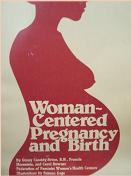
Woman Centered Pregnancy and Birth

“Woman-centered childbirth recognizes the primary role of the mother, and allows labor to progress according to the mother’s natural rhythms.” —ALACE CBE training manual

Several years ago I wrote a popular and somewhat controversial post called What to Expect When You Go to the Hospital for a Natural Childbirth. The article took a look at what women can realistically expect from a “standard” hospital birth and included some thoughts on what they deserve, my conclusion being that what women can expect and what they deserve are often, sadly, very different things. The article was one of my widest-reaching pieces and it was republished on both the Unncesarean and on Navelgazing Midwife. I also converted it into an article that was published in Pathways magazine, laid out so beautifully and professionally I practically cried.

However, my idea for the post didn’t come from me alone, it was sparked by reading a similar list in the 1970’s book Woman-Centered Pregnancy and Birth, co-authored by Carol Downer. So, imagine my delight when I was contacted last month by her assistant, letting me know that they’d read and enjoyed my post and telling me this awesome news:

We recently published the book in its entirety online at: www.womenshealthinwomenshands.org/BirthingOurBabies.html.

That’s right, free online! Check it out!

For my conservative readers, do be aware that the book and website both come from a solidly feminist and pro-choice perspective!

“The whole point of woman-centered birth is the knowledge that a woman is the birth power source. She may need, and deserve, help, but in essence, she always had, currently has, and will have the power.” –Heather McCue

Previous thoughts on Why “Woman-Centered” Childbirth?

Book Review: Lady’s Hands, Lion’s Heart ~ A Midwife’s Saga

Lady’s Hands, Lion’s Heart: A Midwife’s Saga
by Carol Leonard, 2008. ISBN: 978-0-615-19550-6.
Bad Beaver Publishing, $15.00, 363 pages, soft cover.
www.badbeaverfarm.com

Reviewed by Molly Remer, Talk Birth

This memoir by experienced New Hampshire midwife, Carol Leonard, is a wonderful read. It is funny, compelling, exciting, and sad. I think it is the best midwife’s memoir I’ve ever read!

Spanning 13 years (1975-1987), the book represents not just her personal experiences and birth stories, but also chronicles the development of independent midwifery in New Hampshire and the birth of MANA and its emergence as an international presence.

Leonard is an engaging writer with a flair for the dramatic. The style of the book is present tense, so you get a sense of actually “being there” and the book reads with the pace of a novel.

The many birth stories in the book are riveting. She has her share of close calls and complications, as well as tons of strong, inspirational births. Her love of the work and of the women she serves shines throughout and I got a strong sense of the author as a deeply passionate and committed woman.

The book opens with her own birth story in a hospital in 1975, her only child, and chronicles her development into a midwife (a fascinating sub-story in the book is of the changes her local hospital goes through to make their maternity unit more mother-friendly). Be prepared for a sad ending.

The birth stories shared each represent an event or lesson learned. Leonard is a busy midwife (you get a sense in the book that she doesn’t have much time to take care of herself!) and she attends many births in her years of service. The births detailed here are carefully chosen for impact and purpose. (Side note: as an LLL Leader, I was saddened that her one experience with LLL [in the book] is a bad one).

More than a collection of birth stories or midwifery musings, Lady’s Hands, Lion’s Heart: A Midwife’s Saga, is a personal journey, as well as a spirited account of a larger journey occurring in the midwifery profession.

Disclosure: I received a complimentary copy of this book for review purposes

Review previously published at Citizens for Midwifery

Amazon affiliate link included in book title/image.

Birth Customs

“Pay attention to the pregnant woman! There is no one as important as she!”

(Chagga saying, Uganda)

The book Mamatoto is a look at birth in a variety of cultures (including the US) that was published by The Body Shop in 1991. Even though it is “old” it isn’t really dated since it is a brief overview of different customs and rituals and so forth and not a lot of statistics. There are a lot of absolutely fabulous (and fascinating) pictures and illustrations and these are the highlight of the book. Each chapter is followed by a “black page” of “facts you don’t want to know” about such things are reproductive health care policies in Romania and things like that.

One of the things that struck me about this book was that there is little distinction made between the customs of other cultures and the customs of the US. For example:

“People in Tibet believe that whether or not labour is due, a child won’t come out into the world unless the star under which it’s destined to be born is shining. Western medicine has developed a way of starting labour artificially, by injecting into a woman’s blood a simulation of the hormone oxytocin, which triggers contractions. For several years during this century, an unusual number of women laboured between the convenient hours of nine and five on weekdays…As the Malaysians say, a baby is like a fruit; it will be born when it’s ripe.”

I absolutely love seeing Western culture put into the proper context like this. Too often we see our way as THE way and forget that much of what the dominant culture views as normal for birth is not necessarily truly normal, but is instead an artifact of, or custom of, our culture. Viewed from a distance, the routines of birth in America are just interesting customs—in Tibet, born when the proper star is out, in the US, born when artificial hormones are injected…

(Since first reading this, I use the baby is like a fruit quote regularly.)

I may not be explaining myself clearly, but I find this distance in perspective refreshing and interesting. It reminds me of the work of anthropologist Robbie Davis Floyd whose book Birth as an American Rite of Passage explores the “ritual” elements of hospital birth in America and compares and contrasts the “technocratic” model of care with a holistic, woman-centered model of care (an example of which would be the midwives model of care). She asserts that there are many elements of hospital births that serve as rituals to reinforce the technocratic model (rather than to serve actual purposes, but instead to send cultural messages as well as to initiate the baby into the technocratic model). Examples of ritual elements include putting on a hospital gown, riding in a wheelchair, and having a routine IV. These elements serve to enculturate the woman and baby into a particular model–a ritual function–rather than an individually appropriate method of care.

Another example from Mamatoto that I enjoyed is as follows:

“‘Home birth’ can mean different things to different people. It can mean a bedroom, dimly lit and scented with myrr; a sweatbath perched on a Guatemalan hillside, or a birthing pool in an English flat; a warm fireside in a Himalayan kitchen; the packed-snow sleeping platform of an Inuit igloos; or a one-room shack in Jamaica, with a washing line dividing the family bed and the children waiting on the other side for a first glance at the baby who will be held up for them to see. When a woman gives birth at home, she and her family have a degree of control over the event; it’s their domain.”

In short, at home the family is in their own personal culture rather than having to adapt to the customs, culture, and “ritual elements” of an out-of-home environment.

When I think about American birth customs and culture, the first thing that comes to mind is this potent illustration from Mothering Magazine’s powerful article Cesarean Birth in a Culture of Fear, which was then published in booklet form by Childbirth Connection:

20120813-083208.jpgIn this image we see a woman immersed in the hospital birth culture found in many hospitals in the US.* She is hooked up to a potential of 16 different attachments. When I see this image, I instantly see why women might not want to “be martyrs” and thus go ahead and have any medications offered to them. It can be very difficult to stand in her personal power and embrace her own body’s rhythms and rituals when she is literally strapped down in this manner. I also think of this quote:

“Since beliefs affect physiologic functions, how women and men discuss the process of pregnancy and birth can have a negative or positive effect on the women that are involved in the discussion. Our words are powerful and either reinforce or undermine the power of women and their bodies.”–Debra Bingham

*Note: I am fully aware that this may not be what birth looked like in your hospital, but I’m speaking generically about many hospitals in the nation.

Modified from a post originally posted at Citizens for Midwifery

Amazon affiliate links included in book titles.

Productive!

“Being bored is an insult to oneself.” –Jules Renard

This afternoon I made such a long status update on Facebook that I joked it should really be a blog post. So, I decided to convert it into one! (albeit not particularly fascinating or relevant to my blog’s theme. Perhaps I need to remember that Busy is Boring!) I think the abrupt shift in local weather from horrendously hot to near-fall-like crispness has rejuvenated me and we just had a great day today. This morning I went for a walk in the woods with the boys to scout locations for “real life Minecraft.” We also investigated the yard barn shed in our field for rehabilitation possibilities into a cool clubhouse. Then, we had a mini Pinterest Day making baked mozzarella bites and healthy chocolate chip muffins. I gave the kids applesauce with cinnamon for a snack which was met with genuine exclamations of, “this is the best day ever!” (hmm. If that’s all it takes, should break out the applesauce more often!). Also, the doctor finally called back and Zander’s arm is NOT broken (more about this in a minute). We’re finally on a roll with school and Z did 18 worksheets this morning, plus Lann is clicking with things too. On the less productive side, at 2:00 when I made said status update I was still in my pajamas (yes, even on the woods walk and clubhouse scout) and hadn’t taken a shower, let alone finished prepping for Friday’s class. I did get checked in with my online students this morning while still in bed using the miracles of iPad goodness. And, as it turned out, later in the afternoon when the kids went to visit my parents I did finish my prep for Friday’s class after all. What was just delightful about today is that we spent most of the day having fun and enjoying each others’ company—something that sometimes seems not to go hand in hand with productivity! ;-D

Okay, now for the mini-Pinterest Day verdict…

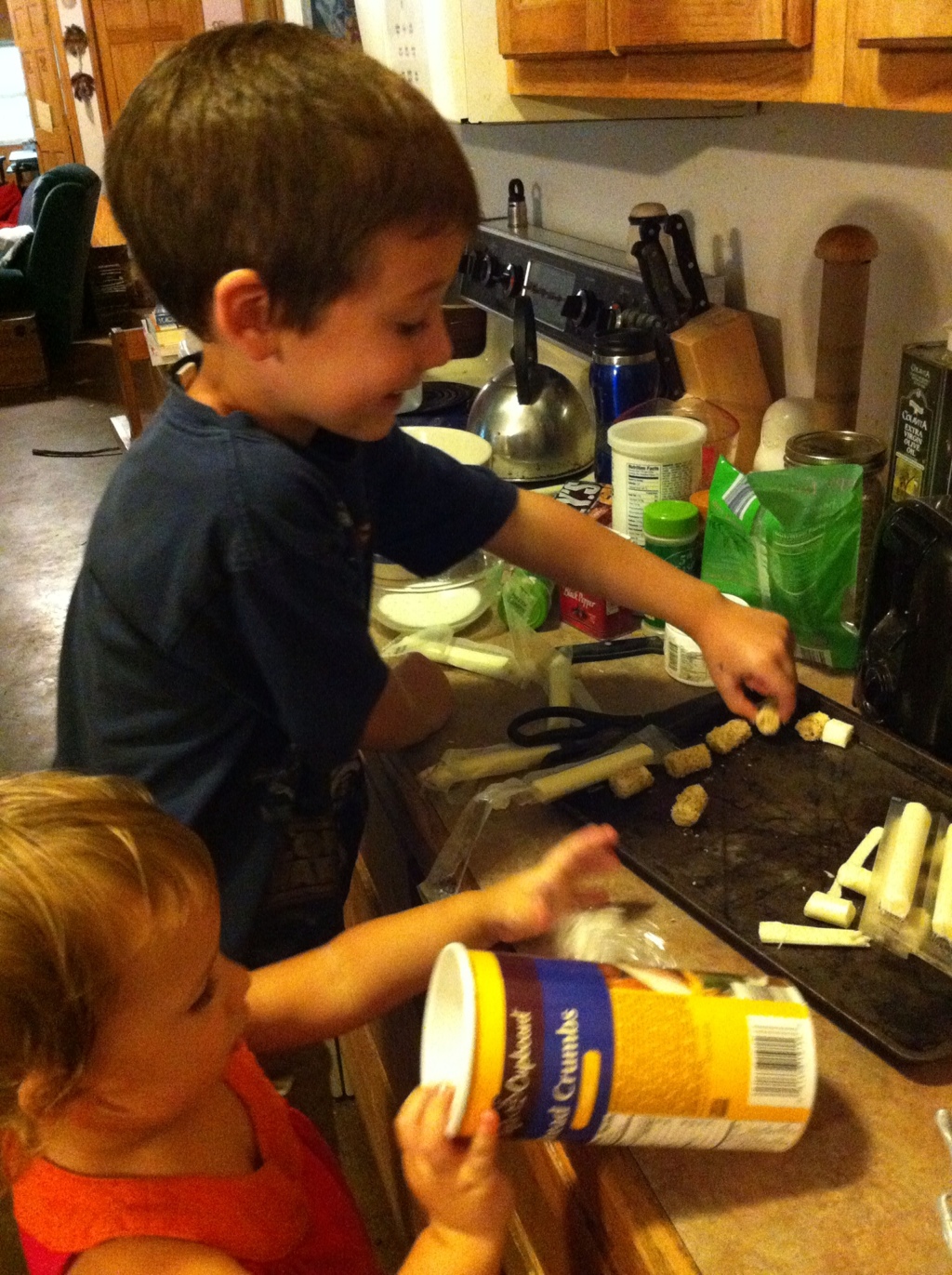
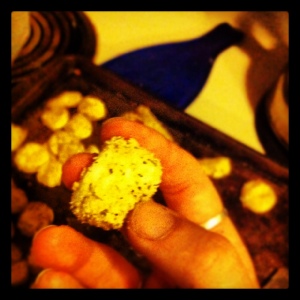
The mozzarella bites were just cut up string cheese dipped in milk and then in bread crumbs which I doctored up with Italian seasoning, pepper, onion and garlic powder. (They were originally inspired by this blog post.)

They were fun to make with kids, tasted great (I recommended my doctored bread crumbs version), and were easy.

20120813-161646.jpg

Zander cut up the cheese and helped me dip the pieces into the crumbs. Alaina helped too.

20120813-162049.jpg

While they flattened some during baking, they had remarkable integrity and did not turn into melted cheese puddles.

Our next Pinterest Day project was to make some delightfully healthy double chocolate muffins…

20120813-161656.jpg

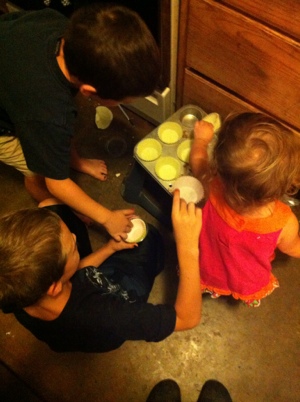
I thought this little threesome all working together so cooperatively was adorable.

20120813-162100.jpg

What a cutie waiting for cupcakes!

20120813-162043.jpg

Alaina enjoyed some batter.

I changed the recipe somewhat from the original and this is what I ended up with:

Double Chocolate Muffins (flourless!)

Ingredients:

1 3/4 c. oats
3 eggs
3/4 c. unsweetened cocoa
1/2 c. applesauce
dash vanilla extract
1/2 c. plain Greek yogurt
1-1/2 TB vinegar
1-1/2 ts baking powder
1-1/2 ts baking soda
1/4 ts salt
1 c. hot water
1 c. sugar
1/2 c. milk chocolate chips

Preheat oven to 350 degrees. Line 2, 12-cup muffin pans. In a food processor, mix all of the ingredients except for the chocolate chips. Blend until oats are ground and mixture is smooth. Gently stir in the chocolate chips (or, if you forget like I did, sprinkle them generously over the top–they kind of sink in and make a gooey center). Spoon mixture into prepared muffin pans. Bake at 350 for about 20 minutes.

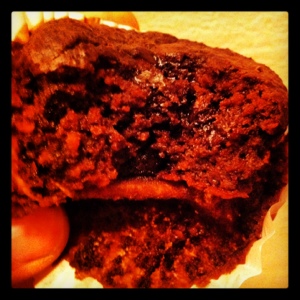
My kids said these muffins were too “intense” after the first one…they’re pretty gooey/rich seeming and they actually thought they were too sweet. I think I’ll cut back the sugar next time–I think 2/3 c. would have been more than enough.

I totally loved them though! They taste like nice squishy brownies! (The kids shaped up later in the day and ate more of them, no longer complaining about being too intense.) As of right now, there are two of the 24 we made left in the house…

20120813-162036.jpg

Finished muffin/cupcake! Look at the nice texture and tasty squishiness.

Okay, and remember the non-broken arm? Last Thursday we spent a lovely playgroup at the river…

20120813-161604.jpg

The boys enjoy playing in this goopy, nasty moss/algae stuff.

20120813-161612.jpg

Zander, “Moss-Man”

20120813-161627.jpg

Having some hummus by the river side and close to Mama’s skirt as is the preferred location (if not in arms)

As we were leaving the river, the boys wanted to stop and play on the playground by the parking lot. Lann tried to swing across on the monkey bars type thing (with a slidey handle deal) and fell off and hurt his tailbone. Rather than learn from this experience, Zander instead decided to see if HE could slide across with only one arm. When he fell off, he fell with arm under him. I saw him go down and my first thought was, he broke his arm! But, after some tears and snuggles, he seemed okay—the arm had full range of motion, etc. However, that night he woke up crying three times in the night because his arm hurt too bad to sleep. We did arnica and healing salve and then tylenol. In the morning, he was cheerful and playing like usual, but I noticed he wasn’t using his arm at all and I started to get worried. He held it up close to his body at a weird angle and was often holding it with his other hand. Then, he mentioned to me that it hurt too bad to push down the soap dispenser in the bathroom. So, I became 99% sure that it was fractured somewhere (somewhere, like on the underside, that didn’t impact his range of motion). The bottom of his forearm also felt really hot to the touch, almost feverish. So, we packed up and went to the urgent care clinic sort of place in town:

20120813-164423.jpg

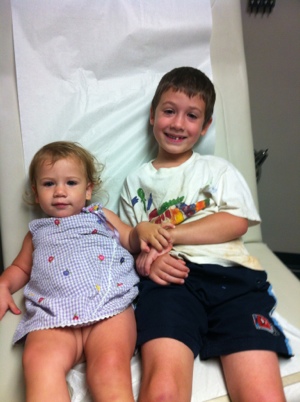
Feeling kind of cool about being up on the exam table.

20120813-164431.jpg

Alaina wants to get in on the “fun”!

After an x-ray, they put a splint and sling on it “just in case,” saying they did not see a fracture in the x-ray, but that they would send it to radiology for a million dollars (j/k) and they might be able to see a very fine one there.

20120813-164440.jpg

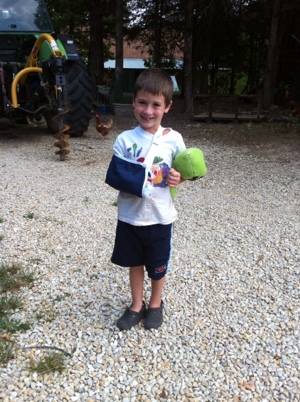
Feeling all doctored up with sling (plus, favored homemade Creeper “snuggly” made by Baba)

It then took until today to get the radiology report which was “negative.” So, sling is now off, arm seems normal, I expect to receive an unpleasantly hefty bill (we have sucky, “catastrophic only” insurance–when Mark cut his leg with the chainsaw earlier this year it cost us about $2000 out-of-pocket), and yet I do still feel like I made the right call in taking him in.

And, there you have it. Facebook status turned blog post. See why I’m just not cut out for Twitter?!

A Bias Toward Breastfeeding?

During World Breastfeeding Week, Lamaze’s Science and Sensibility blog published an interesting and thought-provoking guest post called “Instructor Has A Clear Bias Toward Breastfeeding!” The post explores a birth educator’s experience with teaching breastfeeding classes and receiving the title phrase on one of her evaluations. She is very disturbed by the evaluation and offers this profound and potent reminder: “We must not leave mothers less than whole.”

While I very much appreciate this observation and reminder, we also absolutely need to remember that biased means to exhibit “unfair prejudice”–it simply IS NOT “biased” to support breastfeeding as the biological norm and most appropriate food for babies. I was very concerned to read the comments on the post from other educators talking about their own “biases” toward physiologic birth or breastfeeding and how carefully they guard against exhibiting any such bias in their classes. Hold on! Remember that the burden of proof rests on those who promote an intervention—birth educators and breastfeeding educators should not be in a position of having to “prove” or “justify” the biological norm of unmedicated births or breastfed babies. I hate to see birth instructors being cautioned to avoid being “biased” in teaching about breastfeeding or birth, because in avoiding the appearance of bias they’d be lying to mothers. You can’t “balance” two things that are NOT equal and it is irresponsible to try out of a misplaced intention not to appeared biased. So, while I appreciate some of this educator’s points, I do think she’s off the mark in her fear/guilt and her acceptance of the word “bias.” The very fact that making a statement that someone has a bias toward breastfeeding can be accepted as a reasonable critique is indicative of how very deeply the problem goes and how systemic of an issue it is. If I say that drinking plenty of water is a good idea and is healthier for your body than drinking other liquids, no one ever accuses me of having a “bias towards water.” Breastfeeding should be no different. But, as we all know, breastfeeding occurs in a social, cultural, political, and economic context, one that all too often does not value, support, or understand the process.

This reminds me of an excellent section in the book Mother’s Intention: How Belief Shapes Birth about judgment and bias. The author also address how the word “balanced” is misused in childbirth education–as in, “I’m taking a class at the hospital because it will be more balanced.” Balance means “to make two parts equal”–-what if the two parts aren’t equal though? What is the value of information that appears balanced, but is not factually accurate? Pointing out inequalities and giving evidence-based information does not make an educator “biased” or judgmental-–it makes her honest! (though honesty can be “heard” as judgment when it does not reflect one’s own opinions or experiences).  (formerly quoted in this post. And, see this post for some thoughts about pleonasms.)

I do value the reminder that pregnant and postpartum mothers are vulnerable and how we speak to them really matters. I know that. I also worry that too much “tender” speech regarding breastfeeding as a “choice,” a “personal decision” and “we support you no matter what”—leaves the door wide open for continued systemic support of a bottle feeding culture that treats formula feeding and breastfeeding as similar or interchangeable. I’m not sure what the answer is. Maternal wholeness matters, so does breastfeeding!