Archives

Active Birth in the Hospital

One of the inspiring images in ICAN of Atlanta's "Laboring on the Monitors" slideshow.

The vast majority of my birth class clients are women desiring a natural birth in a hospital setting. My classes are based on active birth and include a lot of resources for using your body during labor and working with gravity to help birth your baby. Sometimes I feel like active birth and hospital birth are incompatible—i.e. the woman’s need for activity runs smack dab into the hospital’s need for passivity (i.e. “lie still and be monitored”). So, I was delighted to discover this awesome series of photos from ICAN of Atlanta of VBAC mothers laboring on the monitors. It IS possible to remain active and upright, even while experiencing continuous fetal monitoring.

In my own classes, we talk about how to use a hospital bed without lying down—the idea that a hospital bed can become a tool you can use while actively birthing your baby. Here is a pdf handout on the subject:How to Use a Hospital Bed without Lying Down. In this handout, I offer these tips for using the bed as an active assistant, rather than a place to be “tied down”:

While being monitored and/or receiving IV fluids that limit mobility, try:

  • Sitting on a birth ball and leaning on bed
  • Sitting on bed
  • Sitting on bed and lean over ball (also on bed)
  • Kneeling on bed
  • Hands and knees on bed
  • Standing up and leaning on bed
  • Leaning back of bed up and resting against it on your knees
  • Bringing a beanbag chair, putting it on the bed and draping over it (can also make “nest” with pillows)
  • Partner sitting on bed and woman leaning on him/supported squats with him
  • Partner sitting behind woman on bed (with back leaned up as far as it will go)

While giving birth, try:

  • Hands and knees on bed
  • Kneeling with one leg up (on bed like a platform or “stage”)
  • Holding onto raised back of bed and squatting or kneeling
  • Squatting using squat bar

While most of the above tips can be used during monitoring, additional ideas for coping with a simultaneous need for monitoring AND activity include:

  • Kneel on bed and rotate hips
  • Sit on edge of bed and rock or rotate hips
  • Sit on ball or chair right next to bed (partner can hold monitor in place if need be)

If something truly requires being motionless, it can be helpful to have some breath awareness techniques available in your “bag of tricks.” One of my favorites is: Centering for Birth

Some time ago, a blog reader posed the question, can I really expect to have a great birth in a hospital setting? I definitely think it is possible! I also think there is a lot you can do in preparation for that great hospital birth! When planning a natural birth in the hospital, it is important to consider becoming an informed birth consumer. I always tell my clients that an excellent foundation for a simple, effective, evidence-based birth plan is to base it on Lamaze’s Six Healthy Birth Practices. My own pdf handout summarizing the practices is also available: Six Healthy Birth Practices. Don’t forget there is also a great video series of the birth practices in action! You might also want to get a copy of the book Homebirth in the Hospital. And, check out this post from Giving Birth with Confidence: Six Tips for Gentle but Effective Hospital Negotiations.

Before you go in to the hospital to birth your baby, make sure you have some ideas about this very popular question, how do I know if I’m really in labor?

And, finally, be prepared for the hospital routines you may encounter by reading my post: What to Expect When You Go to the Hospital for a Natural Childbirth.

For some other general ideas about active birth, read my post about Moving During Labor (written for a blog carnival in 2009).

Best wishes for a beautiful, healthy, active hospital birth! You can do it!

Book Review: Homebirth in the Hospital

Homebirth in the Hospital
by Stacey Marie Kerr, MD
Sentient Publications, 2008
Softcover, 212 pages
ISBN: 978-1-59181-077-3
www.homebirthinthehospital.com

Reviewed by Molly Remer, MSW, ICCE, https://talkbirth.wordpress.com

I would venture to say that most midwifery activists and birth professionals have said at some point, “what she wants is a homebirth in the hospital…” This comment is accompanied with a knowing look, a bit of head shaking, and an unspoken continuation of the thought, “…and we all know that’s not going to happen.”

Well, what if it is possible? A new book by Dr. Stacey Kerr, Homebirth in the Hospital, asserts that it is. She was originally trained at The Farm in TN (home of legendary midwife Ina May Gaskin) and after going to medical school realized that she, “…needed to balance my new knowledge with my old priorities. I missed the feeling of normal birth, the trust that the birthing process would occur without technology, and the time-tested techniques that help women birth naturally. And so it was that I went back to midwives to find the balance.”
If you are a dedicated homebirth advocate, I recommend reading Homebirth in the Hospital with an open mind—clear out any cobwebs and assumptions about doctors, hospitals, and birth and read the book for what it is: an attempt to create a new model of hospital birth. What Dr. Kerr proposes in her book is a model of “integrative childbirth”—the emotional care and support of home, while nestled into the technology of a hospital.

The opening chapter explores the concept of integrative childbirth and “the 5 C’s” of a successful integrative birth: choices, communication, continuity of care, confidence, and control of protocols (“protocols are the most disempowering aspect of modern maternity care…”).

This section is followed by fifteen different birth stories, beginning with the author’s own (at a Missouri birthing center—my own first baby was born in a birth center in Missouri, so I felt a kinship there).

The births are not all happy and “perfect,” not all intervention-free, and most are quite a bit more “managed” and interfered with than a lot of homebirthers prefer (one is a cesarean, several involve epidurals or medications). I, personally, would never freely choose a “homebirth in a hospital” (I also confess to retaining a deep-seated opinion that this phrase is an oxymoron!). However, that is not the point. Over 90% of women do give birth in a hospital attended by a physician and I appreciate the exploration of a new model within the constraints and philosophy of the hospital.

The book closes with a chapter called “how to be an integrative childbirth provider.” The book has no resources section and no index.

I certainly hope that doctors read this book. I am also glad it is available for women who feel like homebirth is not an option or not available and would like to explore an integrative approach. Even though my opinion is that none of the births are really “homebirths in the hospital” as most bear little resemblance to the homebirths I know and love, unlike the content of the standard hospital birth story, they are deeply respectful births in the hospital and that’s the issue truly at the heart of this book.

—-

Disclosure: I received a complimentary copy of this book for review purposes.

Alaina’s Complete Birth Story

It has taken me a long time to finish typing up Alaina’s birth story. I wrote it in my journal at 3 days postpartum and the following is almost verbatim. I’ve gone back and forth about what to include and decided to just include everything, as originally written. I feel critical of the story somehow, like it is “choppy.” I used interestingly short, jumpy sentences and while part of me want to smooth it out, another part of me feels like it is more authentic in this format. I also feel like I “should” be posting it on a more significant date—i.e. her six month birthday, or something. But, it is finished now, so I feel like sharing now! Additionally, I thought about taking the self-analysis section about the use of a hypnosis for birth program out of the story, but, indeed, this was the FIRST thing I wrote in my journal, so it seems like it “deserves” to be included as well. It obviously was one of the most important details for me to write about. However, for the purposes of clarity, I moved it to the end of the story in this version. Likewise, I thought about making the section about my newborn- love into a separate post, but because those feelings are so intimately entwined with her birth and because, in my journal, that is exactly the chronology I used—first hypnosis criticism, second birth chronology, third baby love–it feels like it all belongs together in one story. It is funny how that first story has such value to me and that it feels almost wrong to edit, change, or add anything to it. It feels most honest this way.

The Birth of Alaina Diana Remer
January 19, 2011
11:15 a.m.
7lbs, 8oz; 20 inches.
Short version of her story is here and labor pictures are here.

I had a restless, up and down night, getting up at 3:00 a.m. and even checked in with my online class. Mark got up with me and we talked and speculated. Waves were four minutes apart and then kind of dissipated unenthusiastically away. He went back to bed at 4:00 and I listened to Hypnobabies. At 6:00, I was feeling trapped lying down and got up. Mark got up then too and worked in the kitchen on the dishes and things like that, while I walked around and leaned on the half wall during contractions (a lot. It was the perfect height). Sitting down in a chair caused horribleness, leaning forward on the ½ wall was good. Called Mom and told her to be on standby and to notify my blessingway crew. Also, called Summer (doula/friend) to be on alert. Felt serious, but not totally. Also was having back involvement which each wave. I felt like I would have a real contraction and then a closely following, but milder, back-only contraction (no tightness in uterus really during these, but definitely a wave-like progression and then ease of sensation).

I was very quiet during most waves until the end. I think because I was doing the Hypnobabies and was concentrating on that. Then, I would talk and analyze and be very normal in between. This pattern seemed to lead to a decreased perception of seriousness from others of my need for attention—Mark washed dishes, went outside to take care of chickens, work on fire, feed cats and so forth. The boys woke up at 7:00 a.m. and as soon as they came out and started talking to me (Mark was outside), I knew they needed to go elsewhere. We called my mom at 7:30ish and she came to get them. I did not want to feel watched or observed at all, so asked her to wait to come back.

I kept waiting for the “action” to increase and feeling distressed that it was taking such a “long” time. I suggested to the baby that she come out by 10:00. I continued to stand in the kitchen and lean on the ½ wall, sometimes the table or the bathroom counter. Dismayed to see no blood/mucous, nothing indicating any “progress.” Significant feelings of pressure and pain in lower back continued and at the time felt normal to me, but looking back seems like an extra dose of back involvement. In another intensity-increasing experience, the baby moved during contractions for the entire labor until the contraction before I pushed her out. She moved, wiggled and pushed out with her bottom and body during each contraction, which really added a new layer of intensity that was difficult. I was, however, glad she was moving because then I knew she was okay, without doing any heart checks.

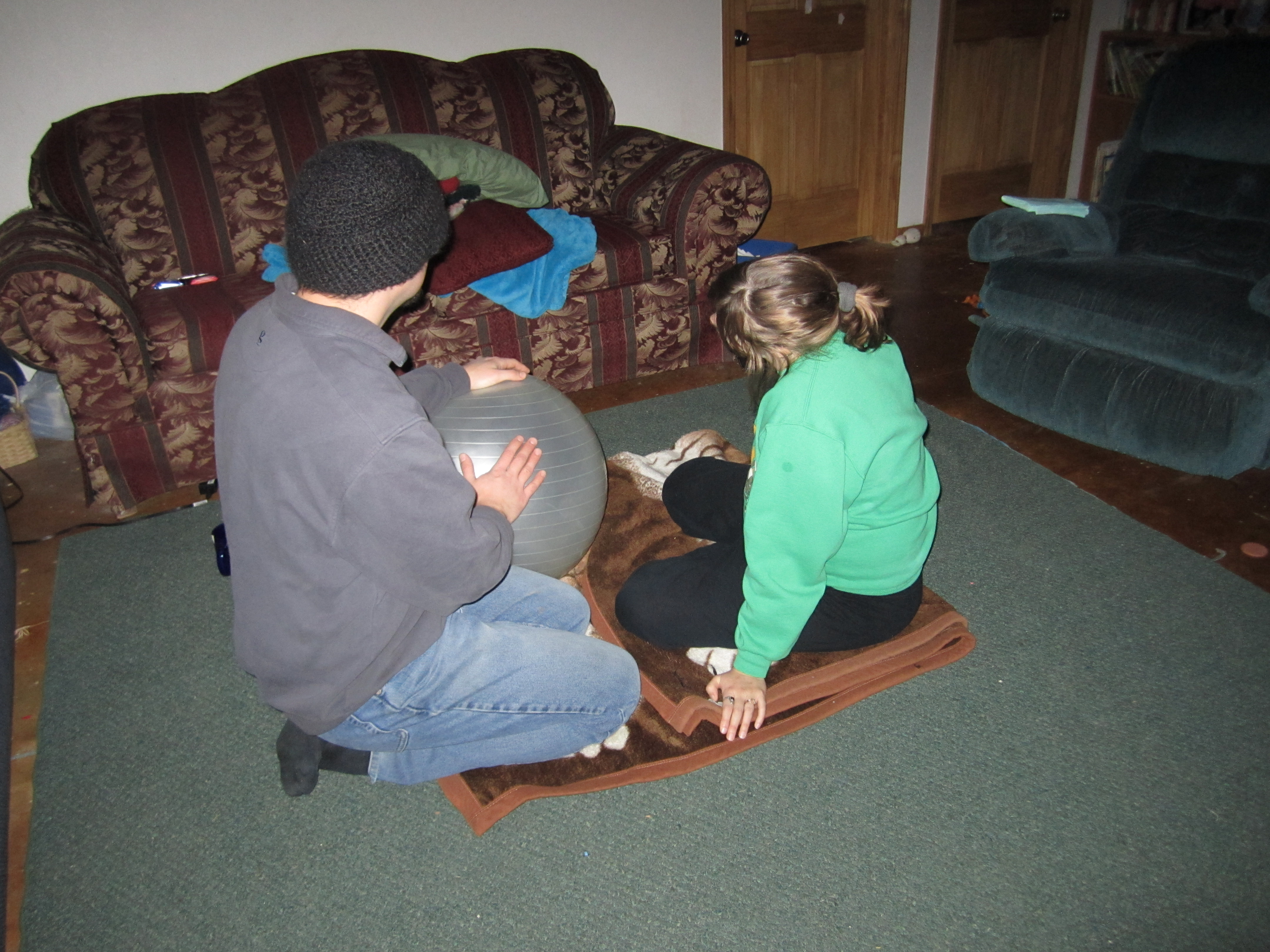
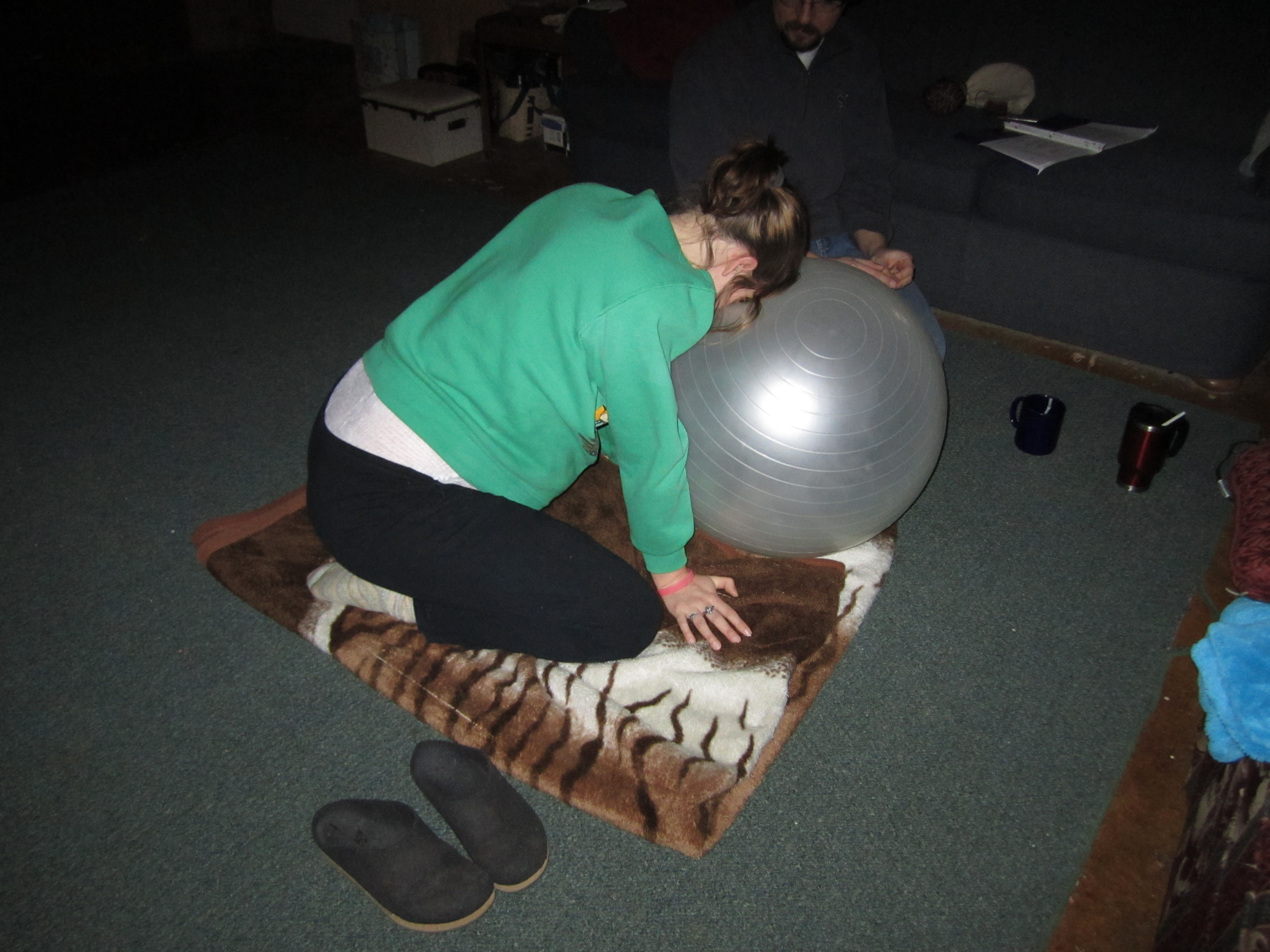
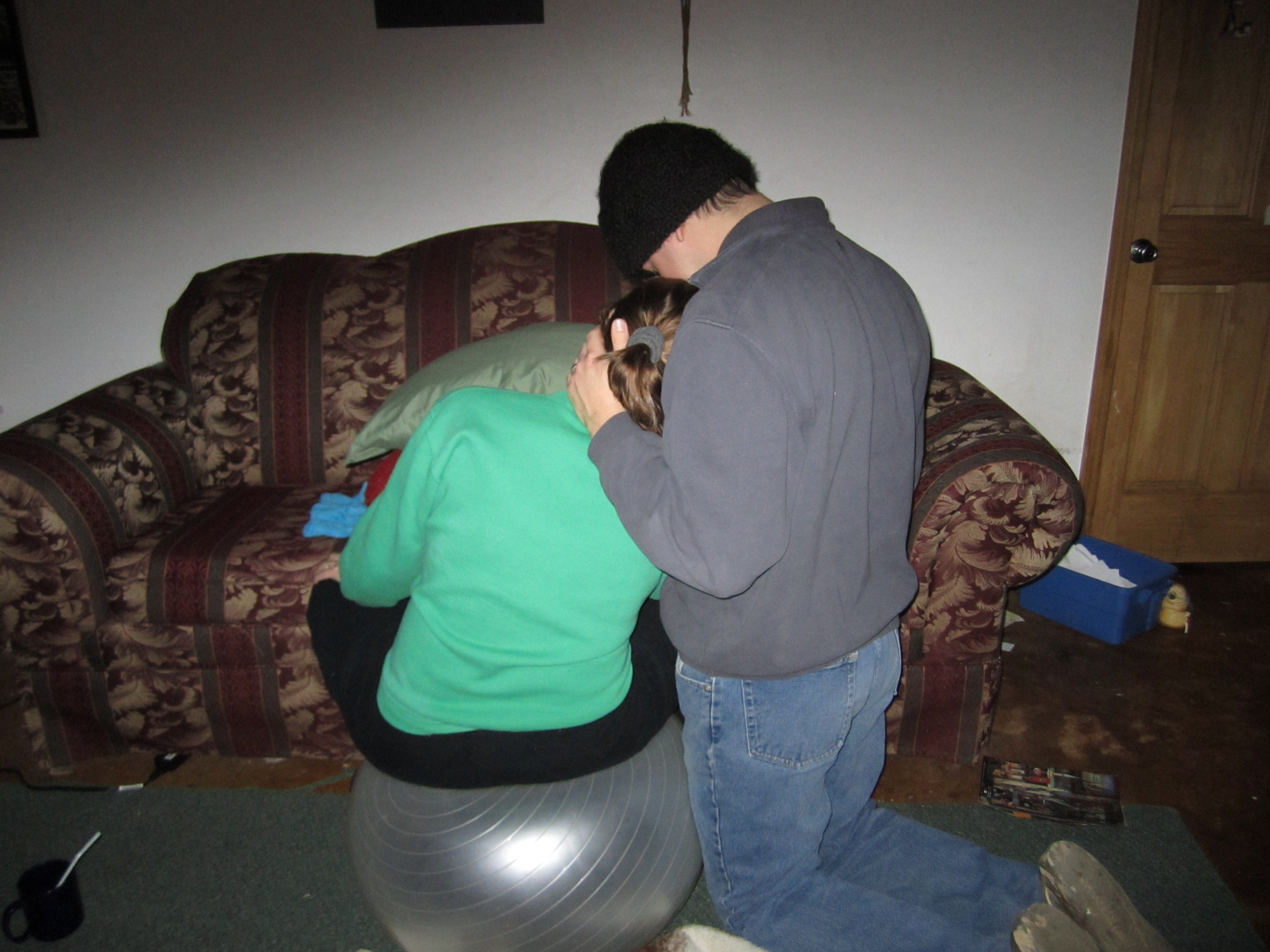
I went into the living room, very tired from bad sleep during the night. We set up the birth ball in the living room so I could sit on it and drape over pillows piled onto the couch. I spent a long time like this. Mark sat close and would lightly and perfectly stroke my back. Continued to use Hypnobabies—finger-drop, peace and release, with most waves.

Mark fixed me chlorophyll to drink and I barfed it up immediately and horribly. Called Mom to come back and 9:00 or so, at which point I finally had a little blood in my underwear. Kept up my ball by the couch routine and moved into humming with each wave. Also did some contractions on the floor leaning over the ball. Also good.

On the ball, I began to feel some rectal pressure with each wave. However, I felt like the waves were erratic still, with some very long and intense and then smaller ones. Hums began to become oooohs and aaaaahs and I began to feel like there was a bit of an umph at the end of the oooooh. Went back to the bathroom and there was quite a bit more blood (plus mucous string) and I started to fret about placental abruptions and so forth. Left the bathroom analyzing how much blood is too much blood and began to critique myself for being too “in my head” and analytical and not letting my “monkey do it.” Said I still didn’t feel like I was in “birth brain” and wondered if that meant I still had a long time to go. Started to feel concerned that I was still early on. This is a common feature of all of my births and is how the self-doubt signpost manifests for me. Rather than thinking I can’t do it, I start thinking I’m two centimeters dilated.

I almost immediately returned to the bathroom feeling like I needed to poop. Serious contractions on toilet produced more pressure with associated umphs at the end. At some point in the bathroom, I said, “I think this is pushing.” I was feeling desperate for my water to break. It felt like it was in the way and holding things up. I reached my hand down and thought I felt squooshy sac-ish feeling, but Mom and Mark looked and could not see anything. And, it still didn’t break. Mom mentioned that I should probably go to my birth nest in order to avoid having the baby on the toilet. My birth nest was a futon stack near the bathroom door. I got down on hands and knees after feeling like I might not make it all the way to the futons. Felt like I wanted to kneel on hard floor before reaching the nest.

Suddenly became obsessed with checking her heartbeat. I knew you’re supposed to do so during pushing and I had stopped feeling her moving painfully with each contraction. I couldn’t find her heartbeat and started to feel a little panicky about that as well as really uncomfortable and then threw the Doppler to the side saying, “forget it!” because big pushing was coming. I was down on hands and knees and then moved partially up on one hand in order to put my other hand down to feel what was happening. Could feel squishiness and water finally broke (not much, just a small trickle before her head). I could feel her head with my fingers and began to feel familiar sensation of front-burning. I said, “stretchy, stretchy, stretchy, stretchy,” the phone rang, her head pushed and pushed itself down as I continued to support myself with my hand and I moved up onto my knees, with them spread apart so I was almost sitting on my heels and her whole body and a whole bunch of fluid blooshed out into my hands. She was pink and warm and slippery and crying instantly—quite a lot of crying, actually. I said, “you’re alive, you’re alive! I did it! There’s nothing wrong with me!” and I kissed her and cried and laughed and was amazed. I felt an intense feeling of relief. Of survival. I didn’t realize until some moments later than both Mark and Mom missed the actual moment of her birth. Mark because he was coming around from behind me to the front of me when I moved up to kneeling. My mom because she went to stop the phone from ringing. I had felt like the pushing went on for a “long” time, but Mark said that from hands and knees to kneeling with baby in my hands was about 12 seconds. I don’t know. Inner experience is different than outer observation. What I do know is that the moment of catching my own daughter in my hands and bringing her warm, fresh body up into my arms was the most powerful and potent moment of my life.

I was covered in blood again. Caked in my fingernails and toenails and on the bottoms of my feet again. And, I did tear again, same places.

I feel the moment of her birth was an authentic “fetal ejection reflex” including the forward movement of my hips. The immediate postpartum went exactly as I had planned. Summer arrived approximately 20 minutes after Alaina was born. She brought me snacks, wiped blood off of me, and served me a tiny bit of placenta (which I swallowed with no problem!). My midwife arrived approximately 40 minutes post-birth and assessed blood loss and helped with placenta. She said I lost about 3 cups of blood, but I think all of the fluid that came out with the baby, plus the blood from the tears, may have bumped the estimate up too high. I did not feel weak or tired like I’d lost too much blood, I felt energetic and really good, actually. I didn’t get faint in the bathroom either and my color stayed good throughout. “Don’t look down” (while using the bathroom) is an excellent plan for me!

My post-birth feelings were different this time. I feel more baby-centered in my feelings about it rather than self-empowerment centered. I also feel more critical in my own self assessment this time—like I didn’t “perform” well or handle myself well. I hypothesize that this may be related to using a hypnosis for birth program, because I didn’t feel “calm and comfortable” on the inside. On the outside I think I looked it, but my internal experience involved more “should” than I like. The hypnosis philosophy wasn’t really a match with my own lived experience of birth. Birth isn’t calm, quiet, and comfortable and I don’t actually think it should be or that I want it to be. However, I was trying to make it so and thus not using some of my own internal resources. I felt more mind/body disconnect than I have before also, perhaps because I was trying to use a mind (“control”) based method on such an embodied process. Anyway, it was good for relaxing during pregnancy, personally not so good for behaving instinctually in labor. I did use it though and technically I guess it “worked” because Mom and Mark couldn’t read where I was in birthing and though I was very calm. It didn’t feel calm inside though, it felt HARD. I also was very stuck—almost in a competitive-feeling way—on thinking it was going to be fast and feeling stressed/concerned that it wasn’t.

I also want to include this segment from my journal, written when she was three days old:

She is so wonderful and amazing and beautiful and perfect and I just want to etch these days into my mind forever and never forget a single, precious, beautiful, irreplaceable moment. I want to write everything down to try to preserve each second of these first few days with baby Alaina—my treasure, my BABY! The one I hoped for and feared for and worked SO HARD to bring to this world (in pregnancy more so than in birth). I can’t really though—I am here, now. Living this, feeling this, knowing this. The newborn haze is my reality in these moments, but it will pass away and the best thing to do is to fully live it. To feel it and to be here—without struggling to preserve it all. It is here in my heart and soul and preserved in the eddies and ripples of time. The unfolding, continuous ribbon of life and experiences. I have a weird, petrified feeling of forgetting—i.e. when I’m 89 will I still remember how this FELT?!

What do I want to remember?

Newborn photo (c) Sincerely Yours Photography

Alaina newborn photo (c) Sincerely Yours Photography

    • The scrunchy feel of a newborn’s body.
    • The little mewing squeaks and sighs
    • How she is comforted by my voice and turns to me with a smacky, nursie face…
    • The soft, soft skin
    • The soft, soft hair
    • The fuzzy ears and arms
    • The little legs that pull up into reflexive, fetal position.
    • The utter, utter, MARVEL that I grew her and that she’s here. That she came from me. That sense of magic and wonder and disbelief when I look over and see her lying next to me—how did YOU get here?!
    • The miraculous transition from belly to baby. From pregnant woman to motherbaby unit? How does it happen? It is indescribably awesome.
  • The sleeping profile
  • The scrunchy face
  • The “wheeling” half coordinated movements of arms and legs—sort of “swimming” in air.
  • The peace of snuggling her against my chest and neck.
  • The tiny, skinny feet.
  • Putting my hand on her back and feeling her breathe, just like in utero

I was still scared she was going to die until the moment I held her.
Molly & Alaina newborn photo (c) Sincerely Yours Photography

Six Healthy Birth Practices Handout

Lamaze’s Six Healthy Birth Practices are one of my favorites resources when discussing birth plans in my classes. I find that some materials about birth planning on the internet are unnecessarily cumbersome (while simultaneously being very “cookie cutter”). As I tell my clients, the Six Healthy Birth Practices provide an absolutely phenomenal “basic” birth plan and concisely cover each element of a healthy birth. I suggest using them as a foundation for any birth plan the client plans to write. For use in my own classes, I created a one page handout briefly summarizing the practices: Six Healthy Birth Practices. At the bottom of the handout, I also include my own even simpler summary of the information. I just love them and think they should be the core of any class that serves women planning hospital births. Seriously, what women deserve in a birth environment can be summed up in six, clear sentences! How practical.

I also absolutely LOVE the video based on the practices that is available from Injoy. It is extremely affordable (I actually own three copies of it!). It is very concise and clear (just like the practices themselves) and I love how it shows women in a hospital environment, getting their needs met and having satisfying births. While I personally choose homebirth for myself and am a big advocate of homebirth, at least 90% of my clients are planning hospital births and deserve information and resources that support healthy, satisfying births in the environment they have chosen. I have a variety of great videos in my library, but many of them focus on homebirth and I think the message this sends to clients is—“good birth = homebirth.” While that feels personally true for me, it isn’t actually the message I want to share with my clients—I want to share my enthusiasm for birth, period, and to help them discover resources and plans for having a beautiful birth in any setting. I want to communicate to them that they deserve access to these healthy birth practices in the hospital and I hope we can create a birthing world in which all women can expect to have access to these practices in any setting. So, I like how this video shows women getting their needs met within in a hospital setting.

Additionally, the videos are available for free, practice by practice, on the Mother’s Advocate site, which also includes a variety of accompanying handouts to print.

And, again, here is my own handout for use during birth classes: Six Healthy Birth Practices.

I know I sound like a “commercial” for Lamaze’s Birth Practices and though I am a Lamaze member, I am actually certified with other organizations (ICEA and CAPPA). I think it is important that childbirth educators not limit themselves only to the materials and information provided by their own certifying organization and instead seek out excellent materials from a variety of the wonderful organizations that exist to support birthing women!

The Spot

“Can I ask you a personal question?” asks the woman on the phone. She is calling to inquire about my birth classes and the subject of homebirth has come up.

“Sure!”

“What about the mess?”

At first I give the standard answer. That birth isn’t so terribly messy, that you can put down towels and chux pads, that the midwife often does the cleanup. I pause a moment. This prospective client and I have an instant connection and excellent rapport. I add, “Actually, I left a huge blood spot on our living room carpet.” I add that the spot came out almost completely with peroxide, but can’t stop myself from also remarking, “I actually feel kind of proud of it—it felt like a symbol to me.” I find myself laughing a little and there is an unmistakable note of triumph in my voice.

“Of what?”

“That I did it. Gave birth in my own home, in my own living room, on my own terms, under my own power, in my own way. In the way that felt best and right and safest to me. On my own. Me. I did it.”

What I did not add—what would have been pushing it just a little too far—is that when we moved the peroxide-cleaned carpet square into our new home a large, round, rusty-red stain was revealed on the concrete floor beneath. And, that I take secret delight in its presence. I am proud that I left my mark on the floor that bore witness to my labor. I delight and actually revel in the reminder of my power that the stain represents. Is this total weirdness? Or freakishness? A type of maternal masochism or even a perversion? No, I decide. It is really not so different from keeping a football trophy from high school or an award for volunteerism in human services from college. Maybe there is a medal for natural childbirth after all—arriving in different surprising guises, one kind a blotchy reddish stain on a concrete floor.

Despite our easy camaraderie, I never hear from that prospective client again.

Those who critique the zealousness of birth activists sometimes accuse us of supporting an insidious “Cult of Natural Childbirth” and assert that we undermine women and their unique and often traumatic experiences by “insisting” that birth be an empowering and triumphant event for women.

Maybe there actually is a Cult of Natural Childbirth and I am an acolyte of Birth cackling with wild glee as I caper around my bloodstained floor….

Nursing my brand new baby boy! (2006)

———

In the original article, I included a post-birth picture from my second son’s birth that showed one completely exposed breast. I must have still been hopped up on the post-birth euphoria when I sent it, because after it was actually published I felt slightly horrified to have my boob in print and didn’t feel like I could show the article to my dad (or, really, to many other people!) If you look closely at the picture I substituted in this blog post, you can see there is blood streaked all over my chest, arms, and hands. It was a very bloody birth!

—————————————————————————————————————–

This is a preprint of The Spot, an essay by Molly Remer, MSW, ICCE, published in Midwifery Today, Issue 86, Summer 2008. Copyright © 2008 Midwifery Today. Midwifery Today’s website is located at: http://www.midwiferytoday.com/

Labor Pictures

I’ve mentioned before that I was disappointed not to have any birth pictures from my last baby. What I do have is quite a few labor pictures and I want to share them in a post since labor pictures don’t often get as much “glory” as birth pictures 🙂 I didn’t have any birth pictures with my first son either, though we have several immediately after as was my preference at the time. I have two labor pictures with him, this one, taken in fairly early labor:

Trying to decide whether or not this is it!

Then, my mom took this one of me after I got out of the shower. I was going to try to go to bed, because the birth center staff seemed pretty sure I wasn’t really in labor and should just get some rest. This picture was taken about 5-6 hours before he was born:

With my second son, my mom took a great series of birth pictures as he was emerging. They’re really good and step by step as he comes out—however, the angle is a very direct “rear view” that I don’t feel comfortable putting on the internet! With that birth, there is only one picture from the actual labor (and, it is a nice active labor picture that isn’t too graphic and it has actually been printed in several publications):

About 30 minutes before giving birth to second baby

I like how you can see all of my older son’s playdoh creations in the foreground. That’s homebirth for you!

With my daughter, my mom took a series of labor pictures and while I’m sad not to have birth pictures too, I like the story that these pictures tell:

Taken during the morning of birthing day–wanted one last “belly picture” of pregnancy.

Spent a lot of time on the ball with Mark at my side

My birth nest is all ready! (on floor outside bathroom) Notice that my birth altar is set up nearby.

More time on the ball…

Proving I can still smile one hour before she is born! (+ advertising my alma mater)

Accidentally got trapped on floor in horrible and painful position.

The closer I get to having a baby, the nearer to the floor I get (hands and knees is right for me)

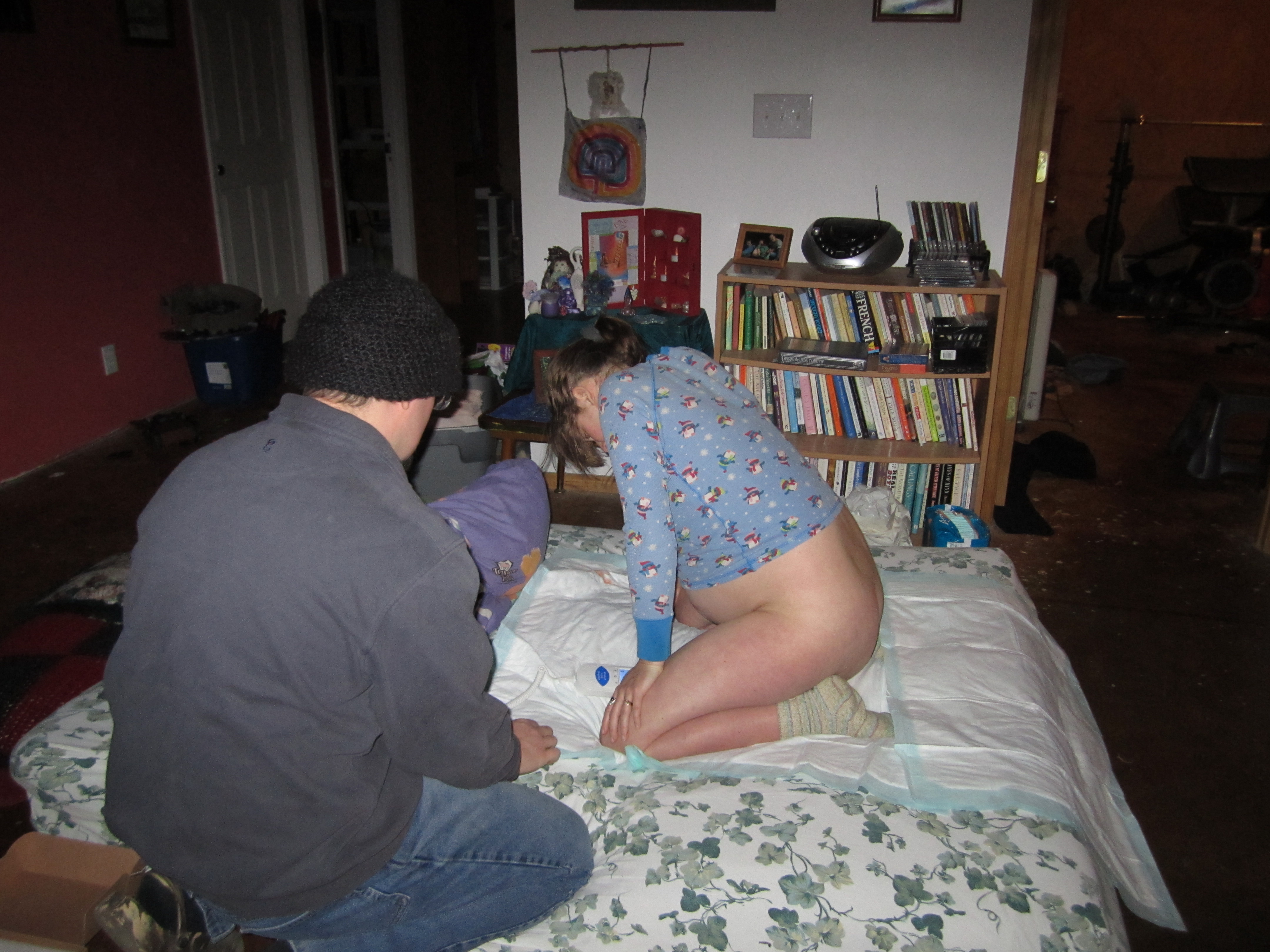
Switched into ridiculous too-small PJ shirt right before pushing.

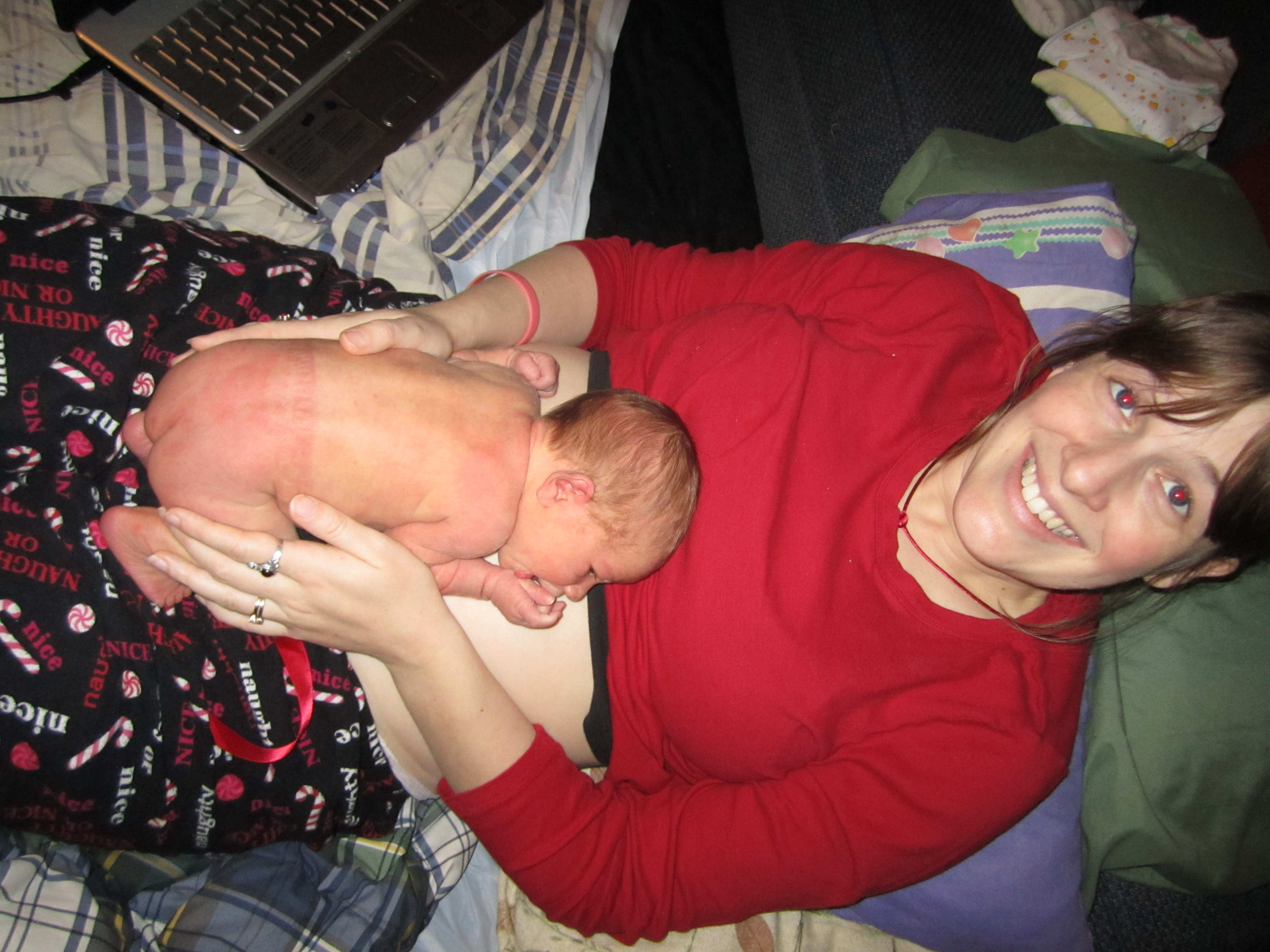
She’s here! Closest thing to a birth picture that we got.

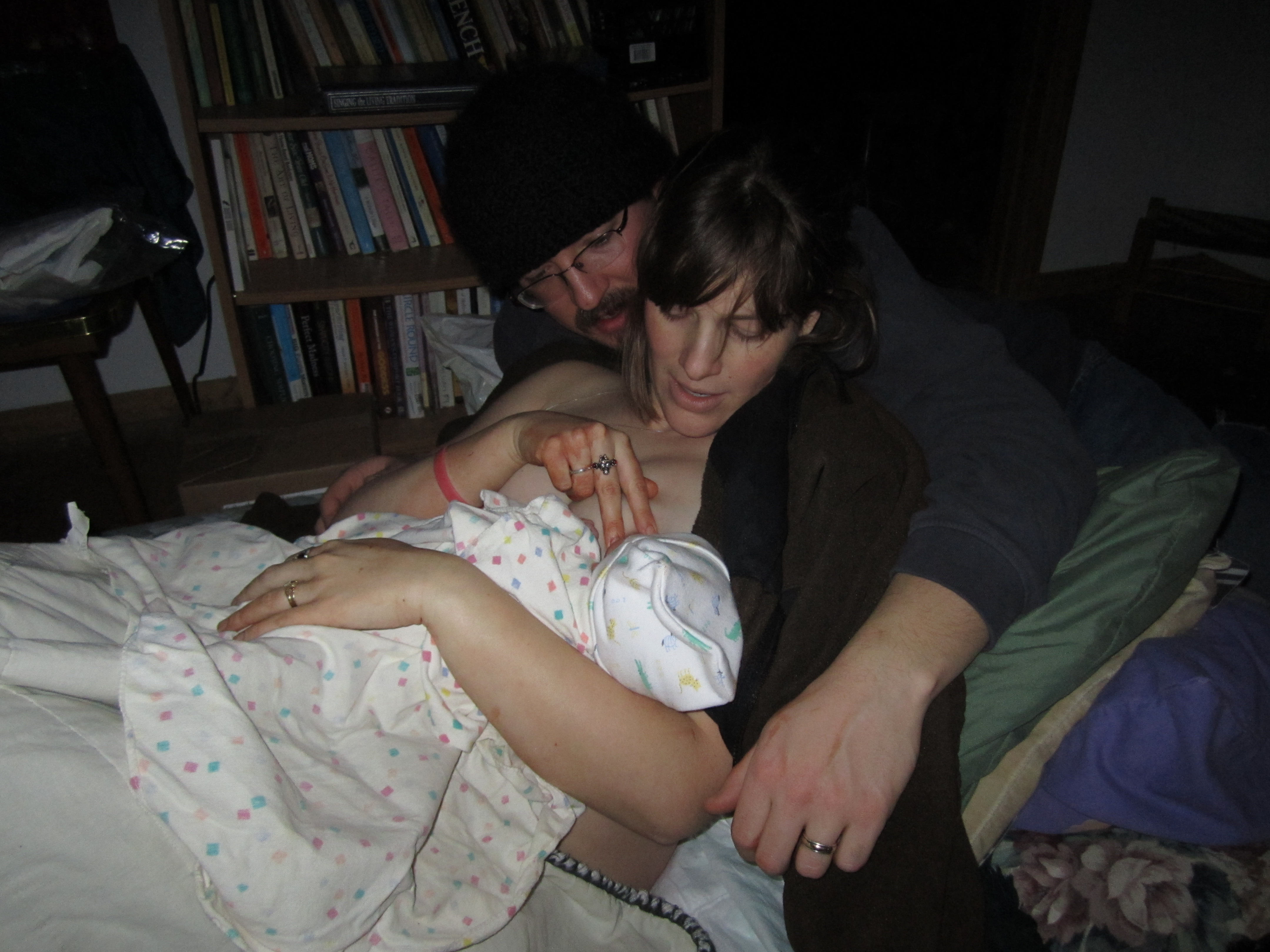
First nursing

Threshold Moments

In cleaning off my desk this weekend, I found the following note from a webinar by Rose St. John that I attended some time ago:

“Labor is all about finding your threshold and learning you can go beyond it.” –Rose St. John

Threshold Stone, Newgrange, Ireland

I think one of the powerful lessons of birth is about one’s own immense capacity—each of my births has had a “threshold” moment and, indeed, I have some notes taken for a possible future article about “At the Threshold: Pivotal Moments in Birth.” With my first son it was during pushing when I realized I had to just do it, I had to push him out even though it was scaring me to do it. With my second son, it was when I realized that I was actually in labor—I had a distinct sense of literally crossing a threshold. A sense of, “there is no turning back now. I’m going back into the house and I’m having a baby.” With my third son, it was when I got up in the night feeling contractions and went into the kitchen. There, I talked to the baby, telling him it was time to let go of each other—“Lets do this. Lets get it done by 3:00” (and we did).With my last baby, it was when I was talking to myself prior to pushing—fretting that I was too “in my head” and not letting go enough. After this moment, I did let go and she was born very rapidly after that.

So, looks like I had two “pushing” thresholds and two “bring it on—labor is beginning” thresholds. The pushing thresholds occurred during my longer labors and the bring it on moments during my short labors.

The Waters are Breaking…

I recently bought a very discounted copy of Penny Simkin’s Comfort Measures for Childbirth video. In the explanatory booklet that comes with it, she mentions the following: “You may also notice the woman’s bag of waters break during a bearing-down effort. This is normal, though quite rare, as the bag of waters is usually broken before this time…” She doesn’t specify whether it is quite rare because the bag of waters is artificially broken before that time for many women, or whether it is just quite rare, period. Regardless, I found it an interesting comment because my personal experiences have all been of this same “rare” type—my water breaks right as I’m pushing out my babies. With my first son, I arrived at the birth center ten centimeters dilated and was told I could push whenever I felt the urge. After about 30 minutes or so, I began pushing sort of experimentally. My water exploded across the room after a few of these mini-pushes. He was then born about an hour after that. With my second son, I was on my hands and knees on the floor feeling the first intense pushes and on the second push, my water broke with a soft, warm gush and ran down my leg. He was born about 5 minutes after that. After these two experiences, my conclusion was that it was kind of a nice benefit to have my water intact until pushing—it created sort of cushion for the baby’s head and (I felt) perhaps lessened the intensity of contractions (I have yet to experience a “freaking out,” identifiable transition stage in any of my births).

Waves breaking at Montana De Oro on CA trip, July 2009.

When my daughter was born last month, it was a slightly different story. As usual, the water stayed intact, but as I began to feel the pressure of her approaching head, I felt like my water really needed to break and wasn’t. It felt distinctly in the way and it was really bothering me. I felt like I could feel it in my “birth path” and it felt like an obstruction rather than a cushion and I was completely annoyed by it. I got on hands and knees on the futon and could feel her head moving down and almost crowning, when the water finally broke and a small trickle of it came out before she did (approximately 12 seconds before!). As I’ve written before, I moved up into a kneeling position then and my entire baby was born all at once along with…a big sploosh of water. Most of it came out after the baby—she was particularly nice and clean after birth too. My sons were very bloody. My daughter had a couple of tiny spots of blood on her head, but the rest of her was pink and vernixy.

I titled my post as I did because during this last pregnancy, I often listened to a CD of chants. One of the songs on the CD has sort of a wailing refrain of, “the waters are breaaaaaaking…all over the world….the waters are breaking!” and I could NOT listen to that song while pregnant (even though it has nothing to do with pregnancy—I’m not sure exactly what it is supposed to mean, but I surmise it is about change in the world). I always ran to skip over it, feeling like to listen to it would be to send some kind of message to my body/baby that I wanted my water to break, when really, I definitely didn’t want it to break early! I wish I would have thought to turn the song on during labor though 😉

Birth Quotes Update

“Remember that most of the people who really need your work are not hanging out in the oversaturated twitterverse, but in places where what you do isn’t common. Get out of the crowded room and go where there’s a dearth of and a thirst for what you do. Don’t try to shout over lots of shouting.” –Tara Sophia Mohr

(Not specifically birth-related, but an excellent reminder from this post. I’ve often felt with blogging and writing for birth publications that maybe I’m just clamoring to …be heard in a cacophony of other voices (that also have good things to say–am I contributing anything unique?!)

“When my kids become wild and unruly, I use a nice, safe playpen. When they’re finished, I climb out.” ~Erma Bombeck (via Moby® Wrap)

“The miraculous nature inherent in the unfolding of a flower is the very same that moves through a woman as she gives life to the world. We can neither control nor improve upon it, only trust it.” -Robin Sale

…the stories I see of birth in the media don’t reflect the intense emotions, the physical power, or the immense impact of the experience itself. Women screaming, fathers fumbling about, doctors doing most of the heroic work–these images don’t do justice to my experience. I felt empowered, strong, heroic in my efforts to bring my daughter into the world yet, I am painfully aware how little others see the heroism in my birth experience.”  –Amy Hudock (essay in Literary Mama)

“It’s not only children who grow. Parents do too. As much as we watch to see what our children do with their lives, they are watching us to see what we do with ours. I can’t tell my children to reach for the sun. All I can do is reach for it, myself.” – Joyce Maynard (via Literary Mama)

Giving birth, certainly, should rank among the pivotal heroic adventures celebrated in our culture. Certainly it is more heroic than catching a football or acting in front of a camera, and perhaps even more heroic than going off to war. Men return from the battlefield with victory, but women return from the birthing room with life…” –Amy Hudock (in Literary Mama)

“...if you want to know where a woman’s true power lies, look to those primal experiences we’ve been taught to fear…the very same experiences the culture has taught us to distance ourselves from as much as possible, often by medicalizing them so that we are barely conscious of them anymore. Labor and birth rank right up there as experiences that put women in touch with their feminine power…” –Christiane Northrup

The intrinsic intelligence of women’s bodies can be sabotaged when they’re put into clinical settings, surrounded by strangers, and attached to machines that limit their freedom to move. They then risk falling victim to the powerful forces of fear, loneliness, doubt , and distrust, all of which increase pain. Their hopes for a normal birth disappear as quickly as the fluid in an IV bottle.” ~Peggy Vincent

So many words commonly used to describe childbirth–support, patient, management, delivered by, coached, helped, guided–suggest that a woman does not have the power to give birth without being dependent on somebody else. This isn’t the case at all.” –Michel Odent

(This reminds me of that Odent quote about not actively supporting a woman in birth that stirred me up a couple of months ago. That one I had some objections to, the one above, I can definitely get behind, even though I think he is actually …saying the same thing in both quotes!)

I believe that natural childbirth is a right and a privilege…Our country needs to step up to the plate in educating women about the benefits of natural birth, and we need to help women actually do it – not just hear about it.” –Mayim Bialik (via ToLabor Doulas Dallas)

In the moments of labor and birth, all the forces of the universe are flowing through a woman’s body.” – Sister MorningStar (The Power of Women)

My Baby Girl is Here!

“A baby, a baby, she will come to remind us of the sweetness in this world, what ripe, fragile, sturdy beauty exists when you allow yourself the air, the sunshine, the reverence for what nature provides…”

– Sarah Werthan Buttenwieser (in Literary Mama)

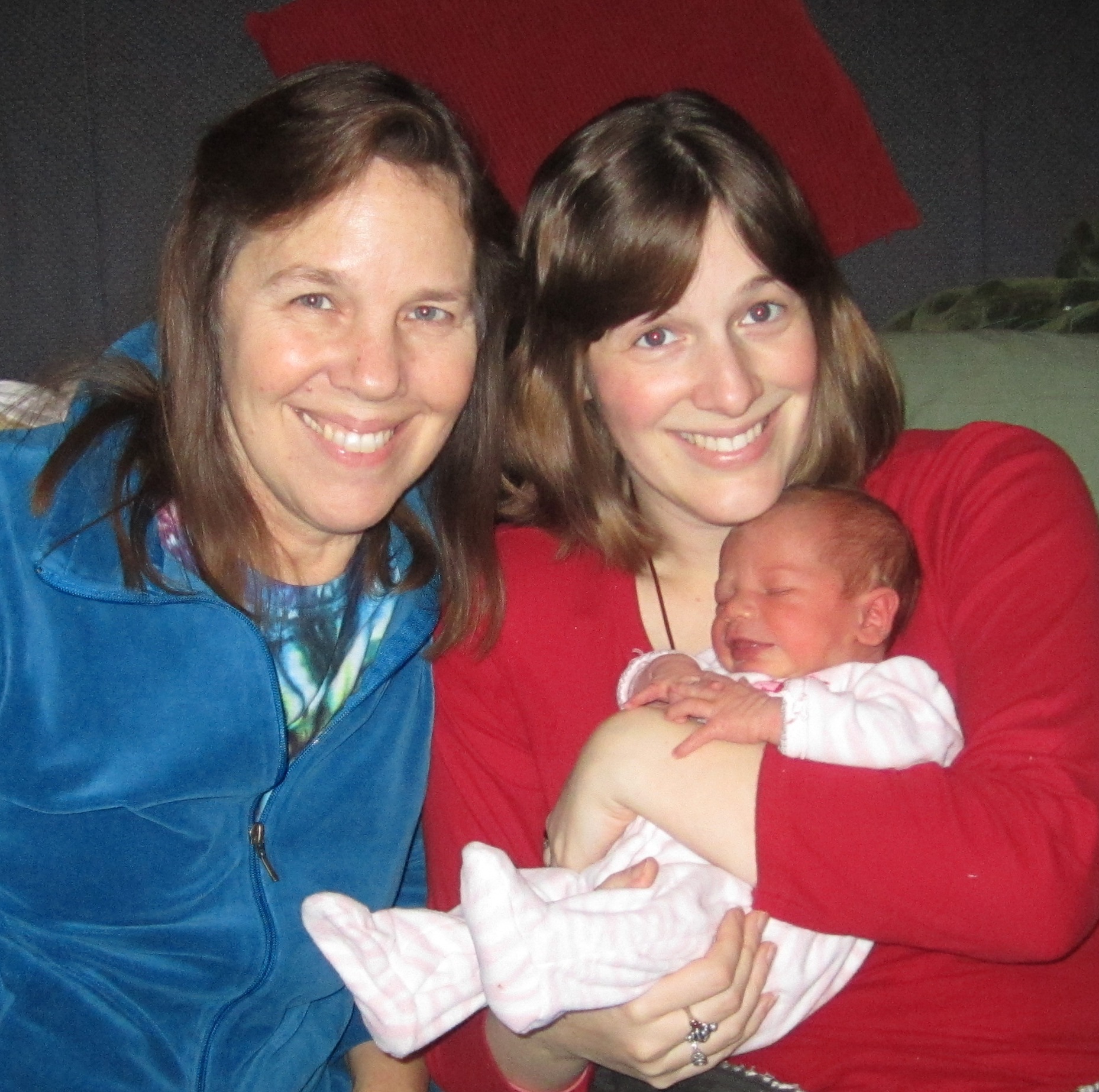
Three generations!

Alaina Diana was born at 11:15 a.m. on January 19th, 2011! She only weighed 7lbs, 8oz and was 20 inches. (My other babies were 8lbs4oz and 9lbs, 2oz.) I’ve sent a short-version birth story to a couple of friends over the last couple of days and decided I could work it up into a short blog post as well (of course, a full-length birth story will eventually follow). I actually had a little trouble getting started in writing about her birth—it was pretty uneventful until the end and I felt like the best description would be: walked around the kitchen, sat on the birth ball, walked around a little more, more time on the ball, hummed and ooohhhhhed, seemed as if  suddenly things changed and I felt big, big things happening and then baby was born all at once! And, I caught her! Emotionally more than temporally, it felt like a long labor and I felt like I experienced less mind-body integration than with previous labors (the actual moment of birth was much more instinctive and powerful than with the other babies though). In general, lots was unexpected about this labor—-it lasted longer than I expected (about 5 hours that were serious, but some warm-up time before that too) and was somewhat erratic and I had quite a bit of back pain. Right before pushing, contractions were still 4-8 minutes apart and it was hard for me to assess where I was/how “active” of labor it was—I was thinking I could either be at the 3cm point OR the transition point! My water didn’t break until seconds before she was born and I felt like it REALLY needed to break, but wasn’t. My kids weren’t here, because her birth was during the day (also unexpected, and a Wednesday, not a weekend!). It was just Mark, my Mom and me.

I spent a lot of time on the birth ball and Mark would stroke my back in just the right way

After criticizing myself at length for being “too analytical,” “thinking too much,” and not letting “my monkey do it,” I experienced a spontaneous birth reflex and pushed her out in a kneeling position and it only took one contraction—her whole head and body came out all at once, no moment of crowning or head birthed and then body following, just a bloosh of entire baby. I caught her myself. Mom and Mark both missed seeing her come out, because the phone rang at the same time. My mom went to stop it and Mark was moving around to the front of me, and when they looked again, I was holding her (Mark says it was about 12 seconds). So, no birth pix 😦

I did tear again, exact same extra-delicate and non-“traditional” place from what I can tell. Feels better than previous births already though–I know how to heal from this (even though I wish I didn’t have to).

My plan for immediate postpartum worked out perfectly and just like we planned. The midwife came about 40 minutes after the birth and checked blood loss. My doula was here about 20 minutes after and fed me a bite of placenta—and, I ate it! No gagging or anything!

I have very different post-birth feelings this time around—though I still had the “I did it!” moment, I felt less euphoric and triumphant and more relief and the feeling that, “we survived!” Blog posts about this will eventually follow…

And, did I mention that I caught her myself?! 🙂

Shortly post-birth

  • My "40 weeks" picture--due date was Jan. 22nd, so took a picture on that day to show how she could (theoretically) still fit! (though she wasn't breech!)