Archives

Woman Centered Pregnancy and Birth

“Woman-centered childbirth recognizes the primary role of the mother, and allows labor to progress according to the mother’s natural rhythms.” —ALACE CBE training manual

Several years ago I wrote a popular and somewhat controversial post called What to Expect When You Go to the Hospital for a Natural Childbirth. The article took a look at what women can realistically expect from a “standard” hospital birth and included some thoughts on what they deserve, my conclusion being that what women can expect and what they deserve are often, sadly, very different things. The article was one of my widest-reaching pieces and it was republished on both the Unncesarean and on Navelgazing Midwife. I also converted it into an article that was published in Pathways magazine, laid out so beautifully and professionally I practically cried.

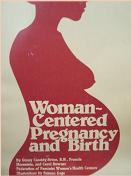
However, my idea for the post didn’t come from me alone, it was sparked by reading a similar list in the 1970’s book Woman-Centered Pregnancy and Birth, co-authored by Carol Downer. So, imagine my delight when I was contacted last month by her assistant, letting me know that they’d read and enjoyed my post and telling me this awesome news:

We recently published the book in its entirety online at: www.womenshealthinwomenshands.org/BirthingOurBabies.html.

That’s right, free online! Check it out!

For my conservative readers, do be aware that the book and website both come from a solidly feminist and pro-choice perspective!

“The whole point of woman-centered birth is the knowledge that a woman is the birth power source. She may need, and deserve, help, but in essence, she always had, currently has, and will have the power.” –Heather McCue

Previous thoughts on Why “Woman-Centered” Childbirth?

A Bias Toward Breastfeeding?

During World Breastfeeding Week, Lamaze’s Science and Sensibility blog published an interesting and thought-provoking guest post called “Instructor Has A Clear Bias Toward Breastfeeding!” The post explores a birth educator’s experience with teaching breastfeeding classes and receiving the title phrase on one of her evaluations. She is very disturbed by the evaluation and offers this profound and potent reminder: “We must not leave mothers less than whole.”

While I very much appreciate this observation and reminder, we also absolutely need to remember that biased means to exhibit “unfair prejudice”–it simply IS NOT “biased” to support breastfeeding as the biological norm and most appropriate food for babies. I was very concerned to read the comments on the post from other educators talking about their own “biases” toward physiologic birth or breastfeeding and how carefully they guard against exhibiting any such bias in their classes. Hold on! Remember that the burden of proof rests on those who promote an intervention—birth educators and breastfeeding educators should not be in a position of having to “prove” or “justify” the biological norm of unmedicated births or breastfed babies. I hate to see birth instructors being cautioned to avoid being “biased” in teaching about breastfeeding or birth, because in avoiding the appearance of bias they’d be lying to mothers. You can’t “balance” two things that are NOT equal and it is irresponsible to try out of a misplaced intention not to appeared biased. So, while I appreciate some of this educator’s points, I do think she’s off the mark in her fear/guilt and her acceptance of the word “bias.” The very fact that making a statement that someone has a bias toward breastfeeding can be accepted as a reasonable critique is indicative of how very deeply the problem goes and how systemic of an issue it is. If I say that drinking plenty of water is a good idea and is healthier for your body than drinking other liquids, no one ever accuses me of having a “bias towards water.” Breastfeeding should be no different. But, as we all know, breastfeeding occurs in a social, cultural, political, and economic context, one that all too often does not value, support, or understand the process.

This reminds me of an excellent section in the book Mother’s Intention: How Belief Shapes Birth about judgment and bias. The author also address how the word “balanced” is misused in childbirth education–as in, “I’m taking a class at the hospital because it will be more balanced.” Balance means “to make two parts equal”–-what if the two parts aren’t equal though? What is the value of information that appears balanced, but is not factually accurate? Pointing out inequalities and giving evidence-based information does not make an educator “biased” or judgmental-–it makes her honest! (though honesty can be “heard” as judgment when it does not reflect one’s own opinions or experiences).  (formerly quoted in this post. And, see this post for some thoughts about pleonasms.)

I do value the reminder that pregnant and postpartum mothers are vulnerable and how we speak to them really matters. I know that. I also worry that too much “tender” speech regarding breastfeeding as a “choice,” a “personal decision” and “we support you no matter what”—leaves the door wide open for continued systemic support of a bottle feeding culture that treats formula feeding and breastfeeding as similar or interchangeable. I’m not sure what the answer is. Maternal wholeness matters, so does breastfeeding!

World Breastfeeding Week Post Round Up

I ended up writing a lot of breastfeeding posts during WBW this year and decided to gather them all together in one post, plus extras, so that no one manages to miss out!

Other favorite posts about breastfeeding:

  • Breastfeeding as a Spiritual Practice: Reflections on the intimate, spiritual connection and meditative quality of being a breastfeeding mother as well as thoughts about parenting as a (rigorous) spiritual practice of its own.
  • Breastfeeding as an Ecofeminist Issue: Why does breastfeeding threaten both feminists and the patriarchy? Why is breastfeeding a core women’s issue? And, why aren’t we more concerned about systemic barriers?
  • The Birth-Breastfeeding Continuum: From a biological perspective birth and breastfeeding are not discreet events, but are inextricably linked. Healthy breastfeeding begins with healthy birth!
  • Ode to my nursling: What it is like to nurse my baby.
  • Nursing Johnny Depp: My “classic” essay on what it is like to nurse things other than my baby…
  • Listening Well Enough: What I learned from a dream about listening to breastfeeding mothers.
  • Listening to my baby…even when we disagreed! Personal story about how I learned to listen to my baby about what he needed with regard to breastfeeding even when I didn’t like what he was telling me.
  • Inseparable: Personal thoughts about being “in dependence” with our babies.

Other great resources:

Infographic for parents (and heck, providers too!) about the first few days of breastfeeding–newborn stomach sizes, number of diapers, etc.

Ban the Bags toolkit: Great rebuttals to common arguments about the assumed neutrality of distributing formula marketing materials via medical care settings/providers as well as evidence about the link between “free” formula distribution and reduced rates of successful breastfeeding.

Resources from the Breastfeeding Taskforce of Greater Los Angeles including:

Also, you can check Baby Friendly USA to see if your birthing facility is Baby Friendly.

CIMS sent out some good WBW information about how Birth Practices Affect Breastfeeding:

CIMS is proud that the WHO/UNICEF included recommendations in the Ten Steps of the Mother-Friendly Childbirth Initiative in the WHO/UNICEF’s Infant and young child feeding: A tool for assessing national practices, policies and programmes (2003).

The WHO and UNICEF recommend that to maximize the establishment of successful breastfeeding women in labor, regardless of birth setting, should have access to the following practices recommended in the MFCI:

  • Care that is sensitive and responsive to the specific beliefs, values, and customs of the mother’s culture, ethnicity and religion;
  • Birth companions of her choice who provide emotional and physical support throughout labor and delivery;
  • The freedom to walk, move about, and assume the positions of her choice during labor;
  • Care by staff trained in non-drug methods of pain relief and who do not promote the use of analgesic or anesthetic drugs unless required by a medical condition;
  • Care that minimizes routine practices and procedures that are not supported by scientific evidence including withholding nourishment, early rupture of  membranes, use of IVs,  routine electronic fetal monitoring, episiotomy and instrumental delivery;
  • Care that minimizes invasive procedures such as unnecessary acceleration or induction of labor and medically unnecessary cesarean sections.

And, so did Lamaze:

Valuable resources and information for expecting parents, like Lamaze’s Push for Your Baby, are aimed at giving expecting parents the tools to push for the best care practices for moms and babies, including those that support breastfeeding education and awareness.

Lamaze calls out the following top five breastfeeding barriers within the first 24 hours of birth to help expecting moms prepare for the best breastfeeding experience:

  1. Unnecessary birth interventions
  2. Separating mom and baby
  3. Use of pacifiers or other artificial nipples before breastfeeding is well established
  4. Supplementing breastmilk with formula
  5. Lack of postpartum breastfeeding support

Note: on August 15, Lamaze is hosting a free webinar called Moms, Babies, Milk and the Law: Legal and Ethical Issues When Teaching Breastfeeding

And, some other interesting posts not by me:

World Breastfeeding Week Sucks According to this Lactation Consultant

While I don’t really care for the title because I think it may cause people to not even read the article, I really appreciated this IBCLC’s thoughts about the correlation between the occurrence of WBW each year and the strategic release “breaking” news about some kind of breastfeeding related controversy. Call me a conspiracy theorist, but this does in fact happen every. single. year. During World Breastfeeding Week, something comes out that causes doubt about breastfeeding or breastfeeding advocates. Maybe it is about vitamin D and how “deficient” breastmilk is, or maybe it is a trumped up “mommy wars” tale or hyperbolic call to action about not letting those mean “breastfeeding Nazis” try to tell us how to raise our babies, or, like this year, a bizarre spin on the idea that formula should not be readily distributed in large “gift packs” via our medical care system, but should instead be reserved for cases in which it is actually needed (see above mentioned notion of those mythical, control-freak breastfeeding Nazis who are out to get us all). Anyway, the LC points out this:

I really hate World Breastfeeding Week because much of the media takes it as an opportunity to attack those who wish to support mothers who breastfeed rather than celebrate their efforts to improve infant feeding. Every year I hope I will not have to read more faux feminist manifestos that denigrate the value of women who enjoy their care-giving roles. I hope I won’t have to read more junk science fishing expeditions by journalists who deliberately exclude the wide body of solid research that does show that what infants are fed does matter. This year sets a new low with the addition of outrageously false claims that New York’s City’s Mayor has imposed a ban on formula that is going to deprive mothers of their rights. –Susan Burger

And, speaking of the bizarre spin of this year’s anti-WBW backlash conspiracy, Moxie wrote a great post exploring this issue: The illusion of choice, the free market, and your boobs

If you truly care about a woman’s right to choose what’s best for her and her baby, you will take the financial pressure out of the equation, and eliminate any actions that impede free choice. Putting formula samples right next to the baby’s head impedes free choice. Having to ask for formula (just like you have to ask for tylenol, or an extra chucks pad, or another container of orange juice) doesn’t impede free choice. It doesn’t change anything for women who cannot breastfeed–they can still get those formula samples easily by asking. It doesn’t change anything for women who don’t want to breastfeed–they can still get those formula samples easily by asking. It could change everything for women who want to breasfeed but don’t have correct information or are experiencing problems they can overcome if they’re given help, because they will be given EQUAL ACCESS to information that can help them breastfeed and formula samples. They ask for help or they ask for formula. Equal access. No privilege for formula.

I don’t want the decisions I make about how to parent my children made by the highest bidder. Especially since the highest bidder doesn’t care about me and only wants my money. (Let’s not forget that those formula samples are worth about $1.50. A woman who chooses to feed formula based on those samples has just been signed on to spend hundreds or thousands of dollars on formula once she leaves the hospital. She is never informed of that. Is THAT free choice?)

I don’t care how you feed your baby. But I want you to make a decision about it with all the information, all the support, and all the help you can get. Free choice. I do not want your choices narrowed by the huge financial incentives formula manufacturers pour into hospitals. [emphasis mine]

And, as I’ve already referenced in some of the posts linked to above, Dr. Newman has a helpful article about How to Know a Health Professional is not Supportive of Breastfeeding that directly connects to the issue of formula distribution by medical care professionals. One way to know right away is if the provider distributes material provided by a formula company—even if that material is labeled “breastfeeding information.”

Breastfeeding Class Resources

I became certified as a breastfeeding educator in 2004 and accredited as a breastfeeding counselor in 2005, so I’ve been working with breastfeeding mothers for a long time. I lead a monthly support group and offer help/counseling via phone, email, text, Facebook message, Words with Friends messages, you name it. Recently, a nurse contacted me asking for ideas for teaching an early pregnancy breastfeeding class. I think this is a great idea, since mothers’ decisions about breastfeeding are often made before the baby is conceived and if not then, during the first trimester.

These are the initial ideas I suggested:

  • Focus on what the mothers themselves want—what do they need/want to know? What have they heard about breastfeeding? What are their fears? What misconceptions do they need cleared up? I’m very much about peer-to-peer support and allowing space for the women to talk to/connect with each other—the facilitator is then available to clear up misinformation and provide tips.
  • Focus on what mothers can do to prepare for successful breastfeeding—there is evidence that prenatal breast massage/colostrum expression helps with both milk supply AND with mother’s comfort with her own breasts. It also helps her think of herself as a breastfeeding mother BEFORE her baby is actually born!
  • Suggest good books to have on hand and encourage attending a breastfeeding support group (like LLL!) prior to baby’s birth.
  • Promote/discuss/encourage “baby led breastfeeding.” I love sharing with mothers about how smart their babies are and how mother’s chest after birth becomes baby’s new habitat! Check out the resources from Suzanne Colson: http://www.biologicalnurturing.com/
  • Discuss and emphasize all of the other great ways dads and other family members can be involved with baby other than giving a bottle. Dad/grandma can do EVERYTHING ELSE baby needs! That’s cool! Leave the feeding to mom and let dad have the other special and important jobs like baths and burping and tummy time and more.
  • DON’T talk about “myths” and try to dispel them in a myth-fact format, because evidence suggests that this actually helps the myths stick more!
  • Use Diane Wiessinger’s approach to language (http://www.motherchronicle.com/watchyourlanguage) i.e. breastfeeding isn’t a “special bond” it is a NORMAL bond. People want to be normal—special is for celebrities and “other people,” normal is what everyone wants. She also has handouts here: http://normalfed.com/Why.html

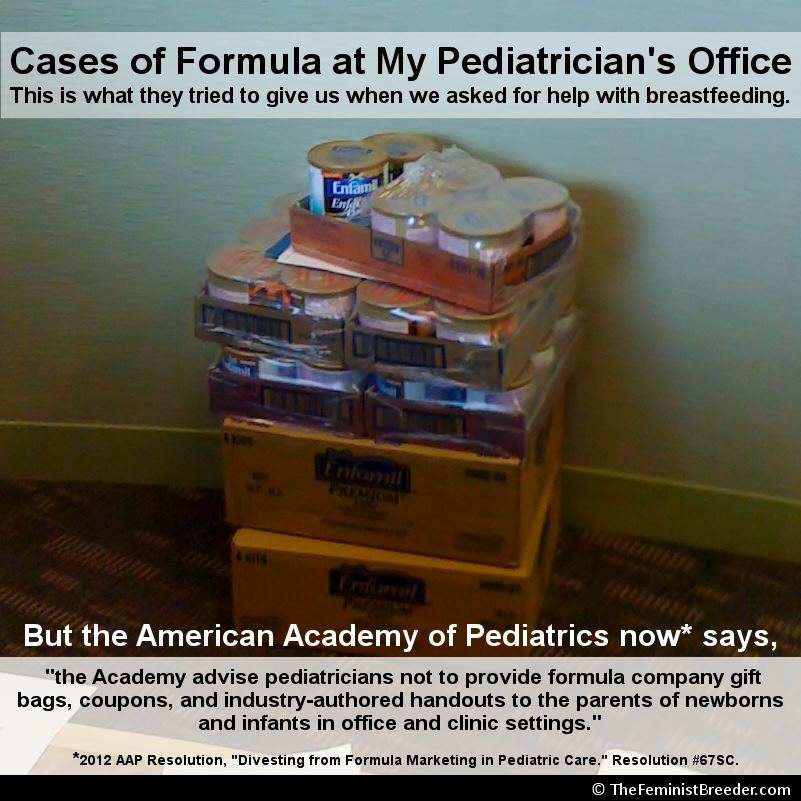
Since her email, a couple of other resources and bits have caught my eye. One is that the AAP has a resolution about the distribution of formula “gift bags” by pediatricians and hospitals. Apparently this came out in 2011, but it only came to my attention when I saw this image on Facebook!

In keeping with the 10 Steps and consistent with the AAP’s resolution, the hospital advocacy project from the Illinois State Breastfeeding Taskforce makes available the following useful documents for mothers to communicate with their hospitals:

The Task Force explains:

We encourage you to make the Breastfeeding Bill of rights and Hospital Experience Letters available to moms in your classes, practices, community events, breastfeeding fairs, “rock & rest” stations, etc.

Encourage moms to fill out the appropriate letter and mail back to the hospital where she delivered her baby.  Or collect the letters and mail them from your agency or task force.  Help moms make their voices heard!

We hope that this will show hospital administrators that lactation consultants, knowledgeable staff and breastfeeding friendly practices are valued by moms and families using their hospital services.

The Missouri Breastfeeding Coalition clued me into this Breastfeeding Plan for Mothers (pdf) from the MO Dept. of Health. The handout may be downloaded and printed as needed and is a, “list of requests that support breastfeeding for the postpartum stay. Similar to a birth plan and based on the 10 Steps for Breastfeeding.”

Also, make sure to check out this awesome resource, the WIC Sharing Gallery—free programs, curricula, brochures, and more from different WIC offices. I found this because I was back at the Illinois Breastfeeding Taskforce’s website downloading their Grandmother’s Tea curriculum for intergenerational support of breastfeeding.

Another great resource is the FREE online Tear-Sheet Toolkit from La Leche League.

And, finally, I already touched on this, but remember there are ample handouts/articles available from the incomparable Diane Wiessinger about birth and breastfeeding.

Building Birth Bridges: Communication

This post is part 5 of my CAPPA re-cap series.

The final day of the CAPPA conference I heard Polly Perez speak about Building Bridges with an emphasis on communication and fear. She described four basic communication and emphasized that communication is a two-way street.

The four styles are:

  • Expressive
  • Sympathetic
  • Direct
  • Systematic

Each style has its strengths and also ways in which it is perceived by others. You should give information in the simplest way to the person you are talking to and adjust your style of communication depending on who you’re talking to, changing communication behavior in order to improve communication. Communication is the lifeblood of all relationships.

She shared this quote:

Luke: I don’t believe it. Yoda: that is why you fail.

And she explained that listening is active, not a passive activity. Listen with empathy, openness, and awareness:“Use language that lets you share your heart openly.”

She also asserted that we must stop letting our practices be fear-based, quoting Connie Pike in saying, “We must give people the opportunity to challenge their fears. Not only will this change each person, it will change the political and medical climate in which they make these choices.”

In communicating within in the medical system, Polly pointed out that a fundamental issue is with the power hierarchy and that we must develop strategies that enhance problem solving, but still retain and support the person in power. (**I’m a little too radical, I guess, for this tip, which is perhaps why I’ve not found a niche working within a medical system and instead work outside of it.) She suggested asking yourself: What does this person you are talking to fear? She also quoted Bethany Hayes “Working in Circle” who said with regard to working in hospital climates, “we found a system that was as sick as the people it was treating.” Changing sick systems is not about subterfuge but bringing light to situations that need to be altered.

Polly then made an observation that I found very powerful and very telling:

We have taken the hearts and minds out of much of our work because we’re frightened of getting too close. But, close is where we need to be.

Yes.

During a different session, but closely related to this topic of communication, I laughed out loud watching this video clip of twin babies communicating with each other. I’m going to use this in future classes.

Controversies in Breastfeeding

20120724-174258.jpg

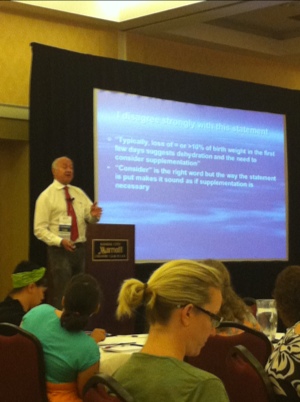
If you get a chance to attend one of his presentations, don’t miss it! In this slide, Dr. Jack explains that he disagrees strongly with the notion that a baby that has lost 10% of its birthweight needs to be supplemented.

Just in time for the start of World Breastfeeding Week, here is part 4 of my CAPPA re-cap series!

This post is a companion to my CAPPA re-cap post about the impact of birth practices on breastfeeding. Dr. Newman’s keynote session about Controversies in Breastfeeding was actually given before his breakout about birth and breastfeeding, but for the chronological value, it made sense to me to put up the birth post first.

As I already shared, in Newman’s perspective we have a huge problem in that many medical care providers do not recognize the critical importance of breastfeeding. Newman also emphasized that there are many people who don’t know squat about breastfeeding and breastmilk and don’t feel like they need to learn anything before they start doing studies and writing papers about it.

Why is hard to study breastmilk?

Because…there is no such thing as “standard” breastmilk. It is a physiological fluid and varies from person to person. We DO NOT have to prove that breastfeeding is better than formula. Those comparison studies are unnecessary.

Some great stuff from Dr. Newman’s presentation about controversies:

  • The exclusively breastfed, well-gaining 5 month old is getting only, at most, 10-15% more milk than the exclusively breastfeeding, well-gaining 1 month old, even though the 5 month old is twice as heavy. Baby continues to gain weight steadily even though it is not “getting enough” compared to its formula fed counterpart. (put that in your pipe and smoke it–yep, he really then said that ;-D)
  • Colostrum has 100,000-5,000,000 leukocytes per ml–that is more than blood. (i.e. colostrum has more white blood cells in it than your actual blood has in it!)
  • Colostrum and formula are the same in the following ways: both are liquid.
  • Breastmilk does not need to supply vitamin D (makes no sense to describe breastmilk as “deficient in” or “lacking” vitamin D).
  • With regard to the high incidence of reflux being diagnosed in babies—his response to why so high is, “because [most] doctors don’t know anything about breastfeeding.”
  • We learn one thing when we hear that the mother has been told to feed her baby X number of minutes per side—>the person telling her this does not understand breastfeeding.
  • There are no such thing as “flat nipples”–women have normal nipples. We live in a bottle feeding culture that makes us assume that if a mother does not have nipples that stick out like a bottle nipple, the nipples are flat (**Molly’s own note–we also live in a culture where 75-90% of women have epidurals during labor which can contribute to edema in the breast and the accompanying appearance of flat nipples).

 And, there should be no controversy about formula feeding vs. breastfeeding. If you actually look at the biochemistry of breastmilk you would know there is no comparison. No controversy. (with a laugh after this he added, “pediatricians are simple folk” ;-D)

In that plainspoken way I found so refreshing, Dr. Jack also pointed out that formula feeding is missing one more thing: breastfeeding. That’s right. Society thinks that bottle feeding is the “same”–it isn’t. Breastfeeding is an intimate relationship. He also pointed out that, “people will lie, lie, lie to sell products.” (see ad to right)

Finally, he explained that this mechanization of breastfeeding (through things like test weighing and nipple shields and timed feedings) will cause more and more mothers to abandon breastfeeding and then she’ll say, ‘we tried everything and it just didn’t work.’ Yes, we did “try everything,” everything to make her not succeed. (And, then she’ll write an article about it complaining about “what’s wrong with breastfeeding.”)

Handouts from Dr. Newman are available here. One I’ve used recently is How to Know a Health Professional is not Supportive of Breastfeeding.

I address other systemic influences on breastfeeding in Breastfeeding as an Ecofeminist Issue

The Impact of Birth on Breastfeeding

Just in time for the start of World Breastfeeding Week, here is part 3 of my CAPPA re-cap series!

…they want you to believe it’s their power, not yours…They stick needles into you so you won’t hear anything, you might as well be a dead pig, your legs are up in metal frames, they bend over you, technicians, mechanics, butchers, students, clumsy or sniggering, practicing on your body, they take your baby out with a fork like a pickle out of a jar.

–Margaret Atwood in her novel Surfacing (opening quote of Dr. Jack’s presentation at the 2012 CAPPA conference)

As I mentioned, my favorite part of the CAPPA conference was hearing Dr. Jack Newman speak about controversies in breastfeeding (see next post) and then about the impact of birth on breastfeeding (breakout session). He was an amazing speaker. Very straightforward and almost blunt as well as funny and fast-paced. I really feel glad to have had the chance to see him in person after years of being familiar with his materials.

The notion of the birth-breastfeeding continuum isn’t new to me, having actually published articles about it previously, however Dr. Newman’s phrasing, descriptions, and reminders was just so perfect that it left me feeling even more enthused about the inextricable link between birth and breastfeeding. It is a biologic continuum that nature does not see distinct events—baby is born and goes to breast, it is part of the same event. Drawing on Diane Wiessinger’s work, Dr. Newman explained

With animal births: following a normal birth, infant feeding just…happens. Following an interventionist birth, the mother rejects the baby and there is no nursing at all.

In some hospitals, separation of mother and baby is routine as a way to “prevent” postpartum mood disorders. Dr. Jack’s own theory was that perhaps human mothers turn this “rejection” against themselves and it shows up as a postpartum mood disorder.

Babies NEED and expect to be with their mothers after birth. It is of critical importance. As I shared via Facebook, Dr. Jack explained this:

Know how much an incubator costs now? $50,000. Why don’t we just give half of that money to the mother and put the baby skin to skin on mother’s chest?

And, this gem:

Our hospital births break every rule in the mammalian list of mother-baby necessities.” –Dr. Newman

He also noted that if baby is put skin-to-skin on mother immediately after birth regardless of original intention, the pair will breastfeed. It is biologically programmed.

Why do hospital births break the rules?

Because, as Dr. Newman explained we have a big, big problem in that HCPs do not recognize the critical importance of breastfeeding. He also repeatedly emphasized (in a very funny way) that there are many people who don’t know squat about breastfeeding and breastmilk and don’t feel like they need to learn anything before they start doing studies and writing papers about it.

Dr. Newman also emphasized the important point that the burden of proof rests upon those who promote an intervention! He was speaking with regard to recommending formula supplementation, but I strongly believe it applies to any birth practice. So simple and yet so profound. One example that he shared that is familiar to birth advocates is that lying down for electronic fetal monitoring is a position of comfort for the care provider, NOT for the mother.

And, he made this excellent point: “All medical interventions, even when necessary, decrease the mother’s sense of control, and increase her sense of her ‘body not being up to the task.” Again, the burden of proof rests on those who promote the intervention, not vice versa.

As I’ve touched on several times before, IV fluids that are commonly administered during labor may increase the baby’s birth weight, leading the baby to be more likely to experience the dreaded 10% weight loss (“totally bogus, by the way”). Also as I’ve noted before, IV fluids lead to significant maternal fluid retention which contributes to edema in the nipples and areolas and then…the dreaded “flat nipples.” The more fluid a mother gets in labor, the more a baby “loses” after birth!

Including the same picture as in my other post, because it is in this picture that Dr. Jack is specifically talking about his next point:

I disagree strongly with this statement:

‘Typically, loss of = or >10% of birth weight in the first few days suggests dehydration and the need to consider supplementation.’

He goes on to note that what is necessary is NOT supplementation but to help the mother and baby breastfeed well. The real question when it comes to newborn weight loss is, “is the mother-baby breastfeeding well?”

Newman also addressed something birth advocates are familiar with, the fact that epidural anesthesia can cause maternal fever. This leads to an infant sepsis workup and antibiotics and usually means separation of mother and baby. Here we again experience the failure of many medical care providers to recognize the importance of breastfeeding as beyond just a feeding method. Breastfeeding protects the baby–this is what most hospitals do not understand.

Of interventions that undermine breastfeeding, Dr. Jack pointed to Demerol (meperidine) as the “worst of the lot,” with newborns experiencing sedation and many of them not sucking at all. He also pointed out that all interventions increase the risk of cesarean section, which leads to increased discomfort for mothers and less willingness to breastfeed and increased likelihood of mother-baby separation.

The importance of skin-to-skin contact

Babies easily find their way to the unwashed nipple. And, given baby’s inborn feeding behaviors and instincts, it seems clear that, “if the baby expresses his or her choice, the baby would choose the breast.” (with regard to breastfeeding as maternal “choice”)

Not putting baby skin to skin with the mother, “increases the risk of hypoglycaemia significantly…Isn’t skin to skin contact a less invasive preventative measure than giving formula?” Newman then points out that most often we see “skin to blankets” which keeps baby from showing they’re ready to feed, doesn’t stimulate milk supply, and leads to engorgement which is not normal.

And, at the end he emphasized that when it comes to birth and breastfeeding, all too often WE MESS IT UP by meddling with the biological processes and rhythms of the mother-baby relationship.

For more about controversies in breastfeeding, check out my next post.

Handouts from Dr. Newman are available here. One I’ve used recently is How to Know a Health Professional is not Supportive of Breastfeeding.

I’ve written about the birth-breastfeeding continuum and about some other systemic influences on breastfeeding in breastfeeding as an ecofeminist issue.

Epigentics, Breastfeeding + Diet, and Prenatal Stress

This post is part one of my CAPPA Re-Cap series.

CAPPA linchpins Laurel Wilson and Tracy Wilson Peters are co-authors of a new book, The Greatest Pregnancy Ever, that focuses on the depth, intensity, and value of the MotherBaby bond. As I noted, I listened to Laurel talk about Bridging the Nutrition Gap and to Tracy speak about the “accidental parent.” In both, they addressed the biological wisdom that mothers possess and of the deeply interconnected nature of the maternal relationship.

Laurel reminded us that there is a brain in our gut, essentially. This brain literally tells us how we should be feeling our emotions, based on the nutrition that we’re putting into our bodies. She discussed epigenetics–a term meaning literally “above the gene”—explaining that this is the “translator that ‘reads’ the book of instructions from our genome.” The translator tells the body to turn on or off the genes we’ve inherited from our parents. Epigenetics is essentially the environment–those things in our environment that influence our biology. Laurel pointed out enthusiastically that we want to create an excellent “translator” for our children. She also emphasized repeatedly that one important job of the placenta is to “train” the baby for the environment it will be experiencing. This is why prenatal diet matters, it is helping to prepare the baby to thrive in the environment into which it will be born. So, chronic stress leads to a stressful womb environment, which leads to a baby that is biologically primed to be born into a stressful postnatal environment. Mother’s body primes baby’s body for success in that environment. As I listened to her speak and discuss the things we’ve learned from science about genetics and how our bodies function, I kept thinking: science can do a lot, it can do wonderful things. Mother’s body can do even moreAnd, isn’t that just cool?!

So, what’s going on in the maternal habitat?

One important point Laurel made about prenatal diets was that prenatal diets high in hydrogenated oils predispose mamas to postpartum moods disorders. She said this is because hydrogenated oils essentially “leach” EFA’s out of the mother’s system.

She also noted that mice up to three generations are affected with PCOS by BPA and phthalates (in food packaging. Our food is literally making us sick). These influence change the endocrine system and are connected with reduced sociality and community engagement.

Laurel explained too that no artificial sweeteners are considered safe for pregnant women and that stevia too is linked to epigentic damage. She suggested using honey and molasses as sweeteners if needed.

One tip that I found funny, basic, but so true with regard to choosing healthy foods is to make sure to choose to eat foods that will rot!

In Tracy’s talk she passionately affirmed that we have to eliminate chronic stress from pregnant women’s lives because she is laying an emotional and physical foundation for another person’s life. This matters! Babies are feeling before they are thinking and we are designed to live in the environment we are being born into.

Also remember, babies don’t need to be in nurseries–they need to be with their mothers. This MATTERS!

Women’s Power & Self-Authority

“I know myself linked by chains of fires,
to every woman who has kept a hearth.
In the resinous smoke
I smell hut, castle, cave,
mansion and hovel,
See in the shifting flame
my mother and grandmothers
out over the world.”
–Elsa Gidlo

I used the quote above as my winter solstice Facebook posting last year. It reminds me of a quote from Margaret Atwood used in the book Sacred Circles, “Sons branch out, but one woman leads to another.” One of the powerful gifts of feminist spirituality is the sense of intergenerational connectedness to all women of all time. We begin to sense the buried matrilineal links across time and culture. Links that have often been culturally, socially, and religiously broken on purpose as a way to separate and disempower women and to bury women’s wisdom. I believe a potent source of female power lies in the female body and that body wisdom has been suppressed and denied over the course of many years as a means of oppression and control. One of the root issues of patriarchy is who “owns” women’s bodies—is it men, is it the government, is the medical system, or is it the woman herself? (you know my pick).

Body wisdom and sources of power

Considering power, sources of power, and body wisdom, I appreciated reading Barbara Starrett’s essay The Metaphors of Power in the book The Politics of Women’s Spirituality. While she used abortion as her example, I have modified and paraphrased her thoughts to make the idea about birth instead. Starrett originally states, “We can create power centers both within and outside ourselves…Power is where power is perceived. Power resides in the mind. We can give or withhold power through our beliefs, our felt thoughts.” Medical professionals can make decisions about a woman’s body and birth choices effectively only as long as women believe that the professionals have the right to do this. When women reclaim the power to decide for themselves about birth, the doctors proclaim in a vacuum. Their power depends on the transference of our power, through our belief that this is right…Power is where power is perceived. This also means that in any given in-the-world situation, we can intentionally set up our own power centers. If we believe that power resides in those centers, it will. We will act successfully on this belief. Women’s organizations, unions, birth coalitions, etc., will never work unless we regard them, “as the legitimate centers of power…We must grant our own power to ourselves” (p. 191).

Lucky to have such a great group of friends to gather in the park to take part in the Our Bodies, Our Votes campaign.

While this comes a little too close for comfort to me with the idea that “we create our own reality” (which I cannot fully embrace due to the logical extension into blaming the victim that it creates), I connect deeply with the idea that we must treat women’s organizations and work as legitimate power sources. I think of books/movements like Our Bodies, Ourselves, for example. To me, this is a definitive women’s health resource—by women, for women and separated from the medical establishment that often dehumanizes women. If we continue to believe our “alternative” structures are just that, “alternative,” then the dominant model is still the norm and still accepted, even by us, as “normal.”

Starrett continues her essay by sharing that “It is necessary for some women to risk total reclamation, to risk the direct and intentional use of power, in bold, even outrageous ways. It takes only a minority of women to alter present reality, to create new reality, because our efforts are more completely focused, more total.” (p. 193) This is the risk that the creators of Our Bodies, Ourselves took. It is the risk birth activists and women’s health activists continue to take.

Peggy O’Mara tackles a similar topic in her essay, “Holy Mother,” in her collection of essays The Way Back Home, observing:

We live in a society…that romanticizes and trivializes the feminine…we live in an economy that regards women as cheap labor. In the marketplace, women work for less than men. At home, we do the large majority of the work. I believe that we enslave ourselves.

Is it any wonder, then, that we have not successfully resolved the childcare debate? Child care and national family policy are process issues, and thus sexist issues. Women themselves engage in sexism when they debate the either/or dichotomy of work or home. Too often, we do not realize the devaluation involved in playing by the crumbling rules of a male-dominated society rather than making up our own. The matriarchal process-based model comes from a religious belief system in which the Divine is immanent, within life, within us, ascribing sacredness to the ordinary processes of daily life. Rather than choosing between opposites, let us evolve a culture that values both the product and the process, a culture that synthesizes both the patriarchy and the matriarchy.

…we must put all of our loves–work and family, mothering and career, self and others—on the bargaining table at once, and not assume that because we are women, we must acquiesce to the cultural ideal. To run our personal lives in enslavement to an economic reality that does not serve our needs makes society crazy.

In a brief except from author Libba Bray, she states that for years she “…heard feminist Gloria Steinem described as ‘shrill’ and ‘hostile’ and many other dismissive, denigrating terms. But after reading about her struggles as a human being and as a leader of feminism’s second wave…I got a truer picture…I learned that it’s far too easy for women to be shamed into staying quiet about their lives–their dreams, needs, desires, anger, aspirations—and that the old adage, ‘Well-behaved women seldom make history’ is all too true.”

Consult your health care provider?

In my own life, I am frustrated by the ubiquitous phrase, “Consult your health care provider.” No thanks. I prefer consulting myself, my books, google, my own research, and my friends. Last time I checked, my doctor did not own my body nor did she have divine revelation as to what I need in my life. I am a breastfeeding counselor providing phone and email support to women who have breastfeeding questions. Women frequently receive very poor breastfeeding “advice” from their doctors—to the extent that I honestly think they’d receive better information by polling random strangers at Wal-Mart with their questions (and, yes, I will actually tell women this). One caller once used the phrase, “but, I don’t want to disobey my doctor” and I found this extraordinarily telling as well as depressing. I recognize that doctors have special training and can be life-saving, however, what does that say about mothering in our culture that a woman would not act on behalf of her own baby and herself because of fear of being disobedient to a professional that she has hired? She is a consumer of a service, not the subject of a ruler!

This brings me to a thought by Dr. Michelle Harrison, author of the book A Woman in Residence: “I used to have fantasies…about women in a state of revolution. I saw them getting up out of their beds and refusing the knife, refusing to be tied down, refusing to submit…Women’s health care will not improve until women reject the present system and begin instead to develop less destructive means of creating and maintaining a state of wellness.” Indeed! And, in an essay by Sally Gearhart’s about womanpower, she notes: “…there’s no forcing any other woman into a full trot or a gallop; she will move at her own pace, but at her own pace we can be sure she will move. At this point I always remind myself that the patriarchal use of crash programs is antithetical to organic movement; in a crash program the theory goes that if you can get nine women pregnant you can have a baby in one month; it takes women, I suppose, to understand that it doesn’t work that way.” (p. 202-203)

Reclaiming power

So, how do women reclaim power? I think story holds a key to power reclamation in this context. As I’ve referenced before, Carol Christ describes it thusly, “When one woman puts her experiences into words, another woman who has kept silent, afraid of what others will think, can find validation. And when the second woman says aloud, ‘yes, that was my experience too,’ the first woman loses some of her fear.” As I touch on above, for me it is to see myself and my body as a source of wisdom and to refuse to participate in structures that do not honor my power and personal agency. It involves more often turning to my peers, to other women, for advice and comfort and support, rather than to experts.

Returning to Gearhart, she states: “If I can move out of the patriarchy for my re-sourcement, then I do indeed march to a different drummer; but I have to march with the consciousness in my very bones of the cost in blood and pain and death that is somewhere being paid for my personal growth.” (p. 203)

I’ve written before that I am a systems thinker. Women’s choices about their bodies and about birth are not made in personal isolation, but in a complexly interwoven network of social, political, medical, religious, and cultural systems. As Gearhart notes, “There may be no ‘enemy’ except a system. How do we deal with ‘the enemy’? As seldom as possible but when necessary by opening the way for [their] transformation into not-the-enemy. What weapons do we use? Our healing, our self-protection, our health, our fantasies, our collective care…” (p. 203).

And, in closing I like this reminder:

“Study after study has taught us that there is no tool for development more effective than the empowerment of women. No other policy is as likely to raise economic productivity, or to reduce infant and maternal mortality. No other policy is as sure to improve nutrition and promote health—including the prevention of HIV/AIDS. No other policy is as powerful in increasing the chances of education for the next generation. But whatever the very real benefits of investing in women, the most important fact remains: Women themselves have the right to live in dignity, in freedom from want and from fear.” —Former UN Secretary-General Kofi Annan

This is the whole point—women’s rights aren’t about “taking” rights from anyone else OR about demanding “special treatment,” they are important for a HUMANE WORLD for all people. I think it is hilariously awful that “women’s rights” are considered a political issue and that there is a section about “women’s rights” in the “opposing viewpoints” database for my social policy class. As long as women’s rights are considered a political issue or as something about which an opposing viewpoint can be held, rather than as self-evident, we are in continued, desperate need of revolution.

—-

(note: portions of this post are excerpted from one of my essays for a class I took about Goddess Traditions)

Breastfeeding as an Ecofeminist Issue

Breasts are a scandal because they shatter the border between motherhood and sexuality.

––Iris Marion Young

After Hurricane Katrina, I read a news story about a young mother whose newborn baby died of dehydration during the days in which she had been stranded without access to clean water. Upon admittance to the hospital, the mother was asked if she needed anything and she replied that her breasts were uncomfortable and could she have something to dry up the milk. This story brings tears to my eyes and chills to my body. What does this say about our culture that it is actually possible for mothers to be unaware that they carry the power to completely nourish their own babies with their own bodies? As mammals, all women have the potential to be lactating women until we choose not to be. The genius of formula marketing and advertising is to get women to withhold from their offspring that which they already have and to instead purchase a replacement product of questionable quality. To me this feels like being a given a “choice” between the blood already flowing through your veins and a replacement product that marginally resembles blood.

We are mammals because as a species we nurse our young. This is a fundamental tie between the women of our time and place and the women of all other times and places as well as between the female members of every mammal species that have ever lived. It is our root tie to the planet, to the cycles of life, and to mammal life on earth. It is precisely this connection to the physical, the earthy, the material, the mundane, the body, that breastfeeding challenges men, feminists, and society.

Breastfeeding is a feminist issue and a fundamental women’s issue. And, it is an issue deeply embedded in a sociocultural context. Attitudes towards breastfeeding are intimately entwined with attitudes toward women, women’s bodies, and who has “ownership” of them. Patriarchy chafes at a woman having the audacity to feed her child with her own body, under her own authority, and without the need for any other. Feminism sometimes chafes at the “control” over the woman’s body exerted by the breastfeeding infant.

Part of the root core of patriarchy is a rejection of the female and of women’s bodies as abnormal OR as enticing or sinful or messy, hormonal, complicated, confusing…. Authentic feminism need not be about denying biological differences between women and men, but instead about defining both as profoundly worthy and capable and of never denying an opportunity to anyone for a sex-based reason. Feminism can be about creating a culture that values what is female as well as what is male, not a culture that tries to erase or hide “messy” evidence of femaleness.

However, precisely because of the patriarchal association of the female with the earthy and the physical, feminists have perhaps wanted to distance themselves from breastfeeding. This intensely embodied biologically mandated physical experience so clearly represents a fundamental difference between men and women that it appears to bolster biological reductionism. Yet in so doing feminism then colludes with patriarchy and itself becomes a tool of the patriarchy in the repression and silencing of women and their leaky ever-changing, endlessly cycling bodies: these bodies that change blood into food and bleed without dying and provide safe passage for new souls upon the earth. Sometimes the issue of a woman’s right not to breastfeed is framed as a feminist “choice.” This is a myth, made in the context of a society that places little value on women, children, and caregiving. It is society that needs to change. Not women and not babies.

Systemic and Structural Context

In an essay for the Academy of Breastfeeding Medicine on “What does feminism have to do with breastfeeding?”, Maternal–fetal medicine specialist Dr. Alison Stuebe (2010) points out that for the most part feminist advocacy ignores breastfeeding and that most breastfeeding advocacy sidesteps the complicated contextual issues of women’s lives. Stuebe notes:

…the conventional wisdom is that breastfeeding is a maternal duty that forces women to eschew their career aspirations to fulfill some ideal of motherhood, while feminism is about liberating women from exactly those constraints. Case closed. Or is it?…The result is that women end up fighting among themselves about the choices our society forces us to make — motherhood or career? Breast or bottle? — instead of uniting to address the societal structures that prevent women from realizing their full potential.

Appropriately, Stuebe further notes that:

…breastfeeding is not a ‘choice.’  Breastfeeding is a reproductive right. This is a simple, but remarkably radical, concept. Here’s why: When we frame infant feeding as a choice made by an individual women, we place the entire responsibility for carrying out that choice on the individual woman…Indeed, the ultimate link between breastfeeding and feminism is that in a truly equitable society, women would have the capacity to fulfill to pursue both their productive and reproductive work without penalty.

And, in considering contextual and systemic issues that impact women every day, Stuebe points out that:

These issues transcend breastfeeding. Why, for example, do we pit “stay at home moms” against “working moms,” rather than demand  high-quality, affordable child care, flexible work, and paid maternity leave so that each woman can pursue both market work and caring work, in the proportion she finds most fulfilling? Why do we accept that, if a woman devotes all of her time to caring for her family, she does not earn any social security benefits, whereas if she gets a paying job and sends her children to day care, she and her day care provider earn credits toward financial security in old age? And why do we enact social policies that subsidize child care and require poor mothers to enter the paid work force, rather than support poor mothers to care for their own children?…

Naomi Wolf (2003) also addresses the myth of  “choice” regarding breastfeeding (specifically with regard to lack of support for breastfeeding while working outside the home) in her book Misconceptions: “…it was unconscionable for our culture to insist that women ‘choose’ to leave their suckling babies abruptly at home in order simply to be available for paid work.” (p. 270) Wolf also quotes Robbie Kahn who says, “the job market holds out an all-or-nothing prospect to new mothers: you can give your body and heart and lose much of your status, your money, your equality, and your income; or, you can keep your identity and your income—only if you abandon your baby all day long and try desperately to switch off the most powerful primal drive the human animal can feel.” And, then considering the argument that bottle feeding “liberates” women from the tyranny/restrictiveness of breastfeeding: “The liberation women need is to breastfeed free of social, medical, and employer constraints [emphasis mine]. Instead, they have been presented with the notion that liberation comes with being able to abandon breastfeeding without guilt. This ‘liberation,’ though, is an illusion representing a distorted view of what breastfeeding is, what breastfeeding does, and what both mothers and babies need after birth” (Michels, p. xxx). Often, not breastfeeding is a structural and systemic symptom of a patriarchal society that devalues women and caregiving work and views the masculine body as normative, not a personal choice!

I am a systems thinker and always hold in mind that breastfeeding, like all aspects of women’s lives, occurs in a context, a context that involves a variety of “circles of support” or lack thereof. Women don’t “fail” at breastfeeding because of personal flaws, society fails breastfeeding women and their babies every day through things like minimal maternity leave, no pumping rooms in workplaces, formula advertising and “gifts” in hospitals, formula company sponsorship of research and materials for doctors, the sexualization of breasts and objectification of women’s bodies, and so on and so forth. According to Milk, Money, and Madness (1995), “…infant formula sales comprise up to 50% of the total profits of Abbott Labs, an enormous pharmaceutical concern.” (p. 164) And the US government is the largest buyer of formula, paying for approximately 50% of all formula sold in the nation.

In a brilliant analysis of the politics of breastfeeding in the US, Milk, Money, and Madness (1995), by Dia Michels and Naomi Baumslag, the following salient points are made about why women in the US so often experience breastfeeding problems: “In western society, the baby gets attention while the mother is given lectures [emphasis mine]. Pregnancy is considered an illness; once the ‘illness’ is over, interest in her wanes. Mothers in ‘civilized’ countries often have no or very little help with a new baby. Women tend to be home alone to fend for themselves and the children. They are typically isolated socially and expected to complete their usual chores, including keeping the house clean and doing the cooking and shopping, while being the sole person to care for the infant…” (p. 17)

Michels and Baumslag go on to explain:

According to the US rules and regulations governing the federal worker, the pregnancy and postdelivery period is referred to as “the period of incapacitation.” This reflects the reality of a situation that should be called ‘the period of joy.’ Historically, mothering was a group process shared by the available adults. This provided not only needed relief but also readily available advice and experience. Of the “traditional” and “modern” child-rearing situations, it is the modern isolated western mom who is much more likely to find herself experiencing lactation failure [emphasis mine]. (p. 18)

There is a tendency for modern women to look inward and blame themselves for “failing” at breastfeeding. There is also an unfortunate tendency for other mothers to also blame the mother for “failing”—she was “too lazy” or “just made an excuse,” etc. We live in a bottle-feeding culture; the cards are stacked against breastfeeding from many angles–economically, socially, medically. When I hear women discussing why they couldn’t breastfeed, I don’t hear “excuses,” I hear “broken systems of support” (whether it be the epidural in the hospital that caused fluid retention and the accompanying flat nipples, the employer who won’t provide a pumping location, the husband who doesn’t want to share “his breasts”, or the mother-in-law who thinks breastfeeding is perverted). Of course, there can actually be true “excuses” and “bad reasons” and women theoretically always have the power to choose for themselves rather than be swayed by those around them, but there are a tremendous amount of variables that go into not breastfeeding, besides the quickest answer or what is initially apparent on the surface. As noted previously, breastfeeding occurs in a context and that context is often one that does not reinforce a breastfeeding relationship. In my seven years in breastfeeding support, with well over 800 helping contacts, I’ve more often thought it is a miracle that a mother manages to breastfeed, than I have wondered why she doesn’t.

The ecology of breastfeeding

A breastfeeding baby is the topmost point on the food chain (above other humans who consume other animals, because a breastfeeding baby is consuming a human product) and as such is deeply impacted by the body burden of chemicals stored by the mother. The book Having Faith: An Ecologist’s Journey to Motherhood (2003), Sandra Steingraber closely examines these factors in both an interesting and disturbing read. The body of the mother during pregnancy and breastfeeding is the natural “habitat” of the baby and our larger, very polluted environment has a profound impact on these habitats. Mothers have pesticide residues and dry cleaning chemicals, for example, in their breastmilk. The breastfeeding mother’s body is quite literally the maternal nest and a motherbaby is a single psychobiological organism. At an international breastfeeding conference in 2007, I was fortunate enough to hear Dr. Nils Bergman speak about skin-to-skin contact, breastfeeding, and perinatal neuroscience. The summary version of his findings are that babies need to be with their mothers following birth in order to develop proper neural connections and ensure healthy brain development and proper brain “organization”; mother’s chest is baby’s natural post-birth “habitat” and is of vital developmental and survival significance; and that breastfeeding = brain wiring.

A baby has no concept of the notion of independence. Even though we live in a culture that pushes for independence at young ages, all babies are born hard-wired for connection; for dependence. It is completely biologically appropriate and is the baby’s first and most potent instinct. Mother’s body is baby’s home—the maternal nest. If a baby cries when her mother puts her down, that means she has a smart baby, not a “dependent” or “manipulative” one.

What happens when society and culture pollute the maternal nest? Is that mother and baby’s problem or is it a political and cultural issue that should be of top priority? Unfortunately, many politicians continue to focus on reproductive control of women, rather than on human and planetary health.

Antonelli (1994) explores women’s reproductive rights in this passage in The Politics of Women’s Spirituality:

Human life is valuable and sacred when it is the freely given gift of the Mother—through the human mother. To bear new life is a grave responsibility, requiring a deep commitment—one which no one can force on another. To coerce a woman by force or fear or guilt or law or economic pressure to bear an unwanted child is the height of immorality. It denies her right to exercise her own sacred will and conscience, robs her of her humanity, and dishonors the Goddess manifest in her being. The concern of the anti-abortion forces is not truly with the preservation of life, it is with punishment for sexuality [and devaluation of the female]. If there were genuinely concerned with life, they would be protesting the spraying of our forests and fields with pesticides known to cause birth defects. They would be working to shut down nuclear power plants and dismantle nuclear weapons, to avert the threat of widespread genetic damage which may plague wanted children for generations to come… (p. 420).


If we valued breastfeeding as the birthright of each new member of our species, we would not continue inventing new breastmilk substitutes that encourage mothers to abandon breastfeeding. We would not continue to pollute the earth, water, and sky and in so doing increase the body burden of hazardous chemicals carried by mother and child. We would not treat as normative workplaces that expect and champion mother–baby separation after a few scant weeks of maternity leave. We would not accept broken circles of support as, “just the way things are.” And, we would not settle for a world that continues to sicken its entire population by devaluing, dishonoring, dismissing, and degrading our own biological connection to the natural world. As Charlene Spretnak states in The Womanspirit Sourcebook (1988):

In a broader sense the term patriarchal culture connotes not only injustice toward women but also the accompanying cultural traits: love of hierarchical structure and competition, love of dominance-or-submission modes of relating, alienation from Nature, suppression of empathy or other emotions, and haunting insecurity about all of those matters. The spiritually grounded transformative power of Earth-based wisdom and compassion is our best hope for creating a future worth living. Women have been associated with transformative power from the beginning: we can grow people out of our very flesh, take in food and transform it into milk for the young. Women’s transformative wisdom and energy are absolutely necessary in the contemporary struggle for ecological sanity, secure peace, and social justice. (p. 90)

As Glenys Livingstone stated: “It is not female biology that has betrayed the female…it is the stories and myths we have come to believe about ourselves [emphasis mine].” (p. 78) The stories we have come to believe are many and have complicated roots in both patriarchal social structures and in feminist philosophies that fail to recognize the potent and profound sociocultural legacy represented by the transformation of women’s blood to milk to life

Molly Remer, MSW, ICCE, CCCE is a certified birth educator, writer, and activist who lives with her husband and children in central Missouri. She is the editor of the Friends of Missouri Midwives newsletter, a breastfeeding counselor, a professor of human services, and a doctoral student in women’s spirituality at Ocean Seminary College. She blogs about birth, motherhood, and women’s issues at https://talkbirth.me/.

This is a preprint version of the following article: Remer, M. (2012). Breastfeeding as an ecofeminist issue. Restoration Earth: An Interdisciplinary Journal for the Study of Nature & Civilization, 1(2), 34–39. Copyright © The Authors. All rights
reserved. For reprint information contact: oceanseminary@ verizon.net.

Click here for a typeset pdf version of the original article.

Sign up for the Brigid’s Grove Newsletter for resources, monthly freebies, + art and workshop announcements.

References:

Antonelli, J. (1994). Feminist spirituality: The politics of the psyche. In C. Spretnak (Ed), The politics of women’s spirituality (p. 420) Garden City, NY: Anchor Books.

Baumslag, N., & Michels, D. (1995). Milk, money, and madness: The culture and politics of breastfeeding. Washington, DC, Bergin & Garvey Trade.

Spretnak, C. (1988). The womanspirit sourcebook. New York: Harpercollins.

Steingraber, S. (2003). Having faith: An ecologist’s journey to motherhood. Cambridge, MA: Perseus Books Group.

Stuebe, A. (2010). What does feminism have to do with breastfeeding. Breastfeeding Medicine, http://bfmed.wordpress.com/2010/06/12/what-does-feminism-have-to-do-with-breastfeeding/ Retrieved on March 1, 2012.

Wolf, N. (2003). Misconceptions: Truth, lies, and the unexpected on the journal to motherhood. New York: Anchor Books.

For some more information about breastfeeding as an ecological issue, see this article: Nursing the World Back to Health, http://www.llli.org/nb/nbmayjun95p68.html