I recently created a brochure for my birth classes. I’m uploading it here because I know how useful it can be to have something you can print out to hold in your hands to read over/think about 🙂
Archives
Right Brain Learning Activities
I have mentioned several times that I strive to orient my classes to “right brain” learning activities. I like this explanation of “why” to take this approach, from Family Centered Education: The Process of Teaching Birth by Trish Booth:
“In the past, much of childbirth education has been weighted toward left hemispheric functions of analysis and linear learning…However, the experience of labor and birth is not necessarily orderly and rational. In fact, emotions and beliefs play a significant role both in how a woman copes with her labor and how it progresses. Therefore, childbirth education is beginning to look at more creative, inutitive, right brain approaches to teaching…If families needed only to take a paper and pencil test or write and essay on birth, the more analytical, rational approach might suffice. However, families must experience the physical and emotional as well as intellectual parts of labor. In order to be better prepared for this intense and integrated experience, they need more integrated learning activities.”
A Father’s Role
I recently finished reading the new book Labor of Love by Cara Muhlhahn and I was struck by this quote:
“Anyone would cry to see the way families interact around a homebirth. In a home environment, the intimacy and integrity of the family, especially the father or partner, often have pivotal roles to play. In the hospital, these key players are mostly cast aside except to hold the woman’s hand and cheer her on: ‘Push!” At home, they can support the mother in any number of invaluable ways, from regulating the temperature of the water in the pool to preparing food or choosing her favorite music.”
I have noticed this as well–I recently watched the new documentary Orgasmic Birth and was struck by the glaring differences in how fathers behaved at home compared to in hospitals. At home, they embraced their wives. They danced, they murmured, they stroked, they kissed, they held. At the hospital, they held her hand or tentatively stroked her back (with body at a distance–just a hand reaching out to lightly touch her). I’ve seen this in real life as well. I tell men in my classes not to be “scared” of their wives in labor, but to walk through the waves (of discomfort, anxiety, whatever) and just hold and love her. I tell them that they do not need to be “trained” to be more “special” or different than they are. They don’t need to be doulas. What they need to do is love her the way they love her and reach out to her to show her that. I tell them that hospitals can be intimidating and it can be awkward to show physical affection in that setting, but to do reach past that and do it anyway. I’ve read a number of posts and emails recently about whether fathers belong at birth–I think they do, but I also think that the hospital climate too often discourages them from having a real role or being valuable. I think they can be stripped of their position as “lover” and “father” and left feeling helpless and useless.
Which Pelvis Model to Buy?
The content in the post was originally made in response to a question on a message board regarding what type of pelvis model do childbirth educators suggest for use in birth classes. I’m posting similar content here for any fellow childbirth educators who may come to this blog looking for pelvis feedback 🙂 Some people had expressed disappointment with a very tiny pelvis model that is out there for sale (and looks deceptively larger in photos) and others were concerned about whether the pelvis was flexible or not and also whether it had “bolts” at the joints for flexibility. Here is my response:
I have a non-mobile pelvis I bought from ebay (around $50) and like it quite a lot. It doesn’t have the flexibility elements, but I point to each joint and describe how it can flex, and that seems to be enough for most people. (The seller was “vanscience” when my husband got it for me for Christmas, not sure what is on there now.)
Then, I have the very tiny one as well (purchased from ebay, not from the Doula Shop). It is only about two inches probably. This is the one I actually prefer to use to show some of the cardinal movements and posterior/anterior positioning of the baby. I have a tiny fetus that I picked up from Birthright. It is a “12 weeks fetus,” but in an odd twist of providence, it fits PERFECTLY through that tiny, cheap pelvis that I regretting having for a long time. Now, I love it and find it really useful. My mom knitted me a tiny uterus with dilating cervix that exactly fits the tiny baby as well! The tiny baby even gets “stuck” on the back of the pelvis when it posterior and then when it rotates to anterior, it slides right through with a little “push.” It is like they were made to go together. The baby is hard plastic, so I can’t flex it to show all the movements, but they get the idea. I just share that babies go through a series of cardinal movements, but I don’t go through a big demo of exactly each one, I just show the baby rotating and slipping through.
I find the tiny set really easy to manipulate and convenient to demo with. The large one works well for tipping back and forth to show how different positions might compress or open and to point out the parts that are flexible in real life. But, I actually find that people seemed more interested in the positioning of the baby when I started to use the tiny set to show that part. I generally teach private, one-on-one classes, so that might be why it works so well for me. It would not work well in an up-in-front-of-a-class setting.
So, I use the big pelvis and big uterus and big baby each as separate teaching tools and then the little pelvis and baby as a “unit.”
Just wanted to share that that tiny pelvis isn’t all horrible! (though, man, was I disappointed when I got it and saw its microscopic nature. I was like, “this is a rat pelvis!”)
Movement and pain
A brief quote from Biance Lepori an Italian architect who specializes in the design of birth rooms:
“Even pain dissolves with movement; pain killers are a consequence of stillness.” (emphasis mine)
This architect specifically designs rooms that support physiological birth–birth that unfolds accords to the natural biological processes of the woman, on her own timeline, and under her own power.
I emphasize active, normal (physiological) birth in my classes. I feel like the use of movement is one of the single most important ways we have to embrace labor and its rhythms and also to support healthy, physiological birth. Though I teach a variety of positions for labor and birth, “birthing room” yoga poses, and encourage practicing them, I believe that the movements you need during labor come from within and arise spontaneously during labor, not from specific training and practice. The key is the FREEDOM to use movement in the way you need to (many women end up being denied the right to free movement during labor 😦 ). The benefit to practicing different positions and movements prior to birth is that you gain a “body memory” of how to move your body in labor supporting ways.
Birth Talk Podcast
Late last month I participated in a fun podcast interview with childbirth educator Donyale Abe of Birth Talk. You can download the podcast here. We had a great time chatting about birth, fear, homebirth, educating women, ACOG’s statement against homebirth, and our passion for birth and for talking with other women about birth! The audio is a little difficult to hear sometimes when I am talking (maybe that is just on my computer).
As a funny side note, the whole reason this blog ended up being called “Talk Birth” instead of “Birth Talk” is because when I went to get a gmail address, “birthtalk” was already taken. So, I settled for my second choice, “talkbirth.” Later, I set up this site/blog and called it the same thing as my gmail address for consistency 🙂 Then, several months after that I ended up making contact with Donyale via some blog posts I’d made and discovered during our emails to each other that lo and behold, SHE was the person who has the “birthtalk” gmail address I’d originally tried to get! How funny!
Lamaze: Pregnancy, Birth, & Beyond
In addition to the Healthy Birth guides I posted about in my last post, I also received my first shipment of Lamaze’s new publication, Lamaze: Pregnancy, Birth & Beyond. This magazine is excellent! I was very favorably impressed. It is brief, but provides an excellent, positive, overall overview of pregnancy, birth, and early parenting. I found myself thinking that if I could give only ONE handout in class, this would probably be the one to choose, since it neatly touches all the important bases and in the tone of confidence, trust, and respect that Lamaze does so well. There is a particularly good article called “Position Statement” that reviews the pros and cons of 11 different positions for labor. It has great photo illustrations as well as clear, accurate information.
I was really pleased with this magazine. The articles are clearly written and easy to understand and takes a clear position on the normal, healthy nature of birth. I also appreciated the articles for new parents about taking care of yourself after the baby’s birth, safe sleeping, and breastfeeding. It is important to remember the continuum extends from pregnancy, through birth, and on to breastfeeding and newborn care! Childbirth educators can sign up to receive their own free shipments of these magazines here. It is published once a year, but shipped quarterly.
There is advertising for disposable diapers as Huggies is a sponsor of the magazine, but absolutely NO formula or bottle advertising, which, of course, is no less than I’d expect from Lamaze and their philosophy.
Speaking of Lamaze, I also really enjoy their basic guide, Giving Birth with Confidence.
Healthy Birth Guides
I recently received a shipment of The 2008/2009 Guide to a Healthy Birth published and distributed free of charge by Choices in Childbirth in NYC. I ordered a stack of these nice little booklets for only the cost of shipping ($11 for 50 booklets). I really like the content and plan to distribute these in my birth classes and encourage other educators to do the same. The emphasis of the booklet is on being an informed consumer and it also touches on the politics of birth and the business of birth, which I really liked. The end of the booklet has an article by Dr. Harvey Karp about the 5 S’s. I particularly enjoyed the chapter called “The Purpose and Power of Pain in Labor.”
All in all, this is a fantastic and nearly free resource and I’m pleased to have them available! Check them out yourself! (You can also download the booklet for free as a pdf.)
I first learned of these booklets from the wonderful Passion for Birth blog.
More Words for Pain
A while ago I posted about needing more words for pain. I got a book for my birthday called Labor Pain (I wanted it in hopes it would have more good coping ideas for me to share with couples in birth classes). In it, she discusses the results of a study about how women feel labor pain. The most frequently used description was “sharp” (62%) followed by camping, aching, stabbing hot, shooting, and heavy. Tiring was another word used (49%), exhausting (36%, intesne (52%), and tight (44%). Other words and descriptions used were burning, grinding, stony, overwhelming, terrific, bruising, knifelike, invaded, baby in charge, powerful, relentless, crampy, like period pain, like thunderbolts, excruciating, frightening, and purposeful. Only 25% of first time mothers and 11% of mothers with other children described pain associated with labor as “horrible” or “excruciating” (the top of the pain-scale range).
How to Use a Hospital Bed Without Lying Down
In classes, I often suggest that when couples enter their hospital room in labor they pile all of their belongings onto the bed rather than the laboring woman hopping into it. I encourage people to start seeing the bed as a tool they can actively use during labor, rather than a place for labor and birth to passively happen to you. To that end, I’ve made a little handout called “helpful ways to use a hospital bed without lying down.” I’m uploading it here in hopes that others may find it useful as well.
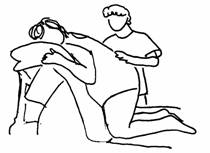 For more about the importance of freedom of movement during labor, make sure to check out Lamaze’s Healthy Birth Practice paper: Walk, Move Around, and Change Positions Throughout Labor or this video clip from Mother’s Advocate.
 Talk Birth