Archives

Birth Customs

“Pay attention to the pregnant woman! There is no one as important as she!”

(Chagga saying, Uganda)

The book Mamatoto is a look at birth in a variety of cultures (including the US) that was published by The Body Shop in 1991. Even though it is “old” it isn’t really dated since it is a brief overview of different customs and rituals and so forth and not a lot of statistics. There are a lot of absolutely fabulous (and fascinating) pictures and illustrations and these are the highlight of the book. Each chapter is followed by a “black page” of “facts you don’t want to know” about such things are reproductive health care policies in Romania and things like that.

One of the things that struck me about this book was that there is little distinction made between the customs of other cultures and the customs of the US. For example:

“People in Tibet believe that whether or not labour is due, a child won’t come out into the world unless the star under which it’s destined to be born is shining. Western medicine has developed a way of starting labour artificially, by injecting into a woman’s blood a simulation of the hormone oxytocin, which triggers contractions. For several years during this century, an unusual number of women laboured between the convenient hours of nine and five on weekdays…As the Malaysians say, a baby is like a fruit; it will be born when it’s ripe.”

I absolutely love seeing Western culture put into the proper context like this. Too often we see our way as THE way and forget that much of what the dominant culture views as normal for birth is not necessarily truly normal, but is instead an artifact of, or custom of, our culture. Viewed from a distance, the routines of birth in America are just interesting customs—in Tibet, born when the proper star is out, in the US, born when artificial hormones are injected…

(Since first reading this, I use the baby is like a fruit quote regularly.)

I may not be explaining myself clearly, but I find this distance in perspective refreshing and interesting. It reminds me of the work of anthropologist Robbie Davis Floyd whose book Birth as an American Rite of Passage explores the “ritual” elements of hospital birth in America and compares and contrasts the “technocratic” model of care with a holistic, woman-centered model of care (an example of which would be the midwives model of care). She asserts that there are many elements of hospital births that serve as rituals to reinforce the technocratic model (rather than to serve actual purposes, but instead to send cultural messages as well as to initiate the baby into the technocratic model). Examples of ritual elements include putting on a hospital gown, riding in a wheelchair, and having a routine IV. These elements serve to enculturate the woman and baby into a particular model–a ritual function–rather than an individually appropriate method of care.

Another example from Mamatoto that I enjoyed is as follows:

“‘Home birth’ can mean different things to different people. It can mean a bedroom, dimly lit and scented with myrr; a sweatbath perched on a Guatemalan hillside, or a birthing pool in an English flat; a warm fireside in a Himalayan kitchen; the packed-snow sleeping platform of an Inuit igloos; or a one-room shack in Jamaica, with a washing line dividing the family bed and the children waiting on the other side for a first glance at the baby who will be held up for them to see. When a woman gives birth at home, she and her family have a degree of control over the event; it’s their domain.”

In short, at home the family is in their own personal culture rather than having to adapt to the customs, culture, and “ritual elements” of an out-of-home environment.

When I think about American birth customs and culture, the first thing that comes to mind is this potent illustration from Mothering Magazine’s powerful article Cesarean Birth in a Culture of Fear, which was then published in booklet form by Childbirth Connection:

20120813-083208.jpgIn this image we see a woman immersed in the hospital birth culture found in many hospitals in the US.* She is hooked up to a potential of 16 different attachments. When I see this image, I instantly see why women might not want to “be martyrs” and thus go ahead and have any medications offered to them. It can be very difficult to stand in her personal power and embrace her own body’s rhythms and rituals when she is literally strapped down in this manner. I also think of this quote:

“Since beliefs affect physiologic functions, how women and men discuss the process of pregnancy and birth can have a negative or positive effect on the women that are involved in the discussion. Our words are powerful and either reinforce or undermine the power of women and their bodies.”–Debra Bingham

*Note: I am fully aware that this may not be what birth looked like in your hospital, but I’m speaking generically about many hospitals in the nation.

Modified from a post originally posted at Citizens for Midwifery

Amazon affiliate links included in book titles.

DVD Review: Birth as We Know It

Birth as We Know It: Educational Edition. DVD directed and produced by filmmaker Elena Tonetti-Vladimirova. 2006, www.birthintobeing.com (40 minutes), $39.95.

Reviewed by Molly Remer, MSW, ICCE, Talk Birth

As a birth educator, I am always on the lookout for the “perfect” video to show in classes. Though not a film I would show in its entirety to the average class, Birth as We Know It is a gorgeous compilation and I’m delighted to have it amongst my educational resources.

The film is available in two versions—the feature film edition and the “educational edition.” The feature film contains almost 4 hours of total footage (a number of bonus features), including 11 births. The educational edition consists of two condensed versions of the feature film—a 40 minute presentation and a 25 minute version designed to show in groups. I chose to purchase the educational edition and this review is based on that edition. I have not seen the full length feature film.

The forty minute version of the film contains gentle, moving footage of 7 births. All the births occur in water—some in the ocean, but most at home. It also includes footage about birth trauma, cesarean section, and circumcision that is not included in the 25 minute presentation version (which also includes only 6 of the births). The DVD also contains instrumental versions of both.

The births included on this film are all exceptionally peaceful, beautiful, gentle, quiet, and calm births. Some of the birth footage is in slow motion, the sounds are muted, and there is instrumental music as the soundtrack as well as occasional voiceover commentary by the filmmaker. The film alternates between birth footage and spoken descriptions/interviews about conscious birth, emotional presence, limbic imprinting, etc. The voiceover commentary addresses things like toning and healing one’s own birth trauma.

The births are wonderfully undisturbed and unhindered—in most the only hands near mother’s perineum are her own and this is such a profound difference from the usual media representations of birth! A highlight is during “Tanya’s Birth” in which she speaks to her older child, smiles with extreme beauty and peace, then casually glances down again and as the camera follows her glance, we see the baby’s head has emerged between her legs and she is cradling it gently. I love for people to have a chance to see this powerful moment!

Though interesting, I find the voiceover content and non-birth portions of the film to be too abstract or “metaphysical” to appeal to the average birth consumer. It is even a bit too metaphysical for me and I find that the concepts she mentions are not well explained and do not seem immediately reasonable or easy to accept in stride. The instrumental version is one way to gloss over this element, but then you are unable to scene select to specific content the way you are able to do in the regular versions.

So, though I do not show the complete film in classes, there are several birth clips that I do show routinely. I find two of the births in particular to be potent educational tools and they have been very well received in classes and have had a profound impact. The births are so different from general media representations of birth that they leave couples stunned with amazement about what birth can be. Since the births are in water, they are a very gentle, non-messy, not very “graphic” way to expand people’s understanding of normal birth. People in my classes have said things like, “wow! You never see something like that!” or, “that was so beautiful, I’m just in shock.” I find men in particular are more receptive to this footage than to other, more detailed, videos I show and I have had a few request to borrow and view the whole video instead of just the clips I have chosen for class.

In conclusion, this is a lovely film and though I have some reservations about showing the entire educational edition, some of the birth footage has been a powerful addition to my work with birth.

This review was previously published at Citizens for Midwifery.

CAPPA Re-Cap

Yesterday I got home from Kansas City where I’d been attending the annual free birth conference hosted by CAPPA. While there I concluded that Desirre Andrews is officially a superhuman live-tweeter. You can catch up with all of her rapid-fire tweets about the conference at CAPPA’s Twitter account.

I also tried my hand at posting a few things that particularly grabbed my attention to my Talk Birth and Citizens for Midwifery Facebook pages which automatically feed into Twitter. I’m not very good at catching short snippets for live-tweets, but some thoughts that I grabbed to highlight are as follows. If they don’t have quotation marks, they aren’t necessarily direct quotes, just “essence” summaries as I tried to take notes and pay attention!

First I attended Laurel Wilson’s talk about Bridging the Nutrition Gap and next, I listened to Tracy Wilson-Peters speak passionately about the “accidental parent.”

Essence tweets from Laurel and Tracy’s talks:

Babies don’t need to be in nurseries–they need to be with their mothers. This MATTERS!

Science can do a lot, can do wonderful things. Mother’s body can do even more…

Prenatal diets high in hydrogenated oils predispose mamas to postpartum moods disorders.

And, then I attended a breakout session from Darla Burns about postpartum rituals and snagged this interesting tidbit:

In Holland, all pregnant women are required to buy a homebirth kit, “just in case.”

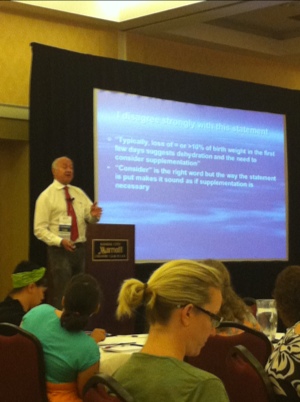
The second day, I found myself entranced by the most awesome Dr. Jack Newman. His presentations were the highlight of the conference for me. I loved him! I attended two–his general session on Controversies in Breastfeeding and then his breakout sessions, Impact of Birth Practice on Breastfeeding:

20120724-174258.jpg

If you ever get a chance to see this man, don’t miss it!

We have a big, big problem in that HCPs do not recognize the critical importance of breastfeeding.

There are many people who don’t know squat about breastfeeding and breastmilk and don’t feel like they need to learn anything before they start doing studies and writing papers about it. –Dr. Jack Newman

There is no such thing as “standard” breastmilk. It is a physiological fluid and varies from person to person. We DO NOT have to prove that breastfeeding is better than formula. Those comparison studies are unnecessary.

The burden of proof rests upon those who promote an intervention! –Dr. Newman

With animal births: following a normal birth, infant feeding just…happens. Following an interventionist birth, the mother rejects the baby and there is no nursing at all.

Our hospital births break every rule in the mammalian list of mother-baby necessities.” –Dr. Newman

Lying down for electronic fetal monitoring is a position of comfort for the care provider, NOT for the mother.

Know how much an incubator costs now? $50,000. Why don’t we just give half of that money to the mother and put the baby skin to skin on mother’s chest? –Dr. Newman

Seriously, Dr. Newman’s talks were amazing. Be prepared to hear more about them soon!

The final day I heard Polly Perez speak about Building Bridges with an emphasis on communication and fear:

Luke: I don’t believe it. Yoda: that is why you fail.

“Use language that lets you share your heart openly.” –Polly Perez

Listening is *active*, not a passive activity. Listen with empathy, openness, and awareness.

We have taken the hearts and minds out of much of our work because we’re frightened of getting too close. But, close is where we need to be.

“We must give people the opportunity to challenge their fears. Not only will this change each person, it will change the political and medical climate in which they make these choices.” –Connie Pike, via Polly Perez

Polly shared the first home birth she attended – made her fear of it “melt away like butter in a pan.”

You do not have to be an OB to be knowledgeable about birth. –doctor working with Polly Perez

Follow up from same doc: “if you tell me a baby is going to come out, I’m a gonna believe you!”

Changing sick systems is not about subterfuge but bringing light to situations that need to be altered.

Since micro-blogging is simply not my gift and is unlikely ever to become so, I am also planning longer posts based on several of the conference sessions. They will be (links will be updated as the posts become live):

At the CAPPA conference I also made a large custom order of great gifts from Joy Belle jewelry.

And, I ate tons of sample honey sticks from Glorybee–yummy! (see prior post: Why Honey Sticks During Labor?)

Other treats involved getting to spend some quality visiting time with a Friends of Missouri Midwives friend from St. Louis. We spent a lot of time talking over the FoMM newsletter (of which I am editor) and I feel very enthused about our ideas for its future.

I also got to meet a Facebook friend who started out originally two years ago as a Talk Birth fan on FB (after finding my site via my all-time most viewed post: In-Utero Practice Breathing). We spent some good time together visiting and laughing and it was fun to make the friendship connection with someone who was previously only an internet friend!

The Spirituality of Birth + Book Giveaway: Birth on the Labyrinth Path

I’ve been experiencing a fun trend in the books I’ve been reviewing lately—many new resources are being published with a shared theme of approaching birth from a spiritual perspective. There are resources now available for women from a variety of spiritual backgrounds, all honoring and respecting pregnancy and birth as experiences uniquely connected in an embodied way to the numinous and sacred, in whichever manner we choose to name it. I recently finished a class for my doctoral program and the subject of my final paper was “A Thealogy of Birth,” in which explored the sociopolitical, cultural, religious, and personal relevance of birth from a thealogical (Goddess-oriented) perspective.
  • I just reviewed The Gift of Giving Life which delves into the divine nature of pregnancy and birth from a Christian (specifically LDS/Mormon) perspective.
  • I then pre-reviewed the upcoming book Embodying the Sacred, which is written from a Catholic point of view.
  • And, earlier in the month I finished reading a gorgeous book with a non-specific spiritual perspective: Sacred Pregnancy
  • In the past, I also reviewed the book L’Mazeltov, which is written specifically for Jewish parents-to-be.

All of these resources are amazing and I’m so glad they’re available for pregnant women.

Now, I’m excited to offer a short review and a giveaway of another new book, this one written from a pagan perspective. Published by Pantheos Press, Birth on the Labyrinth Path is written by Sarah Whedon and focuses on “Sacred Embodiment in the Childbearing Year.”

My mini-review from Goodreads is as follows:

I really enjoyed this short book about pregnancy and birth from a pagan perspective. The reflections on the embodied, spiritual nature of pregnancy and birth were wonderful. It is very positive and reinforcing and contains great thoughts like this one: “A body that is curvier than it was before, maybe bearing stretch marks or scars from surgical procedures or tearing, maybe producing milk, is a body that bears the signs of delivering a human being into this world. We may mourn our smooth, skinny, unmarked maiden bodies, but at the same time we can celebrate the beauty of our storied, productive, and strong mama bodies.” Whedon also quotes this lovely passage regarding the connection pagan women might feel to the Divine: “I am the holy mother; . . . She is not so far from me. And perhaps She is not so very distinct from me, either. I am her child, born in Her, living and moving in Her, perhaps at death to be birthed into yet some other new life, still living and having my being in Her. But while on this earth She and I share the act of creation, of being, and Motherhood” (from Niki Whiting, “On Being a Holy Mother” in Whedon, p.)

I also shared some lovely quotes from Birth on the Labyrinth Path in my recent post on Birth Culture.

*********The giveaway is now closed. Ellen was the winner!*********

I’m also pleased to host a giveaway of a Kindle copy of Birth on the Labyrinth Path for one lucky winner!  To enter, just leave a comment sharing one of your own thoughts or favorite resources about the spirituality of pregnancy and birth. The giveaway will run through next Wednesday (6/27).

Birth Culture

Birth is cultural, the way eating is cultural. We don’t just eat what our bodies need to sustain us. If we only did that, there would be no reason for birthday cake. Birthday cake is part of our food culture. The place you are giving birth in has a local culture as well. It also partakes of our national birth culture. Not everything doctors do regarding birth makes the birth faster or physically easier for you or the baby. Some things are just cultural. For example, most hospitals do not offer enemas to birthing women anymore, yet a few years ago, most women who labored in hospitals were required to have an enema whether they wanted one or not. Enemas are sometimes helpful at birth, but not always…But they used to be part of the birthing culture… –Jan Mallack & Teresa Bailey in (p. 32)

I don’t feel like I have time to construct a big blog post about this subject, but I’ve been having big thoughts lately about birth culture and also how we think about and treat women’s bodies in pregnancy, labor, birth, and postpartum. So, this collection of quotes will have to do for now!

In the short book Birth on the Labyrinth Path by Sarah Whedon, I also marked this passage to share: “In the context of modern medicine, the childbearing year is often treated as a healthcare problem and we are alienated from the natural and holy processes of our reproductive bodies. Let us seek more and more ways to reframe pregnancy as a natural part of the human experience and to honor the holiness of this work that brings a pure and tiny spark of the divine into the messy, beautiful drama of life on Earth. Let us guard mothers, fathers, and babies as they grow families. Let us celebrate our sexy, dangerous, bloody, beautiful ability as people to make and love more people…” (emphasis mine)

Later on, Whedon makes these lovely observations about postpartum bodies:

A body that is curvier than it was before, maybe bearing stretch marks or scars from surgical procedures or tearing, maybe producing milk, is a body that bears the signs of delivering a human being into this world. We may mourn our smooth, skinny, unmarked maiden bodies, but at the same time we can celebrate the beauty of our storied, productive, and strong mama bodies….
—-
You may have seen images of new mothers as mama goddesses, resplendent in their fertility, effortlessly suckling a new babe while woodland creatures graze nearby. This is a lovely scene to aspire to, but my personal experience is that new mama goddesses are more likely to be found pinned to a couch by a ravenous infant, wearing pajamas and a messy ponytail, and surrounded by the remains of hastily grabbed snacks and partially read motherhood memoirs. Those mamas are no less goddesses. In fact, a careful Pagan theology of embodiment will recognize that the true mama goddess must include the range of experience of new motherhood, with all the sleepless nights, messy lochia, and milky-sweet sleeping babes.”

I also came across this quote from Sister MorningStar in the Spring 2011 issue of Midwifery Today: “Every mother has a culture. Every mother is a culture. She is born into an ocean of language, traditions and rituals around how she eats, sleeps, poops, makes love or births a baby.”

And, then from Ani DiFranco’s great introduction to Birth Matters: How What We Don’t Know About Nature, Bodies, and Surgery Can Hurt Us by Ina May Gaskin:
“The pains associated with menstruation and childbirth (even the emotional pain) are the price of having agency with the bloody, pulsing, volcanic divinity of creation, and they lie at the core of feminine wisdom. The literal experience of my body is your body your blood is my blood holds great insight into the way of things. A self-possessed woman in childbirth can be a powerful teacher for all (including herself) on the temporality, humility, and connectedness of life.”
I honestly believe that if modern birth culture rested in perspectives like this, our whole world would change!

The Gift of Giving Life: Interview with Sheridan Ripley

This interview with Sheridan Ripley is a stop on the Virtual Book Tour for The Gift of Giving Life.

Q1: Many people liken the writing of a book to giving birth to a baby? Did you find this an apt analogy?

YES! We (the co-authors) brought this up a lot. It was like we were gestating together and ideas were growing and growing. The first trimester I actually felt like I missed as I joined the group at the beginning of the 2nd year. It was a 3 year process so the trimester analogy works well.

The 2nd trimester we had plenty of energy and got a lot done and things moved forward quickly. We had that happy, easy 2nd trimester.

That 3rd trimester felt SO SLOW!!! It was the editing, book layout, more editing. Details and more details and felt so long. I know I felt so heavy and weighed down by the process. Luckily we had each other for support and we made a great team.

Finally we were pushing the baby out and while there were little hold ups along the way, it was so exciting. The triumph we felt as we finally held our book in our hands was pretty amazing!

Q2: I’m fascinated by the concept of Heavenly Mother and really enjoyed the sections of The Gift of Giving Life that touched on the relationship with Her. Can you explore more about how LDS women might find strength and connection in this image of the Feminine Divine and how she might aid in giving life?

I believe I am a literal child of a Heavenly Father and knowing that he is a partner with a Heavenly Mother and together they are able to love billions of children, helps me to have faith in my ability to love and raise my boys.

Knowing that our bodies are patterned after their bodies also gives me faith that my body can grow and birth babies! We are mortal and there are instances when medical intervention is needed, but the majority of the time birth is safe. Our bodies are created to create!

As we connect with other women in a supportive loving way we can feel connected to Her because we are each created in Her image. Maybe that is why when women gather around women in childbirth we feel so uplifted, powerful and humbled at the same time.

Some women really feel a need for a connection of a mother figure, especially while pregnant. I have an earthly mom who I am very connected to and she was very helpful during my pregnancy, so I didn’t personally have a desire for a connection with a Feminine Divine at that point.

However there are women who may be missing that mother figure in their life and we all have a deep desire for such a connection. Knowing that there is a Heavenly Mother who stands beside Heavenly Father to help guide us and protect us especially during this time of pregnancy and birth is powerful.

Meditating and pondering on the idea of a Heavenly Mother and how that can help us as we give the gift of life and then raise our children is the best way for me to connect to her. I actually just took time to do this as I hadn’t really thought of this question until you asked it.

That is the great thing about our book and having so many contributors is it will speak to different women, because so many view points are included.

Q3: Do you have any specific tips for women wishing to incorporate more spiritual practices into their pregnancies?

We actually have a newsletter that moms can sign up for where they get a free 20 minute meditation MP3 as well as 5 tips to have a more spiritual pregnancy/birth. I think for each mom it may look different. Prayer and meditation are great places to start, as you will often get inspiration on where to go from there. I also love Mother’s Blessings as a way to have the strength of other women buoy up the pregnant mom. She can benefit from feeling their love and spiritual support

Q4: When women in the birth stories say they asked their husband for a blessing or that their husband gave them a blessing, what does that mean?

A blessing is similar to a prayer. All male members of the Church who are prepared receive the priesthood, which is the authority to act in God’s name. One of the ways they can serve others with the priesthood is by giving blessings by the laying on of hands. They can give blessings of healing or for comfort and guidance. In some cases a wife might ask her husband (or other priesthood holder) for a blessing before or during birth.

I know for me in my first birth, it was so comforting because with my first birth my husband gave me a blessing when I was concerned about the Thing 1’s lack of movement. In the blessing he said he would be born when he was ready. When we discovered that he needed to be born by emergency cesarean immediately even though I was only 34 weeks, I had peace knowing that my husband had just blessed me that “he would be born when he was ready.” I knew everything would be OK.

—-

Thanks for the interesting interview and the review copy of The Gift of Giving Life, Sheridan!

Visit The Gift of Giving Life site to sign up for their newsletter and to receive a free Meditation MP3 as well as tips to help increase spirituality in your pregnancy and birth.

For my readers I have a coupon code for 10% off a copy of The Gift of Giving Life. Click here and after you add the book to your cart use this coupon code. GWFWXR3F This code is good until Father’s Day 2012.

Sharing Stories

Mother-to-mother birthtelling is easy at blessingways!

In an excellent article by Rachel Reed in the Autumn 2011 issue of Midwifery Today, Sharing Stories, Reclaiming Birth Knowledge, she makes this important point: “Women not only learn practical information about pregnancy, birth, and motherhood through exchanging stories, but also gain emotional and social support…Through sharing stories, women created a sense of connection to other mothers and to the ‘universal nature of birthing’ …”

Despite the everyday miracle of birth and potent role in women’s lives and self-identity, “women’s birth stories are largely ignored in mainstream childbirth education programs. Instead, the approach consists of an ‘expert’ transmitting standardized information sanctioned by the maternity system. This approach does not adequately meet the needs of mothers, nor reinforce mothers’ expertise and knowledge. Building childbirth education around mother-to-mother story sharing would reinforce mothers as the experts in birth.”

What do you know about birth that other people don’t know?

As I read this article, I thought of several experiences in my own childbearing experiences that varied from “standardized information sanctioned by the maternity system” and that includes the alternative care system of which I was a part. Things that, for me, were not available from those systems around me—books, professionals, or media, but that nevertheless came through and are part of my own stories:

  • Being able to feel my babies practice breathing in the last 8-10 weeks of my pregnancies.
  • “Skipping” transition–no “freaking out” required to have a baby after all.
  • Tearing “up” into the labia/clitoral area instead of the more common or expected perineal tearing
  • Experiencing a spontaneous birth reflex
  • No bloody show/mucus/fluid until shortly before pushing
  • Long “strings” of post-birth mucus. So tough and sinuous that they are almost like membrane.
  • Experiencing a second trimester miscarriage clearly and potently as a birth event.

I’m curious to know what other women have experienced like this. What happened to you that you had never heard about before? What is a part of your story that isn’t a part of birth books? What do you know about birth that other people don’t know? How does your story enhance the collective culture of women?

The role of story in midwifery education

Reed goes on to explore the role of story in midwifery care and the education of midwives, explaining, “It is time for midwives, informed by being ‘with woman’ and experiencing birth in all its complexities, to reclaim their own unique birth knowledge. Sharing birth stories represents a rich source of knowledge and develops the ‘collective culture of women.’ Mothers are already doing this well, and childbirth education should reinforce this mother-to-mother expertise. Midwifery education also needs to embrace the power of storytelling as a means of developing woman-centered knowledge and practice.”

One of the most valuable elements of La Leche League for breastfeeding mothers is the mother-to-mother support and information sharing. This is irreplaceable. We need a means of providing this type of mother-to-mother support for birth as well. Not in swapping horror stories or “enlightening” others, but in authentic connection based on our own unique birth wisdom.

Birthtellers

In another article in the same issue of Midwifery Today KaRa Ananda shares the following gem in her article about Birthtellers: “…the stories women tell to each other privately–shape cultures, beliefs, choices and lives. Women used to learn about birth and motherhood through the stories of their mothers, sisters, grandmothers, midwives and friends. Today, that knowledge is transmitted primary through television, movies, peers and the internet. Now is the time for the Birthtellers to arise and once again share our inspirational birth stories–both within our communities and globally through new media technology.”

One of the midwife-authors that makes my heart sing with her lyrical, magical writing, is Sister MorningStar (author of Power of Women). She shared her daughter’s birth story in the autumn 2011 edition of Midwifery Today and it is just beautiful.

My own article on the value of sharing story also appeared in the same issue of Midwifery Today.

Doulas at Homebirths?

What is a doula?

A doula provides non-medical labor support—all the good stuff like back rubs and encouraging words and suggestions for different positions to help with labor. She does not replace the father’s role, but “holds the space” for both mother and father as they take their own journeys/come into their new roles as parents. In my birth classes, I explain that I think one of the benefits of a doula is that it frees the dad up to JUST be the dad and to live his own experience/journey and not have the pressure of trying to remember all the birth “tricks” and book information.

But, why have a doula at a homebirth?

A lot of women planning homebirths do not feel as much of a need for a doula as do women in the hospital. The midwife is capable of providing many of the same functions as a doula, but she also has the monitoring tasks and baby tasks to take care of, while a doula is just there for YOU. Other things to consider when thinking about a doula for a homebirth are whether or not the midwife will be bringing an assistant and what her role will be if there is one–sometimes the assistant is available to fulfill some aspects of the doula role, other times she is observing or otherwise in training for other tasks. And, also consider how many people who want present at the birth–if you’re already having a midwife, an assistant, and say a mother or sister or friend there, adding a doula too may mean too much crowding.

A couple of months ago, I solicited feedback about doulas and homebirth for an article I was compiling for the Friends of Missouri Midwives newsletter. The full article is available here: Doulas and Homebirth. I had anticipated receiving a number of responses suggesting that doulas at homebirth are unnecessary, or redundant. After all, an emotional connection and secure trust is often the hallmark of what differentiates the midwifery model from the medical model. However, the responses I received were overwhelmingly in favor of hiring a doula for a homebirth. Personally, I very much valued the specific and customized postpartum care my doula provided to me after my last homebirth and I’ve concluded that a doula has the potential to offer something unique and precious to families, in whatever setting the birth takes place. I also think that the doula is the most likely member of the birth team to remain in contact with the family in the future. Perhaps it is because, even given the friendliness of the midwifery model, there is less of a “power differential” between mother and doula.

Personal experiences

The decision to hire a doula is a personal one, regardless of in which setting you give birth. My first baby was born at a birth center with the presence of a midwife, a doctor, my doula, a friend, my mother, and my husband. In hindsight, I felt like it had been too many people and that the doula hadn’t really been needed. For my second birth, at home, it was extremely important to me to have as few people present as possible. My husband, my mom, and my son greeted the arrival of my second son. My midwife arrived five minutes before his birth—just in time to catch! My midwife for his birth was so amazing, that I didn’t feel the need for any other professional care. I still miss her! My third baby was a second trimester miscarriage and he was born at home unassisted and just my husband present. Later, a friend who is a doula was very, very helpful to me with postpartum care/doula stuff. I really wished I had a doula there during his birth for emotional support and supportive physical care tasks (not medical support, but tea bringing and towel washing).

It is the little things that matter--here my doula puts warm socks on me following my baby's January birth (baby and I had special matching birth socks knitted by my mom)

And, finally, with my last baby, while I liked and respected my midwife I didn’t have the same warm bond with her and really wanted to hire a doula again, precisely because I was missing some of the emotional component I value so highly in midwifery care. It is really the little things that make doula care so special (see included photo!). When planning my last birth, I chose to hire the same doula as with my third birth, with the primary purpose being immediate postpartum help (“washing the bloody towels and bringing me tea” is how I define it).

Talk Birth in Labor…

And, speaking of my doula, I’ve been meaning to share this photo for a long time. When my doula had her own baby last April, amongst the wonderful photos that our mutual friend took at the birth, I was tickled to see this picture of my doula looking at my website while in labor:
I think this could be an advertisement for my blog 😉

You can read Summer’s intense birth story here and also be moved to tears by the stunning birth awesomeness of her video slideshow here:

Birth Pause…

What was the moment like immediately following the birth of your baby?

Was the baby placed directly onto your chest by a caregiver? Was she pushed into your own waiting hands and gathered to your body? Was he put first into a warmer and then onto your chest? Did a midwife pass him to you after gently receiving him? Did you glimpse her body as she was held over a blue cloth in the operating room? Did you see her whole body, or just the top of her head as she rested upon you? Did she emerge onto a soft landing where you could gaze at her for a moment, integrating the transition from giving birth to mothering, and then scoop her up into your waiting arms? No matter how it unfolded, I’m sure it was unforgettable.

Waiting to inhale…

I greatly enjoyed reading a beautiful guest editorial in The Journal of Perinatal Education by Mary Esther Malloy, called “Waiting to Inhale: How to Unhurry the Moment of Birth,” in which she explores this precious post-birth moment. This moment when mother meets baby, earthside. Malloy notes that for many women, the moment of meeting is “hurried” by the immediate placement of the baby on mother’s chest. Many women are in a brief, transitional state almost like “birthshock” at this moment—it is the moment before the classic euphoria and “I did it!” hits. Mother often has her eyes closed and needs a second to breathe and re-focus on the world outside her deeply inner focus. Malloy began to observe at births that if baby was allowed to emerge gently onto the softness beneath the mother, the mother is able to take a brief pause to integrate the shift from birthing to mothering and then begins to gently explore baby’s body on her own time, her own terms, before gathering it into her arms and to her breast. This occurs in the space of only moments, but they are unhurried, timeless, liminal moments. She notes: “…just as we are now appreciating what occurs when we respect a baby’s ability to find its mother at birth, what I am seeing [with mothers] is heightening my respect for an understanding of our own abilities as women to find our babies at birth.” She suggests that this natural pause marks a center point of a sequence that transforms woman to mother; that finding our babies ourselves brings us forward into a new state of being physically, emotionally, psychologically, and mentally. Malloy refers to this transition point as a moment to inhale—to “exhale” the experience of giving birth and to “inhale” the sight of the new baby and the beginning of a new phase of life.

Malloy does make sure to mention that the moment of birth is “just fine” and “unforgettable” without this “birth pause” and that mother’s chest is most definitely baby’s intended destination, but that she is starting to acknowledge that having her own babies delivered straight to her chest, “feels a lot like an intervention to me. If intervention feels like too strong a word, at least, it now seems like an interruption to what I might have done if no one told me what to do.” She concludes with some thoughts regarding her own upcoming birth:

Exhale and then inhale. Exhale the magnitude of the experience of birth and then inhale the unfolding moments in which I am receiving this child. Life is not one big inhale, one big gulping in of experience. It is the symmetry of exhale and inhale. Just as we breathe this rhythm through our labors, present to one contraction at a time, we can also breathe through our transition to motherhood, finding that moment between states and passing through as slowly as we need…

Personal experiences with the birth pause

Since I recently wrote about two other  “stages” of the birth process that are not widely acknowledged, the rest and be thankful stage and the spontaneous birth reflex, I knew immediately upon reading this editorial that I wanted to explore the birth pause as well. I am curious to know of others’ experiences with it or reflections upon it. I think back to my own immediate post-birth moments with my babies. My first baby was born and immediately placed onto my chest. I remember feeling disoriented, unreal, and dazed almost. It was sort of surreal. He was crying, I touched his back, and then asked him if he wanted “nursies.” It was very spontaneous and gentle and natural feeling, though taking a step back I see that there was not much time for that inhale moment.

When my second son was born, I was on my hands and knees and the midwife passed him through my legs to me as I turned over. When my daughter was born, I pushed her out into my own hands in a kneeling position. What struck me upon reading the editorial was how after my second son’s birth and after the birth of my daughter, though I was holding them, I did not immediately put them up to my chest. I held them low, against my body, near the tops of my thighs. I think my eyes were closed both times, head tilted back and then tipped forward. Then, I looked down at them, explored them briefly, and then gathered them up in my arms and to my breast. Neither was born onto the surface in front of or behind me, but neither was placed immediately on my chest either. My daughter’s birth was the most undisturbed and instinctual, and I distinctly remember looking down at her as I held her low against my body, and then making the decision to lift her higher and into my arms against my breast. With my son, I felt like his umbilical cord was short and that I actually couldn’t lift him higher without tugging it uncomfortably (it wasn’t actually short though and I’m still unclear what this sensation was exactly).

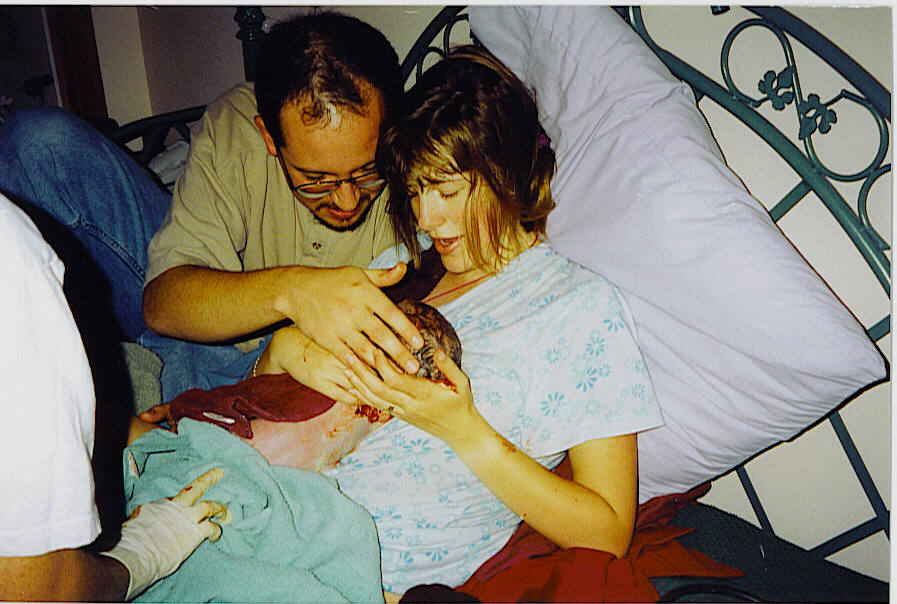
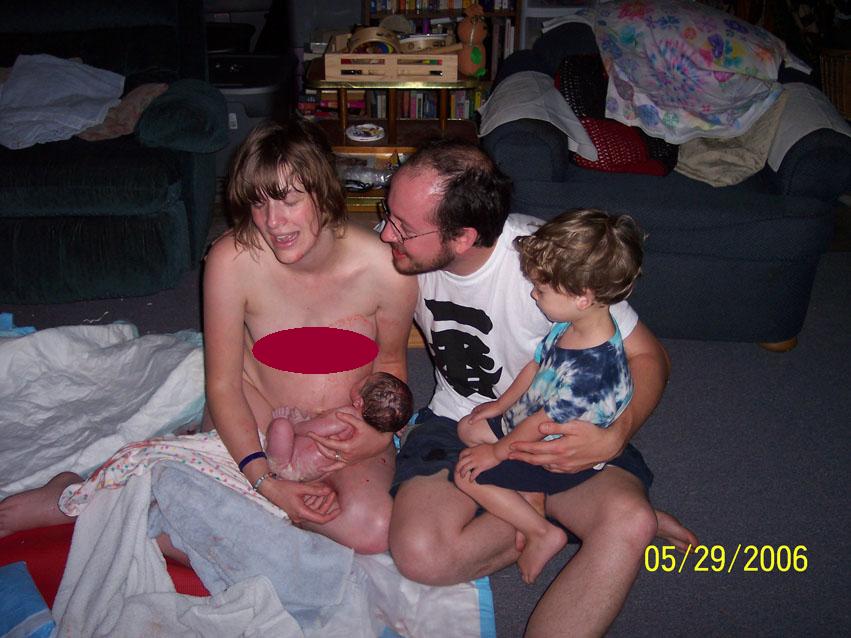
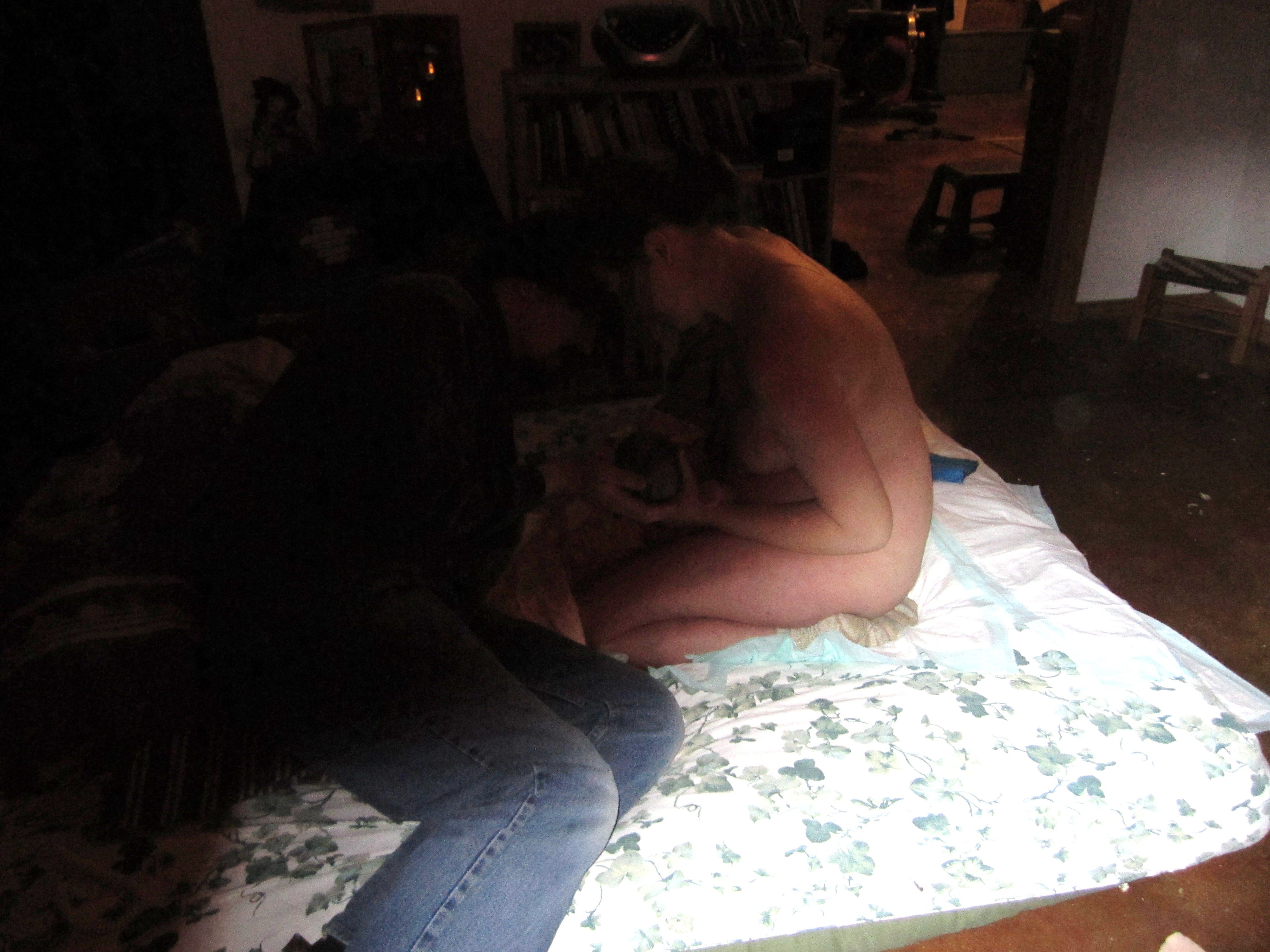
I immediately thought of post-birth pictures of each baby, in this birth pause time:

Immediately after first baby's birth--straight to chest. Main view is of top of his head. Hands tentatively touch/explore.

Immediately after second son's birth. Notice how he's held low down and kind of only with one hand. My eyes are closed and I'm not looking at him yet. In pictures shortly after, I'm looking at him and smiling and I've moved him up to my breast.
(Didn't feel totally comfortable with full breasts shot on my blog, though feel bad to conform to social expectations of appropriateness!)

Immediately after last baby's birth. I know it is dark/hard to see, but note how I'm holding her kind of low down and actually kind of out/away from me (to look at) rather than against my chest.

I actually feel like I see in all of these pictures that birth pause to exhale the birth and then inhale the baby and the mothering of it.

What about you? What was the moment like following the birth of your baby? Did you take a brief pause, a moment to exhale and then inhale? I’d love to hear about it!

A Tale of Two Births

As Penny Simkin has frequently noted: “We can’t control labor, whether it’s hard; that’s a leap of faith. But we can always control how we care for [the mother]” [1]

In 2001 and in 2004, I attended the births of two of my dear friend’s children in the same hospital in a mid-sized Midwestern city.  I was not a childbirth educator or doula at this time, but was there in the capacity of friend and “witness.” Both births were intervention-heavy and not what I would call ideal, natural births; but the feelings were vastly different, which made all the difference.

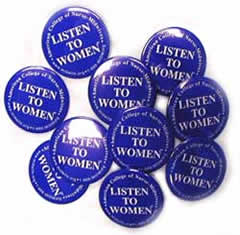
At the 2007 LLL International conference in Chicago, I picked up several of these great "Listen to Women" buttons from the ACNM booth in the exhibit area. I love them. Isn't this what it is all about? So simple and yet so profound. Imagine how the world would change if we just listened to women.

One had an atmosphere of respect, caring and trust; the other had a “climate of doubt” throughout. The difference was a certified nurse-midwife (CNM). My commitment to homebirth midwifery often leads me to forget what a profound and true difference a caring CNM can make in a hospital birth. All the other hospital procedures can be present, but the care factor a CNM provides can transform a woman’s experience from powerless to powerful. Sometimes I forget how CNMs are poised to bridge the gap between home and hospital effectively. The US needs lots of them (not as subordinate “junior obstetricians”—but as expert guardians of normal birth in a hospital setting).

The details were similar in each birth. The babies were both almost 9 lb; a doula was present (same doula in both births); and the mother labored with an IV, spent a large portion of the labor in bed and had internal fetal monitoring. In the first birth (with the CNM), the mother even had several hours of Pitocin augmentation; in the second, with the obstetrician, she had no Pitocin until third stage. With each birth, the mother also had an extensive tear and long repair (a third-degree with the CNM, a second-degree with the obstetrician).

However, some things were very different.

When the mother said, “Can I have a birth ball?” the CNM said, “Yes,” and the obstetrician said, “Not until the baby has been monitored.” And then, “The baby doesn’t like that; you need to get back into bed.”

When the mother’s confidence waned, the CNM said, “You can do it. You are.” The obstetrician said, “I don’t think this baby is moving down.

When the mother said, “This is taking such a long time,” the CNM said, “I know. It is taking for-freaking-ever!” and everyone laughed (including the laboring mother). The obstetrician said, “I think we should consider a c-section based on your history. The baby is not moving down.”

The CNM said, “You have such strong muscles in your legs and bottom, do you exercise a lot? I think because you are so strong, you’re holding a lot of tension here. Try to let it go.” The obstetrician ironed the perineum until the mother screamed with pain.

The CNM waited. The obstetrician did another internal check.

In both, a baby was eventually born (the first after four hours of pushing, the second after a little over an hour). A strong, healthy baby. Vaginally and without pain medications. After the first birth—though she would have done some things differently—my friend felt triumphant, empowered, powerful, strong, capable, happy and proud.

After the second birth she felt abused, disappointed, ashamed, guilty, angry, assaulted, diminished, wounded and scarred.

I believe the CNM’s personality, attitude and basic belief that vaginal birth would work was the critical difference between these two experiences. These births dramatically, viscerally illustrated for me that no matter what else is happening around the birthing woman, we can control how we care for her.

Endnote: My friend went on to have her third baby at home in 2008. She pushed this baby out in fifteen minutes, with no tear, and she shone with her power.

Molly Remer, MSW, ICCE, CCCE is a certified birth educator, writer, and activist who lives with her husband and children in central Missouri. She is the editor of the Friends of Missouri Midwives newsletter, a breastfeeding counselor, a professor of human services, and a doctoral student in women’s spirituality. She blogs about birth, motherhood, and women’s issues at https://talkbirth.me/posts.


[1] Looking to nature, doula Penny Simkin practices the art of delivery, in The Seattle Times, Pacific Northwest Cover Story. Originally published March 23, 2008. Accessed April 27, 2009. http://seattletimes.nwsource.com/html/pacificnw/2004299467_pacificpenny23.html.

This is a preprint of A Tale of Two Births, an article by Molly Remer, MSW, ICCE, published in Midwifery Today, Issue 91, Autumn 2009. Copyright © 2009 Midwifery Today. Midwifery Today’s website is located at: http://www.midwiferytoday.com/