Archives

Addressing Unexpected Outcomes in Birth Classes

“Birth brings powerful and painful sensations to the most intimate spaces of the female body…I stood transfixed by the life-giving strength found in her feminine power.” –Amy Wright Glenn writing about attending her sister’s birth (Birth, Breath, & Death)

What About Unexpected Outcomes?

If one factor contributing significantly to a woman’s satisfaction with her birth experience is having better than expected outcomes, how then can birth educators prepare women for unexpected outcomes? As Pam England notes, “Many women are conditioned to believe that if they have lots of information, then they will ‘pass the test’ or be able to control their birth outcome” (England, 2007). molly37weeks 018

Is it possible to truly prepare couples for unexpected outcomes? Though others may disagree with me, I have to wonder if the answer is “no.” (I confess to also wondering the same thing about truly preparing for giving birth!) I used to spend a whole class session on complications/unexpected outcomes, but suddenly awoke to the realization that most people’s whole lives have been a “class” in “birth complications.” Do they really need to hear it from me too or am I undermining the very confidence I seek to build? Undoing the new messages and competencies I’ve tried to instill?

Instead of a whole class on complications, I switched to spending a short section of class asking couples what they were worried about or if they had fears about specific complications. (Since I usually taught classes one-to-one, there was a certain sense of security with sharing vulnerable emotions that may not be present with larger class settings.) Bringing fears out into the open to “look at” helps shift the perspective from “frozen” fears to coping strategies. After they share their concerns, I usually mention maternal or fetal death because I believe it is important to acknowledge this most scary of fears. I also encourage them to include options for unexpected events during labor or with mother or baby on their birth plans (based on the birth planning worksheet in the book Pregnancy, Childbirth, and the Newborn by Penny Simkin). I share that most births—if not all—involve some element of surprise, the unexpected, loss, or grief. It could be as “small” as disappointment with the baby’s appearance or a sense of loss/grief of the specialness of being pregnant or as a big of a surprise as a baby in the NICU or even death of the newborn. It is normal and okay to experience feelings of grief and loss whether the unexpected event is “big” or “small.” It is helpful to have an understanding of the possibility of the unexpected and the emotions that follow.

I believe this acknowledgment and recognition as well as asking for their personal fears is more helpful as reviewing each and every complication of birth (which is how many CBE programs train their educators!), especially given the widely stated observation that couples dismiss and forget information shared during class that feels—consciously or unconsciously—irrelevant to them (this often includes complications or even postpartum and newborn care). I believe that a generally stated recognition of loss in all its forms is more likely to “stick” because it brings it into the couple’s personal sphere instead of being a more academic exploration.

For possible questions for exploring worries see: Worry is the Work of Pregnancy | Talk Birth.

This post is modified from a sidebar originally published in the International Journal of Childbirth Education accompanying my article about Satisfaction with Birth. I re-post it now in anticipation of a planned post about rituals for coping with unexpected outcomes…

Tuesday Tidbits: The Role of Doulas…

“So many of us are already working towards this aim – mamas (and groups) like LLL for sure, and doulas, women-centred midwives and July 2013 038doctors, and so many others…but really we need more. And there is no time or space for petty jealousies or in-fighting (and no judgments here, because it happens! I know the pain of this kind of sh*t, I’ve written a little about it before – and I may again – but it’s urgent we move beyond this if at all possible…) because we are already losing it – losing this capacity to give birth without intervention, to feed our babies from our own bodies, to experience love and connection in the fulness of which we are intended to be capable…” -Rebecca Wright (see more on why all of us are needed)

In “The Doula Phenomenon and Authentic Midwifery: Protection as a Keyword,” Michel Odent, writing in Midwifery Today issue 104, Winter 2012 describes the cultural conditioning of birth to think that women can’t do it on their own:

In this age of videos, photos and television, one cannot ignore that our current cultural conditioning is mostly determined by visual messages. Let us mention the powerful effects of the recent epidemics of videos and photos of so-called ‘natural childbirth.’ Almost always, several people surround the labouring woman. Young generations familiar with these pictures understand that the basic need of a labouring woman is to be accompanied by several persons. The effects of these visual messages are reinforced by the modern vocabulary, for example, to give birth women need a ‘coach’ (bringing her expertise) and support persons (bringing their energy). More than ever the message is that a woman has not the power to give birth by herself.

We must add that this cultural conditioning is now shared by the world of women and the world of men as well. While traditionally childbirth was ‘women’s business,’ men are now almost always present at births, a phase of history when most women cannot give birth to the baby and to the placenta without medical assistance. A whole generation of men is learning that a woman is not able to give birth. We have reached an extreme in terms of conditioning. The current dominant paradigm has its keywords: helping, guiding, controlling, managing…coaching, supporting…the focus is always on the role of persons other than two obligatory actors (i.e. mothers and baby). Inside this paradigm, we can include medical circles and natural childbirth movements as well.

Odent then goes on to explain that while the word doula comes from ancient Greek, actual modern-day Greek people advise him to use the word “paramana” instead, meaning literally, “with the mother.” He concludes his article with these important thoughts:

The doula phenomenon must be interpreted in the context of a period of transition. When the doula is understood as the mother figure a young woman can rely on before, during and after the birth, the doula phenomenon can be presented in a positive way as an aspect of the rediscovery of authentic midwifery. When, on the other hand, the doula is still another person introduced into the birthing place in addition to the midwife, the doctor and the father, her presence is counterproductive. If the focus is on the training of the doula rather than on her way of being and her personality, the doula phenomenon will be a missed opportunity. [emphasis mine]

I am concerned when I see rivalry between doula training organizations, because I think they are doing just this: focusing on the training of the doula rather than her way of being and her personality.

A long time ago I saved these two relevant, if somewhat opposing, quotes about doulas, culture, and advocacy:

First about doulas and collusion with patriarchy…

“I hate to say that the rise in popularity of doulas has done absolutely nothing to alter the status quo of hospital birth, but this seems to me to be true. In the past 10 or so years, the popularity of doulas has risen dramatically. And so has the rate of C-section and interventions in general. Am I suggesting correlation or causation? Absolutely not. Do I think that doulas are well-meaning, amazingly hard-working women who are truly passionate about women and birth and are trying to make a positive difference? Yes yes yes. But sadly, I don’t think they’re going to get anywhere. Because hospital birth is the collision of female power and patriarchy, and we aren’t going to change anything by behaving ourselves or adopting the approach of our oppressors. (No, this isn’t hyperbole. I really believe it).”

Doubts About Doulas (and patriarchy and stuff)

And, second about not bringing “politics” into the birth room…

“Now I understand there is a type of doula for everyone. Some women benefit from doulas with a more no nonsense attitude, the ones that don’t sugar coat things or come off more “militant”. Other women prefer a lighter touch or a more “middle of the road” doula. I respect the differences and the need for them. However, I believe there should be a separation of doula and advocate. Politics, in particular your own personal politics, have no business at the birth of your client. Once a client is in labor, any personal agendas should be checked at the door. There is a more appropriate time and venue to try and change faulty birth practices.

I think the same thing goes for the myth that we empower women through these actions at her birth. A woman’s power to advocate for herself and birth in the way she wants isn’t ours to give. It’s her birth and it has to be her job to find the power and be empowered. We can help, we can guide, we can even lead, but we can give that to anyone. Sadly though, through our actions, just like the hospital staff, we can take it away…”

Doulas and Advocacy: Are they mutually exclusive?

July 2013 036And, then, some more thoughts about the difference between activism and advocacy:

Activism, advocacy and support. As a birthworker I am always using one of these three tools. Sometimes I am using two at once, but never all three. And here is why: Support and advocacy can overlap. Advocacy and activism can overlap. But if you try to overlap activism and support you are going to be either ineffective, alienating, or both…

Activism, Advocacy and Support – To Brave Birth

We definitely need advocacy though and this is why:

Horrific abuse in childbirth happens every day in developing nations where women and their babies are often denied access to life-saving obstetric care.

Freedom for Birth – Can Anyone Argue Against Respecting Women’s Rights in Childbirth?

And, regardless of where or with whom or in which country women give birth, they deserve access to evidence-based care: What is Evidence Based Birth and Why Should I Care? — Giving Birth with Confidence

Birth is also a creative process:

“I believe that this is one of the important things about preparation for childbirth–that it should not simply superimpose a series of techniques, conditioned responses to stimuli, on the labouring woman, but that it can be a truly creative act in which she spontaneously expresses herself and the sort of person she is. Education for birth consists not, as some would have it, of ‘conditioning,’ but aims at giving a woman the means by which she can express her own personality creatively in childbirth.” –Sheila Kitzinger via More Thoughts on Birth as a Creative Process | Talk Birth.

And, birth matters a lot. It isn’t “just one day.”

“Homebirth cesarean mothers do not complete their births the way they planned, worked for, meditated on, and dreamed of. As a result, their births as mothers are left unfinished. As I told my therapist when my son was six months old, “His birth was finished but my birth, into being a mother, that’s been left hanging.” –via Homebirth Cesarean: “I was still an authentic mother.” – Momma Trauma.

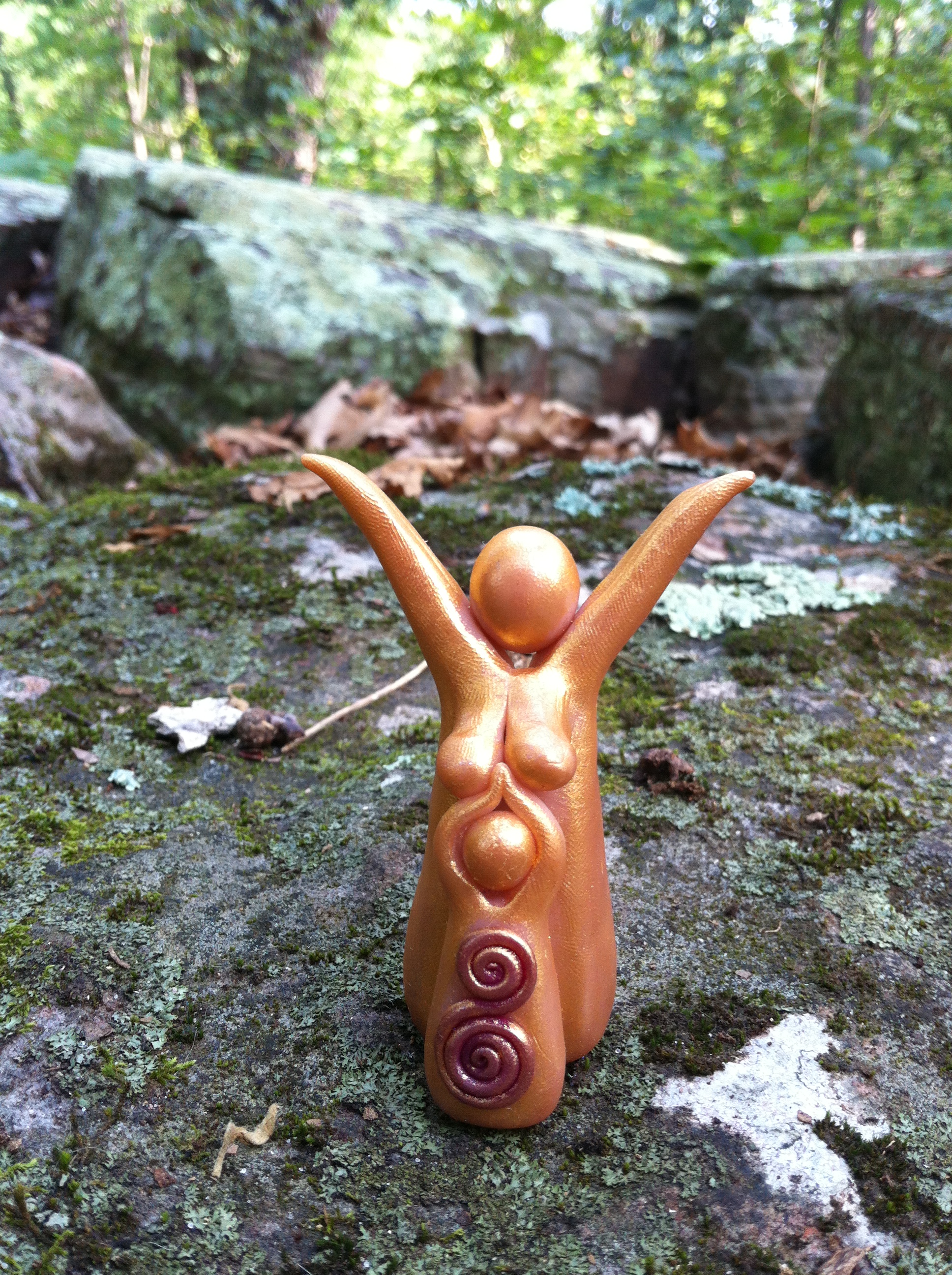
In non-specifically-doula, but birth-related news, I finished some new sculptures and updated my etsy shop! And, one of my breastfeeding mama sculptures was featured in a neat Etsy treasury called Supporting Breastfeeding.

Yesterday, I finished downloading the The Business of Being Born classroom edition kit, which I’ll be reviewing here and hopefully using in my community development class in August. And, I’m also looking forward to finally watching/reviewing Birth Story: Ina May Gaskin and The Farm Midwives on Thursday with my Rolla Birth Network friends! Speaking of Rolla Birth Network, plans are underway for the second annual footprintscharmMamafest event in Rolla, MO on August 10th. This is a pretty epic event given our smallish town and associated resources. It really was great last year and I expect nothing less this year! I went a little crazy online and bought all kinds of supplies so we can make our own bindis at my booth at Mamafest. I also bought a lot of new charms for several purposes and I’m going to donate my favorite footprints-on-my-heart charms   to the Rainbow babyloss support group to make miscarriage memorial charms at their Mamafest booth.

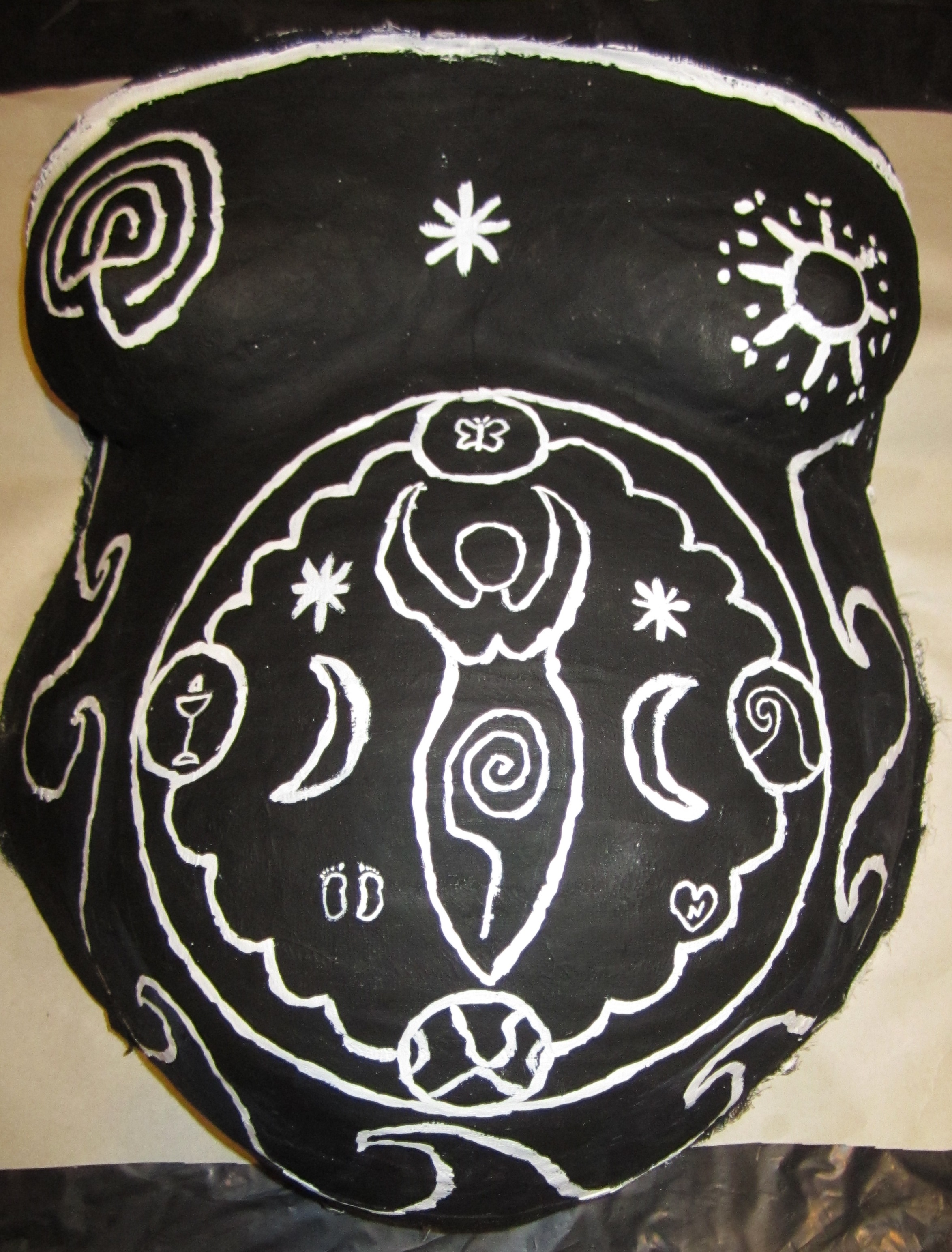
And, finally, as I shared on Facebook earlier this week: I love it when my two-year-old points at my belly casts on the wall and says, GODDESS! And, I’m like, yes, yes that’s me… 😉

Tuesday Tidbits: Moontime Mojo

“I am obsessed with becoming a woman comfortable in her skin.”
— Sandra Cisneros

I know I’ve been focusing on the subject of healthy menstruation a lot lately, but it is has been a persistent interest since my period came back after my last baby. At that time, since we are not planning to have any more children, I realized that I was going to have to redefine my relationship with my cycling body, no longer in the context of planning the next pregnancy. I also had the epiphany of sorts that in not acknowledging or fully experiencing the role of menstruation in my own life as a woman, I have been missing out on an opportunity to connect on a regular basis with one of the core “blood mysteries” of being female—I’ve spent a lot of time on birth and breastfeeding in my life, but my period? Oh, that old thing! I maintain that our attitudes towards our monthly bleeding are reflected in our culture’s attitudes towards birth and breastfeeding—ook! Bloody! Messy! Leaky! Stuff comes out of you! Hide it away! Don’t let anyone see! I shared some of these emerging 2013-06-22 08.59.09discoveries and thoughts during my Moontime session at the La Leche League of Missouri conference this month and many women attending expressed similar feelings—that they’d never actually connected the menstrual cycle fully with their experiences of pregnancy, childbirth, and lactation. As I explained to them, as women involved with LLL or birth advocacy we may be well-versed in listening and responding to our bodies when it comes to childbirth and breastfeeding, but many women overlook or minimize the influence menstruation has on their lives. We easily forget that menstruation also provides us with a regular reminder to listen to our bodies, follow their cues, and honor our own wisdom. I’m still working on it in my own life, but I really believe that women benefit from recognizing moontime as a time for rest, retreat, and renewal—a time to re-gather our scattered energy and resources and to emerge with strength and powerful medicine.

A friend came to me recently to ask for resources for her pre-menstrual daughter and said that she wanted something practical to tell her, not just to go sit in a tent, because that sounds nice, but it isn’t realistic in the modern age. And, I thought, but what if it WAS realistic and practical?! I would go so far as to say that perhaps we wouldn’t have such challenges with birth and breastfeeding in our culture if girls were taught that it was normal to need to rest and listen to their bodies once a month rather than to push forward like they’re exactly the same every single day. If this is how we grew up, wouldn’t it then be easier to accept the swell and flow of the energy of birth, to respect the need for rest and renewal during postpartum, and to listen to our bodies’ messages as we learn to breastfeed our babies and fall into sync with the timelessness of life with a newborn and beyond?

(Side note: when I originally chose the quote to open this post, I totally mis-read it and thought it said, “I am obsessed with women becoming comfortable in her own skin” and that is how I feel, but I guess I’m obsessed with it for myself too?)

I just finished reading the book Honoring Menstruation by Lara Own and it was really good. She says:

Our initiation of girls is superficial…how to put on makeup, buying your first bra, using a tampon for the first time. Many women get married and get pregnant without having any sense of their own capacity for endurance, physically or psychologically. Small wonder then than so many girl-women elect to give birth with the aid of painkillers and a technology that robs them of the experience of their own strength…

And she makes a point that I shared during my conference presentation:

As a culture we value stoicism and the overriding of the body. We have schedules, appointments, and timetables which are based on industrial efficiency rather than the moment-to-moment needs of the body. We wait until the end of the meeting to empty our bladders, until the end of the day to eat our main meal. We go to work when we have colds, when we have menstrual cramps, when we have a headache. ‘Not feeling like it’ is seen as a pretty lame excuse.

This is very useful training for all sorts of situations, but not for everything. And there are certain aspects of being female in which stoicism is exactly the opposite of what is required for successful survival. One of the skills of being a woman lies in being very aware of moment-to-moment bodily needs. Being deeply in touch with her body enables a woman to be able to know, and to say, ‘I need this type of food Now,’ ‘I need to rest Now,’ ‘I need to drink Now…’

I’ve previously used the example of listening to the urge to use the bathroom as a core issue in respecting our bodies and preparing for birth. Very, very few people actually go to the bathroom when they first feel the urge, waiting sometimes hours before finally making the time to run to the restroom. If we cannot listen to this simple, basic request from our bodies on a regular basis, can we honestly expect women to magically know how to “listen to their bodies” and give birth to their babies, particularly when we put them in birthing environments that are in many ways designed around overriding bodily requests? (Eating during labor? Sorry, you can just have ice chips. Moving around. Sorry, we can’t monitor the baby well enough like that.) We’ve been trained for years not to listen.

It is easy in today’s world to forget that our menstrual cycle is all about reproduction. Mostly – young women are given information about cleaning up their cycles from tampons to deodorants. Many are given birth control pills which in some cases stops their monthly bleeding all together. There are not many mothers who teach their daughters about the Rhythms of their Cycles – and instill a sense of true self-care and honoring as opposed to a fear of pregnancy, inconvenience and cleaning up. It is important for us to reconsider our relationship with our cycles – and take the time to not only understand our bodies – but connect with our inner compass.

A woman’s monthly cycle has an emotional and sexual landscape whether we are trying to conceive in that month or not. Instead of walking over these natural patterns – let’s try to understand them.

via Listening to our Menstrual Cycle ~ Wild Women Sisterhood.

I also enjoyed this article about Fertility Awareness, which is intimately tied (obviously) to an understanding of menstruation and body rhythms:

…throughout a natural menstrual cycle, hormonal fluctuation can alter a woman’s facial appearance, body odor, waist-to-hip ratio, vocal pitch, mood, habits of dress, and even language. When ovulating, these changes make women more attractive to men because they indicate fertility; in fact, one scientific study I read about later found that strippers have their peak earnings on the days when they are ovulating. These cycles also affect what type of men a woman finds attractive (women tend to be attracted to high testosterone macho types while ovulating and more nurturing men during the rest of the cycle). In short, a woman’s cycles affect how she thinks, how she feels, and how she behaves. Bly explained that our natural cycles are the full expression of ourselves. When a woman takes a birth control pill, which tricks the body into thinking its already pregnant, she is making a bigger change than she may imagine. Beyond obvious side effects like headaches, irritability, and bloating, Bly says, “The birth control pill emotionally flatlines a woman in a way that supports her ability to participate in the workforce, but does not support the ecstatic or transcendent qualities of masculine and feminine union.”

via The Hidden Wisdom of Fertility Awareness | Spirituality & Health Magazine.

And, I downloaded a free ebook about Rediscovering Your Menstrual Mojo from  Jo Macdonald. She specifically has resources for mothers and daughters. Check her out!

“Menstruation is an initiatory moment. Women can potentially open to a highly charged altered state, giving them access to a singular kind of power – the power of self-awareness, deep feeling, knowingness, intuition. A power that matures over time with each cycle.”

— Alexandra Pope

Finally, on Facebook recently, I saw this handy reminder card:

999013_189701581193314_1476244365_n

Rites of Passage… Celebrating Real Women’s Wisdom

“Woman-to-woman help through the rites of passage that are important in every birth has significance not only for the individuals directly bellypictureinvolved, but for the whole community. The task in which the women are engaged is political. It forms the warp and weft of society.” –Sheila Kitzinger (Rediscovering Birth)

“I love and respect birth. The body is a temple, it creates its own rites, its own prayers…all we must do is listen. With the labor and birth of my daughter I went so deep down, so far into the underworld that I had to crawl my way out. I did this only by surrendering. I did this by trusting the goddess in my bones. She moved through me and has left her power in me.” ~Lea B., Fairfax, CA via Mama Birth)

Summary of Article: How do today’s women prepare for major life changes such as becoming a mother? Have our once meaningful rites of passage been trivialised, and if so at what cost? Kat Skarbek looks at ways to reclaim what we have lost.

Permission is given to publish this story on the web (thanks to Women’s Mysteries Teacher Circle e-journal).

Without wishing to appear overly dramatic, I think that our society may be in danger of becoming devoid of any important spiritually nourishing rites of passage. Women no longer seem to know how to celebrate important transitions. We have fallen into the horrible habit of treating life-changing events in trite and meaningless ways and as a result, we are cheating ourselves out of the powerful positive effects that these rites of passage can bring us.

For women, menstruation, puberty, marriage, pregnancy & birth, menopause, death – even divorce and separation, all need to be properly acknowledged when passing through these stages of life. Instead we either ignore them completely as in the case of puberty, first menses and divorce, which sends the message that they are both shameful and unworthy of celebration. Or we use the opportunity to get drunk, act like strippers and carry out questionable tasks which would make a sober person question why she would want to get married in the first place – as on your average hen night. At a friend’s baby shower recently I watched with sinking heart as one of the most important events in a woman’s life was celebrated with games involving stealing pegs from other women’s clothing the minute they unconsciously crossed their legs, guessing the baby’s weight and answering questions such as did she have ‘an inney or an outey’ bellybutton? How, I found myself asking, does this in any way prepare a woman to deal with the rigours of labour and birthing and the demands of the first year of motherhood? Why are we so seemingly unaware that our accepted celebrations offer absolutely nothing to women except a bunch of baby clothes? At standard baby showers there is no molly5wisdom shared, no loving support offered and no nourishment given (unless you count cupcakes!).

How did it come to this?

What happened to our once vital and spiritually awakening rites of passage? The easy (and heavily feminist) answer is 500 years or more of patriarchy. Prior to this and from the earliest records of society, it has been apparent that there were very well observed, meaningful and symbolic rituals to mark just about any occasion. Rituals existed for everything from simple agricultural celebrations of the changing seasons and giving thanks for food and supplies, to complex marriage and birthing rituals that eased newlyweds into their new roles and prepared the way for women to birth with dignity and power. Women in particular carried enormous wisdom about the cyclical nature of life and shared nourishing rites of passage, which enabled them to marry in confidence and with awareness, birth without fear and to die with dignity and grace. Once patriarchy became established it began the systematic erasure (or appropriation) of many of these important rites and in particular it diminished the roles and experiences of women so that they went from being important and respected members of their communities, with power over land, name and children to women whose only role was to birth heirs and to be subservient to their men. Even in today’s changing society the roles of ‘wife’ and ‘mother’ are still considered less important than the roles of ‘career woman’ and ‘breadwinner’. We have higher rates of divorce, higher rates of birth intervention and subsequent post-natal depression and more difficult menopauses now than women experienced 50 years ago. I believe that this is directly linked to the fact that we are now expected to just ‘get on with it’ and disappear into these changes without the proper observances being made. I’m not suggesting that women to disappear into mud huts every time they bleed or to give birth in fields as we did in the tribal days, but I do think that we need to pay more attention to our needs at these powerful times of change. Menstruation is not a curse, it’s a promise of our life-giving ability to come. Menopause is not a loss of youth and sex appeal, it’s a vital gateway to the enormous power of our wisdom years. And pregnancy, birth and marriage are life-changing experiences that need to be embraced and celebrated with something more nourishing than ‘Mr December’ and his overstuffed banana hammock.

A graceful acceptance of our changing roles and an awareness of the power that these changes bring, gives us huge personal freedom. Freedom from the current obsession with youth and aging, freedom to explore our new shapes, our new lives and the possibilities they hold. Isn’t that worth exploring?

Reclaiming simple rites of passage

So how can today’s modern goddesses, and in particular mammas-to-be, prepare themselves for life’s many transitions? A good starting point is to create your own rite of passage for whatever transition you may be going through. Pregnant women could change their planned baby shower to a Mother Shower (also known as a Blessingway). Mother Showers celebrate and nurture the mother rather than focusing exclusively on the child and are a growing trend amongst women. They offer pregnant women a chance to honour their pregnancy journey, to enjoy symbolic rituals of preparation for the labour and birthing ahead and indulge in an afternoon of loving, nourishing attention from their closest friends and family. And yes, there are still cupcakes! During one of these afternoons a pregnant woman can expect to be waited on hand and foot – often quite literally. Celebrations often include some kind of pampering for the mamma-to-be such as a foot and hand massage with beautiful, pregnancy-safe essential oils. She might choose to have her belly, hands or feet hennaed as a recognition of her changing status. She might enjoy creating a beautiful ‘labour necklace’ created out of beads gifted by each woman present and blessed with all of their best wishes for a wonderful birth. These necklaces can be used as a powerful focusing tool during the darkest hours of her labour and can become a beautiful heirloom that gets passed on from mother to daughter, or even from woman to woman within her community, with each subsequent pregnancy adding more beads to the necklace.

What you can do

There are a number of meaningful activities that you could include in your celebration. You could even combine elements of a traditional baby shower with elements from a mother shower by adding in any of the following:

  • A Fear Releasing Ceremony. Writing down your fears on a piece of paper and ritually burning them can help you rid your unconscious IMG_0821mind of any impediments to an easy and positive birth.
  • Belly Casting. Creating and painting a belly cast (a 3D plaster cast of the beautiful pregnant belly) can be a wonderful meditative tool to connect you more consciously with your body and your baby.
  • Guided Meditation or Visualisations. If there is a group of you, each woman can place a loving hand on the mamma-to-be, while another guides her into a place of deep relaxation where she can communicate with her unborn child or any guides or angels she feels drawn to, in order to receive information or just reassurance.
  • Plant a Tree. Buy a beautiful fruit tree to plant in honour of your newborn. You can tie birth blessings and wishes to its branches until after the baby is born.
  • Give gifts to nurture the mind, body or soul of the mamma-to-be. Most women won’t get the opportunity to enjoy a spot of luxury once the baby is born, so instead of yet more baby clothes why not spoil the mamma with something indulgent such as a pregnancy massage, a hair appointment, a manicure or pedicure or simply some beautiful skin cream to minimise stretchmarks? You can even buy her a gift for after the birth such as a post- natal spa voucher, to give her some ‘me’ time to look forward to when she needs it most.
  • Share Birthing Stories (no horror stories please!). Poetry, singing or chanting can also be a very uplifting way of connecting with your wise inner goddess.
  • Create a Phone-Tree. When labour is established, each woman is called and lights a candle for the birthing mamma to re-create the loving circle of support present on the day and send her thoughts of courage and strength.
  • Provide Nourishing Food and Drink. Each woman present can contribute a meal to be frozen for after the birth.
  • Pledge an Act of Support for after the Birth. Each woman offers one tangible act of support for after the birth when the mother and child are getting to know one another. It can be something simple like providing a home cooked meal, offering to take care of an older child for an afternoon so that the mamma can get some rest, taking the dog for a walk or taking the newborn off her hands so the she can have a recuperative bath.
  • The Baby Moon (or a month of ‘lying in’ with the newborn) is still observed in many cultures and offers a chance for the infant and mother to really bond and get to know one another without the usual worries about cooking, cleaning and taking care of other children. I think it would be very beneficial to women to reclaim this particular tradition.

Finding our way back home.

On the day that a baby is born, so too is a mother. Without properly acknowledging our changing lives in these beautiful and memorable ways, we go into motherhood unprepared for the challenges it may bring. No amount of reading can bring you the kind of self-knowledge needed to be a good mother. No amount of beautiful nursery furniture can enable you to trust in your mothering instincts when you are frightened of making a mistake with your precious little bundle. These things all take time. Reclaiming our rites of passage, no matter in how small a way, can help restore to women something vital for their spiritual and emotional wellbeing. And if you are worried that it might be boring or heavy, you needn’t. Celebrations are just that, a joyous coming together of loved ones to honour something wonderful. Keep that in mind and enjoy the many wonderful ways of celebrating this amazing and challenging time in a woman’s life. Choose the things that work for you, that you will enjoy and that will really give you the space to recognise the momentous changes that are happening and offer you some genuine support and acknowledgement of this special time.

More information about alternative pregnancy celebrations can be found in books such as Mother Rising by Yana Cortlund, Barb Lucke and Donna Miller Watelet (OK) and Blessingways, A Guide to Mother-Centred Baby Showers by Shari Maser (OK).
If published on the web please include the following contact details: Website: www.thedivinefeminine.com.au Email: info@thedivinefeminine.com.au Phone: 0439 636 958

Kat Skarbek
www.thedivinefeminine.com.au
About Kat Skarbek…
Kat Skarbek is a writer, presenter of the Shamballa Spirit Show on 3MDR 97.1FM and the Head Honcho of The Divine Feminine (www.thedivinefeminine.com.au) which specialises in creating unique and spiritually nourishing transitional celebrations and events for women. These include alternative Hen Nights and Mother Showers for pregnant women. She is a proud survivor of the first two years of motherhood and a visit from the PND Fairy.
Phone: 0439 636 958
Email: info@thedivinefeminine.com.au

Previous posts about rites of passage and women’s mysteries:

Rites of Passage Resources for Daughters & Sons

Birth as a Rite of Passage & ‘Digging Deeper’

Blessingways and the role of ritual

Blessingways / Women’s Programs

Red Tent Resources


Tuesday Tidbits: Speaking Birth

Someone came to my site recently by searching for: “how to speak birth.” What do you think? How do you “speak birth” in a way that reaches women?

I asked this question on my Facebook page last week and got several responses:

  • With our stories.
  • Every woman is different. You listen to her. Then you respond
  • Speak it forward. Speak everything forward.
  • I speak birth from an awareness stand point, in a non biased stance and of course judgment free and I do A LOT of listening first.

This question also made me think of some of my own past writing about the language of birth and why it is that how we speak birth matters:

Birth Talk

Health Care or Medical Care?

Maternal-Fetal Conflict?

Pain with a Purpose?

Perceptions of Pain

Words for Pain

Consumer Blame

Cut here?? What not to say to pregnant or laboring women…

I also re-read one of my own articles as I worked on a lesson for one of my classes:

“…I also think, though I could be wrong, that it is possible to plan and facilitate women’s rituals that speak to the “womanspirit” in all of us and do not require a specifically shared spiritual framework or belief system in order to gain something special from the connection with other women…”

After sharing the link on Facebook, I got a lovely comment from a midwife sharing that she shares my handouts with her clients in Trinidad and Tobega and I was humbled at how my “talking birth” in this form reaches out across the ocean and around the world. This is why I keep writing, even when I get discouraged and feel like it is an “indulgence” of some kind to write and blog.

While not about birth, but still related to the  overall theme—perhaps how we speak sisterhood—one of my Facebook friends validated my stressed and overwhelmed experiences/feelings of the past month with an “of course” response and I really appreciated it!

“Through the act of controlling birth, we disassociate ourselves with its raw power. Disassociation makes it easier to identify with our ‘civilized’ nature, deny our ‘savage’ roots and connection with indigenous cultures. Birth simultaneously encompasses the three events that civilized societies fear–birth, death, and sexuality.” –Holly Richards

via The Of COURSE response… | Talk Birth.

talkbirth

Womenergy (Womanergy)

The day before my grandma died, my dad came over and said he’d coined a new word and that I could have it: Womenergy. He said he’d googled it and didn’t come up with anything. I googled it later though and there are a couple of people who have used it before, so I think my dad actually said Womanergy instead, which is still available. So, womanergy has been coined now too! 🙂 I dozed off during Alaina’s nap today and when I woke up the word was in my head and so were a bunch of other words. I channeled a bit of my inner Alice Walker and wrote:

Womenergy (Womanergy):

Feeling fierce at 37 weeks last year.

Feeling fierce at 37 weeks in 2011.

Often felt when giving birth. Also felt at blessingways and circling with women in ceremony and rituals. Involved in the fabric of creation and breath of life. Drawn upon when nursing babies and toting toddlers. Known also as womanpower, closely related to womanspirit and the hearing of one’s “sacred roar.” That which is wild, fierce. Embedded and embodied, it may also be that which has been denied and suppressed and yet waits below her surface, its hot, holy breath igniting her. Experienced as the “invisible nets of love” that surround us, womanergy makes meals for postpartum women, hugs you when you cry, smiles in solidarity at melting down toddlers. It is the force that rises in the night to take care of sick children, that which holds hands with the dying, and stretches out arms to the grieving. It sits with laboring women, nurses the sick, heals the wounded, and nurtures the young. It dances in the moonlight. Womenergy is that which holds the space, that which bears witness, that which hears and sees one another into speech, into being, into personal power. Called upon when digging deep, trying again, and rising up. That which cannot be silenced. The heart and soul of connection. The small voice within that says, “maybe I can, I think I can, I know I can. I AM doing it. Look what I did!” Creates art, weaves words, births babies, gathers people. Thinks in circles, webs, and patterns rather than in lines and angles. Felt as action, resistance, creation, struggle, power, and inherent wisdom.

Womenergy moved humanity across continents, birthed civilization, invented agriculture, conceived of art and writing, pottery, sculpture, and drumming, painted cave walls, raised sacred stones and built Goddess temples. It rises anew during ritual, sacred song, and drumming together. It says She Is Here. I Am Here. You Are Here and We Can Do This. It speaks through women’s hands, bodies, and heartsongs. Felt in hope, in tears, in blood, and in triumph.

Womenergy is the chain of the generations, the “red thread” that binds us womb to womb across time and space to the women who have come before and those who will come after. Spinning stories, memories, and bodies, it is that force which unfolds the body of humanity from single cells, to spiraled souls, and pushes them forth into the waiting world.

Used in a sentence:

“I’m headed to the women’s circle tonight. I could really use the womenergy.” February 2013 196

“I felt like I couldn’t keep going, but then my womanergy rose up and I did it anyway.”

“Feel the womenergy in this room!”

“She said she didn’t think she could give birth after all, but then she tapped into her womanergy and kept going.”

“I hope my friends have a blessingway for me, I need to be reminded of the womenergy that surrounds me as I get ready to have this baby.”

Feel it…

Listen to it…

Know it…

In the air, in her touch, in your soul.

Rising
Potent
Embodied
Yours…

“For months I just looked at you
I wondered about all the mothers before me
if they looked at their babies the way I looked at you.
In an instant I knew what moved humankind
from continent to continent
Against all odds.”

–Michelle Singer (in We’Moon 2011 datebook)

“I believe that these circles of women around us weave invisible nets of love that carry us when we’re weak and sing with us when we’re strong.” –SARK, Succulent Wild Woman

There is a wild tiger in every woman’s heart. Its hot and holy breath quietly, relentlessly feeding her.” – Chameli Ardagh

Circles of women (and art)...

Motherhood and Embodiment

“Loving, knowing, and respecting our bodies is a powerful and invincible act of rebellion in this society.” –Inga Muscio

As I’ve written before, pregnancy, birth, and breastfeeding are incredibly embodied experiences—motherhood in general feels very much a molly37weeks 016physical commitment. Our relationship with our children begins in the body, it is through the maternal body that a baby learns to interpret and engage with the world, and to the maternal body a breastfeeding toddler returns for connection, sustenance, and renewal.

Why might birth be considered an ecofeminist issue though? Because mother’s body is our first habitat. We all entered the world through the body of a woman and that initial habitat has profound and long-lasting effects on us, whether we recognize them or not. Midwife Arisika Razak explains, “the maternal womb is their first environment. The cultural paradigm of birthing is the first institution that receives our children…Each of these elements—womb, birth culture, and family—has a profound effect upon the new human bring. Each deserves our best thinking and analysis. What would it be like if we envisioned a society in which positive, lifelong nurturing support—from old to young, and young to old—were the dominant theme of human interaction?” (p. 167).

What would it be like if we treated birthing women and their babies like they mattered?

Our first and deepest impulse is connection. Before Descartes could articulate his thoughts on philosophy, he reached out his hand for his mother. I have learned a lot about the fundamental truth of relatedness through my own experiences as a mother. Relationship is our first and deepest urge and is vital to survival. The infant’s first instinct is to connect with others. Before an infant can verbalize or mobilize, she reaches out to her mother. Mothering is a profoundly physical experience. The mother’s body is the baby’s “habitat” in pregnancy and for many months following birth. Through the mother’s body, the baby learns to interpret and to relate to the rest of the world and it is to the mother’s body that she returns for safety, nurturance, and peace. Birth and breastfeeding exist on a continuum, with mother’s chest becoming baby’s new “home” after having lived in her body for nine months. These thoroughly embodied experiences of the act of giving life and in creating someone else’s life and relationship to the world are profoundly meaningful experiences and the transition from internal connection to external connection, must be vigorously protected and deeply respected.

via Talk to Your Baby | Talk Birth and Breastfeeding as a Spiritual Practice

I have a particular interest in embodiment and my dissertation topic is related to a thealogy of embodiment (basically the Goddess and the body) and so my attention was caught by some great sections about birth, bodies, and family in the book The Art of Family:

AS WE MOVE THROUGH BODILY stages together, there are some special stages that are worth thinking of in advance. Pregnancy is one, of course, and babies. Nothing is more inescapably BODY than birth. For the mother, both through her pregnancy and the labor and delivery of the baby. In birth, the body gets to drive the soul for a change and one’s soul is on for the wild ride, whatever happens. What does she deliver, after all, but a body, this little lamblike creature packaged in a now wholly-other body? What does she deliver but a body—and what do she and Daddy count but a body’s toes, a body’s fingers? In these small ways we acknowledge our wholeness, our physical sacredness.

Gina Bria (2011-11-28). The Art of Family : Rituals, Imagination, and Everyday Spirituality (Kindle Locations 1693-1700). iUniverse. Kindle Edition.

(Amazon affiliate link included)

And, I appreciate that Bria then moves into a consideration of how men experience pregnancy and birth…

YES, BIRTH IS THE BODY, and for women it is manifestly given. But one should note that the world over, there is a complementary effort by men to try to counterbalance the impressive power of women who have even the potential of birth, whether it is actualized or not. Men, too, have moments of making special use of their bodies. Men make quests, and perform feats of extraordinary effort, to put their bodies on the line in some attempt to match birth.

…For modern men, pregnancy means two things, not one integral, unfolding experience, as for women. First, they must cope with a partner undergoing tremendous physical change. In essence, they are no longer dealing with the same body. It’s a stressful experience, and many men fear they will never see their old partner again, quite literally. They listen to their wives agonize about weight gain and swollen ankles, and secretly grieve the loss, all the while maintaining a show of faith, for their wives, for themselves, that it will come to a happy ending. And on top of that, they must then forge a new relationship with the party responsible for this, someone they can neither see, nor touch, indeed, can hardly believe exists! Women at least get touched by their in-utero babies, even if it’s a swift kick from the inside. “Hey, it’s Daddy,’’ my husband said rather sheepishly into my belly one night. This seemed to me quite amusing, as if the baby needed an introduction to one half of his own genetic material. Then suddenly it struck me that I had never considered introducing myself to the baby, announcer like over an intercom—“This is your mother speaking’’—because I felt the bodily connection so inexorably. I knew I was well known to the baby, but my husband had no such advantage. He had to make connections in other physical ways, in this case using his voice. Making a family where men touch, speak, and care for children is a vital way to connect them to their own progeny; one way that many cultures, including our own, can often deny men. Perhaps you have been stopped in your tracks, as I have, over the recent spate of advertisements of bare-chested men holding tiny babies. Do advertisers, more than Freud, know what women want? Yes! We want to see our handsome men holding babies, snoozing with them, schmoozing with them in chest-to-chest communion. As Jane Austen asks, “What attaches us to life?’’ Anyone who lays on hands gets attached to life.

These thoughts really struck me in a profound way. During each of my own pregnancies, I remember marveling and feeling impressed, as well as a little sad, that my husband had to somehow forge this bond with a newcomer without the same benefit of the embodied, constant experience of pregnancy—pregnancy from the inside is different than pregnancy from the outside. I shared the author’s amusement in picturing how it would have been to “announce” my own presence to my babies. I’ve tried, but cannot fully imagine the process and psychological task involved with the paternal experience, of in a sense, “suddenly” having a baby to hold and care for and “instantly” love, though I’m sure I have the capacity within me somewhere (and, yes, I know that not all mothers feel an instant love either and may have the same sense of suddenness in their own lives—it was certainly true for me that the inner experience of a womb-dwelling baby was pretty different from the external experience of having a physically visible baby to tote around). As a pregnant woman though, the baby is basically inescapably present and part of me in an interconnected, interwoven, symbiosis of being. There is the transition at birth to an “outer” relationship, but that intense embodied interconnection continues immediately with the breastfeeding relationship. It is somewhat impressive or staggering to me almost, that men have to form their own connection born out of different “stuff” that the biology of gestation and lactation that weaves the motherbaby together.

Bria also addresses the loving of a baby’s body that isn’t going to survive:

WE ARE NEVER MORE CRUSHED than when there is trouble at birth. No sadness holds for us the power of an incomplete body, a broken body. We grieve and turn heart stricken at this time like no other. In moments like these we can only comfort ourselves, with love, that love would allow us to care for this child when many would not be able to do so. We hope to find ourselves the kind of people who could, in such circumstances, make a life for a whole person, with an incomplete body. When our son was born with a leaking heart, an old-fashioned “blue baby,’’ and destined to die without surgical repair, we learned quickly that all we could give him, all he could receive as a newborn, was the small, inconsequential daily care of the body, gentle changing, warm nursings, our breath upon his face. Perhaps, we thought, it would be all he would ever get. In that season of attention, we really learned the significance of loving a body. A body, however small, records every trace of touch; it is never unconscious; unlike the mind, a body is never without sensing, even in sleep. A body will always remember.

I liked the description of a body always remembering. We do carry deep, physical memories of our pregnancies, births, and babies. I find the physicality actually comes back most clearly in dreams for me, when I can again feel with a sharp potency the sensation of a baby’s body slipping swiftly from my own body. I also like reading research that indicates that mother’s body carries fetal cells within her forever. I like thinking that physical evidence of the embodied, relational experience of pregnancy remains written into my very cellular structure (well, and on my bones and skin too, I suppose!). I found this a comfort after my little Noah’s birth, thinking that in a very real way, I would truly always remain a “little bit pregnant” with him and that perhaps some of his unique genetic material lives on in my body.

After birth, we continue to relate to our babies on a very physical, body-oriented level. There is nothing like a baby to bring things back to the body, to use your body and their own in a complete, intensive, totalness.

BABIES’ BODIES AND CHILDREN’S BODIES   LIKE PLAY, LOOKING AT THE body of an infant returns us to childhood. Babies’ bodies are a special form of being human, and they elicit in us essential, elemental emotions. They infect us with longing for the integration, the wholeness, they have. As new parents, we experience again all the helpless and exuberant feelings of children, the unfeigned marveling over everything manifested by a baby, a physical miracle. We cannot contain our awe, expressing it to everyone within earshot. New parents on the street can always be identified by their aura of vulnerability; they’ve shed the social cloth that keeps us all appropriately attired to go about our work. Instead, just like the baby, they are naked to everything good. They blink and look around, bemused, tired, and delighted. You will notice they always smile at you at the crosswalk—it is a secret, initiated smile. They assume you either know what they are smiling about or wish that you did. What is it they know? Their babies made them once again aware of the pleasures of physical delight. To care for an infant is a test of our humanness, a trial by fire and love.

What is good about caring for infants is that they never let us forget how essential the body is. They snuffle, bawl, and demand attendance. “Feed me, change me, hold me,’’ for an eternity of right-nows. And when they sleep, it’s as if they have cast themselves on a thin but safe shelf of floating wholeness, complete integration. They show us what we once were, without guile, delightedly in love with our own body. When infants turn into toddlers, the body is still in front, still demanding, but in a bigger world. Now protection from bodily harm becomes a concern of everyday physical life together. We aren’t as impressed by the bodily transmogrification that takes place in front of us, because we’ve learned to live with it happening every day, day to day. It’s impossible for the same miracle to impress us the same way over and over again. Thus begins the very fading away of the lesson we most need from our children—that there is intense pleasure in the active human body. Right under our noses they play. They play and play and we watch and nod as if this itself isn’t a further miracle. What do infants do when they get control of themselves, but move, explore, experience exhilarated delight in their bodies and what they can do. Their essence is to enjoy themselves as bodies, all over…Through physical life with our children, through care of them and play with them, the hands-on of it, we again acquire our innocent selves, a delight in each other and the world around us. We discover all over the potentialities of the senses. This is the heart of being with young children.

Gina Bria (2011-11-28). The Art of Family : Rituals, Imagination, and Everyday Spirituality (Kindle Locations 1729-1760). iUniverse. Kindle Edition.

As they age, this physical, body-based relationality and experiences may wane, and yet still holds important value:

As our children age we must struggle to keep this alive for ourselves, for them, in one form or another, as the world begins its intrusion into our family lives. This may be as simple as pointing out that a flower is beautiful, that rain smells divine, that a hand held feels warm and comfortingly sweet, that nothing satisfies like cool water. Once children hit the walking stage and beyond, we spend more time explaining compared with the time we spent holding. Yet there are still many miniature ways of communicating with one’s body. Its active use—a nod, a wink, a hug—are all fleeting acts of committing one’s body, however momentarily, to another. Looks, touches, squeezes, physical smiles, a physical vocabulary—aren’t they what children long for? Indeed, isn’t that exactly what we thrill to in a romance—those little signals that you belong to each other—and isn’t that what we end up complaining of missing when our marriages seem stale? It isn’t just for romance that these things work, though it is there that we most seem to notice them. All of family life can capitalize on a richer life with each other’s bodies.

And, bringing it back to birth and the care of birthing bodies, I really liked this image via Facebook:

treatment

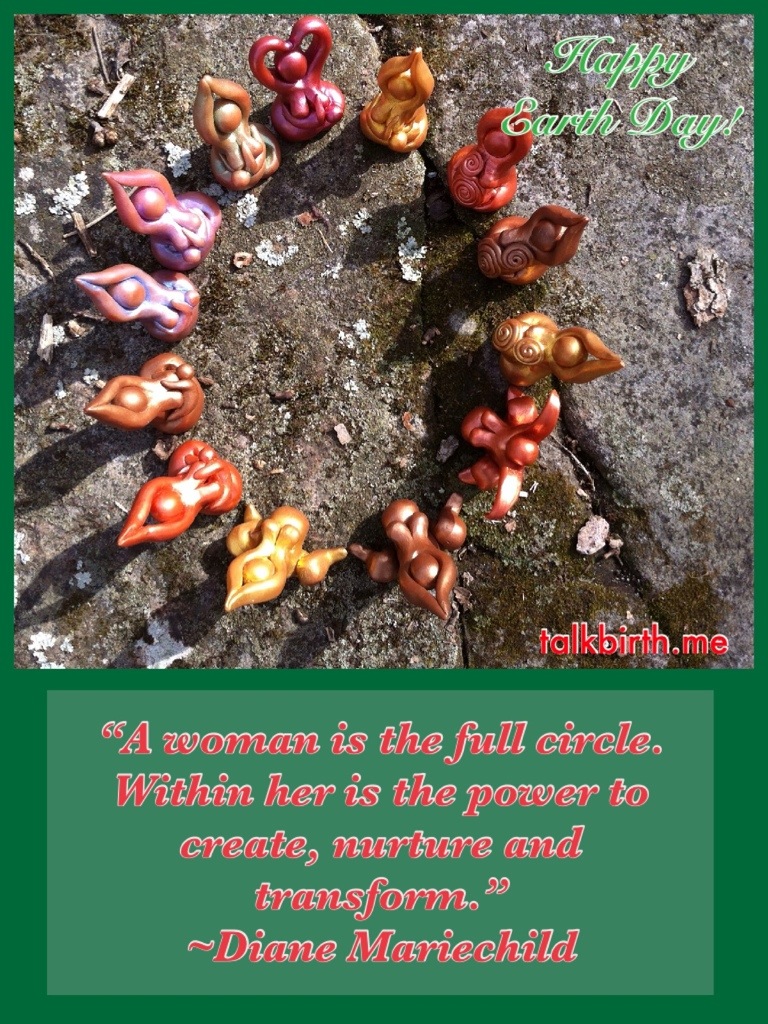
Happy Earth Day!

20130422-140554.jpgWhy this phrase? Two reasons:

Womb ecology reflects world ecology. World ecology reflects womb ecology.

And this (already used in several past posts):

When women are faced each day with enforced cesarean deliveries, birth control that maims and kills them, and doctors who think them dirty, when we encounter rape, violence in the streets, job discrimination, sexual slavery around the world, pollution and nuclear madness, we realize that reclaiming the integrative ways of our ancestors must involve our healing powers on all fronts—from the medical to the social to the environmental to the political to the psychological to the spiritual. Healing the divisions that were imposed during the patriarchal era is the survival issue of our time and our planet. A world that systematically sickens its women cannot survive. [emphasis mine]

Chellis Glendinning in Politics of Women’s Spirituality

20130422-140545.jpg

Tuesday Tidbits: Cesarean Awareness Month Round-Up

motherbaby

April is Cesarean Awareness Month and a lot of great resources have been catching my eye! First, there is a free webinar about the “Natural Cesarean” coming up on April 11th.

If you’re a first-time parent, make sure to check out 10 Tips for Avoiding a First-Time Cesarean from Giving Birth with Confidence. This blog also has a response to the question of Are “Big Babies” Cause for Cesarean? 

And, of course, also check out ICAN’s blog for an ongoing collection of Cesarean Awareness Month related posts as well as helpful cesarean awareness information on a year-round basis.

Science & Sensibility offers a great round-up of resources for clients and classes with regard to cesarean births, cesarean rates, and cesarean prevention: April is Cesarean Awareness Month! Resources for You and Your Classes

One a related note, Science and Sensibility also has a two-part series of posts analyzing the role of doulas in reducing cesareans for mothers using Medicaid:

Medicaid Coverage for Doula Care: Re-Examining the Arguments through a Reproductive Justice Lens, Part One

More fundamentally, however, we argue that doula benefits cannot be captured solely through an economic model.  Neither should doulas be promoted as a primary means to reduce cesarean rates.  Both strategies (economic benefits and cesarean reduction) for promoting doulas have significant barrier.

Medicaid Coverage for Doula Care: Re-Examining the Arguments through a Reproductive Justice Lens, Part Two

However, greater attention needs to be paid to issues of privilege and oppression within the doula community at large.  Advocates need to consider how the prioritization of the cesarean rate as a primary research or policy issue reflects a certain level of unexamined privilege. For those facing spotty access to health care, cultural and linguistic incompetence in care settings, the detrimental effects of the prison industrial complex and the child welfare system on families, and the effects of poverty, racism, and/or homophobia in general, there are other, perhaps equally pressing concerns surrounding childbirth than over-medicalization. Certainly, unnecessary cesareans and over-medicalization are detrimental to everyone, but we need to understand how the effects of these problems play out differently for differently situated people and not limit advocacy to these issues.

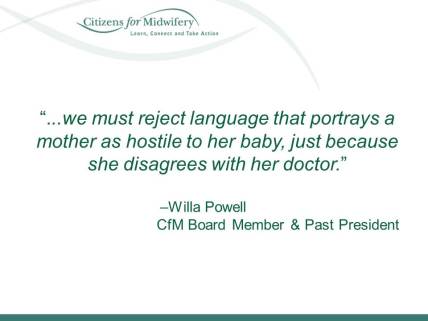
When I consider coercion into unneeded cesareans, I think of my own post addressing the flawed notion of Maternal-Fetal Conflict and from these earlier thoughts, I created the little graphic for Citizens for Midwifery seen above.

I think it is fitting to remember that mother and baby dyads are NOT independent of each other. With a mamatoto—or, motherbaby—mother and baby are a single psychobiological organism whose needs are in harmony (what’s good for one is good for the other).

As Willa concluded in her CfM News article, “…we must reject the language that portrays a mother as hostile to her baby, just because she disagrees with her doctor.”

via Maternal-Fetal Conflict? | Talk Birth.

I was honored recently to make a series of sculptures for mom recovering from a traumatic cesarean and hoping for a VBAC in the future. I hope to make a more detailed post in the future describing these figures and what they’re trying to communicate!

March 2013 070

I dug into the archives and found some older posts either about cesareans or relating to cesarean prevention:

Book Review: Understanding the Dangers of Cesarean Birth

Cesarean Awareness Month

Cesarean Trivia

Cesarean Birth in a Culture of Fear Handout

Guest Post: Abuse of pregnant women in the medical setting

Becoming an Informed Birth Consumer (updated edition)

The Illusion of Choice

ICAN Conference Thoughts

Helping a Woman Give Birth?

Community Organizing

Alone, you can fight,
you can refuse, you can
take what revenge you can
but they roll over you.molly37weeks 071

But two people fighting
back to back can cut through
a mob, a snake-dancing file
can break a cordon, an army
can meet an army.

Two people can keep each other
sane, can give support, conviction,
love, massage, hope, sex.
Three people are a delegation,
a committee, a wedge. With four
you can play bridge and start
an organization. With six
you can rent a whole house,
eat pie for dinner with no
seconds, and hold a fund raising party.

A dozen make a demonstration.
A hundred fill a hall.
A thousand have solidarity and your own newsletter;
ten thousand, power and your own paper;
a hundred thousand, your own media;
ten million, your own country.

It goes on one at a time,
it starts when you care
to act, it starts when you do
it again after they said no,
it starts when you say We
and know who you mean, and each
day you mean one more.

–Marge Piercy (in Life Prayers, p. 143)

I’m teaching community organizing again this session and the above is a poem I saved to share with my class when we talk about community organizing, creating change, and mobilizing power. I love it, because it starts small, which is where we all have to start. And, of course, it makes me think of birth change efforts as well. In a previous post about creating birth change, I used my community organizing class to explain the difference between education and action…

Additionally, with regard to education as a strategy for change, I’m brought back to a point I raise in my community organizing class: People often suggest “education” as a change strategy with the assumption that education is all that is needed. But, truly, do we want people to know more or do we want them to act differently? There is a LOT of education available to women about birth choices and healthy birth options. What we really want is not actually more education, we want them to act, or to choose, differently. Education in and of itself is not sufficient, it must be complemented by other methods that motivate people to act. As the textbook I use in class states, “a simple lack of information is rarely the major stumbling block.” You have to show them why it matters and the steps they can take to get there…

via Women and Knowing