Archives

DVD Review: Birth as We Know It

Birth as We Know It: Educational Edition. DVD directed and produced by filmmaker Elena Tonetti-Vladimirova. 2006, www.birthintobeing.com (40 minutes), $39.95.

Reviewed by Molly Remer, MSW, ICCE, Talk Birth

As a birth educator, I am always on the lookout for the “perfect” video to show in classes. Though not a film I would show in its entirety to the average class, Birth as We Know It is a gorgeous compilation and I’m delighted to have it amongst my educational resources.

The film is available in two versions—the feature film edition and the “educational edition.” The feature film contains almost 4 hours of total footage (a number of bonus features), including 11 births. The educational edition consists of two condensed versions of the feature film—a 40 minute presentation and a 25 minute version designed to show in groups. I chose to purchase the educational edition and this review is based on that edition. I have not seen the full length feature film.

The forty minute version of the film contains gentle, moving footage of 7 births. All the births occur in water—some in the ocean, but most at home. It also includes footage about birth trauma, cesarean section, and circumcision that is not included in the 25 minute presentation version (which also includes only 6 of the births). The DVD also contains instrumental versions of both.

The births included on this film are all exceptionally peaceful, beautiful, gentle, quiet, and calm births. Some of the birth footage is in slow motion, the sounds are muted, and there is instrumental music as the soundtrack as well as occasional voiceover commentary by the filmmaker. The film alternates between birth footage and spoken descriptions/interviews about conscious birth, emotional presence, limbic imprinting, etc. The voiceover commentary addresses things like toning and healing one’s own birth trauma.

The births are wonderfully undisturbed and unhindered—in most the only hands near mother’s perineum are her own and this is such a profound difference from the usual media representations of birth! A highlight is during “Tanya’s Birth” in which she speaks to her older child, smiles with extreme beauty and peace, then casually glances down again and as the camera follows her glance, we see the baby’s head has emerged between her legs and she is cradling it gently. I love for people to have a chance to see this powerful moment!

Though interesting, I find the voiceover content and non-birth portions of the film to be too abstract or “metaphysical” to appeal to the average birth consumer. It is even a bit too metaphysical for me and I find that the concepts she mentions are not well explained and do not seem immediately reasonable or easy to accept in stride. The instrumental version is one way to gloss over this element, but then you are unable to scene select to specific content the way you are able to do in the regular versions.

So, though I do not show the complete film in classes, there are several birth clips that I do show routinely. I find two of the births in particular to be potent educational tools and they have been very well received in classes and have had a profound impact. The births are so different from general media representations of birth that they leave couples stunned with amazement about what birth can be. Since the births are in water, they are a very gentle, non-messy, not very “graphic” way to expand people’s understanding of normal birth. People in my classes have said things like, “wow! You never see something like that!” or, “that was so beautiful, I’m just in shock.” I find men in particular are more receptive to this footage than to other, more detailed, videos I show and I have had a few request to borrow and view the whole video instead of just the clips I have chosen for class.

In conclusion, this is a lovely film and though I have some reservations about showing the entire educational edition, some of the birth footage has been a powerful addition to my work with birth.

This review was previously published at Citizens for Midwifery.

Book Review: Birthwork

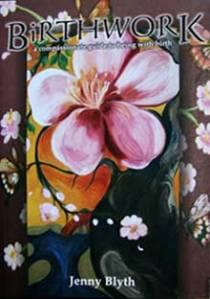
Birthwork
By Jenny Blyth
Reprinted 2007
Softcover, 460 pages
ISBN: 0-9757610-0
www.birthwork.com
Reviewed by Molly Remer, MSW, ICCE, Talk Birth

From Australia, comes a gorgeous and unique book called Birthwork. It is such an amazing and compelling read that it took me a very long time to write my review—it is difficult to describe such a remarkable book. I have never read another book like this. It is truly extraordinary. Subtitled “a compassionate guide to being with birth,” Birthwork was written for all birthworkers–anyone who works directly with birthing women (midwives, doulas, nurses, childbirth educators, physicians…).

This book covers issues of a range and depth I’ve never before seen in a birth text. Subsections include titles like: touching vaginas, respect and relationship, dipping in and out of the birth milieu, group dynamics, conflict, birth culture, loving presence, birth is sacred, trauma release, letting down in the pelvis, and stresses and stretches of childbearing. This is just a sampling of the amazing, comprehensive range of topics explored in Birthwork. I particularly enjoyed sections on directed breathing and “dynamic anatomy in labour.” The book delves into a lot of the emotional and psychological elements of being in a caregiving field and also covers physical components as well.

The book includes lots of questions to ask yourself to increase self-awareness, understanding, and personal development and also exercises to try/explore. Some of the questions are difficult to answer and require you to take a deep look at your motives and ideas about doing birthwork.

The photographs are stunning and there is gorgeous cover art (front, back, and inside). Birthwork has a spiritual component that runs throughout—sort of an Eastern philosophy—that might not appeal to all readers.

The book includes sources and a glossary of fields of care, but no index and no resources sections. It is an expensive book, but so very worth it!

Birthwork is deep and intense. I usually read very quickly and this book took me several weeks to finish because it needs time and space to soak in and be absorbed. Truly a phenomenal read!


Disclosure: I received a complimentary copy of this book for review purposes.

This review was previously published at Citizens for Midwifery.

CAPPA Re-Cap

Yesterday I got home from Kansas City where I’d been attending the annual free birth conference hosted by CAPPA. While there I concluded that Desirre Andrews is officially a superhuman live-tweeter. You can catch up with all of her rapid-fire tweets about the conference at CAPPA’s Twitter account.

I also tried my hand at posting a few things that particularly grabbed my attention to my Talk Birth and Citizens for Midwifery Facebook pages which automatically feed into Twitter. I’m not very good at catching short snippets for live-tweets, but some thoughts that I grabbed to highlight are as follows. If they don’t have quotation marks, they aren’t necessarily direct quotes, just “essence” summaries as I tried to take notes and pay attention!

First I attended Laurel Wilson’s talk about Bridging the Nutrition Gap and next, I listened to Tracy Wilson-Peters speak passionately about the “accidental parent.”

Essence tweets from Laurel and Tracy’s talks:

Babies don’t need to be in nurseries–they need to be with their mothers. This MATTERS!

Science can do a lot, can do wonderful things. Mother’s body can do even more…

Prenatal diets high in hydrogenated oils predispose mamas to postpartum moods disorders.

And, then I attended a breakout session from Darla Burns about postpartum rituals and snagged this interesting tidbit:

In Holland, all pregnant women are required to buy a homebirth kit, “just in case.”

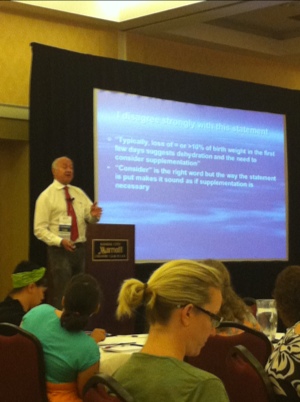
The second day, I found myself entranced by the most awesome Dr. Jack Newman. His presentations were the highlight of the conference for me. I loved him! I attended two–his general session on Controversies in Breastfeeding and then his breakout sessions, Impact of Birth Practice on Breastfeeding:

20120724-174258.jpg

If you ever get a chance to see this man, don’t miss it!

We have a big, big problem in that HCPs do not recognize the critical importance of breastfeeding.

There are many people who don’t know squat about breastfeeding and breastmilk and don’t feel like they need to learn anything before they start doing studies and writing papers about it. –Dr. Jack Newman

There is no such thing as “standard” breastmilk. It is a physiological fluid and varies from person to person. We DO NOT have to prove that breastfeeding is better than formula. Those comparison studies are unnecessary.

The burden of proof rests upon those who promote an intervention! –Dr. Newman

With animal births: following a normal birth, infant feeding just…happens. Following an interventionist birth, the mother rejects the baby and there is no nursing at all.

Our hospital births break every rule in the mammalian list of mother-baby necessities.” –Dr. Newman

Lying down for electronic fetal monitoring is a position of comfort for the care provider, NOT for the mother.

Know how much an incubator costs now? $50,000. Why don’t we just give half of that money to the mother and put the baby skin to skin on mother’s chest? –Dr. Newman

Seriously, Dr. Newman’s talks were amazing. Be prepared to hear more about them soon!

The final day I heard Polly Perez speak about Building Bridges with an emphasis on communication and fear:

Luke: I don’t believe it. Yoda: that is why you fail.

“Use language that lets you share your heart openly.” –Polly Perez

Listening is *active*, not a passive activity. Listen with empathy, openness, and awareness.

We have taken the hearts and minds out of much of our work because we’re frightened of getting too close. But, close is where we need to be.

“We must give people the opportunity to challenge their fears. Not only will this change each person, it will change the political and medical climate in which they make these choices.” –Connie Pike, via Polly Perez

Polly shared the first home birth she attended – made her fear of it “melt away like butter in a pan.”

You do not have to be an OB to be knowledgeable about birth. –doctor working with Polly Perez

Follow up from same doc: “if you tell me a baby is going to come out, I’m a gonna believe you!”

Changing sick systems is not about subterfuge but bringing light to situations that need to be altered.

Since micro-blogging is simply not my gift and is unlikely ever to become so, I am also planning longer posts based on several of the conference sessions. They will be (links will be updated as the posts become live):

At the CAPPA conference I also made a large custom order of great gifts from Joy Belle jewelry.

And, I ate tons of sample honey sticks from Glorybee–yummy! (see prior post: Why Honey Sticks During Labor?)

Other treats involved getting to spend some quality visiting time with a Friends of Missouri Midwives friend from St. Louis. We spent a lot of time talking over the FoMM newsletter (of which I am editor) and I feel very enthused about our ideas for its future.

I also got to meet a Facebook friend who started out originally two years ago as a Talk Birth fan on FB (after finding my site via my all-time most viewed post: In-Utero Practice Breathing). We spent some good time together visiting and laughing and it was fun to make the friendship connection with someone who was previously only an internet friend!

Women’s Power & Self-Authority

“I know myself linked by chains of fires,
to every woman who has kept a hearth.
In the resinous smoke
I smell hut, castle, cave,
mansion and hovel,
See in the shifting flame
my mother and grandmothers
out over the world.”
–Elsa Gidlo

I used the quote above as my winter solstice Facebook posting last year. It reminds me of a quote from Margaret Atwood used in the book Sacred Circles, “Sons branch out, but one woman leads to another.” One of the powerful gifts of feminist spirituality is the sense of intergenerational connectedness to all women of all time. We begin to sense the buried matrilineal links across time and culture. Links that have often been culturally, socially, and religiously broken on purpose as a way to separate and disempower women and to bury women’s wisdom. I believe a potent source of female power lies in the female body and that body wisdom has been suppressed and denied over the course of many years as a means of oppression and control. One of the root issues of patriarchy is who “owns” women’s bodies—is it men, is it the government, is the medical system, or is it the woman herself? (you know my pick).

Body wisdom and sources of power

Considering power, sources of power, and body wisdom, I appreciated reading Barbara Starrett’s essay The Metaphors of Power in the book The Politics of Women’s Spirituality. While she used abortion as her example, I have modified and paraphrased her thoughts to make the idea about birth instead. Starrett originally states, “We can create power centers both within and outside ourselves…Power is where power is perceived. Power resides in the mind. We can give or withhold power through our beliefs, our felt thoughts.” Medical professionals can make decisions about a woman’s body and birth choices effectively only as long as women believe that the professionals have the right to do this. When women reclaim the power to decide for themselves about birth, the doctors proclaim in a vacuum. Their power depends on the transference of our power, through our belief that this is right…Power is where power is perceived. This also means that in any given in-the-world situation, we can intentionally set up our own power centers. If we believe that power resides in those centers, it will. We will act successfully on this belief. Women’s organizations, unions, birth coalitions, etc., will never work unless we regard them, “as the legitimate centers of power…We must grant our own power to ourselves” (p. 191).
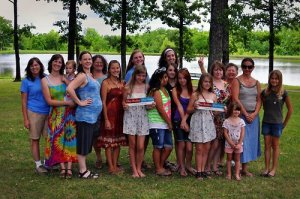
Lucky to have such a great group of friends to gather in the park to take part in the Our Bodies, Our Votes campaign.

While this comes a little too close for comfort to me with the idea that “we create our own reality” (which I cannot fully embrace due to the logical extension into blaming the victim that it creates), I connect deeply with the idea that we must treat women’s organizations and work as legitimate power sources. I think of books/movements like Our Bodies, Ourselves, for example. To me, this is a definitive women’s health resource—by women, for women and separated from the medical establishment that often dehumanizes women. If we continue to believe our “alternative” structures are just that, “alternative,” then the dominant model is still the norm and still accepted, even by us, as “normal.”

Starrett continues her essay by sharing that “It is necessary for some women to risk total reclamation, to risk the direct and intentional use of power, in bold, even outrageous ways. It takes only a minority of women to alter present reality, to create new reality, because our efforts are more completely focused, more total.” (p. 193) This is the risk that the creators of Our Bodies, Ourselves took. It is the risk birth activists and women’s health activists continue to take.

Peggy O’Mara tackles a similar topic in her essay, “Holy Mother,” in her collection of essays The Way Back Home, observing:

We live in a society…that romanticizes and trivializes the feminine…we live in an economy that regards women as cheap labor. In the marketplace, women work for less than men. At home, we do the large majority of the work. I believe that we enslave ourselves.

Is it any wonder, then, that we have not successfully resolved the childcare debate? Child care and national family policy are process issues, and thus sexist issues. Women themselves engage in sexism when they debate the either/or dichotomy of work or home. Too often, we do not realize the devaluation involved in playing by the crumbling rules of a male-dominated society rather than making up our own. The matriarchal process-based model comes from a religious belief system in which the Divine is immanent, within life, within us, ascribing sacredness to the ordinary processes of daily life. Rather than choosing between opposites, let us evolve a culture that values both the product and the process, a culture that synthesizes both the patriarchy and the matriarchy.

…we must put all of our loves–work and family, mothering and career, self and others—on the bargaining table at once, and not assume that because we are women, we must acquiesce to the cultural ideal. To run our personal lives in enslavement to an economic reality that does not serve our needs makes society crazy.

In a brief except from author Libba Bray, she states that for years she “…heard feminist Gloria Steinem described as ‘shrill’ and ‘hostile’ and many other dismissive, denigrating terms. But after reading about her struggles as a human being and as a leader of feminism’s second wave…I got a truer picture…I learned that it’s far too easy for women to be shamed into staying quiet about their lives–their dreams, needs, desires, anger, aspirations—and that the old adage, ‘Well-behaved women seldom make history’ is all too true.”

Consult your health care provider?

In my own life, I am frustrated by the ubiquitous phrase, “Consult your health care provider.” No thanks. I prefer consulting myself, my books, google, my own research, and my friends. Last time I checked, my doctor did not own my body nor did she have divine revelation as to what I need in my life. I am a breastfeeding counselor providing phone and email support to women who have breastfeeding questions. Women frequently receive very poor breastfeeding “advice” from their doctors—to the extent that I honestly think they’d receive better information by polling random strangers at Wal-Mart with their questions (and, yes, I will actually tell women this). One caller once used the phrase, “but, I don’t want to disobey my doctor” and I found this extraordinarily telling as well as depressing. I recognize that doctors have special training and can be life-saving, however, what does that say about mothering in our culture that a woman would not act on behalf of her own baby and herself because of fear of being disobedient to a professional that she has hired? She is a consumer of a service, not the subject of a ruler!

This brings me to a thought by Dr. Michelle Harrison, author of the book A Woman in Residence: “I used to have fantasies…about women in a state of revolution. I saw them getting up out of their beds and refusing the knife, refusing to be tied down, refusing to submit…Women’s health care will not improve until women reject the present system and begin instead to develop less destructive means of creating and maintaining a state of wellness.” Indeed! And, in an essay by Sally Gearhart’s about womanpower, she notes: “…there’s no forcing any other woman into a full trot or a gallop; she will move at her own pace, but at her own pace we can be sure she will move. At this point I always remind myself that the patriarchal use of crash programs is antithetical to organic movement; in a crash program the theory goes that if you can get nine women pregnant you can have a baby in one month; it takes women, I suppose, to understand that it doesn’t work that way.” (p. 202-203)

Reclaiming power

So, how do women reclaim power? I think story holds a key to power reclamation in this context. As I’ve referenced before, Carol Christ describes it thusly, “When one woman puts her experiences into words, another woman who has kept silent, afraid of what others will think, can find validation. And when the second woman says aloud, ‘yes, that was my experience too,’ the first woman loses some of her fear.” As I touch on above, for me it is to see myself and my body as a source of wisdom and to refuse to participate in structures that do not honor my power and personal agency. It involves more often turning to my peers, to other women, for advice and comfort and support, rather than to experts.

Returning to Gearhart, she states: “If I can move out of the patriarchy for my re-sourcement, then I do indeed march to a different drummer; but I have to march with the consciousness in my very bones of the cost in blood and pain and death that is somewhere being paid for my personal growth.” (p. 203)

I’ve written before that I am a systems thinker. Women’s choices about their bodies and about birth are not made in personal isolation, but in a complexly interwoven network of social, political, medical, religious, and cultural systems. As Gearhart notes, “There may be no ‘enemy’ except a system. How do we deal with ‘the enemy’? As seldom as possible but when necessary by opening the way for [their] transformation into not-the-enemy. What weapons do we use? Our healing, our self-protection, our health, our fantasies, our collective care…” (p. 203).

And, in closing I like this reminder:

“Study after study has taught us that there is no tool for development more effective than the empowerment of women. No other policy is as likely to raise economic productivity, or to reduce infant and maternal mortality. No other policy is as sure to improve nutrition and promote health—including the prevention of HIV/AIDS. No other policy is as powerful in increasing the chances of education for the next generation. But whatever the very real benefits of investing in women, the most important fact remains: Women themselves have the right to live in dignity, in freedom from want and from fear.” —Former UN Secretary-General Kofi Annan

This is the whole point—women’s rights aren’t about “taking” rights from anyone else OR about demanding “special treatment,” they are important for a HUMANE WORLD for all people. I think it is hilariously awful that “women’s rights” are considered a political issue and that there is a section about “women’s rights” in the “opposing viewpoints” database for my social policy class. As long as women’s rights are considered a political issue or as something about which an opposing viewpoint can be held, rather than as self-evident, we are in continued, desperate need of revolution.

—-

(note: portions of this post are excerpted from one of my essays for a class I took about Goddess Traditions)

Incorporating Prenatal Yoga into Childbirth Education Classes

Incorporating Prenatal Yoga into Childbirth Education Classes

By Molly Remer, MSW, ICCE, ICPFE

Note: This is a preprint of an article published in the International Journal of Childbirth Education, Volume 27, Number 2 (April 2012)

The essence of yoga can be distilled into four key elements: breath, feeling, listening to the body, and letting go of judgment and expectation (YogaFit, 2010). When considering the essence of yoga, it is easy to see what a natural complement it is to conscious, active preparation for a healthy birth. Most birth educators would agree that paying attention to her breath and to her feelings, listening to her body, and letting go of preconceived expectations of what birth will be like are perhaps the most crucial messages to convey to the pregnant woman and her partner. Additionally, experts widely agree that exercise during pregnancy has beneficial effects for the cardiovascular and musculoskeletal systems and is associated with physical and psychological well-being. There is also some evidence that recreational exercise may reduce the incidence of premature labor and low birthweight babies (Hyatt & Cram, 2003).

Anyone involved with educating adult learners (in any context) is likely to be familiar with the concept that people are most likely to retain information that they have actually practiced (versus reading about, hearing about or seeing demonstrated). I have found that incorporating a few simple yoga poses into each class session is a beautiful way of illustrating and applying many important elements of childbirth preparation. In approximately 10 minutes of movement, important points can be underscored without having to actually say anything or “lecture” to clients. The hope is that as we move together through a carefully chosen series of poses, subtle emotional development and trust in birth occurs—again, in a more effective manner than by the childbirth educator saying during class: “Trust birth!”

One rationale for incorporating yoga into prenatal classes is as follows: First, people often learn and retain information more effectively by actually doing something. Practicing the yoga poses together allows experiential practice of pelvic floor exercises, pelvic rocks, tailor-sitting, leg cramp alleviation, and back pain coping techniques, to name a few, instead of just hearing me talking!

Second, and most important, Yoga in prenatal classes emphasizes that birth happens in the body. As childbirth educators we spend a significant amount of time talking and sharing information, but birth does not only happen in the mind. Birth happens most profoundly in the body. Not only does birth happen in the woman’s body, but supporting and being with a woman in labor is also an intensely physical process, so it is important for partners to try the yoga series.

People today spend much of their time “living in their heads”, and many of us do not feel comfortable with, or at home in, our bodies. Practicing poses in class helps couples out of their heads and into their bodies and begins a process of feeling comfortable with moving and using their bodies in positive ways. This may help them develop the trust and confidence that will contribute to a smooth and peaceful birth process.

Each pose is followed with a birth affirmation such as, “the magic and mystery of birth delight and amaze me” (Miller, 2003). Positive affirmations help plant positive seeds of confidence and trust in the wisdom of women’s bodies and of the beauty of birth. These cognitive adjustments may also send a welcoming message to the woman’s body and baby as they both prepare for birth.

Opening classes with a series of poses is an effective way to “frame” the class. Class can be opened with a brief check-in period asking how people are feeling, about recent prenatal appointments, and any questions can be addressed. A transition from “regular time” into “class time” occurs with a brief series of simple poses. This routine helps people transition from their normal days into feeling ready and excited for birth class information.

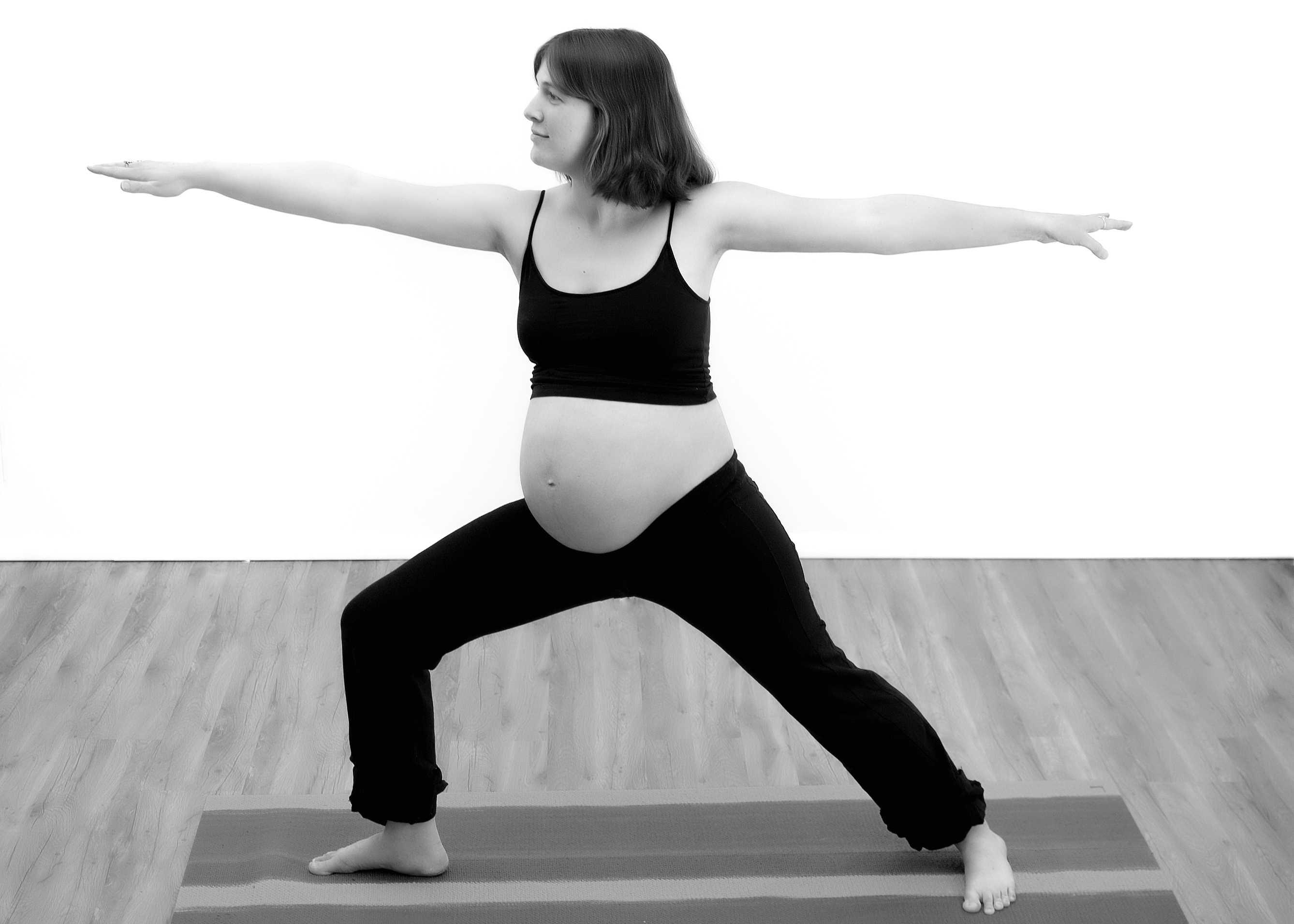
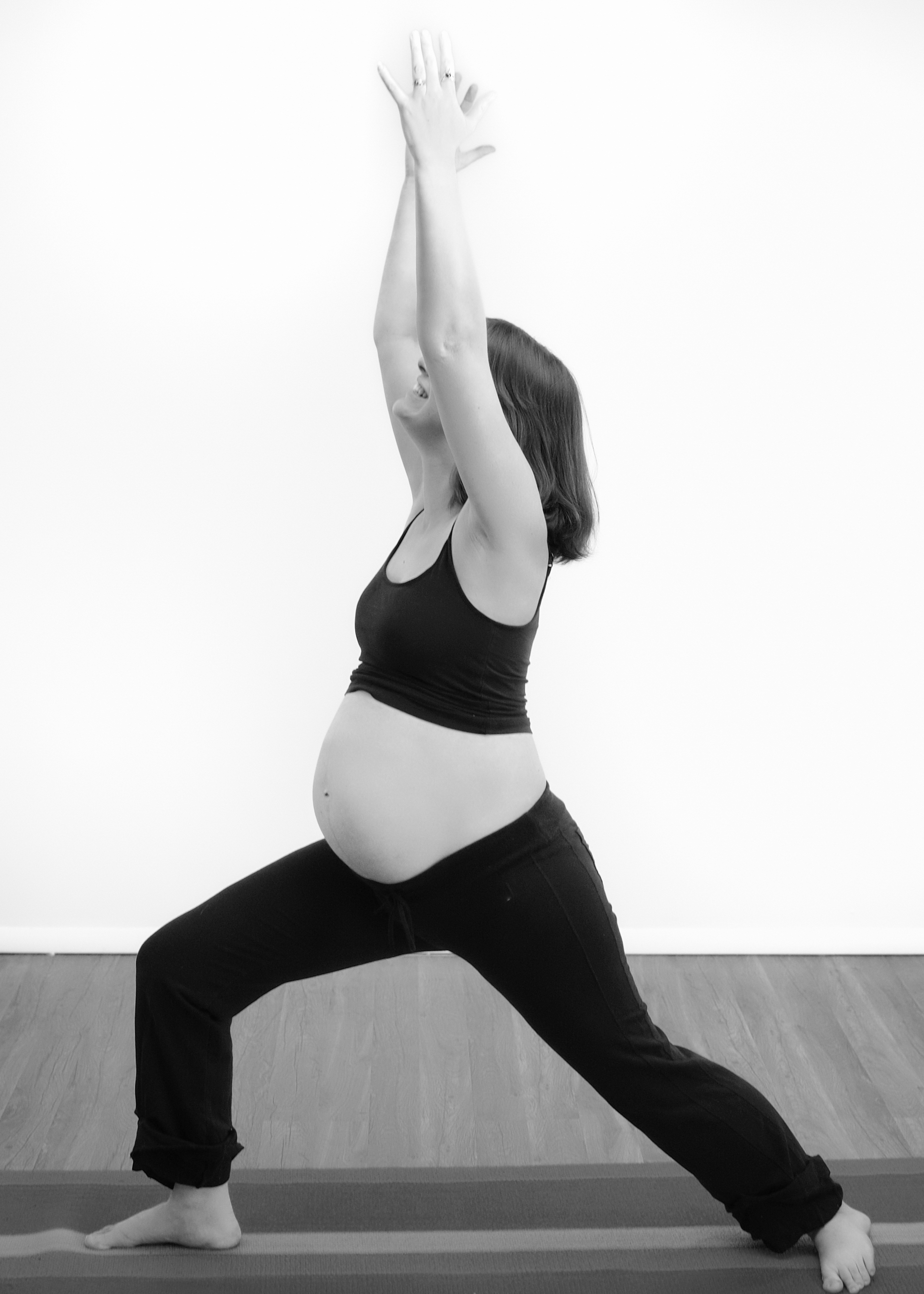
Each pose was chosen because it has specific birth- or pregnancy-related benefits. Begin with healthy sitting—seated crossed legged or tailor-style on the floor with spine straight. Do some neck rolls and shoulder rotations to help release tension. Move into a brief series that includes knee-rocking, leg stretches, Divine Mother Pose, Star Pose, pelvic rock, standing squat, Palm Tree Pose, Half Moon Pose, Triangle Pose and seated Mountain Pose. There is an additional short series of “birthing room yoga” poses described with photographs that is available as a free handout here.

The series is closed with a very brief meditation or visualization exercise. The series of poses and the affirmations are kept the same each week for retention purposes, but the meditation is varied. A quick visualization or relaxation exercise (under two minutes) is often more effective and more readily welcomed by couples than the longer visualization exercises often used in classes (which can seem esoteric to some people). A mindfulness meditation that is effective is:

Inhale and repeat silently: “I exist in the here and now….”

Exhale and repeat silently: “The present moment is all I have to be with…”
Continue inhaling and exhaling as you silently and simply repeat: “Here and now…present moment.”

A favorite resource for easily and smoothly incorporating yoga into classes is The Prenatal Yoga Deck by Olivia Miller, published by Chronicle Books in 2003. The poses listed above were selected from this deck. The deck contains 50 cards, so the educator can easily build a series for use in classes. Each pose card is accompanied by a lovely affirmation. The deck also includes six cards with simple meditations (the meditation above is adapted from one in the deck). The deck format, tidy box for holding the cards and sturdy card for each pose is an ideal format for transport to class as well as serving to provide subtle reminder cards as you lead couples through poses. Each card has a line drawing on the back illustrating the pose, so assessing whether you are doing the pose correctly is easy (sometimes just reading a description of the pose is more complicated than seeing it completed).

Occasionally the childbirth educator may get some eye-rolling or “weird, hippie exercise!” responses from pregnant couples. Regardless of how much or how little they appreciate the practice of yoga in classes, the poses used lay a physical foundation for a positive attitude toward birth and a sense of confidence as a birth-giving woman or supportive partner. Through the simple incorporation of yoga into birth classes, the expectant couple receives an irreplaceable, experiential grounding in the rhythm, focus, release, and conscious awareness so essential to the intensely embodied experience of birthing.

 Molly Remer, MSW, ICCE, ICPFE is a certified birth educator, writer, and activist. She is a professor of Human Services, an LLL Leader, editor of the Friends of Missouri Midwives newsletter, and a doctoral student at Ocean Seminary College. She has two wonderful sons and a toddler daughter and she blogs about birth, motherhood, and women’s issues at Talk Birth (http://talkbirth.me)

Suggested Resources for Birth Educators
The Prenatal Yoga Deck: 50 Poses and Meditations, Olivia H. Miller, ChronicleBooks, (2003)
YogaFit: PreNatal DVD, YogaFit (2009)
Yoga for Your Pregnancy DVD (2004)

All available via Amazon.com

All photos of the author, January 2011, 37 weeks. (c) Karen Orozco, Portraits & Paws Photography

References

Hyatt, G.& Cram, C. (2003). Prenatal & postnatal exercise design. DSW Fitness, Tuscon Arizona (training manual for the ICEA Certified Prenatal Fitness Educator Program)

Miller, O. (2003). The prenatal yoga deck: 50 poses and meditations. Chronicle Books, San Francisco, CA.

Remer, M. (2007). Incorporating prenatal yoga into childbirth educationclasses. Midwifery Today, 4(84), 66.

Talk Birth. (2011). Retrieved from https://talkbirth.me/2010/03/10/birthing-room-yoga-handout/

YogaFit PreNatal/PostpartumSpecialty Program Manual. (2006). YogaFit Training Systems Worldwide, Inc. , www.yogafit.com.

The Spirituality of Birth + Book Giveaway: Birth on the Labyrinth Path

I’ve been experiencing a fun trend in the books I’ve been reviewing lately—many new resources are being published with a shared theme of approaching birth from a spiritual perspective. There are resources now available for women from a variety of spiritual backgrounds, all honoring and respecting pregnancy and birth as experiences uniquely connected in an embodied way to the numinous and sacred, in whichever manner we choose to name it. I recently finished a class for my doctoral program and the subject of my final paper was “A Thealogy of Birth,” in which explored the sociopolitical, cultural, religious, and personal relevance of birth from a thealogical (Goddess-oriented) perspective.
  • I just reviewed The Gift of Giving Life which delves into the divine nature of pregnancy and birth from a Christian (specifically LDS/Mormon) perspective.
  • I then pre-reviewed the upcoming book Embodying the Sacred, which is written from a Catholic point of view.
  • And, earlier in the month I finished reading a gorgeous book with a non-specific spiritual perspective: Sacred Pregnancy
  • In the past, I also reviewed the book L’Mazeltov, which is written specifically for Jewish parents-to-be.

All of these resources are amazing and I’m so glad they’re available for pregnant women.

Now, I’m excited to offer a short review and a giveaway of another new book, this one written from a pagan perspective. Published by Pantheos Press, Birth on the Labyrinth Path is written by Sarah Whedon and focuses on “Sacred Embodiment in the Childbearing Year.”

My mini-review from Goodreads is as follows:

I really enjoyed this short book about pregnancy and birth from a pagan perspective. The reflections on the embodied, spiritual nature of pregnancy and birth were wonderful. It is very positive and reinforcing and contains great thoughts like this one: “A body that is curvier than it was before, maybe bearing stretch marks or scars from surgical procedures or tearing, maybe producing milk, is a body that bears the signs of delivering a human being into this world. We may mourn our smooth, skinny, unmarked maiden bodies, but at the same time we can celebrate the beauty of our storied, productive, and strong mama bodies.” Whedon also quotes this lovely passage regarding the connection pagan women might feel to the Divine: “I am the holy mother; . . . She is not so far from me. And perhaps She is not so very distinct from me, either. I am her child, born in Her, living and moving in Her, perhaps at death to be birthed into yet some other new life, still living and having my being in Her. But while on this earth She and I share the act of creation, of being, and Motherhood” (from Niki Whiting, “On Being a Holy Mother” in Whedon, p.)

I also shared some lovely quotes from Birth on the Labyrinth Path in my recent post on Birth Culture.

*********The giveaway is now closed. Ellen was the winner!*********

I’m also pleased to host a giveaway of a Kindle copy of Birth on the Labyrinth Path for one lucky winner!  To enter, just leave a comment sharing one of your own thoughts or favorite resources about the spirituality of pregnancy and birth. The giveaway will run through next Wednesday (6/27).

Book Pre-Review: Embodying the Sacred

Book Pre-Review: Embodying the Sacred

By Peg Conway

Reviewed by Molly Remer, MSW, ICCE, Talk Birth (http://talkbirth.me)

This week I was excited to have the opportunity to review a new book, not yet released. Publication is anticipated within the next couple of months and I will re-post then with the actual cover image and pricing details.

Embodying the Sacred is a beautiful new book with roots in the Catholic faith. It seeks to answer the questions, “how does birth connect with faith? How can we speak of it in religious language that lives up to the intensity of giving birth? How can spirituality be a resource for childbearing? And why are the churches, deeply concerned for the unborn, so silent about normal childbirth?” The book helps pregnant women build their “spiritual birth bag” through cultivating their inner resources and their embodied connection to spirit.

Written clearly and with a lyrical and intimate style, the book contains a variety of reflections, prayers, and activities to help women make a personal connection with their sense of the divine and sacred. Something I found particularly enjoyable about the book was that not only did the author touch on the labyrinth as a metaphor for birth, she includes literal, purposeful labyrinth walks in the suggested activities for expectant mothers.

Embodying the Sacred speaks to the chord of the holy and sacred in all pregnant women, but readers should be aware that it uses language and prayers strongly rooted in the Abrahamic religions and uses predominantly masculine imagery and language for God. Women from a variety of faith backgrounds will find material to connect with in the book, but may find it necessary to substitute or modify the prayers to suit their personal beliefs and practices.

Pregnant women who are intrigued by the idea of building a spiritual birth bag and who are ready to dig deep and to go beyond the scope of traditional pregnancy and birth books will find a rich resource in Embodying the Sacred.

Disclosure: I received a complimentary copy of this book for review purposes.

The Great Birth (of the Universe)

I love it when someone writes with passion, heart, depth, and poetry about natural and scientific phenomena and as such greatly enjoyed an essay by Brian Swimme in the book Reweaving the World: The Emergence of Ecofeminist Philosophy. As an educator and a homeschooling mother (as well as a former homeschooler myself), I also appreciated his telling observation that (formal) education is a major cause of the “lobotomy” of which he writes: “…by the time they are done training us as leaders for our major institutions, we have only a sliver of our original minds still operative. What sliver is left? …the sliver chiseled to perfection for controlling, for distancing, for calculating, and for dominating. The rest has been sacrificed in the surgery of patriarchal initiation” (p. 16).

Since most children spend 12 years minimum steeped in this educational culture, is it any wonder that we find ourselves in our current social and political conditions? This surgery of which Swimme speaks leads to a mechanical conception of the operations, functioning, and majesty of the universe, meant to be analyzed rather than marveled over.

Rather than a Big Bang, the birth of the universe is much more aptly described in terms of a Big Birth: “Not bombs, not explosions, not abhorrence…a birthing moment, the Great Birth. To miss the reality of birth in these scientific facts is to miss everything. It is to sit at the heavily laden table and starve. For here is a great moment in human consciousness. Now for the first time in all of human history we have empirical and theoretical evidence of a reality that has been celebrated by primal people for millennia…the mathematics of this initial, singularity of space/time are not enough. We require song and festival and chanting and ritual and every manner of art so that we can establish an original and felt relationship with the universe…our universe is quite clearly a great swelling birthing event, but why was this hidden from the very discoverers of the primeval birth? The further truth of the universe was closed to them, because central regions of the mind were closed…I am sensitive to the charge that poetry [like this] is just an ‘addendum’–that what are real are the empirical facts, while the rest is commentary. On the contrary, what is true is that this universe is a stupendous birth process, an engendering reality…” (p. 19).

This is the kind of theapoetics that makes me swoon! What would our world, our culture, the way in which we give birth, and the way in which women are treated look like if we grew up with a Great Birth rather than a Big Bang?

Swimme continues: “From a single fireball the galaxies and stars were all woven. Out of a single molten planet the hummingbirds and pterodactyls and gray whales were all woven. What could be more obvious than this all-pervasive fact of cosmic and terrestrial weaving? Our of a single group of microorganisms, the Krebs cycle was woven, the convoluted human brain was woven, the Pali Canon was woven, all part of the radiant tapestry of being. Show us this weaving? Why, it is impossible to point to anything that does not show it, for this creative, interlacing energy envelops us entirely. Our lives in truth are nothing less than a further unfurling of this primordial ordering activity…Women are beings who know from the inside out what it is like to weave the Earth into a new human being” (p. 21, emphasis mine).

So, if the patriarchal initiation of modern education doesn’t do the job, what should we teach our children? “We will teach our children at a young age the central truth of everything: that this universe has been weaving itself into a world of beauty for 15 billion years, that everything has been waiting for their arrival, for they have a crucial if unknown role to play in this great epic of being. We will teach that their destinies and the destinies of the oak trees and all the peoples of Earth are wrapped together. That the same creativity suffusing the universe suffuses all of us, too, and that together we as a community of beings will fashion something as stupendous as the galaxies” (p. 22).

I believe this is ecofeminism in practice.

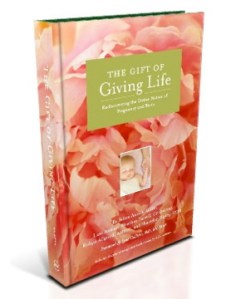
Book Review: The Gift of Giving Life

Book Review: The Gift of Giving Life: Rediscovering the Divine Nature of Pregnancy and Birth
Authored by Felice Austin
Authored with Lani Axman, Heather Farrell, Robyn Allgood, Sheridan Ripley
ISBN: 9780615622521
542 pages, softcover
http://thegiftofgivinglife.com/

Reviewed by Molly Remer, Talk Birth

Written for women who wish to delve into the divine nature of pregnancy and birth from a Christian perspective, The Gift of Giving Life is co-authored by several childbirth educators and doulas who are also members of the Latter-Day Saints (LDS) church. The book is rich with the stories and experiences of dozens of LDS women who share their birth stories and reflections. These additional stories are sprinkled throughout the body of the text, making it very easy to read and “digest” in small sections. The stories represent a wide breadth of experiences—I anticipated many of them to gloss over the difficult parts of pregnancy and birth, but they address both the nitty-gritty, challenging aspects and the transcendent. I especially appreciated that women’s experiences with pregnancy loss and baby loss are integrated throughout the book rather than relegated to a specific subsection. A helpful touch is that stories dealing with loss are indicated with an awareness ribbon symbol, so that if a reader does want to avoid these stories, she is readily able to do so.

As a non-LDS woman as well as someone who does not identify as Christian, I did encounter many segments that had little relevance to my own experience of or interpretation of the world. For example, it was startling for me to come across repeated statements that seemed to hold a literal view of “Satan” as a real entity holding some kind of power or control over people. That said, I was impressed with how deeply and solidly integrated the text is with the spiritual teachings of the LDS faith. For women who wish to permeate their pregnancy and birth experiences with an intimate and intricately woven connection to Christian theology and scripture, The Gift of Giving Life is a faith-based treasure.

As I noted in my recent interview with one of The Gift of Giving Life‘s co-authors, I am fascinated by the concept of Heavenly Mother and really enjoyed the sections of the book that touched on the relationship with Her. I also enjoyed the book’s explanation of Eve’s pivotal choice in the Garden, which was very meaningful framing of the event in a way that was completely new to me.

The Gift of Giving Life has much to offer both to pregnant women and to birth professionals. It will likely have most appeal to those with LDS connections and to members of other Christian traditions who are familiar with scripture and wish to apply these messages to the childbearing year.

Disclosure: I received a complimentary copy of this book for review purposes.

The Gift of Giving Life: Interview with Sheridan Ripley

This interview with Sheridan Ripley is a stop on the Virtual Book Tour for The Gift of Giving Life.

Q1: Many people liken the writing of a book to giving birth to a baby? Did you find this an apt analogy?

YES! We (the co-authors) brought this up a lot. It was like we were gestating together and ideas were growing and growing. The first trimester I actually felt like I missed as I joined the group at the beginning of the 2nd year. It was a 3 year process so the trimester analogy works well.

The 2nd trimester we had plenty of energy and got a lot done and things moved forward quickly. We had that happy, easy 2nd trimester.

That 3rd trimester felt SO SLOW!!! It was the editing, book layout, more editing. Details and more details and felt so long. I know I felt so heavy and weighed down by the process. Luckily we had each other for support and we made a great team.

Finally we were pushing the baby out and while there were little hold ups along the way, it was so exciting. The triumph we felt as we finally held our book in our hands was pretty amazing!

Q2: I’m fascinated by the concept of Heavenly Mother and really enjoyed the sections of The Gift of Giving Life that touched on the relationship with Her. Can you explore more about how LDS women might find strength and connection in this image of the Feminine Divine and how she might aid in giving life?

I believe I am a literal child of a Heavenly Father and knowing that he is a partner with a Heavenly Mother and together they are able to love billions of children, helps me to have faith in my ability to love and raise my boys.

Knowing that our bodies are patterned after their bodies also gives me faith that my body can grow and birth babies! We are mortal and there are instances when medical intervention is needed, but the majority of the time birth is safe. Our bodies are created to create!

As we connect with other women in a supportive loving way we can feel connected to Her because we are each created in Her image. Maybe that is why when women gather around women in childbirth we feel so uplifted, powerful and humbled at the same time.

Some women really feel a need for a connection of a mother figure, especially while pregnant. I have an earthly mom who I am very connected to and she was very helpful during my pregnancy, so I didn’t personally have a desire for a connection with a Feminine Divine at that point.

However there are women who may be missing that mother figure in their life and we all have a deep desire for such a connection. Knowing that there is a Heavenly Mother who stands beside Heavenly Father to help guide us and protect us especially during this time of pregnancy and birth is powerful.

Meditating and pondering on the idea of a Heavenly Mother and how that can help us as we give the gift of life and then raise our children is the best way for me to connect to her. I actually just took time to do this as I hadn’t really thought of this question until you asked it.

That is the great thing about our book and having so many contributors is it will speak to different women, because so many view points are included.

Q3: Do you have any specific tips for women wishing to incorporate more spiritual practices into their pregnancies?

We actually have a newsletter that moms can sign up for where they get a free 20 minute meditation MP3 as well as 5 tips to have a more spiritual pregnancy/birth. I think for each mom it may look different. Prayer and meditation are great places to start, as you will often get inspiration on where to go from there. I also love Mother’s Blessings as a way to have the strength of other women buoy up the pregnant mom. She can benefit from feeling their love and spiritual support

Q4: When women in the birth stories say they asked their husband for a blessing or that their husband gave them a blessing, what does that mean?

A blessing is similar to a prayer. All male members of the Church who are prepared receive the priesthood, which is the authority to act in God’s name. One of the ways they can serve others with the priesthood is by giving blessings by the laying on of hands. They can give blessings of healing or for comfort and guidance. In some cases a wife might ask her husband (or other priesthood holder) for a blessing before or during birth.

I know for me in my first birth, it was so comforting because with my first birth my husband gave me a blessing when I was concerned about the Thing 1’s lack of movement. In the blessing he said he would be born when he was ready. When we discovered that he needed to be born by emergency cesarean immediately even though I was only 34 weeks, I had peace knowing that my husband had just blessed me that “he would be born when he was ready.” I knew everything would be OK.

—-

Thanks for the interesting interview and the review copy of The Gift of Giving Life, Sheridan!

Visit The Gift of Giving Life site to sign up for their newsletter and to receive a free Meditation MP3 as well as tips to help increase spirituality in your pregnancy and birth.

For my readers I have a coupon code for 10% off a copy of The Gift of Giving Life. Click here and after you add the book to your cart use this coupon code. GWFWXR3F This code is good until Father’s Day 2012.