Archives

Birth Pause…

What was the moment like immediately following the birth of your baby?

Was the baby placed directly onto your chest by a caregiver? Was she pushed into your own waiting hands and gathered to your body? Was he put first into a warmer and then onto your chest? Did a midwife pass him to you after gently receiving him? Did you glimpse her body as she was held over a blue cloth in the operating room? Did you see her whole body, or just the top of her head as she rested upon you? Did she emerge onto a soft landing where you could gaze at her for a moment, integrating the transition from giving birth to mothering, and then scoop her up into your waiting arms? No matter how it unfolded, I’m sure it was unforgettable.

Waiting to inhale…

I greatly enjoyed reading a beautiful guest editorial in The Journal of Perinatal Education by Mary Esther Malloy, called “Waiting to Inhale: How to Unhurry the Moment of Birth,” in which she explores this precious post-birth moment. This moment when mother meets baby, earthside. Malloy notes that for many women, the moment of meeting is “hurried” by the immediate placement of the baby on mother’s chest. Many women are in a brief, transitional state almost like “birthshock” at this moment—it is the moment before the classic euphoria and “I did it!” hits. Mother often has her eyes closed and needs a second to breathe and re-focus on the world outside her deeply inner focus. Malloy began to observe at births that if baby was allowed to emerge gently onto the softness beneath the mother, the mother is able to take a brief pause to integrate the shift from birthing to mothering and then begins to gently explore baby’s body on her own time, her own terms, before gathering it into her arms and to her breast. This occurs in the space of only moments, but they are unhurried, timeless, liminal moments. She notes: “…just as we are now appreciating what occurs when we respect a baby’s ability to find its mother at birth, what I am seeing [with mothers] is heightening my respect for an understanding of our own abilities as women to find our babies at birth.” She suggests that this natural pause marks a center point of a sequence that transforms woman to mother; that finding our babies ourselves brings us forward into a new state of being physically, emotionally, psychologically, and mentally. Malloy refers to this transition point as a moment to inhale—to “exhale” the experience of giving birth and to “inhale” the sight of the new baby and the beginning of a new phase of life.

Malloy does make sure to mention that the moment of birth is “just fine” and “unforgettable” without this “birth pause” and that mother’s chest is most definitely baby’s intended destination, but that she is starting to acknowledge that having her own babies delivered straight to her chest, “feels a lot like an intervention to me. If intervention feels like too strong a word, at least, it now seems like an interruption to what I might have done if no one told me what to do.” She concludes with some thoughts regarding her own upcoming birth:

Exhale and then inhale. Exhale the magnitude of the experience of birth and then inhale the unfolding moments in which I am receiving this child. Life is not one big inhale, one big gulping in of experience. It is the symmetry of exhale and inhale. Just as we breathe this rhythm through our labors, present to one contraction at a time, we can also breathe through our transition to motherhood, finding that moment between states and passing through as slowly as we need…

Personal experiences with the birth pause

Since I recently wrote about two other  “stages” of the birth process that are not widely acknowledged, the rest and be thankful stage and the spontaneous birth reflex, I knew immediately upon reading this editorial that I wanted to explore the birth pause as well. I am curious to know of others’ experiences with it or reflections upon it. I think back to my own immediate post-birth moments with my babies. My first baby was born and immediately placed onto my chest. I remember feeling disoriented, unreal, and dazed almost. It was sort of surreal. He was crying, I touched his back, and then asked him if he wanted “nursies.” It was very spontaneous and gentle and natural feeling, though taking a step back I see that there was not much time for that inhale moment.

When my second son was born, I was on my hands and knees and the midwife passed him through my legs to me as I turned over. When my daughter was born, I pushed her out into my own hands in a kneeling position. What struck me upon reading the editorial was how after my second son’s birth and after the birth of my daughter, though I was holding them, I did not immediately put them up to my chest. I held them low, against my body, near the tops of my thighs. I think my eyes were closed both times, head tilted back and then tipped forward. Then, I looked down at them, explored them briefly, and then gathered them up in my arms and to my breast. Neither was born onto the surface in front of or behind me, but neither was placed immediately on my chest either. My daughter’s birth was the most undisturbed and instinctual, and I distinctly remember looking down at her as I held her low against my body, and then making the decision to lift her higher and into my arms against my breast. With my son, I felt like his umbilical cord was short and that I actually couldn’t lift him higher without tugging it uncomfortably (it wasn’t actually short though and I’m still unclear what this sensation was exactly).

I immediately thought of post-birth pictures of each baby, in this birth pause time:
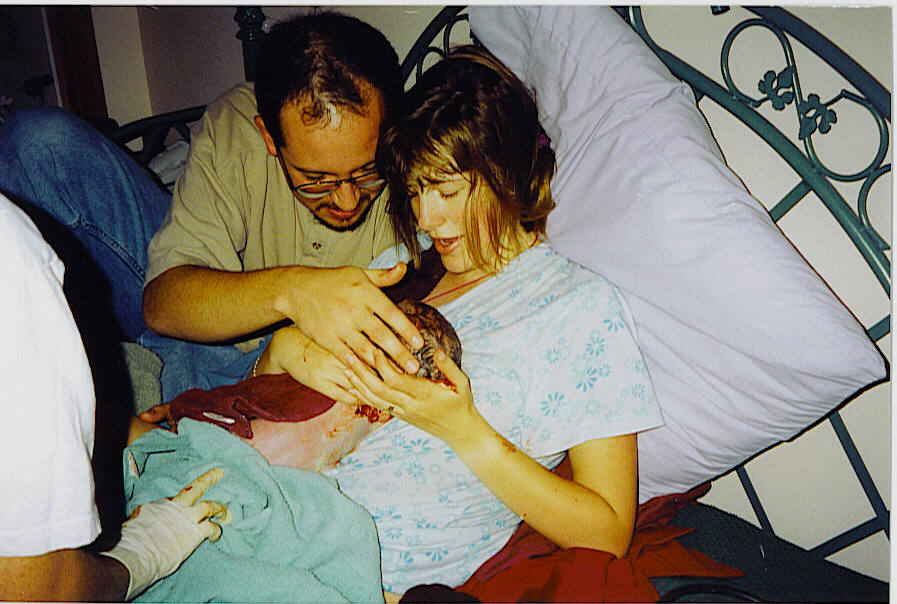
Immediately after first baby's birth--straight to chest. Main view is of top of his head. Hands tentatively touch/explore.
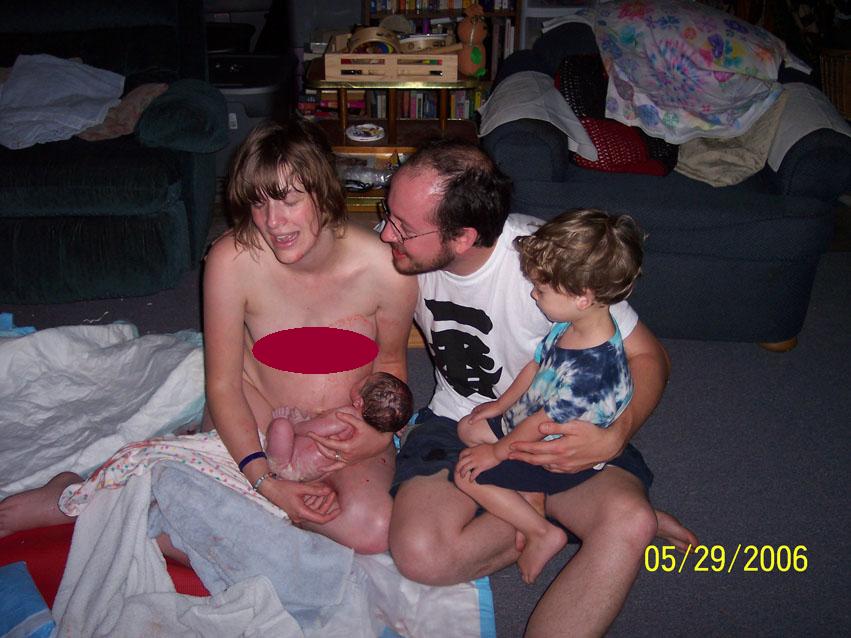
Immediately after second son's birth. Notice how he's held low down and kind of only with one hand. My eyes are closed and I'm not looking at him yet. In pictures shortly after, I'm looking at him and smiling and I've moved him up to my breast.
(Didn't feel totally comfortable with full breasts shot on my blog, though feel bad to conform to social expectations of appropriateness!)
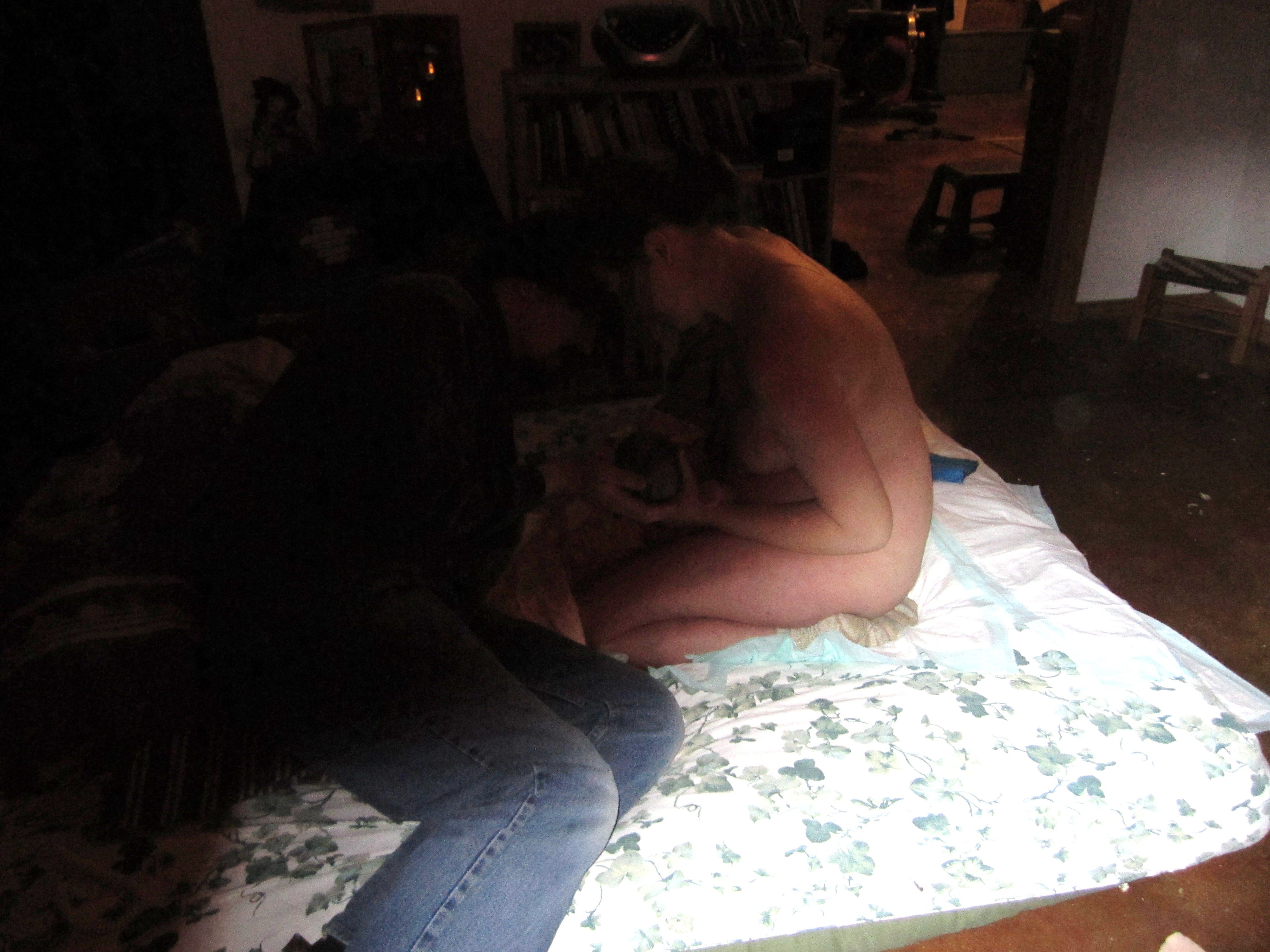
Immediately after last baby's birth. I know it is dark/hard to see, but note how I'm holding her kind of low down and actually kind of out/away from me (to look at) rather than against my chest.

I actually feel like I see in all of these pictures that birth pause to exhale the birth and then inhale the baby and the mothering of it.

What about you? What was the moment like following the birth of your baby? Did you take a brief pause, a moment to exhale and then inhale? I’d love to hear about it!

A Tale of Two Births

As Penny Simkin has frequently noted: “We can’t control labor, whether it’s hard; that’s a leap of faith. But we can always control how we care for [the mother]” [1]

In 2001 and in 2004, I attended the births of two of my dear friend’s children in the same hospital in a mid-sized Midwestern city.  I was not a childbirth educator or doula at this time, but was there in the capacity of friend and “witness.” Both births were intervention-heavy and not what I would call ideal, natural births; but the feelings were vastly different, which made all the difference.

At the 2007 LLL International conference in Chicago, I picked up several of these great "Listen to Women" buttons from the ACNM booth in the exhibit area. I love them. Isn't this what it is all about? So simple and yet so profound. Imagine how the world would change if we just listened to women.

One had an atmosphere of respect, caring and trust; the other had a “climate of doubt” throughout. The difference was a certified nurse-midwife (CNM). My commitment to homebirth midwifery often leads me to forget what a profound and true difference a caring CNM can make in a hospital birth. All the other hospital procedures can be present, but the care factor a CNM provides can transform a woman’s experience from powerless to powerful. Sometimes I forget how CNMs are poised to bridge the gap between home and hospital effectively. The US needs lots of them (not as subordinate “junior obstetricians”—but as expert guardians of normal birth in a hospital setting).

The details were similar in each birth. The babies were both almost 9 lb; a doula was present (same doula in both births); and the mother labored with an IV, spent a large portion of the labor in bed and had internal fetal monitoring. In the first birth (with the CNM), the mother even had several hours of Pitocin augmentation; in the second, with the obstetrician, she had no Pitocin until third stage. With each birth, the mother also had an extensive tear and long repair (a third-degree with the CNM, a second-degree with the obstetrician).

However, some things were very different.

When the mother said, “Can I have a birth ball?” the CNM said, “Yes,” and the obstetrician said, “Not until the baby has been monitored.” And then, “The baby doesn’t like that; you need to get back into bed.”

When the mother’s confidence waned, the CNM said, “You can do it. You are.” The obstetrician said, “I don’t think this baby is moving down.

When the mother said, “This is taking such a long time,” the CNM said, “I know. It is taking for-freaking-ever!” and everyone laughed (including the laboring mother). The obstetrician said, “I think we should consider a c-section based on your history. The baby is not moving down.”

The CNM said, “You have such strong muscles in your legs and bottom, do you exercise a lot? I think because you are so strong, you’re holding a lot of tension here. Try to let it go.” The obstetrician ironed the perineum until the mother screamed with pain.

The CNM waited. The obstetrician did another internal check.

In both, a baby was eventually born (the first after four hours of pushing, the second after a little over an hour). A strong, healthy baby. Vaginally and without pain medications. After the first birth—though she would have done some things differently—my friend felt triumphant, empowered, powerful, strong, capable, happy and proud.

After the second birth she felt abused, disappointed, ashamed, guilty, angry, assaulted, diminished, wounded and scarred.

I believe the CNM’s personality, attitude and basic belief that vaginal birth would work was the critical difference between these two experiences. These births dramatically, viscerally illustrated for me that no matter what else is happening around the birthing woman, we can control how we care for her.

Endnote: My friend went on to have her third baby at home in 2008. She pushed this baby out in fifteen minutes, with no tear, and she shone with her power.

Molly Remer, MSW, ICCE, CCCE is a certified birth educator, writer, and activist who lives with her husband and children in central Missouri. She is the editor of the Friends of Missouri Midwives newsletter, a breastfeeding counselor, a professor of human services, and a doctoral student in women’s spirituality. She blogs about birth, motherhood, and women’s issues at https://talkbirth.me/posts.


[1] Looking to nature, doula Penny Simkin practices the art of delivery, in The Seattle Times, Pacific Northwest Cover Story. Originally published March 23, 2008. Accessed April 27, 2009. http://seattletimes.nwsource.com/html/pacificnw/2004299467_pacificpenny23.html.

This is a preprint of A Tale of Two Births, an article by Molly Remer, MSW, ICCE, published in Midwifery Today, Issue 91, Autumn 2009. Copyright © 2009 Midwifery Today. Midwifery Today’s website is located at: http://www.midwiferytoday.com/

Woman Rising

No time for a long post today (or, probably, this week), so I share this quote I had saved from the book A Dozen Invisible Pieces by Kimmelin Hull (p. 229):

When faced with behavior battles, health concerns, family finances, and the struggle to stretch time to the fullest, I could choose to sink into the quicksand of life with young children–becoming engulfed in the daily grind, unaware of my own loss of self–or I could rise to the occasion. And I am rising.

Hull goes on to share the following:

Whether it be the thick memory of enduring a non-medicated labor and finally pushing our third child into the world, despite feeling as though I hadn’t an ounce of energy left, or the meager sprint I managed as I neared the finish line of the marathon…, I hold tight to these images as proof that I can and will be able to rise to the occasion–again and again, if and when I need to-because the ability to do so is in my very bones. Because I am a woman.” [emphasis mine]

The birth face, immediately following birth of second son. This feeling--this crying, laughing, euphoric, I DID IT, feeling is the one I draw upon in the rest of life.

This is one of things I find so powerful about women’s birth memories—they can hold onto them as a touchstone, as an affirmation of strength and personal capacity, during other challenging (or mundane) moments of their lives. I also don’t think births have to be “empowering,” natural, or unmedicated births in order to hold this affirmation for women. There is a lot of courage to be found in most birth journeys and the ability to find moments of powerfully conscious strength to draw nourishment from in the rest of life exists in many types of birth experiences. Personally, my birth experiences created a lasting sense of personal worth, that I have drawn from ever since. This includes the birth of Noah, which was not a “happy ending” to my pregnancy. In the months after his birth, I found myself at many times thinking, “I gave birth to my little, nonliving baby alone in my bathroom, I can do this too.” I did the same with the births of my other two boys—only thankfully without the “nonliving” part. Alaina’s birth is more “integrated” somehow, and I don’t find myself thinking about it or referring to it in quite the same way, though I’ve definitely had moments of remembering, “I caught my own baby, I can do this too!

Talk Less, Learn More: Evolving as an Educator

Since late 2006, I have written at the top of each of my teaching outlines: “Talk less, listen more.” This simple reminder has  fundamental importance and has completely revolutionized how I structure and guide my childbirth classes. During each series that I teach, I realize how listening to the women and giving them a space in which to share, is one of the most important things I can offer. Though I studied principles of adult learning and designing effective curricula during my certification program, I started out my childbirth education journey with a lecture and information-heavy approach I’ve since heard called, “opening their heads and dumping information in.” As I continue to teach, I’m continually discovering ways to talk less, but hopefully, impart more, creating a guiding philosophy of “talk less, [they] learn more” for myself as I plan and implement my classes.

Real birth preparation

After my first year of teaching, I realized that couples that sign up for my classes are not really looking for pregnancy and prenatal care information, but for real birth preparation. They are there because the women want to learn, “Can I do this?” and “How will I do this?” and the men are asking, “How I can help her do this?” It feels almost insulting to meet this quest for inner knowing with a discussion about the benefits of prenatal vitamins. I had to confront the fact that some of the things I was teaching seemed irrelevant, redundant, or obvious.

It became clear to me that I had to tackle the slightly embarrassing reality that I was following a model of prenatal education that was not in line with the true needs of the women in my community. I teach independent, natural childbirth classes privately in people’s homes. Maybe with a different population, my original approach would be more successful or I would take a different approach altogether. Also, just as students have different learning styles educators naturally have preferred methods. I have an information-heavy personal style that spilled into my teaching. I continue to wrestle with this tendency and struggle to rein in the information overload approach I gravitate towards.

Action!

As I made my discoveries, I began to drastically cut my talk time (lecture) and focus on action instead. Though it felt nearly sacrilegious to do so, I trimmed many things out of my outlines that were about nutrition, prenatal testing and so forth, because many of the women I work with have already read a great deal and don’t need to hear it again from me. I’ve come to see I really need to skip a great deal of the “book learning” and get them actually moving and practicing and using skills. Then, the “book learning” naturally arises during the course of the class, either via questions or via me needing to explain why something is useful or helpful during pregnancy or in labor.

I totally restructured and rearranged my class outlines to include a whole class about the mind-body connection and psychological preparation for birth. This class took the place of a previous class about birth planning. I was finding that many people already had a birth plan written and/or the birth plan information naturally comes up during the course of the six weeks without my needing to spend an excessive amount of lecture time on it. I tell them that I have the information, ask if you want it! I also dedicated a whole class to labor support with plenty of time to practice hands-on support techniques. In addition, I created a brand new class called “Active Birth” that involves lots of moving and positioning as well as many helpful ways to use a hospital bed without lying down. Informed consent, consumerism, and birth planning naturally arise as topics during this class, rather than being separately scheduled topics.

Information overload

Many pregnant women have information overload. They are faced with more information than they know what to do with. They are bombarded by it. What they really need is “knowing.” They need to know: “What skills do I possess or can learn that will help me greet my birth with anticipation and confidence? What are my tools? My resources? Can I just let it happen?” As an educator I ask myself, “What will help them feel confident? Feel ready? Trust their bodies and their capacities?”

I want people in my classes to learn material that is dynamic, active, exploratory, self-illuminating, supportive, positive, enriching, and affirming. I created a vision statement and asked myself where my classes stood in relationship to my vision. The answer was, “not as close as I want them to!” My vision statement for my classes is: to focus on celebration, exploration, motivation, education, inspiration, validation, initiation, and dedication.

I know I’m hitting the mark when couples comment, “Oh, this makes so much sense! I see how this works!” Or, “This was a really good illustration of what you were just talking about.” In this way, class participants readily reinforce (or modify) my own presentation style and I learn from series to series what to change, continue using, discard, or alter.

“Talk less…” teaching tips

I have many ideas of ways to “talk less” in birth classes, here are a few:

  • Media portrayals of birth—show two contrasting clips, such as a birth from a popular TV show (I often show Rachel’s birth from the show Friends) paired with an empowering birth from a film like Birth as We Know It and then have students discuss the two.
  • Use “The Ice Cube Minute” exercise from Family-Centered Education: The Process of Teaching Birth. In this exercise, couples hold an ice-cube in one hand for one minute and see what coping measures spontaneously arise for them. I do this exercise fairly early in my class series, before we’ve done a lot of formal talking about coping measures. It is very empowering for couples to discover what tools and resources come from within as they try the ice-cube minute.
  • To illustrate the potency of the mind-body contraction, practice two pretend contractions while holding ice. One contraction has an accompanying “stressful” paragraph read with it (“your body fills with tension…it hurts! Oh no!”) and the second contraction has a soothing paragraph read with it (“you greet the wave….it is YOUR power….”). This illustrates the fear-tension-pain cycle viscerally.
  • Use a five minutes series of birthing room yoga poses to begin the class—birth happens in our bodies, not our heads. Practicing the poses opens space to simultaneously discuss and practice: squatting, pelvic rocks, optimal fetal positioning ideas, healthy sitting, pelvic floor exercises, leg cramp prevention, back pain alleviation, and more.
  • Role playing cards—talk through various scenarios. I’ve found that couples are more receptive to talking through the cards than actually getting into a role and playing it through.
  • Values clarification exercise–participants cut out values from a list and arrange them in a grid to help them figure out if they are in alignment with each other and with their caregivers.
  • Leg stretch exercise to explore the use of vocalizations and other coping mechanisms during labor.
  • Ask plenty of open-ended questions that stimulate discussion and ideas, “what have you heard about XYZ?” or “what is your experience with…?”

Evolutionary spiral of a childbirth educator

After I had already done all of this self-inquiry and curriculum modification, I discovered Trish Booth’s concept of “The Evolutionary Spiral of a Childbirth Educator.” I quickly recognized myself and my experiences along the loops of the spiral. In the Early Stage of the spiral, educators are focused on “content and presenting the information.” This perfectly matches where I was when I started out with my “open heads and dump information in” approach. The Intermediate Stage is focused on the “group as a whole” and also “emphasizes learning rather than teaching.” Though I tend to teach one-to-one private classes and not groups, this seems to clearly be the stage I was in when I looked at my vision and realized that I needed to talk less so people would learn more. In the Advanced Stage, the educator “understands the meaning of the childbearing experience” and the focus is on the “individual learners.” This feels like the stage to which my teaching has spiraled. Further along the spiral is the Master Stage in which the educator “integrates the first three stages and moves gracefully between them” with a focus on “cognitive, emotional, and spiritual needs of the group as well as the individual learners” (Booth, 1995).

Perhaps my insights are old news to experienced educators, but they have made a profound difference in the quality of my classes. I’m sure as I continue to teach, I will continue to deepen and refine my approach and will continue to blossom as an effective educator.

Molly Remer, MSW, ICCE, CCCE is a certified birth educator, writer, and activist who lives with her husband and children in central Missouri. She is the editor of the Friends of Missouri Midwives newsletter, a breastfeeding counselor, a professor of human services, and doctoral student in women’s spirituality. She blogs about birth, motherhood, and women’s issues at https://talkbirth.me/posts.

Modified from an article originally published in the International Journal of Childbirth Education, December 2008.

References:

Booth, Trish. Family-Centered Education: The Process of Teaching Birth, ICEA, 1995.

An Act of Motherhood

Some time ago I read a clever essay by Jeannie Babb Taylor called “May, 2052.” It is about birth in the future and is told from the perspective of a grandmother who gave birth in 2007, sharing with her granddaughter how birth was “back in the day” and the granddaughter being shocked by how horrible the birth climate was in the “old days” of 2007). Side note: in some ways this story reminds me of a piece that I reprinted with permission of LLL called A Fantasy, which is a satire about birth and breastfeeding that I’m still not convinced won’t actually come to pass.

Feeling fierce at 37 weeks last year.

However, I was struck afresh by the power of the closing lines in May, 2052 (when discussing how/why things finally changed):

We insisted on dignity. We did not let doctors push us into inductions or surgeries just to accommodate their schedules. Women who still used hospitals refused the wheelchair and the gown that were presented at check-in. Women refused to be starved, or to have their veins punctured with unnecessary IVs. Mothers refused to let doctors break their waters or insert electronic monitors in the baby’s scalp. When we pushed our babies into the world with our own fierce power, then we refused to let them out of our sight.

…Eventually even the medical community came to recognize that birth is an act of motherhood, not an act of medical science. Today a laboring woman is not regarded as a body on a table, as if she and the baby needed some doctor to ‘deliver’ them from each other. Today women are honored as life-bringers.

Don’t you just love that? Recognizing that birth is an an act of motherhood, not an act of medical science… So true.

I can’t write about it in-depth, but I began thinking about this today after speaking with a mother who had received very, very questionable (to the point of thoroughly bizarre) breastfeeding advice from her doctor. When I could not help but express my dismay at the suggestions she had received, I had the distinct feeling that she was not able to even consider that possibility that her doctor might have been wrong. I wish I could write about the actual circumstance because it just boggled my mind and made my heart cringe. Breastfeeding too is an act of motherhood, not an act of medical science, and not one that “belongs” to anyone except for the motherbaby unit.

However, returning to the act of motherhood, vs. medical act, I also have this quote saved from the older book, Who Made the Lamb:

“Tom [her husband] laughed at this idealism. ‘You don’t understand,’ he said, ‘Pregnancy is not regarded as a process of creation. It’s a disease of the uterus.'” [emphasis mine]

What a (culturally) still true and unfortunate sentiment: A disease of the uterus. This is absolutely how many within the medical system and the general population continue to view pregnancy (and birth is the excavation of the disease). This reminds me of our “friendly” neighborhood doctor testifying at the Capitol against the midwifery bill several years ago stating that pregnancy can be viewed as a foreign object in the body and therefore “babies are like tumors that need to be removed.”

I look forward to the day when our acts of motherhood are celebrated and valued, the motherbaby bond is accepted as inviolable, and pregnancy is a state of health and well-being.*

—-

Note: I am aware that pregnancy and birth take a physical toll on most women and that for some pregnant women, “disease of the uterus” might feel like an apt descriptor—I’m speaking in more general terms of the emotional and cultural climate surrounding pregnancy and birth.

Virtual Screening of More Business of Being Born!

How exciting! Tonight birth activists and pregnant women across the country have the chance to virtually attend a free screening of one of the More Business of Being Born films: “Special Deliveries: Celebrity Mothers Talk Straight on Birth” on The Huffington Post.

From the press release:

LOS ANGELES, CA – Executive Producer Ricki Lake and Filmmaker Abby Epstein present an online screening of Special Deliveries: Celebrity Mothers Talk Straight Talk on Birth from their highly influential four-part DVD series More Business of Being Born on Monday, March 5th at 6:00pm PST on The Huffington Post.  Lake, Epstein and special guests from the film including Kellie Martin will host a live Q&A chat following the film beginning at 7:10pm PST. Viewers are encouraged to ask questions and engage in conversation with Lake, Epstein, and Martin by directing messages via twitter to @rickilake with #mbobb as the hash tag.

More Business of Being Born, a follow up to their landmark documentary, The Business of Being Born, offers a practical look at birthing options as well as poignant celebrity birth stories from stars. The virtual screening will air on HuffingtonPost.com and MyBestBirth.com. BabyCenter will host the virtual screening on their Facebook fan page.

I’m also excited that the Classroom Edition of the film premieres today. I would definitely like to add it to my birth class library.

More about the episode of MBOBB airing during the screening tonight:

Special Deliveries: Celebrity Mothers Talk Straight on Birth

Featuring celebrity moms Laila Ali, Gisele Bundchen, Cindy Crawford, Alyson Hannigan, Melissa Joan Hart, Kellie Martin, Alanis Morissette, Christy Turlington-Burns and Kimberly Williams-Paisley, Special Deliveries is a collection of intimate birth stories from a diverse group of mothers. Whether they chose to deliver at a hospital, home or birthing center, these heartfelt and humorous testimonies speak to the lasting power of the birth experience.  True inspiration for any mother-to-be, this group of women trusted their bodies and intuitions, taking responsibility for their birth decisions even when things didn’t go according to plan. None of these courageous women has ever spoken on the record in such compelling detail, and, on this DVD, the filmmakers weave together their passionate narratives as a celebration of the journey to motherhood that will leave viewers with a renewed sense of amazement about the power of women.
(Running Time: 74 min)

 Enjoy!


Birth Quotes of the Week

Quotes that recently caught my eye…

Your own wisdom is more powerful than anything you see around you. The price for living your dream is facing your deepest fear; ask yourself ‘What am I afraid of most?’ Facing your answer is the price of greatness.“–@Roots of She

“In acknowledging woman-to-woman help it is important to recognize that power, within the family and elsewhere, can be used vindictively, and that it is not only powerful men who abuse women; women with power may also abuse other women.” –Sheila Kitzinger

A woman who is enjoying her labor swings into the rhythm of contractions as if birth-giving were a powerful dance, her uterus creating the beat. She watches for it, concentrates on it, like an orchestra following its conductor.” –Shelia Kitzinger

“If you have never been called a defiant, incorrigible, impossible woman… have faith. There is yet time.” –Clarissa Pinkola Estes (via @Roots of She)

Pregnancy is a uniquely intimate relationship between two people. All of us luxuriate in this relationship once, and half of us are lucky enough to be able to do it all over again a second time, from the other side as it were. Never again outside of pregnancy can we be so truly intwined with someone else, no matter how hard we try.” -David Bainbridge

“We must not, in trying to think about how we can make a big difference, ignore the small daily differences we can make which, over time, add up to big differences that we often cannot foresee.” –Marian Wright Edelman

Reading this last quote made me remember my Small Stone Birth Activism article and so I posted it yesterday!

The Rest and Be Thankful Stage

During my first labor, I experienced what Sheila Kitzinger calls the “rest and be thankful stage” after reaching full dilation and before I pushed out my baby. The “rest and be thankful stage” is the lull in labor that some women experience after full dilation and before feeling the physiological urge to push. While commonly described in Kitzinger’s writings and in some other sources, mention of this stage is absent from many birth resources and many women have not heard of it. After writing recently about the spontaneous birth reflex, I received a comment stating the following: “I was particularly interested in the idea of resting after full dilation before pushing. This makes sense if you are only following your body’s urges to push, but never something I had seen (or remember seeing?) spelled out before.

I always make sure to tell my birth class clients about the possibility of experiencing a lull like this, because it is during this resting phase that labor is sometimes described as having “stalled” or as requiring Pitocin to “kick it off again” or as requiring directed or coached pushing. Also, think of the frequency of remarks from mothers such as, “I just never felt the urge to push.” When exploring further, it is often revealed that what the mother actually experienced was no immediate pushing urge instantly following assessment of full dilation. Depending on the baby’s position, this can be extremely normal. The way I explain it to my clients is that the lull represents the conclusion of the physiological shift happening in the uterus—the transition between contractions that open the cervix and the contractions that push the baby down and out.

As I wrote in a previous post from several years ago:

Your uterus is a powerful muscle and will actually push your baby out without conscious or forced effort from you–-at some point following complete dilation your body will begin involuntarily pushing the baby out. Many women experience the unmistakable urge to push as an “uncontrollable urge”–-but, in order to feel that uncontrollable urge, you often have to wait a little while! Though some care providers and nurses encourage you to begin pushing as soon as you are fully dilated there is often a natural lull in labor before your body’s own pushing urge begins. Some people refer to this lull as the “rest and be thankful” stage. It gives your body a chance to relax and prepare to do a different type of work (in labor the muscles of your uterus are working to draw your cervix up and open. During pushing, the muscles of your uterus change functions and begin to push down instead of pull up). If you wait to push until you really need to, you will often find that your pushing stage is shorter and progresses more smoothly that pushing before you feel the urge.

In the book, Our Bodies, Ourselves: Pregnancy and Birth they share the following important point:

“Research suggests that the length of time before the baby is born is the same if you allow one hour of ‘passive descent’ of the baby (when you relax and don’t consciously try to push) or you start pushing immediately after you are fully dilated.”

via Waiting before pushing… « Talk Birth.

That’s right, the length of time between full dilation and baby’s birth is the same, whether the mother waited one hour before pushing, or started pushing without the urge immediately following full dilation. I know which one sounds easier and more peaceful to me!

In my own experience with my first baby, I found that I felt like I should be pushing after full dilation and thus began to do so before feeling the full urge. I ended up pushing for about an hour and fifteen minutes. I suspect if I’d just continued hanging out for 45 minutes to an hour, he may have flown out in 15 minutes. Prior to pushing though, I did experience a rest and be thankful stage of about 30 minutes in which I sat in a rocking chair, joked about feeling “trippy,” and talked about being an A++ birthing woman. I describe it in my son’s birth story:

After finding out that I was fully dilated, I started to feel very odd and I really think I had to go through a sort of emotional/psychological transition to adjust myself to the fact that I had “missed” the physical transition point…I sat in the rocking chair for a while and kept saying things like, “am I dreaming? Is this real?” I also made a joke about feeling “trippy” like in Spiritual Midwifery. We also joked about what an A+ + + laboring woman I was (a family joke–I was a 4.0 student throughout college and grad school and so we always say that I like to get an A+ + + on everything I do). Those pressure feelings I had been having for a while, got a little more intense and I started pushing kind of experimentally. I was on my knees with my head on the bed on my pillow again and during one of the little pushes my water broke with a giant, startling POP and sprayed across the room including all over my friend. At this point, the midwife left saying, “I think I should call the doctor.” via My First Birth « Talk Birth.

The blog Birth and Baby Wise has some great thoughts to share on resting and being thankful (note the blog is from an educator in London, thus the use of the term Syntocinon, rather than the U.S. based brand Pitocin):

… it seems that there is little appreciation for this well documented pause amongst health professionals working in the consultant-led units of hospitals. Any stop in action once the magic ’10 cm dilatation’ is reached is met with almost instant medical intervention to get the contractions back up and running, ie a syntocinon drip. Women experiencing this are already on a consultant-led unit, where a higher level of medical intervention can be anticipated, but it is strange that there seems to be such a rush to use a syntocinon drip to get the contractions going again, providing mother and baby are both coping well.

One reason the contractions may ease temporarily is in order to allow the baby’s head to get into a better position. If this is the case, then artificially speeding contractions up is hardly likely to have the benefit of a faster birth for the woman – if anything, a slower and more complicated birth as she tries to push out a baby that is not quite in the right position. In addition, she has to cope with stronger contractions that she might find difficult to deal with, necessitating further medical help in the shape of an epidural – which in turn makes pushing the baby out even harder…

…At this stage, the woman and her partner are incredibly vulnerable to this well meant ‘help’ from midwives and obstetricians and are unlikely to question the requirement for additional medical help. It is also unlikely that the calm and relaxed environment so important for a peaceful birth can survive the worries of the health professionals, which will affect most women and their partners. via Rest and be thankful – or panic and have a drip shoved in? | Birth and Baby Wise.

I agree. In my own personal experience with my first birth, I was very vulnerable to just the perceived expectation of it being “time to push.” With later babies, it was intensely important to me that I have very few people present at the birth, knowing how sensitive I am to the expectations of those around me. It is truly only my husband and my mother than I trust to not disrupt my “birth brain” and the freedom of my birth space.

I’d love to hear more from readers about their experiences with the rest and be thankful stage.

Did you experience this lull between full dilation and pushing out your baby?

Was the lull recognized and respected by your birth attendants?

If you pushed without feeling the urge, was the pushing stage fairly long?

With subsequent babies, I had no internal checks during labor, so I never really knew if I experienced the rest and be thankful stage with them. I just pushed when my body started pushing—I have no idea how long after full dilation that was. So, I also am curious to know if women find they experience this stage with all babies, with only the first one, or with only some of their babies?

I suspect I did experience it with Alaina, because I remembering feeling concerned that contractions were suddenly “far apart.” I started talking more and analyzing myself and the labor and this was probably part of a lull in the intensity of the contraction action while my body prepared for a powerful spontaneous birth reflex.

Spontaneous Birth Reflex

Why do we, then, continue to treat women as if their emotions and comfort, and the postures they might want to assume while in labor, are against the rules?

– Ina May Gaskin (via Birth Smart)

I’ve  been intrigued for some time by Michel Odent’s description of what he calls the “fetal ejection reflex.” Personally, I would like to rename it the “spontaneous birth reflex.” Essentially, this reflex involves the spontaneous birth of the baby without coaching or conscious effort on the part of the mother. It is most likely to occur when the mother feels very safe and very private, which may be why we do not read descriptions of it occurring during many births. In an article about the fetal ejection reflex Odent writes: “During the powerful last contractions the mother-to-be seems to be suddenly full of energy, with the need to grasp something. The maternal body has a sudden tendency to be upright. For example, if the woman was previously on hands and knees, her chest tends to be vertical. Other women stand up to give birth, more often than not leaning on the edge of a piece of furniture. A fetus ejection reflex is usually associated with a bending forward posture.

Flicked forward hips?

In the book Optimal Birth: What, Why & How, which was heavily influenced by the work of Odent, the author frequently describes spontaneous birth reflex occurring with a swift “flicked forward” motion of the mother’s hips. I found the description curious at the time that I read the book, not really conceptualizing how one would flick one’s hips forward when pushing out a baby. However, following the birth of my daughter last year, I was completely amazed to hear my husband describe the pushing stage in these words, “…you were down on your hands and knees, but then you pushed up and moved your hips forward and suddenly you were holding her.” I would describe her birth as involving an authentic spontaneous birth reflex much like Odent and Sylvie Donna (the author of Optimal Birth) describe. This is what I wrote three days after her birth:

Shortly following a spontaneous birth reflex!

I was down on hands and knees and then moved partially up on one hand in order to put my other hand down to feel what was happening…her head pushed and pushed itself down as I continued to support myself with my hand and I moved up onto my knees, with them spread apart so I was almost sitting on my heels and her whole body and a whole bunch of fluid blooshed out into my hands… I didn’t realize until some moments later than both Mark and Mom missed the actual moment of her birth. Mark because he was coming around from behind me to the front of me when I moved up to kneeling…I had felt like the pushing went on for a “long” time, but Mark said that from hands and knees to kneeling with baby in my hands was about 12 seconds.

via Alaina’s Complete Birth Story « Talk Birth.

Birth without pushing?

I’ve been meaning to write about the experience for some time and then I received a comment on an older post I wrote titled Pushing the issue of pushing in labor… which addresses physiological pushing vs. coached/directed pushing. The mother wrote: “I would so love to give birth without pushing..I hope I can do this without pushing but is it really possible?? If it’s possible, why isn’t it practiced more widely?”

While I did not experience such a dramatic spontaneous birth reflex with any of my other births, Yes! It IS possible. There are a variety of reasons why it is not practiced more widely, two common ones being that many mothers do not give birth in the atmosphere of privacy that facilitates the reflex and secondly because many birth attendants ascribe to the notion that 10 centimeters of dilation = time to push, regardless of what mother’s body is telling her to do. With my own first baby, I was checked at 10 centimeters and told I could push whenever I felt the urge. While no one coached or directed me to begin pushing, I felt like I “should” be doing so and so start to experiment with actively pushing a little with contractions. It took a little over an hour before my son was finally born. I never felt an intense or irresistible or spontaneous urge to push. With my second baby, I felt literally driven to my knees by the force of the birthing energy. I did not consciously push him out, but it definitely took several pushes and maybe about 15 minutes to push him out. There was a process of pushing involved with his birth. With my daughter, as I describe above, it was like an irresistible force gripped my body and she just came flying out with no directed physical or mental involvement from me.

Trusting the urge

I shared the mother’s question with the CfM Facebook page in order to get some other perspectives on births with “no pushing.” I received several comments to share with the questioning mother-to-be. Most mothers referenced the idea of pushing when their bodies told them to. It is difficult to communicate this with someone who has not yet experienced it—how to recognize the “urge” and what it really means to “push when your body tells you to.” I also suspect it is frustrating for women who are honestly and courageously seeking “answers” in order to best prepare their bodies, minds, and hearts for birth, to receive responses like, “just trust your body,” which can feel trite or dismissive to the pregnant woman who hungers to know. However, then once on the other side of the birthing bridge, we discover there are really few better answers to give. I believe the capacity to trust that her body will communicate the unmistakable urge to push comes with an environment where the mother is treated with dignity and respect. She has her need for privacy honored and that she is mentally able to surrender to the birthing process and let her body take over—no attempting to wrestle with or control the birth, but to dig deep and then to let go.

Personal experiences in birthing without pushing:

ARA shared: “I will say that with my last birth I started out with having coached pushing. Then I felt my body take over. The nurse told me to stop pushing and I told her I can’t my body is doing it on it’s own. It was the most awesome feeling in the world.”

And AK shared: “I pushed when my body said to do so. It was relieving!! lol

EW wrote that she, “highly recommend physiological pushing over directed pushing. listen to your body. Consider hypnobirthing if you are wanting to birth without pushing, it encourages laboring down.

DF had this experience to share: “I don’t know if this is the same thing but with my first child, the nurse didn’t listen to me when I said I thought it was time and when my midwife came to check I was crowning, I had ‘labored down’ as she called it by my body doing the work. So I only actually pushed once on her cue and my baby was here. The second child the same happened automatically I wasn’t even aware it was happening…..maybe subconsciously?

NB shared that, “Because of my uterine prolapse issues, I do not push until the baby is essentially crowning on his own. I also don’t have anyone check to see how far dilated I am (since baby #1, that is) so when that burning feeling starts to get really strong I try a gentle little push to see what happens, and that usually initiates complete crowning… at which time, despite my best efforts, I CANNOT control the pushing urge any longer because I need to get that baby out!! 😉 I think it does make ‘transition’ longer in the sense that perhaps birth would have happened earlier if I’d begun pushing before the baby slid down that far on his/her own, but it makes the pushing stage much shorter and is certainly better for the baby – and me, too, since I’m not putting that strain on my uterine ligaments until the very last seconds.”

JD shared her different experiences: “With my first baby, I felt the need to push waaaay too early. (Baby turned posterior; I had back labor contractions less than a minute apart for several hours.) I spent over an hour pushing, but I can’t blame the wonderful midwives who attended my homebirth. They told me several times that it wasn’t time to push yet. But I was in so much pain, and had exhausted all my coping strategies, and just had to get that baby OUT! Then we had a dystocia, and everybody ended up yelling at me to push even though I wasn’t having a contraction, and my very calm, collected midwife sounded worried, so I pushed some more. Lots of pushing, lots of pain, lots of tearing. My second baby was smaller and lined herself up better. I didn’t push until the very end, and she came in a big hurry and surprised everybody. Nobody told me to push, and I barely needed to. So, yes, it can be done, but there are more factors at play than your doctor/midwife. I had two very different pushing experiences, both at home with the same midwife.

G wrote: “Unmedicated, midwife-assisted home birth, pushed for 3 hours, never really got the hang of it. Baby was not quite lined up right and was stuck, crowned, for an hour. I was exhausted and basically checked out. Eventually it was gravity that got him out – they hauled me upright and he basically fell out of me. I look back and wonder if maybe I should have taken more of a break after dilation – I FELT like I was ready to push, but who knows if I actually was. Maybe he would have labored down on his own if I’d just zonked out.

Why isn’t it encouraged?

I’ve already addressed several reasons why and then LDM shared these important points: “It’s not widely practiced because the obstetric timetable doesn’t allow for it. The physiological urge to push will be there, for some women sooner than others. Most care providers are taught to coach pushing (after all we all know women just can’t do the job they were designed to do) and to have that coached pushing happen under certain conditions (wait for the dr! Ok, doc is here!) Some women say they never felt any urge- they may have had normal physiological signals quelled from drugs or other common labor practices and/or they were not given time to rest and sleep after fully dilating. There is such urgency to force a baby out once she reaches 10, but if she is tired and cannot feel her body pushing, then mom probably needs a nap & maybe a snack. Letting a woman take that break is unheard of in hospitals.

And additionally, Mommy Baby Spot offered this tip: “Stay away from “helping” drugs so that your body knows what to do and learn different positions so that your body puts itself in the prime position to get the baby out with the minimum of hassle (which is different for everyone).

I thank the women who shared their experiences for their thoughts and I wish the mother who posed the question the very, very best with her upcoming birth. May you birth smoothly, peacefully, and spontaneously in harmony with your body’s wisdom, cues, and urging!

(Note: personal experiences are reprinted directly as shared on the CfM FB page, but have had some spelling corrected for readability.)

Sign up for my Brigid’s Grove Newsletter for resources, monthly freebies, and art announcements.

Honoring Miscarriage

When I had my first miscarriage, I vowed several things in the immediate aftermath. One was that I was going to write a book about it so that other women would not have to experience the same total dearth of resources about the physical process of coping with home miscarriage. While I did publish my miscarriage memoir this year, I am still collecting stories and experiences for a different, more comprehensive book on this theme. However, in the time since I made that vow and since I had my miscarriages, a new resource emerged for women: Stillbirthday. This is the website I NEEDED when I was preparing for the birth of my tiny, nonliving baby. While I received emotional support from a variety of sources, I found a void where the physical information I sought should be. That information is skillfully covered in the birth plans section of the Stillbirthday website. I reprinted information from their “early home birth plan” in my Footprints on My Heart memoir, since it was the information I was desperately seeking during my own home miscarriage-birth. I am grateful the information is now available to those who need it.

My second vow was that, if I knew about it, I would never leave another woman to cope with miscarriage alone on her own. My third vow came a little later after more fully processing and thinking about my own experience and that was to always honor and identify miscarriage as a birth event in a woman’s life.

A friend’s loss

In March of 2010, my good friend, who had doula’ed me very gracefully and respectfully and lovingly through my miscarriage-birth postpartum experience and processing, experienced a miscarriage herself. She didn’t call me while she was experiencing it, so I couldn’t go to her as I had imagined I would if needed, but afterwards I went to her with food and small gifts and hugged her tightly, recognizing all too well that hollow, shattered look in her eyes and the defeated and empty stance of her body. Later, I bought her a memorial bracelet. However, I was still in the midst of coping with my own grief and loss process—my second miscarriage having just finally come to a long-drawn out end only a month before and the experience of which having brought another friendship to an almost unsalvageable point—and my dear friend’s own process, her feelings, got lost along the way. She recently wrote about the experience on her own blog and it was harder for me to read than I would have expected. As she noted, I agree that doesn’t matter how little the baby, or baby-start, or baby-potential that is lost-–there is no quantifying loss and no “prize” for the “worst” miscarriage. It is a permanent experience that becomes a part of you forever. Also permanent for me is the empathy and caring showed to me by my friend/doula during my time of loss and sorrow. I regret that I was not able to be that same source of solace, companionship, and understanding to her. I thank her for having held space for me to grieve “out loud” and I’m really sorry that part of the cost of that was the suffocating of her own sadness or minimization of her own experience. While I do feel like I did what I could to acknowledge her miscarriage at the time that it happened I really wish I would have done more, particularly in terms of acknowledging how very long the feelings of emptiness and grief persist. I made a mistake in taking her, “I’m okay” remarks as really meaning it, rather than being part of the story that babyloss mamas often tell themselves in a desperate effort to “get over it” and be “back to normal.”

That said, I also compassionately acknowledge that it can be hard for people to know what it is that we need if we don’t tell them. So, now I’d like to hear from readers. What are your own thoughts on recognizing and acknowledging miscarriage—how do we best hold the space for women to experience, identify, and honor miscarriage as a birth event in their lives?

Charm & book giveaway (**Giveaway is now closed. Veronica was the winner***)

In harmony with my question and associated thoughts, I am hosting a giveaway of a sterling silver footprints on my heart charm exactly like the one I bought for myself after Noah’s birth and that I gave to my husband and my parents afterward (my husband carries his on his keychain). If you win the charm, perhaps it is something that will help you to honor your own miscarriage experience or that you can give to someone else to acknowledge their loss. This giveaway is in concert with the blog contest on Stillbirthday and will end on March 20. Additionally, everyone who enters will receive a free pdf copy of my miscarriage memoir.

To enter the giveaway, please leave a comment addressing the subject of honoring miscarriage. I am wondering things like:

What did you need after miscarriage?

What did you wish people would do/say to honor your miscarriage experience?

How could people have helped you more?

What do you still wish you could do/say/write/share about your miscarriage experience(s)?

What do you wish you had done for yourself?

What did you want to tell people and what do you wish you had been able to say?

What did you want to do that you didn’t feel as if you had “permission” to do? (personal, social, medical, cultural, whatever type of permission…)

I will share my answers to these questions in a later post, but I do want to mention that one of the things that was most important to me to have acknowledged was that this was REAL. That was one of the first things I said to my parents about it when they came over to help me immediately after Noah was born—this is real.

Water babies

I continue to honor the experience of miscarriage and babyloss in my own life in various ways. Recently, I found a buddhist monk garden statue from Overstock.com that reminded me of the “jizo” sculptures that honor and protect “water babies” in Japan (mizuko is a Japanese word meaning “water baby” and specifically refers to babies lost during pregnancy—the only specialized word that exists). I have a small jizo inside on my living room windowsill, but I’ve wanted one that could weather the outdoors by Noah’s tree.

20120222-115308.jpg

20120222-115315.jpg

I took this one for size perspective, but you can barely see the sculpture in the shadow to Alaina's right.

I believe I may be partially responsible for the widespread usage of the following quote on the internet now with regard to babyloss mamas:

Miscarriages are labor, miscarriages are birth. To consider them less dishonors the woman whose womb has held life, however briefly.” –Kathryn Miller Ridiman

I found it in an issue of Midwifery Today from 1995 and shared it multiple times on Facebook and on my blog. I have since seen it in many locations around the web and I feel happy that I was able to be a conduit for the sentiment and the increased recognition of miscarriage as a birth event.

To participate in the Stillbirthday blog contest/carnival go here. And, make sure to check them out on Facebook too.