Archives

Labor Pictures

I’ve mentioned before that I was disappointed not to have any birth pictures from my last baby. What I do have is quite a few labor pictures and I want to share them in a post since labor pictures don’t often get as much “glory” as birth pictures 🙂 I didn’t have any birth pictures with my first son either, though we have several immediately after as was my preference at the time. I have two labor pictures with him, this one, taken in fairly early labor:

Trying to decide whether or not this is it!

Then, my mom took this one of me after I got out of the shower. I was going to try to go to bed, because the birth center staff seemed pretty sure I wasn’t really in labor and should just get some rest. This picture was taken about 5-6 hours before he was born:

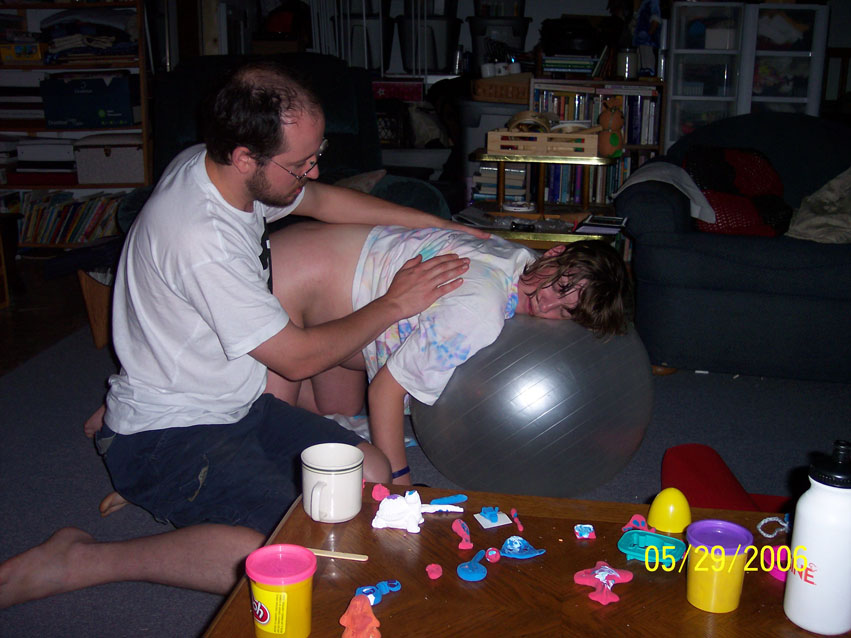
With my second son, my mom took a great series of birth pictures as he was emerging. They’re really good and step by step as he comes out—however, the angle is a very direct “rear view” that I don’t feel comfortable putting on the internet! With that birth, there is only one picture from the actual labor (and, it is a nice active labor picture that isn’t too graphic and it has actually been printed in several publications):

About 30 minutes before giving birth to second baby

I like how you can see all of my older son’s playdoh creations in the foreground. That’s homebirth for you!

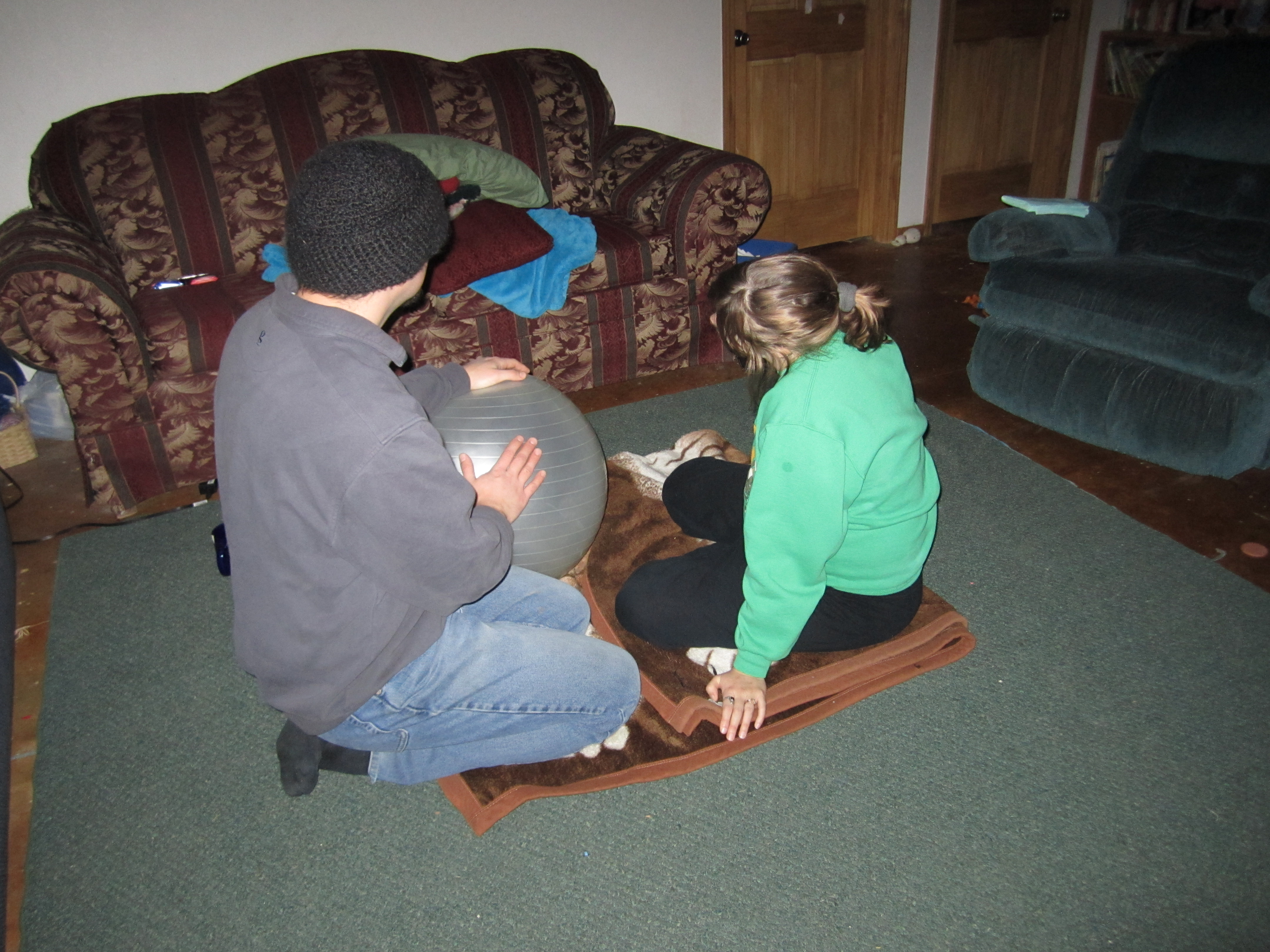
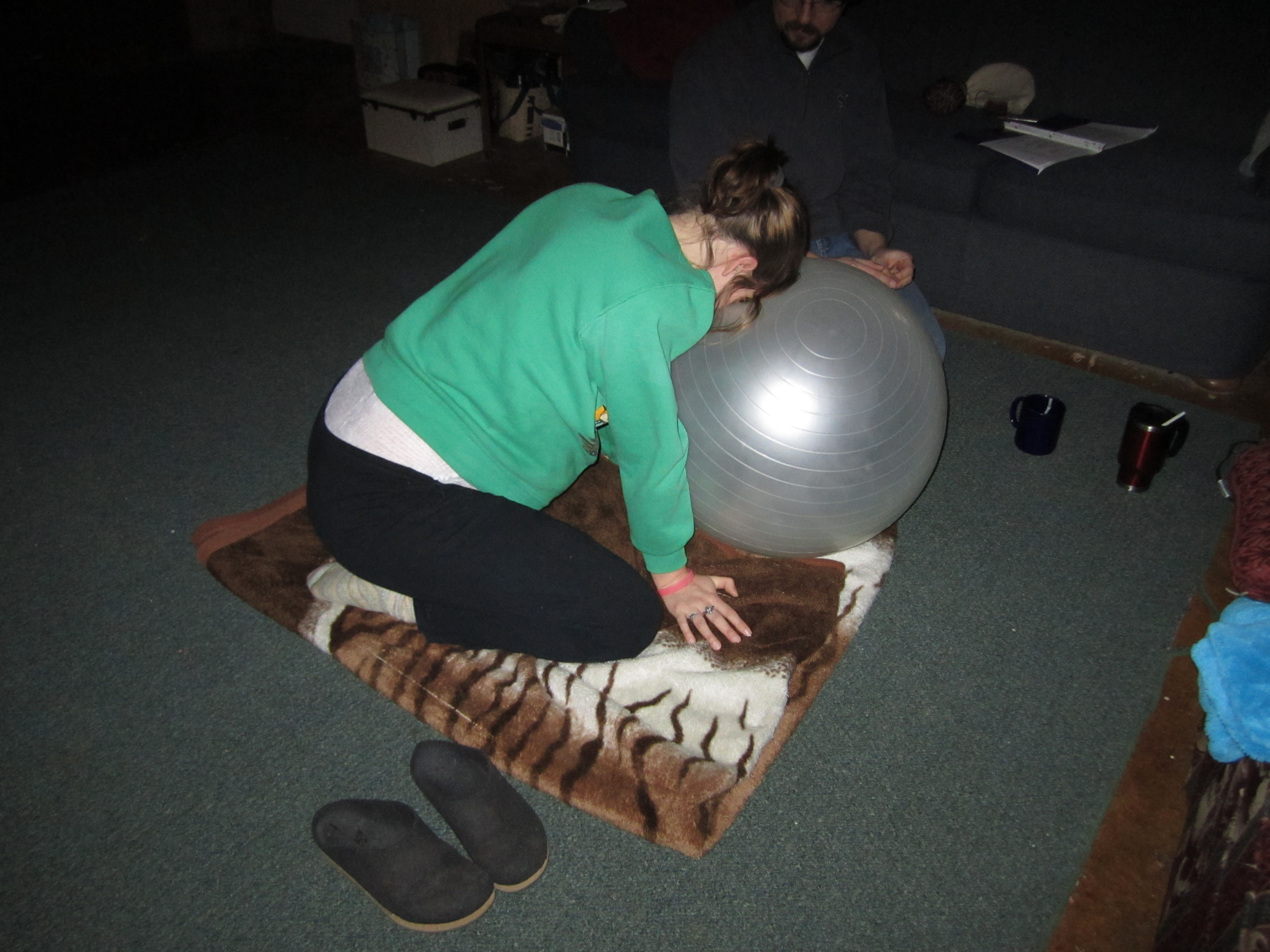
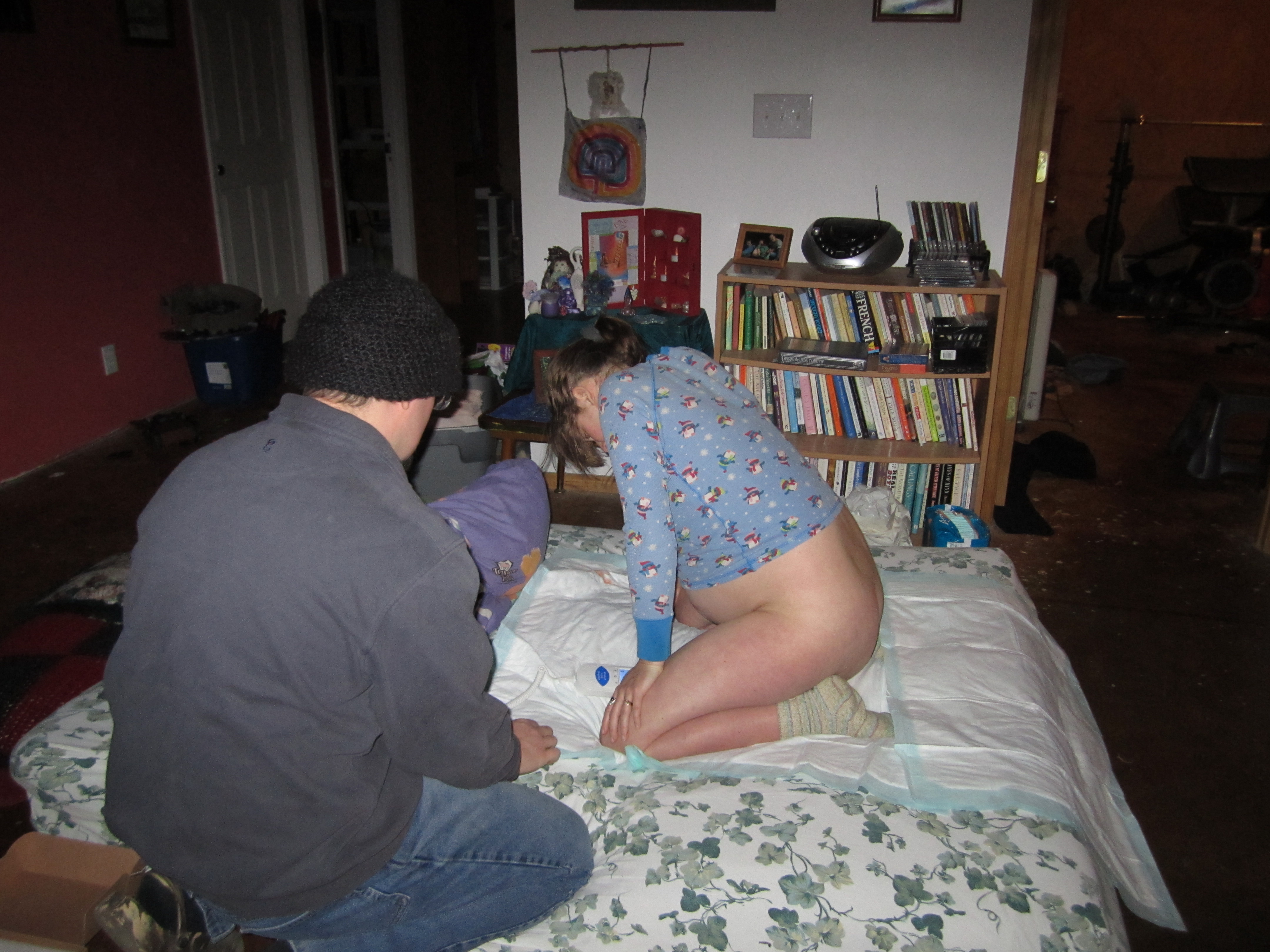
With my daughter, my mom took a series of labor pictures and while I’m sad not to have birth pictures too, I like the story that these pictures tell:

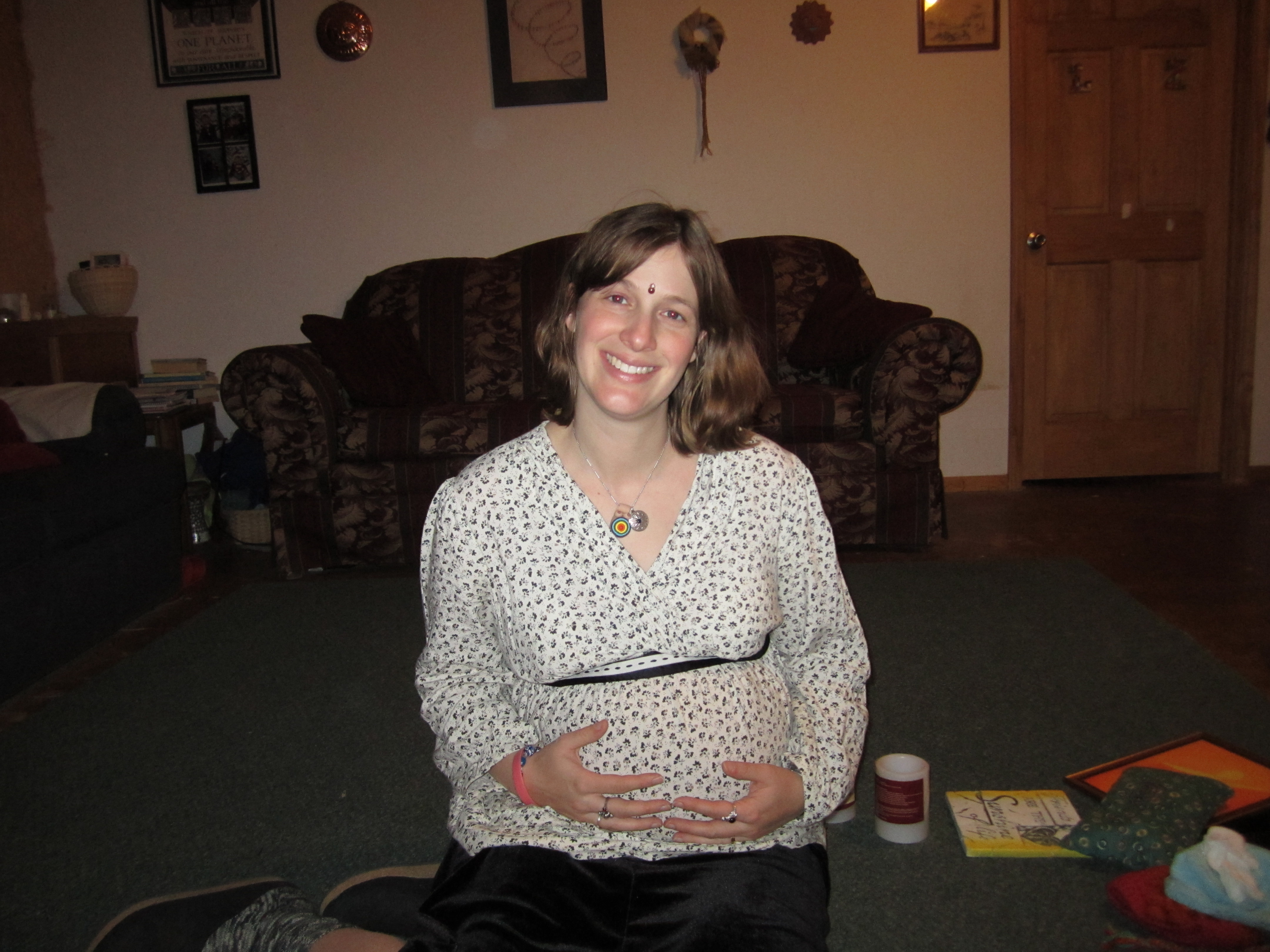
Taken during the morning of birthing day–wanted one last “belly picture” of pregnancy.

Spent a lot of time on the ball with Mark at my side

My birth nest is all ready! (on floor outside bathroom) Notice that my birth altar is set up nearby.

More time on the ball…

Proving I can still smile one hour before she is born! (+ advertising my alma mater)

Accidentally got trapped on floor in horrible and painful position.

The closer I get to having a baby, the nearer to the floor I get (hands and knees is right for me)

Switched into ridiculous too-small PJ shirt right before pushing.

She’s here! Closest thing to a birth picture that we got.

First nursing

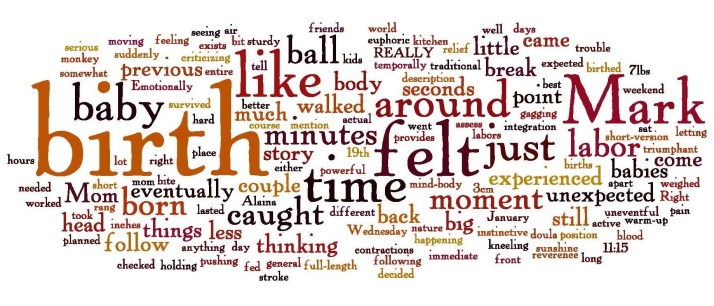
Birth Story Wordle

I’ve done Wordle images before using the text of this blog, but I didn’t realize that you could make one using only one particular post. A couple of nights ago when I was up late with the baby, I made one using Alaina’s short birth story! I made it the day before her two month birthday—I also took her out to show her the supermoon 🙂 I like it—I find it meaningful that my husband’s name is the second largest word after the word “birth.” I also find it significant that the word baby is above the word birth, since for me this time, the baby ranked above the birth in my emotional experience of birthing. In an ultimate reckoning, The baby is always more important than the birth, of course, but my feelings about the two are usually interlocked and go hand and hand and I believe that birth has inherent value as an experience—this time I felt exhilirated about the baby and then secondarily had separate feelings about the experience of birth.

Unity

I keep wanting to write an update post about Alaina and never finding enough moments in one day in which to do it—I joked the other day about, “instead of taking care of your sweet little self, I want to write a blog post about taking care of your sweet little self!” ;-D Overall, I’m surprised by how easy she is to take care of. I love having a baby again—I’m surprised I ever found it hard to take care of a baby! Her needs are very simple and easy to meet and it just isn’t very complicated to figure her out. Older kids are a different story altogether! Though, taking care of her while taking care of my other kids adds a different level of challenge and isn’t itself actually easy. But, caring for her when considered on its own is very easy and natural and good. I was concerned about “starting over” and taking care of a baby all over again and I’m pleased to discover anew how much I love having a baby.

She does have an interesting habit of being awake until about 1:00 a.m. every night. Not sure what is up with that and keep puzzling over changing the pattern. With my first baby, I remember remarking that at night I felt in “perfect harmony” with him, but during the day I found him somewhat confusing (and also kind of fussy/unsettled). With Alaina, I feel in perfect daytime harmony with her, but the night is the confusing time. It is also hard to write about her without comparing her to my other babies—I’d like to consider each child on their own, rather than using the others as a yardstick, but I also think it is a natural thing to do. I feel like she is my happiest baby yet. I’d worried she would be an anxious or difficult baby, because of all the fear I “marinated” her in during pregnancy, but she is a happy little soul. She is also incredibly quiet. It is weird, actually, sometimes I look down at her and she’s just riding along quietly and I get kind of a start, like, “oh, you’re still here!” She does not really ever cry—just occasionally commentary type “wahs” of protest or alert or notice. I remember the boys becoming unsettled more easily and also being harder to calm down. For example, yesterday she was asleep when we got home from the park. I hurried to bring in my stuff and when I got back out to the car she was awake and crying pretty hard—I was horrified and ran to scoop her up. The second I picked her up, she made not another peep. I know for a fact that my other babies would have kept on crying for a couple of moments just for emphasis, as well as just taken a little more conscious effort for me to calm them back down. She smiles a lot and enjoys watching her big brothers play.

While the feeling isn’t as intense as it was when she was first born (she is two months old tomorrow!), I continue to marvel at her every day—“HOW did you get here, you amazing little thing?” I feel almost startled that she is here with us, happy and whole and engaging with the world around her. I don’t remember having quite the same sense of miracle about the boys. Sense of magic, yes, but the sense of surprise and/or disbelief about their existence, no.

Aren't they cuties?

I think she looks remarkably like my oldest in this picture, but in baby pictures at the same age and to my eyes in person, she doesn’t look so much like him.

I am enjoying experiencing the symbiosis of the nursing relationship again. I sat nursing her a couple of days ago and remembered a quote from the book The Blue Jay’s Dance by Louise Erdrich in which she is talking about male writers from the nineteenth century and their longing for an experience of oneness and seeking the mystery of an epiphany. She says:

“Perhaps we owe some of our most moving literature to men who didn’t understand that they wanted to be women nursing babies.”

I am currently reading three different books about spirituality and one of them has this focus on  “oneness”I was reading it while nursing her and that quote popped into mind.

Blessingway Readings & Chants

I’m looking through my files to choose a reading for a mother blessing this weekend as well as choosing readings for a women’s retreat this weekend. Anyway, I felt like sharing some of them here for people who might be googling around looking for something to share at a blessingway:

From the book Joyful Birth: A Spiritual Path to Motherhood by Susan Piver

The path of motherhood has a beginning, but no end. It’s constantly changing and constantly challenging. Along the way, we encounter our personal limits over and over. We fall in love over and over. We ride the sharp edge of hope and fear. On this path of discovery, as on any spiritual path, our pretensions are shattered, our minds are blown, and our hearts are opened. We cry, we laugh, we bumble around and make countless mistakes. Through it all, we are gently—or abruptly—poked into greater honesty, lovingkindness, and understanding. It is a truly joyful path.

The memory of [my child’s] birth has become a talisman that I hold in my heart as I journey deeper and deeper into motherhood. For these moments come again in every mother’s life—the times when we are asked to walk straight into our pain and fear, and in doing so, open up to a love that is greater than anything we ever could have imagined: all life’s beauty and wonder, as well as all the ways that things can break and go wrong…Again and again, motherhood demands that we break through our limitations, that we split our hearts open to make room for something that may be more than we thought we could bear. In that sense, the labor with which we give birth is simply a rehearsal for something we mothers must do over and over: turn ourselves inside out, and then let go.

This is the reading we often use for symbolically summoning the four directions. It is from the book  Mother Rising: The Blessingway Journey into Motherhood:

Blessed be this gathering with the gifts of the East: communication of the heart, mind, and body; fresh beginnings with each rising of the sun; the knowledge of the growth found in sharing silences.

Blessed be this gathering with the gifts of the South: warmth of hearth and home; the heat of the heart’s passion; the light to illuminate the darkest of times.

Blessed be this gathering with the gifts of the West: the lake’s deep commitments; the river’s swift excitement; the sea’s breadth of knowing.

Blessed be this gathering with the gifts of the North: firm foundation on which to build; fertile fields to enrich our lives; a stable home to which we may always return.

From previous posts here is:

After my blessingway with baby girl, January 2011

A birth blessing

Full moon poem

Courage reading

Fear release for birth

Birth warrior affirmation

Two birth poems

Birthing poem

And, finally, here is a handout of the chants we often use. It is formatted with the chants in two columns so it can be cut in half to distribute.

Birth & Breastfeeding in Unexpected Places

No, I’m not talking about giving birth in the car, or breastfeeding in the rotunda at the Capitol, I’m talking about birth and breastfeeding showing up in unexpectedly positive ways in books and movies. I had two such occasions last week.

In the animated children’s movie Ponyo, which we watched on Netflix, the two main character children encounter a father, mother, and baby floating in a small boat in the flooded town. Ponyo attempts to give the baby a drink from her thermos and the mother says, “no, he gets his milk from me. I can drink it and make milk for the baby and he can get it that way.” The little boy then says, “when I was little my mom made milk for me too.” Ponyo then tries to give the mother big stacks of sandwiches saying, “for milk! For milk! Here, you can have this for milk!” It was really cute 🙂

Then, I finished reading a novel called Medicus on my Kindle. It was a “novel of the Roman Empire” about a military doctor in Britannia during the Roman occupation. It was a mystery book, but definitely not a traditional sort of mystery. The doctor ends up buying an enslaved girl to stop her from being abused and investigates the suspicious deaths of several prostitutes/slaves. It is noted several times that the girl has “some skill in midwifery” and that she used to attend births with her mother. Towards the very end of the book, the doctor is called to attend a complicated birth in which the baby is transverse and everyone is pretty sure both mother and baby will die. She has been pushing for a long time and is all worn out. The doctor enters the room and has no idea what to do. He says, “I’m only a medic. A surgeon. Where’s a midwife?” And, with a few dramatic twists, the slave girl with some midwifery knowledge is convinced to come help, turns the transverse baby, and saves the lives of both mother and baby who are later described as nursing happily (the mother “pale, but alive”). Birth often makes a dramatic appearance in books and films, but the drama usually involves the baby, mother, or both then dying. So, this was a refreshing change as well as a nice plug for midwifery 🙂

International Women’s Day, Birth Activism, and Feminism

“The minute my child was born, I was reborn as a feminist. It’s so incredible what women can do…Birthing naturally, as most women do around the globe, is a superhuman act. You leave behind the comforts of being human and plunge back into being an animal. My friend’s partner said, ‘Birth is like going for a swim in the ocean. Will there be a riptide? A big storm? Or will it just be a beautiful, sunny little dip?’ Its indeterminate length, the mystery of its process, is so much a part of the nature of birth. The regimentation of a hospital birth that wants to make it happen and use their gizmos to maximum effect is counter to birth in general.” –Ani DiFranco interviewed in Mothering magazine, May/June 2008

“We were all held, touched, interrelated, in an invisible net of incarnation. I would scarcely think of it ordinarily; yet for each creature I saw, someone, a mother, had given birth….Motherhood was the gate. It was something that had always been invisible to me before, or so unvalued as to be beneath noticing: the motheredness of the world.” –Naomi Wolf, Misconceptions

Since tomorrow is International Women’s Day, I felt moved to share the above quotes. I also wanted to touch briefly on birth as a feminist issue, spurred by this thought-provoking post by my friend Summer (I have TONS more ideas about this topic, but limited time in which to share them!). Personally, I’ve identified as a feminist since I was a child—long before I became a birth activist. Identifying in this way was my first taste of the activist spirit that has fueled me for the rest of my life. For me, my birth activism is intimately and inextricably entwined with my larger interest in women’s rights. I have always been somewhat confused to hear any woman say she is not a feminist, it grieves me because when you dig a little deeper, it is usually because they are defining feminism according to a very skewed, simplified, inaccurate, media misportrayal of feminism (i.e. a man-hating caricature). I also like the term “womanist.” To me, being a feminist most simply means believing and acting as if women have value. All too often, those who mischaracterize feminism in the above ways believe EXACTLY the opposite.

In one of my many books about women’s issues, I found these awesome explanations of what feminism is—the source being of some surprise to me, the Roman Catholic Order of Sisters of Loretto:

Feminism: a world-wide social change movement which critically but lovingly rejects relationships and structures based on stereotyped roles of dominance (male) and submission (female).

Feminism: a life-affirming movement reorganizing institutions and relationships, so that women will have equal access to society’s goods, services, status, and power.

Feminism: the bonding of women discovering the joy of woman-identity.

Feminism: a process freeing women to work toward liberation for themselves and other oppressed persons.

And here is another definition: “Feminism is a conscious and continuous effort to improve the lives of all women, an effort which requires changing the system that defines success as making a lot of money.” –Jane O’Reilly

To me it also means defining all women’s work, paid or unpaid, as having real value (this includes the “invisible” work of mothering reflected in the second quote I chose to open this post).

I think all of these definitions can be well applied to our work with birth!

I  also think some women who do not self-identify as feminist do not because they feel like, “feminists want women to be like men.” So, here is a feminist quote about that too 🙂 “A woman should not be a mirror image of man’s universe. A woman should not try to emulate men, thus taking on masculine traits, she should develop herself, realize herself, gain direct vision into her own being.” —Anais Nin

I love the final point especially—gain direct vision into her own being. I think empowered birth often triggers this for women.

Net of love in action!

And, then finally, bringing us back to International Women’s Day I have a final quote:

“I believe that these circles of women around us weave invisible nets of love that carry us when we’re weak and sing with us when we’re strong.” –SARK, Succulent Wild Woman

As I noted in my post for CfM this week, in honor of International Women’s Day—and every day—let us celebrate our bodies, honor our mothers, and trust in the nets of love woven around us by a multitude of remarkable, powerful, everyday women.

Return to the Mother

In my recent blog post about waters breaking, I mentioned a chant/song with a refrain of “the waters are breaaaaking! All over the world…” A doula commented on that post and was curious to know the rest of the words to the song. The chant is called “Return to the Mother” and is on the CD Chants by Reclaiming. As I read over the words it actually feels kind of like a neat birth song (and like I said in the other post, I wish I would have remembered it in labor!):

Return to the Mother

(song)

All over the world,
The waters are breaking.
Everywhere, everywhere
The waters are breaking.

(chant)

And so return,
Return, return,
Return to the Mother…

Perhaps if it was a birth song, the word “return” could be changed to something else—representing “come out and meet your mother!” 🙂

I’m a Birth Warrior!

Earlier this week, I was surprised and pleased to get a small package in the mail from my Birthing from Within mentor friend. In it was a sweet little “My Mama is a Birth Warrior” t-shirt. The words surround a labyrinth image, which of course, I love.

Modeling new t-shirt 🙂

In the enclosed card was the following:

Imagine a tribe in which a woman is prepared for childbirth in the same way warriors are prepared for battle. Imagine a Ceremony for this woman before she gives birth, a grand send-off with holy songs and fire. Imagine a feast, prepared just for her.

Her tribe tells her, they say to her “Go to your journey,  you have prepared. We have prepared you. If you fall from your horse once or a hundred times, it does not matter. All that matters is that you come back to us, that you come home.

Throughout your journey–your labyrinth of Great Love, Great Determination, Great Faith and Great Doubt—you rode on!

The Great Tribe of Mothers welcomes you back from your birth journey with honor.

Imagine, indeed. I have a partially prepared blog post about my own labyrinth of pregnancy and birth. I hope to eventually publish it, but for now, just know that I do feel I embarked on a mighty journey during this last pregnancy, I did pass through those Gates, and I did ride on. I AM a birth warrior! 🙂

Standing up so big!

The Waters are Breaking…

I recently bought a very discounted copy of Penny Simkin’s Comfort Measures for Childbirth video. In the explanatory booklet that comes with it, she mentions the following: “You may also notice the woman’s bag of waters break during a bearing-down effort. This is normal, though quite rare, as the bag of waters is usually broken before this time…” She doesn’t specify whether it is quite rare because the bag of waters is artificially broken before that time for many women, or whether it is just quite rare, period. Regardless, I found it an interesting comment because my personal experiences have all been of this same “rare” type—my water breaks right as I’m pushing out my babies. With my first son, I arrived at the birth center ten centimeters dilated and was told I could push whenever I felt the urge. After about 30 minutes or so, I began pushing sort of experimentally. My water exploded across the room after a few of these mini-pushes. He was then born about an hour after that. With my second son, I was on my hands and knees on the floor feeling the first intense pushes and on the second push, my water broke with a soft, warm gush and ran down my leg. He was born about 5 minutes after that. After these two experiences, my conclusion was that it was kind of a nice benefit to have my water intact until pushing—it created sort of cushion for the baby’s head and (I felt) perhaps lessened the intensity of contractions (I have yet to experience a “freaking out,” identifiable transition stage in any of my births).

Waves breaking at Montana De Oro on CA trip, July 2009.

When my daughter was born last month, it was a slightly different story. As usual, the water stayed intact, but as I began to feel the pressure of her approaching head, I felt like my water really needed to break and wasn’t. It felt distinctly in the way and it was really bothering me. I felt like I could feel it in my “birth path” and it felt like an obstruction rather than a cushion and I was completely annoyed by it. I got on hands and knees on the futon and could feel her head moving down and almost crowning, when the water finally broke and a small trickle of it came out before she did (approximately 12 seconds before!). As I’ve written before, I moved up into a kneeling position then and my entire baby was born all at once along with…a big sploosh of water. Most of it came out after the baby—she was particularly nice and clean after birth too. My sons were very bloody. My daughter had a couple of tiny spots of blood on her head, but the rest of her was pink and vernixy.

I titled my post as I did because during this last pregnancy, I often listened to a CD of chants. One of the songs on the CD has sort of a wailing refrain of, “the waters are breaaaaaaking…all over the world….the waters are breaking!” and I could NOT listen to that song while pregnant (even though it has nothing to do with pregnancy—I’m not sure exactly what it is supposed to mean, but I surmise it is about change in the world). I always ran to skip over it, feeling like to listen to it would be to send some kind of message to my body/baby that I wanted my water to break, when really, I definitely didn’t want it to break early! I wish I would have thought to turn the song on during labor though 😉

Transformation Through Birth

One of my favorite birth books is Transformation Through Birth. Written in 1984 by Claudia Panuthos, who also wrote the excellent book Ended Beginnings (about miscarriage, stillbirth, neonatal death, and healing all sorts of childbearing losses), it is one of the books I recommend as “going beyond” typical pregnancy/birth book material. I enjoy books that are designed to help women with the emotional work of pregnancy instead of just the physical work, with a quick dabble into the psyche. I find they are few and far between.

Some quotes and ideas from this book that I particular like:

“In some sense, childbirth is much like a marathon. Once given some general guidelines, marathon runners know how to breathe, to run, and to complete their race according to their own body signals. Similarly, women know how to breathe, to birth, and to complete the delivery according to their own body signals. Marathon runners who are true champions are free to stop the fast pace, and even quit the race without loss of integrity.”

She then makes the point that birth is really more like a “Zen marathon” in that “the focus is to become centered and one with the body, to remain on purpose and directed toward a single goal and to act from the witness or higher mind within” and goes on to say, “Because we view marathon running as an expression of ultimate physical health, a similar attitude toward childbearing may greatly aid in the altering of present attitudes that respond to childbearing as an abnormal condition requiring medical treatment.”

I use the marathon example in my birth classes usually—particularly when talking about “pain” and what birth feels like. I use the marathon analogy to illustrate how the sensations of birth are not like the sensations of accident, illness, or injury, which send us pain signals indicating something is wrong. There is nothing wrong with birth! (well, usually) The sensations of birthing are more similar to the feeling of healthy muscles working hard and working for a long time, but doing something of which they are fully capable.

I’ve posted about this before, but the marathon talk reminds me of something one of the doctors in the Business of Being Born film said that made me really outraged. He said something to the effect of: “in three months you’re just going to be pushing a baby in a stroller, so what difference does it make how you gave birth?” What difference does it make?! Would anyone even THINK to say something like that to a marathon runner or Olympian—“in three months, you’ll just be pushing a baby in a stroller, who cares that you won a gold medal?” (analogy side note, feeling good that you won a gold medal [gave birth in a triumphant and empowering way] does not invalidate or cause guilt in those who did not run the marathon, or had to quit early, or needed help finishing. There is no shame in not running, but there is also rightful PRIDE and “glory” in finishing the “race” you set out on.

Okay, back to the actual book! Another good quote, but one I have a mixed reaction to:

“Women who birth joyfully do so because of who they are, what they believe, and how they live.”

While I like the sentiment, there is an unintended subtext of—if you did NOT birth joyfully, it must be because you have a sucky life in general and does not take into consideration the millions of factors that go into any one birth (it isn’t JUST about what the individual believes and how she lives, it is also about what those around her believe and how they live, and also what our culture believes about birth).

That said, the book is very compassionate with regard to cesarean birth experiences, stating:

“For the woman who delivered surgically, her task is to see that she was attempting to save her baby’s life through an act of personal courage.”

I love this re-framing—it isn’t a failure to have a cesarean birth, it is often an act of personal courage.

The final element I love from Transformation Through Birth is the author’s concept of encouraging and preparing for postpartum EXPRESSION instead of postpartum depression (the theory being that stuffed down, unexpressed feelings, moods, conflicts, emotions contribute to depression by repression of expression. That’s my own bit of alliteration there–I’m so catchy! 😉