Archives

A Fantasy

Several years ago, I requested permission to reprint an essay from La Leche League International’s book Learning a Loving Way of Life. The essay is a birth/breastfeeding parody and I realized I’d never shared it here (please do not reprint without permission!).

A Fantasy

By Melanie Axel-Lute

Time: The not-too-distant future.

Scene: A Doctor’s office.

Doctor: Yes, Judy, the test is positive—you are going to have a baby. Now I’ll just give your instructions for the artificial womb.

Judy: Well, doctor, I have been planning to be pregnant.

Doctor: (surprised) Oh! I do have a few patients who say they’d like to try that. It’s very difficult nowadays, though, so many pressures on the modern woman. Of course, I’m all for it. It is the best thing for the fetus, though the new artificial wombs are very good. Now—have you done any preparatory exercises?

Judy: I didn’t think about that.

Doctor: You’ll find it very hard then, especially at first. I usually have my patients do several months of sit-ups and leg-lifts.

Many women say they’d like to try being pregnant, but they have to give it up in a few weeks. They have morning sickness and are very tired. I always recommend that anyone with nausea switch to the artificial womb.

Being pregnant takes a lot out of a woman. You’ll need your strength for the baby. And you don’t seem very big through the pelvis. You may not be big enough to be pregnant. I’ll have to test your amniotic fluid to see if it’s adequate.

It’s very hard to judge the weight of the fetus when it’s in a human womb, too. Some women worry whether it’s gaining enough weight. I always like to start intrauterine feedings at about two months.

Now, how long had you planned to be pregnant?

Judy: I planned on letting the baby be born naturally.

Doctor: (shocked) Oh, my! That’s really not necessary, you know. Most of my patients go for about three months—that’s the critical period—although a few stick it out for six. More than that is definitely unnecessary.

Have you thought about what people will say? Most people don’t mind seeing a woman pregnant with a tiny fetus, but when it gets to be more than six months—well! It’s just very unusual.

Besides, have you thought about how tied down you’ll be? You’ll have to take that fetus everywhere. Women really need to get out alone once in a while, you know. I feel that most women who prolong pregnancy like that do so for very selfish reasons.

Judy: I want to go ahead with it anyway.

Doctor: (patronizing) Well, I guess I just have to let you try it for a while and see how it goes…

This essay was reprinted with permission from the book Learning a Loving Way of Life, published by La Leche League in 1987. The essay reprinted was originally written in 1978. LLLI is the world’s foremost authority on breastfeeding. For a wealth of breastfeeding information, support, resources, or to purchase a copy of the book referenced, visit: www.llli.org.
Sheila Kitzinger on a Woman’s Right to Her Own Experience

I have written before that every woman has the right to define her own experience—a phrase I first remember hearing when used by an ICAN volunteer. I was cleaning out a pile of stuff by my computer this weekend and found I’d marked a related quote in Education and Counseling for Childbirth by Sheila Kitzinger, so it obviously caught my eye before hearing it from ICAN, but hearing it is what fixed it into my own personal philosophy of birthwork. With regard to what good childbirth educators need to know/how they should approach teaching:

…nothing can replace the experience of having joyfully born one’s own babies in full awareness and of having had to face and cope with some of the psychological and social problems which confront most women in childbearing and child rearing. But simply having given birth happily oneself is inadequate as a basis for good teaching. Too often then a woman has a very one-sided picture of labour, and merely superimposes on other women ideals of how labour ought to be.

Labour is a highly personal experience, and every woman has a right to her own experience and to be honest about the emotions she feels. Joy tends to be catching, and when a teacher has enjoyed her own births this is valuable because she infuses her own sense of wonder and keen pleasure into her relations with those she teachers. But she must go on from there, learn how difficult labour can be for some women, and develop an understanding of all the stresses that may be involved.

I’ve noticed that women come into birthwork for a variety of different reasons (okay, that is a very obvious statement!) and two of the big ones seem to be either that she had a wonderful birth herself and wants to “share the light” or, she had a disappointing birth herself and wants to help prevent other women from having the same experience. I came from the first camp—my first birth experience was tremendously empowering and I couldn’t wait to share the joy with others. My second was even more triumphant and powerful and really lit my fire to finish my certification process and to start teaching in earnest. I feel like I have always been compassionate to that fact that not all women DO feel a sense of triumph and joy in birth, even if they do everything “right,” and I read plenty of books and articles on “unexpected outcomes” and about birth trauma. Additionally, as I’ve noted before, I also feel like my birth-miscarriage experience with my third baby more fully opened the complete range of experiences of the childbearing year to me and gave me a deeper sense of compassion and heart for all women.

Birth Dreams

I’ve always been interested in the birth dreams that women have. During my first pregnancy, I only had a couple of birth/baby dreams and they were very odd/unrealistic (because I didn’t know physically what giving birth was actually like). I did have one very vivid and scary miscarriage dream. Between that birth and my pregnancy with my second son, I had TONS of birth dreams. A common theme was that I gave birth to a baby boy and would say to my husband “now we have three sons!” (even though we only had one son at the time and I wasn’t even pregnant). I also dreamed I had twins, dreamed I had a very premature baby at about 20 weeks who then died, and several others. These dreams were very vivid and real-seeming and have stuck with me as meaningful for a long time.

Then, during my second pregnancy, I had seven dreams in which I gave birth to a boy and thus I was convinced I was having a boy (I did). Some of these dreams were exceedingly realistic, down to length of labor and time of birth. Seven of them revealed/confirmed that he was a boy (in the only girl dream I had during that pregnancy, my husband was the one giving birth to the baby, so both genders were “switched”). One of them was extremely vivid and was that he was born on a specific date and time. I was in the living room on my hands and knees. The birth took four hours and when he was born I said, “I KNEW he was a boy, I KNEW it would be a fast labor, and I KNEW he would be born on a weekend.” As it was, he was not born on that day (two weeks later) and he was born at a different time (within a few hours of the dream time). He was a boy and it was a fast labor (two hours, not four). He was born at 2:45 a.m. on Memorial Day morning, so it was actually a Monday, but it WAS a holiday weekend. He was born in the living room by the green chair on my hands and knees, just like in the dream.

During my third pregnancy, I didn’t really have any birth dreams, and then had one vivid miscarriage dream the night we found out the baby had died. I did have one ultrasound dream in which he was a girl (he wasn’t). After he was born, I had a vivid placenta dream and then I only have had one other dream about him since he was born—I halfway expected to have several birth dreams or “still pregnant” dreams as a way to kind of “psychically” close out his pregnancy, but I didn’t (which in a way was comforting—like my subconscious has “processed” the loss completely). That single dream I did have post-loss was kind of a miscarriage re-do dream in which the birth proceeded exactly as it really had, but instead of all the blood following the baby, I was able to spend a LONG time looking at him and making hand and footprints.

As I mentioned, one of my vivid birth dreams after my first pregnancy, but before any others, was about giving birth to a premature baby (one of the aforementioned “third sons”) and trying to nurse him at least once before he died as well as remembering to smell his head so I would never forget his own unique baby smell. In that dream, I named the baby Noah, which is what in fact we did name our third son when he died early in my second trimester.

After my second baby was born, but before I was pregnant with my third, I had many, many vivid birth dreams about a specific birth position to give birth (half kneel/half squat) in to avoid tearing as well as the idea of making a “birth nest” for myself to have the baby in, rather than having it in the living room and then having to get up to go lie down somewhere else. I feel like the position dream is a strong message from my subconscious about how I should plan to give birth—something I’ve been working over in my unconscious or something and I’m giving myself a “tip.” As it turned out, that baby was born much earlier than expected and I ended up giving birth standing. I did, in fact, make myself a “birth nest” as my dreams had suggested and would do the same again.

During my fourth pregnancy I had two brief miscarriage dreams and since the pregnancy ended quickly, there was no time really to have any other dreams. However, the whole reason I knew I was pregnant in the first place was because I dreamed that I took a pregnancy test and it was positive. When I woke up from that dream, I took one and it was positive. During my fifth pregnancy (so far), I’ve had quite a few “bleeding” dreams and one miscarriage dream.

Then, this week, I had the first birth dream that I’ve had in AGES!

I was in a birth pool in our the living room and the baby was born in the water. The focus of the dream was on the placenta really, not the baby—though I think it was a boy. Placenta was perfectly heart shaped (and small) and had strange “bands” of tissue on it, which I decided meant it was a “circumvallate placenta” (a term I had just heard referenced for the first time the day before in a blog post). The experience of pushing the placenta out was VIVID. It is weird how the body remembers the feeling so clearly and can reproduce it in a dream, when my brain cannot conjure up a daytime memory of how exactly it feels to have the placenta bloop out—and then there was quite a bit of blood with the placenta that diffused/clouded through the water, just like it really would. It was very clear.

So, do birth dreams predict anything? Basically, I feel like my dreams, while not exactly “predictive,” do have some signs/intuitive information within them. I also think dreams often have symbolic (rather than literal) meaning. And, obviously some dreams are simply related to day-to-day happenings (or fears, like with the bleeding dreams) and do not have “deep” meaning at all. With that second baby, I really felt strongly that he was “telling” me he was a boy. My first child was a boy and I felt like the second baby wanted me to never even entertain the notion of “wanting a girl.” I knew I was having a boy and so THAT was the baby I wanted 🙂

When I say vivid, I mean really vivid—the feeling of pushing the baby out is JUST what it really feels like, the sensation of holding the new, slippery baby, etc. I think it is a “body memory” thing and the whole feeling of giving birth comes back vividly during dreams in a way that it doesn’t in just plain memory. While, the memories of my actual sons’ births ARE extremely vivid and I DO feel like I remember what it feels like to birth (I know some people say “you forget how it feels, that is why you can do it again,” but I do not feel like that is true for me), that visceral body-feeling isn’t really there in memory (for me), the way it is in dreams.

Another logical reason for all my birth dreams is that I’m a childbirth educator and writer and read/write about birth constantly. Makes sense that that is what I dream about! 😉

Practical Ways to Enhance Knowledge for Birth

Related to my previous posts about information vs. knowledge, I want to share a couple of ideas from an article I wrote some time ago for the International Journal of Childbirth Education. Obviously, I don’t have all the answers, but these are some of my ideas/tips about transferring information into knowledge that will be meaningful to parents when their birthing time comes:

  • Use “The Ice Cube Minute” exercise from Family-Centered Education: The Process of Teaching Birth. In this exercise, couples hold an ice cube in one hand for one minute and see what coping measures spontaneously arise for them. I do this exercise fairly early in my class series, before we’ve done a lot of formal talking about coping measures. It is very empowering for couples to discover what tools and resources come from within as they try the ice cube minute.
  • To illustrate the potency of the mind-body contraction, practice two pretend contractions while holding ice. One contraction has an accompanying “stressful” paragraph read with it (“your body fills with tension…it hurts! Oh no!”) and the second contraction has a soothing paragraph read with it (“you greet the wave….it is YOUR power….”). This illustrates the fear-tension-pain cycle viscerally.
  • Use a five minutes series of birthing room yoga poses to begin the class—birth happens in our bodies, not our heads. Practicing the poses opens space to simultaneously discuss and practice: squatting, pelvic rocks, optimal fetal positioning ideas, healthy sitting, pelvic floor exercises, leg cramp prevention, back pain alleviation, and more.
  • Role playing cards-—talk through various scenarios. I’ve found that couples are more receptive to talking through the cards than actually getting into a role and playing it through. The activity that seems to work best for actual role play is the labor simulation series available on the Transition to Parenthood site.
  • Values clarification exercise—participants cut out values from a list and arrange them in a grid to help them figure out if they are in alignment with each other and with their caregivers.
  • Leg stretch exercise to explore the use of vocalizations and other coping mechanisms during labor.
  • Ask plenty of open ended questions that stimulate discussion and ideas, “what have you heard about XYZ?” or “what is your experience with…?”
  • Use birth art processes to “switch” parents from linear, logical, left-brain thinking into the right-brain mode they will also enter in “laborland.”
  • Media portrayals of birth—show two contrasting clips, such as a birth from a popular TV show (I often show Rachel’s birth from the show Friends) paired with an empowering birth from a film like Birth as We Know It and then have students discuss the two. Sometimes this more clearly brings into focus the influence of our culture on birth practices than a simple discussion does. Since I originally wrote this, the film Laboring Under an Illusion was released which does exactly this—contrast media portrayals of birth with how birth can be. It is a great resource for birth classes.

In classes, I also incorporate the idea of mother-baby symbiosis through:

  • The use of affirmations—“my baby and my body work in harmony to make birthing easier.”
  • A discussion of cardinal movements with an emphasis on how the baby moves to help itself navigate the pelvis (thus, helping you have a smoother birth).
  • Visualization exercises that encourage “seeing” and connecting with the baby while in the womb.
  • Belly Mapping” to get a sense of the baby as a person positioned in the uterus. Talking about what baby is like in the womb—when does it kick more, when is it quiet, does it like music, poke you back with you touch it, etc.
  • Impressing upon participants that it is not selfish to want both a good birth and a healthy baby (I actively challenge statements about, “well, in the end, all that matters is that the baby is healthy”). Laboring women have a basic right to humane care, which supports both a happy, satisfied mother and a healthy baby. I use examples during class to show how these are intertwined—for example, a stressed, unhappy, unsupported, tense mother may have a baby with heart decels and accompanying distress.

I try to build a sense of confidence through:

  • Opening each class with a brief series of “birthing room yoga” poses to help couples become comfortable using their bodies and moving from “head space” into “body space.” Birth is a physical process and I am convinced that it is vital to include physical movement during every class to bring that message home. Additionally, the poses I teach can all be used while in labor (thus, building confidence in coping “tools” for labor).
  • Emphasizing active birth—freedom of movement through labor helps baby rotate and descend and helps mother feel more comfortable.
  • Encouraging active birth on all levels: First, the physical level–being active during the actual physical process of birth. Second, the mental level–mentally engaged with labor. Third, a cultural level—a perspective that sees women as active birthgivers, not victims of birth. Birth is something women do, as opposed to something that “gets” them.
  • Giving couples plenty of time for hands on practice of labor support and coping measures. I have a personal motto for classes of, “talk less, learn more.” Practicing support tools in class helps them develop a sense of confidence in having a well-stocked toolbox for labor, instead of being a victim of pain.

How Do Women Really Learn About Birth?

April 2015 123“I usually claim that pregnant women should not read books about pregnancy and birth. Their time is too precious. They should, rather, watch the moon and sing to their baby in the womb.” –Michel Odent

Related to a previous post about the difference between information and knowledge, I have been pondering how women really learn about birth. Where does birth knowledge they can really use when they need it come from? Is it from birth classes, reading, or from other sources? Though I teach birth classes and believe that childbirth education has important value, I continue to return to thought that what women truly need to give birth does not come from (traditional) classes and it doesn’t come from books either.

Ever since I posted the above quote from Michel Odent on my Facebook page, I have been reflecting back to my pregnancy with my own first baby. Personally, I love books–-of all sorts-–and reading is the top way for me to learn about anything. I think some of the best preparation I did before having my first baby was to read and I always give a recommended reading list to my clients. And, while I “hear” the sentiment in the quote and honor it, my personal opinion is that in our current birth culture it is nearly impossible to go into birth just planning to “go with the flow” and let labor unfold without expectation (if you are birthing in the hospital that is—because the hospital is FULL of expectations and those will often run right over your flow).

When I was pregnant the first time and approaching my first birth, I was hungry for birth information and keenly felt the mystery and unknowableness of the challenge I was about to face. I described it as feeling like I was preparing for the biggest test of my life, but without knowing what the test was. So, how did I learn what I needed to know about giving birth? AND, perhaps most importantly, what had I learned before birth that actually spoke to me while in labor? What did I use and how did I learn about that? Obviously, women are different and have different learning styles and each birth is different, but reflecting on these questions, several things arise as most helpful for me in real preparation:

  • Other women’s experiences—these were frequently what floated through my head during labor and were what I drew on for information and guidance, not “technical” childbirth books, but the stories and opinions and reflections I had read in birth stories and from the participants of the newsgroup misc.kids.pregnancy.
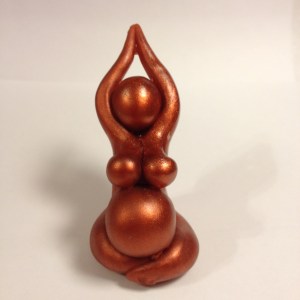
  • Birth art—I created a series of needle felted birth goddess sculptures during my pregnancy that had a “message” for me (that what I needed to give birth—that wild, intuitive knowledge—was already inside me).
  • And yes, reading (and to some extent, classes). I didn’t necessarily use or remember things that I’d read (other than other women’s “voices” through birth stories), but reading definitely helped me prepare—so, while I was not necessarily conscious of book or class-knowledge when I was actually in labor, I was informed by it, yes. During all my reading what I really wanted to to figure out and know was, how am I going to do this? This is the same question that most women who come to my classes have (and my answer is really, “you just will”). The books that were of most value to me were Birthing from Within and An Easier Childbirth. These were the books that had “right brain” lessons to share, even though it was the “left brain” books that I “studied” harder.
  • Yoga—I spontaneously adopted poses used in prenatal yoga during my first labor without even knowing it was “prenatal yoga.” It was an example of how the knowledge already existed inside my body and spontaneously arose when given the space to do so. I also used yoga poses during my other births—not consciously (“I think I’ll try child’s pose now”), but spontaneously and instinct-driven.
  • My blessingway experience/memories—particularly the chant Woman Am I, which I hummed over and over again during my first labor.
  • Voice—talking to myself (inside my head or our loud), verbally coaching myself.
  • My husband—his presence just there with me. I felt like we were one person. This isn’t something I feel like you can “train” for. It too was naturally arising and just pure.
  • Holding a fused glass touchstone and having my favorite pillow (in my third labor, it was holding my goddess of Willendorf pendant).

For me, it all came down to FREEDOM and space for me—I was not in an institutional setting, I was in my own “nest” and that was very key for letting my own body’s wisdom unfold and find expression.

——

A powerful pre-birth lesson in my body’s wisdom actually came from an assassin bug (of all things!). Assassin bugs have very potent, poisonous bites (and in some countries carry hideous diseases). During my first pregnancy I was bitten multiple times in the night by one of them. I had bites on my face (lip) as well as in a row on my arm. The bites caused swelling, ongoing stabbing pain, and joint aching (as well as intense palm-of-hand and sole-of-feet itching when they first occurred). I turned this into a practice experience for myself in coping with labor—figuring that, like labor, this was something uncomfortable and out of my control, but that would eventually pass and that my body would take care of without my needed to actively do anything about it. The stabbing pain was also intermittent (like a pulse), so I thought that was good practice too. I practicing “softening” around the sensations and “being” with the discomfort. I reminded myself that my body knew what to do and that it would heal itself. And, guess what? It did. Each day as the bites healed, I would marvel, “look how much my body knows! Look what it can do without me even knowing what or how it is doing.” Of course, it took several days of stabbing and aching pain for this process to occur, whereas my first labor involved only 5 hours of intense sensation as well as several preceding hours of totally manageable sensation and my subsequent labors only involved 2 hours each of fairly intense sensation. This experience in watching my body take care of itself using its own inherent wisdom was a potent (and unexpected) lesson for me in approaching my first birth.

150 Word Birth Story

Birthing Magazine had a contest recently involving birth stories in 150 words. I edited my second son’s story down and submitted it and it was published in their summer issue. I wanted to go ahead and share the super-abbreviated story of Z’s birth here also:

Open channel
Feeling a familiar sharper edge to my contractions, I woke my husband and got my birth ball. The contractions suddenly picked up to one minute apart. I hung on my husband during contractions and felt some pressure. I reminded myself to be a clear, open channel for birth. I said, “It’s okay baby, you can come out!”

I dropped to my hands and knees, saying, “This is MAJOR!” I talked myself down out of feeling out of control with an ongoing chant of, “It’s okay, I’m okay, it’s okay.” I pushed a little and my water broke.

Zander’s head was fully crowning as our midwife came in. I pushed him out and as I held him, I saw that he was a boy. I could barely believe that after two hours of labour, my baby was here! Zander weighed nine pounds, two ounces.

—-

The much longer version of his birth story is here.

The benefit of participating in the contest is that I discovered what a super-cool resource Birthing Magazine is. It has TONS of great content and I’m excited to read the whole issue!

Pain Pie Exercise for Birth Classes

I address the issue of pain in several ways during my classes. I have struggled with doing this—by mentioning pain do I plant the seed that their births will be painful? etc. I’ve eventually come to a place where I feel like it is important to mention pain directly and to look at it head-on. Many people have the perception that birth is THE most painful thing ever and essentially the most painful thing anyone could ever imagine. So, I feel like by not talking about pain in class, I would be ignoring the elephant in the room of THE (cultural) pinnacle of pain. While I have no doubt that birth can be very painful for some women, I deeply feel that our current birth culture and manner of treating birthing women makes birth painful for more of them.

A very useful tool in exploring sources of pain is the “Pain Pie” idea from Teaching Pregnancy & Birth: A Childbirth Educator’s Perspective by Marcy White (published by ICEA).  With this tool, you create a red circle with the word pain on it and a separate set of white wedges (pie pieces) each containing a supportive element, such as “movement” or “relaxation techniques.” Each piece of pie covers up a portion of the red “pain”—as elements of the pie are removed, the pain piece gets bigger and bigger (an alternative presentation is to add pieces, so that the pain gets smaller).

I mention that too often women in our society are left feeling as if they “couldn’t do it” or that their bodies failed them, but in reality their coping pieces of the pie were stripped away from them (sometimes forcibly). I also talk about how sources of distress to the mother during labor: lack of emotional support, disrespect, ignoring of needs, repeatedly offering medications when none are desired, and restriction of movement, often have little to nothing to do with pain, but instead to what is happening around her (environment and caregivers).

Book Review: Painless Childbirth: An Empowering Journey Through Pregnancy and Birth

Book Review: Painless Childbirth: An Empowering Journey Through Pregnancy and Birth

By Giuditta Tornetta
Cumberland House, 2008
ISBN 978-1-58182-640-1
320 pages, softcover, $16.95

http://joyinbirthing.com/

Reviewed by Molly Remer, MSW, CCCE

Written by a mother of two who is also a doula, childbirth educator, hypnotherapist, Painless Childbirth takes the pregnant mother on a physical, mental, and spiritual journey from conception through postpartum. The text is interspersed with personal stories from the author’s own pregnancies and births as well as those of her doula clients.

A lot of people are initially skeptical of the phrase “painless childbirth” and I really loved the author’s description of what painless childbirth means: “When I say painless, please understand, I don’t mean you will not feel anything. What you will feel is a lot of pressure; you will feel the might of creation move through you. Pain, however, is associated with something gone wrong. Childbirth is a lot of hard work, and the sensations that accompany it are very strong, but there is nothing wrong with labor.” The book has no rigid concept of what “painless” means and no suggestion that mothers who do not experience birth as painless have “failed.” Painless Childbirth is written in a gently nurturing tone throughout (you can “hear” the author’s doula skills coming through), but is also very assertive that painless childbirth is very reasonable, doable, and is, indeed, the birthing mother’s right.

The book contains a lot of ideas and concepts that are of use to doulas and childbirth educators. I particularly liked Tornetta’s characterization of the three phases of first stage labor according to the primary means of coping with each phase—distraction, concentration, and surrender.

After my own experiences with pregnancy loss, I have become more aware of the treatment of the subject in birth books. Painless Childbirth directly addresses childbearing losses in a short, but compassionately written segment about healing past grief. The book also has content about exploring and overcoming fears.

The book is holistic in its approach, addressing body, mind, and spirit. It contains a lot of spiritual content of a “new age” flavor (for example, lots of references to the law of attraction and the book is organized by month according to fetal development as well as associated body chakra). While I definitely agree that birth is a spiritual event, my practical, down-to-earth side stumbled a bit over some of the concepts and phrasing, and the esoteric content may not appeal to all audiences. That said, Painless Childbirth presents a positive, loving, welcoming approach to giving birth that is both refreshing and interesting.

Disclosure: I received a complimentary copy of this book for review purposes.

Birth Warrior?

On Memorial Day, I shared a “birth warrior” quote on Facebook (I was making a thematic connection). It prompted some interesting comments regarding the appropriateness or not of associating “war” or “fighting” with birth. I shared my personal reasons for enjoying the quote in a FB comment and decided to share those thoughts via my blog as well:

I recognize that not everyone connects with the “birth warrior” imagery and I have some personal thoughts to share about its relevance in my own experiences. I was surprised to find myself connect with the birth warrior metaphor in labor. Shortly after my first baby was born, I turned to my dear friend who had been present and said, “I feel like I’ve been in a war.” I distinctly recall my sense of vulnerability, amazement, and weariness in saying that. It was my fundamental and deep, heart assessment of how I felt at the time—I mostly associated it with the blood. I tend to have extremely bloody births and there was blood all over my arms, belly, etc. I felt like one of those bloody, battle-weary soldiers staggering off the battlefield. This is interesting imagery for me, because I tend towards the pacifist/antiwar type of mentality. The second birth also involved lots of blood—I had it streaked on my face, the bottoms of my feet, EVERYWHERE. In that birth and with my third as well, I connected with the “hero’s journey” type of metaphor. Like I had journeyed to my personal threshold and successfully, powerfully crossed it.

So, to me, the “birth warrior” image represents that experience of focusing and channeling and “riding” the waves of intense energy and the feeling of having climbed my mountain, run my marathon, swum my ocean, crossed my threshold, faced my self-doubt, taken my journey, felt my personal POWER, and brought home my prize.

I agree with Carla Hartley wholeheartedly that birth is not a time when a woman should have to *fight* for anything. I also feel like there is a place for the “warrior” archetype in the birthroom. To me, it represents the active nature of birth and dispels any sense of a passive “patient” lying in a bed accepting her “fate.”

And, as I often note, I think it is critical that each woman define her OWN experience—and likewise not try to put limits on other peoples’ experiences/descriptions of their feelings.

The Birth-Breastfeeding Continuum


Birth professionals have long been aware that there is a connection between birth and breastfeeding, but in recent years experts are making this link more explicit and the inextricable nature of the two experiences is becoming clearer. Birth and breastfeeding exist on a continuum. They are not discreet events. As speaker and author Dia Michels says, “we need a new word—birthandbreastfeeding.” Human women are mammals and the same things that disrupt bonding and breastfeeding for other mammals also apply to women. Darkness, quiet, no disruptions/interruptions, safe, upright, mobile, easy access to food and drink as they choose….these things support healthy births for female mammals! In brief, a normal, healthy, undisturbed birth leads naturally into a normal, healthy, undisturbed breastfeeding relationship. Disturbed birth contributes to disrupted breastfeeding.

New mothers, and those who help them, are often left wondering, “Where did breastfeeding go wrong?” All too often the answer is, “during labor and birth.” Interventions during the birthing process are an often overlooked answer to the mystery of how breastfeeding becomes derailed. An example is a mother who has an epidural, which leads to excess fluid retention in her breasts (a common side effect of the IV “bolus” of fluid administered in preparation for an epidural). After birth, the baby can’t latch well to the flattened nipple of the overfull breast, leading to frustration for both mother and baby. This frustration can quickly cascade into formula supplementation and before she knows it, the mother is left saying, “something was wrong with my nipples and the baby just couldn’t breastfeed. I tried really hard, but it just didn’t work out.” Nothing is truly wrong with her nipples or with her baby, breastfeeding got off track before her baby was even born!

Problems with breastfeeding often start before baby is born. According to Linda Smith, BSN, FACCE, IBCLC, co-author of the book Impact of Birthing Experiences on Breastfeeding (2004), birth practices that impact breastfeeding include:

  • Mechanical forces of labor (positioning of baby, positioning of mother, etc.)
  • Chemicals (drugs) used in labor
  • Injuries to mother or baby
  • Treatment of mother during labor
  • Treatment of mother after birth
  • Separation from mother after birth
  • Procedures that alter behavior

Linda Smith also notes that a mother’s confidence and trust in her body’s ability to give birth is related to her confidence in her body’s ability to breastfeeding. There are several birth related risk factors for breastfeeding problems (please note that not all babies with risk factors will actually have problems):

  • Induction of labor
  • Epidural and/or narcotic medications
  • Cesarean
  • Instrumental delivery (forceps or vacuum)
  • Post birth suctioning of baby’s airway

Additional procedures that affect baby’s ability to breastfeed if they are done before baby’s first breastfeeding include:

  • Separation of mother and baby for any reason.
  • Weighing and measuring
  • Vitamin K injection
  • Metabolic tests
  • Circumcision
  • Infant hypothermia

According to the Academy of Breastfeeding Medicine (www.bfmed.org), “unmedicated, spontaneous, vaginal birth with immediate skin-to-skin contact leads to the highest likelihood of baby-led breastfeeding initiation.” Immediate skin-to-skin contact restores the biologic continuum begun during conception.

When I was in graduate school, one of my professors used the following analogy to make a point and I now use it with my own students:

There is a river running through town. Daily, emergency workers are called upon to rescue people from the river who have fallen in and are floating downstream drowning. Day after day they pull the gasping people back to land until one of the workers suddenly realizes, “maybe we should go see what is happening upstream and try to stop these people from falling in to begin with?”

My professor then encouraged us to always remember to go “upstream” when working in the helping professions rather than only addressing the immediately presenting problem. Childbirth professionals are in an “upstream” position when it comes to protecting the birth-breastfeeding continuum!

—-

For more about the value of keeping mothers and babies together following birth, check on Healthy Birth Practice Six: Keep Mother and Baby Together – It’s Best for Mother, Baby, and Breastfeeding from Lamaze.

—-

References:

If my mom were a platypus: what we can learn by studying mammal lactation, presentation by Dia L. Michels, La Leche League of Missouri Conference, November 2007.

Impact of Birthing Practices on Breastfeeding: Protecting the Mother and Baby Continuum. Mary Kroeger and Linda J. Smith, Jones and Bartlett Publishers, Inc.; 1 edition (February 2004). ISBN-13 978-0763724818.

Mother-Baby Togetherness, presentation by Dr. Nils Bergman, La Leche League International Conference, July 2007.

The Power of Touch, presentation by Diane Wiessinger, La Leche League of Missouri Conference, November 2007.

Winning at Birth, presentation by Linda J. Smith, La Leche League International Conference, July 2007.

——

This article is adapted from “Celebrating World Breastfeeding Week and the Birth-Breastfeeding Continuum” by Molly Remer, MSW, ICCE, published in the International Journal of Childbirth Education, June 2008.