Archives

Guest Post: The Land of Colour

In a lovely synchronicity with the Carnival of Creative Mothers coming up on Wednesday, I got a surprise message this weekend from one of my Facebook page’s fans. She shared a beautiful story of self-discovery through birth art and she offered the story to me to share with others. It is my great pleasure to share her voice and her art with you now.

by Amanda Wolf Hara

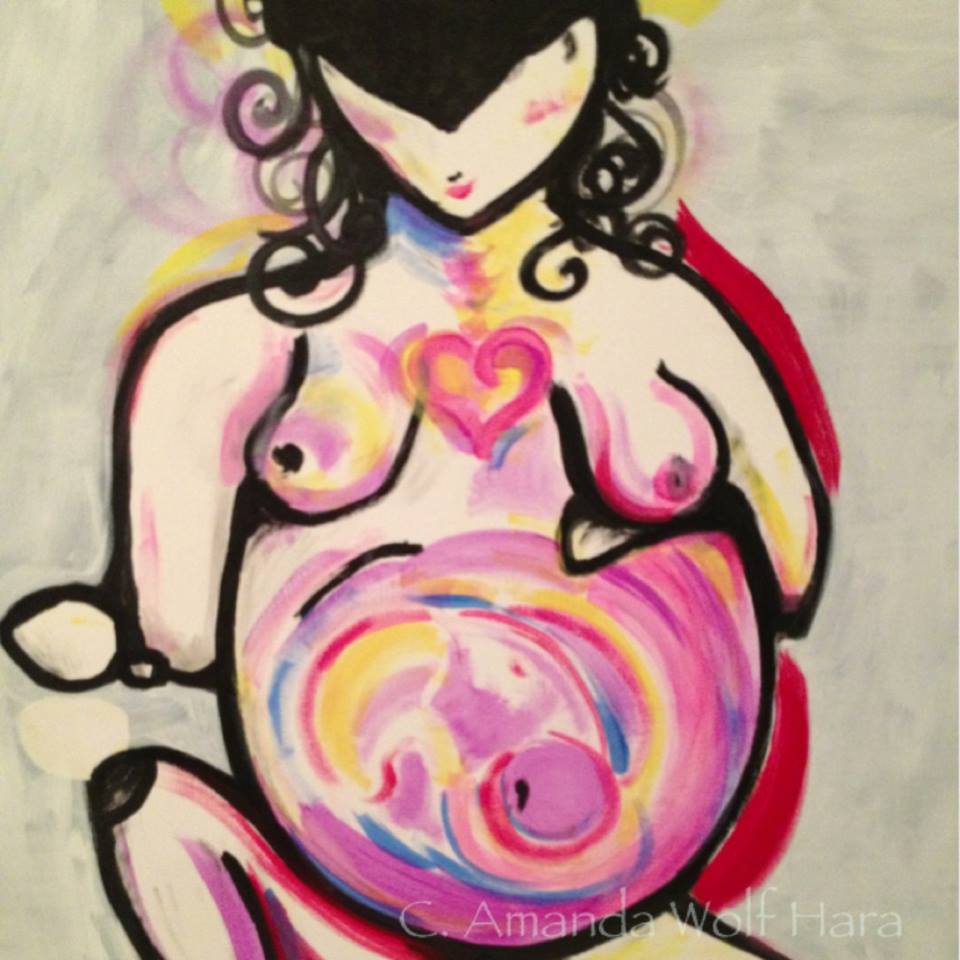
I started a painting 6 years ago- I was reading about the transformative power of birth art- creating art to capture the energy of pregnancy.

I remember the power I felt creating such bold lines and stark contrasts.

The shape of her flowed. The huge swell of her belly, the small legs—because that’s how they felt! The breasts, shaped like mine, not just stock representations of breasts. I was proud of myself as she emerged!

Then I became unsure–afraid.

I didn’t want to go any further—I believed I would add too much and take away her potential & power. I wasn’t sure how to finish her head… Could I do a face? Would that ruin the rest of her?

So I hurriedly made an impersonal head shape–no face, and gave her black short hair–nothing like mine, but, I told myself, maybe we can go for elegant?? Then, did a quick grey background behind her, to fill the blank space & choosing grey, thinking I had to keep the monochromatic quality for her to be “art”.

It was my serious go at sophisticated expression. And I had my inner critic telling me my Birth Art had to be a certain kind of primal. Stark. High contrast. Simple.

But, I hated it.

The grey was depressing. It lacked any technique or skill.

I felt timid and trapped when I looked at her.

All this awesome power, and I caged her in with some hurried attempt to keep her subdued- safe- not “too much” so she would be accepted by her audience.

When I was done, I hung her- mostly out of a determination and obligation to display her.

To show off her powerful form.

But, I never revered her. Celebrated her.

She was in a room only I went into.

When we moved, I kept her in the closet.

I thought about taking off the canvas, rolling it up & storing it, and using the frame to stretch another canvas and create “better” art.

I avoided her for years.

But then, yesterday, I had to paint.

A canvas.

A piece came to mind- a design of the feminine using a prayer I found and love.

I searched my stacks for the right canvas.

I found Her. I looked at her again. Again, hating the grey.

I thought, “If only I could change it; cover the grey. Even just a white background has got to be better.
“But, no, that’s gotta be cheating. That breaks the “rules” of birth art. You can’t go back once it’s done- I’m not pregnant anymore-” blah blah blah went my list.

I kept staring at her, wishing the grey was different.

Then, a thought came like a tickle.
What if?
Why the hell not?
It was MY work, after all.
Why should this have to be a snapshot?
Why can’t I change it?
Why can’t this be a story??
Maybe an ongoing one, if I want?
Who’s going to know?
There are no birth art police, for heaven’s sake!

“Yeah!” I encouraged myself-
“Motherhood is an ongoing story!
I’ve developed, I’m constantly pregnant with myself- learning to birth myself in a myriad of ways!
I want this piece to be a tribute to my ongoing process, not just a one time shot!”

And as I looked at her, giving myself permission to alter her, she started coming alive.
She instantly began calling for bright pinks, blues, purple, red, yellow!
I began to “see” where colours wanted to be.

So, I took the dive and set up to do it.

And, I hesitated.

All those same fears I’ve carried with me.
What if I mess her up?
What if she gets lost under new paint?
What if go totally too wild and end up somewhere in this process where she is unrecognizable, and I exceeded my skill to be able to “fix” it?

What if I regret it??

All these questions are so very familiar.

I ask myself variations of them every time I feel myself called by my passions and intuition to do something.
It’s a contest between my Muse and my inner Critic.
My confidence and my insecurity.

Sometimes I let the Critic win.

So, brush full of white paint, ready to cover the grey, I paused. Waited. Debated.
Then looked at her.

I hated how sad I felt looking at her.
How limited.

I connected with my own feelings of my pregnancy: wanting to burst with empowerment, celebration, Creative force!
But…
feeling obligated to bear the responsibility of all the emotional BS and baggage that surrounded me during that time.

I hated how she was stuck there.
In that time.
I had done amazing work- liberating myself from that energy. I had escaped into the land of Colour.

She needed to, too.

So, I took the plunge.
I did it.
Colours flowed onto her, taking shape and coming home.
She began to come alive!
She began to claim her power.
Celebrate it!
She suddenly became infused with all the vitality I wished I could have articulated before.

I revisited parts of her that never looked like me–I gave her wild curls, more hair, red lips, a blush on her cheeks, a colourful womb, and, as the colours spoke, a baby took shape.

I paused.

My daughter.

Me.

All the creative projects waiting inside me to be birthed and claimed as my Work.

She began to claim her power.
Celebrate it!
She suddenly became infused with all the vitality I wished I could have articulated before.

So, why didn’t I do this before?

I don’t think I had the skill- the experience- I have now- this wouldn’t have come out of me the way it did yesterday.

I don’t think I would have trusted her wisdom in calling for the colours the way I did yesterday.
No, I’m certain of it.

I needed time to develop.

To allow my exploration and development.

I look at her now, and instead of feeling like I covered up that first painting, I have the exhilarating feeling like I built a bridge.

Then to now.

All the colours and lines, considerations and the process are all there for me.

Both/And.
Not either/or like I believed.

So, I ask myself, “Is she done?”
I dunno.

Maybe…
I think, so…
For now….

😉

painting

Amanda Wolf Hara’s web site and etsy shop, Wild Priestess, is coming soon. She is an Artist, Writer, Single Mom (to an absolutely dazzling 5 yr old daughter!), Intuitive, and Shamanic Minister… among a few other things. She can be contacted for commission work.

Guest Post: Infertility Doula

Infertility Doula:  Infertility and the Natural Birth Community

by Kristen Hurst

Okay, so you’ve wanted to have kids since you emerged from the womb. You had your dolls enact your birth plan before you could write it down. At some point, you adopted the title birth junkie, no shame attached. You studied to become a midwife or a doula. You finally get to the age at which you could conceivably conceive…and then you can’t. November 2013 019

For some women suffering from infertility, waiting the year before they can have access to IVF and other medical interventions isn’t the answer. It’s not that they don’t want to wait that long, it’s just that some women don’t feel comfortable with pumping your body full of hormones in order to conceive when you have made an effort to rid your home of hormone-altering plastics and chemicals. Yet when it comes to natural “solutions” it can be just as frustrating to be handed a garden full of herbs and told to wait. You’ve been waiting your whole life—the wait was supposed to be over.

In my experience, natural birth communities tend to do an excellent job supporting mothers who have experienced miscarriages, but are less certain about the role of would-be mothers who can’t conceive. It’s not that we don’t welcome them, especially if they are midwives and doulas, but we assume that they have another place to go: there are a significant number of infertility support groups in the world that even have their own lingo! Nevertheless, midwives and doulas that have experienced infertility are an integral part of our community, and their needs—and perspectives— shouldn’t be ignored.

For women who have only recently discovered their infertility, we can support them through natural treatments and even more conventional fertility treatments. We can offer acupuncture, fertility massage, and a variety of herbs and dietary changes.  We can accompany these women to difficult appointments. We can offer to be an infertility doula, a concept that, as far as I can tell, was coined by Ebru B. Halper to describe the profession she created as a result of her struggles with infertility. Halper guides women through the overwhelming maze of fertility treatments, providing whatever kind of support they may need. I’m not sure why this concept hasn’t caught on, but I think it’s a helpful frame for how we can approach infertility in our communities.

Since training to become a doula, I’ve often thought about how we can be doulas for the women in our communities no matter what they’re experiencing. I often feel as though I am a doula to my children, helping them birth their best selves. But that process has to extend beyond the treatment process into whatever grief or celebration might follow. Ultimately, there is no one “right” thing to say to a birth worker who cannot have her own babies. What we need to do is to listen and be present because we know that birth is a gift. I can’t know what it feels like to be denied that gift, but there are many women who can share their perspective.

The point of this conversation isn’t to make me feel grateful for the fact that I have been able to give birth—it is to celebrate grief as an end in itself. “Grief is neither a disorder nor a healing process: it is a sign of health itself, a whole and natural gesture of love,” says Dr. Gerald May. He continues, “[n]or must we see grief as a step towards something better. No matter how much it hurts–and it may be the greatest pain in life–grief can be an end in itself, a pure expression of love–“  As a birthing community, we must bear witness to this painful love rather than assure the woman that it’s “meant to be.” We can’t stop being infertility doulas once the treatment is over. Making space for both the love within birth and the love within grief can only make our lives richer.

Kristen Hurst is a mother, a writer, a yogi, and a doula. She received her bachelor’s degree in fashion marketing, and writes often about pregnancy and maternity fashion for Seraphine Maternity.   When she’s not trying to juggle the lives of  her sons, she enjoys painting and catching up with a great Jane Austen novel.

Guest Post: Squatter’s Rights

October 2013 024

Squatter’s Rights

A couple of posts ago, I mentioned I’d made a new sculpture that I titled after a friend of mine and an article she wrote several years ago. She originally sent me the article to review, because she was thinking of sending it to a magazine. Several years passed, several more babies were born, her computer got fried, and the article was lost. However, it stayed with me anyway. It stayed with me when I prepared for the birth of my rainbow baby girl, it stayed with me as I created birth art to prepare for her birth, and it stayed with me as I reached down to catch my baby’s whole pink wonderful self in my hands as she was born in one smooth reflex almost three years ago. So, I created my figure and I emailed Shauna about it and then I went digging. Deep in the ancient, archived messages in my Outlook Express folder on my old laptop that now belongs to Zander (age 7), I found it. I found Shauna’s squatter’s rights article that had so touched my birth consciousness in such a way that I never forgot—even though babies, computers, friendships, and time have all marched on. I was already a childbirth educator when I read it, had already given birth myself, and was deeply immersed in birth work and childbearing. However, that doesn’t mean that certain descriptions cannot reach us and grab our attention in new ways. I’m delighted that Shauna gave me permission to publish her article here and to share her insights and experiences in this way!

Squatter’s Rights

by Shauna Marie

Would the new child coming from me be slippery like soap? I rubbed my fat belly. I loved each pound I gained, each craving I had, and every trip to the bathroom. Okay, maybe not every trip to the bathroom. But, I loved this growing baby. Tucked away like a pearl in the sea just waiting to be discovered. I was in a constant state of marvel.

Would I be able to physically do this? No, I don’t mean the labor, nor do I mean the birth. I knew I could do that. I got lost in thought as I planned in my head every moment that would come after my body did the work of labor. The moment would come once my body was ready and the crown of a child’s head pushed itself from me, the moment the child would emerge. That’s what I was planning for; I planned to catch my own baby.

I imagined opening my legs and squatting, I even practiced. I wondered where I’d put my hands, how I would have my legs, and if this little wet creature would be so slippery that I’d drop him or her. In December of 1999 this would be my second birth, but my first time catching a baby.

Like many people from a young age I was led to believe that women didn’t and couldn’t birth outside hospitals. The ones who did were radical or even dangerous. I was led to believe that the birth doesn’t matter, the baby matters. For my own personal sanity, due to cultural birth fear, I had to just come to the conclusion that as long as my baby was okay I could endure anything and that it would all be over soon.

Now rewind a little bit here, because there is something to be said about being at the right place at the right time; or knowing the right person. As a person who now tries to make a difference by being a strong home birth and natural family living advocate, I know who you know can sometimes make all the difference. For some people they just need that connection with real birth; they need to know someone who will talk about what birth really is about from a natural and physiological point of view. Above all people need to be exposed to home birth because it normalizes birth.

I was almost connected at one small point during my first pregnancy, just weeks before my first birth a friend of a friend was having a baby. I asked where she was having the baby at and when. My friend said she was in labor now, and having the baby at home. A jolt of sudden uncomfortableness and worry struck me, “At home! Why?” (Thinking oh my gosh there is no epidural at home!) My friend responded with a rather obvious sounding answer, “Well her mom is a midwife.” “Oh,” I said in an understanding tone. Somehow this made total sense now. If her mom is a midwife then it’s okay for her.

Quickly all home birth thoughts were intercepted with other conversations of non-birth related content. To this day I feel that should have been my contact with home birth. Instead I missed my first calling and just two months later I was induced two weeks before my due date against my own wishes (along with two other women from my OB’s office) to fit into the OB’s schedule.

I learned an awful lot that night. I learned I would never give birth to a healthy baby in a hospital again. I learned that in a hospital it is okay for others to look at your body, touch you, reach into you, and deliver your baby; but it’s not okay for you to do so.

I also learned that birth does matter, not just a healthy baby. Healthy empowered moms matter and instincts are stripped away by technology and birth colliding. This often even includes the instinct to breastfeed.

I was shocked at how disconnected I felt from the waist down. These strangers were in charge of me. There is something about being tied to IV’s and monitors, naked from the waist down in a hospital bed, legs in stirrups, that takes your power away. Even though some one at some point said, “Here comes your baby, look at your baby come” I felt like I wanted to reach over my belly and feel, or catch. I’d seen that in a birth video once –a nurse said something like ‘you can touch your baby’s head and feel’ to a mom giving birth flat on her back. I waited for someone to say that to me, but no one did.  Be it because of hospital policy, or be it because of shame, it was a no-no to touch or even catch what was mine. I felt so disconnected as I tried eagerly to see over my belly, knees being held up to my ears by three sets of hands to the chants of, “Push, push, pushhh…. good girl.”

I wondered so much about just staying home. I had what I thought was an unexplainable and unfounded desire to hibernate in a dark corner like an animal.

Around the same time that I got pregnant with baby number two I heard a doctor on television actually say that women are physiologically unable to catch their own babies. Already committed to having a home birth that comment further sealed the deal. I was catching my own baby this time. Not only do I dislike someone telling me that I can’t do something, I didn’t believe a woman would let her baby just fall to the floor (many mammals are born that
way though). Surely even if a woman didn’t squat with intent to catch her baby the child would be born slipping onto bed or floor without assistance or harm. My research lead me to discover that women have given birth effortlessly while in comas, unassisted and unmedicated. We’ve all heard the stories of scared teens giving birth suddenly, alone in a bathroom. The body just gives birth when it’s time. Not to mention National Geographic taught me from a young age more than just that women in tribes go topless; they also sometimes give birth to babies unassisted and catch them.

Shauna’s eighth baby, born into her hands this summer.

I was also somehow sure a woman could give birth in total control; in control of her thoughts, feelings, and use of good judgment. I was no longer buying into the stereotypical out of control agony portrayed in movies. I didn’t know, but I deeply believed a woman giving birth, if allowed, could totally be in control and instinctively know how to give birth.

I figured that squatting would give me the best angle to catch my baby. Being in a squat, on bent knees, or even on all fours is clearly the most natural and easiest way to birth a baby. Squatting has roots in ancient history as far as birth goes back. It is only within the last 100 to 150 years, since physicians took control of birth, that women have been required to have babies laying their backs in the lithotomy position. Lying on the back (or semi lying) has obvious benefits from the doctor’s perspective as it provides a good view and way to manually remove a baby, as well as use a scalpel to cut a wider opening to the vagina. The use of gigantic tongs (forceps), vacuum suction extraction on the baby’s head, and even manually pulling on the baby’s head have all been routinely practiced by physicians.

Elizabeth Noble, author of Childbirth with Insight, states, “Women who squat for birth can generally deliver their babies without any manual assistance at all. Gravity and the free space around the perineum allow the baby’s rotation maneuvers to be accomplished spontaneously.”

There are vast differences in giving birth in a squatting position rather than lying down. Well over half of all the births in this country currently involve some type of surgical or operative procedure such as; cesarean section, episiotomy, vacuum extraction, or the use of forceps. These interventions and their accompanying risks could be avoided if women would just adopt a squatting position for birth. Aside from working with rather than against the body and gravity the birth canal depth is shortened during a squat, and the pelvic diameter is increased. In fact just the simple act of squatting can open a women’s pelvic outlet by up to 28 percent. All of these benefits can shorten the second stage of labor and the need for interventions. Squatting also reduces the risk of tearing. Dr. Michel Odent writes in Birth Reborn that, “This position assures maximum pelvic pressure, optimal muscle relaxation, extensive perineal stretching, and minimal muscular effort. It also provides the best safeguard against serious perineal tears.”

Routinely birthing moms are put on their backs or reclined in beds which center the mother’s weight on her tail bone, narrowing the pelvic outlet and compressing major blood vessels which reduce proper circulatory function. This in turn reduces oxygen to the baby and to the uterus making contractions less productive and more painful. Less oxygen to the baby signals distress in the infant, which if in a hospital could cause a whole round of interventions. Combine an oxygen deprived baby with a mother trying to push uphill with a baby that cannot move into a good birthing position because of restricted pelvic room, and ultimately you have mothers who are very good candidates for a birth that must be forcefully assisted by forceps, vacuum extraction or the ever so common routine C-section. The Centers for Disease control states on their website that cesarean sections are now at 32.8% in North America (2011).

Delivery of the after birth in an upright position also has clear advantages. When the placenta isn’t compressed there is less chance of blood pooling up and creating large clots, and gravity aids in placental expulsion.

When the day finally came for me to catch my baby I talked myself through the contractions. I told myself I could do this. I said over and over I can do this, because as a pregnant mammal it’s what I was put here to do. When I felt it was time I squatted over a mirror and saw the crown. I told myself to enjoy this moment, not everyone gets to catch their own baby, and I didn’t want to miss one second of this experience. I swirled the thick wet black hair that was presenting around in a circle with my fingertips. Any and all pain was gone, it was amazing. I focused on this new life that was unfolding from my body. I waited for contractions and I let my body do the work without forceful pushing or feeling agony. When the baby slid into freedom and the room was engulfed with newborn smells and newborn cries I cried out, “It’s a boy, it’s a baby boy!”

The impact of that birth was powerful and amazing; so much so that I have caught five more children from my body since then. There is a saying about the “thrill of the catch,” and midwives and doctors know this. It’s intoxicating and it’s very powerful to catch a baby.

So much harm has been done to cloud the process of childbirth. Birth isn’t just about babies, it’s about mothers too. It’s about how they work together. Catching your own baby puts you focused on your birth, and without trying you take the control and suddenly you feel and know what you need to do. Focusing on the important task of birth made an impact on me a very positive way as a mother. True freedom over my body gave me independence, confidence, and self-control.

Not every woman may want to catch her own baby, but every woman should be encouraged to do so, or at the very, very least know they can if they do wish to. Most women I have spoken with actually say they have never even thought of it.

The state of birth in this country lies squarely in the hands of birthing women. Until we start demanding more respect and more variation in our birthing options we have no one to blame but ourselves. We must first credit ourselves with being able to birth safely the way nature intended before anyone else will give us that credit. The seeking out of safe and natural birth options will slowly continue to influence and change how birth is perceived.

There are specialized hospital beds that can be converted in a way that women are more upright. If you will be giving birth in a hospital request them, demand them. Hill-Rom makes such a bed; the Affinity Three Birthing Bed aids a woman to side lie, squat, kneel, sit, and lean in various positions. It has a labor bar and position controls that are quite impressive. The bed can be lowered or raised up, down, back, and forth

There are birth balls, birth bars, and birthing stools that can aid in more natural upright positions in whatever birth setting you choose. There are showers and tubs to soothe a mother.

I share my experiences with catching my own babies, and have even shared very private birth photos and even one video with others in the past; because I have been told by so many women it has empowered them. I also hear from lots of women who say how strong both me and my legs must be to squat down like that. I assure that it’s not my legs that are strong; it’s my heart and my passion, and the willingness to open up and catch what is mine.

Shauna Marie is happily married to the man of her dreams. They live in the Midwest where they juggle eight energetic children while homeschooling and developing upon a one acre hobby farm of veggies, fruits, chickens, geese, and the dream of a dairy goat. She blogs about her life at Life with Eight Kids. Shauna is very passionate about family with an emphasis on childbirth and healthy, happy moms and babies.

Postscript: Shauna’s most recent birth story, excerpted below, is an excellent description of a squatting birth!

I was standing there in the still of the labor lull a rush of hormones hit me and the baby’s head slipped fully into the birth canal. I squatted down instinctively. I was then super indecisive: I flip-flopped between on my hands and knees to squatting, then squatting with one leg up and one leg down, then a leg up on the side of the tub, then standing upright, then a squat-stand and finally then back to the other positions all over again. This baby was going to start to seriously crown in a big way and I had no idea where I wanted to be! Having done this so many times I had way too many choices in my head and I knew what they all felt like. Later Ricky told me he got nervous that I was moving around so much in the tub; he was worried I’d slip and fall. I however felt firmly planted like a rock. I told him later I felt like I had sticky gecko pads on my limbs and slipping never crossed my mind.

Our baby was starting to crown as I finally squatted down low with one leg higher than the other (I was out of time to change things up. I’ll just squat and do it the same ‘boring’ highly effective way I always do it I thought lol.) I used some counter pressure on her velvety head to help ease her head out but it wasn’t really needed and a painless contraction inched her head fully out.

via Life With Eight Kids: Beatrice’s Unassisted Birth Story (half hour labor and birth -with extra info on my favorite topics of vernix, cord cutting, and not pushing).

Related Talk Birth resources:

Active Birth in the Hospital

Spontaneous Birth Reflex

How to Use a Hospital Bed without Lying Down

What to Expect When You Go to the Hospital for a Natural Childbirth

References:

(Elizabeth Noble, Childbirth with Insight, 78). See also Golay, J., et al., “The squatting position for the second stage of labor: effects on labor and maternal ad fetal well-being,” Birth 20(2) (June 1993):73-78.

Postpartum outcomes in supine delivery by physicians vs nonsupine delivery by midwives.Terry RR, Westcott J, O’Shea L, Kelly F. J Am Osteopath Assoc. 2006 Apr;106(4):199-202. Conclusion: Nonsupline positions during labor and delivery were found to have clinical advantages without risk to mother or infant. Enhanced maternal outcomes included improved perineal integrity, less vulvar edema, and less blood loss.

Dr. Martha Collins D.C., Pregnancy and Chiropractic Planetciropractic.com

Russell JGB. Moulding of the pelvic outlet. J Obstet Gynaec Brit Cwlth 1969;76:817-20

Squatting can enlarge the pelvic outlet up to 28 percent (Russell, J.G., “The rationale of primitive delivery positions,” Br J Obstet Gynaecol 89 (September 1982):712-715

Paciornik M; Commentary: arguments against episiotomy and in favor of squatting for birth. Birth 1990; 17(2): 104-5.

The total U.S. cesarean delivery rate reached a high of 32.9% of all births in 2009, rising 60% from the most recent low of 20.7 in 1996 Martin JA, Hamilton BE, Ventura SJ, et al. Births: Final data for 2009. National vital statistics reports; vol 60 no 1. Hyattsville, MD: National Center for Health Statistics. 2011.

Marion Sousa writes: “[Squatting shortens and widens the pelvic outlet.” (Childbirth at Home. New York: Bantam, 1976 in Judith Goldsmith, Childbirth Wisdom from the World’s Oldest Societies, 153)

Several studies have reported that in the majority of women delivering in the lithotomy position, there was a 91% decrease in fetal transcutaneous oxygen saturation (Humphrey et al. 1973, 1974)

Robertson, Empowering Women: Teaching Active Birth in the 90s, (105)

Dr. M. Odent Birth Reborn, (101)

Hill-Rom Affinity Three Birthing Bed educational video and website. Online user manual http://www.hill-rom.com/PDFs/manuals/UserManuals/u025_iet.pdf
Guest Post: Paid Menstrual Leave?

Paid Menstrual Leave – it’s time!  

by DeAnna L’am. Reprinted with permission.

“A Russian lawmaker has asked parliament to give women two days paid leave a month when they menstruate… Mikhail Degtyaryov, a member of the nationalist LDPR party, wrote on his website “During that period (of menstruation), most women experience psychological and physiological discomfort. The pain for the fair sex is often so intense that it is necessary to call an ambulance”… Scientists and gynecologists look on difficult menstruation not only as a medical, but also a social problem…” ~ Standard Digital, August 2013

Fascinating! Lets look at how good things are turned on their heads, yet again, to result (unsurprisingly) in women’s dis-empowerment.

Indeed, a paid monthly Menstrual Leave would be an honoring, empowering option for women worldwide. Yet proposing it for all the wrong reasons diminishes us, and our cyclicity, to “a social problem.”

Campaigns have been initiated over the years under the guise of empowering women, which ended up diminishing, dis-empowering, and ultimately killing us! Marketing guru Edward Bernays was hired in 1928 by an American Tobacco Company president to increase sales of Lucky Strike cigarettes. Sigmond Freud’s work was utilized to expand understanding of ‘What Women Want’ and capitalize on it for marketing purposes.

Realizing that women were motivated and empowered by the suffrage movement, Bernays manipulated a real need – into a persuasive sales tactic. He hired women to march in the Easted Sunday parade smoking what he cleverly named their “Torches of Freedom.” Bernays succeeded overnight: he persuaded women to pick up an unhealthy habit, and commit to spending their hard earned money for years, by equating cigarettes with personal freedom and equality to men. Smoking among women exploded into unparalleled heights. Their personal freedom and equality to men continued to suffer…

Similarly, women were encouraged by manipulative campaigns to start giving birth in hospitals after countless generations of home births. Many new hospitals were built as a result of Second World War, to accommodate the staggering number of injured soldiers returning from battle. It took a few years for most hospitals to empty, as wounded soldiers either recovered or died. Faced with many large vacant hospital buildings and idle staff, administrators procured and released ad campaigns, which sinisterly manipulated women to believe that giving birth at home was ‘primitive’ and unsafe, while birthing at the hospital was promoted as safer, ‘modern’, and a highly intelligent choice.

Women bought into these campaigns, and many others like them, all over the world. They started smoking and felt ‘glamorous’. They started giving birth in hospitals and felt ‘modern’. They started using disposable menstrual products and felt ‘progressive’ and ‘in control.’ All along they have also been developing an array of respiratory diseases and dying of lung cancer; They have been cut open in cesarean sections (1 in 4, to accommodate doctor’s convenience); They have reached an all-time-high maternal and infant mortality rates following hospital birth; And they have been contributing to our planetary ecological crisis by damping 12 billion “feminine hygiene” products into landfills every year, in the U.S.A. Alone!

And here we are: In the midst of a pioneering worldwide movement of women reclaiming menstruation as the heightened state of awareness for which it was recognized in all indigenous cultures; In the process of inspiring women to honor their menstrual blood and their body’s needs, by taking time off to rest and renew themselves on the first day of their period — we are faced with a legal initiative which is both revolutionary and reactionary at the same time!

Wouldn’t it be revolutionary for the workplace to grant Paid Menstrual Leave to women? Wouldn’t we feel validated in our need for rejuvenation, honored for our body’s monthly regeneration, and empowered by the cultural acknowledgment of our rhythm?

We certainly would, if it weren’t billed as a response to “a social problem” of the “fair sex” who suffers “psychological and physiological discomfort.” Our menstrual cycle is neither a social problem nor a mere discomfort. Our menstrual flow is profound and life affirming work performed monthly by our bodies. We need to rest and renew in response to it, or we develop symptoms labled “psychological and physiological discomfort” by our culture (and frequently by us, too…)

Cigarettes, hospital births, and disposable menstrual products were sold to us through clever manipulative tactics, yet we never needed them… We DO NEED Paid Menstrual Leave!

We have stopped smoking in drovers. We have been reclaiming home births, and have started using sustainable menstrual products (such as cloth pads, sea sponges, and menstrual cups). It is time to claim for ourselves, and demand from our culture, a monthly PML to replace PMS!

PML (Paid Menstrual Leave) is the deeply deserved rest our body, mind, and spirit need monthly. In its absence, our body screams in PMS pain, and will continue to do so until we listen to its needs and honor them.

This is a call for action! Lets unite in demanding legaly-bound Paid Menstrual Leave — not as a patronizing gesture designed to send us home for being a “social problem.” But rather as the honoring of a deep need, which springs from our depth, to renew our body, our emotions, and our spirit – monthly – while preparing for another cycle in the ever turning wheel of our lives.  


Š 2013, DeAnna L’am, Red Moon – Cycles of Women’s Wisdom™

DeAnna L’am, (B.A.) speaker, coach, and trainer, is author of ‘Becoming Peers – Mentoring Girls Into Womanhood’ and ‘A Diva’s guide to Getting Your Period’. She is founder of Red Moon School of Empowerment for Women & Girls™ and of Red Tents In Every Neighborhood – Global Network. Her pioneering work has been transforming women’s & girls’ lives around the world, for over 20 years.

DeAnna helps women & girls love themselves unconditionally! She specializes in helping women make peace with their cycle; Instructs Moms in the art of welcoming girls to empowered womanhood, and trains women to hold RED TENTS in their communities. Visit her at: www.deannalam.com

Disclaimer: I am a Red Moon program affiliate. However, the only affiliate link in this post is the one included here!

Rites of Passage… Celebrating Real Women’s Wisdom

“Woman-to-woman help through the rites of passage that are important in every birth has significance not only for the individuals directly bellypictureinvolved, but for the whole community. The task in which the women are engaged is political. It forms the warp and weft of society.” –Sheila Kitzinger (Rediscovering Birth)

“I love and respect birth. The body is a temple, it creates its own rites, its own prayers…all we must do is listen. With the labor and birth of my daughter I went so deep down, so far into the underworld that I had to crawl my way out. I did this only by surrendering. I did this by trusting the goddess in my bones. She moved through me and has left her power in me.” ~Lea B., Fairfax, CA via Mama Birth)

Summary of Article: How do today’s women prepare for major life changes such as becoming a mother? Have our once meaningful rites of passage been trivialised, and if so at what cost? Kat Skarbek looks at ways to reclaim what we have lost.

Permission is given to publish this story on the web (thanks to Women’s Mysteries Teacher Circle e-journal).

Without wishing to appear overly dramatic, I think that our society may be in danger of becoming devoid of any important spiritually nourishing rites of passage. Women no longer seem to know how to celebrate important transitions. We have fallen into the horrible habit of treating life-changing events in trite and meaningless ways and as a result, we are cheating ourselves out of the powerful positive effects that these rites of passage can bring us.

For women, menstruation, puberty, marriage, pregnancy & birth, menopause, death – even divorce and separation, all need to be properly acknowledged when passing through these stages of life. Instead we either ignore them completely as in the case of puberty, first menses and divorce, which sends the message that they are both shameful and unworthy of celebration. Or we use the opportunity to get drunk, act like strippers and carry out questionable tasks which would make a sober person question why she would want to get married in the first place – as on your average hen night. At a friend’s baby shower recently I watched with sinking heart as one of the most important events in a woman’s life was celebrated with games involving stealing pegs from other women’s clothing the minute they unconsciously crossed their legs, guessing the baby’s weight and answering questions such as did she have ‘an inney or an outey’ bellybutton? How, I found myself asking, does this in any way prepare a woman to deal with the rigours of labour and birthing and the demands of the first year of motherhood? Why are we so seemingly unaware that our accepted celebrations offer absolutely nothing to women except a bunch of baby clothes? At standard baby showers there is no molly5wisdom shared, no loving support offered and no nourishment given (unless you count cupcakes!).

How did it come to this?

What happened to our once vital and spiritually awakening rites of passage? The easy (and heavily feminist) answer is 500 years or more of patriarchy. Prior to this and from the earliest records of society, it has been apparent that there were very well observed, meaningful and symbolic rituals to mark just about any occasion. Rituals existed for everything from simple agricultural celebrations of the changing seasons and giving thanks for food and supplies, to complex marriage and birthing rituals that eased newlyweds into their new roles and prepared the way for women to birth with dignity and power. Women in particular carried enormous wisdom about the cyclical nature of life and shared nourishing rites of passage, which enabled them to marry in confidence and with awareness, birth without fear and to die with dignity and grace. Once patriarchy became established it began the systematic erasure (or appropriation) of many of these important rites and in particular it diminished the roles and experiences of women so that they went from being important and respected members of their communities, with power over land, name and children to women whose only role was to birth heirs and to be subservient to their men. Even in today’s changing society the roles of ‘wife’ and ‘mother’ are still considered less important than the roles of ‘career woman’ and ‘breadwinner’. We have higher rates of divorce, higher rates of birth intervention and subsequent post-natal depression and more difficult menopauses now than women experienced 50 years ago. I believe that this is directly linked to the fact that we are now expected to just ‘get on with it’ and disappear into these changes without the proper observances being made. I’m not suggesting that women to disappear into mud huts every time they bleed or to give birth in fields as we did in the tribal days, but I do think that we need to pay more attention to our needs at these powerful times of change. Menstruation is not a curse, it’s a promise of our life-giving ability to come. Menopause is not a loss of youth and sex appeal, it’s a vital gateway to the enormous power of our wisdom years. And pregnancy, birth and marriage are life-changing experiences that need to be embraced and celebrated with something more nourishing than ‘Mr December’ and his overstuffed banana hammock.

A graceful acceptance of our changing roles and an awareness of the power that these changes bring, gives us huge personal freedom. Freedom from the current obsession with youth and aging, freedom to explore our new shapes, our new lives and the possibilities they hold. Isn’t that worth exploring?

Reclaiming simple rites of passage

So how can today’s modern goddesses, and in particular mammas-to-be, prepare themselves for life’s many transitions? A good starting point is to create your own rite of passage for whatever transition you may be going through. Pregnant women could change their planned baby shower to a Mother Shower (also known as a Blessingway). Mother Showers celebrate and nurture the mother rather than focusing exclusively on the child and are a growing trend amongst women. They offer pregnant women a chance to honour their pregnancy journey, to enjoy symbolic rituals of preparation for the labour and birthing ahead and indulge in an afternoon of loving, nourishing attention from their closest friends and family. And yes, there are still cupcakes! During one of these afternoons a pregnant woman can expect to be waited on hand and foot – often quite literally. Celebrations often include some kind of pampering for the mamma-to-be such as a foot and hand massage with beautiful, pregnancy-safe essential oils. She might choose to have her belly, hands or feet hennaed as a recognition of her changing status. She might enjoy creating a beautiful ‘labour necklace’ created out of beads gifted by each woman present and blessed with all of their best wishes for a wonderful birth. These necklaces can be used as a powerful focusing tool during the darkest hours of her labour and can become a beautiful heirloom that gets passed on from mother to daughter, or even from woman to woman within her community, with each subsequent pregnancy adding more beads to the necklace.

What you can do

There are a number of meaningful activities that you could include in your celebration. You could even combine elements of a traditional baby shower with elements from a mother shower by adding in any of the following:

  • A Fear Releasing Ceremony. Writing down your fears on a piece of paper and ritually burning them can help you rid your unconscious IMG_0821mind of any impediments to an easy and positive birth.
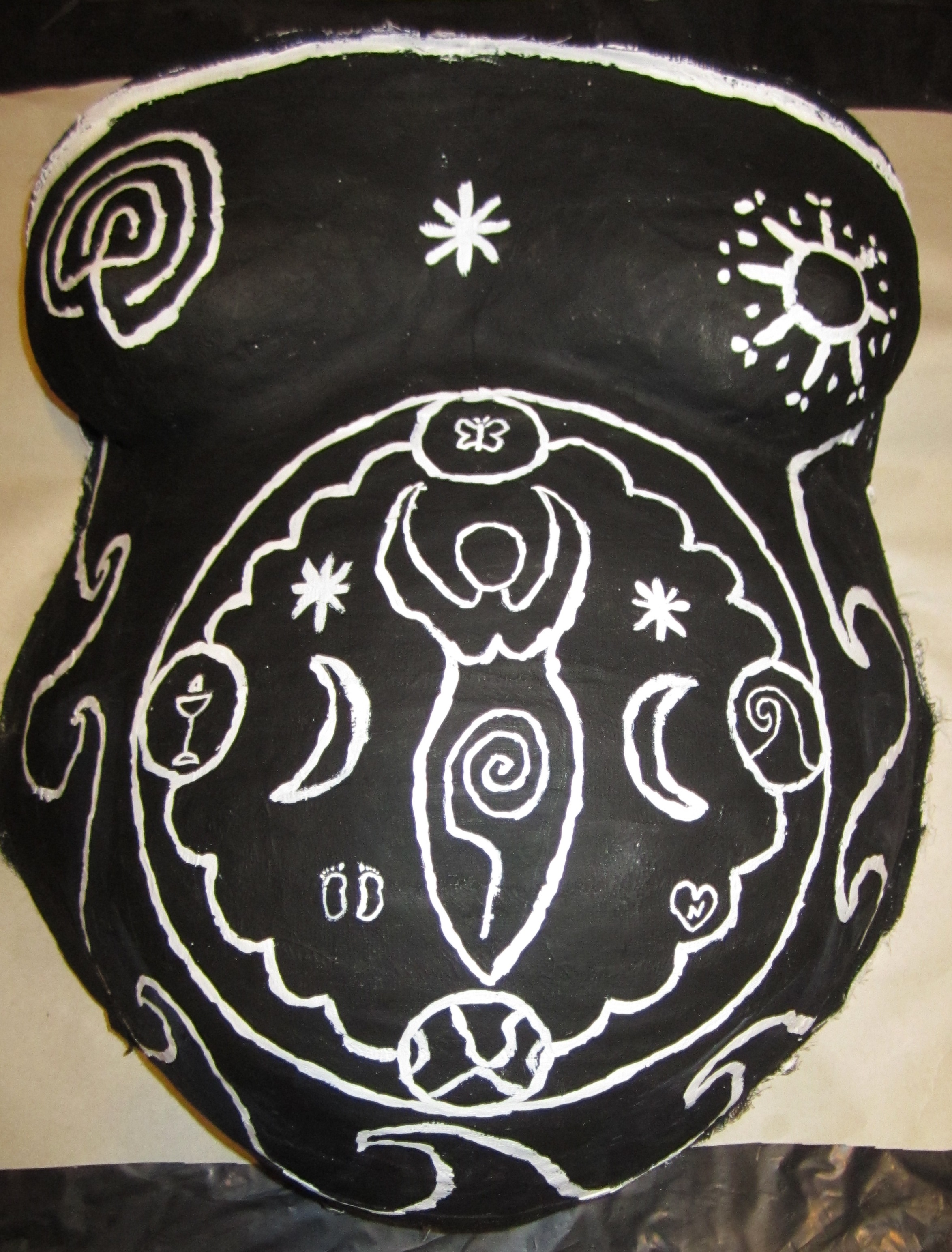
  • Belly Casting. Creating and painting a belly cast (a 3D plaster cast of the beautiful pregnant belly) can be a wonderful meditative tool to connect you more consciously with your body and your baby.
  • Guided Meditation or Visualisations. If there is a group of you, each woman can place a loving hand on the mamma-to-be, while another guides her into a place of deep relaxation where she can communicate with her unborn child or any guides or angels she feels drawn to, in order to receive information or just reassurance.
  • Plant a Tree. Buy a beautiful fruit tree to plant in honour of your newborn. You can tie birth blessings and wishes to its branches until after the baby is born.
  • Give gifts to nurture the mind, body or soul of the mamma-to-be. Most women won’t get the opportunity to enjoy a spot of luxury once the baby is born, so instead of yet more baby clothes why not spoil the mamma with something indulgent such as a pregnancy massage, a hair appointment, a manicure or pedicure or simply some beautiful skin cream to minimise stretchmarks? You can even buy her a gift for after the birth such as a post- natal spa voucher, to give her some ‘me’ time to look forward to when she needs it most.
  • Share Birthing Stories (no horror stories please!). Poetry, singing or chanting can also be a very uplifting way of connecting with your wise inner goddess.
  • Create a Phone-Tree. When labour is established, each woman is called and lights a candle for the birthing mamma to re-create the loving circle of support present on the day and send her thoughts of courage and strength.
  • Provide Nourishing Food and Drink. Each woman present can contribute a meal to be frozen for after the birth.
  • Pledge an Act of Support for after the Birth. Each woman offers one tangible act of support for after the birth when the mother and child are getting to know one another. It can be something simple like providing a home cooked meal, offering to take care of an older child for an afternoon so that the mamma can get some rest, taking the dog for a walk or taking the newborn off her hands so the she can have a recuperative bath.
  • The Baby Moon (or a month of ‘lying in’ with the newborn) is still observed in many cultures and offers a chance for the infant and mother to really bond and get to know one another without the usual worries about cooking, cleaning and taking care of other children. I think it would be very beneficial to women to reclaim this particular tradition.

Finding our way back home.

On the day that a baby is born, so too is a mother. Without properly acknowledging our changing lives in these beautiful and memorable ways, we go into motherhood unprepared for the challenges it may bring. No amount of reading can bring you the kind of self-knowledge needed to be a good mother. No amount of beautiful nursery furniture can enable you to trust in your mothering instincts when you are frightened of making a mistake with your precious little bundle. These things all take time. Reclaiming our rites of passage, no matter in how small a way, can help restore to women something vital for their spiritual and emotional wellbeing. And if you are worried that it might be boring or heavy, you needn’t. Celebrations are just that, a joyous coming together of loved ones to honour something wonderful. Keep that in mind and enjoy the many wonderful ways of celebrating this amazing and challenging time in a woman’s life. Choose the things that work for you, that you will enjoy and that will really give you the space to recognise the momentous changes that are happening and offer you some genuine support and acknowledgement of this special time.

More information about alternative pregnancy celebrations can be found in books such as Mother Rising by Yana Cortlund, Barb Lucke and Donna Miller Watelet (OK) and Blessingways, A Guide to Mother-Centred Baby Showers by Shari Maser (OK).
If published on the web please include the following contact details: Website: www.thedivinefeminine.com.au Email: info@thedivinefeminine.com.au Phone: 0439 636 958

Kat Skarbek
www.thedivinefeminine.com.au
About Kat Skarbek…
Kat Skarbek is a writer, presenter of the Shamballa Spirit Show on 3MDR 97.1FM and the Head Honcho of The Divine Feminine (www.thedivinefeminine.com.au) which specialises in creating unique and spiritually nourishing transitional celebrations and events for women. These include alternative Hen Nights and Mother Showers for pregnant women. She is a proud survivor of the first two years of motherhood and a visit from the PND Fairy.
Phone: 0439 636 958
Email: info@thedivinefeminine.com.au

Previous posts about rites of passage and women’s mysteries:

Rites of Passage Resources for Daughters & Sons

Birth as a Rite of Passage & ‘Digging Deeper’

Blessingways and the role of ritual

Blessingways / Women’s Programs

Red Tent Resources


Repost: How I learned to mother myself

One of my very favorite books for mothers is The Mother’s Guide to Self-Renewal by RenĂŠe Trudeau (past posts referencing her are here). I also enjoy her digital newsletter. While it is a bit after the fact now, I’m reposting her Mother’s Day article about how she learned to listen to her Wise Self. As I wrap up the school session, prepare to travel, keep up with my blogs, plan rituals, attempt to halfway manage to keep up with the classes I’m taking, and mother my children, I need all the reminders I can get about self-care! (Speaking of mothers, self-care, and Mother’s Day, I also very much enjoyed this lovely blessing from Shiloh Sophia: A Mama Day Blessing for All Kinds of Mothering | Our Lady of the Red Thread.)

How I learned to mother myself

by RenĂŠe Trudeau IMG_2168

There’s been a lot of belly button gazing in our house this past week. My adolescent son told me on Friday, “I’m thinking a lot about my life right now,” my introspective husband is taking a class where he’s contemplating our relationship to the cosmos and having just returned from teaching at the ethereal Esalen Institute in Big Sur, CA and the redwood forests, I’m reflecting on my how much my self-care practice has affected my relationship with my husband (read more) …. and myself.

My beloved and I are celebrating our 13-year wedding anniversary this Tuesday and while we still two-step with our respective issues, it seems we’re becoming more accepting and gentle with another, as we slowly become more compassionate and kind to ourselves.

But it’s been a long road.

I have a visceral recollection of the day, ten years ago, when my husband returned to work after being home with me and our newborn for two weeks. Sitting in our dark, quiet kitchen, holding my baby boy, listening to the kitchen clock tick, and blanketed in a postpartum haze, I thought, “This is it. I’m all alone.”  It was a frightening and devastating realization, and I have never felt the absence of maternal nurturing more than I did then. But then, I heard a comforting voice whisper from within, “Renee, it’s time to start mothering yourself.”

That moment was a catalyst for me and the beginning of my journey to learning to both nurture and nourish myself.

For years, I didn’t even know what I needed (self-care, what’s that?!). I was so habituated to the seduction of productivity, to going non-stop, to value “doing over being,” to allowing my internal state to be dependent upon the external world and to tying my self-worth to my latest win. But as I began to tune inward and become reacquainted with my desires—my love of nature, my need to be fed by beauty/art and dance, my passion for nurturing my body through vibrant natural cooking—and watched my own commitment to my well-being grow each day, I began to see the ripple effect this had on my family, my friends and beyond. (Hear how this evolved.)

Learning to mother myself has evolved into a thirteen-year journey to not only becoming my own best friend, but to living a soulful, vibrant awakened life. At times, I am ferocious, radical and even willing to p*** people off in order to stay in integrity with “her”—what I call my Wise Self.  And I found that once I opened up and walked through the doors of self–care, I was gently brought to the path of self-compassion, then self-acceptance and eventually to self-love. It’s been long and slow. But this deeply spiritual practice of self-care has changed my life more than any other.

Now as I move steadily into the second half of my sweet, unpredictable life, holding hands and moving forward–sometimes tentatively–with my kind, tender soul, I leave behind who I thought I was  in order to fully welcome who I am becoming. Warts and all. And I watch my love and acceptance for this beautiful, sometimes controlling and perfectionististic usually compassionate and generous woman grow more each day.

Self-care has gone beyond learning to attune and respond to my physical, emotional and intellectual needs and desires—it’s how I nurture my soul—my very essence. And it’s how I not only celebrate the incredible gift of being in this amazing body and having the gift of this beautiful life— it’s how I remember who I really am.


You may reprint this newsletter in its entirety provided you include at the end: Renée Peterson Trudeau is a life balance coach/speaker and author of The Mother’s Guide to Self-Renewal and Nurturing the Soul of Your Family. You can download free book chapters, receive life balance tips or learn about upcoming events at www.ReneeTrudeau.com. On Facebook at: LiveInsideOut.

Subscribe here to receive Renée’s life balance newsletter.

Guest Post: Spring Sugar Scrub Recipe

I’ve been making my own body care products for quite a few years and I enjoy sharing recipes and ideas with other women. I used to teach classes in making “salves and scrubs” and “lotions and potions” and I find it pretty empowering to take charge of your own personal care products, using only ingredients you can find readily at grocery stores and that you could actually safely eat! So, when I received a guest post submission from Michelle Pino from the spa Skana, I was happy to share it with my readers. Sugar scrubs make a nice simple handmade gift for Mother Blessings ceremonies in particular. If you attach the recipe to the jar, it makes it easy for her to refill it as needed! I also like making sea salt scrubs, for which you would just replace the sugar in this recipe with sea salt (the finer the grain the better).

Scrub Away Winter Skin Just in Time for Spring

by Michelle PinoScreen Shot 2013-02-20 at 10.25.39 AM.png

I love seeing the grass turn green, watching the flowers begin to blossom and the feeling the sun shining through the clouds. Here in central NY, sunshine is rare during the winter months, but there’s plenty to look forward to in spring in summer. However, one of the things most people don’t look forward to in the spring is revealing their dull, dry skin that his been covered up all winter.

Working at a spa in central NY, dry skin is often the focus of many of our treatments this time of year. We use a blend of natural ingredients including fresh herbs and organic products at the spa. Luckily some of the same products we use at the spa can be found right in your own home–or a quick trip to your grocery store!

This simple DIY body scrub is the perfect way to prep for spring, tank tops, shorts, sundresses, and flip-flops! It could also be a perfect gift for a girl friend, aunt, sister, mom or co-worker this Mother’s Day.

Ingredients:

1 c. White Granulated Sugar

½ c. Almond Oil

4-6 drops Lemon Essential Oil

Combine the sugar and oil by slowly adding the oil to the sugar. You may not use all of the oil, or you may need more. You don’t want your sugar scrub to be too ‘soupy’ though!

That’s that! Apply the scrub to your skin in the shower to warm, clean skin. I don’t recommend using it on your face; however, as it may be too coarse.

A sugar scrub is easy to make and can be used any time of year! Try using different essential oils to get the perfect scent for anyone!

This inexpensive treat can be stored in a mason jar or other airtight container. Try adding some ribbon or a printable sticker if you are using the body scrub for a gift. The lucky recipient is sure to enjoy!

Screen Shot 2013-02-20 at 10.19.31 AM.png

Michelle Pino is the Spa Manager at Skana Spa in Verona NY. Michelle is an enthusiastic person that is passionate about her job as well as leading as healthy of a lifestyle as possible. Outside of work, you will find Michelle baking, reading or possibly crafting!

Guest post: working/parenting interview

In late 2011, I participated in a working/parenting series at the blog First the Egg (authored by another Molly!) As I continue to balance my working/parenting life (and as I take a computer-off retreat during this week), I decided to revisit my guest post and reprint it here. I’m not changing or editing anything about it, so in this universe, I still had an infant, rather than a busy toddler girl!

working/parenting interview: Molly Remer

Balancing working and parenting... ;)

Balancing working and parenting… 😉

By Molly | Published: 18 October 2011

An interview with Molly Remer of Talk Birth, & part of working/parenting series that’s ongoing here. The first three of us were Mollys, but I swear I’m done and will give you guest post authors with other first names soon!

–

What activities in your life do you consider “work”? Do you think of parenting–or some component of parenting–as “work”?

I do not think of parenting as my “job.” Being a mother is a *relationship* to me, not a role or a job. However, it is an extremely consuming relationship! And, perhaps paradoxically, some elements of mothering do feel like hard work. Like Adrienne Rich, I feel like one’s feelings about motherhood as a relationship and motherhood as an institution are two separate things–I can find motherhood as institution oppressive, while still finding the relationship with my children fulfilling. So, I guess what I’m saying is that there are parenting tasks that are work to me, but that the relationship dimension–which I place primary value on–is not a job or work.

A mothering moment that I’m not proud of came up for me immediately upon reading this question. My son was about three and something challenging had happened that I’ve since forgotten–I believe it was something to do with kitchen mess–and I said to my son with a sigh, “wow! Sometimes you are really hard to take care of” (like I indicated, not the best moment from me) and he replied, “I’m not hard, I’m soft! Just feel my little body!” He rubbed his hands all around his chest and stomach as he shared this–demonstrating his genuine softness. ::sob::

Has your relationship with work changed as a result of your experiences parenting?

Yes, I desperately snatch at free moments, packing one million tasks into my solo hours, like a starving person who is unsure where the next time-meal is coming from. I feel greedy for time alone to work in silence. I continue to require silence for my best work–I hate listening to music while writing, etc. This isn’t new for me, but the advent of motherhood layered on many challenges to experiencing what for me is an ideal work environment (silent and distractionless).

Do you do any non-parenting activities, for pay or without pay, that you consider “work”? If so, how do you juggle these roles and activities with parenting?

An example: I typed this whole response on my phone while nursing my sleeping baby.

Yes, I teach in-seat and online college classes. I write. I am a breastfeeding counselor. I edit a newsletter. I am a D.Min student. I facilitate groups. I teach birth classes. I consider all of these things work activities. I do not distinguish between paid and unpaid activities.

Something I feel is important to mention and is likely a feature of socioeconomic factors, is that to me my work equals passion, commitment, vibrancy, and aliveness. The place where the world’s great hunger and my own gifts meet. It is my “music.” The things I am “called” to do on this planet. The wild and precious life I have to offer to the world. Work to me does not connote drudgery or burden (except when I make it so, by expecting inhuman quantities of productivity from myself).

Is there work that you want to do but can’t right now? What does that look like for you?

Yes, I have three books in partial stages of development and just have to let them rest right now.

Do you ever feel misunderstood or judged because of how work happens in your family, or because of your relationship with work? What does that look like for you?

Yes, but I don’t feel like I have time to explore my answer right now. Women have always worked-–in motherhood capacities and in other capacities (usually simultaneously). I feel like we do all women a disservice by setting up or assuming either-or scenarios. I feel like people who think of me as a WOHM imagine I’m gone all the time and missing milestones, when really I’m out of the house ten hours per week and spend 99% of my waking and sleeping moments in the company of my baby, not to mention the fact that I homeschool my boys. I feel like those who look at me as a SAHM consider my teaching and writing to be my casual little “hobbies” that I dabble with in my free time, rather than career activities for me.

I could go on for ages, but both work and motherhood call to me now and I’m going to have to be okay with this being what I have to offer to the dialog in this moment.

–

For more on Molly’s relationship with working/parenting, please click through to her lovely post “I just want to grind my corn!” and her follow-up “Surrender?“

Guest Post: Nine Reasons to Choose Independent Birth Eduation

This guest post is part of my blog break festival. The festival continues through December, so please check it out and consider submitting a post! Also, don’t forget to enter my birth jewelry giveaway.

I’ve been an independent childbirth educator since 2005. For many years, I’ve taught one-on-one classes to local couples and it has been wonderful to connect on a personal level with such individualized classes. Now, I’m teaching Birth Skills Workshops in collaboration with Rolla Birth Network. I’m still an independent educator—one not employed by any other organization or hospital—but now, rather than exclusively one-on-one, small groups of couples come together to practice hands-on skills for birth in a private, comfortable setting. I previously explored my own take on why choose independent birth education and here are some additional reasons!

Nine Reasons You Should Choose Independent Birth Education

by Jan Haley

Whether you still have a few months to go before the birth of your baby or the due date is right around the corner, it’s not too late to look into some independent birth education. Why are these educators an excellent decision? Read on to find out!

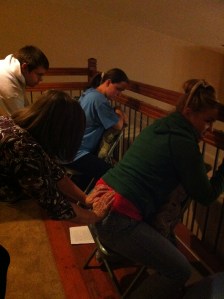
At a recent workshop.

At a recent workshop.

Personalized Attention
In a class, everyone has to work on the same components at the same time. However, with independent birth education, the program is tailored to your own needs. If you already know the answer to a particular question, you need not spend countless minutes listening to a lecture on the subject matter.

Personalized Questions
In addition to not hearing information of which you are already well aware, independent birth education allows you to ask the questions that pertain to your specific situation. Whether it’s about the birthing process or how to handle your baby immediately after birth, the concern will be addressed.

Personal Information
Let’s face it: when it comes to giving birth, you need to be comfortable revealing some personal information about yourself. However, that doesn’t mean it must be done in a room full of strangers. Working one on one with someone allows you to still maintain a level of privacy.

Generalities
In a hospital program, the educators might have to answer questions in a very diplomatic way, because that is what their work policy requirements. When it comes to independent education though, no such requirements exist, unless the person is attached to a hospital or other type of program.

A Customized Plan
Many mothers write out a birth plan, but some of them may feel forced into certain decisions. An independent birth educator will know a lot of information and will be able to offer many details and ideas for structuring a birth plan. A good independent educator will also remind you that a birth plan is not a substitute for good communication with your health care provider!

Partners
Some women choose to give birth at home. Doing so can feel like a lot of pressure on dads, so it’s common to ask independent birth educators for referrals for doulas to be present and support the process (some independent educators are also doulas and may be available to attend births). Birth partners can also feel totally comfortable asking questions in a private setting and they will also learn many useful comfort measures to add to their own labor support “toolbox.”

For Single Moms

Speaking of going it alone, it’s important to address single mothers when it comes to independent birth education. Being pregnant alone can be a really lonely road, and these educators provide not only an instructor, but a friend to such individuals.

Formal Instruction
Some educators are certified. Therefore, they are not only providing their personal experience as mothers, but also information that was garnered from a reputable course or program, so you’re really gaining the best of both worlds.

Confidence

It’s easy to feel embarrassed about giving birth or anxious about everything that is going to happen after the baby is born. Fortunately, independent birth educators are able to give women the boosts of confidence that they need, because as they get to know you, they can help you figure out what works best for you.No matter what plan you ultimately wind up choosing for your birth, be sure to at least consider independent birth education to have a method that is tailored to you. I tried this track, and I never looked back.

Jan Haley writes about motherhood, health and more. A home nurse, she enjoys writing about the profession and helping aspiring nurses find the best RN-to-BSN Programs for them.

Guest Post: A Secular Sabbath

This guest post is part of my blog break festival. The festival continues through December, so please check it out and consider submitting a post! Also, don’t forget to enter my birth jewelry giveaway.

I was happy to review Sarah’s book earlier this year and I absolutely love this guest post from her explaining how digital sabbaticals work in her own life. At our own house we have been observing “computer off day” every Sunday for a number of years. It is most excellent—amazing how much “more time” appears in my life when the digital noise is silenced for a spell. I do need to make sure I commit to having Sundays be “app off days” too, because I didn’t have those devices when I started the practice and it is very easy to trick myself into thinking it is okay to check, “just one thing” on Sunday as long as it isn’t on a computer! (Of course, these days I use my i-devices more often than my laptop anyway)

A Secular Sabbath

by Sarah Whedon

“It is one thing to race or be driven by the vicissitudes that menace life, and another thing to stand still and to embrace the presence of an eternal moment.” -Abraham Joshua Heschel in The Sabbath

 I love that I had the mental space to generate the idea for this guest post while I was taking a short break from everything to do with blogging.

 You see, my dreams at night had begun taking the distressing form of social media streams: Facebook, Twitter, Hootsuite, Google+, GoogleReader, email, Moodle, Skype, WordPress. (Side note: these are all web-based tools with free versions that I use regularly. There, now if you go look one up, reading about taking a break was also productive.) 

I spend most of my time at home with young kids, but I also manage to volunteer for a couple of reproductive health and justice organizations, Chair an online seminary department, and manage a blog, because I can do most of it online from home using those apps.

My dreams were a warning sign, though, about how I was managing my time and mental resources. I listened, and I decided that once a week I would observe a social media Sabbath. I originally got the idea of limiting technology use once a week from Michael Pollan, whose version is about greening your lifestyle, which is also appealing.

He, of course, got the Sabbath idea from Jewish tradition, in which the day is a time to rest from work, and focus on family and holy things. Michael Pollan’s version doesn’t borrow much from the rich traditions of Jewish observance, my version isn’t exactly like Michael Pollan’s version, and if you decide to observe a secular sabbath, yours won’t be exactly like mine.

Here’s what I do: from 6:30am to 6:30pm on Fridays I’m officially off social media (in practice it’s usually a few hours longer). I don’t use any of the apps I’ve listed above, nor do I do “just one quick Google search” to look something up that I get curious about. I do use my smart phone to take pictures of my kids, navigate around town, and (gasp) talk to loved ones, because those aren’t the uses that were causing me trouble. 

When I observe my version of a secular Sabbath I find that I’m more present all day Friday, and actually all the other days, too. Nobody minds that I’m offline for a day, especially because I set Friday posts to run in advance, and let people know I won’t be available. I don’t dream about social media anymore. And when I step away from the constant input of internet data, I can have my own ideas, like the idea that while Molly is trying to take a bit of a break, I can share how I take my break. 

So that’s how I’ve been claiming some rest time each week for the past month or so. Do you take technology fasts or Sabbaths? How do you do it?

Sarah Whedon is Chair of the Department of Theology and Religious History at Cherry Hill Seminary and is the founding editor of Pagan Families: Resources for Pagan Pregnancy and Birth. Sarah’s teaching, research, and advocacy work center around topics of spirituality, feminism, and reproduction. She makes her home in San Francisco with her partner and their children.Whedon2crop.jpg