Archives

Tuesday Tidbits: International Day of the Midwife

IMG_4848Today is International Day of the Midwife and I find myself reflecting on the many midwives I have known and the incredibly diversity and gifts of the women who join this profession. In addition to the midwives I had for prenatal and postpartum care for each of my births, I’ve been privileged to know many midwives on the state and national level through our shared interest in maternity care activism and birth rights. With my first baby, I had prenatal and birth care with a family practice physician and a CPM. The CPM was gray-haired, pretty, soft-spoken and wryly witty and pretty much exactly what you picture a stereotypical midwife looking like! My prenatal care with this team was excellent, birth care so-so (I didn’t need much), but my postpartum care left a lot to be desired and I felt very cast adrift after the birth. I became very embroiled with midwifery activism and birth work after this birth and as a result my experiences with all subsequent midwives has been an interesting blend of collegial + consumer. My first birth was the only one for which I was consumer only. Though I’m not a midwife myself, my subsequent experiences all involved being a sister birthworker AND client, rather than solely a client. This has both benefits and disadvantages.

My midwife with my second baby was amazing. I loved her so much and I have felt a gap in every pregnancy following that I was not able to have her as a midwife again. She was gentle and caring and passionate and inspiring and wonderful. Cute and upbeat, full-figured, and intelligent, she had a soft and reassuring presence and gave wonderful hugs! We became good friends and she was a very important part of my life. My prenatal care and birth care with her was excellent. She was also helpful with postpartum care, but I don’t think I “allowed” her to be as helpful as she could have been because I couldn’t allow myself to be as vulnerable and needy as I actually felt.

When I was pregnant with my third baby, my much-loved midwife had moved away and found myself at a loss for who to choose for pregnancy and birth care. This baby died early in my second trimester and I found myself calling on the sisterhood of midwives for help when I desperately needed it. From the very busy midwife who talked to me kindly and patiently when I was freaking out over a retained placenta, to the Mennonite midwife who helped me from the road as she was driving to another state and connected me to yet another midwife several hours away who drove in to town to meet and help me when I was very scared and alone, it was during this experience that I realized very viscerally how much we need midwives in our lives. When I was pregnant again, I decided to choose the Mennonite midwife for my prenatal care and immediate postpartum care. She is a very capable and determined and intelligent midwife, but I felt an unbridgeable gap between us spiritually speaking and so was never able to fully connect with her emotionally. She embodied the gray-haired, no-nonsense “granny midwife” archetype. She provided great prenatal care and was very respectful of my wish for immediate postpartum care, but an unassisted birth. Postpartum follow-up care was limited due to snowstorms.

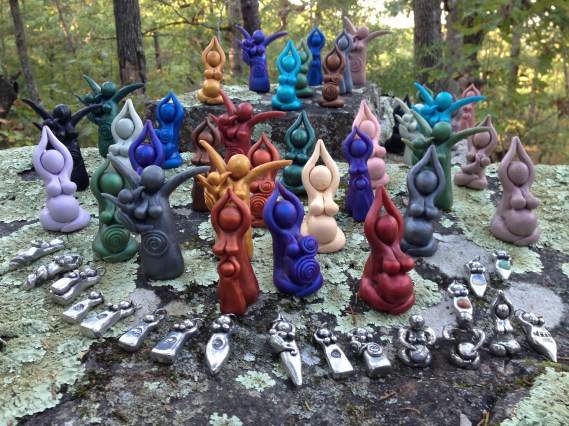
With my last baby, I felt a powerful need to feel taken care of again. I really needed to have some set aside time, Mollyblessingway 027space, and energy that was just focused on me and my baby. I knew that I needed a midwife! While I could have used the same midwife as with the baby before, this time it was important to me to develop the emotional connection I had with my second midwife—I needed a midwife with whom I could feel “safe” with all of me, instead of feeling like I had to hide my goddess sculptures when she came over! 😉 It took some work, but I was able to find that. With this experience, I came to accept that the blur between colleague-consumer is my reality and I will never re-capture the feeling of being client only and being completely focused on in that respect, because I’m simply not just a client only. That’s okay. This midwife has long brown hair, wears lots of skirts and had the hippie-ish midwife feel I was craving. She is funny and talkative and connected to the roots of what midwifery is all about. I was safe with her in the way I needed. I really appreciated the midwife’s prenatal care (and the opportunity to focus on my pregnancy and baby), her respect of my wish for immediate postpartum care rather than birth care, and her postpartum follow-up care. I felt like this midwife offered the most complete postpartum care of all of my birth experiences.

I’ve mentioned before that the only vaginal exam I had during six pregnancies was at ten centimeters dilated when I went to the birth center to push out my baby (I also had to have one for a manual clot extraction following his birth and one for help removing the placenta after my miscarriage-birth of my third baby). This is totally cool with me. Somehow I’ve managed to labor and birth four full-term babies without ever knowing how dilated I am in labor! So, I loved reading this article about the pointlessness of vaginal exams in labor and the cultural attachment, even in midwifery circles, to cervix-focused childbirth:

“…There is also reluctance to change hospital policies, underpinned by a need to maintain cultural norms. The Cochrane review on the use of partograms on the one hand states that they cannot be recommended for use during ‘standard labour care’, and on the other hand states: “Given the fact that the partogram is currently in widespread use and generally accepted, it appears reasonable, until stronger evidence is available, that partogram use should be locally determined.” Once again, an intervention implemented without evidence requires ‘strong’ evidence before it is removed. The reality is that we are unlikely to get what is considered ‘strong evidence’ (ie. randomised controlled trials) due to research ethics and the culture of maternity systems. Guidelines for care in labour continue to advocate ‘4 hourly VEs’ and reference each other rather than any actual research to support this (NICE, Queensland Health). Interesting whilst Queensland Health guidelines recommend 4 hourly VEs, their parent information leaflet states: “While a VE can provide information about how a woman has progressed so far in labour, it cannot predict how much longer you will be in labour…” and that there are “…other factors such as the strength, duration and length of contractions as well as a woman’s behaviour and wellbeing that can indicate progress in labour”. Which begs the question ‘why bother doing a VE’?

The cervical-centric discourse is so embedded that it is evident everywhere. Despite telling women to ‘trust themselves’ and ‘listen to their body’, midwives define women’s labours in centimetres “She’s not in labour, she’s only 2cm dilated”. We do this despite having many experiences of cervixes misleading us ie. being only 2cm and suddenly a baby appears, or being 9cm and no baby for hours. Women’s birth stories are often peppered with cervical measurements “I was 8cm by the time I got to the hospital”. Even women choosing birth outside of the mainstream maternity system are not immune to the cervical-centric discourse. Regardless of previous knowledge and beliefs, once in labour women often revert to cultural norms (Machin & Scamell 1997). Women want to know their labour is progressing and there is a deep subconscious belief that the cervix can provide the answer. Most of the VEs I have carried out in recent years have been at the insistence of labouring women – women who know that their cervix is not a good indicator of ‘where they are at’ but still need that number. One woman even said “I know it doesn’t mean anything but I want you to do it”. Of course, her cervix was still fat and obvious (I didn’t estimate dilatation)… her baby was born within an hour…”

Vaginal examinations: a symptom of a cervical-centric birth culture | MidwifeThinking

I also read this article about the now late, great midwife and activist, Sheila Kitzinger and how she connected her birthwork to feminism (as do I). I despise the article’s title, but it is still worth a read!

…In the Seventies, I was viewed as a radical for saying that birth was being depersonalised and treated as if it were a pathological event, rather than a normal life process.

To my surprise, it wasn’t just obstetricians who dismissed what I had to say. I also found myself in conflict with feminists, who saw birth in very simplistic terms.

Why? Because they claimed it was every woman’s right to give birth painlessly.

An article in Spare Rib, the radical campaigning feminist magazine, went further.

Without any evidence, the authors asserted: ‘Undoubtedly, hospitals, with all their faults, are the safest places in which to give birth. For this reason, we think we should press for improvements in hospitals rather than support a move to more home confinements.’

I was appalled at how my sister-feminists could fail to support woman-centred birth. Polly Toynbee, writing in The Guardian, was particularly virulent, dismissing me as a lentil-eating earth goddess…

via Sheila Kitzinger on why feminists HATE natural childbirth and why it’s harmful | Daily Mail Online.

Lentil-eating earth goddesses unite! Unlike Kitzinger’s experiences with the distance between some expressions of feminism and birth-care, I find that many midwives, whether explicitly or implicitly, understand the deep connection between midwifery care, birth activism, and feminism.

“Midwifery work is feminist work. That is to say, midwives recognize that women’s health care has been subordinated to men’s care by a historically male, physician-dominated medical industry. Midwifery values woman-centered care and puts mothers’ needs first. Though not all midwives embrace the word feminism (the term admittedly carries some baggage), I maintain that providing midwifery care is an expression of feminism’s core values (that women are people who have intrinsic rights).

–Jon Lasser, in Diversity & Social Justice in Maternity Care as an Ethical Concern, Midwifery Today, issue 100, Winter 2011/2012

via Midwifery & Feminism | Talk Birth

Perhaps this is because midwives care so deeply about mothers and feminists might actually make the best mothers…

…As a mother who works extensively with other mothers, I appreciated Caron’s acknowledgement that raising children is a feminist act with potential to create change as well. “Another strategy for change is through raising children to be just and caring people. A media image portrays feminists as being against motherhood—but in fact, feminists make the best mothers. They raise children aware of themselves and the world, of options and values, of what justice means and how to work toward it, and how to be self-critical and self-respecting” (p. 203-204). Caron also explains that “in a just society, women would be free to make whatever decisions they needed to, for however long they needed to, in relation to political action in the public and the private sphere. All people would participate in the decision-making, and women would be supported in their decisions rather than, as sometimes happens, made to feel guilty for not doing enough or not valued for what they do.”

via Thesis Tidbits: Feminism, Midwifery, and Motherhood | Talk Birth.

dayofmidwifeHappy International Day of the Midwife! Thank you for bearing witness to our journeys and for holding the space for the continually unfolding spiral of life.

“…As we ready ourselves to accept new life into our hands,
Let us be reminded of our place in the dance of creation.
Let us be protectors of courage.
Let us be observers of beauty.
Let us be guardians of the passage.
Let us be witnesses to the unfolding…”

—Cathy Moore (in Sisters Singing)

via National Midwifery Week! | Talk Birth.

In addition to midwives, we’re also celebrating mothers all week this week! First on our lineup of activities is our gift to you: our first ever coupon code for $5 off purchases over $15. Use code: MOTHER.

We’ve also got a giveaway upcoming, two new product launches, a new Facebook group, and two class announcements! Stay tuned…
April 2015 021

Tuesday Tidbits: Mothers and Babies

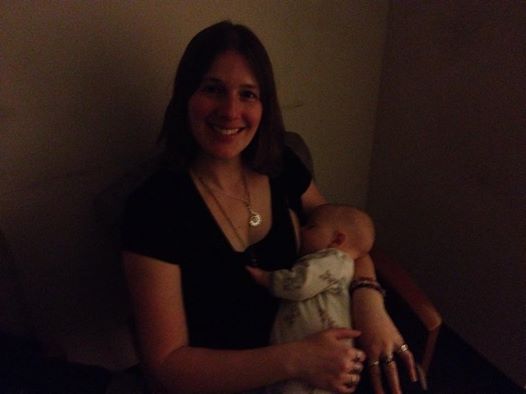
IMG_4269I might look like I’m just sitting on the floor at a Red Tent Circle nursing my baby, but really I’m using the power of my mind-manipulating microbes:

So, when a mother breastfeeds her child, she isn’t just feeding it. She is also building a world inside it and simultaneously manipulating it.

via Could Mothers’ Milk Nourish Mind-Manipulating Microbes? – Phenomena: Not Exactly Rocket Science.

Some thoughts from my Facebook friend Jenny about being done having babies and not feeling sad about it:

Today, my heart is too full of four little people, and the man with whom I created them, to even allow room for an ache. In that tiny corner where an ache might form someday, I’m growing my own dreams, my someday-plans that have nothing to do with raising children, nurturing seeds of myself apart from my role as mother. Truthfully, I kind of love having that corner to myself. I’m not sure I want to share it with a sense of sadness over who or what won’t be, because I’m pretty happy with who and what is as well as with what lies ahead…

via Waiting for The Ache: We’re Done with Babies and I’m Not Sad.

Tanner is such a sweet treasure bonus of a baby and I feel like I’m cherishing him a great deal. And, I hold two realities: a definite sense of “doneness” and readiness to be done with the baby stage of my life, as well as a bittersweet pang at the babyness of his babyness and how swiftly it is passing me by. I want to soak in it and yet the world keeps spinning so rapidly and every day he grows bigger right before my eyes. I want to memorize it. I keep telling Mark, “we only get this year to have THIS BABY!” and it kinds of freaks me the heck out!

Foot bath together after salt bowl ceremony.

Foot bath together after salt bowl ceremony at April Red Tent Circle.

And some lyrical musings at 39 weeks from my friend Halley as she stands at the edge of another birth/postpartum experience… April 2015 123

I think about what’s coming next,

The beast that is postpartum.

I think about what’s coming next,

The love that is new baby.

My labor will be (I pray) just one day,

One day among thousands

My mothering will go on and on,

And I’ll need to know how strong I am…

via Messy 39 Week Poetry | Peace, Love, & Spit Up.

Her poem made me get a little teary and brought me back to the Standing at the Edge song by Nina Lee that I found so meaningful during labor and postpartum…

Every mother deserves excellent care postpartum, however, the “arrowhead” of American postpartum care does not show us a culture that values mothers, babies, or life transitions. I am fortunate to have had the kind of excellent care that every woman deserves and that few women receive. Part of this was because I actively and consciously worked towards building the kind of care I wanted following birth, but part of it is because I am lucky enough to belong to a “tribe” that does value pregnancy, birth, postpartum, and mothering.

via Ceremonial Bath and Sealing Ceremony | Talk Birth.

My last postpartum experience was actually a really delicious time of nourishment and cocooning. Postpartum with my first baby was the worst and I just kept getting better and better at planning for and getting what I know I need during that time of tender vulnerability.
That said, I still feel like this more often than I’d like!

Like how parenthood totally doesn't change you at all.via This New Mom Chronicled Her Baby’s First Year In Brutally Honest Doodles.

I enjoyed this post by a dad about why mothers don’t want to be touched. My instinct to shrink away or duck under his arm, doesn’t stop at just my husband though, I don’t feel like I have a lot of physical caregiving energy left for my other kids lately either—Tanner uses up a lot of me!

…I felt offended. It made me feel like she didn’t love me. I was her husband of 10 years. She should want to be held by me… right? I wasn’t one of her children, I was her husband.

“I just wanted to hold, you.” I said. “I’m not asking for sex, or anything. I’m too tired for that. I’m getting old, obviously. It’s been just a long day.”

At the mention of being held, Mel cringed a little. Once again, I was offended. I usually am when this happens. And it doesn’t happen all that often, but always more than I’d like. But it was late, and I didn’t want to fight…

via Why a mother doesn’t want to be touched ~ No Idea What I’m Doing: A Daddy Blog.

In last week’s post I just missed including this powerful post about the courage and strength of women who give birth by cesarean:

But in the birth world, I see a certain type of birth held up as ideal, and in my work I capture many that would fit the standard. The fictional “first place trophy of childbirth” always seems to go to the un-medicated, vaginal births where mom and partner are active and unhindered by doctors or nurses. Just last night, I read an amazing birth story where mom, unintentionally, gave birth at home in her bathtub. Her husband caught the baby because no one else was there. They sat at home on their couch and soaked in all the newborn goodness. It was a great birth story…and I’m sure it will get passed around again and again.

I had the honor of photographing this gorgeous cesarean birth – not the plan, (she was hoping for a VBAC) but beautiful, powerful – and redemptive, in its own right.

via Three Truths About C-section Mamas

April 2015 045

Tuesday Tidbits: Cesarean Awareness Month

11148668_1614543705424512_3613965156253725168_nIt is Cesarean Awareness Month! We finished several new mama goddess designs this month and have a CAM-themed April newsletter ready to go out (subscriber freebie in this newsletter is a new birth education handout: “Can I really expect to have a great birth?” Sign up for the newsletter at Brigid’s Grove!)

Some Cesarean Awareness Month themed posts for this week. First, a meditation for before a cesarean:

You say you honor choices. 11108844_1614067252138824_1518757261202060615_n
Can you really honor mine?
I will always honor the process which
brought forth flesh of my flesh.
I honor your births too.
Can you ever honor my experience, or will I
forever be a part of your statistics on
the way things shouldn’t be?

via Birthrites: Meditation Before a Cesarean | Talk Birth.

And, some past thoughts on helping a woman give birth…what is the balance between birth interference and birth neglect?

There can be a specific element of “smugness” within the natural birth community that has been gnawing at me for quite some time. A self-satisfied assumption that if you make all the “right choices” everything will go the “right way” and women who have disappointing or traumatic births must have somehow contributed to those outcomes. For example, I’m just now reading a book about natural mothering in which the author states regarding birth: “Just remember that you will never be given more than you can handle.” Oh, really? Perhaps this is an excellent reminder for some women, and indeed, at its very core it is the truth—basically coming out alive from any situation technically means you “handled it,” I suppose. But, the implicit or felt meaning of a statement like this is: have the right attitude and be confident and everything will work out dandily. Subtext: if you don’t get what you want/don’t feel like you “handled it” the way you could or “should” have, it is your own damn fault. How does a phrase like that feel to a woman who has made all the “right choices” and tried valiantly to “handle” what was being thrown at her by a challenging birth and still ended up crushed and scarred? Yes, she’s still here. She “handled it.” But, remarks like that seem hopelessly naive and even insulting to a woman whose spirit, or heart, has been broken. By birth. Not by some evil, medical patriarchy holding her down, but by her own body and her own lived experience of trying to give birth vaginally to her child.

via Helping a Woman Give Birth? | Talk Birth.

An educational video and some cesarean infographics from Lamaze: Lamaze for Parents : Blogs : How to Avoid a Cesarean: Are You Asking the Right Questions?

And a VBAC Primer from Peggy O’Mara: VBAC Primer | Peggy O’Mara

Some thoughts on the flawed assumption of maternal-fetal conflict and how that impacts the climate of birth today:

I think it is fitting to remember that mother and baby dyads are NOT independent of each other. With a mamatoto—or, motherbaby—mother and baby are a single psychobiological organism whose needs are in harmony (what’s good for one is good for the other).

As Willa concluded in her CfM News article, “…we must reject the language that portrays a mother as hostile to her baby, just because she disagrees with her doctor.”

via Maternal-Fetal Conflict? | Talk Birth.

And some past thoughts on Birth Strength:

“Women are strong, strong, terribly strong. We don’t know how strong until we are pushing out our babies. We are too often treated like babies having babies when we should be in training, like acolytes, novices to high priestesshood, like serious applicants for the space program.” –Louise Erdrich, The Blue Jay’s Dance

via Birth Strength | Talk Birth.

(I would revise this slightly to say “until we have birthed our babies,” since strength is found in many different birth, postpartum, breastfeeding, and mothering experiences, not only in pushing out our babies. I still love the quote though!)

11150546_1614074768804739_5920468981887497904_n

Author Interview: Sally Hepworth

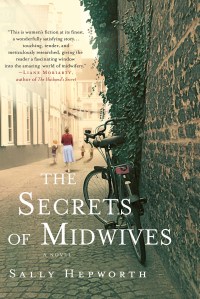
At the end of last year, I reviewed a preview copy of an awesome new novel about midwives: The Secrets of Midwives.

Secrets of Midwives, the

The Secrets of Midwives is released for sale today and I’m excited to share an interview with the author, Sally Hepworth.

A Conversation with Sally Hepworth…

Q 1. How did you come to write the book?

Sally Hepworth and Family

Sally Hepworth and Family

There is a saying among writers “Write the book you want to read.” That’s what I did. Being the mother of young children (and pregnant while I wrote book), I was finding myself drawn to novels such as The Birth House by Ami McKay and Midwives by Chris Bohjalian. I have always thought there was a certain magic to midwifery—for a while, after I left high school, I even considered becoming a midwife. So, when it came time to start a novel, there was no choice to make.

I researched for months before I wrote a word. While I knew I was going to write about midwives, I had no idea what the actual story would be. I had a suspicion it would involve a mother and a daughter—particularly when I found out I was carrying a daughter—but it wasn’t until I read some fascinating stories about midwifery in the 1940s and 50s that Floss’s character (a grandmother) was born.

For me, the best plots start with a question, and the question I landed on for this book was: “Why would a woman hide the identity of her baby’s father?” I like books that have a big upheaval really early on—a “call to action” for the readers—so I knew that by the end of the first chapter, the reader would find out that Neva was pregnant, and that she wouldn’t reveal the identity of the father. At first, I didn’t know why she was hiding it, and I didn’t know who the father was, but as I wrote, I started to figure it out.

But when all is said and done, THE SECRETS OF MIDWIVES is a book about family. What makes a mother, what binds family together, and the role of biology.

In writing this book, I found answers to a whole lot of questions I never knew I had. And I suspect it is no coincidence that this book took me nine months to write.

In effect, in 2012, I gave birth to two babies.

Q 2. In the novel there are many differing opinions about the “right” way to give birth, even among the midwives. Why did you choose to include this in the book?

In my experience, there still exists a lot of debate over the “right” way to give birth so I thought it was important for December 2014 119authenticity to include this in the book. Also, the idea of “right” and “wrong” tied in with the novel’s theme: family. Unfortunately, there is still a commonly held belief that there is a “right” and “wrong” kind of family. Or at least a “good” and a “better” type. But these days, there are so many different kinds of families—blended, adoptive, single-parent, same-sex parents, communities of singles. Of course, there are a lot of (strong) opinions on this too! To me, this was all rich fodder for a novel.

As I started researching for this book, I read a lovely line in a book that said childbirth was a woman’s first battle as a mother, and it was this battle that made her a warrior, capable of protecting her child. I found this fascinating, but also troubling. If birth makes a mother a warrior, where did it leave adoptive parents? Step parents? Fathers?

It was also troubling on a personal level. My son had been born naturally and my daughter was due to be born by scheduled C-section. I had a sense that it didn’t matter how the baby was born, that the birth had no continued bearing on the relationship between mother and child, but the more I read about the transformative quality of natural birth, the more I wondered.

In writing this book, and in giving birth to my daughter by C-section, I was able to find answers to my questions. I have more respect for natural birth and midwifery now than I ever did, and I think a woman’s ability to provide everything her child needs through pregnancy and birth (and beyond!) is astonishing—even magical. And the idea of a home birth, I’ll admit, holds a certain appeal for me now that it hadn’t before. But I finally determined that there is no “right” way to give birth, because there is no “wrong” way. You don’t become a warrior because of the way you give birth. You become a warrior because of the depth of the love you feel for your child.

And while labor may be the first battle you’ll fight for your child, compared to the battles that still lie ahead? Even the most arduous birth is a walk in the park.

Q 3. What research did you do?

As I prepared to write this novel, I read everything I could get my hands on about midwifery—novels, memoirs, non-fiction books—and I watched every piece of footage that showed high-risk deliveries that YouTube had available. I subscribed to online communities and forums where I was able to ask questions about midwifery and birth and I touched base with several home-birth midwives and midwives alliance groups. I also have an aunt who is a midwife who was able to make suggestions and verify things for me.

Being pregnant, I also had easy access to my obstetrician for questions. It became common for my prenatal check-ups to consist of a quick blood pressure check, followed by twenty minutes of question time about my novel. In the hospital after having my daughter, I had a fantastic midwife who shared many stories with me about unusual or memorable births. I was stunned by the level of skill and expertise that was required, and the host of things to be prepared for during labor. But what I remember most about our conversations is her awe and respect for mothers in labor, and I attempted to weave this awe into all three of my POV characters, particularly Neva.

Q 4. What are some of the weird and wonderful facts you’ve learned about midwifery and birth during your research?

  • In the past, midwives were known to secretly harbor unwed mothers, perform abortions, baptize babies, and serve as pediatricians for the first year of the baby’s birth.
  • May Babies Are The Heaviest: Babies born in May are, on average, 200 grams heavier than any other month.
  • Centuries ago the midwife would catch the baby in her apron!
  • In the US, midwifery is only licensed or regulated in 21 states. In most states licensed midwives are not required to have any practice agreement with a doctor.

Q 5. One of your protagonists has issues with her mother. Did you draw on personal experience for this?

 Actually, my mother and I have a very close—verging on boring—relationship. Though we are quite different (she is private and conservative like Neva, and I am like Grace—pushy and talkative and loud) conflict between us is rare. So I wasn’t able to draw on that relationship from a dysfunctional perspective. That said, I was able to identify with loving someone who is very different (not just my mother, but also my husband and my son), and learning how to love them the way they need you to. Above all, the key is respecting the person for who they are, and always looking for the good they can offer.

Q 6. How can readers get in touch with you and support your work?

I am very active on Facebook, Instagram and Twitter. I have also started spending more time on Goodreads. My website www.sallyhepworthauthor.com is the place to go for book information, upcoming events and my bio.

Thanks for listening (reading)!

Sally x

October 2014 023

Disclosure: I received a complimentary copy of the book for review purposes.


Thursday Tidbits: The Return

1800276_792912184104774_7325239257627050486_nTwo months after Tanner’s birth, I still feel like I’m “coming back” from this trip.

January 2015 003
And, speaking of returning, last night I went back to teaching my in-seat class. I am grateful to have a husband who accompanied me to keep the baby close on site for nursing as well as for helpful parents who rearranged their schedules/lives to take care of our other kids while we were gone.

10891470_10155078781285442_1676917073873038818_n

At class last night.

As I mentioned in a recent post, I’d mentally prepared to be “off” until January and now that it is January, I have a feeling of being sped up in an unpleasant way. So, I appreciated reading this essay and the reminder: you just had a baby.

You just had a baby.

So, let’s stop pretending like that didn’t just happen.

And let’s give you some grace and permission.

You don’t have to answer every email, every text or every invitation that comes your way. You don’t have to keep your house clean or make fancy dinners this week or plan your family vacation for the year. You don’t have to take your toddler to the dentist or figure out how to save for college right now…

You Just Had a Baby | Ashlee Gadd.

While I do keep up with a large variety of projects, ideas, communication, and relationships, there is not a single day that passes that I don’t drop a ball, forget something, let something go (intentionally or not), or let someone down. There are emails I don’t answer, calls I don’t take, and text messages I don’t respond to as well as laundry I don’t fold and piles of clutter than don’t get put away, not to mention all the blog posts I don’t write. This simply has to be okay. I’ve joked with friends and with Mark that my “word of the year” should actually be “ruthless,” meaning that I must be ruthlessly assessing of how I spend my time, ruthless about cutting out non-essentials. Every day involves a pile of choices and some of them are hard to choose between, or to not choose. I must be ruthless in my discernment—choosing wisely, choosing carefully, choosing mindfully. My real word of the year is “grow,” while at the same time the message I’ve frequently been picking up in moments of synchronicity and surprising overlap is “let go.” So, maybe I’ve actually got a trifecta of words this year!

I already wrote about the breastfeeding brain in a recent past post, but it appears that there are permanent changes to the maternal brain as well:

The artist Sarah Walker once told me that becoming a mother is like discovering the existence of a strange new room in the house where you already live. I always liked Walker’s description because it’s more precise than the shorthand most people use for life with a newborn: Everything changes…

The greatest brain changes occur with a mother’s first child, though it’s not clear whether a mother’s brain ever goes back to what it was like before childbirth, several neurologists told me. And yet brain changes aren’t limited to new moms…

via What Happens to a Woman’s Brain When She Becomes a Mother – The Atlantic.

And, speaking of mothers and their childbearing brains, Childbirth Connection has produced two phenomenal new resources. There is a report by Sarah Buckley on the Hormonal Physiology of Childbearing and a companion booklet for mothers that simplifies the research into a user-friendly booklet on the role of hormones in a healthy birth. Great resources for childbirth educators and doulas.

For more see: Hormonal Physiology of Childbearing | Transforming Maternity Care.

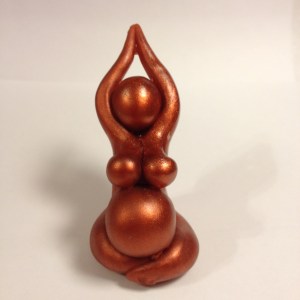
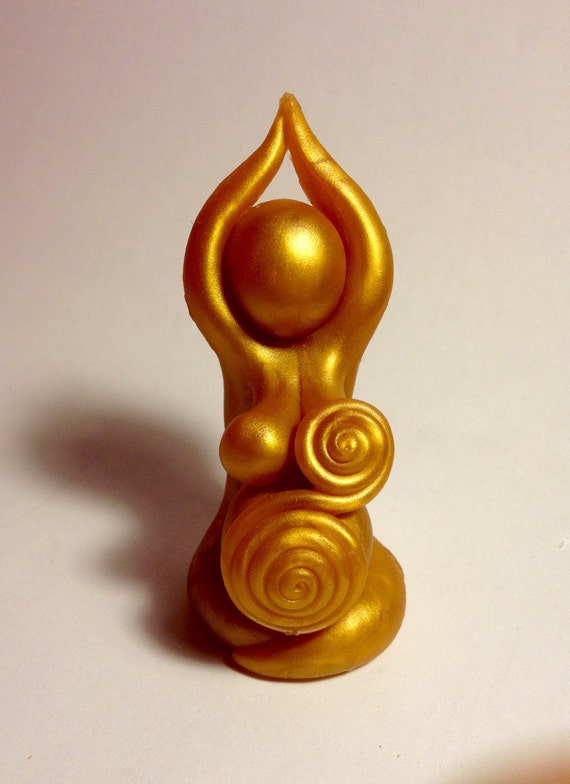
Pregnant birthing mama goddess birth art sculpture (doula, midwife, birth altar, childbirth)


Talk Books: The Secrets of Midwives

“By the time the baby boy spilled into my arms, I knew. Women were warriors. And I wanted to be part of it.” –Neva Bradley

(character in The Secrets of Midwives by Sally Hepworth)

While feeling somewhat pre-laborish in the last days of pregnancy, I stayed up way too late devouring a review copy of the new novel The Secrets of Midwives Secrets of Midwives, theby Sally Hepworth. I  got it in the mail in the afternoon and by 1:30 a.m. that night, I’d finished the whole thing! In the past, I’ve been heard to remark that I can think of few things better than a novel about a midwife. Well…how about a novel about three midwives? That’s right, The Secrets of Midwives interlaces the three stories and pivotal life journeys of three midwives, who happen to be grandmother, mother, and pregnant daughter. Each midwife has a different personality and style of practice. In an intriguing style that kept me turning pages, the chapters are split between the viewpoints of each, allowing for multiple perspectives on the same relationship and personal issues.

Floss, the grandmother/mother, is retired from midwifery, but her chapters alternate between her early experiences as a midwife in the UK and her current life as a natural childbirth instructor. Neva, the daughter/granddaughter, is a hospital birth-center based CNM who is hiding her unexpected pregnancy with her own first child. Grace, the mother/daughter, is a CNM who attends homebirths.

The Secrets of Midwives contains elements of a romance story and elements of a mystery story. It blends the three women’s midwifery journeys in a creative, engaging way, including exploring the complex quality of mother-daughter relationships and communication vs. secret-keeping therein. It is serious enough to keep the pages turning, but not so “heavy” as to be depressing. There is a subplot in which the homebirth midwife is investigated by the state nursing board for possible malpractice and it felt relevant and contemporary to the fears and risks faced by midwives around the country. And, while reading as a pregnant woman myself, I appreciated that in this novel, with one pivotal exception, there are no scary births with bad outcomes—I find that high drama births resulting in maternal or infant death are a common feature of midwifery novels that often makes them somewhat iffy reads for pregnant women!

“That superhuman feeling people describe? It has nothing to do with the way the baby comes out. It’s about what happens to the mother. You become superhuman. You’ll grow extra hands and legs to look after your baby. You’ll definitely grow an extra heart for all the love you’ll feel.” –Neva Bradley

(in The Secrets of Midwives)

October 2014 012

 THE SECRETS OF MIDWIVES by Sally Hepworth

Find the author on Facebook here and her website here.

Published by St. Martin’s Press

On sale February 10, 2015

ISBN-13: 978-1-250-05189-9 | $25.99

Disclosure: I was provided with a complimentary copy of the book for review purposes.


Welcoming Tanner Matthias!

“There really was a baby!” –Me, in birth video

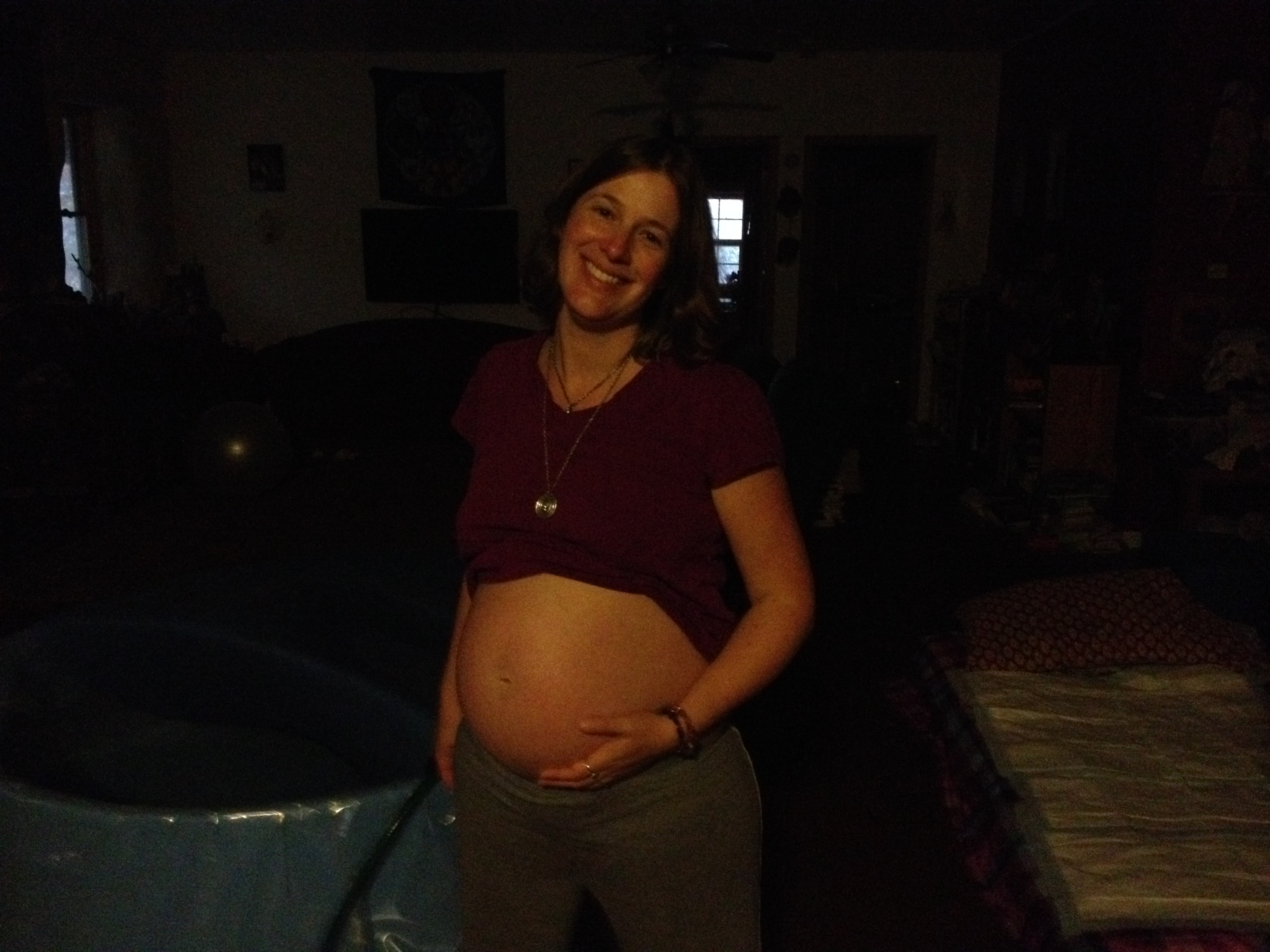
IMG_8557As was my pregnancy custom, on October 30th I woke up around 3:00 a.m. with definite contractions. They were spaced about 30 minutes apart, however, and I kept myself awake unnecessarily waiting for them to get bigger or closer together. I finally got up at 4:30 or 5:00 and Mark got up too. As I as I got up, contractions picked up to about three minutes apart. I couldn’t believe I’d “wasted time” by lying down, non-sleeping AND non-laboring! I felt very adrenaline filled and excited. The sense of urgency and “coming soon” was very familiar to Zander’s exceedingly fast labor, whereas my sense of need to call Mom during a contraction and then changing my mind afterward was similar to Lann’s. And, leaning on the kitchen half-wall as an ideal labor position was similar to Alaina’s. There was no slow lead-in here, these were sharp, strong, intense contractions that I already couldn’t talk through. Though they felt big and serious, they were also short in duration. I lit my birth altar candle and since I wanted to have clean, freshly washed hair, I decided to take a shower.

043 044After showering and even blowdrying my hair for cuteness in future pictures, the intensity of the contractions increased again. Mark got to work on filling the pool and heating more water as soon as I got out of the shower and he kept messing with the pool even though I was starting to feel like I needed him (also needed pool, so he wasn’t doing the wrong thing!). I felt sure that this was picking up FAST. We texted Mom and she contacted Robin and Summer (midwife and doula). I felt a weird sensation of time pressure then, looking out window, waiting and not wanting to be observed, waited for, or watched. The pool continued to take a lot of time and attention and was annoying. Plus, the hose popped out when Mark was in the laundry room and flooded the floor. I was saying things like, “this had better be the best thing ever, because right now I hate it!” I couldn’t decide if I should keep standing up or try something else like sit on the birth ball or try the water. It seemed early for water (except during contractions!), so I sat on the ball at which point contractions became HUGE, but, also only 8-10 minutes apart. I was confused and kept trying to figure out what made more sense—smaller, more frequent contractions while standing up, or bigger but far apart on the ball. I was laughing about my indecisiveness and kept saying, “so, tell me what to doooooooo!” (which is actually my most despised thing in labor). I opted to stay on the ball because I felt open there and when standing I felt like I was closing my legs together and tensing up. On the ball, I started humming the Sacred Pregnancy Standing at the Edge song I listened to so often during my pregnancy: standing at the edge…clinging to my innocence…one more tiny step…time is here and now…diving into the unknown. I believe in me, I believe in meee-eeee. I believe in me, I do, I do…

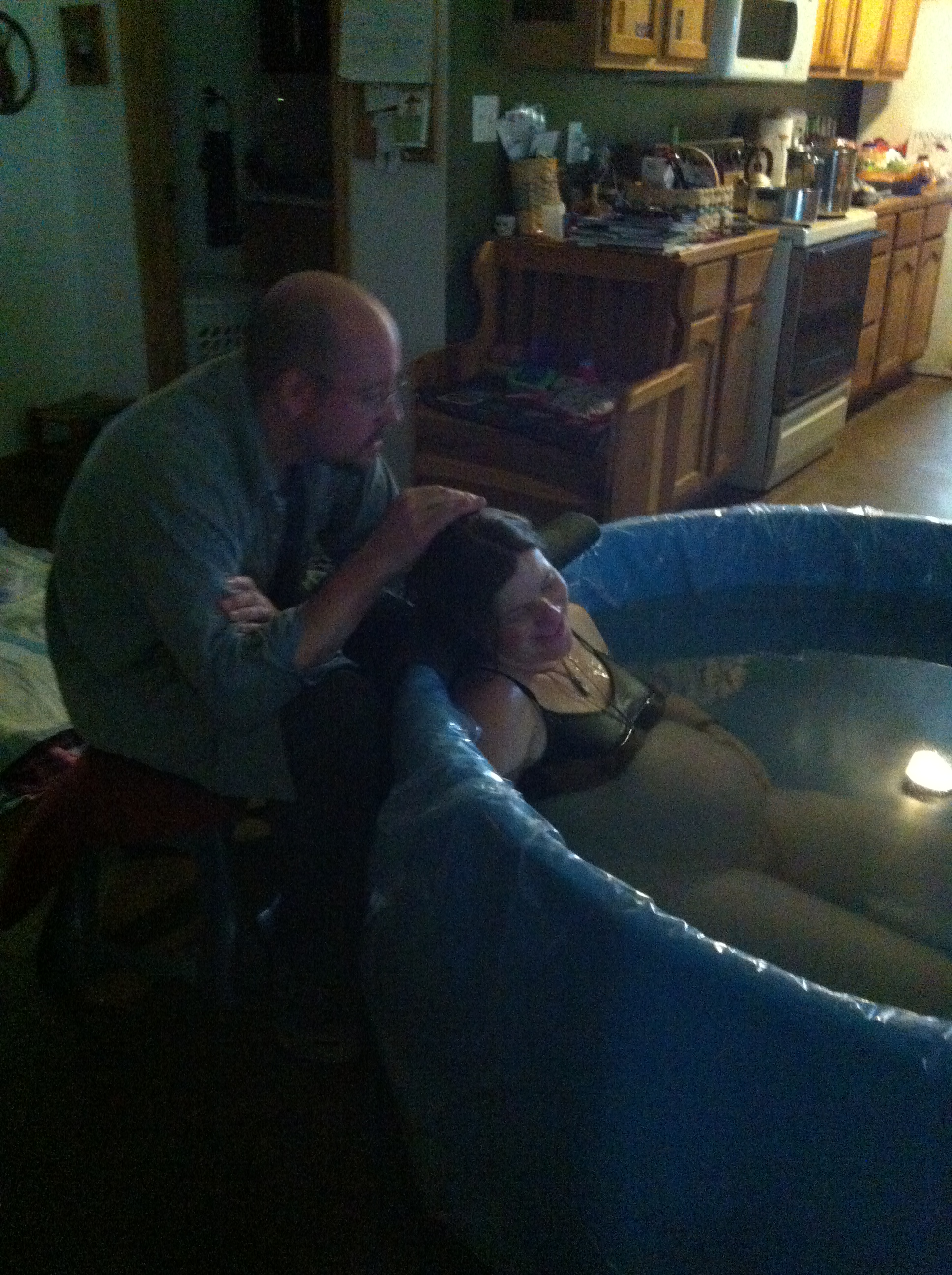
Later, in the pool, I turned on the rest of my Sacred Pregnancy playlist from the CD, which I both liked and didn’t like because I could no longer anchor myself then with the “I believe in me, I do” hum.  I talked and joked and laughed about stuff a lot. And, I would sing little things like: let’s find something else to say and not owie-zooooowie… I do not know how else to say that these were intense, big, powerful contractions. To my memory, they feel like they were the biggest, most painful contractions I’ve ever had—but slooooooowly far apart. The sensation of downward pressure was powerful already during each, but the distance between them very confusing. After back and forthing verbally for some time, I decided to get in the pool: this had BETTER be WORTH IT.

I loved the pool, but I also, intensely, felt like I was on “display” or being watched. I also felt a little isolated or separated and observed, even by my own mom (who, mindfully, went to sit on the couch to give me space). I kept feeling worried and pressured about my midwife and doula getting there any minute, even though we talked in advance about how I mainly needed them for immediate postpartum care and only wanted them to come in at the very end. I had never talked to my mom about specifically when to tell them to actually come though, so I kept thinking they were sitting in the driveway waiting for me (they weren’t, because they were being respectful of what they knew I wanted and needed). As with my other babies, I knew in my heart I wanted to birth alone, but then with immediate postpartum/follow-up care. This is hard to balance and gauge. And, I acknowledge that it isn’t really fair to the midwife either! My birth brain really needs to be alone and unwatched and I knew in the pool that I wanted to push my baby out before anyone else was there.

I took my favorite birth goddess sculpture into the pool with me where she kept me company and floated with me and reassured me until I was pushing and set her outside the tub (ever practical, I didn’t want her to get lost in what I knew would end up as bloody water!).

047

If you look close, you can spy the little goddess in my hand.

048

Here, I was laughing about feeling like a little toad in a pool.

My mom kept me supplied with food and drinks and occasional encouragement and Mark stayed close, touching me and being present. There was lots of waiting in the pool (I feel like) for those slow but BIG contractions. I got out to pee and finally saw some BLOOD. I always wait and wait for this sign because for me it is the herald of nearly full dilation. I have no blood or any leaking or discharge until I’m only a short distance from pushing out a baby! I shook and shook in the bathroom at this point too, which I think was related to the temperature change from getting out of the warm pool and not transition per se, but it could have been both.

Back to the pool and out one more time to pee (more blood! Yay! Blood is so fun! Really. It is super encouraging for me to see during labor at this point.) I started to weirdly fret about my bladder at this point getting in the way of baby’s head (potentially): this can happen, you know, I told my mom and Mark (even though I was totally peeing and had no signs of bladder being in the way). I could tell baby was moving down and getting close to pushing, but I felt impeded with the amniotic sac intact. I moved to hands and knees in the tub and talked to myself: it’s okay. You’re okay. We’re okay. I can do it. We can do it. You can come out baby. We want you. We want you. (I cried I tiny bit saying this.)

IMG_8532

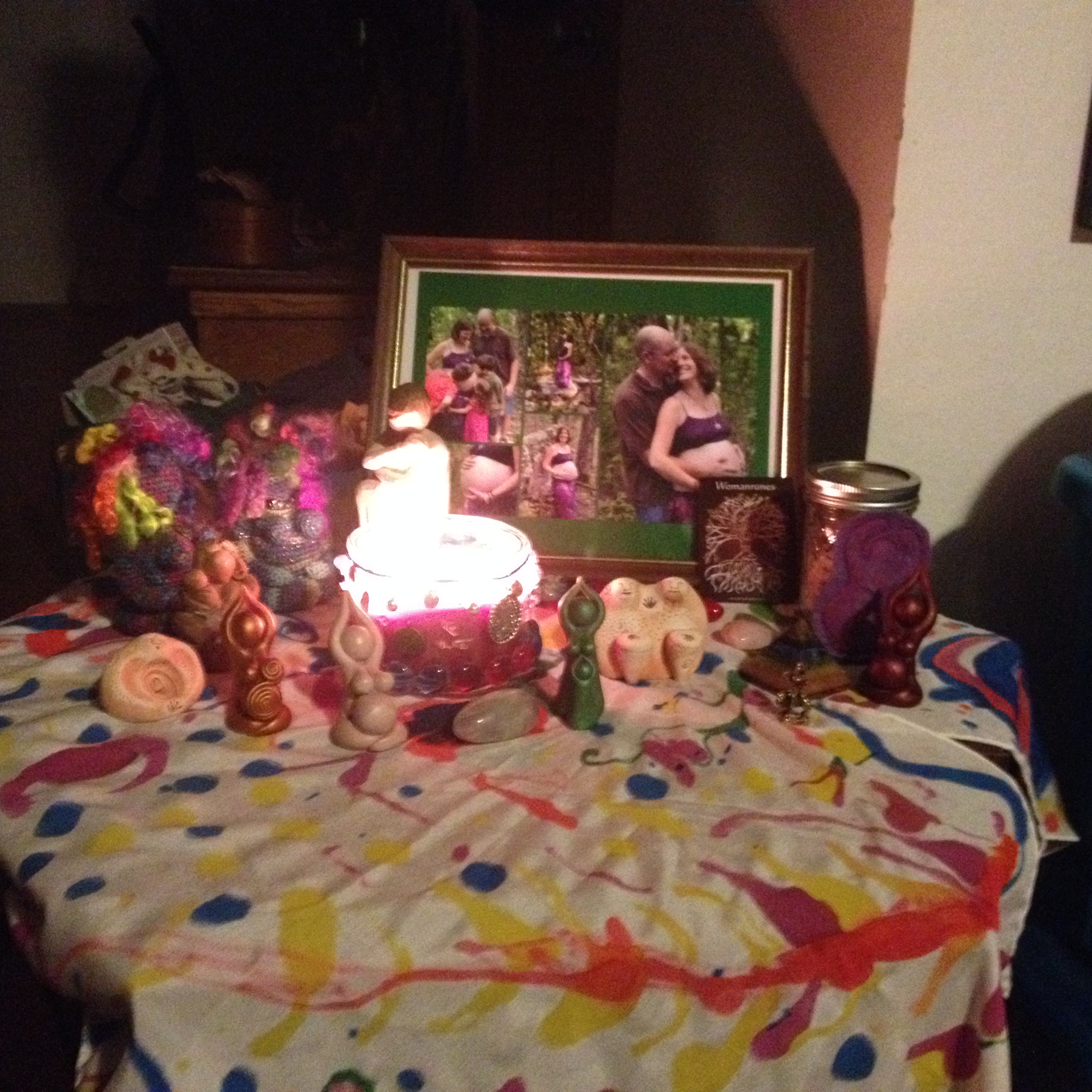
I like how you can see my friendly little birth altar glowing in the background.

IMG_8533

I turned back over then and kept on smiling…

IMG_8535

One hour before birth.

IMG_8543Some time after this, I started feeling inside after each contraction and could feel a hard lump getting closer and closer every time I had a (now close together) contraction. I didn’t feel sure it was a head though, but that maybe I was somehow feeling my own pubic bone or some other mysterious part of my anatomy never before felt. It felt squishy kind of, though hard underneath. (Duh, because it was an amniotic sac around a baby head, Molly!), so then I imagined I wasn’t fully dilated and was somehow prolapsing my cervix instead of feeling a baby’s head. I think these types of thoughts are one of the hazards of being a birth professional. They are also proof, to me, that no matter what odd or frightening things you think, babies’ heads still move down and come out anyway! At this point, the baby began to have hiccups. He was so low that it basically felt like my anus was hiccupping. I had Mark feel them very low on my belly—just above my pubic bone—and then I laughed and saidthis counts as a fetal heart tones check!

Finally, my water broke at last and I knew he was almost out. Pushing was intense and big and felt huge and hard and long. I became convinced baby weighed ten pounds and was probably not going to come out. I felt like it was taking a long time and a lot of work, but according to Mom and Mark it was about four pushes and date stamps on pictures reveal about 5-6 minutes total of this hard work. I also kept thinking someone else was going to come in. I felt the familiar burning on my front right side and knew I would tear again (labial/clitoral). It felt scary and I looked at my mom and said I was scared (she said, “I know”). I almost pushed through the burn, but then I stopped myself and waited for the next push and then his head was out, along with a bloom of blood in the water which does indicate tearing, but I didn’t get checked for tears (by my specific decision and request) so I don’t know for sure. A minimal follow-up push and his body came out into my hands. He bobbed to the top of the pool and I lifted him out of the water. He cried a little and was already reasonably pink. He was looking around and was a little bit gurgly. I talked to him and kissed his head and told him I loved him: oh my little one, oh my little one. Oh my goodness! Oh my goodness! There really was a baby! Oh, he’s CUTE! I noticed his cord was around his neck and arm and somewhat awkwardly moved it off. It was 10:20, a little over five hours after I got up.

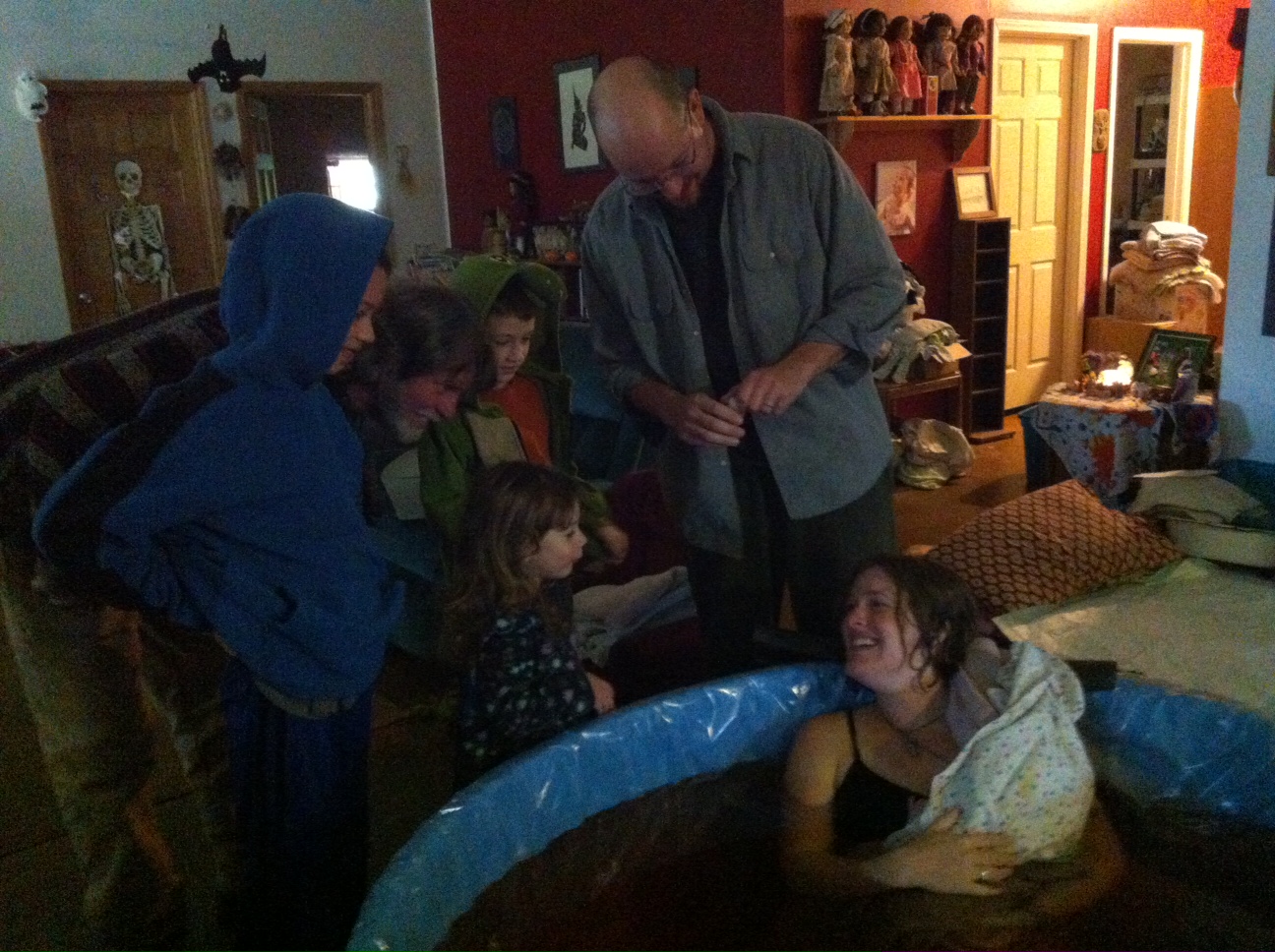
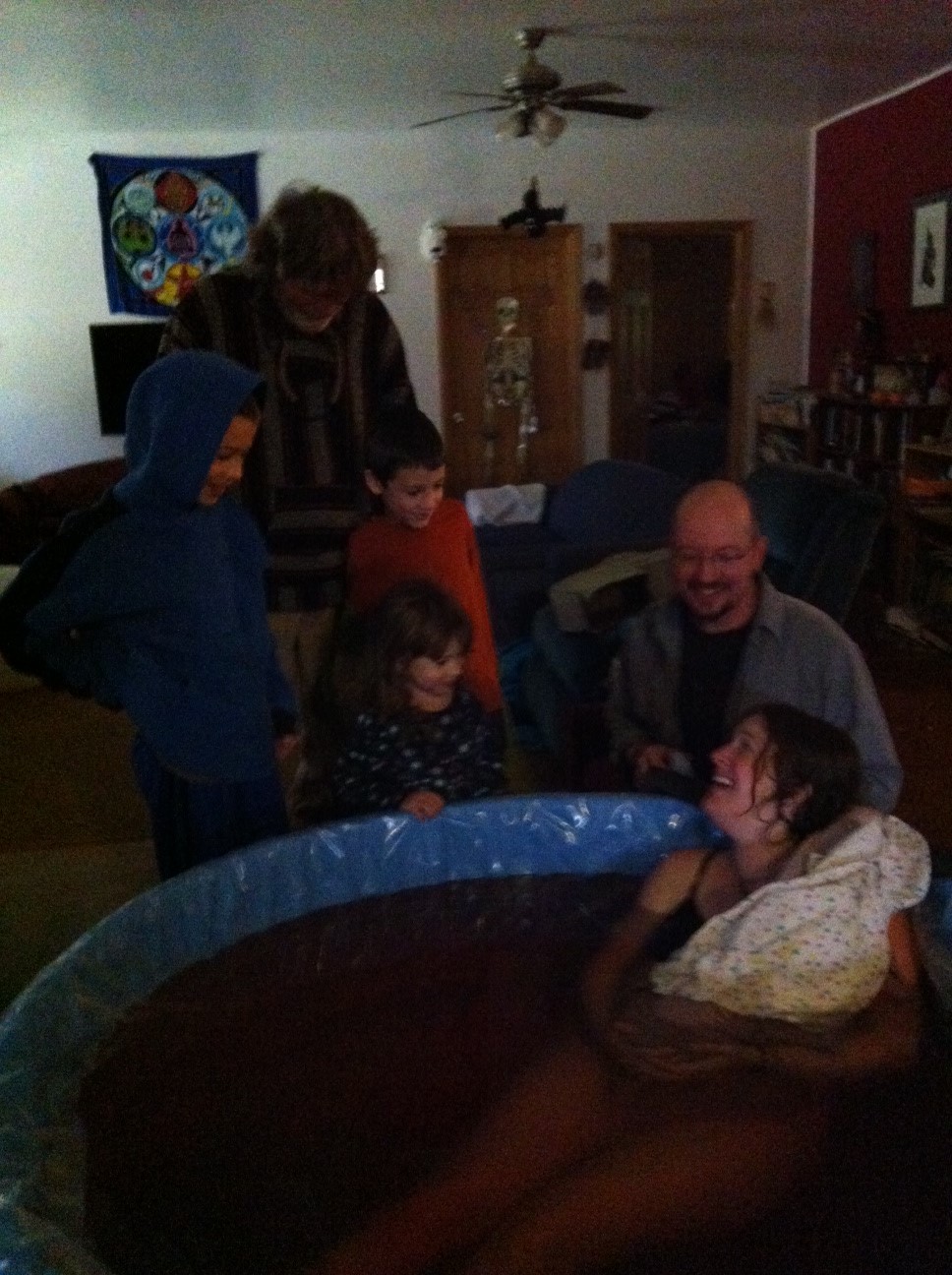
We called my dad to bring the kids back over to see the baby and cut the cord and they arrived a few minutes before Summer and Robin got there.

053 054After Robin and Summer arrived, they helped me out the pool which I was eager to get out of, but had a lot of trouble actually doing, and onto my futon nest on the floor between the pool and bathroom. This is the part I didn’t like. So familiar and so not fun. The weak and wounded transition. But, Summer (doula) reminded me that the warrior moments are in feeling the vulnerability too. Sometimes the warrior is found in showing the vulnerability and needing the help.

After some lying on the futon and waiting for the placenta, I went to the bathroom (still holding baby attached with cord) and the placenta finally came out there (after it was washed, I swallowed a small piece of it). Zander and Alaina cut the cord as they had been waiting to do and then left for playgroup with my friend who was waiting patiently outside to take them. When the placenta was examined, they saw he had a velamentous cord, which is fairly rare and can actually be dangerous and possibly explains my widely spaced contractions (giving baby time he needed).

256

The baby’s temperature was low and it took us some time and effort to get him warmed up and that was probably because I was in the water a little long after birth and that is my only regret about this birth. When his temperature was normal, we weighed him and he only came up as 6lbs4oz. He then weighed 7lbs4oz at two days, which means he was really bigger than that at birth. He weighs eight pounds now at a week. So, he weighed something at birth, but the exact amount is unknown! He was 20 inches and had a 14 inch head.

As I laid on my futon and latched baby on for the first time, I realized that in all my planning and fretting and preparing and deadlining, I’d forgotten how very, very much love was possible.

Edited one year later to add that Tanner’s birth video is now available online: Welcoming Tanner Matthias (Home Water Birth Video) – Brigid’s Grove

National Midwifery Week!

“…As we ready ourselves to accept new life into our hands,
Let us be reminded of our place in the dance of creation.
Let us be protectors of courage.
Let us be observers of beauty.
Let us be guardians of the passage.
Let us be witnesses to the unfolding…”
Cathy Moore (in Sisters Singing)

New Etsy Pictures 332

Lots of events in October! I just found out that National Midwifery Week is October 5-11 (same as Babywearing Week). It is finals week for me (I teach on an 8 week session schedule) and so I don’t have time for a lot of things other than grading, but I did pluck some delicious quotes out of past blog posts…

“It’s hard to describe if you’ve never been there, but to watch a woman access her full power as a woman to give birth is awe-inspiring, and I never get tired of being witness to it. It’s an honor to watch that transformation take place.”

~ Julie Bates, CNM

“There is no ‘normal’ birth–each is individual and nonconforming. Childbirth opens an extraordinary spectrum of physical, emotional, and spiritual growth opportunities that is  nothing less than extraordinary, which women should be supported in freely exploring. The Midwife must guard parameters of safety, yes, but she should also encourage women to play their edges, experience deep currents of emotion, discover their own ways of transformation, and chart new creative territory.”

–Elizabeth Davis

“Midwifery asks us to truly become at home with ourselves, with nature, and with women. Birth takes us out of our external experiences, our linear timing of progress, and our everyday rituals. In contrast, birth time is measured in a circular movement like the seasons. There are rhythms and patterns. If we let birth unfold with spontaneity and attuned to nature, we will end up appreciating the nature of our souls as well.”

–Mary Sommers (More than a Midwife)

To me, midwife means: loves women. I wrote about this idea in a past post:

I know the traditional root of the word midwife is “with woman” some sources say “wise woman”, but I’d like to offer another. When I was pregnant with my second son, I had a wonderful midwife and we spent many hours together talking about birth and midwifery. During one conversation she said to me, “you can’t be a midwife unless you love women.” This struck me profoundly—a midwife must love women

via Midwife means “loves women”… | Talk Birth.


To acknowledge midwifery week and the profound gift of service offered by midwives to so many women, we also set up a special discount code in our etsy shop. It is our best one ever: 20% off a purchase of $12 or more (expires October 12). This could be the perfect opportunity to find a special gift for your midwife! To receive the discount use midwifeweek2014 for the 20% on $12+ (Remember, this week only we also have one for International Babywearing Week: babywearing2014 for 15% off any purchase.)

New Etsy Pictures 348

We’ve been working on improving our colors for our birth art sculptures recently and are finally getting some really nice results! We also have new pigments ordered so we can do even more colors soon.

New Etsy Pictures 474

Tuesday Tidbits: Creation and Distraction

“I have discovered nothing more stunning, nothing more emotionally stirring, nothing more intriguing than a woman as she creates life.” –Patrick Stull (in Evolve)

August 2014 085From the Celebrating Motherhood book I’ve been using for an intermittent series of posts, comes this thought about creativity from Meinrad Craighead:

Images are like children. Children come out of our bodies as distinct creatures with their own life form…They have come out of us, but they have their own energy separate from us.

Women create—we all create—out of our bodies…The creativity in women’s bodies, the potential in our bodies for making children from our many eggs is, I think, no different from the potential for making imagery from our many eggs…It is very important for we women to understand that whether we are creating biologically or metaphysically from those eggs, it is all the fruit of our body, the fruit of our creativity.

–Meinrad Craighead, from Sacred Stories quoted in Celebrating Motherhood (p. 43).

After quoting Craighead, I remembered I’ve quoted her previously and so I went looking for that quote, which was:

“Come into my lap and sit in the center of your soul. Drink the living waters of memory and give birth to yourself. What you unearth with stun you. You will paint the walls of this cave in thanksgiving.”

–Meinrad Craighead

This quote was used in the context of a post I wrote about my last computer-off week and “defragmenting” my brain, in which I eventually came to the conclusion:

I always have “too much to do,” technology or not. It is kind of how I’m built. I am packed with ideas and plans and goals all the time, so are my kids, so are my parents. I think it is genetic. Also, this makes us interesting people albeit perhaps not Zen enough for some as well as for my imaginary conception of how my life “should” be.

via Mental Defrag computer off week reflections | Talk Birth.

This post led me to another one musing about the “distractions” of technology:

I have to say that when I read content decrying technology as negative and lamenting the abundance of children on their “devices,” part of me hears: “these new-fangled kids driving cars instead of good old horses and buggies!” This is reality. In my specific family, technology and screen-time built my family’s financial security and our literal home. My husband made a living for years off of screens—eight hours a day in front of one in fact. I use one now to support my family and to, get this, be with my children. Using a computer (ipad, etc.) is how I teach, how I write, how I communicate, how I interact, how I earn money, how I sell my creations. My mom was on the phone a lot when I was a kid. I’m on the computer a lot. Maybe Idealized Mythical Past Mom was in the cotton field a lot, or washing laundry for others, or working in a lace factory, or milking cows, or shelling peanuts or making paper flowers, or keeping up the house, or taking care of younger children, or, or, or. Moms have never “not worked.” And, they’ve never been non-“distracted,” just the mode and texture of this “distraction” shifts with times, contexts, roles, activities, and availability of whatever. Perhaps it is all just life and living?! I am as interested by mindfulness and present moment awareness as the next person and yet I always wonder: “can’t I be typing this blog post in the present moment?!” Can’t I be thinking about my to-do list in the present moment? Can’t I be smelling this rose in the present moment? AND, can’t I also be sending this text in the present moment? Why does “present moment” have to be synonymous with no to-do list and no technology? I can very presently us both…right?!

via Tuesday Tidbits: Blogging, Busyness, and Life Part 2 | Talk Birth.

And, I’ve been thinking about the snappy feeling I have this week and how I can be both controlling and flexible, good-humored and humorless, happy Mom reading books aloud and crabby Mom saying, “get that out of my face,” on edge and content, often within the same day and same hour. This reminded me of a post I wrote quite a while ago about “dualism” and how we are received, perceived, and experienced by people can all be true:

And, I started to reflect that I guess I am all these things and how people experience me and my writing is in part up to me and in part up to them. Just like in real life. I can be gentle, kind, and nurturing. I can be critical, judgmental, and harsh. I can be helpful and I can be selfish. I can be patient and impatient. I can be friendly, I can be preoccupied. I can be energetic and enthusiastic and upbeat and I can be exhausted and defeated. I can be a fabulous, fun mother and I can be a distracted and grouchy mother. I can be funny and I can take myself too seriously. Different people, relationships, and environments bring out different expressions of who I am. Sometimes I really like myself a lot. I like who I am, I like how I move through the world, and I’m impressed with my own capacities. I have great ideas and solid values and principles and the ability to articulate those in writing. Sometimes I actually hate myself. I see only the bad parts and I wish I could just be better. I feel hypocritical and over aware of inconsistencies in my own thoughts/beliefs and my expression of my values in the world. I often want to be better than I am, but in rare moments of grace and self-compassion, I realize that I’m pretty good already. And, in some moments of self-righteousness and superiority, I actually feel better than some people in some areas/some ways!

via The dualism of blogging and life | Talk Birth.

I hope I can remember to extend enough compassion and grace to others to realize they are the same way and not write someone off based on one experience or encounter!

(Isn’t it convenient that I’ve already had all these thoughts already and can just go back to my blog to mine for them, rather than starting from scratch all the time? 😉 )

Returning to creation and motherhood though, I think this etsy shop (Shaping Spirit) has the most amazing and best driftwood sculptures of all time:

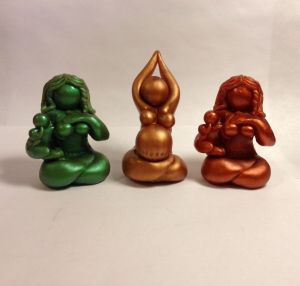
Reserved for Gillian, I Will Remember, Driftwood Sculpture by Shaping Spirit, Last PaymentAnd I wanted to share a new picture of our cesarean birth goddess design that we re-worked slightly and re-cast recently:

September 2014 030I thought of her as I read a beautiful article about why grieving for birth is selfless and not selfish (shared via Summer Birth Services):

Women grieve stolen birth experiences very deeply, but their grief often remains private because modern birth culture maintains that a healthy baby is the one and only goal. The roots of “the healthy baby lie” are found in the reality of birth, that the outcome is unknown and one potential outcome is, quite undeniably, death. But to women, birth means a great deal more than being alive afterwards. Birth is the introduction to their baby, it matters a great deal.

Mothers spend many months imagining birth, sometimes many years. They imagine feeling more love than they ever imagined when they set eyes on their new baby. The reality is that sometimes things go awry – women are not so stupid that they can’t grasp that – but when they reach out to tell their stories they are often told one of two things; that they should focus on their healthy baby; and that they had unrealistic expectations of birth. But it is not unrealistic to expect that you will feel joyful when you give birth…

via Grieving for Birth is Selfless Not Selfish – Whole Woman.

September 2014 023

“These are her endless years, woman and child, in dream molded and wet, a bowl growing on a wheel, no mud, not bowl, not clay, but this becoming, winter and split of darkness, years of wish.”

–Muriel Rukeyser (quoted in Celebrating Motherhood, p. 47)

Tuesday Tidbits: Science, Mother Blame, & Postpartum Psychosis

“There is nobody, out the other side of that sort of strong birth, who is not better prepared to meet the absolutely remarkable challenges of parenthood. When the power and trust is transferred to the mother, when she delivers her child, rather than ‘is delivered’ when she chooses, rather than ‘is allowed’, no matter what sort of technical birth she has, she is stronger, fiercer, and better…”

–Stephanie Pearl McPhee (The Yarn Harlot)

August 2014 019Just a short Tidbits post for today…

Over the weekend, I appreciated reading this article about an unusual topic: postpartum psychosis.

Two weeks previously, Jessica was in perfect health, enjoying a career as an actress, comedian and writer and at the end of a straightforward pregnancy with her actor husband Matthew Bannister.

“I describe Albert’s first weeks as ‘peace and war’,” she says. “The birth was gentle; I delivered Albert myself in a pool in our dining room. I remember looking down as he was born, seeing this baby blinking up at me under the water, and feeling such love. Then came a tidal wave of terror.”

The first days of parenthood were the blur of joy and shock common to most. “It was a time of epic contradictions: you’ve lost so much of yourself and you’ve never been more whole,” Jessica explains. Yet by day three she began to display symptoms of a rare illness affecting one to two in every 1,000 UK mothers…

via Postpartum psychosis: How Jessica Pidsley was driven to the edge by the rare illness – Features – Health & Families – The Independent.

I also read a significant article about epigenetic research and motherblame:

So why is it that the complex science of human development, in particular, is so readily distilled into this single, unhelpful message: “It’s all about mom”?

Of course, science is influenced by values in all sorts of ways: in the questions we address, the conclusions we prioritize, and the applications we pursue. But when dealing with complex causal processes and the assignment of causal responsibility “it’s the mother!”, values can affect the conclusions we draw from science in an especially pernicious way. That’s because we think of causal claims as simple descriptive facts about the world — as value-free. But a growing body of empirical work shows they’re not. In fact, the way we make causal claims depends a lot on how things normally happen and on how we think they should happen.

via Using Science To Blame Mothers : 13.7: Cosmos And Culture : NPR.

This in turn reminded me of my own past post about asking the right questions, which I shared on a friend’s Facebook page in response to all of the recent media attention being paid to newly developed date rape drug detecting nail polish.

We MUST look at the larger system when we ask our questions. The fact that we even have to teach birth classes and to help women learn how to navigate the hospital system and to assert their rights to evidence-based care, indicates serious issues that go way beyond the individual. When we say things about women making informed choices or make statements like, “well, it’s her birth” or “it’s not my birth, it’s not my birth,” or wonder why she went to “that doctor” or “that hospital,” we are becoming blind to the sociocultural context in which those birth “choices” are embedded. When we teach women to ask their doctors about maintaining freedom of movement in labor or when we tell them to stay home as long as possible, we are, in a very real sense, endorsing, or at least acquiescing to these conditions in the first place. This isn’t changing the world for women, it is only softening the impact of a broken and oftentimes abusive system…”

Asking the right questions… | Talk Birth.

And, while not completely related to the topics at hand in today’s post, but absolutely relating to quality mother care, I wanted to share a link to a fundraising project from my doula, Summer:

Who's <br />
Your <br />
Doula?

“…Smyth comments that ‘the role of mother is not immediately intelligible to those who find themselves inhabiting it’ p. 4. This is certainly borne out in the confessional writing and memoirs of young feminist women, who try to make sense of their experiences as a new mother. They write of a crisis of selfhood, feeling undifferentiated in ‘a primordial soup of femaleness’ Wolf 2001 and of experiencing a gendered, embodied and relational self for the first time Stephens 2012…”

via Tuesday Tidbits: Story Power | Talk Birth.

August 2014 044