Archives

Good Birth Books to Gift to Others

I’ve recently had several requests from friends asking about the best birth books to give as gifts to pregnant relatives. After sending my third response, I realized that there’s a blog post in here somewhere!December 2013 010

Here are my current recommendations:

Sacred Pregnancythis book is simply beautiful. My past review is here.

Giving Birth with Confidence—this is the well-known childbirth education organization Lamaze International’s guide to pregnancy and birth and it is one of my favorites. My review of a past edition is here.

The Birth Partnerthis guide by Penny Simkin is a classic for helping fathers or other birth partners serve during labor

The Greatest Pregnancy Everfocused on positive mental attitude during pregnancy and cultivating a mother-baby bond prenatally (caveat: I’ve not actually finished reading this one, so I’m not sure if I have any reservations about it or not. I bought it at the last CAPPA conference)

Birthing from Within—the original birth art resource and a fabulous “out-of-the-box” handbook for preparing for birth. It is not attached to a particular outcome and can help mothers dig deep whether experiencing a home birth or a cesarean. This book is my all-time favorite, but my recommendation comes with a caveat that the short breastfeeding section is terrible.

The Baby Book-a comprehensive, reassuring look at baby’s first year by Dr. and Martha Sears.

For birth stories, I love and adore Simply Give Birth (past mini-review is here). I also like Journey Into Motherhood (available as a free digital copy here) and Adventures in Natural Childbirth.

I used to recommend The Thinking Woman’s Guide to a Better Birth, but is has been replaced by an updated version called Optimal Care in Childbirth and I’ve not yet read that one. My educated guess is that it is still an excellent recommendation! 🙂 I also used to recommend The Birth Book by Dr. Sears. It is still a good suggestion, but it is now an “older” book and so I don’t put it at the top of my list any longer.

Also, make sure you grab a copy of the free Guide to a Healthy Birth from Choices in Childbirth. I love this little booklet so much! It is my top favorite resource for tabling at community events. Another free educational resource that I recommend (particularly for women planning natural births in hospital settings) is Mother’s Advocate. There is a free booklet and a series of videos that explore Lamaze’s Six Healthy Birth Practices (which all mothers deserve as part of evidence-based care during birth, regardless of birth location).

Past book lists and related suggestions:

What To Do When Newly Pregnant and Wanting a Natural Birth…

Suggested Reading

Postpartum Reading List

Book list: Preparing Children for Homebirth

Non-Advice Books for Mothers

2012 Book List (all kinds of stuff, not just birth)

In addition, all the books I’ve reviewed in the past are available on my website from this link, so make sure to browse and see if anything else jumps out at you as a good match.

“Everyone who interacts with a pregnant woman is, in some way, her ‘teacher.’ Telling birth stories, sharing resources, imparting obstetrical information, giving advice or warnings—these are all direct or indirect ways of teaching about birth and parenting. Whether you currently identify yourself as a ‘childbirth teacher,’ or you are a midwife, doctor, doula, yoga teacher, nurse, therapist, breastfeeding counselor, or you are simply a woman or man who cares about the power of the childbearing year, you already hold the power of mentoring within you.”

–Pam England

Business of Being Born: Classroom Edition

Childbirth is a women’s rights issue and a reproductive justice issue. The United States maternity system is one of the costliest in the developed world, yet our birth outcomes compare poorly to those of other industrialized nations. Among industrialized countries, we consistently rank last or second to last in perinatal and maternal mortality rates. Moreover, birth is depicted in mainstream media with fear, medical intervention, and crisis…

via The Business of Being Born Classroom Edition.

It took me some time to get around to it, but I’ve finally finished exploring The Business of Being Born: Classroom Edition and its associated toolkit of educational materials! As a long-time childbirth educator and birth activist, of course I was interested in this classroom version of the (new) classic birth advocacy film, but I’m also a college professor and therefore was doubly interested—how might this resource be incorporated into one or more of my human services courses? As the BoBB companion site explains…

Childbirth is an issue most people do not engage with until they have experienced the maternal health system. The Business of Being Born: Classroom Edition reaches out to young adults BEFORE they confront their own birth decisions, both placing the issue on the radar and challenging the prevailing assumptions about birth providers and current obstetrical management trends. The goal is for the next generation of policy makers, practitioners, educators, and parents to approach birth decisions with awareness and confidence. Our strategy is to incorporate this evidence-based presentation into classrooms around the country. We envision empowering the next generation of parents to seek out systemic change and new policies supporting domestic maternity care…

via The Business of Being Born Classroom Edition.

The Classroom Edition of the film runs about 25 minutes and comes packaged with one of my all-time favorite resources for birth classes and tabling events: The Guide to a Healthy Birth from Choices in Childbirth. It also comes with two additional celebrity interviews, the short film Birth by the Numbers, and a instructor’s toolkit with classroom activities tying the themes of the film to major subjects such as Women’s Studies, Public Health, and Sociology.

My only critique of the classroom edition of the film is that the assembled quotes at the beginning of the film are put together in a choppy sort of way that makes it difficult to perceive (for the average viewer), which are the “good” (i.e. accurate) quotes and which are popular types of misinformation. There is also an odd, repetitively distracting, monotonal quality to the music that plays through much of the footage. Excerpted from the full-length film, the classroom edition still includes Ricki Lake’s homebirth in her bathtub, which was one of my top favorite moments of the original film. Content from a historical perspective as well as content involving the shadowing of a homebirth midwife and the personal stories from families choosing midwifery care were greatly reduced from the original version and the classroom edition seems to have more of an emphasis on sociocultural analysis. It is noted that 90% of women in many hospitals experience some type of labor augmentation (usually pitocin) and also that hospitals are businesses, businesses that are not really interested in having women hang around in the labor room.

One of the college courses I teach is American Social Policy. I have always been interested in birth change from a systemic (macro) level as a companion to change on the individual (micro) level, so I especially appreciated watching the Birth by the Numbers presentation included with the classroom edition of BoBB. When speaking about the idea that the increase in cesarean rate reflects maternal choice, public health professor Gene Declercq says, “this blaming of women is farcical. It is not about the mothers, it is about the way we treat care in the United States. Nobody ever wants to admit there is a difficult inherent in the system.” Well, I want to admit it and this is the kind of macrosystem-level change we talk about in my Policy course. At the companion Birth by the Numbers website, you can download a powerpoint presentation and other teaching tools, as well as watch the short film, in which public health professor Gene Declercq debunks popular myths about the causes of the United States cesarean rate increase. The film also looks at disparities in maternity mortality rates and tackles questions of systemic influences on maternal health outcomes.

So, are mothers really asking for cesareans?

slide

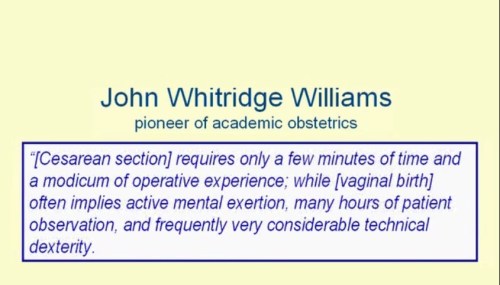
Declercq also draws on writing from the classic obstetrics textbook, Williams Obstetrics, and shares this quote about one of the real reasons that cesarean rates continue to rise:
whycesareanAnd, he makes this important observation:womenhaventchanged
As Nadine Goodman says in The Business of Being Born Classroom Edition, “A woman will always remember how she was made to feel during her birth…if you don’t have the reverence and respect for birth, where do you go from here?”

Prior post about The Business of Being Born: Transformation Through Birth | Talk Birth

Disclosure: I received a complimentary digital package for review purposes.

Talk Books: One Recumbent Mommy

Some time ago I received a unique memoir to review along with a companion book for children. The topic of One Recumbent Mommy is bedrest and the book is written in a friendly, conversational, and personal style that has potential to bring an air of sisterhood to women experiencing the same challenge and make them feel less alone. The book is based on the author’s blog and a casual, breezy, lighthearted style comes through strongly. The author writes:

I was on hospital bedrest with incompetent cervix for about 16 weeks and while there, I kept a blog chronicling the ups and down of day to day life in the hospital.  That blog was published and is entitled, One Recumbent Mommy: A Humorous Encounter With Bedrest.  I wrote a children’s companion book as well, entitled Wherever I Am, I Will Love You Still: A Book About An Extended Hospital Stay.  This book was written from my 2 year old son’s point of view.  I was trying to get at a way of explaining the situation in terms that a young child could understand.

The companion children’s book: Where I Am, I Will Love You Still, is friendly and sweet and the illustrations are engaging. This book would be a very useful addition to a family whose mother is experiencing a hospital stay. While the book’s conclusion includes the new baby sister coming home, it definitely has the potential to be applied to non-maternity-related hospital stays as well. Do note that bottle feeding is portrayed in the book.

While I was somewhat disappointed by the very conventional medical model of care in One Recumbent Mommy and the seemingly unquestioning acceptance of it by the author (especially considering that bedrest has come under serious scrutiny as to its actual effectiveness at preventing pregnancy loss), as well as the apparently overlooked irony of the baby’s birth then being induced, I appreciated the reminder that for many women pregnancy is anything but a joyful, flower-strewn walk through a miraculous meadow of belly casts and earth-goddesses. My writing and my posts often trend to a Happy Birth Dance! mode of writing about birth and was beneficial to me to remember that this model can feel very isolating, discouraging, and depressing to women whose experiences of pregnancy and birth are different from my own.

Along this same line of thought, I was reminded of recent writings from beautiful blogger Leonie Dawson about her experiences with severe hyperemesis gravidarum (requiring multiple hospitalizations):

And despite everything – despite it all –

Love is calling me forward.

As ancient as the beginning of time, love calls upon us to do what we could not do without.

Love asks of us great things…

via The Love That Calls Us Forward | Leonie Dawson – Amazing Biz, Amazing Life.

As I read One Recumbent Mommy and my priestess/ceremonialist self came to fore however, I also found myself wishing this mama had had some kind of beautiful hospital blessing ceremony to honor her commitment to her baby or that someone had offered her a nurturing prayer, poem, or blessing for her as a Bedrest Warrior doing what had to be done to protect her baby. Could there be a place for a Happy Bedrest Birth Dance mode of writing and experiencing as well? I gratefully welcome additions to this post of ideas for rituals, poems, prayers, or resources that can be offered to bedrest mamas who are doing their best to welcome a healthy, full-term baby into their lives! 🙂

Tuesday Tidbits: Postpartum Mamas

As Americans, we are under the impression that new moms are ‘Superwomen’ & can return to life as it was before baby. We must remember to celebrate this new mother and emulate the other cultures that honor new mothers by caring for them, supporting them, & placing value on the magnificent transformation she is going through. This is the greatest gift we can give to new mothers & newborns…–Darla Burns (via Tuesday Tidbits: Postpartum Mothering)

“The first few months after a baby comes can be a lot like floating in a jar of honey—very sweet and golden, but very sticky too.” –American College of Nurse-Midwives

The United States are not known for their postpartum care practices. Many women are left caught completely off guard by the postpartum recovery experience and dogged by the nagging self-expectation to do and be it all and that to be a “good mother” means bouncing back, not needing help, and loving every minute of it.

This country is one of the only utterly lacking in a culture of postpartum care. Some version of the lie-in is still prevalent all over Asia, Africa, the Middle East, and particular parts of Europe; in these places, where women have found the postpartum regimens of their own mothers and grandmothers slightly outdated, they’ve revised them. The U.S. seems only to understand pregnancy as a distinct and fragile state. For the expectant, we issue reams of proscriptions—more than can reasonably be followed. We tell them what to eat and what not to eat. We ask that they visit the doctor regularly and that they not do any strenuous activity. We give them our seats on the bus. Finally, once they’ve actually undergone the physical trauma of it, their bodies thoroughly depleted, we beckon them most immediately to rejoin the rest of us. One New York mother summed up her recent postpartum experience this way: “You’re not hemorrhaging? OK, peace, see you later…”

…“A culturally accepted postpartum period sends a powerful message that’s not being sent in this country,” said Dr. Margaret Howard, the director of the Day Hospital for Postpartum Depression in Providence, Rhode Island. “American mothers internalize the prevailing attitude—‘I should be able to handle this myself; women have babies every day’—and if they’re not up and functioning, they feel like there’s something wrong with them.”

via Why Are America’s Postpartum Practices So Rough On New Mothers? – The Daily Beast.

Via First the Egg, I then read this powerful reflection prompted by the article above:

In the piece, one woman mentions that women are literally still bleeding, long after they’re expected to “bounce back” and reclaim their old lives and be totally self-sufficient. Our bodies haven’t finished healing, and we’re supposed to look and act as though nothing even happened here, it’s all good. It’s all just the same as it was.

Secretly, I’ve been the slightest bit ashamed of all the help I’ve needed.

via Eat the Damn Cake Âť bleeding time.

I also read this raw, honest, and touching look at the “betrayal” experienced by women who enter into the mystery of birth expecting a blissed out, earth mother, orgasmic birth experience:

…But inside my head, I could not believe what was happening. How painful it was. How terrifying. I felt helpless. And degraded and humiliated by there being witnesses. And at the same time, I felt so, so alone. I remember at one point saying, completely out of my mind, “I don’t understand why no one is doing anything to help me! Please help me!” Della reminded me that what I was feeling was the baby coming. That I was doing just what I was supposed to, having the baby, right then….

via Mutha Magazine » S. LYNN ALDERMAN’S Ugliest, Beautiful Moment (Or, Fuck Ina May).

And, that made me think of my own thoughts about birth regret and how we may hide it from the pregnant woman we perceive as vulnerable in her beautiful, fleeting state as Pregnant Woman:

I’ve come to realize that just as each woman has moments of triumph in birth, almost every woman, even those with the most blissful birth stories to share, have birth regrets of some kind of another. And, we may often look at subsequent births as an opportunity to “fix” whatever it was that went “wrong” with the birth that came before it. While it may seem to some that most mother swap “horror stories” more often than tales of exhilaration, I’ve noticed that those who are particularly passionate about birth, may withhold or hurry past their own birth regret moments, perhaps out of a desire not to tarnish the blissful birth image, a desire not to lose crunchy points, or a desire not to contribute to the climate of doubt already potently swirling around pregnant women…

via Birth Regrets? | Talk Birth.

Which then made me think about the women who know...

Where are the witches, midwives

and friends

August 2013 011

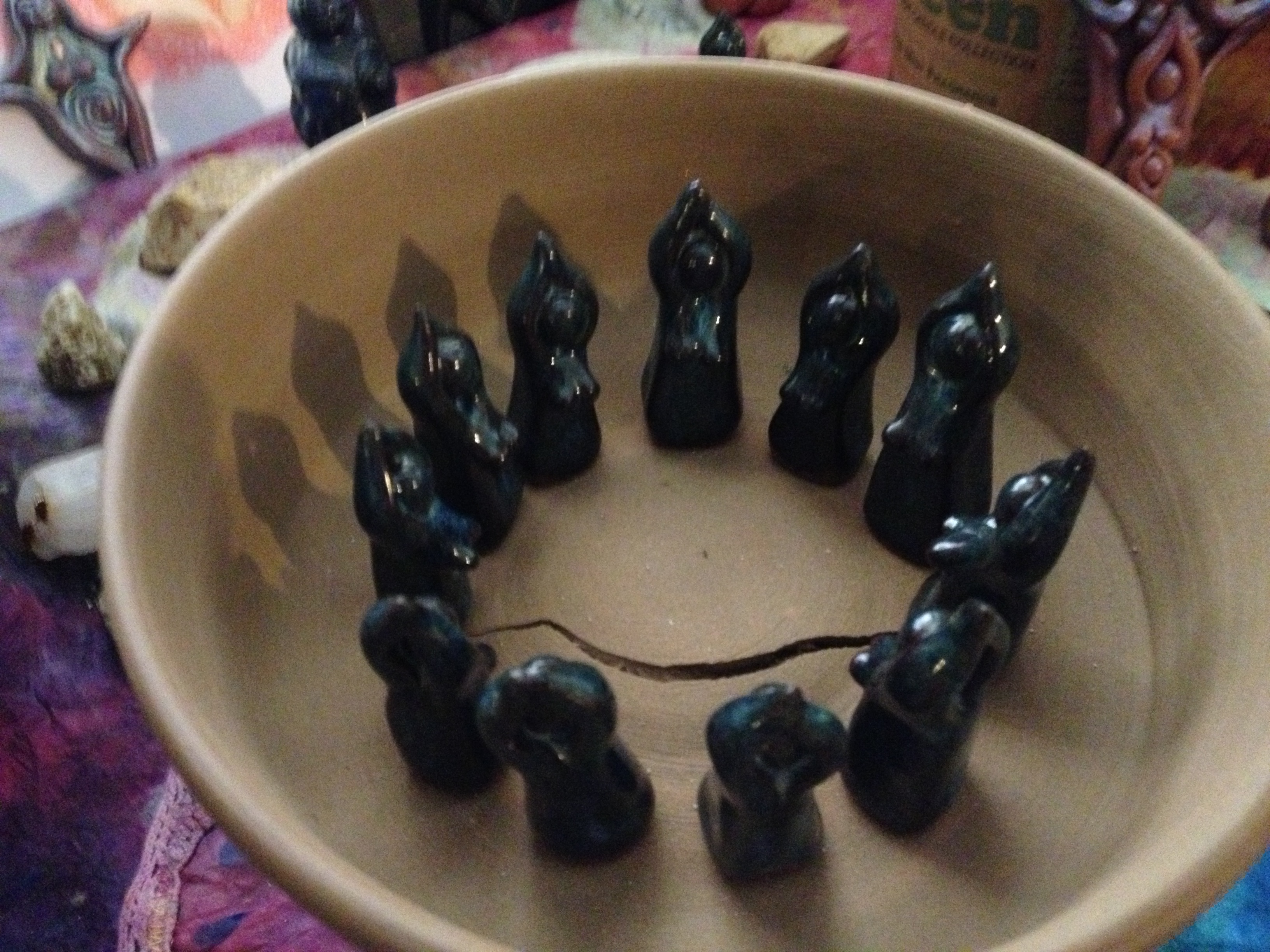
Circle of women sculptures as gifts for my women’s group. Yes, there’s a crack—“the world cracks everyone”—but that is how the light gets in…

to belly dance and chant

while I deliver

to hold me and breathe with me

as I push

to touch me and comfort me

as I cry?

Where are the womyn who know

what it’s like

to give birth?

via Where are the women who know? | Talk Birth.

Thinking about that reminded me of the chant we sang around the fire at the festival I just returned from on Sunday night:

Dance in a circle of women,

Make a web of my life,

Hold me as I spiral and spin,

Make a web of my life…

via Goddess Chants – Dance in a Circle of Women by Marie Summerwood.

May all pregnant women and tender postpartum mamas dance in a circle of women!

I’d hoped to have time to post a festival recap and some lessons learned, but other responsibilities take precedence at least for today, so I’ll leave you with one of the pictures my sister-in-law took on a misty morning, sunrise stroll around the lake and another that I took in the Temple at the festival:

Sept 2013 090

Sept 2013 036

See also:

Postpartum Survival Tips

Timeless Days: More Postpartum Planning

Mothers Matter–Creating a Postpartum Plan

Planning for Postpartum

Some reminders for postpartum mamas & those who love them

Birthing the Mother-Writer (or: Playing My Music, or: Postpartum Feelings, Part 1)

Postpartum Thoughts/Feelings, Part 2

Postpartum Feelings, Part 3

What to tell a mother-to-be about the realities of mothering…

A Mother’s Nest

“Although pregnancy and birth is a richly intuitive and instinctive process, a woman will prepare her ‘nest’ and birth according to the style of her culture, in the same way that a particular species of bird will build its nest with whatever is available.” –Pam England

I am planning a mother blessing ceremony for a good friend in September. In addition to fun plans like a belly cast and henna, she asked for something a little different than our usual “roster” of blessingway activities, in that she wants her friends to prepare a Mother’s Nest for her. We are going to communally decorate a birthing sheet for her bed and bring supplies for a “birth box” to have available during birth and postpartum (i.e. containing raspberry leaf tea, chlorophyll, postpartum pads, paper for placenta prints, outfit for new baby, towels etc. All the supplies you like to have on hand for a homebirth!). And, each guest will bring items to add to her bedroom, so that the whole room becomes a Mother’s Nest of birth power, strength, and support, basically like one huge birth altar!

While it wasn’t a communal process, I did intentionally create a nest for myself for the birth of my last baby. I put a futon on the floor about two feet from the bathroom and double sheeted it with a waterproof sheet in the middle and some chux pads on top. I wanted a nest that allowed me to “crawl to the bathroom” if needed. This is a request I repeated frequently during my pregnancy and it was really important to me. My mom asked, “why would you be crawling to the bathroom? Someone could help you?” and all I could say is, “I want to be able to crawl to the bathroom if I need to!” After my other births resulted in unfortunate and extensive labial tearing, I really, really disliked trying get up and into a regular bed. This time, I wanted a birth nest on the floor that I could roll off of and drop down onto, rather than trying to swing my legs out or lift them up to get in. As it was, I remained in this nest for the first three days after my daughter’s birth. I never crawled to the bathroom, but I could have if I’d needed to, dang it!

In the photo, the gray plastic tub near the futon is my birth box, all packed with labor and postpartum supplies. The cardboard boxes on the floor nearby contain my neonatal resuscitation equipment (before my daughter’s birth I became certified in Neonatal Resuscitation, because I had a fear of the baby not breathing at birth—rather than be frozen by that fear, I decided to do something about it. We then realized that it wasn’t that smart to have the only person who knows how to resuscitate a baby also being the person giving birth to that baby, so I trained my husband and mom how to use the equipment as well). I kept these supplies with my emergency birth plan underneath separate from my birth box, in order to mentally/visually have space between what was “normal” (the birth box) and what was “just in case.” My doppler is also there and some extra chux pads. You can also see my lovely birth altar with my Woman Am I picture on it, watching over my birth nest.

My baby was born into my waiting hands in this very nest, just as I planned. She breathed and cried immediately.

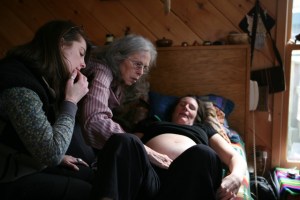
Moments before her birth. You can see the doppler in front of me, because I suddenly got freaked out about needing to listen to her heartbeat. My husband is wearing a hat because it is January and we heat with wood, but were busy having a baby instead of tending a fire!

Moments before her birth. You can see the doppler in front of me, because I suddenly got freaked out about needing to listen to her heartbeat. My husband is wearing a hat because it is January and we heat with wood, but were busy having a baby instead of tending a fire!

I look forward to helping my friend create her mother’s nest. How about you? Do you have any ideas for a Mother’s Nest? Did you build one for yourself? What would you like friends to contribute to a nest for you?
Modified from this post.

Tuesday Tidbits: Miscarriage Care

66112_618725968151055_156983473_nFor ages, I’ve had the following quote about miscarriage and doctors saved in my drafts folder:

“The only person who can really tell you what is happening to you is your own doctor, who peers into you with a light and a speculum, who samples your blood or urine, or who presses a sonogram paddle into your belly. If you are in trouble, bleeding, scared, or more depressed than you think you can handle on your own, you must find help. Read and research all you can, but remember that the one-on-one assistance of a real doctor is the only thing that will give you answers that count. If you don’t like or trust your doctor, then find one you can…”

I Will Carry You

I saved it because it bothered me so much to read. One-on-one assistance of a real doctor is the ONLY thing that will give you answers that count?! I disagree so much with this and it saddens me to know that women turn to doctors for support that they are unlikely to be able to provide, particularly if women are looking for compassion. My own ER doctor experience was horrendous and involved quotes like: “this is very common, it is just natural selection” and, “this wouldn’t hurt so much if you would just stay still,” as well as leaving bloody handprints streaked across the bed and blood on the floor (specifically after being told how very disturbed I was by all the blood). In contrast, I was treated with beautiful compassion (and actual, genuine, useful help) by every midwife I talked to. In defense of doctors though, I also went to my own family practice doctor for a follow-up visit and she said one of the best things I heard from anyone, doctor or not: “some women find comfort in knowing that love was all their babies ever knew.” And, before I left, she asked if she could give me a hug. That mattered more and lasted longer than any “advice” that she gave me about possible causes, trying, again, etc.

So, this week, related miscarriage articles and stories started catching my eye, such as this one that touches on the various dehumanizing ways many women are treated in medical care environments:

Rush of blood to my brain. Pounding in my ears. Breathing comes in short bursts. And I’m ushered out into the waiting area where I’m told to go home to wait for it to ‘come away’. And there I find myself, blinking in the sun, shaking like a leaf. So I waited. And waited. One week later the tiny form within still clung on. I saw it in my minds eye, not wanting to let go of me, its mother. Perish the thought. Instead I spent the week overly busy whilst somehow trying to recalibrate a defeated dream and birth date that would never occur. Finally, I just booked in for the D&C, and signed for an “excavation of contents.”

I am a psychotherapist and counsellor. I focus mainly on fertility in all its guises. From pre pregnancy to birth and beyond I am struck as women and their partners endure dehumanising experience after dehumanising experience, just like this one…

via The heartbreak of miscarriage

And, that reminds me of what Ina May said in her Birth Story documentary that the number one rule of maternity care should be Be Nice and she asks us to consider how just those two words could change maternity wards. While not miscarriage-specific, of course The Neighborhood Doula’s status on Facebook tonight jumped out at me:

“We need to treat women tenderly in labor. This may be the first time she has ever been treated that way. She will pass that on to her baby. If mom has a traumatic birth, filled with interventions she may be afraid of her baby. Fear of baby = disempowerment. A new mother should never feel that way. We need to treat dad with tenderness during labor too. If we treat him well, he will treat mom and baby well.”

Wise words from Ina May Gaskin at the 2012 Joyful Birth and Breastfeeding expo, Asheville, NC

Over the weekend, I was touched to see a photo from Stillbirthday on Facebook with a caption that almost made me cry because I think this perspective is SO important:

Supporting Birth Diversity means…

…Honoring that birth can occur, at any point in pregnancy.

The word “birth” is not reserved for full term, neither is it exclusively for live babies.

(Share your photo and what Supporting Birth Diversity means to you.)

And, of course I’ve already shared my thoughts on miscarriage as a birth event: 421806_605009189522733_1988490402_n

“Miscarriages are labor, miscarriages are birth. To consider them less dishonors the woman whose womb has held life, however briefly.” –Kathryn Miller Ridiman

via Miscarriage and Birth | Talk Birth.

I also read several articles about other women’s experiences with miscarriage as a birth event such as this moving exploration of “missing” when your expectation was of carrying:

Instead I was overwhelmed by pain that felt like the worst wrenching of labor, contractions that came so fast I could barely breathe, shaking and numbness in my limbs that finally made me crawl to the phone and call the nurse who told me to get to the ER as fast as we could. I’d never heard stories of the real, raw truth of what it means to miscarry, so I had no idea what to expect.

But just because a death comes early does not mean it is lighter to bear or let go…

on carrying and missing | mothering spirit.

And this article that touches on the birth event concept, as well as issues of guilt and blame, as well as the idea of miscarriage as a rite of passage:

That is why there is no doubt in my mind that any woman – and indeed any family – who goes through a miscarriage should see it as a rite of passage. The more that miscarriage is seen as horrific, as something which somehow could have been preventable, and is therefore blamed on the woman’s health, fitness or diet, the more we are denying ourselves as fallible animals. We are making women responsible somehow for these acts of nature. We are instilling guilt and fear, layer upon layer. The result is a woman, and by extension her family, who no longer trusts her body to do what is right. It must be faulty – it miscarried. Her body was not healthy enough, not experienced enough or somehow not adequately formed to be able to carry the pregnancy to full term.

This is not a healthy attitude to have, and can only result in more negative birth outcomes. One of the reasons I do not have a black tinge around my memories of my son’s birth is that, through it all, I trusted in my body. I did what I could, and although I couldn’t understand WHY it had happened, I came to accept that this time was just not meant to be. I am an animal, and I am fallible. This time I fell into the statistics of 1 in 7 pregnancies failing. There’s really no more to it – no guilt, no shame, no fear for future pregnancies; it’s just not appropriate.

Having gone through this whole process I now feel more of a woman. Yes, really. Not only have I experienced the horror myself, but I have had countless other women suddenly willing to share their own story with me. In a sad way I feel as if I have entered a secret club, something taboo and a bit shameful. I’m not really sure why nobody wants to discuss miscarriage, when it affects so many of us. If it were accepted as a rite of passage for any woman, as much as childbirth itself, I feel we’d all have a more positive outlook on all births, whatever the outcome.

via Guest Post: Miscarriage as a Rite of Passage | The Happy Womb.

I also finished reading a quick book that was offered free on Kindle last week (now back to a regular, reasonable price) and saved these two quotes:

In the days that followed, the bleeding continued. Every time I would see the blood, I couldn’t help but think I was losing my child slowly bit by bit. It wasn’t just ordinary bleeding; it was the end of my baby’s life. It was the end of my dream to become a mom. I was devastated. I felt so lost and alone. Unfortunately, my husband didn’t seem to understand or be able to comfort me. To him, the baby was not even real yet. And since he was actually afraid of becoming a dad, I think in some ways he was relieved that it didn’t work out. In my mind, I had lost a child. Someone important to me had died, and I was grieving. The hard part is that I was grieving alone with no one to share my sorrow. This is often a problem for women who miscarry. You feel so sad and devastated, but many times your friends and family don’t get it. They don’t realize how much love you can feel for a baby you never saw, met or held. You try to turn to those you love for comfort and support, but they have little to offer you during the time when you need someone to lean on the most. It’s not that they don’t want to help or that they don’t care. No one wants to see you sad or hurting. They just don’t understand what you are feeling and the intensity of your emotions. Even the words they say to you can come across as insensitive or hurtful. They often dismiss your grief and trivialize your pain, all the while thinking they are being encouraging and supportive.

(Amazon.com: From Pain to Parenthood: A Journey Through Miscarriage to Adoption eBook: Deanna Kahler: Kindle Store)

The author also touches on the depth of the grief following miscarriage and how very, very real it is (I’ve written before that one of the things I kept saying to my parents when they came to my house following Noah’s miscarriage-birth was, “this was real. I want you to know it was real.” (I honestly think I didn’t think miscarriages were “real” before, in the sense that I categorized them as something other than birth or death.)

According to The Women’s Encyclopedia of Health and Emotional Healing, “the length of the pregnancy is not as significant as how emotionally linked a woman feels to her baby.” The book goes on to say that if you felt your child was real very early in the pregnancy, then you may experience as much grief as someone who has lost a newborn. If the love for your unborn child was already there, you will be heart-broken and devastated. Your loss can affect you in many different ways, some emotional and some physical. You may notice muscle tension, have trouble sleeping, have difficulty concentrating, suffer from frequent headaches, cry a lot or even notice unusual sensations in your body.

(Amazon.com: From Pain to Parenthood: A Journey Through Miscarriage to Adoption eBook: Deanna Kahler: Kindle Store)

And, these quotes made me remember a brief post from The Amethyst Network regarding early losses and the validity of feelings:

I felt very conflicted over this. I HAD grieved before, but if I was grieving over not-an-actual-miscarriage then did it count? If my loss wasn’t actually a loss, then was my grief valid?

I was talking with a friend (who happens to also be involved with TAN) and explained to her how I was feeling confused and upset over this. She taught me something important.
“You grieved” she said. “It doesn’t matter whether the physical experience was a miscarriage or not, because the grief was real, you experienced the emotional process, and that is valid.”

And so I would say to all mothers who have had an early loss, or a loss that they felt in their gut even though there was no proof. Your feelings–no matter what they are–are valid feelings. We each have different experiences, and we each have different feelings. But what you feel is legitimate, regardless of the circumstances.

Did It Count?

995401_615271668496485_1504558296_n

(and, really, there is no “shame” in not acknowledging how it changes us either, the shame rests in the lack of acknowledgment from so many around us)

This last photo (for some reason it refuses to let me caption it?!) is of some “hope” baubles created by members of the Rainbow Group (local loss support group) at our recent MamaFest event (more about this soon, I hope!).

August 2013 028

Tuesday Tidbits: Birth Imprinting

What are imprinting upon newborns at birth in our culture?

As Sister MorningStar writes in her article The Newborn Imprint in Midwifery Today issue 104, Winter 2012…

If you have had the misfortune, as nearly all of us who can read and write have had, to see a baby born, perhaps pulled out, under bright lights with glaring eyes and loud noises of all sorts, in a setting that smells like nothing human, with a mother shocked and teary and scared; if you have witnessed or performed touch that can only be described as brutal and cruel in any other setting…

Every baby born deserves uninterrupted, undisturbed contact with her mother in the environment the mother has nested by her own instinctual nature to create. Any movement we make to enter that inner and external womb must be acknowledged as disturbing and violating to what nature is protecting. We do not know the long-term effects of such disturbance. We cannot consider too seriously a decision to disturb a newborn by touch, sound, light, smell and taste that is different and beyond what the mother is naturally and instinctually providing. Even facilitating is often unnecessary if the motherbaby are given space and time to explore and relate to one another and the life-altering experience they just survived. They both have been turned inside out, one from the other, and the moment to face that seemingly impossible feat cannot be rushed without compromise. We have no right to compromise either a mother or a baby.

I am deliberately leaving out the issue of life-saving because it has become the license for full-scale abuse to every baby born… [emphasis mine]

In the same issue in an article called Problems in American Maternal Health Care, Dan Currin points out:

Americans put a lot of trust in their physicians. We are socialized to believe that physicians are the only ones capable of taking care of us. For everything from how to eat to how to die, the mantra is the same in the US: ‘Ask your doctor.’ Meanwhile, physicians are more and more subject to a system that, as Gaskin describes, favors the priorities of hospitals, insurances companies and doctors above the best interests of mothers and their babies

And, Judy Slome Cohain writing in Collusion and Negligence in Hospitals describes it thusly:

To err is considered human, even when it involves maternal death, at a hospital birth. When a woman dies from malpractice after birth the protocol is to hold meetings to consider how to improve relevant protocols to prevent future disasters. Survival of the hospital is first and foremost. However, if a woman dies at an attended homebirth, the Ministry of Health policy is to start a case against the guilty part in a disciplinary court…”

I wrote about birth imprinting in another short post, The Magic of Mothering and about the notion of consulting your health care provider in some thoughts about Women’s Power and Self-Authority.

We also need to consider the role of birth “imprinting” on the breastfeeding relationship:

New mothers, and those who help them, are often left wondering, “Where did breastfeeding go wrong?” All too often the answer is, “during labor and birth.” Interventions during the birthing process are an often overlooked answer to the mystery of how breastfeeding becomes derailed. An example is a mother who has an epidural, which leads to excess fluid retention in her breasts (a common side effect of the IV “bolus” of fluid administered in preparation for an epidural). After birth, the baby can’t latch well to the flattened nipple of the overfull breast, leading to frustration for both mother and baby. This frustration can quickly cascade into formula supplementation and before she knows it, the mother is left saying, “something was wrong with my nipples and the baby just couldn’t breastfeed. I tried really hard, but it just didn’t work out.” Nothing is truly wrong with her nipples or with her baby, breastfeeding got off track before her baby was even born!

via The Birth-Breastfeeding Continuum | Talk Birth.

417

If she came with it label, it would say: Imprint with Care…

*Short post today because I’m out-of-town again! What the heck?! I need a vacation from vacations!

Tuesday Tidbits: Birth Thoughts

Lots of birth stuff to share this week! I may be slowly transitioning away from face-to-face birth work, but reading and writing about birth definitely remain on my agenda. First, this post about pivotal moments in one birth professional’s journey:

Thanks to a powerful recent blog by a doula in England about her experience in a Birthing from Within workshop, I have found myself reflecting on my own path as a doula and childbirth educator. Over the years I’ve done ICEA training, DONA Birth Doula Certification, and Birthing from Within Mentor Certification, along with apprenticing as a midwife and a Masters of Science in Parent-Child Nursing – more than my fair share of learning. Through the past twenty + years of practice I can identify the 7 core experiences that have shaped who I am as a birth professional.

via Birthing Ourselves | My Path as a Doula & Childbirth Educator.

Reading her list brought back some of my own pivotal moments and also helped me see how those moments relate to my current priestess/women’s mysteries path. I think I’ve already mentioned that I renewed my ICEA CBE certification this year, but I let my CAPPA certification lapse. I will let my prenatal fitness educator certification lapse as well and I did not renew my membership in several birth-related organizations. And, in a complicated decision related to a variety of factors, I withdrew my registration for a Birthing from Within mentor training this fall. I’ve wanted to train with BfW for ages, but I realized after we got home from California that I just can’t picture myself doing birth classes any more. Single day workshops or presentations, yes, but teaching (or mentoring) series of birth classes is just not on my radar any longer. I feel removed from or distant from it and I also feel okay with that. It is taking me quite some time to realize that birth writing is still a legitimate form of birthwork/birth advocacy/activism and I don’t need to feel like I “should” be doing something else in order to be valuable.

Speaking of birth professionals, I was interested to see this promising new blog by Amy Gilliand: Doulaing The Doula | Professional Development for Birth Doulas.

And, I’m so thankful that Missouri midwives have now known the freedom to practice for five years! I meant to post this link in an earlier Tuesday Tidbits post:

There is something so genuine, so deep, so…right about women serving women. Midwifery and midwives are intricately woven into the fabric of my life.

via 5 Years of Legal Midwifery in Missouri | Midwives, Doulas, Home Birth, OH MY!

Don’t forget to watch the lovely Ballad of the Midwife video that goes with it! Both the video and the post were created by a talented friend of mine 🙂

Speaking of friends, check out these large family blogs and vote for my friend Shauna’s blog Life with 7 Kids! (she just welcomed a new baby, so it is 8 kids now! :))

And, speaking of videos, after seeing a pretty hands-on, baby-twisting sort of breech birth in Birth Story, I found this pictorial article to be a good reminder with lots of useful pictures:

Most important rule is HANDS OFF THE BREECH no matter how tempting it is just to pull on that leg DON’T. It’s the easiest way to create nuchal arms and a completely deflexed head. When you pull on the leg you create a morro reflex in the baby.

via Mechanism of breech | Homebirth: Midwife Mutiny in South Australia.

And, speaking of Ina May:

“Remember this, for it is as true as true gets: Your body is not a lemon. You are not a machine. The Creator is not a careless mechanic. Human female bodies have the same potential to give birth well as aardvarks, lions, rhinoceri, elephants, moose, and water buffalo. Even if it has not been your habit throughout your life so far, I recommend that you learn to think positively about your body.”
― Ina May Gaskin, Ina May’s Guide to Childbirth

And, speaking of watching Birth Story: Ina May Gaskin and The Farm Midwives documentary, it made me think of this old post:

I know the traditional root of the word midwife is “with woman” (some sources say “wise woman”), but I’d like to offer another. When I was pregnant with my second son, I had a wonderful midwife and we spent many hours together talking about birth and midwifery. During one conversation she said to me, “you can’t be a midwife unless you love women.” This struck me profoundly—a midwife must love women.

via Midwife means “loves women”… | Talk Birth

Oh, and speaking of this loving women and this not being a lemon stuff…

Respect for our bodies, our babies, and our rights is never too much to expect.

That’s why I’m joining forces with the folks I thought were nuts. Remember the ones waving the signs? The ones I thought were nosy, yoga-ball bouncing doctor-haters? Turns out, they are none of those things. They are a smart, growing global coalition of people who recognize that we have a problem with the way many women are treated while giving birth. Nine out of 10 women give birth in a hospital in the United States. Through rallies and advocacy, ImprovingBirth.org is making sure everyone knows that all those women do not check their human rights at the door.

via Nosy, Yoga-Ball Bouncing Doctor-Haters – Why I Changed My Tune – Improving Birth | Improving Birth

But, what happens after the birth? I’ve often thought that my role in breastfeeding support, while less “glamorous” or exciting than birth work, has had more lasting value to the women I serve. Breastfeeding is the day in, day out, nitty-gritty reality of daily mothering, rather than a single event and it matters (so does birth, of course, it matters a lot, but birth is a rite of passage, liminal event and breastfeeding is a process and a relationship that goes on and on for every. single. day. for sometimes years). Anyway, sorry for the brief side note, but I enjoyed reading this article about the celebrity culture surrounding pregnancy and birth with its obsession with who has a “bump” and then how after the birth the main deal is losing that weight and having a fabulous bod again! Woot!

And that’s it. There’s no talk of the hard decisions and challenges that arise when bringing another human in the world: coping emotionally, miscarriages and health risks throughout the pregnancy, emotions that range from excitement to loss, how the partner is coping, decisions surrounding the birth, doulas, home birth, hospital birth, breastfeeding, milk supply, c-section recovery, vaginal recovery, colic, sleep, schedules, being tired all the time, depression, regret, fear, hiding in the bathroom crying. Agonizing decisions about work, caregivers and new priorities. Maternity leave. Paid time off. Unpaid time off. Pumping at work. Making time for your partner. Making time for yourself. A body that has changed but can also do incredible things.

Instead it’s mostly about getting skinny again after the baby is born, which we’re told over and over again is the MOST IMPORTANT THING. And it’s not. I know it’s not, and yet I have a constant dialogue in my head about how I have thirty pounds to lose and my thighs rub together and my stomach is bloated and has the texture of a grape that’s not quite a raisin and my face is fat and I’ll never fit into my old clothes again. I say this to friends (who haven’t had kids) and the response is: “Focus on the amazing thing your body just did, girl! A baby came out of you! You’re being too hard on yourself!” And they are right. I know this. But I can’t shake the feeling that I’m a failure because I’m not the size and shape I once was. And then I feel dumb and embarrassed for focusing on my looks when I should be celebrating how awesome it is that I’m a mom to two healthy, wonderful kids. It’s an exhausting, stupid cycle.

There is an important conversation to have about motherhood that we’re not having on a larger level. I know this because I talk to moms all the time. None of us are talking about maxi dresses or nursery colors or how we worked out for 90 minutes a day with our trainers while wearing a corset. We’re talking about how our maternity leaves don’t feel long enough. How often there’s nowhere to pump at work so we do it in our cars. How frustrating it is to be making too much milk/too little milk. How some days we can’t stand our partners, and on other days they totally save us.

via Exclusive: There Is More To Motherhood Than A Post-Baby Bod | Kate Spencer.

Reading all that and thinking about my own “grape” stomach that just isn’t quite making it back to “normal” after having my last baby, I was reminded of a quote from a very recent post:

“…we all need the renewing powers of ‘rhythm, ritual, and rest.’ This phrase reminds doulas of three helpful labor techniques outlined by legendary doula trainer, Penny Simkin. Rhythm, ritual, and rest not only aid birthing women, but they support all of us to move skillfully through our life’s labors. The power of rhythm restores vibrancy through dance, music, and motion. The power of ritual opens the way to direct encounter with the mysterious wonder of life. Rest renews and restores the very cells of our often tired and over-stimulated bodies and minds…” –Amy Wright Glenn

via Talk Books: Birth, Breath, & Death | Talk Birth.

And, speaking of Amy Glenn, I loved her lovely blessing for mothers to be!

“…May your pregnancy unfold with ease

May gentleness surround you

Joy for precious days

Days of two hearts beating in one body

You radiate wonder

Inspiring poetry, art, worship of ancients…” –Amy Glenn

via The Birthing Site

And, speaking of loving lovely words, I just have to re-share this quote as well:

labyrinth

Tuesday Tidbits: Domestic Violence

Tonight in my Introduction to Human Services class we cover Violence, Victim Advocacy, and Corrections. In a stroke of coincidence, I saw some great materials on Facebook this morning that I quickly added to tonight’s lecture:

The first is this infographic series from the World Health Organization. I first saw it here, but it really comes from here.

WHO_NMH_VIP_PVL_13.1_eng-page-001The second was this powerful public service message from Women’s Aid in the UK (trigger warning for violence):

During this same lesson, I also show my favorite mock poster about fool-proof ways to prevent sexual assault:

preventiontipsIs this at all related to birth? Yes, totally. In fact, I used this same poster in a past post that I really liked, if I do say so myself:

I truly think this is a chronic social issue—motherblame. We MUST look at the larger system when we ask our questions. The fact that we even have to teach birth classes and to help women learn how to navigate the hospital system and to assert their rights to evidence-based care, indicates serious issues that go way beyond the individual. When we say things about women making informed choices or make statements like, “well, it’s her birth” or “it’s not my birth, it’s not my birth,” or wonder why she went to “that doctor” or “that hospital,” we are becoming blind to the sociocultural context in which those birth “choices” are embedded. When we teach women to ask their doctors about maintaining freedom of movement in labor or when we tell them to stay home as long as possible, we are, in a very real sense, endorsing, or at least acquiescing to these conditions in the first place. This isn’t changing the world for women, it is only softening the impact of a broken and oftentimes abusive system.

via Asking the right questions….

And, unfortunately, domestic violence often begins during pregnancy:

Violence during pregnancy is an unfortunately common experience. Between four and eight percent of women experience domestic (intimate partner) violence during their pregnancies. The incidence of violence increases for women with unplanned or unwanted pregnancies with 26% of pregnant teens experiencing intimate partner violence and 15% of all women whose pregnancies are unwanted being in an abusive relationship. Indeed, murder is the second only to car accidents as the most common cause of injury related death for pregnant women.[1] Sadly, these statistics are likely higher in reality due to underreporting or misclassification.

via Domestic Violence During Pregnancy.

Our maternity care system unfortunately may also BE the perpetrator of violence against women:

While the situation is different from domestic violence in some ways, it is also similar. Abuse in the medical setting is also about power and control, the pregnant or laboring woman is often blamed for her situation, and verbal and emotional abuse can be similar. Because we are taught to “trust your doctor”, and in fact there is an explicit assumption of trust in the “fiduciary relationship” between the woman and her doctor who is an “expert”, most of us do not think about the possibility of abuse, and many of us stay with the OB or feel we have no choice about our health care providers or settings, especially when we are in labor. Also, the doctors and staff generally are not even aware that their behavior or actions are abusive.

via Guest Post: Abuse of pregnant women in the medical setting.

And finally, “normative” institutional abuse may be a part of many women’s birth experiences:

“‘Old wives’ tales,’ says the Oxford dictionary, are ‘trivial stories, such as are told by garrulous old women.’ It is significant that no one ever talks about ‘old husbands’ tales’ or ‘old doctors’ tales.’ Women are blamed instead. It is implied that there is poison in their speech and that the only safe thing to do is remain silent. The experiences that women share with other women are thus rejected and trivialized…In reality, it is not other women who instill and fuel anxiety in most pregnant women, but the medical system itself.” This quote from the 1980’s book, Giving Birth, by Sheila Kitzinger, remains strikingly relevant today. When women in the United States today enter the hospital to give birth, many experience some form of institutional violence. They may not explicitly define it as violence, but listening to their stories provides a disheartening picture of maternity care today.

via Birth Violence | Talk Birth.

Film Reaction: Birth Story

bs_header_f1I have never met anyone with more than a passing interest in birth activism who has not heard of Ina May Gaskin. She isn’t referred to as a the world’s most legendary midwife for nothing! But, how did she get this way? The new documentary film, Birth Story, helps explore that question.

inamayteaches

Prenatal visit

“The feature-length documentary BIRTH STORY: INA MAY GASKIN & THE FARM MIDWIVES tells the story of counterculture heroine Ina May Gaskin and her spirited friends, who began delivering each other’s babies in 1970, on a caravan of hippie school buses, headed to a patch of rural Tennessee land. With Ina May as their leader, the women taught themselves midwifery from the ground up, and, with their families, founded an entirely communal, agricultural society called The Farm. They grew their own food, built their own houses, published their own books, and, as word of their social experiment spread, created a model of care for women and babies that changed a generation’s approach to childbirth.

Forty years ago Ina May led the charge away from isolated hospital birthing rooms, where husbands were not allowed and mandatory forceps deliveries were the norm. Today, as nearly one third of all US babies are born via C-section, she fights to preserve her community’s hard-won knowledge. With incredible access to the midwives’ archival video collection, the film not only captures the unique sisterhood at The Farm Clinic–from its heyday into the present–but shows childbirth the way most people have never seen it–unadorned, unabashed, and awe-inspiring.”

I really enjoyed Birth Story. It skillfully weaves together vintage footage, commentary, and births with a present day shadowing of Ina May in her natural environment: at the Farm. The documentary shows her working in her kitchen, eating, talking to her husband, watering plants, riding her bicycle, teaching workshops, training midwives, going to prenatal visits, and finally, attending a very hands-off gentle waterbirth. It also lets us peek at images from the early days of The Farm community, the caravan of buses, the dreams of Stephen Gaskin and the “hippies” who followed him to Tennessee. Birth Story is not just a film about Ina May though, it chronicles the experiences of several other Farm midwives as well, and I loved hearing the commentary and opinions of the less-famous midwives who helped transform the birth world. inamaystephen

I found footage of Ina May with Stephen to be particularly poignant and very much enjoyed the vintage photos and footage. I also find it interesting how The Farm began because of Stephen’s leadership and ideas and yet Ina May took off as the ongoing famous person in the family. Of Stephen, Ina May explains: “He thought women we supposed to be uppity—this was great relief, I didn’t like being held down.”

Ina May describes her own first birth explaining that in typical birth climates, “there’s nothing about the special energy of birth and that’s kind of the most important thing…I felt like I was doing something sacred.” She also makes the basic and crucial point that the number one rule of maternity care should be Be Nice and laughs as she asks us to consider how just those two words could change maternity wards. There are only a handful of actual births in the film, three of which are from sometime in the 1980’s. We see a breech birth (a lot more hands-on than I think of present-day midwifery practice) and a shoulder dystocia, both rare occurrences in birth films. We also see brief footage of Ina May’s Safe Motherhood quilt project and a brief discussion of disparities in maternal mortality rates.

Another highlight of the film for me was midwife Pamela, whose birth we also see on-screen. She is shown telling us about an early birth she attended saying, “I fell in love with women. How can you see someone be so strong and not fall in love?” Exactly. My doula and friend, Summer, who watched the film with me, developed her reaction to this quote in a lovely blog post and it reminds me of my own past post about my own former midwife who helped me see that midwife means loves women. Ina May explains that she learned how to be a midwife by allowing herself to be instructed by the women themselves and then she trained other midwives. As I watched Birth Story I found myself feeling a little sad, nostalgic, and inamayandbabybittersweet, because I feel like the world that these beautiful midwives envisioned has yet to really be birthed and that in some ways we’ve gotten so far away from the relationship-oriented and community living/engagement model upon which The Farm was based.

My initial feeling as I watched the film was that it would be primarily of interest to people already very familiar with Ina May, thinking that it  may not appeal to or interest “regular” people. However, the friends I viewed the film with had totally different perspectives. One friend told me she thought her husband would really have liked the documentary, particularly for the emphasis on community. The one husband who was present reported that he thought everyone should see the film and not just people who are already “birth junkies.” So, I stand corrected, and will now say that Birth Story has the capacity to engage with many people!

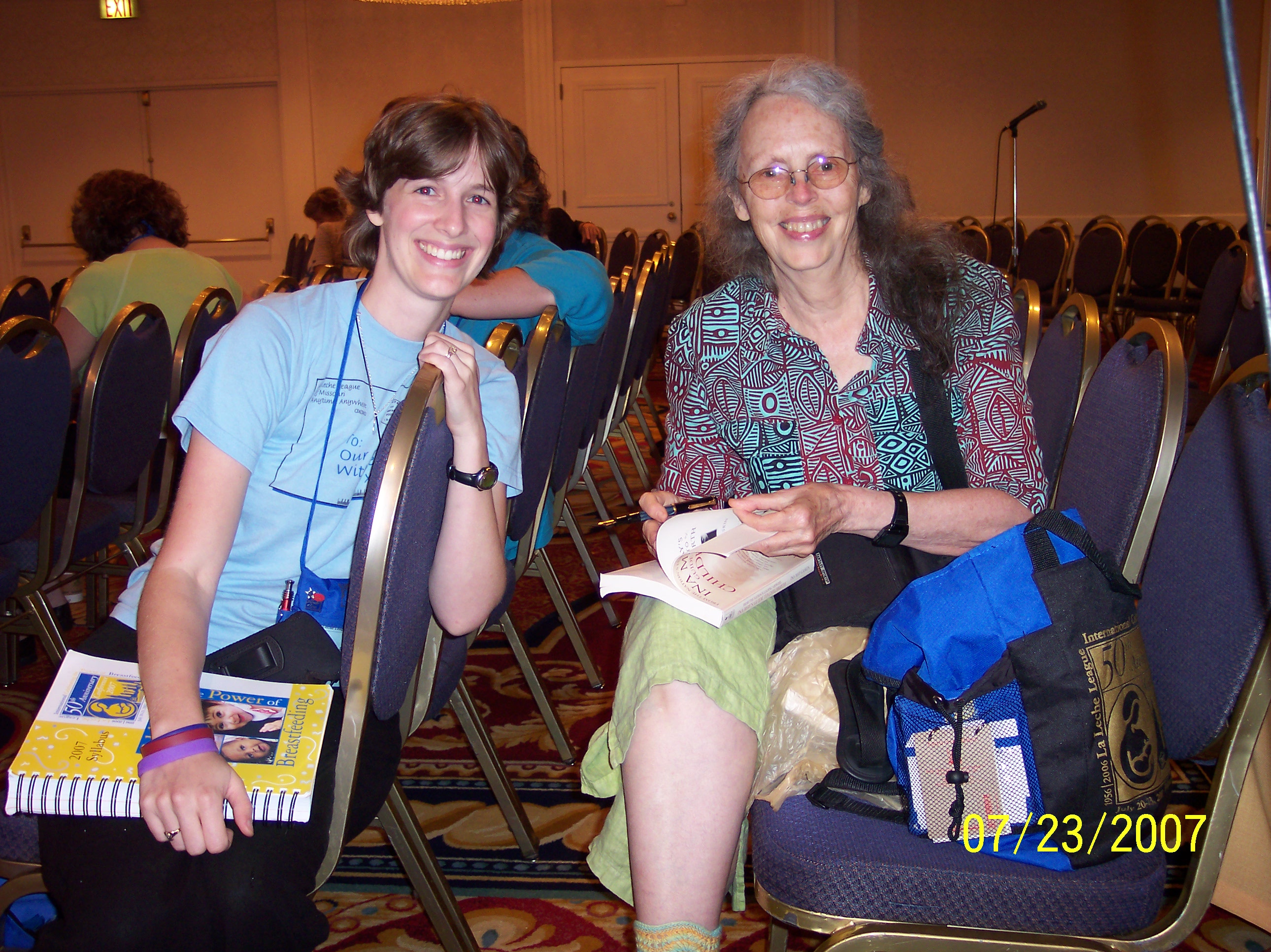
In 2007, I had the opportunity to listen to Ina May speak in person at the La Leche League International conference in Chicago. She talked about sphincter law and made the association with our bodies’ capacity for bowel movements and women’s physical capacity to rebound from childbirth. I will never forget her saying: “I don’t know about you, but my butt closes back up after I poop.” That summed her up for me: plainspoken, real, matter-of-fact, and practical. She’s a legend!

100_0564

Starstruck? Oh, yes I am. My husband said, “these people are like your *celebrities.*”

Disclosure: I received a complimentary screening copy of the film for review purposes.