Archives

Breastfeeding as an Ecofeminist Issue: Collage Project

Processed with Moldiv

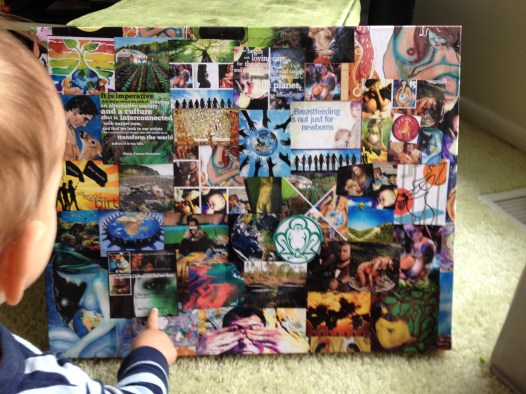
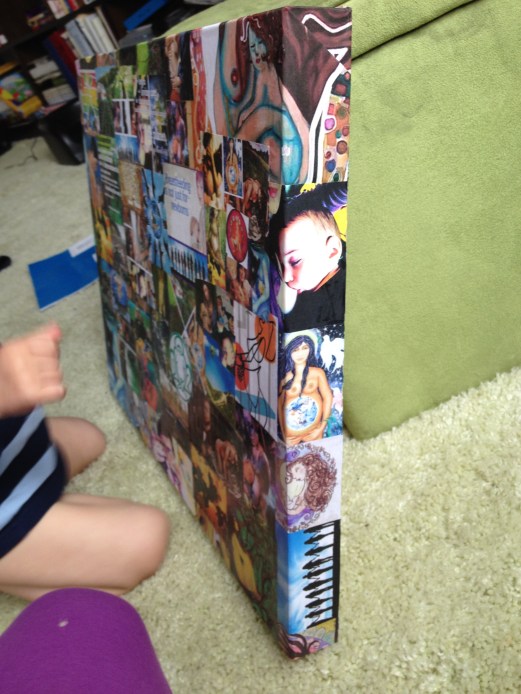
Since January I’ve been working with an independent study student from Prescott College on a self-designed course called Breastfeeding and Ecofeminism. Her class ended this month and her final project was a collage making the connection between the world body and the female body and reflecting the idea that how we treat women and their bodies as a culture is mirrored by our global treatment of the planet (and, conversely, if we change how women’s bodies our treated, our treatment of the planet will also change). As she worked on her collage, she also made a series of digital collage images for use on social media (see above), using quotes from her reading for the course.

“Governments and commercial companies will ‘invest’ billions in expensive new technology: roads, bridges, airports, dams or power generation plants, ‘for the good of society’. They may even ‘invest’ in schools and hospitals, but the crucial primary investment in the emotional, physical and mental health of all humans, which breastfeeding and mothering provide, is invisible.”

Gabrielle Palmer (The Politics of Breastfeeding, p. 333)

As my student remarked, this is an atrocity. AND, it is one that is largely “invisible” to the average person.

I also find this quote relevant from The Politics of Women’s Spirituality:

“Human life is valuable and sacred when it is the freely given gift of the Mother—through the human mother. To bear new life is a grave responsibility, requiring a deep commitment—one which no one can force on another. To coerce a woman by force or fear or guilt or law or economic pressure to bear an unwanted child is the height of immorality…If they were genuinely concerned with life, they would be protesting the spraying of our forests and fields with pesticides known to cause birth defects. They would be working to shut down nuclear power plants and dismantle nuclear weapons, to avert the threat of widespread genetic damage which may plague wanted children for generations to come…” (p. 420).

For one of her digital images, she chose one of my favorite quotes from Reweaving the World in an article that touches on birth as an ecofeminist issue:

Here are some photos of her final collage project:

photo 1 photo 5 photo 3

“Knowledge serves no purpose if it is not spread around. As the poor get poorer and the rich get richer, an entrenched ignorance is kept in place through a culture created and maintained by commercial interests.” – Gabrielle Palmer, The Politics of Breastfeeding

Thesis Tidbits: Feminism, Midwifery, and Motherhood

“Feminism catches fire when it draws upon its inherent spirituality. When it does not, it is just one more form of politics, and politics never fed our deepest hungers.” –Carol Lee Flinders (in The Millionth Circle)

Yesterday, I spent several hours finishing a blog post for Feminism and Religion regarding empowered self-care (it won’t run until next  week). It is a primarily a personal narrative, rather than a political commentary, but as I was writing it, I learned about new legislation introduced in Missouri in an effort to effectively destroy the practice of independent midwifery here. I also have a friend whose family March 2014 082 member just experienced terribly abusive treatment during the immediate postpartum period. I typed feverishly away with an absolutely excruciating headache and a million things on my mind, primarily the very many injustices experienced by women during the childbearing year. I was also left wondering HOW we can truly take care of ourselves when legislators and health care workers actively take dramatic and even cruel steps to prevent us from doing so?

Another friend wrote a comprehensive blog post about this malpractice insurance legislation and the issues involved with it. Midwifery advocacy organizations have already introduced a perfectly appropriate piece of legislation this session and do not need the proposed bogus piece of legislation that offers nothing in the way of protection for Missouri midwifery consumers and instead simply serves to drive midwives out of practice:

…Fortunately, midwives in Missouri do offer a grievance process and adhere to the practice standards set by the certifying agency NARM (North American Registry of Midwives). While there is already a high degree of professional accountability practiced in Missouri, this is because the state professional organization (Missouri Midwives Association) believes it is important and necessary for the professional practice of midwifery and not because the state has directed midwives to do so.

The state of Missouri has continued to be uninterested in working with midwives and home birth families to improve and safeguard the practice of midwifery.

Is there a better option? YES! HB 1363

Instead of HB 2189, we would like to suggest directing legislators to support HB 1363. This is a comprehensive midwifery licensing bill which does provide a mechanism for oversight and responsible, regulated practice. It also addresses the issue of malpractice insurance by requiring midwives to have coverage under the same conditions as physicians. It would also require Medicaid reimbursement for families desiring the care of Certified Professional Midwives and home birth.

via Missouri Legislature Works Against Women, Families and Midwives….AGAIN. | Midwives, Doulas, Home Birth, OH MY!.

I also recently finished a class on ritual theory for my doctoral degree program. The text for the class was To Make and Make Again: Feminist Ritual Thealogy by Charlotte Caron. In it, I was repeatedly reminded that gathering with other women in a circle for ritual and ceremony is deeply important even though it might just look like people having fun or even being frivolous, it is actually a microcosm of the macrocosm—a miniature version of the world we’d like to see and that we want to make possible. Returning to Caron, she explains something similar: “Ritual change is symbolic change, but it can lead to direct action or to ideological change, so it can be an important element in strategizing for change. One way of causing change is to re-form or alter the system. This involves recognizing that we are part of the system and that the system is dependent on feedback from its parts to keep it in balance, which means that we have the capacity to change” (p. 209).

Ritual experience can lead to practical action: spiritual praxis. But, this action does not need to look the same for all women, nor does it always have to involve large structures of society or even sweeping societal change.

“It is important to recognize that not all women will choose to act in the large structures of society. While it is hoped that all women will act toward justice, still electoral politics, lobbying, and revising the economic system may not be the spheres in which some women exert their energy. Ritual actions, raising children to be just and caring people, living in just ways in intimate and community relationships, and modeling different patterns and values are political actions to change patriarchal ideology. The choices of what spheres to devote energy to are important to honor. The constraints of women’s lives—when they are disabled, when they are dealing with past traumas, when they are raising young children, and when they are doing the many other things expected of women in our society—mean that women need to make choices that will allow them to live with integrity and well-being.” (p. 211)

A number of options of action are possible. “What is important are women’s choices to act in concrete ways in every circumstance, to know our neighbors, to raise children to be caring people, to live as if justice exists, to be just in personal relationships, and to live in the community in ways that model the values of justice and well-being for women and all of creation.” (p. 211)

As a mother who works extensively with other mothers, I appreciated Caron’s acknowledgement that raising children is a feminist act with potential to create change as well. “Another strategy for change is through raising children to be just and caring people. A media image portrays feminists as being against motherhood—but in fact, feminists make the best mothers. They raise children aware of themselves and the world, of options and values, of what justice means and how to work toward it, and how to be self-critical and self-respecting” (p. 203-204). Caron also explains that “in a just society, women would be free to make whatever decisions they needed to, for however long they needed to, in relation to political action in the public and the private sphere. All people would participate in the decision-making, and women would be supported in their decisions rather than, as sometimes happens, made to feel guilty for not doing enough or not valued for what they do.”

In connection with women being valued for what they actually do, Caron makes an interesting note about the visions women in her research hold for the future, for the possible:

“Interestingly, none of the visions described by women was based in self-fulfillment, in gaining personal power, or in one’s group having power and the expense of others. Instead, the interviewees talked about the elimination of social, economic, military, and other patriarchal problems, and about living in a world of valued individuals, healthy and diverse relationships, economic and environmental sustainability, equality for all, and shared decision-making and power” (p. 220).

Connected to these themes, one of my classic favorite quotes about women’s spirituality groups is this one:

“…Women’s spirituality groups can become birth centers for social change”

–Anne Rush in The Politics of Women’s Spirituality (p. 384)

March 2014 127

Breastfeeding as a (s)hero’s journey?

Every single human being was drummed into this world by a woman, having listened to the heart rhythms of their mother.

––Connie Sauer

February 2014 003

Recently I re-posted an article I wrote about breastfeeding and parenting as spiritual practices. I received a comment on the re-post that really gave me pause and some food for thought:

I’ve really liked your writing about preparing for birth as a warrior’s rite. I only wish I’d had materials that prepared me for breastfeeding similarly…

I’d like to have at least one breastfeeding book out there that supports women in breastfeeding even when it’s hell, and that doesn’t assume any pain is due to some tiny, easily fixed problem. I continue to get the most condescending advice when I talk about this in public — I don’t know how anyone thinks, with the amount of pain I’ve experienced trying to make this work, that I haven’t already tried every obvious solution.

Anyway, that is all a bit tangential to your post. I do think breastfeeding can be spiritual, though for some of us, it may be an ordeal as much as birth is. I would love to see that acknowledged better in breastfeeding resources.


I’ve been a breastfeeding counselor for nine years. I’ve written before that I have much more often marveled that a mother kept breastfeeding than I have wondered why she didn’t! Mothers are amazing and they go through a LOT. Reading this comment made me wonder why I’ve never really written about my own breastfeeding stories in the sense of a hero’s journey—perhaps because the difficult parts, once overcome, then fade into the fabric of that ongoing relationship? Perhaps because of the sheer ongoing involvement of breastfeeding, rather than the more discreet, definable event of birth? Perhaps because the path can be even more twisty and intimate and embodied and thorough and invested than even pregnancy and birth? Perhaps because, for me, my early breastfeeding stories are very bound up in my overall feelings during postpartum and the struggles I experienced there? Perhaps because for me personally the breastfeeding relationship continues to evolve into toddlerhood and so some of visceral, newborn, early journey elements are subsumed into the more habitual and every day? Why have I never written about the bloody, messy, tearful, painful parts of breastfeeding in my own personal motherhood story?! They’re there. And, when I counsel mothers in person I do talk about those parts. I also never tell people that breastfeeding hurts because they’re doing it wrong—I tell them they will read that phrase over and over, but that in reality, most women experience some degree of discomfort and even pain in the early weeks. Where it becomes not normal is when there is blood or blisters or open wounds, but if someone suddenly started sucking on ANY of your body parts 8-12 times a day, I think it is logical that we can expect some adjustment or difficulty or stress or pain in adjusting to that degree of intense, sustained, body contact/involvement.

I wrote the following at the end of one of my blog posts last year: January 2014 041

I’m also reminded again, however, of why breastfeeding support holds such a lasting pull for me and that is because postpartum is where it is at, that is where we are so very, very deeply needed as support people. Birth is amazing and exhilarating and women most definitely need us there too, but in the nitty-gritty, day-to-day, unglamorous, nipples and breast infections, teething, crying, dirty-haired, exhausted, wrung-out maternal web of daily being is a very tender and delicate beauty that becomes visible only when we’re willing to spend months and months, or even years, serving as a listening ear, a medication lookup, and someone to trust with both her laughter and her tears.

Talk Books: Laughter & Tears: The Emotional Life of New Mothers | Talk Birth.

Birth has been one of my biggest passions for many years. It is so exciting and interesting and almost “glamorous”—it is where the thrill is, the big work, and the big moment: the baby’s emergence. But, guess what, it is in the breastfeeding relationship and the first year with the new baby in which the mother’s strength is really tested. Breastfeeding is the day in and day fabric of connection. It is a huge physical and emotional investment, the continued devotion of one’s body to one’s baby. Breastfeeding support may not as exciting or thrilling as birthwork for me, but it is so very REAL and so very needed, and part of the nitty-gritty reality of individual mother’s complicated lives as they find their feet on the motherhood road. It really matters.

In what ways has breastfeeding been a hero’s journey for you? I’ve written a lot about birth in this context—the idea of the birth warrior or birth as a shamanic experience or birth as a labyrinth path, etc…but what about the breastfeeding journey? How were you tested, how were you challenged, how did you rise, or make peace, or triumph, or cry, or scream, or dig so deeply into yourself that you had to gasp in wonder at your own capacity? What is your breastfeeding story…?

cropped-tbjanuary-2014-039.jpg


Tuesday Tidbits: Cesarean Courage

“Her courage is written on her body.” –Molly (Talk Birth)

March 2014 009Last year I made several cesarean birth art sculptures by request. It felt like a “risk” of sorts to make them, like I was trying to interpret another woman’s experience artistically, but I did it and they were well-received. I chose to imprint words in the figure’s cesarean scar because I kept thinking about how that mother’s love and hope and courage are all permanently written on her body. Recently, I had a request to make another and so I re-visited my Cesarean Courage idea and made some new figures. She is wearing her baby and her scar with pride and strength. These sculptures are not supposed to send an “at least you have a healthy baby” message, they are communicating that her birth journey with her baby is seen and acknowledged and validated.

“I became a mama goddess, too. I became a wonder of fertility, of softness, of late nights and warm beds; a body capable of unimaginable things. I labored and tore open, too.”

–Amanda King (in Being a C-Section Mama In the Birth Goddess Club)

When I shared the cesarean courage mama picture on Facebook, someone responded: Usually I look at the scar as a forever reminder of my failure. The idea my courage and love is forever written on my body in the marks of a surgeon’s knife is so transforming. I am humbled and amazed and inspired and encouraged by the ways in which birth art “speaks” to other women. It is a powerful experience and I feel so honored to communicate and share in this way. When I stopped teaching birth classes, I worried about no longer being “of service” to birthing women, but through my sculptures, jewelry, and writing, I still am doing this work and I am grateful.

Thinking about it reminded me of this wonderfully powerful photo of a mother-assisted cesarean birth in which the mother (a midwife, IIRC) caught her own baby…

You can read more in the accompanying article.

WHEN a baby is born by caesarean, the hands that lift it from the womb to the world usually belong to an obstetrician. But now, there’s someone else who can help deliver the baby: the mother.

via Delivered safely by caesarean with his mother’s hands – National – theage.com.au.

This picture and article were published several years ago and also covered in a Radical Doula post.

There are lovely photos from an online doula friend at Plenitud of a family-centered cesarean birth as well. And, two more recent posts with family-centered cesarean births here and here.

This week I was also touched to read a mother’s story of homebirth plans turned hospital birth plans turned cesarean birth after the baby developed an atrial flutter and was risked out of homebirth:

This has been a big week, with deep shifts that I’m sure will keep happening as we go through the coming days. March 2014 036Sometime in the next three weeks, I will subdivide into two women — one a mother, and one a fresh newborn infant, each with our own developing story and life path. I will find that I care more deeply about some things than I ever thought possible, and other things that were important markers of my life and identity are no longer significant. I’ll celebrate and I’ll mourn…

via Pregnancy Not-So-Blahs: My Story of Fetal Atrial Flutter | Amanda Aguilar Shank.

I knew I was going to be a mother very soon. I focused on not freaking out, and on enjoying my last moments of being so intertwined with my baby. I sent her telepathic messages of love and reassurance. I knew I wouldn’t be seeing her right after the surgery and that likely she would have to go through some trials before I could be with her again.

The operation itself was not as bad as I expected. One critical piece of my experience was having the accompaniment of a labor and delivery nurse friend, who served as a kind of impromptu doula, helping me to hold my ground when treatments being offered were inappropriate or unnecessary, and to fully embrace with less fear and more trust the life-saving help that hospital staff had to offer…

via From Home Birth to Hospital: My Story of Fetal Atrial Flutter | Amanda Aguilar Shank.

smallMarch 2014 059These mamas have taken powerful birth journeys. They have laid down their bodies for their babies. They hold their experiences, they wear them, their courage, love, and hope, upon their skin. The birth experience is there, loud and clear, and yet new experiences and joys are too. She is whole.


International Women’s Day: Body Prayer

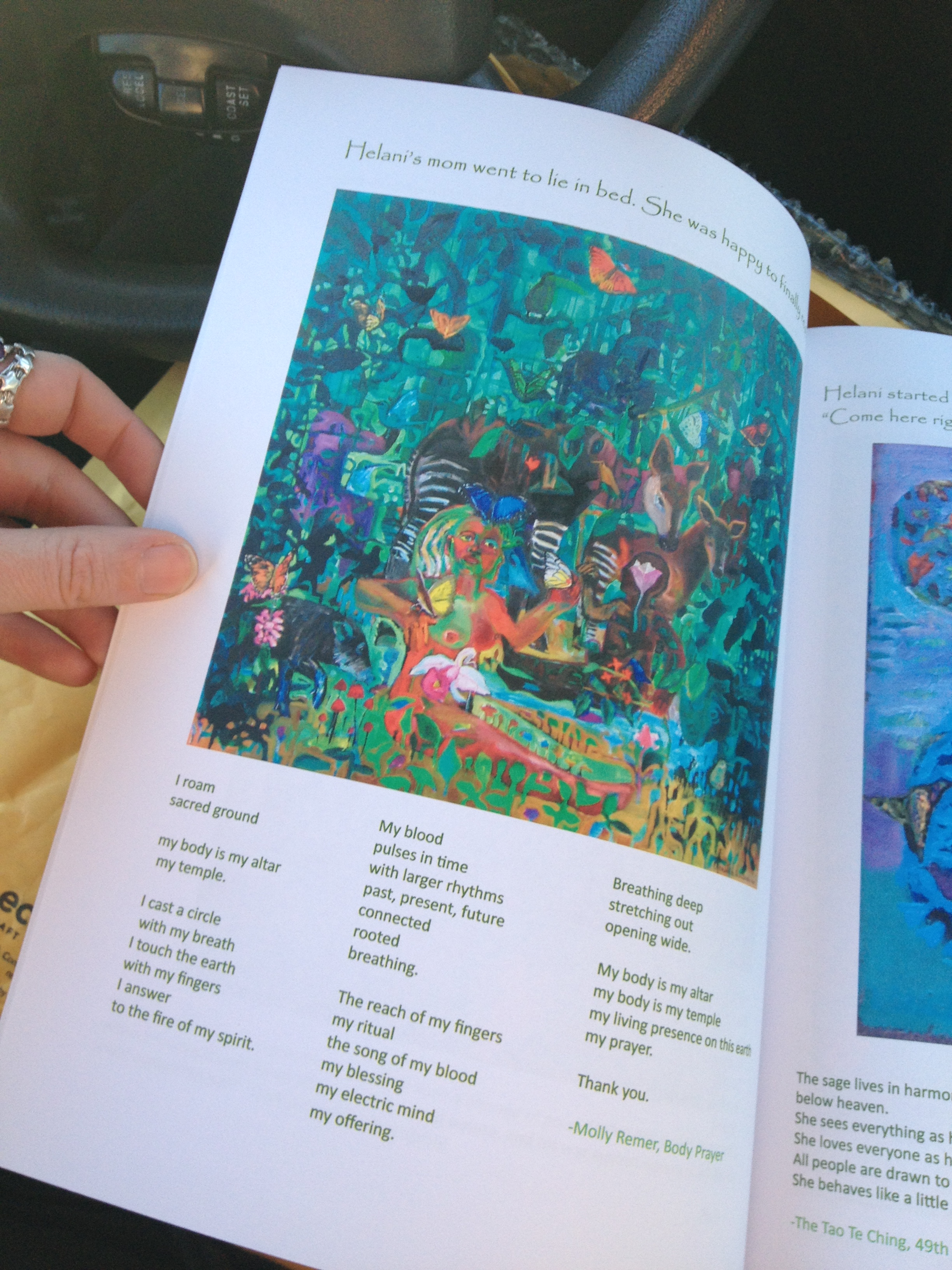
I roam
sacred ground
my body is my altar
my temple.

I cast a circle
with my breath
I touch the earth
with my fingers
I answer
to the fire of my spirit.

My blood
pulses in time
with larger rhythms February 2014 040
past, present, future
connected
rooted
breathing.

The reach of my fingers
my ritual
the song of my blood
my blessing
my electric mind
my offering.

Breathing deep
stretching out
opening wide.

My body is my altar
my body is my temple
my living presence on this earth
my prayer.

Thank you.

I wrote this poem in the spring of last year and was very pleased when Trista Hendren, author of the children’s book The Girl God, wrote to ask permission to reprint it in her new book: Mother Earth. I received my copy of the book last month and wanted to offer a mini-review of it today, International Women’s Day, because as Trista says, it is “a beautiful tribute to the world’s first ‘woman.’” Mother Earth is theoretically a children’s book, but it offers an important message and call to action to all world citizens. Along the top of the pages is a story, written as a narrative experience between Trista and her daughter Helani, about the (human) mother’s need to rest. The story evolves into a message about the Earth and the care and rest she is crying out for. Each page features a large illustration and below the illustration is a relevant spiritual quote, poem, prayer, or message.

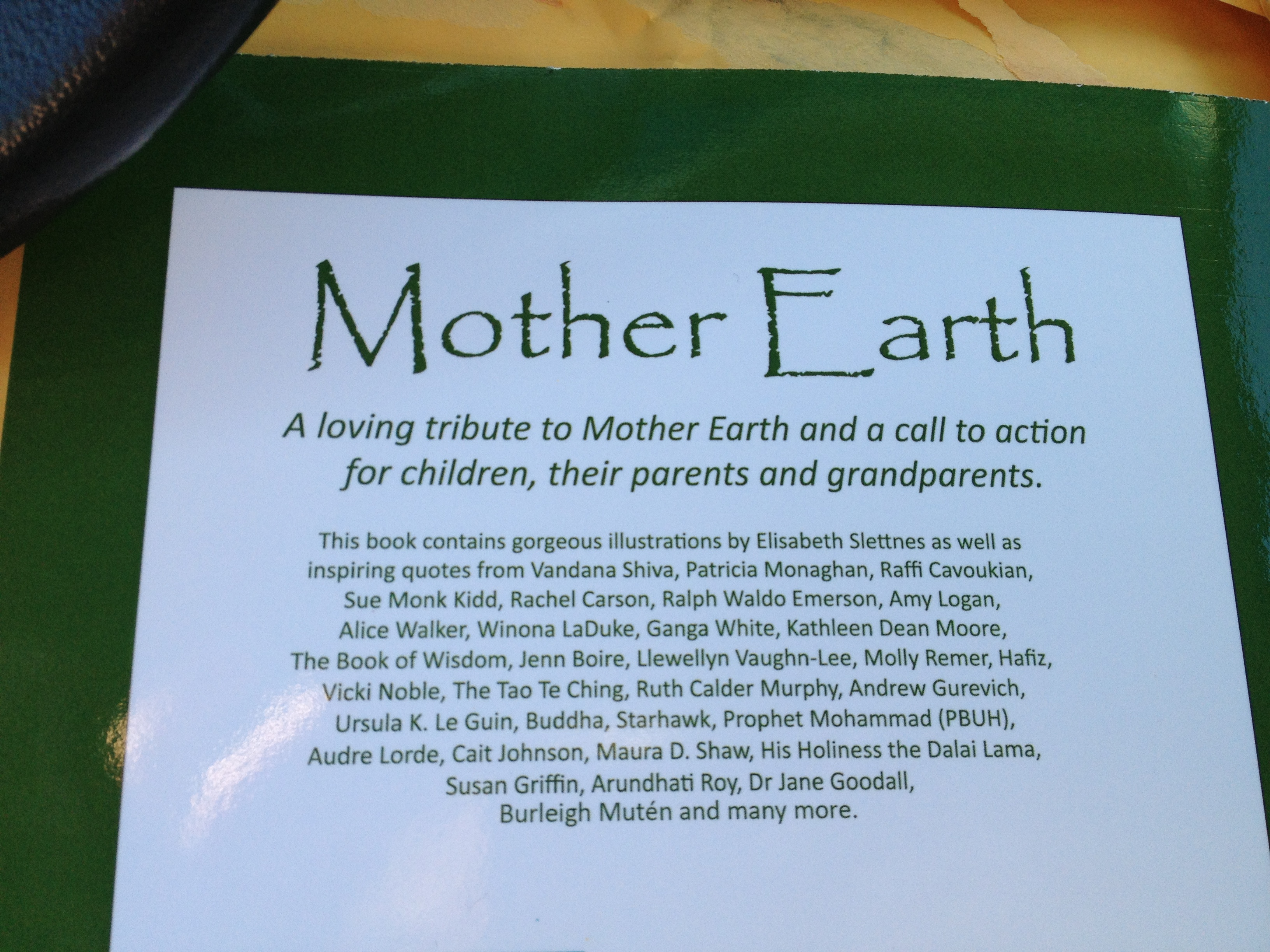
February 2014 038(I got a big kick out of seeing the company I keep on the back cover…Buddha, Hafiz, the Dalai Lama, Starhawk…Molly Remer?!)


I’m still wrapping up the school session as well as preparing for a big event next weekend. I feel taut, overcommitted, crabby, snappy, distracted, and out of time for writing even though I have a pile of ideas for things to write about (always!). Trying to remember that this is normal for me during the week of final paper grading and final exam giving and does not indicate a permanent state of imbalance requiring mass quitting of everything, but that is still how it feels in my (tired) body. It was nice to revisit this poem and take some quiet time to read the whole book.

I wrote a prayer for mothers last year on International Women’s Day:

See your worthIMG_8522
hear your value
sing your body’s power
and potency
dance your dreams
recognize within yourself
that which you do so well
so invisibly
and with such love.

Fill your body with this breath
expand your heart with this message
you are such a good mother.

via International Women’s Day: Prayer for Mothers | Talk Birth.

It is also important to remember the sociopolitical purpose of this day:

International Women’s Day is not about Hallmark. It’s not about chocolate. (Thought I know many women who won’t turn those down.) It’s about politics, institutions, economics, racism….

As is the case with Mother’s Day and many other holidays, today we are presented with a sanitized, deodorized, nationalized, commoditized version of what were initially radical holidays to emphasize social justice.

Initially, International Women’s Day was called International Working Women’s Day. Yes, every woman is a working woman. Yes, there is no task harder perhaps than raising a child, for a father and a mother. But let us remember that the initial impetus of this International Working Women’s Day was to address the institutional, systematic, political, and economic obstacles that women faced in society.

via How we miss the point of International Women’s Day–and how to get it right. | What Would Muhammad Do?.

In years past, I also wrote about the connection to birth as a feminist issue:

“The minute my child was born, I was reborn as a feminist. It’s so incredible what women can do…Birthing naturally, as most women do around the globe, is a superhuman act. You leave behind the comforts of being human and plunge back into being an animal. My friend’s partner said, ‘Birth is like going for a swim in the ocean. Will there be a riptide? A big storm? Or will it just be a beautiful, sunny little dip?’ Its indeterminate length, the mystery of its process, is so much a part of the nature of birth. The regimentation of a hospital birth that wants to make it happen and use their gizmos to maximum effect is counter to birth in general.” –Ani DiFranco interviewed in Mothering magazine, May/June 2008

via International Women’s Day, Birth Activism, and Feminism | Talk Birth.

Happy International Women’s Day! May we all find the space in our day to take a deep breath and honor our bodies, our families, and women around the world who are working, working, working every day to make the world a gentler place to live. (Even if we sometimes get snappy while doing it…)

November 2013 061

Birth Spiral Chakra Blessing

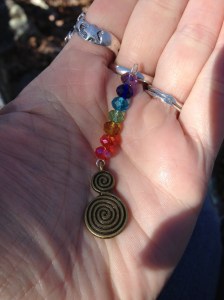
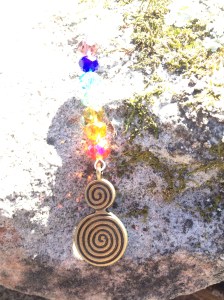
Birth spiralFebruary 2014 015.
Energy
feel it spin throughout your body.
Beginning in your core,
unfolding, unfolding, spiraling upward into a peak
and release
Every part of you opening
making space
making room
for this new little one.
Calling the child forth into your waiting arms
your waiting family
your waiting heart.
Enlivened
alive
fully engaged and embodied
in the current of labor.
It builds
it pulses
it rolls
it rocks
it peaks
it crests.
These waves of power.
They are you.
You are doing it.
You ARE it.
This is energy, this power, this unfolding might of creation.
It’s you.
Your body
your power
your birth
your baby.

February 2014 003

Let the sparkles of these chakra colors remind you to bring your whole self to your labor. To walk the spiral path, to dive in, to embrace, to unfold, and to become: Mother.

Root (red):

Where baby came into being and now will be welcomed. Source of creation. Gateway for baby and life.

Sacrum (orange):

Where baby has sheltered within a cradle of bone. Pelvic bowl that rocks the child. Make way. February 2014 007

Solar Plexus (yellow):

Where you take deep breaths, carried on the waves, following your rhythm.

Heart (green):

Where your love bursts forth and you discover what it is like to be endless.

Throat (blue):

Where you roar your birth song. Welcome your baby with your voice, your cry of greeting. Your cry of triumph. Your cry of fulfillment.

 Brow (indigo):

Where you let your mind go, where you release, and give, and surrender to the creative, nameless, raw pulsing energy of birth.

Crown (violet):

Where you draw in the wisdom of the ancestors. The power of the Divine Feminine. The ocean of mother love that has gone before you and that surrounds you even now as you work.

Draw it in, draw it up, draw it down. And know, without a doubt, that you can do it. You can walk this path. You can rise to the occasion. You can respond with strength to whatever is asked of you. All the surprises, all the mystery, all the twists and turns and unexpected places. You carry the wisdom within you to let it flow.

February 2014 012

Rise for Justice

1497514_10153552346400442_1148387720_nOkay, so I knew I would enjoy The Vagina Monologues. How could I not, right?! Well, I did not expect to be SO blown away by the power, presence, and passion of my magnificent friends. They were incredible. Seriously incredible. It was an amazing show!  There were many powerful moments–some very funny, some sad, some horrifying. My friend, doula, and colleague did the piece on birth at the end and brought me to tears with her vibrance and passion. There was a moment in the middle where the teenage girl member of the cast read out some statistics on the One Billion women who are raped, abused, or assaulted. Each member of the cast began to rise in turn and as they did, their friends in the audience rose with them, until the whole theater was standing. We rose for justice.

I’ve mentioned several times that I came to birth work with a core foundation in feminism and social justice work, primarily in domestic violence. I remain firmly convinced that the way we treat women in the birthplace reflects an overall cultural attitude towards women in general. I believe that peace on earth begins with birth. I believe that we can change the world with the way we greet new babies and celebrate new mothers and see the deep, never-ending work of parenting our children. I believe in rising for justice and I keep vigil in my heart every day for women around the world.

In a stroke of coincidence that gave me chills, my independent study student who is working on a Breastfeeding and Ecofeminism course submitted her weekly reflections and in it she mentioned Eve Ensler, The Vagina Monologues, and One Billion Rising with no idea that I was going to the show this week. As I read her reflections, the connection between the personal and political was so tangible that I asked her if I could use her assignment as a guest post for my blog. Part of the reason I assigned the book Reweaving the World for this course was because of how it contextualizes the issues facing women so broadly and makes this undeniable connection between exploitation of the planet and exploitation of women’s bodies. While it might sometimes trigger a sense of hopelessness and distress, I think ultimately, the contextualization is empowering. The Vagina Monologues are based on the courage of women telling their stories and sharing their truths. Likewise, I appreciate Alea’s generosity and courage in sharing her reflections with my readers…

November 2013 061

Dancing for Change: A look inside a personal exploration of ecofeminism, sexuality, and social justice.

Guest post by Alea Scarff

I began reading The Politics of Breastfeeding which sparked a series of “hell, yes’s!” It also left me feeling inspired, excited and validated that I’m not the only one with these feelings and notions about women, breastfeeding, and the injustice I witness within this issue. Her kick-ass presentation of the truth among this profound cultural issue left me enlivened and ready for action sentence after sentence.

Then I read several pages of Reweaving the World: The Emergence of Ecofeminism. Yikes. This was heavy. I suddenly found myself caught between two worlds of inherent optimism excited for positive social change, and the deep dark issues of ecology and the longstanding reality of suffering and inequality of women on this planet. I felt my body overcome with anger. A feeling of helplessness ensued. I felt those women in third world countries starving and overheated, overworked and just trying to sustain the lives of their children on top of enduring mental, emotional, physical, and sexual abuse. I felt all the children who suffer because of this. I felt all of the gender imposing rules children in the western world are conditioned by, thus tainting our hearts and souls with limitation and sharp edges surrounding who we are allowed to be in this society. All of the emotionally repressed men; all of the objectified, degraded women who have never known what it feels like to feel good in their bodies.

I began to feel my grandmother’s oppression she suffered from my grandfather in the 60s. The abandonment, the sexual abuse, the use and re-use of her as a resource and service for himself. I felt my mother’s experience of an emotionally abusive relationship, and finally my experience of sexual molestation as a child. Where was all of this coming from? A deep sadness came over me as I desperately tried to figure out my own issues with sexuality and my relationship to the world as I sat amongst strangers in this warm coffee shop. Was I angry about what happened to me? Was I angry at my partner? Past partners? Was I angry at the world? I really couldn’t identify where the anger came from, or where it was directed. I had to stop, refresh, and start over. Maybe this shit is too intense for me. Maybe I need to change my course of study.

No, no. You can’t run away. I realized I had been running from this issue my whole life and it’s finally time to recognize it. I stopped, took some deep breaths, did some yoga asanas to release the sticky tensions of injustice lurking in my joints throughout my body. Ok. Begin again.

So I went back to my childhood, with my deepest memories of the frequent encounters of gender inequality. My mother, to this day, credits me for bringing to light her own femininity and capturing her attention to the inequalities of men and women. Something that went unnoticed until I came along, however she still was not interested in changing the ways of the world to the extent I was. She had her own social change she was working on. It was entrenched in art and consciousness. Luckily, I picked up on this, and found my own desire for changing the world through consciousness. Consciousness through equality for women. How could anyone else NOT be outraged by the fact that 8 out of 10 songs on the radio were sung by men? As a twelve year old, I began writing letters to radio stations. I couldn’t understand how no one seemed to care about this absurd injustice constantly happening on the radio. Something so simple yet so powerful as radio permeated our culture – and no one seemed to notice. There were a plethora of female musicians that I favored at this age. How could I not hear them on the radio? On top of an array of social issues such as this, I always HATED those older men who would make random, confusing, degrading comments to me for others’ and their own amusement. What the hell was up with that?

I began reading an interview with Eve Ensler, the creator of The Vagina Monologues and the global women’s campaign, One Billion Rising. The figures quoted from the UN in this interview left me in a deeper outrage. One billion women on the planet today are beaten or sexually assaulted. I reflected on an article I had read earlier that week, as well about how to talk with your children about their private parts and to help prevent them from being sexually abused. The article stated that one in five girls are sexually molested and one in six boys are. I never identified with the label “sexually molested” nor did I want to admit I was affected by this, but just in the last few years when I looked at the definition, I realized, even my few small inappropriate experiences are considered just that, and they have, in fact, affected me.

I had to take a few days off. This all needed to settle inside and I had to figure out what to do with it. I spent days pondering, how do I continue to explore this crucial subject and maintain a positive outlook? How do I channel this anger into solutions for helping others? How can I continue researching and hold my strength and goddess energy as a female role model, an inspiration for my two little boys, my partner, men and women, and the planet?

This is a tall aspiration I set for myself, I realize. I suppose this is simply what I aspire to be.

I began speaking with my mother about my sexuality from a young age and my exploration of it now. It was both comforting and disheartening to discover my mother had similar inappropriate sexual experiences as a child that I endured, as well as finding she’s still on her journey of understanding this taboo topic herself, female sexuality. Perhaps a running thread in my family of women? Or is this prevalent everywhere? Why is no one talking about it? Even after being so close with my mother, and being able to talk about anything for as long as I can remember, it took some courage to bring up this subject with her. Regardless, I am so glad I did.

I began to read again. I decided I had to begin with an open heart and mind, as I swim right through the obstacles of understanding the depths and spaces of the world of women and the planet. There is a lot to be grateful for, and a lot that needs changing. Positive reflection throughout this journey can only bring more light. Letting go and forgiving my past experiences, and the oppression the women I know and love have endured, I take a step into a new beginning. I can move forward continuing to understand my path of my sexuality growing up, and what this means for me now. I feel I’ve got a long way to go, and I can sense a gap of mystery and unknown feelings sitting somewhere inside. But I’m ready to embrace and heal whatever decides to reveal itself.

I am now in the process of releasing fear and letting go. Letting go of being afraid to speak up and stand up for what’s right; of being viewed as a bitch, uptight, or simply being exposed. We as women need to start somewhere within this realm in order to ignite change. Rather than accepting these old cultural paradigms and letting them continue to thrive within this patriarchal society, it’s time to change this tired, destructive trend. As Ensler quotes in a recent interview with Deccan Aitkenhead for The Guardian, “We have one in three women on the planet being raped or beaten…We’ve all learned to be so well behaved and polite. We should be hysterical.”

Ensler launched One Billion Rising which, on Valentine’s Day in 2013 brought close to one billion women out on the streets to protest against violence towards women. Ensler’s goal is to have one billion gather on February 14th outside buildings that represent justice – police stations, courthouses, and government offices – and dance. That’s it. Where and how they dance is up to them; each is organized at a local level. In this, I found tremendous uplifting relief.

Through this personal revelation, I’ve decided to remain free – and not restrained by anger or resentment of injustice. I simply cannot move forward or flourish from that space. We must find liberation through the endurance, triumph and the celebration of womanhood. Simply. This is the only way to encourage and create change. I must release the tensions that like to creep up and burrow inside my joints and muscles. I no longer will walk around carrying this stuff – I’d rather be dancing than dwelling. This is the only way I will find my way to living up to my goddess vibration of inspiration for social change for my two little boys, my partner, women and men, and the planet collectively.

Next year on Valentine’s Day, I think I will be dancing.

“But when you suddenly understand that violence against women is the methodology that sustains patriarchy, then you suddenly get that we’re in this together. Women across the world are in this together.” –Eve Ensler


Tuesday Tidbits: Birth Art, Retreat, and Free-Range Husbands

Photo: “Let us initiate our daughters into the beauty and mystery of being strong and confident women who claim their right to give birth and raise their children with dignity, power, love, and joy.” –Barbara Harper (New post about local activism: https://talkbirth.me/2014/02/05/wednesday-tidbits-activism/)

“Let us initiate our daughters into the beauty and mystery of being strong and confident women who claim their right to give birth and raise their children with dignity, power, love, and joy.” –Barbara Harper

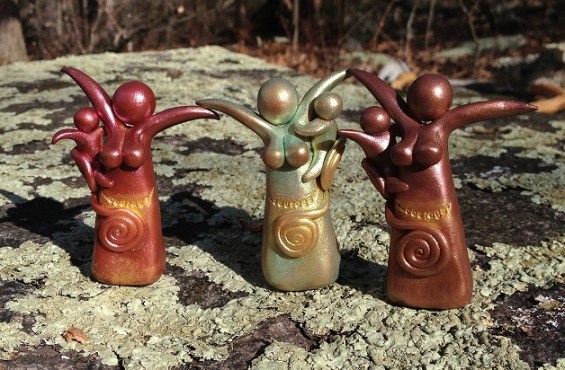
I’ve been getting a lot of requests lately to make more birthing mama sculptures, so I spent some time on Sunday sculpting up a new crew of them!

Photo: It took me a little longer than I thought and my poor mamas look chilly out there in the snow, but I finished taking pictures of my recent sculptures and they are all available on etsy now! :) http://etsy.com/shop/BrigidsGrove

You know how they say that birth art is as real, messy, raw and spontaneous as birth itself? Well, this birth artist doesn’t always gallivant around in the snow with tiny, empowered art pieces. Instead, sometimes I post things like this on Facebook: my toddler has been screaming because she wants to, “make a blue doddess RIGHT NOW” and when the sole cheerful sibling in the house attempted to make one for her she said, “it ball of poop” and squished it in the pasta roller. Ahhh. This is the life…

“Rigid plans work best if you’re building a skyscraper; with something as mysteriously human as giving birth, it’s best, both literally and figuratively, to keep your knees bent.” –Mark Sloan, MD (Birth Day)

via Brought to our knees | Talk Birth.

I recently read an article about spirituality and birth that is going in my dissertation work file:

“She remembers one devout Catholic who birthed holding rosary beads. Propped up on the bed, this mom-to-be rocked and hummed softly during contractions. During her home birth—which lasted only a few hours—she gazed at the three-foot-tall statue of the Virgin Mary in her room. “I felt I was in the palm of the Virgin Mary,” the mother explained to Vincent afterward. “She was protecting me.”

It is not a particular religious denomination that helps women have enjoyable, vaginal, and medication-free childbirths. Rather it is the belief that their bodies are doing what they’ve been made to do and that they are connected to something higher—be that God, the spirit, the universe, or even an awareness of women in the past who have given birth before them…”

Special Delivery | Spirituality & Health Magazine | Page 1.

My first ever miscarriage sculpture when up on etsy this week too. While, I made one like this for myself last year, I’ve never made one for sale until this week. This past week actually marked the fourth anniversary of my second miscarriage. When I took my photo of the new sculpture out in the snow, I reflected that this is how I felt after my second miscarriage–cold and alone. Trying to stand steady and find my ground, even though I felt as if my legs had been kicked out from under me…

Photo: My first ever miscarriage sculpture is also up on etsy today. I made one like this for myself, but I've never made for sale until this week.  This week marks the fourth anniversary of my second miscarriage. I took this photo of the new sculpture out in the snow and reflected that this is also how I felt after my second miscarriage--cold and alone. Trying to stand steady and find my ground, even though I felt as if my legs had been kicked out from under me...

This is part of what I originally wrote about that experience:

I just want to say two things again:

I do NOT want people to feel sorry again for me so soon.

I feel DUMB

I do not feel like I am handling this well or with strength. I just feel numb and dumb and done and done for. I am bottoming out right now. Bottom. Pit. Despair.

It is hard for me to read this again, to type it out, and to remember these feelings. It still feels strange or confusing to me about how Noah’s birth was “easier” for me to cope with emotionally—even as it was the most fundamental and profound grief I’ve ever experienced, it was clean. It felt meaningful. It also had a distinct physical, embodied connection via having given birth to him. The second miscarriage felt like being kicked while I was down and being erased.

via The Amethyst Network February Blog Circle ~ Sharing Our Stories: A Confusing Early Miscarriage Story | Talk Birth.

This time of year, the first week of February, is when I have a personal tradition of taking a week-long computer off retreat. Even though I felt the same call to retreat this year, I didn’t do it. I’m not ruling out the possibility of still getting to do so because February isn’t over yet, but I reached the point where I realized it was stressing me out more to feel like I “should” be planning a retreat than it was not to do it. Since we planned our business launch to start on February 1st, it also just didn’t make practical sense to suddenly disconnect at exactly the same time! What I did do was a family ritual on February 1st and also I did a single-day “email off retreat” that was really amazing. I would like to make that a regular part of my week, perhaps every Wednesday or something.

The merry-go-round of work never stops. There will always be more work than we can handle, more emails than we can ever manage, more projects to juggle. It’s up to us to heed our inner calling, whether that voice is saying, “You’re starving creatively … you can’t keep pushing, your body can’t do this anymore … if you look at one more email, your mind will explode … or, you have got to slow down and rest,” and take action.

via Why I’m taking a sabbatical – Renee Trudeau & Associates.

This reminded me of two past posts about the classic memoir, Gift from the Sea:

“With a new awareness, both painful and humorous, I begin to understand why the saints were rarely married women. I am convinced it has nothing inherently to do, as I once supposed, with chastity or children. It has to do primarily with distractions. The bearing, rearing, feeding and educating of children; the running of a house with its thousand details; human relationships with their myriad pulls–woman’s normal occupations in general run counter to creative life, or contemplative life, or saintly life. The problem is not merely one of Woman and Career, Woman and the Home, Woman and Independence. It is more basically: how to remain whole in the midst of the distractions of life; how to remain balanced, no matter what centrifugal forces tend to pull one off center; how to remain strong, no matter what shocks come in at the periphery and tend to crack the hub of the wheel.”

― Anne Morrow Lindbergh, Gift from the Sea

via The Revolving Wheel (Gift from the Sea) | Talk Birth.

Even though she wrote the book in the 50’s, the sense of fragmentation and balancing that many mothers today experience was her experience as well…

For life today in America is based on the premise of ever-widening circles of contact and communication. It involves not only family demands, but community demands, national demands, international demands on the good citizen, through social and cultural pressures, through newspapers, magazines, radio programs, political drives, charitable appeals, and so on. My mind reels in it, What a circus act we women perform every day of our lives. It puts the trapeze artist to shame. Look at us. We run a tight rope daily, balancing a pile of books on the head. Baby-carriage, parasol, kitchen chair, still under control. Steady now!

This is not the life of simplicity but the life of multiplicity that the wise men warn us of. It leads not to unification but to fragmentation. It does not bring grace, it destroys the soul. And this is not only true of my life. I am forced to conclude, it is the life of millions of women in America. I stress America, because today, the American woman more than any other has the privilege of choosing such a life. ― Anne Morrow Lindbergh

via Tuesday Tidbits: Gift from the Sea (Communication Overwhelm) | Talk Birth.

February 2014 012

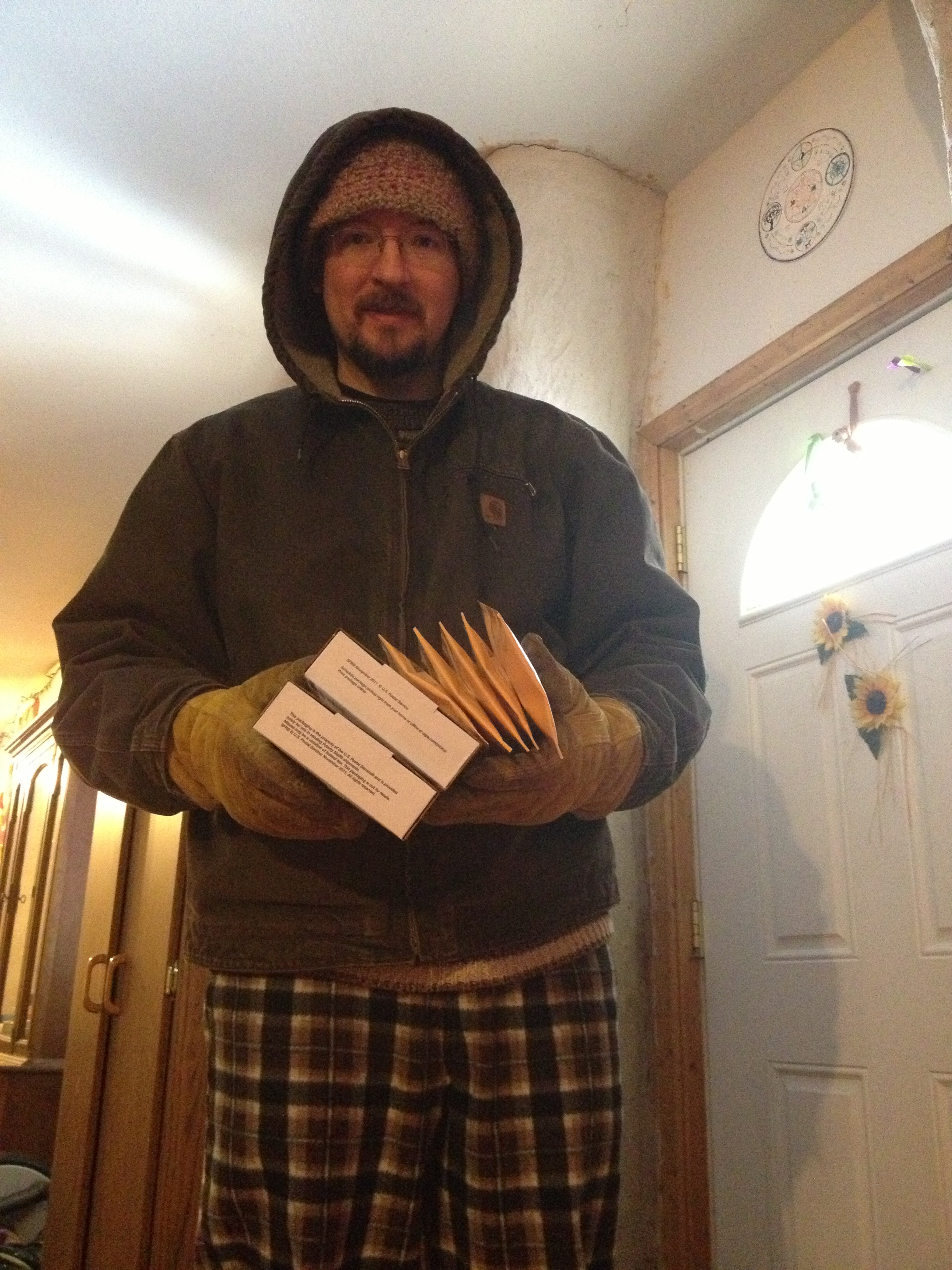
Check out the stack of orders he’s taking to the mailbox! Also, note PJ pants still on at noon, no breakfast (for him, I fixed my own), no shower, but also no need to drive through the current snow and ice to get to work…

I’ve been reflecting a lot recently on the household navigation of being an introvert mama with now having my also-introvert husband home full-time. Turns out that both parents home doesn’t magically extend the hours in a day (actually seems to shorten them) and it means both parents end up feeling pretty maxed out by kids and in need of somewhere quiet to recharge! 😉 I love having a “free-range” husband and I’m blown away by our joint creativity, which is an energy we’ve never experienced before at this level in our 19 year relationship because he was always at work all week and we had to squeeze everything else in around the edges. I also notice these interesting facts about having us both home all of the time: the house is way messier, we consistently stay up “too late” and sleep “too late,” it seems harder than ever to cook/figure out meals, we have less time to spend on homeschooling (!!), we still don’t feel like we have enough time to talk to each other, I seem to have less time to write and focus on writing, I feel like I give my kids less attention than I did when I was the only at-home parent (because I now have Mark to pay attention to too and I really like him), it is perhaps harder than ever to get the TWO HOURS I desperately need, I feel as if I have less time to focus on my teaching work, we argue more over household and parental responsibilities, we laugh way more and have more fun with each other and with our kids and we do more spontaneous, relaxed and fun stuff with our kids. It has been an interesting experience!

Related reads on introvert parenting:

I hate that as a mother, I felt like I had to choose between caring for my child and caring for myself. Because really, I can choose both. I can teach my kids—by example, which is perhaps the most potent way of teaching—that they are worthy of listening to their own needs. To the quiet, sure voice that might tell them they need a break. To lie on a yoga mat and sink deep into their own body and breath. To wander through a cemetery, alone, slowly enough to read the names on the gravestones. To sit down and write about how they’re feeling, or to surrender to sweet sleep for an hour.

via High Needs Mother | Brain, Child Magazine

So, sometimes when I start feeling ragged and can’t put my finger on exactly why, it comes to me: “I WANT MY TWO HOURS!”

via The Ragged Self | Talk Birth and Taking it to the body… Part 2: Embodied mindfulness, introversion, and two hours! | Talk Birth

February 2014 005

More time for spontaneous fun: she set this up yesterday and called me to come, “have ceremony!” and so we did. And, we drummed and sang too. She has a made up song she sings lately: “Oh, I’m her little daughter! Oh, I’m her little daughter!”

Toddlerhood and Beyond—Oh dear, now is when “no time to think” starts to wear on Introverted Mama’s nerves and stamina. I’ve met some awesome mothers of large families who comment on how they, “love the chaos” of home with lots of children. “Our house is wild and crazy and full of noise and I love it,” they may be known to say. Thinking of how desperately I crave silence and solitude, sometimes with an almost physical pain and longing, I feel inadequate in comparison to these declarations. Is this too simply a function of personality? Can these chaos-thriving mamas be extroverts who gain energy from interaction with others? I find that my own dear children, my own flesh and blood and bone and sweat and tears, still feel very much like “company” in terms of the drain on my energy that I experience. Whether it is socializing with a group or friends or spending the day with my energetic, loveable, highly talkative children, I crave time alone to recollect myself and to become whole once more. I once commented to my husband that I feel most like a “real person” when I’m alone. That means that the intensiveness and unyielding commitment of parenting can be really, really hard on me emotionally. Maybe it is okay to “own” that need for quiet, even as a mother, rather than to consider it some type of failure or an indication of not being truly cut out for this motherhood gig. (See more in a past, lengthy, navel-gazing post on why I need my “two hours”.)

How do you experience (and honor) introversion in your life as a parent? Sometimes I feel like being an introvert and being a mother are not very compatible, but as I learn to respect my own needs, to speak up for myself, and to heed that call for silence and solitude, I realize it is compatible after all. My children have two introverted parents and will hopefully grow up feeling confident in the knowing that there is profound power in being quiet, in taking time to think deeply, and to respond to the call of solitude if it comes knocking at the door of their hearts.

via Introverted Mama | Talk Birth.

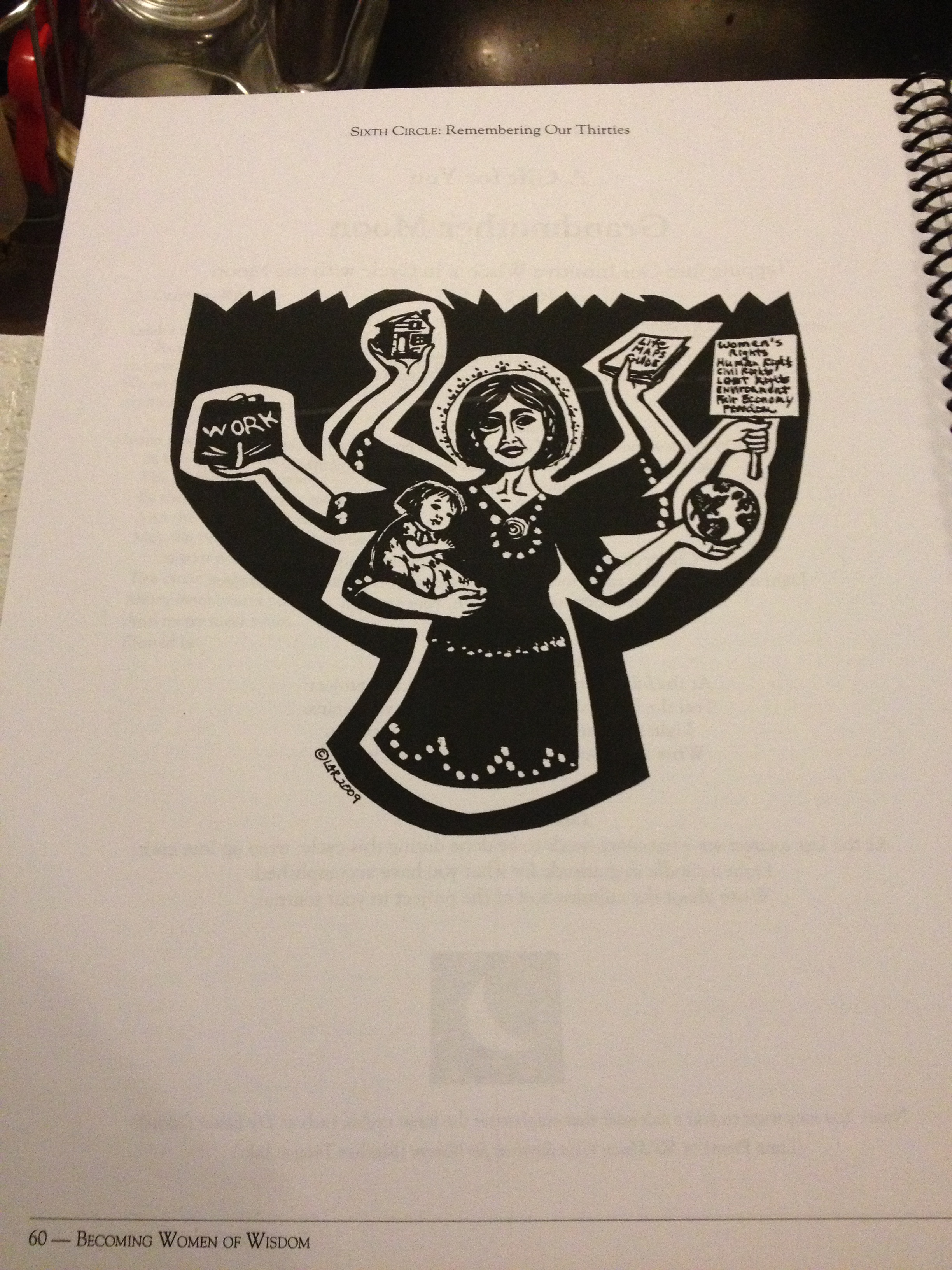
I was looking through a new women’s circle curriculum I bought a couple of months ago that is about “becoming women of wisdom.” It is for older women and it takes your through a journey from your teens through your 60’s and beyond. Each “lesson” is illustrated with a drawing for that life stage. This is the illustration for “Remembering Our Thirties”:

February 2014 068It is so spot-on that it really made me laugh! I was encouraged to see the one that followed for your forties. She looks both chill and sizzling with her own power:

February 2014 069Finally, cycling back around to birth art, next up on our month-long launch-month giveaway agenda is one of our brand new womb labyrinth pendants! To enter, just click on the labyrinth picture below to go to the Facebook contest. As a special bonus, I’m holding a “secret” companion giveaway via this blog! For an entry to win one of our tree of life pendants, go like our new Brigid’s Grove Facebook page and then leave a comment here letting me know you did so. Double chance to win a prize from us this week! 🙂

Also, there is still time to get our free Ritual Recipe Kit! (just sign up for our newsletter).

Nursing Mama, Magic Mama

January 2014 041Magic mama. She who transforms body and blood into milk. Into life. Into the heartsong of another. Maternal sacrament. Shared freely. Flowing sweetly. Uniting. This thoroughly embodied stuff of motherhood. This physical commitment. This body-based vow to our young. She holds her baby. And she holds the world.

Mammal mama. Liquid love. Cellular vow. Unbreakable, biological web of life and loving.

She’s just feeding her baby. Is she? Or is she healing the planet at the very same time?

Milky smile, fluttering eyes, smooth cheeks, soft hair. Snuggle up, dear one. Draw close. Nestle feet to thighs, head to elbow. And know that you are encircled by something so powerful that it has carried the entire human race across continents and through time for thousands upon thousands of years on its river of milky, white devotion.

This new pendant is one of the designs released for the launch of Brigid’s Grove, my collaborative project with my husband. We’re hosting giveaways on our website throughout the month of February to correspond with our launch and one of these pendants is currently being offered as a giveaway! We’ve also got a discount code, a free digital Ritual Recipe Kit, and more to check out on the Brigid’s Grove website and Facebook page.

book

Thesis Tidbits: Birth as an Initiation

“We owe it both to our children and to the world, to conceive, birth and welcome our children with as much love and prayerfulness as possible.” –Jackie Singer (Birthrites)

“Childbirth is a rite of passage so intense physically, psychologically, emotionally, spiritually, that most other events in a woman’s life pale next to it. In our modern lives, there are few remaining rituals of initiation, few events that challenge a person’s mettle down to the very core. Childbirth remains a primary initiatory rite for a woman.” –from the book MotherMysteries

via Thesis Tidbits: Birth as a Shamanic Experience | Talk Birth.

I recently finished reading a short book called Return to the Great Mother, which is very specifically focused on giving birth as an initiatory event. It includes a variety of birthing women’s voices and experiences with accessing the energy and wisdom of the “great mother,” be it archetype, an inner resource, or one face of the Sacred. The author, Isa Gucciardi, writes:

Giving birth is one of a series of important initiations a woman may experience in her lifetime. Initiations are intimately tied https://www.sacredstream.org/components/com_virtuemart/shop_image/product/b0e92ae33095ca07867acb0a841a9f05.jpgwith change. They bring the initiate from one state of being into a new state of being. Initiations accomplish this task by putting the initiate through a series of experiences that challenge them in a particular way and bring them into new ways of being and of understanding. The initiate must meet these challenges and overcome any obstacles in order for the initiation to succeed in bringing about these changes.

Today, many people going through initiations and many people managing initiations do not have a clear understanding of the nature of the power and vulnerability that is at the heart of initiation. Initiates must render themselves vulnerable to initiatory processes in order for initiations to become complete, and the power in that vulnerability must be managed carefully and thoughtfully. Most importantly, for an initiation to be successful, that power and vulnerability must be safeguarded and dedicated to the initiate.

The process of meeting an obstacle and overcoming it in order to ultimately gain greater insight and power is described by Joseph Campbell as the “hero’s journey.” The “hero’s journey” is an initiatory experience. Every woman takes this journey when she gives birth and it can be the primary initiation a woman undergoes in the course of her life.

Often a woman encounters herself in an entirely new way during the process of giving birth. She may encounter the effect of traumas long buried, or she may encounter fear long denied. She may also discover power deep within herself that she had never imagined.

When the processes of birth are allowed to take their course, a woman with the proper care has the opportunity to come to terms with whatever may arise. In doing so, she may experience a shift into a new way of being or understanding. Yet, when the birth process is interrupted, or not properly held, the power of the initiation is often lost or distorted… (p. 10)

We know that women do not always have full and free choice when it comes to decisions about their birthing bodies and childbearing years…so, how does this impact the initiatory process? Isa writes:

In modern births, the power of the initiation of birth is often co-opted by doctors, pharmaceutical companies, insurance companies, and hospitals. It is also co-opted by the fear of pain and the influence of friends and family. It is difficult for women to hold onto the power of the initiation of birth under these circumstances. The unfortunate implication here is that the subsequent initiations of women interrupted in this way will be affected by their inability to hold onto the power of their birthing process.

Based on the level of interruption of the birth initiation caused by unnecessary interventions in the birthing process today, it seems reasonable to suggest that many women experience incomplete initiations when giving birth…

(Personally, I would clarify that it is not that women are unable to hold onto the power of the birthing process, but rather that it is often systematically stripped from them.)

Each of my children’s birth experience was an initiatory event for me, but in varying ways. With my first, it was the initiation to motherhood, the mystery and anticipation of giving birth. The crucible moment for me with him was actually my journey through the harrowing landscape of postpartum. With my second son, giving birth rapidly and with great intensity and power, the initiation felt like it was in letting go and hanging on for the ride—letting my mind stop and my body go. With my third birth, which was my first miscarriage, the initiation was in the physically grueling and bloody aftermath of his birth and then the broad, deep, unknown, transformative path of grief and change. I still feel as if this was one of the most powerfully initiatory experiences of my life. (And, I did have an encounter with one face of the great mother.) After Alaina’s birthday this week, I was talking to my husband about my memories of this last birth and telling him that I do not review the details of her birth with the same sense of power or initiation as the births of my other children. It doesn’t hold that same “touchstone” energy for me as the births of my boys—experiences that I continued to draw strength from as I went on into other events in my life. I don’t return to her birth for strength or courage the way I remember returning to the births of each of my sons. And, then I said it was because with her, the pregnancy was the initiation. The long, long, path of pregnancy after loss and all the fear and all the hope and all the strain of feeling the feelings and doing it anyway. Her birth itself was the moment of relief. The end of a trial, rather than the triumph or peak experience of the births of my first two babies. So, while of course I still carry powerful and potent memories of her birth as well, it was the journey of pregnancy that holds the talismans of initiation for me.

In her classic book Shakti Woman, Vicki Noble describes giving birth as a central shamanic experience and perhaps the root of all shamanism:

“I believe I underwent an initiation of the most ancient variety, birth as a shamanic experience, the central act of female shamanism—the quintessential act that offers a woman a completed experience of facing and moving through her fears to the other side. It isn’t that birth is the only way for a woman to experience this initiation—many women climb mountains or face other kinds of physical endurance tests and also come through it reborn into their power. But biologically birth is a doorway, a given for most women on the planet. It is fundamental opportunity to become empowered. Most of us giving birth today do not have the full experience, which is co-opted and distorted beyond recognition, changed from an active process into something that is done to us, as if we don’t know how to do it ourselves. Reclaiming the right to birth in our own instinctual way is a shamanic act of courage that has unfortunately become as remote to us as our ability to fly through the night in the form of an owl or heal the sick with the power of the drum. It wouldn’t hurt if we began to think of our birthing and child rearing as central parts of our shamanic work…” (p. 223).

via Thesis Tidbits: Birth as a Shamanic Experience | Talk Birth.

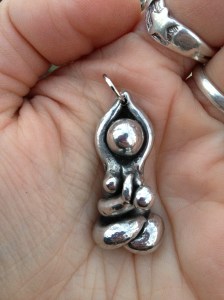
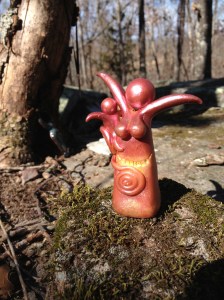
I just finished a new sculpt for a medium sized version of our classic birth goddess pendant and Mark cast and finished some of them last night. I woke up this morning with a phrase from a past piece of poetry floating through my mind over and over:

Soft belly January 2014 088
no longer bearing children
I am pregnant with myself
ripe with potential,
possibility, power
I incubate my dreams
and give birth to my vision…

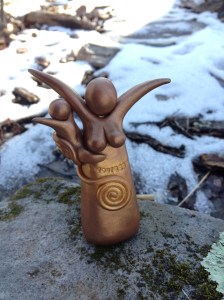
I also thought about what I hope to communicate to others through my sculptures and when I took the new pendant down to the woods with me, a little song emerged to go with her:

Birth mama
birth goddess

reaching out
to join the circle of mothers

feeling her way
finding her place
in the web of women

Birth mama January 2014 050
birth goddess

hold strong
hold steady

make way for baby
make way for baby

Body opens
heart opens
hands open to receive

Birth mama
birth goddess

she’s finding her way
she’s finding her way…

Disclosure: I received a complimentary digital copy of the book for review purposes.