Archives

What Does Coping Well Mean?

“I believe with all my heart that women’s birth noises are often the seat of their power. It’s like a primal birth song, meeting the pain with sound, singing their babies forth. I’ve had my eardrums roared out on occasions, but I love it. Every time. Never let anyone tell you not to make noise in labor. Roar your babies out, Mamas. Roar.” –Louisa Wales

Occasionally, I hear people telling birth stories and emphasizing not making noise as an indicator, or “proof,” of how well they coped with birthing–“I didn’t make any noise at all,” or “she did really well, she only made noise towards the end…” Women also come to classes looking for ways to stay “in control” and to “relaxed.”

This has caused me to do some thinking. Though relaxation is very important and helpful, to me, the goal of “laboring well” is not necessarily “staying in control” or “staying relaxed” or “not making any noises.” Instead, I view “laboring well” as involving: listening to yourself; respecting your own needs and acting on them; working with your body; finding your rhythm; trusting your instincts; following your body’s urges/signals; accessing your inner wisdom; finding your unique way along the path; journeying with openness, curiosity, acceptance, excitement and joy; and responding to coping strategies that spontaneously arise from within.

I have been reading Penny Simkin’s The Labor Progress Handbook and she addresses this subject as well:

“Childbirth education programs first emerged in the 1940s, when much less was known about the powerful, multisensory ways in which women spontaneously cope with labor. Much has been learned since then, but older ideas have left their stamp on Western culture…Many people still think that ‘coping well’ means that the woman remains silent and does not move during contractions. Often, caregivers, partners, and the women themselves believe that women who are physically active and vocal are coping poorly, and may strive to help these women to be quiet. However, we now know that women with kinesthetic and vocal coping styles often find much more effective relief from pain and stress when they move and make sounds, than when they try to use the quiet, still techniques of early childbirth methods.”

During my own births I found movement and sound to be of tremendous importance. With my first baby, I felt more inhibited and primarily coped by humming. I spent a lot of time kneeling on the ground with my head on the bed. With my second, I was alone with my husband for most of the time and was much more vocal–“talking” myself through contractions. I also moved around a great deal and found it very important. Talking (well, really rhythmic word repetition) and moving, for me, are parts of “surrendering” to the power, process, and intensity of giving birth. This fits with my personality as well as in “normal” life I talk a lot (talk-to-think) and I also have a lot of physical energy that leads to my “buzzing” around the room a lot or stepping back-and-forth as I speak.

Edited to add that the Feminist Childbirth Studies blog linked to this post with an interesting and insightful further development/exploration of this subject in the post characteristics of a ‘good’ labor and birth experience?

I revisited this topic in a later post: The Power of Noise in Labor

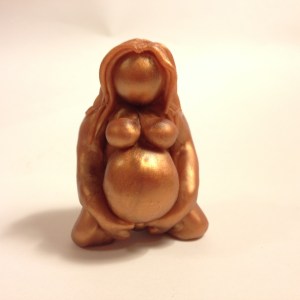
Birth art sculpture depicting pushing the baby out. Roar, mama, roar!
Pain-Free Birth?

As I’ve referenced before, I have a special interest different theories with regard to pain and birth. The last issue of the Midwifery Today e-news had “Pain in Childbirth” as a theme and there was an excerpt of an article by Ingrid Bauer called “Pain Free Birth?” It was very powerful. She says:

“Inevitably, in discussions about unassisted or natural birth, the topic of pain-free birth rolls around. When it does, I wonder if striving for a ‘pain-free birth’ doesn’t inadvertently miss the potential beauty of natural birth itself. I don’t believe birth is meant to be pain-free, in fact, I believe it’s far more than that! I believe, and have experienced, birth to be downright ecstatically, blissfully pleasurable. ‘Pain-free’ doesn’t even come close to describing that experience. That’s like calling a high sexual union with your mate ‘pain-free,’ or the most breathtaking sunset you’ve ever seen ‘ugly-free.’ I think that as long we’re focusing on getting rid of or avoiding pain, we’re focusing on the wrong area and we’re completely missing the point.”

I love this! Language is so powerful. I like how Hypnobabies educators often refer to “easy, comfortable birthing” and other people who refer to birth as “pleasurable birth” or “joyful birth” or “ecstatic birth.” How much more descriptive than “pain-free” or “painless” that is. Painless or pain-free to me communicates a loss of sensation or awareness–a “deadness” or “dullness” to the fullness of birth.

Personal Mastery and Birth

I wanted to share a link to a post I wrote recently for the ICEA blog. In this post I discussed some research from the book Childbirth Education: Research, Practice, & Theory:

The book also shares the research that when mothers were interviewed postpartum who had had epidurals, their comments following birth focused almost totally on the baby. Women who had relied on relaxation and other non-pharmaceutical coping methods talked about the baby AND about the emotional and psychological benefits of their birth experiences. Women in both groups expressed satisfaction with their birth experiences, but for those in the epidural group “the element of personal accomplishment or mastery was missing in their comments.”

I believe that starting out the parenting adventure with a sense of “personal accomplishment and mastery” is a tremendous gift and I wish all expectant couples had the opportunity to experience birth in this way. In my classes, I strive to emphasize that both process (giving birth) and product (healthy baby, healthy mom) are important!

As long as I’m discussing posts I’ve made elsewhere, I wanted to also link to my CfM blog post this week which was about what are we thankful for? (in the “birth world”). I have a lot to be thankful for and hope you do as well!

What’s at the root?

On a discussion board this week in the birth professionals section (doulas, midwives, birth educators), someone asked the question “what’s at the root of your love of birth?” I was still for a moment and let my intuitive, heart-felt, gut level response come to me and it was this:

Women.

Women’s health, women’s issues, women’s empowerment, women’s rights.

Social justice.

…..

And, that feeling. The “birth power” feeling–that laughing/crying, euphoric, climbed-the-mountain, glowing, rapture…feeling. The transformative, empowering, triumphant, powerful, I DID IT, feeling.

I want all women to have the chance to experience that.

————————-
As I look at my list above and invert it, it becomes my “tree” of birthwork–with women as the root and then spreading up to blossom with that birth-power-feeling. 🙂

To any birth professionals reading this, how about you? What’s at the root for you?

Birth Talk Podcast

Late last month I participated in a fun podcast interview with childbirth educator Donyale Abe of Birth Talk. You can download the podcast here. We had a great time chatting about birth, fear, homebirth, educating women, ACOG’s statement against homebirth, and our passion for birth and for talking with other women about birth! The audio is a little difficult to hear sometimes when I am talking (maybe that is just on my computer).

As a funny side note, the whole reason this blog ended up being called “Talk Birth” instead of “Birth Talk” is because when I went to get a gmail address, “birthtalk” was already taken. So, I settled for my second choice, “talkbirth.” Later, I set up this site/blog and called it the same thing as my gmail address for consistency 🙂 Then, several months after that I ended up making contact with Donyale via some blog posts I’d made and discovered during our emails to each other that lo and behold, SHE was the person who has the “birthtalk” gmail address I’d originally tried to get! How funny!

“Balanced” Information?

Occasionally I read that someone is planning to take a hospital sponsored birth class because they feel they will get more “balanced” information. This usually seems to be said with regard to medications “versus” natural birth. There is an excellent discussion about this issue in the book Mother’s Intention: How Belief Shapes Birth.

“Let us look at [the word] ‘balanced’ first…’to make two parts exactly equal.’ What if the two parts are not equal? What if a parent will be making decisions that will affect her and her baby with both short and long term consequences? Is it fair to distort reality so that the information she has to choose from seems ‘equal,’ even though it really isn’t? Why would a parent want information that appears balanced, but isn’t factual?”

From my perspective, independent classes are better able to provide you with truly helpful, accurate, and factual information (even though they might not feel “balanced” towards all interventions/options), because the educator is working for you and not for an institution.

Words for Pain

May 2015 146I recently purchased a new educational DVD about natural birth called It’s My Body, My Baby, My Birth. A childbirth educator interviewed during the film briefly discusses pain and says that we need more words for pain, because it is ridiculous that we have only one word that is used to describe a hangnail, a broken leg, being hit by a car, and labor. I had already been musing about pain during labor and how we perceive it, talk about it, and so forth and this comment was additional food for thought for me. I’m thinking that there are many other words used to describe women’s experiences of labor and birth other than pain–a word that is limited in scope and that for some women may well not even apply to the experiences in birth (I’m thinking of the intriguing “comfortable, easy birthing” philosophy of programs such as Hypnobabies).

I reflected on my own birth experiences and how I would describe them, especially my second birth, which was very quick. I would describe it as:

Powerful

Intense

Triumphant

Empowering

Major (this is a word I kept repeating during labor…”This is MAJOR!”)

Beautiful

Special

Amazing

Awesome

If someone then asked me, “yes, but was it painful.” I would have to think a minute and then say, “oh yeah. I guess it was painful.” However, pain is very far from my dominant interpretation, impression, or experience of this birth. It does not make my “top ten” list of descriptors. I’m interested by that. I’m also interested to know about the other words women use to describe their births and where “pain” falls on their lists (feel free to leave a comment sharing your words for your birth experiences! If pain is at the top of your personal list, that is okay! I’m fascinated by women’s experiences of all kinds.)

I have heard people scoff at this kind of language to describe birth–triumphant, empowering, etc.–saying that it is just natural birth “rhetoric” trying to lie to women or that if giving birth is so wonderful why do we use “euphemisms” to describe it, but the words I chose above are truthfully my experience. Why would describe my births as painful, if that truly is NOT the best word to describe them? If I had to pick the best word, I’d probably say triumphant. Or, I might choose intense (particularly with that second, fast labor and birth).

As I said, I’ve been reflecting a great deal about pain and the word pain and how to address the issue of pain during birth classes. I hope to share some more of these thoughts soon.