Archives

The Impact of Birth on Breastfeeding

Just in time for the start of World Breastfeeding Week, here is part 3 of my CAPPA re-cap series!

…they want you to believe it’s their power, not yours…They stick needles into you so you won’t hear anything, you might as well be a dead pig, your legs are up in metal frames, they bend over you, technicians, mechanics, butchers, students, clumsy or sniggering, practicing on your body, they take your baby out with a fork like a pickle out of a jar.

–Margaret Atwood in her novel Surfacing (opening quote of Dr. Jack’s presentation at the 2012 CAPPA conference)

As I mentioned, my favorite part of the CAPPA conference was hearing Dr. Jack Newman speak about controversies in breastfeeding (see next post) and then about the impact of birth on breastfeeding (breakout session). He was an amazing speaker. Very straightforward and almost blunt as well as funny and fast-paced. I really feel glad to have had the chance to see him in person after years of being familiar with his materials.

The notion of the birth-breastfeeding continuum isn’t new to me, having actually published articles about it previously, however Dr. Newman’s phrasing, descriptions, and reminders was just so perfect that it left me feeling even more enthused about the inextricable link between birth and breastfeeding. It is a biologic continuum that nature does not see distinct events—baby is born and goes to breast, it is part of the same event. Drawing on Diane Wiessinger’s work, Dr. Newman explained

With animal births: following a normal birth, infant feeding just…happens. Following an interventionist birth, the mother rejects the baby and there is no nursing at all.

In some hospitals, separation of mother and baby is routine as a way to “prevent” postpartum mood disorders. Dr. Jack’s own theory was that perhaps human mothers turn this “rejection” against themselves and it shows up as a postpartum mood disorder.

Babies NEED and expect to be with their mothers after birth. It is of critical importance. As I shared via Facebook, Dr. Jack explained this:

Know how much an incubator costs now? $50,000. Why don’t we just give half of that money to the mother and put the baby skin to skin on mother’s chest?

And, this gem:

Our hospital births break every rule in the mammalian list of mother-baby necessities.” –Dr. Newman

He also noted that if baby is put skin-to-skin on mother immediately after birth regardless of original intention, the pair will breastfeed. It is biologically programmed.

Why do hospital births break the rules?

Because, as Dr. Newman explained we have a big, big problem in that HCPs do not recognize the critical importance of breastfeeding. He also repeatedly emphasized (in a very funny way) that there are many people who don’t know squat about breastfeeding and breastmilk and don’t feel like they need to learn anything before they start doing studies and writing papers about it.

Dr. Newman also emphasized the important point that the burden of proof rests upon those who promote an intervention! He was speaking with regard to recommending formula supplementation, but I strongly believe it applies to any birth practice. So simple and yet so profound. One example that he shared that is familiar to birth advocates is that lying down for electronic fetal monitoring is a position of comfort for the care provider, NOT for the mother.

And, he made this excellent point: “All medical interventions, even when necessary, decrease the mother’s sense of control, and increase her sense of her ‘body not being up to the task.” Again, the burden of proof rests on those who promote the intervention, not vice versa.

As I’ve touched on several times before, IV fluids that are commonly administered during labor may increase the baby’s birth weight, leading the baby to be more likely to experience the dreaded 10% weight loss (“totally bogus, by the way”). Also as I’ve noted before, IV fluids lead to significant maternal fluid retention which contributes to edema in the nipples and areolas and then…the dreaded “flat nipples.” The more fluid a mother gets in labor, the more a baby “loses” after birth!

Including the same picture as in my other post, because it is in this picture that Dr. Jack is specifically talking about his next point:

I disagree strongly with this statement:

‘Typically, loss of = or >10% of birth weight in the first few days suggests dehydration and the need to consider supplementation.’
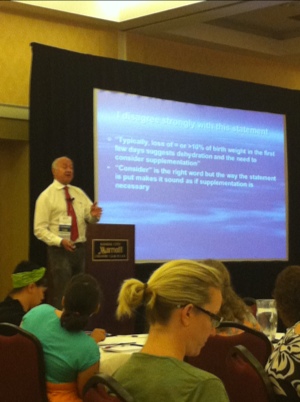
He goes on to note that what is necessary is NOT supplementation but to help the mother and baby breastfeed well. The real question when it comes to newborn weight loss is, “is the mother-baby breastfeeding well?”

Newman also addressed something birth advocates are familiar with, the fact that epidural anesthesia can cause maternal fever. This leads to an infant sepsis workup and antibiotics and usually means separation of mother and baby. Here we again experience the failure of many medical care providers to recognize the importance of breastfeeding as beyond just a feeding method. Breastfeeding protects the baby–this is what most hospitals do not understand.

Of interventions that undermine breastfeeding, Dr. Jack pointed to Demerol (meperidine) as the “worst of the lot,” with newborns experiencing sedation and many of them not sucking at all. He also pointed out that all interventions increase the risk of cesarean section, which leads to increased discomfort for mothers and less willingness to breastfeed and increased likelihood of mother-baby separation.

The importance of skin-to-skin contact

Babies easily find their way to the unwashed nipple. And, given baby’s inborn feeding behaviors and instincts, it seems clear that, “if the baby expresses his or her choice, the baby would choose the breast.” (with regard to breastfeeding as maternal “choice”)

Not putting baby skin to skin with the mother, “increases the risk of hypoglycaemia significantly…Isn’t skin to skin contact a less invasive preventative measure than giving formula?” Newman then points out that most often we see “skin to blankets” which keeps baby from showing they’re ready to feed, doesn’t stimulate milk supply, and leads to engorgement which is not normal.

And, at the end he emphasized that when it comes to birth and breastfeeding, all too often WE MESS IT UP by meddling with the biological processes and rhythms of the mother-baby relationship.

For more about controversies in breastfeeding, check out my next post.

Handouts from Dr. Newman are available here. One I’ve used recently is How to Know a Health Professional is not Supportive of Breastfeeding.

I’ve written about the birth-breastfeeding continuum and about some other systemic influences on breastfeeding in breastfeeding as an ecofeminist issue.

CAPPA Re-Cap

Yesterday I got home from Kansas City where I’d been attending the annual free birth conference hosted by CAPPA. While there I concluded that Desirre Andrews is officially a superhuman live-tweeter. You can catch up with all of her rapid-fire tweets about the conference at CAPPA’s Twitter account.

I also tried my hand at posting a few things that particularly grabbed my attention to my Talk Birth and Citizens for Midwifery Facebook pages which automatically feed into Twitter. I’m not very good at catching short snippets for live-tweets, but some thoughts that I grabbed to highlight are as follows. If they don’t have quotation marks, they aren’t necessarily direct quotes, just “essence” summaries as I tried to take notes and pay attention!

First I attended Laurel Wilson’s talk about Bridging the Nutrition Gap and next, I listened to Tracy Wilson-Peters speak passionately about the “accidental parent.”

Essence tweets from Laurel and Tracy’s talks:

Babies don’t need to be in nurseries–they need to be with their mothers. This MATTERS!

Science can do a lot, can do wonderful things. Mother’s body can do even more…

Prenatal diets high in hydrogenated oils predispose mamas to postpartum moods disorders.

And, then I attended a breakout session from Darla Burns about postpartum rituals and snagged this interesting tidbit:

In Holland, all pregnant women are required to buy a homebirth kit, “just in case.”

The second day, I found myself entranced by the most awesome Dr. Jack Newman. His presentations were the highlight of the conference for me. I loved him! I attended two–his general session on Controversies in Breastfeeding and then his breakout sessions, Impact of Birth Practice on Breastfeeding:

20120724-174258.jpg

If you ever get a chance to see this man, don’t miss it!

We have a big, big problem in that HCPs do not recognize the critical importance of breastfeeding.

There are many people who don’t know squat about breastfeeding and breastmilk and don’t feel like they need to learn anything before they start doing studies and writing papers about it. –Dr. Jack Newman

There is no such thing as “standard” breastmilk. It is a physiological fluid and varies from person to person. We DO NOT have to prove that breastfeeding is better than formula. Those comparison studies are unnecessary.

The burden of proof rests upon those who promote an intervention! –Dr. Newman

With animal births: following a normal birth, infant feeding just…happens. Following an interventionist birth, the mother rejects the baby and there is no nursing at all.

Our hospital births break every rule in the mammalian list of mother-baby necessities.” –Dr. Newman

Lying down for electronic fetal monitoring is a position of comfort for the care provider, NOT for the mother.

Know how much an incubator costs now? $50,000. Why don’t we just give half of that money to the mother and put the baby skin to skin on mother’s chest? –Dr. Newman

Seriously, Dr. Newman’s talks were amazing. Be prepared to hear more about them soon!

The final day I heard Polly Perez speak about Building Bridges with an emphasis on communication and fear:

Luke: I don’t believe it. Yoda: that is why you fail.

“Use language that lets you share your heart openly.” –Polly Perez

Listening is *active*, not a passive activity. Listen with empathy, openness, and awareness.

We have taken the hearts and minds out of much of our work because we’re frightened of getting too close. But, close is where we need to be.

“We must give people the opportunity to challenge their fears. Not only will this change each person, it will change the political and medical climate in which they make these choices.” –Connie Pike, via Polly Perez

Polly shared the first home birth she attended – made her fear of it “melt away like butter in a pan.”

You do not have to be an OB to be knowledgeable about birth. –doctor working with Polly Perez

Follow up from same doc: “if you tell me a baby is going to come out, I’m a gonna believe you!”

Changing sick systems is not about subterfuge but bringing light to situations that need to be altered.

Since micro-blogging is simply not my gift and is unlikely ever to become so, I am also planning longer posts based on several of the conference sessions. They will be (links will be updated as the posts become live):

At the CAPPA conference I also made a large custom order of great gifts from Joy Belle jewelry.

And, I ate tons of sample honey sticks from Glorybee–yummy! (see prior post: Why Honey Sticks During Labor?)

Other treats involved getting to spend some quality visiting time with a Friends of Missouri Midwives friend from St. Louis. We spent a lot of time talking over the FoMM newsletter (of which I am editor) and I feel very enthused about our ideas for its future.

I also got to meet a Facebook friend who started out originally two years ago as a Talk Birth fan on FB (after finding my site via my all-time most viewed post: In-Utero Practice Breathing). We spent some good time together visiting and laughing and it was fun to make the friendship connection with someone who was previously only an internet friend!

The Rest and Be Thankful Stage

During my first labor, I experienced what Sheila Kitzinger calls the “rest and be thankful stage” after reaching full dilation and before I pushed out my baby. The “rest and be thankful stage” is the lull in labor that some women experience after full dilation and before feeling the physiological urge to push. While commonly described in Kitzinger’s writings and in some other sources, mention of this stage is absent from many birth resources and many women have not heard of it. After writing recently about the spontaneous birth reflex, I received a comment stating the following: “I was particularly interested in the idea of resting after full dilation before pushing. This makes sense if you are only following your body’s urges to push, but never something I had seen (or remember seeing?) spelled out before.

I always make sure to tell my birth class clients about the possibility of experiencing a lull like this, because it is during this resting phase that labor is sometimes described as having “stalled” or as requiring Pitocin to “kick it off again” or as requiring directed or coached pushing. Also, think of the frequency of remarks from mothers such as, “I just never felt the urge to push.” When exploring further, it is often revealed that what the mother actually experienced was no immediate pushing urge instantly following assessment of full dilation. Depending on the baby’s position, this can be extremely normal. The way I explain it to my clients is that the lull represents the conclusion of the physiological shift happening in the uterus—the transition between contractions that open the cervix and the contractions that push the baby down and out.

As I wrote in a previous post from several years ago:

Your uterus is a powerful muscle and will actually push your baby out without conscious or forced effort from you–-at some point following complete dilation your body will begin involuntarily pushing the baby out. Many women experience the unmistakable urge to push as an “uncontrollable urge”–-but, in order to feel that uncontrollable urge, you often have to wait a little while! Though some care providers and nurses encourage you to begin pushing as soon as you are fully dilated there is often a natural lull in labor before your body’s own pushing urge begins. Some people refer to this lull as the “rest and be thankful” stage. It gives your body a chance to relax and prepare to do a different type of work (in labor the muscles of your uterus are working to draw your cervix up and open. During pushing, the muscles of your uterus change functions and begin to push down instead of pull up). If you wait to push until you really need to, you will often find that your pushing stage is shorter and progresses more smoothly that pushing before you feel the urge.

In the book, Our Bodies, Ourselves: Pregnancy and Birth they share the following important point:

“Research suggests that the length of time before the baby is born is the same if you allow one hour of ‘passive descent’ of the baby (when you relax and don’t consciously try to push) or you start pushing immediately after you are fully dilated.”

via Waiting before pushing… « Talk Birth.

That’s right, the length of time between full dilation and baby’s birth is the same, whether the mother waited one hour before pushing, or started pushing without the urge immediately following full dilation. I know which one sounds easier and more peaceful to me!

In my own experience with my first baby, I found that I felt like I should be pushing after full dilation and thus began to do so before feeling the full urge. I ended up pushing for about an hour and fifteen minutes. I suspect if I’d just continued hanging out for 45 minutes to an hour, he may have flown out in 15 minutes. Prior to pushing though, I did experience a rest and be thankful stage of about 30 minutes in which I sat in a rocking chair, joked about feeling “trippy,” and talked about being an A++ birthing woman. I describe it in my son’s birth story:

After finding out that I was fully dilated, I started to feel very odd and I really think I had to go through a sort of emotional/psychological transition to adjust myself to the fact that I had “missed” the physical transition point…I sat in the rocking chair for a while and kept saying things like, “am I dreaming? Is this real?” I also made a joke about feeling “trippy” like in Spiritual Midwifery. We also joked about what an A+ + + laboring woman I was (a family joke–I was a 4.0 student throughout college and grad school and so we always say that I like to get an A+ + + on everything I do). Those pressure feelings I had been having for a while, got a little more intense and I started pushing kind of experimentally. I was on my knees with my head on the bed on my pillow again and during one of the little pushes my water broke with a giant, startling POP and sprayed across the room including all over my friend. At this point, the midwife left saying, “I think I should call the doctor.” via My First Birth « Talk Birth.

The blog Birth and Baby Wise has some great thoughts to share on resting and being thankful (note the blog is from an educator in London, thus the use of the term Syntocinon, rather than the U.S. based brand Pitocin):

… it seems that there is little appreciation for this well documented pause amongst health professionals working in the consultant-led units of hospitals. Any stop in action once the magic ’10 cm dilatation’ is reached is met with almost instant medical intervention to get the contractions back up and running, ie a syntocinon drip. Women experiencing this are already on a consultant-led unit, where a higher level of medical intervention can be anticipated, but it is strange that there seems to be such a rush to use a syntocinon drip to get the contractions going again, providing mother and baby are both coping well.

One reason the contractions may ease temporarily is in order to allow the baby’s head to get into a better position. If this is the case, then artificially speeding contractions up is hardly likely to have the benefit of a faster birth for the woman – if anything, a slower and more complicated birth as she tries to push out a baby that is not quite in the right position. In addition, she has to cope with stronger contractions that she might find difficult to deal with, necessitating further medical help in the shape of an epidural – which in turn makes pushing the baby out even harder…

…At this stage, the woman and her partner are incredibly vulnerable to this well meant ‘help’ from midwives and obstetricians and are unlikely to question the requirement for additional medical help. It is also unlikely that the calm and relaxed environment so important for a peaceful birth can survive the worries of the health professionals, which will affect most women and their partners. via Rest and be thankful – or panic and have a drip shoved in? | Birth and Baby Wise.

I agree. In my own personal experience with my first birth, I was very vulnerable to just the perceived expectation of it being “time to push.” With later babies, it was intensely important to me that I have very few people present at the birth, knowing how sensitive I am to the expectations of those around me. It is truly only my husband and my mother than I trust to not disrupt my “birth brain” and the freedom of my birth space.

I’d love to hear more from readers about their experiences with the rest and be thankful stage.

Did you experience this lull between full dilation and pushing out your baby?

Was the lull recognized and respected by your birth attendants?

If you pushed without feeling the urge, was the pushing stage fairly long?

With subsequent babies, I had no internal checks during labor, so I never really knew if I experienced the rest and be thankful stage with them. I just pushed when my body started pushing—I have no idea how long after full dilation that was. So, I also am curious to know if women find they experience this stage with all babies, with only the first one, or with only some of their babies?

I suspect I did experience it with Alaina, because I remembering feeling concerned that contractions were suddenly “far apart.” I started talking more and analyzing myself and the labor and this was probably part of a lull in the intensity of the contraction action while my body prepared for a powerful spontaneous birth reflex.

Birth Plan Item #1: Leave My Cervix Inside My Body!

Some time ago I read several articles in Midwifery Today about birth in the Ukraine. Apparently, it is a routine practice immediately postpartum to use two “shoe horn” shaped devices to pull the cervix out of the woman’s body to examine. Yes, I think that warrants repeating–manually pulling out the cervix to look at! (no pain medications). This is so patently horrible and unnecessary that I had a visceral response to reading about it–my uterus hurt.

U.S. maternity care routines

However, as I reflected on my reaction, I began to wonder if the practice is any more strange or disturbing that some U.S. maternity care routines? I still feel like cervix-pulling-out ranks pretty high on the horrible factor, but I also recognize that it is filtered through my cultural lens of what I’m used to—“normal” (i.e. culturally acceptable) birth practices in the U.S. (such as Pitocin injection immediately following most normal births regardless of indication and so on and so forth). We have any number of questionable medical care practices in this country too, but because I’m used to them they register as “normal.” Of course, this doesn’t mean I approve of them or fail to notice that they are not evidence-based, but I accept them as possible occurrences and I’m certainly not surprised to read about them over and over again, or shocked when my clients experience them during their births.

One of the articles was about birth in a Ukrainian “birth house” and the other was a composite of observations about birth in the Ukraine in general. Sometimes there is a tendency amongst midwifery supporters to romanticize birth and midwifery care in other countries and to vilify the U.S.—if you are a Ukrainian woman, this is clearly misplaced!

My first thought when reading the essays was, “Wow! The U.S. system isn’t so terrible after all!” But then, I tried to imagine the U.S. birth culture seen through completely fresh eyes, as I had just viewed the cervix-pulling technique. How would facets of hospital birth care in the U.S. appear to me if I was just hearing about them for the first time? As gross human rights violations?

Though I cannot make it have the same raw emotional and physical shock to me as cervix-pulling-out, I can only imagine how an episiotomy might sound to my imaginary fresh eyes: “then the doctor took some scissors and cut through the skin and muscles at the base of the woman’s vagina.” Or, the same with the not uncommon addition of, “as she begged ‘please don’t cut me! No!'”

I also read with sadness and dismay about the emotional maltreatment of Ukrainian women in labor and how (in hospitals) they are frequently denied the companionship of their husbands. Is this really more awful than women being coerced into unnecessary cesareans or even more basic, being denied food and drink throughout their labors? No, not really, just less familiar.

What do all women deserve?

While it is nice to recognize that there are things that women birthing in U.S. hospitals can be very grateful for, there is not an official continuum or hierarchy of “better” bad things to happen to birthing women regardless of country of residence. Humanized care is humanized care. Women worldwide deserve a safe environment, a respectful caregiver, continuous emotional support, physically responsive care, evidence-based medicine, and to have their cervixes and uteruses left inside their bodies.

(P.S. In case anyone is interested, “cervices” or “cervixes” and “uteri” or “uteruses” are both acceptable plurals)

All That Matters is a Healthy Husband (or: why giving birth matters)

It is your wedding day. You have been planning this day since you got engaged nine months ago. You are happy, excited, and a little nervous. When you get to the church, you are told that it is necessary to switch your wedding to the courthouse instead—it is disappointing, but the minister’s assistant reminds you that the courthouse is probably a safer location for your wedding because there are more people on staff there to handle any problems that might arise. When you arrive, you are told that your minister isn’t going to be there for the ceremony after all, but there is a perfectly good justice of the peace available instead.

You ask when the ceremony can begin and the clerk tells you not until your fiancé’s heart rate has been monitored for twenty minutes—“We need a baseline strip on him, hon. After all, you do want a healthy husband out of all this, don’t you?!” she says.

You are asked to change out of your wedding gown and into a blue robe. When you express your dismay, you are reminded that your dress could get messy during the wedding and also, “Why does it really matter what you’re wearing? In the end you’ll have your husband and you’ll be married and that’s really what counts.”

Next, the clerk starts an IV in your hand because, as she explains, you might get dehydrated while you wait for your fiancé.

I have my favorite juice here, I’ll drink that instead,” you reply.

No, no dear. No juice. You could aspirate it and die if you end up needing surgery.”

SURGERY!” you exclaim, “Why would I need surgery? I’m just getting married!

The clerk gives you a knowing glance, “Honey, about forty percent of women who get married here need surgery before their marriages are finalized. This is an excellent courthouse! We do everything possible to make sure you have a healthy husband when you leave here. Isn’t that what you want?

Yes,” you reply weakly.

Finally, the other clerk signals that your fiancé is ready. You turn to look at him and see that he has a monitor strapped to his chest to monitor his heart rate and that he has an electrode on his scalp. You smile at him and prepare to say your vows—you’ve waited for this moment for so long! But, as you begin to speak, the clerk tells you to stop making so much noise. You start to cry in confusion and embarrassment and she tells you that you really need to get control over yourself.

She calls over several other clerks who stand near you and they all begin chanting loudly, “Say I DO! Say I DO!

Wait,” you protest, “What about our vows?”

No time for that—you’ve got to get married as quickly as possible. Husbands can only bear to stand at the altar for a short time before they start showing signs of distress—you wouldn’t want anything to happen to your husband would you? Now, say ‘I DO,’ say ‘I DO’!!

So, you say the words, feeling a sense of dismay at it not being like you had planned, but excited to finally be married to your beloved. You turn to your new husband and reach out for him eager for your first married kiss, but the clerk grabs his arm and tugs him away after her.

Wait!” you call, “I want to see my husband!”

Sorry,” is the reply, “He needs to be taken to the new husbands’ lounge for observation.”

Observation of what?”

Weddings are stressful for husbands; we need to make sure he is all right. Now wait here, while the other clerk brings you a wheelchair to take you to your waiting room.”

Instead of leaving for your honeymoon, you end up staying at the courthouse for three days. You keep asking to see your husband, but the clerk tells you he needs to gain some weight before he can leave and that he also needs some more blood drawn. She also lets you know that he has finally stopped complaining about his spinal tap.

Spinal tap?! Your dismay shows on your face and she tells you, “Come on! You’ll be married for the rest of your life! A few hours of separation isn’t going to hurt either one of you. You’ll have plenty of time with him after you get home and will probably just get fed up with him then! What really matters now is that your husband is healthy.”

Yes, of course…

Finally, you get to go home, but you feel distant and sad. Your wedding was nothing like you’d dreamed of and you feel disappointed and betrayed. You enjoy being married and snuggling with your new husband, but you keep thinking about your wedding day and all of your ruined plans to make it special. When you try to tell your mother how you feel, she tells you that you should be grateful, at least your husband is nice and healthy.

When you tell your best friend about your disappointment, she tells you it is time to get over it—“Your wedding is just one day of your entire life. It is the marriage that really matters in the end. You only get married once, but in the end, you’re married and you’ve got a healthy husband and that’s really what counts, not how you get there!

You tell another friend about your ruined plans and she reminds you that you are lucky your husband is healthy and that it is selfish of you to keep thinking about your wedding. It is over and you’ve got your nice healthy husband to keep you busy now.

Yes, but I feel like I missed out,” you venture.

On what? Weddings are SO overrated. It isn’t like you get a medal for having a beautiful wedding or anything. People have weddings every day.”

You stop sharing your feelings, but you can’t shake the memories. What you expected to be a beautiful day filled with love and celebration was not and you feel a real sense of grief at the loss of your dreams. You know you shouldn’t feel this way. You know that what really matters is your healthy, happy husband, but you keep wondering if your wedding really had to be that way. Yes, you love your husband and you are so happy that he is healthy, but you also wonder if that really is all that matters. Don’t you matter too? Doesn’t your relationship matter? What about respect, dignity, love, and self worth? Don’t those matter too? Wasn’t this a special life transition for your family? Wasn’t it the beginning of a special relationship together and couldn’t that relationship have been celebrated, honored, and treated as worthy of care and respect?

————————————————————————————————————

Notes: I originally wrote this essay in 2007. It was retained for publication by Mothering magazine, but did not end up making it in before the print publication ceased. It was then retained for publication by Midwifery Today, but has not yet appeared. I decided it is FINALLY time for it to see the light of day!

I was inspired to write this essay after reflecting upon the similarities between weddings and births—both mark the beginning of a new form of relationship and a change to the family structure and to individual roles in society. Yet, in our culture, one of these transitions is celebrated as a milestone of adult life and the value of honoring the first steps in life as new partners in a relationship is a given. The other is institutionalized and mechanized and the partners’ individuality is minimized or ignored. Much preparation, energy, time, and finances are invested in planning a lavish wedding and you are expected to expect things to go beautifully, perfectly, and as planned. If they didn’t and your wedding was ruined, most people would say, “It is awful that your wedding was ruined! Wow!” and not call into question your love of your husband or your commitment to your new role as his wife. The wedding ceremony is respected as having value in its own right. This is not true of birth, which is widely viewed as unimportant in terms of how it happens, as long as the result is a “healthy baby.”

Molly Remer, MSW, ICCE is a certified birth educator, writer, and activist. She is a breastfeeding counselor, editor of the Friends of Missouri Midwives newsletter, and a professor of Human Services. Molly has two wonderful sons and one delightful daughter and lives in central Missouri. She blogs about birth, motherhood, and women’s issues at http://talkbirth.me and is the author of the miscarriage memoir Footprints on My Heart.

Alaina’s Birth Story–Baba Style!

On Alaina’s birthday I received a special treat—her birth story written by my mom (called Baba in our family). I asked her if I could post it here and here it is!

Alaina’s Birth Story

Baba’s version

Waiting for a baby to be born can be exciting and stressful at the same time – but waiting for baby Alaina was especially poignant because of Molly’s previous loss of little Noah. I was worried. I knew she had a specific vision of how this – her last – birth would be, and I was concerned that my presence would somehow ruin things for her, or not live up to her expectations. I was also actually afraid. I was afraid something would go wrong, either with the birth process or with the baby herself.  I was afraid I’d have to be the one who was called upon to act in some heroic manner and would fail. I was afraid I wouldn’t measure up to Molly’s birth expectations. I wanted to do it all right, perfectly, and was afraid I couldn’t. I felt that voicing these fears would somehow manifest them, and I didn’t want to carry the fear into the sacred birth space. I felt prepared – I had been trained in neonatal resuscitation, knew where all the tinctures, supplements, and supplies were located, had a little bag packed for myself – but I was still emotionally and mentally concerned.

However, a few days before the birth, Molly and I had a talk, and it really cleared the air! When the “stand by” call came from Mark, I knew I was ready to be of service to my daughter and arriving granddaughter. The first request was for us to collect the big brothers, who had awakened early and were impacting Molly’s birth environment. I picked them up and brought them to home with me. At that time, Molly was very clear and focused, doing her work on the birth ball. When Mark called me to come back to the house at about 9:00, I scrambled into the car and tore over there, as if there might not be enough time! Molly has a history of precipitous births…….

There was definitely some birthy energy going on! Molly was on the ball with Mark rubbing her back. I knew she wanted to be left alone and have a peaceful environment, so I spoke as little as possible. At some point, I slipped over to her futon nest and tucked my little cheat sheet list underneath. I didn’t want to forget any of the resuscitation steps or what supplements to give her.  I tried to remind her to eat, drink and use the bathroom, without being obtrusive about it. She was obviously making progress, and I could hear in her voice that the contractions were growing in intensity. She worried about being too much “in her head” and analyzing things. I tried to reassure her that this is always how she approaches the world, and that it was fine to be that way. She was up and moving around, talking and considering, and also worried that she might not be progressing. This made me think transition might be near, but I didn’t say that to her. She felt some rectal pressure and decided to sit on the toilet for a while. It seemed to me that things were progressing apace, when she reached down and felt something squishy. She said she thought she was pushing, and I decided it was time to abandon my “silence” (really hard for me, by the way!) and comment that she should probably get to her nest if she wanted to avoid having the baby on the toilet.  She agreed, but didn’t really seem to want to move. No wonder. She barely made it! Meanwhile, I had called Summer, the doula, and midwife E.

Baba meets Alaina!

Molly dropped to her knees on her futon nest, and had an obviously intense contraction. We helped her get her clothes off. She was upright on her knees, intent upon finding heart tones, when the phone started ringing incessantly. It was SO annoying that I ran over to, picked it up and slammed it down to make it stop. That’s when I heard some garbled crying and Molly had baby Alaina in her arms! In my mad dash to the phone, I had missed the actual moment of birth :(. We all burst into tears and Molly was repeating, “You’re alive! You’re alive! I did it! There’s nothing wrong with me!” The baby was crying lustily, so we got Molly into a prone position (she was still kneeling) with the baby on her chest and covered up. My job was to pop things into Molly’s mouth – supplements, vitamins, chlorophyll, etc., so I got ready to do that. Summer arrived, midwife E arrived, and all was right with the world. Baby Alaina was safe and in her mother’s arms! And in mine, as soon as I could get my hands on her…..

—-

Molly’s version of Alaina’s full birth story.

Thoughts on epidurals, risk, and decision making

In the Winter 2012 issue of The Journal of Perinatal Education I read several interesting tidbits related to women’s experiences of medication during labor, expectations for birth, and thoughts on risk and choice. In an article by Hidaka and Callister titled, “Giving Birth with Epidural Analgesia: The Experience of First-Time Mothers,” I was struck by one mother’s explanation of why she “chose” an epidural: “‘I was nervous about lying down and being confined to the bed again.'” As the researchers explain, “She wanted to stand or sit to cope with labor pain; however, many times she had to lie down for monitoring, and that position made her pain worse, so she was inclined to opt for an epidural” (p. 29).

Some questions immediately arise here. Did this mother actually want an epidural? Do women really need to lie down to be monitored? Was normal labor unbearable without medication? Did she make a free choice? The answer to all is, no. In this case and in so many others around the nation every day, the physiologically normal and fully appropriate need for freedom of movement during labor ran smack into the hospital’s expectation of stillness. And, medication was a consequence of that stillness, not an inability to cope with normal labor–it was an inability to cope with enforced passivity that was directly counter to the natural urges of her birthing body. Where is the “opting” here? When birthing women are literally backed into corners, no wonder epidural analgesia becomes the nationally popular “choice.”

Risk and birth

In another article titled “Risk, Safety, and Choice in Childbirth,” Judith Lothian explores our risk-driven obstetrical model, drawing on material from Raymond De Vries who, “describes that the common strategy of professional groups gaining control is to create risk or exaggerate risk. One ways groups gain power is by reducing risk and uncertainty. Where there is limited risk, it can be ‘created’ by redefining ordinary life events as risky and emphasizing whatever risk exists. The medical model encourages women to see birth as inherently risky for mother and baby…The obstetrician is then in the powerful position of reducing the risk and uncertainty. During pregnancy, women are advised and cautioned about every conceivable, however small, risk; but interestingly, when it comes time for the birth there is little, if any, discussion about the risks of routine interventions, such as continuous electronic fetal monitoring, elective induction, and epidurals…” (p. 45-46).

What are the implications for childbirth educators and doulas? We need to be cautious of perpetuating a medically oriented model that implies that women are responsible for minimizing all possible risks during pregnancy and yet then accepting a climate for giving birth that actually increases risks for both mother and baby. Lothian notes that educators must make it clear “that the current maternity care system increases risk and makes birth less safe for mothers and babies. Women need to know the care practices that make birth safer for mothers and babies and the practices that do not.” She goes on to address a key point, stating that “Childbirth educators need to take a strong stand in support of changing the system to increase safety for mothers and babies…safety is not about frantically trying to minimize small or exaggerated risks during pregnancy and then giving birth in hospitals that protect obstetricians’ interests while increasing risk for mothers and babies” (p. 47). [emphasis mine]

Storytelling and birth

In a later article by Barbara Hotelling about styles of teaching about medications in birthing classes, she references Lothian who suggests, “childbirth educators replace in-depth discussions of stages and phases of labor, medical interventions, hospital policies, and complications…’Let go of trying to fit everything in. Women don’t need to know everything about labor and birth.'” What to do instead? She suggests replacing traditional forms of education with storytelling and other strategies that recall how women through the ages have traditionally come to know and understand birth, stating that, “‘Storytelling is a powerful way to convey basic information about physiology, coping strategies, and confidence'” (p. 51). I’ve written before that what women need isn’t actually just more information and to get educated and these experienced educators agree, “Now there are many books, videos, YouTube videos, and magazines that give expectant parents the information. In their classes, childbirth educators can add storytelling from friends and family about their experiences with pain medication during labor and birth, allowing educators and their class participants to learn from the wise women who went before them” (p. 51).

I’ve long sought ways to help parents cultivate their inner knowing and body wisdom and to focus classes around the development and enhancement of personal resources, rather than on simple information sharing. I would like to re-vision my own approach to childbirth education into a cooperative, woman-to-woman, birth circle type of environment. Michel Odent describes this in his book Birth and Breastfeeding as “new style” childbirth education: “for the most part, these are mothers who have no special qualification but, having given birth to their own children, feel the need to help other women who could benefit from their personal experience. They organize meetings, often at their own homes. They do not usually encumber themselves with any particular theoretical basis for their teaching, but may find it useful to give this or that school of thought as a reference. Their aim could most accurately be described as being to provide information and education, rather than specific preparation.”

Addressing the subject of pain…

Returning to the first article quoted above, in their discussion, Hidaka and Callister state, “Our findings confirm those of a recent systematic review of women’s expectations and experience of pain relief in labor. Across studies, women underestimated the pain of childbirth, we’re not prepared for the intensity of the experience, and often had unrealistic expectations” (p. 29). I’d like to address the other points in a future post, because I think they are very significant, but for now they offer several good tips for childbirth educators to address the topic of labor pain during birth classes:

  • Teach that some pain/sensation has a purpose to alert the laboring woman to the need for movement, doing something different to encourage rotation and descent, or to push
  • Teach that the sense of empowerment for accomplished tasks and goals cannot be replaced only with pain relief
  • Teach that perception of pain is different for every woman
  • teach that every situation is unique so that no single pain management strategy works
  • Teach that the word labor means “hard work” and not “big pain”
  • teach that labor contractions intensify until about 5 cm, and that other sensations (e.g. “downward pressure”) may seem scary or painful
  • Teach that the sensations of labor are not all unique to labor (e.g. bad menstrual cramps, back pain, nausea, pressure)–they have lived through these experiences before

Related posts:

The Illusion of Choice

The Value of Sharing Story

Practical Ways to Enhance Knowledge for Birth

Information ≠ Knowledge

Women and Knowing

Asking the right questions…

Health Clubs, Heart Health, & Birth

One of the things I enjoy about the book Mother’s Intention: How Belief Shapes Birth, by Kim Wildner is how straightforward, matter-of-fact and unapologetic the author is when exploring concepts, realities, facts, and beliefs about birth. In a section addressing perceived risk and birth, she shares an effective analogy about health clubs and heart disease paralleling the accident-waiting-to-happen mentality of modern obstetrics:

A multitude of things CAN go wrong with any system in the body, but seldom DO. Take the heart/circulatory system for example. Heart disease is the leading cause of death in the US. 873 per 100,000 die of heart disease (CDC). (Remember, natural birth is between 6 and 14 per 100,000 in the US, depending on the population.) Some have arteries on the verge of clogging. Some have heart defects they are unaware of. Some have damage they don’t know about. Something could go wrong at any minute and immediately available surgery can undoubtedly save lives.

Using the logic of obstetrics, all health clubs should be in hospitals and all fitness trainers should be cardiac surgeons. Any independent health club with ‘lay’ trainers would be ‘practicing medicine without a license,’ subject to prosecution. It’s for your own good.

In fact, in order to know if a problem is developing, close monitoring and ‘management’ is required. We will need to place straps on the muscles to measure the intensity of the workout. of course, it will be restrictive, but we need to know how hard the muscles are working to know if the heart can take it. We’ll need to monitor heart rate, blood pressure, fluid output. We’ll need to give an IV because with sweat excreted, you could dehydrate, and of course, we simply can’t take the risk of letting you drink anything lest you need emergency surgery….

Later in the book, the author employs another helpful analogy, again using cardiology as an example to make a point about inappropriately applied maternity care interventions:

What if…

You went to the doctor complaining of chest pain…not bad pain, but bothersome. To rule out a heart problem, the caregiver listens to your heart. He scowls, then excuses himself to make a phone call. He comes back in and tells you that you need to be admitted to the hospital for a test that requires the use of a drug. The drug has a low risk of serious complications, which is why you must be in the hospital, but he feels confident in taking that risk.

You go, and within minutes of having the drug administered, you have a heart attack. You are rushed into emergency open-heart surgery. Complications arise, but they are dealt with. You nearly bleed to death, but with a blood replacement you recover.

The repair doesn’t go well, which may mean you will need further surgery later…maybe even a heart transplant. You definitely will need to change your previously active lifestyle.

Later, you discover the call your care provider places wasn’t to a specialist, but an HMO lawyer who advised him not to let you walk out the door, just in case the routine examination missed a serious problem. You also learn there were less dangerous ways to determine if there could be a minor problem.

It turns out, you really did have a minor case of heartburn. All you have been through was avoidable, but “As long as everyone’s ok now…that’s all that matters”…right?

A comment like that, to a mother who has suffered unnecessarily, when she would have–or could have had–the result of a live, healthy baby without such sacrifice, disregards her feelings of loss.

Parents should be expecting more!

In Open Season, by Nancy Wainer, she refers to OBGYN care is referred to as “gynogadgetry.”

In The Doula Guide to Birth, I marked another quote that feels very relevant to the others above: [a March 2006 study in the American Journal of Obstetrics & Gynecology] “reviewed all fifty-five of ACOG’s current practice bulletins, calling these articles ‘perhaps the most influential publications for clinicians involved with obstetric and gynecological care.’ The study concluded that ‘among the 438 recommendations made by ACOG, less than one third [23 percent] are based on good and consistent scientific evidence.'”

Enough said.

Magic of Mothering

Nursing baby A at two weeks old


(The first part of this post is an excerpt from an assignment in one of the classes I’m taking)

“Remember, when Keplet postulated that the moon effected the tides on earth, Galileo dismissed the hypothesis as ‘occult fancy.’ It involved action at a distance, and, therefore, violated the ‘solid laws of nature’ of that time. Now these laws of nature (as they were understood by classical physics only a century ago) have already been transcended; this progression should gently hint to us that many of the solid laws of our day are beliefs that obscure the otherwise obvious” (Passmore, 168).

I have long been wary of the phrase, “we used to think, but now we know…” usually stated with great conviction and little room for debate.

Body Wisdom

As Passmore goes on to note, “It is important to make a distinction between ‘progress in science’ and its explanatory power. This power for explanation depends upon the kind of question being asked. History shows that the questions change with changing beliefs/values in both time and space, periods and cultures.” It is exciting to me to consider how much we just don’t know and yet, the world keeps on spinning along, with or without our “knowing” all the facts. I think about this with regard to birth and breastfeeding. How many generations of women have pushed out their babies and fed them at the breast without knowing the exact mechanics of reproduction even, let alone milk production. There are all kinds of historical myths and “rules” about breastmilk and breastfeeding and even ten years ago we used to think the inner structure of the breast was completely different than what we think it is like now. Guess what? Our breasts still made milk and we still fed our babies, whether or not we knew exactly how the milk was being produced and delivered. Body knowledge, in this case, definitely still trumped scientific knowledge. I love that feeling when I snuggle down to nurse my own baby—my body is producing milk for her regardless of my conscious knowledge of the patterns or processes. And, guess what, humans cannot improve upon it. The body continues to do what the human mind and hand cannot replicate in a lab. And, has done so for millennia. I couldn’t make this milk myself using my brain and hands and yet day in and day out I do make it for her, using the literal blood and breath of my body, approximately 32 ounces of milk every single day for the last eleven months. That is beautiful.

The protective impact of a mama

And, on a somewhat related note, several years ago when I read Birth Book, I marked a section about “imprinting” in it (I think it has been fairly well established that there isn’t really human “imprinting” after birth, but when this book was written it was still one of the ideas). Anyway, there was a section about research done with baby goats done to look at the ability of a mother to protect her offspring from environmental stress. They separated twin goats and put some in rooms alone and the others in rooms with their mothers. The only difference in the room was the presence of the mother. An artificial stress environment was created involving turning off the lights every two minutes and shocking the baby goats on the legs. After the babies were conditioned like this, they were tested again two years later. This time all the babies (now adult goats) were in rooms alone and were again “treated” to the lights off and shock routine. The goats who had been with their mothers during the early experience showed no evidence of abnormal behavior in the stressful environment. The ones who had not been with their mothers did show “definite neurotic behavior.” Somehow, the presence of the mother alone served to protect the baby goats from the traumatic influences and keep them from being “psychologically” disturbed in adulthood.

Except for feeling sorry for the baby goats, I thought this information was SO COOL. How magic are mothers that just by being there we can help our babies–even if there is still something stressful going on, our simple presence helps our babies not be stressed by it and continue to feel safe. Magic!

Birth stress?

The goat research was included in the book because of the idea that birth may be a stressful environment for a baby and if the continuity of motherbaby is maintained after birth (immediate skin-to-skin contact and opportunity for breastfeeding), the baby does not become stressed or “neurotic.” But…if the continuity for mother and baby is broken by separation (baby whisked away for weighing or whatever), both mother and baby are stressed by this and it may have an impact on their future relationship and behavior. The book also talks about how the sound of the baby’s first cry has a sort of “imprinting” effect on the mother in that her uterus immediately begins to contract and involute after hearing her baby’s first cry, whereas mothers who are immediately separated from their babies and do not make contact with them have a higher likelihood of postpartum hemorrhage (I have no idea if this has been debunked or not since the book was written in 1972, but it was an interesting idea to read about).

Mothering is magic. Seriously.

Birth Fear

“…if you want to know where a woman’s true power lies, look to those primal experiences we’ve been taught to fear…the very same experiences the culture has taught us to distance ourselves from as much as possible, often by medicalizing them so that we are barely conscious of them anymore. Labor and birth rank right up there as experiences that put women in touch with their feminine power…” -Christiane Northrup

Since it was just Halloween, I wanted to re-post some things about fear and birth that I shared on another blog a couple of years ago. I encounter a lot of women who are very scared of birth, particularly of the pain of birth. Grantly Dick-Read’s Fear-Tension-Pain cycle has influenced the teachings of most natural birth educators and most people readily connect to the idea that fear leads to elevated tension in body which leads to increased pain (more about fear-tension-pain in a linked post below).

One of my favorite birth books, Birthing from Within, has several sections about coping with fear. The author’s idea is that by naming fears and looking them in the eye rather than denying they exist, you shift your thinking from frozen, fear-based, thoughts to more fluid, adaptable coping-mechanisms. There is a useful handout based on her ideas available at the Transition to Parenthood site.

I also think of this quote from Jennifer Block:

Why is it that the very things that cause birth related morbidity rates to rise are seen as the ‘safe’ way to go? Why aren’t women and their doctors terrified of the chemicals that are dripped into their spines and veins—the same substances that have been shown to lead to more c-sections? Why aren’t they worried about the harm these drugs might be doing to the future health of their children, as some studies are indicating might be the case? Why aren’t they afraid of picking up drug-resistant staphylococcus infections in the hospital? And why, of all things, aren’t women terrified of being cut open?

I actually was afraid of these things, which is part of why I didn’t go to a hospital to have my babies!

I hope some day all women will be able to greet birth with confidence and joy, instead of fear and anxiety. This does NOT mean denying the possibility of interventions or that cesareans can save lives. And, it also doesn’t mean just encouraging women to “trust birth.” Indeed, I  read a relevant quote in the textbook Childbirth Education: Research, Practice, & Theory: “…if women trust their ability to give birth, cesarean birth is not viewed as a failure but as a sophisticated intervention in response to their bodies’ protection of the baby.”

Here are some more good quotes from Childbirth without Fear:

A well–prepared woman, not ignorant of the processes of birth, is still subject to all the common interventions of the hospital environment, much of which places her under unnecessary stress and disrupts the neuromuscular harmony of her labor.

It is for this reason that thousands of women across the country are staying home to give birth…Women are choosing midwives as attendants, and choosing birth centers and birthing rooms, in order to regain the peaceful freedom to ‘flow with’ their own labors without the stress of disruption and intervention. Pictures on the wall and drapes on the window do not mask the fact that a woman is less free to be completely herself in the hospital environment, even in a birthing room. The possibility of her being disturbed is still there.

The women in labor must have NO STRESS placed upon her. She must be free to move about, walk, rock, go to the bathroom by herself, lie on her side or back, squat or kneel, or anything she finds comfortable, without fear of being scolded or embarrassed. Nor is there any need for her to be either ‘quiet’ or ‘good.’ What is a ‘good’ patient? One who does whatever she is told—who masks all the stresses she is feeling? Why can she not cry, or laugh, or complain?

When a woman in labor knows that she will not be disturbed, that her questions will be answered honestly and every consideration given her, then she will be better able to relax and give birth with her body’s neuromuscular perfection intact. The presence of her loving husband and/or a supportive attendant will add to her feelings of security and peace, so she can center upon the task at hand.

Childbirth without Fear was originally written in the 1940′s. The quotes above are just as relevant and true today.

Related posts:
Fear & Birth
Fears about birth and losing control

Fathers, Fear, and Birth
Fear-Tension-Pain or Excitement-Power-Progress?
Cesarean Birth in a Culture of Fear Handout
Worry is the Work of Pregnancy