Archives

Tuesday Tidbits: Miscarriage and Story-Sharing

April 2014 077

As birth professionals, we are often cautioned against sharing our personal stories. We must remember that it is her birth and her story, not ours. In doula and childbirth educator trainings, trainees are taught to keep their own stories to themselves and to present evidence-based information so that women can make their own informed choices. As a breastfeeding counselor too, I must remind myself to keep my own personal experiences out of the helping relationship. My formal education is in clinical social work and in that field as well we are indoctrinated to guard against inappropriate self-disclosure in a client-helper setting. In each environment, we are taught how to be good listeners without clouding the exchange with our own “baggage.” The messages are powerful—keep your own stories out of it. Recently, I have been wondering how this caution might impact our real-life connections with women?

via The Value of Sharing Story | Talk Birth.

This week I’ve been reminded several times about the power of sharing stories in a variety of contexts. I’ve also been thinking about miscarriage and miscarriage stories and how they need to be told.

I read a touching and heart-wrenching unexpected birth story of a baby at 19 weeks while the author was traveling in Mongolia:

But the truth is, the ten or twenty minutes I was somebody’s mother were black magic. There is no adventure I would trade them for; there is no place I would rather have seen. Sometimes, when I think about it, I still feel a dark hurt from some primal part of myself, and if I’m alone in my apartment when this happens I will hear myself making sounds that I never made before I went to Mongolia. I realize that I have turned back into a wounded witch, wailing in the forest, undone.

via Ariel Levy: “Thanksgiving in Mongolia” : The New Yorker.

A couple of weeks ago, one of my friends entered the miscarriage “club” that I so wish would gain no further members and wrote her Miscarriage Memories Footprints on Heart Charm, Pendant, Babylossvulnerable, visceral, story with raw intensity about the blood and grief of miscarriage:
Blood. As women we have a complex relationship with blood. The sight of our red-stained underwear can elate us, relieve us, annoy us, embarrass us, disappoint us, or devastate us depending on our life stage and intentions. The arrival of our period can bring the sweetest relief when we dread becoming pregnant. Conversely, it can lower the cruelest blow when our efforts to conceive have not been successful and we deeply long for a child. And somewhere in the middle of the spectrum, is the unfortunate experience of finding yourself ill-prepared for Aunt Flow in a public location…thank goodness for kind friends (or total strangers) who provide emergency tampons in such situations.

I have been thinking about blood a lot because I just had a terrifying, violent, and heartbreaking experience with my own blood. That sounds so hokey to say, that I “had an experience with my blood.” But I did. It was me and my blood. Doing battle. So much blood. There was no one else.

My baby died.

Three words. It only took me three words to tell you, friend, acquaintance, or stranger, what happened to me. I wonder how many more words it will take to tell myself — the MAMA, the bearer of lost life — what happened.

via Losing Susannah | Peace, Love, & Spit Up.

Miscarriage stories often bring up the question of “when to tell” about pregnancies, with mothers lamenting that they told “too soon,” OR wishing that they had told, so they wouldn’t have to bear the loss with such aloneness. I retain enough scars from pregnancy loss, despite my successful pregnancy-after-loss experience too, that my initial reaction to anyone’s new pregnancy announcement is always fear, not joy. I worry every time I see a Facebook announcement that I will then see a sad follow-up a couple of weeks later—my main thought being, “what if she has to look back on this and be so sad?” However, that does not mean I think she shouldn’t tell, I just hold such hope in my heart for her that she doesn’t end up entering the club too.

I love this article about why it is okay to tell:

I’m angry that we live in a world where talking about miscarriage and first trimester pregnancy is still taboo. Where a woman must go to great lengths to hide her fatigue, nausea, sudden diet changes and pain, both emotional and physical, just to be polite.

Staying quiet for 12 weeks while you grow a human being inside of you is nothing short of completely insane.

Thanks in large part to social media, people have no problem opening up about personal details to those they might not have shared with in the past. The curtain of privacy has been pulled back, yet this one life-changing event remains shrouded until you reach a certain threshold.

I respect any woman’s decision to keep her pregnancy or miscarriage a secret, but I don’t think we should feel ashamed if we decide to share the news with whomever we choose, whenever we choose.

Take a look around you. Chances are, if you’re sitting in a room with five women of childbearing age, one of them has had (or will have) a miscarriage. And if you’re one of them, don’t be afraid to open up. You just might find comfort in the arms of a nurse, in the knowing nod of a trusted friend, or in kind words of an Internet stranger — the war stories of unlikely heroes.

via Why We Shouldn’t Have to Keep Pregnancy A Secret For the First Trimester | xoJane.

I was also deeply touched by this heartbreaking and very honest exploration of a mother’s experience in spending time with the body of her baby Thor who was stillborn:

This was when I understood: Thor was our baby. He did not belong to the hospital. He did not belong to the funeral home. He was ours.

So began my life with Thor. Thor pulled me to him like a magnet. I craved him. I never thought he was real, if by real you mean alive or in some way sentient after death. I just wanted to be with him. Not with him in spirit. With him in body.

I’d carried his body inside me for nine months; I’d felt it kicking for the last five or six of them. That body had forced its way out of me early in the morning of Nov. 12, 2008, and along the way it had turned from a living body to a dead body, but it was still Thor. Why should the body that was Thor transmogrify from a beloved member of the family, from a familiar part of my own body, into a repellent object just because it had died? This was my child.

via My stillborn child’s life after death – Salon.com.

And, this very honest, detailed, thorough miscarriage story:

I have a folder on my computer called “1st Pregnancy” and it is full of things that still make me sad. Pictures of my growing belly, a video of us telling our family the news that we were pregnant, this story, and the pictures we took from the miscarriage that happened one year ago today. I am a student of traditional midwifery, so my take on the experience, and the details I share may be different than most miscarriage stories. It is really long, really honest, and really raw, but I wanted to share it in its entirety, both to honor my experience, to share it with others that are going through similar stories themselves, and for those that support women (friends or clients) that are experiencing a pregnancy loss. This story was written in the days after the miscarriage, and I am thankful that I took the time and energy to put it all down. I hope that this story can serve as a resource for women going through pregnancy and baby losses, and that we at Indie Birth can provide support for these experiences as well.

via A Miscarriage Story.

These stories reminded me of my own past post:

“…When you miscarry, the body has already broken its ties with the baby, but I’d already put this child into my family in my imagination. That was what was hard to break…”

via Birthrites: Miscarriage | Talk Birth.

And, of a healing experience with story and sand tray therapy at the ICAN conference in St. Louis:IMG_8501

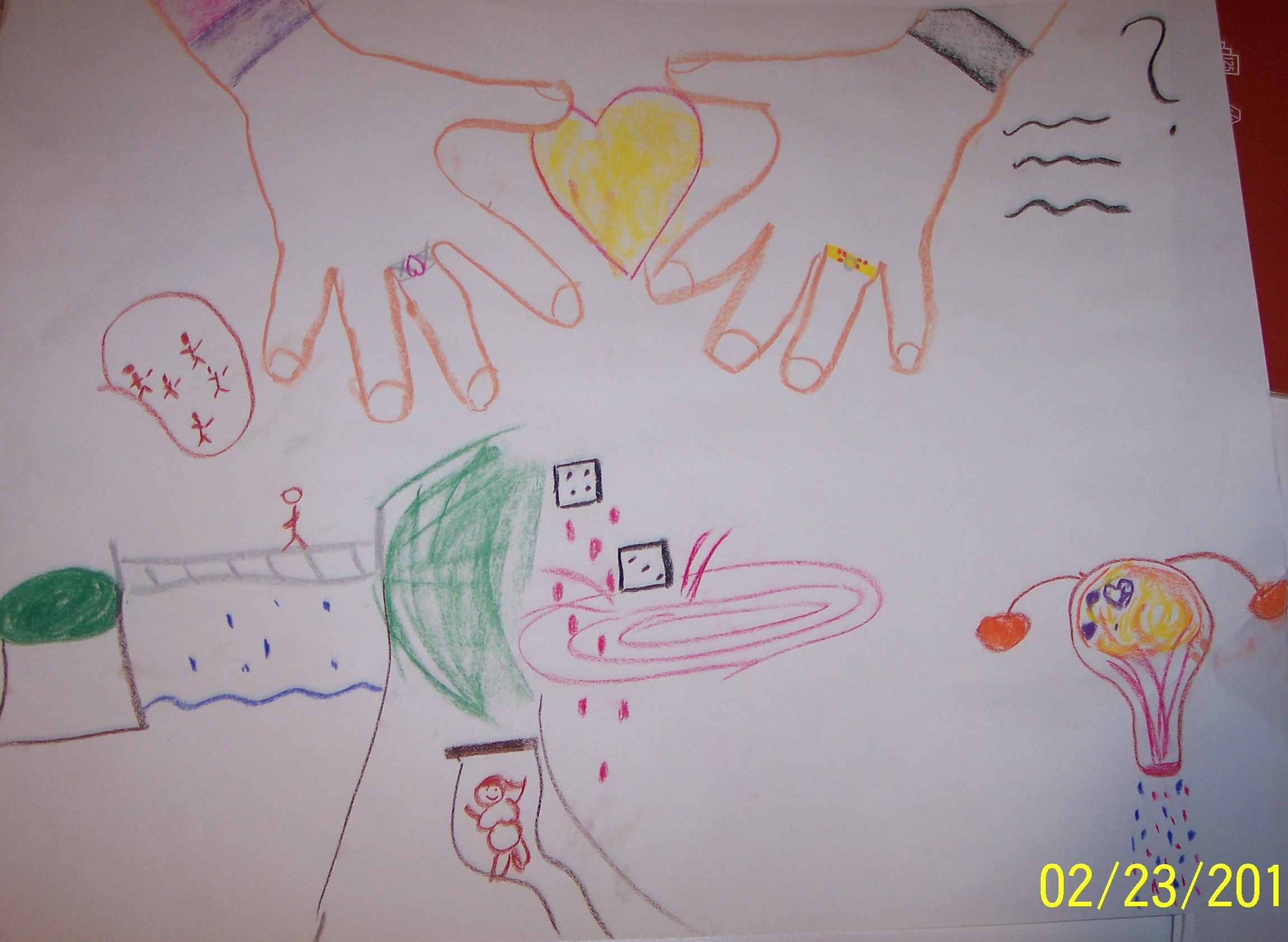
While it might be hard to see everything, I chose the bridge to symbolize my feeling of having crossed the bridge to the “other side”—meaning first the fact that after Noah and my second miscarriage, I felt separated from women who had not experienced loss by a bridge and as if I’d crossed over into new territory and left my old, happy, naive pregnant self behind (along with the other non-loss mamas. A little more about this bridge here). AND, that I also felt like with Alaina’s birth that I crossed a bridge into the unknown and to the end of the pregnancy-after-loss journey. Her birth represented the “other side” of PAL. So, at the end of the bridge I drew a question mark in the sand, representing all the questions I had to get past and over in order to get to my new baby.

via Sand Tray Therapy | Talk Birth.

We also need to remember how many women have stories they are holding close to their hearts and that our casual inquiries or thoughtless remarks about family size may leave further scars. This essay is about miscarriage at ten weeks and is a reminder why biting your tongue before casually remarking on someone else’s family size or fertility is a good idea:

During a recent girls’ night at a friend’s house, I sat cross-legged on the living room floor sipping coffee and catching up with four other women. One friend had just finished sharing the antics of her toddler who gave himself a haircut during quiet time when another friend announced the pending arrival of her third child—”a complete accident” as she described it. Then she turned her attention to me and assured me in front of the other women in the room, “It’s okay if you hate me. I understand.” I was stunned and mortified. I knew this was not her intent, but her statement minimized my loss in such a way that I felt small and petty for struggling with infertility.

via Bite Your Tongue | Brain, Child Magazine.

So, is there anything to say, or to do for those who are grieving? For people I know, I mail little gifts—usually jewelry—so that they know that their loss is real to me too and that they are not alone. I recently found this little handout on “how to help” (not miscarriage-specific, but for anyone going through a hard time):

Here’s the big thing I’ve learned: no two people need help in the same way. I’ve gotten to the point where I have very little pride and I’ll just take what goodness comes my way. But for other people, well intentioned but actually unhelpful help is just one more thing they have to deal with.

This is especially true when people express sympathy and then say, “Let me know if you need anything.”

via How to help – Reese Dixon.

I was also touched by this article by a bereaved mother about what she wishes people would say after the death of her daughter:

…Nothing at all when I start crying. I do it every day. It’s my normal and if you give me a minute or two, I’ll probably be able to put on my social mask again.

Some kind words to accompany those pictures of a new family member that you’re sharing with me. To bereaved parents, seeing a newborn can be a cruel shove back to the time when our world was safe, when our late child was an infant, like the one in the pictures you’re showing me, destined for a future full of love and full of light. An infant that blossomed into a gorgeous girl. A girl that left this world about 70 years too early…

via A Bereaved Mom’s Plea to the Nonbereaved: ‘I Wish You’d Say …’ – Mothering Community.

My own family is coming up on the anniversary of my grandmother’s death. I’m teaching three classes again this session and it is a lot to manage at once. I felt pretty stressed in advance about my Fort Leonard Wood class, Working with Families, because last time I was teaching it one year ago was during my grandma’s sudden and brutal illness and it was unbelievably hard to be teaching about families while my own family was experiencing so much stress and sadness (and then also planning a trip to CA and helping with a memorial service, etc. while trying to grade papers and finish class.) Three weeks ago, on the first night of class, I found myself acknowledging the upcoming anniversary to my class and sharing a story about my mom texting me while singing to my grandma at her bedside, which prompted a brief tears-in-front of class episode which caught both my students and me by surprise. I feel like there is “work” to do here in my own family during this anniversary month and yet the hustle and bustle of kids and responsibilities is making it hard to settle down and sit with it. 😦

The Goddess of Willendorf & Does My Uterus Make Me Look Fat?

“Loving, knowing, and respecting our bodies is a powerful and invincible act of rebellion in this society.”
~ Inga Muscio

IMG_0222

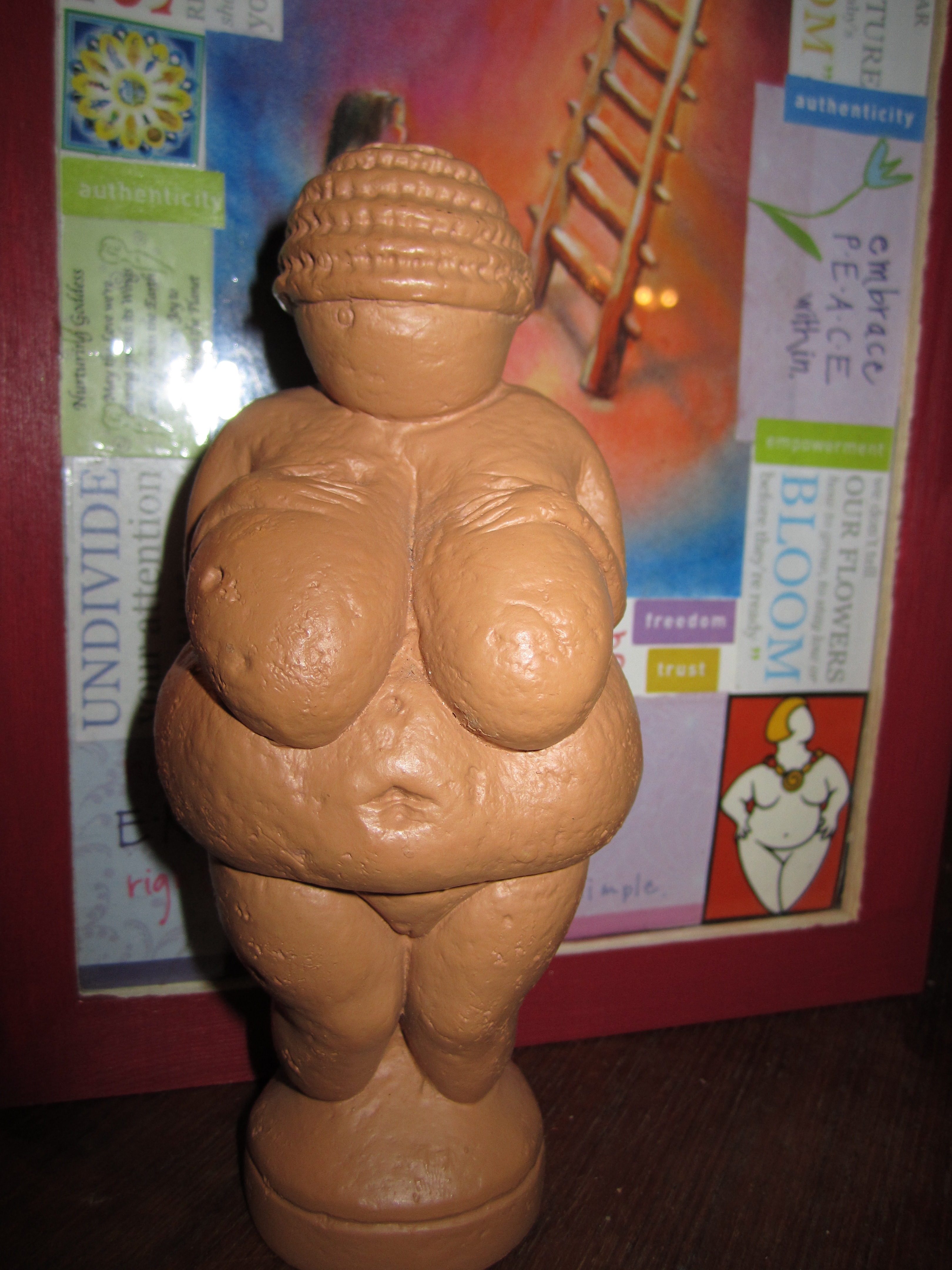
Replica on my birth altar.

I do not remember the first time I ever saw her, but I do know that I have loved the Goddess (Venus) of Willendorf sculpture for many, many years now. I consider her almost a personal “totem.” I do not see her as a literal representation of a particular deity (though when someone uses the phrase, “Great Goddess” or “Great Mother,” she’s the figure I see!), I see her more as honoring the female form. I love that she is so full-figured and not “perfect” or beautiful. I like that she is not pregnant (there is some disagreement about this and many people do describe her as pregnant) and what I like best is that she is complete unto herself. She is a complete form–not just a headless pregnant belly–I just LOVE her. She represents this deep, ancient power to me.

In a past assignment for one of D.Min classes, I wrote:

I have a strong emotional connection to the Paleolithic and Neolithic figures. I do not find that I feel as personally connected to Egyptian and Greek and Roman Goddess imagery, but the ancient figures really speak to something powerful within me. I have a sculpture of the Goddess of Willendorf at a central point on my altar. Sometimes I hold her and wonder and muse about who carved the original. I almost feel a thread that reaches out and continues to connect us to that nearly lost past—all the culture and society and how very much we don’t know about early human history. There is such a solid power to these early figures and to me they speak of the numinous, non-personified, Great Goddess.

I know ancient goddess figures are commonly described as “fertility figures” or as pregnant, but most of the early sculptures do not actually appear pregnant to me, they appear simply full-figured. One of the things I love about the Willendorf Goddess is her air of self-possession. She is complete unto herself. She may be a fertile figure, but she is not clearly pregnant and she does not have a baby in her arms, which indicates that her value was not exclusively in the maternal role. Early goddess figurines are usually portrayed alone, it is only later that we see the addition of the son/baby figure at the mother’s breast or in arms. The earliest figures seem independent of specifically maternal imagery, it is later that we begin to see Goddess defined in relationship to children or as exclusively maternal. I think this reflects a shift that women continue to struggle with today (in Goddess religion as well as personal life) with the mother role see as exhaustive or exclusive. In contemporary society, the only mainstream representation of the Goddess that manages to survive under public recognition is the Madonna and Child and here, not only has Goddess been completely subsumed by her offspring, but she is no longer even recognized as truly divine.

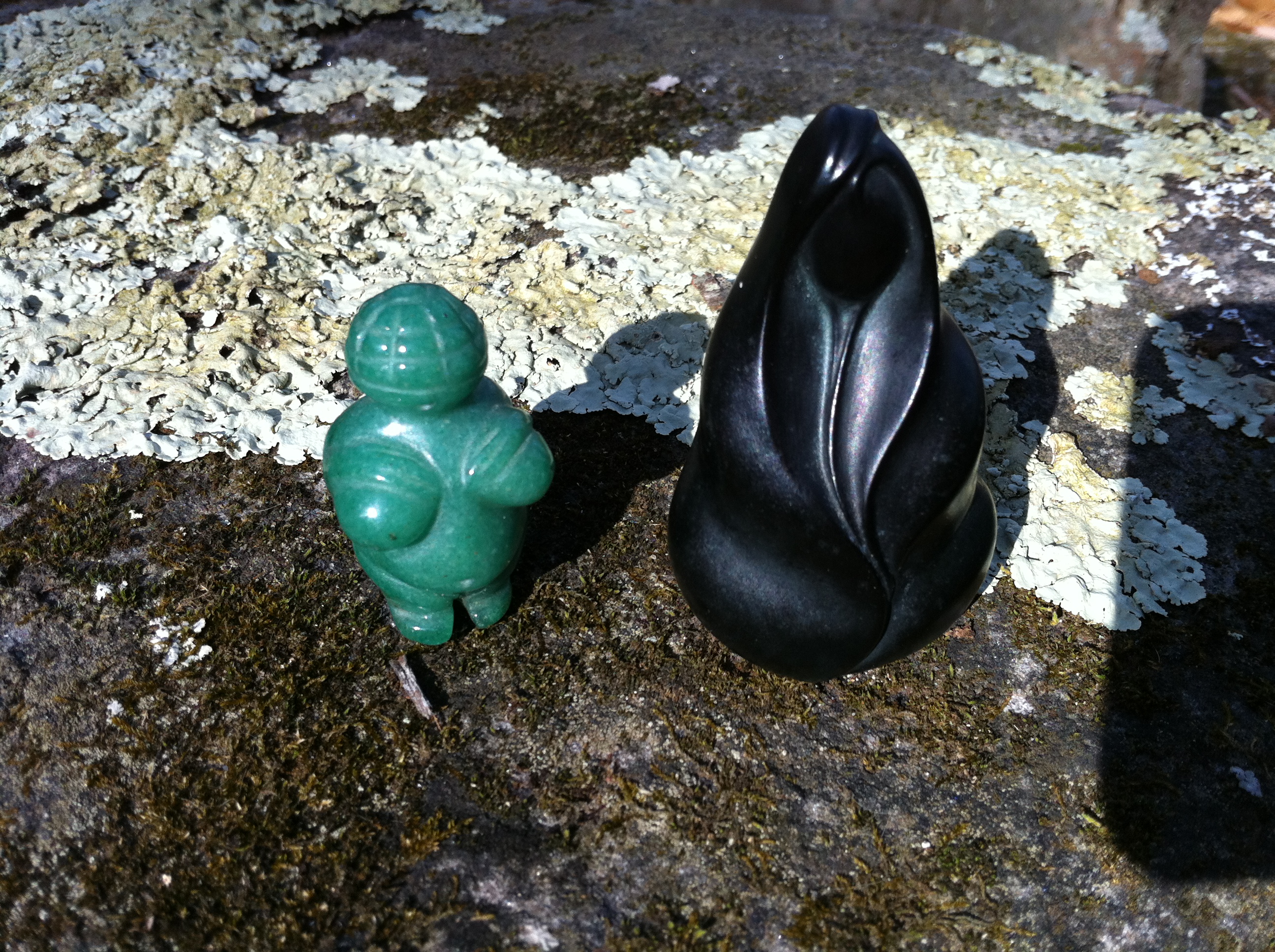
This image has been a potent affirmation for me many times in my life. One Mother’s Day, my then four-year-old son Lann found a IMG_0636little green aventurine Goddess of Willendorf at a local rock shop: “We have GOT to get this for Mom!” he told my husband and they surprised me with it that afternoon. It still makes me get a little teary to look at it, because it was such a beautiful moment of feeling seen by my little child.  When I found out I was pregnant for the third time, my husband surprised me with a beautiful, large Goddess of Willendorf pendant. I was holding onto that pendant during the ultrasound that told us that our third son no longer had a heartbeat and during my labor with my little non-living baby, I wore and held onto the pendant. It went with me to the emergency room and I could feel its solid, reassuring weight against my chest when dressed in just a hospital gown and receiving IV fluids as blood continued to come from me as my body said goodbye to my baby. I buried a goddess of willendorf bead with my baby’s body and put a matching one on his memorial necklace.

100_2269

Bead ready to go in with my baby.

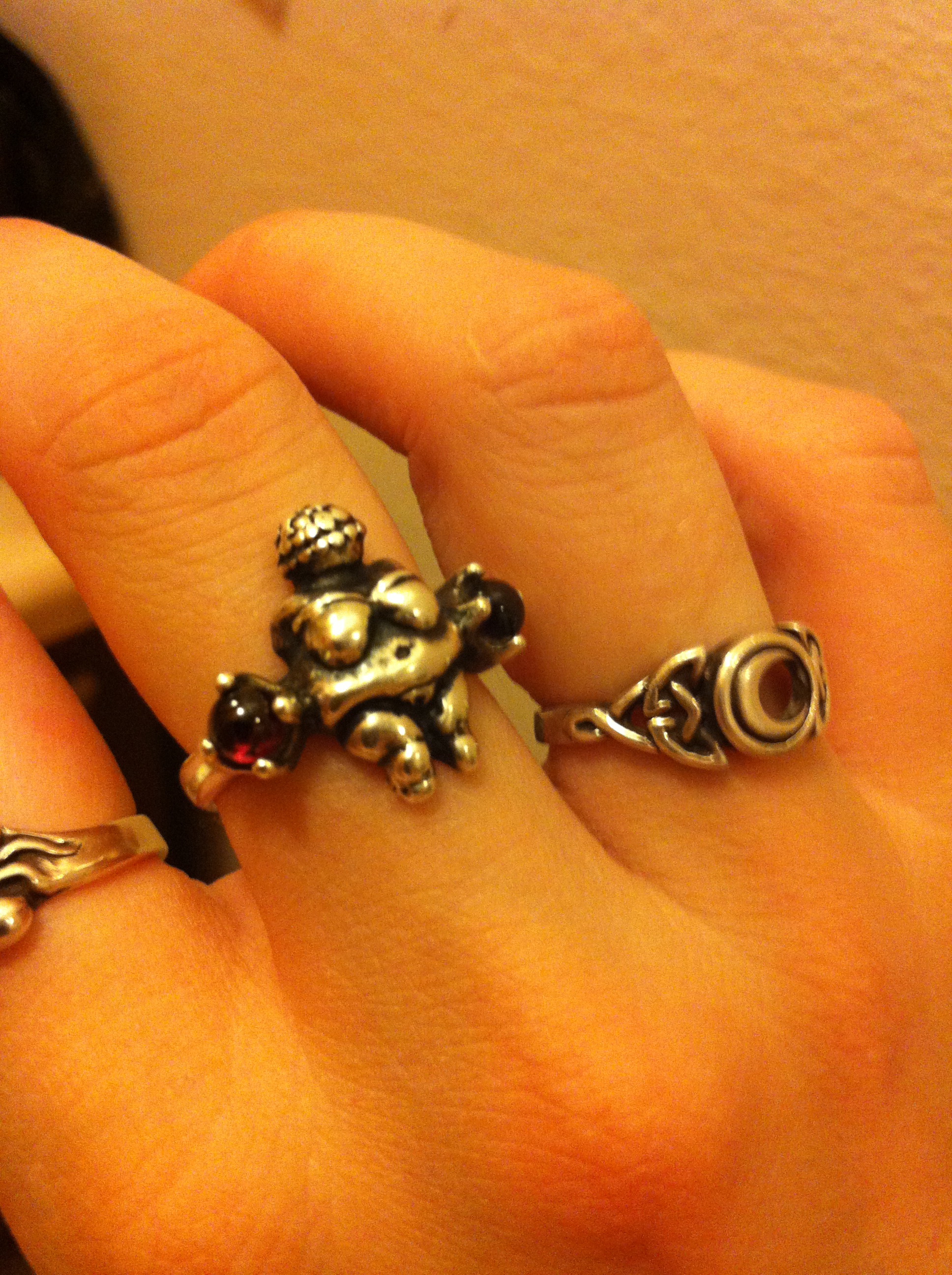
On Mother’s Day the following year, right after finding out I was pregnant with my rainbow baby girl, my husband gave me a beautiful new Goddess of Willendorf ring. I was little scared to wear it, because what if she too, became a sad reminder of a pregnancy lost (I have only worn the pendant again a tiny handful of times since the miscarriage-birth experience, even though I took a lot of comfort in it during that time), but wear it I did up to and through the moment when I caught my sweet little living girl in my own grateful, be-ringed hands.

The website that he bought the ring from went down shortly after and I’d not ever seen another ring like it for sale. However, I signed up to become a retailer for Wellstone Jewelry in 2011. While on the phone making an order, I requested one of their Venus of Lespugue pendants. The woman on the phone told me, “we don’t sell very many of those. She seems to make people uncomfortable. In fact, we used to make a ring too. A venus of willendorf ring, but no one ever wanted her. I think because 1057she is ‘too fat’ and she makes people feel weird.” Oh my goodness, I replied, I think I have one of your rings! I emailed her a picture of my hand and sure enough, though discontinued now, I’d coincidentally gotten one of the last ones ever made. She said they could get the mold out of storage and make some more custom rings just for me. Since I’m a business genius (what? You said they never sold? Sign me up for a dozen!), I immediately said yes and she shipped me several beautiful Goddess of Willendorf rings, which I then sold to several friends. (I still have two left if anyone wants to buy one! I would wear them all if I had enough fingers. My favorite ring ever!)

What does this have to do with my uterus making me look fat? Well, I’ve had the experience of wearing this ring and having another woman, a wonderful, peaceful, healer of a woman, laugh at it, like it was a joke ring. My mom sold a pottery sculpture version of the Willendorf to a man at our craft workshop and he laughed at her too saying, “this is hilarious.” Hilarious? Because she is fat, I guess? Several years ago, I read a post online titled Does My Uterus Make Me Look Fat? and I thought of my beloved Goddess of Willendorf, She of the Ample Uterus. While I can no longer locate the article itself and the post I had linked to in my drafts folder takes me to a re-direct site, I remember the article talking about how even pre-teen girls have a slight swell to their bellies. The author of the post was like, “duh, a flat belly IS NEVER POSSIBLE. THERE IS A UTERUS IN THERE.” When I read it, I thought about the jewelry woman’s comments about women not liking the goddess of willendorf ring because she is too fat. And, I saved a couple of quotes, the first two from the Our Bodies edition of Sage Woman magazine (Spring, 1996):

IMG_0243

Batik Goddess of Willendorf from a friend at my blessingway.

“…so it has been: women’s power has declined as woman’s belly has been violated and shamed…5,000 years of patriarchal culture has degraded belly, body, woman, the sacred feminine, the soul, the feminine sensibility in both women and men, native peoples, and nature–all in a single process of devaluation. Because our belly is the bodily site of feminine sensibility, our patriarchal culture marks the belly as a target of assault, through rape, unnecessary hysterectomies and Cesarians [sic], reproductive technology, legal restrictions on women’s authority in pregnancy and childbirth, and belly-belittling fashions, exercise regimens, and diet schemes…a culture that literally hates women’s guts…” –Lisa Sarasohn, The Goddess Ungirdled

“Our bodies are vessels of the sacred, not the homes of sinful urges. Our bodies create and sustain the sacred. And that sacredness does not equate with any artificial notion of bodily perfection. All of us are fit habitations for the divine, no matter what the diet doctors, fitness gurus, health good fanatics, New Age healers, and the fashion police try to force on us. If we don’t take our bodies into account in our expression of [our religion], then it becomes a mere shadow of itself. When we are fully present in our bodies [women’s religion] becomes a three-dimensional, vibrant, fully fleshed-out expression of the divine…” –DeAnna Alba in How to Flesh Our Your Magick

And, perhaps from the original Does My Uterus Make Me Look Fat article, I had this quote saved as well that addresses the “love your body,” rhetoric so often expressed, including, I suppose, in even the quote I chose to open this post:

“the fact that “love your body” rhetoric shifts the responsibility for body acceptance over to the individual, and away from communities, institutions, and power, is also problematic. individuals who do not love their bodies, who find their bodies difficult to love, are seen as being part of the problem. the underlying assumption is that if we all loved our bodies just as they are, our fat-shaming, beauty-policing culture would be different. if we don’t love our bodies, we are, in effect, perpetuating normative (read: impossible) beauty standards. if we don’t love our individual bodies, we are at fault for collectively continuing the oppressive and misogynistic culture. if you don’t love your body, you’re not trying hard enough to love it. in this framework, your body is still the paramount focus, and one way or another, you’re failing. it’s too close to the usual body-shaming, self-policing crap, albeit with a few quasi-feminist twists, for comfort.”

–saved from this post

March 2014 023
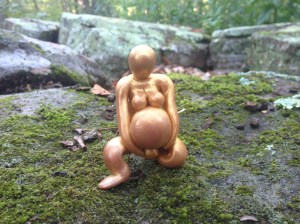
Even though I am a goddess sculptor myself, I have never been able to make my own version of the Goddess of Willendorf that satisfied me. I tried polymer clay, I tried pottery clay, I tried making my husband make one for me. None of them were right. Finally, just this month, my husband said, why don’t you make one, but using your own style? This was an ah ha moment for me and guess what, it worked! I successfully used the same technique and structure I use for all of my sculptures, but with a Willendorf-style-twist and I finally made my own sculpture that I’m really proud of. My husband made a mold and cast her in pewter and I’m wearing her right now. Her uterus might make her look fat, but to me, she is one of the most powerfully affirming images of womanhood I have ever encountered and there is nothing funny about her.

        “Your body is your own. This may seem obvious. But to inhabit your physical self fully, with no apology, is a true act of power.”

–Camille Maurine (Meditation Secrets for Women)

March 2014 022  March 2014 038

Thesis Tidbits: Birth as an Initiation

“We owe it both to our children and to the world, to conceive, birth and welcome our children with as much love and prayerfulness as possible.” –Jackie Singer (Birthrites)

“Childbirth is a rite of passage so intense physically, psychologically, emotionally, spiritually, that most other events in a woman’s life pale next to it. In our modern lives, there are few remaining rituals of initiation, few events that challenge a person’s mettle down to the very core. Childbirth remains a primary initiatory rite for a woman.” –from the book MotherMysteries

via Thesis Tidbits: Birth as a Shamanic Experience | Talk Birth.

I recently finished reading a short book called Return to the Great Mother, which is very specifically focused on giving birth as an initiatory event. It includes a variety of birthing women’s voices and experiences with accessing the energy and wisdom of the “great mother,” be it archetype, an inner resource, or one face of the Sacred. The author, Isa Gucciardi, writes:

Giving birth is one of a series of important initiations a woman may experience in her lifetime. Initiations are intimately tied https://www.sacredstream.org/components/com_virtuemart/shop_image/product/b0e92ae33095ca07867acb0a841a9f05.jpgwith change. They bring the initiate from one state of being into a new state of being. Initiations accomplish this task by putting the initiate through a series of experiences that challenge them in a particular way and bring them into new ways of being and of understanding. The initiate must meet these challenges and overcome any obstacles in order for the initiation to succeed in bringing about these changes.

Today, many people going through initiations and many people managing initiations do not have a clear understanding of the nature of the power and vulnerability that is at the heart of initiation. Initiates must render themselves vulnerable to initiatory processes in order for initiations to become complete, and the power in that vulnerability must be managed carefully and thoughtfully. Most importantly, for an initiation to be successful, that power and vulnerability must be safeguarded and dedicated to the initiate.

The process of meeting an obstacle and overcoming it in order to ultimately gain greater insight and power is described by Joseph Campbell as the “hero’s journey.” The “hero’s journey” is an initiatory experience. Every woman takes this journey when she gives birth and it can be the primary initiation a woman undergoes in the course of her life.

Often a woman encounters herself in an entirely new way during the process of giving birth. She may encounter the effect of traumas long buried, or she may encounter fear long denied. She may also discover power deep within herself that she had never imagined.

When the processes of birth are allowed to take their course, a woman with the proper care has the opportunity to come to terms with whatever may arise. In doing so, she may experience a shift into a new way of being or understanding. Yet, when the birth process is interrupted, or not properly held, the power of the initiation is often lost or distorted… (p. 10)

We know that women do not always have full and free choice when it comes to decisions about their birthing bodies and childbearing years…so, how does this impact the initiatory process? Isa writes:

In modern births, the power of the initiation of birth is often co-opted by doctors, pharmaceutical companies, insurance companies, and hospitals. It is also co-opted by the fear of pain and the influence of friends and family. It is difficult for women to hold onto the power of the initiation of birth under these circumstances. The unfortunate implication here is that the subsequent initiations of women interrupted in this way will be affected by their inability to hold onto the power of their birthing process.

Based on the level of interruption of the birth initiation caused by unnecessary interventions in the birthing process today, it seems reasonable to suggest that many women experience incomplete initiations when giving birth…

(Personally, I would clarify that it is not that women are unable to hold onto the power of the birthing process, but rather that it is often systematically stripped from them.)

Each of my children’s birth experience was an initiatory event for me, but in varying ways. With my first, it was the initiation to motherhood, the mystery and anticipation of giving birth. The crucible moment for me with him was actually my journey through the harrowing landscape of postpartum. With my second son, giving birth rapidly and with great intensity and power, the initiation felt like it was in letting go and hanging on for the ride—letting my mind stop and my body go. With my third birth, which was my first miscarriage, the initiation was in the physically grueling and bloody aftermath of his birth and then the broad, deep, unknown, transformative path of grief and change. I still feel as if this was one of the most powerfully initiatory experiences of my life. (And, I did have an encounter with one face of the great mother.) After Alaina’s birthday this week, I was talking to my husband about my memories of this last birth and telling him that I do not review the details of her birth with the same sense of power or initiation as the births of my other children. It doesn’t hold that same “touchstone” energy for me as the births of my boys—experiences that I continued to draw strength from as I went on into other events in my life. I don’t return to her birth for strength or courage the way I remember returning to the births of each of my sons. And, then I said it was because with her, the pregnancy was the initiation. The long, long, path of pregnancy after loss and all the fear and all the hope and all the strain of feeling the feelings and doing it anyway. Her birth itself was the moment of relief. The end of a trial, rather than the triumph or peak experience of the births of my first two babies. So, while of course I still carry powerful and potent memories of her birth as well, it was the journey of pregnancy that holds the talismans of initiation for me.

In her classic book Shakti Woman, Vicki Noble describes giving birth as a central shamanic experience and perhaps the root of all shamanism:

“I believe I underwent an initiation of the most ancient variety, birth as a shamanic experience, the central act of female shamanism—the quintessential act that offers a woman a completed experience of facing and moving through her fears to the other side. It isn’t that birth is the only way for a woman to experience this initiation—many women climb mountains or face other kinds of physical endurance tests and also come through it reborn into their power. But biologically birth is a doorway, a given for most women on the planet. It is fundamental opportunity to become empowered. Most of us giving birth today do not have the full experience, which is co-opted and distorted beyond recognition, changed from an active process into something that is done to us, as if we don’t know how to do it ourselves. Reclaiming the right to birth in our own instinctual way is a shamanic act of courage that has unfortunately become as remote to us as our ability to fly through the night in the form of an owl or heal the sick with the power of the drum. It wouldn’t hurt if we began to think of our birthing and child rearing as central parts of our shamanic work…” (p. 223).

via Thesis Tidbits: Birth as a Shamanic Experience | Talk Birth.

I just finished a new sculpt for a medium sized version of our classic birth goddess pendant and Mark cast and finished some of them last night. I woke up this morning with a phrase from a past piece of poetry floating through my mind over and over:

Soft belly January 2014 088
no longer bearing children
I am pregnant with myself
ripe with potential,
possibility, power
I incubate my dreams
and give birth to my vision…

I also thought about what I hope to communicate to others through my sculptures and when I took the new pendant down to the woods with me, a little song emerged to go with her:

Birth mama
birth goddess

reaching out
to join the circle of mothers

feeling her way
finding her place
in the web of women

Birth mama January 2014 050
birth goddess

hold strong
hold steady

make way for baby
make way for baby

Body opens
heart opens
hands open to receive

Birth mama
birth goddess

she’s finding her way
she’s finding her way…

Disclosure: I received a complimentary digital copy of the book for review purposes.

Birthrites: Miscarriage

August 2013 048

Miscarriage is a death in the heart of life, a death that happens inside the body of a woman. Sometimes a child just brushes the earth lightly, and is gone before the embryo is anything more than a few cells. Even so, there may already have been a strong connection, love, the beginning of hopes and dreams for the child. Later in a pregnancy, when the being has made itself known through kicks and a visible bump, a whole community may have already begun to make a place for it. Whenever a miscarriage happens, it is a loss that cuts deeply, and needs to be grieved…

–Jackie Singer

This quote from Birthrites touched me and made me think of the many women I’ve known who have walked the long, long path of grief. Singer then goes on to share some words from a mother of miscarriage:

“…When you miscarry, the body has already broken its ties with the baby, but I’d already put this child into my family in my imagination. That was what was hard to break…”

It my own experience, my body letting go of the baby was profoundly meaningful. My body’s later reluctance to let go of the placenta—to finally finish breaking the physical tie to the baby—was pretty traumatic. Acknowledging my own miscarriages through ritual, writing, ceremony, and memorial jewelry was very important to me and while these experiences are now past and do not hold the same fresh, raw, intensity as they once did, they are still inextricably a part of me and have shaped my identity and outlook today. I am always on the lookout for miscarriage resources for others and always, always take note when the experience of miscarriage is honored and included in a book.

As previously shared from Wild Feminine

The red of my blood confirmed what my body already knew; miscarriage is birth and death simultaneously. Miscarriage is ecstatic connection and unquenchable loss. The uterus dilates and contracts, as in the process of birth. In its wake follows something ancient, something from the hearts and lives of the grandmothers and women who have walked before, pouring forth from the uterus…

via Wild Feminine: Miscarriage Wisdom | Talk Birth.

Some other past posts about honoring the experience of miscarriage:

Sept 2013 021

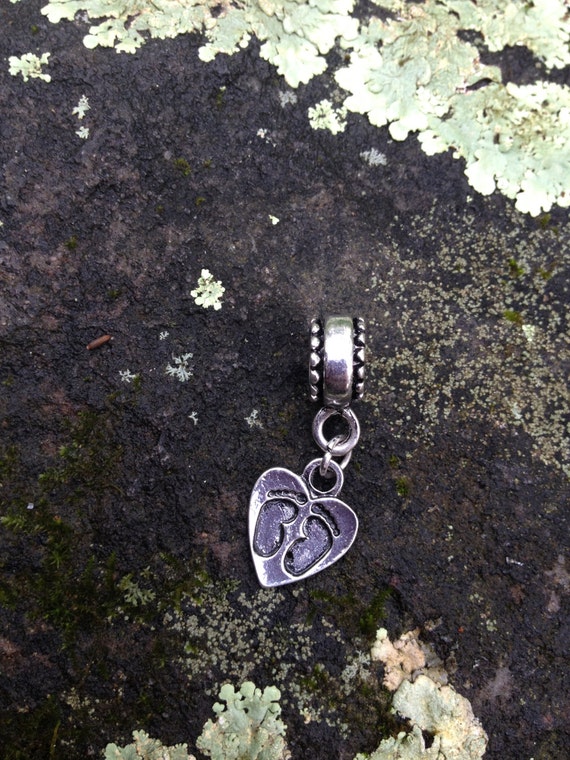
Footprints symbol that held such healing for me and that I make sure to keep available affordably in my etsy shop.

Honoring Miscarriage

Tuesday Tidbits: Miscarriage Care

Miscarriage and Birth

Blog Circle: Tender Mercies, Unexpected Gifts

The Amethyst Network February Blog Circle ~ Sharing Our Stories: A Confusing Early Miscarriage Story

This post is part of a short series of posts from the book Birthrites by Jackie Singer. The first was about ritual and the second about birth as a rite of passage and the third about cesareans.

Mothers of Sorrow and Change

I woke up this morning thinking about the blog post I would write today. I thought of opening it with, “it has been four years since the worst day of my life.” But, then I realized that November 7th was not the worst day of my life. It may have been the hardest, the most grief-stricken, the most wrenching, and the most raw, the most sorrowful, but with the tincture of time, I cannot call it the worst, because I know what I gained from loss. It was four years ago today that I experienced the miscarriage-birth of my third baby. When I went out to his memorial tree this morning, I told him that he will always be a part of me and will always be a hinge upon which my life pivoted in a deep way. This is what today is an anniversary of—it is an opportunity to remember and to honor what his short life and tiny footprints gave to my world, and, through the posts and stories of other women today, to the worlds of others. While somehow it doesn’t feel quite appropriate to say, “Happy Birthday,” I said it anyway: Happy Birthday, tiny baby Noah. You changed my life! As I do with all my kids on their birthdays, I shared the link to his birth story:

…I woke at 1:00 a.m. (November 7) with contractions. I got up to use the bathroom and then walked around in the kitchen briefly, rubbing my belly, talking to the baby and telling him it was time for us to let go of each other—“I need to let go of you and you need to let go of me.” I looked at the clock and said to go ahead and come out at 3:00—“let’s get this done by 3:00.” I had woken every night at 3:00 a.m. throughout my pregnancy for no discernible reason and had said several times previously, “I’ll bet this means the baby is going to be born at 3:00!” (but in MAY, not November). I knelt on the futon by the bathroom door in child’s pose. I said again that I didn’t know HOW I was going to do this, but my body does…

via Noah’s Birth Story (Warning: Miscarriage/Baby Loss) | Talk Birth.

And, as I replied to my caring doula-friend when she posted on my Facebook wall today, I had to count on my fingers twice to make sure it really was four years. Four years!!! OMG. I thought the rawness would never fade and now I have to consciously reach back in time to touch that onslaught of emotion and experience.

Today I feel thankful for the healing power of time, memory, friendship, writing, nature, and family.

The wheel of life keeps turning.

When I got up this morning, with the tightness of too many to-dos in my chest and the plans for what I wanted to write skittering around in my brain, I had to think: do I want to write a blog post about this, or do I want to actually DO THIS? I voted for the doing and the partially planned blog post and the time in which to write it slipped away. I went outside still in my pajamas and put my hand on his memorial plaque the way I used to do every day in the first year after he was born. I remembered the feeling of peace that used to settle on me when doing so. I saw how the sun was rising right next to the tree and it felt like a living metaphor for what this tiny baby was to me. I walked my little labyrinth and sang my post-miscarriage mantra song from the Rise Up and Call Her Name curriculum CD: I’m so glad, trouble don’t last always…oh, my mothers what shall I do? They said…take care of yourself…live free or die…speak the truth…and let your light shine…

Then, I went down to the woods and took some pictures. I’ve been drumming in the woods in the morning lately with my little hand drum and I found myself making up and singing a little song. (It sounds better with a drumbeat)

I drum today to remember my baby
I drum today to remember myself
I drum today to remember the mothers

Mothers who cry
mothers who mourn
mothers who pick up and try again

Mothers who cry
mothers who mourn
mothers who don’t get to try again

Mothers of angels
mothers of rainbows
mothers of butterflies
mothers of sorrow

Mothers of angels
mothers of rainbows
mothers of butterflies
mothers of sorrow

I drum today to remember my baby
I drum today to remember myself
I drum today to remember the mothers
I drum today to remember the mothers…

Pregnancy and Infant Loss Remembrance Day

Pregnancy and Infant Loss Remembrance Day is October 15. At The Amethyst Network, co-founder Jenni has been working on making some new images for the purpose of sharing either in advocacy or support. There you can find different buttons designed for sharing on social media or blogs on both Facebook and Pinterest.

Tonight, I went to a candlelight vigil in Rolla in honor of this Remembrance Day. I took Alaina with me, my little rainbow girl, and we spent some peaceful time at dusk in the park with my friend and her daughter.

Tonight via TAN, I also read an interesting article about miscarriage from a feminist perspective and I very much valued her conclusion:

I’ve come to the conclusion that my understanding of this event as a feminist simply backs up my earlier understanding: that miscarriage is different for every person who experiences it.

via A Feminist’s Miscarriage | Liz Boltz Ranfeld.

Thinking of the 1 in 4 women tonight who share the experience of miscarriage as well as the sisters who support them, in whatever capacity they can.

(A tutorial for how to make star paper lanterns like we used tonight may be found here.)

Tuesday Tidbits: Life and Death

October 2013 041

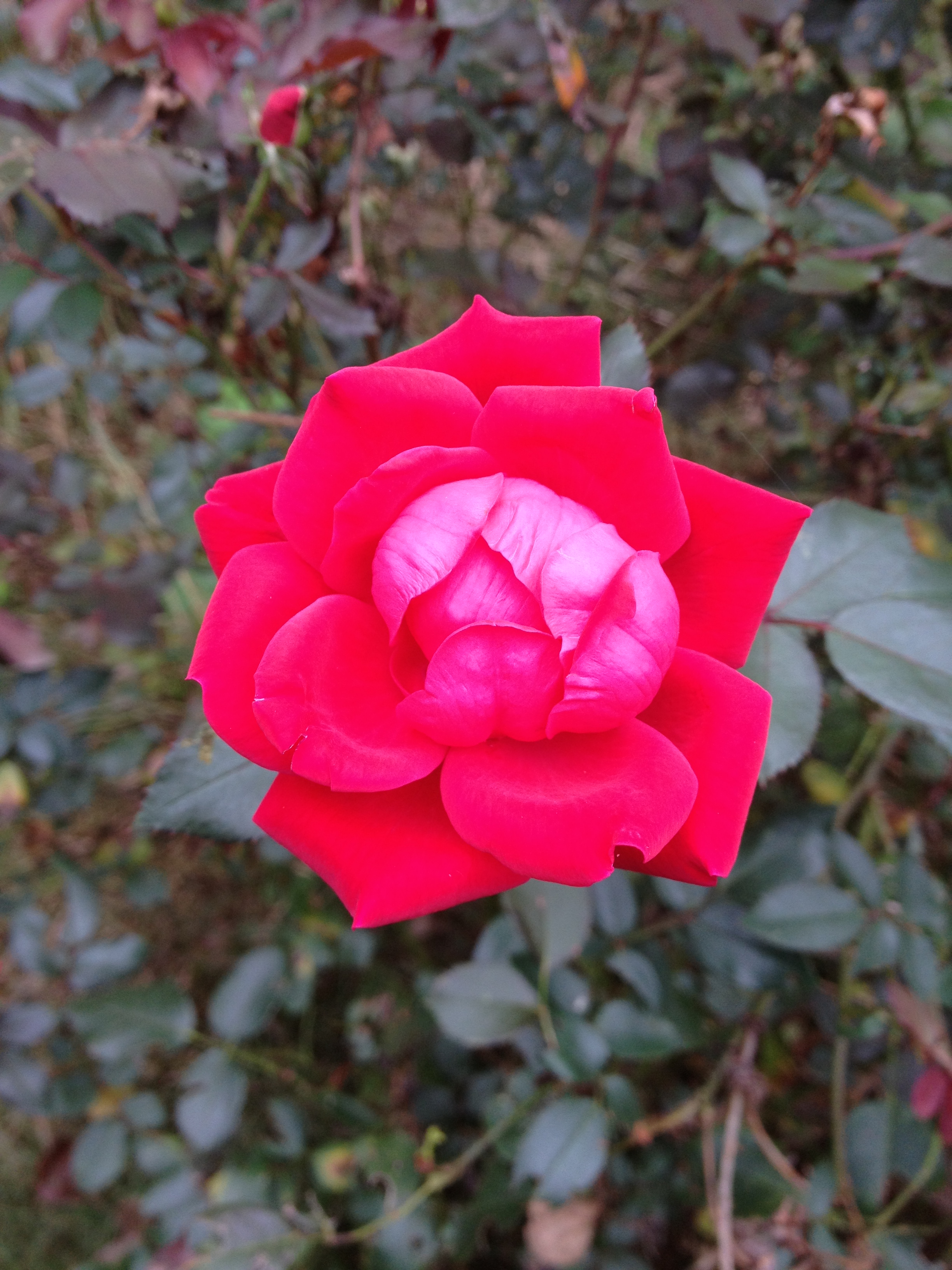
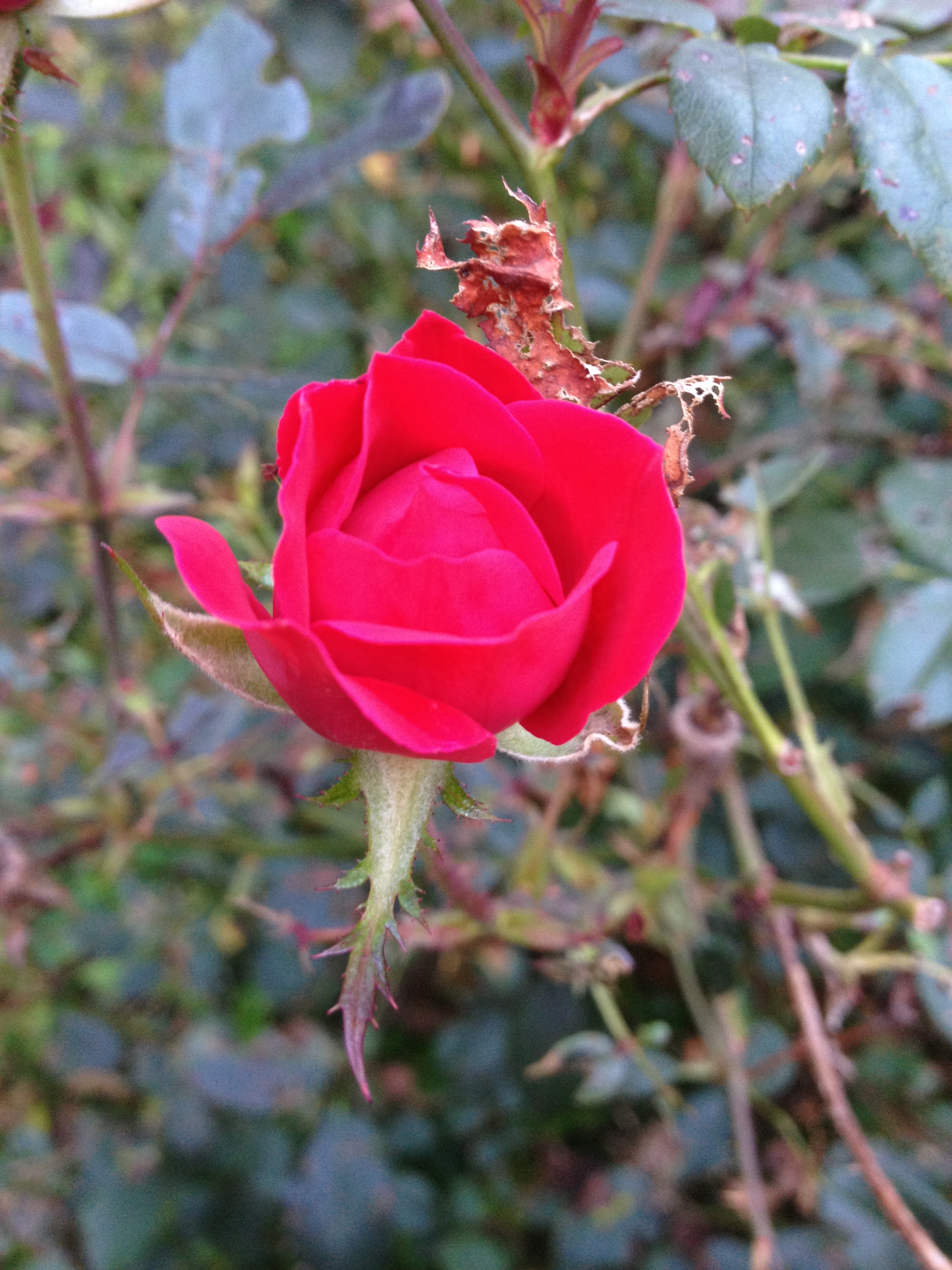
A nice fresh October rose in the back yard.

“Here’s what I know about the other side: women carry the doorway to this place within the womb. The womb is the connection to the spirit realm from which all spirits enter.” –Tami Lynn Kent (Wild Feminine)

After my grandma died, I read an article that paralleled good birth care with good death care. I saved a quote from it to share, but didn’t post it because I didn’t really have anything else to go with it at the time. This month marks the six-month point since my grandma died and I found myself writing about her and making my own birth-song, death-song parallel for my most recent essay for Feminism and Religion and I knew the time for this current post had also come. (Note: the FAR post doesn’t come out until Wednesday, so the link won’t work until then.) Here is the quote I saved:

My Oma was completely cared for. She was bathed in her bed. My mom made homemade applesauce for her. My uncle gave her drops of wine. Her clothes were changed to housedresses she loved. We whispered love notes in her ears. We stroked her arms and held her hands. Nothing existed besides her.

A woman in labor, with the best support, is completely loved up. Taken care of so that she can focus on following her body and natural rhythms. She is massaged, sung to, whispered words of power and praise. All to fill her up so that she can remember her strength, courage, and beauty.

via Life and Death. Miracles Abound. | Naturally Prosperous.

August 2013 001

My grandma’s perpetual calendar. Made by my dad and painted by my mom in the 80’s or so, it was passed along to me. When I finally changed the tiles to September, it prompted another bout of crying because I had to put away the tiles from March–the last time my grandma touched and set up this calendar herself. It was both sad and painful and also beautiful and generative to be setting it up myself and now…the wheel of the year continues to turn and I really should be taking out September and setting up October…

My mom doula’ed my grandmother through her dying process and it was hard, but she did it. This week, my aunt sent out some pictures from my grandma’s doll collection so that we could pick which dolls we might like to have. My grandma loved Shirley Temple and had a Shirley collection, among quite a few other dolls. I’ve written before that I guess this love of dolls is genetic and I definitely got it from both my grandmas. Anyway, I was looking through the doll pictures and feeling impressed with the effort and love my aunt had put into captioning and describing each doll, as well as deciding which one was my favorite and then my eyes were filled with tears. I thought about my own dolls, there on the shelves and in nooks and corners of the house and pictured my little daughter going through them and taking pictures after I die and it was just really flipping sad.

And, so to continue to the theme of today’s post I remembered marking this poem in my 2013 We’Moon datebook (I’m getting ready to order my 2014 edition and so I’m going back through the things I’ve marked this year).

 We All Become Small

…Above the hospital bed
hangs a photo of you:
black lingerie, red curls,
mouth alive with laughter.

You were flamboyance
boasting bold jewelry
and flowered baseball caps.
Everyone called you Mom.

Now you are thin and still…
…You are the end of my journey
the final portrait.

No matter how red our curls,
how bright our rings
we all become small.

We all grow silent,
ease out of our feet,
slip away from our hands,
rise beyond our body
and fill the room with goodbye.

Natascha Bruckner (in We’Moon 2013)

I’d also marked a poem about miscarriage:

Sept 2013 021

I recently added new miscarriage memorial charms to my Etsy shop.

Miscarriage
I won’t forget
how cold that summer turned
after
or how my days developed
sharp edges or how
with time passing,
you still grow older.

You’re the girl I wasn’t
convinced I wanted,
and there’s no name
for the landscape I stand on.

–Joyce Hayden in We’Moon 2013

I really identified with the sentence, there’s no name for the landscape I stand on, feeling reminded of my own post-miscarriage drawing in which I tried to capture the sensation of having to walk over the bridge alone…

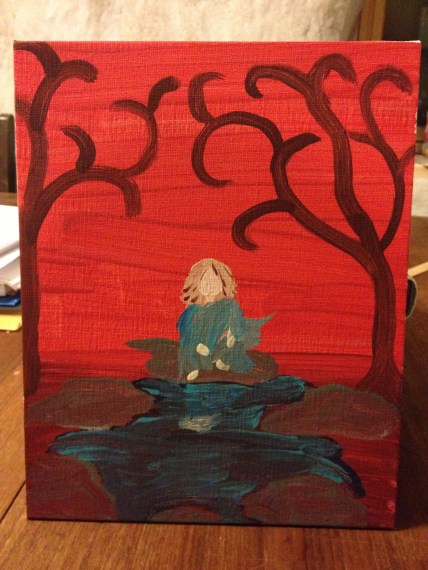
miscarriagedrawingOne of my friends does Prayer Paintings for mothers who’ve experience pregnancy loss, miscarriage, or stillbirth (she also does Birth Blessing painting to celebrate pregnant women). She asked me if she could paint one for me and as we talked it over, I realized I didn’t feel like I needed a loss painting OR one that was about pregnancy or birth, but rather something “integrative.” And, she created something beautiful for me that felt perfect. She titled it Empowering Circle of Reflection and I love the rich, red, surprising sky. It is perfect.

October 2013 020Returning to my grandma as well as thinking about the purpose of writing and exploring feelings in writing and so forth, I also want to share this quote from We’Moon 2013:

“I see beauty in all faces, all women, near and far. All  winds blow, all ferns and grasses grow, all cello weep, all hands write. In writing move the body, the memory in the bones. Lift me up into these trees and into these women’s arms, all branches intertwining..Get those stories down. The moon, the Milky Way, the cream smear of falling stars, the bats and frogs and wood chips, racoons on a log. My jacket hangs on a tree stump every night, and I wear a spiderweb each dawn. Remember this: preserve. Pass on, embellish, enliven and unfold. All winds will blow this history into dust—unless we write it down, and name it holy…” Bonnie J. Morris (in We’Moon 2013)

One of the realizations I had after my trip to the Gaea Goddess Gathering this year was that not everything has to be a story. There doesn’t have to be a blog post around every corner. However, after reading the above, I thought that maybe it isn’t so bad/annoying that I look for the story everywhere and that I try to write it down and name it holy.

And, one last We’Moon transcription:

A Meditation by Mia Howell (in We’Moon 2013)

Sept 2013 010

New mother-blessing tree of life pendants.

The Japanese say that even the other side
has another side. We need to keep turning
things over in our minds until we can see
them in circles of motion, in spirals, in
the complete roundness of their being, through
all the cycles of becoming, undoing, renewing.

We need to understand how we got to this point
and then we need to remember it is just a point.
We feel each beat as a beat but also as part
pf the rhythm of the greater dance of greater things.
We need to turn ourselves around, in order to
see our journey in its full-spiraled progression,
to see our self in its many iterations
of age, development, understanding,
to see how the layers peel away one by one
and yet each is part of the other,
to see how the edges blur, to see how sometimes
there are no sides at all…

Talk Books: One Recumbent Mommy

Some time ago I received a unique memoir to review along with a companion book for children. The topic of One Recumbent Mommy is bedrest and the book is written in a friendly, conversational, and personal style that has potential to bring an air of sisterhood to women experiencing the same challenge and make them feel less alone. The book is based on the author’s blog and a casual, breezy, lighthearted style comes through strongly. The author writes:

I was on hospital bedrest with incompetent cervix for about 16 weeks and while there, I kept a blog chronicling the ups and down of day to day life in the hospital.  That blog was published and is entitled, One Recumbent Mommy: A Humorous Encounter With Bedrest.  I wrote a children’s companion book as well, entitled Wherever I Am, I Will Love You Still: A Book About An Extended Hospital Stay.  This book was written from my 2 year old son’s point of view.  I was trying to get at a way of explaining the situation in terms that a young child could understand.

The companion children’s book: Where I Am, I Will Love You Still, is friendly and sweet and the illustrations are engaging. This book would be a very useful addition to a family whose mother is experiencing a hospital stay. While the book’s conclusion includes the new baby sister coming home, it definitely has the potential to be applied to non-maternity-related hospital stays as well. Do note that bottle feeding is portrayed in the book.

While I was somewhat disappointed by the very conventional medical model of care in One Recumbent Mommy and the seemingly unquestioning acceptance of it by the author (especially considering that bedrest has come under serious scrutiny as to its actual effectiveness at preventing pregnancy loss), as well as the apparently overlooked irony of the baby’s birth then being induced, I appreciated the reminder that for many women pregnancy is anything but a joyful, flower-strewn walk through a miraculous meadow of belly casts and earth-goddesses. My writing and my posts often trend to a Happy Birth Dance! mode of writing about birth and was beneficial to me to remember that this model can feel very isolating, discouraging, and depressing to women whose experiences of pregnancy and birth are different from my own.

Along this same line of thought, I was reminded of recent writings from beautiful blogger Leonie Dawson about her experiences with severe hyperemesis gravidarum (requiring multiple hospitalizations):

And despite everything – despite it all –

Love is calling me forward.

As ancient as the beginning of time, love calls upon us to do what we could not do without.

Love asks of us great things…

via The Love That Calls Us Forward | Leonie Dawson – Amazing Biz, Amazing Life.

As I read One Recumbent Mommy and my priestess/ceremonialist self came to fore however, I also found myself wishing this mama had had some kind of beautiful hospital blessing ceremony to honor her commitment to her baby or that someone had offered her a nurturing prayer, poem, or blessing for her as a Bedrest Warrior doing what had to be done to protect her baby. Could there be a place for a Happy Bedrest Birth Dance mode of writing and experiencing as well? I gratefully welcome additions to this post of ideas for rituals, poems, prayers, or resources that can be offered to bedrest mamas who are doing their best to welcome a healthy, full-term baby into their lives! 🙂

Brought to our knees

“Rigid plans work best if you’re building a skyscraper; with something as mysteriously human as giving birth, it’s best, both literally and figuratively, to keep your knees bent.” –Mark Sloan, MD (Birth Day)

Today I spent a few minutes listening to a lovely webinar by Amy Glenn, the author of Birth, Breath, & Death. The topic was Supporting a Birthing Woman’s Spiritual Practice and I was immediately caught by Amy’s comparison of giving birth to kneeling in prayer. She mentioned that giving birth may drop us to our knees, just as those who pray may pray on their knees. Since I’m currently writing about birth as a spiritual experience, I connected to this implied notion: birth as embodied prayer. And, looking at the webinar photo of a woman kneeling in August 2013 019child’s pose, my own birth-prayers came vividly to mind. In my first labor, I spent a lot of time on my knees, later wishing that I had also given birth on hands and knees rather than being encouraged to birth in a semi-sitting position that I felt contributed to tearing. Later, when I discovered birthing room yoga, I loved realizing that these kneeling postures that I adopted spontaneously and intuitively in my first labor were yoga poses—an inherent body wisdom I carried within me, waiting to arise when called upon. This is part of my first birth story, briefly touching on my time on my knees…

Mark & Mom were wonderfully supportive of me as I labored. I tried various positions and they stacked up pillows for me on the bed so that I could be on my hands and knees on a soft surface (they put the Boppy onto some other pillows to make a “well” for my belly) and then Mom read some of my birth affirmations to me. That worked for a while. I also tried the birth ball for a while and ended up spending a lot of time on my knees on the floor with my head and arms resting on a pillow on the bed…

via My First Birth | Talk Birth.

Kneeling to birth played a prominent role in my second birth experience as well and I have frequently described the rapid birth of my second son as an experience that literally drove me to my knees. When writing about this birth experience, I said:

I was extremely proud of my body and its super-awesomeness 🙂 I felt that my sense of birth trust was physically manifested in my actual birth experience. My body was a powerful and unstoppable force and I had to get out of my own way and let it happen! I felt driven to my hands and knees–like a power was holding me there. After the birth my body felt weak and “run over by a truck”—I felt powerful and like a warrior during the birth…

via Quick Births | Talk Birth.

And, in perhaps my most spiritually meaningful birth experience, the home miscarriage-birth of my third baby also brought me to my knees:

August 2013 041

Brand new sculpture inspired by the thoughts in this post.

When I was still having the “HOW?” questions, other women that I knew who had experienced miscarriage started to come to mind and I knew I could do it too. I told myself that I had to do what I had to do. I said out loud, “let go, let go, let go.” I said I was okay and “my body knows what to do.” The afternoon I found out the baby died, I’d received a package that included a little lavender sachet as a free gift with my order. When my labor began, for some reason I wanted the sachet and held and smelled it throughout the experience. As I chanted to myself, “let go, let go, let go,” I smelled my sachet (later, I read in one of my miscarriage books that in aromatherapy lavender is for letting go). I also told myself, “I can do it, I can do it” and “I’m okay, I’m okay.” I felt like I should get more upright and though it was very difficult to move out of the safety of child’s pose, I got up onto my knees and felt a small pop/gush. I checked and it was my water breaking. The water was clear and a small amount. I was touched that now these gray pants were my water-breaking pants too…

Contractions continued fairly intensely and I continue to talk myself through them while Mark rubbed my back. I coached myself to rise again and after I sat back on my heels, I felt a warm blob leave my body. I put my hand down and said, “something came out. I need to look, but I’m scared.” Then, “I can do it, I can do it,” I coached myself and went into the bathroom to check (it was extremely important to me not to have the baby on the toilet). I saw that it was a very large blood clot. I was a little confused and wondered if we were going to have to “dissect” the clot looking for the baby. Then I had another contraction and, standing with my knees slightly bent, our baby slipped out…

via Noah’s Birth Story (Warning: Miscarriage/Baby Loss) | Talk Birth.

When the time came to gave birth to my rainbow daughter, she brought me to my knees as well and she was the only baby I caught in my own hands while in a kneeling position. Here is a segment from her birth-prayer:

At some point in the bathroom, I said, “I think this is pushing.” I was feeling desperate for my water to break. It felt like it was in the way and holding things up. I reached my hand down and thought I felt squooshy sac-ish feeling, but Mom and Mark looked and could not see anything. And, it still didn’t break. Mom mentioned that I should probably go to my birth nest in order to avoid having the baby on the toilet. My birth nest was a futon stack near the bathroom door. I got down on hands and knees after feeling like I might not make it all the way to the futons. Felt like I wanted to kneel on hard floor before reaching the nest.

…I couldn’t find her heartbeat and started to feel a little panicky about that as well as really uncomfortable and then threw IMG_0422the Doppler to the side saying, “forget it!” because big pushing was coming. I was down on hands and knees and then moved partially up on one hand in order to put my other hand down to feel what was happening. Could feel squishiness and water finally broke (not much, just a small trickle before her head). I could feel her head with my fingers and began to feel familiar sensation of front-burning. I said, “stretchy, stretchy, stretchy, stretchy,” the phone rang, her head pushed and pushed itself down as I continued to support myself with my hand and I moved up onto my knees, with them spread apart so I was almost sitting on my heels and her whole body and a whole bunch of fluid blooshed out into my hands. She was pink and warm and slippery and crying instantly—quite a lot of crying, actually. I said, “you’re alive, you’re alive! I did it! There’s nothing wrong with me!” and I kissed her and cried and laughed and was amazed.

via Alaina’s Complete Birth Story | Talk Birth.

Motherhood, especially my postpartum experience with my first baby also dropped the legs out from under me and I used the same expression echoed above in writing about this postpartum crucible:

I had regularly attended La Leche League (LLL) meetings since halfway through my pregnancy and thought I was prepared for “nursing all the time” and having my life focus around my baby’s needs. However, the actual experience of postpartum slapped me in the face and brought me to my knees…

via Planning for Postpartum | Talk Birth.

I’m not the only mother who finds this an apt description of the process of giving birth, today I found this touching story about memorializing the still birth of a mother’s baby girl:

This blanket isn’t much to look at. It isn’t a work of art. But it holds an entire story within its stitches. It holds the legacy of our precious baby girl who was stillborn, yes, but she was still born. Her name is etched on our hearts, and her short little life was not in vain. In those 37 weeks, she brought us joy and excitement. She brought us laughter. She brought me to my knees (to dry heave, because of being in pain, and to pray…). She brought us together, tighter, as a family. She brought us love. She brought us hope.

via Mind Mumbles: Our Stillbirth Storm.

And, I also read this gorgeous birth story that brings the concepts of prayer and birth kneeling into direct, evocative connection:

August 2013 047

Brand new sculpture inspired by the thoughts in this post.

From this point on, labor was like a long, hard prayer taking place through a dark and cold night. It literally brought me to my knees. At times I knelt, hands clasped in front of me. I had to work hard to surrender, to open myself up to the reality of labor and pain and let it be. It was a challenge. Knowing I needed to surrender to the labor, and to your advent, I made a silent decision to open my hands. I held them open and palm up in between each contraction. I tried to keep them open as long as I could once a contraction started. This was one of the most poignant parts of your birth – this surrender. I had to keep pushing my soul in the direction of you. I needed an openness of spirit as much as of body, for my spirit was caught up in a complicated grief from the months prior. At one point, when a contraction was coming, Kristen said to me, “Camille, you need to let this be big.” How did she know that I was holding back, hesitating? I needed to surrender to the hugeness of the mystery of life and birth and yes, even death. The challenge in your birth, dear Silas, was in the soul places…

…Kristen said simply, “Ok. Just listen to your body.” She trusted my body, which was so freeing. As I pushed, it felt natural. I was part of the pushing, as were you. I knew that the pushing was working, that you were coming down into the world. No one moved closer or moved away. No one tried to move me. I remained in the cleared meadow of a space with the freedom to move as my body wanted to move. There was complete freedom to do just as my midwife asked – to listen, and listen closely. To be. I was on my hands and knees, as close to earth as I could muster in the middle of Queens. And the transition to pushing felt seamless. I was permitted to remain in the deep cavities of my body, which were doing such brave work…

via The Birth Pause: Unhurrying the Moment of Meeting: The Story of Your Birth.

It isn’t only mothers who are brought to their knees by the act of birth, so are birth witnesses:

This is the story of falling in love with a baby before we even met her, the story of witnessing two friends fall deeper in love and the joy of meeting someone you just know you’ll know a lifetime in their very first second of life. This experience brought me to my knees in the end, a wreck of being awake 39.5 hours after witnessing such beauty I thought my heart would explode. I wailed in happiness, and entered a place where the only logical thing to do was roll around in the grass in the sun in full, tearful joy. I forever remain grateful to be a part of this.

It’s beautiful to document beauty, to witness beauty and just downright jump inside beauty…

via a birth story » Sara Parsons Photography.

In fact, we even see birth and knees referenced in the Bible as well:

Now when Rachel saw that she bore Jacob no children, Rachel envied her sister, and said to Jacob, “Give me children, or else I die!” And Jacob’s anger was aroused against Rachel, and he said, “Am I in the place of God, who has withheld from you the fruit of the womb?” So she said, “Here is my maid Bilhah; go in to her, and she will bear a child on my knees, that I also may have children by her.” Then she gave him Bilhah her maid as wife, and Jacob went in to her.

[No need to note how strongly I object to the notion of women being “given” to men. The author of the post referencing this quote then goes on to explain what ‘on my knees’ actually means, which is a little different than what I was thinking…]

…On my knees refers to the custom where the husband impregnated the surrogate while the surrogate reclined on the lap of the wife, and how she might even recline on the wife as she gave birth. The symbolism clearly showed the child was legally the child of the mother, not the surrogate, who was merely in the place of the wife in both conception and birth.

via Genesis 30 – The Children Born to Jacob.

Other birthing women experience the energy of birth as an embodied experience of Shakti. While Shakti can be personified as a Goddess, she is also understood as the great cosmic “fuel” of the universe, the feminine force that drives creation. Women may experience the energy of birth as Shakti moving through, with, and within them. While not specifically about birth, I recently wrote about Shakti in a related sense:

Shakti woman speaks August 2013 043
She says Dance
Write
Create
Share
Speak.

Don’t let me down
I wait within
coiled at the base of your spine
draped around your hips
like a bellydancer’s sash
snaking my way up
through your belly
and your throat
until I burst forth
in radiant power
that shall not be denied.

Do not silence me
do not coil my energy back inside
stuffing it down
where it might wither in darkness
biding its time
becoming something that waits
to strike. August 2013 050

Let me sing
let me flood through your body
in ripples of ecstasy
stretch your hands wide
wear jewels on your fingers
and your heart on your sleeve.

Spin
spin with me now
until we dance shadows into art
hope into being
and pain into power.

7/1/2013
via Woodspriestess: Shakti Woman Speaks

After thinking about this post all day and working on it in snippets at a time, a friend shared this quote with me saying that it reminded her of me. It felt like the perfect closing:

“As women connected to the earth, we are nurturing and we are fierce, we are wicked and we are sublime. The full range is ours. We hold the moon in our bellies and fire in our hearts. We bleed. We give milk. We are the mothers of first words. These words grow. They are our children. They are our stories and our poems.”

–An excerpt from “Undressing the Bear” by Terry Tempest Williams

Day of Hope and Healing (Plus Amethyst Network Birthday Giveaway)

A Birth Healing Blessing

Blessed sister, beautiful one
with broken wings.
Your journey is a difficult one…
that no mother should have to endure.
Your path is steep, rocky and slippery
and your tender heart is in need of gentle healing.

Breathe deeply and know that you are loved.
You are not alone,
though at times, you will feel like a
desolate island of grief
untouchable
distant.
Close your eyes.
Seek the wisdom of women who have walked this well-worn path before you,
before,
and before,
and before you yourself were born.
These beautiful ones
with eyes like yours
have shared your pain, and
weathered the storms of loss.

You are not alone (breathe in)
You will go on (breathe out)
Your wings will mend (breathe in)
You are loved (breathe out)
~ Mary Burgess (Mending Invisible Wings)

Today is the Day of Hope and Healing, a national remembrance day for families who have experienced miscarriage, stillbirth, infant or child loss. Tonight, one of my friends is having a Day of Hope event for local families. I’m happy to participate and I picked out the poem above to read. I also made a prayer flag as part of the prayer flag project. I included lines from a song that spoke to me deeply during my second miscarriage. I left the mama’s arms unglued so that they can close, open, or wave in the breeze. Unfortunately, the glue I used leaked through, which gives her a “weeping Madonna” quality. I was bugged by it at first and almost didn’t show a picture, but then I decided I actually like it like that!

August 2013 027 August 2013 028

This week is also The Amethyst Network’s third birthday. I helped co-found this organization as a direct result of my own in-the-midst-of-miscarriage-realization about the need for miscarriage doulas in the world, and I’m proud of the resources we’ve collected and the services we offer to women around the country. As TAN posted on our Facebook page:

We hope you’ll join us in celebrating this week by doing random acts of kindness or paying it forward and then coming back here and telling us about what you did. Whether it’s related to your baby’s memory or not, what goes around comes around, and TAN believes in being a force for good in the world. We hope you will join us in celebrating our birthday by giving gifts to those around us.

***Giveaway now closed. Ravenna was the winner!***

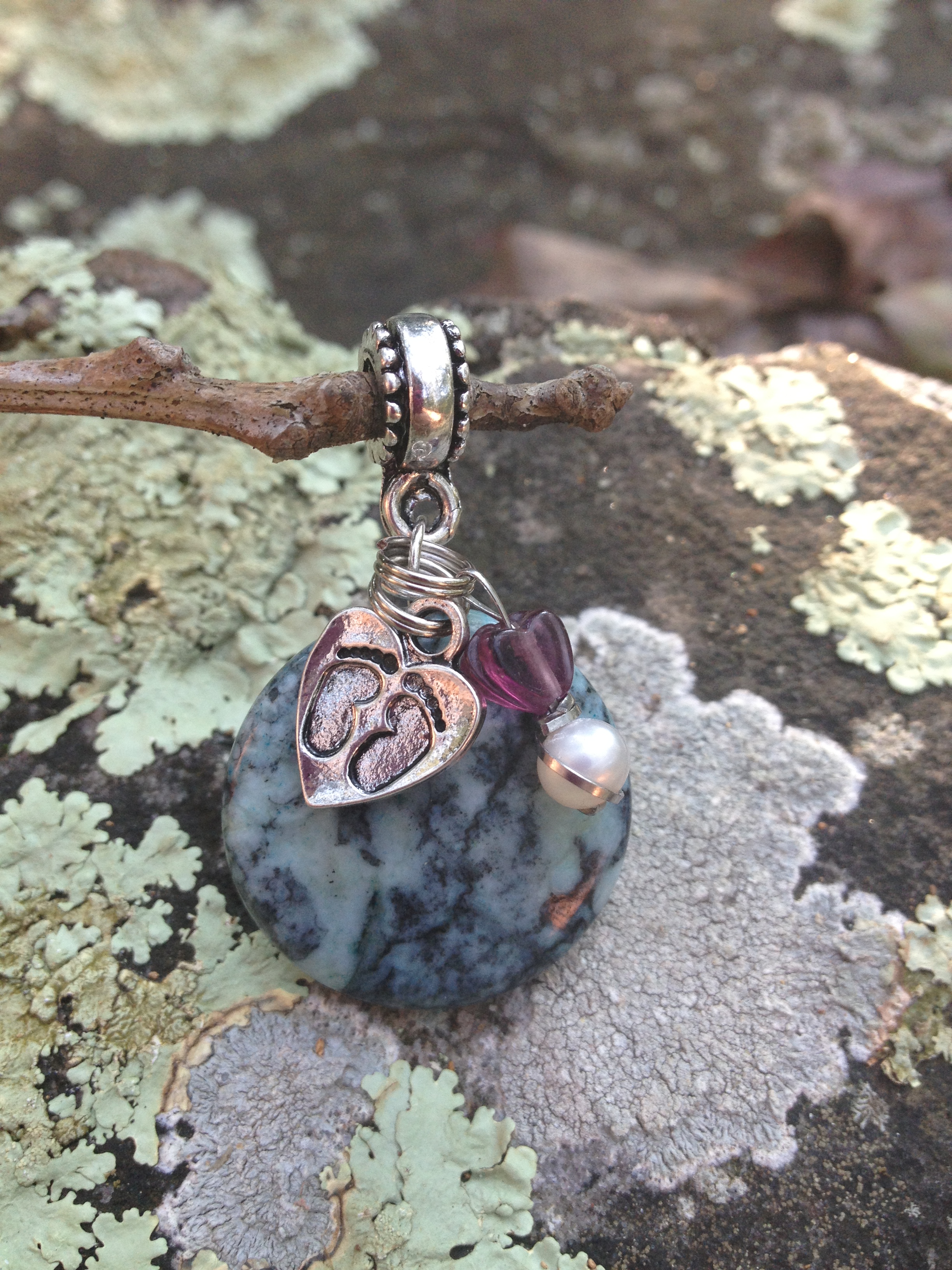
So, I decided to offer a pendant giveaway in honor of TAN’s birthday! (I also reached 500,000 hits last week and I often do a giveaway for things like that, so it is doubly time to do one!) I made this pendant last night specifically for TAN’s birthday. It has a footprints charm like the one that was so meaningful to me, a howlite stone, and also a tiny amethyst heart (and a freshwater pearl). It comes on a simple ribbon, but can easily be taken off and added to your favorite chain instead. You don’t have to do anything fancy to enter, just leave a comment. If you’d like to share The Amethyst Network’s page or website with your Facebook friends or followers, then you can earn a bonus entry! (just make sure to leave another comment telling me you did so)

August 2013 011

(classy twig not included 😉 )

The giveaway will close next Monday night.

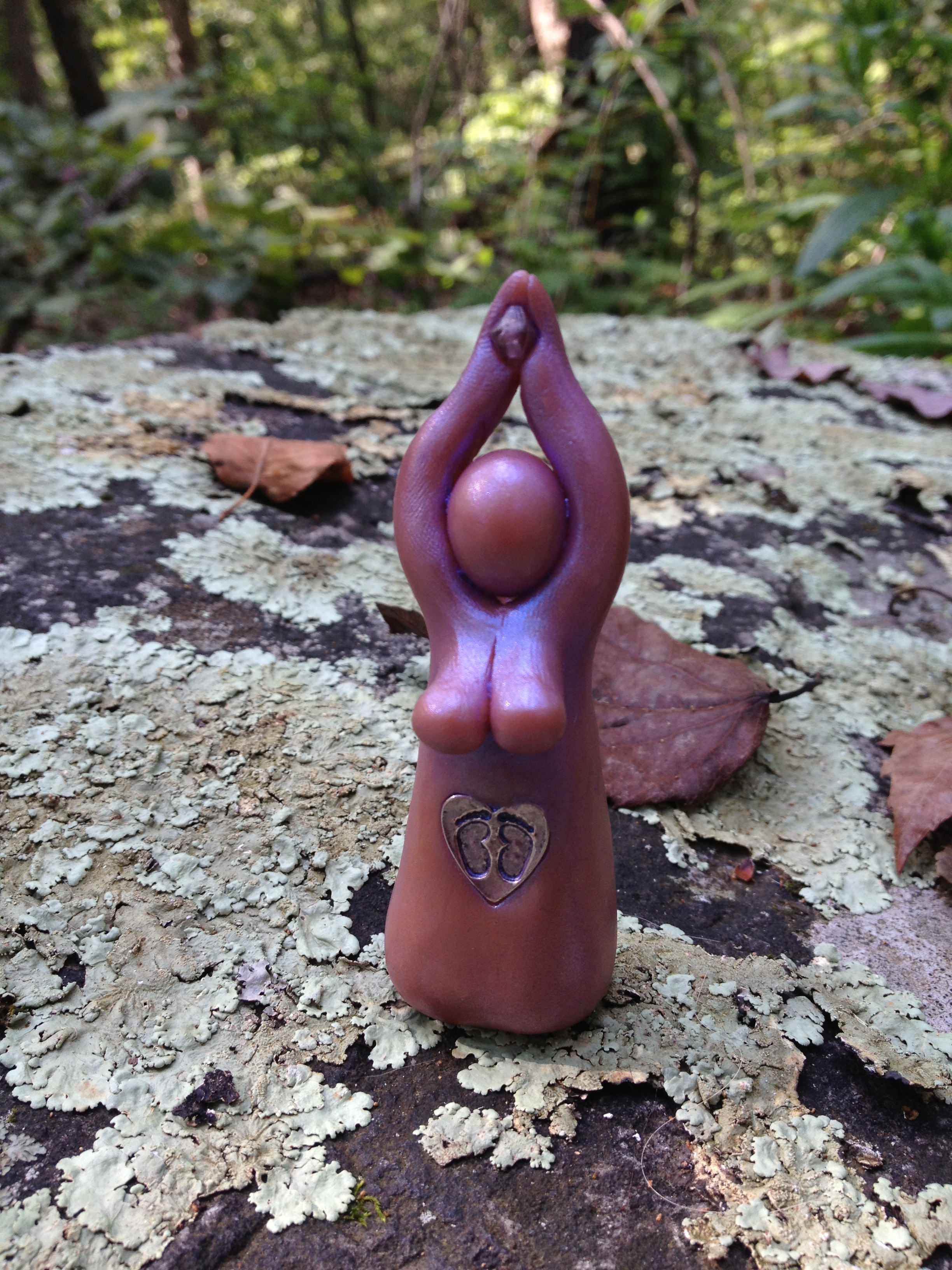
I also made a diverse assortment of birth art goddesses last night and I decided to make a miscarriage mama with a footprints charm too. She is purple and is holding an amethyst crystal, in honor of The Amethyst Network’s birthday too! I haven’t decided what to do with her yet…keep her…sell her…do another giveaway…

August 2013 048Here are the rest of the mamas who came to life in my hands last night:

August 2013 043There are some VBAC mamas, a river mama, a laboring mama, a birthing mama, a moon mama, and a loss mama. I’m working on adding them to my etsy shop along with some more new pendants! 🙂

August 2013 020

Other past posts about miscarriage may be found here.