Archives

Footprints on My Heart: A Memoir of Miscarriage & Pregnancy After Loss

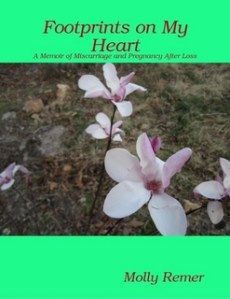
As of this week, my miscarriage memoir, Footprints on My Heart, has finally been published and is now available in eBook format via Kindle and Lulu, Inc. (epub format compatible with Nook and iBooks). There are a few formatting errors and some other general problems (like with the sample/preview–it is totally wonky–and with the lettering on the cover), but guess what, it is DONE, it available, and it is out there. I’m really, really excited about it and I feel this huge sense of relief. I still want to write my Empowered Miscarriage book someday, but for now, this memoir is what I had in me and it will have to do for the time being. I realized after Alaina was born and was, in a sense, the happy “ending” to my Noah story, that in writing my miscarriage blog I had actually ended up writing most of a book. So, the bulk of the book is drawn from my miscarriage blog and from this blog as well (for the pregnancy after loss content). I also included an appendix of resource information/additional thoughts that is fresh.
I’ve felt haunted by the desire to publish this for the entire last year. It took a surprising amount of work, as well as emotional energy, to prepare for publication, even though I actually did most of the actual writing via blog in 2010. Now that it is ready, I just feel lighter somehow and have this really potent sense of relief and ease, as if this was my final task. My final act of tribute. My remaining “to do” in the grief process.

If anyone really, really, really wants it and cannot afford the $3.99 for which I priced it, I do have it available as a pdf file, a mobi file, and an epub file and I will be happy to email it to you in one of those formats.

<deep breath> Aaaaaahhhhhh….
A Year of Talk Birth–Free ebook (rough copy)

Earlier this year I mentioned that I’d used BlogBlooker to convert my blog into a book so that I could copy the text into a year-end Wordle. Anyway, I decided I might as well make the finished blogbook available for download here as an ebook of sorts. It is pretty rough, since it includes comment text as well as “footnotes” of any websites I linked to. And, the formatting of pictures and other elements is a little funky, plus it includes any reviews or giveaways or quotes posts that I did during 2011. But, for anyone who wants it, here is a year of Talk Birth in pdf ebook format. I sent it to myself to read on my iPad and it was really pretty fun! It is a long document—410 page pdf. Enjoy!

Guest Post: Alcohol and Breastmilk

Just in time for the holiday season, a note to clarify the issue of nursing moms drinking alcohol. (c) Karen Orozco

Your milk alcohol level will be exactly the same as your blood alcohol level. So if you’ve had a couple of drinks and hit the legal limit, your milk has about the same alcohol content as fresh fruit juice or a non-alcoholic beer–.08%ish. Alcohol does not concentrate in the milk, and as your liver clears it from your blood, the milk alcohol level will also drop. There is no need to pump and dump for a healthy baby! If you are concerned about even very minimal amounts of alcohol in the baby’s system, nurse before you go out, and time your drinking so that you give your liver time to metabolize it before the baby would want to nurse again.

The takeaway message: Long before you have enough alcohol in your milk for your baby to even notice, you would be so hammered that you would hardly remember you even had a baby. The concern for occasional drinkers is not really alcohol being passed to the baby, but mom and dad remaining sober enough to care for the baby–and that’s a really big deal where co-sleeping is concerned! Safely sleeping with a baby means being stone cold sober. Period.

Merry Christmas, Happy Holidays, and a great New Year to everyone!

Please note that I’m really only talking about moms who have a drink now and then, not habitual heavy drinkers. We just don’t know what effect continuous long-term exposure to alcohol might have on a baby.

Lynn Carter is an IBCLC in Kirksville, Missouri.

Guest Post: More Business of Being Born Mini-Review

In conjunction with the More Business of Being Born giveaway I’m currently hosting, I’m also pleased to share this mini-review of the first installment (Down on the Farm) guest posted by my friend and colleague, doula Summer:

More Business of Being Born

Down on the Farm: Conversations with Legendary Midwife Ina May

Reviewed by Summer Thorp-Lancaster

http://peacefulbeginnings.wordpress.com
http://summerdoula.wordpress.com

The first installation of More Business of Being Born, Down on the Farm: Conversations with Legendary Midwife Ina May, is infused with loving scenes of midwifery care, loads of vital information and even a few jokes (such as a gift referencing Ina May’s infamous “sphincter law”).  We are given an up close view of the well-known Farm in Tennessee, whose Midwives boast an exemplary track record of Midwife attended, out-of-hospital births. This record includes a less than 2% cesarean section rate in over 2500 births. Throughout the interviews, Ina May’s (and the other Midwives featured) reverence and respect for the Midwifery Model of Care is ever-present. Her passion for the safety and overall well-being of the motherbaby is palpable and stirring.

It would be impossible to cover the many aspects of birth, or even just Midwife attended out-of-hospital birth, in a full length film, let alone an episode, but this piece successfully touches on many topics and will (hopefully) lead to further discussion amongst viewers. As an activist, I found myself left with a renewed sense of action or purpose, a desire to do more and help more so that all mamas and babies have the opportunity to experience birth as the positive, loving and intimate experience it was meant to be as well as a deeper understanding of the crisis surrounding our medical model of birth. I would recommend this film to everyone, as the state of maternity care affects us all.

More Readings for Women’s Programs

I absolutely love collecting these kinds of things (almost as much as I love collecting quotes) and I figure that as long as I’ve bothered retyping or saving them, I might as well share them via my blog—that way more people can possibly benefit from or enjoy them!

Invocation:

Mother of the Medicine Wheel (from Sage Woman issue 81)

By Sharon Blessum

In the womb of the East Lodge

She gives birth in the morning.

She mothers us with smiles and songs.

In the strong sun of the South

She offers food from Her garden,

Enchantment for the mid-day of life.

In the benediction of the West

She colors evening with sunset

Wraps us in reflections of day.

In the old age of the North Lodge,

She will hold us in sweetness

Cross with us into the Land of the Ancestors.

—-

Opening Words/Chalice Lightings

May we be reminded here of our highest aspirations,

 and inspired to bring our gifts of love and service to the altar of humanity.

 May we know once again that we are not isolated beings

 but connected, in mystery and miracle, to the universe,

 to this community and to each other.

-Anonymous (Reading #434 in Singing The Living Tradition)

—-

Or (not sure of the source for this one, I had it jotted on a little piece of paper):

With the kindling of this flame,

We honor the mysteries and riddles that prompt us to ask questions;

We give thanks for community, in which we can seek their answers;

And we open our hearts and minds to our great and many freedoms.

Introductory Reading/Welcome

The Gaze of Love: A Body-Loving Invitation to all Women, by Patricia Lynn Reilly

Today, and everyday, let’s turn toward other women’s bodies, and our own, with mercy and unconditional acceptance, letting go of the competition and scrutiny-based sizing up of each other, letting go of the subtle put-downs and diminishments when we’re threatened by each other, allowing healing attention to flow one to another until the gaze of love heals us.

A gaze of love, calling wise women with their beautiful silver hair and life-lines out of hiding; inviting our smart, gifted daughters to reject the tyranny of thinness and to cease from harming themselves; welcoming the full, rounded bodies of our friends, bodies that refuse to be battered into shape by diets and admonishments.

A gaze of love so powerful, so encompassing, embracing the whole community of women, all sizes, shapes, colors, ages, and languages, with the widest welcome, the deepest affirmation, the highest calling, the loudest YES.

A gaze of love, inspiring us to bite into LIFE and the fullness of its possibility, to express LIFE through us in color and shape, sound and movement, to honor LIFE by turning our body-loving energy toward projects of justice, relationships of comfort, strategies of  wellness, and words of affirmation.

Knowing we’re all in this together.
One breath. One body. One life. And so it is.

Affordable Fetal Model

Two things to know about me:

1. I love dolls.

2. I love bargains.

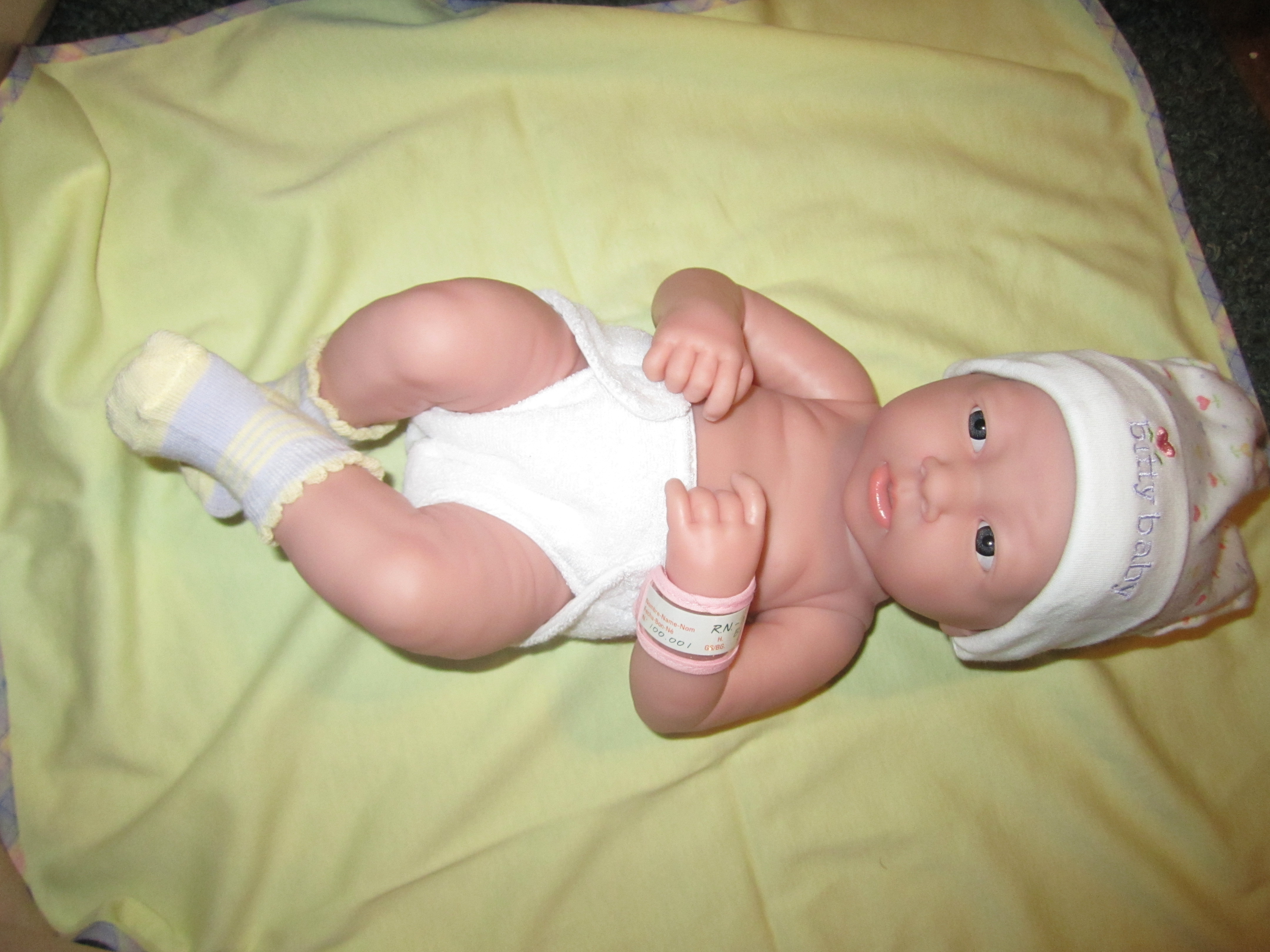
For quite a while, I’ve wanted a realistic baby model to use in my birth classes. My ideal model could be used both for demonstrations of fetal positioning in the pelvis and also for demo’ing newborn care and possibly breastfeeding. Most fetal models sold by CBE supply companies range from $60-150. I usually use a Bitty Baby doll to demo newborn care and breastfeeding (a third thing to know about me is that my love of bargains makes an exception when it comes to American Girl dolls. I have an embarrassing number of AG dolls and vast quantities of accessories. I’ve had this Bitty Baby for over 10 years, I didn’t buy her to use in class). In my knitted uterus, resides a cute little baby doll I bought at Target for $5. Neither of these dolls works at all for fetal positioning or with my demonstration pelvis.

Look at this cute baby!

So, imagine my delight when I found a nearly perfect model newborn at Kmart yesterday while my son was picking out his birthday presents. I named her Sasha AND, get this, she was $20. In a bonus twist, unlike 99.9% of the dolls in the store, she did not come with a bottle! (There is a bottle pictured with a different doll on the back of the box.) She did come with a little cloth diaper, a onesie, a band to cover her cord stump (yes, she seems to have one, but it could just be a dramatic “outie”!), a little outfit, a hat, and socks. Called La Newborn (nursery doll), she is made by Berenguer.

Legs and arms straightened out a little

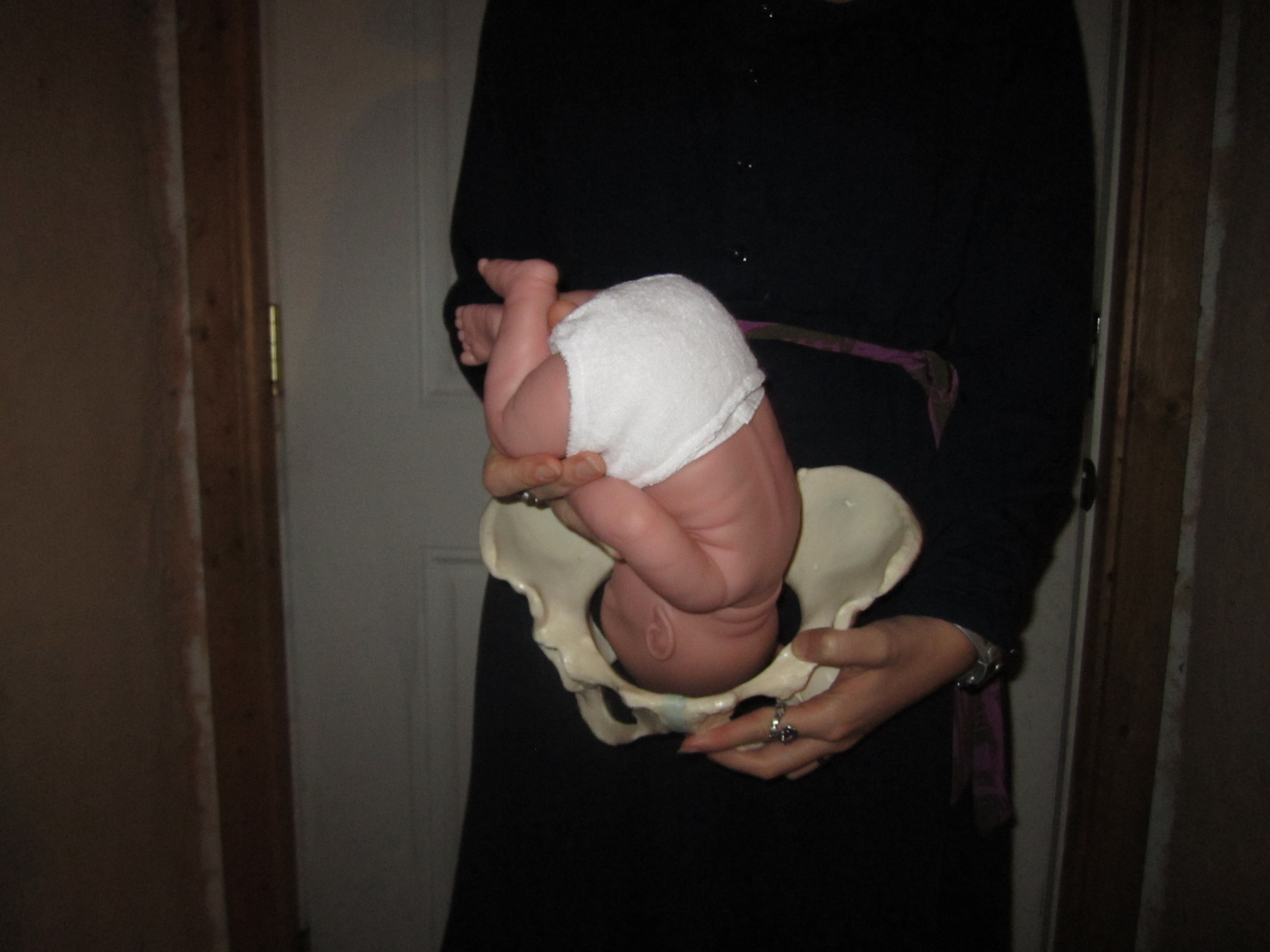
The only drawback is she is not very flexible and so would be hard to use comfortably for things like practicing putting on diapers. Her fairly flexed permanent body position does make her absolutely ideal for use for fetal positioning and even for swaddling or babywearing practice. I originally planned to take her arms and legs off to fill with plastic pellets to add weight, but I’d don’t think I’m going to bother. While nothing near the weight of a real baby, she is made from good quality vinyl.

After looking these dolls up various places online, I’m now thinking I should have bought the remaining one or two that they had at K-Mart. They don’t seem to be widely available for the $20 price.

This morning, my older son helped me take all kinds of pictures of my new toy—I mean, teaching aid!—today (yet another of the many benefits of having an 8 year old in the house!). So, this is a photo-heavy post!

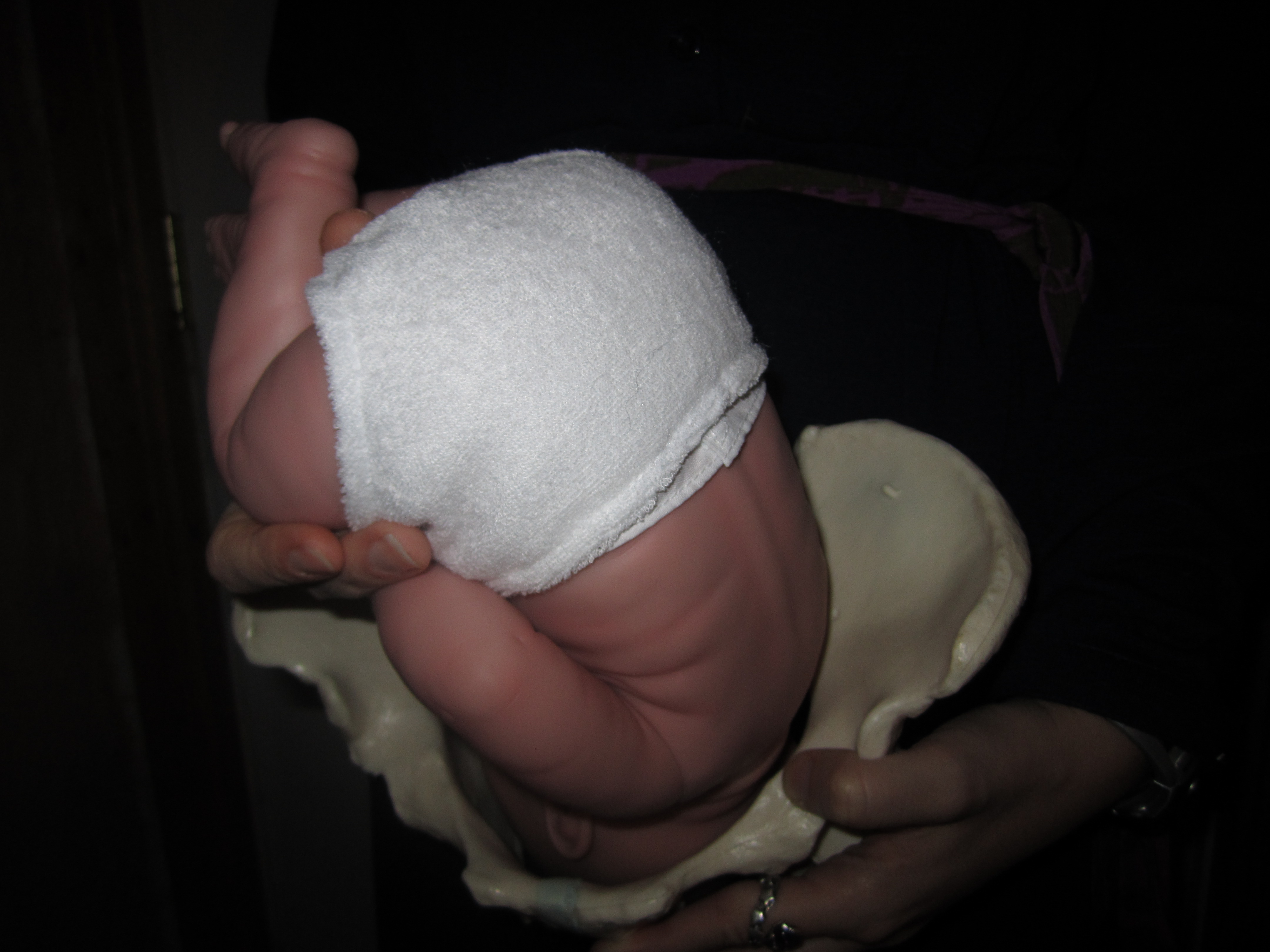
See what I mean about well flexed for fetal positioning information?!

And now my Christmas pelvis gets in on the demo…

If the demo pelvis had a coccyx joint, the baby would fit perfect through. As it is, her head does get stuck on it (good teaching moment about the importance of active positions for birthing!)

Bitty Baby Noelle and Target Baby are less than impressed with this interloper…

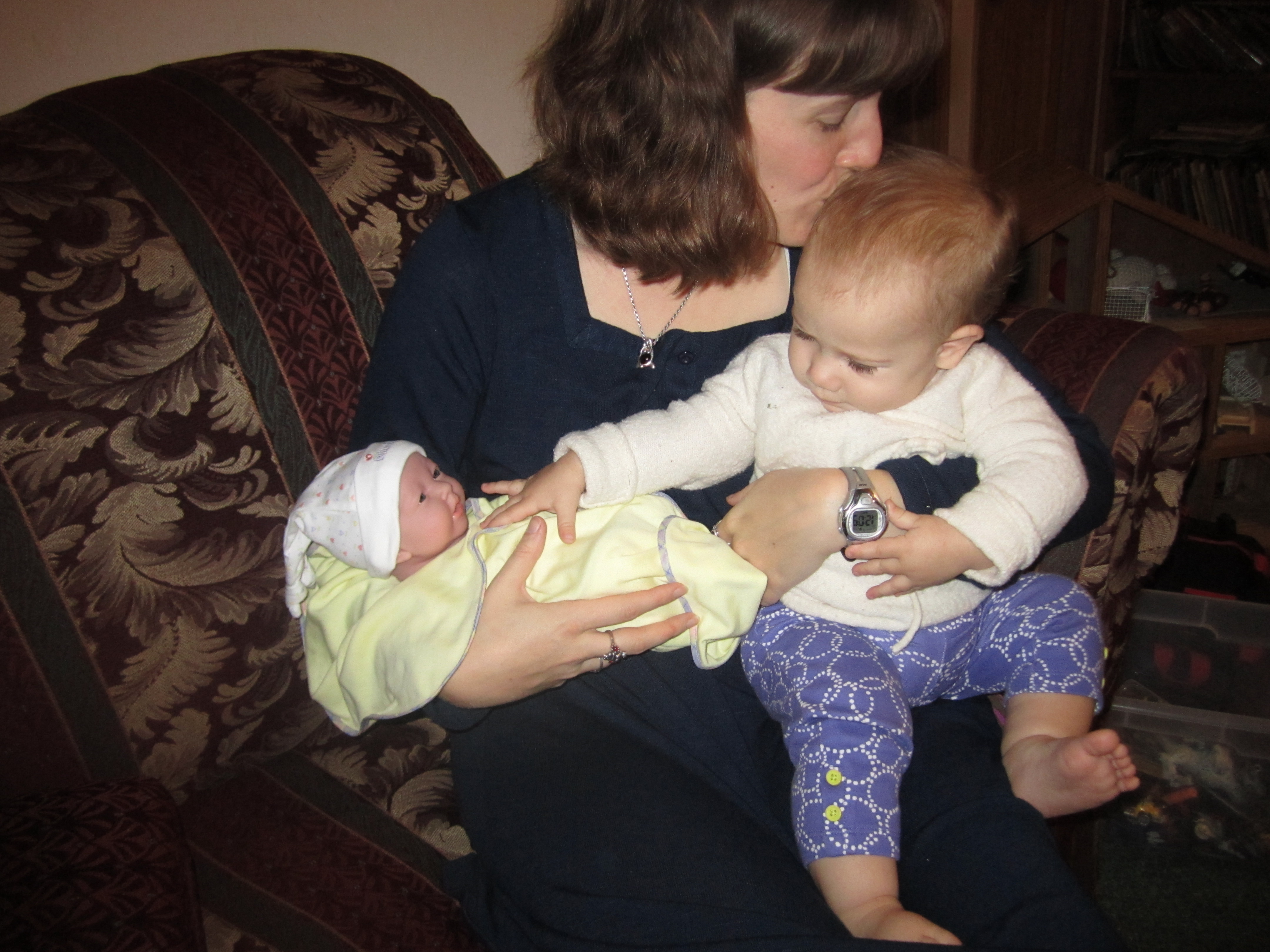
Alaina helps take care of baby Sasha…

For sizing purposes—while I think she appears to be the perfect, realistic size when held up to my belly as a fetal model for positioning, when held in arms, she is more the size of a preemie baby (maybe a 31 weeker or so). She is about 15 inches.

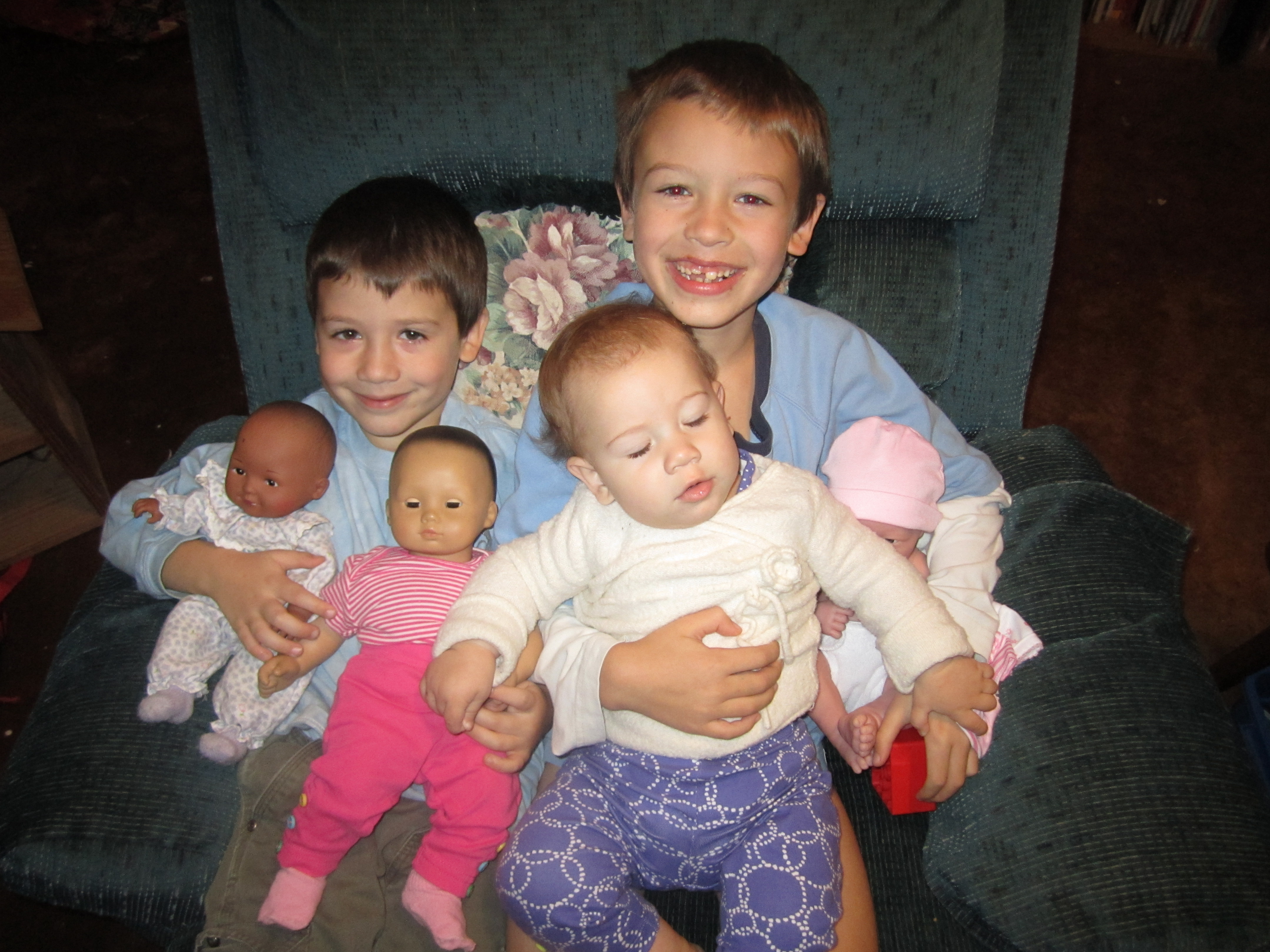
Lann wanted me to take this one—“make them guess who’s the real baby!!!”—conveniently, Alaina closed her eyes for this picture, making identification of the real baby even trickier…


Edited to add, Baby Sasha later experienced an unfortunate accident and had to be replaced. See Fetal Model Update post for pictures.

Guest Post: 5 Easy Ways to Stay Happy and Relaxed

Chicago Healers Practitioner Dr. Helen Lee provides five easy ways to stay calm, relaxed and connected to the self throughout even the busiest days.

  • Breathe – It may feel silly to remind oneself to breathe, but it is so important.  There are two types of breathing: shallow and deep.  Taking shallow chest breaths causes the body to operate in “fight or flight” mode, which is highly stressful.  Less oxygen goes to the brain and the body continues to operate on high alert.  It is important to take deep abdominal breaths, which stimulate the parasympathetic nervous system.  This optimizes digestion, relaxation and detoxification while keeping hormones balanced.
  • Gratitude – Remembering things to be grateful for throughout the day really does wonders for personal state of mind and for the body.  Positive thinking releases chemicals that help with digestion, euphoria, relaxation and overall well-being.
  • Laughter – Laughter is the best medicine as the saying goes, and this is often the case.  Laughing for 10 minutes a day will do amazing things.  It changes the physiology of the entire body—increases circulation, releases different “happy” chemicals in the body, reduces stress, keeps everyone in a lighter frame of mind, helps the heart and can even burn calories!  It’s contagious, too!
  • Sit in Silence – Taking 10-30 minutes to quiet the mind and clear thoughts can be so beneficial.  If meditating is not preferable, spend the time visualizing goals for the day.  This will put focus on personal needs, which will be relaxing later when the day starts to get stressful.
  • Take a 15-20 Minute Walk Outside – Sometimes all that’s needed is fresh air and sunlight.  Taking a step away from the computer, the phone, the office, etc. can really help clear thoughts and be very calming.

Stress is almost unavoidable these days but there are many ways to keep it at bay.  Practicing these five methods is a great start.

Chicago Healers (www.ChicagoHealers.com) is the nation’s pioneer prescreened integrative health care network, offering a comprehensive understanding of each practitioner’s services, approach, and philosophy.  Our holistic health experts teach and advocate natural and empowered health and life choices through their practices, the media, educational events, and our website.  With close to 200 practitioners and over 300 treatment services, Chicago Healers has provided nearly 400 free educational events for Chicagoans and has been featured in 300+ TV news programs and print publications.  For more information, visit www.ChicagoHealers.com.

Active Birth in the Hospital

One of the inspiring images in ICAN of Atlanta's "Laboring on the Monitors" slideshow.

The vast majority of my birth class clients are women desiring a natural birth in a hospital setting. My classes are based on active birth and include a lot of resources for using your body during labor and working with gravity to help birth your baby. Sometimes I feel like active birth and hospital birth are incompatible—i.e. the woman’s need for activity runs smack dab into the hospital’s need for passivity (i.e. “lie still and be monitored”). So, I was delighted to discover this awesome series of photos from ICAN of Atlanta of VBAC mothers laboring on the monitors. It IS possible to remain active and upright, even while experiencing continuous fetal monitoring.

In my own classes, we talk about how to use a hospital bed without lying down—the idea that a hospital bed can become a tool you can use while actively birthing your baby. Here is a pdf handout on the subject:How to Use a Hospital Bed without Lying Down. In this handout, I offer these tips for using the bed as an active assistant, rather than a place to be “tied down”:

While being monitored and/or receiving IV fluids that limit mobility, try:

  • Sitting on a birth ball and leaning on bed
  • Sitting on bed
  • Sitting on bed and lean over ball (also on bed)
  • Kneeling on bed
  • Hands and knees on bed
  • Standing up and leaning on bed
  • Leaning back of bed up and resting against it on your knees
  • Bringing a beanbag chair, putting it on the bed and draping over it (can also make “nest” with pillows)
  • Partner sitting on bed and woman leaning on him/supported squats with him
  • Partner sitting behind woman on bed (with back leaned up as far as it will go)

While giving birth, try:

  • Hands and knees on bed
  • Kneeling with one leg up (on bed like a platform or “stage”)
  • Holding onto raised back of bed and squatting or kneeling
  • Squatting using squat bar

While most of the above tips can be used during monitoring, additional ideas for coping with a simultaneous need for monitoring AND activity include:

  • Kneel on bed and rotate hips
  • Sit on edge of bed and rock or rotate hips
  • Sit on ball or chair right next to bed (partner can hold monitor in place if need be)

If something truly requires being motionless, it can be helpful to have some breath awareness techniques available in your “bag of tricks.” One of my favorites is: Centering for Birth

Some time ago, a blog reader posed the question, can I really expect to have a great birth in a hospital setting? I definitely think it is possible! I also think there is a lot you can do in preparation for that great hospital birth! When planning a natural birth in the hospital, it is important to consider becoming an informed birth consumer. I always tell my clients that an excellent foundation for a simple, effective, evidence-based birth plan is to base it on Lamaze’s Six Healthy Birth Practices. My own pdf handout summarizing the practices is also available: Six Healthy Birth Practices. Don’t forget there is also a great video series of the birth practices in action! You might also want to get a copy of the book Homebirth in the Hospital. And, check out this post from Giving Birth with Confidence: Six Tips for Gentle but Effective Hospital Negotiations.

Before you go in to the hospital to birth your baby, make sure you have some ideas about this very popular question, how do I know if I’m really in labor?

And, finally, be prepared for the hospital routines you may encounter by reading my post: What to Expect When You Go to the Hospital for a Natural Childbirth.

For some other general ideas about active birth, read my post about Moving During Labor (written for a blog carnival in 2009).

Best wishes for a beautiful, healthy, active hospital birth! You can do it!

Book Review: Homebirth in the Hospital

Homebirth in the Hospital
by Stacey Marie Kerr, MD
Sentient Publications, 2008
Softcover, 212 pages
ISBN: 978-1-59181-077-3
www.homebirthinthehospital.com

Reviewed by Molly Remer, MSW, ICCE, https://talkbirth.wordpress.com

I would venture to say that most midwifery activists and birth professionals have said at some point, “what she wants is a homebirth in the hospital…” This comment is accompanied with a knowing look, a bit of head shaking, and an unspoken continuation of the thought, “…and we all know that’s not going to happen.”

Well, what if it is possible? A new book by Dr. Stacey Kerr, Homebirth in the Hospital, asserts that it is. She was originally trained at The Farm in TN (home of legendary midwife Ina May Gaskin) and after going to medical school realized that she, “…needed to balance my new knowledge with my old priorities. I missed the feeling of normal birth, the trust that the birthing process would occur without technology, and the time-tested techniques that help women birth naturally. And so it was that I went back to midwives to find the balance.”
If you are a dedicated homebirth advocate, I recommend reading Homebirth in the Hospital with an open mind—clear out any cobwebs and assumptions about doctors, hospitals, and birth and read the book for what it is: an attempt to create a new model of hospital birth. What Dr. Kerr proposes in her book is a model of “integrative childbirth”—the emotional care and support of home, while nestled into the technology of a hospital.

The opening chapter explores the concept of integrative childbirth and “the 5 C’s” of a successful integrative birth: choices, communication, continuity of care, confidence, and control of protocols (“protocols are the most disempowering aspect of modern maternity care…”).

This section is followed by fifteen different birth stories, beginning with the author’s own (at a Missouri birthing center—my own first baby was born in a birth center in Missouri, so I felt a kinship there).

The births are not all happy and “perfect,” not all intervention-free, and most are quite a bit more “managed” and interfered with than a lot of homebirthers prefer (one is a cesarean, several involve epidurals or medications). I, personally, would never freely choose a “homebirth in a hospital” (I also confess to retaining a deep-seated opinion that this phrase is an oxymoron!). However, that is not the point. Over 90% of women do give birth in a hospital attended by a physician and I appreciate the exploration of a new model within the constraints and philosophy of the hospital.

The book closes with a chapter called “how to be an integrative childbirth provider.” The book has no resources section and no index.

I certainly hope that doctors read this book. I am also glad it is available for women who feel like homebirth is not an option or not available and would like to explore an integrative approach. Even though my opinion is that none of the births are really “homebirths in the hospital” as most bear little resemblance to the homebirths I know and love, unlike the content of the standard hospital birth story, they are deeply respectful births in the hospital and that’s the issue truly at the heart of this book.

—-

Disclosure: I received a complimentary copy of this book for review purposes.

Book Review: 101 Offline Activities You Can Do With Your Child

101 Offline Activities You Can Do With Your Child
Steve Bennett,  Ruth Bennett
Paperback: 134 pages
Publisher: BPT Press (June 14, 2011)
ISBN-13: 978-0984228522

Reviewed by Molly Remer

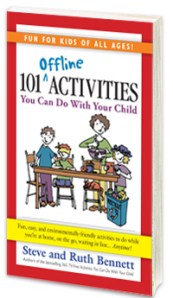
Just in time for summer amusement comes the new book 101 Offline Activities You Can Do With Your Child. Written by the authors of the classic 365 TV-Free Activities You Can Do With Your Child (a book I’ve used a resource for about 6 years), this concise little book offers a wide variety of fun activities. Coded at the bottom of the page with a sketch, the activities are either designed to be used at home, on the road, in the kitchen, or anytime, anyplace. A nice feature is the picture index for kids who are not yet reading to choose their own activities.

Single page explanations/descriptions mean all of the activities are fairly simple to implement and enjoy—offering a brief time-out for anytime fun. Many of the craft ideas seem most appropriate for children under age 10 and plenty of the other games and other activities are enjoyable for any age group.

My kids have come up with quite a few of the suggested ideas using their own imaginations and some of the ideas are classic car games (or variations thereof), but there is enough fresh, unique content to make this book a worthwhile resource for our family.

Disclosure: I received a complimentary copy of this book for review purposes.