Archives

Healthy Birth Guides

I recently received a shipment of The 2008/2009 Guide to a Healthy Birth published and distributed free of charge by Choices in Childbirth in NYC. I ordered a stack of these nice little booklets for only the cost of shipping ($11 for 50 booklets). I really like the content and plan to distribute these in my birth classes and encourage other educators to do the same. The emphasis of the booklet is on being an informed consumer and it also touches on the politics of birth and the business of birth, which I really liked. The end of the booklet has an article by Dr. Harvey Karp about the 5 S’s. I particularly enjoyed the chapter called “The Purpose and Power of Pain in Labor.”

All in all, this is a fantastic and nearly free resource and I’m pleased to have them available! Check them out yourself! (You can also download the booklet for free as a pdf.)

I first learned of these booklets from the wonderful Passion for Birth blog.

How to Use a Hospital Bed Without Lying Down

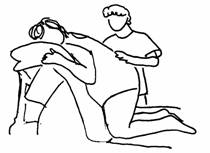
In classes, I often suggest that when couples enter their hospital room in labor they pile all of their belongings onto the bed rather than the laboring woman hopping into it. I encourage people to start seeing the bed as a tool they can actively use during labor, rather than a place for labor and birth to passively happen to you. To that end, I’ve made a little handout called “helpful ways to use a hospital bed without lying down.” I’m uploading it here in hopes that others may find it useful as well.

Kneeling & leaning on back of hospital bedFor more about the importance of freedom of movement during labor, make sure to check out Lamaze’s Healthy Birth Practice paper: Walk, Move Around, and Change Positions Throughout Labor or this video clip from Mother’s Advocate.

Ideas for supporting your partner in labor

One of my favorite handouts to give in birth classes is a “Cliff’s Notes” to labor support. It is a two page handout with a variety of reminders and ideas about supporting your partner or wife during her labor. There are small illustrations as well and a review of the stages of labor. The handout is available here from the website Transition to Parenthood. This site offers a variety of useful handouts for childbirth educators and for parents-to-be and I really appreciate the educator’s generosity in making her materials available online like this!

The handout referenced focuses primarily on physical support and comfort measures of the laboring woman. Some additional, less concrete things I like to remind fathers-to-be of are:

  • Follow her lead. Labor is like a dance and your partner is leading the dance! Anything I say in class or anything you’ve read about is less important than what she is actually doing and you responding to her.
  • The most important thing you can do is just love her. This is more important than learning “techniques.” Just love her the way you love her and she will feel your love and support.
  • Let it happen. I encourage women to “let birth happen” and to let it flow. As her support person, you can help her by letting her let it happen (instead of hushing her or telling her to calm down or asking her to do something different than what is working for her).
  • Don’t interrupt a woman who is coping well with a new technique or idea–if what she is doing is working for her, encourage THAT instead of trying to introduce new ideas or tips.
  • Remember that as a support person you may also experience the three “emotional signposts” of labor–these are excitement, seriousness, and self-doubt and they correspond to stages of labor. A woman in early labor shows the excitement “signpost” a woman in active labor tends to be very serious and “busy working” and during transition many women show a self-doubt signpost maybe saying they “can’t do this anymore” or “I can’t do this much longer.” It is okay to let your partner know that you are experiencing excitement and seriousness, but try to keep the “self-doubt” signpost under wraps and don’t show her that you are also experiencing that one! Be as calm and supportive and confident and trusting as you can as she journeys through the sometimes challenging time of transition in her labor.

House of Babies

During my classes, we talk about how media portrayals of birth impact our perceptions and expectations as well as contribute to our fears about birth. Often media portrayals of birth have a tense, “emergency” atmosphere, with lots of rushing around and communicate that birth is a dangerous, medical event requiring rescuing by medical teams. Usually, when I bring this up, people in my classes nod in agreement and have lots of examples to share. However, in the last two classes, women have responded, “well, on House of Babies, I saw…” or “in House of Babies…” or “House of Babies isn’t like that.” Well, cool! I think I need to see House of Babies! (I don’t get any TV channels though, so alas, I can’t see it. Someone in my current class offered to show me a recording of it though, so I’m excited to see it).

I’m encouraged to know that there are shows like this with positive, affirming messages reaching women and showing them what birth can be like in a supportive, midwifery model of care atmosphere.

New, Free Breastfeeding Guide from LLLI!

La Leche League International has completely redone their catalog–the layout and appearance have received a stunning makeover and the result is a beautiful new “pocket guide” called “Breastfeeding Guide: tips & products.” So, instead of being a catalog, it is actually a helpful little booklet first and a catalog second (the products come in the second half of the booklet, after the tips. 26 pages of questions answered and then 25 pages of catalog–pocket sized though, so maybe 3 x 5?). For being so small, it covers a remarkable amount of territory and gives lots of good information–from “How often will my baby nurse?” to “When will baby sleep all night?” to “Is it possible to breastfeed twins?” It is a great little *book* not just a catalog. I love it and think it was a stroke of genius to reach out this way! The format is inspired (and inspiring!)

Childbirth educators, doulas, and lactation consultants wishing to acquire many of these Guides in bulk to distribute to their clients can do so for only the cost of shipping! ($5.41 for 50 little books!) Go to the LLLI online store to order some. They really are a lovely and useful resource!

Good Foods to Eat in Labor

IMG_4848Eating is important during early labor to keep up your strength and provide you with energy for your work. Many women find that they naturally no longer wish to eat once in active (serious) labor. Eat small portions of easily digested foods that you know that you like and that sound good to you at the time. Choose foods that are light and stomach-friendly. Complex carbohydrates are better choices than fatty or fried foods.

Some ideas are:

  • soups
  • crackers
  • graham crackers
  • fruits
  • bananas
  • Jello
  • pasta
  • honey sticks (plastic tube with about a TB of honey in it–good quick energy boost, especially in a birth setting with restrictions on food or drink intake. See my previous post for a discussion of the validity of withholding food and drink from laboring women).
  • toast
  • broth
  • yogurt
  • herbal tea
  • white grape juice
  • apple juice
  • miso soup
  • popsicles
  • fruit juice or honey-sweetened tea frozen into ice cubes
  • cereal
  • noodles
  • rice
  • cooked cereals
  • scrambled or boiled egg
  • applesauce

It is also very important to stay hydrated during your labor! Try to take a sip of something every 15-30 minutes and at least once an hour. Have one of your labor support helpers follow you around with a drink with a straw in it and hold it to your lips every so often. If you feel like sucking, you will, if you don’t, you won’t. There is no need to have a big conversation about it every time. Some women like to drink apple juice during labor, other feel it is too acidic. Orange juice is not usually recommended as it might make you feel sick or vomit. Some women choose to drink a sports drink (like Gatorade). Water is always a good choice! Other women choose hard candy to suck on during labor. Be careful choosing a flavor, because you may taste it again later and it may bother you. Avoid carbonated drinks.

What about dad?

Make sure you have snacks packed for you as well! Avoid anything that will linger unpleasantly on your breath (garlicky pasta is out!) Dads may like to have some easy to grab, quickly nutritious snacks like trail mix, granola bars, peanut butter, nuts, fruit, or an already prepared sandwich.

Sign up for my Brigid’s Grove Newsletter for resources, monthly freebies, and art announcements.

Evidence Based Care Fact Sheet (& Mother Friendly Care)

In Sept. 2007, Citizens for Midwifery published a useful new fact sheet summarizing the evidence basis for the 10 Steps for Mother-Friendly Care. The fact sheet is two sided and packed with information. The Coalition for Improving Maternity Services (CIMS) has a mission “to promote a wellness model of maternity care that will improve birth outcomes and substantially reduce costs.” To this end, they created the evidence based
Mother-Friendly Childbirth Initiative (MFCI). This Initiative “provides guidelines for identifying and designating “mother-friendly” birth sites including hospitals, birth centers and home-birth services.” There are ten steps for mother-friendly care and ample evidence supporting each step.

CIMS also has a very useful consumer handout–“Having a Baby: 10 Questions to Ask“–that helps expectant couples ask questions of their health care providers to determine if the care they are receiving is the evidence based, mother friendly care all pregnant women deserve.

The 10 Steps are:

“A mother-friendly hospital, birth center, or home birth service:

  1. Offers all birthing mothers:
    • Unrestricted access to the birth companions of her choice, including fathers, partners, children, family members, and friends;
    • Unrestricted access to continuous emotional and physical support from a skilled woman-for example, a doula or labor-support professional:
    • Access to professional midwifery care.
  2. Provides accurate descriptive and statistical information to the public about its practices and procedures for birth care, including measures of interventions and outcomes.
  3. Provides culturally competent care — that is, care that is sensitive and responsive to the specific beliefs, values, and customs of the mother’s ethnicity and religion.
  4. Provides the birthing woman with the freedom to walk, move about, and assume the positions of her choice during labor and birth (unless restriction is specifically required to correct a complication), and discourages the use of the lithotomy (flat on back with legs elevated) position.
  5. Has clearly defined policies and procedures for:
    • collaborating and consulting throughout the perinatal period with other maternity services, including communicating with the original caregiver when transfer from one birth site to another is necessary;
    • linking the mother and baby to appropriate community resources, including prenatal and post-discharge follow-up and breastfeeding support.
  6. Does not routinely employ practices and procedures that are unsupported by scientific evidence, including but not limited to the following:
    • shaving;
    • enemas;
    • IVs (intravenous drip);
    • withholding nourishment;
    • early rupture of membranes;
    • electronic fetal monitoring;

    Other interventions are limited as follows:

    • Has an induction rate of 10% or less;
    • Has an episiotomy rate of 20% or less, with a goal of 5% or less;
    • Has a total cesarean rate of 10% or less in community hospitals, and 15% or less in tertiary care (high-risk) hospitals;
    • Has a VBAC (vaginal birth after cesarean) rate of 60% or more with a goal of 75% or more.
  7. Educates staff in non-drug methods of pain relief and does not promote the use of analgesic or anesthetic drugs not specifically required to correct a complication.
  8. Encourages all mothers and families, including those with sick or premature newborns or infants with congenital problems, to touch, hold, breastfeed, and care for their babies to the extent compatible with their conditions.
  9. Discourages non-religious circumcision of the newborn.
  10. Strives to achieve the WHO-UNICEF “Ten Steps of the Baby-Friendly Hospital Initiative” to promote successful breastfeeding…”

Suggested Reading

There are a number of wonderful books available. Some of the ones I strongly suggest people read are:

The Birth Book by Dr. William Sears & Martha Sears. This book is a good, basic book to start with. The Sears’ present their material in a pretty balanced, supportive, and accepting way. They favor natural childbirth and are supportive of midwives and homebirth. They also recognize that couples choose a spectrum of choices.

Birthing From Within, by Pam England. This book is a treasure. A fresh and exciting way to view birth and birth preparation. Pam views birth as a rite of passage and encourages women to “birth in awareness” regardless of the circumstances around them (natural, when interventions are needed, with medications, during a cesarean, etc.). I LOVE her work with birth art.

The Complete Book of Pregnancy & Childbirth, by Sheila Kitzinger. This is a good basic birth with lots of great pictures. I especially like the opening section with photos of a pregnant women at different stages of pregnancy accompanying by “at a glance” facts about that stage of pregnancy and an illustration of the fetus at each point as well.

The Birth Partner, by Penny Simkin. This book is a wonderful guide for fathers and also for doulas. Contains a wealth of information about supporting a women in labor and birth. Excellent.

Pregnancy, Childbirth, & the Newborn, by Penny Simkin. This book is a phenomenal resource for basic pregnancy and childbirth information. It has some great illustrations of positions for labor and birth.

The Thinking Woman’s Guide to a Better Birth, by Henci Goer. I think all pregnant women and women planning to become pregnant should read this book. This is not a preparation for birth type of book, but a research heavy exploration of issues in the birthplace, evidence based care, and preparing for the birth you want.

The Baby Book, by Dr. William Sears & Martha Sears. This is a comprehensive guide to baby care during the first year. Attachment parenting based philosophy and covers a broad spectrum of information.

The Womanly Art of Breastfeeding, by La Leche League International. The original guide to breastfeeding from the world’s foremost authority on breastfeeding. A comprehensive book that really explores mothering through breastfeeding, not solely breastfeeding management.

Journey into Motherhood by Sheri Menelli. This is a phenomenal collection of inspiring birth stories. I love it! Plus, you can download it from her site as a free e-book.

Fathers at Birth by Rose St. John. This book is a wonderful resource for fathers to be. Lots of helpful ideas, photos, and explanations.