Archives

Book Review: Pregnant on Prozac

Book Review: Pregnant on Prozac: The Essential Guide to Making the Best Decision for You & Your Baby

By Shoshanna Bennett, Ph.D.
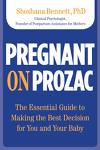
GPP Life, 2009
ISBN 978-0-7627-4940-9

248 pages, softcover, $16.95
http://www.clearsky-inc.com

Reviewed by Molly Remer, MSW, CCCE

Written by a clinical psychologist and mother of two, Pregnant on Prozac is a comprehensive look at the benefits and risks of antidepressant use during pregnancy or postpartum. The focus on depression during pregnancy is what makes this book stand out—this is a subject that has received very little attention and it is important for doula and childbirth educators to learn more about the issues involved.

The book includes sections on “natural and emerging treatments” including homeopathy and acupuncture as well as a section on nutrition, though the overall emphasis is on pharmacological treatment methods.

The information presented is very comprehensive, though I was disturbed by the suggestion not to read the package inserts coming with medications, but to trust your doctor to know “what is safest for you and your baby.” This is not the type of informed decision-making I promote in my work with pregnant and new mothers!

Pregnant on Prozac briefly addresses midwives and doulas in a section about “helping professionals who may be of use to you.”

I have three significant critiques of the book. During one section the author waxes eloquent about the non-specific benefits of an unnamed “exercise system” and then later an unnamed “nutritional system.” She glowingly recommends these unidentified systems and refers readers to her website for more information about the nutritional system and to another website for the exercise system. I suddenly felt like I was reading a commercial and the tone called into question for me the validity and reliability of the entire rest of the book.

My third critique is that the segment addressing medication use while breastfeeding is woefully incomplete, falling back on the trite platitude “a calm, happy mother is more important to a child’s healthy development than breast milk.” Though I do not quibble with the truth of this statement in an “ultimate” sense, my concern is that it summarily dismisses the fact that many women can take medication AND breastfeed—it is not an either or situation! The very brief section on breastfeeding also included the questionable and disappointing statement, “you can even get better eye contact with your baby with a bottle in its mouth instead of being squished face-first into your breast.”

Each of these sections is small, but my concerns about them are large. Despite these critiques however, I would still recommend Pregnant on Prozac to birth professionals and parents seeking information about treatment options for depression during pregnancy with the caution not to rely on it as your only resource and certainly not to count on it for advice on exercise, nutrition, or breastfeeding.

Disclosure: I received a complimentary copy of this book for review purposes.

New Training!

This year, I completed several new trainings that I am very excited about.

Prenatal Yoga Training

This weekend I fulfilled a 7 year old dream and attended a prenatal yoga teacher training in St. Louis. I have wanted to teach prenatal yoga since I was pregnant with my first baby, but a training opportunity just never opened up for me until now. I felt like this was perfect timing. The training was through YogaFit and was pretty basic, but it was just what I needed to feel like I can move forward with this dream. YogaFit is a very “fitness” oriented type of program vs. any kind of holistic-mind/body connection stuff, but I can add those elements in myself. I think I will be able to offer something fairly unique—not just yoga and not just childbirth education but yoga-childbirth-education. There are several other programs like that, of course, but none in the local area! At the training, I also learned some really cool partner yoga stuff that I didn’t know how to do before.

Birth Art Training

In February, I completed something else that I’ve been dreaming about for some time—I took Birthing from Within‘s online course, “How to Lead the Birth Art Process.” Aside from a few minor complaints about the sometimes-frustrating “Zen” underlay and occasional contradictions within the course, I really LOVED this class. I found the online course format to be an ideal format for me—real-person interaction through message board, chat, phone call, and email; written information; writing journals/essay responses; hands-on personal practice with the assignments; and real-life application with other people/clients in birth art sessions. I felt like I got more out of actual use out of this workshop than most of the other classes and workshops I’ve attended—I think this was because the course was spread out over 5 weeks, not just a weekend, which allowed plenty of time to really assimilate and USE the information. It was very affordable too and I was able to attend right from the comfort of my own chair! The class is marketed as suitable for beginners, but personally I found my past background in childbirth education to be very important and I cannot imagine having taken the class with no prior birth class teaching experience—I think the people who had little experience were kind of disadvantaged in this course. Birthing from Within is my all-time favorite birth preparation book/resource and it was so exciting for me to have a little taste of direct training with them. Hopefully at some point in the not-too-distant future, I will take further training with BfW.

Childbirth Educator Certification

In March of this year, I was pleased to earn my childbirth educator certification with CAPPA. Since I am already certified with other organizations, I enrolled in the dual certification program option. I am very excited to be “throwing my hat in” with CAPPA. The organization is very friendly and stable and I really connect with the CAPPA Vision. The program information itself was pretty basic and I didn’t really learn anything new from it, but that makes sense because it isn’t specifically designed for people who already have CBE teaching experience—I think it is a great program for someone starting out in this field.

Comparing CBE Programs:

I get a lot of inquiries from people seeking information about different childbirth education programs and thought I would provide a super-quick mention of the things I enjoyed most about each of my certification programs/organizations. Keep in mind that I certified with ALACE first, hence, I had the most direct experience with their full training program, vs. the other organization’s “accelerated” options (which I SO deeply value and I am SO grateful that ICEA and CAPPA make that option available to people—I’m very, very grateful!). In sequential order:

ALACE (now IBWP)—phenomenally in-depth training program with a wonderful woman-oriented, holistic, midwifery-model. Very homebirth friendly. When I finished this program, I felt like I’d earned another master’s degree—this time in birth. At the present time, however, I do not get a “stable” or professional feeling from the organization and that is very disappointing 😦

ICEA—very professional. Lots of really good information on how to teach and on the principles of adult education in general. I learned the most about the “how” from ICEA (and the “how” is very, very important). They also have several great teaching manuals that are super-affordable. I enjoy the International Journal of Childbirth Education as well. Very professional. The training information assumes educators will be teaching a “mainstream” population, probably in a hospital, but their position papers are very sound and I can really get behind their mission as well. Their certification exam was the most difficult of the three programs and I feel like I really earned my certificate!

CAPPA—I am really pleased with my association with CAPPA. As I noted, they are very friendly and I feel like they will be around for a long time to come. I just get a lovely, warm feeling of “sisterhood” from CAPPA and that is very important to me. I feel connected to the organization and the people and it is a very supportive atmosphere. I recommend them for training, especially for people who are just starting out. I’m excited about the free conferences CAPPA offers as well and I’m going to my first one this July! I also enjoy the CAPPA Quarterly and and I am proud to write the book/film reviews column.

Book Review: She Births

Book Review: She Births: A Modern Woman’s Guidebook for an Ancient Rite of Passage By Marcie Macari
Infinity Publishing, 2006
ISBN 0-7414-3390-7
255 pages, softcover, $23.95
http://www.shebirths.com

Reviewed by Molly Remer, MSW, ICCE

She Births is a book that “goes beyond” the average birth book. It is a particularly good read for mothers having subsequent children—perhaps for a woman who is well read in the physiology and stages of labor and who wants to dig deeper into the emotional and spiritual meaning of giving birth. It is also helpful for first-time mothers, though I felt that there was a lot of content that seemed to assume the reader had already given birth (and was perhaps reading this book to reflect, process, and prepare for future births).

The emphasis of She Births is on childbirth as a rite of passage and as an opportunity for spiritual growth and personal transformation. There is a lot of content that has a very “New Age” flavor. While I personally do not mind—and actually enjoy—this framework, other readers may consider some of the sections to be offputting.

Each chapter ends with a short chapter-topic meditation and several pages of related journaling exercises.

The book contains a higher than average number of minor typographical errors, as well as odd mid-sentence capitalizations, and too-short dashes between ideas. Persistent capitalization of words such as Birth and Spirit were a bit distracting. The book contains a variety of empowering birth stories, but none of them have attribution, making it difficult to identify who was giving birth. (The author? The woman in the previous story?) It was hard to grasp who was the “I” reflecting and sharing in each story.

She Births has several particularly wonderful passages that are well worth quoting and it also has a lovely cover. It is a passionately written book that is very dynamic and “alive” to read. The book is strongly written—the author does not mince words nor attempt to “balance” her perspective and this can be a refreshing approach. She Births also raises thought-provoking questions such as, “The way a society views a pregnant and birthing woman, reflects how that society views women as a whole. If women are considered weak in their most powerful moments, what does that mean?”

Disclosure: I received a complimentary copy of this book for review purposes.

DVD Review: Dance of the Womb

DVD Review: Dance of the Womb: Belly Dance for Pregnancy and Birth
By Maha Al Musa, 2009
Red Polar Pictures
164 minute DVD, $49.95 (AUS)
http://www.bellydanceforbirth.com

Maha Al Musa has created a remarkable treasure for the birth world—an easy-to-follow, beautifully presented, step-by-step instructional bellydancing DVD called Dance of the Womb. Maha’s interest in Middle Eastern Dance was sparked by her Palestinian/Lebanese roots and she brings a lot of love and authenticity to her presentation of the dance techniques. Maha has also published a gorgeous companion book, Dance of the Womb (see previous review).

Dance of the Womb contains a 45-minute dance stretch warm-up. The exercises are comprehensive, gentle, and easy to follow. There are also six instructional dance technique chapters that cover specific beginning bellydance movements.

One of the special treats of this DVD is the included 50 minute video about Maha’s own homebirth journey with her third child (at age 46!). It also contains interviews with several homebirth midwives. The still photographs and birth footage are beautiful and brought a tear to my eye several times! Another bonus feature is a seven minute guided relaxation exercise.

Dance of the Womb is a great introduction to the basic physical elements of prenatal belly dance and also to some the spiritual and rhythmic aspects of giving birth. The DVD is a gentle and nurturing experience for both pregnant women and the women who serve them.


Disclosure: I received a complimentary copy of this DVD for review purposes.

Review: Moby Wrap

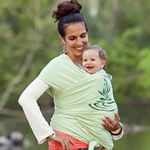
Several months ago, I was sent a sample Moby Wrap. I was absolutely delighted to receive the Moby, because amongst my friends and LLL Group members, a Moby Wrap is hands-down the number one pick for babywearing with an infant. I have a variety of slings and other baby carriers available in my demonstration bag to show parents during the final week of classes, but I did not have a wrap-style carrier (though I was always sure to mention that parents rave about wrap carriers!). I’m so pleased to actually have one available for parents to practice with.

The Moby Wrap is very versatile and can be used in a variety of positions from birth until over two years old. The fabric is soft and nice and hugs the baby closely and securely into your body. The knit of the fabric is also lightweight enough that you do not get roasting hot while wearing the carrier. A Moby Wrap is a long piece of breathable cotton fabric that is “wrapped around the wearer to create a safe, custom-fitted and versatile baby carrier.” Another benefit is that it can be used for “kangaroo care” with premature babies or any baby needing special care.

Babies that are “worn” cry much less frequently and parents can be hands-free to go about daily tasks while still being in close contact with their babies. When my first son was a baby, I was only half-joking when I would say that I would not be able to live without my baby carrier. With my second baby, I greatly appreciated being able to grocery shop while comfortably nursing him and still having both hands available to push the cart!

Recent negative press about slings has made me all the more determined to share the benefits and joys of babywearing with parents in my birth classes. (Reports about sling dangers are referring to a specific type of “bag” type sling [see more here], not to carriers like the Moby Wrap.)  I am currently working with very young parents for a series of prenatal classes and I am eager to introduce them to babywearing and to show them how a Moby Wrap can help them bond with their baby!

Book Review: Get Me Out

Book Review: Get Me Out: A History of Childbirth From the Garden of Eden to the Sperm Bank
By Randi Hutter Epstein, MD
W.W. Norton & Company, 2010
ISBN 978-0-393-06458-2
302 pages, hardback, $24.95
http://www.randihutterepstein.com/

Reviewed by Molly Remer, MSW, ICCE

Since it shares a subtitle about the history of childbirth, I expected the new book Get Me Out to be very similar in content to the recent book Birth Day by Mark Sloan or to the book Birth by Tina Cassidy. I wondered how much more could possibly be reported about the history of childbirth. It turns out there is plenty more and I was delighted to discover that Get Me Out stands alone as a unique and interesting contribution to books of this genre.

Written by a physician and mother of four, Get Me Out focuses on some very recent elements of birth history including assisted reproductive technologies (ART), ultrasound, and freebirth, subjects not addressed in the books referenced above. Aside from familiar content about things like the Chamberlen brothers and the Twilight Sleep movement, the remainder of the text was fresh and engaging. Part one included an interesting and disturbing chapter about Marion Sims and his research and experiments with fistula repair on enslaved women. A later chapter explores Sims’ research with artificial insemination (this time with middle class white women). In fact, the latter half of the book contains an extensive historical look at artificial insemination, moving into present day history including an exploration of sperm banking and cryo-preservation of eggs.

Unique among birth history books is Epstein’s chapter on freebirth (more commonly known as “unassisted childbirth”) followed with a chapter about ultrasound including content about 4D and “novelty” ultrasounds. There is also a chapter exploring DES and its effects on reproduction.

Also different than Birth Day and Birth, is the total absence of memoir or personal reflective content. Epstein is a medical journalist and Get Me Out is written in that voice. There is a light, personal tone to the text, but nothing personal aside from occasional descriptions, observations, or quotes from interviews with sperm bank mangers (for example). I found myself feeling a little curious about her personal history of childbirth, an element freely interspersed throughout the texts of other recent birth history books.

As the author says, “…the way we give birth is a story about our deepest desires and our fundamental concerns about life, death, and sex.” Get Me Out is a fascinating tale focusing on our collective, cultural story about birth in the late nineteenth and twentieth centuries, as well as dip into the story that continues being written today.


Disclosure: I received a complimentary copy of this book for review purposes.
Book Review: L’Mazeltov

L’Mazeltov: Your Personal Guide to Jewish Childbirth Education
By Pamela Nadav
L’Mazeltov, Inc. 2008
Softcover, 248 pages, $18.00
ISBN: 978-097786610-6
www.lmazeltov.org

Reviewed by Molly Remer, MSW, ICCE

The title of the new Jewish childbirth education book L’Mazeltov combines “two important Jewish symbolic expressions—L’Chaim (To Life) and Mazel Tov (Good Fortune).” The first half of the book consists of basic childbirth education and preparation. The second half is about “Jewish Life Cycle Education.” The strength of this book is the fusion of the two.

The childbirth education section was very conventional and conservative. I was surprised by some of the advice offered such as, “Always follow your doctor’s advice in all matters related to your pregnancy, labor and delivery” and in the section about anesthesia, “All of these modern technologies are designed to assist you in having the best possible birthing experience, and are considered to be relatively safe.” Personally, I feel like an important piece of childbirth education is encouraging pregnant couples to be informed birth consumers. There was no element of this perspective within L’Mazeltov.

The book includes some population-specific pregnancy information such as a short section on Jewish genetic diseases and testing.

There is a nice recipe section at the end of L’Mazeltov. I was inspired to make some delicious Challah bread for my family! There is no index, resource list, or glossary of terms (as a non-Jewish reader, many words were unfamiliar to me—-the author does a good job defining many within the body of the text, however).

Despite my wish for a more creative and evidence-based approach to the birth education portion, this book is a one-of-a-kind contribution to birth literature, covering both the “oys and joys” of preparing for parenthood. What a resource for Jewish couples expecting their first baby! “There is such a special sweetness in being able to participate in creation.”

Disclosure: I was provided with a complimentary copy of this book for review purposes.
Review first published in The CAPPA Quarterly, January 2010.

Rolla Area Doula Recommendation

Summer Eyberg has been a colleague and friend of mine for many years. Late last year, I was privileged to received Summer’s skills as a doula during my third pregnancy and also postpartum when that pregnancy ended unexpectedly during the fourth month. Summer has an amazing gift of presence—she is open and receptive and listens without judgment. She is also skilled at always returning decision-making power to the hands of the mother (where it belongs!). I have always been impressed with Summer’s ability to notice when something needs to be done and how she quickly and graciously moves to do it without fanfare. Summer is also friendly, passionate, and easy to trust and she has a natural gift in celebrating and honoring pregnant women.

Summer’s compassionate attention and sensitive listening have blessed me beyond measure and I am lucky to call her my doula and my friend!

Summer can be contacted via Peaceful Beginnings Doula Services or via Facebook

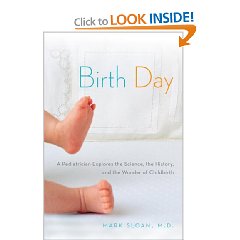
Book Review: Birth Day

Book Review: Birth Day: A Pediatrician Explores the Science, the History, and the Wonder of Childbirth
By Mark Sloan, M.D.
Ballantine Books, 2009
ISBN 978-0-345-50286-5
370 pages, hardcover, $25

Written in a fast-paced journalistic rather than academic style, Birth Day is a biological, historical, and sociocultural look at birth in our species, highlighting the experiences and skills of the fetus and newborn infant. The focus of Birth Day is on childbirth, but as a pediatrician, the emphasis of the journey in this book is on the baby and its development, skills, and remarkable adaptations to the womb and to life on earth. The book contains frequent references to evolution, which is not a concern to me, but may be to other readers.

The author’s personal experiences and observations are interwoven skillfully throughout the book lending an engaging “human” component—I loved his wry and occasionally self-deprecating honesty and realistic sharing. We read about the births of both of his children (one a very long labor eventually with an epidural and the second a scheduled cesarean due to placenta previa), his experiences as a medical student, and his observations as a hospital and clinic pediatrician. Dr. Sloan has been present at over 3000 births as a hospital pediatrician and 20 births as the baby “catcher” (medical school OB rotation). There is no real mention of homebirth, but occasional, supportive references to CNMs and to doulas.

The author has a healthy respect for the process of birth, noting in his conclusion that “…the most striking thing to me after all these years is how often such a complicated process goes right.” As a breastfeeding counselor, an element that I loved in this book was the author’s complete acceptance and integration of the importance and normalcy of the birth-breastfeeding continuum as well as the assumption of breastfeeding present throughout (bottles and formula do not make a single appearance throughout the 370 pages). This presentation was both very refreshing and completely appropriate.

The content of Birth Day was reminiscent of Birth by Tina Cassidy, with the primary difference being the emphasis on the infant’s experiences. There were occasional instances of questionable data such as, “An unattended breech birth, for example, is nearly always fatal to mother and child.” (?!)

Fast paced and often very funny, the author of Birth Day has a knack for explaining complicated concepts in simple terms and using effective analogies. I learned some new facts about the history of birth and was pretty captivated by the whole ride.

Disclosure: I received a complimentary copy of this book for review purposes.

Racktrap Giveaway!

Giveaway closed! The  four winners for this giveaway were Rini, inoakpark, Summer, and Rixa!

Time for another giveaway! This is not really birth related, but it is breast-related and since breasts are part of being female and nurturing children, etc., etc. I decided it was related enough to go ahead and share here! The Racktrap is a little tiny purse/pouch that you tuck inside your bra (credit card, ID, cash, etc.) to leave yourself hands-free and unencumbered. I was amused the the first step in the instructions included is to, “Locate your breasts.” ;-D You can use the Racktrap while exercising OR while going out somewhere in a fancy dress! They have lots of different colors (though presumably no one will see it!). I wasn’t sure how it would work exactly because I wear simple “sleep bra” type bras that pull over my head like a sports bra, but I tried it and it works really well even in that kind of bra (don’t worry, I didn’t try the ones I’m giving away, I tried out the cute Valentine print one they sent and I’m keeping that one!)

Something that surprised me about it is that the open edge doesn’t have a closure, so I thought things might fall out of it, but once it is tucked away, nothing falls out (somehow in the context of talking about bras, this sounds like there are secret meanings here…). It is very trim and, I have to say, MUCH classier than just sticking money directly into your bra (which I’ve never done, but still, if that is something you do, perhaps you’d like to win one of these instead!).

Okay, so I have FOUR cute little Racktraps to give away. They came in a little pouch together, but I’m giving them away one at a time because that way more people get to win. I will close the giveaway this Friday. To enter, you can simply leave a comment here (make sure I can figure out your email address from your comment so I can get in touch with you if  you win). You can get additional contest entries by becoming a fan of the Racktrap on Facebook (first time fans only) and leave a comment here telling me you did so, and/or becoming a fan of Talk Birth on Facebook (first time fans only) and leaving a comment here telling me you did so. It is that simple 🙂

Disclosure: I was provided with complimentary samples of this product. I have no other financial or commercial relationship to the company.