Archives

Listen to the wise woman…

20120928-123955.jpg

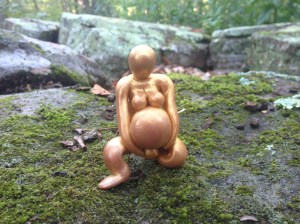
Mini mamapriestess sculpture I made to take with me for my medicine bundle.

Last summer after I finished my priestess certification and I’d been facilitating women’s retreats for two years, I got a wild idea to go to a womanspirit or goddess festival of some kind. I did a google search and found one that sounded great—the Gaea Goddess Gathering–and it was happening in just two weeks. Imagine my surprise to then look at the bottom of the screen and see that it was located only a five-hour drive from me, just over the border into Kansas. I decided it was “meant to be.” My mom and a friend signed up with me (and Alaina) and we packed up my van and went! The night before we left on our adventure, I sat down at the kitchen table and felt a knife-like stinging pain on the back of my leg. I’d accidentally sat on a European giant hornet (these are not regular hornets, they are literally giant hornets about two inches long).

20120928-123138.jpg

Sting before I left.

Though it became hot and swollen and terribly painful, we set forth anyway. I asked for input on Facebook and did google research and started putting benadryl cream on it, even though I usually go with home remedies over medical-model remedies. It got worse and worse, eventually running from my hip to my knee and wrapped around my entire leg so
that two thirds of my thigh was sting-area and the difference in size between my legs was noticeable through clothing. During the festival, as I watched myself get worse and worse and people kept making remarks about needing epi-pens and maybe I should go to the hospital, I decided to dispense with the benadryl and listen to the wise women instead. My friend found plantain and made me a poultice. The cook gave me baking soda that I applied in a paste. I went to a ceremony that involved a healing ritual with sound and a priestess in a tent beat a drum over me as I lay there on my stomach. After a little Reiki healing, she then leaned very, very close to my ear and said quietly, “are you taking good enough care of yourself? You give and give and it is time to receive. You need to be taken care of too.” And, I cried.

20120928-123203.jpg

Sting after arriving. I didn’t take any pictures of it at the worst. It got about twice as bad as this. Every time I thought it could not possible get worse, it got twice as bad!

I came out of the tent and laid on a bench and women I didn’t know came and put their hands on my back and made me tinctures of strange plants they found in the herb garden and I drank it even though it almost made me gag. Another woman I didn’t know rubbed my back and though I couldn’t even see her face, she leaned close to my ear and said, “sometimes life stings you. Your friends, your family, being a parent, taking care of your children. It stings sometimes. Things people say without meaning to sting you. You’re sensitive, Sometimes it stings a lot and you worry that you’re not good enough. I see you with your baby. You are such a good mother.” And, I cried again, lying there on bench in the middle of nowhere with my dress pulled up and my red, sore, swollen, horrible thigh covered with a poultice of mysterious weeds, surrounded by women I didn’t know, but who were caring for me. And, I got better. By the time I got home, the sting was almost totally healed.

As soon as I returned home, I made a list, intending to develop it into a blog post about everything I’d learned at this gathering of women. The list languished in my drafts folder and the wheel of the year continued to turn and now it is September again and next week, some friends and I will be hopping back in my van and heading back to the GGG for this year’s festival. I decided the blog post will never get “developed” into the post I had intended, but that I can still share my list anyway. I also realized that I have been reluctant to post it here for fear of being too “weird” and alienating readers. But, Talk Birth is like a buffet, you can take what works for you and leave the rest! 😉 I’m also writing now because I’m going to go ahead and give myself a week off from blogging and I wanted to post some sort of explanation as to why. I’m going to focus on getting ready for the festival (I’m selling jewelry while there too!) and hanging out with my family (and, oh yeah, grading all the papers that are due this Sunday night!).

So, what did I learn at the GGG?

  • I have a lot to learn
  • Likewise, I know more than I give myself credit for—I am both more skilled than I may think and less skilled than I’d like to be.
  • I want to be more confident
  • I need to always remember to look for a wise woman when I need help. And, that allowing myself to be cared for by strangers is a surprisingly powerful experience.
  • I am much more quickly judgmental than I realized or like to admit—I judge the book by its cover and assess “worth” by appearance more often than I thought and I disappointed myself with that. I learned that ALL women have hidden gifts and I was surprised over and over again what people had to offer, that their appearance might not have suggested.
  • My body knows how to heal (I’ve learned this before, also from a bug)
  • It was great to have just one-on-one time with Alaina. She just wants to be with me. I didn’t have to cook/do laundry or anything else. I just toted her around which is exactly what she needs/wants (*note from this year: she still wants exactly this and I’m looking forward to giving it to her).
  • My mom is incredibly creatively gifted. And, I’m lucky to be around so many creative women in my own community. They have awesome gifts!
  • I don’t need to do everything—other people have their own talents and I don’t have to “do it all,” all of the time.
  • But by the same token, I don’t have to be good at everything and it is still okay to do things and be bad at them, but still try. (However, it also good to let other people have their specialties/share their gifts. I don’t have to do it all.)
  • I can be open to receive.
  • I can be a singer! Perform in a group! Feel awesome!
    20120928-123214.jpg

    Once this started, I knew I’d made the right choice to come after all!

  • Ditto drummer!
  • Explanation of the two points above which also connect to the one about not having to do everything and yet it also being okay to try. One of the sessions at the festival was the “GGG Soul Singers.” One of the women taught a large group of us several cool songs. During the special dinner that night, we got up together with sound equipment and everything and performed our songs. Everyone was yelling and cheering and clapping and it was great. So much fun! I’m a terrible singer, I know that, but that night I felt like I was amazing. And, I learned that being terrible at something doesn’t mean you can’t do it anyway and enjoy yourself. I’m looking forward to doing this again this year! At this festival I was captivated by these massive community drums the women had. Large enough to be played by four or even more women at once, I absolutely loved them. Even though I didn’t know what I was doing, I tried, and discovered I could indeed do it. I could drum and sing and keep up with the group. When I got home, I decided I must have a drum like this and spent way too much money and ordered one online. And, even though I’m tone-deaf and “non-musical,” I can play it. And, I’m still amazing, whether I really am or not!
  • I felt both more and less competent—related to knowing a lot and yet having a lot to learn, I discovered that I’m a pretty good ceremonialist, a lot better than I’d given myself credit for, but that some other people are way better than me (and others are not. What matters is trying).
    20120928-123806.jpg

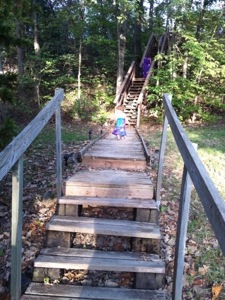
    Intense stairs from the dining hall and lodging to the “ridge” where ceremonies took place. Navigating these was NO FUN with that sting on my leg! But, isn’t tiny Alaina cute setting off on her own and heading on up?!

  • I was acknowledged/recognized as priestess/clergy to my own circle of women and it felt very good to be seen in that way. I’m trying to be/offer/bring something to the local area that still feels tender and vulnerable in myself. I lack some confidence. Want to build it! And, yet, I do it anyway. I’m brave! Maybe I’m not as skilled or musical or awesome as I could be, but I’m pretty darn good and…at least I TRY!
  • Want family to be clear priority. Family harmony is a top goal. I want to make sure to give them my good stuff too! Don’t save my passion and enthusiasm for “others” only!

When I got home from this festival, I was so inspired that I planned and facilitated a pretty great nighttime, firelit “sagewoman” ceremony in a teepee (with drumming on my new community drum) for the wise women of my own community. As a ritualist/ceremonialist, I learned from the GGG-experience that ambiance really, really matters in offering a cool ritual.

Since last year, I’ve developed my ceremonialist skills even further and last month received an additional supplemental ordination from the American Priestess Council. I’m almost three years into my D.Min program, I’ve taken advanced coursework in ritual design as well as pastoral counseling, liturgy, the role of the priestess, ethics, history, and so forth. At this time last year, I was struggling with whether or not it was “okay” for me to own the Priestess identity I felt “called” into and at the GGG I was seen and heard into this identity particularly by my friend and also by my mom. It turns out it is okay for me to serve others as a Priestess and to claim that title with authenticity even though I’m not as perfect and amazing as I feel like I should be (I’m also a blogger for SageWoman magazine and I’m currently working on a post called who does she think SHE is, that is about exactly this tension).

Some more pictures:

20120928-123107.jpg

Henna feet! From the woman who did this for me, I learned the phrase: “sparkles are my favorite color.”

20120928-123044.jpg

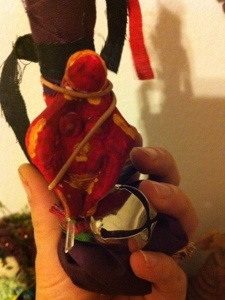
Medicine bundle! This was the best class ever. The woman brought piles and piles of random and awesome stuff and it was all free to choose what you wanted for your bundle. How cool is this face?!
20120928-123839.jpg

She also had simple clay goddesses for us to paint and attach as well as we could.

20120928-123121.jpg

Pensive little Lainey looking back thoughtfully at the stairs up which she just journeyed.

20120928-123746.jpg

Back home demo’ing a beautiful sarong gifted to my by my seeing friend!

20120928-123817.jpg

What’s this…

20120928-123825.jpg

…I hear…big DRUMS!

20120928-123850.jpg

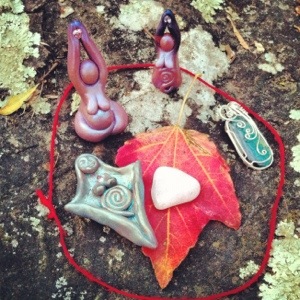
When I got home, I was inspired to make some new sculptures and Mark cut a lovely gemstone and made a pendant.

Here I go again! I wonder what lessons await me this year…
Thesis Tidbits: Birth as a Shamanic Experience

Childbirth is a rite of passage so intense physically, psychologically, emotionally, spiritually, that most other events in a woman’s life pale next to it. In our modern lives, there are few remaining rituals of initiation, few events that challenge a person’s mettle down to the very core. Childbirth remains a primary initiatory rite for a woman.” –from the book MotherMysteries

When I was pregnant with my first baby, I read an article centered on the theme, “Birth as a Shamanic Experience.” I can no longer find August 2013 050the exact article (online or printed), but I distinctly remember my feeling upon reading it: I was entering into a mystery. Giving birth was big. Bigger than anything I’d ever done before and it went beyond the realm of a purely biological process and into something else. Like shamanic experiences, giving birth is often described as involving a sense of connection to the larger forces of the world as well as being in an altered state of consciousness or even a trance state. While shamanic experiences may involve “journeying” to other realms of reality, giving birth requires the most thoroughly embodied rootedness of being that I’ve ever experienced. It, too, is a journey, but it is a journey into one’s own deepest resources and strongest places. The sensation of being in a totally focused, state of trance and on a soul work mission is intense, defining, and pivotal.

Shamanic journeys may be embarked upon for the purpose of soul retrieval and I can’t help but think that this is the purpose of giving birth as well—the birthing woman travels into herself to bring forth the soul of her child.

“Birth is certainly messy and bloody. It is intense, fierce, fiery and loud, but not violent. It is bloody from shamanic transformation. Birth-blood is the primordial ocean of life that has sustained the child in utero; the giving of this blood in birth is the mother’s gift to her child. The flow of blood is the first sign, following the flow of waters, that signals that new life is on the way, just as it is the first sign of a young maiden’s initiation into a new life at her menarche. The blood of transformation is miraculous. In Spanish, the phrase ‘dar a la luz, to give birth, literally means ‘to give to the light’. Giving to the light — mothers giving birth are giving light to new life through blood. The messiness and bloodiness of birth are the gift of the Earth–elemental chaos coming into form.”

via Article: Birthing as Shamanic Experience.

In the aftermath of giving birth, particularly without medication, many women describe a sense of expansive oneness—with other women, with the earth, with the cycles and rhythms of life. People who become shamans, usually do so after events involving challenge and stress in which the shaman must navigate tough obstacles and confront fears. What is a laboring woman, but the original shaman—a “shemama” as Leslene della Madre would say —as she works through her fears and passes through them, emerging with strength.

In her classic book Shakti Woman, Vicki Noble describes giving birth as a central shamanic experience and perhaps the root of all shamanism:

“I believe I underwent an initiation of the most ancient variety, birth as a shamanic experience, the central act of female shamanism—the quintessential act that offers a woman a completed experience of facing and moving through her fears to the other side. It isn’t that birth is the only way for a woman to experience this initiation—many women climb mountains or face other kinds of physical endurance tests and also come through it reborn into their power. But biologically birth is a doorway, a given for most women on the planet. It is fundamental opportunity to become empowered. Most of us giving birth today do not have the full experience, which is co-opted and distorted beyond recognition, changed from an active process into something that is done to us, as if we don’t know how to do it ourselves. Reclaiming the right to birth in our own instinctual way is a shamanic act of courage that has unfortunately become as remote to us as our ability to fly through the night in the form of an owl or heal the sick with the power of the drum. It wouldn’t hurt if we began to think of our birthing and child rearing as central parts of our shamanic work…” (p. 223).

After explaining that the homebirth of her second son was her, “first initiation into the Goddess…even though at that time I didn’t consciously know of Her,” Monica Sjoo writing in an anthology of priestess essays called Voices of the Goddess, explains:

“The Birthing Woman is the original shaman. She brings the ancestral spirit being into this realm while risking her life doing so. No wonder that the most ancient temples were the sacred birth places and that the priestesses of the Mother were also midwives, healers, astrologers and guides to the souls of the dying. Women bridge the borderline realms between life and death and in the past have therefore always been the oracles, sibyls, mediums and wise women…

…the power of original creation thinking is connected to the power of mothering. Motherhood is ritually powerful and of great spiritual and occult competence because bearing, like bleeding, is a transformative magical act. It is the power of ritual magic, the power of thought or mind, that gives rise to biological organisms as well as to social organizations, cultures and transformations of all kinds…” (page unknown).

20130903-200523.jpg

I’m working on my thesis project on the subject of birth as a spiritual experience and this topic is part of it. You can read more about Birth as a Shamanic Experience in the blog post at Feminism and Religion from which this post is excerpted: Birth as a Shamanic Experience by Molly | Feminism and Religion.

Brought to our knees

“Rigid plans work best if you’re building a skyscraper; with something as mysteriously human as giving birth, it’s best, both literally and figuratively, to keep your knees bent.” –Mark Sloan, MD (Birth Day)

Today I spent a few minutes listening to a lovely webinar by Amy Glenn, the author of Birth, Breath, & Death. The topic was Supporting a Birthing Woman’s Spiritual Practice and I was immediately caught by Amy’s comparison of giving birth to kneeling in prayer. She mentioned that giving birth may drop us to our knees, just as those who pray may pray on their knees. Since I’m currently writing about birth as a spiritual experience, I connected to this implied notion: birth as embodied prayer. And, looking at the webinar photo of a woman kneeling in August 2013 019child’s pose, my own birth-prayers came vividly to mind. In my first labor, I spent a lot of time on my knees, later wishing that I had also given birth on hands and knees rather than being encouraged to birth in a semi-sitting position that I felt contributed to tearing. Later, when I discovered birthing room yoga, I loved realizing that these kneeling postures that I adopted spontaneously and intuitively in my first labor were yoga poses—an inherent body wisdom I carried within me, waiting to arise when called upon. This is part of my first birth story, briefly touching on my time on my knees…

Mark & Mom were wonderfully supportive of me as I labored. I tried various positions and they stacked up pillows for me on the bed so that I could be on my hands and knees on a soft surface (they put the Boppy onto some other pillows to make a “well” for my belly) and then Mom read some of my birth affirmations to me. That worked for a while. I also tried the birth ball for a while and ended up spending a lot of time on my knees on the floor with my head and arms resting on a pillow on the bed…

via My First Birth | Talk Birth.

Kneeling to birth played a prominent role in my second birth experience as well and I have frequently described the rapid birth of my second son as an experience that literally drove me to my knees. When writing about this birth experience, I said:

I was extremely proud of my body and its super-awesomeness 🙂 I felt that my sense of birth trust was physically manifested in my actual birth experience. My body was a powerful and unstoppable force and I had to get out of my own way and let it happen! I felt driven to my hands and knees–like a power was holding me there. After the birth my body felt weak and “run over by a truck”—I felt powerful and like a warrior during the birth…

via Quick Births | Talk Birth.

And, in perhaps my most spiritually meaningful birth experience, the home miscarriage-birth of my third baby also brought me to my knees:

August 2013 041

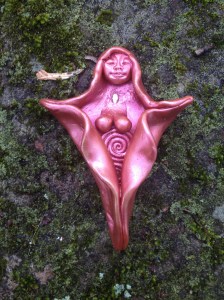
Brand new sculpture inspired by the thoughts in this post.

When I was still having the “HOW?” questions, other women that I knew who had experienced miscarriage started to come to mind and I knew I could do it too. I told myself that I had to do what I had to do. I said out loud, “let go, let go, let go.” I said I was okay and “my body knows what to do.” The afternoon I found out the baby died, I’d received a package that included a little lavender sachet as a free gift with my order. When my labor began, for some reason I wanted the sachet and held and smelled it throughout the experience. As I chanted to myself, “let go, let go, let go,” I smelled my sachet (later, I read in one of my miscarriage books that in aromatherapy lavender is for letting go). I also told myself, “I can do it, I can do it” and “I’m okay, I’m okay.” I felt like I should get more upright and though it was very difficult to move out of the safety of child’s pose, I got up onto my knees and felt a small pop/gush. I checked and it was my water breaking. The water was clear and a small amount. I was touched that now these gray pants were my water-breaking pants too…

Contractions continued fairly intensely and I continue to talk myself through them while Mark rubbed my back. I coached myself to rise again and after I sat back on my heels, I felt a warm blob leave my body. I put my hand down and said, “something came out. I need to look, but I’m scared.” Then, “I can do it, I can do it,” I coached myself and went into the bathroom to check (it was extremely important to me not to have the baby on the toilet). I saw that it was a very large blood clot. I was a little confused and wondered if we were going to have to “dissect” the clot looking for the baby. Then I had another contraction and, standing with my knees slightly bent, our baby slipped out…

via Noah’s Birth Story (Warning: Miscarriage/Baby Loss) | Talk Birth.

When the time came to gave birth to my rainbow daughter, she brought me to my knees as well and she was the only baby I caught in my own hands while in a kneeling position. Here is a segment from her birth-prayer:

At some point in the bathroom, I said, “I think this is pushing.” I was feeling desperate for my water to break. It felt like it was in the way and holding things up. I reached my hand down and thought I felt squooshy sac-ish feeling, but Mom and Mark looked and could not see anything. And, it still didn’t break. Mom mentioned that I should probably go to my birth nest in order to avoid having the baby on the toilet. My birth nest was a futon stack near the bathroom door. I got down on hands and knees after feeling like I might not make it all the way to the futons. Felt like I wanted to kneel on hard floor before reaching the nest.

…I couldn’t find her heartbeat and started to feel a little panicky about that as well as really uncomfortable and then threw IMG_0422the Doppler to the side saying, “forget it!” because big pushing was coming. I was down on hands and knees and then moved partially up on one hand in order to put my other hand down to feel what was happening. Could feel squishiness and water finally broke (not much, just a small trickle before her head). I could feel her head with my fingers and began to feel familiar sensation of front-burning. I said, “stretchy, stretchy, stretchy, stretchy,” the phone rang, her head pushed and pushed itself down as I continued to support myself with my hand and I moved up onto my knees, with them spread apart so I was almost sitting on my heels and her whole body and a whole bunch of fluid blooshed out into my hands. She was pink and warm and slippery and crying instantly—quite a lot of crying, actually. I said, “you’re alive, you’re alive! I did it! There’s nothing wrong with me!” and I kissed her and cried and laughed and was amazed.

via Alaina’s Complete Birth Story | Talk Birth.

Motherhood, especially my postpartum experience with my first baby also dropped the legs out from under me and I used the same expression echoed above in writing about this postpartum crucible:

I had regularly attended La Leche League (LLL) meetings since halfway through my pregnancy and thought I was prepared for “nursing all the time” and having my life focus around my baby’s needs. However, the actual experience of postpartum slapped me in the face and brought me to my knees…

via Planning for Postpartum | Talk Birth.

I’m not the only mother who finds this an apt description of the process of giving birth, today I found this touching story about memorializing the still birth of a mother’s baby girl:

This blanket isn’t much to look at. It isn’t a work of art. But it holds an entire story within its stitches. It holds the legacy of our precious baby girl who was stillborn, yes, but she was still born. Her name is etched on our hearts, and her short little life was not in vain. In those 37 weeks, she brought us joy and excitement. She brought us laughter. She brought me to my knees (to dry heave, because of being in pain, and to pray…). She brought us together, tighter, as a family. She brought us love. She brought us hope.

via Mind Mumbles: Our Stillbirth Storm.

And, I also read this gorgeous birth story that brings the concepts of prayer and birth kneeling into direct, evocative connection:

August 2013 047

Brand new sculpture inspired by the thoughts in this post.

From this point on, labor was like a long, hard prayer taking place through a dark and cold night. It literally brought me to my knees. At times I knelt, hands clasped in front of me. I had to work hard to surrender, to open myself up to the reality of labor and pain and let it be. It was a challenge. Knowing I needed to surrender to the labor, and to your advent, I made a silent decision to open my hands. I held them open and palm up in between each contraction. I tried to keep them open as long as I could once a contraction started. This was one of the most poignant parts of your birth – this surrender. I had to keep pushing my soul in the direction of you. I needed an openness of spirit as much as of body, for my spirit was caught up in a complicated grief from the months prior. At one point, when a contraction was coming, Kristen said to me, “Camille, you need to let this be big.” How did she know that I was holding back, hesitating? I needed to surrender to the hugeness of the mystery of life and birth and yes, even death. The challenge in your birth, dear Silas, was in the soul places…

…Kristen said simply, “Ok. Just listen to your body.” She trusted my body, which was so freeing. As I pushed, it felt natural. I was part of the pushing, as were you. I knew that the pushing was working, that you were coming down into the world. No one moved closer or moved away. No one tried to move me. I remained in the cleared meadow of a space with the freedom to move as my body wanted to move. There was complete freedom to do just as my midwife asked – to listen, and listen closely. To be. I was on my hands and knees, as close to earth as I could muster in the middle of Queens. And the transition to pushing felt seamless. I was permitted to remain in the deep cavities of my body, which were doing such brave work…

via The Birth Pause: Unhurrying the Moment of Meeting: The Story of Your Birth.

It isn’t only mothers who are brought to their knees by the act of birth, so are birth witnesses:

This is the story of falling in love with a baby before we even met her, the story of witnessing two friends fall deeper in love and the joy of meeting someone you just know you’ll know a lifetime in their very first second of life. This experience brought me to my knees in the end, a wreck of being awake 39.5 hours after witnessing such beauty I thought my heart would explode. I wailed in happiness, and entered a place where the only logical thing to do was roll around in the grass in the sun in full, tearful joy. I forever remain grateful to be a part of this.

It’s beautiful to document beauty, to witness beauty and just downright jump inside beauty…

via a birth story » Sara Parsons Photography.

In fact, we even see birth and knees referenced in the Bible as well:

Now when Rachel saw that she bore Jacob no children, Rachel envied her sister, and said to Jacob, “Give me children, or else I die!” And Jacob’s anger was aroused against Rachel, and he said, “Am I in the place of God, who has withheld from you the fruit of the womb?” So she said, “Here is my maid Bilhah; go in to her, and she will bear a child on my knees, that I also may have children by her.” Then she gave him Bilhah her maid as wife, and Jacob went in to her.

[No need to note how strongly I object to the notion of women being “given” to men. The author of the post referencing this quote then goes on to explain what ‘on my knees’ actually means, which is a little different than what I was thinking…]

…On my knees refers to the custom where the husband impregnated the surrogate while the surrogate reclined on the lap of the wife, and how she might even recline on the wife as she gave birth. The symbolism clearly showed the child was legally the child of the mother, not the surrogate, who was merely in the place of the wife in both conception and birth.

via Genesis 30 – The Children Born to Jacob.

Other birthing women experience the energy of birth as an embodied experience of Shakti. While Shakti can be personified as a Goddess, she is also understood as the great cosmic “fuel” of the universe, the feminine force that drives creation. Women may experience the energy of birth as Shakti moving through, with, and within them. While not specifically about birth, I recently wrote about Shakti in a related sense:

Shakti woman speaks August 2013 043
She says Dance
Write
Create
Share
Speak.

Don’t let me down
I wait within
coiled at the base of your spine
draped around your hips
like a bellydancer’s sash
snaking my way up
through your belly
and your throat
until I burst forth
in radiant power
that shall not be denied.

Do not silence me
do not coil my energy back inside
stuffing it down
where it might wither in darkness
biding its time
becoming something that waits
to strike. August 2013 050

Let me sing
let me flood through your body
in ripples of ecstasy
stretch your hands wide
wear jewels on your fingers
and your heart on your sleeve.

Spin
spin with me now
until we dance shadows into art
hope into being
and pain into power.

7/1/2013
via Woodspriestess: Shakti Woman Speaks

After thinking about this post all day and working on it in snippets at a time, a friend shared this quote with me saying that it reminded her of me. It felt like the perfect closing:

“As women connected to the earth, we are nurturing and we are fierce, we are wicked and we are sublime. The full range is ours. We hold the moon in our bellies and fire in our hearts. We bleed. We give milk. We are the mothers of first words. These words grow. They are our children. They are our stories and our poems.”

–An excerpt from “Undressing the Bear” by Terry Tempest Williams

Thesis Tidbits: Naming and Claiming

As I mentioned recently, I’m working on my thesis project on the subject of birth as a spiritual experience. Today, instead of my usual August 2013 032Tuesday collection of links, I’m sharing some thought-provoking quotes that I collected while writing the prospectus for my thesis. Pictures in this post are from last night’s Day of Hope and Healing ceremony in Rolla.

The first quote really relates to the whole reason I chose this topic in the first place:

“In this culture…a woman can be made to feel foolish for emphasizing the centrality of giving birth to her identity or her personal religiousness, her ‘womanspirit’” (Listening to Our Bodies, Stephanie Demetrakopoulos, p. 18)

While it is the opposite in my own circle of friends, in the dominant culture, whether given “religious” significance or not, I find this is true: women are made to feel foolish for emphasizing the centrality of birth to her womanspirit, to her life, to her feelings about her capacities as a woman and mother. Women are made to feel foolish for struggling with birth trauma OR for feeling “empowered” by birth. After all, it is just one day. But maybe, just maybe, part of this sensation actually originates in sensitivity to the feelings of other women:

Elizabeth Gray in Sacred Dimensions of Women’s Experience explains:

…this is not the entire story of the ambivalence a woman experiences along the way to claiming the sacredness of her own birthing process. There is the reticence she feels about possibly offending other women by seeming to elevate her own birthing experience. How is one woman to claim her own experience of an ‘easy’ birth when she knows other women labor for days in pain and some women die giving birth? How is she to name as sacred her experience of having babies, when, for whatever reason, other women are childless? How is she to claim her own experience of ‘conscious’ home-birth…,when other women may now regret having been unconscious with medications? Or if you had a ‘bad’ experience giving birth, how are you to name that when women around you are happily anticipating a successful culmination to their Lamaze classes? Women’s naming of much in their own birthing experiences is silenced by the sensitivity to other women’s feelings.

But despite these many reasons for reticence, there is a bonding of women who have given birth. It is deep and silent…a silvery shadowed oath between life and death down which all ‘the birthing mothers on the planet’ have moved, those ‘mothers of all times without whom no one walks this planet.’ Women who have given birth reach out to one another…saying to all those mothers whose birthing experiences were different than hers, ‘Don’t feel badly. ‘Rejoice in the incredible, joyous, astounding fact of creation…Every moment a child is born is a holy moment…’

(Elizabeth Dodson Gray, ed. Sacred Dimensions of Women’s Experience, p. 49-50)

Before this quote, Gray shares that the patriarchal association of birth (and women) with “uncleanliness” continues to impact women August 2013 040today:

“Because of this ancient overlay, it is not easy for women to lay claim to our life-giving power. How are we do reclaim that which has been declared fearful, polluting and yet unimportant? How are women to name as sacred the actual physical birth, which comes with no sacred ritual, while lurking around the corner of time are the long-established meta-physical rituals of circumcision and baptism?” (Elizabeth Dodson Gray p. 49)

Women today are also laboring to birth a healthier, more whole planet and means of being. For many women this begins with how they approach pregnancy and childbirth, how they consciously prepare to the welcome their babies into the world.

It is well past time in human history to push aside male dread and boldly claim the sacred woman-centeredness of every human birth…The wonder at new human life cannot be separated from the sacredness of women’s bodies or women’s lives. We will be involved in a profound betrayal of the gift of life itself as long as individual men and male culture ‘freak out’ before women’s power to give birth…If we cannot affirm women and women’s bodies and women’s birthing and women’s choice, we will go on bringing death to the planet and to ourselves. We cannot affirm life without affirming women. [emphasis mine]

(Elizabeth Dodson Gray, ed. Sacred Dimensions of Women’s Experience, p. 50-51)

And, as I’ve touched on before, birth and breastfeeding are the original sacramental experiences:

“Woman’s body is a transmutation system; it has the power to change blood to milk, to change itself into food which in turn becomes the physical and psychic energy of a child. She is creating an incarnate soul, assisting it in growth.” —Stephanie Demetrakopoulos (Listening to Our Bodies, p. 36)

August 2013 052

(this is my prayer flag this morning when I hung it up at home after the event last night)

August 2013 017

Flowers released on the lake at sunset.


Birth as a Spiritual Experience (Thesis Project)

Here is your sacrament MR_089
Take. Eat. this is my body
this is real milk, thin, sweet, bluish,
which I give for the life of the world…
Here is your bread of life.
Here is the blood by which you live in me.”
–Robin Morgan (in Life Prayers, p. 148)

“…When I say painless, please understand, I don’t mean you will not feel anything. What you will feel is a lot of pressure; you will feel the might of creation move through you…” – Giuditta Tornetta in Painless Childbirth

“I am the holy mother; . . . She is not so far from me. And perhaps She is not so very distinct from me, either. I am her child, born in Her, living and moving in Her, perhaps at death to be birthed into yet some other new life, still living and having my being in Her. But while on this earth She and I share the act of creation, of being, and Motherhood.”Niki Whiting, “On Being a Holy Mother” in Whedon

“Woman-to-woman help through the rites of passage that are important in every birth has significance not only for the individuals directly involved, but for the whole community. The task in which the women are engaged is political. It forms the warp and weft of society.” –Sheila Kitzinger

In 2011, I started working on my doctoral degree in women’s spirituality/thealogy (Goddess studies). Before I even began my first class, I chose my dissertation subject: birth as a spiritual experience. I’ve been steadily plugging away on my coursework and somehow in the midst of everything else that I am responsible for, I’ve successfully completed 13 of my classes. I already have a (not related) master’s degree and this is why I was admitted straight into the doctoral program, even though I have to complete a lot of M.Div (master’s of divinity) level coursework as prerequisites to the actual doctoral classes. After I finished my most recent class and got my updated transcript, I finally actually noticed how many M.Div classes I’ve completed thus far on my journey and it occurred to me to email to inquire what it would take to finish an M.Div degree first. I had this sudden feeling of what a nice stepping stone or milestone experience it would be to finish something, since I know that I have a minimum of three more years remaining before I complete the D.Min! They wrote back quickly and let me know that with the completion of three courses in matriarchal myth (I’m halfway through the first right now), my almost-completed year-long class in Compassion (I’m in month 11), and The Role of the Priestess course (involving three ten-page papers), all of which are also part of my doctoral program, the only other thing required for successful completion of my M.Div would be a thesis (minimum of 70 pages).

As I’ve been working through my classes, I’ve felt a gradual shift in what I want to focus on for my dissertation, and I already decided to switch to writing about theapoetics and ecopsychology now, rather than strictly about birth. I was planning to mash my previous ideas about birth and a “thealogy of the body” into this new topic somehow, perhaps: theapoetics, ecopsychology, and embodied thealogy. Then, when I got the news about the option of writing a thesis and finishing my M.Div, it became clear to me: my thesis subject is birth as a spiritual experience! This allows me to use the ideas and information I’d already been collecting as dissertation “seeds” as a thesis instead and frees me up to explore and develop my more original ideas about theapoetics for my dissertation! (This is the primary subject of my other blog.) So…why post about this now? Well, one because I’m super excited about all this and just wanted to share and two, because I’d love to hear from readers about their experiences with birth as a spiritual experience! While I don’t have to do the kind of independent research for a thesis that I will be doing for my dissertation and while my focus is unabashedly situated within a feminist context and a thealogical orientation, I would love to be informed by a diverse chorus of voices regarding this topic so that the project becomes an interfaith dialog. Luckily for me I’ve already reviewed a series of relevant titles.

Now, I’d like to hear from you. What are your experiences with the spirituality of birth? Do you consider birth to be a spiritual experience? Did you have any spiritual revelations or encounters during your births or any other events along your reproductive timeline? (miscarriage, menstruation, lactation…) Did you draw upon spiritual coping measures or resources as you labored and gave birth? Did giving birth deepen, expand, or otherwise impact your sense of spirituality or your sense of yourself as a spiritual or religious person? Did any of your reproductive experiences open your understanding of spirituality in a way that you had not previously experienced or reveal beliefs or understandings not previously uncovered?

When I use the word “spiritual,” I mean a range of experiences from a humanistic sensation of being linked to women around the world from all times and spaces while giving birth, to a “generic” sense of feeling the “might of creation” move through you, to a sense of non-specifically-labeled powers of Life and Universe being spun into being through your body, to feeling like a “birth goddess” as you pushed out your baby, to more traditional religious expressions of praying during labor, or drawing upon scripture as a coping measure, or feeling that giving birth brought you closer to the God of your understanding/religion, or, indeed, meeting God/dess or Divinity during labor and birth).  I’m particularly interested in women’s embodied experiences of creation and whether or not your previous religious beliefs or spiritual understandings in life affirmed, acknowledged, or encouraged your body and bodily experience of giving birth as sacred and valuable as well as your own sense of yourself as spiritually connected or supported while giving birth. I would appreciate links to birth stories or articles that you found helpful, books you enjoyed or connected with, and comments relating to your own personal experiences with any of the comments or questions I have raised above. I would love to hear about your thoughts as they relate to:

  • Pregnancy IMG_0225
  • Labor
  • Birthing
  • Lactation
  • Miscarriage
  • Infertility
  • Menstruation
  • Reproductive Rights
  • Birth as a feminist or social justice issue…

 Thank you!

With these things said, I also want to mention that I’m planning to redirect a lot of my writing energy/time into this thesis project rather than to blog posts. I’m trying to come up with a blog posting schedule for myself, but in order to actually do this thing, I must acknowledge that I have to re-prioritize some things and that means writing for my blogs probably needs to slip down a couple of notches in terms of priority of focus.

Oh, and I also hope this thesis project will turn into a book of some kind as well! 🙂

“It is hard to find a female-based concept such as Shakti alive within Western spiritual traditions. Shakti could be viewed as an expression of goddess in the female body at the time of birth. I would say its flow / expression and outcome of love is hindered by unnecessary interventions at birth which divert such energy towards fear- based, masculine forms. The use of masculine, rescue-based healing forms such as cutting (Grahn, 1993) can be necessary and useful, yet such procedures are currently used at the cost of women’s autonomy in the birthing process (see Jordan on C-section, 2007), and define the parameters of what feminist thinker Mary Daly called patriarchal medicine (1978). Modern women are largely lost when it comes to giving birth, turning to medical authority figures to be told what to do. Daly pointed to the dangers of this appropriation for women’s personal and collective autonomy.

Birthing bodies resist, disrupt and threaten standard North American modernist investments in linear time, rationality, order, and objectivity. Birth disrupts the Judeo-Christian male image of God, even as He hides the reality of female creation and creativity. I hold that women giving birth act from a focal point of power within their respective cultures and locations, the power to generate and renew human life itself from within the female body. This power is more absolute in its human reality then any other culturally sanctioned act of replication and material production, or social construction. I speculate that how this female power is expressed, denied, or acknowledged by women and within the society around a birthing woman reflects the degree to which women can and may express themselves at large. As each soul makes the journey through her/his mother, re-centring human consciousness within the female-based reality of human birth causes transformation of patriarchal consciousness as a whole…” –Nane Jordan, Towards an Ontology of Women Giving Birth

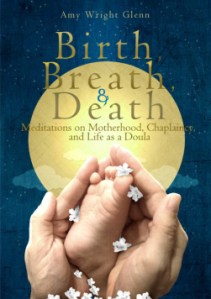
Talk Books: Birth, Breath, & Death

I just finished reading a lovely little book by Amy Wright Glenn. Lyrical, gentle, contemplative, and touching, Birth, Breath, and Death explores Amy’s meditations on life as a doula, mother, and hospital chaplain. birthbreathanddeath-amywrightglenn

Amy Wright Glenn was raised as a Mormon and eventually found her way onto a different faith path, Unitarian Universalism. Her reasons for connecting with the UU church actually closely mirror my own. Amy mentions that she first finds the UU church through her interest in poetry, which I found interesting. She then explains, “I was drawn to the way that Unitarian Universalist (UU) ministers attempt to evoke wonder and exploration in the minds and hearts of their congregants” (p. 10). This attempt to engage with the “transcendent sense of mystery and wonder” is exactly what attracted me to the UU’s, as well as the respect for the interdependent web of life of which we are all a part, the affirmation of the dignity and worth of each human being, and the commitment to social justice.

Amy writes, “I had been raised to acknowledge only one entrance to God’s energy. In fact, one need not use the term ‘God’ at all. Such a term is another doorway into the mysterious heart unifying all existence. However, humans need language to direct the attention to the ineffable. There are many names for this mystery. The doorways were holy too” (p. 13).

She continues with a very UU perspective (I’ve heard of it describes as “the light shines through many windows. We respect all windows and welcome everyone, except for those who think they should throw rocks through everyone else’s window!”):

“Spiritual surface structures open human beings to encounters with the ineffable…I have no doubt when my father bows his head in a small Utah town, and when I meditate in quiet sublime stillness, we touch the same source. At their best, religious traditions affirm the wonder at the heart of existence and provide meaningful contexts for its experience. This mystery allows us to breathe, dream, love, and dimly perceive so,etching beyond time even while we live in time…The moon is simply the moon, a miracle enough” (p 16).

I connect to this sense of wonder, with no need for explanation or interpretation—isn’t it is enough, to just marvel at what is? On my other blog, I once wrote:

I also have a favorite passage from Susan Griffin about the earth in which she exclaims, “We are stunned by this beauty.” That is exactly how I feel. This relationship to the planet is what used to make me feel that a conception of deity was unnecessary—isn’t it enough to just marvel at what is, right here in front of us? The majesty and the miracle of the natural world. I am stunned by this beauty. I am stunned by the realization that we are all suspended in space, spinning timelessly through the universe on this beautiful planet, so small in the vastness of all that surrounds us, and yet so big that it is literally our whole world. Sometimes when I have a bad day or feel overwhelmed by the swirl of daily tasks I remember that old saying about, “sometimes I go about pitying myself when all the while I am being carried by a great wind across the sky.” If we really stopped to think about this—to sense how we are carried by the great wind, I think the whole world would change, how people relate to each other and to the environment would be transformed. Stop, look, listen, breathe, and feel how we spin. Together.

Moving into birth, Glenn addresses the potent, transformative aspects of birth in describing attending her sister’s birth, the birth that led her into doula work (before the birth of her own son): “Birth brings powerful and painful sensations to the most intimate spaces of the female body…I stood transfixed by the life-giving strength found in her feminine power.”

She also explains:

“All forms of birth–physical, intellectual, spiritual, or emotional–bring one to the depths. The power to give birth originates in the creative life spirit birthing all, the seen and the unseen. According to Joseph Campbell, the source of life is beyond gender and the duality of male and female. However, when symbolizing the power that creates, Campbell argues the representation is ‘properly female.’ I agree. From this universal goddess energy emanates the seasons, the mountains, the rivers, and the galaxies. Writ large, human birth embodied the process of manifesting dreams, working diligently through our labors, and bringing vital energies to life. On this level, all human give birth. All humans participate in life’s creative energy…

On this level, we all need the renewing powers of ‘rhythm, ritual, and rest.’ This phrase reminds doulas of three helpful labor techniques outlined by legendary doula trainer, Penny Simkin. Rhythm, ritual, and rest not only aid birthing women, but they support all of us to move skillfully through our life’s labors. The power of rhythm restores vibrancy through dance, music, and motion. The power of ritual opens the way to direct encounter with the mysterious wonder of life. Rest renews and restores the very cells of our often tired and over-stimulated bodies and minds.” (p. 28-29).

And, she makes some poignant observations about breastfeeding, one that almost made me cry: “…only a child knows what his mother’s heartbeat sounds like from the inside” (p. 67) and one that made me cheer: “Family and friends need to draw a fierce circle of protection and non-interference around the nursing mother-child dyad.

In giving birth to her own son, Amy’s awareness and understanding are further deepened and expanded and she explains that:

“For me, birthing was a crucible moment, a dying, a deepening, and a healing. The light of birth transformed me into a mother. The light of birth is love. Looking back I see this clearly. Love was the pain and joy. Love restored me as I rested and held me up when I transformed into a wild eyed Kali. Love chanted with me in the birthing tub and love was certainly the epidural. Love pushed my baby out and gazed at me through Taber’s eyes. Love sustains me now as I watch his sweet small mouth suckle…” (p. 68)

Towards the end of this sweet, thoughtful book, she also used a great analogy that I’m going to borrow for my human services classes. She posits the scenario in which you are passing by a pond on the way to work and notice a small child drowning. You are wearing an expensive pair of new shoes and rushing into the water will ruin them. Do you rush in? The answer is YES. No one should choose their shoes over the life of the child and almost no one would respond to this scenario by saying that they would not save the child, yet, if the pond is world poverty, we do in fact, choose the shoes every day…we just aren’t looking those children in the eyes at the time…

Disclosure: I received a complimentary copy of this book for review purposes.

Birth on the Labyrinth Path: Anniversary Book Giveaway!

BirthontheLabyrinthPath_300x250-ad_2Last year, while browsing through the Kindle store on Amazon, I made the chance discovery of a delightful little treasure of a book called Birth on the Labyrinth Path. Written by Sarah Whedon, the editor of Pagan Families, the book was very affordable and so I snapped it up and devoured it right away! (I don’t think I had any idea that it had  literally just been published within a few days of my purchase.) The book’s lyrical explorations inspired a brief blog post, through which the author then discovered me. After some time spent enjoying each other’s writing on our respective blogs, she invited me to become a contributor at Pagan Families. While I don’t actually self-identify as Pagan, but instead as something more unwieldy like a Panentheistic Goddess-oriented Unitarian Universalist, I was delighted to begin contributing and find that I have stretched my horizons and come to learn new things about myself through the process of writing for a collaborative project. This week we’re celebrating the anniversary of Sarah’s lovely book with a fun giveaway and a series of thematic posts.

****Giveaway is now closed. Michelle was the winner****

This post is a companion giveaway to the book birthday celebration! You can enter to win your own e-book copy of Birth on the Labyrinth Path. The giveaway will end this Sunday at midnight, so make sure to enter soon 🙂 I’m not fancy enough yet to figure out a Rafflecopter giveaway, so I’m doing this the old-fashioned way. To enter, just leave a comment sharing anything you’d like to share about labyrinths or birth or the two together! 

Also, make sure to check out my long post today at Pagan Families on the subject of life and labyrinths—perhaps better titled, “labyrinths I have known and loved,” or “labyrinths as birth art.” Here’s an excerpt:

It took me a little while, but I eventually discovered that a labyrinth is a perfect metaphor for birth and could be of potent use during birth education, as well as a tool for birth preparation and for processing one’s birth story, feelings about birth, and birth experiences. I was inspired by Pam England’s work with the LabOrinth and began to incorporate the concept into my own birth classes. Most couples seem to connect with it, regardless of their own religious background, though I think on the surface it feels a little too “New Agey” to some of them. Labyrinths are actually ancient (oldest found is 3500 years old!) and have been found in many cultures and places. According to England, they were used by midwives in England 500 years ago as tools for healing. And, centuries ago, mosaic labyrinths inlaid in the floors of churches were walked by pilgrims on their knees (those who could not actually make pilgrimages to the Holy Land in person, would crawl through the labyrinth in the church on their knees as their pilgrimage). I use the crawling example in class to explain that in the “labyrinth” of birth, you can go at your own pace and speed and you can even crawl if you need to! You can also find your own way blindfolded or walking or running or dancing.

via Book birthday party: of life and labyrinths.

On our last vacation day at Pismo Beach, my husband and I drew a labyrinth in the sand together with our toes and then we walked it with our family.

Womenergy (Womanergy)

The day before my grandma died, my dad came over and said he’d coined a new word and that I could have it: Womenergy. He said he’d googled it and didn’t come up with anything. I googled it later though and there are a couple of people who have used it before, so I think my dad actually said Womanergy instead, which is still available. So, womanergy has been coined now too! 🙂 I dozed off during Alaina’s nap today and when I woke up the word was in my head and so were a bunch of other words. I channeled a bit of my inner Alice Walker and wrote:

Womenergy (Womanergy):

Feeling fierce at 37 weeks last year.

Feeling fierce at 37 weeks in 2011.

Often felt when giving birth. Also felt at blessingways and circling with women in ceremony and rituals. Involved in the fabric of creation and breath of life. Drawn upon when nursing babies and toting toddlers. Known also as womanpower, closely related to womanspirit and the hearing of one’s “sacred roar.” That which is wild, fierce. Embedded and embodied, it may also be that which has been denied and suppressed and yet waits below her surface, its hot, holy breath igniting her. Experienced as the “invisible nets of love” that surround us, womanergy makes meals for postpartum women, hugs you when you cry, smiles in solidarity at melting down toddlers. It is the force that rises in the night to take care of sick children, that which holds hands with the dying, and stretches out arms to the grieving. It sits with laboring women, nurses the sick, heals the wounded, and nurtures the young. It dances in the moonlight. Womenergy is that which holds the space, that which bears witness, that which hears and sees one another into speech, into being, into personal power. Called upon when digging deep, trying again, and rising up. That which cannot be silenced. The heart and soul of connection. The small voice within that says, “maybe I can, I think I can, I know I can. I AM doing it. Look what I did!” Creates art, weaves words, births babies, gathers people. Thinks in circles, webs, and patterns rather than in lines and angles. Felt as action, resistance, creation, struggle, power, and inherent wisdom.

Womenergy moved humanity across continents, birthed civilization, invented agriculture, conceived of art and writing, pottery, sculpture, and drumming, painted cave walls, raised sacred stones and built Goddess temples. It rises anew during ritual, sacred song, and drumming together. It says She Is Here. I Am Here. You Are Here and We Can Do This. It speaks through women’s hands, bodies, and heartsongs. Felt in hope, in tears, in blood, and in triumph.

Womenergy is the chain of the generations, the “red thread” that binds us womb to womb across time and space to the women who have come before and those who will come after. Spinning stories, memories, and bodies, it is that force which unfolds the body of humanity from single cells, to spiraled souls, and pushes them forth into the waiting world.

Used in a sentence:

“I’m headed to the women’s circle tonight. I could really use the womenergy.” February 2013 196

“I felt like I couldn’t keep going, but then my womanergy rose up and I did it anyway.”

“Feel the womenergy in this room!”

“She said she didn’t think she could give birth after all, but then she tapped into her womanergy and kept going.”

“I hope my friends have a blessingway for me, I need to be reminded of the womenergy that surrounds me as I get ready to have this baby.”

Feel it…

Listen to it…

Know it…

In the air, in her touch, in your soul.

Rising
Potent
Embodied
Yours…

“For months I just looked at you
I wondered about all the mothers before me
if they looked at their babies the way I looked at you.
In an instant I knew what moved humankind
from continent to continent
Against all odds.”

–Michelle Singer (in We’Moon 2011 datebook)

“I believe that these circles of women around us weave invisible nets of love that carry us when we’re weak and sing with us when we’re strong.” –SARK, Succulent Wild Woman

There is a wild tiger in every woman’s heart. Its hot and holy breath quietly, relentlessly feeding her.” – Chameli Ardagh

Circles of women (and art)...

Tuesday Tidbits: Red Tent

April 2013 019

Dogwoods are blooming here.

“..by honouring the demands of our bleeding, our blood gives us something in return. The crazed bitch from irritation hell recedes. In her place arises a side of ourselves with whom we may not-at first- be comfortable. She is a vulnerable, highly perceptive genius who can ponder a given issue and take her world by storm. When we’re quiet and bleeding, we stumble upon solutions to dilemmas that’ve been bugging us all month. Inspiration hits and moments of epiphany rumba ‘cross de tundra of our senses…”
Inga Muscio

“The great mother whom we call Innana gave a gift to woman that is not known among men, and this is the secret of blood. The flow at the dark of the moon, the healing blood of the moon’s birth – to men, this is flux and distemper, bother and pain. They imagine we suffer and consider themselves lucky…In the red tent, the truth is known. In the red tent, where days pass like a gentle stream, as the gift of Innana courses through us, cleansing the body of last month’s death, preparing the body to receive the new month’s life, women give thanks — for repose and restoration, for the knowledge that life comes from between our legs, and that life costs blood.
Anita Diamant

I have to be quick today—lots going on. I don’t know if anyone else is enjoying my little Tuesday Tidbits post series particularly, but I really love doing it, because it gives me an automatic structure for a post, a sense of focus rather than an open book of endless possibility, and also the ability to put something up quickly even admidst life swirls. And, I find it funny how things collect around a theme without me consciously trying to do so. What collected around me during the past week was Red Tent Resources again…

First, a short video about starting a Red Tent:

Then, this cool Lunation website where you can subscribe to a newsletter and receive a free guided meditation called Connect to the Red Threads.

And, I enjoyed an article called Menstrually Yours – Women Can Map Periods as a Path to Self-Awareness.

This article uses the same “seasons” metaphor for understanding the energy of your cycle that a lot of menstrual empowerment activists are using. This seasons idea has helped me find an enhanced place of understanding about my own ebb and flow of energy, enthusiasm, and creativity.

Winter is the first stage, when we bleed. Characteristically it’s the time of wanting to hibernate (or just hide under a duvet and eat chocolate). We are withdrawn and inward and it’s tough to focus and find a lot of energy, contrary to the images forced on us by the Bodyform adverts.

Spring is the week after when the bleeding has stopped and we suddenly feel more energised and sociable. We want to get on and often we get stuff done quickly and with grace and ease.

Summer is characterised by our really coming into fullness, it’s when we are ovulating and energetically we are fully blooming and really advancing.

Autumn is when we start the decline back into ourselves. Typically now we may experience some PMT, being a bit snappy or less tolerant than we were in spring and summer.

via Claire Snowdon-Darling: Menstrually Yours – Women Can Map Periods as a Path to Self-Awareness.

What I find transformative about this understanding is the acceptance that comes from realizing what season I’m in and knowing that a new season is coming. Rather than get frustrated with myself during “autumn” or winter, thinking it means a permanent state of being, I say, “ah ha! This sense of needing to pull in and retreat. I know this. Time to break out some of those saved guided meditations, say no to things I can say no to, and sit down with a book and some tea.” Just a few months ago, I would have taken this impulse as a sign that my life is too crowded and I MUST. QUIT. SOMETHING. NOW. THINGS. MUST CHANGE. ARGHHHH. NO MORE! Now, I see that it is just a call for right now, for this little season, not a permanent change, just an honoring of body rhythms. Interestingly, I’m actually in the summer stage of my own cycle right now, which is the time I usually wait for and get a bunch of “stuff done” and scheduled to post so that when I feel withdrawn again, my blog can go on on its own. However, with my grandma’s dying process and my mom’s absence while she cares for my grandma in California, I actually feel extremely “autumn” right now and would like nothing better than to just lie down with a book and STOP. My kids and my students all need attention though.

And, I enjoyed this cool website too:

Birthing Art Birthing Heart is a website

that promotes, facilitates and offers examples of art made by woman.

Birthing Art Birthing Heart offers new ways for woman to explore what they are ‘birthing’ at any given moment.

via Birthing Art – Birthing Heart – Home.

Bringing it into the Red Tent theme, they have a current project called Bleeding Art, Bleeding Heart too.

Speaking of art, though it isn’t finished yet, I made a couple of new pieces about my grandma. This is the first one:

April 2013 038

The shells were supposed to be a spiral, not a “6,” but on such a small surface, I couldn’t spiral them any better.

Related past posts:

Red Tent Resources

Book Review: Moon Time

Moontime’s Return…

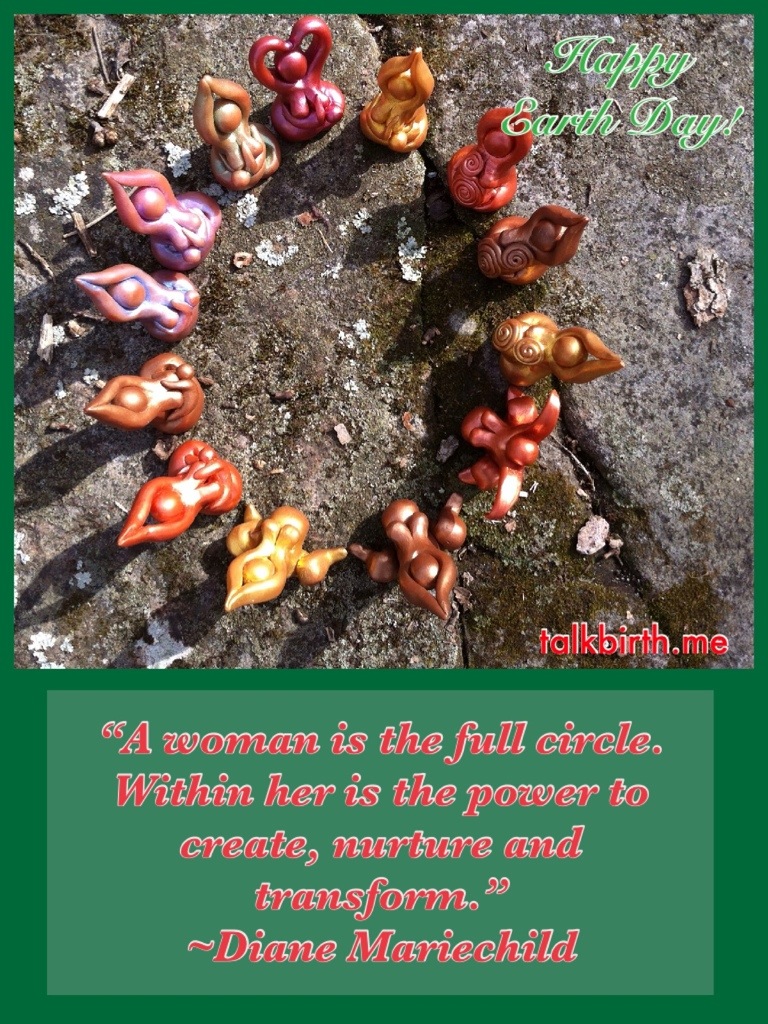
Happy Earth Day!

20130422-140554.jpgWhy this phrase? Two reasons:

Womb ecology reflects world ecology. World ecology reflects womb ecology.

And this (already used in several past posts):

When women are faced each day with enforced cesarean deliveries, birth control that maims and kills them, and doctors who think them dirty, when we encounter rape, violence in the streets, job discrimination, sexual slavery around the world, pollution and nuclear madness, we realize that reclaiming the integrative ways of our ancestors must involve our healing powers on all fronts—from the medical to the social to the environmental to the political to the psychological to the spiritual. Healing the divisions that were imposed during the patriarchal era is the survival issue of our time and our planet. A world that systematically sickens its women cannot survive. [emphasis mine]

Chellis Glendinning in Politics of Women’s Spirituality

20130422-140545.jpg