Tuesday Tidbits: Birth Power

October 2013 032

“When a woman births without drugs…she learns that she is strong and powerful…She learns to trust herself, even in the face of powerful authority figures. Once she realizes her own strength and power, she will have a different attitude for the rest of her life, about pain, illness, disease, fatigue, and difficult situations.” –Polly Perez

~~

“The way a society views a pregnant and birthing woman, reflects how that society views women as a whole. If women are considered weak in their most powerful moments, what does that mean?” –Marcie Macari

~~

“I think one of the best things we could do would be to help women/parents/families discover their own birth power, from within themselves. And to let them know it’s always been there, they just needed to tap into it.” –John H. Kennell, MD

~~

“As doulas, midwives, nurses, and doctors, it’s important to never underestimate how deeply entrusted we are with someone’s most vulnerable, raw, authentic self. We witness their heroic journeys, see them emerge with their babies, hearts wide open…” –Lesley Everest (MotherWit Doula)

~~

“When you have a baby, your own creative training begins. Because of your child, you are now finding new powers and performing amazing feats.” –Elaine Martin

~~

“Learn to respect this sacred moment of birth, as fragile, as fleeting, as elusive as dawn.” ~ Frederick Leboyer (via From Womb to Cradle Doula Services)

~~

‎”It takes force, mighty force, to restrain an instinctual animal in the moment of performing a bodily function, especially birth. Have we successfully used intellectual fear to overpower the instinctual fear of a birthing human, so she will now submit to actions that otherwise would make her bite and kick and run for the hills?” –Sister Morningstar (in Midwifery Today)

~~

“Birth is women’s business; it is the business of our bodies. And our bodies are indeed wondrous, from our monthly cycles to the awesome power inherent in the act of giving birth.” –Sarah Buckley

~~

“We are volcanoes. When we women offer our experience as our truth, all the maps change. There are new mountains. That’s what I want to hear–to hear you erupting. You Mount St. Helenses who don’t know the power in you–I want to hear you…If we don’t tell our truth, who will?” –Ursula K. Le Guin

~~

“For most people, modern life meanders along a path of ups and downs, by and large devoid of high-voltage experiences that have the power to alter our lives in significant ways…The birth of a child is one of those significant experiences.” –John & Cher Franklin (FatherBirth)

~~

Birth power has been on my mind today after I read my friend’s Shauna’s unassisted birth story of her eighth baby:

Our baby was starting to crown as I finally squatted down low with one leg higher than the other (I was out of time to change things up. I’ll just squat and do it the same ‘boring’ highly effective way I always do it I thought lol.) I used some counter pressure on her velvety head to help ease her head out but it wasn’t really needed and a painless contraction inched her head fully out. I noticed I talked a lot to Ricky about what was happening like I was giving him a play-by-play of a sport. I stood up on two legs again…As I stood up Ricky took a few pictures of me holding her fully birthed head with one hand and I said, “Get a picture of me smiling.” I totally posed for a picture while I cradled her head between the two worlds of womb and Earth…

via Life With Eight Kids: Beatrice’s Unassisted Birth Story (half hour labor and birth -with extra info on my favorite topics of vernix, cord cutting, and not pushing).

Completely coincidentally, over the weekend I made a new sculpture that I named in honor of Shauna and her past births.

October 2013 024I called this one “Squatter’s Rights,” after an article draft Shauna wrote several years ago that had a potent impact on me, particularly her line, “and then I reach down and catch what’s mine.” (previously written about in this post.) I made the new sculpture because I received a message on etsy asking me about the sculpture shown at the conclusion of another past post:

“I believe with all my heart that women’s birth noises are often the seat of their power. It’s like a primal birth song, meeting the pain with sound, singing their babies forth. I’ve had my eardrums roared out on occasions, but I love it. Every time. Never let anyone tell you not to make noise in labor. Roar your babies out, Mamas. Roar.” –Louisa Wales

via What Does Coping Well Mean? | Talk Birth.

Over the weekend, I also made a batch of new sculptures for a training taking place in Hawaii:

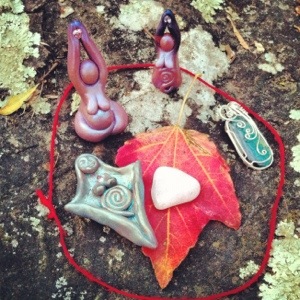
October 2013 020I hope these bring a sense of birth power to the women receiving them 🙂

Tonight I lit a candle as part of the Wave of Light for Pregnancy and Infant Loss Remembrance Day. It is important to acknowledge that power may be found in the full spectrum of experiences of the childbearing year…

October 2013 020

And, in a thematically appropriate connection, a Facebook fan sent me a link today to a powerful video of a woman singing during labor. I’d seen a version on YouTube before, so I went looking for it there and instead I found a short webisode specifically about singing during labor:

In my own first labor, I hummed the blessingway chant Woman Am I over and over again until the baby was born. I find that humming, vocalizing, and talking to/coaching myself is one way that I awaken my own birth power during birthing.

How do you awaken your birth power?

I shared some ideas in another past post, but I’d love to add to it!

Business of Being Born: Classroom Edition

Childbirth is a women’s rights issue and a reproductive justice issue. The United States maternity system is one of the costliest in the developed world, yet our birth outcomes compare poorly to those of other industrialized nations. Among industrialized countries, we consistently rank last or second to last in perinatal and maternal mortality rates. Moreover, birth is depicted in mainstream media with fear, medical intervention, and crisis…

via The Business of Being Born Classroom Edition.

It took me some time to get around to it, but I’ve finally finished exploring The Business of Being Born: Classroom Edition and its associated toolkit of educational materials! As a long-time childbirth educator and birth activist, of course I was interested in this classroom version of the (new) classic birth advocacy film, but I’m also a college professor and therefore was doubly interested—how might this resource be incorporated into one or more of my human services courses? As the BoBB companion site explains…

Childbirth is an issue most people do not engage with until they have experienced the maternal health system. The Business of Being Born: Classroom Edition reaches out to young adults BEFORE they confront their own birth decisions, both placing the issue on the radar and challenging the prevailing assumptions about birth providers and current obstetrical management trends. The goal is for the next generation of policy makers, practitioners, educators, and parents to approach birth decisions with awareness and confidence. Our strategy is to incorporate this evidence-based presentation into classrooms around the country. We envision empowering the next generation of parents to seek out systemic change and new policies supporting domestic maternity care…

via The Business of Being Born Classroom Edition.

The Classroom Edition of the film runs about 25 minutes and comes packaged with one of my all-time favorite resources for birth classes and tabling events: The Guide to a Healthy Birth from Choices in Childbirth. It also comes with two additional celebrity interviews, the short film Birth by the Numbers, and a instructor’s toolkit with classroom activities tying the themes of the film to major subjects such as Women’s Studies, Public Health, and Sociology.

My only critique of the classroom edition of the film is that the assembled quotes at the beginning of the film are put together in a choppy sort of way that makes it difficult to perceive (for the average viewer), which are the “good” (i.e. accurate) quotes and which are popular types of misinformation. There is also an odd, repetitively distracting, monotonal quality to the music that plays through much of the footage. Excerpted from the full-length film, the classroom edition still includes Ricki Lake’s homebirth in her bathtub, which was one of my top favorite moments of the original film. Content from a historical perspective as well as content involving the shadowing of a homebirth midwife and the personal stories from families choosing midwifery care were greatly reduced from the original version and the classroom edition seems to have more of an emphasis on sociocultural analysis. It is noted that 90% of women in many hospitals experience some type of labor augmentation (usually pitocin) and also that hospitals are businesses, businesses that are not really interested in having women hang around in the labor room.

One of the college courses I teach is American Social Policy. I have always been interested in birth change from a systemic (macro) level as a companion to change on the individual (micro) level, so I especially appreciated watching the Birth by the Numbers presentation included with the classroom edition of BoBB. When speaking about the idea that the increase in cesarean rate reflects maternal choice, public health professor Gene Declercq says, “this blaming of women is farcical. It is not about the mothers, it is about the way we treat care in the United States. Nobody ever wants to admit there is a difficult inherent in the system.” Well, I want to admit it and this is the kind of macrosystem-level change we talk about in my Policy course. At the companion Birth by the Numbers website, you can download a powerpoint presentation and other teaching tools, as well as watch the short film, in which public health professor Gene Declercq debunks popular myths about the causes of the United States cesarean rate increase. The film also looks at disparities in maternity mortality rates and tackles questions of systemic influences on maternal health outcomes.

So, are mothers really asking for cesareans?

slide

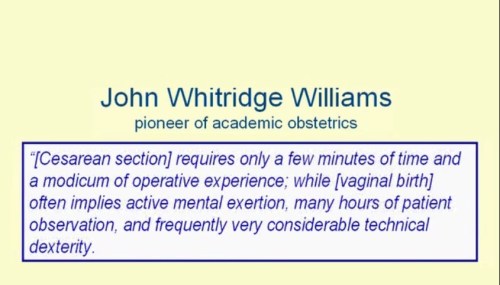
Declercq also draws on writing from the classic obstetrics textbook, Williams Obstetrics, and shares this quote about one of the real reasons that cesarean rates continue to rise:
whycesareanAnd, he makes this important observation:womenhaventchanged
As Nadine Goodman says in The Business of Being Born Classroom Edition, “A woman will always remember how she was made to feel during her birth…if you don’t have the reverence and respect for birth, where do you go from here?”

Prior post about The Business of Being Born: Transformation Through Birth | Talk Birth

Disclosure: I received a complimentary digital package for review purposes.

Pregnancy and Infant Loss Remembrance Day

Pregnancy and Infant Loss Remembrance Day is October 15. At The Amethyst Network, co-founder Jenni has been working on making some new images for the purpose of sharing either in advocacy or support. There you can find different buttons designed for sharing on social media or blogs on both Facebook and Pinterest.

Tonight, I went to a candlelight vigil in Rolla in honor of this Remembrance Day. I took Alaina with me, my little rainbow girl, and we spent some peaceful time at dusk in the park with my friend and her daughter.

Tonight via TAN, I also read an interesting article about miscarriage from a feminist perspective and I very much valued her conclusion:

I’ve come to the conclusion that my understanding of this event as a feminist simply backs up my earlier understanding: that miscarriage is different for every person who experiences it.

via A Feminist’s Miscarriage | Liz Boltz Ranfeld.

Thinking of the 1 in 4 women tonight who share the experience of miscarriage as well as the sisters who support them, in whatever capacity they can.

(A tutorial for how to make star paper lanterns like we used tonight may be found here.)

Tuesday Tidbits: Life and Death

October 2013 041

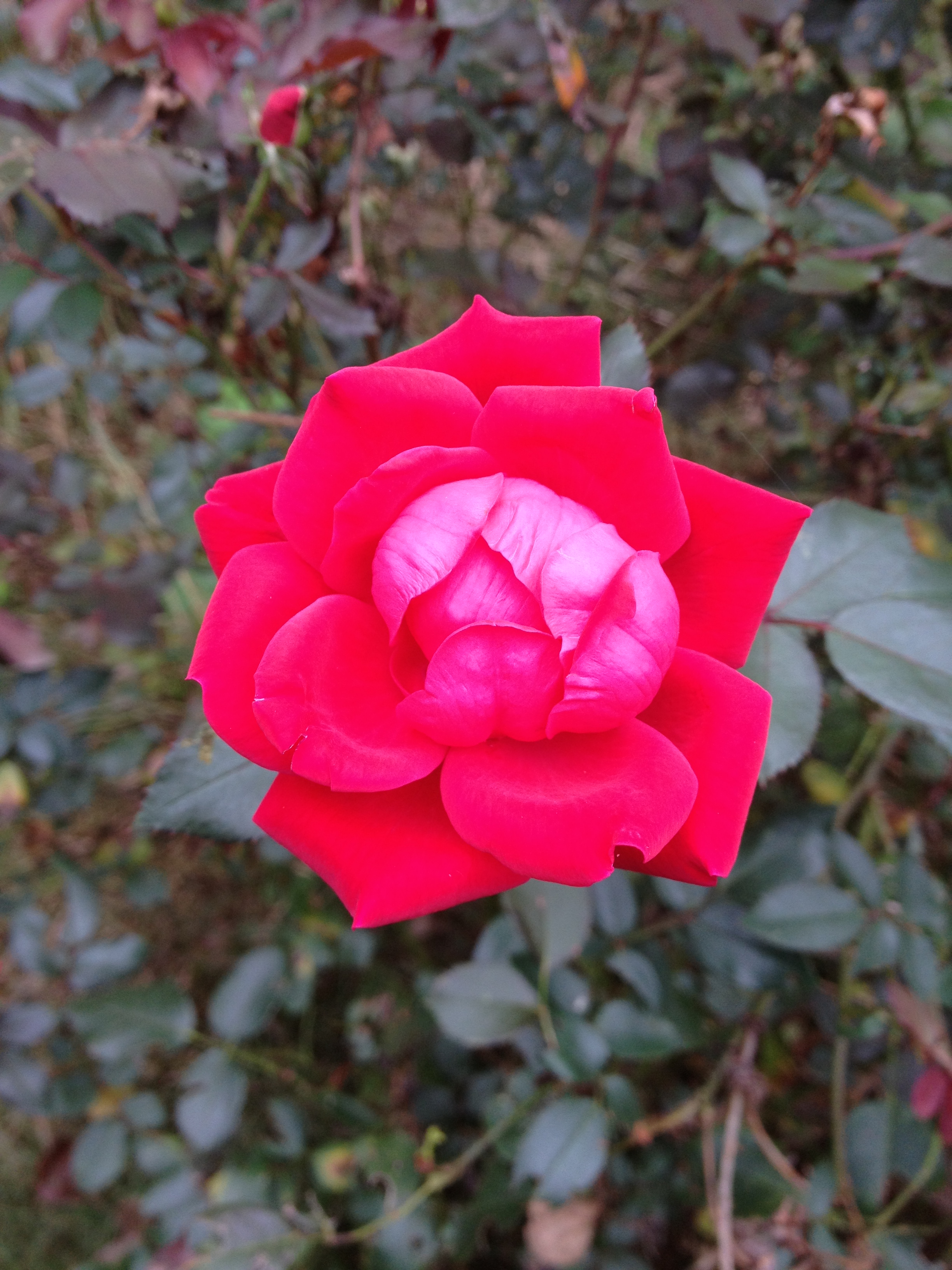
A nice fresh October rose in the back yard.

“Here’s what I know about the other side: women carry the doorway to this place within the womb. The womb is the connection to the spirit realm from which all spirits enter.” –Tami Lynn Kent (Wild Feminine)

After my grandma died, I read an article that paralleled good birth care with good death care. I saved a quote from it to share, but didn’t post it because I didn’t really have anything else to go with it at the time. This month marks the six-month point since my grandma died and I found myself writing about her and making my own birth-song, death-song parallel for my most recent essay for Feminism and Religion and I knew the time for this current post had also come. (Note: the FAR post doesn’t come out until Wednesday, so the link won’t work until then.) Here is the quote I saved:

My Oma was completely cared for. She was bathed in her bed. My mom made homemade applesauce for her. My uncle gave her drops of wine. Her clothes were changed to housedresses she loved. We whispered love notes in her ears. We stroked her arms and held her hands. Nothing existed besides her.

A woman in labor, with the best support, is completely loved up. Taken care of so that she can focus on following her body and natural rhythms. She is massaged, sung to, whispered words of power and praise. All to fill her up so that she can remember her strength, courage, and beauty.

via Life and Death. Miracles Abound. | Naturally Prosperous.

August 2013 001

My grandma’s perpetual calendar. Made by my dad and painted by my mom in the 80’s or so, it was passed along to me. When I finally changed the tiles to September, it prompted another bout of crying because I had to put away the tiles from March–the last time my grandma touched and set up this calendar herself. It was both sad and painful and also beautiful and generative to be setting it up myself and now…the wheel of the year continues to turn and I really should be taking out September and setting up October…

My mom doula’ed my grandmother through her dying process and it was hard, but she did it. This week, my aunt sent out some pictures from my grandma’s doll collection so that we could pick which dolls we might like to have. My grandma loved Shirley Temple and had a Shirley collection, among quite a few other dolls. I’ve written before that I guess this love of dolls is genetic and I definitely got it from both my grandmas. Anyway, I was looking through the doll pictures and feeling impressed with the effort and love my aunt had put into captioning and describing each doll, as well as deciding which one was my favorite and then my eyes were filled with tears. I thought about my own dolls, there on the shelves and in nooks and corners of the house and pictured my little daughter going through them and taking pictures after I die and it was just really flipping sad.

And, so to continue to the theme of today’s post I remembered marking this poem in my 2013 We’Moon datebook (I’m getting ready to order my 2014 edition and so I’m going back through the things I’ve marked this year).

 We All Become Small

…Above the hospital bed
hangs a photo of you:
black lingerie, red curls,
mouth alive with laughter.

You were flamboyance
boasting bold jewelry
and flowered baseball caps.
Everyone called you Mom.

Now you are thin and still…
…You are the end of my journey
the final portrait.

No matter how red our curls,
how bright our rings
we all become small.

We all grow silent,
ease out of our feet,
slip away from our hands,
rise beyond our body
and fill the room with goodbye.

Natascha Bruckner (in We’Moon 2013)

I’d also marked a poem about miscarriage:

Sept 2013 021

I recently added new miscarriage memorial charms to my Etsy shop.

Miscarriage
I won’t forget
how cold that summer turned
after
or how my days developed
sharp edges or how
with time passing,
you still grow older.

You’re the girl I wasn’t
convinced I wanted,
and there’s no name
for the landscape I stand on.

–Joyce Hayden in We’Moon 2013

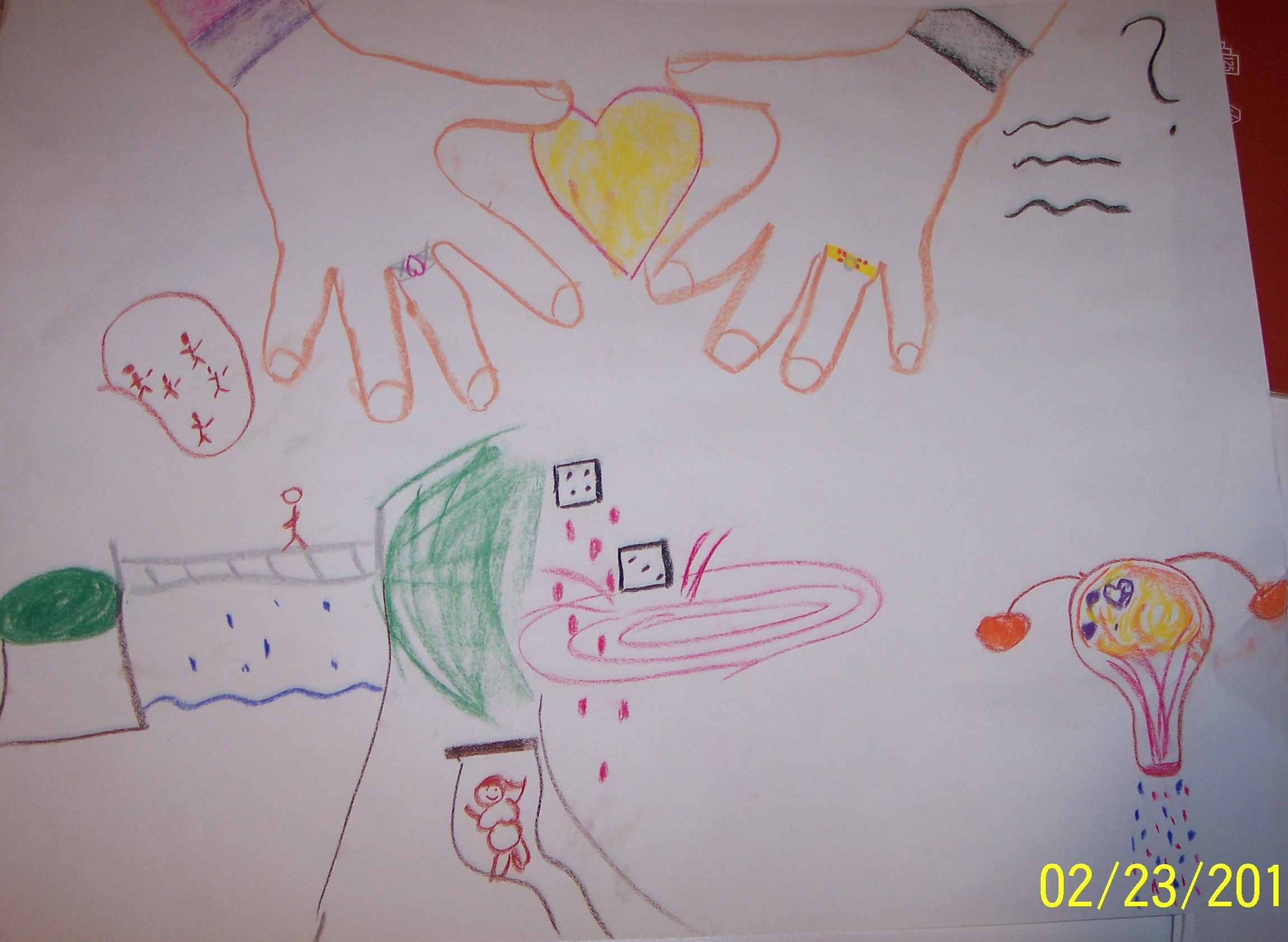
I really identified with the sentence, there’s no name for the landscape I stand on, feeling reminded of my own post-miscarriage drawing in which I tried to capture the sensation of having to walk over the bridge alone…

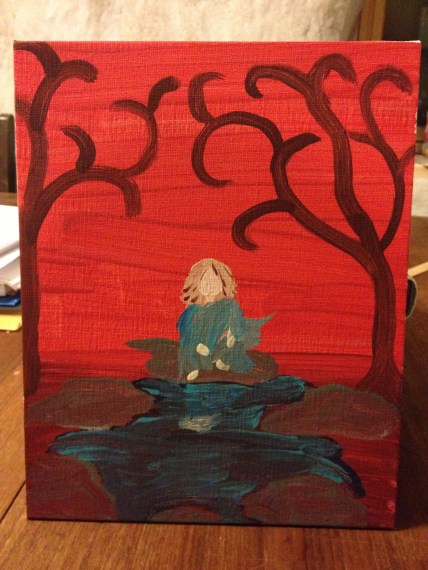
miscarriagedrawingOne of my friends does Prayer Paintings for mothers who’ve experience pregnancy loss, miscarriage, or stillbirth (she also does Birth Blessing painting to celebrate pregnant women). She asked me if she could paint one for me and as we talked it over, I realized I didn’t feel like I needed a loss painting OR one that was about pregnancy or birth, but rather something “integrative.” And, she created something beautiful for me that felt perfect. She titled it Empowering Circle of Reflection and I love the rich, red, surprising sky. It is perfect.

October 2013 020Returning to my grandma as well as thinking about the purpose of writing and exploring feelings in writing and so forth, I also want to share this quote from We’Moon 2013:

“I see beauty in all faces, all women, near and far. All  winds blow, all ferns and grasses grow, all cello weep, all hands write. In writing move the body, the memory in the bones. Lift me up into these trees and into these women’s arms, all branches intertwining..Get those stories down. The moon, the Milky Way, the cream smear of falling stars, the bats and frogs and wood chips, racoons on a log. My jacket hangs on a tree stump every night, and I wear a spiderweb each dawn. Remember this: preserve. Pass on, embellish, enliven and unfold. All winds will blow this history into dust—unless we write it down, and name it holy…” Bonnie J. Morris (in We’Moon 2013)

One of the realizations I had after my trip to the Gaea Goddess Gathering this year was that not everything has to be a story. There doesn’t have to be a blog post around every corner. However, after reading the above, I thought that maybe it isn’t so bad/annoying that I look for the story everywhere and that I try to write it down and name it holy.

And, one last We’Moon transcription:

A Meditation by Mia Howell (in We’Moon 2013)

Sept 2013 010

New mother-blessing tree of life pendants.

The Japanese say that even the other side
has another side. We need to keep turning
things over in our minds until we can see
them in circles of motion, in spirals, in
the complete roundness of their being, through
all the cycles of becoming, undoing, renewing.

We need to understand how we got to this point
and then we need to remember it is just a point.
We feel each beat as a beat but also as part
pf the rhythm of the greater dance of greater things.
We need to turn ourselves around, in order to
see our journey in its full-spiraled progression,
to see our self in its many iterations
of age, development, understanding,
to see how the layers peel away one by one
and yet each is part of the other,
to see how the edges blur, to see how sometimes
there are no sides at all…

Tuesday Tidbits: Tree Mother

“Childbirth takes place at the intersection of time; in all cultures it links past, present and future. In traditional cultures birth unites the world of ‘now’ with the world of the ancestors, and is part of the great tree of life extending in time and eternity.” –Sheila Kitzinger

“Just as a tree grows best when anchored firmly in the earth, so can a pregnant mother feel strong and capable when supported by a sisterhood of nurturing friends.” -April Lussier

”And I say the sacred hoop of my people was one of the many hoops that made one circle, wide as daylight and as starlight, and in the center grew one mighty flowering tree to shelter all the children of one mother and one father.” – Black Elk (via Literary Mama)

“Good timber does not grow with ease; the stronger the wind, the stronger the trees.” – J. Willard Marriott

“A pregnant woman is like a beautiful flowering tree, but take care when it comes time for the harvest that you do not shake or bruise the tree, for in doing so, you may harm both the tree and its fruit.” –Peter Jackson

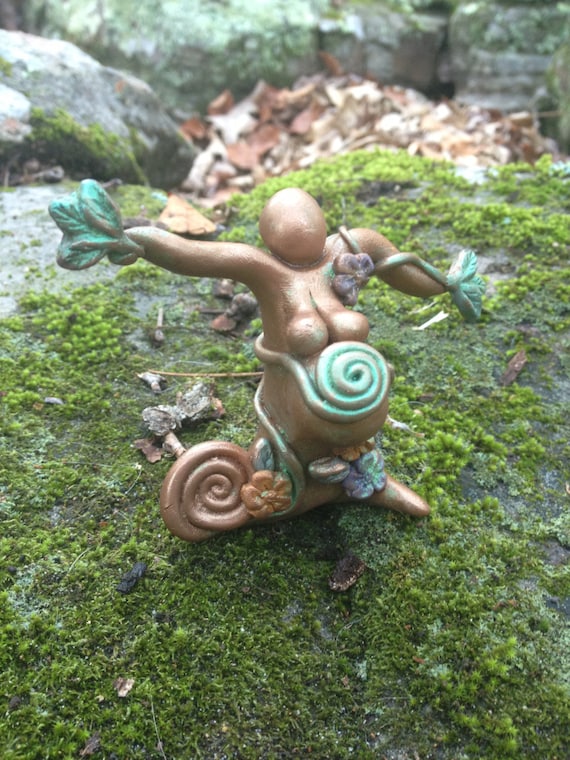
I am at the point in my school session in which I’m barely keeping my head above water! So, since I recently made a tree mama sculpture and because I recently helped do a tree-themed henna design on a pregnant mama, I decided to just go with some quotes today and call it a day!

I’m definitely no Mandala Journey, but my mom and I did a tree mandala attempt with my friend anyway:


And, the next day she had her baby! I think he was waiting for henna… 🙂

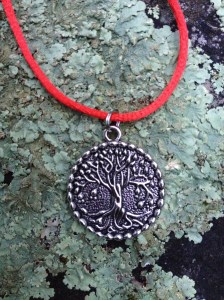
I also added some simple tree of life “birth amulet” pendants to my etsy shop! 🙂
Sept 2013 010

Talk Books: Sweetening the Pill

I haven’t actually read this book yet, or even obtained a copy, but I am intrigued enough by the promo spot that I’m doing a short blog post about it anyway! I’ve struggled with the question of birth control for some time. I took the pill for about six years and then after having my first baby in 2003 and going on the minipill, I had the sudden “epiphany” that if I was so committed to natural birth and breastfeeding and natural living and trusting my body, why the heck was I okay with filling said body full of hormones?! (The same epiphany, but including cloth diapers, led me to start using cloth moon pads rather than disposable as well. Never looked back!) We started using natural family planning instead (really, the Billings method) and it has been excellent for nine years—no “accidents” and more babies exactly when we decided we wanted them. And, no side effects, no money, and no hormones. Now that our family size feels complete, I find myself struggling with whether or not NFP will continue be “enough” until natural infertility takes over. NFP was fine when an accidental pregnancy was an acceptable option. At this point, an unexpected pregnancy would still be an acceptable option, however fast-forwarding the clock, I really, really, really, do not want to be someone who ends up having her first unexpected pregnancy at age 45 or something! I also do not want to engage in any permanent body-modification efforts (for either myself or my husband) when my own fertility will be up in the next 15 years or so (but body modification is forever!). So, I feel very optionless at this point…Anyway, on to the book I haven’t read. Here’s the promo copy I got that piqued my interest!

SWEETENING THE PILL OR HOW WE GOT HOOKED ON HORMONAL BIRTH CONTROL by Holly Grigg-Spall
Book Description: Millions of healthy women take a powerful medication every day from their mid-teens to menopause – the Pill – but few know how this drug works or the potential side effects. Contrary to cultural myth, the birth control pill impacts on every organ and function of the body, and yet most women do not even think of it as a drug. Depression, anxiety, paranoia, rage, panic attacks – just a few of the effects of the Pill on half of the over 80% of women who pop these tablets during their lifetimes.When the Pill was released, it was thought that women would not submit to taking a medication each day when they were not sick. Now the Pill is making women sick.However, there are a growing number of women looking for non-hormonal alternatives for preventing pregnancy. In a bid to spark a backlash against hormonal contraceptives, this book asks: Why can’t we criticize the Pill?

Carol Downer of Women’s Health in Women’s Hands makes a really important that our feminist health commitment to birth control access may blind us to the actual poor health impacts of the Pill:

“We discovered in the ’70s that the personal is political. Holly Grigg-Spall starts with her and other women’s personal experiences with the Pill, then thoughtfully and thoroughly considers it scientifically, medically and philosophically to discover the political truth of the Pill. She shares strategies for finding new ways to control our fertility while regaining control of our destiny. Grigg-Spall’s careful study on the Pill’s effect on women’s health is long, long overdue. We are so busy fighting to keep hormonal birth control available that we don’t want to question what it is doing to our health and our lives. After reading this book, we can never see the Pill in the same way again.”

Comments and resources welcome! 🙂

Talk Books: One Recumbent Mommy

Some time ago I received a unique memoir to review along with a companion book for children. The topic of One Recumbent Mommy is bedrest and the book is written in a friendly, conversational, and personal style that has potential to bring an air of sisterhood to women experiencing the same challenge and make them feel less alone. The book is based on the author’s blog and a casual, breezy, lighthearted style comes through strongly. The author writes:

I was on hospital bedrest with incompetent cervix for about 16 weeks and while there, I kept a blog chronicling the ups and down of day to day life in the hospital.  That blog was published and is entitled, One Recumbent Mommy: A Humorous Encounter With Bedrest.  I wrote a children’s companion book as well, entitled Wherever I Am, I Will Love You Still: A Book About An Extended Hospital Stay.  This book was written from my 2 year old son’s point of view.  I was trying to get at a way of explaining the situation in terms that a young child could understand.

The companion children’s book: Where I Am, I Will Love You Still, is friendly and sweet and the illustrations are engaging. This book would be a very useful addition to a family whose mother is experiencing a hospital stay. While the book’s conclusion includes the new baby sister coming home, it definitely has the potential to be applied to non-maternity-related hospital stays as well. Do note that bottle feeding is portrayed in the book.

While I was somewhat disappointed by the very conventional medical model of care in One Recumbent Mommy and the seemingly unquestioning acceptance of it by the author (especially considering that bedrest has come under serious scrutiny as to its actual effectiveness at preventing pregnancy loss), as well as the apparently overlooked irony of the baby’s birth then being induced, I appreciated the reminder that for many women pregnancy is anything but a joyful, flower-strewn walk through a miraculous meadow of belly casts and earth-goddesses. My writing and my posts often trend to a Happy Birth Dance! mode of writing about birth and was beneficial to me to remember that this model can feel very isolating, discouraging, and depressing to women whose experiences of pregnancy and birth are different from my own.

Along this same line of thought, I was reminded of recent writings from beautiful blogger Leonie Dawson about her experiences with severe hyperemesis gravidarum (requiring multiple hospitalizations):

And despite everything – despite it all –

Love is calling me forward.

As ancient as the beginning of time, love calls upon us to do what we could not do without.

Love asks of us great things…

via The Love That Calls Us Forward | Leonie Dawson – Amazing Biz, Amazing Life.

As I read One Recumbent Mommy and my priestess/ceremonialist self came to fore however, I also found myself wishing this mama had had some kind of beautiful hospital blessing ceremony to honor her commitment to her baby or that someone had offered her a nurturing prayer, poem, or blessing for her as a Bedrest Warrior doing what had to be done to protect her baby. Could there be a place for a Happy Bedrest Birth Dance mode of writing and experiencing as well? I gratefully welcome additions to this post of ideas for rituals, poems, prayers, or resources that can be offered to bedrest mamas who are doing their best to welcome a healthy, full-term baby into their lives! 🙂

Tuesday Tidbits: Postpartum Mamas

As Americans, we are under the impression that new moms are ‘Superwomen’ & can return to life as it was before baby. We must remember to celebrate this new mother and emulate the other cultures that honor new mothers by caring for them, supporting them, & placing value on the magnificent transformation she is going through. This is the greatest gift we can give to new mothers & newborns…–Darla Burns (via Tuesday Tidbits: Postpartum Mothering)

“The first few months after a baby comes can be a lot like floating in a jar of honey—very sweet and golden, but very sticky too.” –American College of Nurse-Midwives

The United States are not known for their postpartum care practices. Many women are left caught completely off guard by the postpartum recovery experience and dogged by the nagging self-expectation to do and be it all and that to be a “good mother” means bouncing back, not needing help, and loving every minute of it.

This country is one of the only utterly lacking in a culture of postpartum care. Some version of the lie-in is still prevalent all over Asia, Africa, the Middle East, and particular parts of Europe; in these places, where women have found the postpartum regimens of their own mothers and grandmothers slightly outdated, they’ve revised them. The U.S. seems only to understand pregnancy as a distinct and fragile state. For the expectant, we issue reams of proscriptions—more than can reasonably be followed. We tell them what to eat and what not to eat. We ask that they visit the doctor regularly and that they not do any strenuous activity. We give them our seats on the bus. Finally, once they’ve actually undergone the physical trauma of it, their bodies thoroughly depleted, we beckon them most immediately to rejoin the rest of us. One New York mother summed up her recent postpartum experience this way: “You’re not hemorrhaging? OK, peace, see you later…”

…“A culturally accepted postpartum period sends a powerful message that’s not being sent in this country,” said Dr. Margaret Howard, the director of the Day Hospital for Postpartum Depression in Providence, Rhode Island. “American mothers internalize the prevailing attitude—‘I should be able to handle this myself; women have babies every day’—and if they’re not up and functioning, they feel like there’s something wrong with them.”

via Why Are America’s Postpartum Practices So Rough On New Mothers? – The Daily Beast.

Via First the Egg, I then read this powerful reflection prompted by the article above:

In the piece, one woman mentions that women are literally still bleeding, long after they’re expected to “bounce back” and reclaim their old lives and be totally self-sufficient. Our bodies haven’t finished healing, and we’re supposed to look and act as though nothing even happened here, it’s all good. It’s all just the same as it was.

Secretly, I’ve been the slightest bit ashamed of all the help I’ve needed.

via Eat the Damn Cake » bleeding time.

I also read this raw, honest, and touching look at the “betrayal” experienced by women who enter into the mystery of birth expecting a blissed out, earth mother, orgasmic birth experience:

…But inside my head, I could not believe what was happening. How painful it was. How terrifying. I felt helpless. And degraded and humiliated by there being witnesses. And at the same time, I felt so, so alone. I remember at one point saying, completely out of my mind, “I don’t understand why no one is doing anything to help me! Please help me!” Della reminded me that what I was feeling was the baby coming. That I was doing just what I was supposed to, having the baby, right then….

via Mutha Magazine » S. LYNN ALDERMAN’S Ugliest, Beautiful Moment (Or, Fuck Ina May).

And, that made me think of my own thoughts about birth regret and how we may hide it from the pregnant woman we perceive as vulnerable in her beautiful, fleeting state as Pregnant Woman:

I’ve come to realize that just as each woman has moments of triumph in birth, almost every woman, even those with the most blissful birth stories to share, have birth regrets of some kind of another. And, we may often look at subsequent births as an opportunity to “fix” whatever it was that went “wrong” with the birth that came before it. While it may seem to some that most mother swap “horror stories” more often than tales of exhilaration, I’ve noticed that those who are particularly passionate about birth, may withhold or hurry past their own birth regret moments, perhaps out of a desire not to tarnish the blissful birth image, a desire not to lose crunchy points, or a desire not to contribute to the climate of doubt already potently swirling around pregnant women…

via Birth Regrets? | Talk Birth.

Which then made me think about the women who know...

Where are the witches, midwives

and friends

August 2013 011

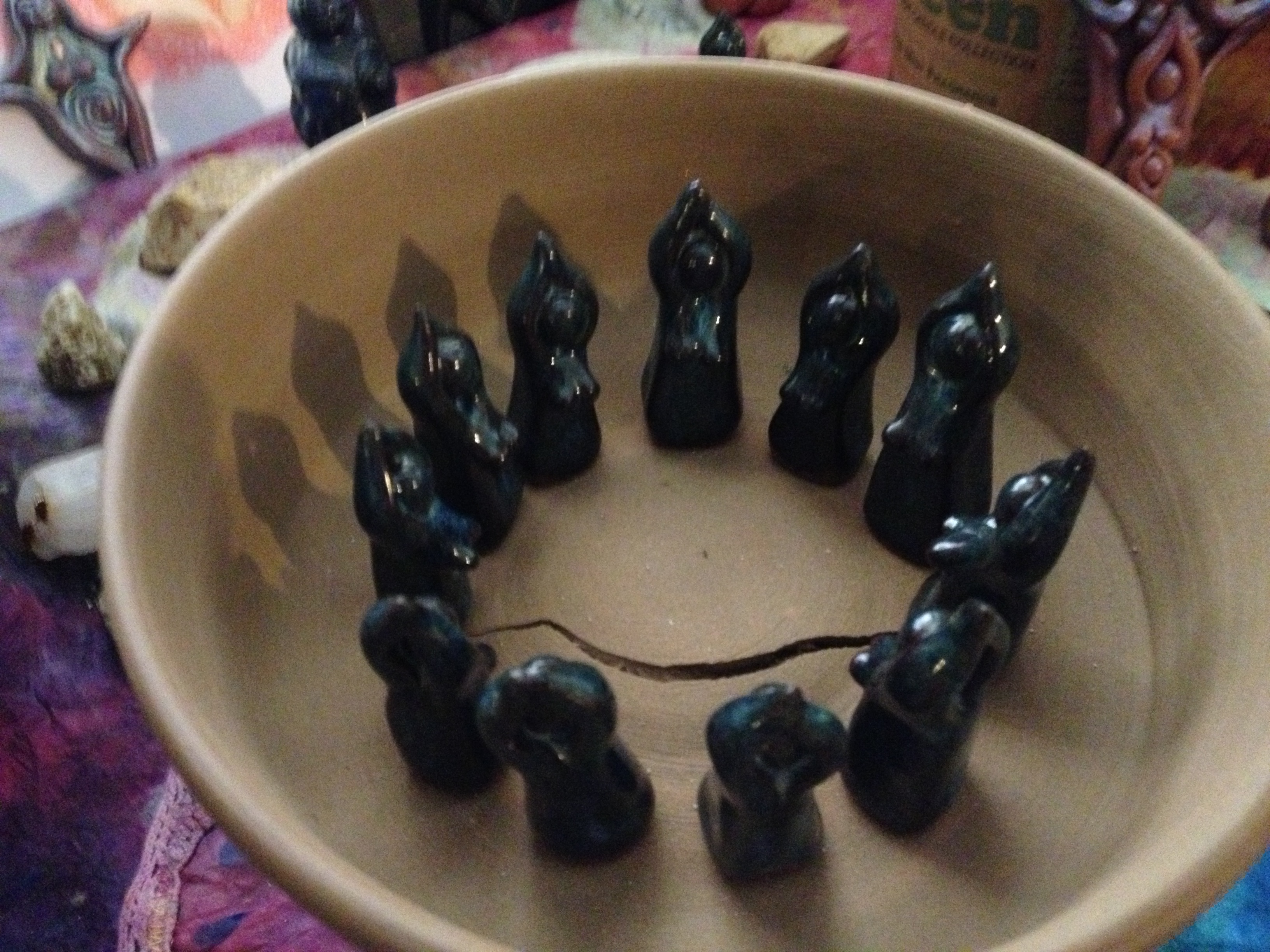
Circle of women sculptures as gifts for my women’s group. Yes, there’s a crack—“the world cracks everyone”—but that is how the light gets in…

to belly dance and chant

while I deliver

to hold me and breathe with me

as I push

to touch me and comfort me

as I cry?

Where are the womyn who know

what it’s like

to give birth?

via Where are the women who know? | Talk Birth.

Thinking about that reminded me of the chant we sang around the fire at the festival I just returned from on Sunday night:

Dance in a circle of women,

Make a web of my life,

Hold me as I spiral and spin,

Make a web of my life…

via Goddess Chants – Dance in a Circle of Women by Marie Summerwood.

May all pregnant women and tender postpartum mamas dance in a circle of women!

I’d hoped to have time to post a festival recap and some lessons learned, but other responsibilities take precedence at least for today, so I’ll leave you with one of the pictures my sister-in-law took on a misty morning, sunrise stroll around the lake and another that I took in the Temple at the festival:

Sept 2013 090

Sept 2013 036

See also:

Postpartum Survival Tips

Timeless Days: More Postpartum Planning

Mothers Matter–Creating a Postpartum Plan

Planning for Postpartum

Some reminders for postpartum mamas & those who love them

Birthing the Mother-Writer (or: Playing My Music, or: Postpartum Feelings, Part 1)

Postpartum Thoughts/Feelings, Part 2

Postpartum Feelings, Part 3

What to tell a mother-to-be about the realities of mothering…

Tuesday Tidbits: Pain, Birth, and Fear

20130903-200523.jpg  “…if you want to know where a woman’s true power lies, look to those primal experiences we’ve been taught to fear…the very same experiences the culture has taught us to distance ourselves from as much as possible, often by medicalizing them so that we are barely conscious of them anymore. Labor and birth rank right up there as experiences that put women in touch with their feminine power…” -Christiane Northrup

During my first pregnancy, I read like crazy. I felt like I was studying for the biggest test of my life, only it was impossible to know what was actually going to be on it. When I actually gave birth, I was delighted to find I was able to get out of my head and trust my body. Quite some time later, I figured out that information about birth does not equal knowledge about birth.

We spend a lot of time informing and educating women about their choices surrounding birth and are often then surprised that this apparent information does not translate into experience once in the birth room. Obviously, this is partially because the birth room is a context impacted by a large number of social, cultural, psychological, and environmental factors, but I believe it is also because with all of our information we still haven’t managed to help parents develop knowledge and the two are not the same. Parents are often not able to recall or to mobilize information resources while actually embroiled in the birth experience. They need an inner knowing and inner resources to draw on for coping.

via Information ≠ Knowledge

I also pondered (and continue to ponder) how women really learn about birth. Like I did, most of them seek out written information and this can lead to information overload…

With the wonderful world wide web available to us 24/7, the deluge of information we encounter (and seek out) during pregnancy can feel a lot like drowning. So many choices, so much to learn, so much to digest. There are times when everything seems to come into question — from what you eat during pregnancy to whether you should create a birth plan…

via Stop Birth Information Overload by Getting Back to Basics — Giving Birth with Confidence.

My all-time favorite article about the notion of this “information feeding frenzy” engaged in by pregnant women is by Pam England who explains the following:

It would seem at first glance that a mother who gathers lots of information during pregnancy is motivated and headed in the “right direction.” However, a more important detail of her preparation is her being aware of what is motivating her to August 2013 041become so well-informed. What does the drive for information feel like in her body? How does she know in her bones and gut how to use the information? And to what degree is she is aware of any of this?

If she is not listening to the subtle messages in her body, in her breath, in her dreams, or in the patterns in her thoughts and emotions, then she is acting from her conditioning and not from awareness. From the outside, no one may be able to tell the difference, but on the inside, she will feel the difference…

via Birthing From Within – Information Frenzy.

Which brings me back to this quote:

“I usually claim that pregnant women should not read books about pregnancy and birth. Their time is too precious. They should, rather, watch the moon and sing to their baby in the womb.” –Michel Odent

via How Do Women Really Learn About Birth?

And also to another of my own articles about information overload during pregnancy:

Many pregnant women have information overload. They are faced with more information than they know what to do with. They are bombarded by it. What they really need is “knowing.” They need to know: “What skills do I possess or can learn that will help me greet my birth with anticipation and confidence? What are my tools? My resources? Can I just let it happen?” As an educator I ask myself, “What will help them feel confident? Feel ready? Trust their bodies and their capacities?”

via Talk Less, Learn More: Evolving as an Educator

A lot of this information feeding frenzy, including that of my own first pregnancy, may be related to fear of labor, pain, and the unknown.

Could it be that human fear of pain is being used to generate financial profit? (the opium-is-the-opiate-of-the-masses model). Perhaps once the notion of palliative care reached a certain level of acceptance for the dying within the medical community, it began to spill over into other human conditions (the slippery-slope model). Or, perhaps we don’t want transparency at all (the denial model)…

…I can think of many questions that fall under this topic…Why do we call the intense phenomenon of birth “painful”? How do our genetics, behavior, training and thought-processes affect our experience of pain? What about the health care culture – has it focused on relieving pain at the expense of what we gain from working with pain short of trauma or imminent death? How do we prepare women for working with sensation without automatically labeling it pain? Is the “empowerment” often attributed to giving birth what is learned by going through the center of the “there is no birth of consciousness without pain” experience? These questions are just a start…

via About Pain and Birth | Dancing Thru Pregnancy® Blog.

Could these fears also be tied to our cultural lack of appropriate vocabulary for pain?

A childbirth educator interviewed during the film briefly discusses pain and says that we need more words for pain, because it is ridiculous that we have only one word that is used to describe a hangnail, a broken leg, being hit by a car, and labor. I had already been musing about pain during labor and how we perceive it, talk about it, and so forth and this comment was additional food for thought for me. I’m thinking that there are many other words used to describe women’s experiences of labor and birth other than pain–a word that is limited in scope and that for some women may well not even apply to the experiences in birth

via Words for Pain

Or, to a fear of “losing control” during labor?

A topic that frequently arises in birth classes is about the fear of “losing control” in labor. Losing control, “losing it,” or “freaking out” are concerns expressed by women preparing to give birth. It is important to acknowledge that this is a common fear. I also like to ask parents to think about what “freaking out” or “losing it” would mean to them? I ask them to consider what benefits there may be to losing control. I also say, “What if you do freak out? Maybe, so what?! Maybe it is okay. Maybe it is good. Maybe it is helpful…”

via Fears About Birth and Losing Control

Or, perhaps more simply, to a lack of trust in our care providers?

I was interested to read a short segment in the book Labor Pain about studies on fear about birth. A Swedish study indicated that it was not pain that caused women the most anxiety about labor (44% of women had fear of pain). It also wasn’t fear of death of the mother or baby (55% worried about this). It wasn’t fear of their physical or mental capacity to give birth (65% feared this), but it was “lack of trust of obstetric staff during delivery” (73%).

via Fear & Birth

Men may also feel a lot of fear surrounding birth and have few ways to express it:

Although a man cannot feel the same pain as a laboring woman, I believe that many men experience a similar cycle of emotions in the birthing space to that which Dick-Read described, with a slightly different end product, namely: Fear > Tension > Panic. A man who is not confident in his partner’s birthing abilities, who is poorly informed, and/or who is poorly supported, becomes increasingly tense; and if this tension is not eased, then he spirals into an irreversible state of panic. This panic manifests differently in different men: some men become paralyzed by their fear (the familiar specter of the terrified dad sitting stock-still at the foot of the bed), while others spring into hyperactivity, bringing endless cups of water or becoming obsessively concerned with the temperature of the birth pool.

via Fathers, Fear, and Birth

I think it is also important to recognize the deep gifts to be found in facing our fears and doing it anyway:

We may feel guilty, ashamed, negative, and apologetic about our deepest “what ifs.” We worry that if we speak of them, they might come true. We worry that in voicing them, we might make homebirth or midwifery or whatever look bad. We don’t want to add any fuel to the fire of terror that already dominates the “mainstream” birth climate. And, we don’t want to lose “crunchy points.” We want to be blissfully empowered, confident, and courageous. And, guess what? We are. Sometimes that courage comes from looking the “what ifs” right in the eye. Sometimes it comes from living through them. My most powerful gift from my pregnancy with my daughter, my pregnancy-after-loss baby, was to watch myself feel the fear and do it anyway. I was brave. And, it changed me to learn that.

What if we can learn more from our shadows than we ever thought possible? There is power in thinking what if I can’t do this and then discovering that you CAN…

via What If…She’s Stronger than She Knows… | Talk Birth.

20130903-200533.jpg

Listen to the wise woman…

20120928-123955.jpg

Mini mamapriestess sculpture I made to take with me for my medicine bundle.

Last summer after I finished my priestess certification and I’d been facilitating women’s retreats for two years, I got a wild idea to go to a womanspirit or goddess festival of some kind. I did a google search and found one that sounded great—the Gaea Goddess Gathering–and it was happening in just two weeks. Imagine my surprise to then look at the bottom of the screen and see that it was located only a five-hour drive from me, just over the border into Kansas. I decided it was “meant to be.” My mom and a friend signed up with me (and Alaina) and we packed up my van and went! The night before we left on our adventure, I sat down at the kitchen table and felt a knife-like stinging pain on the back of my leg. I’d accidentally sat on a European giant hornet (these are not regular hornets, they are literally giant hornets about two inches long).

20120928-123138.jpg

Sting before I left.

Though it became hot and swollen and terribly painful, we set forth anyway. I asked for input on Facebook and did google research and started putting benadryl cream on it, even though I usually go with home remedies over medical-model remedies. It got worse and worse, eventually running from my hip to my knee and wrapped around my entire leg so
that two thirds of my thigh was sting-area and the difference in size between my legs was noticeable through clothing. During the festival, as I watched myself get worse and worse and people kept making remarks about needing epi-pens and maybe I should go to the hospital, I decided to dispense with the benadryl and listen to the wise women instead. My friend found plantain and made me a poultice. The cook gave me baking soda that I applied in a paste. I went to a ceremony that involved a healing ritual with sound and a priestess in a tent beat a drum over me as I lay there on my stomach. After a little Reiki healing, she then leaned very, very close to my ear and said quietly, “are you taking good enough care of yourself? You give and give and it is time to receive. You need to be taken care of too.” And, I cried.

20120928-123203.jpg

Sting after arriving. I didn’t take any pictures of it at the worst. It got about twice as bad as this. Every time I thought it could not possible get worse, it got twice as bad!

I came out of the tent and laid on a bench and women I didn’t know came and put their hands on my back and made me tinctures of strange plants they found in the herb garden and I drank it even though it almost made me gag. Another woman I didn’t know rubbed my back and though I couldn’t even see her face, she leaned close to my ear and said, “sometimes life stings you. Your friends, your family, being a parent, taking care of your children. It stings sometimes. Things people say without meaning to sting you. You’re sensitive, Sometimes it stings a lot and you worry that you’re not good enough. I see you with your baby. You are such a good mother.” And, I cried again, lying there on bench in the middle of nowhere with my dress pulled up and my red, sore, swollen, horrible thigh covered with a poultice of mysterious weeds, surrounded by women I didn’t know, but who were caring for me. And, I got better. By the time I got home, the sting was almost totally healed.

As soon as I returned home, I made a list, intending to develop it into a blog post about everything I’d learned at this gathering of women. The list languished in my drafts folder and the wheel of the year continued to turn and now it is September again and next week, some friends and I will be hopping back in my van and heading back to the GGG for this year’s festival. I decided the blog post will never get “developed” into the post I had intended, but that I can still share my list anyway. I also realized that I have been reluctant to post it here for fear of being too “weird” and alienating readers. But, Talk Birth is like a buffet, you can take what works for you and leave the rest! 😉 I’m also writing now because I’m going to go ahead and give myself a week off from blogging and I wanted to post some sort of explanation as to why. I’m going to focus on getting ready for the festival (I’m selling jewelry while there too!) and hanging out with my family (and, oh yeah, grading all the papers that are due this Sunday night!).

So, what did I learn at the GGG?

  • I have a lot to learn
  • Likewise, I know more than I give myself credit for—I am both more skilled than I may think and less skilled than I’d like to be.
  • I want to be more confident
  • I need to always remember to look for a wise woman when I need help. And, that allowing myself to be cared for by strangers is a surprisingly powerful experience.
  • I am much more quickly judgmental than I realized or like to admit—I judge the book by its cover and assess “worth” by appearance more often than I thought and I disappointed myself with that. I learned that ALL women have hidden gifts and I was surprised over and over again what people had to offer, that their appearance might not have suggested.
  • My body knows how to heal (I’ve learned this before, also from a bug)
  • It was great to have just one-on-one time with Alaina. She just wants to be with me. I didn’t have to cook/do laundry or anything else. I just toted her around which is exactly what she needs/wants (*note from this year: she still wants exactly this and I’m looking forward to giving it to her).
  • My mom is incredibly creatively gifted. And, I’m lucky to be around so many creative women in my own community. They have awesome gifts!
  • I don’t need to do everything—other people have their own talents and I don’t have to “do it all,” all of the time.
  • But by the same token, I don’t have to be good at everything and it is still okay to do things and be bad at them, but still try. (However, it also good to let other people have their specialties/share their gifts. I don’t have to do it all.)
  • I can be open to receive.
  • I can be a singer! Perform in a group! Feel awesome!
    20120928-123214.jpg

    Once this started, I knew I’d made the right choice to come after all!

  • Ditto drummer!
  • Explanation of the two points above which also connect to the one about not having to do everything and yet it also being okay to try. One of the sessions at the festival was the “GGG Soul Singers.” One of the women taught a large group of us several cool songs. During the special dinner that night, we got up together with sound equipment and everything and performed our songs. Everyone was yelling and cheering and clapping and it was great. So much fun! I’m a terrible singer, I know that, but that night I felt like I was amazing. And, I learned that being terrible at something doesn’t mean you can’t do it anyway and enjoy yourself. I’m looking forward to doing this again this year! At this festival I was captivated by these massive community drums the women had. Large enough to be played by four or even more women at once, I absolutely loved them. Even though I didn’t know what I was doing, I tried, and discovered I could indeed do it. I could drum and sing and keep up with the group. When I got home, I decided I must have a drum like this and spent way too much money and ordered one online. And, even though I’m tone-deaf and “non-musical,” I can play it. And, I’m still amazing, whether I really am or not!
  • I felt both more and less competent—related to knowing a lot and yet having a lot to learn, I discovered that I’m a pretty good ceremonialist, a lot better than I’d given myself credit for, but that some other people are way better than me (and others are not. What matters is trying).
    20120928-123806.jpg

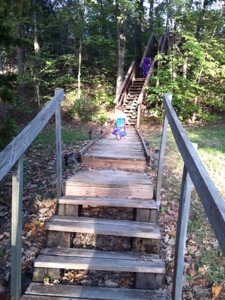
    Intense stairs from the dining hall and lodging to the “ridge” where ceremonies took place. Navigating these was NO FUN with that sting on my leg! But, isn’t tiny Alaina cute setting off on her own and heading on up?!

  • I was acknowledged/recognized as priestess/clergy to my own circle of women and it felt very good to be seen in that way. I’m trying to be/offer/bring something to the local area that still feels tender and vulnerable in myself. I lack some confidence. Want to build it! And, yet, I do it anyway. I’m brave! Maybe I’m not as skilled or musical or awesome as I could be, but I’m pretty darn good and…at least I TRY!
  • Want family to be clear priority. Family harmony is a top goal. I want to make sure to give them my good stuff too! Don’t save my passion and enthusiasm for “others” only!

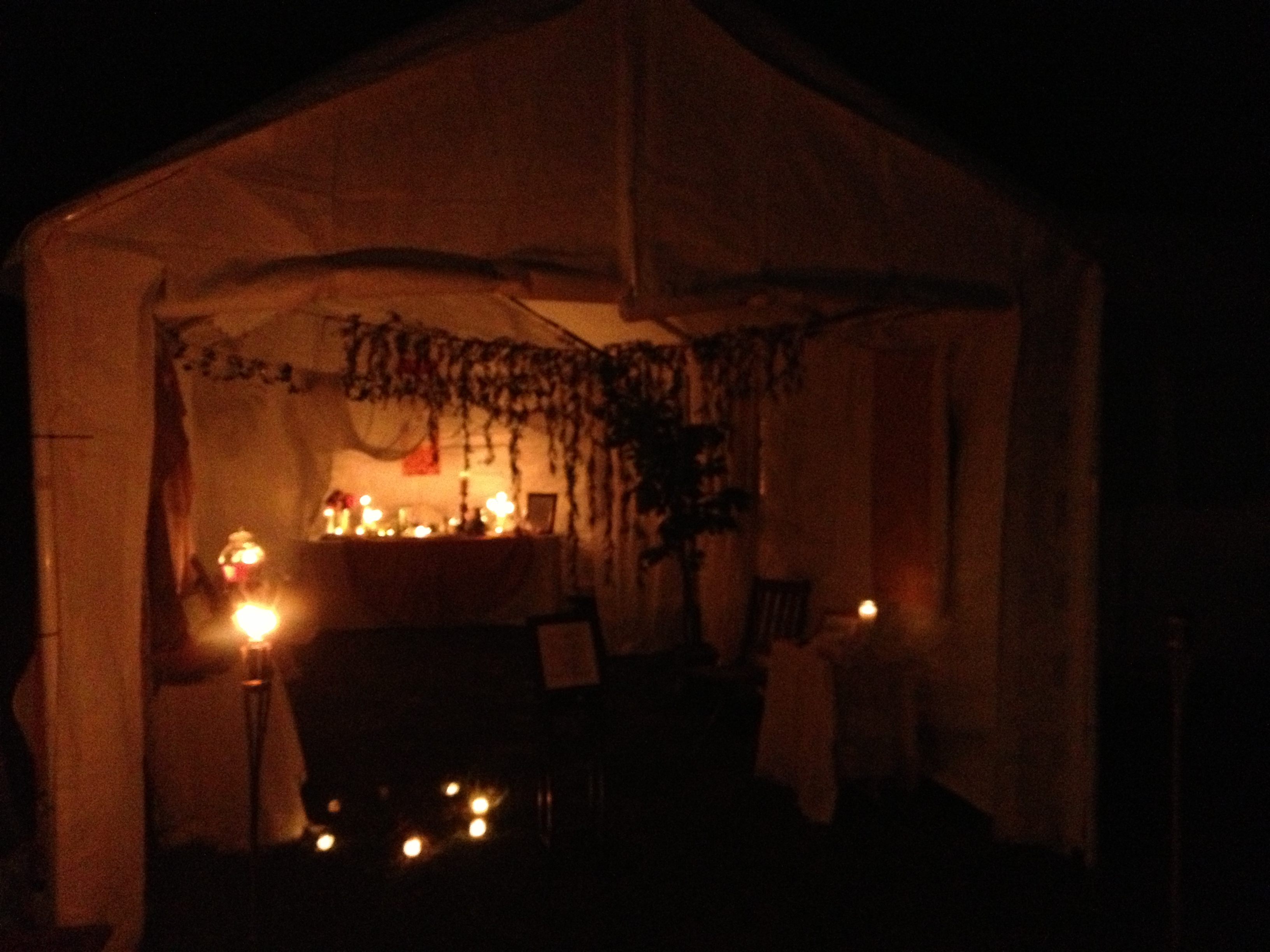
When I got home from this festival, I was so inspired that I planned and facilitated a pretty great nighttime, firelit “sagewoman” ceremony in a teepee (with drumming on my new community drum) for the wise women of my own community. As a ritualist/ceremonialist, I learned from the GGG-experience that ambiance really, really matters in offering a cool ritual.

Since last year, I’ve developed my ceremonialist skills even further and last month received an additional supplemental ordination from the American Priestess Council. I’m almost three years into my D.Min program, I’ve taken advanced coursework in ritual design as well as pastoral counseling, liturgy, the role of the priestess, ethics, history, and so forth. At this time last year, I was struggling with whether or not it was “okay” for me to own the Priestess identity I felt “called” into and at the GGG I was seen and heard into this identity particularly by my friend and also by my mom. It turns out it is okay for me to serve others as a Priestess and to claim that title with authenticity even though I’m not as perfect and amazing as I feel like I should be (I’m also a blogger for SageWoman magazine and I’m currently working on a post called who does she think SHE is, that is about exactly this tension).

Some more pictures:

20120928-123107.jpg

Henna feet! From the woman who did this for me, I learned the phrase: “sparkles are my favorite color.”
20120928-123044.jpg

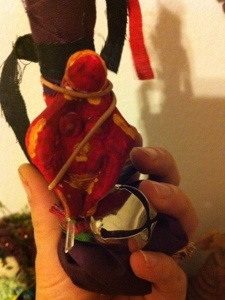
Medicine bundle! This was the best class ever. The woman brought piles and piles of random and awesome stuff and it was all free to choose what you wanted for your bundle. How cool is this face?!

20120928-123839.jpg

She also had simple clay goddesses for us to paint and attach as well as we could.

20120928-123121.jpg

Pensive little Lainey looking back thoughtfully at the stairs up which she just journeyed.

20120928-123746.jpg

Back home demo’ing a beautiful sarong gifted to my by my seeing friend!

20120928-123817.jpg

What’s this…

20120928-123825.jpg

…I hear…big DRUMS!

20120928-123850.jpg

When I got home, I was inspired to make some new sculptures and Mark cut a lovely gemstone and made a pendant.

Here I go again! I wonder what lessons await me this year…