I am a Story Woman

“The greatest gift we can give one another is rapt attention to one another’s existence.” –Sue Ellen quoted in Sacred Circles

“Human connections are deeply nurtured in the field of shared story.” –Jean Houston

I am a strong woman, I am a story woman…

I’m busy preparing for a New Year’s Eve ritual on Monday, the first ritual like this for which we will include all family members instead of just women. As I was getting our “family fireside circle” song sheet ready, my husband asked a question about one of the lines in one of the chants…I am a strong woman, I am a story woman…

“I’m not sure about this,” he said, “what is a story woman anyway?” I wasn’t able to give him a solid answer at that moment, but guess what, I am one.

In fact, didn’t I just write earlier this week that story holds the key to the reclamation of power for women? How and why does this work?

Because of these two things:

“The one who tells the stories rules the world.” –Hopi Indian Proverb

“We feel nameless and empty when we forget our stories, leave our heroes unsung, and ignore the rites of our passage from one stage of life to another.” –Sam Keen and Anne Valley-Fox

We need to hear women’s stories. We need to hear each other into speech. We need to witness and be witnessed. We need to be heard. We need to shift the dialogue of birth and, indeed, most aspects of women’s lives into powerfully positive “what if’s” and courageous explorations of our “negative” stories. When we hear the experiences of other women, of other people, sometimes it lights something in us and we are able to go forward in a way in which we would not have done without that story…

“Once the imagination has been kindled, we begin to see choices that we had never even seen before…but just seeing that we have different options and choices rarely gives us the strength we need to exercise these options. For this we need more than imagination. We need the courage to reach beyond ourselves, extending our hands to one another…” –Robin Deen Carnes and Sally Craig

And, then, this afternoon we had an ugly, sad, overtired, family-wide meltdown about homeschooling. I don’t really want to bother reliving the agony by typing up everything that happened, because we’re all back to normal now, but it was really the same old story. Parent suddenly gets bee in bonnet that kids (who are perfectly happy at the time pursuing their own interests and living robust lives) “should” be doing something different. Kid doesn’t live up to expectations and is, in fact, so unable to perform a very simple, basic task, that questions arise in parents’ minds about kid’s mental capacities. Parents feel personally responsible and like homeschooling parent failures as well as annoyed with kid who should know this already. Brief ranting and raving ensues along with hurt feelings. Sweeping pronouncements are made about what needs to happen to transform all of our lives into properly performing homeschooling bliss.

During this time, I abruptly decided this was IT, I HAVE TO STOP BLOGGING. I cried and cried. I don’t want to quit, but, if I can’t do homeschooling properly I certainly don’t deserve to be a blogger. And, then I remembered these quotes about stories and I especially remembered this one:

“As long as women are isolated one from the other, not allowed to offer other women the most personal accounts of their lives, they will not be part of any narratives of their own…women will be staving off destiny and not inviting or inventing or controlling it.” –Carolyn Heilbrun quoted in Sacred Circles
mollyatparkAnd, also this one:

Telling our stories is one way we become more aware of just what ‘the river’ of our lives is. Listening to ourselves speak, without interruption, correction, or even flattering comments, we may truly hear, perhaps for the first time, some new meaning in a once painful, confusing situation. We may, quite suddenly, see how this even or relationship we are in relates to many others in our past. We may receive a flash of insight, a lesson long unlearned, a glimpse of understanding. And, as the quiet, focused compassion for us pervades the room, perhaps our own hearts open, even slightly, towards ourselves.

–Robin Deen Carnes & Sally Craig in Sacred Circles

And, just last night, I got a beautiful thank you note for the Mindful Mama essay that I wrote in 2008 and that was updated/published in 2011. My stories, my words, were serving as “medicine” for another woman while I was cooking dinner last night, even though I actually wrote them several years before. That is story power. I am a story woman.

Last month, I had an email chat with a friend about why we write in the first place. She’d written a blog post about her family and as I read it I was reminded of how glad I am I blog and why I don’t want to give it up. Her post was a post like that—one that will bring back a whole collection of memories that have slipped from conscious memory. At the time of our exchange, I’d been looking back at some of my own old posts and found the ones I wrote about Pinterest day and it was so much fun to re-read them, because I’d already forgotten some of the recipes we’d tried. And…that was only after like six months have passed. It will be even more fun in a couple of years 🙂 I can remember having this fear (or whatever) of forgetting even since I was a girl. I write to remember. In fact, I’d actually left a comment on a Literary Mama blog post on the subject:

I write to remember. I write to share. I write to preserve. I write to collect. I write to store. I write for myself. I write for my children. I write for others. I write for perspective. I write to play my life’s music. I write because I just can’t help it. I write to pay attention and to tell about it.

I do feel like I have to have a balance between personal memory stuff and other information/education/advocacy on this blog because I don’t want to overdose readers on the picture of my kids and make people bored. I also have probably 100 ideas for posts before I actually get to write one. If I was only blogging for myself (and my future memory) I’d make more of the shorter, personal, picture-type posts, but I start to worry “who cares” and so I put up something educational! (BUT, as it turns out, the pictures/personal/kids stuff is NOT boring to me in other people’s blogs or in going back to my own.)

As another example, a couple of weeks ago, I came across the post I’d written based on a journal entry about Alaina when she was a one month old (Memories of a One Month Old…). This is exactly why I do it and why I’m not going to stop. Because reading what I wrote that day in my journal brought that one month old treasure of a baby girl back into my arms for a few moments in vivid clarity, rather than just as a hazy, distant recollection. It isn’t that you truly forget without having written it down, but that in the reading of your old story, a powerful, stored, storied memory that you had forgotten how to access fully is reactivated.

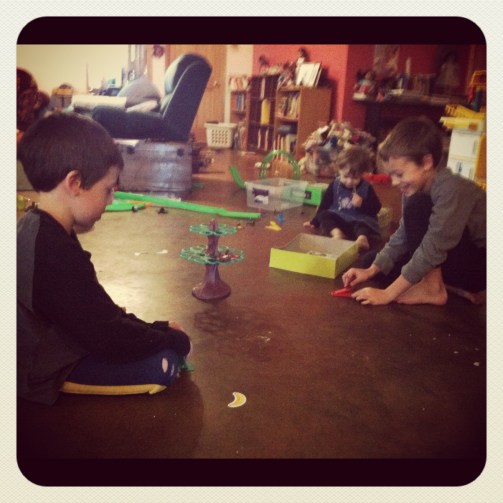
Also a couple of weeks ago, I got a little tear in my eye when Alaina came to get me in the bedroom showing me her handful of monkeys from the “monkey jump game.” When Lann was about her age if you asked him if he was a big boy, he would answer: “I not bigger yet, I can’t reach the monkey jump game!” Well, guess what, he reached it for them that day and they were all in the living room playing while I was getting dressed…
November 2012 243

I am a story woman.

And, I’m not quitting.

Other posts about Story:

Story Power

A Blessing…and more…

The Value of Sharing Story

The Of COURSE response…

Musings on Story, Experience, & Choice…

Taking it to the Body, Part 4: Women’s Bodies and Self-Authority

Taking it to the Body, Part 4: Women’s Bodies and Self-Authority

This is a somewhat shortened version of a prior post. I revised it to be a part of my taking it to the bodyDecember 2012 001 series.

I believe a potent source of female power lies in the female body and that body wisdom has been suppressed and denied over the course of many years as a means of oppression and control. One of the root issues of patriarchy is who “owns” women’s bodies—is it men, is it the government, is the medical system, or is it the woman herself? (you know my pick!).

Body wisdom and sources of power

Considering power, sources of power, and body wisdom, I appreciated reading Barbara Starrett’s essay The Metaphors of Power in the book The Politics of Women’s Spirituality. While she uses a different example, I have modified and paraphrased her thoughts to make the idea about birth. Starrett originally states, “We can create power centers both within and outside ourselves…Power is where power is perceived. Power resides in the mind. We can give or withhold power through our beliefs, our felt thoughts.” Medical professionals can make decisions about a woman’s body and birth choices effectively only as long as women believe that the professionals have the right to do this. When women reclaim the power to decide for themselves about birth, the doctors proclaim in a vacuum. Their power depends on the transference of our power, through our belief that this is right…Power is where power is perceived. This also means that in any given in-the-world situation, we can intentionally set up our own power centers. If we believe that power resides in those centers, it will. We will act successfully on this belief. Women’s organizations, unions, birth coalitions, etc., will never work unless we regard them, “as the legitimate centers of power…We must grant our own power to ourselves” (p. 191).

While this comes a little too close for comfort to me with the idea that “we create our own reality” (which I cannot fully embrace due to the logical extension into blaming the victim that it creates), I connect deeply with the idea that we must treat women’s organizations and work as legitimate power sources. I think of books/movements like Our Bodies, Ourselves, for example. To me, this is a definitive women’s health resource—by women, for women and separated from the medical establishment that often dehumanizes women. If we continue to believe our “alternative” structures are just that, “alternative,” then the dominant model is still the norm and still accepted, even by us, as “normal.”

Starrett continues her essay by sharing that “It is necessary for some women to risk total reclamation, to risk the direct and intentional use of power, in bold, even outrageous ways. It takes only a minority of women to alter present reality, to create new reality, because our efforts are more completely focused, more total.” (p. 193) This is the risk that the creators of Our Bodies, Ourselves took. It is the risk birth activists and women’s health activists continue to take.

Consult your health care provider?

In my own life, I am frustrated by the ubiquitous phrase, “Consult your health care provider.” No, thanks. I prefer consulting myself, my books, google, my own research, and my friends. Last time I checked, my doctor did not own my body nor did she have divine revelation as to what I need in my life. I am a breastfeeding counselor providing phone and email support to women who have breastfeeding questions. Women frequently receive very poor breastfeeding “advice” from their doctors—to the extent that I honestly think they’d receive better information by polling random strangers at Wal-Mart with their questions (and, yes, I will actually tell women this). One caller once used the phrase, “but, I don’t want to disobey my doctor” and I found this extraordinarily telling as well as depressing. I recognize that doctors have special training and can be life-saving, however, what does that say about mothering in our culture that a woman would not act on behalf of her own baby and herself because of fear of being disobedient to a professional that she has hired? She is a consumer of a service, not the subject of a ruler!

This brings me to a thought by Dr. Michelle Harrison, author of the book A Woman in Residence:

I used to have fantasies…about women in a state of revolution. I saw them getting up out of their beds and refusing the knife, refusing to be tied down, refusing to submit…Women’s health care will not improve until women reject the present system and begin instead to develop less destructive means of creating and maintaining a state of wellness.”

Indeed! And, in an essay by Sally Gearhart’s about womanpower, she notes: “…there’s no forcing any other woman into a full trot or a gallop; she will move at her own pace, but at her own pace we can be sure she will move. At this point I always remind myself that the patriarchal use of crash programs is antithetical to organic movement; in a crash program the theory goes that if you can get nine women pregnant you can have a baby in one month; it takes women, I suppose, to understand that it doesn’t work that way.” (p. 202-203)

Reclaiming power

So, how do women reclaim power? I think story holds a key to power reclamation in this context. As I’ve referenced before, Carol Christ describes it thusly, “When one woman puts her experiences into words, another woman who has kept silent, afraid of what others will think, can find validation. And when the second woman says aloud, ‘yes, that was my experience too,’ the first woman loses some of her fear.” As I touch on above, for me it is to see myself and my body as a source of wisdom and to refuse to participate in structures that do not honor my power and personal agency. It involves more often turning to my peers, to other women, for advice and comfort and support, rather than to experts.

I’ve written many times before that I am a systems thinker. Women’s choices about their bodies and about birth are not made in personal isolation, but in a complexly interwoven network of social, political, medical, religious, and cultural systems. As Gearhart notes, “There may be no ‘enemy’ except a system. How do we deal with ‘the enemy’? As seldom as possible but when necessary by opening the way for [their] transformation into not-the-enemy. What weapons do we use? Our healing, our self-protection, our health, our fantasies, our collective care…” (p. 203).

20121218-134856.jpg

Happy Holidays!

20121218-163237.jpg

My effort to make a collage greeting card this year to actually mail out to my family members was thwarted by an uncooperative WalMart.com photo site that would not allow me to preview my collage (meaning I would just have to randomly accept the results!). So, I decided to make a virtual holiday greeting this year and thought I’d pair it with a companion update post about what we’ve been up to 2012 (kind of like one of those annoying holiday letters, only more annoying, because I’m not even bothering to actually send it via real mail!)

Mark:

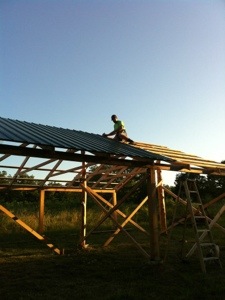
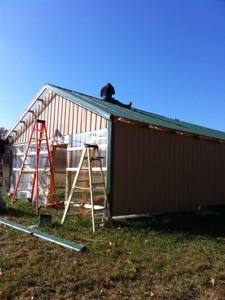
Two big projects to report this year: First, thanks to our work party (more on this later) we have a completed greenhouse building! You can read more about the process and progress on our not-often-updated farm blog:

20121218-223704.jpg20121218-223841.jpg
20121218-223658.jpg20121219-151841.jpg20121219-151849.jpg

Second, Mark has launched a Let’s Play series of Minecraft videos on his YouTube channel, RockHoundGames. Check out his most recent video and if you or your kids are Minecraft fans make sure to become a subscriber!

20121218-231101.jpg

Lann & Zander:

Speaking of Minecraft, the boys are big fans as well and even included a Minecraft themed picture in our family photo shoot! 20121218-231111.jpg

The boys have changed a lot during this year. One important change is that they’ve both been taking Taekwondo classes at Vessell’s Fitness (same place my own brother and sister both used to go)! They’re really committed to it and go to class twice a week for a total of four hours.

MollyNov 003

MollyNov 171

Oblivious to the ninjas stalking us through the forest…

They also take gymnastics class which I am less impressed with because it is twice as much money for half as many classes and 1/4 as many hours, but they absolutely love it! I got some poor-quality home video recently of their cartwheeling action:

Alaina: 

She is turning into a “real girl” instead of a baby! As long as she wasn’t talking, I still felt like she was my baby. Now, as she adds new words every day, I feel like I’ve got a little small girl instead of a baby. I caught her just saying a brand new word in a quick, poorly filmed video (my cell phone was plugged in to charge and it is hard to take a video when you’re tied to a wall!). For those of you who are friends with me on Facebook, there’s a much longer version of “Can You Say…” uploaded in my videos there.

MollyNov 111

“Nonnies” on the rocks is a favorite!

MollyNov 035

Molly:

I’m still teaching at Columbia College—both online and in-seat at the Fort on an every session basis and in Rolla on a twice a year or so basis. I love teaching online because it is perfect match for family life and integrates almost seamlessly into my days (as long as you don’t talk to me during paper-grading time!). I also love teaching in person because I love the face-to-face interaction as well as having the same students in multiple classes so that our relationship deepens over time. In January, I start teaching a hybrid class for the first time (half online/half in-seat). It should put me home before the kids get home from taekwondo! I’m really looking forward to that format. I’m still working (slowly!) on my D.Min degree in women’s spirituality. I’ve finished nine of my classes so far and I’m thisclose to finishing the tenth. On July 1st, I became ordained as a Priestess with Global Goddess and I’m really enjoying branching out more formally into the “women’s mysteries” and rites of passage work that I’ve been doing informally for a number of years. I was thrilled to officiate at my brother’s wedding in October and then at another wedding just last week.

MollyNov 083

On the priestess rocks in our woods and wearing my beautiful silk robe hand dyed by my friend.

20121218-231445.jpg

Handfasting with the lovely bride and handsome groom!

Other things that happened with our family in 2012…

We also had around 25 work parties with our amazing work party group. Being involved in this mini-community has enriched, enhanced, and changed our lives in many good ways. Our biggest project as a group was to help our friends build their straw bale house from scratch! (In 2012, we personally benefited from work party in these ways: gutters on our house, new coat of plaster on the interior living room and kitchen walls, and almost completely finishing our huge new greenhouse over the span of three work parties [see pix in Mark’s update above]). Here is a beautiful video slideshow of our friends’ straw bale house project (my dad, Tom, shows up a lot in this video because he helped on lots of other occasions other than our scheduled work party days):

This is an impressive amount of progress for less than a year!

Happy Holidays from our home to yours!

20121218-164540.jpg

MollyNov 181

All photos, save the greenhouse pix, taken by the incomparable Karen of Portraits and Paws Photography.

Birth Activism Opportunities!

Recently I got an email letting me know that I’ve been nominated for the Health Activist Hero Award in this year’s WEGO Health Activist Awards! Nominations are open through December 31st, 2012, after which judging will begin. You can “endorse” my nomination by clicking on the badge. You can also follow the happenings on WEGO’s Pinterest board. You can also nominate someone!  There are 16 award categories and there’s no limit to the number of people you can nominate with this quick form.

Second, Freedom for Birth just released a free 15 minute version of their documentary online. Check it out!

Celebrating Pregnancy & Birth Through Art

This article is adapted from my notes for past birth art workshop presentations. It is part of a story for the Winter 2013 edition of the Friends of Missouri Midwives newsletter.

Celebrating Pregnancy & Birth Through Art

by Molly Remer, MSW, ICCE, CCCE

http://talkbirth.me

See other posts and pictures about birth art here.

Birth art is one of my favorite birthy subtopics and I used art during my pregnancies, postpartum, and continuing in life today. I love exploring birth art with women and I’ve presented on the subject at multiple conferences, as well as hosted a “birth art booth” at our local MamaFest event this past fall. Art can play an important role in self-discovery and preparation for birth and parenting. Art used during pregnancy and following birth can be powerful tool of validation, celebration, exploration, and insight.

Why is art during pregnancy is useful?

Art during pregnancy is primarily as a tool to tap into “right brain” consciousness and express unexplored gifts, primal wisdom, or release hidden fears. Creating birth art can help both women and men explore your feelings, memories, beliefs, and perceptions surrounding birth outside of the confines of the spoken or written word. The purpose of birth art is to explore what you find within as you create your art and not the final product—as Pam England describes, birth art is as raw, honest, spontaneous, and personal as birth itself.

Art during pregnancy can be used for:

    • Birth preparation.
    • Exploration of fears.
    • Celebration of feelings & experiences.
    • Fun!
    • Visualization.
    • Focal point.
    • Exploration of the unknown.
    • Self-discovery & insight.
    • Healing.
    • Revealing unconscious patterns/ideas.
    • Celebration of the power of the female form.
    • Celebration of new life.
    • Representing hopes/dreams.
    • Communicating hard to verbalize ideas/feelings.
    • Exploring “right brain” methods of understanding the birth journey.
    • Explaining concepts in new ways.
    • Symbolic/spiritual insights.
    • Revealing hidden birth wisdom.
    • Expressing creative gifts.
    • Mementos

Types of art exploration in pregnancy:

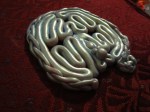
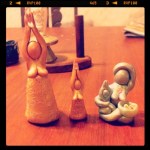
    • Sculpture—variety of mediums (fiber, clay, pottery…)
    • Painting
    • Drawing
    • Photos
    • Jewelry
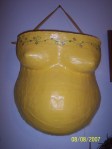
    • Belly casting
    • Body art (such as henna)
    • Collage
    • Mandalas
    • Decorating objects—prayer box, wreath
    • Quilting

Birth Art Examples:


Two Suggested Exercises for Birth Professionals or Parents:

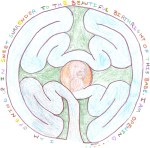
Based on Pam England’s LabOrinth article, I enjoy showing parents how to draw a birth labyrinth (several examples can be seen in the gallery above). Drawing a labyrinth with an explanation of how this type of image can be used to explain/explore the progress of labor as opposed to medical models such as cervical dilation charts or labor progress “bell curves,” can be a very eye-opening exercise for parents. The resulting image is a powerful visual of “normal birth,” instead of “clock watching” birth. I’ve made two posters than I use when I teach birth classes. The first shows a rough Friedman’s curve and a cervical dilation chart—these images are part of a deeply ingrained cultural view of birth and it is hard to shake these associations. This linear birth structure may be how we view labor from the outside, but it is not how we experience it from the inside, the labyrinth is a more appropriate birthing image as it feels from within and this is why…

      • No shortcuts—have to keep going til the end.
      • Speed varies.
      • Can’t get off the path (no falling off the curve).
      • Can get through blindfolded.
      • One step at a time will get you through—one foot in front of the other (one contraction at a time).
      • Can’t get lost. If you get out of the lines, you get lost—try to take shortcuts, get lost. Have to continue on your path.
      • Can crawl if you need to (or run!).
      • Circular (nonlinear)
      • No right way to finish.
      • Contemplative
      • Meditative
      • Journey
      • Everyone gets to the same place eventually—can go own speed, some fast, some slow
      • Do not need instruction to complete (no birth plan)
      • No timeline
      • No need to study.
      • Can rest if you need to.


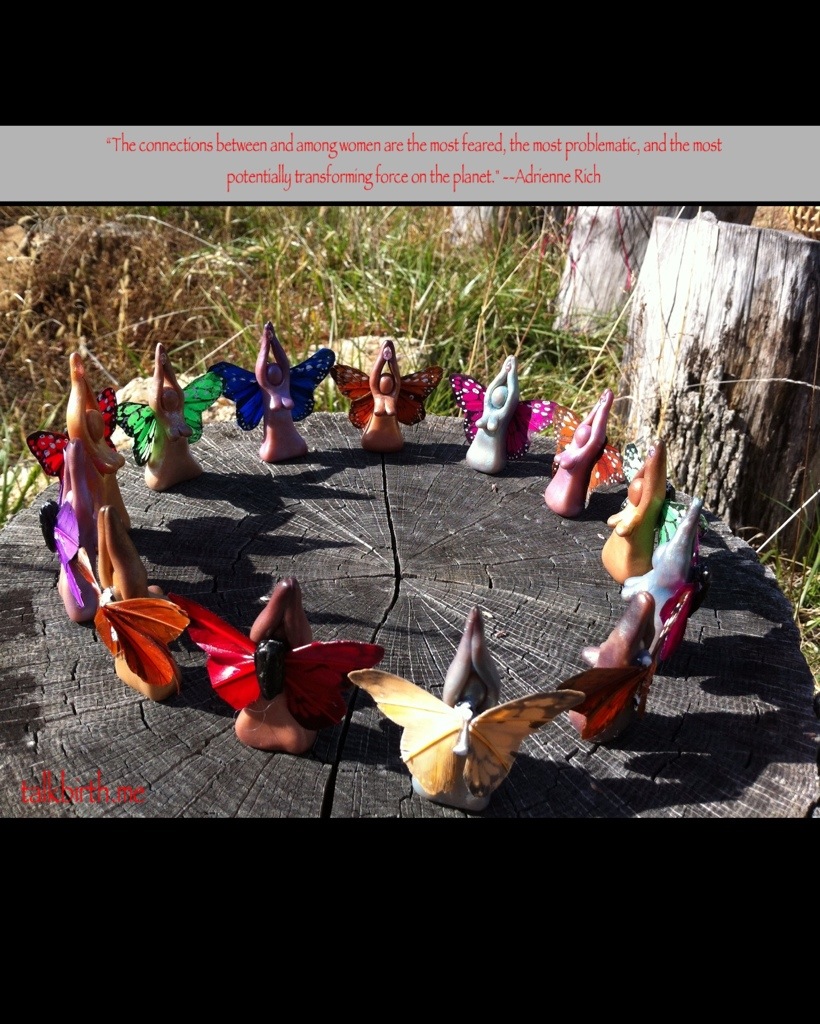
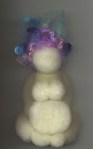
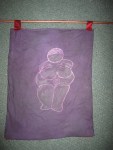
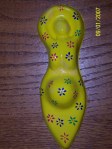
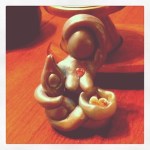
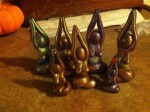
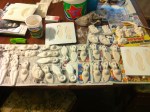
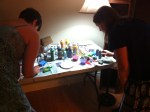
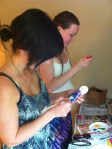
My other favorite group birth art project is to painting small pregnant goddess figurines (I make big batches of these in a mold using plaster). My most recent experience in doing so was at Rolla Birth Network’s MamaFest event:

This experience reaffirmed for me that birth art is about process not product. And, also that I don’t have to personally do anything to have the process be a meaningful one to participants. As an example of what I mean: at MamaFest, a very young mother came into the birth art sanctuary. I gave her my one minute spiel about the purpose of birth art and she painted her figures alone in the room for about 20 minutes. When she emerged, she showed her figures to me and explained what all the symbols and colors meant. Then, with tears in her eyes, she hugged me and said thank you and left. This was a mother I’d never met before and I’ve never seen again. And yet, we shared a special moment through birth art.

Molly Remer is the Friends of Missouri Midwives newsletter editor. She enjoys blogging about birth, motherhood, and women’s issues at http://talkbirth.me.

Talk to Your Baby

I already know that you can learn a lot from chickens about giving birth. This summer, I had another profound birth-mothering experience with one of our chickens after she hatched her first baby. During the last several days of incubation, mothers hens “talk” to their babies a lot through the eggshells and the babies respond. It is part of how they get to know each other and imprint before hatching. Then, after baby hatches, the mother hen continues to talk and cluck to the baby in a reassuring manner—she calls to the babies when separated and she calls a special call when there is something good to eat and she clucks softly and reassuringly at bedtime as she snuggles them all beneath her. There is a specific type of “soothing” noise they make to stressed or lost babies and a specific sort of excited sound they make to let the babies know something good is happening. There are also distressed sound that means, “run to me now, there might be danger!”

537

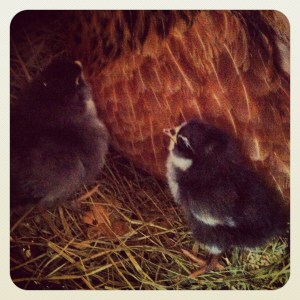
The baby chick who tried desperately to get to a mama who would talk to it (this mama, interestingly, is the same one I wrote about in the Birth Lessons from a Chicken essay several years prior).

We had three broody chickens at the time, each in their own little separate nest box in the broody coop. One of the hens had hatched a baby already and was in the neighboring box. The inexperienced mama hen hatched her baby and she would not talk to it. The baby freaked out. It flailed, it freaked, it stumbled all around. It dragged its tiny little wet, not-even-able-to-walk body to the very corner of the nest box as far away from the mother as possible. It flung itself into the wall where it could hear the neighboring mother clucking to her baby. The baby peeped more frantically and loudly than I’ve ever heard a chick cry out before, it sounded like it was in grave distress and danger. We moved it back to its mother and she fluffed out her wings around it just like she was supposed to do and I thought all would be all right, but…silence. The mother did not talk. Her baby desperately struggled out from under her, still not able to walk, still wet, and flung itself back into the corner, sinking down under the straw, crying piteously. Silence from the mother.

Talk to your baby, we pleaded. Your baby needs to hear you. Please talk to your baby. Silence. The baby squished down on the wire slats, pressed into the corner of the box, screaming at the top of its chick-lungs. The mother in the next box became distressed as well, calling back to the baby more and more loudly. The chick became more frenzied and flopping. The baby in the next box picked up on the fear and began peeping loudly as well. Still, the new mother sat silently and unresponsive. Talk to your baby. We left her alone, thinking her instincts would kick in, but as time passed and we could hear the chick screaming from all the way across the yard, we went back to interfere. We tried twice more to put it back under her and again the same routine repeated. We became concerned the baby would die if its level of distress continued, particularly with forcing itself down and under the straw and into the wire, so we made the decision to remove it and put it in “foster care” with the other, responsive mother. We thought she might attack it, since it wasn’t her own hatchling and because it was several days behind her own baby, but she snuggled it right up, clucking in reassurance, and it went to sleep, the next morning it was fluffy and quiet and perfectly happy with its new mother. The red hen continued to sit, silent, and unresponsive, and of course I felt horrible for stealing her baby and giving it to someone else after she’d worked so hard to hatch it. Luckily for the mental health of all involved, she successfully hatched one more baby and did take care of it, albeit still quite silently compared to all other mama hens we’ve experienced.

What does this have to do with birth?

Babies are primed to hear their mothers’ voices after birth. They expect to be snuggled into the maternal nest. Mammal babies expect to receive a warm breast and to hear comforting words in their own language. I feel fortunate that my own birth pause was respected after all my children’s births and that each baby felt only my hands and heard my voice for their first minutes of life. I talked to all my babies, soothingly and lovingly, and then brought them to my breast. My midwife and the other people around me did not interfere with these sacred, timeless moments of introduction.

It has been several years now, but I’ve worked with a couple of mothers for breastfeeding help postpartum who were unwilling or unable to talk to their babies, even with direct encouragement to do so. Baby was expecting mother’s voice and mother was unable to give it. Not surprisingly to me, these mothers experienced significant difficulty in getting baby to breast. I believe baby is expecting mother’s voice as a guide to the breast as much as it is expecting the smell of her and the sound of her heartbeat. Baby is not expecting multiple, strange voices from nurses (or even helpful breastfeeding helpers like me!). Baby is not expecting gloved hands. Baby is not expecting bright lights or loud noises. Baby is most definitely not expecting to be “helped” to the breast and “shoved” on as many mothers describe experiencing after their births. In Breastfeeding Answers Made Simplethe author emphasizes that what motherbaby pairs need most to successfully breastfeed is time alone to get to know each other. Mother and baby need to explore each other’s bodies and to listen to each other. She points out that with many people in the room, even well-meaning people, mothers have trouble getting to know their babies and getting babies to breastfeed. She says the most helpful strategy to supporting early breastfeeding is to get out of the way and let mother talk to her baby, smell her baby, touch her baby, meet her baby, and learn about her baby.

536

The non-communicative mother and her second baby, who was okay without much talking.

What are we really imprinting upon many newborns at birth in our culture?

As Sister MorningStar writes in her article The Newborn Imprint in Midwifery Today issue 104, Winter 2012…

If you have had the misfortune, as nearly all of us who can read and write have had, to see a baby born, perhaps pulled out, under bright lights with glaring eyes and loud noises of all sorts, in a setting that smells like nothing human, with a mother shocked and teary and scared; if you have witnessed or performed touch that can only be described as brutal and cruel in any other setting…

Every baby born deserves uninterrupted, undisturbed contact with her mother in the environment the mother has nested by her own instinctual nature to create. Any movement we make to enter that inner and external womb must be acknowledged as disturbing and violating to what nature is protecting. We do not know the long-term effects of such disturbance. We cannot consider too seriously a decision to disturb a newborn by touch, sound, light, smell and taste that is different and beyond what the mother is naturally and instinctually providing. Even facilitating is often unnecessary if the motherbaby are given space and time to explore and relate to one another and the life-altering experience they just survived. They both have been turned inside out, one from the other, and the moment to face that seemingly impossible feat cannot be rushed without compromise. We have no right to compromise either a mother or a baby.

I am deliberately leaving out the issue of life-saving because it has become the license for full-scale abuse to every baby born… [emphasis mine]

If mother has been taken to an operating room to give birth, or if mother is for any reason overwhelmed, exhausted, scared, vulnerable, hurt, and traumatized, she may have great difficulty in talking to her baby. If the room is full of people, baby may have difficult hearing her mother’s voice and feeling her welcoming touch. If baby is greeted by a bright light and masked face instead of her mother’s voice, baby may cry loudly in distress and eventually “shut down” into sleep rather than immediately to breastfeeding.

What can we do?

Beyond the obvious answers in carefully choosing place of birth and birth attendant, we can talk to the babies. If birth has been long, scary, or otherwise difficult, talk to the baby. If baby needs immediate care after birth, try as hard as humanly possible to have that care take place on mother’s chest and in reach of mother’s voice. If baby has to be separated from mother, talk to the baby. Call out to him. If mother can’t call out to the baby, father can talk to the baby. If father is unable, doula or midwife or nurse can talk to the baby. Welcome her to the world, reassure her that she is safe and all will be well. Speak gently and soothingly and kindly, never forgetting that this is a new person’s introduction to the world and to life. Our first and deepest impulse is connection. Before Descartes could articulate his thoughts on philosophy, he reached out his hand for his mother. I have learned a lot about the fundamental truth of relatedness through my own experiences as a mother. Relationship is our first and deepest urge and is vital to survival. The infant’s first instinct is to connect with others. Before an infant can verbalize or mobilize, she reaches out to her mother. Mothering is a profoundly physical experience. The mother’s body is the baby’s “habitat” in pregnancy and for many months following birth. Through the mother’s body, the baby learns to interpret and to relate to the rest of the world and it is to the mother’s body that she returns for safety, nurturance, and peace. Birth and breastfeeding exist on a continuum, with mother’s chest becoming baby’s new “home” after having lived in her body for nine months. These thoroughly embodied experiences of the act of giving life and in creating someone else’s life and relationship to the world are profoundly meaningful experiences and the transition from internal connection to external connection, must be vigorously protected and deeply respected.

“Birth should not be a celebration of separation, but rather a reuniting of mother and baby, who joins her for an external connection.” –Barbara Latterner, in New Lives

“No mammal on this planet separates the newborn from its mother at birth except the human animal. No mammal on this planet denies the breast of the newborn except the human.” –James Prescott (neuropsychologist quoted in The Art of Conscious Parenting)

 “A woman’s confidence and ability to give birth and to care for her baby are enhanced or diminished by every person who gives her care, and by the environment in which she gives birth…Every women should have the opportunity to give birth as she wishes in an environment in which she feels nurtured and secure, and her emotional well-being, privacy, and personal preferences are respected.” –Coalition for Improving Maternity Services (CIMS)”


361

Guest Post: Mothers Matter–Creating a Postpartum Plan

I connected with today’s guest post author, Rachel Van Buren, via Facebook. Rachel has a passion for postpartum support and so do I. When she mentioned that she was teaching a postpartum planning workshop, I asked if she’d consider writing up her notes into a post to share and she did!

IMG_5598“Mothers matter” – Creating a postpartum birth plan
by Rachel Van Buren

The Neighborhood Doula

I feel compelled to state the obvious: Society fails to meet the needs of the laboring, birthing, postpartum woman. Because these women lack the support that seems obvious for those around them to give, they assume their feelings are not normal. I am here after having birthed 4 children over the last 13 years to reassure you that your needs are normal. So normal, that I can read ten thousand threads in one afternoon of women who are crying out for support during the postpartum months. Why is it that we dismiss our feelings, and label ourselves as “ungrateful, needy, or weak” because we read one perfect looking blog, or Facebook post? Don’t misunderstand…the 4th trimester is beautiful. It really truly is. But it’s also life changing. Have you ever experienced a life change without experiencing anxiety? Of course not.

My message here is this: Women need to plan for the postpartum time period. It is essential. We get so wrapped up with birth, we forget about what happens when we bring baby home.

There are 3 areas of importance to explore before you bring baby home: Dealing with friends and relatives, how to delegate without guilt, and the importance of self-care.

Let’s explore these topics together.

How to deal with relatives and visitors during those first few weeks:

  • Have a clear vision of what your postpartum time will look like. If you aren’t sure, have that discussion with your partner now. Do not wait.
  • Set clear boundaries: Everyone does better when they know what to expect.
  • Set phones to go directly to voicemail.
  • Change your outgoing voicemail greeting. For example: “You have reached the _______ family, we are sorry we can’t take your call right now, as we are busy enjoying some quiet time together as a family. We are all doing well, and really appreciate your thoughtfulness in calling. We will return your call when we have the opportunity to talk, or are ready to expect company. So good to hear from you, and have a great day!”
  • Stay in bed.
  • Stay in pajamas.
  • Do not offer beverages. Visitors will be less likely to overstay if you are not in the entertaining mode.
  • Have partner or Postpartum doula mediate and advocate to well-intentioned but pushy friends or family. A BFF, parent, or close relative shouldn’t serve in this capacity. Prepare with them an “elevator speech” regarding visitors “Their Doctor/Midwife has encouraged the family to take a postpartum “Baby Moon” and they are really taking that advice to heart.”
  • If mom is breastfeeding: A gentle reminders to others, that she is nursing the baby about every hour(maybe even more) and are spending lots of time skin to skin, so visitors are just not practical right now.
  • Use social media to the fullest…
092b3a174b95cf52f6cbca69837daa08

Update your Facebook status as a way of giving a “heads up“.

Delegating without the guilt: I find it interesting to meet a lot of women that perceive themselves as feminists; they have no problem advocating for a natural/intervention free birth, defending their right to an elective Ceserean, or advocating for their future right to nurse in public. However many of these women come home after birth, and suddenly find themselves struggling to find their inner voice. Suddenly things become sticky because we’re now dealing with people that we have relationships with on a personal level. Boundaries can be tough to establish and maintain because our desire is really to our loved ones. Here’s when guilt creeps in. Perhaps guilt over losing exclusive relationships (first child, partner, or even self). Guilt of not living up to our mother’s example, our friend’s example, or the “perfect” mother on Pinterest who is sewing her own postpartum maxi pads and cloth diapers.

I’m a believer in learning to delegate. It decreases levels of guilt from not being able to be Mrs Cleaver. It lightens our load. Whether it’s with our partner, or our children, we need to do it. The days are gone where we can “do it all”.

Here are some simple steps to practice in order to delegate without feeling guilty:

  • Set your ego aside: There is more than one right way of doing things. Yours is not the only way. Invite the possibility that they might even do the task better or faster than you.
  • Stop waiting for people to volunteer: It is your job to communicate your needs. Partners are not mind readers. Just because they don’t offer, does not mean your needs aren’t normal.
  • Ask and you shall receive: Get to the root as to why you struggle with asking for help (shame? guilt?). Learn a different way. Learn to ask for help.
  • Delegate the objective – NOT the procedure: Dignify the person helping you by allowing them to do it as they choose, but make clear what your desired end result is. This will stop you from being the ever annoying micro-manager. After all, you are not training a robot, but a human being who can adapt and improve.
  • Be patient: The person you delegate will make mistakes, it is part of the learning process. Work consciously to keep a positive and realistic attitude.
  • Recognize your helper: Make sure they hear you brag about them to your friends or family. Everyone loves praise, and when they are appreciated they will be more apt to tune into your needs and want to help. Say THANK YOU! Let partner know that it makes you feel so special that they are working so hard to meet your needs.
  • Avoid controlling partner’s feelings. It doesn’t build up the relationship, and only adds resentment. (“I won’t ask partner to load the dishwasher because I don’t want to hear complaints. I’ll just do it myself to avoid the argument”) Partner has feelings, and is entitled to them, whether you perceive them as “good or bad”. Feelings are not facts. They are interpretations of the facts.
  • It’s OK to feel guilty. NO ONE has ever died from guilt!! (excellent mantra during particular moments of delegating)
  • Avoid saying “yes” when you really mean “no”.
  • Change your “normal”. Embrace the fact that the next 3 months are truly a time to expect the unexpected.

Self care:

Postpartum self-care is an absolute necessity. Get in the habit now of taking care of yourself. I firmly believe that how we take care of ourselves is learned behavior. Surround yourself with women who value their physical and mental health. Watch them, and copy them.

Here is a list of self-care ideas for your physical postpartum recovery: Alaina064

  • Ice packs for perineum
  • Postpartum massage
  • Belly binding
  • C-scar massage
  • Herbal bath (with baby too!)
  • Lots of sleep
  • Ask for help
  • Eat nutritious living food
  • Stay hydrated
  • Listen to your favorite music.
  • Avoid any negative television.
  • If you are already caring for a child with special needs, make sure that support is already in place to continue caring for them during those first few months until you are back into somewhat of a routine.
  • Create a network. Women want intimacy. Do not isolate. Isolation breeds anxiety.
  • Stick to your spiritual routine (whatever that looks like) Feed your soul daily.
  • Avoid stress triggers (if overbearing mother in law is coming by, let partner and baby spend time with her. Go take a shower, or get some rest)
  • Hug your partner. A lot
  • Avoid alcohol and caffeine. These both will be very tempting, and can be OK depending on your circumstances. If you are feeling blue, or have a history of depression, I recommend avoiding during the 4th trimester.

And most of all, listen to your instincts. Don’t compare yourself to others. Believe in yourself. Postpartum is a special time in which we evolve, allow yourself to be transformed.

Be empowered: create a postpartum plan today!
Rachel Van Buren is a birth and postpartum doula living in Charlotte, NC with her husband and four children. Visit her online at The Neighborhood Doula.

Originally posted at The Neighborhood Doula,
Dec 6, 2012

You can read past Talk Birth posts about postpartum here:

Planning for Postpartum

Young Moms: Making Childbirth Education Relevant to Them

This guest post is part of my blog break festival. The festival continues throughout December, so please check it out and consider submitting a post! Also, don’t forget to enter my birth jewelry giveaway. This guest post is about making childbirth education relevant to young mothers. I have a previous post about the classes I taught for a local Young Parents program (some handouts are included): Young Parents Program Prenatal Classes. Another related post, though not specific to childbirth education, is this one about Rites of Passage Resources for Daughters & Sons. If you’re interested in providing birth education specifically for young parents, you might also enjoy checking out CAPPA’s Teen Educator certification program.

Young Moms: Making Childbirth Education Relevant to ThemLoriblessingway 117a

by Keri Samuelson

In this day and age, encountering young mothers is common. With so many of our daughters fitting into this category, updating the ways we educate these expectant mothers should be a top priority. Young people may think they can handle everything on their own, but the truth is that they may still need to learn the basics when it comes to childbirth. They need to know what to expect and how to react. Here’s my take on how to tackle the experience:

Update The Imagery
We have many tools at our fingertips, but some of them require a bit of updating. For instance, it’s imperative to revamp the video and online databases that we frequently employ in hospitals, high school classrooms and the like. Young people today simply do not relate to the characters depicted in movies from the 80s or 90s. They want to see people they can relate to experiencing what they themselves are about to. Do yourself a favor – avoid these outdated resources, and make suggestions to libraries or clinics that still use them.

The Whole Truth
Tell girls the truth – this will need to encompass more than just some action shots of women giving birth. If you are for instance sponsoring a program for expectant mothers, invite women who have recently given birth, and have them detail everything from the beginning to the end of the laboring process. This way, mothers-to-be will have fewer surprises in tow. Also, make sure there is time for questions, and be sure to allow questions to be asked confidentially (on slips of paper, for instance, that you collect and read without announcing the asker), so that the session is truly as relevant as possible.

Technology
Show them that birth is unlikely to be like the shows they watch on television or the movies that they have seen. It sometimes can take many, many hours. It can be exhausting and might be very painful, but it is also very normal and usually safe.

Celebrity Guest Spots
Information is a wonderful tool, but the presenter of this information is what can make or break its effectiveness. In this day and age, celebrities are given the floor more than medical professionals, and so it can be a wise decision to have celebrity mothers give their own testimonies of and their experience. Obviously, not everyone has access to a celebrity, so perform simple Google searches for celebrities you know of that your clients might identify with, and see what they have to say about motherhood on their website, or in interviews. If this still doesn’t work, look for local superstars whom you know have given birth – athletes, state officials, teachers, etc. that you know your young clients will look up to and listen to.

These are, of course, just a few ideas for making childbirth education a little more relatable to youth that are expecting a child. It begins with accurate information, presented by someone who they feel they can trust, and delivered in a manner that doesn’t sugar coat the process either.

Keri Samuelson writes about health promotion, motherhood and helping young people find the best accelerated nursing programs.

Guest Post: Nine Reasons to Choose Independent Birth Eduation

This guest post is part of my blog break festival. The festival continues through December, so please check it out and consider submitting a post! Also, don’t forget to enter my birth jewelry giveaway.

I’ve been an independent childbirth educator since 2005. For many years, I’ve taught one-on-one classes to local couples and it has been wonderful to connect on a personal level with such individualized classes. Now, I’m teaching Birth Skills Workshops in collaboration with Rolla Birth Network. I’m still an independent educator—one not employed by any other organization or hospital—but now, rather than exclusively one-on-one, small groups of couples come together to practice hands-on skills for birth in a private, comfortable setting. I previously explored my own take on why choose independent birth education and here are some additional reasons!

Nine Reasons You Should Choose Independent Birth Education

by Jan Haley

Whether you still have a few months to go before the birth of your baby or the due date is right around the corner, it’s not too late to look into some independent birth education. Why are these educators an excellent decision? Read on to find out!

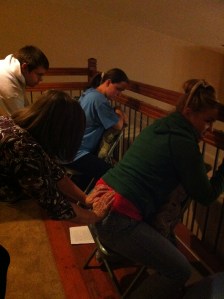
At a recent workshop.

At a recent workshop.

Personalized Attention
In a class, everyone has to work on the same components at the same time. However, with independent birth education, the program is tailored to your own needs. If you already know the answer to a particular question, you need not spend countless minutes listening to a lecture on the subject matter.

Personalized Questions
In addition to not hearing information of which you are already well aware, independent birth education allows you to ask the questions that pertain to your specific situation. Whether it’s about the birthing process or how to handle your baby immediately after birth, the concern will be addressed.

Personal Information
Let’s face it: when it comes to giving birth, you need to be comfortable revealing some personal information about yourself. However, that doesn’t mean it must be done in a room full of strangers. Working one on one with someone allows you to still maintain a level of privacy.

Generalities
In a hospital program, the educators might have to answer questions in a very diplomatic way, because that is what their work policy requirements. When it comes to independent education though, no such requirements exist, unless the person is attached to a hospital or other type of program.

A Customized Plan
Many mothers write out a birth plan, but some of them may feel forced into certain decisions. An independent birth educator will know a lot of information and will be able to offer many details and ideas for structuring a birth plan. A good independent educator will also remind you that a birth plan is not a substitute for good communication with your health care provider!

Partners
Some women choose to give birth at home. Doing so can feel like a lot of pressure on dads, so it’s common to ask independent birth educators for referrals for doulas to be present and support the process (some independent educators are also doulas and may be available to attend births). Birth partners can also feel totally comfortable asking questions in a private setting and they will also learn many useful comfort measures to add to their own labor support “toolbox.”

For Single Moms

Speaking of going it alone, it’s important to address single mothers when it comes to independent birth education. Being pregnant alone can be a really lonely road, and these educators provide not only an instructor, but a friend to such individuals.

Formal Instruction
Some educators are certified. Therefore, they are not only providing their personal experience as mothers, but also information that was garnered from a reputable course or program, so you’re really gaining the best of both worlds.

Confidence

It’s easy to feel embarrassed about giving birth or anxious about everything that is going to happen after the baby is born. Fortunately, independent birth educators are able to give women the boosts of confidence that they need, because as they get to know you, they can help you figure out what works best for you.No matter what plan you ultimately wind up choosing for your birth, be sure to at least consider independent birth education to have a method that is tailored to you. I tried this track, and I never looked back.

Jan Haley writes about motherhood, health and more. A home nurse, she enjoys writing about the profession and helping aspiring nurses find the best RN-to-BSN Programs for them.

Book Review: Fathers-To-Be Handbook: A Road Map for the Transition to Fatherhood


Fathers-To-Be Handbook: A Road Map for the Transition to Fatherhood
By Patrick Houser
Creative Life Systems, 2007
Softcover, 160 pages, $16.95.
ISBN: 978-0-615-23338-3
www.fatherstobe.org

Reviewed by Molly Remer
http://talkbirth.me

I am delighted to see another contribution to a growing body of birth and fatherhood literature written for men. Unlike many fathering books I’ve reviewed, the Fathers-To-Be Handbook was actually written by a man! This man-to-man, father-to-father perspective is a valuable strength of the book.

Patrick Houser is the father of two boys, both born at home with a midwife. His second son, born in 1980 in Missouri, was the first documented water birth in the U.S. The author has been based in the U.K. for a number of years now and is the co-founder of a wonderful organization called Fathers-To-Be, offering resources and education for expectant fathers as well as to the childbirth professionals who work with them.

Fathers-To-Be Handbook is a quick read and is a small-size paperback; like a “pocket guide.” It is definitely meant to accompany other reading and classes. It does not have an index, but does have a helpful resources section.

The first several chapters of the book are about the experience of fathering—about becoming a father, your personal history with your own father (“fathering school”—what was your teacher like?), the importance of fathers, and the journey through pregnancy. The final four chapters address preparing for birth, giving good support, empowered birth, and fathering the newborn. The handbook is very supportive of midwifery, homebirth, and doulas. It also encourages fathers to have a male support person nearby the birthing room (or perhaps available for support by phone).

As the author states in an article included at the end of the handbook, “Humanity cannot invent a drug that can work better than a mother’s body can manufacture or a knife that is sharper than her instinctual nature.” I deeply enjoyed an addition to birth literature that both honors the father’s experience and is rooted in a positive, healthy, celebratory approach towards birth and the inherent capabilities of a woman’s body.

Disclosures: I received a complimentary copy of the book for review purposes.

Amazon affiliate link included in image and book title.

Review first published at Citizens for Midwifery.