Introversion

Ring the bells that still can ring

Forget your perfect offering

There is a crack in everything

That’s how the light gets in.

–Leonard Cohen, from “Anthem”

via A Meditation for the Weekend: How the Light Gets In – By Susan Cain.

Accidentally came across this quote via Facebook today and just loved it. It led me to the rest of Susan Cain’s website about introverts and her new book, Quiet.

During every session of my online class, I have my students take an online version of the classic Myers-Briggs personality inventory: Personality Type Explorer. Personally, I am an INFJ which is the result I also get when taking the paper version of the test as well as other online versions. So, it seems pretty consistent. I feel I am more accurately an “extroverted-introvert” (which isn’t a real category)—I really enjoy being around people and I’m friendly and social, but on the flip side I then feel very drained after people contact and need time alone to recharge. I find I am restored by being alone and drained by being with others (even though I like them!), hence my own self-labeling as “extroverted-introvert.” Though, of course, by definition it isn’t actually that extroverts “like people” and introverts don’t like people, it is a difference between whether they are fueled or drained by people contact. I’ve just observed that people seem to make an assumption that being introverted means someone is “shy” or “doesn’t like people,” so that’s why I choose extroverted-introvert for myself.

On the website above, I read Cain’s Manifesto, which contained these gems:

“1. There’s a word for ‘people who are in their heads too much’: thinkers.”

I have heard this phrase more times than I can count—“you think too much.” While often said with a teasing air, it is also tinged with a touch of shaming. Once, several years ago, I mentioned feeling “too busy” to an acquaintance. She responded with, “it is good to be busy, then you don’t have time to think.” I was stunned by the concept then and I remain stunned by it now—no time to think? What kind of life would that be?! Sounds hellish to me. When I begin feeling like I have no time to think or that I don’t have enough space in my own head, that is my personal cue that I need to make life changes. While I can “overthink” things or ruminate in pointless and self-berating ways, most of the time I really enjoy my own company. I like time to think and I love time spent in my own head. It is a pretty interesting and fun place to be. And, for me then, writing is thought made visible. (This brings me to Cain’s third point in her manifesto was: “3. Solitude is a catalyst for innovation.”)

And, finally, her fifth point appealed to the homeschooler in me:

“5. We teach kids in group classrooms not because this is the best way to learn but because it’s cost-efficient, and what else would we do with the children while all the grown-ups are at work? If your child prefers to work autonomously and socialize one-on-one, there’s nothing wrong with her; she just happens not to fit the model.”

(I love the casual acknowledgement that a primary purpose of government school is to provide publicly funded day care while parents are at work.)

My own kids love being home best of all (actually, they may love visiting my parents’ even better!). They always have each other for company though. I do not know if I’ve ever fully expressed how very much I love having this pair of boys. It is phenomenal. They pretty much play with each other from the time they wake up until the time they go to bed. Day in and day out each spends with his best buddy, his brother. Last weekend we had a family wide meltdown over something pretty silly, but the whole family ended up yelling about it and Lann ended up in his room for a while because the boys needed to be separated (besides being best buddies, they each have a “signature” behavior that leads to some challenges—L’s is to tease/taunt and then laugh in a horrible mocking way when Z gets upset, and Z’s is to throw massive “rage fits” that involve physical attacks). Z kept begging and begging for Lann to be able to come out of his room (L wanted to stay in because he was really upset and crying and mad) and then said to us, “you don’t understand, I HAVE to be with my BROTHER!” While it is an unfortunate example because of the family wide meltdown context, it was very telling about the depth and quality of their relationship and I just feel extraordinarily fortunate that they like each other so very much and are such an integrated and committed unit.

wearing their signature skeleton sweatshirts of awesomeness

This experience with a pair of brothers is one of the things that makes me want to have just one more baby—so A has a chance to have that intense sibling connection too. Of course, there are no guarantees that she would bond that well with a younger sibling—it could be a sibling rivalry torture fest that drives me screaming from my home with no scrap of time left to think. And, I know it is extremely ridiculous to plan to have kids to be friends for other kids (how would that hypothetical other baby feel to know that it was only born to be a buddy for someone else?!) And, of course, she has her two big brothers to be her friends. The boys are such a tight pair though and are enough older than she is that I don’t think she’ll ever be on the true friend level with either of them.

Okay, so I started on one topic and ended somewhere totally different. Ah, well.

Honoring Miscarriage

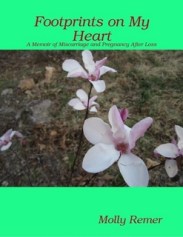
When I had my first miscarriage, I vowed several things in the immediate aftermath. One was that I was going to write a book about it so that other women would not have to experience the same total dearth of resources about the physical process of coping with home miscarriage. While I did publish my miscarriage memoir this year, I am still collecting stories and experiences for a different, more comprehensive book on this theme. However, in the time since I made that vow and since I had my miscarriages, a new resource emerged for women: Stillbirthday. This is the website I NEEDED when I was preparing for the birth of my tiny, nonliving baby. While I received emotional support from a variety of sources, I found a void where the physical information I sought should be. That information is skillfully covered in the birth plans section of the Stillbirthday website. I reprinted information from their “early home birth plan” in my Footprints on My Heart memoir, since it was the information I was desperately seeking during my own home miscarriage-birth. I am grateful the information is now available to those who need it.

My second vow was that, if I knew about it, I would never leave another woman to cope with miscarriage alone on her own. My third vow came a little later after more fully processing and thinking about my own experience and that was to always honor and identify miscarriage as a birth event in a woman’s life.

A friend’s loss

In March of 2010, my good friend, who had doula’ed me very gracefully and respectfully and lovingly through my miscarriage-birth postpartum experience and processing, experienced a miscarriage herself. She didn’t call me while she was experiencing it, so I couldn’t go to her as I had imagined I would if needed, but afterwards I went to her with food and small gifts and hugged her tightly, recognizing all too well that hollow, shattered look in her eyes and the defeated and empty stance of her body. Later, I bought her a memorial bracelet. However, I was still in the midst of coping with my own grief and loss process—my second miscarriage having just finally come to a long-drawn out end only a month before and the experience of which having brought another friendship to an almost unsalvageable point—and my dear friend’s own process, her feelings, got lost along the way. She recently wrote about the experience on her own blog and it was harder for me to read than I would have expected. As she noted, I agree that doesn’t matter how little the baby, or baby-start, or baby-potential that is lost-–there is no quantifying loss and no “prize” for the “worst” miscarriage. It is a permanent experience that becomes a part of you forever. Also permanent for me is the empathy and caring showed to me by my friend/doula during my time of loss and sorrow. I regret that I was not able to be that same source of solace, companionship, and understanding to her. I thank her for having held space for me to grieve “out loud” and I’m really sorry that part of the cost of that was the suffocating of her own sadness or minimization of her own experience. While I do feel like I did what I could to acknowledge her miscarriage at the time that it happened I really wish I would have done more, particularly in terms of acknowledging how very long the feelings of emptiness and grief persist. I made a mistake in taking her, “I’m okay” remarks as really meaning it, rather than being part of the story that babyloss mamas often tell themselves in a desperate effort to “get over it” and be “back to normal.”

That said, I also compassionately acknowledge that it can be hard for people to know what it is that we need if we don’t tell them. So, now I’d like to hear from readers. What are your own thoughts on recognizing and acknowledging miscarriage—how do we best hold the space for women to experience, identify, and honor miscarriage as a birth event in their lives?

Charm & book giveaway (**Giveaway is now closed. Veronica was the winner***)

In harmony with my question and associated thoughts, I am hosting a giveaway of a sterling silver footprints on my heart charm exactly like the one I bought for myself after Noah’s birth and that I gave to my husband and my parents afterward (my husband carries his on his keychain). If you win the charm, perhaps it is something that will help you to honor your own miscarriage experience or that you can give to someone else to acknowledge their loss. This giveaway is in concert with the blog contest on Stillbirthday and will end on March 20. Additionally, everyone who enters will receive a free pdf copy of my miscarriage memoir.

To enter the giveaway, please leave a comment addressing the subject of honoring miscarriage. I am wondering things like:

What did you need after miscarriage?

What did you wish people would do/say to honor your miscarriage experience?

How could people have helped you more?

What do you still wish you could do/say/write/share about your miscarriage experience(s)?

What do you wish you had done for yourself?

What did you want to tell people and what do you wish you had been able to say?

What did you want to do that you didn’t feel as if you had “permission” to do? (personal, social, medical, cultural, whatever type of permission…)

I will share my answers to these questions in a later post, but I do want to mention that one of the things that was most important to me to have acknowledged was that this was REAL. That was one of the first things I said to my parents about it when they came over to help me immediately after Noah was born—this is real.

Water babies

I continue to honor the experience of miscarriage and babyloss in my own life in various ways. Recently, I found a buddhist monk garden statue from Overstock.com that reminded me of the “jizo” sculptures that honor and protect “water babies” in Japan (mizuko is a Japanese word meaning “water baby” and specifically refers to babies lost during pregnancy—the only specialized word that exists). I have a small jizo inside on my living room windowsill, but I’ve wanted one that could weather the outdoors by Noah’s tree.

20120222-115308.jpg

20120222-115315.jpg

I took this one for size perspective, but you can barely see the sculpture in the shadow to Alaina's right.

I believe I may be partially responsible for the widespread usage of the following quote on the internet now with regard to babyloss mamas:

Miscarriages are labor, miscarriages are birth. To consider them less dishonors the woman whose womb has held life, however briefly.” –Kathryn Miller Ridiman

I found it in an issue of Midwifery Today from 1995 and shared it multiple times on Facebook and on my blog. I have since seen it in many locations around the web and I feel happy that I was able to be a conduit for the sentiment and the increased recognition of miscarriage as a birth event.

To participate in the Stillbirthday blog contest/carnival go here. And, make sure to check them out on Facebook too.

Babies & Balance

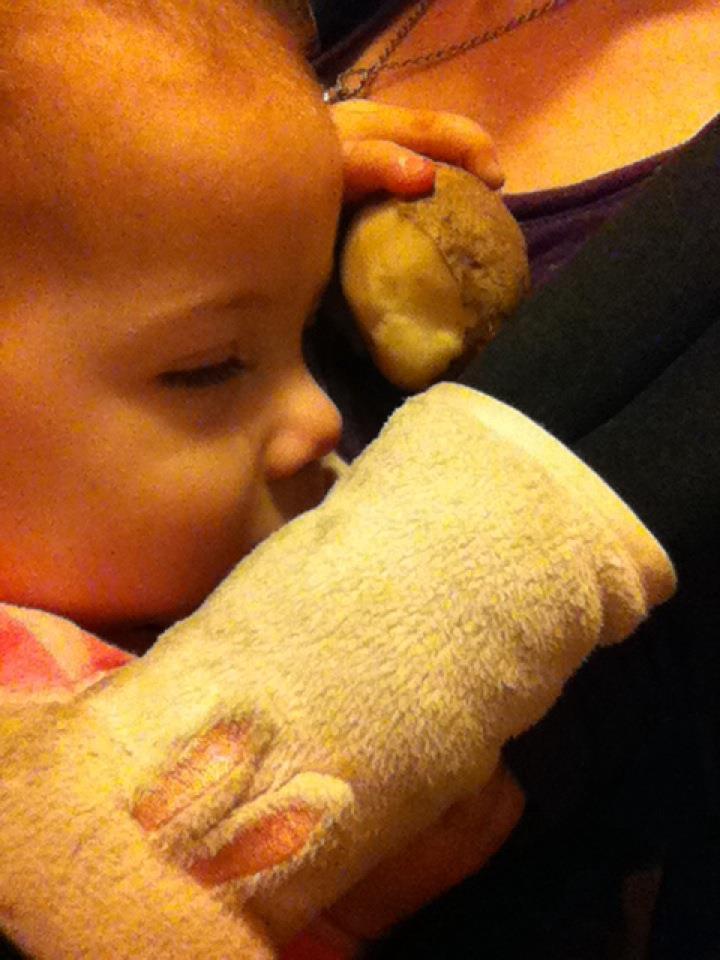
She is nursing here and holding a partially peeled potato. She likes to fall asleep holding something--and those somethings are often very random.

I’m just bursting with ideas for blog posts recently, but Alaina has other ideas for me namely with regard to her sleep “schedule.” She has had several days recently where she has only napped for 15 minutes. At night, she insists on sleeping with her head on my arm, which is really fine and pretty sweet, but since she goes to bed at about 8:30, I am then “trapped” there in the dark (light has to be off for her to go to sleep too) for hours and hours. (My iPad helps make this work.) With my boys, I could usually sneak away after they fell asleep. She, however, pops awake when I reclaim my arm. In the morning, I can’t get up before she does either, because she is still on my arm and pops awake when I try to sneakily wiggle away. I’ve surrendered to these things, knowing that they will pass soon and enjoying the fact that my baby has spent every night of her existence sleeping in my actual arms, but I have not surrendered to the notion that I’ll be able to put her down for a nap during the day! I nurse her to sleep for nap while walking her in the Ergo and then put her down on the bed. Today…popped up. This weekend…popped back up. Uh oh.

I have been “mining” my old blog for content that I want to move over here. In the same post in which I originally shared some quotes from the book The Mommy Wars, I found a quote that spoke to me again today as I try to figure out my “balance” with kids and teaching and writing and A’s popping up from nap ways. I thought I’d shared the quote here before, but I don’t see it now. So, here it is:

Let me save you some money: In a life with children, balance does not exist. Once you’re a parent, you can figure you’ll be out of whack for the rest of your life…Children are not born to provide balance. children are made to stir us up, to teach us how angry we can get, how scared we can be, how utterly happy, happier than we’d ever imagined was possible, how deeply we can love. Children turn us upside down and inside out; they send us to the depths and heights of ourselves; but they do not balance us. We can’t balance them either, and that’s a good thing, too. They’re finding out how to live in the world, and the most we can do is make them as safe as possible and have a good time with them.

I have struggled in the past when things like this happen thinking I need to give up my blog, but in the last year, I’ve accepted it is one of my favorite hobbies and should actually be the last thing to go. I’ve also come to the conclusion that it is a legitimate avenue for writing, providing me with countless seeds for later article and book projects, not to mention the personal posts serving as a “time capsule” or memory record for both me and my kids in the future.

Motherhood, Feminism, and More

When a woman tells the truth she is creating the possibility for more truth around her.

– Adrienne Rich (May 16, 1929 – March 27, 2012)

Some time ago Molly at First the Egg did a series of posts about the book Of Woman Born. This book is an excellent feminist classic that at the time during which I read it helped to clarify for me that it is the “institutional” elements of motherhood that I sometimes find so oppressive and binding—it isn’t the children themselves, in the climate of motherhood in which I find myself.

Several years ago I also read Fruitful, by Anne Roiphe. The subtitle is Living the Contradictions : A Memoir of Modern Motherhood. Like Of Woman Born, it was written before the more recent wave of “momoirs” (that is a kind of dismissive term, but it does help me classify the genre) and focuses heavily on feminism and its relationship to mothers/motherhood (so, different from momoirs in that the focus is less on personal experience of motherhood and more on motherhood and its social/cultural/political connections, I suppose). Fruitful is less “heavy” and depressing than Of Woman Born. The focus of the book is on the tension between feminism and motherhood (i.e. can you be a “good” feminist and also be a “good” mother) and she explores that issue throughout. Roiphe is a feminist and yet critiques some elements of the movement’s impact on mothers and motherhood. She is also very pro-father and I appreciated her exploration of men/fathers as people vs. “evil patriarchy—down with them!”

This is a quote about the crux of the mother/feminist issue: “Motherhood by definition requires tending of the other, a sacrifice of self-wishes for the needs of a helpless, hapless human being, and feminism by definition insists on attention being paid to the self. The basic contradiction is not simply the nasty work of a sexist society. It is the lay of the land, the mother of all paradoxes, the irony we cannot bend with mere wishing or might of will.

This reminds me of my journal entry from my early months as a new mother—“is it possible to balance motherhood with person-hood?” I’m still figuring it out! (some days it seems to work, some days it really doesn’t!)

During the time in which I read Fruitful, I also read The Mommy Wars. I almost didn’t read it because I was worried that it would be excessively harsh or inflammatory and I don’t need to bring things like that into my life. However, it seemed truly supportive of women/mothers. It was a collection of essays by various authors (alternating between those who have chosen to be mostly at home and those who have chosen to be mostly pursuing careers) and it quickly became clear that the most real “mommy war” that most of us experience is the one inside of our own heads. There seems to be no ideal/perfect solution. I also noticed that many of the women (including the editor of the collection) had cobbled together some sort of “balance” between working-outside-of-the-home and working inside it–there were lots of part-timers, lots of WAHMs, lots of writer-in-the-spare-minutes, etc. Since I’ve done the same, I particularly identified with those tales of struggle to discover the right balance for your family.

The first quote I wanted to share from this book is with regard to being asked “what do you do?” at a cocktail party: “I find it odd that I’d generate far more interest if I said I raised dogs or horse or chinchillas, but saying, in effect, ‘I raise human beings’ is a huge yawn...It might, in fact, be boring if child care were simply a series of pink-collar tasks–bathe, dress, feed, repeat. But observing and participating in a little Homo Sapien’s development is fascinating to me. Furthermore, being a mother isn’t just a ‘job’ any more than being a wife or a daughter; it’s a relationship.” [emphasis mine and in total agreement with this]

Then in another writer’s essay (the above was from one of the SAHM, the below is from one of the WOHM) came this interesting observation:

I remember reading once that all manner of selfishness is excused under the banner of focusing on one’s family, and it strikes me now as penetratingly true. How many of us don’t do for others because we’re supposedly saving it for our families? and how valuable is staying at home if you’re not teaching your children how much other people (and their feelings) matter?

In another book I have, The Paradox of Natural Mothering, she refers to the “family first” mentality as a type of narcissism and I do see the point.

I also wanted to share some quotes from an essay by a woman who does not yet have children, but is planning to, with regard to talking to mothers who shut down her opinions/thoughts with the, “what could you know? You don’t have children” brush-off. (Which, I personally, have definitely been guilty of thinking on more than one occasion! And, actually did so while reading this essay!):

I want to be able to say that all the judgment and aggression and competitiveness I witness among working and stay-at-home mothers surprises me and absolutely must change. But that wouldn’t be honest. I’ve been party to this one-upping and henpecking and know-it-all-ness my entire life. It’s as if becoming a mother puts us back into a sorority or junior high school, into some petri dish of experience where what other females think and say and feel and do counts more than anything.

The one thing my stay-at-home and working-mom friends share in the country of motherhood is a superiority gene, some may call it a gift of vision, that convinces them that women who don’t have children are, despite their educations and accomplishments, dumb as doorknobs. I’ve sat through many a heated conversation…during which I’ve been silly enough to offer an opinion only to be shut down more condescendingly and viciously by wise Goddess Mothers than I ever have been shut down by any man.

FWIW, I would not call this a “superiority gene” or “gift of vision,” but a “voice of experience”…I think most of us have been in the position of ourselves being the “just doesn’t get it” woman without kids! And, after you have kids of your own, you suddenly realize why “those mothers” were condescending to you.

On a somewhat related subject, I also enjoyed this post by Dreaming Aloud about the silencing of mama anger.

Memories of a One Month Old…

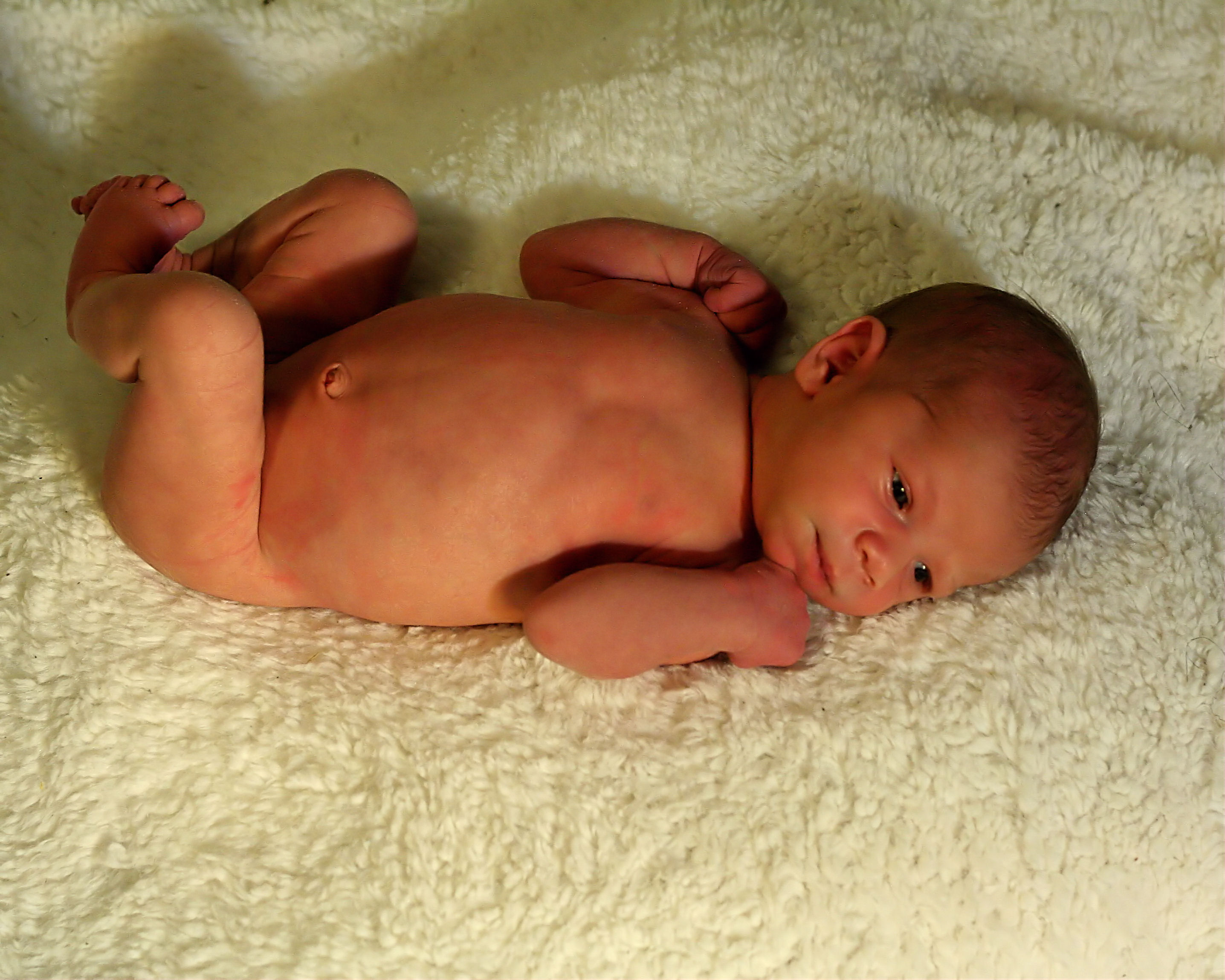
My newborn!

I didn’t make a “onemonthababy” post about Alaina and as I flipped back through my journal on her birthday this year, I found the entry I made on February 20—the day after her one month “birthday.” So, I feel like adding it now to join the other monthababy posts I made during her first year.

Alaina is one month old! Still a nice quiet, contented little soul with new smiling action, head-lifting action, and potty-peeing action. I love her SO incredibly much. I’m loving having a baby again. I do not find baby-parenting to be difficult, confusing, or frustrating. Pretty much non-stop marvelment. She feels so easy to take care of.

Alas, tis not true of my other kids lately who are exhausting, noisy, need-factories obsessed with butts and poop jokes.

Weather has been delightful lately and I walked with her down to the priestess rocks this afternoon feelings as if I was officially “presenting” her to the world/planet.

Earlier in the week, I took her outside to wait for [my friend’s] visit and I walked the labyrinth with her and also introduced her to Noah. I had profound sense of unity with her. Symbiosis. A feeling of being her whole world and she my whole world. World felt narrowed in on us and then also like I was part of some great, grand majesty. Her nestled against my chest, me protecting her and enfolding her. Nurturing her. Our twosome the whole world. “The sheltered simplicity of two people existing only for each other.” And, that is enough. All she wants is me and I can give that to her. 🙂

I also spotted this quote on a friend’s Facebook page recently and it spoke to my heart and feelings:

“A mother’s body remembers her babies–the folds of soft flesh, the softly furred scalp against her nose. Each child has its own entreaties to body and soul. It’s the last one, though, that overtakes you. I can’t dare say I loved the others less, but my first three were all babies at once, and motherhood dismayed me entirely. . . . That’s how it is with the firstborn, no matter what kind of mother you are–rich, poor, frazzled half to death or sweetly content. A first child is your own best foot forward, and how you do cheer those little feet as they strike out. You examine every turn of flesh for precocity, and crow it to the world.

But the last one: the baby who trails her scent like a flag of surrender through your life when there will be no more coming after–oh, that’s love by a different name. She is the babe you hold in your arms for an hour after she’s gone to sleep. If you put her down in the crib, she might wake up changed and fly away. So instead you rock by the window, drinking the light from her skin, breathing her exhaled dreams. Your heart bays to the double crescent moons of closed lashes on her cheeks. She’s the one you can’t put down.” ― Barbara Kingsolver, The Poisonwood Bible

Alaina is most likely my last baby. When we are alone together, I often spend time just staring at her. I want to memorize her. I stare at her eyelashes, her lips, her little nose, the curve of her cheek, her profile, her fuzzy hair, her little neck. I nuzzle her face with my nose and lips and sniff her all the time. Today, we went back down to the woods, and just sat there on the rocks together and I marveled at how fast time continues to pass and how she grows and grows and grows. It isn’t that I didn’t notice or appreciate or cherish my boys as babies, I did, and I have crystal clear memories of lying in bed nursing my first baby and cradling the back of his soft little head with my hand and crying as I laid there thinking about how he would be a teenager before I knew it. He isn’t gone now, of course, and he is still my “baby” forever and I cherish him today also, but that baby whose head I cradled and cried over in that moment is in fact gone and every day I feel conscious of the fact that another day of Alaina’s babyhood has passed. As I’ve noted before, there is just a sharp sweetness to this time with her that I did not experience before and I think it is the trailing flag of surrender, of a passing season, that Kingsolver references in the quote above.

20120217-170451.jpg

Getting soap

20120217-170552.jpg

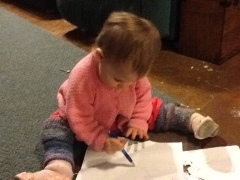
Drawing seriously

Postpartum Thoughts/Feelings, Part 2

The time of danger, what needs to be survived, comes at different times for mothers. For me, it came early — during my [child]’s infancy.

From Sleeping Beauty & The Fairy Prince: A Modern Retelling By Cassie Premo Steele

After posting my “playing my music” essay containing an exploration of my postpartum feelings after the birth of my first son, I went back and forth about continuing to explore the subject. I’ve written about it a lot, but the feelings are scattered throughout a variety of locations—including partially written articles and also blog posts from my first, no-longer-updated blog. I actually wrote this post last year, immediately after my part 1 post, and then ended up not sharing it, but moving straight on to Postpartum Feelings, Part 3 instead.

Weird thoughts

Anyway, I wanted to briefly address the weird/intrusive thoughts that I experienced postpartum with both of my boys. I think one of the reasons I have trouble broaching this topic on this blog is that to look back at my thoughts and feelings is to begin to acknowledge to myself that I very likely experienced a postpartum mood disorder, even though I—perhaps purposefully—did not identify it as such at the time. With my first, I had a recurrent image of the bookshelf in my computer room at the time falling over and squashing me. I also had the sense that the baby was trying to “squash” me—as in stamp out my life spark (actually, who am I kidding, life with kids still makes me feel like this is their goal sometimes! ;-D) and the best way I could come up with to describe my feelings at the end of a long day was that I had been chewed up and had my bones spit out. This is a pretty intense description that some people might feel is ridiculous or over-the-top, but is the way I would have described it.

When my second son was a baby, I planned much better for postpartum and experienced a fairly pleasant babymoon at home with him. I felt like in general, mothering him was easier than mothering my first and as he grew, I frequently would say (and feel) that having a second child was the best thing I’d ever done. Despite those feelings, I had a recurrent image that would pop into my mind unbidden of falling backwards through a grate, my body dissolving into water as I fell and dripping through the grate and the skin of my face remaining a “mask” on the grate, eventually also dissolving/dripping through. I also had a weird, recurrent sensation that my shin bones were fragile somehow and I would imagine them snapping.

So, after typing this out I officially felt mentally ill, and that is why it hasn’t been posted until now.

The current

With my second son, I described my mood to my husband in this way: There is a current that underlies all of my emotions. I feel like I can “dip” into this current and test out how it feels, beneath the mood that I present outwardly or how I feel on the surface. My current lately is always sad—even when I am happy and feeling/acting happy, if I take the time to “dip” beneath, what I feel is sad. I used to actually chart the feelings on my calendar, with a little notation for the surface feeling and a different notation for the current. I tried to explain to him that I did not feel like I had a neutral point and that I would like to feel “even.” However, I also acknowledged that if to feel “even” or neutral as my “current” would mean trading in all peaks of emotion, rather exuberant or despondent, I’d rather have the ups and downs. During this time I looked up various mood disorders, thinking that I might possible qualify as having cyclothymia.

Wal-Mart “angel”

Then, one day, when my second son was perhaps a year or so old, I had an interesting experience at Wal-Mart with a very friendly and cheerful checker. She chatted along with us and was just very nice and pleasant to be around. That night I had a vivid dream that this checker was actually an angel and that she had come to “heal” my feelings. When I woke up that morning, I had very dramatic sensation and announcement of sorts in my head, “you are not depressed anymore” and indeed, when I dipped into the current it had become a wellspring of joy, rather than sadness. Since this time, my “current” has never again shifted back to sad. While I definitely have sad or “down” moods or get distressed about things, I now feel like it is only that surface emotion that is being buffeted, but that what waits underneath is always doing all right. Perhaps you have to know me in real life to understand how strange of an experience this is for me to describe. I have never had another “angel” experience and do not connect with angel imagery. The word “angel” is not one that I use to describe anything, really, and I feel extraordinarily skeptical and uncomfortable when other people say things about having guardian angels. I suppose if I did have PPD, it could be looked upon as a “hallucination” almost. However, I do not have a way to describe what happened to me without using the word. Indeed, I feel so oddly about it, that I have never actually told anyone else about this—I told my husband about the current shifting, but left out the “Wal-Mart angel” piece of the story.

Why tell it now?

As I noted, I’ve been waffling about posting this. It is close on the heels of another post that may seem woo-tastic. It makes me feel vulnerable and embarrassed. Why? Why bother sharing things that bring up these sorts of feelings? My answer was almost, just don’t, and then I read a fabulously amusing essay in the winter issue of Brain, Child magazine about a woman’s experience teaching “sexuality and the new mother” workshops at Babeland in New York City. In her postscript closing the essay, Meredith Fein Lichtenberg writes the following:

“…writing this now, years after it happened, I still felt that sharing something personal cast stark light on the Inner Vat of Chaotic Shit I Haven’t Figured Out Yet. The desire to hide that is amazingly strong; I see it in my students, and I see it in myself. But I also see that when we bend our lives’ stories into words to be shared, everything changes. Sharing stories reminds us we’re not alone with our icky mess of doubts and questions. In the light of day, frightening concerns and general weirdness become more understandable, forgivable, human.”

Reading this, I knew I wanted to share after all. And, it reminded me of another quote, this one by Carol Christ, a thealogy scholar that I love:

“When one woman puts her experiences into words, another woman who has kept silent, afraid of what others will think, can find validation. And when the second woman says aloud, ‘yes, that was my experience too,’ the first woman loses some of her fear.” –Carol Christ

Postpartum Feelings, Part 1

Postpartum Feelings, Part 3

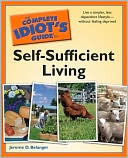
Book Review: The Complete Idiot’s Guide to Urban Homesteading & to Self-Sufficient Living

The Complete Idiot’s Guide to Urban Homesteading
Sundari Elizabeth Kraft
Paperback, 352 pages
Published by Penguin Group (USA)
ISBN: 9781615641048

And

The Complete Idiot’s Guide to Self-Sufficient Living
Jerome Belanger
Paperback, 400 pages
Published by Penguin Group (USA)
ISBN: 9781592579457

Reviewed by Molly Remer

Written in clear, straightforward language and covering an impressive array of topics, Urban Homesteading and Self-Sufficient Living, are excellent resources to those on a sustainable living path. At first I expected them to be “too basic,” but discovered useful information and resources applicable to people at various stages and experience levels. Because they are so comprehensive, the books both serve primarily as a broad overview of relevant topics, rather than as in-depth how-to guides. They serve to whet your appetite for further resources for a sustainable lifestyle.

I’m not a fan of the title Complete Idiot’s Guide in general, finding it unnecessarily insulting rather than amusing, but that is a minor drawback to these thorough, useful guides.

Of the two tomes, The Complete Idiot’s Guide to Urban Homesteading really shines. The focus is on micro-farming and self-sufficiency for the city dweller. It covers gardening (including options for those without yards), chickens and other small livestock, food preservation and preparation (including cheesemaking and various recipes for food prep), soapmaking, composting, foraging, and off-grid living. It also includes information about zoning laws and working with landlords. As someone who has homesteaded in a rural area for a number of years, I still found the Urban Homesteading book quite useful and informative.

The Complete Idiot’s Guide to Self-Sufficient Living focuses on living a self-reliant lifestyle and on sustainable living. It covers topics such as gardening, kitchen coordination, raising animals, and self-sufficient housing.

Disclosure: I received complimentary copies of these books for review purposes.

Birth Plan Item #1: Leave My Cervix Inside My Body!

Some time ago I read several articles in Midwifery Today about birth in the Ukraine. Apparently, it is a routine practice immediately postpartum to use two “shoe horn” shaped devices to pull the cervix out of the woman’s body to examine. Yes, I think that warrants repeating–manually pulling out the cervix to look at! (no pain medications). This is so patently horrible and unnecessary that I had a visceral response to reading about it–my uterus hurt.

U.S. maternity care routines

However, as I reflected on my reaction, I began to wonder if the practice is any more strange or disturbing that some U.S. maternity care routines? I still feel like cervix-pulling-out ranks pretty high on the horrible factor, but I also recognize that it is filtered through my cultural lens of what I’m used to—“normal” (i.e. culturally acceptable) birth practices in the U.S. (such as Pitocin injection immediately following most normal births regardless of indication and so on and so forth). We have any number of questionable medical care practices in this country too, but because I’m used to them they register as “normal.” Of course, this doesn’t mean I approve of them or fail to notice that they are not evidence-based, but I accept them as possible occurrences and I’m certainly not surprised to read about them over and over again, or shocked when my clients experience them during their births.

One of the articles was about birth in a Ukrainian “birth house” and the other was a composite of observations about birth in the Ukraine in general. Sometimes there is a tendency amongst midwifery supporters to romanticize birth and midwifery care in other countries and to vilify the U.S.—if you are a Ukrainian woman, this is clearly misplaced!

My first thought when reading the essays was, “Wow! The U.S. system isn’t so terrible after all!” But then, I tried to imagine the U.S. birth culture seen through completely fresh eyes, as I had just viewed the cervix-pulling technique. How would facets of hospital birth care in the U.S. appear to me if I was just hearing about them for the first time? As gross human rights violations?

Though I cannot make it have the same raw emotional and physical shock to me as cervix-pulling-out, I can only imagine how an episiotomy might sound to my imaginary fresh eyes: “then the doctor took some scissors and cut through the skin and muscles at the base of the woman’s vagina.” Or, the same with the not uncommon addition of, “as she begged ‘please don’t cut me! No!'”

I also read with sadness and dismay about the emotional maltreatment of Ukrainian women in labor and how (in hospitals) they are frequently denied the companionship of their husbands. Is this really more awful than women being coerced into unnecessary cesareans or even more basic, being denied food and drink throughout their labors? No, not really, just less familiar.

What do all women deserve?

While it is nice to recognize that there are things that women birthing in U.S. hospitals can be very grateful for, there is not an official continuum or hierarchy of “better” bad things to happen to birthing women regardless of country of residence. Humanized care is humanized care. Women worldwide deserve a safe environment, a respectful caregiver, continuous emotional support, physically responsive care, evidence-based medicine, and to have their cervixes and uteruses left inside their bodies.

(P.S. In case anyone is interested, “cervices” or “cervixes” and “uteri” or “uteruses” are both acceptable plurals)

All That Matters is a Healthy Husband (or: why giving birth matters)

It is your wedding day. You have been planning this day since you got engaged nine months ago. You are happy, excited, and a little nervous. When you get to the church, you are told that it is necessary to switch your wedding to the courthouse instead—it is disappointing, but the minister’s assistant reminds you that the courthouse is probably a safer location for your wedding because there are more people on staff there to handle any problems that might arise. When you arrive, you are told that your minister isn’t going to be there for the ceremony after all, but there is a perfectly good justice of the peace available instead.

You ask when the ceremony can begin and the clerk tells you not until your fiancé’s heart rate has been monitored for twenty minutes—“We need a baseline strip on him, hon. After all, you do want a healthy husband out of all this, don’t you?!” she says.

You are asked to change out of your wedding gown and into a blue robe. When you express your dismay, you are reminded that your dress could get messy during the wedding and also, “Why does it really matter what you’re wearing? In the end you’ll have your husband and you’ll be married and that’s really what counts.”

Next, the clerk starts an IV in your hand because, as she explains, you might get dehydrated while you wait for your fiancé.

I have my favorite juice here, I’ll drink that instead,” you reply.

No, no dear. No juice. You could aspirate it and die if you end up needing surgery.”

SURGERY!” you exclaim, “Why would I need surgery? I’m just getting married!

The clerk gives you a knowing glance, “Honey, about forty percent of women who get married here need surgery before their marriages are finalized. This is an excellent courthouse! We do everything possible to make sure you have a healthy husband when you leave here. Isn’t that what you want?

Yes,” you reply weakly.

Finally, the other clerk signals that your fiancé is ready. You turn to look at him and see that he has a monitor strapped to his chest to monitor his heart rate and that he has an electrode on his scalp. You smile at him and prepare to say your vows—you’ve waited for this moment for so long! But, as you begin to speak, the clerk tells you to stop making so much noise. You start to cry in confusion and embarrassment and she tells you that you really need to get control over yourself.

She calls over several other clerks who stand near you and they all begin chanting loudly, “Say I DO! Say I DO!

Wait,” you protest, “What about our vows?”

No time for that—you’ve got to get married as quickly as possible. Husbands can only bear to stand at the altar for a short time before they start showing signs of distress—you wouldn’t want anything to happen to your husband would you? Now, say ‘I DO,’ say ‘I DO’!!

So, you say the words, feeling a sense of dismay at it not being like you had planned, but excited to finally be married to your beloved. You turn to your new husband and reach out for him eager for your first married kiss, but the clerk grabs his arm and tugs him away after her.

Wait!” you call, “I want to see my husband!”

Sorry,” is the reply, “He needs to be taken to the new husbands’ lounge for observation.”

Observation of what?”

Weddings are stressful for husbands; we need to make sure he is all right. Now wait here, while the other clerk brings you a wheelchair to take you to your waiting room.”

Instead of leaving for your honeymoon, you end up staying at the courthouse for three days. You keep asking to see your husband, but the clerk tells you he needs to gain some weight before he can leave and that he also needs some more blood drawn. She also lets you know that he has finally stopped complaining about his spinal tap.

Spinal tap?! Your dismay shows on your face and she tells you, “Come on! You’ll be married for the rest of your life! A few hours of separation isn’t going to hurt either one of you. You’ll have plenty of time with him after you get home and will probably just get fed up with him then! What really matters now is that your husband is healthy.”

Yes, of course…

Finally, you get to go home, but you feel distant and sad. Your wedding was nothing like you’d dreamed of and you feel disappointed and betrayed. You enjoy being married and snuggling with your new husband, but you keep thinking about your wedding day and all of your ruined plans to make it special. When you try to tell your mother how you feel, she tells you that you should be grateful, at least your husband is nice and healthy.

When you tell your best friend about your disappointment, she tells you it is time to get over it—“Your wedding is just one day of your entire life. It is the marriage that really matters in the end. You only get married once, but in the end, you’re married and you’ve got a healthy husband and that’s really what counts, not how you get there!

You tell another friend about your ruined plans and she reminds you that you are lucky your husband is healthy and that it is selfish of you to keep thinking about your wedding. It is over and you’ve got your nice healthy husband to keep you busy now.

Yes, but I feel like I missed out,” you venture.

On what? Weddings are SO overrated. It isn’t like you get a medal for having a beautiful wedding or anything. People have weddings every day.”

You stop sharing your feelings, but you can’t shake the memories. What you expected to be a beautiful day filled with love and celebration was not and you feel a real sense of grief at the loss of your dreams. You know you shouldn’t feel this way. You know that what really matters is your healthy, happy husband, but you keep wondering if your wedding really had to be that way. Yes, you love your husband and you are so happy that he is healthy, but you also wonder if that really is all that matters. Don’t you matter too? Doesn’t your relationship matter? What about respect, dignity, love, and self worth? Don’t those matter too? Wasn’t this a special life transition for your family? Wasn’t it the beginning of a special relationship together and couldn’t that relationship have been celebrated, honored, and treated as worthy of care and respect?

————————————————————————————————————

Notes: I originally wrote this essay in 2007. It was retained for publication by Mothering magazine, but did not end up making it in before the print publication ceased. It was then retained for publication by Midwifery Today, but has not yet appeared. I decided it is FINALLY time for it to see the light of day!

I was inspired to write this essay after reflecting upon the similarities between weddings and births—both mark the beginning of a new form of relationship and a change to the family structure and to individual roles in society. Yet, in our culture, one of these transitions is celebrated as a milestone of adult life and the value of honoring the first steps in life as new partners in a relationship is a given. The other is institutionalized and mechanized and the partners’ individuality is minimized or ignored. Much preparation, energy, time, and finances are invested in planning a lavish wedding and you are expected to expect things to go beautifully, perfectly, and as planned. If they didn’t and your wedding was ruined, most people would say, “It is awful that your wedding was ruined! Wow!” and not call into question your love of your husband or your commitment to your new role as his wife. The wedding ceremony is respected as having value in its own right. This is not true of birth, which is widely viewed as unimportant in terms of how it happens, as long as the result is a “healthy baby.”

Molly Remer, MSW, ICCE is a certified birth educator, writer, and activist. She is a breastfeeding counselor, editor of the Friends of Missouri Midwives newsletter, and a professor of Human Services. Molly has two wonderful sons and one delightful daughter and lives in central Missouri. She blogs about birth, motherhood, and women’s issues at http://talkbirth.me and is the author of the miscarriage memoir Footprints on My Heart.

Toddler Birth Art

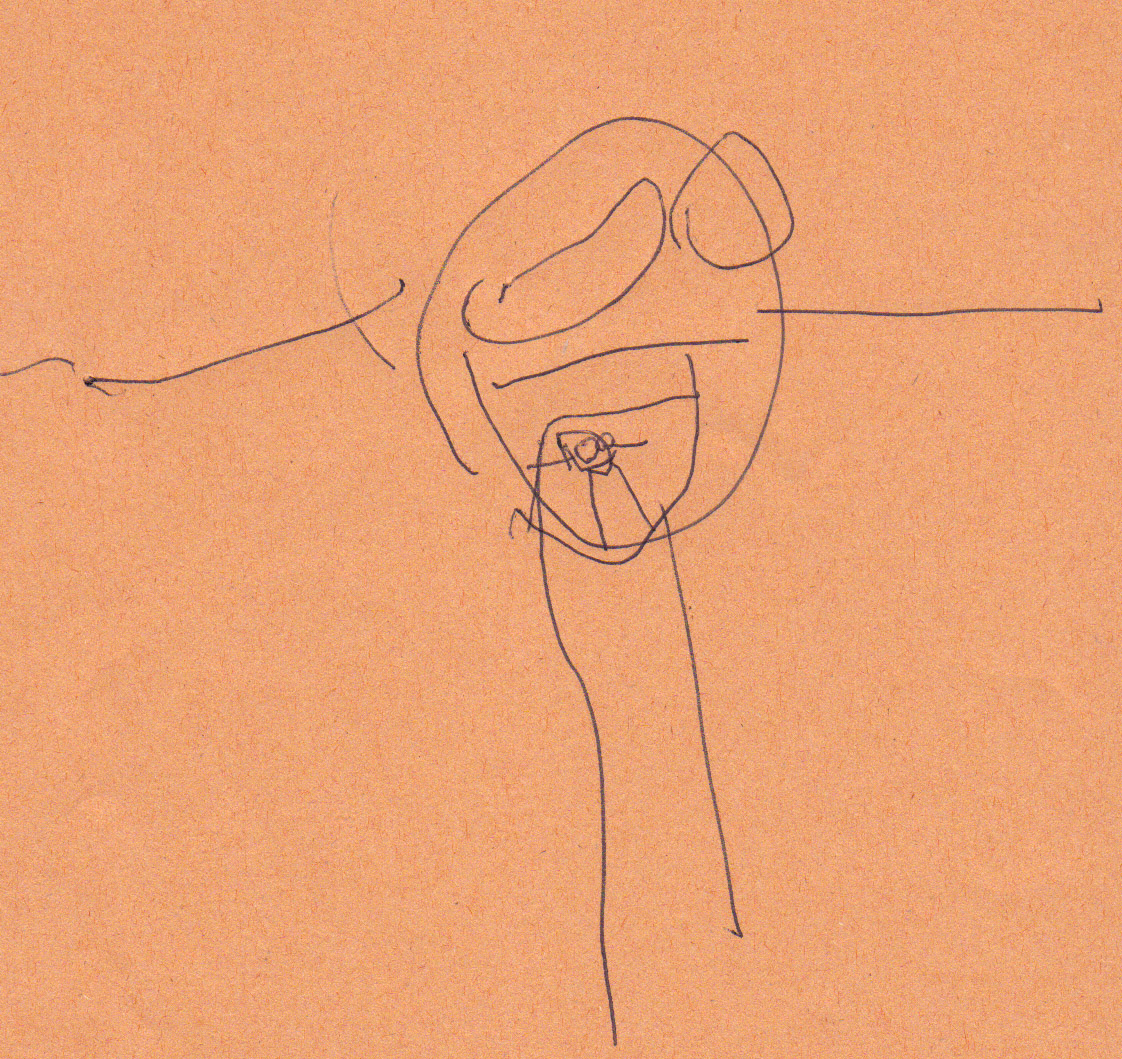
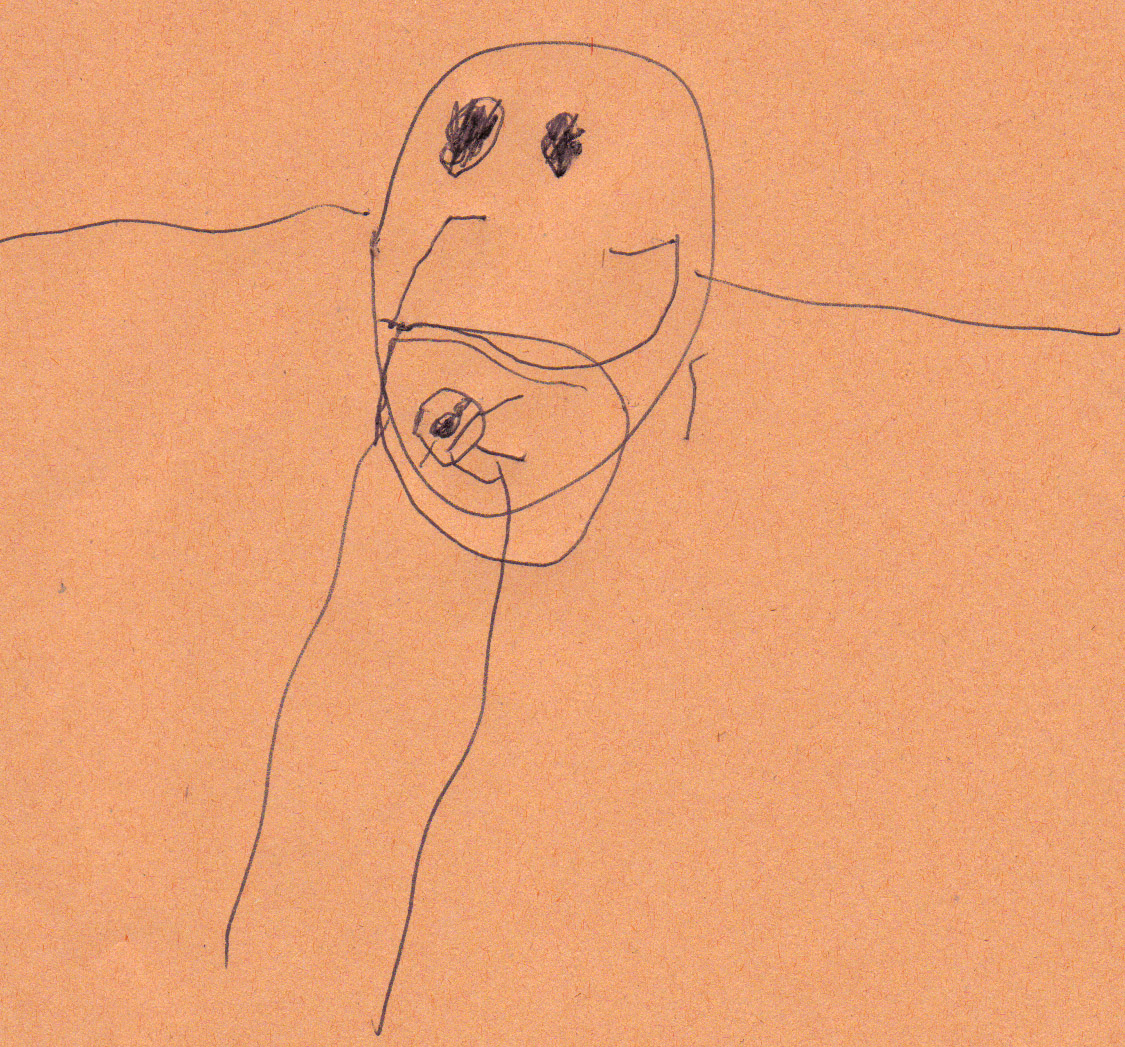
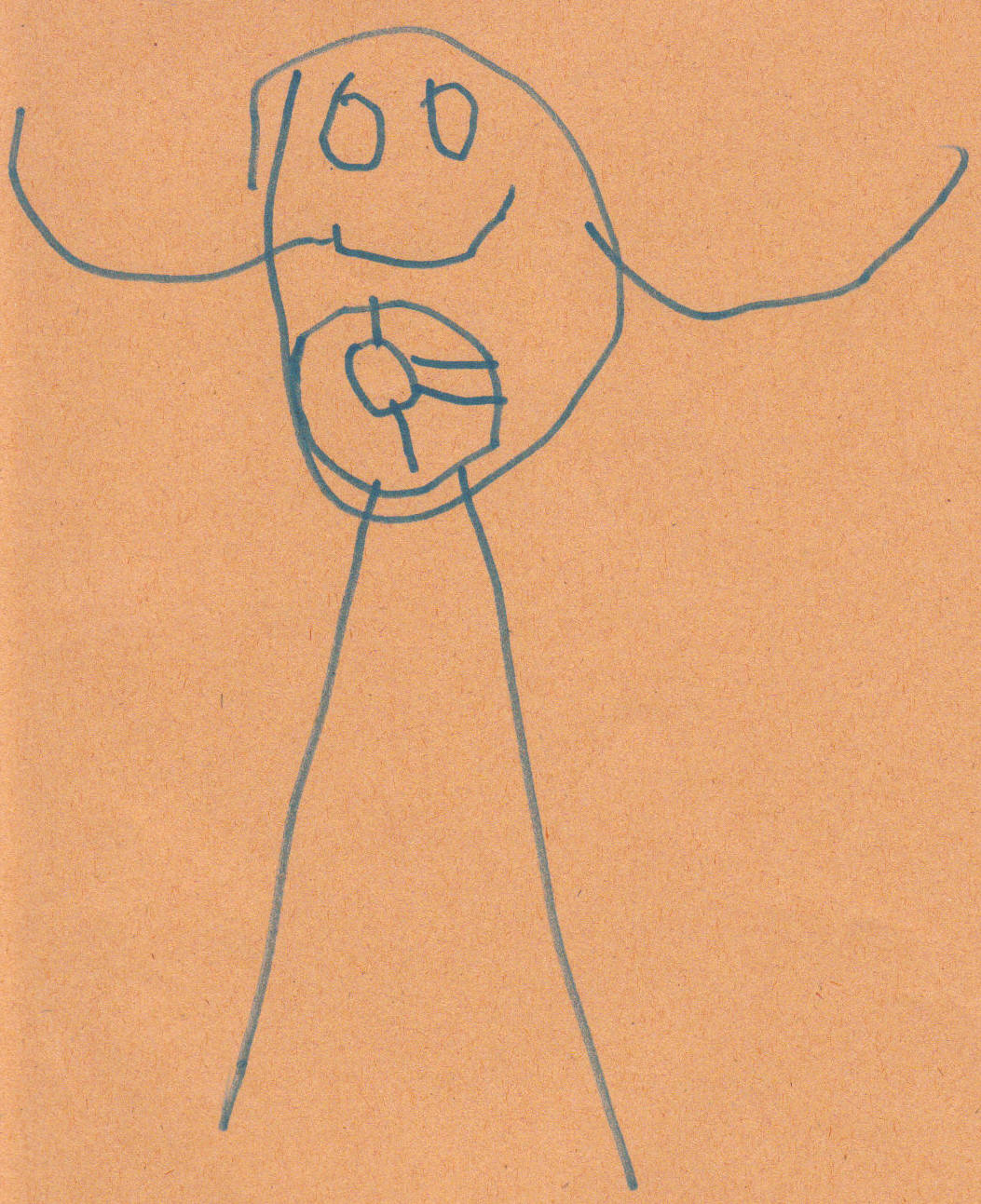
As I look at these drawings by my older son at ages 2.5 and 3.5, I feel quite a pang. This time has passed. He is eight now. He hasn’t drawn a picture like this in years. I didn’t fully realize at the time that he was drawing them that it was a one shot deal—looking at them gives me that familiar feeling of, but that was SO REAL. That was my life and my toddler and now our life landscape is a totally different one. Obviously, I guess I did have some recognition of the one shot nature, because I did save the drawings and have them to share this much later. In the first two pictures, which he drew before I gave birth to his brother, I love how the baby’s eyes match the mother’s.

I love how the baby looks like it is "floating" in this one.

After Zander was born, Lann got a little older and a little more skillful at drawing. I forget exactly when he drew this one, it was sometime during Z’s first year I think, and is obviously based on Lann’s own observations of the birth, rather than just the idea of “mama’s got a baby in there.”

Love the placenta in a bowl and the baby attached to the mama with cord (yes, I know the two are mutually exclusive, but I love these details anyway!)

I forget if I’ve ever shared Lann’s version of his own birth story here. I asked him about it when he was about two (so, before he’d ever seen a birth). Do you remember being born? He immediately said yes and I asked him what it was like. He said:

Swimming.
Swimming down out of mama.
Crying.
Nursies.
Happy now!

This was a surprisingly accurate thumbnail snapshot of his birth. He cried when only his head was born. I brought him to my chest and said, totally instinctively with no pre-planning of the name, “do you want some nursies, baby?” and he immediately latched on and nursed. 🙂

These pictures and these thoughts are exactly why I write so much and why I have a semi-obsession with storing papers, drawings, writings, the printed word (I joke about being a personal archivist), it is because seeing them or reading what I’ve written later, brings that so real feeling back to me and that life that I lived, those babies that I raised, are vivid again, rather than faded, fuzzy, or forgotten.