Birth Waves

‎”Uterine contractions are felt by many women to sweep towards them, rise in crescendo and then fade away like waves of the sea, so that wave imagery is very useful when describing the sensations they produce. This wave imagery is closely associated with the idea of rhythm, which is all important in harmonious psychosomatic adaptation to labor.”

–Sheila Kitzinger (Education and Counseling for Childbirth)

Sheila Kitzinger is one of my all-time favorite birth writers and I quote her frequently. She has such a beautifully lyrical writing style.

I’ve noted before that even though I’m not much of a “water” person, wave/water imagery and analogies always strike me as very right/true for my own birth experiences. I shared the quote above on the CfM Facebook page and one person made a comment that quotes like the one above “hide” the truth about how birth is painful and that perhaps we should stop talking in flowery images and instead address how it really is. What was interesting to me is that I do not associate “wave” images with lack of pain or lack of intense sensation. Indeed, somewhat of the opposite! This is one of my personal experiences that leads me to identify with quotes about waves, water, and birth:

With my second baby, I described the contractions as having a “sharp edge” to them. My mental imagery of water and birth was not so much of peaceful, lapping waves, but of intense waves CRASHING into/around a rock. They would then part and flow around the rock (i.e. me), so it wouldn’t get knocked down by them but would be there waiting for the next wave to crash into it…I actually have this same image come to mind during the tough moments of parenting young children!

Additionally, the way contractions build to a peak of intensity much the way waves crest and break, as well as the unstoppable rhythm and flow of them also held power and relevance for me. The ocean is BIG and waves are powerful and so is birth!

Humor and Labor

“Don’t forget to bring your sense of humor to your labor.” ~ Ina May Gaskin

I chose this quote to share on the Citizens for Midwifery Facebook page this week because it made me think about my own labor experiences.

I made jokes during the end of all of my labors and then laughed at my own wit—in a stroke of coincidence, one of the jokes was actually about Spiritual Midwifery ;-D I had just been told I was fully dilated with my first baby and I couldn’t believe it and said I was, “feeling all trippy like in Spiritual Midwifery.” With my second baby, I had inadvertently started saying “ouchie, ouchie” at the peaks of contractions and then joked, “ouchie, ouchie is a dorky thing to be saying!” With my third labor, which was an early second trimester miscarriage, I even managed to find some humor, joking to myself that I really should, “get into extreme sports” rather than keep having babies.

On a somewhat related note, one of my fears going into my first birth was about “being mean” to my husband and mother during labor. I think this idea came from all the media representations of women being “out of control” and yelling mean things at their husbands and/or grabbing the collars of their shirts and saying, “you did this to me!” and other such things. My actual experience was that I was nicer during labor than I am during my everyday life! I told my husband I loved him several times (perhaps because the normal hormonal symphony of labor was undisturbed) and we hugged and kissed and I felt very connected to him in the process of bringing our baby into the world. I think feeling safe and undisturbed is critical to birth for a variety of reasons, but one of them is to prevent  fight-or-flight stress reactions from being activated. I had no reason to “turn mean” and snarl at my support people, because I was in my own protected environment with only a few carefully chosen people around me. When I think about those women snapping at their husbands during labor in media representations (i.e. being used as comic relief, rather than bringing their own sense of humor to labor!), I see a trapped, mistreated animal snarling and snapping and anyone who comes close 😦

I cannot remember being distressed or annoyed or upset with anything my husband or mom said during my labors. They knew well in advance that having quiet people in attendance is of paramount importance to me—aside from the obvious things, the top element of any birth plan for me is “NO extraneous noise or chatter.” Extra noise causes women to leave their “birth brain” mode (right brain) and switch into the logical, analytical part of their brain (left brain) which is not helpful to a physiological labor. The only person who was allowed to talk (or make jokes!) during my labors was ME! And, I could trust that the people around me would respect that.

Maybe GIRL Baby?

I have had more ultrasounds during my current pregnancy than I ever imagined having before and I have struggled with some “cognitive dissonance” over my feeling about the overuse of ultrasound in our medical care system, coupled with the intense desire to “check in” with my baby and “make sure” it is okay, as well as to have as many opportunities to bond and develop a sense of connection as I can. During this pregnancy, it has been important to me to learn the baby’s gender. I really want to be able to name it this time and to not call it “it” through the whole pregnancy. I had an ultrasound this week at 21 weeks (this is the last u/s I plan to have), and as he also said at 18 weeks, the doctor said he thinks the new baby is a girl. While we had a good view and the images also looked very “girlish” to me and I think he is probably right, I don’t feel like he was committal enough for me to really name the baby and to start cleaning 7 years worth of boy clothes out of the closets! I need to have some confirmatory dreams or something! Part of the reason I don’t want to become too invested in a girl concept, is because in my heart I feel like I only grow boys and if the baby is really a boy after all, I do not want to have been overly attached to an imaginary girl. I’ve given birth to three boys already and long ago decided that I was “meant” to be a boymom.

I have two sisters and one brother and before I had any children of my own I always assumed, expected, and anticipated having daughters of my own. During my first pregnancy, I was pretty sure the baby was a girl. We had an ultrasound at 21 weeks during that pregnancy as well and the baby was very clearly a boy. I had to do some quick mental re-shifting and then was very excited about having a boy and have really loved the experience of mothering a son. During my second pregnancy, I had no ultrasounds, but I knew with a deep sense of certainly that my second baby was also a boy. I had 7 dreams that he was a boy and there was no space or reason for me to even consider having a girl. I did wonder if this very clear communication was to prevent any kind of “disappointment” about having a second boy—since I KNEW he was a boy, there was no room to “hope for girl.” I knew who I was having and THAT was the baby I wanted. While I know that the “ideal” family for many consists of a boy and girl, personally I actually prefer same-gender sibling pairs. Indeed, I literally feel grateful every single day that I have two boys and not one of each. They are fabulous buddies and I couldn’t imagine having anything else! I also hypothesized that since much of my life is focused around women and working with women, having boys is a necessary, balancing influence for me. I decided that sons are the children I can learn the most from the experience of mothering and that I was destined to be an exclusively boymom—that these boys were specifically intended gifts from the “universe” to properly balance the energies and influences in my life!

While we have planned for a long time to have three children, it took some time to come to the final decision to have a third—I felt like we had a pretty good thing going with our two and wasn’t sure any longer whether I really wanted to add anyone else to the mix. And, when we made the decision to have a third baby, it was intensely important for me to clarify whether we wanted to have a third baby or whether we were wanting to have a girl. I never wanted any of the possible sons to follow my first to feel as if they were the “wrong” gender or like we kept “trying for a girl.” So, my husband and I got crystal clear with each other that what we wanted was a third child in our family, not one of a specific gender. With my third pregnancy, I was sick for the first time ever, which made me think that the baby was possibly a girl, even though I was pretty sure another boy was in my cards (as I’ve noted previously, I had a lot of “you have three sons” dreams in the interim between my first and second babies). That third pregnancy ended unexpected at 14w5d and that baby was indeed my third son.

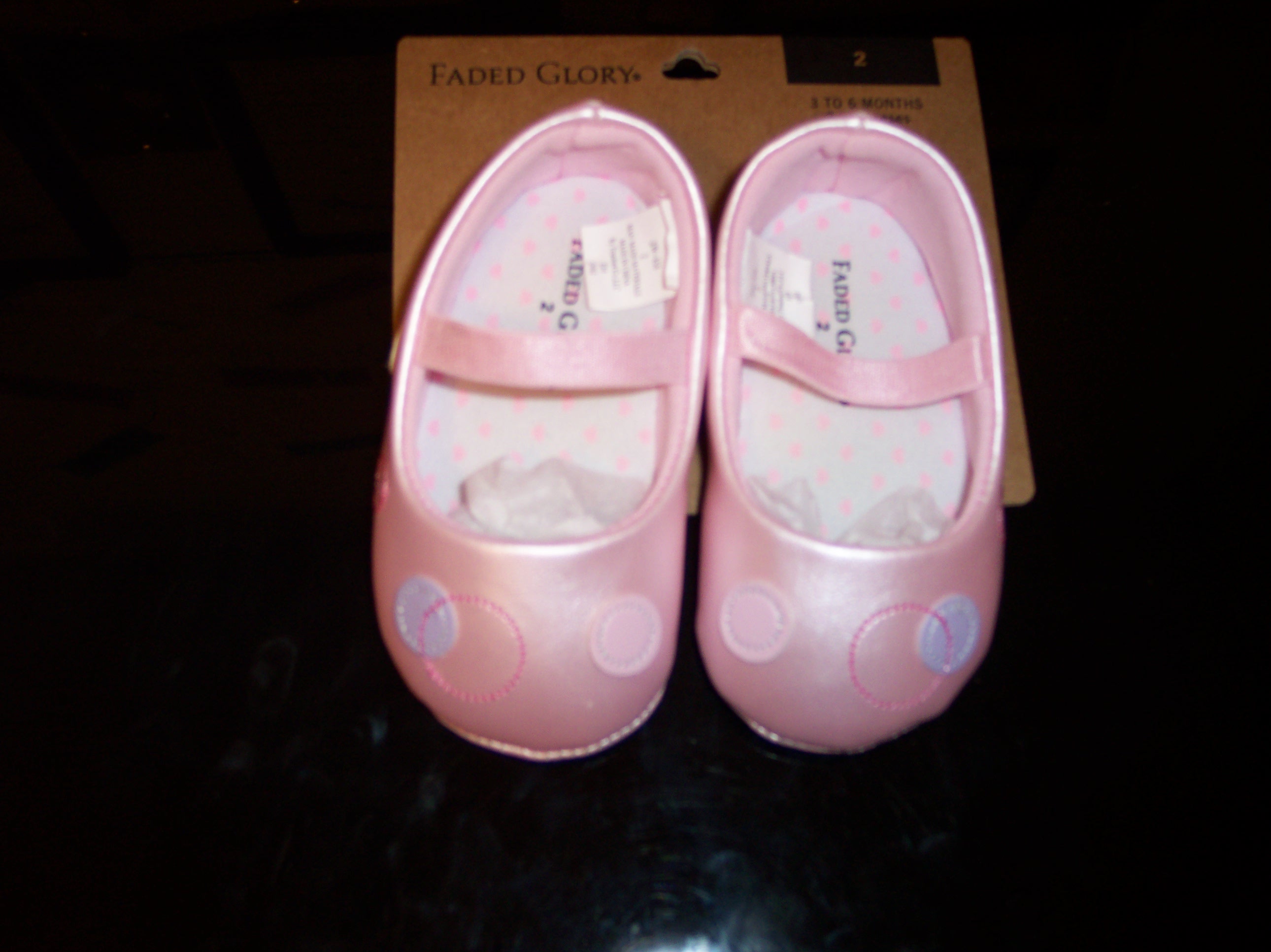
My current pregnancy is very much the same as my first two and I’ve had a feeling since the beginning that this baby too, was also another boy. I did wonder if this was a similar mental “trick” as with my second pregnancy—my observation is that if you know in your heart the baby is a boy, there is no room to “hope” for something else or to get attached to a “girl” image—but I also felt a sense of certainty that boys are simply the babies that I grow. Boys are the babies meant for me. After that 18 week ultrasound, when it was inconclusive but looked like a girl, I suddenly felt a small, secret spot in my heart that had been shut up a long time ago start to open up again. My original image as mother of a daughter. I thought she was long gone, but I discovered that she was hiding away very deeply and suddenly she came blooming up again. I was in Lowe’s with my husband after that ultrasound and suddenly I had a crystal clear image in my mind—my two boys were walking along holding hands dressed in matching vests (??!!) and behind them toddled a tiny girl wearing shiny pink shoes. While shiny pink shoes aren’t really my “thing,” after the 21 week ultrasound this last week, I went to the store and bought these:

Book Review: Understanding Pregnancy and Childbirth: Your Complete Guide

Book Review: Understanding Pregnancy and Childbirth: Your Complete Guide

By Linda Ayertey, CCCE
Resolve Medical Services, 2008
ISBN 978-9988-1-2163-1
152 pages, softcover

http://www.resolvegh.com

Reviewed by Molly Remer, MSW, CCCE

Written in simple, straightforward language, Understanding Pregnancy and Childbirth is a basic guide intended primarily for first-time mothers. It would be appropriate for clients with low literacy levels. With sections covering each trimester of pregnancy, physical changes, labor, comfort measures, and postpartum, the book is a handy, portable size that makes it easy for reference.

Published in Ghana by a midwife working in a small maternity hospital that she founded with her husband (an OB), the book contains some country-specific phrases and suggestions that may be mildly confusing to readers based in the U.S. I noted a higher than average number of minor errors in the text as well as some incorrect information (such as calling all morning sickness “hyperemesis gravidarum” and the advice to shave your pubic hair regularly because otherwise it, “may cause you to have an unpleasant odour”).

Overall, the information provided by Understanding Pregnancy and Childbirth is very basic as well as conventional. There is a nice illustrated section of positions for labor. However, the only “delivery” position described is the standard semi-sitting position and episiotomies are discussed without criticism (as are other interventions like IVs). The illustrations in the book (aside from cover image) are all of women, couples, and babies of color, which is a welcome change from many similar books on the market.

Disclosure: I received a complimentary copy of this book for review purposes.

Book Review: Birthing a Mother: The Surrogate Body and the Pregnant Self

Book Review: Birthing a Mother: The Surrogate Body and the Pregnant Self

By Elly Teman
University of California Press, 2010
ISBN 978-0-520-25964-5
362 pages, softcover, $21.95

http://www.ucpress.edu

Reviewed by Molly Remer, MSW, CCCE

A scholarly work of passion and depth, Birthing a Mother is an in-depth look at the experience and feelings of Jewish surrogates and intended mothers in Israel. The book explores both perspectives—the unique experience of being a gestational surrogate and that of the intended mother. (The term “surrogate mother” is not considered a desirable one and this is clearly explained in the text, the surrogate is not the mother of the baby and this is reinforced over and over again by both surrogate and intended mother.)

Divided into four broad sections chronicling the surrogate journey, a special focus of Birthing a Mother is the intensive strategies employed by surrogates to dis-identify from the pregnant identity (the pregnant body) and focus the attention and bonding experiences on the intended mothers. Surrogates and intended parents both were very careful to identify the surrogate’s role as “container” for the baby, not as a maternal role. No surrogates in Israel use their own eggs and this was significantly emphasized—i.e. “maybe if it was my own egg, I would feel differently, but I know that this is not my baby.” I was very interested to read that this process actually leads some surrogates to choose elective cesareans (after having normal, vaginal births for their own biological children), feeling that to give birth to the baby vaginally might remove some of the containing elements and connect them physically to the baby in an undesirable way.

As the title would suggest, I was touched by the book’s passionate emphasis on the process of birthing a mother. The surrogacy experience was most often defined as this process—as giving birth to new parents by carrying their child and surrogacy is often seen as a profound gift (by both sets of people involved). And, indeed, most often the surrogates noted feelings of grief and dismay at having to give up the relationship with the intended mother following the birth, rather than “giving up” the baby. With the “container” identity firmly in place, most surrogates did not view the experience as a “relinquishment” of the baby at all, but as placing it into the arms of its rightful parents. As one intended mother stated, “You are not just giving birth to children; you are giving birth to new mothers and to new and happy families.”

A work of medical anthropology and women’s studies, rather than a book designed for birthworkers, Birthing a Mother has an academic feel and occasionally reads like a dissertation, but for the most part this style does not become overly cumbersome. The tight focus on the experiences of women in Israel made me wonder how stories and feelings would change cross-culturally. As someone who is admittedly not very informed about domestic surrogacy arrangements, I remain unclear how applicable the book’s observations and conclusions are to the U.S. population.

While not specifically directed at birthworkers, nor at surrogates or intended mothers, Birthing a Mother is a worthwhile read for anyone interested in exploring the intricacies and unique challenges of the surrogate experience.

Disclosure: I received a complimentary copy of this book for review purposes.

“The Empowered Miscarriage” Book: Call for Contributions

I already posted about this on my miscarriage blog, but I have more readers here and wanted to reach out to those followers as well.

I am currently compiling contributions for a book about miscarriage. I am especially interested in stories about natural miscarriages (i.e. miscarriages that begin and complete on their own timeline rather than a medical timeline) and on miscarriage at home, but I am happy to receive any miscarriage story contribution. I am seeking full stories about miscarriage—the nitty gritty physical reality as well as the emotional components. I have a big vision for this book—I want it to be a “what to expect when you’re having a miscarriage” guidebook that doesn’t only address the feelings involved with miscarriage, but answers practical questions like, “what should I eat?” and “how do I take care of myself?” and “how much blood is too much blood?” and “how to decide whether to have a D & C or whether to wait it out at home?” I feel like the best way to answer many of these questions is through the heartfelt stories of other women who have “been there.”

I welcome contributions from women who chose to go to the hospital at some point during the process even if they originally started out to have a natural miscarriage (I am particularly interested in the decision-making process about going). My primary interest is in the nitty gritty, physical coping stories rather than specific location of miscarriage-birth, though I do still have the special interest in home experiences—-at the root, I want real, complete stories from any setting.

I have a full survey of questions that I am developing to post online, but for now I am pleased to accept any contribution related to my primary theme of natural miscarriage (and/or the physical miscarriage experience regardless of setting). Stories can be emailed to me and I will respectfully and gratefully accept each one with my heart wide open.

——–

I was previously seeking suggestions for the title of this book, originally thinking of calling it simply, “Miscarriage at Home,” when a reader emailed me to suggest the title “The Empowered Miscarriage” (see comments on my other blog for her full explanation). I really like the connotations of the title—-particularly, that it suggests something about miscarriage that is very different than the normal coverage of miscarriage in books. So, I edited my original post to reflect this new title and focus.

Also, I still find myself signficantly displeased with the woefully inadequate word, “miscarriage.” I don’t like it. I don’t like, “miscarrying.” It isn’t enough. I also don’t like the euphemism “loss.” “Pregnancy loss” as a phrase is all right—side note: I feel like there is a range of experiences contained within the miscarriage experience and I think the three are almost separate experiences (emotionally, mentally, and physically)—the babyloss experience, the actual birth-miscarriage experience, and the experience of the loss of being pregnant. I have coped with my own strong, strong feelings about miscarriage as a birth event by referring to my own first miscarriage experience in writing as a miscarriage-birth or a birth-miscarriage. For me, this modifier makes an important point. However, it is cumbersome, not in popular use, and I want something else! Any ideas?

Comparing Belly Pictures

I’ve been looking at pix from my other pregnancies and felt like doing a belly comparison post:

Here at am at 19.5 weeks with baby #1:

I’m so young! And, I weighed 126 pounds in this picture! (those are regular, non-maternity jeans)

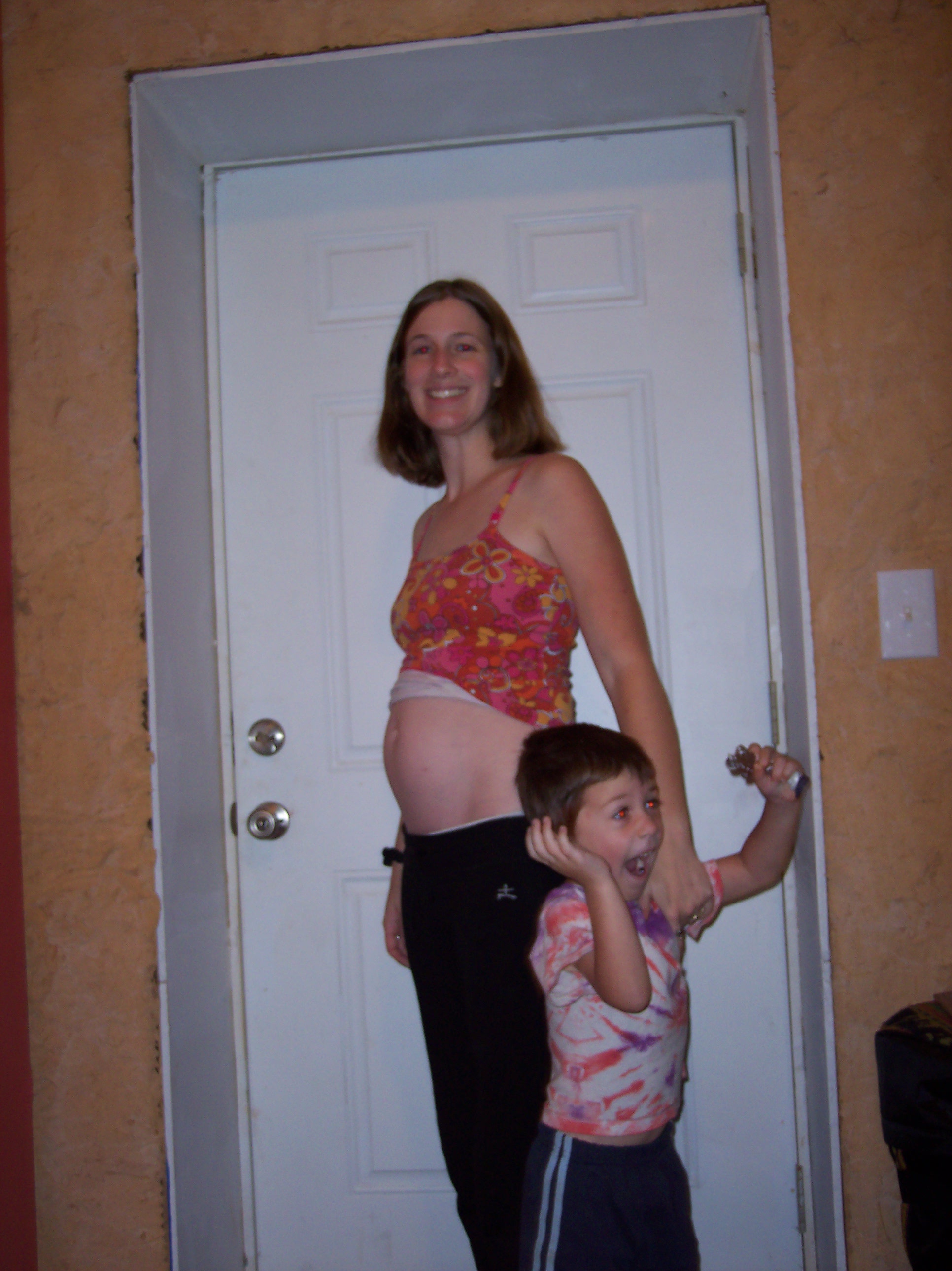
Here is my 20 week picture with baby #2 (we lived in our temporary shop/garage-house at this point, which is why the lovely backdrop):

I didn’t make it to 19 weeks with my third baby, but I don’t want to leave him out, so here is a 12 week picture from my third pregnancy:

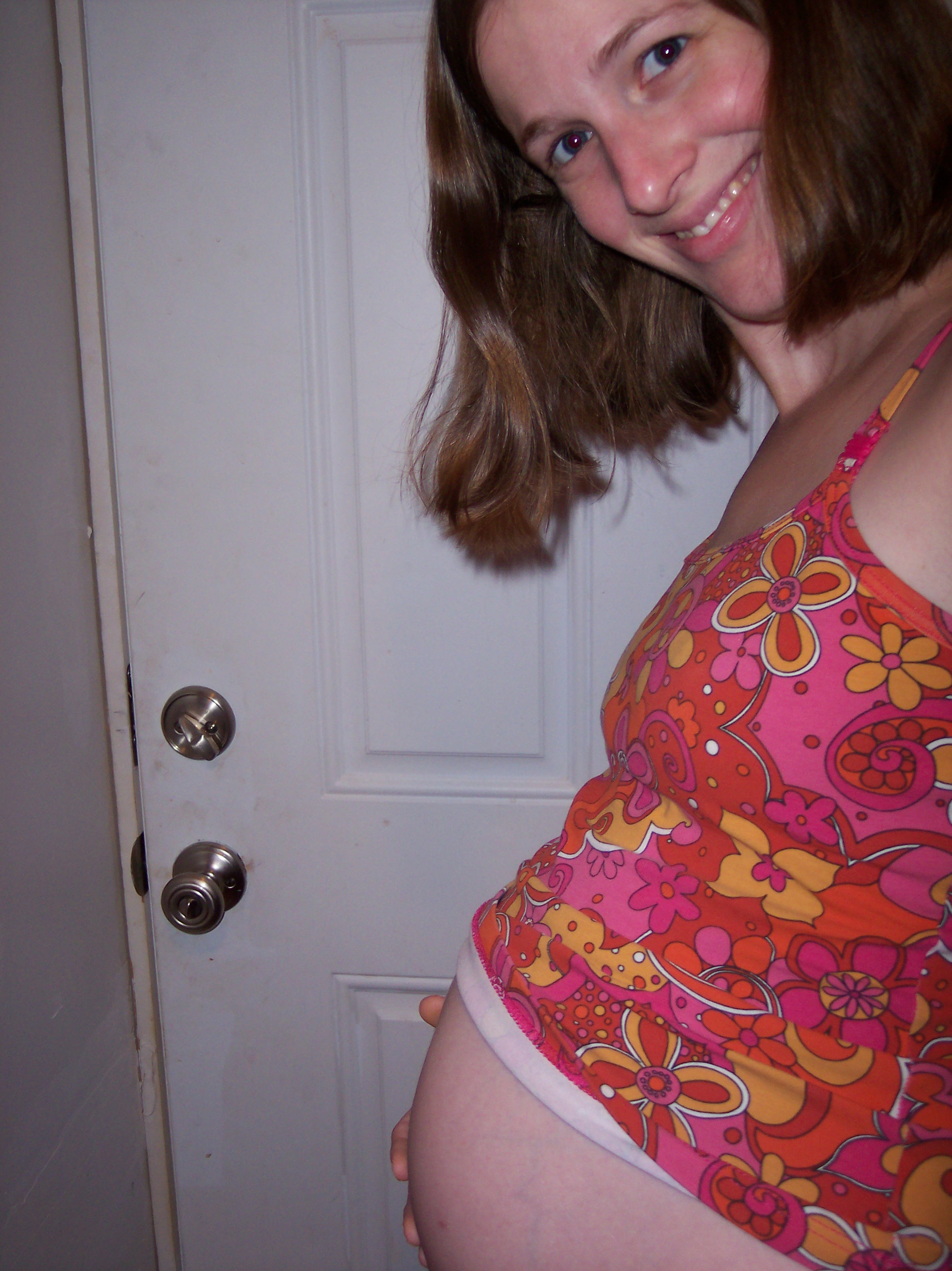
And, finally, below is a 19 week picture from my fifth pregnancy. Yay us! (and, by the way, I definitely do not weigh 126 pounds!) Lann took this one:

And then, I stuck my belly out and took a self-portrait of myself:

🙂

Childbirth and ‘Flow’ Experiences

One of my areas of interest within childbirth education is about the importance of birth as an experience. I know this isn’t necessarily a popular approach—more popular is to focus on evidence-based care, because using the dreaded “experience” word implies something too esoteric or “woo-woo,” OR it implies that women value the “experience” over a healthy baby (the very notion of which is so insulting to mothers that I can hardly stand it). However, I tend to think that an overemphasis on evidence-based care simply isn’t enough to explore and describe all that birth means for women. Women deserve even more than evidence-based care! (I actually have an article brewing that addresses this subject.) All too often women’s plans for beautiful births are dismissed with comments such as, “all that really matters is a healthy baby,” or “birth is just one day in a woman’s life.” I believe that wanting a healthy baby is a given and that giving birth is also a transformative rite of passage and life experience that has value in and of itself.

In the textbook Childbirth Education: Practice, Research, & Theory the concept of birth as a peak, or “flow” experience is addressed several times:

The joy and personal growth that can result from successfully meeting challenging experiences has been described as ‘flow experiences’…such experiences are generally better understood in athletics than in childbirth because the public understands athletic events to be character building and an effort or a struggle that requires skill, practice, and concentration and is not without pain. As such, athletic accomplishments are widely recognized for both the product and process…Society focuses the celebration of birth almost totally on the product–the baby–and is rather neutral about the process as long as the mother emerges healthy.

The book also shares the research that when mothers were interviewed postpartum who had had epidurals, their comments following birth focused almost totally on the baby. Women who had relied on relaxation and other non-pharmaceutical coping methods talked about the baby AND about the emotional and psychological benefits of their birth experiences. Women in both groups expressed satisfaction with their birth experiences, but for those in the epidural group “the element of personal accomplishment or mastery was missing in their comments.”

I believe that starting out the parenting adventure with a sense of “personal accomplishment and mastery” is a tremendous gift and I wish all expectant couples had the opportunity to experience birth in this way. In my classes, I strive to emphasize that both process (giving birth) and product (healthy baby, healthy mom) are important, and indeed, are inextricably linked.

Creating Needle Felted Birth Art Sculptures

I wrote this article about birth art some time ago and it has appeared in some form or another in both the CAPPA Quarterly and in the Friends of Missouri Midwives newsletter. Since I posted yesterday about polymer clay birth art figures, I felt like sharing this article today!

—————————

I learned about creating birth art during my first pregnancy in 2003 when I read Pam England’s amazing book, Birthing from Within. Seeing paintings creating by pregnant women, mothers, and fathers was inspirational for me. I was also moved by reading the accompanying explanations of how the art process had helped people on their birth journeys, or on paths to healing from traumatic experiences with past births. In the book, Ms. England primarily discusses the use of journaling, painting/drawing, or sculpting. Though I am an avid journal keeper, I did not find that medium vibrant or visual enough to express the hidden birth wisdom I sensed faintly at the edges of my consciousness, waiting to be given form. Birth art allows you to tap into your “right brain” consciousness and express unexplored gifts, primal wisdom, or release hidden fears. Creating birth art can help you explore your feelings, memories, beliefs, and perceptions surrounding birth outside of the confines of the spoken or written word.

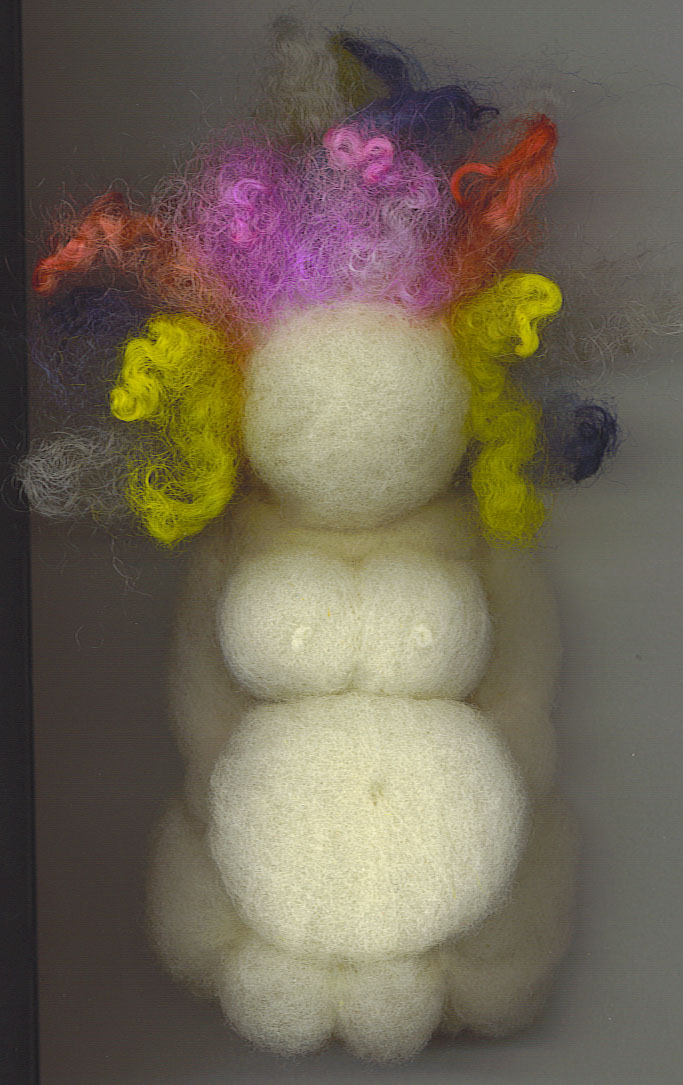
During this time, I had also been experimenting with the craft of needle felting. Needle felting involves using 100% wool fiber, a single felting needle, and your imagination! Needle felting is a dry felting process in which washed and carded wool fleece is sculpted into shape using only a special barbed needle. I decided I had found the perfect medium to express my birth art. I had envisioned creating a Venus of Wilendorf style goddess sculpture. My first attempts left me feeling dissatisfied. I had created the form of a pregnant woman with white wool and then layered colors over it (the effect was cluttered and disorienting—not the inner wisdom I was seeking to explore). I also gave them faces that seemed unfortunately more haunting than wise.

Finally, I created a lushly full figured pregnant woman in white wool in a seated position (my previous efforts were standing) and decided to leave her white and without facial features. I gave her wild, colorful hair in colors representing the four elements. Finally, I felt my vision being manifest! My only concern was how the eye was drawn to her head/hair. One of my fears surrounding birth was that I would be too “in my head” to get into the rhythm of the birth process. I worried that this fear was given visual form in my goddess sculpture—her “energy” was concentrated in her wild, woolly hair, not in her ripe body where I thought it “should” be. Only after I gave birth to my son, did I fully realize what my exuberant goddess was trying to tell me. Her hair and the colors in it were symbolic of the elemental forces and intuitive knowledge that each birthing woman possesses. I had been concerned about being “in my head” with “book learning.” After giving birth, I recognized the intuitive, natural, wild wisdom that I do carry in both my mind and my body.

Polymer Clay Birth Goddess Sculptures

In my recent post about “the tentative pregnancy,” I mentioned feeling the urge to make some birth art. Coincidentally, I have several blessingways/mother blessings coming up and also needed to make some gifts…so I put the two needs together and made some lovely (if I do say so myself) polymer clay birth goddess sculptures. I’ve made quite a few in the past, but this was the first time I’d tried using pigments to color them. I also boiled them instead of baking them, which works really well (and they are just as hard and plasticky as when baked—not rubbery or anything as you might expect—but there isn’t any weird fumes from the oven or a need to have an oven heating up the house on a hot day). I think the pigments turned out nice, though I was hoping for more color.

I hope that none of the pregnant mamas for whom these are intended will read this post and have the surprise ruined! (the blue one is actually for me, I thought as long as I was creating for others, I would like to create something for myself as well)

In my earlier post, I’d also mused about my feelings that my pregnancy loss experiences have impacted my ability to connect with the “pregnant identity” during my current pregnancy while at the same time still being constantly aware of being pregnant. Interestingly, I was skimming through my old pregnancy journal from my first pregnancy in 2003 and found the almost exact same sentiment expressed (6 years PRE-loss experiences). I wrote (reflecting on earlier in the pregnancy), “I felt almost constantly aware of being pregnant, but not fully connected to being PREGNANT. This feeling changed after I started feeling the baby move on a regular basis.” Ah ha. So, perhaps my current feelings have more to do with the normal developmental tasks of pregnancy than with having been wounded by loss? (it is probably a combination of both, really, but it was reassuring to me to see that this is not a completely “fresh” feeling!)