New Post…

I spent quite some time writing a new post yesterday and then it disappeared without a trace! I like to make a post here at least once a week, so I’m going to have to just link to the other post I wrote yesterday as part of the Women’s History Month blog carnival from Birth Activist. Birth Activist was the very first birth blog I ever started reading and the blog that sparked my own interest in blogging (a couple of years later).

In addition to teaching the Young Parents classes, which is a new venture for me, I also start teaching my second college class next week. This one is at a college branch about an hour from me, so I’m going to be doing a lot of driving in addition to all the preparation work. I think blogging is going to have to slip down my list of priorities for a while and so I may not be making new posts for a little while—I hope my readers don’t abandon me! Have no fear, I’ve managed to work birth activism into my class in a very appropriate way—I’m going to show them the Reducing Infant Mortality film and possibily The Doula Story as well, during my section of the class on teen pregnancy.

Resource Rack

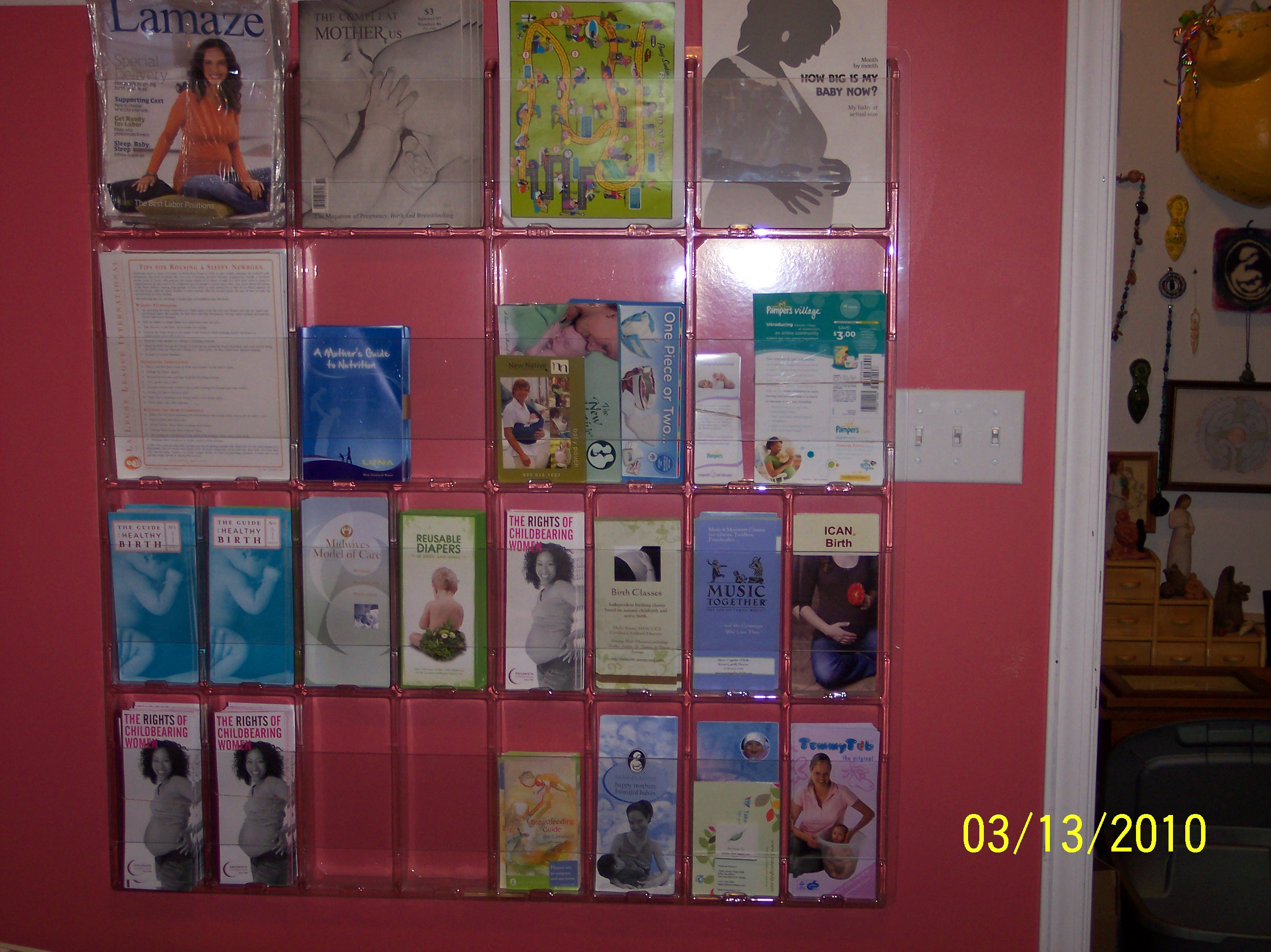
I was pleased as can be when my husband brought home a plastic brochure rack that was getting thrown away at work. As a semi-compulsive gatherer and sharer of information, I have boxes of pamphlets, magazines, brochures, etc. that I put together in packets for my birth class clients. How much more efficient and attractive to organize them this way! I took a picture of it because I’m so happy.

Young Parents Program Prenatal Classes

I am getting ready to teach a series of classes for a local Young Parents program. I have had to rework my class outlines a bit to meet some of the program’s requirements/needs. I decided to upload some of the activities here in case they may help someone else avoid reinventing the wheel by typing up their own similar activities.

Birth BINGO–this is a Bingo card with birth terminology. You can enter the terms into one of a variety of bingo card makers online in order to randomize the cards so that they are not all in the same order (which would then make everyone always win together).

Bingo Definitions–this is the list of definitions that goes with the card above. You can cut them apart and draw terms at random to read aloud. Participants yell out the answer and get to put a candy (Smarties, M & M’s, that sort of thing) onto the appropriate square on their card.

Labor Rehearsal–this is a labor walk-through. It is a little more conventional/conservative than I really like. In most of my classes I like to use the Labor Stations from the Transition to Parenthood site. I print them out as cards, not full pages, and hand them over to the parents to practice. The cards walk them through a whole labor early labor through pushing and it is a god opportunity to review and integrate everything they’ve learned and experimented with in class. I do not include the patterned breathing suggestions because I do not teach patterned breathing techniques. There are LOTS of good games and handouts for classes on this site. I really appreciate it!

Communicating with Baby Prenatally–I was specifically asked to include a component of this in this series of classes. This exercise is modified from one in the Nurturing Parents prenatal curriculum. It isn’t my favorite exercise, but I’m going to try it out. I also have another one from ICEA that I am going to use called Sensory Imaging: The Baby Inside You.

Book Review: Get Me Out

Book Review: Get Me Out: A History of Childbirth From the Garden of Eden to the Sperm Bank
By Randi Hutter Epstein, MD
W.W. Norton & Company, 2010
ISBN 978-0-393-06458-2
302 pages, hardback, $24.95
http://www.randihutterepstein.com/

Reviewed by Molly Remer, MSW, ICCE

Since it shares a subtitle about the history of childbirth, I expected the new book Get Me Out to be very similar in content to the recent book Birth Day by Mark Sloan or to the book Birth by Tina Cassidy. I wondered how much more could possibly be reported about the history of childbirth. It turns out there is plenty more and I was delighted to discover that Get Me Out stands alone as a unique and interesting contribution to books of this genre.

Written by a physician and mother of four, Get Me Out focuses on some very recent elements of birth history including assisted reproductive technologies (ART), ultrasound, and freebirth, subjects not addressed in the books referenced above. Aside from familiar content about things like the Chamberlen brothers and the Twilight Sleep movement, the remainder of the text was fresh and engaging. Part one included an interesting and disturbing chapter about Marion Sims and his research and experiments with fistula repair on enslaved women. A later chapter explores Sims’ research with artificial insemination (this time with middle class white women). In fact, the latter half of the book contains an extensive historical look at artificial insemination, moving into present day history including an exploration of sperm banking and cryo-preservation of eggs.

Unique among birth history books is Epstein’s chapter on freebirth (more commonly known as “unassisted childbirth”) followed with a chapter about ultrasound including content about 4D and “novelty” ultrasounds. There is also a chapter exploring DES and its effects on reproduction.

Also different than Birth Day and Birth, is the total absence of memoir or personal reflective content. Epstein is a medical journalist and Get Me Out is written in that voice. There is a light, personal tone to the text, but nothing personal aside from occasional descriptions, observations, or quotes from interviews with sperm bank mangers (for example). I found myself feeling a little curious about her personal history of childbirth, an element freely interspersed throughout the texts of other recent birth history books.

As the author says, “…the way we give birth is a story about our deepest desires and our fundamental concerns about life, death, and sex.” Get Me Out is a fascinating tale focusing on our collective, cultural story about birth in the late nineteenth and twentieth centuries, as well as dip into the story that continues being written today.


Disclosure: I received a complimentary copy of this book for review purposes.

Birthing Room Yoga Handout

In my classes, I teach a short little series of prenatal yoga poses called “Birthing Room Yoga.” I learned the series from the excellent video, Yoga for Your Pregnancy by Yoga Journal and Lamaze. My rationale for including the poses in all my classes is that while academic/intellectual information is useful (and is my personal learning style), birth happens in your body and not your head—-lots of us are uncomfortable with our bodies, so I try to get people to use their bodies a lot during classes. This helps women become comfortable with using their bodies, plus gets them out of their heads-space and into body-space, plus each exercise chosen has pregnancy or birth related benefits. Physical work is important for partners too—-birth is a physical event (both for the person helping and for the partner watching the pregnant woman work during labor).

I didn’t learn this series of poses until after my first two children were born. I was interested to see that I used all of the poses (or variations thereof—I also show a variety of variations during class) during my labor with my first son—even though I didn’t call it “yoga” or consciously “practice” during labor. I think that is a powerful reminder of the wisdom we carry in our bodies—as long as there is space and freedom in which to do so, this “birth yoga” arises spontaneously out of our own inherent wisdom, no training required!

Here is the Birthing Room Yoga handout I give with the pose reminders! The pelvic circles are particularly good and can be done seated on the edge of a hospital bed while having fetal monitoring.

Birth Quotes Update

More birth quotes collected for my Facebook pages. Maybe I need to start compiling a book!

“…natural birth is full of magnificent, life-changing wisdom.” –Christiane Northrup

“The major role that the body’s natural oxytocin plays in birth encourages the idea that birth is an experience of love…birth is a spiritual experience simply because it is largely an act of love on the part of the body physiology and the indwelling spirit.” –Cathy Daub

“It makes sense that we should help our bodies with the amazing work of giving birth, rather than make the process more difficult and complicated. However, along with all the life-saving benefits modern [L & D] units provide, many of today’s routine practices…and interventions can actually slow down labor, increase pain, cause unnecessary stress for baby, and make cesarean surgery more likely.” (Mother’s Advocate)

“…experiences have clearly shown that an approach which ‘de-medicalizes’ birth, restores dignity and humanity to the process of childbirth, and returns control to the mother is also the safest approach.” –Michel Odent, MD (via BirthWorks)

“A calm, watchful, loving presence protects the fragile harmony of birth; frantic coaching has *never* been part of nature’s plan.” –Pam England

“Yes, of course, some women have a choice about becoming pregnant, but whether a woman chooses to give birth or not, once she is in the throes of labor, her individuality counts for little; she becomes caught up in the universal act of ‘giving life.’ She can do this with control and passion or be totally unconscious and unable to participate–but once begun, the birth process is unstoppable.” –Judy Chicago

“A knowledgeable childbirth teacher can inform mothers *about* birth, physiology, hospital policies and technology. But that kind of information doesn’t touch what a mother actually experiences IN labor, or what she needs to know as a mother (not a patient) in this rite of passage.” –Pam England

“Women…are storytellers. They are nurturers…filled with creative forces when they are fertile, pregnant or birthing. Millions of years of biology are on their side to ‘bring forth.’ Nothing can stop the power behind that force, not even the woman herself…She is the living essence of the future. She is a holy woman and there is intelligence at work in her. It is sacred energy.” –Sister MorningStar

“When enough women realize that birth is a time of great opportunity to get in touch with their true power, and when they are willing to assume responsibility for this, we will reclaim the power of birth and help move technology where it belongs–in the service of birthing women, not their master.” –Christiane Northrup

“Before I had children I always wondered whether their births would be, for me, like the ultimate in gym class failures. And I discovered instead…that I’d finally found my sport.” –Joyce Maynard

“Our body-wisdom knows how to birth a baby. What is required of the woman who births naturally is for her to surrender to this body-wisdom. You can’t think your way through a birth, and you can’t fake it.” –Leslie McIntyre

“Birth is an opportunity to transcend. To rise above what we are accustomed to, reach deeper inside ourselves than we are familiar with, and to see not only what we are truly made of, but the strength we can access in and through Birth.” –Marcie Macari

“So the question remains. Is childbirth painful? Yes. It can be, along with a thousand amazing sensations for which we have yet to find adequate language. Every Birth is different, and every woman’s experience and telling of her story will be unique.” –Marcie Macari

“The natural process of birth sets the stage for parenting. Birth and parenting mirror each other. While it takes courage and strength to cope with labor and birth, it also takes courage and strength to parent a child.” –Marcy White

“The instant of birth is exquisite. Pain and joy are one at this moment. Ever after, the dim recollection is so sweet that we speak to our children with a gratitude they never understand.” ~ Madline Tiger

“…celebrate ourselves for our courage to birth. The real question becomes not, ‘Have you done your breathing exercises?’ but rather, ‘Can you love yourself no matter how you birth, where you birth, or what the outcome?'” –Claudia Panuthos

“Listening to your heart is not simple. Finding out who you are is not simple. It takes a lot of hard work and courage to get to know who you are and what you want.” –Sue Bender

“As women, we are inherently both power-filled and power-full. Each one of us knows on some level that we do have awesome strength at our core.” –from the book Mother Rising

“VITA MUTARI – the literal translation from Latin to English is ‘Life Transformation.’ That is the closest thing I could think of the feeling of labor/birth…what you are feeling isn’t pain, it’s life transformation. Is it dramatic? You bet! I think it should be!” –Stephanie Soderblom

“…Birth is a rite of passage of women. Their journey should be honored, their rights should be fiercely protected, and their stories should be shared.” –Marcie Macari

“How you view childbirth is a reflection of your philosophy of life…I feel…sad about…our culture where the message is that women can’t have a good childbirth experience without turning themselves over to the control and interventions of the medical community.” –Marcie K. Richardson (OB & instructor at Harvard Medical School!)

“Birth is a three legged stool, a healthy mom, a healthy baby and a healthy birth. Without ANY one leg, it is equally unstable!” –Sharon Muza

“While all of your (birth) planning may spin a cocoon of security, in actuality, the course of your labor is unknowable…your critical task is to prepare for a birth that has NO script.”–Pam England

“A woman in Birth is at once her most powerful, and most vulnerable. But any woman who has birthed unhindered understands that we are stronger than we know.” –Marcie Macari

“Breastfeeding… led me to self-discovery and to a greater appreciation of the full humanity of the babies who were entrusted to me. Each woman needs to trust her own instincts, her own feelings, and her own sense of what will work for her with each baby.” –Viola Lennon (1923-January 22, 2010, LLLI Founder and profound influence on the world)

“Whether a woman is making children or other works of the womb, the creative power of her uterus is amazing to behold. Some of a woman’s greatest transformations involve the changes in her womb: menarche, pregnancy, miscarriage, childbirth, and menopause.” –Tami Lynn Kent

“Life is full of beauty. Notice it. Notice the bumble bee, the small child, and the smiling faces. Smell the rain, and feel the wind. Live your life to the fullest potential, and fight for your dreams.”~ Ashley Smith

“I would say in obstetrics you are numbed by the technology. Your ability to understand the more sacred and spiritual aspects of birthing is extremely numbed.” –Dr. Eden Fromberg, OB/GYN (in The Business of Being Born)

“There is such a special sweetness in being able to participate in creation.” –Pamela Nadav

“Never underestimate the power of a woman AND never underestimate the power of YOU!!” –Nicole at Your Birth Right

“Although pregnancy and birth is a richly intuitive and instinctive process, a woman will prepare her ‘nest’ and birth according to the style of her culture, in the same way that a particular species of bird will build its nest with whatever is available.” –Pam England

“keeping active during labour and adopting natural, upright or crouching birth positions is the safest, most enjoyable, most economical and sensible way for the majority of women to give birth.” –Janet Balaskas

“Until women themselves value and honor mothering in all its forms, there is little chance that the cultural paradigms will change…Many women with children have come to respect the art of mothering, but still need to advocate for its value when faced with external expectations and pressures to feel professional success.”–Tami Lynn Kent

“…birth is the pinnacle where women discover the courage to become mothers…” –Anita Diamant

“We are made to do this work and it’s not easy…I would say that pain is part of the glory, or the tremendous mystery of life. And that if anything, it’s a kind of privilege to stand so close to such an incredible miracle.” –Simone in Klasson 2001

“A woman is the full circle. Within her is the power to create, nurture and transform.” –Diane Mariechild

“Women are AWESOME – We can do such out of control, yet in-control cool stuff with our bodies.” –Desirre Andrews

“There is power that comes to women when they give birth. They don’t ask for it, it simply invades them. Accumulates like clouds on the horizon and passes through, carrying the child with it.” – Sheryl Feldman

(I don’t think the power “invades” so much as it is already there, inherent, just not tapped into…)

“Mothering is a subtle art whose rhythms we collect as much from one another as from instinct.” –Louis Erdrich

“The woman about to become a mother, or with her newborn infant upon her bosom, should be the object of trembling care and sympathy wherever she bears her tender burden or stretches her aching limbs…. God forbid that any member of the profession to which she trusts her life, doubly precious at that eventful period, should hazard it negligently, unadvisedly or selfishly”. – Oliver Wendell Holmes

“The knowledge about how to give birth is born within every woman: women do not need to be taught how to give birth but rather to have more trust and faith in their own body knowledge.” –BirthWorks

“A new year is unfolding – like a blossom with petals curled tightly concealing the beauty within.” –Anonymous

“Birth is about radical, creative, life-affirming change. It is about adaptation on a nearly unbelievable scale.” –Mark Sloan, MD

“Understanding birth technology shouldn’t lull you into thinking you understand *birth*. The profound mystery and spirituality of birth can never be understood with the mind, they are known through the heart…” –Pam England

“Attempting to fulfill an idea of the ‘perfect’ mother can only prove soul-destroying, as no such person exists.” –Adela Stockton

“Pregnancy, birth and motherhood move us further along on life’s continuum. They challenge us to create a new nomality.” –Pat Thomas

(I feel like having children is an essential part of my “development” as a human being–without them, I’d be a less developed person…)

“Pregnancy and birth knit womankind together. Help weave a gorgeous thread to add to the fabric. Be supportive. Be kind. Be wise. Be open.” –Desirre Andrews

“Birth is a mystery. Words are not enough.” –Marie O’Connor

“Birth matters. It brings us into being, on many levels.” –Ananda Lowe

“Babies are bits of star-dust blown from the hand of God. Lucky the woman who knows the pangs of birth for she has held a star.” –Larry Barretto

“Midwifery calls upon you to be the best you can be: the best advocate, guide, healer, counselor, mother, comrade, and confidant of the women seeking your care.” — Anne Frye

“This is the day which honors the bond between sisters and the freedom of all women. There is no slavery today…Today all women are joined in the joys of motherhood: for we hold up, not our own, but our sister’s children to the sun.” –Ovid, Fasti (today, March 1, was known as “Matronalia” in ancient Rome, the great spring feast of motherhood.)

“I think of women’s kinships as pottery kilns, where two together shape the rough clay of emotion into humankind’s most valuable and prized vessels: human community.” –Pythia Peay

“Simply put, when there is no home birth in a society, or when home birth is driven completely underground, essential knowledge of women’s capacities in birth is lost to the people of that society—to professional caregivers, as well as to the women of childbearing age themselves.” –Ina May Gaskin

“…to give birth with power, without drugs, means having to go to the edge, and beyond…the hospital ‘battle field,’ in striving to be sterile and clean, inadvertently sends a confusing message to women giving birth. Birth-warriors don’t stay clean, made-up, and poised…” –Pam England

“Strange as it may appear…the results of trials and investigations show that fewer women die when treated in their own squalid ill-ventilated houses and nourished by the coarsest of food than when inmates of the best-equipped and best-managed lying-in hospital in the world.” –New York City newspaper ~1801 (I got this quote from the new book Get Me Out. Of course, I would prefer that women have access to non-squalid homes and non-coarse food, but I thought the sentiment was interesting–and relevant!)

“Sometimes the strength of motherhood is greater than natural laws.” –Barbara Kingsolver

“…fear has to be present in order for courage to exist. The English word ‘courage’ is derived from the French word for the heart, coeur. Finding the heart to continue doing the right thing in the face of great fear inspires others to become nobler human beings.” ~ Gloria Lemay

“When I stopped seeing my mother with the eyes of a child, I saw the woman who helped me give birth to myself.” — Nancy Friday

“Giving birth is not an isolated event in a person’s life. A woman births with both her mind and her body and participates in the attitudes toward childbearing of her culture and her family.” –Rahima Baldwin

“For each of us as women, there is a deep place within, where hidden and growing our true spirit rises…Within these deep places, each one holds an incredible reserve of creativity and power, of unexamined and unrecorded emotion and feeling. The woman’s place of power within each of us…it is dark, it is ancient, and it is deep.” –Audre Lorde

“The way we give birth is a story about our deepest desires and our fundamental concerns about life, death, and sex.” –Randi Epstien

“…what is normal today is not the same as what is healthy.” –Barbara Patterson & Pamela Bradley

“Our lives begin to end the day we become silent about things that matter.” –Martin Luther King Jr.

“Pregnancy and birth are the most crucial and powerful passages in a woman’s life. Most births around the world lead to some degree of preventable trauma for the mother and baby…preventable because much of it is iatrogenic, that is, caused by the doctor or midwife. In many cases, if the mother, baby and birthing …process had been treated with respect, the trauma would possibly have never taken place…Instead, the mother likely would have had the most miraculous experience of her life.” –Midwifery Today e-news

“Rigid plans work best if you’re building a skyscraper; with something as mysteriously human as giving birth, it’s best, both literally and figuratively, to keep your knees bent.” –Mark Sloan, MD

“It is not ‘ladylike’ to give birth. The strength and power of labor is not demure.” –An Easier Childbirth (quoting a midwife)

“Mothers need to know that their care and their choices won’t be compromised by birth politics.” – Jennifer Rosenberg

“To rediscover midwifery is the same as giving back childbirth to women. And imagine the future if surgical teams were at the service of the midwives and the women instead of controlling them.” -Michel Odent, MD

“…Childbirth in itself is a rite of passage. Being born is an initiation and giving birth is a transforming experience.” –Benig Mauger

“We must attempt to tell the whole truth about birth, the truth that includes the transformation, mastery, satisfaction, personal power and the difference between pain and suffering.” –Cheri van Hoover

“Giving birth is a transformation and it doesn’t matter whether you’ve had eight babies before. It’s still a transformation the next time you have another baby, because you are no longer the same woman you were before you had that baby.” –Penny Handford

“We need nothing less than a revolution in our attitudes towards conception, pregnancy, birth and parenting.” –Sophie Style

“When you destroy midwives, you also destroy a body of knowledge that is shared by women, that can’t be put together by a bunch of surgeons or a bunch of male obstetricians, because physiologically, birth doesn’t happen the same way around surgeons, medically trained doctors, as it does around sympathetic women.” –Ina May Gaskin

Birth Violence

“‘Old wives’ tales,’ says the Oxford dictionary, are ‘trivial stories, such as are told by garrulous old women.’ It is significant that no one ever talks about ‘old husbands’ tales’ or ‘old doctors’ tales.’ Women are blamed instead. It is implied that there is poison in their speech and that the only safe thing to do is remain silent. The experiences that women share with other women are thus rejected and trivialized…In reality, it is not other women who instill and fuel anxiety in most pregnant women, but the medical system itself.” This quote from the 1980’s book, Giving Birth, by Sheila Kitzinger, remains strikingly relevant today. When women in the United States today enter the hospital to give birth, many experience some form of institutional violence. They may not explicitly define it as violence, but listening to their stories provides a disheartening picture of maternity care today.

What kinds of violence occur in the birth place? Here are a few possible examples of “normative abuse” women may experience when giving birth in U.S. hospital setting

• Restriction of movement
• Restriction of nourishment
• Domination by those in positions of authority—must obey even when it is against her own best interests.
• Routine, forced interventions such as IVs
• Repeated, possibly painful, vaginal examinations by many different people
• Denial of option for VBAC (vaginal birth after cesarean)
• At the most extreme example of overriding patient rights, a forced cesarean section
• Vaginal cutting (episiotomy)
• Abusive language
• Separation from family/restriction of companionship
• Lack of respectful treatment
• Voice and wishes disregarded/unheard
• Emotional manipulation using baby as a “card” to force compliance (“you want a healthy baby don’t you?” No mother doesn’t. It is degrading and dehumanizing to suggest that she doesn’t.)
• Forced separation of mother and baby
• Administration of medications without consent
• Cord traction and interference with third stage (placenta) that may lead to hemorrhage.

The emotional treatment of women in labor is the most significant factor contributing to their satisfaction with their birth experiences (emotional factors of highest importance include having good support from caregivers and being treated with respect). According to Kitzinger, “We are only now discovering the long-term destructive effect on human beings and families of treating women as if they were merely containers, to be opened and relieved of their contents; and of concentrating attention on a bag of muscle and a birth canal, rather than relating to, and caring for, the person to whom they belong. The violence which is a common element in childbirth today leaves many women feeling that birth has been a kind of rape. This sort of experience is not easily forgotten. It can shatter a woman’s self-confidence, make her doubt her ability to mother her baby, destroy joy in the expression of her sexuality, and attack her very sense of self–the roots of her identity. It is psychologically mutilating.”

And, as Mary Rucklos Hampton says, “The effort to separate the physical experience of childbirth from the mental, emotional, and spiritual aspects of this event has served to disempower and violate women.”


Molly Remer, MSW, ICCE is a certified childbirth educator and activist who blogs about birth at https://talkbirth.wordpress.com and midwifery at http://cfmidwifery.blogspot.com.

Note: In 2009, I wrote an article about birth violence for International Women’s Day, but it appears to have never been published. So, I decided to post it here (and on the CFM blog in honor of this year’s International Women’s Day on March 8th). I also read two relevant articles recently: How childbirth caused my PTSD and Birth Trauma: An Introduction.
Book Review: L’Mazeltov

L’Mazeltov: Your Personal Guide to Jewish Childbirth Education
By Pamela Nadav
L’Mazeltov, Inc. 2008
Softcover, 248 pages, $18.00
ISBN: 978-097786610-6
www.lmazeltov.org

Reviewed by Molly Remer, MSW, ICCE

The title of the new Jewish childbirth education book L’Mazeltov combines “two important Jewish symbolic expressions—L’Chaim (To Life) and Mazel Tov (Good Fortune).” The first half of the book consists of basic childbirth education and preparation. The second half is about “Jewish Life Cycle Education.” The strength of this book is the fusion of the two.

The childbirth education section was very conventional and conservative. I was surprised by some of the advice offered such as, “Always follow your doctor’s advice in all matters related to your pregnancy, labor and delivery” and in the section about anesthesia, “All of these modern technologies are designed to assist you in having the best possible birthing experience, and are considered to be relatively safe.” Personally, I feel like an important piece of childbirth education is encouraging pregnant couples to be informed birth consumers. There was no element of this perspective within L’Mazeltov.

The book includes some population-specific pregnancy information such as a short section on Jewish genetic diseases and testing.

There is a nice recipe section at the end of L’Mazeltov. I was inspired to make some delicious Challah bread for my family! There is no index, resource list, or glossary of terms (as a non-Jewish reader, many words were unfamiliar to me—-the author does a good job defining many within the body of the text, however).

Despite my wish for a more creative and evidence-based approach to the birth education portion, this book is a one-of-a-kind contribution to birth literature, covering both the “oys and joys” of preparing for parenthood. What a resource for Jewish couples expecting their first baby! “There is such a special sweetness in being able to participate in creation.”

Disclosure: I was provided with a complimentary copy of this book for review purposes.

Review first published in The CAPPA Quarterly, January 2010.

What Kind of Mother ARE You?

A couple of years ago I read the book Inconsolable: How I Threw My Mental Health Out with the Diapers by Marrit Ingman. There was a short section in it about “what kind of mother are you” (actually, it was in a MILF- musings segment). How often do we think that exact thing, with emphasis on the “ARE”?! For me, it is most often about myself and in a self-denigrating way (i.e. my kids just ate chips for breakfast, what kind of mother AM I?!). Anyway, her section on the subject and her conclusions had me rolling with laughter. Some time later I was giving a little talk at our Mindful Mothers group about life balance/life organizing and I closed it out with a parenting quiz that I made based on the section in the book. (As I noted a couple of posts ago, I’m trying to remember to put things online that I’ve already written, rather than having them languishing on my computer unread, after having used them once. I think I gave the presentation over a year ago.) The section in the book wasn’t in quiz format, it was talking about other types of parenting quizzes and then includes the material in paragraph form that she’d like to see in a quiz. I turned it into a “proper” quiz and have now uploaded it here for the enlightenment of all ;-D

What Kind of Mother Are You Quiz

I should make it into a Facebook quiz, but I don’t use those Facebook apps anymore.

Rolla Area Doula Recommendation

Summer Eyberg has been a colleague and friend of mine for many years. Late last year, I was privileged to received Summer’s skills as a doula during my third pregnancy and also postpartum when that pregnancy ended unexpectedly during the fourth month. Summer has an amazing gift of presence—she is open and receptive and listens without judgment. She is also skilled at always returning decision-making power to the hands of the mother (where it belongs!). I have always been impressed with Summer’s ability to notice when something needs to be done and how she quickly and graciously moves to do it without fanfare. Summer is also friendly, passionate, and easy to trust and she has a natural gift in celebrating and honoring pregnant women.

Summer’s compassionate attention and sensitive listening have blessed me beyond measure and I am lucky to call her my doula and my friend!

Summer can be contacted via Peaceful Beginnings Doula Services or via Facebook