Conclusions About Listening

“What would happen if one woman told the truth about her life? The world would split open.” —Muriel Rukeyser

I continue to think about the ideas in the post I made a couple of days ago about birth choices and listening to women’s stories. Though my thoughts are by no means fully “concluded,” I wanted to add a postscript of sorts based on comments some people have left as well as to share some new apropos quotes that keep popping out at me from all kinds of places. I guess my basic conclusion is that as “birth advocates” we definitely should NOT stop sharing our stories–-perhaps what most needs to change is how we listen to stories—how they are received and accepted and heard, rather than analyzed or dissected. And, perhaps also our approach at story-telling itself needs to change-–to being about our experiences and not trying to “convert” anyone. Bottom line for me is that if I was forced to choose, I value WOMEN the most–-not birth or giving birth the “right way.”

I just finished reading a book called Soul Sisters and came across this quote: “I have learned that…in listening you become an opening for that other person.” Perhaps this is how changes are born. And later this treasure, “Indeed, nothing comes close to an evening spent spellbound by the stories of women’s inner lives.”

And, I think the KuKd author made a good point–-most women are “capable” of seeking out the information they wish, without having it handed to them (that supports the blog theory-–the value of sharing our stories via blogs and letting people find them as they wish!). Though, then my recent experience with my brother’s girlfriend shows me that maybe some people really don’t even know that they’d like to seek out the information and I’m back to the beginning again…

Another blogger commented that my post raised many conflicting feelings for her and expressed that she does not believe in a “live and let live approach,” that some choices in life truly are  “wrong.” I have many conflicting feelings about my post too…and I wrote it! However, the basic conclusion I reached with my wanderings was that I think we (okay, I) need to do some serious thinking about HOW it is (and WHY it is) that I share information about alternative choices or tell stories. Because, as the KuKd post I quoted shared, sharing in a specific type of “zealous” way, closes doors rather than opens eyes.

Giveaway: Cinch by Anew

This giveaway is now closed. Rebecca is the winner!

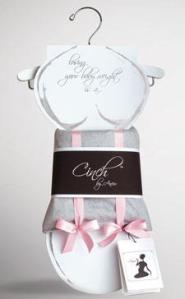
I thought it would be fitting to kick off March with a giveaway from Anew (get it?! “a new month,” Anew giveaway! :)). I have a Cinch for one lucky winner. The Cinch is a abdominal wrap that, “allows you to regain your healthy waistline naturally and comfortably with a single wrap.”  The creator (mother of two) says that, “Cinch was created out of a fear of developing a pregnancy induced muffin top.” ;-D I recognize that this product might not be a match for all of my readers, but I’m happy to share the information anyway!

I have to mention how extremely nice the packaging for this item is—super cute. It comes in a silver satin garment bag (with hanger) trimmed with black lace (not shown in the picture). I think it may be the most fancily packaged maternity item I’ve seen. So cute 🙂

The same company also offers a line of post-pregnancy wear called Silouette.

I have one Cinch to give away. I will draw the winner via random number generator on March 5th. You can enter to win by simply leaving a comment. You can earn extra entries by doing one or all of the following (and leaving a comment to tell me you did so!):

  • Become a (first time) fan of Talk Birth on Facebook.
  • Visit the Anew website and leave a comment telling me what product on the site is most interesting to you.
  • Leave a comment sharing your favorite tip about postpartum weight loss.
  • Share a link to the giveaway on your own/business Facebook page.

Giveaway: The Ionic Bulb!

This giveaway is now closed. Congrats to Katie who won!

I’m pleased to offer another giveaway this week. This time it is for an Ionic Bulb. What does this have to do with pregnancy or birth you might wonder? Well, I think it might be great for use in the room where your baby sleeps! According to the company’s information: “The bulb silently emits negative ions that help clear the air of smoke, dust, pet dander, allergens, airborne viruses and odors.” A dual purpose is that the bulb is also energy efficient—so if green, healthy living is important to you, this might be a good match:  “The Ionic Bulb comes equipped with a patented air purifying microchip ion emitter that is powered by the bulb’s own energy. The 23W Ionic Bulb is equivalent to a standard 100W incandescent bulb and uses 25% of the electricity than a regular incandescent bulb. In addition to being four times more energy efficient, the Ionic Bulb lasts up to 10 times longer and use 50% to 80% less energy than regular incandescent light bulbs.”

A single bulb works in a 100 square foot area.

I have one bulb to give away and will draw the winner via random number generator next Friday at noon. You can enter to win by simply leaving a comment on this post (making sure it gives me a means of contacting you if you win). You can receive bonus entries by doing one or all of the following (and posting to tell me you did so!):

Musings on Story, Experience, & Choice…

“Power consists to a large extent in deciding what stories will be told.” –Carolyn Heilbrun

A lot of thoughts and ideas have been swirling together in my head during the last couple of days. I read a thought-provoking post from Navelgazing Midwife about choices and the prevalence of the phrase “‘If women knew their options, they’d make different choices.'” She continues by saying, “The first is the assumption that she doesn’t/didn’t know her options, the belief that if she just knew them, she would have made different (my) choices.”

I have at several points in my life had the realization that I persist in thinking that if only people were “enlightened” (i.e. like me), they would make different choices, but then I am confronted with the fact that many people ARE aware of their choices and actively choose differently.

I was then reading the book Sacred Circles (not about birth, about creating a women’s spirituality group) and was interested to come upon this section:

People can feel especially fragile about giving birth because they hate to think they ‘did it wrong.’ We may defend one way of doing it because it is too threatening to think that there might have been a better alternative to the way we gave birth…go gently, and avoid the impulse to polarize or convert. Encourage each person to speak of her own experience in ‘I’ statements…”

Having a miscarriage has led me into a whole new blog world of miscarriage/stillbirth blogs, which often overlap with infertility blogs. There is such vast and deep pain associated with childbearing losses of all kinds. It is staggering—the weight and variety and prevalence. One babyloss blog I have been enjoying recently is Knocked Up, Knocked Down and in a stroke of synchronicity, she also wrote recently about choice and birth advocacy and minding your own dang business. She writes about talking to a friend about her plans—lack thereof—for upcoming birth of her child (following miscarriage and stillbirth). The friend begins to “push” midwifery and other “birth choices” and the KuKd authors writes this:

“And the conversation sort of fizzles there, because by that point I’ve shut down. I mean, I sort of pretend to carry on in conversation, talking and not talking, smiling and not smiling, but my brain has gone elsewhere – because the person I’m conversing with has just morphed from friend-on-equal-footing into a Homebirth Amway Salesperson in a blue suit and tie, standing at my doorstep with a clipboard in arm. And suddenly I’m too busy to talk, with WTF’s swirling around inside my head.”

I think we really need to hear this. There are any number of women out there who are not waiting to be “enlightened” by our “superior” homebirth wisdom! She continues:

“WTF is UP with the homebirth salespeople, and W(hy)TF do does it matter to them how I choose to deliver this child? In what way does my personal choice of baby-delivery affect anyone else’s life besides mine, my husband’s, and my baby’s? WTF is up with anyone believing in something – a religion, a product, anything – so righteously and rigidly that they feel compelled to convert others into following their so-called enlightened path?”

And then she reaches into “choices” that brings us back to the theme of Navelgazing Midwife’s post:

“My friend Jen explained it like this: ‘…but a lot of women don’t know they HAVE other options besides just a routine hospital delivery.’ Maybe true – but so what? Let’em find out on their own! Let’em read about it, ask about it, think about it like the smart people they probably are.”

There is SUCH a difference between sharing your story and “proselytizing” or trying to convert others (i.e. how our dearly held “birth advocacy” efforts may feel to others :().

And a final quote from a much longer and very good post:
“Just know that childbirth for a KuKd momma is psychologically complicated, and there’s a reason for every choice we make. Do not be alarmed by the sinister terms ‘hospital delivery’ and ‘no birth plan,’ as these do not necessarily equate to ‘poor ignorant woman who needs to be saved in the name of Jesus Christ the Lord of Homebirth Wonderfulness.’ Relax: things will be okay.”

As one of the extra-enthusiastic myself, perhaps a bit uncomfortable to read, but also upfront and honest and really important. One of the most important lessons I learned from my miscarriage is that I finally get HOW and WHY some women just don’t care about the birth. I have new clarity as to why everyone isn’t all fired about the miracle of birth and the glorious rite of passage. And an understanding of why women say, “as long as I have a healthy baby.” I feel like one of the gifts my little Noah brought me was not to be smug anymore. While I feel like I have always had a fairly good capacity for empathy and compassion and also the ability to see other peoples’ points of view and perspectives, I can now see that I also retained some measure of smugness that I, I get it. If my third pregnancy had ended merrily in another full-term, triumphant birth at home, I would still have some smug satisfaction at my core. It’s gone. Smug no more. For some women—me included—the end result of pregnancy and birth is a dead baby (whether a full-term baby or an early second trimester baby like my own) and the simultaneous birth of unquenchable, indescribable wells of grief and loss (and your little three year old saying, “but I was going to be the big brother. Why did our baby die, Mama? We will never get to hold his hand. He will never crawl all around our house. We will never get to play with him”). It can be hard to get all fired up and excited and “GO Birth Energy!”  if this is your reality and your experience of birth. Because I have other healthy children and because, along with the grief and pain, I experienced my own miscarriage as another “empowering” birth, I retain much of my fascination with birth and my love of the subject. However, my heart, eyes, and compassion have been opened to the larger breadth, depth, and range of being female and the breathtaking spectrum of childbearing experiences contained therein.

Last fall I attended a performance of Birth, the Play in St. Louis. During the BOLD Talkback following, a volunteer with ICAN made a statement that had a profound impact on me: “We believe that every woman has the right to define her own experience.” This struck me deeply as a core truth and it is becoming a foundation of how I work with and speak to women. How would the world look if this is truly how all birthworkers believed and worked and lived our lives? Instead of “hearing” what could have been done differently or seeing how “if only she had made different choices then XYZ,” we could simply listen to each woman’s own experience as she defines it—whether or not her experience supports or defends or challenges or disproves our own philosophies, beliefs, and experiences. And, whether or not her story is a “good” or “bad” one. Guess what? This also removes the tendency to take responsibility for other people’s experiences (i.e. “she took my classes and she had an epidural, so I must not be a very good childbirth educator,” etc., etc.). Additionally, and sort of on the flip side, what if we could listen to other women’s experiences that are very different from our own without “hearing” a subtext of, “you should have made choices like I did,” or, “the way you did things was wrong” and what if we could share our stories—our experiences—without feeling a need to explain ourselves or to “prove” anything about “our side”?  I have written before about needing to be able to hold two truths simultaneously (see this post) and my current train of thought is a continuation of that idea. I define my own experiences of giving birth as the most transformative and empowering experiences of my life (and, as another point of definition that is perhaps not shared by everyone, I give my miscarriage experience of my third son full and equal weight as a “birth experience” in my life)—these are my experiences as I define them, but I can hold the space for the “opposing” truth simultaneously, that to some women giving birth really is “just another day” or “just get it out, I don’t care how!” and I do not need to convert them to the “wisdom” of my own “right way.” Every woman has the right to define her own experience.

As my opening quote indicates, I also believe deeply in the power of sharing stories—but sharing stories without promoting analysis or defense. This can be a tricky balance to maintain, especially because what we say and what the listener “hears” can be two very different things—another reason to come back to the right of each woman to define her own experience. If women do not talk about the power and transformation and rewards they have experienced in giving birth, then that story—that power—is lost. If women do not talk about miscarriage and childbearing loss because they do not want to be “negative” or “depressing” or “fear-based,” then that story and scope and range of experience is lost. Likewise, if we are unable to hear that another woman did NOT experience “birth power” and in fact DOES NOT CARE about birth, but solely wants a living child then that story and the lessons therein are also lost and so may be lost the very important, human element of simply relating to one another and listening deeply to our personal stories about our lives as women.

I think the sentiments and perspectives  from all the quotes I’ve shared in this post are extremely important and I think it boils down to the essential fact of a woman’s right to define her own experience (I could have made a much shorter post if I’d just said that!).

Spiraling back around into the language of choices and birth advocacy though, I have recently had the delightful experience of “talking birth” with my brother’s girlfriend. She is an aspiring writer and I finally shared some of my own published writing with her—said writing is almost all birth, midwifery, and childbirth education related, which is not her “world” and I wasn’t sure she would care about it or be interested in it at all. (She is a college student in her late teens, no kids.) I shared my articles because of our shared interest in writing, not because I had any plan whatsoever to “convert” her. Well, lo and behold, she read everything—cover to cover, not just my articles—and said…wait for it…”I had no idea there were other choices. You’ve really opened my eyes! If I had gotten pregnant, I would have just gone and done what everyone else does. I had no idea I had choices.” She also said she would like to give some articles to her pregnant friend because, “I don’t think she has any idea she has other choices.” (Sorry if I’m not getting the phrasing exactly right, as well as for writing about you without telling you I was doing so, J!) So, all of the sudden this brought me full circle from the posts quoted above about choices—and how as birth advocates we may be stuffing them—uninvited, unwelcome, and ineffective—down other women’s throats. I began thinking about how there is truth to the need for birthy folk have to share information about “options” so women can make “different choices” and that that sharing does have value after all…I also was reminded how perhaps the best avenue for birth advocacy is to back up and start talking to young women in high school or college, not in trying to “preach” to other adult women who in all likelihood have very complicated reasons for making the choices they are making (and not being “enlightened” as to the “empowering way!” is not one of those reasons). This brings me back to the first quote from Sacred Circles—if birth advocates are actually going to make meaningful changes (instead of enemies, or at least making women feel “unheard,” unacknowledged, dismissed, or misunderstood) they/we probably need to reach women before they are in that “fragile” or defensive state with regard to their own experiences.

I’d like to close with another quote from Sacred Circles (again written with regard to women’s spirituality, not homebirth, though homebirth was actually also mentioned in the same paragraph):

“Once the imagination has been kindled, we begin to see choices  that we had never even seen before…but just seeing that we have different options and choices rarely gives us the strength we need to exercise these options. For this we need more than imagination. We need the courage to reach beyond ourselves, extending our hands to one another…” –Robin Deen Carnes and Sally Craig

Extending a hand–not judgment OR enlightenment–and listening to each woman as she defines her own experience

How to Meditate with a Baby…

How to meditate with a baby…

Lie down in a comfortable place.
Latch baby on.
Feel your bodies relax and become
Suffused with peace.
Rest your nose in his hair.
Inhale.

By Molly Remer
1/10/08

Previously published in New Beginnings and in Compleat Mother. I decided that I need to remember to post some of the things that I’ve written and had published various places. This poem popped into my head one afternoon when I was nursing Z to sleep during an illness—he’d been wanting to nurse A LOT and I had spent a lot of time doing so during a several day time period.

Book Review: Birth Day

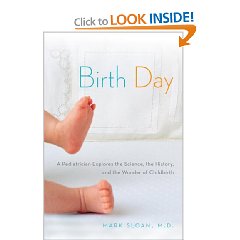
Book Review: Birth Day: A Pediatrician Explores the Science, the History, and the Wonder of Childbirth
By Mark Sloan, M.D.
Ballantine Books, 2009
ISBN 978-0-345-50286-5
370 pages, hardcover, $25

Written in a fast-paced journalistic rather than academic style, Birth Day is a biological, historical, and sociocultural look at birth in our species, highlighting the experiences and skills of the fetus and newborn infant. The focus of Birth Day is on childbirth, but as a pediatrician, the emphasis of the journey in this book is on the baby and its development, skills, and remarkable adaptations to the womb and to life on earth. The book contains frequent references to evolution, which is not a concern to me, but may be to other readers.

The author’s personal experiences and observations are interwoven skillfully throughout the book lending an engaging “human” component—I loved his wry and occasionally self-deprecating honesty and realistic sharing. We read about the births of both of his children (one a very long labor eventually with an epidural and the second a scheduled cesarean due to placenta previa), his experiences as a medical student, and his observations as a hospital and clinic pediatrician. Dr. Sloan has been present at over 3000 births as a hospital pediatrician and 20 births as the baby “catcher” (medical school OB rotation). There is no real mention of homebirth, but occasional, supportive references to CNMs and to doulas.

The author has a healthy respect for the process of birth, noting in his conclusion that “…the most striking thing to me after all these years is how often such a complicated process goes right.” As a breastfeeding counselor, an element that I loved in this book was the author’s complete acceptance and integration of the importance and normalcy of the birth-breastfeeding continuum as well as the assumption of breastfeeding present throughout (bottles and formula do not make a single appearance throughout the 370 pages). This presentation was both very refreshing and completely appropriate.

The content of Birth Day was reminiscent of Birth by Tina Cassidy, with the primary difference being the emphasis on the infant’s experiences. There were occasional instances of questionable data such as, “An unattended breech birth, for example, is nearly always fatal to mother and child.” (?!)

Fast paced and often very funny, the author of Birth Day has a knack for explaining complicated concepts in simple terms and using effective analogies. I learned some new facts about the history of birth and was pretty captivated by the whole ride.

Disclosure: I received a complimentary copy of this book for review purposes.

Giveaway! Simple Wishes Hands-Free Pumping Bra

This giveaway is now closed. Summer was the winner! Congratulations!

I’m excited to have a Simple Wishes Hands-Free Pumping Bustier to give away this week! A lot of mothers combine breastfeeding with working (and pumping at work). As one of my friends (a mother of infant twins) phrased  it recently, you have to be a “multi-tasking phenom.” A bra like this would be a helpful addition to the multi-tasker’s skill set 🙂 I wish that all mothers would have the freedom and flexibility at work to be able to sit down and really take a few minutes “time out” to pump for their babies. However, this is not the reality that a lot of mothers experience in the workplace and that is where a “bustier” like Simple Wishes can definitely come in handy! The company was founded by four sisters and has formed a recent partnership with WIC. According to the company’s website:

Using a breast pump is significantly easier with the Bustier, as it allows moms to pump hands-free. Pumping hands-free encourages and supports moms to:

• Promote the use of a breast pump for greater length of time (ideally six to 12 months), by minimizing user frustration.

• Reduce the duration of each pumping session

• Double pump—pump both breasts simultaneously

• Massage breasts, relax, and think of their baby while expressing

I have a light pink Simple Wishes to give away this week (contest ends on Saturday the 20th at noon). One of the cool things about this bra is that the ribcage band is adjustable up to 10 inches, so you can get a “custom” fit. The one I have to give away is a size L up to XXL. I have taken the bustier out of the package to look at, but it is brand new and never worn (though the seal is opened from my having examined it). To enter to win, you have several choices. For the basic entry, just leave a comment (making sure I have some way to contact you from it if you win). For bonus entries, do one (or all) of the following:

You Can’t Be Everything to Everyone…

I got the following article in an e-newsletter and though it isn’t birth business specific, I think it has a lot of valuable food for thought in it for childbirth educators/birth professionals. I am going to answer the questions in it and post again with my thoughts!

You Can’t Serve Everyone: Clarifying Your Niche for Better Marketing Results

Before you even start implementing any marketing strategies, it’s important to be crystal clear about whom it is you are trying to reach. Some of the questions you should be able to answer around this include: What is your niche?  Who is your target market and what is it that they want?  What is your message to them?

Often, small business owners are afraid to narrow down their target market for fear that this will limit them. Countless times I have heard people say “my target market is small business owners” or “my niche is really anyone who needs what I offer.”

The truth is, you can’t be everything to everyone, and it is actually easier to market and attract prospects when you focus on a particular group of people.  It is also easier for others to refer people to you when they see you as someone who works with a specific group.  To further illustrate, here is a simple example: Instead of “I’m a financial planner,” you could clarify it to say “I’m a financial planner who specializes in families with special needs children.”

Or, instead of “I’m a marketing consultant,” a more descriptive way to say it would be “I’m an online marketing consultant who specializes in social media strategies for coaches.”

Online, a good way to create the type of presence that draws people to you is to clearly communicate who you are, what you are about, and why people should take notice. In order to figure this out, some of the questions you could ask yourself might be:

*How would you describe the essence of who you are in a single word?
*What are your top three passions related to your work or three unrelated to your work?
*What would be three adjectives used to describe your business?
*Who your best clients or the people who are most likely to benefit from your work?

Those are just some of the questions you can ask to really get clear on who you are professionally, as well as who you are personally.

Clarifying your niche is a point of “stuckness” for many business owners and it does take a bit work to discover if you aren’t clear on it yet.  But once you have that specific niche narrowed down, reaching them with your marketing becomes a whole lot easier.

© 2010 Communicate Value. All Rights Reserved.

Want to use this article on your website or your own e-zine? You can, as long as you include the following:

Christine Gallagher, The Online Marketing and Social Media Success Coach, is founder of Communicate Value, where she is dedicated to teaching small business owners and professionals how to conquer the overwhelming aspects of online and social media marketing to increase business and maximize profits. To get your F.R.E.E. 5-Part E-Course and receive her weekly marketing & success articles on leveraging technology, building relationships and boosting your profits, visit http://communicatevalue.com.

Racktrap Giveaway!

Giveaway closed! The  four winners for this giveaway were Rini, inoakpark, Summer, and Rixa!

Time for another giveaway! This is not really birth related, but it is breast-related and since breasts are part of being female and nurturing children, etc., etc. I decided it was related enough to go ahead and share here! The Racktrap is a little tiny purse/pouch that you tuck inside your bra (credit card, ID, cash, etc.) to leave yourself hands-free and unencumbered. I was amused the the first step in the instructions included is to, “Locate your breasts.” ;-D You can use the Racktrap while exercising OR while going out somewhere in a fancy dress! They have lots of different colors (though presumably no one will see it!). I wasn’t sure how it would work exactly because I wear simple “sleep bra” type bras that pull over my head like a sports bra, but I tried it and it works really well even in that kind of bra (don’t worry, I didn’t try the ones I’m giving away, I tried out the cute Valentine print one they sent and I’m keeping that one!)

Something that surprised me about it is that the open edge doesn’t have a closure, so I thought things might fall out of it, but once it is tucked away, nothing falls out (somehow in the context of talking about bras, this sounds like there are secret meanings here…). It is very trim and, I have to say, MUCH classier than just sticking money directly into your bra (which I’ve never done, but still, if that is something you do, perhaps you’d like to win one of these instead!).

Okay, so I have FOUR cute little Racktraps to give away. They came in a little pouch together, but I’m giving them away one at a time because that way more people get to win. I will close the giveaway this Friday. To enter, you can simply leave a comment here (make sure I can figure out your email address from your comment so I can get in touch with you if  you win). You can get additional contest entries by becoming a fan of the Racktrap on Facebook (first time fans only) and leave a comment here telling me you did so, and/or becoming a fan of Talk Birth on Facebook (first time fans only) and leaving a comment here telling me you did so. It is that simple 🙂

Disclosure: I was provided with complimentary samples of this product. I have no other financial or commercial relationship to the company.

Birth & Culture & Pregnant Feelings

“Giving birth is not an isolated event in a person’s life. A woman births with both her mind and her body and participates in the attitudes toward childbearing of her culture and her family.”

This quote from the book Pregnant Feelings by Rahima Baldwin reminds me of two other relevant quotes about culture, birth, and women’s choices:

“Although pregnancy and birth is a richly intuitive and instinctive process, a woman will prepare her ‘nest’ and birth according to the style of her culture, in the same way that a particular species of bird will build its nest with whatever is available.” –Pam England

“One does not give birth in a void, but rather in a cultural and political context. Laws, professional codes, religious sanctions, and ethnic traditions all affect women’s choices concerning childbirth.” –Adrienne Rich

I think we get onto slippery ground when we start talking about how women just need to “educate themselves” and then they will make different (i.e. “enlightened like ours”) choices. If education was all that was needed, we would see much different things in our present birth culture (more on this later!). As Pam England would also say (paraphrased), thousands of factors seen and unseen go into the resulting birth experience, it is hard to point to one, two, or three factors and say “that was it! I have it all figured out.” (Reminds me of another quote that women birth as they live.) With regard to the second quote, I have to ask myself whether couples truly have a free choice of where to give birth? Ultimately speaking, yes they do, but according to my clients’ perspectives insurance companies and the political climate surrounding midwifery in our state dictate their birth location, as well as opinions of family, friends, books, and so forth. I do a “pain pie” exercise during my classes and after I do it, I always talk about how sometimes choices are actively stripped away from women and we need to keep that in mind when we hear “bad” birth stories—not, “she ‘failed’ or made the ‘wrong’ choices” but that her pieces of the pie were taken away from her (sometimes forcibly!).

The reason I initially marked Rahima Baldwin’s quote is because I am fascinated by how my birth experiences continue to inform the rest of my life–while not the defining moment of motherhood for me, I continue to draw upon the lessons of birth throughout the rest of  my life, as well as retaining a total fascination with the subject. I wonder why I’m so “stuck” on birth? Why fixate on this one element of a lifespan? Does it mean I’m not “moving on” somehow—like a high school football player still reliving the glory of that touchdown from 10 years ago? I think it is because birth touches something else. Something deep and raw and true and we glimpse something that we rarely glimpse in everyday life. A touch of the sacred perhaps. Magic. Mystery. Or is it a sense of personal power and satisfaction in being a woman? I know that the “birth power” experience is a rare one for me—I have never felt so powerful and capable and amazing as I did giving birth. I like to think about how this “birth power” sense could be drawn into the rest of my life—how can I live a powerful and affirming and amazing life, not just as a birth giver, but as a woman? Lately, I am finding some answers in feminine spirituality, but it is a question I love to consider and hope to write more about in the future.

Okay, moving back to Rahima and the quotes from Pregnant Feelings:

Anthropologists’ reports of women working the fields, going to a sheltered spot to drop their babies without any ‘preparation’ and then returning to work describe a kind of mythical natural childbirth that is nearly impossible for Western women. We are far too cerebral, and our twentieth-century consciousness intrudes between us and our instinctual selves. The fact that we question both how to birth and how to parent shows how awake our consciousness is. We must of necessity involve our minds in understanding what we do and create, for it is impossible to turn them off. Nor can we simply erase, or afford to ignore, our culture’s view that giving birth is a dangerous and painful event requiring intervention and technology. Rather, we must consciously replace that view with new knowledge and new images if we are going to be able to reclaim our ability to birth with harmony of mind and body.

Loved this. The mythical woman giving birth by the side of the road and popping back into the field to work is strongly ingrained amongst “natural birth” advocates. Some women draw strength from the image—“if she could just squat in the field, so can I!” Others make a joke of it—“are you one of those nuts who encourages women to just squat in the field?!” And others are doubtful that it has any basis in reality. I also suspect that if said women did ever exist they did not return quickly to the fields because they wanted to do so, but because of the framework of their culture and those seen and unseen factors that shape our lives—perhaps their other children would starve if they didn’t run back to the field, perhaps the overseer would beat them, etc., etc. It doesn’t mean those women were stronger or more capable, but perhaps less valued and less cared for than they should have been.

Okay, back to Rahima again:

Our task is to integrate our minds and bodies, so we can give birth in a way that feels whole and nurturing—to ourselves as parents and to our babies…We cannot go back to ‘natural childbirth’ in which we just let it happen. There must be knowledge of birth and an assumption of responsibility for our own health care and for decisions affecting ourselves and our children. There exists for us the exciting possibility of giving birth with full awareness, participating in the joy and exhilaration of working in harmony with the tremendous energy of creation. But it does not occur automatically or unconsciously…

The potential for conscious birthing can exist independently of the place of birth, although some places require more watchfulness than others….Let us just say that it is actively giving birth in an environment which is woman-centered and child-centered, in which the cues are taken from the birthing woman while she experiences fully the sensations and emotions of new life coming into the world through her. She is not medically managed or manipulated, but is supported with the knowledge, love and experience of her attendants (doctors, midwives, husband, other support people) to birth in a way which is safe, yet does not deny the intense physical, emotional, and spiritual aspects of giving birth.

Birthing in this way is rare in today’s culture…less than 5 percent of women in this country today experience ‘purebirth’ [positive birthing/conscious birthing]…

Given the wealth of images of birth that surround us, our task is to recognize that none of them adequately denies or exhausts the potential of birth. Perhaps their infinite variety can help to free us from any one fixed idea of giving birth and help us to realize our freedom to birth in the way that is right for us. We cannot control the energy of birth, but we can control our response to it by deciding to be open, relaxed positive, noisy, grouchy, whatever. We don’t need to behave in a certain way and we can accept ourselves and our births without self-judgment.

What caught me about this section was the mention of not being able to go back to a time when we could just “let it happen.” Though I feel like getting out of my own way and “letting it happen,” was a personal key to my own births—that the surrender is what gets the job done—I agree with her point that there is no letting it happen in today’s culture. A long time ago someone mentioned in an online forum that they were not planning to take birth classes or read any birth books because they felt like they should just let it happen and not have any preconceived notions; that cluttering up their heads with this other information would cloud their ability to do so. While I hear the motive and feeling behind this sentiment and believe there is some (perhaps idealized) truth to it, I simultaneously feel like it is impossible to do this, because women do not give birth in a void or outside of their culture. Women give birth in a context, usually involving other people (even with unassisted births, there is usually someone else there). If you enter the birth room (the aforementioned woman was planning to give birth in a hospital, not unassisted) without any ideas or pre-knowledge about what to expect or what you want, the stories and dramas and ideas and myths and preconceived notions and reading and media-exposure of all the other people present DO enter the room and impact your birth. You cannot just “let it happen,” because they will not just let it happen. Right or wrong, this is the environment in which many of us our building our birth nests.

I’d like to close my thoughts with another quote. This one is from one of my favorite birth books, Transformation Through Birth by Claudia Panuthos. In giving birth, regardless of our nest and our choices and all the seen and unseen elements shaping our lives, perhaps we can simply, “…celebrate ourselves for our courage to birth. The real question becomes not, ‘Have you done your breathing exercises?’ but rather, ‘Can you love yourself no matter how your birth, where you birth, or what the outcome?'”