Quick Births

I recently finished reading the book Permission to Mother by Denise Punger (you can read my full review in an upcoming issue of the CAPPA Quarterly). In one of the Appendices of the book, she addresses “Herbal Inductions–Are They Safe?” Her response is “no” and she adds “A homebirth does not equal a ‘natural birth’ if Blue and Black Cohosh are used to induce.” She opens the section by referencing her third labor which was over 12 hours and gave her “time to emotionally adjust to the escalating physical demands and surprise of my labor” and then goes on to say, “Over and over…I am hearing about intense labors that occur in two hours or less! Women often express delight about their miraculously quick labors (as if a quick labor were the goal). But I don’t sense any emotional, physical, or spiritual satisfaction accompanying these seemingly precipitous deliveries.” She also shares that a commonality in these stories is the use of herbals to induce or augment labor.

This section caught my eye, because I had a very quick birth with my second baby. I also was intrigued by the presumptiveness of dismissing a quick birth as not emotionally, physically, or spiritually satisfying—it seems like someone who is seeing through their own “lens” of 12+ hour labors and can’t imagine another type of timeline for birth. For the past several days I’ve been pondering this issue and considering my own experiences. I also did a variety of google searches looking for information about “emotional impact” of “fast labor” or “precipitous birth.” I turned up surprisingly little information—there was one article that popped up several times titled “The experience of precipitate labor” in the journal Birth. However, I was not able to access the full text of the article to read what it actually says. The results were described as: “The experience of precipitate labor was categorized in terms of physical experience (perception of labor length and contractions), psychological experience (relationship of how women perceived birth to their prenatal expectations, and emotional trajectory of disbelief, alarm, panic, and relief), and external factors (support persons and hospital system).”

My searches also turned up personal birth stories, excerpts from nursing textbooks or emergency medicine texts about handling precipitous birth, and message board discussion threads. The most commonly shared pieces of information about rapid labors is that they can be physically shocking and can be difficult to “catch up with” emotionally, as well as stressful because the mothers often are thinking, “if this is early labor, how I can possibly handle another 12 hours?!” They also reference increased change of hemorrhage. I did not see the questions raised by the Permission to Mother segment directly addressed anywhere. So, I want to know–if you experienced a quick birth what physical, emotional, and spiritual satisfaction did you experience, if any? What about external factors? (support persons, birth environment.) How about your psychological experience and “emotional trajectory”?

My own experiences are as follows:

Second baby, total labor two hours. Forty weeks pregnant. No herbal induction methods used. About 45 minutes were “serious labor.” It was very intense and I’ve said several times before that it felt a bit like a train rushing past and that I had run to catch up with it (emotionally and mentally).

Physical Satisfaction:

I was extremely proud of my body and its super-awesomeness 🙂 I felt that my sense of birth trust was physically manifested in my actual birth experience. My body was a powerful and unstoppable force and I had to get out of my own way and let it happen! I felt driven to my hands and knees–like a power was holding me there. After the birth my body felt weak and “run over by a truck”—I felt powerful and like a warrior during the birth, but afterward it was a physical “crash” of sorts. I did not have excessive bleeding, but I did almost faint several times after getting up (hindsight says, why didn’t I just stay down a while longer?!). I experienced labial tearing (no perineal tearing) and a lot of swelling as well as bruising, that I surmise was a direct result of my son’s rapid birth.

Emotional Satisfaction:

The birth was very emotionally satisfying. I did feel as if I never made it to “labor land” though–that hazy, dreamy, unreal state that I associate with my first son’s birth (and longer labor). I did not feel scared or overwhelmed or out of control as such (I did consciously let go of control—I think these are two different things) . I felt proud of myself. I felt amazed. I felt phenomenal. I felt ecstatic. I felt powerful. I felt empowered. I felt triumphant. I was pleased with how I’d verbally coached myself through labor—telling myself “it’s okay, you’re okay” and “be a clear, open channel for birth” and “relax your legs.” I felt excited and enjoyed the “drama” of already holding my baby after only a short while before thinking, “maybe I’m in labor.” It felt like a wonderful, fulfilling adventure.  I didn’t feel like a “victim,” but I did feel like something “happened to me”–as I said, I had to just get out of my own way and let the power roll through me. Later, I felt emotionally upset about the tears and the bruising. This felt like my piece of “failure,” because I had hoped and planned not to tear again.

Spiritual Satisfaction:

This is related to the above for me. I felt like a force of nature–like I was one with the powers of the universe. I was happy with my ability to get out of my head and “be in the now” with the energy of birth. My son’s birth was the most powerful and transformative experience of my life. I think that counts as sprititual satisfaction 🙂

External Factors:

I gave birth at home. If I hadn’t planned a homebirth, I think there would have been more stress and fear involved with trying to get to the hospital (and possibly a car birth, as we live 30 minutes from the hospital). My husband was very physically there with me–holding and supporting me–I felt like we were one person. My mother was present towards the end and held my older son. They felt overwhelmed and surprised by the intensity, but they got out of my way and let me birth! My midwife was present for 5 minutes–enough time to catch the baby. She was calm and a gentle presence.  She was very physically supportive postpartum. No one tried to influence or control what I was doing, where I was, or how I was laboring and giving birth. I had complete freedom and control over my environment.

Emotional Trajectory:

I went from excitement—“I hope this is really it!”—to, “Oh my goodness, we don’t have time to fill up the birth pool—just get me my birth shirt, my blessingway bracelet, and my ponytail holder!” and wading deeply in to the rushing waves of energy. The experience became completely encompassing–I was no longer in my left-brain, but was instead holding on to the train and catching up. I did not feel panicked or alarmed and I did not feel relieved when it was over, I felt amazed and happy and blissful and powerful.

Favorite Birth Class Videos

The question of “what are your favorite teaching videos?” has arisen on several email lists I belong to recently. I decided to re-post my answer here, since I had it freshly typed up!

I have quite a few birth DVDs now and I don’t show them in class anymore, but I offer the selection to my clients and they can borrow anything they want to watch at home.

I have:

  • Orgasmic Birth (highly recommended! Beautiful births, powerful message)
  • The Big Stretch (kind of “hippie-ish,” but very lovely. Has naked man riding bicycle at the end–have to warn people about that!). I like how it is women talking about birth, no experts.
  • Birth, Joy, & Raspberry Leaves (all water births, from Compleat Mother magazine, kind of amateurish, but good).
  • Birth as We Know It (also hippie-ish, but really peaceful, beautiful births–clients seem to really like it. The voiceover content is mildly annoying).
  • It’s My Body, My Baby, My Birth (very reasonably priced at like $10–mostly about “natural childbirth” vs. showing a lot of births. Very good introduction to the “whys” of natural birth)
  • Pregnant in America–more of a birth activism/advocacy film than a  birth movie. I give a disclaimer before offering anyone this one, because baby does end up in the NICU and you worry that she is going to die (she doesn’t)
  • Homebirth Dads–primarily “talking heads” format, a bit on the boring side really, but good to have available for homebirth couples.
  • Birth Day–nice waterbirth in Mexico.
  • Noa was Born–another nice waterbirth. Same filmmakers as the It’s My Body one. A lot of my clients love this one!
  • Gentle Birth Choices–rarely checked out because it is more “dated.” I make sure they know that the quality of the births doesn’t change though, only the hairdos! I like that it comes with the Gentle Birth Choices book (the set is around $15 and the book is a classic).
  • Penny Simkin‘s Rhythm, Relaxation, and Ritual, which is good to show for labor support purposes. I only have this on VHS and it is rapidly getting a, “how archaic!” reaction!
  • Laboring Under an Illusion–this one is brand new. Compares 100 birth clips from the media with the real thing and looks at the impact of media perceptions on birth. Clips from I Love Lucy, Coneheads, etc. Pretty funny and a bit of a different “take” than the other films.
  • Natural Born Babies–can be watched online. Nice, contemporary video that is almost like an extended “commercial” for homebirth/midwifery (in a good way!). No birth scenes, just modern couples talking about homebirth (some of them are doctors, which gives the video a little extra zest!)
  • Dance of the Womb–lovely instructional bellydancing video. Also includes bonus homebirth video.
  • The Business of Being Born–I think of this as a “classic” now. A must have. Very good activism video as well as educational.

There is also a nice series of free video clips available on Mother’s Advocate. This series is based on Lamaze’s Healthy Birth Practices and is a great resource for use in birth classes.

I also have several breastfeeding videos (the Mother of 7 ones), a babywearing video (Tummy2Tummy), and several prenatal yoga videos (my favorite is the Yoga Journal/Lamaze Yoga for Your Pregnancy DVD).

On my wishlist is:

What to Expect When You Go to the Hospital for a Natural Childbirth

I’ve been debating about whether to share this post or not. I’m concerned that it may come across as unnecessarily negative, pessimistic, or even “combative” or “anti-hospital.”  However, I do think it is honest and I’ve decided to share it. There is a fairly “normal” course of events for women having a natural birth in a hospital setting. In order to be truly prepared to give birth in the hospital, it is important to be prepared for “what to expect” there and to know how to deal with hospital procedures. All hospital procedures/routines can be refused, but this requires being informed, being strong, and really paying attention to what is happening. I hope this list of “what to expect” with help you talk with your medical care provider in advance about hospital routines and your own personal choices, as well as help prevent unpleasant surprises upon actually showing up in the birthing room. This list is modified from material found in the book Woman-Centered Pregnancy and Birth. I am not saying that is how your specific hospital operates, but that many American hospitals function in this manner.

  • Expect to have at least some separation from the person who brought you to the hospital, whether this separation is due to filling out admission paperwork, parking the car, giving a urine sample, being examined in triage, etc.
  • Expect to remove all your clothing and put on a hospital gown that ties in the back.
  • Expect to have staff talk over you, not to you, and to have many different people walk into your room whenever they want without your permission and without introducing themselves.
  • Expect to have your cervix examined by a nurse upon admission and approximately every hour thereafter. Sometimes you may have multiple vaginal exams per hour by more than one person.
  • Expect to have an IV inserted into your arm, or at minimum a saline lock (sometimes called a Hep lock).
  • Expect to be denied food and drink (at best, expect clear liquids or ice).
  • Expect to give a urine sample and perhaps a blood sample.
  • Expect to have an ID bracelet attached to your arm.
  • Expect to have to sign a consent form for birth and for application of a fetal monitor that states that your doctor will be responsible for making the decisions about your care (not you).
  • Expect to have a fetal heart rate monitor attached around your belly—two round discs on straps that will often stay with you continuously until you give birth (or, at best, for 15 minutes out of each hour of your labor).
  • Expect to have your water manually broken at about 4 centimeters (or at least, strongly suggested that you allow it to be broken). After this point, expect to be encourage to have an electrode screwed into the baby’s scalp to measure the heartbeat and a tube places in your uterus to measure your contractions.
  • Expect to be offered pain medications repeatedly.
  • Expect to receive Pitocin at some point during your labor–“to speed things up.”
  • Expect to be encouraged (or even ordered) to remain in your bed through much of labor, especially pushing.
  • Expect to either have your legs put in stirrups or held at a 90 degree angle at the hips.
  • Expect to be told you are not pushing correctly.
  • Expect to hold your baby on your chest for a few minutes, before it is taken away to be dried, warmed, and checked over.
  • Expect the baby to have antibiotic eye ointment put into its eyes (without telling you first).
  • Expect to have your baby suctioned repeatedly.
  • Expect to be given a shot of Pitocin to make your uterus contract and deliver the placenta.
  • Expect not to be shown the placenta.
  • Expect your baby to be given a vitamin K injection.

I think it is important to note that what you can expect is often different than what you deserve and that what you can expect often reduces or eliminates your chances of getting what you deserve. In my classes, I’ve made a conscious decision to present what women deserve in birth and though I also talk about what they can expect and how to work with that, I think sometimes they are left surprised that what they actually experience in the hospital. At minimum, what you deserve are Six Healthy Birth Practices (as articulated by Lamaze):

  1. Let Labor Begin on Its OwnDownload PDF
  2. Walk, Move & Change PositionsDownload PDF
  3. Have Continuous SupportDownload PDF
  4. Avoid Unnecessary InterventionsDownload PDF
  5. Get Upright & Follow Urges to PushDownload PDF
  6. Keep Your Baby With YouDownload PDF

As an example of what I mean about what you can expect clashing with what you deserve, consider the second healthy birth practice “Walk, Move Around, and Change Positions”—monitoring and IVs directly conflict with the smooth implementation of a practice based on freedom of movement throughout labor.

So, how do you work with or around these routine expectations and your desire for a natural birth?

  • Discuss in advance the type of nursing care you would like and request that your doctor put any modifications to the normal routines in your chart as “Doctor’s Orders” (if your doctor is unwilling to do so, seek a new medical care provider!)
  • Labor at home until labor is very well-established.
  • Go through the above list of “what to expect” and make a decision about how to handle each one on a case by case—you may choose to actively refuse something, you may be okay with accepting certain procedures or routines, and you can develop a coping plan for how specifically to work with any particular issue.
  • Take independent childbirth classes and learn a variety of techniques and pain coping practices so that your “toolbox” for working with labor is well stocked.
  • Hire a doula, or bring a knowledgeable, helpful, experienced friend with you. It can help to have a strong advocate with you (this may or may not be a role your husband or partner is willing to take on).
  • Another tactic is to “never ask permission to do what you want, but to go ahead and do it unless the hospital staff actively stops you.” (An example of this is of getting up and walking around during labor)
  • “Many people, if they can find no other way to get around a dangerous or unpleasant hospital policy, unobtrusively ignore it”—a good example of this is with regard to eating and drinking during labor. Restricting birthing women to ice chips or clear liquids is not evidence-based care. Bring light foods and drinks and quietly partake as you please.
  • Leave the hospital early, rather than remaining the full length of stay post-birth. This can minimize separation from baby and other routines you may wish to avoid.
  • For some additional ideas see my post, “Can I really expect to have a great birth?


Finally, and most importantly, “birth is not a time in a woman’s life when she should have to FIGHT for anything,” so if you find that you feel you are preparing yourself for “hospital self-defense” I encourage you to explore your options in birth places and care providers, rather than preparing for a “battle” and hoping for the best. If you feel like you are going to have to fight for your rights in birth, STRONGLY consider the implications of birthing in that setting. Also, as The Pink Kit says, “hope is not a plan”—so if you find yourself saying “I hope I can get what I want” it is time to take another, serious look at your plans and choices for your baby’s birth.

Beautiful Homebirth Slideshow

Today I was sent a link to a lovely homebirth slideshow (scroll down through the photos and story to get to the slideshow link—-the story is worth reading too. It has some good observations about why birth matters: “If you have scene the movie The Business of Being Born there is a seen where one of the OBs being interviewed states in so many words that the process of birth is unimportant that it’s the outcome that is important – a healthy baby and a healthy mom. And while he is correct that a healthy baby and a healthy mom are always the most important end result he is dead wrong about the process. The process matters – -immensely. Physically the birth process is extremely important for the long term health of the mother and the baby, emotionally and psychologically the birth process will affect a woman for the rest of her life.” Can I just say, Amen!)

I absolutely love the joyful expressions on the mother’s face immediately after birth. So beautiful! Plus, it brings that feeling from my own births back to me. On Labor Day, CAPPA posed the question:


“Happy ‘LABOR’ day from CAPPA. What I loved about labor was________________!”

My response was: The feeling of personal power at the end—the “I climbed my mountain,” I DID IT feeling. And that moment of ecstasy of holding my new baby and saying, “my baby, my baby, oh my baby” over and over 🙂 Brings tears to my eyes thinking about it!

Watching the slideshow above, also brought the memory of that same “my baby, my baby” rapture back to me.

Awakening Your Birth Power

25_ways_to_awaken_your_birth_power

“If you have heard enough birth ‘war stories,’ advice, and medical information…

If you are beginning to doubt yourself and to feel confused and worried about giving birth…

It is time to focus on something simple, positive and inspirational.

It is time to come back to center and listen to your own inner wisdom.

It is time to Awaken your Birth Power.”

I recently received a copy of the book and CD set 25 Ways to Awaken Your Birth Power, by Danette Watson and Stephanie Corkhill Hyles. The book is a collection of 25 short breathing meditations each accompanied by a beautiful (and sort of whimsical) drawing. The enclosed CD has 3 tracks–the first is called “awaken your birth power for pregnancy” and consists of the relevant meditations from the book read aloud. The woman reading has a pleasant, soothing voice with a slight Australian (?) accent. The second track on the CD is “awaken your birth power for labour and birth” and consists of 48 minutes of the relevant meditations from the book read aloud. The third track is an abbreviated almost 8-minute guided meditation. This CD would be perfect to listen to while in labor. The book and its gentle illustrations is a nurturing, confidence-inspiring, birth-power-enhancing, reflective, time-out for use during pregnancy or birth.

Reading it got me thinking about ways in which women awaken their birth power during pregnancy? How did you awaken yours? I’d love to hear about it and to write more about this topic!

I reflected on the ways in which I awakened my own birth power and my sense of confidence in my own inner wisdom. Here are the ways that I came up with when considering my own pregnancies and births:

+I read like a maniac 🙂 During my second pregnancy, I read a lot of literature about unassisted birth–though I didn’t have an unassisted birth (my midwife was there for 5 minutes of my son’s birth), I found the philosophies of unassisted birthers to be very inspiring.

+I maintained a daily yoga practice that included affirmations about my ability to give birth.

+I had specific dreams that reinforced my confidence.

+I journaled daily.

+I created birth art–needle felted birth goddess sculptures during my first pregnancy. Later, I drew womb labyrinth drawings–the labyrinth is a powerful metaphor for birth and I really connect with it. There are pictures of both of these on a very neglected other blog of mine.

+I talked extensively with my very birth positive friends–no horror stories from them!

+I formed my personal philosophy about birth and its role as a sacred rite of passage.

+My mother had a blessing way ceremony for me (with both my pregnancies) that made feel special and also confident and secure.

+The materials and philosophy on the Trust Birth website. I love their “what we believe” statement. It gives me chills!

+The book Birthing from Within–one of my all-time favorite birth books and a great birth power resource.

Nothing really worried me about my second birth or my ability to do so. I feel like I had a deep and true  and physical sense of confidence and trust in birth. During my second pregnancy, it became a *knowing* for me that I was a capable birth giver. I had complete trust in my body and my baby. With my first pregnancy, I remembering feeling like I was studying for the biggest test of my life–I did not yet have the deep and true sense that developed during my second pregnancy (actually, I think  developed as I read voraciously during the interim between my pregnancies). I also earned my certification as a childbirth educator during the interim between births and that also increased my confidence.

I attended a performance of Birth, the play, in St. Louis last weekend. While there, I picked up one of ICAN‘s flyers called “ICAN Birth” (sponsored by Hypnobabies). I think the flyer is an excellent resource for awakening your birth power, particularly the back panel with a list of things that, “if you were my sister, I’d tell you…” I’m going to order a bunch to give away in my class packets.

How do you awaken your birth power?

Word Associations

If you could choose only one word to describe the type of birth experience you want, what would it be?

Something might come immediately to you mind, or perhaps you need some ideas…

Some possibilities:

gentle

fast

loving

relaxing

long

adventurous

exciting

emotional

charged

transformative

active

beautiful

orgasmic

at home

homebirth-like

natural

vaginal

surgical

harmonious

intense

empowering

amazing

medically managed

with drugs

serene

safe

pain free

comfortable

controlled

drug free

joyful

intimate

I don’t care, just get the baby out

triumphant

calm

free

family centered

——

After you pick your word, then consider what your answer might be if you eliminated the following ideas from your consideration: fear of birth, fear of pain, fear of the unknown, fear of wasting people’s time, fear of medical procedures, fear of failure, fear of dying, fear of disappointing someone, fear of the baby dying, fear of annoying your medical care providers., or any of a variety of possible fears. After you’ve cleared out these “cobwebs” is your one word different? Would you ask for/expect something different once you’ve removed fear? Or, is your one word still the same?

My one word is “powerful.” I’m not sure what I would have chosen before having children–perhaps “beautiful” or “joyful.” If I had to describe each of my sons’ births in only one word I would choose “empowering” for the first birth and “intense” for the second, and “transformative” for both. For the mothers reading this who have already given birth, what one word would you choose to describe that birth?

Source: Modified from a Teaching Tip from Lamaze

Cut here?? What not to say to pregnant or laboring women…

The Rebirth blog is having a “blog carnival” with “what what not to say to a pregnant or laboring woman” as the theme. When I read the theme, two personal occurrences immediately sprang to mind:

After my Blessingway ceremony with my first baby, all the guests got into the pool (it was August). I changed out of my Blessingway finery and came out in my cute little two piece bathing suit with my big, pregnant belly leading the way. One of the Blessingway attendees looked at me and at the brown “linea nigra” line on my belly and said, “What’s that line mean? Cut here!” and laughed. I was appalled! And at my Blessingway too! I will never forget how it felt to hear something like that on my special day.

Less bothersome, but something that undermined my confidence in following my instincts was when I was laboring with my first son. I said I felt ready to go in to the birth center, but my doula suggested I take a shower first (and relax). When I went in to the bathroom to do so, I heard her say to my mom and husband outside the door, “first time moms always think they need to go in too soon.” I am a people-pleaser and it took a lot for me to come back out of the bathroom (without taking a shower) and say, “no, I want to go to the birth center now.” We went (and I was 10 centimeters dilated when we got there). I felt like I had super-amplified hearing during labor and heard everything that people said even though they thought I didn’t (eyes closed, very inwardly focused). This was one example of several similar occurrences during my first birthing.

I also thought of an experience of one of my birth class clients. As she was pushing and the baby’s head was crowning, her doctor said “I wouldn’t rule out a c-section just yet…”

One of the reasons that I actually called this blog “Talk Birth” is because I have a special interest in the language of birth and the impact of the lexicon of birth on pregnant and birthing women.

The experiences above and the theme in general reminded me of a quote I really liked from an article I read recently:

“Since beliefs affect physiologic functions, how women and men discuss the process of pregnancy and birth can have a negative or positive effect on the women that are involved in the discussion. Our words are powerful and either reinforce or undermine the power of women and their bodies.”–Debra Bingham

Resources for Fathers to Be

“The transition to fatherhood is one of the most significant and challenging experiences a man will ever face. In order to have a satisfying and successful experience fathers must feel safe, supported and confident. To optimize the possibilities for our families, we need to provide appropriate educational, physical and emotional support for ‘father love’.

Patrick M. Houser (Fathers to Be)

I recently learned of a book for fathers called Fathers to Be Handbook. I always have my eyes open for resources for fathers and this  looks like a great one. I look forward to reading it soon.

Other books I’ve recently read and recommend for fathers to be are the nurturing, respectful, encouraging book Fathers at Birth and the practical and informative The Father’s Homebirth Handbook. In classes, I also hand out the short publication Dads Adventure. I love photos of dads and babies and one on the homepage of Fathers at Birth is priceless. I like the pictures in Dads Adventure also. There was also a great picture in the article in New Beginnings in which I learned of the Fathers to Be Handbook in the first place.

I have a smallish collection of other books for fathers and I also have the DVD Homebirth Dads (the resources mentioned above without “homebirth” in the title are for fathers in any birth setting, the homebirth specific titles have a special emphasis on homebirth, but are still useful to anyone preparing for birth).

If you have any other favorite resources for fathers please tip me off about them! I am constantly seeking ways in which to become a better resource to families.

I just wrote about this subject on the ICEA blog as well.

For other posts I’ve written about fathers, click here.

Fear Release for Birth

I want to share a fear release exercise that I’ve used several times at Blessingways for pregnant friends. I got the idea from The Pregnant Woman’s Comfort Book and then modified the wording slightly. I think it is a powerful exercise to do in a group. We circle around the pregnant woman holding hands and then read the following together:

There goes all fear you hold about giving birth. The birth will be perfect.

There goes all fear you hold about healing. You will heal beautifully

There goes all fear you hold about not being a good mother. You will be enough.

There goes all fear of never being creative again. You have a deep well of creativity within your soul.

There goes the deepest, most private fears you have about giving birth. You will be enough.

You will be enough. You are strong enough.

—–

Depending on the setting, I’ve also changed the word birth in the second-to-last-line to “life” instead.

I have written several other posts about fear and birth.

I also use this handout in my classes when talking about fear: Tracking Your Tigers, Effects of Fear on Labor.

Comfort Measures Illustrations

We spend a lot of time in my classes talking about different comfort measures for birth. In fact, one of my most popular classes is my “Labor Support and Comfort Measures” single session class in which we practice all kinds of different skills that may be of use for birthing.

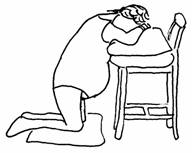
I enjoy Childbirth Connection’s free pdf booklet “Comfort in Labor” and use this as a class resource. Very recently, they added a new section to their website  with lots of helpful, line drawing illustrations for Comfort Measures During Labor.  The illustrations are the same as in the booklet, but presented on one page without a lot of accompanying text—great for visual learners!

As I’ve referenced before, the Transition to Parenthood website also has a helpful section of comfort measures illustrations available to birth educators.

Even if it might feel silly, I encourage people to print out the images and physically practice the techniques illustrated a couple of times—this helps develop a “body memory” so that when you are actually in labor different labor-beneficial positions feel comfortable and familiar. Also, it helps for the birth partner to have a body memory as well to help reinforce healthy positions or suggest fresh ideas.

kneeling with head on chair