Tag Archive | childbirth

Awakening Your Birth Power

25_ways_to_awaken_your_birth_power

“If you have heard enough birth ‘war stories,’ advice, and medical information…

If you are beginning to doubt yourself and to feel confused and worried about giving birth…

It is time to focus on something simple, positive and inspirational.

It is time to come back to center and listen to your own inner wisdom.

It is time to Awaken your Birth Power.”

I recently received a copy of the book and CD set 25 Ways to Awaken Your Birth Power, by Danette Watson and Stephanie Corkhill Hyles. The book is a collection of 25 short breathing meditations each accompanied by a beautiful (and sort of whimsical) drawing. The enclosed CD has 3 tracks–the first is called “awaken your birth power for pregnancy” and consists of the relevant meditations from the book read aloud. The woman reading has a pleasant, soothing voice with a slight Australian (?) accent. The second track on the CD is “awaken your birth power for labour and birth” and consists of 48 minutes of the relevant meditations from the book read aloud. The third track is an abbreviated almost 8-minute guided meditation. This CD would be perfect to listen to while in labor. The book and its gentle illustrations is a nurturing, confidence-inspiring, birth-power-enhancing, reflective, time-out for use during pregnancy or birth.

Reading it got me thinking about ways in which women awaken their birth power during pregnancy? How did you awaken yours? I’d love to hear about it and to write more about this topic!

I reflected on the ways in which I awakened my own birth power and my sense of confidence in my own inner wisdom. Here are the ways that I came up with when considering my own pregnancies and births:

+I read like a maniac 🙂 During my second pregnancy, I read a lot of literature about unassisted birth–though I didn’t have an unassisted birth (my midwife was there for 5 minutes of my son’s birth), I found the philosophies of unassisted birthers to be very inspiring.

+I maintained a daily yoga practice that included affirmations about my ability to give birth.

+I had specific dreams that reinforced my confidence.

+I journaled daily.

+I created birth art–needle felted birth goddess sculptures during my first pregnancy. Later, I drew womb labyrinth drawings–the labyrinth is a powerful metaphor for birth and I really connect with it. There are pictures of both of these on a very neglected other blog of mine.

+I talked extensively with my very birth positive friends–no horror stories from them!

+I formed my personal philosophy about birth and its role as a sacred rite of passage.

+My mother had a blessing way ceremony for me (with both my pregnancies) that made feel special and also confident and secure.

+The materials and philosophy on the Trust Birth website. I love their “what we believe” statement. It gives me chills!

+The book Birthing from Within–one of my all-time favorite birth books and a great birth power resource.

Nothing really worried me about my second birth or my ability to do so. I feel like I had a deep and true  and physical sense of confidence and trust in birth. During my second pregnancy, it became a *knowing* for me that I was a capable birth giver. I had complete trust in my body and my baby. With my first pregnancy, I remembering feeling like I was studying for the biggest test of my life–I did not yet have the deep and true sense that developed during my second pregnancy (actually, I think  developed as I read voraciously during the interim between my pregnancies). I also earned my certification as a childbirth educator during the interim between births and that also increased my confidence.

I attended a performance of Birth, the play, in St. Louis last weekend. While there, I picked up one of ICAN‘s flyers called “ICAN Birth” (sponsored by Hypnobabies). I think the flyer is an excellent resource for awakening your birth power, particularly the back panel with a list of things that, “if you were my sister, I’d tell you…” I’m going to order a bunch to give away in my class packets.

How do you awaken your birth power?
Word Associations

If you could choose only one word to describe the type of birth experience you want, what would it be?

Something might come immediately to you mind, or perhaps you need some ideas…

Some possibilities:

gentle

fast

loving

relaxing

long

adventurous

exciting

emotional

charged

transformative

active

beautiful

orgasmic

at home

homebirth-like

natural

vaginal

surgical

harmonious

intense

empowering

amazing

medically managed

with drugs

serene

safe

pain free

comfortable

controlled

drug free

joyful

intimate

I don’t care, just get the baby out

triumphant

calm

free

family centered

——

After you pick your word, then consider what your answer might be if you eliminated the following ideas from your consideration: fear of birth, fear of pain, fear of the unknown, fear of wasting people’s time, fear of medical procedures, fear of failure, fear of dying, fear of disappointing someone, fear of the baby dying, fear of annoying your medical care providers., or any of a variety of possible fears. After you’ve cleared out these “cobwebs” is your one word different? Would you ask for/expect something different once you’ve removed fear? Or, is your one word still the same?

My one word is “powerful.” I’m not sure what I would have chosen before having children–perhaps “beautiful” or “joyful.” If I had to describe each of my sons’ births in only one word I would choose “empowering” for the first birth and “intense” for the second, and “transformative” for both. For the mothers reading this who have already given birth, what one word would you choose to describe that birth?

Source: Modified from a Teaching Tip from Lamaze

Cut here?? What not to say to pregnant or laboring women…

The Rebirth blog is having a “blog carnival” with “what what not to say to a pregnant or laboring woman” as the theme. When I read the theme, two personal occurrences immediately sprang to mind:

After my Blessingway ceremony with my first baby, all the guests got into the pool (it was August). I changed out of my Blessingway finery and came out in my cute little two piece bathing suit with my big, pregnant belly leading the way. One of the Blessingway attendees looked at me and at the brown “linea nigra” line on my belly and said, “What’s that line mean? Cut here!” and laughed. I was appalled! And at my Blessingway too! I will never forget how it felt to hear something like that on my special day.

Less bothersome, but something that undermined my confidence in following my instincts was when I was laboring with my first son. I said I felt ready to go in to the birth center, but my doula suggested I take a shower first (and relax). When I went in to the bathroom to do so, I heard her say to my mom and husband outside the door, “first time moms always think they need to go in too soon.” I am a people-pleaser and it took a lot for me to come back out of the bathroom (without taking a shower) and say, “no, I want to go to the birth center now.” We went (and I was 10 centimeters dilated when we got there). I felt like I had super-amplified hearing during labor and heard everything that people said even though they thought I didn’t (eyes closed, very inwardly focused). This was one example of several similar occurrences during my first birthing.

I also thought of an experience of one of my birth class clients. As she was pushing and the baby’s head was crowning, her doctor said “I wouldn’t rule out a c-section just yet…”

One of the reasons that I actually called this blog “Talk Birth” is because I have a special interest in the language of birth and the impact of the lexicon of birth on pregnant and birthing women.

The experiences above and the theme in general reminded me of a quote I really liked from an article I read recently:

“Since beliefs affect physiologic functions, how women and men discuss the process of pregnancy and birth can have a negative or positive effect on the women that are involved in the discussion. Our words are powerful and either reinforce or undermine the power of women and their bodies.”–Debra Bingham

Resources for Fathers to Be

“The transition to fatherhood is one of the most significant and challenging experiences a man will ever face. In order to have a satisfying and successful experience fathers must feel safe, supported and confident. To optimize the possibilities for our families, we need to provide appropriate educational, physical and emotional support for ‘father love’.

Patrick M. Houser (Fathers to Be)

I recently learned of a book for fathers called Fathers to Be Handbook. I always have my eyes open for resources for fathers and this  looks like a great one. I look forward to reading it soon.

Other books I’ve recently read and recommend for fathers to be are the nurturing, respectful, encouraging book Fathers at Birth and the practical and informative The Father’s Homebirth Handbook. In classes, I also hand out the short publication Dads Adventure. I love photos of dads and babies and one on the homepage of Fathers at Birth is priceless. I like the pictures in Dads Adventure also. There was also a great picture in the article in New Beginnings in which I learned of the Fathers to Be Handbook in the first place.

I have a smallish collection of other books for fathers and I also have the DVD Homebirth Dads (the resources mentioned above without “homebirth” in the title are for fathers in any birth setting, the homebirth specific titles have a special emphasis on homebirth, but are still useful to anyone preparing for birth).

If you have any other favorite resources for fathers please tip me off about them! I am constantly seeking ways in which to become a better resource to families.

I just wrote about this subject on the ICEA blog as well.

For other posts I’ve written about fathers, click here.

Fear Release for Birth

I want to share a fear release exercise that I’ve used several times at Blessingways for pregnant friends. I got the idea from The Pregnant Woman’s Comfort Book and then modified the wording slightly. I think it is a powerful exercise to do in a group. We circle around the pregnant woman holding hands and then read the following together:

There goes all fear you hold about giving birth. The birth will be perfect.

There goes all fear you hold about healing. You will heal beautifully

There goes all fear you hold about not being a good mother. You will be enough.

There goes all fear of never being creative again. You have a deep well of creativity within your soul.

There goes the deepest, most private fears you have about giving birth. You will be enough.

You will be enough. You are strong enough.

—–

Depending on the setting, I’ve also changed the word birth in the second-to-last-line to “life” instead.

I have written several other posts about fear and birth.

I also use this handout in my classes when talking about fear: Tracking Your Tigers, Effects of Fear on Labor.

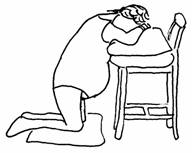
Comfort Measures Illustrations

We spend a lot of time in my classes talking about different comfort measures for birth. In fact, one of my most popular classes is my “Labor Support and Comfort Measures” single session class in which we practice all kinds of different skills that may be of use for birthing.

I enjoy Childbirth Connection’s free pdf booklet “Comfort in Labor” and use this as a class resource. Very recently, they added a new section to their website  with lots of helpful, line drawing illustrations for Comfort Measures During Labor.  The illustrations are the same as in the booklet, but presented on one page without a lot of accompanying text—great for visual learners!

As I’ve referenced before, the Transition to Parenthood website also has a helpful section of comfort measures illustrations available to birth educators.

Even if it might feel silly, I encourage people to print out the images and physically practice the techniques illustrated a couple of times—this helps develop a “body memory” so that when you are actually in labor different labor-beneficial positions feel comfortable and familiar. Also, it helps for the birth partner to have a body memory as well to help reinforce healthy positions or suggest fresh ideas.

kneeling with head on chair

New Edition of The Guide to a Healthy Birth!

One of my favorite resources to hand out in birth classes and to give to pregnant friends is Choices in Childbirth‘s booklet “The Guide to a Healthy Birth.” I’m so excited to learn that the second edition of the booklet is now available! (Thanks to Teri at Passion for Birth for the tipoff!) You can download the pdf version directly here. Or, for very minimal shipping, you can order print versions here.

I just ordered 50 copies, so if you’re a real life friend of mine or are taking a class from me, I’d be delighted to give you one of these phenomenal booklets!

Birth Quotes

I’ve been periodically posting various birth quotes to my Talk Birth Facebook page. Then, I realized I should also be collecting them into a post where they will last a little longer and be enjoyed by more people! I think I will just keep updating this post as I add quotes, but I may make multiple shorter posts or otherwise sub-categorize them to make them easier to follow.

“…labor is not about dilation. Your body knows how to give birth whether or not you ever have a pelvic exam during labor. Birthing women need encouragement to trust their bodies, and to be the stars of their own labors…”

The Doula Guide to Birth


“The empowerment of laboring women, not the management of childbirth by means of painkillers, leads to satisfactory birth experiences.”

Research conclusion by Belgian scientists in 2007

I received a comment on this quote that is very true: “Satisfactory is the wrong word. Spiritual, beautiful, peaceful, wonderful, mind blowing, amazing, phenomenal…. any of those would be better!” My response is Absolutely! I would say powerful, transformative, beautiful, and empowering 🙂

“In giving birth to our babies, we may find that we give birth to new possibilities within ourselves.”

Everyday Blessings

“The whole point of woman-centered birth is the knowledge that a woman is the birth power source. She may need, and deserve, help, but in essence, she always had, currently has, and will have the power.”

Heather McCue

“You will find it incredible that labor gets stronger and stronger–and you do, too.”

The Doula Guide to Birth

“You do not have to be a particularly strong or brave or relaxed woman to get through labor. You just need to be a woman.”

The Big Book of Birth

“It is not ‘ladylike’ to give birth. The strength and power of labor is not demure.”

An Easier Childbirth (quoting a midwife)

“Women are strong, strong, terribly strong. We don’t know how strong until we’re pushing out our babies.”

Louise Erdrich, The Blue Jay’s Dance

“Women around the world and throughout time have known how to take care of each other in birth. They’ve shown each other the best positions for comfort in labor, they’ve used nurturing touch and repeated soothing words, and they’ve literally held each other up when it’s needed the most…”

The Doula Guide to Birth

“Education for birth consists not, as some would have it, of ‘conditioning,’ but aims at giving a woman the means by which she can express her own personality creatively in childbirth.”

Sheila Kitzinger

“A self-determined birth is a potent symbol of womanly power, of human courage, of loving compassion, even of ecological holism. It may look like childbirth educators are just showing charts and teaching relaxation, but we are also helping to create a gentle atmosphere in which personal and cultural transformation can take place.”

ALACE CBE Manual

Birth & Courage

I wrote previously about when birth doesn’t go as planned and shared my perspective that a cesarean is often an act of personal courage by the birthing woman. I’ve been reading the new book The Doula Guide to Birth and the authors make similar comments:

“Remember, you are still giving birth to your baby. It takes courage to give birth whether interventions are used or not.”

And

“Whatever way birth happens, it is your rite of passage into motherhood, and that passage is to be celebrated. Natural childbirth is a passage, cesarean birth is a passage, and birth with an epidural is a passage to be celebrated. That passage cannot be taken away from you. Every mother’s birth experience is valid, and an act of courage.” (emphasis mine)

Another good quote from the book is with regard to vaginal exams during labor and whether they are necessary or not (they’re not!):

“Although there is currently a heavy emphasis on dilation, vaginal exams, and timelines for giving birth, labor is not about dilation. Your body knows how to give birth whether or not you ever have a pelvic exam during labor. Birthing women need encouragement to trust their bodies, and to be the stars of their own labors. Doulas help provide this encouragement. And the confidence a woman discovers in labor can help carry her through the demands of parenting and future challenges in life.” (emphasis mine)

Recent Publications

This has been quite a month for me for publications!

My short article Centering for Birth was published in the International Journal of Childbirth Education (page 20)

My book review of Fathers at Birth was published in The CAPPA Quarterly (page 14).

My film review of Birth as We Know It was in The CAPPA Quarterly (page 15).

And, my piece of creative nonfiction Nursing Johnny Depp was published in Literary Mama.

I’m excited about all of these! 🙂