Archives

Guest Post: Squatter’s Rights

October 2013 024

Squatter’s Rights

A couple of posts ago, I mentioned I’d made a new sculpture that I titled after a friend of mine and an article she wrote several years ago. She originally sent me the article to review, because she was thinking of sending it to a magazine. Several years passed, several more babies were born, her computer got fried, and the article was lost. However, it stayed with me anyway. It stayed with me when I prepared for the birth of my rainbow baby girl, it stayed with me as I created birth art to prepare for her birth, and it stayed with me as I reached down to catch my baby’s whole pink wonderful self in my hands as she was born in one smooth reflex almost three years ago. So, I created my figure and I emailed Shauna about it and then I went digging. Deep in the ancient, archived messages in my Outlook Express folder on my old laptop that now belongs to Zander (age 7), I found it. I found Shauna’s squatter’s rights article that had so touched my birth consciousness in such a way that I never forgot—even though babies, computers, friendships, and time have all marched on. I was already a childbirth educator when I read it, had already given birth myself, and was deeply immersed in birth work and childbearing. However, that doesn’t mean that certain descriptions cannot reach us and grab our attention in new ways. I’m delighted that Shauna gave me permission to publish her article here and to share her insights and experiences in this way!

Squatter’s Rights

by Shauna Marie

Would the new child coming from me be slippery like soap? I rubbed my fat belly. I loved each pound I gained, each craving I had, and every trip to the bathroom. Okay, maybe not every trip to the bathroom. But, I loved this growing baby. Tucked away like a pearl in the sea just waiting to be discovered. I was in a constant state of marvel.

Would I be able to physically do this? No, I don’t mean the labor, nor do I mean the birth. I knew I could do that. I got lost in thought as I planned in my head every moment that would come after my body did the work of labor. The moment would come once my body was ready and the crown of a child’s head pushed itself from me, the moment the child would emerge. That’s what I was planning for; I planned to catch my own baby.

I imagined opening my legs and squatting, I even practiced. I wondered where I’d put my hands, how I would have my legs, and if this little wet creature would be so slippery that I’d drop him or her. In December of 1999 this would be my second birth, but my first time catching a baby.

Like many people from a young age I was led to believe that women didn’t and couldn’t birth outside hospitals. The ones who did were radical or even dangerous. I was led to believe that the birth doesn’t matter, the baby matters. For my own personal sanity, due to cultural birth fear, I had to just come to the conclusion that as long as my baby was okay I could endure anything and that it would all be over soon.

Now rewind a little bit here, because there is something to be said about being at the right place at the right time; or knowing the right person. As a person who now tries to make a difference by being a strong home birth and natural family living advocate, I know who you know can sometimes make all the difference. For some people they just need that connection with real birth; they need to know someone who will talk about what birth really is about from a natural and physiological point of view. Above all people need to be exposed to home birth because it normalizes birth.

I was almost connected at one small point during my first pregnancy, just weeks before my first birth a friend of a friend was having a baby. I asked where she was having the baby at and when. My friend said she was in labor now, and having the baby at home. A jolt of sudden uncomfortableness and worry struck me, “At home! Why?” (Thinking oh my gosh there is no epidural at home!) My friend responded with a rather obvious sounding answer, “Well her mom is a midwife.” “Oh,” I said in an understanding tone. Somehow this made total sense now. If her mom is a midwife then it’s okay for her.

Quickly all home birth thoughts were intercepted with other conversations of non-birth related content. To this day I feel that should have been my contact with home birth. Instead I missed my first calling and just two months later I was induced two weeks before my due date against my own wishes (along with two other women from my OB’s office) to fit into the OB’s schedule.

I learned an awful lot that night. I learned I would never give birth to a healthy baby in a hospital again. I learned that in a hospital it is okay for others to look at your body, touch you, reach into you, and deliver your baby; but it’s not okay for you to do so.

I also learned that birth does matter, not just a healthy baby. Healthy empowered moms matter and instincts are stripped away by technology and birth colliding. This often even includes the instinct to breastfeed.

I was shocked at how disconnected I felt from the waist down. These strangers were in charge of me. There is something about being tied to IV’s and monitors, naked from the waist down in a hospital bed, legs in stirrups, that takes your power away. Even though some one at some point said, “Here comes your baby, look at your baby come” I felt like I wanted to reach over my belly and feel, or catch. I’d seen that in a birth video once –a nurse said something like ‘you can touch your baby’s head and feel’ to a mom giving birth flat on her back. I waited for someone to say that to me, but no one did.  Be it because of hospital policy, or be it because of shame, it was a no-no to touch or even catch what was mine. I felt so disconnected as I tried eagerly to see over my belly, knees being held up to my ears by three sets of hands to the chants of, “Push, push, pushhh…. good girl.”

I wondered so much about just staying home. I had what I thought was an unexplainable and unfounded desire to hibernate in a dark corner like an animal.

Around the same time that I got pregnant with baby number two I heard a doctor on television actually say that women are physiologically unable to catch their own babies. Already committed to having a home birth that comment further sealed the deal. I was catching my own baby this time. Not only do I dislike someone telling me that I can’t do something, I didn’t believe a woman would let her baby just fall to the floor (many mammals are born that
way though). Surely even if a woman didn’t squat with intent to catch her baby the child would be born slipping onto bed or floor without assistance or harm. My research lead me to discover that women have given birth effortlessly while in comas, unassisted and unmedicated. We’ve all heard the stories of scared teens giving birth suddenly, alone in a bathroom. The body just gives birth when it’s time. Not to mention National Geographic taught me from a young age more than just that women in tribes go topless; they also sometimes give birth to babies unassisted and catch them.

Shauna’s eighth baby, born into her hands this summer.

I was also somehow sure a woman could give birth in total control; in control of her thoughts, feelings, and use of good judgment. I was no longer buying into the stereotypical out of control agony portrayed in movies. I didn’t know, but I deeply believed a woman giving birth, if allowed, could totally be in control and instinctively know how to give birth.

I figured that squatting would give me the best angle to catch my baby. Being in a squat, on bent knees, or even on all fours is clearly the most natural and easiest way to birth a baby. Squatting has roots in ancient history as far as birth goes back. It is only within the last 100 to 150 years, since physicians took control of birth, that women have been required to have babies laying their backs in the lithotomy position. Lying on the back (or semi lying) has obvious benefits from the doctor’s perspective as it provides a good view and way to manually remove a baby, as well as use a scalpel to cut a wider opening to the vagina. The use of gigantic tongs (forceps), vacuum suction extraction on the baby’s head, and even manually pulling on the baby’s head have all been routinely practiced by physicians.

Elizabeth Noble, author of Childbirth with Insight, states, “Women who squat for birth can generally deliver their babies without any manual assistance at all. Gravity and the free space around the perineum allow the baby’s rotation maneuvers to be accomplished spontaneously.”

There are vast differences in giving birth in a squatting position rather than lying down. Well over half of all the births in this country currently involve some type of surgical or operative procedure such as; cesarean section, episiotomy, vacuum extraction, or the use of forceps. These interventions and their accompanying risks could be avoided if women would just adopt a squatting position for birth. Aside from working with rather than against the body and gravity the birth canal depth is shortened during a squat, and the pelvic diameter is increased. In fact just the simple act of squatting can open a women’s pelvic outlet by up to 28 percent. All of these benefits can shorten the second stage of labor and the need for interventions. Squatting also reduces the risk of tearing. Dr. Michel Odent writes in Birth Reborn that, “This position assures maximum pelvic pressure, optimal muscle relaxation, extensive perineal stretching, and minimal muscular effort. It also provides the best safeguard against serious perineal tears.”

Routinely birthing moms are put on their backs or reclined in beds which center the mother’s weight on her tail bone, narrowing the pelvic outlet and compressing major blood vessels which reduce proper circulatory function. This in turn reduces oxygen to the baby and to the uterus making contractions less productive and more painful. Less oxygen to the baby signals distress in the infant, which if in a hospital could cause a whole round of interventions. Combine an oxygen deprived baby with a mother trying to push uphill with a baby that cannot move into a good birthing position because of restricted pelvic room, and ultimately you have mothers who are very good candidates for a birth that must be forcefully assisted by forceps, vacuum extraction or the ever so common routine C-section. The Centers for Disease control states on their website that cesarean sections are now at 32.8% in North America (2011).

Delivery of the after birth in an upright position also has clear advantages. When the placenta isn’t compressed there is less chance of blood pooling up and creating large clots, and gravity aids in placental expulsion.

When the day finally came for me to catch my baby I talked myself through the contractions. I told myself I could do this. I said over and over I can do this, because as a pregnant mammal it’s what I was put here to do. When I felt it was time I squatted over a mirror and saw the crown. I told myself to enjoy this moment, not everyone gets to catch their own baby, and I didn’t want to miss one second of this experience. I swirled the thick wet black hair that was presenting around in a circle with my fingertips. Any and all pain was gone, it was amazing. I focused on this new life that was unfolding from my body. I waited for contractions and I let my body do the work without forceful pushing or feeling agony. When the baby slid into freedom and the room was engulfed with newborn smells and newborn cries I cried out, “It’s a boy, it’s a baby boy!”

The impact of that birth was powerful and amazing; so much so that I have caught five more children from my body since then. There is a saying about the “thrill of the catch,” and midwives and doctors know this. It’s intoxicating and it’s very powerful to catch a baby.

So much harm has been done to cloud the process of childbirth. Birth isn’t just about babies, it’s about mothers too. It’s about how they work together. Catching your own baby puts you focused on your birth, and without trying you take the control and suddenly you feel and know what you need to do. Focusing on the important task of birth made an impact on me a very positive way as a mother. True freedom over my body gave me independence, confidence, and self-control.

Not every woman may want to catch her own baby, but every woman should be encouraged to do so, or at the very, very least know they can if they do wish to. Most women I have spoken with actually say they have never even thought of it.

The state of birth in this country lies squarely in the hands of birthing women. Until we start demanding more respect and more variation in our birthing options we have no one to blame but ourselves. We must first credit ourselves with being able to birth safely the way nature intended before anyone else will give us that credit. The seeking out of safe and natural birth options will slowly continue to influence and change how birth is perceived.

There are specialized hospital beds that can be converted in a way that women are more upright. If you will be giving birth in a hospital request them, demand them. Hill-Rom makes such a bed; the Affinity Three Birthing Bed aids a woman to side lie, squat, kneel, sit, and lean in various positions. It has a labor bar and position controls that are quite impressive. The bed can be lowered or raised up, down, back, and forth

There are birth balls, birth bars, and birthing stools that can aid in more natural upright positions in whatever birth setting you choose. There are showers and tubs to soothe a mother.

I share my experiences with catching my own babies, and have even shared very private birth photos and even one video with others in the past; because I have been told by so many women it has empowered them. I also hear from lots of women who say how strong both me and my legs must be to squat down like that. I assure that it’s not my legs that are strong; it’s my heart and my passion, and the willingness to open up and catch what is mine.

Shauna Marie is happily married to the man of her dreams. They live in the Midwest where they juggle eight energetic children while homeschooling and developing upon a one acre hobby farm of veggies, fruits, chickens, geese, and the dream of a dairy goat. She blogs about her life at Life with Eight Kids. Shauna is very passionate about family with an emphasis on childbirth and healthy, happy moms and babies.

Postscript: Shauna’s most recent birth story, excerpted below, is an excellent description of a squatting birth!

I was standing there in the still of the labor lull a rush of hormones hit me and the baby’s head slipped fully into the birth canal. I squatted down instinctively. I was then super indecisive: I flip-flopped between on my hands and knees to squatting, then squatting with one leg up and one leg down, then a leg up on the side of the tub, then standing upright, then a squat-stand and finally then back to the other positions all over again. This baby was going to start to seriously crown in a big way and I had no idea where I wanted to be! Having done this so many times I had way too many choices in my head and I knew what they all felt like. Later Ricky told me he got nervous that I was moving around so much in the tub; he was worried I’d slip and fall. I however felt firmly planted like a rock. I told him later I felt like I had sticky gecko pads on my limbs and slipping never crossed my mind.

Our baby was starting to crown as I finally squatted down low with one leg higher than the other (I was out of time to change things up. I’ll just squat and do it the same ‘boring’ highly effective way I always do it I thought lol.) I used some counter pressure on her velvety head to help ease her head out but it wasn’t really needed and a painless contraction inched her head fully out.

via Life With Eight Kids: Beatrice’s Unassisted Birth Story (half hour labor and birth -with extra info on my favorite topics of vernix, cord cutting, and not pushing).

Related Talk Birth resources:

Active Birth in the Hospital

Spontaneous Birth Reflex

How to Use a Hospital Bed without Lying Down

What to Expect When You Go to the Hospital for a Natural Childbirth

References:

(Elizabeth Noble, Childbirth with Insight, 78). See also Golay, J., et al., “The squatting position for the second stage of labor: effects on labor and maternal ad fetal well-being,” Birth 20(2) (June 1993):73-78.

Postpartum outcomes in supine delivery by physicians vs nonsupine delivery by midwives.Terry RR, Westcott J, O’Shea L, Kelly F. J Am Osteopath Assoc. 2006 Apr;106(4):199-202. Conclusion: Nonsupline positions during labor and delivery were found to have clinical advantages without risk to mother or infant. Enhanced maternal outcomes included improved perineal integrity, less vulvar edema, and less blood loss.

Dr. Martha Collins D.C., Pregnancy and Chiropractic Planetciropractic.com

Russell JGB. Moulding of the pelvic outlet. J Obstet Gynaec Brit Cwlth 1969;76:817-20

Squatting can enlarge the pelvic outlet up to 28 percent (Russell, J.G., “The rationale of primitive delivery positions,” Br J Obstet Gynaecol 89 (September 1982):712-715

Paciornik M; Commentary: arguments against episiotomy and in favor of squatting for birth. Birth 1990; 17(2): 104-5.

The total U.S. cesarean delivery rate reached a high of 32.9% of all births in 2009, rising 60% from the most recent low of 20.7 in 1996 Martin JA, Hamilton BE, Ventura SJ, et al. Births: Final data for 2009. National vital statistics reports; vol 60 no 1. Hyattsville, MD: National Center for Health Statistics. 2011.

Marion Sousa writes: “[Squatting shortens and widens the pelvic outlet.” (Childbirth at Home. New York: Bantam, 1976 in Judith Goldsmith, Childbirth Wisdom from the World’s Oldest Societies, 153)

Several studies have reported that in the majority of women delivering in the lithotomy position, there was a 91% decrease in fetal transcutaneous oxygen saturation (Humphrey et al. 1973, 1974)

Robertson, Empowering Women: Teaching Active Birth in the 90s, (105)

Dr. M. Odent Birth Reborn, (101)

Hill-Rom Affinity Three Birthing Bed educational video and website. Online user manual http://www.hill-rom.com/PDFs/manuals/UserManuals/u025_iet.pdf
Thesis Tidbits: The Wise Women Behind, Within, and Around Us

October 2013 130

“The Childbearing Year” sculptures cast in pewter.

When I first described my thesis project about birth as a spiritual experience, I described my use of the word “spiritual” in this way:

When I use the word “spiritual,” I mean a range of experiences from a humanistic sensation of being linked to women around the world from all times and spaces while giving birth, to a “generic” sense of feeling the “might of creation” move through you, to a sense of non-specifically-labeled powers of Life and Universe being spun into being through your body, to feeling like a “birth goddess” as you pushed out your baby, to more traditional religious expressions of praying during labor, or drawing upon scripture as a coping measure, or feeling that giving birth brought you closer to the God of your understanding/religion, or, indeed, meeting God/dess or Divinity during labor and birth).

via Birth as a Spiritual Experience (Thesis Project) | Talk Birth.

Just this week, a mother shared a link to her birth story on my Facebook wall and there, embedded within the body of her narrative, was exactly the kind of thing I’m exploring with my thesis:

The pain was deep and blinding at this point. I was still pacing. I felt out of control, my primal being had been unleashed and it was a spirit I could no longer cage. I yelled that I couldn’t do it, I begged for help. In my mind I was screaming, I wanted to claw at my eyes, rip out my uterus, jump off a cliff and end my pain.

Then something happened… I don’t remember what was said, but the walls around me rung with words of encouragement from my men, and from the wise women.

All of a sudden it didn’t feel like we were just 6 people, but the very ground beneath opened and the walls melted and the ceiling cracked to reveal the sky and what I saw were the souls of billions of women who had come before me, gathered together in support of us. I opened my eyes and suddenly it was as though I was immeshed in a tightly woven tapestry of all the mothers who have ever existed- all my sisters and grandmothers- that had birthed their children before me and they held the space- I found myself surrounded by souls from every time and place. These were women of the cities, of the jungles, the sierras, the ghettos, the caves, the shores… these were mothers from every single culture, every walk of life. Starting deep and low and getting louder and louder was a chanting, and in my mind’s ear I heard some ancient song that these mothers sang to me- and it brought me one message: I can do this. I am doing this. I am safe. I have the power. I am protected by all the mothers who have come before me and I will hold the space for all the mothers who will come after In that moment, I was protected and supported by every mother who had ever existed- they stood around me in a circle and from them, I drew my strength.

No more fear. No more pain. I banished the negative feelings and harnessed all positive energy. I opened my eyes and looked deep into the eyes of my child and I was moved by his wisdom- Joell smiled back at me and a universal truth made itself known to me in that moment: all children are deeply connected to birth. Something in his eyes told me, “You can do it, mommy”. They understand the universe in ways we cannot fathom. They are the wise ones, and from them we have much to learn.

via A Slightly Twisted Fairy Tale » A Perfect Circle: The homebirth story of Carmelo Cypress, pt. 1.

I’ve also been catching up with issues of Midwifery Today and noticed the following quote in the article, “Searching for Ancient Childbirth Secrets” in Midwifery Today Autumn 2013. Tsippy Monat writes:

“Anthropology describes trance as a condition is which the senses are heightened and everyday things take on a different meaning. Communicative competence with other people may increase or may not exist. Facts of time and place are revealed differently than in normal everyday consciousness. This description reminded me of situations encountered at birth because birth is a condition in which the mind is altered. When I accompany births, I experience the flooding of oxytocin and endorphins. In Hebrew, the root of the word birth can also mean ‘next to God'” (p. 49).

And, in an essay based around an article about an old Gemanic/Jewish naming ceremony that I wrote for a different blog, I wrote:

If power does indeed rest in the stories that are told, how would the birth culture in the US change if we did have stories and rituals like the Hollekreisch (with original connection to the Goddess intact, of course)? In their book Milk, Money, and Madness, Michels and Baumslag explain: “In western society, the baby gets attention while the mother is given lectures [emphasis mine]. Pregnancy is considered an illness; once the ‘illness’ is over, interest in her wanes. Mothers in ‘civilized’ countries often have no or very little help with a new baby. Women tend to be home alone to fend for themselves and the children. They are typically isolated socially and expected to complete their usual chores, including keeping the house clean and doing the cooking and shopping, while being the sole person to care for the infant…” (p. 17)

This is in contrast with perhaps the original function of the Hollekreisch ceremony which acknowledged the mother’s vital role:

“The consistent connection of the ritual with the motherʼs rise from childbed, and the home-based nature of the ceremony, seem to indicate that the Hollekreisch ceremony gave the mother an important role. Hayyim Schauss, whose research was based on interviews, eyewitness accounts, and historical writings dating from the seventeenth century, indicates that in some areas of Germany, a synagogue ritual preceded the ceremony. The mother of the child walked to worship with the local rebbetzin and donated a new wrapper (wimple), with the infantʼs name sewn onto it, for the Torah scroll. This allowed the mother and her ability to give birth to be celebrated along with the new child—which may be precisely why the ceremony became associated with, or was originally rooted in, the legend of Frau Holle” (p. 66, emphasis mine).

via Hollekreisch: Honoring Childbirth.

Also in a new family project that actually has deep roots in my personal experiences with birth as a spiritual experience, Mark and I have been working on making pewter versions of some of my birth art sculptures. This one is my pushing-the-baby-out sculpture, the original of which was created to help me prepare for the birth of my last baby:

October 2013 134

I am a wild woman
and the spirit of every wild woman
coalesces in me
for we are each wild women
and we are all the spirit
of the wild woman.
I will follow the voice in my heart.

~ Melissa Clary, quoted by Raising Ecstasy

(via Journey Of Young Women)

Tuesday Tidbits: Birth Power

October 2013 032

“When a woman births without drugs…she learns that she is strong and powerful…She learns to trust herself, even in the face of powerful authority figures. Once she realizes her own strength and power, she will have a different attitude for the rest of her life, about pain, illness, disease, fatigue, and difficult situations.” –Polly Perez

~~

“The way a society views a pregnant and birthing woman, reflects how that society views women as a whole. If women are considered weak in their most powerful moments, what does that mean?” –Marcie Macari

~~

“I think one of the best things we could do would be to help women/parents/families discover their own birth power, from within themselves. And to let them know it’s always been there, they just needed to tap into it.” –John H. Kennell, MD

~~

“As doulas, midwives, nurses, and doctors, it’s important to never underestimate how deeply entrusted we are with someone’s most vulnerable, raw, authentic self. We witness their heroic journeys, see them emerge with their babies, hearts wide open…” –Lesley Everest (MotherWit Doula)

~~

“When you have a baby, your own creative training begins. Because of your child, you are now finding new powers and performing amazing feats.” –Elaine Martin

~~

“Learn to respect this sacred moment of birth, as fragile, as fleeting, as elusive as dawn.” ~ Frederick Leboyer (via From Womb to Cradle Doula Services)

~~

‎”It takes force, mighty force, to restrain an instinctual animal in the moment of performing a bodily function, especially birth. Have we successfully used intellectual fear to overpower the instinctual fear of a birthing human, so she will now submit to actions that otherwise would make her bite and kick and run for the hills?” –Sister Morningstar (in Midwifery Today)

~~

“Birth is women’s business; it is the business of our bodies. And our bodies are indeed wondrous, from our monthly cycles to the awesome power inherent in the act of giving birth.” –Sarah Buckley

~~

“We are volcanoes. When we women offer our experience as our truth, all the maps change. There are new mountains. That’s what I want to hear–to hear you erupting. You Mount St. Helenses who don’t know the power in you–I want to hear you…If we don’t tell our truth, who will?” –Ursula K. Le Guin

~~

“For most people, modern life meanders along a path of ups and downs, by and large devoid of high-voltage experiences that have the power to alter our lives in significant ways…The birth of a child is one of those significant experiences.” –John & Cher Franklin (FatherBirth)

~~

Birth power has been on my mind today after I read my friend’s Shauna’s unassisted birth story of her eighth baby:

Our baby was starting to crown as I finally squatted down low with one leg higher than the other (I was out of time to change things up. I’ll just squat and do it the same ‘boring’ highly effective way I always do it I thought lol.) I used some counter pressure on her velvety head to help ease her head out but it wasn’t really needed and a painless contraction inched her head fully out. I noticed I talked a lot to Ricky about what was happening like I was giving him a play-by-play of a sport. I stood up on two legs again…As I stood up Ricky took a few pictures of me holding her fully birthed head with one hand and I said, “Get a picture of me smiling.” I totally posed for a picture while I cradled her head between the two worlds of womb and Earth…

via Life With Eight Kids: Beatrice’s Unassisted Birth Story (half hour labor and birth -with extra info on my favorite topics of vernix, cord cutting, and not pushing).

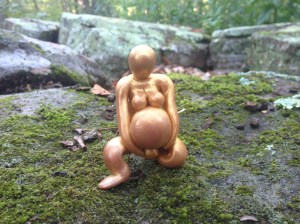
Completely coincidentally, over the weekend I made a new sculpture that I named in honor of Shauna and her past births.

October 2013 024I called this one “Squatter’s Rights,” after an article draft Shauna wrote several years ago that had a potent impact on me, particularly her line, “and then I reach down and catch what’s mine.” (previously written about in this post.) I made the new sculpture because I received a message on etsy asking me about the sculpture shown at the conclusion of another past post:

“I believe with all my heart that women’s birth noises are often the seat of their power. It’s like a primal birth song, meeting the pain with sound, singing their babies forth. I’ve had my eardrums roared out on occasions, but I love it. Every time. Never let anyone tell you not to make noise in labor. Roar your babies out, Mamas. Roar.” –Louisa Wales

via What Does Coping Well Mean? | Talk Birth.

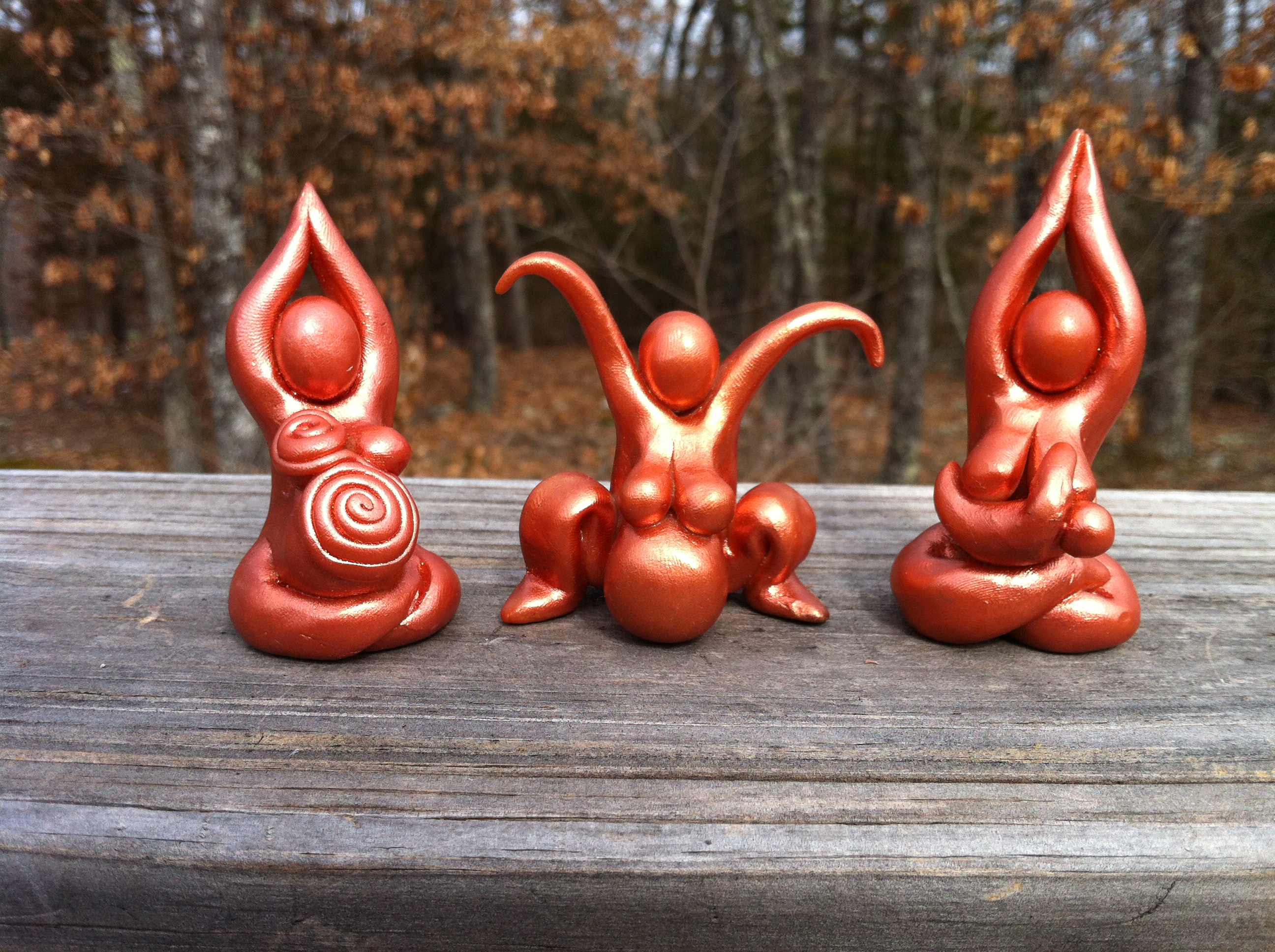
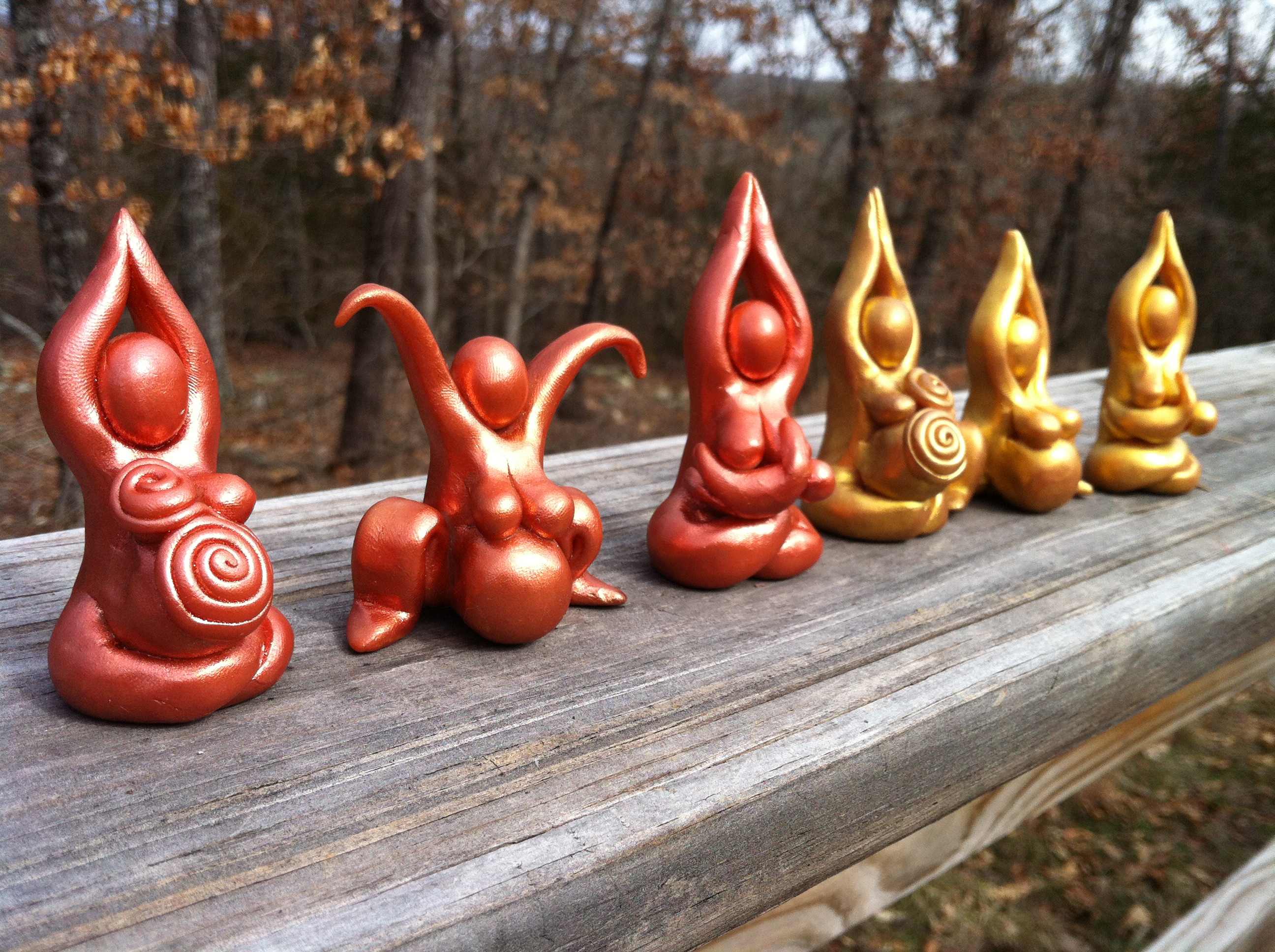
Over the weekend, I also made a batch of new sculptures for a training taking place in Hawaii:

October 2013 020I hope these bring a sense of birth power to the women receiving them 🙂

Tonight I lit a candle as part of the Wave of Light for Pregnancy and Infant Loss Remembrance Day. It is important to acknowledge that power may be found in the full spectrum of experiences of the childbearing year…

October 2013 020

And, in a thematically appropriate connection, a Facebook fan sent me a link today to a powerful video of a woman singing during labor. I’d seen a version on YouTube before, so I went looking for it there and instead I found a short webisode specifically about singing during labor:

In my own first labor, I hummed the blessingway chant Woman Am I over and over again until the baby was born. I find that humming, vocalizing, and talking to/coaching myself is one way that I awaken my own birth power during birthing.

How do you awaken your birth power?

I shared some ideas in another past post, but I’d love to add to it!

Brought to our knees

“Rigid plans work best if you’re building a skyscraper; with something as mysteriously human as giving birth, it’s best, both literally and figuratively, to keep your knees bent.” –Mark Sloan, MD (Birth Day)

Today I spent a few minutes listening to a lovely webinar by Amy Glenn, the author of Birth, Breath, & Death. The topic was Supporting a Birthing Woman’s Spiritual Practice and I was immediately caught by Amy’s comparison of giving birth to kneeling in prayer. She mentioned that giving birth may drop us to our knees, just as those who pray may pray on their knees. Since I’m currently writing about birth as a spiritual experience, I connected to this implied notion: birth as embodied prayer. And, looking at the webinar photo of a woman kneeling in August 2013 019child’s pose, my own birth-prayers came vividly to mind. In my first labor, I spent a lot of time on my knees, later wishing that I had also given birth on hands and knees rather than being encouraged to birth in a semi-sitting position that I felt contributed to tearing. Later, when I discovered birthing room yoga, I loved realizing that these kneeling postures that I adopted spontaneously and intuitively in my first labor were yoga poses—an inherent body wisdom I carried within me, waiting to arise when called upon. This is part of my first birth story, briefly touching on my time on my knees…

Mark & Mom were wonderfully supportive of me as I labored. I tried various positions and they stacked up pillows for me on the bed so that I could be on my hands and knees on a soft surface (they put the Boppy onto some other pillows to make a “well” for my belly) and then Mom read some of my birth affirmations to me. That worked for a while. I also tried the birth ball for a while and ended up spending a lot of time on my knees on the floor with my head and arms resting on a pillow on the bed…

via My First Birth | Talk Birth.

Kneeling to birth played a prominent role in my second birth experience as well and I have frequently described the rapid birth of my second son as an experience that literally drove me to my knees. When writing about this birth experience, I said:

I was extremely proud of my body and its super-awesomeness 🙂 I felt that my sense of birth trust was physically manifested in my actual birth experience. My body was a powerful and unstoppable force and I had to get out of my own way and let it happen! I felt driven to my hands and knees–like a power was holding me there. After the birth my body felt weak and “run over by a truck”—I felt powerful and like a warrior during the birth…

via Quick Births | Talk Birth.

And, in perhaps my most spiritually meaningful birth experience, the home miscarriage-birth of my third baby also brought me to my knees:

August 2013 041

Brand new sculpture inspired by the thoughts in this post.

When I was still having the “HOW?” questions, other women that I knew who had experienced miscarriage started to come to mind and I knew I could do it too. I told myself that I had to do what I had to do. I said out loud, “let go, let go, let go.” I said I was okay and “my body knows what to do.” The afternoon I found out the baby died, I’d received a package that included a little lavender sachet as a free gift with my order. When my labor began, for some reason I wanted the sachet and held and smelled it throughout the experience. As I chanted to myself, “let go, let go, let go,” I smelled my sachet (later, I read in one of my miscarriage books that in aromatherapy lavender is for letting go). I also told myself, “I can do it, I can do it” and “I’m okay, I’m okay.” I felt like I should get more upright and though it was very difficult to move out of the safety of child’s pose, I got up onto my knees and felt a small pop/gush. I checked and it was my water breaking. The water was clear and a small amount. I was touched that now these gray pants were my water-breaking pants too…

Contractions continued fairly intensely and I continue to talk myself through them while Mark rubbed my back. I coached myself to rise again and after I sat back on my heels, I felt a warm blob leave my body. I put my hand down and said, “something came out. I need to look, but I’m scared.” Then, “I can do it, I can do it,” I coached myself and went into the bathroom to check (it was extremely important to me not to have the baby on the toilet). I saw that it was a very large blood clot. I was a little confused and wondered if we were going to have to “dissect” the clot looking for the baby. Then I had another contraction and, standing with my knees slightly bent, our baby slipped out…

via Noah’s Birth Story (Warning: Miscarriage/Baby Loss) | Talk Birth.

When the time came to gave birth to my rainbow daughter, she brought me to my knees as well and she was the only baby I caught in my own hands while in a kneeling position. Here is a segment from her birth-prayer:

At some point in the bathroom, I said, “I think this is pushing.” I was feeling desperate for my water to break. It felt like it was in the way and holding things up. I reached my hand down and thought I felt squooshy sac-ish feeling, but Mom and Mark looked and could not see anything. And, it still didn’t break. Mom mentioned that I should probably go to my birth nest in order to avoid having the baby on the toilet. My birth nest was a futon stack near the bathroom door. I got down on hands and knees after feeling like I might not make it all the way to the futons. Felt like I wanted to kneel on hard floor before reaching the nest.

…I couldn’t find her heartbeat and started to feel a little panicky about that as well as really uncomfortable and then threw IMG_0422the Doppler to the side saying, “forget it!” because big pushing was coming. I was down on hands and knees and then moved partially up on one hand in order to put my other hand down to feel what was happening. Could feel squishiness and water finally broke (not much, just a small trickle before her head). I could feel her head with my fingers and began to feel familiar sensation of front-burning. I said, “stretchy, stretchy, stretchy, stretchy,” the phone rang, her head pushed and pushed itself down as I continued to support myself with my hand and I moved up onto my knees, with them spread apart so I was almost sitting on my heels and her whole body and a whole bunch of fluid blooshed out into my hands. She was pink and warm and slippery and crying instantly—quite a lot of crying, actually. I said, “you’re alive, you’re alive! I did it! There’s nothing wrong with me!” and I kissed her and cried and laughed and was amazed.

via Alaina’s Complete Birth Story | Talk Birth.

Motherhood, especially my postpartum experience with my first baby also dropped the legs out from under me and I used the same expression echoed above in writing about this postpartum crucible:

I had regularly attended La Leche League (LLL) meetings since halfway through my pregnancy and thought I was prepared for “nursing all the time” and having my life focus around my baby’s needs. However, the actual experience of postpartum slapped me in the face and brought me to my knees…

via Planning for Postpartum | Talk Birth.

I’m not the only mother who finds this an apt description of the process of giving birth, today I found this touching story about memorializing the still birth of a mother’s baby girl:

This blanket isn’t much to look at. It isn’t a work of art. But it holds an entire story within its stitches. It holds the legacy of our precious baby girl who was stillborn, yes, but she was still born. Her name is etched on our hearts, and her short little life was not in vain. In those 37 weeks, she brought us joy and excitement. She brought us laughter. She brought me to my knees (to dry heave, because of being in pain, and to pray…). She brought us together, tighter, as a family. She brought us love. She brought us hope.

via Mind Mumbles: Our Stillbirth Storm.

And, I also read this gorgeous birth story that brings the concepts of prayer and birth kneeling into direct, evocative connection:

August 2013 047

Brand new sculpture inspired by the thoughts in this post.

From this point on, labor was like a long, hard prayer taking place through a dark and cold night. It literally brought me to my knees. At times I knelt, hands clasped in front of me. I had to work hard to surrender, to open myself up to the reality of labor and pain and let it be. It was a challenge. Knowing I needed to surrender to the labor, and to your advent, I made a silent decision to open my hands. I held them open and palm up in between each contraction. I tried to keep them open as long as I could once a contraction started. This was one of the most poignant parts of your birth – this surrender. I had to keep pushing my soul in the direction of you. I needed an openness of spirit as much as of body, for my spirit was caught up in a complicated grief from the months prior. At one point, when a contraction was coming, Kristen said to me, “Camille, you need to let this be big.” How did she know that I was holding back, hesitating? I needed to surrender to the hugeness of the mystery of life and birth and yes, even death. The challenge in your birth, dear Silas, was in the soul places…

…Kristen said simply, “Ok. Just listen to your body.” She trusted my body, which was so freeing. As I pushed, it felt natural. I was part of the pushing, as were you. I knew that the pushing was working, that you were coming down into the world. No one moved closer or moved away. No one tried to move me. I remained in the cleared meadow of a space with the freedom to move as my body wanted to move. There was complete freedom to do just as my midwife asked – to listen, and listen closely. To be. I was on my hands and knees, as close to earth as I could muster in the middle of Queens. And the transition to pushing felt seamless. I was permitted to remain in the deep cavities of my body, which were doing such brave work…

via The Birth Pause: Unhurrying the Moment of Meeting: The Story of Your Birth.

It isn’t only mothers who are brought to their knees by the act of birth, so are birth witnesses:

This is the story of falling in love with a baby before we even met her, the story of witnessing two friends fall deeper in love and the joy of meeting someone you just know you’ll know a lifetime in their very first second of life. This experience brought me to my knees in the end, a wreck of being awake 39.5 hours after witnessing such beauty I thought my heart would explode. I wailed in happiness, and entered a place where the only logical thing to do was roll around in the grass in the sun in full, tearful joy. I forever remain grateful to be a part of this.

It’s beautiful to document beauty, to witness beauty and just downright jump inside beauty…

via a birth story » Sara Parsons Photography.

In fact, we even see birth and knees referenced in the Bible as well:

Now when Rachel saw that she bore Jacob no children, Rachel envied her sister, and said to Jacob, “Give me children, or else I die!” And Jacob’s anger was aroused against Rachel, and he said, “Am I in the place of God, who has withheld from you the fruit of the womb?” So she said, “Here is my maid Bilhah; go in to her, and she will bear a child on my knees, that I also may have children by her.” Then she gave him Bilhah her maid as wife, and Jacob went in to her.

[No need to note how strongly I object to the notion of women being “given” to men. The author of the post referencing this quote then goes on to explain what ‘on my knees’ actually means, which is a little different than what I was thinking…]

…On my knees refers to the custom where the husband impregnated the surrogate while the surrogate reclined on the lap of the wife, and how she might even recline on the wife as she gave birth. The symbolism clearly showed the child was legally the child of the mother, not the surrogate, who was merely in the place of the wife in both conception and birth.

via Genesis 30 – The Children Born to Jacob.

Other birthing women experience the energy of birth as an embodied experience of Shakti. While Shakti can be personified as a Goddess, she is also understood as the great cosmic “fuel” of the universe, the feminine force that drives creation. Women may experience the energy of birth as Shakti moving through, with, and within them. While not specifically about birth, I recently wrote about Shakti in a related sense:

Shakti woman speaks August 2013 043
She says Dance
Write
Create
Share
Speak.

Don’t let me down
I wait within
coiled at the base of your spine
draped around your hips
like a bellydancer’s sash
snaking my way up
through your belly
and your throat
until I burst forth
in radiant power
that shall not be denied.

Do not silence me
do not coil my energy back inside
stuffing it down
where it might wither in darkness
biding its time
becoming something that waits
to strike. August 2013 050

Let me sing
let me flood through your body
in ripples of ecstasy
stretch your hands wide
wear jewels on your fingers
and your heart on your sleeve.

Spin
spin with me now
until we dance shadows into art
hope into being
and pain into power.

7/1/2013
via Woodspriestess: Shakti Woman Speaks

After thinking about this post all day and working on it in snippets at a time, a friend shared this quote with me saying that it reminded her of me. It felt like the perfect closing:

“As women connected to the earth, we are nurturing and we are fierce, we are wicked and we are sublime. The full range is ours. We hold the moon in our bellies and fire in our hearts. We bleed. We give milk. We are the mothers of first words. These words grow. They are our children. They are our stories and our poems.”

–An excerpt from “Undressing the Bear” by Terry Tempest Williams

Birth Regrets?

March 2013 034I usually talk in my classes about how ‘this’ is the only chance you’re going to get to birth this baby. Sure you may go on to have other babies, but you only get *THIS* chance to birth *THIS* baby. I also share with moms that because of this fact, the significance of this birth is infinitely greater than the significance of this birth is to your nurse, OB, midwife, etc.” – Louise Delaney

As I was writing my post last week about “bragging rights” in birth, I was also considering the role of birth regret. I’ve come to realize that just as each woman has moments of triumph in birth, almost every woman, even those with the most blissful birth stories to share, have birth regrets of some kind of another. And, we may often look at subsequent births as an opportunity to “fix” whatever it was that went “wrong” with the birth that came before it. While it may seem to some that most mother swap “horror stories” more often than tales of exhilaration, I’ve noticed that those who are particularly passionate about birth, may withhold or hurry past their own birth regret moments, perhaps out of a desire not to tarnish the blissful birth image, a desire not to lose crunchy points, or a desire not to contribute to the climate of doubt already potently swirling around pregnant women. I’ve already acknowledged all of my own moments of birth regret, but never all in the same post…so, here they are…

First birth: This birth was great and very empowering, but I also learned a lot of things I’d like to do differently the next time. Maybe “regret” is too strong a word, but there were things I definitely knew I wanted to change for next time. I regretted feeling pushed into several things I wouldn’t have chosen on my own, such as giving birth in a semi-sitting position rather than on hands and knees. I wished I hadn’t had quite so many people around me at the birth and I wished I would have just stayed home, rather than driving to a birth center. I regretting not asking to squat after the placenta to help the “sequestered clots” come out and possibly avoid the manual extraction I experienced which was pretty awful (I swear my uterus actually twinges when writing/thinking about it). I regretted having a pitocin shot after the birth, because I still don’t think I actually needed it and it bothered me for a long time that I couldn’t figure out whether or not I’d really needed it. I was also pretty physically and emotionally traumatized by the labial/clitoral tearing I experienced and desperately wanted to fix that next time! Interestingly, most of these regrets were clearly connected to other people and to events in the immediate postpartum period, rather than anything to do with the labor or birth process itself.

Second birth: With this birth, I see very clearly how I deliberately made choices to “fix” the things that nagged at me from my first birth. I gave birth at home, I had very few people present, I gave birth on hands and knees. I was extremely distraught to tear again in the same unfortunate and traumatic way. I’d been totally convinced before the birth that it was all related to positioning and I could fix it, next time. I regretted getting up and showering, etc. so soon after the birth and I wished for more postpartum care (noticing a theme here…). I wished I hadn’t almost fainted several times and still recall the feeling of my head snapping back as I almost went under. That said, I felt the proudest and most exhilarated after this birth.

Third birth: Aside from the obvious of wishing my baby had been born alive, I “fixed” some things from prior births in that I stayed down after the birth to keep myself from fainting. I regretted drinking Emergen-C after the birth. I regretted not being better informed about coping physically with a miscarriage. And, I wished I’d been better able to assess blood loss. I also wished I’d had an attendant of some kind, particularly for immediate postpartum care. I still feel traumatized from the memory of what felt like extreme blood loss during this birth. This was the most physically demanding experience of my life. Not just my birth life, my whole life.

Fourth birth: My biggest regret from this birth was having tried to use a hypnosis for birth program while in labor. I feel as if there were some pre-birth benefits from using the program, but it was not a match for the way I labor and birth and I actually feel as if using it had a negative impact both on my ability to clearly remember and to focus my energy. I did still tear in the same place and in what seems like some new ways as well. I never want to tear like that again. I hate it. I’ve reached my physical and emotional limit with experiencing that type of tearing and I feel like I still have some negative lasting effects. I also think I had some nerve damage that continued until about six months ago. What I “fixed” this time was having a living baby and rediscovering that I could in fact do this and there was nothing wrong with me. I loved that I caught my own baby. (Best. Moment. Ever.) I also had the immediate postpartum care I’ve finally learned I really, really need. I consumed a small piece of placenta postpartum, I drank chlorophyll (and not vitamin C), when I went to the bathroom and did not look down, so I didn’t get all fainty and woozy from seeing the blood, and my doula encapsulated the placenta and I loved it.

It is interesting to me to look at these feelings and situations in the same place. With my last birth, I finally “fixed” the postpartum and blood loss issues that haunted me, but I created new things to fix by experimenting with hypnosis rather than the active birth, birth warrior, Birthing from Within type of experience that truly suits me. I guess I will never fix the tearing situation (I still want to write about that someday!). I also notice how impacted I was and still am by the two births that involved major blood loss. This came up for me very viscerally in reading the current Midwifery Today issue about hemorrhage. While the topic is important and the issue is really informative and useful, I actually had to put it down by page nine because my uterus was hurting/twinging so much (low back too). I really don’t think it was only my imagination either. (This is one reason my work with birth is never going to actually include becoming a midwife!)

I’m curious to know…do you have birth regrets? Or, things that you used subsequent births to fix, overcome, or cope with? Do you see any patterns to your birth experiences like I see in mine?

The other thing this exercise brought up for me is the important of preparing for the birth you want during this birth. This baby is only born once. This birth only happens once. I have clients tell me sometimes while still pregnant with their first baby, “well, next time, I’ll try XYZ…” Don’t wait for next time, do it this time!

The first birth is the pivotal birth. Every birth experience that follows builds on that one. Our choices now are choices for the NEXT birth. The first birth doesn’t have to be either perfect or awful and earth shattering to make us think. We don’t have to choose differently than the first birth; but it’s the first one that gives us a place to begin experiencing not just birth but ourselves as mothers, women, people. We may not all have ground shaking, earth thundering thoughts but we have them. The experience belongs to us. We choose what to do with it. Choosing to do nothing different is still an influenced choice ~ made on that experience…

…What will YOU do to have a first birth that leaves you with few regrets or changes for your NEXT birth? Why not have the birth of your choosing, rooted in truth and your ability to know yourself and your baby now?…

via The Home Birth Experience: The First Birth is HERstory | Real women. Real options. Real birth..

These types of triumphs and regrets produce both birth professionals dedicated to helping others and also mothers who become so hurt and disillusioned with birth that they may actively reject the “natural birth” movement.

March 2013 049

Multimedia Review: Pregnancy Health Yoga


Multimedia Review: Pregnancy Health Yoga (book/DVD set)
by Tara Lee and Mary Atwood
ISBN: 978-1-84899-081-4
http://www.taraleeyoga.com/shoponline.php

Yoga has played an important role in all of my pregnancies and births. I began practicing yoga daily in 2001 and it was only natural to continue that practice throughout my first pregnancy. I was surprised in realize in hindsight that I’d also used yoga throughout my first labor—spending a lot of time in a modified version of child’s pose and on hands and knees, and also in a supported version of downward facing dog. Later, as a birth educator, I discovered those same poses could be combined in a series of “birthing room yoga” poses. I loved the knowledge that my body had spontaneously used these poses during my own birth experience—it was an affirmation for me that deep birthing wisdom resides in our bodies and will emerge if we have the freedom around us to let it emerge, no books, classes, and “preparation” really necessary, just space, breath, and freedom of movement.

So, naturally I was very excited to receive a copy of the new book and DVD set Pregnancy Health Yoga: Your Essential Guide for Bump, Birth and Beyond. The book is particularly lovely, containing clear, colorful, ample photographs, not only of step-by-step pose instructions, but also close-up photos of flowers. Another special touch is a set of affirmations introducing each section. The affirmations are appropriate for pregnancy, labor, birth, and many can be applied into the rest of life as well (i.e. “Breathing deeply, I let go of tension with each exhalation”). The book and the DVD both do and excellent job connecting yoga to the birth process, something that I do not always find present in prenatal yoga resources (many of which seem to be simply designed as modifications to traditional yoga and completely ignore the connection between prenatal yoga practice and birthing itself). There are ample mentions of the baby and how your yoga practice benefits the baby as well as many integrated connections between the movement of your body and breath in yoga and in the dance of birth.

The included DVD is a restorative, simple, gentle yoga series of about 20 minutes. It includes a closing meditation and the content is basic and easy to follow. It helps pull together the information from the book into actual practice. The lines are clean, the narrator is pleasing, and the pregnant model is comfortable to follow. Many prenatal yoga DVDs include a large amount of modifications based on trimester being demonstrated by multiple models during the practice session, which I find distracting. This DVD is different in that all the poses are appropriate for all trimesters and when a very few modifications or adjustments are offered, they are smoothly incorporated into the flow of the existing pose, rather than being demonstrated by someone else.

My only critique of both the book and DVD is that they feel a bit choppy—the book primarily presents poses alone, rather than as a series of exercises, meaning the reader has to then create their own series of poses to practice from scratch, rather than having a prepared series of poses to practice routinely (there is a step-by-step photo exploration of a sun salutation that is an exception). The DVD helps provide an example series of poses though the manner in which the DVD is filmed contributes to a similar feel (i.e. rather than see the model move from one pose into another, the camera fades out and then back in on her already in the next position, so the sense of continuity between poses is impacted).

Pregnancy Health Yoga: Your Essential Guide for Bump, Birth and Beyond is a beautiful, helpful companion for pregnant women as well as for those who work with them. As well as chapters about breathwork and visualization, creating space, strength and stamina, and relaxation, the book includes a MR_110 useful section about working with common ailments and conditions (including backache, leg cramps, and symphysis pubis dysfunction), exercises specifically for labor and birth, and also section about getting back into shape postpartum.

“Yoga can create space where there was compression, can make open what was closed and can make soft our hard and abrasive edges. The process of pregnancy itself opens and expands our hearts and our capacity to love.” –Pregnancy Health Yoga

Related articles:

Incorporating Prenatal Yoga into Childbirth Education Classes

Moon Salutation Yoga Series for Blessingway or Women’s Gathering

Birthing Room Yoga Handout

Centering for Birth

Birthing Affirmations

How Do Women Really Learn About Birth?

Book Review: Mindful Motherhood

Disclosure: I received a complimentary copy of this product for review purposes.

Tuesday Tidbits: Birth Pause

BirthontheLabyrinthPath_300x250-ad_1Last year I wrote about the birth pause, that timeless moment of inhaling after birth and exhaling into motherhood:

This moment when mother meets baby, earthside. Malloy notes that for many women, the moment of meeting is “hurried” by the immediate placement of the baby on mother’s chest. Many women are in a brief, transitional state almost like “birthshock” at this moment—it is the moment before the classic euphoria and “I did it!” hits. Mother often has her eyes closed and needs a second to breathe and re-focus on the world outside her deeply inner focus…

So, of course, when one of my Facebook friends posted the following thoughts last week, I asked her if I could quote her on my blog!

One moment that EVERY MOTHER remembers is the moment she first laid eyes on her baby. I am asking every woman to consider what that moment means to you and how she pictures it to be? Will it be in your home with dim lights and scented candles, and the loving arms of your partner embracing you both physically and emotionally at the moment of emergence? Or will it be in a brightly lit hospital room lying on your back while 6-10 strangers yell for you to push and stare at your vagina while you lay there feeling a bit helpless being strapped with cords to a half dozen medical devices?

Will your baby be touched first by your hands and brought up to your bare breasts as he fills his lungs for the very first time? Or will your baby be caught with a cold latex glove, lifted mid-air with glaring lights and strange sounds all around him? Will his oxygen supply and blood be stolen from his body with a quickly cut cord as he is swept away and rubbed by unfamiliar hands. Will he be swaddled so tight he cannot feel his mother’s warm skin when she holds him at her breast?

Think these are details that do not matter in the grand scheme of things? Think again… PLEASE! Because… BIRTH REALLY DOES MATTER. Know where and with whom you desire to give birth. Do the necessary research to make that happen! You DO have options, so do NOT let ANYONE tell you that you don’t. Birth matters. Make your decisions wisely. You WILL remember that moment! –Pamela Brott, Beginning at Home

And, then I read a great little post from Rebecca Wright about being a birthkeeper rather than “catching” babies:

As a birth keeper it’s not my place to catch babies. It’s my place to hold space. It’s my place to support the mama-baby dyad so that they birth in power and remain undisturbed as far as possible in this process.

One of my friends wrote an article some time ago about catching your own baby. She called it “squatter’s rights” and concluded with something to the effect of, “and then I reach down and catch what’s mine.” It gave me chills. Alaina is the only baby that I caught myself and it was the most potent moment of any birth. Sometimes I still can’t believe I did it.

And, on a related note, I also shared these two articles via ScoopIt:

Active birth positions for the hospital–Effective Birthing Positions | Taking Charge of Your Health

Some musings about mental comfort zones and birth–Planning a Childbirth: Is there a Comfort Zone and Should You get out of it…

BirthontheLabyrinthPath_300x250-ad_2

Tuesday Tidbits: Teeth and Teaching

“Do not try to satisfy your vanity by teaching a great many things. Awaken people’s curiosity. It is enough to open minds; do not overload them. Put there just a spark. If there is some good inflammable stuff, it will catch fire.”
Anatole France (in The Earth Speaks)

A woman who writes has power, and a woman with power is feared.” —Gloria Anzaldúa, “Speaking in Tongues” (via The Girl God via Guerrilla Feminism)

Bits of the birth net:

It is old news, but this week a 2009 post from The Unnecesarean caught my eye: An OB’s Birth Plan: Obstetrician’s Disclosure Sent One Mom Running. The article describes the “doctor’s birth plan” a mother received from her medical care provider, which includes gems like this one:

“…I do not accept birth plans. Many birth plans conflict with approved modern obstetrical techniques and guidelines. I follow the guidelines of the American College of Obstetrics and Gynecology which is the organization responsible for setting the standard of care in the United States. Certain organizations, under the guise of “Natural Birth” promote practices that are outdated and unsafe. You should notify me immediately, if you are enrolled in courses that encourage a specific birth plan. Conflicts should be resolved long before we approach your due date. Please note that I do not accept the Bradley Birth Plan. You may ask my office staff for our list of recommended childbirth classes…”

One of many reasons to run far away from this doctor! One of my Facebook friends made a great point though: “at least he’s honest! I think there are other doctors with similar views who might not make it clear until it’s ‘too late.'” This is true–he said it, but you know a LOT of people are thinking it/acting on it. So, that IS good that he was up front. Another mother then commented to add her own similar experience: “We went to an OB who had us sign something saying we would not have a birth plan or hire a doula. It felt so creepy to sign away all involvement in my own child’s birth – and doing so at 9 weeks felt like I was signing that I’d keep my mouth shut throughout the pregnancy, too. But gratefully, as you’re saying, it was clear early on that way this was not the OB for us. I’m sure many don’t get to find out before labor.”

Speaking of teaching and igniting sparks, it isn’t too late to register for our next Birth Skills Workshop—rapidly approaching on February 2nd! This workshop is specifically designed not to be a lecture, but is a hands-on, skills-building workshop.

Also via ScoopIt, I shared this article: Bearing the Burden of Choice: A Young Feminist’s Perspective

“Based on personal observation, choices concerning women’s reproductive health are heavily concentrated in preventative action – what are the best practices to avoid pregnancy? Consequently, prevention inspired language lends to a negative association with child bearing. It is something to prevent rather than embrace…”

She goes on to address something that I find to be a reason why sometimes birth activists have trouble connecting to the larger feminist community:

Abortion is one of those issues that seems to leak into every “women’s issue” whether initially intended or not. Needless to say, we talked about abortion to the point of exhaustion. Not to take away from the weight of abortion to the feminist cause, I began to recognize a gap in our reproductive justice discussions. I found myself asking the question:What about the women who choose the path of childbearing?

Those women are basically why I’m here and why I do what I do. And, what has been on my mind recently is explored in my most recent post: What to tell a mother-to-be about the realities of mothering…

“Why didn’t anyone tell me?” and, “why isn’t anyone talking about this?” is a common refrain echoing in the postpartum tales of many mothers. So, why don’t we tell them? Or, what can we actually tell them? Is there a way to really do so? I kind of think there’s not

And, connecting the teaching and the sparks and the women’s issues and the women writing having power, I also made sure to sign this petition: Vigorously support women’s rights by fully engaging in efforts to ratify the 1972 Equal Rights Amendment. This is going to be one of the discussions towards the end of my current Social Policy class (I can’t really write much about it here, but suffice to say the class is extraordinarily challenging so far and we’re only to week three). I hope no one vigorously disagrees with it or I might FREAK OUT! When I shared it on Facebook, a friend commented: “I am enraged that women’s rights are an ‘issue.‘” To which I replied: “Isn’t that the truth?! I hate that. It boggles my mind that women’s rights are considered a political issue that anyone could have a ‘position’ on. The nerve!!! ARGH. FREAK OUT, I TELL YOU”

And now, the teeth…

This post is essentially all about what I shared on Facebook apparently (might as well get some mileage out of it!). This is what I wrote yesterday:

In case anyone cares, I’m totally sick of taking my kids to the dentist! All three had appointments in Sullivan today (1.25 hour drive one way). Alaina wasn’t cooperative and is clearly traumatized from prior dental experience and we will need to go back to a pediatric dentist for her (crowns on two molars). Zander’s were good and he got two seals. Lann had two extractions (previously filled teeth) and one filling. I’m exhausted!

I still haven’t written my planned blog post about the heartbreak of tooth decay. I came home yesterday all fired up to write it, but then I had to get caught up on grading instead. But, I did take these pictures of my little pearls-wearing, skirt-sporting, curly-haired, brave little girl:

20130128-175534.jpg

20130128-175545.jpg

I told her I wanted to take a picture of her face and she ran away from me like this!

20130128-175613.jpg

Two other Facebook kid updates from this week that were funny:

Alaina put a bracelet on pushed high on her arm. When she took it off, it left a red mark. She looked at the mark solemnly and said, “scar.” Poor little sugar. She said it very acceptingly. Like, yep, I’m scarred now…

And

Yesterday, my little entrepreneurs cooked up a plan to raise some money to buy a pug. They decided they should raise Dobermans and sell them…”When people see the big cage of Dobermans in our yard, we’ll just tell them, don’t worry…it’s for pugs!” Hmm. I see a couple of flaws with this plan…

Hearing this, it suddenly became clear to me how puppy mills were invented—a couple of pre-ten-year-olds (or, adults with similar critical thinking skills) hung around talking about money-making schemes…

Strong, Strong…

20121121-212301.jpg

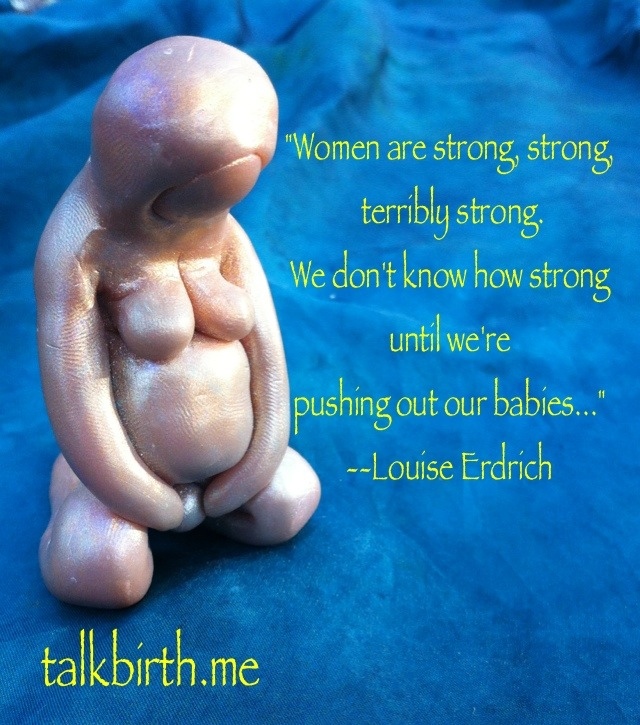
I woke up this morning with this quote running through my head and thinking of a pregnant friend of mine. Since her story is not mine to tell, suffice to say, she had a long and winding road to reach this point and this evening she gave birth at home after having had a cesarean with her first baby! Yay! I’m so excited for her and for their whole family. One part of me just knew she could do it and the other part of me still worried that I was being falsely optimistic. It has happened to me before—that I supported and encouraged and hoped with the mother and despite all those hopes and dreams and wonderful, careful, thoughtful plans, the birth still didn’t go as planned. I also believe that all births are acts of courage and that mothers, whether they push out their babies or not, have the capacity to dig deep and discover strength beyond anything they previously knew. However, just, yay. I’m so happy and excited and relieved for this friend of mine 🙂 The sculpture in the picture is the birth art piece I made after I actually gave birth to my last baby. She captures the pose in which I caught my daughter. My previous photo with this quote was of the pre-birth sculpture I’d made to address my pushing-the-baby-out fears:

Still figuring out the pictures with words app that I got. I love my nature spots in the woods as backgrounds, but they’re too busy and make choosing a text color that actually works almost impossible!

Childbirth is power in its purest and most natural form–it is wild and uncontrollable and takes us on a journey of surrender. Birth is about so much more than babies being born. It is about a mother finding her inner strength at her most vulnerable and powerful moment, which begins her unique and lifelong journey of mothering that child.”

–Brianna Kauer (in Midwifery Today, issue 103)

And, speaking of thankful birthy goodness, Thanksgiving is tomorrow and that reminded me of an earlier post about the rest and be thankful stage!

I also would like to mention that I have a Talk Birth topic on ScoopIt now. I primarily started it so that it could handily feed into my Talk Birth Facebook, while still leaving a more useable record for me to go back to/repost (things just kind of disappear off the page on Facebook and it can be hard to remember what the heck I’ve shared there if I then want to do a blog post about it). I was introduced to ScoopIt via LinkedIn when I started following a really well-curated topic about E-Learning and Online Teaching. There are very, very few birth-related topics on ScoopIt, so start curating one! It is fun and easy and, as I said, really handy for feeding content into your Facebook page or other media (I experimented yesterday with sending a post directly to WordPress and that worked too!)

I’m also thankful for several days at home to spend with my family and without a long to-do list. I have one final paper to grade tonight and then my calendar is pretty deliciously blank for the next four days! We can really use this. I need a stillpoint, a rest, and some time to spend on the fun things I want to do like wallow in piles of books and make fabulous new sculptures and go sit out in the woods and…and…and…

Thankful for all these people too! And, also thankful for fab new pictures from recent photo session with my friend 🙂

Invisible Nets

I have several friends and acquaintances preparing for the births of their babies at the end of this month and into November. This weekend, when I found out one of them was in labor, I peeked in at her Facebook page and saw her profile picture, so strong and beautiful and solitary and I remembered with such poignancy that liminal point between pregnant woman and mother of a newborn. The tenderness and triumph of standing up with your new baby for the first time. The marveling at the fact that, I did it. The sweet, fresh, beautiful irreplaceable sensations of your fresh new baby lying upon your chest. The worry of how to do this mothering thing “right.” All of those vibrant and deep first moments and trying to sink into them. The stark sensation of having crossed into completely new territory and having left your old self behind forever. The moments of marveling at your own strength and courage and reveling in your own power. The moments of feeling bitterly lost and confused.

I wrote this on my Facebook page as I thought of her and of the other Oct/Nov mothers about to step across the birth threshold:

Holding in my heart all the special mothers taking their birth journeys tonight–stepping across that pivotal threshold and into the unknown. May they discover they are stronger than they knew, may they marvel at their own courage, may they dig deep, and may they know joy beyond measure.

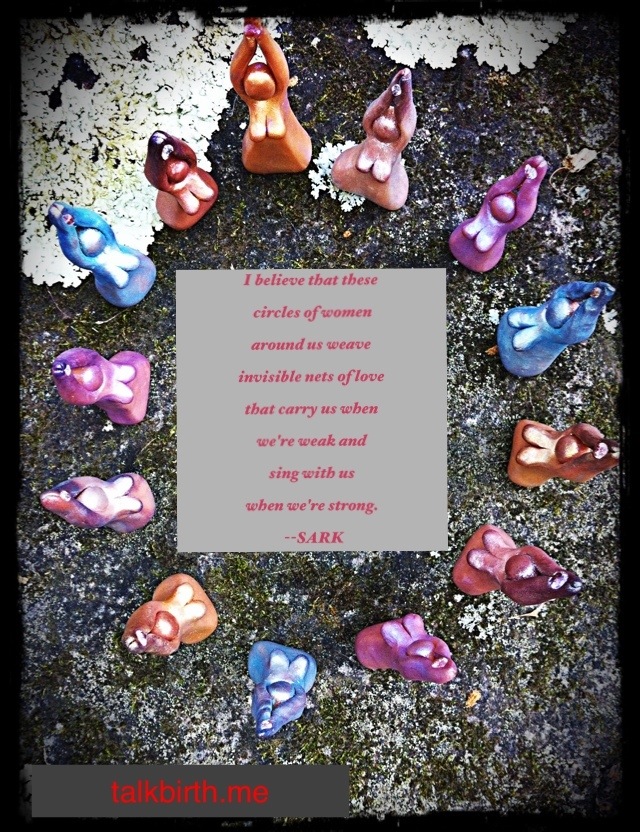
I also finally used one of my favorite quotes for women’s circles and a picture of a set of new sculptures that I made this weekend and turned it into a little shareable image. I’ve wanted to do this for a long time, but had trouble finding anything that would let me edit a picture on my phone to include words. It isn’t perfect, but it is my first attempt!
20121023-152429.jpg
And, I thought of my own past posts…

Thoughts about a birth blessing and more

“…May we see and hear women. May we witness them in the act of living, of birthing, of struggling, of triumphing. In surrender and in self-doubt. In exultation and joy. May we hold that space for her story. May we listen well and wisely.” (Molly Remer)

Thoughts about being a “birth warrior“…

“I was surprised to find myself connect with the birth warrior metaphor in labor. Shortly after my first baby was born, I turned to my dear friend who had been present and said, “I feel like I’ve been in a war…”

Thoughts about those sweet, delicate, precious moments of waiting to inhale

Thoughts of the sweet, sticky, beautiful, and simultaneously soul-crushing and soul-expanding experiences of early postpartum

I hope all of the women I know who are giving birth in the upcoming season discover that, as Sheila Kitzinger said, “Birth isn’t something we suffer, but something we actively do and exult in.” (from promo for One World Birth)

And, that while, “Women are as nervous and unsure of themselves as ever, and they need to learn to trust their bodies. Birthing is much more that eliminating pain. It is one of life’s peak experiences.” (Elisabeth Bing)

Happy Birthing Days, Mamas!

(P.S. This is an experiment with writing a short post! How’d I do?!)